‘Close Encounters of the Third Kind’ Still Leaves Us in Awe 40 Years Later

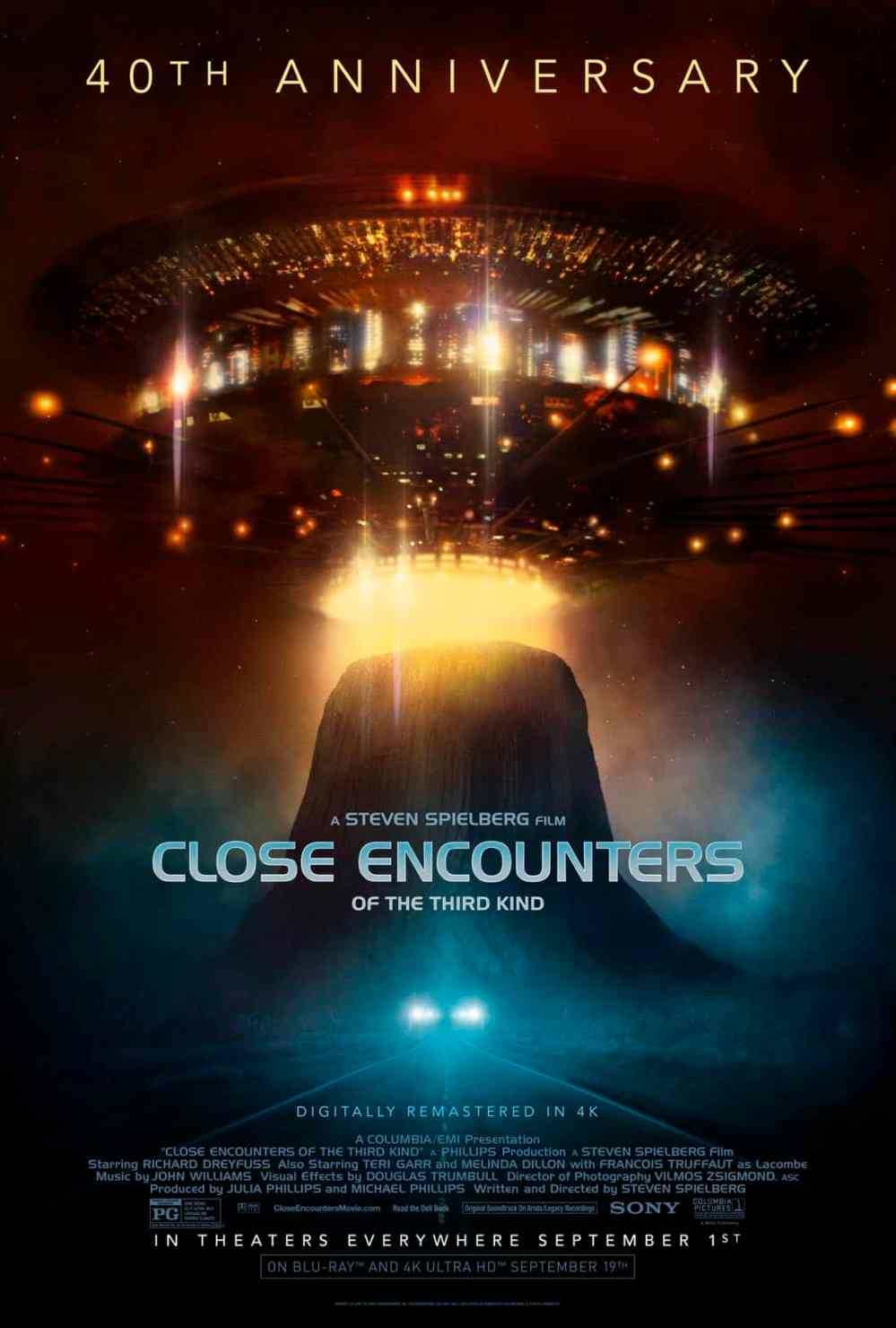
Close Encounters of the Third Kind 40th poster

On this week’s edition of yes, this movie really is that old, we have Steven Spielberg’s “Close Encounters of the Third Kind.” Released back in 1977, it is now being re-released in a new 4K remastered version in honor of its 40th anniversary. I first watched it on laserdisc at a friend’s house back in the 80’s, and I remember being somewhat traumatized by it as there were scenes which proved to be quite scary. I have since watched the film several times, but this 40th anniversary re-release allowed me to see it on the big screen for the first time. Suffice to say, this is the way you should view this particular Spielberg classic.

The film begins with strange discoveries being made in various parts of the world which include the appearance of Army airplanes reported to have gone missing back in the 1940’s, a lost cargo ship which has reappeared in the Gobi Desert for no discernable reason, and witnesses living in India are found singing a five-tone musical phrase which is revealed to be the distinctive sounds of UFO’s. Meanwhile, out in Indiana, Ray Neary a blue-collar worker, husband and father to three very loud kids, is working late at night after a large-scale power outage takes place, and he finds himself having a very close encounter with a UFO, one which lightly burns his face with its bright lights. From there, he becomes obsessed with finding out more about these alien visitors to where he gets left with subliminal messages he is desperate to find answers for.

Throughout the decades, there have been countless movies dealing with human beings and their first contact with extra-terrestrials, many of which feature the last remnants of humanity fighting off an alien invasion determined to wipe them out with extreme prejudice. As I got older, I came to realize how rare it is to have a science fiction movie which deals with aliens in a highly intelligent way. Among them are Stanley Kubrick’s “2001: A Space Odyssey,” Robert Zemeckis’ “Contact,” Spielberg’s “E.T.,” and Denis Villeneuve’s “Arrival” which was one of the very best movies of 2016. Even rarer these days is the motion picture which leaves you in an extended state of wonder and awe from start to finish and even after you leave the theater.

Even 40 years after its release, “Close Encounters of the Third Kind” still has an immense power to enthrall us as its characters come into contact with something they have longed to see. There is nothing about it which comes across as unintentionally laughable, and while technology has evolved to a whole other level since the 1970’s, this movie feels timeless in its exploration of possibilities and discoveries. It also works on many different levels in that it is funny, scary, thrilling, and deeply emotional.

This film is especially unique on Spielberg’s resume as it is one he directed and also wrote the screenplay for. It would also mark the last time he would direct his own screenplay until he made “A.I. Artificial Intelligence” in 2001. As a result, there should be no doubt of just how personal this film is to him. It turns out he wanted to make this one before “Jaws,” but he didn’t have the commercial clout at the time to get the budget he wanted. Of course, when “Jaws” came out, this changed forever.

Spielberg has said “Close Encounters of the Third Kind” is not actually a science fiction film, and watching it again has me agreeing with him completely. Yes, it does feature aliens and UFO’s, but they are not really the point. Also, this film takes place in a reality we all know and relate to. “Close Encounters” does not take place in some future dystopian world, but instead one we all inhabit as the main characters are regular people working regular jobs and supporting their families. They don’t want to see UFO’s, but they did, and now they cannot and will not deny their existence. Throughout this movie, we remain in the human universe and we never enter an alien one, and this is very important to point out here.

“Close Encounters” also deals with stories which would become a hallmark of future Spielberg films and productions such as “E.T. The Extra Terrestrial” and “Poltergeist” among others. Seeing the government conspire to keep this alien visitation a secret is presented in a way which feels not only realistic, but also very possible to pull off back in the 1970’s. But he also shows how the truth of things cannot be kept a secret forever, and, like Ray Neary, we want to see this all the way to the end because we won’t stop and until we get answers to fulfill our curiosities.

When it comes to the actors, Spielberg really just lets them loose here. He doesn’t direct them as much as he lets them run wild, and I don’t just mean the kids who are a noisy bunch as presented here. Richard Dreyfuss is perfectly cast as Ray Neary as he brings a crazed and enthusiastic energy to the role of a man who has seen things he wasn’t supposed to see, and he is not in a position to unlearn what he has learned. Even as Ray’s actions increasingly alienate him from his wife and kids, Dreyfuss makes us empathize with his plight as he is caught up in something he cannot turn his back on.

Melinda Dillon is equally wonderful as Jillian Guiler, another character who, along with her fearless son Barry (Cary Guffey), experiences a close encounter of her own. She also suffers the indignity of her son being kidnapped by aliens, but she is eventually reunited with him in the movie’s last half. It may sound like I’m giving plot points away here, but I’m not because Dillon’s performance is such an emotionally fulfilling one to witness as she takes Jillian through the stages of fright, grief, desolation, and eventually joy and happiness. She makes you experience these emotions with her, and seeing her smile when Barry reappears is a moment of pure elation.

Spielberg’s casting of filmmaker Francois Truffaut as Claude Lacombe, a French government scientist, was truly inspired. Along with Bob Balaban who plays David Laughlin, Lacombe’s assistant and interpreter, he portrays a government official who brings sanity to a situation which has other government officials responding to in a panic to where the quick answer is cover everything up and keep the number of witnesses to a bare minimum. Truffaut brings a strong level of thoughtfulness and wonderment to his character as Lacombe shows an openness to first contact others would not be quick to embrace. While military officers are eager to keep Ray and Jillian out of the area, Lacombe tries to make them see they were invited to be here.

Many images from “Close Encounters” will forever remain burned into my consciousness. The most prominent image of all is when young Barry opens the front door where an alien ship hovers outside, waiting to make contact with someone, anyone. This is still the defining image of who he not just as a filmmaker, but as a human being. Spielberg’s eagerness to make contact with aliens from another galaxy is no secret, and here’s hoping a UFO does make contact with him in his lifetime. Better they meet him than a certain person who is currently occupying the White House.

I think people these days who are seeing “Close Encounters” for the first time might say it takes too long to get to the last half where humans finally get to communicate with aliens. But like Francis Ford Coppola’s “Apocalypse Now,” this film is more about the journey than the final destination. Spielberg wants us to question what we believe and how far we will go to get answers to questions which have plagued us for an infinite amount of time, and we share the awe of the characters once those answers are delivered to us here. And it’s not just that the characters get answers here, they truly earn them as well.

This is also one of those films its director couldn’t stop tinkering with over the years. Ridley Scott couldn’t leave “Blade Runner” alone years after its release, and Oliver Stone continued to tinker with his dream project “Alexander” to where the final cut he gave us still doesn’t feel final. As Spielberg was finishing up “Close Encounters,” Columbia Pictures was in dire straits financially and begged the filmmaker to release his pet project sooner rather than later. What came out in 1977 wasn’t his complete vision, and he eventually got to make a special edition of the film which was released in 1980. The 4K restoration of “Close Encounters” is essentially a combination of both versions, but the scenes with Ray Neary exploring the inside of the mothership have been cut out. Spielberg has said over and over he never should have taken us inside the ship, and I completely agree. While Spielberg provides the characters with many answers, there are still some things better left to the imagination.

Seeing “Close Encounters of the Third Kind” at the Cinerama Dome afforded me the opportunity to see the movie in its most desirable format. The audience I saw it with was left spellbound at what unfolded, and this says so much about this movie’s staying power. Just when I think I have become so jaded and embittered a filmgoer as studios continue in their desperate search for the next big franchise, a motion picture like this comes along to remind us filmmakers still have the power to leave us in a state of sheer wonderment. It feels like we have had an overabundance of movie anniversaries lately to where these celebrations feel more like a ploy to get more money out of our pockets. But this particular anniversary is one worth acknowledging as it continually reaffirms the power of cinema to truly transport to another time and place and, in the process, rescue us from the real world even if it’s only for a temporary time.

The only thing which bugs me about “Close Encounters” these days is Ray’s decision to leave his family behind and travel with the aliens. Essentially, he is presented with the same question Captain Decker is faced with in “Star Trek: The Motion Picture;” Would you leave everything and everyone you have ever known behind just to explore another world and dimension? Seeing Ray getting on board the ship made me wonder how his family would have reacted to this decision, and it plagues my mind long after the end credits have finished. Then again, Spielberg did make this film before he had any kids of his own. Had he made it after he became a father, there’s no doubt Ray would have made a different decision. Still, one could not blame Spielberg or Ray for being tempted to go. I certainly would be tempted.

* * * * out of * * * *

Ben and Josh Safdie Discuss the Making of ‘Heaven Knows What’

Heaven Knows What movie poster

Heaven Knows What” is a movie which takes us into a landscape alien to many of us: the world of a drug addict. Arielle Holmes stars in a riveting performance as Harley, a homeless addict on the streets of New York who has two passionate yet volatile loves in her life: her boyfriend Ilya and heroin. We watch as they struggle to survive one day after another on the mean streets of New York, struggling with addiction and each other as Harley attempts to prove her love to Ilya in the most passionate and dangerous way possible.

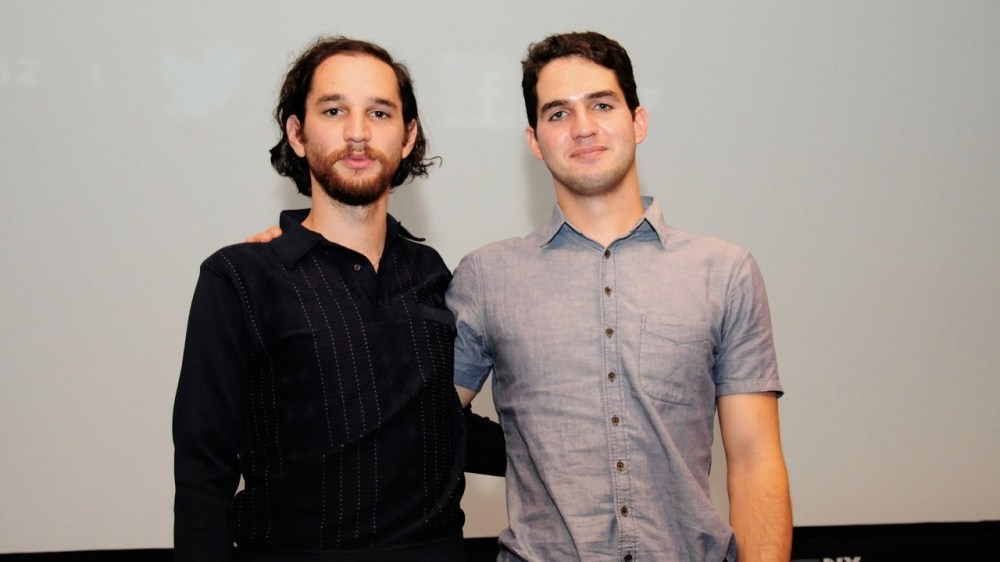
The movie was directed by brother filmmakers Josh and Ben Safdie whose previous credits include the comedy drama “Daddy Longlegs,” the documentary “Lenny Cooke,” and the crime-drama “Good Time” starring Robert Pattinson. I got to speak with them while they were in Los Angeles, and they described the various elements behind this movie’s making in great detail.

“Heaven Knows What” is based on the memoir “Mad Love in New York City” written by Holmes. I was eager to read it after watching the movie, but it hasn’t been published yet. Josh explained why.

Ben and Josh Safdie photo

Josh Safdie: She has a few publishers who want to do it, but she’s like rethinking about how she wants to release it now that she’s done these two other movies and is now in the responsible world.

Ben Safdie: There’s a beautiful rawness to it. If you were to read the pages, it really feels like you were right there sitting next to her all the time and it’s beautiful. That kind of immediacy is also what really attracted me to it because first you hear about, oh, homeless person addicted to drugs. We’ve heard that story a million times. How do you tell that story in a new and different way? Her voice was that new way.

I came into this movie not knowing anything about its backstory, and I honestly thought Holmes was a highly trained actress as her performance is brilliant and mesmerizing. This, however, is not the case as she is not all that far removed from the addict we see on screen. She was a homeless addict for years but has managed to get herself cleaned up, and her performance in “Heaven Knows What” has earned her attention from many who want to make her a star. Both Josh and Ben described what it was like working with her.

JS: Her performance is incredible. You have to remember when you live on the street you’re performing on an everyday level. Whether you’re hustling this person or trying to get this thing out of that person, it’s a performance and a performative life. She was also moonlighting as a dominatrix where she literally was performing as a different character.

BS: One of the most difficult performances you can give is as yourself because you need to be able to understand what makes you tick and then be able to put that out there without any inhibition. And then that’s how you build other performances because if you can get at your core in its ugliest form, or whatever its form, you can build from there.

JS: Acting is just painting your personality a different color. I really was amazed. When I watch the movie now, as I get more and more distance from it just in terms of just having filmed it with a sense of making it, I watch Ari’s performance and I’m really in shock about it. It would take like six or seven takes to get the performative level because it would often start out with her enthusiasm level and how enthused she was to do the scene. Sometimes she was really in it and she would give us this incredible performance. Other times it would take 12 takes to get it out of her. It’s really a beautiful performance from her. And the guy, Caleb (Landry Jones, who plays Ilya), is an actor in Hollywood movies. That’s like the craziest performance because people don’t even realize that it’s a performance and they learn his real story that he is a Texan and that he was in “X-Men: First Class,” he was in “Contraband,” he was in “Antiviral,” he lives in Los Angeles. This is not him at all. Maybe there are traces of him in Ilia, but no, that’s not him.

What’s fascinating about “Heaven Knows What” is how it combines fiction with a raw cinema verite. It’s essentially a fictionalized version of true events, and yet it feels like we’re watching real life unfold right before our eyes. I asked the directors what it was like balancing out the fictional elements with the real-life ones while making this movie.

BS: I think it was about putting them in a blender and not knowing where that line was because that was the only way to make it successful. We made a documentary before this, and that was a documentary. That was a real person and we were trying to tell his real story, but in order to tell his story most effectively we had to use techniques from fiction filmmaking, reenactment and changing the timeline. We were fictionalizing reality there to get the point across. So here we are making a fiction film with a kind of documentary base, and again we had to employ the same kind of tools. You have to make things up to really get at the true emotional core of things. (Werner) Herzog says it’s like the ecstatic truth once you get there.

The movie also features a brilliant electronic score which serves to illustrate just how alien the world drug addicts inhabit is to the rest of us. Along with movies like “The Guest,” “It Follows” and “Ex Machina,” electronic film scores are making a big comeback. Josh and Ben talked about the movie’s composers and why they chose that kind of music.

JS: There’s a bunch of things that are happening in music in the movie. For the most part, we feature the work of Isao Tomita and his renditions of Debussy. We really wanted to have a romantic score, but this movie is like a time squared, nighttime vibe. It’s like electrified and it’s kind of seedy, and it’s an alien landscape almost. We like to say the movie takes place on Mars which is where an addict’s brain goes in a weird way. Debussy music is some of the most romantic music ever composed, but when it’s done through this Japanese mind from the 70’s it’s different. It’s reinterpreted. It’s no longer really romantic but it has its core in romanticism.

BS: There’s other music that we use throughout the movie. There’s some original music by Paul Grimstad in the hospital sequence, and then there’s Ariel Pink who’s a Los Angeles guy who wrote a song for the movie called “I Need a Minute.” It’s electrified as well, and he wanted it to be a love song to the locked bathroom, being able to lock your own bathroom and needing another minute while people are banging on the door.

Watching “Heaven Knows What” brings to mind movies like “Kids” and “Requiem for a Dream” which dealt with lifestyles which were unnerving and at times horrifying to witness. We want to look away and these films dare us to, but in the end we can’t avoid the reality of what people do to each other and themselves.

“Heaven Knows What” is now available to own and rent on DVD, Blu-ray and Digital.

Exclusive Interview with Erin Benach on ‘Loving’

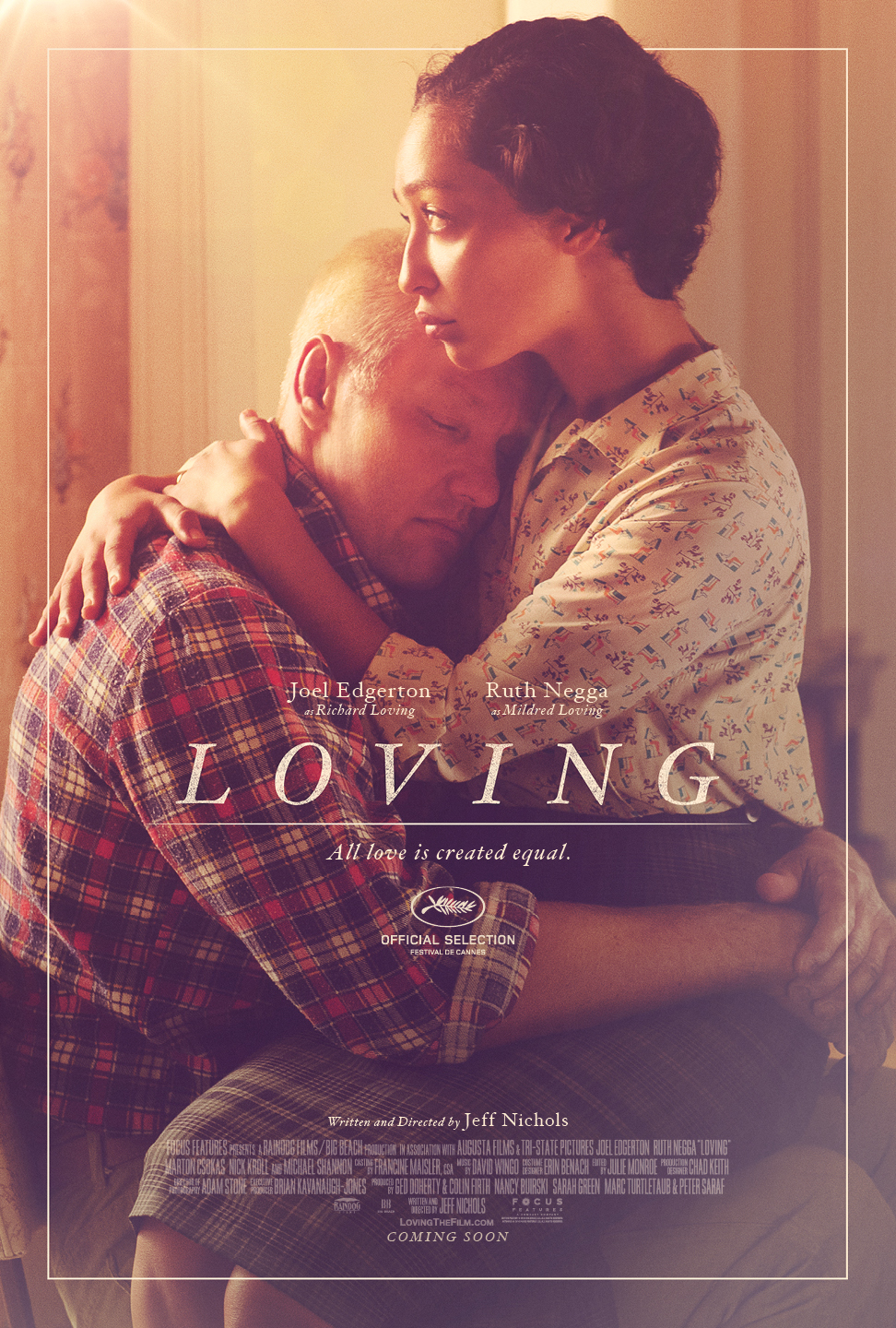
I got to speak with Costume Designer Erin Benach about her work on Jeff Nichols’ historical drama “Loving.” The movie takes us back to the late 1950’s and early 1960’s where we are introduced to Richard and Mildred Loving, an interracial couple whose marriage quickly had them banished from Virginia as it violated the state’s anti-miscegenation laws. They later sued Virginia, and their civil rights case, “Loving vs. Virginia,” eventually made it all the way to the Supreme Court which affirmed the very foundation of marriage ways and ended state laws that prohibited interracial marriage.

Benach also worked with Nichols on his other 2016 movie, “Midnight Special.” She earned a 2012 Costume Designers Guild Award nomination for her work on Nicolas Winding Refn’s “Drive,” and she reteamed with him on “The Neon Demon.” She has also worked with filmmaker Derek Cianfrance on his movies “Blue Valentine,” “The Place Beyond the Pines,” and “The Light Between Oceans.” Her other credits include Brad Furman’s “The Lincoln Lawyer,” Andrew Niccol’s “The Host,” Anna Boden and Ryan Fleck’s “Sugar,” and Ryan Gosling’s directorial debut “Lost River.” You can visit her website at www.erinbenach.com.

In my conversation with Benach, she talked about having the costumes fit into the story without overwhelming it, why the costumes could not stand out too much, and of the challenges she faced in capturing the look and feel of the years “Loving” takes place in. She also talked about the differences of working with Nichols and Refn whose films are so very different from one another.

Please check out the interview above. “Loving” is now playing in Los Angeles and New York.

loving_onesheet1463418554

Leigh Janiak on Her Directorial Debut, ‘Honeymoon’

honeymoon-leigh-janiak-photo

With the horror film “Honeymoon,” Leigh Janiak gives us one of the strongest directorial debuts I have seen in a while. It stars Harry Treadaway and Rose Leslie as Paul and Bea, a newlywed couple who spend their honeymoon at a beautiful cabin overlooking the river only to see their new beginning descend into chaos as sinister forces begin to tear them apart. For a first-time filmmaker, Janiak never takes a wrong step as she generates strong levels of suspense and horror and succeeds in maintaining them all the way to the movie’s infinitely creepy conclusion.

Janiak dropped by the Four Seasons Hotel in Los Angeles, California for the “Honeymoon” press day just before the movie was released. She studied creative writing and comparative religion at New York University, and then she later enrolled in a doctoral program at the University of Chicago which dealt with modern Jewish studies with an emphasis on violence and identity in post–World War II Hebrew literature. It was there her interest in movies skyrocketed after she met a group of student filmmakers known as Far Escape Films. As a result, she dropped out of her doctoral studies and moved to Los Angeles to pursue a career making movies.

Many wondered what horror movies inspired “Honeymoon” as well as which ones are her favorites. In regards to inspirations, her answer was a bit of a surprise.

“Well certainly ‘The Invasion of the Body Snatchers’ is the most kind of thematically influential on it,” Janiak said. “‘Rosemary’s Baby’ and ‘The Shining,’ those are kind of my favorite horror films generally. I like grounded horror where you really spend time with the characters and you get to this place of uncomfortableness.”

For myself, I was very interested in finding out how she maintained the suspense throughout “Honeymoon.” I kept waiting for the movie to make a wrong turn which would ruin everything which came before it, but that never happened. For a first time director, she really kept us on the edge of our seats throughout in a way I didn’t expect. I asked her how she managed to accomplish this feat.

“I think that the reason that works is because Harry and Rose’s characters are each transforming in different ways,” Janiak said. “So it was only challenging in so far as knowing that Rose would be on one page for her character internally and Harry is on a completely different one. We have to make them still interacting and keeping these things from one another so we recognize that as an audience we sense the unease. We sense things are going wrong with each of them even though we don’t know what and just making it feel like ‘okay enough. We know something secret is happening.’ It was just about balancing their transformations.”

After the interview ended, I asked Janiak which version of “Invasion of the Body Snatchers” she likes the best. There have been four different cinematic adaptations of Jack Finney’s novel “The Body Snatchers,” the most recent being the 2007 movie “The Invasion,” and she said she enjoyed the first two versions the most but the one with Kevin McCarthy, the 1956 version directed by Don Siegel, is her favorite

Here’s hoping that we get to see many more movies from Leigh Janiak in the near future. “Honeymoon” is now available to own and rent on DVD, Blu-ray and Digital.

honeymoon-movie-poster-2

Keeping Up With The Joneses

keeping-up-with-the-joneses-poster

When a movie takes its title from a tagline used to promote “Indiana Jones and the Last Crusade,” I can’t help but walk into it with high expectations. Indeed, “Keeping Up with the Joneses” boasts a plot which quickly reminded me of “True Lies” and “Mr. and Mrs. Smith” in which government spies disguise themselves as ordinary suburban residents, and it has a cast of actors who you can always count on to give you a fun time. It’s even directed by the man who gave us “Superbad” and “Adventureland,” Greg Mottola. But while it does have some inspired moments, “Keeping Up with the Joneses” ends up feeling, to put it bluntly, half-assed.

We meet Jeff Gaffney (Zach Galifianakis) who works at a corporate office as a human resources director. He is happily married to Karen (Isla Fisher), and they have two children who, as the movie starts, are heading off to summer camp for a few weeks. For the first time in years, the Gaffneys have the whole house to themselves which has them thinking of all kinds of mischief to get into, but any plans they have for getting naughty are interrupted when a new couple moves into the neighborhood.

Tim and Natalie Jones (Jon Hamm and Gal Gadot) are not your usual couple as they look as if they have traveled all over the world, and they look far too gorgeous to pass as ordinary people. As a result, the Gaffneys get overly suspicious and are eager to learn everything there is to know about them. It doesn’t take long, however, to realize they are spies, but whether they are foreign or domestic spies remains to be seen.

“Keeping Up with the Joneses” gets off to a strong start as we get a picturesque view of suburbia with the peaceful neighborhood these characters inhabit. As the camera pans around the different houses, one of them blows up into smithereens, and the explosion almost feels like something out of a Kathryn Bigelow movie. Next thing you know, the story moves back to two weeks before the explosion, so we already know this peaceful neighborhood won’t be very peaceful for much longer.

The great things about the movie is the cast. Galifianakis gets to play a different role this time around as Jeff Gaffney is not like the mentally unstable characters he became famous for playing like in “The Hangover.” Seeing him play a down to earth guy who is all about family and good times feels like a stretch for him, and it’s fun watching him opposite Hamm especially when they have lunch at an underground restaurant which is definitely not for vegans.

Hamm gets to play on his sexy guy image, and he is well matched with Gadot who looks very comfortable in the action comedy genre. Isla Fisher has been great fun to watch in any movie she appears in ever since her scene-stealing turn in “Wedding Crashers,” and she doesn’t disappoint here. There’s also a nice pair of performances from Matt Walsh and Maribeth Monroe as a pair of neighbors who might be getting a little to nosy in everyone’s affairs.

But as terrific as this cast is, they are not enough to save this movie which runs out of inspiration very quickly. It would have been more fun if the director and screenwriter kept us guessing as to whether the Joneses really were spies or not. Looking back, I kept thinking everyone missed out on various opportunities to make this movie cleverer than it is. This could have been an uproarious comedy had more effort been put into the script. After a while, we know how things are going to turn out for the four main characters here, and it just reminds us of other movies like it which were much, much better.

When the movie reaches its conclusion, it’s sunk by a predictability everyone could have avoided for the benefit of the audience. What we are left with is a premise which everyone could have and should have had a lot more fun with. The characters, despite the best efforts of the actors, could have been better developed to where they don’t feel like caricatures. The action scenes are fun, but you feel like they could have been more thrilling. Instead of accepting the movie for what it is, we keep thinking about the movie it could have been, and realizing this is depressing.

“Keeping Up with the Joneses” is one those films I analyze endlessly as I watch it because I am convinced I could have done a better job with the material. This premise could have been taken in a number of different directions and could have ended up being an insane amount of fun. But we get instead is a motion picture which have spent more time in the development phase because this one came out of the oven far too soon. It has its moments, but it could have had a lot more of them.

* * out of * * * *

Blu-ray Review: Anchor Bay’s ‘Halloween’ 35th Anniversary Edition

halloween-35th-anniversary-blu-ray-cover

Just when you thought Anchor Bay Entertainment had released the last edition of John Carpenter’s “Halloween” on DVD or Blu-ray, another one emerges to taunt the movie’s die-hard fans with the possibility of purchasing it. Now we have the “Halloween: 35th Anniversary Edition” which was released on Blu-ray and contains an all-new high definition transfer supervised and approved by the film’s cinematographer, Dean Cundey. With a couple of new special features combined with a few from previous editions, is it worth paying a few more bucks to own another version of this horror classic? Well, let’s find out…

Anchor Bay has released just about as many special editions of “Halloween” as they have of “Evil Dead” and “Army of Darkness,” so it’s hard to see what the point was of putting out yet another. But after watching this one, I can certainly see why. The colors on this high definition transfer look very balanced, and the movie looks far more vividly frightening as a result. It is a huge improvement over the 25th anniversary DVD Anchor Bay released as part of their Divimax Series as it proved to be hard on the eyes due to certain colors being far brighter than they needed to be. Seriously, this particular Blu-ray edition makes me want to watch “Halloween” over and over again as it made me feel like I had never watched it before, and I have seen this horror classic over a hundred times.

Among the brand new special features, the one I was surprised to see most was a brand-new commentary with Carpenter and Jamie Lee Curtis. That Carpenter would even consent to doing another commentary on “Halloween,” which he has long since answered every conceivable question about, is astonishing, but he sounds very enthusiastic here as he talks with Curtis about what went down during this movie’s making. It’s also great to hear Curtis’ thoughts on “Halloween” as we haven’t heard her talk too much about it in a long time. Carpenter’s commentaries are always more fun when he has someone to converse with, and he and Curtis share a lot of great memories here.

The other new special feature is the documentary “The Night She Came Home” which follows Curtis as she attends her first ever horror convention in Indianapolis, Indiana. Curtis talks about how she has stayed away from her past in horror movies because she was working on other things or being a mom, but now she feels the need to honor the fans who love “Halloween” so much because she now realizes just how strong the horror fan base is. It’s fun watching her sign autographs for fans who waited hours in line, and her generosity to them is genuinely sweet. The convention also proves to be a reunion of sorts as Curtis meets up with Charles Cyphers who played Sheriff Leigh Brackett, Brian Andrews who played the young Tommy Doyle, Production Designer Tommy Lee Wallace who would later go on to direct “Halloween III: Season of the Witch,” and filmmaker Nick Castle who was the first person to play Michael Myers.

As for the other special features, they are recycled from other previous editions. There’s the featurette “On Location: 25 Years Later” which looks at where “Halloween” was shot. Also included are the movie’s trailer, some TV and radio spots, and footage specifically shot for the television version. You’d figure Anchor Bay would make this another ultimate edition that would be jam packed with extras, but since this the umpteenth edition of this horror classic, I guess they didn’t want to make the previous editions seem altogether disposable. So for those who still own those editions, you should hang onto them as they contain a lot of extras and commentaries not to be found here.

Is it worth it to buy the “Halloween 35th Anniversary Edition” from Anchor Bay Entertainment? Well, it may depend on how much you love this movie. The remastered high definition transfer makes it look like it was filmed not too long ago, and watching it can quickly remind you of how frightening this horror classic is. You also get a nice booklet with interesting behind the scenes photos of the production and an essay by Stef Hutchinson which details why this movie still has a powerful impact on people years after its release.

The fact is none of the sequels or shameless imitators of John Carpenter’s “Halloween” can ever take away from the suspense and uneasiness it generated upon its release. I find myself revisiting this classic quite often, and this 35th anniversary edition makes me want to revisit it more and more. If you are happy with the “Halloween” special edition you currently own, then you probably won’t need this one, but you should at least check out how it looks here. For those who are still committed to buying every single incarnation of this movie Anchor Bay releases, then this one is definitely worth your money.

The Whole Truth

the-whole-truth-poster

Watching “The Whole Truth,” I wondered if I had seen way too many courtroom dramas over the years to have the energy to appreciate this one. Then again, this movie does start off with a narration which had me laughing unintentionally, and its plot of a young man on trial for patricide felt like I was experiencing a severe case of déjà vu. How many episodes of “Law & Order” dealt with this kind of crime? Furthermore, how many of them proved to be more enthralling than this motion picture? Considering the talent involved in front of and behind the screen, “The Whole Truth” is a major disappointment.

Perhaps one of the main problems comes from an opening image which has a snake slithering on the ground as Keanu Reeves’ lawyer character of Richard Ramsay rides his motorcycle up the road. As soon as Richard goes by, the snake slithers right after him. From there, we have a good idea of the kind of people this movie will inhabit, and realizing this makes one realize there will be no real surprises in store for us.

Richard is a defense attorney, and he is defending young Mike Lassiter (Gabriel Basso) who is accused of murdering his father, Boone Lassiter (Jim Belushi). Things are not going well for these two as Mike refuses to speak about anything regarding his father’s death, and Richard tries to make him see they are on their way to a guilty verdict. All this time, Mike’s mother, Loretta (Rene Zellweger) sits in the courtroom looking on impassively. Did Mike really kill his father? Oh, come on, you already know the answer to this.

For those familiar with the novels of John Grisham and Scott Turow or the movies based on their works, the path “The Whole Truth” takes is one which has been traveled endlessly. We know something is up from the start, and it just makes us all the more impatient for the big reveal we know is coming. And while I’m no lawyer, I can see so many plot holes in this case which defy all reasonable logic. Mike himself makes a revelation on the stand which turns everything upside down, but the prosecuting attorney doesn’t even order a medical evaluation to verify it.

As for Reeves’ character, he seems much too close to the Lassiter family to represent them without bias. Then again, this probably doesn’t matter in the real world. It certainly didn’t matter when Johnnie Cochran represented O.J. Simpson in his murder trial, so why should it here? Still, with Richard so close to the family, it’s no surprise he is involved in this fiendish crime to where I just wanted him to admit the truth already.

The most dispiriting thing about “The Whole Truth” is it was directed by Courtney Hunt, the same person who gave us the terrific crime drama “Frozen River” back in 2008. That one starred Melissa Leo and the late Misty Upham as a pair of working-class women who smuggled illegal immigrants across the border into the United States. Hunt directed her actors to incredible performances, and she gave us a movie which felt alive and was never weighed down by clichés or illogical moments.

“The Whole Truth,” however, is the exact opposite as it is full of clichés and proves to be an insult to the intelligence even before the movie reaches its halfway point. The courtroom scenes are lifelessly staged, and the actors lack conviction in their performances. I expected Howard to bring something fresh to this material, and she even had a screenplay by Rafael Jackson to work from. But none of the energy and originality she brought to “Frozen River” can be found here. It’s been eight years since that film, and I can’t help but wonder why she chose this project as her follow up.

When it comes to Reeves as an actor, he either gives you the best or the worst he has to offer. His performance in “The Whole Truth” has him delivering courtroom speeches in an inauthentic manner which is depressing to watch, and his delivery of the voiceover narration is at times laughable. While he fares much better than he did in “Knock, Knock,” watching Reeves here makes me yearn for the “John Wick” sequel to come out sooner rather than later. Just from looking at the trailer for it, he looks far more alive in that sequel than he does here.

Then there’s Zellweger who makes Loretta far too enigmatic a character here. Furthermore, she looks very sick and emaciated here; very unhealthy. This all but takes away from the great performance she could have given but doesn’t. Loretta proves to be nothing more than another helpless wife and mother, and more could have been done to make this character complex and interesting. Instead, Zellweger is wasted in a role which gives her very little to work with. It’s great to see her back onscreen, but she deserves much better than this.

The only actor who gets off easy is Belushi as he succeeds in leaving his “According to Jim” persona in the dust by playing such an unlikable prick. His character of Boone is a jerk to put it mildly, but Belushi manages to make him more than that even with his limited screen time. Boone is like Aaron Paul’s character of Peter from “The 9th Life of Louis Drax” in that Boone initially comes across as a jerk, but we soon realize there is more going on with him than what’s on the surface. Belushi manages to convey this in a way the other actors are unable to, but it’s still not enough to life this movie out of the muck of mediocrity.

Popular culture has been and still is filled with court shows like “The People’s Court” and procedurals like “Law & Order: Special Victims Unit” to where we know exactly what to expect from the trials presented to us. It’s tempting to say “The Whole Truth” suffers from being stuck in a time where we have long since been burned out from this kind of entertainment, but it still feels like so much more could have been done with this material. What ends up unfolding before us feels stale, derivative and easily forgettable. My hope is Howard will have more luck on her next film because this one does not represent a step in the right direction for her.

Daniel Craig was actually set to play Reeves’ role, but he ended up dropping out before filming began. Perhaps he realized the screenplay for “The Whole Truth” wasn’t as good as he originally thought. Jack Nicholson once yelled “you can’t handle the truth” in “A Few Good Men,” and there’s no reason why audiences should have to handle “The Whole Truth.” Courtroom dramas are a dime a dozen, and this one doesn’t even try to stand out from the pack.

* ½ out of * * * *


John Carpenter’s Halloween (1978)

halloween-1978-poster

What is there to say about “Halloween” which hasn’t already been said? It has been discussed ad nauseam, and even Carpenter must be sick of talking about it all the time. Granted, he did take the time to record a new commentary track with Jamie Lee Curtis for Anchor Bay’s 35th anniversary edition, but when the 25th anniversary edition came out it just had the same commentary track from the Criterion Collection laserdisc.

We all know the story, and this is in large part due to the countless imitators who rushed to create their own psychotic killer following “Halloween’s” astonishing success. At the time of its release, it was the most successful independent movie ever made. Made for about $300,000, it ended up grossing over $50 million. “Friday The 13th” would never have existed without “Halloween,” and that franchise is far more responsible for those clichés horror movies exploit to infinity.

What I love about “Halloween” is how down to earth it is. All of these characters come across as very relatable. The way the script is written and how the actors played their roles, they easily reminded us of people from our own lives we grew up with. The only character in the whole movie who is NOT down to earth is Michael Meyers as he is a killer who has no real motive for why he heads back home to kill. As the movie goes on, we eventually stop seeing him as a person and instead as a force of evil which cannot be easily stopped.

We have all lived in a town like Haddonfield, a small town where families can raise their children in peace, or so it would seem, and the problems they face there end up paling in comparison to those they were forced to endure in the city. The parents see small town life as a home away from reality, but for the children it is reality. It is all they know. So when multiple murders occur there, it threatens to define the town more than anything else. Was there anything interesting about Haddonfield before young Michael Meyers took a knife to his sister when he was only a boy?

I also love how “Halloween” was shot. Working with Director of Photography Dean Cundey, Carpenter creates truly unnerving visuals of a killer lurking in the shadows. One moment Michael appears in the frame, and in the next he is gone. Michael could be anywhere and there is no escape from him. How does one escape from evil anyway? One of Carpenter’s main themes with “Halloween” is how evil never dies. It is a force which is with us whether we like it or not, and it is always just around the corner…

One of my favorite shots is when little Tommy is fooling around with Lindsay as they watch Howard Hawks’ version of “The Thing.” But when Tommy turns around and looks out the window, he sees a man carrying a lifeless body from the garage to the front door. The bullies at school kept warning him about the boogeyman coming, and it is an unfortunate and infuriating coincidence that they are correct. It is one of the creepiest images from “Halloween,” and it is one which always stays with me. Don’t you wonder what your neighbors are up as you look at their houses across the street?

The other brilliant thing about “Halloween” is how it was edited in such a way where you cannot be sure when or where Michael will appear next. The best example of this is when Laurie Strode is running away from Michael. Carpenter puts us right in her shoes as she desperately tries to escape the madman who wears an altered William Shatner mask. The editing plays with your emotions beautifully. You want her to escape, but you soon feel as helpless as her as she yells at Tommy to wake the hell up.

The moment where Laurie is at the front door of Tommy’s house, screaming for him to let her in, is one of the scariest scenes I have ever seen in a movie. It intercuts with her banging on the door while the Shape approaches her, and Carpenter succeeds brilliantly in leaving us stuck in a place we are desperate to escape from. Like her, we are begging for Tommy to unlock the door to where we want to yell at the movie screen, TV set or whatever device you are watching this movie on.

And who could ever forget the music? Carpenter’s score for “Halloween” ranks among the greatest horror movie scores ever composed to where I would put it up alongside Bernard Herrmann’s score for “Psycho.” Carpenter’s musical work has been done mostly in a minimalist style, very much unlike the bombastic orchestral scores from every other Hollywood composer. After all these years, the main title for “Halloween” is a piece of music I never get sick of listening to. The music succeeds in heightening the ever growing tension which never lets up even after the movie is ovr.

The final shot is unnerving and utterly perfect in the way Carpenter shows how evil never dies. We see images we have become familiar with throughout the movie, and they now have the stain of evil on them. The point is point he could be anywhere at this point.

This is definitely one of my all-time favorite movies, and the recent 35th anniversary edition Blu-ray reminded me of how I never get tired of watching it. Jamie Lee Curtis is great here as Laurie Strode, the only one who is the least bit observant about what’s going on around her. Then you have P.J. Soles and Nancy Loomis as Laurie’s so-called friends who frolic around, completely unaware of the killer stalking them from a distance. And you have Donald Pleasance, and his Dr. Loomis is a character which pretty much came to define the latter half of the franchise.

Many say “Halloween” originated the undying cliché of how teenagers who have premarital sex and do drugs are the first ones to be killed off. In the Criterion commentary, both Carpenter and the late Debra Hill make it abundantly clear they were not trying to lay any sort of judgment on these characters. Religion was not intended to shoved down our throats by anyone involved with this movie. These characters don’t get murdered because they are sinners, but because they aren’t paying attention to what is going on around them. Laurie Strode, on the other hand, is always very suspicious of her surroundings.

John Carpenter’s “Halloween” will always remain the best of all the so-called slasher movies in my humble opinion. There is no way anyone can top what he did with the 1978 classic, and this is even though Rob Zombie’s take on Michael Meyers was better than people gave his “Halloween” movies credit for. It has reached such a high level of praise in the ever growing pantheon of cinema to where duplicating its power is extremely difficult to pull off. The fact it still has the power to unsettle generations of audiences is a testament to Carpenter’s brilliance as a director, and its amazing success led him to make many other great films which continue to stay with us long after the end credits have finished.

* * * * out of * * * *

Exclusive Interview with Greg McLean on ‘Wolf Creek 2’

wolf-creek-2-mclean-and-jarratt

Australian film director Greg McLean returns to the scene of the crime with “Wolf Creek 2,” a movie which, supposedly anyway, is based on actual events. The original “Wolf Creek” came out in 2005 and introduced us to the relentless serial killer Mick Taylor (played by John Jarratt) who captures a group of backpackers and tortures them without any remorse. Now Mick is back to take on another group of tourists who make the mistake of crossing his path and have the serious misfortune of not being from his home country. If you are not a proud Australian and are not fully aware of the country’s rich history, pray you don’t run into Mick.

McLean also directed the killer crocodile horror film “Rogue,” and he is said to be a member of the unofficial “Splat Pack.” This term, which was created by film historian Alan Jones, refers to the modern wave of directors who make brutally violent horror films, and other members include Alexandre Aja, Neil Marshall, Eli Roth, James Wan and Rob Zombie. I spoke with McLean about “Wolf Creek 2” and he talked about how a sadistic psychopath like Mick Taylor can be strangely appealing, how this sequel differs from the original, and he pointed out the differences between making a film in Australia and the United States.

Ben Kenber: This was a terrific sequel, and it was great to see John Jarratt return as Mick Taylor. Mick is one of the most sadistic psychopaths ever put in a movie, and yet there is something about him which is undeniably appealing. Why is he so memorable and why are we drawn to characters like him?

Greg McLean: I think that people are generally fascinated with evil and true crime. A character like Mick Taylor represents a very interesting way of peering into a very, very dark psyche. People are fascinated with the nature of evil, and I think the appeal of a character like Mick Taylor is to really get a chance to examine someone who is completely devoid of any sign of humanity. He’s really incredibly dark and twisted, and he’s very terrifying. I think people who like horror films and thrillers and like being scared enjoy coming face-to-face with really disturbing personalities. There is a long history of really fascinating, evil characters and I think people are intrigued at how their personalities work.

BK: When it came to doing a sequel to “Wolf Creek,” was it something you had planned on doing all along, or did you consider doing it after the original movie was finished?

GM: My plan was always to see if the movie worked and people liked it. If people embraced the character (of Mick Taylor), then there will be a chance for another film. So it was always in my mind to do it, it just took a lot longer to get around to it than I thought it ever would (laughs).

BK: Regarding John Jarratt’s portrayal, did you develop the character with him or was it largely his creation?

GM: Well we obviously did the first film together so we had a background to how to approach the character and a discussion on what the character is about. We had been talking about this particular draft of the screenplay (for “Wolf Creek 2”) for a couple of years, so there were certain things we wanted to explore and certain aspects of the character we wanted to bring up, and we kept evolving it on set. Obviously John makes choices as an actor, and then some of those things are in the script and some are developed in the moment. When we got together, we just kind of jammed and came up with cool things to do.

BK: Since the script was in the development stage for a couple of years, did that make it easier for you to return to the character of Mick Taylor and the original movie’s setting?

GM: It certainly enabled us to mine the thematic ideas that we wouldn’t have had if we didn’t have such a long gestation period. We had a script a couple of years ago and it was good, but it just wasn’t amazing. I realized that there was an element to it that was missing and which was making me not want to pull the trigger on it, and what it didn’t have was a kind of somatic investigation into the character that I thought we needed to have. Then once I locked into that concept, then there was enough new information we revealed about his character that I thought it be worth making the film. We also wanted to make a different genre film. The first film is very much a first-person, true crime, real terror film whereas this one I wanted very much to explore the thriller film, and it’s more of an action film. It has horror elements, but it certainly is a different structure in terms of what kind of film that is.

BK: I agree, it does have a different structure and feels more like a road movie. Speaking of that, how did you manage to pull off the sequence where Mick Taylor launches the big rig truck into Paul Hammersmith’s (played by Ryan Corr) car?

GM: We just found a big hill and dropped the truck off it (laughs). It’s much easier to do stuff like that in Australia than it is in the (United) States. Doing things over there is still a bit of the Wild West. It’s interesting because I’m doing a film right now in Los Angeles and I showed that scene to some people and they were just like going, “Wow! How did you do that?” And there’s a shot after the actual truck hits where the fire is just actually continuing to burn the hillside, and everybody was freaking out about that. I said, “Why is that so weird?” They were just going, “Oh my god, how did you let the hill keep burning?” The restrictions are very intense. Obviously there are rules and regulations here and there are in Australia as well, but they were just fascinated by the idea of just literally destroying a truck and letting it burn a hole in the hill. We had fire brigades in the back, and we were able to just do some really crazy stuff. We also wanted to do it in a very practical way. I love doing CG stuff and we used a lot of CG for the kangaroo sequence, but some things I feel are just better to get onscreen practically because you see the texture of things and the physics of moving in a particular way that’s kind of cool.

BK: Yeah, I think that’s what I liked most about that sequence because it really did look real. In most American films, filmmakers would more likely film a sequence like that with CG.

GM: Yeah, I think that part of that is kind of a budgetary thing as well. When you have a low budget you have to find more practical ways of doing things. Digital effects, if you want them to, can be ultra-photorealistic and necessarily expensive. The other way to do it is to find a location you can do something like that and ask to just do it. For all the driving stuff in that sequence, we just closed down highways and did crazy driving on them for two weeks and got all the shots. It was great fun doing a sequence like that.

BK: Looking at those empty highways reminded me of “The Hitcher” with Rutger Hauer and C. Thomas Howell. You have this great open space, but still there’s something about it which is quite claustrophobic.

GM: Well I think the first movie had a very particular primary feed that it was drawing on, and this film to me was really about the fear of isolation in a desolate place. What most of the fear comes from is the primary idea of that which is quite different from the first film. The first film had a different emphasis which was more about the randomness of violence in the real terror that comes from believing someone is something and then suddenly seeing them transform. This one is really much more about exposing the audience to the real terror which comes from extreme isolation and being pursued by a character that is just relentless.

BK: What elements do you believe a horror movie should have in order for it to be successful?

GM: Two things. One, it needs to be based on a primary universal human fear that touches the psychic pressure point. Number two, the film has to have three, if not more, unique and believably memorable set pieces or things that people will talk about when they leave the cinema for hopefully weeks if not years, and that’s it.

I want to thank Greg McLean for taking the time to talk with me about “Wolf Creek 2.” The movie is now available to own and rent on DVD, Blu-ray and Digital.

wolf-creek-2-poster


Exclusive Interview with John Jarratt on ‘Wolf Creek 2’

john-jarratt-wolf-creek-2

It’s been a long time coming, but Australian actor John Jarratt finally returns to his famous role of serial killer Mick Taylor in “Wolf Creek 2.” When Jarratt first played this role back in the 2005 original, he succeeded in giving us one of the most terrifying psychopaths the world of cinema has ever seen. But at the same time, he also made Mick into one of the most amusing as well, and while watching him in this sequel you can’t help but laugh with him even as he becomes increasingly sadistic. Now he’s back to terrorize a new group of backpackers from other countries who don’t quite share his love for Australia.

I got to talk with Jarratt while he was doing press for “Wolf Creek 2,” and it was a real pleasure chatting with him. The sequel isn’t so much a horror movie as it is a thriller and a road movie, and Jarratt talked about the change in tone between the two movies. In addition, he also discussed how he based Mick Taylor on his father, how method he was in his approach to playing him, and of whether or not movies like this will affect tourism to Australia.

Ben Kenber: Thanks for another great performance as Mick Taylor. It was a lot of fun watching you play him once again.

John Jarratt: Thank you very much.

BK: You’re welcome. There was a long break between “Wolf Creek” and “Wolf Creek 2” (about eight years). Were there any changes for you in the way you portrayed Mick Taylor between the two movies?

JJ: No, not a bit. It was exactly the same. He’s not the kind of guy who has growth.

BK: That’s true. It was said you stayed in character during the making of “Wolf Creek.” Was this also the case on the sequel?

JJ: Not so much because I knew what worked, but you have to stay within the realms of it. You can’t be having a coffee and just fall back into John Jarratt and then some guy says, “Come over here and cut this person’s head off,” you know? So you’ve got to kind of stay in the zone if you know what I mean (laughs).

BK: But it’s not like Daniel Day-Lewis who stays in character 24 hours a day obviously.

JJ: No, I think that’s a bit of a wank, but anyway. With Mick Taylor, I tend to go a little bit method because he’s a psychopath and a serial killer, and it’s a long way from who I am, you know? So I have to work at that. People say you’re a method actor, and I just say I’m a professional actor.

BK: It was said that you based Mick Taylor on your father but that you filled in the evil bits because your father is clearly not evil. When it came to the evil bits, what exactly did you add?

JJ: Well if Mick Taylor wasn’t a psychopath and a serial killer, if he wasn’t bent, and if he was the guy you thought you knew at the hotel at the bar if you met Mick, that’s my dad. But like all serial killers he’s bent and everyone says, “He seems like such a nice guy and he’s a terrific fella. He’s quiet and he was a good neighbor and he’s mutilated 27 people, but…” The hard part for me was to find that part of Mick, that psychopath side, and find a way that he was comfortable with it, you know?

BK: Yeah. It reminds me of when Anthony Hopkins played Hannibal Lecter in “The Silence of the Lambs” where he said he wasn’t so much interested in doing research on serial killers. Instead, he worked on finding the psychopath or the crazy person within himself.

JJ: Yeah.

BK: While the original was a full out horror movie, and one of the scariest and unnerving in recent memory, “Wolf Creek 2” is more of a thriller and a road movie. How did you feel about that shift in tone this time out?

JJ: In a way, sequels are lose, lose affair, you know? If we made it pretty much the same as the first one, you’d all be complaining about that we didn’t go anywhere with it. But if you change a little, then everyone says it’s not like the first one. To me, I thought it was a good movement on the first one. The first one you wait for the monster to come out of the cage which is about halfway through the movie, and it’s the set up that’s scary and then how he becomes (who he is) and everyone freaks out. With the second one we all know who he is, so it’s a waste of time doing that so you get them from the get-go. It’s not unlike the first one much when Mick turns up because, as you may remember in the first one, they (the unlucky tourists) drive my pick up over a cliff and then I chased them in a car and I blow the girl way, and that’s the end of the movie. So there’s a bit of chase in that one, but a hell of a lot more in this one because you get the Mick thing happening from the beginning rather than halfway through.

BK: The scene where Mick Taylor sends that big rig truck rolling down a hill where it crashes into Ryan Corr’s jeep gives “Wolf Creek 2” one of its best action sequences. Were you on the set when it was shot?

JJ: Yeah, I was there. It was fantastic (laughs). The funny thing was that the jeep came down the hill and landed like nothing had happened to it. We didn’t expect that, but it says a lot about the jeep I’ve got to say. Then the big truck comes down and creams it, and it was a great day. They were 20 cameras on it watching the truck come down the hill. In real life it was quite stunning.

BK: I imagine it was. If this was an American production, I bet they would’ve used CGI effects instead, but the fact that you did the real thing makes the sequence all the more thrilling to watch.

JJ: Yeah, it was great. It was like “Mad Max” days, you know? It’s what Aussies do really well.

BK: What would you say you added to this character that wasn’t in the script or which Greg McLean didn’t come up with?

JJ: I don’t think I added anything. He (McLean) was there for the entire film. There was more opportunity for a lot more humor I suppose, but I honestly didn’t add anything. I just knew a hell of a lot more, and I thought Mick was pretty funny in the first one. I think about 90% of this film is Mick as opposed to 50%. I think that’s the difference, I really do, so I didn’t do anything differently except you see even more of what he does. I suppose that’s different.

BK: The black humor in this movie is very clever.

JJ: Yeah, you’ve got to have a laugh. You got to remember that he (Mick) is having a ball and he’s got a great sense of humor. If you met him in a bar you’d think he was a lot of fun; he’s a big barrel of happy-go-lucky and a fun kind of guy. He’s having a ball playing games with these Pommy backpackers, so I think it lends itself to comedy.

BK: A lot of people might look at a movie like this as if it will decrease tourism to Australia, but I think it will increase it because people travel to different countries for a variety of reasons. What effect do you think “Wolf Creek 2” will have on tourism?

JJ: I tend to think that tourism improves with these kinds of films and “Crocodile Dundee” kind of films. If someone gets eaten by a crocodile in the northern territory in Australia, the tourist numbers go up from the publicity it gets. So I don’t think people will be frightened (from travelling there) really.

I want to thank John Jarratt for taking the time to talk with me. “Wolf Creek 2” is now available to own or rent on DVD, Blu-ray and Digital.

wolf-creek-2-poster