‘Scott Pilgrim vs The World’ – 10 Years Later and it is Still Awesome!

Upon seeing how the filmmakers gleefully manipulated the Universal Pictures logo to make it look like something out of an old Atari or Nintendo game in addition to scoring the fanfare with the prehistoric techno music we knew these games to have, I knew I was in for a very entertaining time at the movies. I always get a kick out of people messing around with the studio logos we see at the beginning of every motion picture. It is an immediate sign of how we are about to see something different from the usual Hollywood fare, something we do not get enough of. Perhaps if audiences embraced more movies like these, we wouldn’t have to deal with all these remakes and reboots!

Scott Pilgrim vs. The World” was without a doubt the most fun I had watching a movie in a theater back in 2010. It is also another inspired masterpiece from director Edgar Wright who has previously given us the giddy cult classics “Shaun Of The Dead” and “Hot Fuzz.” Based on the comic book series by Bryan Lee O’Malley, it is really an ode to all things video games and a collage of the visual audio effects from them, and they are combined with a story featuring characters who are anything but boring. It is also beautifully shot, perfectly cast, very well written, and extremely well directed. In case you are wondering, yes, I love this movie, and I love it just as much 10 years after its release.

The Scott Pilgrim of the movie’s title is a 22-year-old man child who plays bass guitar with his friends for the rock band Sex Bob-omb. Finally rebounding from a devastatingly painful break up a year ago, he has started dating a 17-year old girl named Knives who is still in high school. Scott’s friends, including his gay roommate Wallace, tell him ever so bluntly he has lost his mind and assume he is trying to rebound with someone they consider to be his “fake girlfriend.” But then he gets a glimpse of the new girl in town, the mysterious raven-haired Ramona Flowers, and he is hopelessly smitten on sight and becomes intent on asking her out.

However, there is a catch; if Scott is going to be in a relationship with Ramona, he will have to defeat her seven evil exes. Indeed, Scott does get an email warning him of this, but he ends up deleting it quickly after declaring it as “boring.” As Arnold Schwarzenegger would say, big mistake! When Scott and his friends perform at a battle of the band’s competition, he is suddenly met by the first evil ex of the bunch, Matthew Patel. Other exes include those with mystical powers, a former skateboarder who has since become an actor, and another bass player who has developed telekinetic powers thanks to his Vegan diet. Let the battles begin!

Basically, the movie treats Scott’s life as though it were one old school game with dated graphics, and we watch him take on each ex (note, not all of them are men) as if he were in a real life Mortal Kombat tournament but without all the blood and guts. That’s the thing; there is no real gore to be found here as was the case in Edgar Wright’s previous two films. I bring this up because I gave my sister in law the DVD for “Hot Fuzz,” and she was horrified at the sight of Timothy Dalton’s face being impaled on a tiny replica of the Big Ben tower.

Scott defends himself pretty well, but he is also dealt a harsh beating without suffering any broken bones. It sounds cool when you think you can take a licking without a shattered collarbone or worst, but he does feel pain, so this side effect of taking on those people who were at other times equally enamored by Ramona is unavoidable. In defeating the exes, he will capture Ramona’s heart and become the first boyfriend of hers who is far from evil. He will also end up inheriting a boatload of coins after delivering the final blow.

I do have to say, however, it sucks he has no time to collect the coins or have some big gym bag to put them in. The amount spilled would have set him up in the local video arcade for life!

What I loved about “Scott Pilgrim vs. The World” is how endlessly inventive it is in its visuals and the scenarios Wright comes up with, and it integrates all these images from video games deeply engraved in our minds to make us feel like kids again. There is one shot in particular which defies easy description, but it had me laughing harder than anything else I had seen in 2010 to the point where I got seriously light-headed. I’m pretty sure you’ll know it when you see it.

Now the pitfall of having such great visuals is other elements like acting and the screenplay might fail to get the same attention. But Wright, along with Michael Bacall, has written a script containing characters who, while flawed, I came to care about deeply. Unlike all those characters from those Pac Man or Super Mario Brothers games we played at home or, in my case, at a friend’s house, these are not just one-dimensional beings with one simple goal in mind. Scott doesn’t just have to defeat the league of evil exes, he also has to develop a strong self-respect before he can move on with his life in Canada.

Leading the cast here is Michael Cera who plays Scott, and he gives one of his best performance here. He was dealing with a backlash back then because many assumed he was just playing the same character in every movie he was in; an awkward young man who isn’t sure how to feel or act about anything due to a deep fear of embarrassment. But Scott is not really the same sort of character Cera has been portraying. Sure, there is a good dose of awkwardness when we first see him talking to Ramona, but he’s about to give up on getting her to go out with him.

It’s also important to note that Scott is not always a likable character. At times he is caught red-handed in being very dishonest with his friends, and he doesn’t always take their feelings into consideration. The major triumph of Cera’s performance is he still makes you root for Scott in spite of some of his selfish actions.

Playing the beautiful Ramona is Mary Elizabeth Winstead, and I cannot think of another actress who has looked so incredibly gorgeous with dyed hair. Winstead has appeared as John McClane’s daughter, Lucy, who proved to be just as tough as her dad in “Live Free or Die Hard,” she showed off a fantastic set of vocal pipes in Quentin Tarantino’s “Death Proof” (one of the two movies in “Grindhouse”), and she was a force to be reckoned with in “10 Cloverfield Lane.” Winstead makes Ramona look tough and intimidating on the outside, but she also allows us to see the wounded person underneath that cold defensive exterior of hers. Ramona may look mean, but she is a wounded soul. Then again, who wouldn’t be after having endured seven failed relationships?

There is also a dynamic scene stealer to be found here, and it is Kieran Culkin who plays Scott’s roommate, Wallace Wells. Shamelessly stealing men from Scott’s little sister while texting gossip on his phone like it is second nature, Culkin gets to bring the same biting wit of his which he used to great effect in “Igby Goes Down.” He is a fiendish delight in every scene he is in.

As for the exes, each actor imbues their characters with the specific traits and powers they come equipped with, and they succeed in making each one totally unique from the other. Brandon Routh gets to really let loose here in a way he never got to in “Superman Returns” as Todd Ingram, the Vegan ex with telekinetic powers. Witnessing his expected demise brings about one of the funniest moments as Scott finds this rival bass player’s kryptonite. Jason Schwartzman is also excellent as a slick theater manager who uses his charms on anyone and everyone around him, and he is a slimy delight as a record company exec who earns your trust only to break it when you’re not looking.

What else is there to say about “Scott Pilgrim vs. The World?” Plenty! The director of photography on this splendid picture was Bill Pope, the same man who did wonders for many of Sam Raimi’s films as well as “The Matrix” trilogy. His style perfectly matches up with Wright’s sensibility, and the way he sets up certain shots is amazingly brilliant. Furthermore, I have to applaud artists like Beck and Nigel Godrich for giving Sex Bob-Omb some kick ass music for them to play. In movies like these, I expect the bands to get stuck with some lame music which is geared more to sell a soundtrack than fit in with the overall story. That’s not the case here, thank goodness.

There are also inspired turns from Anna Kendrick (“Up In The Air”) as Scott’s sister Stacey, Alison Pine whose character of Kim Pine shows a bitter and stony expression, and Aubrey Plaza whose heavy stares and sarcastic state of mind as Julie Powers is a sight to behold.

I was depressed to see “Scott Pilgrim vs. The World” bomb back in 2010. I could not believe it had such a lousy opening weekend, and I was miffed that audiences were more eager to see the god-awful comedy “Vampires Suck” snag the number one spot at the box office instead of this one. Over the years though, it has become a cult hit, and Wright did manage to score a big hit with “Baby Driver.” Regardless of its initial reception, this movie has proven to have a long shelf life, and I invite you to watch it if you have not already. Besides, in this time of an endless global pandemic, this one will take your mind off of it for a couple of hours.

Loved this movie, I did!

* * * * out of * * * *

‘Jaws’ – Looking Back at Steven Spielberg’s ‘Apocalypse Now’

By the time I finally got around to renting Steven Spielberg’s “Jaws” on VHS, I already knew how it ended. Heck, everyone knew the ending of all the “Jaws” movies just as we did with “Rocky” and its endless sequels, and yet we still went in droves to the nearest theater playing them when they opened. But even while the great white shark’s final moment was never in doubt, it still provided to be one hell of an exciting movie. Much of this is thanks to Spielberg and actors Roy Scheider, Richard Dreyfuss, and Robert Shaw. Its landmark success has been noted for starting the trend of summer blockbusters as well as the collective phobia of what’s in the water. 45 years later, many of us still do not feel the least bit safe about going into the water.

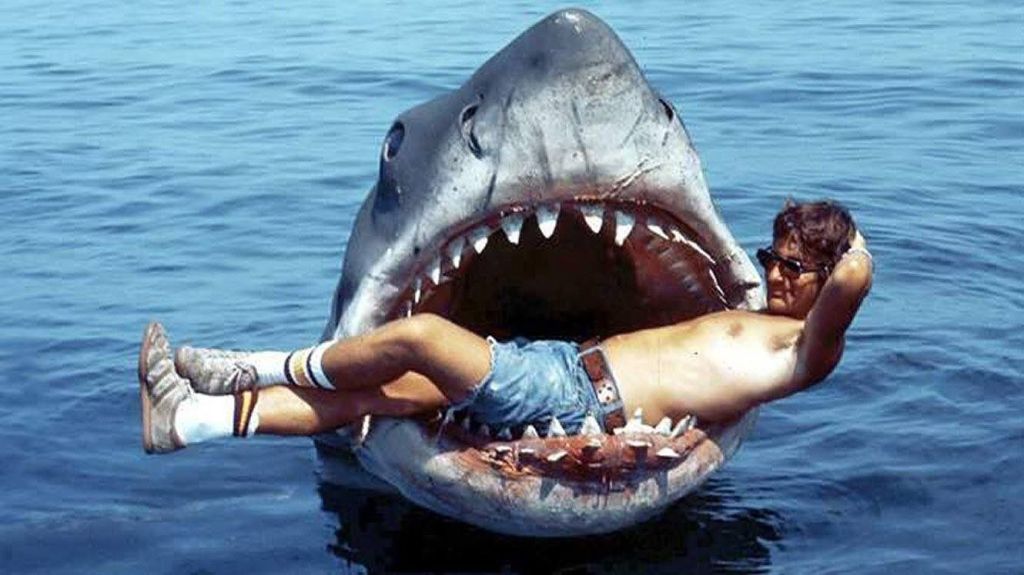
Looking back at the making of “Jaws” reveals a very troubled production which almost didn’t make it to the silver screen. From what I have read, this movie was to Steven Spielberg what “Apocalypse Now” was to Francis Ford Coppola. Remember the picture of Coppola on the set of “Apocalypse Now” with a gun to his head? Steven had one of him resting in the shark’s mouth, and he looked like he was more than ready for the shark to eat him.

The story of a great white shark terrorizing a New England island originated as a novel of the same name written by Peter Benchley which itself was inspired by several real-life incidents of shark attacks including the ones on Jersey Shore back in 1916. After buying the rights to the novel, film producers Richard D. Zanuck and David Brown tried to get John Sturges who made “The Great Escape” to bring it to the screen. When this did not happen, they went to Dick Richards who ended up calling the shark the whale, so he didn’t last long. Zanuck and Brown finally brought on Spielberg to direct, and this was just before the release of his first theatrical film “The Sugarland Express.” In adapting the novel, Spielberg focused on its main concept and took out the various subplots such as the affair between Ellen Brody and Matt Hooper. In retrospect, this was an excellent call as it would have added more stories to a movie which did not need any extra baggage.

Hearing Dreyfuss describe his take on the whole production gives one idea of the mess Spielberg and Universal got themselves into:

“We started the film without a script, without a cast and without a shark.”

When he appeared on “Inside the Actor’s Studio,” Spielberg said he invited the actors to dinner and they ended up “spit balling” the entire movie or, in other words, they made it up. Pages of the script were apparently not available to anyone until the day they were actually shot. A lot of filmmakers still work like this today even though it makes far more sense to work with a finished screenplay.

Then there was the shark itself which Spielberg nicknamed “Bruce” after his lawyer, Bruce Raimer. Three mechanical sharks were built for the production: a whole shark to be used for underwater shots, one which moved from camera-left to right as to hide the other side which completely exposed its internal machinery, and an opposite model with the right side uncovered. But while these models were tested in a pool under controlled conditions before production began, making them work in the ocean was another story. Some of them accidently sank and a team of divers were forced to retrieve them. The main mechanical model endured various malfunctions throughout, and its operation was constantly hindered by the hydraulics being corroded by salt water. Spielberg even joked about Bruce’s maiden voyage and how he sank to the bottom of the sea:

“It was a terrible sight! The shark comes out of the water tail first, wagging like Flipper! The tail comes down into the water, and then it sinks. And then there’s another explosion of white water, and all these pneumatic blue cables come out like snakes everywhere flying around! And then that got quiet, and then there was one last belch of bubbles, and that was the last we saw of the shark for about three weeks.”

Dreyfuss described the frustration everyone had with these models, and those walkie talkies being used by the crew always had the same words coming out of them:

“(static) The shark is not working, (static) the shark is not working.”

Things got even worse from there as filming at sea resulted in many delays as it would with just about any other film. Uninvited sailboats kept drifting into shots, and the Orca ended up sinking while the actors were onboard. This apparently led Spielberg to yell out as it was sinking:

“Screw the actors! Save the sound equipment!”

The crew members had absolutely no reason to believe they were filming a classic, and they instead nicknamed the film “Flaws.” Brown commented how the budget was originally $4 million, and it ended up costing $9 million. While this may sound like chump change today, this was long before the days when movies came with budgets of at least $100 million. Filming was scheduled to last 55 days, but it ended up lasting 159. Spielberg was not yet the director we know him as today, so you have to understand what was going through his mind while he was enduring this trial by fire:

“I thought my career as a filmmaker was over. I heard rumors that I would never work again because no one had ever taken a film 100 days over schedule.”

Spielberg was not even on set for the final shot when the great white meets its maker, and it was mainly because he was under the suspicion the crew would throw him into the water. This has apparently become a tradition for Spielberg on the films that he directs; not being there for the shooting of the final scene. This is regardless of the fact not all his movies take place on the water.

As we all know now, the shark malfunctioning proved to be a blessing in disguise as it gave the “Jaws” a more suspenseful tone than it had already. By filming the dorsal fin as often as he could or using those yellow barrels to indicate the shark’s location, he was able to get away with not showing the whole thing through most of the movie. In fact, he had already told the producers he would agree to direct the movie on the condition he did not have to show the shark for the first hour. Spielberg went on to explain the logic behind this decision:

“I don’t know of anything more terrifying than off-camera violence, off-camera suspense. You have to give the audience credit; they bring with them to the movie theater probably collectively more imagination than any of us behind the scenes put together. And they come in there with their imaginations and implore us as filmmakers to use it.”

Looking back at the hell Spielberg went through to finish this, it is amazing any movie came out of it. You can only imagine what he was thinking before “Jaws” was even released. One of the funniest stories he ever told about it was when he went to a preview or test screening. As he stood in the back of the theater right near the exit, he was expecting the worst:

“Around the time that little boy was killed on the raft, a man got up and began to walk out of the theater. And I said ‘well, here’s our first walk out, the movie’s too violent. I shouldn’t have done this; I shouldn’t have made it that intense.’ The guy then starts running and I go ‘oh worst the walking out, he’s running out of the theater! He’s RACING out of the theater!’ He got right next to me, went to one knee and threw up all over the carpeting of the lobby. Went to the bathroom, came out five minutes later, walked back to his seat and I said ‘IT’S A HIT!’ “

“Jaws” ended up becoming the first movie in history to gross over $100 million at the box office, and it marked a watershed moment in how movies were distributed. Since its release, it has spawned several sequels, become a memorable part of the Universal Studios tour and has spawned lord knows how many VHS, laserdisc, and DVD reissues. And, of course, it was released on Blu-ray, and it has now been released on the format 4K Ultra HD. If there is to be another new format on the horizon, you can be sure “Jaws” will be released on it.

As for the sequels, “Jaws 2” had its moments, the only saving graces of “Jaws 3-D” was its 3D effects which look awful when viewed on your television, and for the beautiful appearances of Bess Armstrong and Lea Thompson. As for “Jaws: The Revenge,” it remains one of the worst movies ever made as it contains many unforgivably glaring errors. On the upside, “Jaws: The Revenge” did inspire one of the greatest movie reviews on “Siskel & Ebert” which still has me laughing whenever I watch it. Spielberg later said he felt bad about how the franchise turned out, but he couldn’t go back to it after the frustration he had with making the first. By the time “Jaws 2” came around, Spielberg and Dreyfuss were already busy making “Close Encounters of the Third Kind.”

After all these years, “Jaws” remains one of the all-time great movies as it effortlessly taps into those fears we all have of the unknown, or of what is underneath us in the water. You could watch it a dozen times and still be thrilled by it, and it made Spielberg into the director he is today. If you are about to watch it for the first time, and you will find that the shark is indeed still working.

Here are some other interesting tidbits about “Jaws”:

  • Spielberg originally offered the role of Brody to Robert Duvall, but he was more interested in playing Quint.
  • Charlton Heston expressed interest in playing Quint, but Spielberg felt he was too big a personality and would end up overshadowing what he saw as the film’s real star: the shark.
  • Spielberg was initially apprehensive about casting Scheider because he feared he would play a tough guy like he did in “The French Connection.”
  • The role of Quint was offered to Lee Marvin and Sterling Hayden, but both turned it down.
  • The scene where Hooper discovers Ben Hooper’s body in the hull of his wrecked boat was actually added after an initial screening of the film. Spielberg said he was greedy for one more scream, and he ended up financing this moment with $3,000 of his own money since Universal Pictures denied him anymore financing at that point in the production.

The Help Does Not Seek To Shamelessly Manipulate Our Emotions

The Help” was released with some controversy back in 2011 as it was based on a 2009 best seller by Kathryn Stockett, a white woman who wrote about African American maids’ experience working in the houses of white people. Many would have preferred to have had a black man or woman write this story, but it is important to note Stockett was herself raised by a black maid who instilled her with a strong confidence which proved to be unwavering, and this was all while her mother was absent from her life. Plus, Stockett, as represented by the character of Eugenia “Skeeter” Phelan, captured the voices of these ill-treated black women with really piercing honesty, and she made herself a vessel for their voices to be heard. From the start, she made it clear to the world that this book was about them and not her.

The movie version comes to us wrapped in a bow of beautiful colors and a very appealing movie poster. I kept think of Rob Reiner’s “Ghosts of Mississippi” which blew the opportunity to make audiences aware of who Medgar Evers was at the expense of some truly bland while characters, and neither Alec Baldwin or James Woods could not save the movie from its inescapable banality. “The Help” looked like it would make the same mistakes, but thankfully it does not. Regardless of whatever flaws it has, it is still a deeply felt motion picture which revisits a painful part of American history people have either forgotten or are sick of revisiting.

At its center is Skeeter (Emma Stone), a recent college graduate who gets a job writing a housekeeping column for the local paper in Jackson, Mississippi. After reuniting with good friends in her hometown, she finds herself perturbed by the senseless racism which has divided the blacks and whites in an almost unspoken way. Skeeter also becomes concerned as to the whereabouts of the maid who raised her, Constantine, as she has vanished without a trace. These events compel her to start writing a book of the travails black housekeepers go through, and she is determined to capture their pride, heartache and deep-seated anger resulting from their thoughtless mistreatment.

This could easily have been a manipulative motion picture filled with cloying emotions, but the filmmakers have given us a variety of characters, black and white that are complex and who never come across as simply caricatures. Each one has their own needs and desires which conflict with those of others, and after a while it becomes clear their problems do not always have to do with race.

The black maid Skeeter leans on the most is Aibileen Clark, played in a powerhouse of a performance by Viola Davis. Just as she did in “Doubt,” Davis inhabits her character with a pride which, while wounded, remains defiantly strong. While her voice projects a kindness and understanding on top of an obedience to her employers, Clark’s face and eyes betray a huge resentment which has long since reached its boiling point.

The next black maid who contributes to Skeeter’s book is Minny Jackson, played in another great performance by Octavia Spencer. She proves to be the most outspoken of the bunch which results in her getting fired quite often, and yet she is reluctant at first to talk with Skeeter about her experiences. We later see Jackson getting her revenge in a way which somehow feels inspired by episodes of MTV’s “Punk’d” or “Jackass.” Spencer gives “The Help” a great sense of humor it might have otherwise not had, and she is every bit Davis’ match.

Minny also develops a highly unusual relationship with the hopelessly naive Celia Foote. Unlike other working relationships, she gets the opportunity to be blunt with Celia and tells her what she needs to hear. I found the friendship between them to be one of “The Help’s” most welcome surprises. Jessica Chastain brilliantly portrays Celia Foote, and she has long since proven to be one of the best actresses working in movies today.

As for Emma Stone, she proved to be a revelation here, and she holds her own against a large number of acting stalwarts. Stone imbues Skeeter with a hard-won independence which never waivers. I love how even in Stone’s eyes you can see her determination in proving how strong a woman Skeeter is and of the sincere goodness in her heart. If she has not proven herself as a dramatic actress before this movie, she certainly did here, and now she has an Oscar to make this clearer to those foolish not to pay attention.

The majority of the white characters in “The Help” could have all been one-dimensional idiots, and while several of them make assumptions which are as ridiculous as they are racist, we see other sides of their personalities as well. One white character who can be seen as the movie’s chief villain is the snobby Hilly Holbrook, played in a truly gutsy performance by Bryce Dallas Howard. Her superiority against the black maids turns out to be driven more by fear than anything else, and realizing this at the film’s end gives Hilly a dimension we weren’t sure she had in the first place.

Howard has done phenomenal work over the years, and she was a good reason to actually see some of M. Night Shyamalan’s movies like “The Village.” She has also given us reasons to sit through “Jurassic World” and its sequel as well as “Spider-Man 3.” While those movies failed to reach the heights of greatness, she gave you a reason to watch them in the first place.

Other great performances in “The Help” come from Allison Janney as Skeeter’s mother, Charlotte, who goes from being a stubborn mother desperate for her daughter to get a man to someone who regrets the decisions she has made in her life. Sissy Spacek is a hoot throughout as Hilly’s mother, Mrs. Walters, who delights in her daughter’s misfortunes as her dad made the unforgivable mistake of spoiling her rotten. One underrated performance comes from Chris Lowell who plays Skeeter’s eventual boyfriend, Stuart. He starts off as an arrogant young man who thinks he has women all figured out, but he later comes to his senses thank goodness.

“The Help” is not perfect and does get a bit too cute at times, but its emotions ring true thanks to the acting and the direction by Tate Taylor who is a longtime friend of Stockett’s. It skirts the conventional narrative to give us something more authentic which is not, if you will excuse the expression, white-washed like so many other Hollywood movies. It covers a subject which we have no choice but to revisit as history repeats itself much too often, and it says a lot about the movie that it jumped from number two to number one at the box office in its second week of release.

* * * ½ out of * * * *

Steven Soderbergh Looks Back at King of the Hill

WRITER’S NOTE: The following article is about a screening which took place back in 2011.

In the midst of promoting “Contagion” in Los Angeles, California, filmmaker Steven Soderbergh dropped by the Silent Movie Theater where Cinefamily was screening one of his earlier and most underrated features, “King of the Hill.” Not to be confused with the Fox animated series, the film follows 12-year-old Aaron Kurlander (Jesse Bradford) who is forced to fend for himself in Depression era America after his parents leave him alone at the Empire Hotel in St. Louis. Aaron is forced to grow up a lot faster than any kid should ever have to, and he desperately searches for ways to avoid eviction from the family’s apartment. Soderbergh thanked the sold-out crowd for coming to the theater, and he started off by saying, “Why aren’t you guys going to see ‘Contagion’? This film is never going into profit!”

“King of the Hill” was Soderbergh’s third film after “Sex, Lies & Videotape” and “Kafka,” and it was released back in 1993. Based on the memoir of the same name by A.E. Hotchner, it was given to him as a gift by a friend. At the time he was looking for something different than “Sex, Lies & Videotape,” and he found Hotchner’s story to be just what he needed. He did, however, describe it as a “tricky adaptation” since he only had a budget of $8 million and 48 days to shoot the film, and it was a period piece. On the upside, though, he said Universal Pictures, which released the movie through its Gramercy Pictures division, was “hands off” during the production.

Watching it again, Soderbergh described it as the one movie of his he might change aesthetically. He felt the prettiness of the picture would help counteract the harsher parts of the story, but now finds the film to be “almost too pretty.” Most of the conversation he had in pre-production involved the overall palette color which he and cinematographer Elliot Davis wanted to remain within a certain range. Were he to film it today, Soderbergh said he would go out of his way to make it “less commercial.”

Soderbergh recalled doing three preview screenings of his movie, none of which went well. When finished with the project, he admitted feeling somewhat dissatisfied as the movie’s ending did not seem entirely satisfactory to him. Whatever problems he had, they did not stop him from trying to adapt Hotchner’s follow up memoir “Looking for Miracles” which focused on the writer’s relationship with his brother. Sadly, Soderbergh’s hopes were quickly dashed when “King of the Hill” did not find an audience upon its release.

Regardless of his feelings, the audience was in agreement that “King of the Hill” is a great film, and it truly is one of Soderbergh’s best works. The director also found a big fan in Sid Sheinberg, the famous entertainment executive, who, soon after seeing it, introduced him to Lew Wasserman. It also made Soderbergh how that he didn’t enjoy writing as much as he thought, but he did continue writing screenplays for his films “The Underneath,” “Schizopolis,” and his remake of “Solaris.” This was one of five films he did after “Sex, Lies & Videotape” which he openly admitted “did no business,” but perhaps they will eventually.

“King of the Hill” is not currently available on DVD (not in America anyway) or Blu-ray, nor is it available to stream on Netflix. Soderbergh remarked this is because “cult flicks are not marketable right now” and that “no one buys DVD’s anymore.” But with this director being so highly regarded in Hollywood, hopefully this third film of his will get the digital release it deserves so fans can discover it for the great movie it is.

UPDATE: “King of the Hill” has since been released by the Criterion Collection in a DVD/Blu-ray combo pack. It features a new restored 2K digital film transfer, interviews with Soderbergh and Hotchner, movie trailers, and Soderbergh’s fourth film “The Underneath.” To find out more about this release, click here.

Greta Gerwig’s ‘Little Women’ is Simply Brilliant

It was published back in 1868, but Louisa May Alcott’s “Little Women” remains one of the most timeless novels ever written. It has been made into a movie six times, been turned into several shows on television, was eventually adapted into a musical, and even an opera was created out of it. Taking this into account, it should be no surprise this particular piece of literature remains a popular one from one generation to the next.

Now we have the seventh adaptation of “Little Women,” and it comes to us courtesy of writer and director Greta Gerwig who is still riding high off of her success with “Lady Bird.” Is it better than Gilliam Armstrong’s 1994 cinematic adaptation which starred Winona Ruder? I don’t know, and at this point I don’t care because making such comparisons threatens to do a real disservice to both versions. All that matters is Gerwig has taken this classic novel and turned it into a motion picture which is uniquely her own. A story which has been read and told to others over the ages now feels fresh again, and it is one of the best films of 2019.

Alcott’s “Little Women” was originally published in two volumes, the first which dealt with March sisters’ (Jo, Mary, Beth and Amy) childhood in Massachusetts, and the second which followed them into their adult years. While previous versions have presenting the story in a linear fashion, Gerwig dares to tell the tale in a non-linear fashion as she has the present and past intertwining with one another. This has the result of giving the story and its characters more depth than was already there, and the emotions are more powerful as a result.

Now granted, this non-linear approach was a bit jarring for me because, at first, it was a little hard to figure out where things were taking place. But thanks to director of photography Yorick Le Saux who uses different strokes of light to differentiate the two parts, I did eventually gain a foothold on where things were going. The childhood sequences are painted in a beautiful set of hues which typically color our most nostalgic memories, and the adult scenes are illustrated with darker and more stark colors to remind us of how harsh the real world can be.

Looking back at Armstrong’s “Little Women,” it almost seemed fantastical in the way it portrayed the March family as if they had it made. Gerwig’s version reminds us of how they lived in poverty and were forced to fend for themselves while the patriarch (played by Bob Odenkirk) is away fighting as a soldier in the Civil War. But thanks to the wealthy Mr. Laurence (Chris Cooper), they have a friend who will help them during the toughest of times. Isn’t that great? You know, when the rich went out of their way to help out the poor?

“Little Women” features a bevy of fantastic performances from a gifted cast. Saoirse Ronan is ever so wonderful as Jo, the most free-spirited March sisters who is determined to become a writer and defy society’s expectations of her as a lady. Ronan inhabits this character in such a marvelous way to where her spirit proved to be infectious, and she makes you want to follow along with here from start to finish. She is so full of joy here, and you want to experience this joy with her.

Another key performance comes from Florence Pugh who plays the artistically inclined Amy March. Pugh already wowed us earlier this year in the deeply unnerving “Midsommar,” and here she gets to play this movie’s most complex character as Amy struggles to separate her expected duties as a woman from what her heart is telling her to do. Pugh does excellent work in portraying the conflict within Amy as her words express a surrender to what society expects of her even as her eyes show what her heart truly desires more than anything else.

It is also great to see Laura Dern here as the matriarch of the March family, Marmee. While she has done a lot of great work on television over the years, the recent movies Dern has appeared in like “Cold Pursuit” have made unforgivably poor use of her talent. Here, Gerwig gives her a platform to do some of her most memorable work on the silver screen in some time, and she makes the most of it. Dern even gives Marmee an extra layer of depth when she admits how her pleasant nature manages to hide how angry she is at the world around her.

The rest of the cast features actors you can never go wrong with. Meryl Streep is a joy as always, this time playing the far too high-minded Aunt March. Timothee Chalamet shows incredible range as he takes Theodore “Laurie” Laurence from a hopelessly naïve young man to a troubled soul whose broken heart can never be easily mended, and then he shows us the person who arrives on the other side of all that to tremendous effect. Emma Watson makes Margaret “May” March into a character who goes from having endless anxiety about her place in society to becoming a strong individual who comes to see what her heart desires most in life. And then there’s Tracy Letts who has appeared in what seems like every other movie this past year, and he plays Jo’s story editor Mr. Dashwood to great effect.

Gerwig’s “Little Women” is one of those films which had me completely absorbed and engrossed in its story and characters to where I never took my eyes off the screen. There is not a single false note to be found here as Gerwig shows off a sheer confidence as a director which makes clear how her previous successes behind the camera were no fluke. In taking one of the most classic novels ever written, one which has been adapted dozens upon dozens of times, she shows a mastery over the material to where it is impossible to think anyone else could have done as great a job as she has here.

Many will probably view “Little Women” as nothing more than a “chick flick,” but this rather shallow description does it no justice. Regardless of what your gender or sexual preference is, there is a lot of us in these unforgettable ladies. They yearn for better futures, get caught up in the innocence of their childhood to where they let their collective imaginations run wild, and they struggle with what a cruel world which expects only so much from them. Please do not try to convince me you cannot relate to these women go through because of who you think you are. Their struggles are not very different from our own, and this makes this particular adaptation so remarkable as we relate to them in inescapable ways. This is truly one of the best movies of 2019.

* * * * out of * * * *

‘Silver Bullet’ Movie and Blu-ray Review

The following review was written by Ultimate Rabbit correspondent Tony Farinella.

The work of Stephen King has usually produced highly entertaining and enjoyable films.  Not everything has been great or even good, but for the most part, there is usually something to take away from them which is unique and falls right in line within the realm of King’s wonderful and twisted brain.  That is definitely the case with “Silver Bullet,” which is based on his novella “Cycle of the Werewolf.” King also wrote the screenplay as well, so he was very hands-on with his approach to this film and in making sure his vision was seen clearly on screen.  The fine folks over at Scream Factory have brought it back into the public eye with this special collector’s edition on Blu-ray.

The film was released in 1985, the year I was born, and it stars Corey Haim as Marty, a 13-year-old boy who is stuck in a wheelchair.  Because of this, he tends to get special treatment from his family.  This does not endear him to his sister Jane, played by Megan Follows.   She feels as though her parents are always taking his side and that he can get away with anything and everything.   He is also very popular with his Uncle Red, played by Gary Busey.  Red is coming off his third divorce, and he is not shy about hitting the sauce as often as possible.

Deep down, however, Uncle Red has a lot of love and affection for Marty, and this leads him to build Marty a special wheelchair he names Silver Bullet which allows him to get around and have a little more fun.  But suddenly, this quiet and quant town where they live gets turned upside down when they start to notice people are being killed off left and right.  First, there was the local town drunk. And then a young child, an angry father and a pregnant woman also end up dead in a matter of days. The people of this small-town start to get restless and they want answers right away, but the local sheriff Joe Haller (Terry O’Quinn) is not able to provide them.  Because of this, they decide to go out looking for some private justice of their own.  Even the local Reverend Lowe (Everett McGill) doesn’t know what to say to the people anymore about the deaths which are occurring, and it is about to get worse before it can possibly get better.

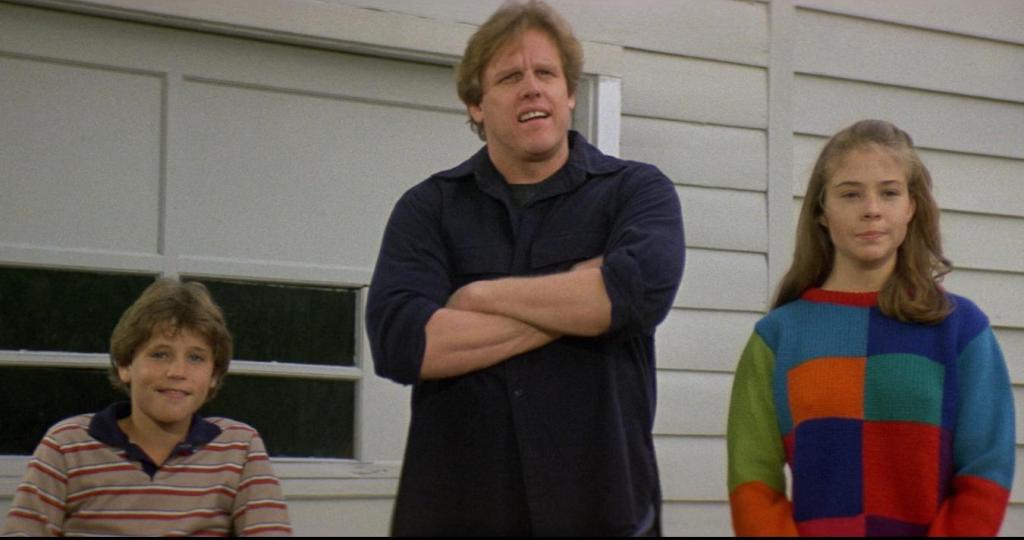
Corey Haim, Gary Busey and Megan Follows.

“Silver Bullet” is only 94 minutes, but a lot happens in those 94 minutes.  There is never really a dull moment or a scene which doesn’t make sense to the overall film.  At times, the category it falls under can be a little confusing.  Is it a straight up werewolf movie?  Is it a horror movie about a werewolf for young children to watch? At times, the film goes full throttle with the gore which set up some gruesome and enjoyable death scenes.  During other scenes, it cuts away from the gorier aspects of the killings.  It seems to want to have its cake and eat it too.

What I mean by that is it wants to be accessible for young children as a horror movie they can watch, but it doesn’t want to go too far.  Tonally, it seems to be trying to please young children and horror fans, and this is not an easy task to pull off.  There is a brother/sister relationship which is something a lot of kids can relate to, and the kids are trying to get the adults to see there is a werewolf out there.  On the other hand, they deal with topics such as divorce, suicide, and alcoholism. While the film worked for me, I could see it having a tough time finding an audience back when it was released.

According to IMDB, the budget was seven million dollars, and it grossed 12 million worldwide.  It was not a total bust, but it didn’t set the world on fire either.  That is why Scream Factory is perfect for films like “Silver Bullet.”  I had never seen it in the past, but I enjoyed it quite a bit.  The film has a good sense of humor, great performances from Haim, Follows and Busey, and it contains some pretty cool kills.  I think it will find a whole new audience on with this collector’s edition Blu-ray.

* * * out of * * * *

______________________________________________________________________________

Blu-Ray Info: “Silver Bullet” is released on Collector’s Edition Blu-Ray from Shout Factory/Scream Factory. It has a running time of 94 minutes and is rated R.

Video Info: “Silver Bullet” is presented in 1080p High-Definition Widescreen (2.35:1), and it looks out of this world on Blu-ray for being thirty-four years old.  At this point, we should expect no less from Scream Factory.  They do not disappoint with their transfers, and there is not a single shot in the film which is grainy or dirty.  It is clear, bright and filled with life.

Audio Info:  The English DTS-HD Master Audio Mono is also top-notch.  It must be mentioned that the music was composed by Jay Chattaway who will forever hold a place in my heart for his work on the “Maniac Cop” Rap.  He does a great job with the music in knowing when to keep it calm and mellow and when to take it up a notch.

Special Features:

NEW Audio Commentary with Producer Martha De Laurentiis

NEW Cutting to The Bone – An Interview with Editor Daniel Loewenthal

NEW A Little Private Justice – An Interview with Actor Kent Broadhurst

The Wolf Within – An Interview with Actor Everett McGill

Full Moon Fever – The Effects of Silver Bullet – An Interview with Special Effects Artists Matthew Mungle And Michael McCracken

Audio Commentary with Director Daniel Attias

Isolated Score Selections and Audio Interview with Composer Jay Chattaway

Theatrical Trailer

TV Spot

Radio Spot

Still Gallery

Should You Buy It?

I love what Scream Factory is doing for the horror genre and how they are bringing new life to films which have long been forgotten unless you are a super hardcore horror fan.  I like to consider myself very knowledgeable when it comes to the genre, but they always find a movie here and there which I haven’t heard of before, or have heard of but never seen in the past.  With “Silver Bullet,” they add plenty of special features that are worth watching and which add a lot to the film.  Scream Factory has become like the Criterion Collection for horror fans.  As far as the film itself, it is a nice 94-minute ride that is paced perfectly.  It is one of those films where you sit back, relax, laugh, scream and just enjoy yourself from start to finish.  I recommend you pick this one up if you get any Amazon gift cards over the holiday season.  You will be pleasantly surprised by it, despite some of the flaws I mentioned in my review.  Still, those flaws do add to the charm of the film.

‘The Art of Racing in the Rain’ – Cynicism Be Damned!

The Art of Racing in the Rain movie poster

Okay, I get why people in general are being resistant to and are cynical about this particular movie. A story told from a dog’s point of view? Even I had trepidations as I entered the theater to check this inescapably sentimental feature which looks to have many visuals of an adorable dog or two. Was this dog going to have a “Mr. Ed” relationship with his owner? How many scenes would we get of the dog sniffing another dog’s butt? Trust me, I have been to dog parks and I have seen them do this endlessly. And considering how this dog’s owner is a race car driver, will the dog be able to advise him of how to keep sliding out of control on the track even if it isn’t raining? Indeed, it says a lot about a race car driver who can drive in the rain without skidding or getting into an accident, and only so many can pull this off.

Well, it should be noted how Garth Stein’s novel “The Art of Racing in the Rain,” upon which this movie is based, brought about a similar reaction as Stein’s literary agent laughed at its concept from the get go. As a result, Stein fired him and had the last laugh as the novel spent over 150 weeks on the New York Times best seller list. Now it has finally been turned into a motion picture, and I have to admit I was truly taken in by it. While it breaks no new ground, “The Art of Racing in the Rain” moved me in a way I did not expect, and it is not at all an exercise in emotional manipulation or filled with an endless supply of cringe-inducing moments.

We meet Denny Swift (Milo Ventimiglia), a race car driver, as he stops by a farm to see the puppies on display. One of them is quick to capture his attention, and we can see how quickly the two form a bond which we know will never be broken. It’s a sweet moment as even the most jaded viewer has to admit how cute puppies are, and no Sarah McLachlan song is utilized at any time to sell us on this connection (for the record, I love Sarah McLachlan).

Denny comes to name his new dog Enzo after Enzo Ferrari, the Italian motor racing driver and entrepreneur who made the kind of car I keep asking my parents for at Christmas time. Enzo completes the bond between him and Denny by taking a piss on his apartment floor, and this is after Denny hurriedly takes him outside to pee on the grass. Still, like Jack Nicholson in “Wolf,” he had to mark his territory before being properly potty trained.

Throughout “The Art of Racing in the Rain,” we are privy to Enzo’s inner thoughts as he spends his days watching races on television with Denny, and he even goes with him to races to where he realizes how racing serves as a metaphor for life. Moreover, Enzo becomes infinitely keen on being reincarnated as human in the next life after watching a documentary about a particular Mongolian legend. Can he make this happen? Does the answer really matter?

The filmmakers prove to be very knowledgeable about dogs, and this made the movie especially interesting to me. A dog’s sense of smell really comes to the forefront as Enzo eventually realizes a certain character is very ill, and it breaks the heart to see the concern on his face which cannot be verbalized to this person. It was at this point I wished dogs could talk because this particular character could have gotten medical attention a heck of a lot sooner. Imagine what Enzo would say, “Hey buddy! You’re sick! See a doctor now or I’ll chase you up a tree!”

But while the characters cannot hear Enzo’s inner thoughts, we can thanks to Kevin Costner. Upon learning he would be voicing Enzo, I was concerned Costner would give Enzo’s narration the same monotone delivery he gave John Dunbar in “Dances with Wolves,” and that movie is a bona fide classic. However, he captures Enzo’s wise nature which is not easily corrupted by money, greed or an inescapable addiction to cellphones, and not once does he overplay a single moment which is much appreciated. Even as Enzo groans about Eve (the ever so radiant Amanda Seyfried) coming into Denny’s life as a certain line of dialogue from “Killing Zoe” flashed through my mind (“never let a woman come between two men”), Costner shows how Enzo evolves through each new person who comes into his life and of the challenges thrown in his way.

Directing “The Art of Racing in the Rain” is Simon Curtis, the filmmaker who first introduced us to Daniel Radcliffe in his version of “David Copperfield,” and who also directed one of the most underappreciated movies of 2017 with “Goodbye Christopher Robin.” This could have been an emotionally overwrought cinematic experience, but Curtis keeps things grounded in a certain reality we can all relate to, and he is very careful to not milk our emotions too much throughout. Just when I thought things would start getting overly sentimental, Curtis succeeds in keeping everything in check to where any cynical thoughts we had about this movie were completely done away with.

I should also add I saw this movie with my parents who have in fact read Stein’s novel, and they both confirmed Mark Bomback’s screenplay is very faithful to the source material. Yes, there are predictable moments such as when a character dies prematurely or when the grandparents (played by Kathy Baker and Martin Donovan) sue Denny for custody of his and Eve’s daughter, Zoe (the delightful Ryan Kiera Armstrong), believing Denny’s career will leave him little time to be at home. My parents, however, reminded me how people with money often do this in life more often than I realize, so this is clearly not so shallow plot device to get us all miffed at the grandparents.

And yes, this movie starts out with the inevitable, with Enzo in his last days lying on the floor and waiting for Denny to come home. Curtis eventually circles back to this moment as we are reminded of the unbreakable bond between humans and dogs, and it leads to a lovely moment where Enzo gets one last spin in a classic car. Few movies in 2019 have gotten me choked up, but this one did.

“The Art of Racing in the Rain” is not a masterpiece of cinema, but it does its job and gives us an emotionally fulfilling time at the movies. Its take on dogs is very thoughtful, and if you were never keen on owning an animal before, this movie may change your mind. It’s a shame this project has proven to be a hard sell for audiences as its storyline seems too ridiculous on paper to be taken seriously. I cannot really blame people for having a cynical attitude to this material as I certainly did, but what results is a very good movie which will check your cynicism at the door if you give it a chance. And if you never thought about owning a dog before, seeing this movie just might change your mind.

As for myself, I am in no hurry to own any pets as stuffed animals, especially Eeyores, are more than enough for me. And to Curtis’ and Bomback’s credit, there is a scene where Denny has to take Enzo to the vet, and we are reminded of just how much caring for a pet can cost. The love of a pet can be a great thing, but it can also be seriously expensive. Still, there is no doubt in mind we can get more love from a dog than Chevy Chase did in “Funny Farm.”

* * * ½ out of * * * *

Jennifer Lawrence on Her Oscar-Winning Role in ‘Silver Linings Playbook’

Jennifer Lawrence in Silver Linings Playbook

WRITER’S NOTE: This article was originally written in 2012.

She played a hard-bitten young woman in “Winter’s Bone” and portrayed the heroic Katniss Everdeen in “The Hunger Games,” but now actress Jennifer Lawrence gets her most challenging role yet in David O. Russell’s “Silver Linings Playbook.” Starring opposite Bradley Cooper, she plays Tiffany who has been recently widowed and speaks bluntly about what’s on her mind without a single apology. The eccentricities and quirkiness of the character required an actress who is wise beyond her years, and Lawrence proved to be the one who could pull it off.

Lawrence ended up auditioning for Russell via Skype from her father’s home in Louisville, Kentucky. In talking with Rebecca Ford of The Hollywood Reporter, she said what attracted her to the role was that she didn’t understand who Tiffany was. I think this is what made her performance in “Silver Linings Playbook” especially good because this lack of understanding forced her to make some important discoveries along with the character. A lot of times actors are expected to know their characters inside and out, but here is a case where an actor can grow along with who they are playing.

“I was very confused by her,” Lawrence told Ford. “She was just kind of this mysterious enigma to me because she didn’t really fit any basic kind of character profile. Somebody who is very forceful and bullheaded is normally very insecure, but she isn’t. I was driven to her to kind of discover that personality a little bit more.”

“Silver Linings Playbook” is based on the book of the same name by Matthew Quick, and in the book, Tiffany is described as being a goth chick. Lawrence told Ramin Setoodeh of The Daily Beast how in addition to getting her hair dyed black, she was also going to get her tongue, and possibly other parts of her body, pierced. But Lawrence later came to see how Tiffany needed to be made less intense of a character because, just like with Cooper’s character of Pat Solitano, she needed to be made relatable enough for the audience to want to follow her.

But unlike Cooper’s character who is diagnosed with bipolar disorder, Lawrence did not try to discover what Tiffany’s psychological diagnosis was. In the film we learn Tiffany’s husband was a cop who was killed in the line of duty three years ago, and she still hasn’t gotten past his death. Both she and Cooper benefitted greatly from focusing on what their characters’ personal problems were as opposed to what a doctor may have described their problems as being.

“I didn’t ever feel like Tiffany had a condition. I felt like Tiffany did something and made no apologies,” Lawrence told Setoodeh. “She’s like, ‘Yeah, I fucked everyone in my office. I was mourning the death of my husband.’ For me, I gained weight and lay around.”

Yes, Lawrence had to gain weight to play Tiffany in “Silver Linings Playbook.” However, Lawrence ended up telling Melena Ryzik of the New York Times she was actually thrilled to put on the pounds as “that never happens in a movie.” There is something really refreshing about hearing an actor, any actor, get excited about putting on weight as there are far too many svelte individuals in Hollywood. Actresses are especially held up to a ridiculous physical standard which can be far from healthy, so seeing Lawrence defy such standards makes her seem both refreshingly intelligent and down to earth.

Ironically, the thing which almost kept Lawrence from being cast was she was much younger than her character. On top of that, she is also 15 years younger than her co-star Cooper which complicated matters even further. Russell, however, told Ford of The Hollywood Reporter how he was won over by Lawrence because she is “wise beyond her years.”

“She plays kind of ageless. She can be 30 or 40 or 20,” Russell told Ford.

Russell also told Ryzik that Lawrence is one of the “least neurotic people” he has ever met in his life. The more he talked about the actress’ confidence and vulnerability, the more it seems like Lawrence was the only logical choice to play Tiffany in “Silver Linings Playbook.”

“She (Lawrence) always offers her opinion,” Russell said to Ryzik. “She’s not afraid to talk to anybody about anything, and yet she can also turn around and have an 18-year-old’s ‘nevermind.’ That’s their version of being vulnerable.”

Jennifer Lawrence’s quick ascent to becoming one of Hollywood’s biggest stars today was no mistake. After her breakthrough turn in “Winter’s Bone,” she has continued to impress audiences with her talent in films like “The Beaver,” “The Hunger Games” and “X-Men: First Class.” But “Silver Linings Playbook” shows us all just how far her range as an actress goes. It looks like another Oscar nomination is in store for her in the near future.

SOURCES:

Rebecca Ford, “‘Silver Linings Playbook’: Jennifer Lawrence Wins Her Role via Skype, Learns to Dance Like an Amateur,” The Hollywood Reporter, November 21, 2012.

Ramin Setoodeh, “Jennifer Lawrence on ‘Silver Linings Playbook,’ ‘Hunger Games’ & More,” The Daily Beast, November 19, 2012.

Melena Ryzik, “Shooting the Sass Easily as an Arrow,” New York Times, November 9, 2012.

‘Doctor Sleep,’ Sequel to ‘The Shining,’ Gets Its First Trailer

Upon hearing that Stephen King’s 2013 novel “Doctor Sleep,” the sequel to “The Shining,” was going to be turned into a movie, many things ran through my head. Could a cinematic sequel be created out of this novel? If so, should it have the same visual style Stanley Kubrick gave to his film adaptation of it in 1980? Wouldn’t it be better to make a movie which stands on its own from its predecessor in the way “Hannibal” stood apart from “The Silence of the Lambs?” Will it be closer to King’s novel or Kubrick’s film? Would it acknowledge the 1997 miniseries which King very much preferred to Kubrick’s film to an infinite degree? Heck, would it even acknowledge the documentary “Room 237” which dealt with the many interpretations and perceived meanings people had of Kubrick’s classic horror film?

Well, several of these questions were answered when Warner Brothers released the first trailer for the cinematic adaptation of “Doctor Sleep” which stars Ewan McGregor as Dan Torrance who is now grown up and still suffering from the trauma he endured from the events at the Overlook Hotel. At first, it looks like any other movie as McGregor keeps writing a word or two in chalk on the wall in his bedroom. But then one day this same wall erupts in a way which wakes him up quite violently, and he sees that it says “REDRUM.” From there, you know you are back in Stephen King territory, let alone the universe he created in “The Shining.”

At first, “Doctor Sleep” looks to have a different visual look from “The Shining” as Danny Torrance is now in a different place which is far removed from the Overlook Hotel. But then he meets a young girl named Abra Stone (Kyliegh Curran) who has the same gift he has, and he becomes determined to save her from Rose the Hat (Rebecca Ferguson), head of the True Knot cult which feeds on the psychic powers of children.

But as things go on, we see images which appear to be strikingly accurate recreations of Kubrick’s film all the way to the carpet on the hotel floor. There’s even a moment where we see the blood rushing like a river out of those elevators, and another where the occupant of room 237 pushes away the shower curtain to see who is invading her private space. The trailer ends on McGregor looking through the same door Jack Nicholson once broke through with an axe and yelled at Shelley Duvall, “HERE’S JOHNNY!!!”

My thoughts on this “Doctor Sleep” trailer are a bit mixed as I feel it could have had more energy as it seems a little too quiet or subdued. At the same time, it shows the movie has a lot of promise as it dares to match the visual style Kubrick gave us years beforehand to where it invites us to compare it to his 1980 horror classic. It is also written and directed by Mike Flanagan who has already given us an excellent Stephen King adaptation with “Gerald’s Game,” and those who read that particular King novel were convinced it was unfilmable until he proved otherwise. Suffice to say, it feels like this movie is in very good hands.

Well, the ultimate comparisons between “Doctor Sleep” and “The Shining” will be made when “Doctor Sleep” arrives in theaters on November 8, 2019. Please check out the trailer above.

Doctor Sleep teaser poster


‘Pet Sematary’ Remake Easily Improves on the Original

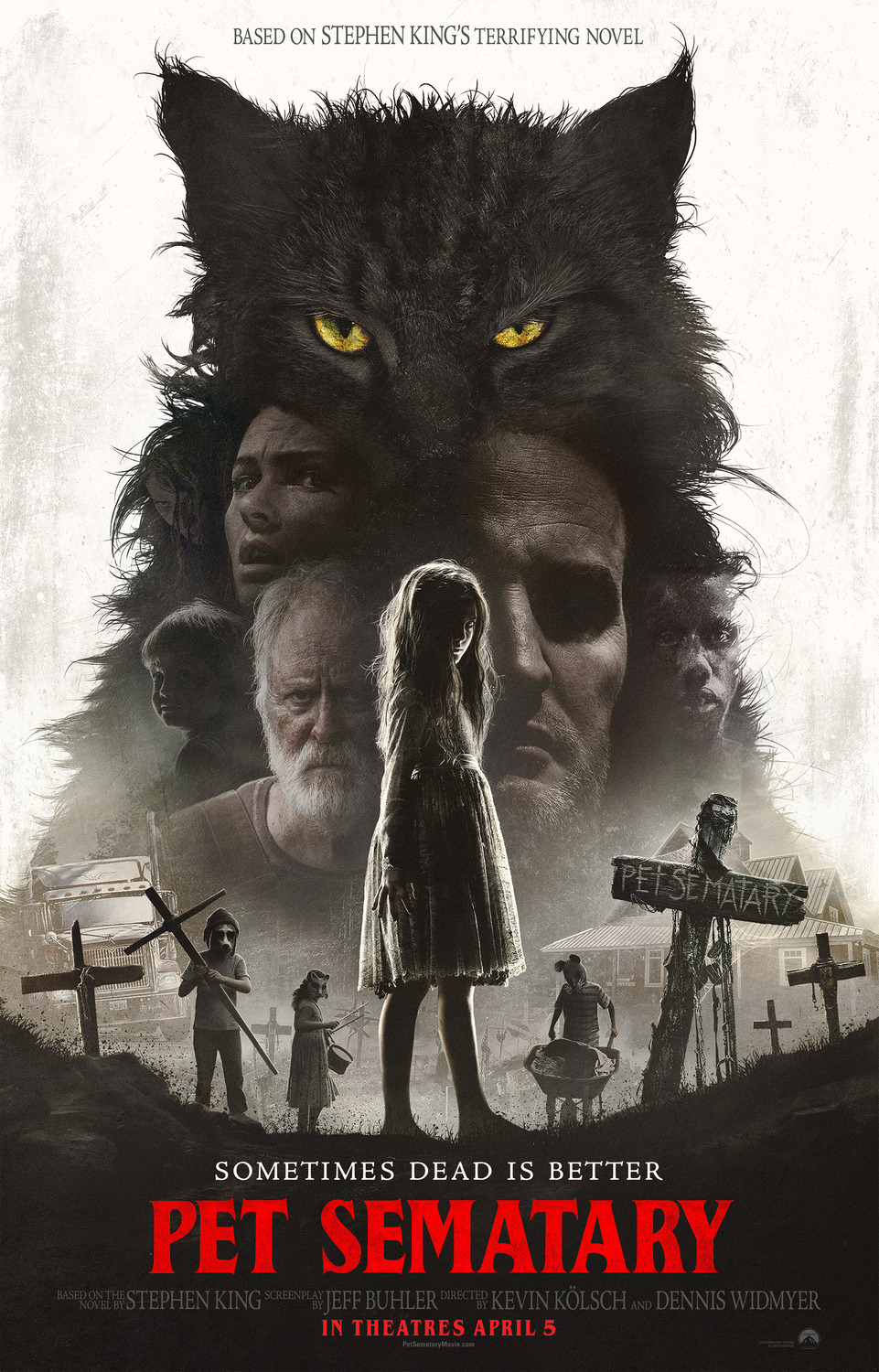
Pet Sematary 2019 movie poster

Of all the Stephen King cinematic adaptations up for a remake, “Pet Sematary” is the one I looked forward to the most. I never cared much for the 1989 version directed by Mary Lambert. It wasn’t a terrible movie, but it was undone by a screenplay which tried to fit in too much from King’s novel, and ironically it was a screenplay written by King himself. While Fred Gwynne was perfectly cast as Jud Crandall, Dale Midkiff’s performance goes way over the top and contains moments which Kevin Smith and Ralph Garman are justified in describing as “exquisite acting.” And there was the ending which was undone by test screenings where the audience demanded something more graphic. Bitch, please!

Now we have the remake of “Pet Sematary” which comes to us from the directors of “Starry Eyes,” Kevin Kölsch and Dennis Widmyer, and it is easily an improvement over what came before. It is not a great horror movie, but even if it were, it is nearly impossible to top King’s 1983 novel which itself is one of the darkest works of fiction ever conceived. Heck, even King himself thought he went too far with it, and that should tell you something. Still, it is an effective film which pays tribute to the spirit of the novel even as it makes changes to the source material in a way I did not see coming.

As before, the story starts with Louis Creed (Jason Clarke) driving with his wife Rachel (Amy Seimetz) and their two kids to their new home in the small town of Ludlow, Maine. We learn that Louis and Rachel were looking to escape big city life for something simpler and countrylike to where they could spend more time with each other and the children. When they arrive at their new home, it looks like a heavenly and peaceful place which they will serve them well, but we all know where the story will go from there as a huge 18-wheeler truck zooms by with little warning while leaving a lot of dust and dead leaves in its wake.

The first half of the “Pet Sematary” remake more or less follows King’s novel to the letter as it treads familiar ground while adding some interesting touches in the process. Upon discovering the pet cemetery of the movie’s title, we also see a procession of children wearing animal masks as they march on by while carrying a dead dog in a wheelbarrow to the place which will bring about its resurrection. Both Kolsch and Widmyer give this movie a wonderfully unnerving feeling which they keep building on throughout as things for the Creed family get worse and worse to where they have little chance to regret the deeds they have committed.

WARNING: SPOILERS AHEAD.

One of the interesting things about this version is how the filmmakers have switched elements around, but in a way which does not take away from the spirit of the novel. Instead of young Gage getting run over by a truck driver who is distracted by his cell phone (and who isn’t these days?), it is Ellie, and the reaction of her parents to this terrible tragedy feel all too real to where neither has to yell out in sheer anguish.

Jeté Laurence plays Ellie Creed, and her performance is especially impressive as she makes this resurrected character far more than a zombie with a thirst for blood. Ellie seems very aware of the fact she is not who she once was, but she also has knowledge of what lies beyond the realm of the living, and she becomes a little too eager to bring her parents to the other side of it.

Jason Clarke has long since proven to be one of our most dependable actors in movies today with his terrific performances in “Dawn of the Planet of the Apes” and “Chappaquiddick.” Clarke makes Louis Creed into an especially sympathetic character even as he comes to play God when it comes to Ellie’s life. The late Victor Pascow (Obssa Ahmed) warns Louis not to exceed the boundaries set for humanity, but Louis is blinded by a grief I would not wish on anyone, and his desire to undo a terrible tragedy is understandable even if it flies in the face of reason, logic and the saying of “sometimes dead is better.”

Amy Seimetz, who co-starred in “Alien: Covenant,” also makes the most of her role as Rachel Creed, an individual who has dealt with death a far too young an age. Rachel remains forever haunted by the passing of her sister Zelda (Alyssa Brooke Levine) whom she was forced to watch by her lonesome while their parents were away. Indeed, Seimetz makes you deeply feel the unfairness of Rachel’s predicament as no child should be forced into such a position at such a young age, and it proves to be one of this movie’s most haunting segments as a result.

And while there is no topping Fred Gwynne’s performance as Jud Crandall, the great John Lithgow succeeds in making this role his own. How many movies and TV shows have we watched Lithgow in anyway? He has been a constant in popular culture, and he remains a welcome presence in anything he appears in. Lithgow doesn’t have to do much to show how Jud has lived a long life which has been filled with one tragedy too many, and this is the mark of a great on camera actor.

Kölsch and Widmyer do an excellent job of raising the tension and overbearing atmosphere of the story throughout the movie’s running time, and they don’t just resort to giving us jump scares every five minutes. They are also aided by a powerful film score composed by Christopher Young which makes an already unnerving motion picture even more so.

“Pet Sematary” is one of the few books I got to read before it was turned into a movie, and this is quite the feat for me these days as filmmakers typically beat me to the punch. As a result, my perspective of the book will forever remain more powerful than any movie made out of it. Still, this cinematic version of it is a powerful one which takes chances with the source material while remaining true to its spirit. I am also quite thankful the filmmakers had enough freedom to give this movie the ambiguous conclusion it deserves. I am a big fan of ambiguity in movies, and this one has an unsettling conclusion which stays with you long after you have walked out of the theater.

Still, I would have preferred The Ramones’ version of their song “Pet Sematary” as opposed to the cover of it performed here by Starcrawler. Nothing against their version, but in this case the original reigns supreme.

* * * out of * * * *