This ‘Peter Rabbit’ is Far From Ultimate

Peter Rabbit 2018 poster

After watching the trailer for Sony Pictures Animation’s “Peter Rabbit,” I kept thinking of the times when brands like KFC and Planter’s Peanuts among others changed their image in commercials to something more hip which made them look ever so desperate to appeal to a youthful demographic. It was both hilarious and cringe-inducing to see these popular brands reduce themselves to current trends they were never created for, and more often than not, it just revealed to us how tone deaf corporate executives can be in their quest for a profit. Those of you who have seen the “Peter Rabbit” trailer can agree this is not quite the same character we grew up reading about in those wonderfully imaginative books by Beatrix Potter. Now that I have seen the movie all the way through, I can confirm Ms. Potter is rolling over in her grave.

This “Peter Rabbit” is nothing more than a bastardization of those innocent tales as the filmmakers go out of their way to modernize this material to such an infinitely nauseating extent, and it hurt to see everyone trying way too hard to be clever. The harder everyone tries to be hip here, the more depressing this movie becomes as its story becomes increasingly convoluted and eventually turns in a poor man’s version of “Home Alone” as Peter tortures his nemesis in the same way Macauley Culkin tortured Joe Pesci and Daniel Stern.

Directed by Will Gluck who previously gave us the ill-advised remake of “Annie,” this movie isn’t so much an adaptation of “The Tale of Peter Rabbit” as it is a story which exists outside of it. Even though Peter Rabbit (voiced by James Corden) came close to meeting his maker the last time he invaded Mr. McGregor’s vegetable garden, we see he has not learned his lesson as he continues to steal every single vegetable he gets his paws on. But when a new McGregor moves into town, things will become even more challenging for him and his furry friends.

The opening minutes of “Peter Rabbit” serve to introduce not only Peter, but also a number of Potter’s other creations like Benjamin Bunny (Matt Lucas), Mrs. Tiggy-Winkle (Sia), Tommy Brock, Mr. Tod and Mr. Jeremy Fisher. Seeing this, I couldn’t help but think Sony Pictures was aiming to create a cinematic universe to rival the one Marvel Studios continues to add to. If this movie succeeds at the box office, we may very well see these characters get their own solo adventures to where they might have their own “Avengers” or “Justice League” movie. Still, I don’t think we should expect “Peter vs. Benjamin: Dawn of Radishes” anytime soon. After all, neither has a mother named Margret.

Peter runs afoul again of Mr. McGregor (a completely unrecognizable Sam Neill), but a heart attack suddenly does the old man in, freeing up the rabbit and his friends to have the equivalent to an endless rave party in his home. But then into the picture comes family relative Thomas McGregor (Domhnall Gleeson) who moves in after being fired from his job at Harrods in London, and no time is wasted before he and Peter wage war against one another which involves, among other things, repeated electrocution.

Perhaps it was too much to expect the filmmakers to remain true to “The Tale of Peter Rabbit” with had its main character being portrayed as being very naughty and later paying a price for being recklessly disobedient to his elders. This particular Potter tale was a great one for kids as it taught them the value of being good, something which Peter did not value in the slightest. “Peter Rabbit,” however, defies the tale’s morality and shows how this rabbit’s rebellious ways are something to cheer on instead of lay caution to. Also, Peter’s sisters Flopsy, Mopsy and Cottontail are shown to be willing participants in his rebellious escapades, something they were not previously.

I was also shocked to see how Neill’s Mr. McGregor was portrayed as a bloodthirsty meat eater who showed no hesitation in making a rabbit pie out of those who failed to escape his clutches. This leads “Peter Rabbit” to have a “Watership Down” scene where we learn how one of his parents became a tasty meal for Mr. McGregor, and this reeks of shameless manipulation on the part of the filmmakers. At the very least, this movie is bound to appeal to vegans as much as it will to children.

Then there is Thomas McGregor, and Gleeson portrays him in a way very similar to his role as General Hux in the recent “Star Wars” movies. Thomas is such an obsessive neat freak to where he wants the toilets at Harrods to be so clean he could drink out of them, and he almost does so with a straw. I expect sick humor like this in “The Human Centipede,” not in a family movie. If you want to see Gleeson in something good, check out “About Time” or the underrated “Goodbye Christopher Robin” instead.

James Corden is a wonderful talent, and I always enjoy watching his late-night sketches which include many unforgettable carpool karaoke episodes. But when it comes to roles like voicing Peter Rabbit, he tries way too hard to be funny and hip. This was the same problem with his work in “The Emoji Movie” which, in retrospect, I gave him too much leeway on. His performance in “Peter Rabbit” is definitely spirited, but seeing him trying to be infinitely clever to where he is desperate to stay one step ahead of the audience becomes painful and exhausting as the movie drags on.

Indeed, the filmmakers try way too hard to make “Peter Rabbit” seem so hip and cool to where they include songs like Len’s “Steal My Sunshine,” a great pop song which has now been officially used once too often in movies. Gluck also includes Big Country’s “In a Big Country,” Rancid’s “Time Bomb,” Vampire Weekend’s “The Kids Don’t Stand a Chance,” and The Proclaimers’ “I’m Gonna Be (500 Miles).” You know, the kind of music Potter listened to endlessly while she wrote. Seeing the animals dancing the latest dance moves here was very dispiriting to me, but at least we never see Flopsy, Mopsy or Cottontail do any twerking.

If there is one real saving grace in “Peter Rabbit,” it is Rose Byrne. As Bea, the McGregor’s next-door neighbor, painter and animal lover, she is so infinitely appealing to where she truly lights up the screen whenever she appears. Byrne gives these proceedings a heart and soul which doesn’t deserve them, and I became infinitely jealous of Peter whenever she picked him up and cuddled him. It’s moments like those which had me wanting to be Peter, but anyway.

The children I saw “Peter Rabbit” with really enjoyed the shenanigans portrayed onscreen, and I am sure many of them will get a kick out of this movie. I, on the other hand, stared at the silver screen feeling dejected as the plot went down a road which filmmakers have traveled thousands of times before. Things get even more ridiculous when Thomas and Peter go from being bitter enemies to much needed allies. Seeing one character attempting to blow up another with dynamite is enough to bring about a restraining order. These two coming together near the end is as ridiculous as the thing which kept a pair of superheroes from beating one another to death in “Batman v. Superman: Dawn of Justice.”

“Peter Rabbit” is the first 2018 movie I have watched, and I’m positive many others which have yet to be released will be far better. Parents right now have a chance to take their children to movies which are far more imaginative and thoughtful like “Paddington 2,” but it looks like they will be quicker to get in line for this one instead. Call me a purist, but this is not how a Beatrix Potter tale should be translated to cinema. Of the many rabbits out there, this one is far from being ultimate.

* out of * * * *
 

‘Tinker Tailor Soldier Spy’ Has Gary Oldman Giving One of His Best Performances

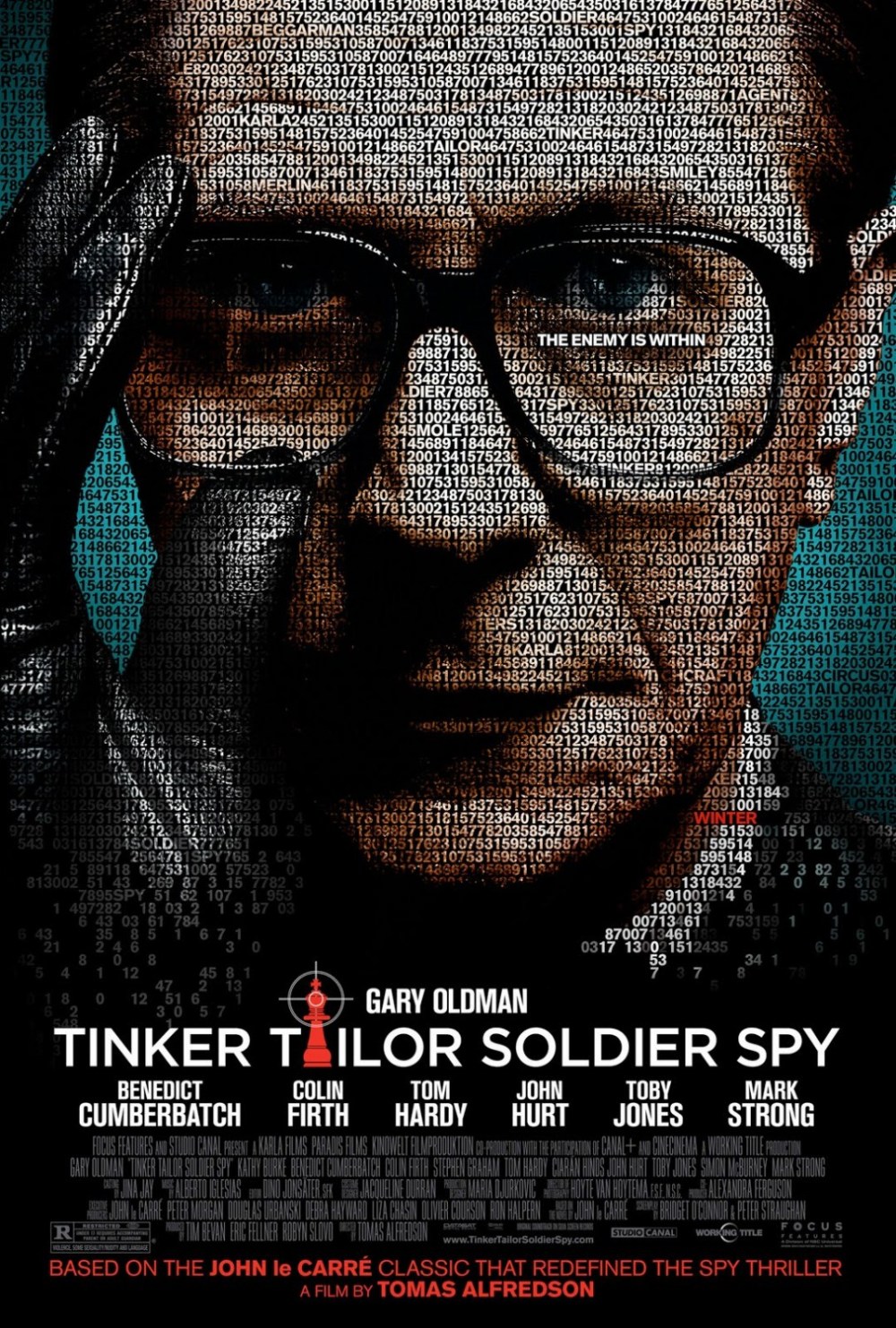
Tinker Tailor Soldier Spy movie poster

It’s interesting how the spy world in John le Carré’s novels differs sharply from the one in Ian Fleming’s. Whereas James Bond was a dashing playboy of a spy and the good and bad guys were easy to tell apart, the spies in Carré’s world exist in a morally gray area, and their lives prove to be anything but glamorous. No one is innocent, and everyone has something to hide from others or perhaps even themselves. Here, there are no gunfights or explosions but instead conflicts both internal and external. Even the people we look up to in Carré’s novels are deeply flawed, and you can quickly see why no one can truly trust one another.

No book in Carré’s vast library of work exemplifies this more than “Tinker Tailor Soldier Spy” which features his most famous fictional character, George Smiley. Originally turned into a brilliant BBC miniseries back in 1979 with Sir Alec Guinness as Smiley, it has now been made into a motion picture with Gary Oldman in the lead role. Whereas the miniseries had more time to develop the story and characters, this movie does an excellent job of doing the same in a shorter span of time. Granted, much has been left out from the novel, but those unfamiliar with the miniseries are unlikely to notice.

The movie hovers around the goings on in The Circus, the codename for British Intelligence. After one operation goes wrong and an agent is killed, the head of Intelligence, Control (John Hurt), is forced to resign along with his right-hand man, Smiley. Smiley, however, is brought back into service when it becomes apparent there is a mole in British Intelligence. Moreover, it’s a mole which has been in The Circus for a long time, and he is a senior member with access to all sorts of secret information. Smiley, in his own way, seeks out the mole before the British become completely compromised in world affairs, and what results is a game of chess more than a battle of wits.

Casting Oldman as George Smiley at first seems like a surprising choice. Oldman made his film debut as Sid Vicious in “Sid & Nancy,” and his performance as the doomed punk rocker reminds us of how over the top he can be as an actor, and I always looked forward to seeing him play the villain in movies like “The Professional” and “Air Force One.” We revel in his emotionally unhinged performances which have made him stand out prominently among other actors of his ilk, and he has rarely, if ever, let us down.

As Smiley, however, Oldman is forced to dial back on the manic energy he became famous for. George Smiley is a character who never loses his cool and conveys so much even through the simplest of gestures. With even an ever so slight movement, we can see Smiley’s thought process at work and are never in doubt of how powerful a character he is. Each movement Oldman takes as Smiley is one which has been deliberately thought out, and even he knows he doesn’t have to bounce off the wall as this famous spy because this one goes into the room knowing all he needs to know.

In recent years, Oldman has gotten to stretch a bit with roles like Sirius Black in the “Harry Potter” movie franchise. While Black is first seen as a bad guy, it turns out he is a good one who cares deeply about Harry’s well-being. Then there is his role as James Gordon in Christopher Nolan’s “Batman” movies where he makes the good guy seem very cool without being such a square. What makes George Smiley an especially interesting character is he is neither a good or bad guy, but instead someone who is forced to navigate the dirty waters which he cannot help but get submerged in from time to time.

This is one of those roles which drive most actors crazy because it can become ever so easy to become utterly self-conscious about every single scene they are in. Being an actor myself, I often wonder if I am doing enough or perhaps too much in one performance to the next. While acting on the stage makes this easier to answer, acting in a movie or television is not only different but far more intimate. In the latter, you have to be more natural to where the camera never catches you emoting, and this can be difficult to say the least. But it’s those subtleties which can provide amazing results with the right director watching over you.

“Tinker Tailor Soldier Spy” also has a cast of brilliant British actors like John Hurt, Colin Firth, and Toby Jones, all of whom do their best in playing characters who have long since accepted the fact that they are morally compromised. You also have Tom Hardy, who succeeded in doing so much with just his eyes as Bane in “The Dark Knight Rises,” as a British agent who is only beginning to become morally compromised. None of these intelligence officers are easy to decipher on the surface, and a lot of this is thanks to their excellent performances.

Directing this adaptation is Tomas Alfredson who directed the great film “Let the Right One In.” Alfredson handles the intricacies of a story which could easily have become convoluted in terrific fashion, and he keeps us enthralled throughout. Even if we can’t follow the story, he succeeds in keeping us on the edge of our seat all the way to the end. Furthermore, he generates an intense and exciting climax without the use of gunplay or explosions, and there is something to be said about that.

Describing all which goes on in “Tinker Tailor Soldier Spy” is not easy, but it is not an impossible story to follow. Watching this movie for a second time will help give you a chance to examine the subplots more closely. While the spy world of Carré may seem nowhere as exciting as the one Fleming created for 007, it deals with the real world more directly as the line between right and wrong is forever blurred. What’s fascinating is how these people survive in it even as they continue losing pieces of themselves in a world and time which is prepared to beat them down on a regular basis. Everyone involved deserves a lot of credit for making what might seem ordinary and unglamorous seem so relentlessly thrilling.

* * * * out of * * * *


Kenneth Branagh’s ‘Murder on the Orient Express’ is Wonderfully Old-Fashioned

Murder on the Orient Express 2017 movie poster

Kenneth Branagh’s adaptation of “Murder on the Orient Express” marks a return of sorts for the actor and director. His last few movies as a director, “Thor,” “Jack Ryan: Shadow Recruit” and “Cinderella,” had him embracing all the cinematic tools available to him to where his unique talents threatened to be squashed as he began to look like any other filmmaker making blockbuster motion pictures. But with this latest adaptation of Agatha Christie’s classic mystery novel, we see him returning to his theatre roots as he directs an all-star cast to excellent performances while simultaneously playing the lead role of Belgian detective Hercule Poirot. The late Leonard Nimoy said he never directed another “Star Trek” movie after “The Voyage Home” because acting and directing at the same time was just too much work. Branagh, however, makes it all look like a walk in the park, and after all these years I am astonished that he can make it look so easy.

Branagh is fantastic as Hercule, and he makes this classic character into a man of many splendors. We first see him being very picky about being served two hard-boiled eggs, both of which need to be the same size for him to eat. This scene almost makes him looks like a food snob, but then we see him solve a crime at the Wailing Wall in Jerusalem. Hercule brings up three holy men to the front of the crowd, and immediately we think one of them is guilty, and that, once the guilty man is revealed, people will find their prejudices to be justified. But instead, Hercule implicates another man with the crime, and it shows how he sees sins as being universal and not relegated to a particular group or ethnicity. From there, we know this man will not be bound by prejudice when it comes to solving a crime.

Hercule just wants to take a holiday aboard the Orient Express, and we see him take great joy in observing perfectly baked foods as well in reading Charles Dickens’ “A Tale of Two Cities” which he laughs at constantly. But detectives like him can only stay on vacation for so long as the scent of crime is never far from him. And, as the movie’s title implies, a murder is committed which only he can solve with his unique set of skills. This will not be an easy case, but Hercule is quick to tell us, “If it were easy, I would not be famous.”

“Murder on the Orient Express” has been adapted several times, the most famous adaptation being Sidney Lumet’s 1974 film which, like this one, features an all-star cast. I have not seen any of the previous versions nor have I read Christie’s novel, so I am coming into this one a fresh newbie. From the start, I expected Branagh’s film to be an old-fashioned whodunit, but as it went on, I was surprised to see the story deal with themes Shakespeare wrote about time and time again. It becomes less about who the murderer is and more about the sins we allow ourselves to live with and of the different kinds of punishment we are forced to endure. Once the murderer is revealed, the story doesn’t stop there.

Branagh brings together a terrific group of actors who sink their teeth into roles which, on the surface, might seem underwritten and one-dimensional, but each actor does excellent work in creating an inner life for their characters to where their eyes tell us more than their mouths do. Even as they work on perfecting their poker faces, something which Hercule has them all beat at, their eyes betray a truth which can no longer stay buried.

Johnny Depp shows up as Edward Ratchett, an unsavory individual who becomes the victim of the story. Seeing Depp getting killed off early on in a movie is guaranteed to please many audience members who have had their fill of him, and I don’t just mean Amber Heard. I’m just glad Branagh cast him in this role instead of as Hercule. Depp would have just resurrected his Guy LaPointe character from “Tusk” and “Yoga Hosers” if he played Hercule, or perhaps he would have given us another variation on Charlie Mortdecai as, like Hercule, that character sports a truly extravagant mustache. All the same, Depp is wonderful in the role and makes Ratchett into a despicable character whose nasty fate deserves a thorough investigation.

I loved watching Penelope Cruz as Pilar Estravados as her demeanor presents the character as one with dark intentions as well as someone who has suffered far too much pain and tragedy in life. It took me a bit to recognize Josh Gad who plays Ratchett’s right-hand man, Hector MacQueen, and he is excellent as a man who has compromised his values once too often. Daisy Ridley, whom we cannot wait to see again as Rey in the next “Star Wars” movie, matches Branagh scene for scene as Mary Debenham, a lady who refuses to be investigated by Hercule for a protracted amount of time, but even her poker face falls apart before she realizes it. And you can always depend on Derek Jacobi, Dame Judi Dench and Willem Dafoe to turn in excellent performances as they rarely, if ever, have let us down.

But one performance I want to single out in particular is Michelle Pfeiffer’s who portrays Caroline Hubbard. 2017 has been a big year for Pfeiffer as she has emerged from what seems like an infinitely long hiatus and has given unforgettable and scene-stealing performances in Darren Aronofsky’s “mother!” and Barry Levinson’s “The Wizard of Lies.” The same goes with her performance here as she takes the stereotypical divorced socialite and renders her into a complex figure of tragedy whose armor is harder for Hercule to break through. Pfeiffer has always been a fantastic actress, and her performance as Caroline reminded me of this and of how long her career has lasted. She has a show-stopping moment towards the movie’s end (you’ll know it when you see it), and it is further proof of how she has never been just another pretty face in Hollywood.

Branagh has directed “Murder on the Orient Express” as a theatre piece, and it is clear to me how much attention he has given the actors here. Having said that, he also gives this adaption a beautifully cinematic look. Along with his collaborators, director of photography Haris Zambarloukos and composer Patrick Doyle, he makes this film feel wonderfully old-fashioned, and it seems like forever since I have watched a movie which evokes this feeling. It should also be noted how he shot this movie on 65mm film which suits the material perfectly, and seeing those cigarette burns appear on the screen was a very welcome sight for me.

Of course, not everything about “Murder on the Orient Express” is perfect. The movie does drag a bit towards the end, and the story is at times a bit hard to follow. It also pales in comparison to another mystery movie Branagh directed back in the 1990’s, “Dead Again.” Still, it proves to be a wonderfully entertaining motion picture which reminded me of his best work even while not quite equaling it. The ending draws our attention to another Agatha Christie classic novel which implies, if this movie does well, we could be seeing the beginning of a franchise. I do hope this happens as Branagh has put together a wonderfully entertaining motion picture which begs for a continuation. Whether he can come up with a follow up remains to be seen as the world of movies remains dominated by endless superhero/comic book franchises.

I also have to say the mustache Branagh sports in this movie is very impressive. Lord knows how long it took for him to grow and keep so pointy. Many other actors would have been easily upstaged by such a mustache, but not Branagh.

* * * ½ out of * * * *

Mike Flanagan Makes the Unfilmable ‘Gerald’s Game’ a Cinematic Reality

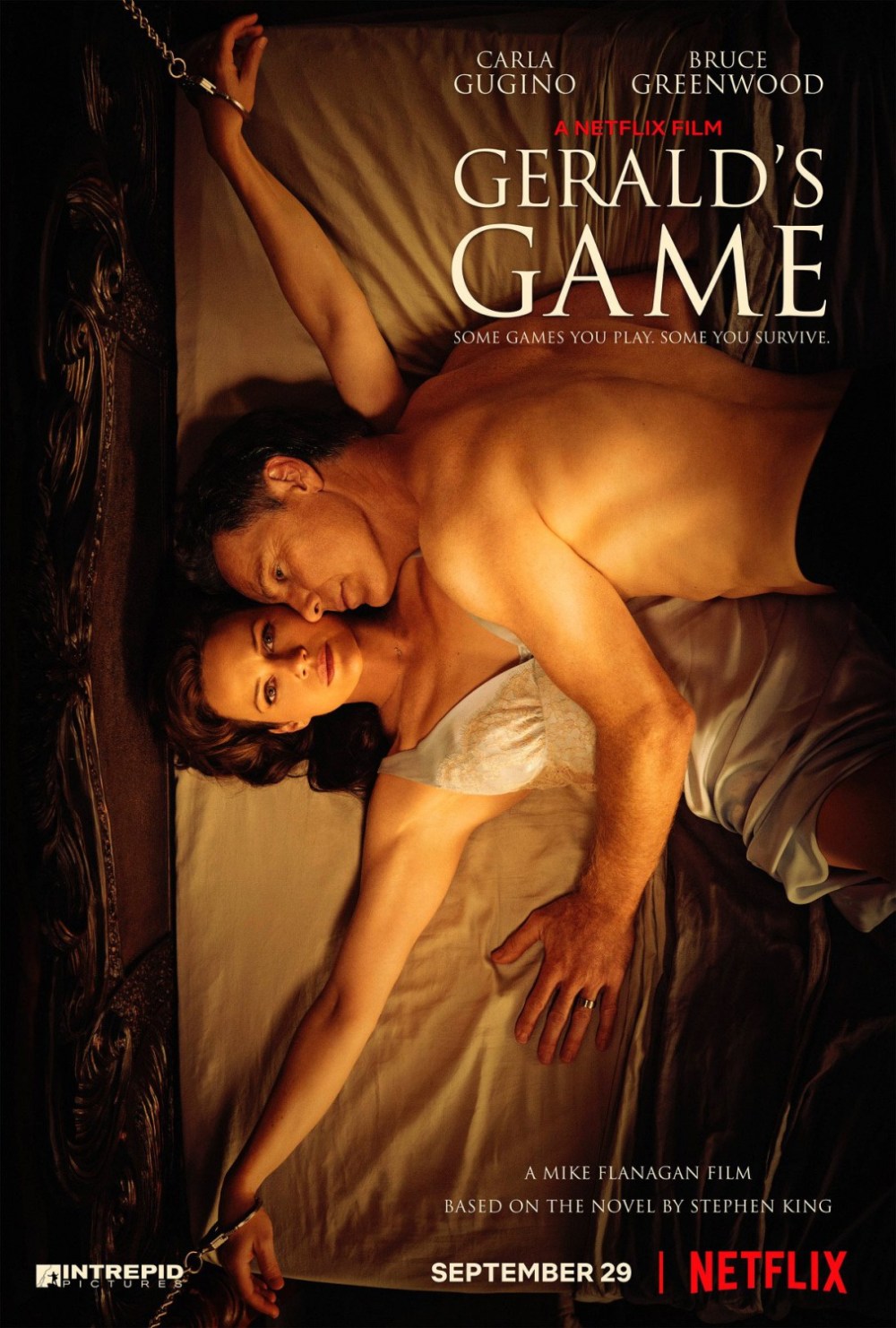
Geralds Game movie poster

Of the many Stephen King novels, “Gerald’s Game” is one of my favorites. Hearing the author talk about it on an episode of Fresh Air with Terry Gross, I was instantly intrigued by its premise of a couple’s sex game gone wrong to where the husband dies and the wife is left handcuffed to the bedpost with no means of escaping. The more King talked about it, the quicker I was to leap out to the bookstore to buy a copy (albeit, when it came out in paperback).

I was also intrigued at the possibility of “Gerald’s Game” being made into a movie as it presented unique challenges to daring filmmakers; how can you stage the action when much of it takes place in the character’s head? Furthermore, how many actresses would be willing to play such an emotionally draining role? Many have described this particular King novel as “unfilmable,” but I always had a feeling this would be proven wrong.

Well, Mike Flanagan, the director of “Oculus,” “Hush” and “Ouija: Origin of Evil,” accepted the challenge of adapting “Gerald’s Game” as he is also one of its biggest fans. Along with screenwriter Jeff Howard, he has made this seemingly unfilmable novel a cinematic reality as he puts us right in the head of its main character as she is trapped in a predicament which presents her with physical and emotional terrors we live to avoid in real life.

We are introduced to Gerald (Bruce Greenwood) and Jessie Burlingame (Carla Gugino) as they pack their bags for a weekend getaway to their house by the lake. It is filmed to look like an average vacation with them gathering their things. That is, until Gerald puts two pairs of handcuffs in his bag. Once they arrive, it doesn’t take long for them to get up to the devil’s business as Gerald cuffs Jessie to the bed. You can see in her eyes she is really not into this sex game of his, and she tells Gerald to stop. Gerald, however, suddenly suffers a fatal heart attack as the result of taking one Viagra pill too many, and he drops dead right there on the bedroom floor. Just like Renton told Begbie in “Trainspotting 2,” “Remember not to exceed the stated dose.”

Jessie is then trapped in a most unfortunate situation as she and her husband picked a time to vacation when everyone else is not, so it’s unsurprising to realize is no one around for miles to hear her screaming for help. I have seen this a lot in horror movies, a married couple vacationing at a time when the tourist season is non-existent, and it’s like they have the whole place to themselves. Heck, “Gerald’s Game” would make for an inspired double feature at New Beverly Cinema along with “Honeymoon” as both deal with the same predicament.

Flanagan sets up things for us cleverly as he shows how isolated Jessie and Gerald are from regular society. We meet the dog who will later become hungrier than ever even after Jessie offers him a piece of steak which Gerald tells her costs $200 a pound.  Beyond that, the two of them even leave the front door open as if the house represents Pandora’s Box. This all adds to the growing tension as we know how badly this game will turn out for the two of them.

Once the action focuses on Jessie being handcuffed to the bed, Flanagan gleefully tightens the screws. A cellphone is on the nightstand next to her, but it’s just out of her reach. There is a glass of water nearby, but she cannot bring it to her lips. And then we become witness to her hallucinations as her situation becomes increasingly precarious to where we feel every bit as vulnerable as she does.

The way Flanagan handles Jessie’s hallucinations is quite brilliant as they take the forms of herself, her dead husband, and even her younger self (played by Chiara Aurelia). Flanagan also edited the film, and he keeps us guessing as to where we should be looking next as the focus changes before we realize it. I loved how successful he was at catching the audience off guard as the POV shifts constantly as I had no idea where it would go next.

“Gerald’s Game” does feature a music score by The Newton Brothers, but the film works best when the only sound, other than what’s outside Jessie’s window, is silence. I don’t know about you, but I need some form of sound, soothing or otherwise, to calm my brain just to even fall asleep. When everything is silent, I cannot help but be all too aware of my surroundings and feel like Dee Wallace’s son hiding under the covers in “Cujo.” Flanagan seizes on this silence as every single sound takes on a new, and much more frightening meaning.

Things get even more unnerving when we are taken back to a time when young Jessie was watching a total eclipse with her father. While watching it with special glasses, her father ends up doing something no father should ever do to their child. We don’t see exactly what he’s doing, but it’s enough to make us squirm in our seats as we know it’s something very inappropriate. Henry Thomas, years removed from “E.T.” and “Cloak & Dagger,” turns in a fantastic performance as Jessie’s father, Tom. Just watch him as he carefully manipulates Jessie into keeping this event a secret from her mother. The way he slyly gets Jessie to see things his way reminds me of what a good actor Thomas still is, and that’s even when you want to break his character’s nose.

Some horror movies either show very little or show everything, and with “Gerald’s Game,” Flanagan finds a balance between this. We never see much of Gerald’s body once it flops onto the floor and out of Jesie’s eyesight, nor do we get a specific view of which body parts the dog is feasting on (what did you expect? He almost got to eat a $200 steak). He does, however, show us Jessie’s ever-so-delicate movements as she retrieves a glass of water without breaking it just as Eddie Murphy had to carry one over a bottomless cavern in “The Golden Child.” Of course, this moment is completely dwarfed by the method Jessie undertakes to free herself as it provides us with a cringe-inducing scene on the level of James Franco amputating his arm in “127 Hours.”

If there is anything wrong with “Gerald’s Game,” it is the inclusion of the Raymond Andrew Joubert character (played here by Carel Struycken) whom another describes as “the man made of moonlight.” Indeed, this was also a big problem with the novel as Raymond figures prominently in its last half to where it felt like I was reading a whole other book. Flanagan would have been best to leave this part out of the movie as it never fits here in any meaningful way, and the ending suffers because of it. Having said this, the character’s inclusion is almost worth the trouble as Struycken makes him a terrifying presence, especially when he first appears out of the shadows in the corner of Jessie’s bedroom. It is truly the stuff nightmares are made of.

Carla Gugino would not have been my first choice to play Jessie, and this ends up saying more about me than anyone else. Her work in the “Spy Kids” movies, “Sin City,” and on television shows like “Spin City” and the short-lived “Karen Sisco” should have made her a bigger star, and yet she still seems to be flying below everyone’s radar. Her performance in “Gerald’s Game,” however, should quickly remind us all of how fearless an actress she can be. This is not the most appealing role for anyone to take on as it is emotionally draining, and actors can fall into the trap of emoting rather than acting here. Gugino never does fall into this trap though, and she never backs away from portraying Jessie’s most agonizing moments as her privacy is invaded in different ways.

As for Bruce Greenwood, you can never go wrong with him. While he in no way fits the physical description of Gerald in the novel, it doesn’t matter because he makes the character both loving and undeniably creepy. Just wait until you see the look in his eyes. Even after Gerald dies, Greenwood remains a strong presence as he takes the form of one of Jessie’s hallucinations, and he makes Gerald as creepy in death as he was in life.

The images King evoked in “Gerald’s Game” still remain strong in my mind even though it has been over 20 years since I read it. Thanks to this novel, I will never listen to the Steve Miller Band’s “The Joker” in the same way ever again. I even got my dad to read it, and he later told me, “Why did you make me read this? It’s so revolting!” While many consider this novel one of King’s lesser works, I completely disagree as it still permeates my consciousness to this very day.

With this cinematic adaptation of “Gerald’s Game,” Flanagan has succeeded in making a motion picture both compelling and agonizing to sit through. Even though I know how the story turns out, my eyes were glued to the screen as I wondered how the director would visualize the novel’s most extreme moments. In a year where King adaptations have ranged from excellent (“It”) to utterly disappointing (“The Dark Tower”), this one delivers as it prods at our deepest fears in the real world as they prove more terrifying than anything from the supernatural realm.

Speaking of “The Joker,” I kept waiting for that song to come on. Maybe issues with song rights kept Flanagan from using it. Or perhaps, after our first look at Raymond and his box of bones, it is clear he is not about to speak of the pompatus of love.

* * * ½ out of * * * *

‘Left Behind’ is as Cinematically Atrocious as Movies Get

Left Behind movie poster

The 2014 version of “Left Behind” received quite the critical smackdown upon its release, and this made me all the more interested in seeing it. How many times do you get the opportunity to say you were one of the handful people who got to see such a god-awful motion picture on the big screen which notoriously flopped at the box office during its incredibly short time in theaters? There were a few people who proudly wore t-shirts signifying they saw “Gigli” while it was in theaters, and some wear it like a badge of honor.

“Left Behind” looks like one of those so bad it’s good movies, but even on that level it is a complete failure. This cinematic version of the best-selling novel by Tim LaHaye and Jerry B. Jenkins is every bit as hideous as its reputation suggests. The acting is amazingly bland and lifeless, the dialogue is unforgivingly bad, and the direction is beyond incompetent. Upon coming out of this movie, one has to wonder if its best sequences were all left behind on the cutting room floor on purpose or by accident.

The movie opens on Chloe Steele (Cassi Thomson) arriving home from college to surprise her father, airline pilot Rayford Steele (Nicolas Cage), for his birthday. Rayford, however, is already set to pilot a flight to London and cannot make it. Also, his marriage to his wife Irene (Lea Thompson) is on the fritz as she has since become a devout Christian, something which drives him and Chloe up the wall. He also has his eye on an infinitely beautiful flight attendant to the point where he doesn’t hesitate to leave his wedding ring in the glove compartment of his car.

Anyway, the family members go their separate ways to do their thing, but then people suddenly vanish into thin air without any explanation, and the world quickly descends into utter chaos. Their clothes and belongings are left behind, but their bodies have apparently disappeared and don’t look to reappear anytime soon. It turns out the end of the world is much nearer than the non-believers ever bothered to realize, and those who believe in Jesus are now under his, or her, protection. As for those back on Earth, they are forced to prepare for the rapture which is certain to kill them off at some point in the not too distant future.

“Left Behind” is actually a remake of the 2000 film that starred Kirk Cameron and which received largely negative reviews upon its release. In a time where every other movie is being remade, this looked like the rare remake which could have easily improved upon the original, but no such luck. For all we know, this remake is even worse than its predecessor, and sitting through it is like pouring salt on an already gaping wound.

Where do we start with a cinematic monstrosity like this? Well, let’s take into account how the story lacks much in the way of drama. Those characters who didn’t go up to heaven are basically condemned to a hellish existence, so where’s the drama? As for what’s going on up in the sky, the characters stuck in the airplane are forced to act stupidly and utter dialogue so silly and inane to where it makes the screenplays of the “Star Wars” prequels sound like they were written by Aaron Sorkin.

The saddest thing about “Left Behind” is watching Nicolas Cage give one of the worst performances of his long career. Granted, Cage has done more bad movies than good ones these past few years, but even he can sometimes elevate a terrible motion picture into something which is, at the very least, entertaining. But here he looks like he is about to fall into a coma like Ben Carson threatens to during his campaign for President as he appears bereft of passion and meaning. What made Cage decide to do this movie anyway? He can underplay a role to great effect in movies like “Joe,” but here he only succeeds in making a terrible movie all the more infinitely pathetic.

The director of this misbegotten disaster is Vic Armstrong who is said to be the world’s most prolific stunt double in movies. He doubled for Harrison Ford in the first three “Indiana Jones” movies, Timothy Dalton in “Flash Gordon” and George Lazenby in “On Her Majesty’s Secret Service.” Whatever lessons he gleaned from the directors he worked with on those projects did not translate to “Left Behind.” He should be forgiven for the lousy special effects he had a budget of only $16 million which, for a movie like this, is not nearly enough to, but my sympathy doesn’t extend much further than that. His direction is so amateurish to where I wondered how he got the directing job at all.

There is only so much time one can waste on a movie like “Left Behind” because there are hundreds upon hundreds of other movies out there so much better than this one. It ends on a note of seeming uncertainty as the apocalypse has only begun, but Cage stares at it so blankly as if to say he won’t be around for the sequel, assuming there will ever be one. It’s depressing to see a number of careers hit rock bottom here, but this is what happens here as movies don’t get much worse than this one. Sitting through a Dinesh D’Souza “documentary” is hard enough, but this one is a real endurance test.

For what it’s worth, it is nice to see Lea Thompson here as she always proves to be a very appealing presence in each movie or television show she appears in. What a shame it is that she disappears from this movie far too soon.

½* out of * * * *

‘It’ Proves To Be one of the Best Stephen King Movies in a Long Time

It teaser poster

It” isn’t just one of my favorite Stephen King novels, it’s also one of my favorite books ever. On one hand, it is a terrifying tale of a malevolent force who takes the form of a clown and feeds on the fearful children living in Derry, Maine. On the other, it is a thoughtful and deeply felt examination of kids who are forced to endure a tougher childhood than anyone ever should. I read King’s massive novel (1,138 pages) back when I was a teenager, and it made me realize it was okay to be different than others. Looking back, it also reminded me of a line of dialogue from one of my all-time favorite movies, “Pump Up the Volume:”

“High school is the bottom. Being a teenager sucks, but that’s the point. Surviving it is the whole point.”

For those who have read this novel, you can see how it is more about the kids than it is about Pennywise the Dancing (not to mention incredibly vicious) clown. Thank goodness director Andy Muschietti realized this when he came on to direct the long-awaited film version of “It.” While Muschietti delivers the requisite thrills and chills a horror film like this one demands, he keeps a very observant eye on the kids and the conflicts they are forced to endure, and I don’t just mean Pennywise.

The film focuses on the book’s first half when the members of “The Losers’ Club” were suffering the slings and arrows of daily life at school. But while King set this half in the 1950’s, Muschietti moves things up to the 1980’s, a time of Ronald Reagan, calculator watches, New Kids on the Block, and movies like “Gremlins” and “Beetlejuice” which, like “It,” were released by Warner Brothers. This was a decade defined by greed, but for these kids, it was a time of innocence which would be destroyed for them far too quickly.

“It” was previously made into a wonderfully entertaining television miniseries by Tommy Lee Wallace, but Muschietti lets you know right from the start how the censorship of American television was not going to apply here. Little Georgie Denbrough suffers a most terrible fate when Pennywise bites his arm off and drags his body into the sewer, and even if you know this event is coming, it is still chilling to witness as this is the kind of thing movies typically avoid showing. From there, I couldn’t help but remain in a state of heightened anxiety as while I knew what was going to happen, the safety of network television was not around to reassure me about the horrors I was going to witness.

The misery and sufferings of The Losers’ Club feel much more unnerving on the silver screen than on television. It’s especially galling to see poor Beverly Marsh get wet garbage poured all over her in the bathroom as she has become the victim of unsubstantiated rumors that she is promiscuous. But judging from the moment she when she puts her backpack over her head for protection, she has been dealing with this stigma for a very long time. Or how about Ben Hanscom, the overweight new kid in town who has zero signatures in his yearbook, one of the saddest sights the audience is forced to take in here. While these kids’ sufferings don’t feel as raw as what Sissy Spacek endured in “Carrie,” it’s still easy to feel for these kids who have been cast out of what is perceived to be the realm of normal.

Heck, even their parents prove to be an emotionally distant, and if they are not, they instead prove to be ridiculously overprotective. Beverly’s father seems to care for her a little too much, and this care seems to imply crimes more insidious than our imaginations can ever handle. Eddie Kaspbrak’s mother is determined to keep him safe from any and every germ planet Earth has to offer, and at times she threatens to be as scary as Pennywise due her raising her son as if he is the reincarnation of Howard Hughes. As for William Denbrough, things will never be the same between him and his parents following the death of his brother Georgie.

There’s some passage in the Bible which says God only gives you what you can handle, but the members of The Losers’ Club have far more than anyone should ever be made to handle, and this is made clear before Pennywise begins to disrupt their unfairly depressing lives. As a result, they need each other to get from one day to the next, and the strength they have together allows them to be a formidable force against Pennywise. Muschietti’s attention to these kids’ struggles makes this film very effective as we come to care for them deeply, and this makes their stand against this homicidal clown all the more involving.

Speaking of Pennywise, Bill Skarsgard makes him into the freakiest clown and scarier than any clown Rod Zombie could come up with. Whereas Tim Curry’s Pennywise was at first approachable and then murderous, Skarsgard’s is vicious right from the get go whether the kids realize it or not. Even before those set of jaws come out, Skarsgard more than reminds the audience of how clowns have always been creepy, and he makes Pennywise into the clown who gleefully inhabits all our nightmares.

So where do I rank this particular Stephen King adaptation among the many already unleashed on the public? Hard to say. It is easily one of the best King adaptations in a while, but it is not as scary as “The Shining” or “Carrie.” This is not a motion picture filled with jump scares every 5 minutes as Muschietti is more in creating something which is infinitely chilling and suspenseful. What results is a highly entertaining movie which never feels like a simple remake of the miniseries. He is also blessed with a terrific cast of actors who are not afraid to embrace the depressing natures of their characters. I just hope none of them have to deal with this shit in real life.

I’m also thrilled no one tried to fit the whole book into one movie. There’s no way you could have done that without messing everything up. There was already talk of a sequel long before this movie even opened, and this is a sequel I am more eager to see than any “Star Wars” movie which has yet to be released. It’ll be interesting to see how The Losers’ Club will transition from childhood to adulthood as they attempt to put the past behind them. But as Peter Gabriel once sang, “Nothing fades as fast the future. Nothing clings like the past.”

* * * ½ out of * * * *

Kimberly Pierce’s ‘Carrie’ Not Really Necessary, But Better than Expected

Carrie 2013 poster

“Carrie” was the first Stephen King novel ever published, and it’s the one people keep coming back to. Filmmakers had the hardest time, until recently that is, getting “The Dark Tower” made into a movie, and bringing “It” to the silver screen seemed to be an impossible challenge. This serves as a reminder of how development hell is still alive and well in Hollywood. “Carrie,” however, has been adapted into the horror classic Brian De Palma directed in 1976, turned into a musical that became famous for how long it didn’t run on Broadway, generated a sequel called “The Rage: Carrie 2” which disappeared from theaters not long after its release, and was later remade into a TV movie where the only saving graces were Angela Bettis as Carrie White and Patricia Clarkson as Margaret White. Now we have yet another remake of “Carrie” which would have been totally unnecessary were it not for Kimberly Peirce, the same filmmaker who gave us the brilliant and emotionally devastating “Boys Don’t Cry” which dealt with a human being cruelly cast out of regular society. As a result, this remake suddenly felt a lot more promising than I expected it to be.

Why do people keep coming back to this particular King novel? Well, with its themes of bullying, isolation and the pain of adolescence, “Carrie” proves to be as timely now as it was when the novel came out in the 1970’s. The story remains the same, but the tools of humiliation and anger have been slightly updated. Carrie White (Chloë Grace Moretz) still has her first period, but this time it is captured on an iPhone and posted on the internet with gleeful malice and a complete lack of sympathy. Granted, Carrie probably doesn’t have a Facebook page as her mother Margaret (Julianne Moore) has spent a lot of time homeschooling her daughter before being forced to send her to a public high school, and she remains as strictly religious as ever; locking her poor daughter into a closet to pray to a bleeding Jesus on a cross.

The main fault with this version of “Carrie” is it follows De Palma’s film a little too closely. For those who have seen the 1976 movie, not much has changed, so this may not seem as scary as before. At the same time, I found myself admiring what Peirce was able to convey with the characters, particularly the females. While certain characters end up coming off as a bit too generic, we get to see the different dimensions which make them more human than the average character we constantly get exposed to in horror movies.

Moretz successfully makes the character of Carrie White her own, and you never feel the shadow of Sissy Spacek’s performance hovering over her. She is able to bring more of Carrie’s rage we saw in King’s book, and we see her as a powder keg just waiting to explode. We all know her as Hit Girl from the “Kick Ass” movies, and it’s only a matter of time before she starts kicking some serious ass at the prom. Even though Moretz doesn’t quite match the description King made of Carrie in the book (she’s one of those actresses you can’t make look ugly), it’s clear from her performance how deeply she understands this horribly shy and alienated teenager inside and out. While this Carrie isn’t ugly by a long shot, she is made to feel ugly by everyone around her, and you can see this weighing heavily on her psyche.

Julianne Moore continues to put in one great performance after another, and her work here as Margaret White is very effective. Whereas Piper Laurie played Margaret as a deranged religious zealot whose devotion to Jesus was unwavering, Moore instead makes the character surprisingly empathetic. Margaret is still deranged, but Moore shows her to be a loving mother who does care ever so deeply about her daughter even if her love comes with a lot of mental anguish. Moore even shows Margaret engaging in self-mutilation which is painful to watch and adds another layer to this character which wasn’t in the book.

Actually, for me one of the most fascinating characters in “Carrie” is Chris Hargensen who is played here by Portia Doubleday. Chris hates Carrie with a passion and looks forward to humiliating her with a vengeance on prom night, but I found myself really getting caught up in how the character goes from being just another spoiled girl to someone who slowly gravitates towards the dark side. Chis initially shows some hesitation when her never do well boyfriend Billy Nolan (Alex Russell) kills the pig whose blood they will use to dump on Carrie, but once she starts cutting the dead pig’s throat, I found the look on her face to be one of the movie’s most horrifying moments. As she gets deeper into criminal activity, we see Chris starting to get both aroused and scared by it, and she doesn’t realize until it’s too late that there’s no turning back.

I was also glad to see Judy Greer playing PE teacher Miss Desjardin, and the role allows her to balance out her sweet side with a rougher exterior as she gets constantly exasperated by her students who show little signs of being the least bit sympathetic towards Carrie. I also have to give Ansel Elgort some credit as he makes Tommy Ross’ transition from not wanting to take Carrie to the prom to making sure the two of them have the best time possible very convincing. Then there’s the lovely Gabriella Wilde who plays Sue Snell, the popular girl who encourages Tommy to take Carrie to the prom. She’s very good in the role and shows us the inner turmoil going on as she sees her goodwill get dumped on, literally.

Look, there’s no way that Peirce could have topped De Palma’s “Carrie.” Having read the book, it would have been interesting to see it done as kind of a documentary as the book is told from various points of view where the townspeople share their memories of what happened on the night of the prom. Still, it’s Peirce’s approach to the characters which made her version of “Carrie” worth watching for me.

Was a remake of “Carrie” really necessary? Not really, but it happened anyway and not for the first time. Having Peirce behind the camera for this one gives this remake a reason for being, and she is blessed with a cast who did not let their memories of De Palma’s horror classic get in their way. If anyone else had directed this version, I’m not sure I would have bothered watching it. Peirce remains a filmmaker who understands how cruelly we can alienate someone for being different, but she never gets caught up in making this into a message movie. She is determined to have us rooting for Carrie even as she lays waste to a town and its inhabitants who have been relentlessly cruel to her. That’s why we go to the movies anyway, to engage in our fantasies.

Now let’s think about adapting some Stephen King novels which haven’t already been made into movies or miniseries. There are so many to choose from.

* * * out of * * * *

Click on the video below to check out the interviews I did with Chloe Grace Moretz, Julianne Moore, Judy Greer and Kimberly Pierce on “Carrie” for the website We Got This Covered.

No, I Haven’t Seen It Until Now: ‘Cujo’

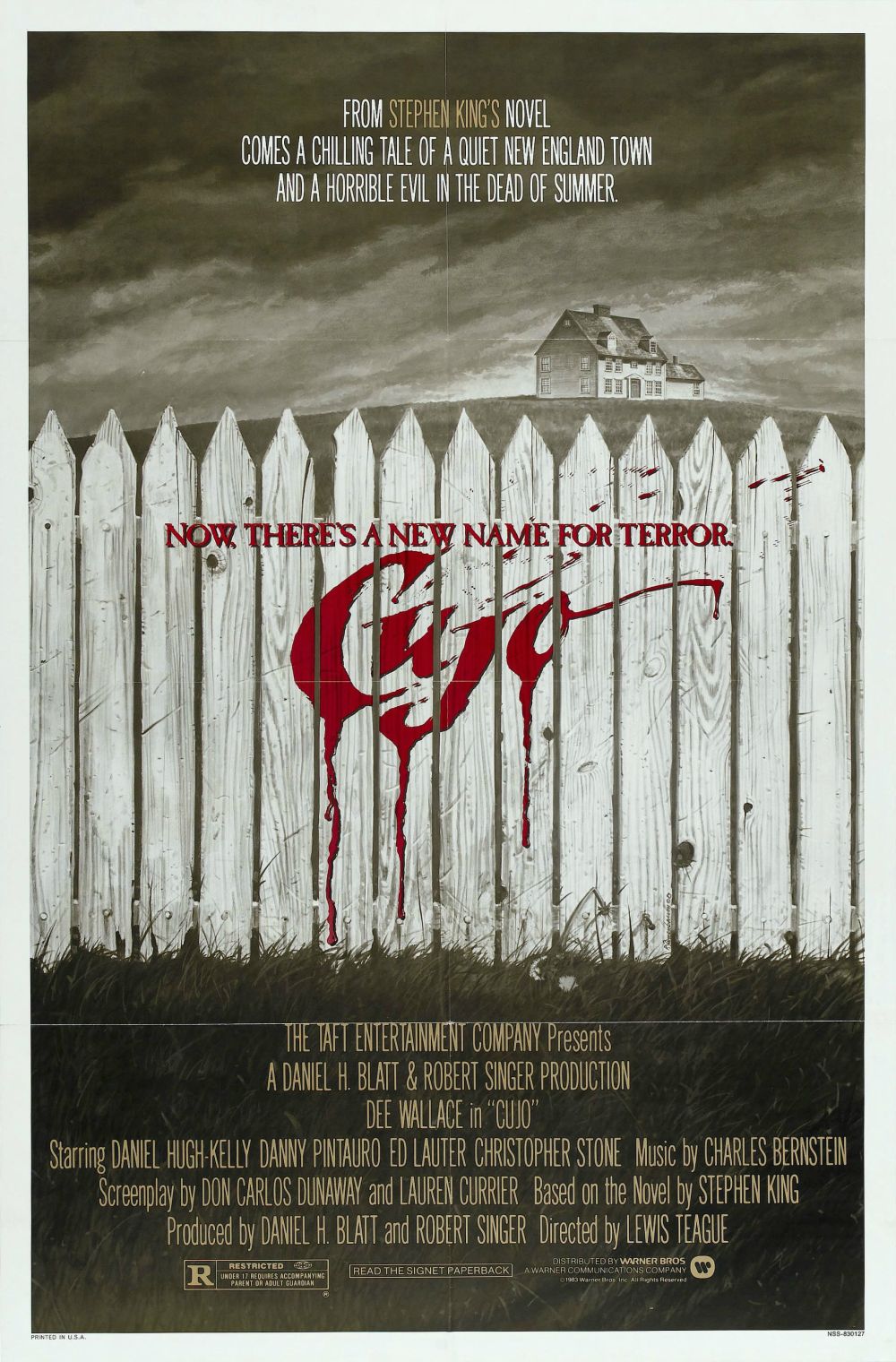
Cujo movie poster

It took Cinematic Void putting together a Stephen King film festival at the Egyptian Theatre in Hollywood to give me a reason to finally check out the cinematic adaptation of “Cujo.” It was a movie I have heard a lot about, and I remember the book’s original artwork with those growling teeth which indicated this particular dog was looking for more than puppy chow and snausages. Moreover, the word Cujo has long since been burned into my consciousness, and it seems to exist as a description of a dog who has gone mad and cannot be mistaken for man’s best friend. In “Fletch,” it made perfect sense when Chevy Chase said “Cujo” as he wandered through a seemingly abandoned house in Utah. Considering he was attacked by a Doberman Pinscher earlier in the film, his fear of being attacked again was completely understandable.

“Cujo” was released in 1983 during a decade when adaptations of King’s work were plentiful and varied in quality. While some were exceptional (“Stand by Me,” “The Shining,” and “The Dead Zone”), others like “Maximum Overdrive” just didn’t work. “Cujo,” however, proves to be an above average adaptation of his work as well as one of the more unusual. While many of his books deal with the supernatural, this one deals more with the horrors of real life instead of just monsters.

I’m sure you all know the story to “Cujo” by now. In case you don’t, it involves a beautiful St. Bernard who, at the movie’s start, chases a rabbit through the woods. In the process, he gets his head stuck in a cave filled with bats, one of which bites him on the nose. From there, he goes from being a lovable household pet to an infinitely vicious one as he attacks any and every human being in his sight.

From the outside, “Cujo” seems to have a very straightforward plot which indicates to the viewer it will be one of those animal attack movies we have seen time and time again. But what really surprised me most is how it focused more on the human element to where I realized the dog was really a supporting character more than anything else.

You have Vic and Donna Trenton (Daniel Hugh Kelly and Dee Wallace), a married couple and the proud parents of a highly imaginative boy named Tad (Danny Pintauro). But while they appear to be leading the perfect life in Castle Rock, Maine, there are cracks beneath the surface which will inevitably become visible to everyone. Vic is increasingly concerned with economic security, something even more understandable these days. Donna is having an affair with Steve Kemp (Christopher Stone), her ex-boyfriend from high school, as she is terrified of being trapped in a small town for the rest of her life. And Tad, he is still at an age where it’s far too easy to believe monsters are hiding in the closet and waiting to jump out at him. Seriously, seeing Tad race to his bed after turning off the light and hiding under the covers brings back a lot of memories.

Taking the fears of each character into account, it serves as a reminder of how brilliant King is at examining not just horrors of the unknown, but also the ones we are forced to experience in the real world. This makes “Cujo” especially effective as the obstacles these characters are forced to deal with feel almost as scary as the thought of this dog tearing their flesh apart.

“Cujo” was directed by Lewis Teague who also helmed the Stephen King anthology film “Cat’s Eye” as well as the cult classic “Alligator” and “The Jewel of the Nile.” Teague was lucky he got to make “Cujo” back in the 80’s, a decade where filmmakers had the opportunity to build up to a furious climax instead of being forced to rush straight to one. These days, studio executives would have begged, if not ordered, him to rush right into the sequences where the dog attacks the hapless humans and increase the blood and gore horror fans are expecting. Instead, Teague got to take his precious time introducing us to characters who are not mere stereotypes and whose struggles will soon pale in comparison to the dog whose appearance becomes increasingly dirty and slimy.

This movie’s major set piece comes when Donna and Tad become trapped in a Ford Pinto as Cujo thrashes away at it, trying to get inside. From there, “Cujo” becomes a major exercise in sheer intensity as we watch Donna do what she can to save herself and her son before the dog makes chop suey out of them both. But if the dog doesn’t get to them, the sweltering summer heat may do them in instead. Suffice to say, they cannot stay in the car forever.

It’s interesting King chose a St. Bernard as the type of dog instead of another like a Doberman Pinscher. Of course, casting a Doberman might have seemed like typecasting as they have always been the villains of dogs. St. Bernard dogs seem more like comic relief, and this was made clear back in the 1990’s with those “Beethoven” movies starring Charles Grodin. Therefore, choosing a St. Bernard as a dog is an inspired choice as it shows how easily a dog, any dog, can turn deadly after being bitten by a bat. When we first see Cujo, he is a beautifully groomed dog you just want to hug. But he soon becomes a dog in desperate need of a shower as he looks disgustingly slimy and has what looks like an abundance of snot sliding off his face. Eventually he becomes an evil force to be reckoned with, and it’s easy to understand how no one could have prepared for him.

But while this dog looks to be the main star of “Cujo,” he is not. The real star is instead Dee Wallace who, just as she did in “E.T. The Extra Terrestrial,” gives us a mother who cannot be mistaken for the average movie mother. I love talking about when actors inhabit roles more than play them, and it is certainly the case with Wallace here as she gives a performance best described as emotionally blistering. She makes us feel Donna Trenton’s frantic struggles as well as her mental and physical exhaustion in dealing with a crumbling marriage, an affair, her son and, of course, the dog. Also, she makes us feel every single bead of sweat coming off of her body as she and Tad are trapped not just in the car, but in the sweltering summer heat as well.

There also moments where Donna loses her patience with Tad, and this makes Wallace’s performance feel all the more real. Just as “Cujo” was being released, some associated with its production were keen to cut a scene where Donna snaps at her son as she grows tired of his crying out for daddy. This, however, would have been mistake as all parents lose their patience with their children. Seriously, just as my mom. I’m sure she has tons of stories she would love to share with you.

While I’m at it, let’s not leave out Danny Pintauro whose performance as Tad feels unbearably real at times. Seeing him weep and panic when the dog tries to get at him and his mother makes an already intense motion picture even more intense.

Teague and his collaborators which include composer Charles Bernstein, director of photography Jan De Bont, and editor Neil Travis clearly had more on their mind than giving us the average horror film with “Cujo.” While there is a conventional feel to much of what we see here, the filmmakers were more invested in the human element than the animal one. Lord only knows how this movie would look if it were made today, and I’m stunned it has not been remade yet. As this cinematic adaptation shows, horror movies can’t thrive unless we are emotionally invested in the characters to where they are not just stock or filler. This film may not be a masterpiece, but it proved to be far more effective than I ever could have expected it to be.

* * * ½ out of * * * *

‘Gone Girl’ is a Deliciously Twisted Masterpiece

Gone Girl movie poster

David Fincher’s “Gone Girl” is a deliciously twisted masterpiece, a shocking and at times darkly comic look at marriage. I had an insanely good time watching it and I can’t wait to see it again, and that’s even if it’s just to watch the audience react so strongly to it. There’s no way you can come out of this movie and say you weren’t the least bit enthralled by the nasty journey Fincher takes us on. Just when you think “Gone Girl” couldn’t get any more twisted, it does. Based on Gillian Flynn’s best-selling novel (she also wrote the screenplay), he succeeds in getting away with a number of things in this movie just as he has with his past work.

“Gone Girl” opens on Nick Dunne (Ben Affleck), a frustrated writer who drops in one morning at the bar he owns (which is literally called “The Bar”) where he talks with his sister Margo (Carrie Coon) about the state of his marriage to Amy (Rosamund Pike). It happens to be their fifth wedding anniversary, and Nick celebrates it with a couple of glasses of bourbon which should give you an idea of how messed up things are between them. But then Nick comes home to find Amy gone and smashed furniture and glass scattered all over the floor, a sure sign something bad happened while he was gone. Suspecting Amy has been kidnapped, Nick calls the police and from there the search is on to find her before she disappears forever.

Now “Gone Girl” is a movie with an insane number of twists which makes it hard to talk about because it’s not worth spoiling any of them. But what I really loved is how it works on a number of different levels. Many movies can be boiled down to one sentence, but not this one. “Gone Girl” is a critique of a marriage that started off passionately but which has since been devoured by bitterness and resentment, and it makes you wonder why we tend to hurt the ones we love most. It takes a number of jabs at social media and people consumed with exploiting the trials and tribulations of others for the sake of ratings while the truth threatens to get lost in all the hoopla. It also serves as an indictment of a society quick to believe what they are told instead of recognizing a person is innocent until proven guilty. But at the heart of the movie is this question; how well do we know the person we choose to spend the rest of our lives with?

We see people reaching out to Nick Dunne in sympathy, but they just as quickly turn on him when evidence suggests he may have murdered his wife. From there, it becomes a constant game of media manipulation as the characters work furiously to get the upper hand on those who have deceived them and to sway public opinion in their favor. We live in a world of sound bites where information comes to us quickly and not always in an accurate manner. By the time we get to the truth, it may already be too late to view it objectively.

Over the years, many have described Ben Affleck as being this horrible actor who never had any business working in movies, but I’ve never agreed with this assessment. Yes, he has given some bad performances in “Pearl Harbor” and “Gigli,” but then again “Gigli” didn’t do anyone any favors. In “Gone Girl,” Affleck succeeds in giving one of his best and most naturalistic performances to date as he gives us a character who is not altogether likable, but who is still a complex individual caught up in a situation beyond his control. Nick is a complicated character who we are quick to make assumptions about, but what we think of him ends up saying more about us. I love how Affleck makes Nick a deeply mercurial character whose motives you can’t help but be suspicious of, and a scene where he sways the public back to his side during an on-camera interview with shows him at his conniving best.

I remember Pike from her early appearance as a Bond woman in “Die Another Day,” and she has gone on to give unforgettable performances in “An Education,” “Barney’s Version” and “The World’s End.” But when it comes to describing her work in “Gone Girl,” a flurry of adjectives cross my mind to where I have to be careful of what I say. What I can say is she is endlessly mesmerizing in a role which has her exploring every single facet of her character to where she surprises us in such an unnerving fashion. It’s a truly fearless performance you won’t soon forget after you leave the theater, and Pike doesn’t hold anything back.

“Gone Girl” also has a great supporting cast, and each actor sinks their teeth into their roles with relish. Kim Dickens is a delight as the cynical and yet slightly mischievous Detective Rhonda Boney, and she is blessed with a lot of great dialogue throughout. Patrick Fugit, almost completely unrecognizable from his “Almost Famous” days, is a snarky delight as Rhonda’s partner Detective Jim Gilpin. Neil Patrick Harris gives a charming and yet enigmatic performance as Desi Collings, Amy’s ex-boyfriend who looks like he can be trusted, but there’s a certain creepiness about him to where you wonder what’s really going on in his head.

Even Tyler Perry shows up in a very non-Medea-like role as Tanner Bolt, a somewhat devious attorney far more interested in winning the most impossible to win cases in court and playing the media like a piano to his clients’ benefit. Knowing how Perry caters mostly to the church going audience, I’ll be interested to see what they make of his time in Fincher’s dark world. I got a kick out of watching Perry here as he keeps his cool even as Nick’s case spins out of control.

You also have Missi Pyle on board as Ellen Abbott, a character clearly designed to remind you of Nancy Grace and of how annoyingly abrasive television hosts like her can be. Acting so entitled to her point of view even if the truth is not in her favor, Pyle makes her into a shameless individual who doesn’t apologize for anything even when she’s proved wrong.

But one supporting performance I really got a huge kick out of in “Gone Girl” was Carrie Coon’s as Margo. Coon is sarcasm incarnate right from the first moment she appears onscreen, and her scenes with Affleck are filled with love and devotion as well as a lot of anger at his foolish mistakes. I’m not too familiar with Coon’s work as she has appeared mostly in television and made a name for herself in various productions of the famed Steppenwolf Theatre Company, but I hope to see more of her in the future. She makes Margo a strong and fiercely independent character in a movie filled with so many morally clueless ones who get away with far too much.

The movie also marks Fincher’s third collaboration with composers Trent Reznor and Atticus Ross, and the two succeed in putting together another unforgettably creepy film score. What’s fascinating about their music here is it starts off sounding nice and inviting, but soon it becomes overcome by discordant sounds which imply there is something seriously disturbing going on in this quiet suburban neighborhood. Just when you think you can pull yourself away from the nasty voyage Fincher is taking you on, Reznor and Ross’ atmospheric score sucks you right back in and refuses to let you go.

Fincher’s “Gone Girl” is definitely a movie for these crazy times we live in now, and it is likely to make many out there think twice about getting married. Heck, even eloping sounds like a bad idea after watching this. But amid this tale of deeply flawed individuals and industry types more interested in their own celebrity than anything else, it makes one wonder whether we can ever really know someone completely. We’d like to think we know everything about our significant other, but can we really? This movie seems to imply we can’t, and Fincher makes you see this is one of the most frightening truths of all.

Fincher is a guy who never plays it safe, and “Gone Girl” is the latest example of that fact. Seriously, this is the most subversive and darkly funny take on marriage since Danny DeVito’s “War of the Roses.” I have not yet read Gillian Flynn’s book, but I really want to now. A woman sitting next to me at the screening confirmed the book is a great read and that she was very satisfied with Fincher’s adaptation of it. I’m fairly certain she is not the only one who feels this way.

* * * * out of * * * *

Daniel Radcliffe on the Young Actor who Played Him in ‘Horns’

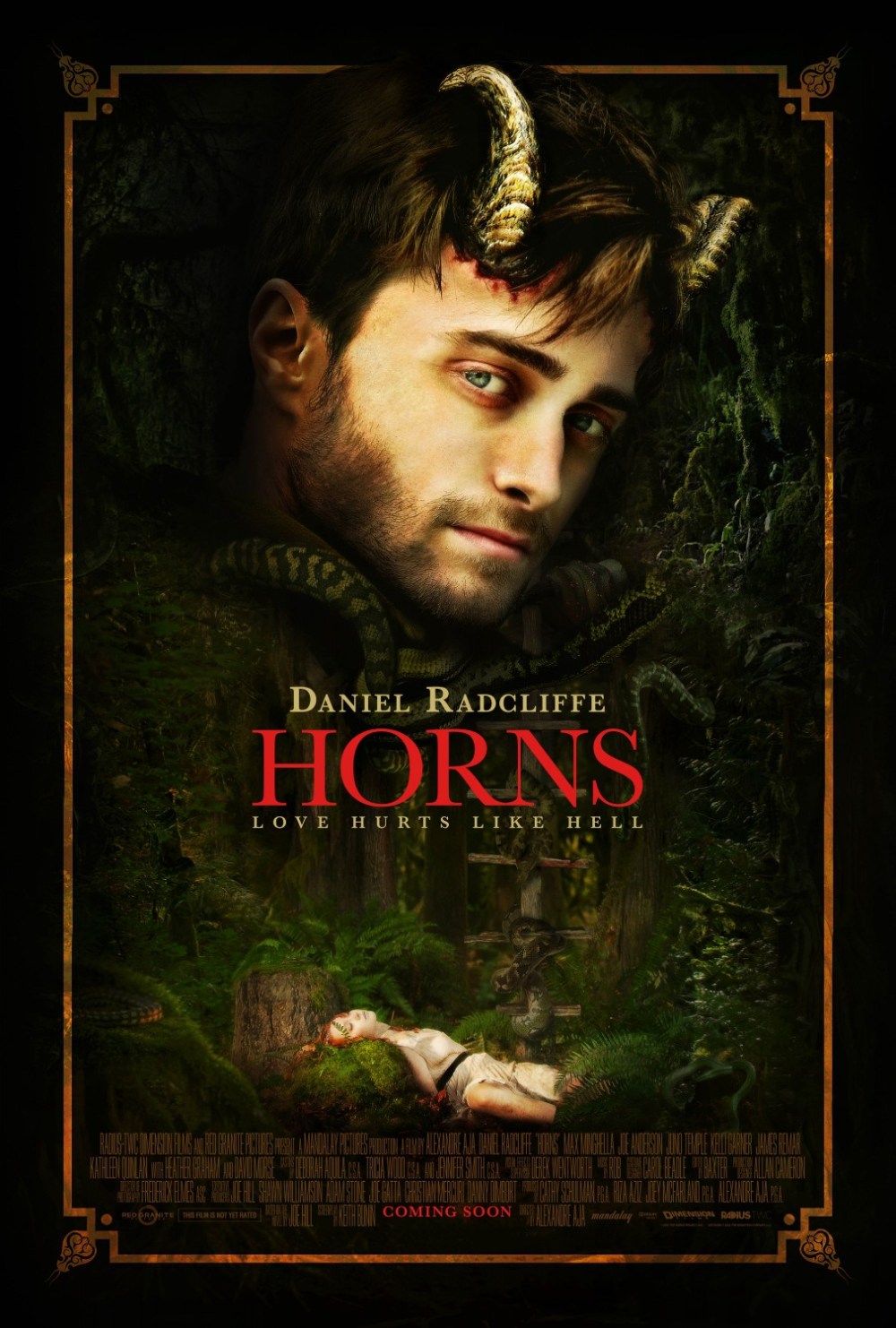
Horns movie poster

The “Horns” press conference held at the Four Seasons Hotel in Beverly Hills, California proved to be a lot of fun as stars Daniel Radcliffe, Juno Temple and writer Joe Hill, whose book the movie is based on, shared great memories about the making of this dark fantasy. Radcliffe plays Ig Perrish, a young man madly in love with Merrin Williams (Temple) and who will do anything for her. But as the movie opens, we discover Merrin was brutally murdered, and everyone thinks Ig was the one who killed her.

In addition to scenes where we see Ig and Merrin being intimate with one another, we also get to see a flashback where these two lovers first met. This resulted in two younger actors being hired to play these characters: Mitchell Kummen as Ig and Sabrina Carpenter as Merrin, and both look a lot like Radcliffe and Temple. While watching this sequence, I started thinking of the movie “Contact” in which Jodie Foster plays Eleanor Arroway and Jena Malone plays the same character as a young girl. In her commentary track on the “Contact,” Foster said the following:

“I always love watching actors play me, and actually it’s always the reverse; whenever you hire a child actor to play the adult actor, you just ask the adult actor to copy the kid. That’s certainly what Tom Hanks did in ‘Forest Gump,’ and that’s what I tried to do a little bit in this movie.”

That remark stayed with me long after the first time I heard it, and I wondered if Radcliffe or Temple had the same experience with the actors playing the younger versions of themselves in “Horns.” I asked Radcliffe about that, and his answer led to one of the funniest moments of the day.

Daniel Radcliffe: That’s interesting because we didn’t really see a huge amount of what the kids were doing. I was often, when they would be doing stuff, getting made up or de-made up or something would be going on so they would try and time it like that, so I didn’t really get to see a lot of what they were doing. I got to spend quite a lot of time particularly with Mitchell on the movie, and it was funny because Sabrina lives in L.A. now and she’s 13 going on 21. She’s incredibly mature and well above her years, and Mitchell is like I was when I was like 13. He’s a kid from Winnipeg, and he’s like a kid and he’s incredibly sweet. He’s awesome and I just like the fact that… Obviously, Mitch is blond naturally and he’s got much fairer hair than I do, and they dyed his hair on the first day. He went back to his hotel in Vancouver and nobody knew what he was doing, and then one of the girls just happened to say, ‘Oh you look like Harry Potter.’ That just made his day. He was so happy.

So, while Radcliffe didn’t necessarily take anything specifically from Kummen’s performance, he did illustrate how difficult it can be for casting directors to find an actor to play him as a younger person. Still, both Radcliffe and Kummen took the same character and made it their own in this movie. Thanks to their performances, we succeeded in getting the best of both worlds in “Horns.”