‘Blaze’ Gives a Late Musician the Audience He Never Got in Life
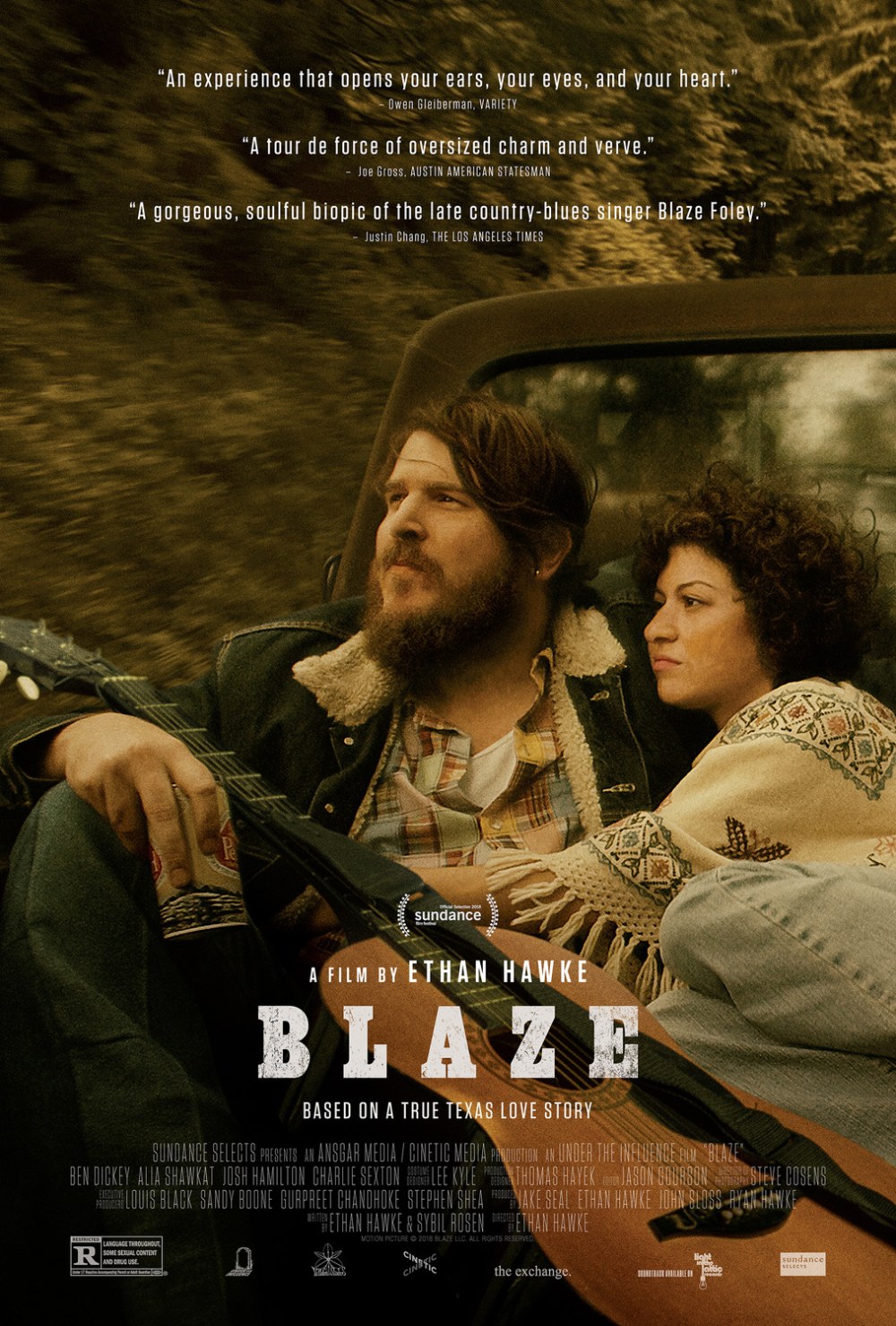
Blaze 2018 movie poster

There have been a number of music biopics in the last few years like “Straight Outta Compton,” “Love and Mercy” and “I Saw the Light.” Looking back, I wonder if my enjoyment, or lack of, was the result of how much knowledge I had of their main subjects: the rap group N.W.A., Beach Boys singer Brian Wilson, and country singer Hank Williams. Typically, biopics focus on people we know of, and I went into them wondering if the filmmakers had anything new to say about these iconic figures. Biopics are, of course, “based on a true story,” so you can expect many liberties will be taken with the source material, so this just complicates things even more.

I bring this up because “Blaze” deals with a country singer and songwriter whom I am not familiar with, Blaze Foley. Many consider him a cult figure in the realm of country music, especially in Austin, Texas. What results here is an absorbing motion picture which delves into the life of a musician whose life, like many of his ilk, was cut short at far too young an age. Part of me wonders if my enjoyment of this movie would have been affected had I known more about Blaze Foley before I walked into the theater, but considering how much I liked it, I suppose the answer doesn’t matter much.

Based on the memoir “Living in the Woods in a Tree: Remembering Blaze” by Sybil Rosen, “Blaze” weaves together three different timelines which examines this musician in life and death. We see him develop a loving relationship with aspiring actress Sybil Rosen (Alia Shawkat) to where she becomes his muse. Then we see him being discussed post-mortem by his close friends Zee (Josh Hamilton) and Townes Van Zandt (Charlie Sexton) on a radio show, and they reflect on his life with both respect and bafflement. And then there is the Blaze’s last night on earth which is presented in an unspectacular fashion, and we come to mourn a loss which was deeper than many realized at the time.

The narrative of “Blaze” shifts back and forth quite often, but I never lost track of where the story was going. This is saying a lot as the editing job on this movie could have rendered it into a complete mess, but it instead makes “Blaze” into an especially interesting motion picture as I was never sure which direction it would end up taking. Viewing a person’s life while they were alive and after they died proves to be endlessly fascinating here as we see all sides of the man in a way which feels both subjective and objective.

While watching “Blaze,” I kept thinking of “I Saw the Light” which focused on the life of Hank Williams. While it featured a stellar performance by Loki himself, Tom Hiddleston, the movie was a narrative mess even though it was told in a linear fashion. There were moments where it took me some time to figure out what was happening as events jumped from one place to another with very little warning. “Blaze” could have been a similar mess, but Hawke never lets us lose sight of where things are going, and kept my attention throughout as I was intrigued to see where the movie would head next. I can’t say that for a lot of biopics these days.

When we first see Blaze Foley, he is a complete mess and screwing up a recording session to where a producer does little to hesitate in throwing him out of his studio. But then we rewind back to when he was an up and coming musician who showed the great love he had for music. Sybil asks him if he wants to be famous, but Blaze replies he how he instead wants to be a legend. As the movie goes on, we see him struggling with being a true musician and becoming a star in a way which he feels will dilute everything he does. When the movie started, I felt it would be like Oliver Stone’s “The Doors” which made Jim Morrison into the kind of musician you thought you would like to spend time with, but ended up wanting to avoid at all costs. Instead, the movie dares to look at Blaze’s life in a way which evokes both sympathy and pity.

In his unorthodox way of wooing Sybil, we see Blaze defying ordinary conventions in showing his love to another human being. As the movie goes on, we watch as he struggles with both his artistic ambitions and the fear he has of becoming a commodity which may make him a rich man, but will also rob him of any artistic integrity he ever hopes to have. Clearly this is a musician who wants to leave his mark on society, but like any stubborn artist, he wants to leave his mark on his own terms. The trouble is, does anyone get to leave their mark on this world on their own terms?

“Blaze” was co-written and directed by Ethan Hawke, an actor who has struggled with his place as a celebrity. We know him for acting in box office hits like “Dead Poets Society” and “Sinister,” but he is also well-known for delving into movies which defy mainstream convention like the “Before Sunrise” trilogy. I can see how the story of Blaze Foley appealed to him as Blaze is an artist who wants to be true to his art, but he is also subjected to the pressures of commercial success, or the potential for it, to such a degree that they fold under the pressure or have an overwhelming fear of being seen as a sellout. Hawke continues to walk the fine line between Hollywood and indie movies, and I believe it when he says how long it took for him to become comfortable with the fame he had achieved.

Hawke has directed a few movies previously such as “Chelsea Walls” and “The Hottest State,” both of which had their share of flaws but showed him to be a filmmaker willing to take chances even if critics questioned his methods and material. With “Blaze,” he has given us a motion picture which feels assured in its vision, and it features some of the most ingenious editing I have seen in movie in some time.

Playing Blaze Foley is musician Ben Dickey, a man who has never acted before. But in a movie like this, the actors are meant to inhabit their characters more than play him, and Dickey ends up inhabiting Blaze in a way few others could. His life is similar to Blaze’s in a number of ways as he also has music running through his blood and has traveled throughout America playing songs filled with cinematic imagery which deal with life at its most hopeful and at its darkest.

As Blaze. Dickey gives the movie its heart and soul as we see him traveling through life wanting to be pure as an artist while dealing with a past and a heartache that will never let him be. He is matched perfectly with the fantastic Alia Shawkat as Blaze’s wife and muse, Sybil. I admired her work in a movie which came out earlier this year called “Duck Butter,” and she brings same emotionally raw power to the role of a person who lives to be another’s muse until it becomes too much to bear.

My only real complaint with “Blaze” is it never digs too deep into the singer’s life. We get only hints and implications of how troubled his childhood was, but no real specifics are given so we can only guess what led him to be such a tortured soul. We do get a nice cameo from Kris Kristofferson as Blaze’s father who is seen asking everyone for a cigarette, but it only tells us so much about their relationship. Perhaps Hawke felt it was better to imply certain things without spelling everything out to audience.

Hawke has had quite the year with this and “First Reformed,” and “Blaze” shows he has long since arrived at a place where he can do passion projects like this and Hollywood films to where he can transition from one to the other with relative ease. More importantly, he makes Blaze Foley into a complex human being who may have alienated many people close to him, but we never lose our empathy for the struggles he endures. I have seen many biopics which try to present a complex portrait and have failed to get below the surface, and it says a lot that Hawke doesn’t make the same mistake here.

* * * ½ out of * * * *

‘The Trump Prohecy’ – Yes, it is Real, and it Looks Awful

The Trump Prophecy poster

I learned of this movie’s existence through an article on the Birth Movies Death website, and its headline declared its trailer to be “one of the worst things we’ve ever seen.” Just when I thought I wouldn’t see a worse movie in 2018 than “Death of a Nation,” this one just might beat it for that unenviable title. But after watching this trailer, I’m not really eager to see it after sitting through Dinesh D’Souza’s latest historical garbage-fest.

The Trump Prophecy” is a Christian drama which tells the story of fireman Mark Taylor who believes, in April 2011, God told him Donald Trump would one day be elected President of the United States. Well, this makes sense, right? Because we know God talks to the sanest people on planet Earth all the time, right? And why wouldn’t God want Trump move into the White House? Could there be another white man who can personify what a true Christian is other than the host of “The Apprentice?”

Yes, I’m being sarcastic, but you can tell. “The Trump Prophecy” looks to defy all reasonable logic to make its audience believe Trump was anointed by God to become President of the United States. The trailer starts off with us being introduced to Mark Taylor (Chris Nelson) who talks about having seen everything as a fireman. But then we see him suffering through a nightmare, and the acting on display is as bad as any in “Death of a Nation.” Remember the beginning where Eva Braun dies a most unintentionally hilarious death? Mark’s bad dream threatens to be even worse.

From there, we people praying endlessly for what one character calls “the Commander-in-Chief prophecy.” Basically, Mark thinks his dreams are God’s way of talking to him. We are then shown headlines which say how Trump has no chance of winning the election, but Mark is intent on leading others in prayer as he looks to make America great again in a way which defies logic. There’s even a bible verse mentioned which I guess is used to justify this movie’s title. The description of this movie is hilarious enough, but watching its trailer has my eyes rolling all the way in the back of my head.

Look, many have a strong bias against faith-based movies like “God’s Not Dead” as they are made with an agenda in mind which results in a product which is an unforgivable insult to our collective intelligence. I try to keep an open mind to them as not all of them are out to do this, but “The Trump Prophecy” clearly is as there still many supporters who are determined to support Trump in spite of all the damage he has done so far. By now, it should be clear to the majority of Americans, let alone people around the world, that Trump is anything but a true Christian. He cheated on his wife with Stormy Daniels, his administration is full of corrupt people, several of who have since been indicted, and he clearly holds his own self-interests above all others.

“The Trump Prophecy,” like many faith-based movies, was made on a very low budget ($2 million to be exact) and in cooperation with the film department at Liberty University, the evangelical Christian school founded by the late Jerry Falwell. It is also directed by the head of that school’s film department head, Stephan Schultze. Only evangelical Christians would dare make a movie like this as they remain convinced beyond a doubt that Trump deserves to be President above all others, including those who are actual politicians.

Yes, I am tempted to see it in the same way I rush out to see Dinesh D’Souza’s movies, so I can analyze everything wrong with them. But this time I think I will pass as there are many others worth my time as Oscar season is heating up. Learning of “The Trump Prophecy” and watching its trailer simply serves as a reminder of how people willfully blind themselves to horrible truths, and of why Christianity and evangelical Christianity need to be seen as two very separate things.

Right now, I keep thinking of John Carpenter’s “Pro-Life,” the “Halloween” director’s second episode for the Showtime series “Masters of Horror.” That episode featured a religious fanatic played by Ron Perlman who was determined to rescue his daughter from an abortion clinic, especially after he hears a voice telling him to save her baby. But in the end, the voice he hears is revealed to be a demon who looks to unleash literal hell on earth. Perhaps it is unfair to compare Mark Taylor to Ron Perlman’s character as I am sure he is a decent man looking to lead a peaceful life, but hey, both said God talked to them.

Fathom Events will be screening “The Trump Prophecy” two days only, October 2 and 4, 2018, in theaters throughout the United States. While watching the trailer, which is included below, you may hear a voice talking to you. If this voice is telling you “save your money,” you are not insane.


‘The Predator’ is This Franchise’s Best Installment Since the Original

The Predator movie poster version 3

Having Shane Black co-write and direct “The Predator” brings this franchise around full circle. Black appeared in John McTiernan’s “Predator” as Rich Hawkins, a member of the elite military rescue team led by Butch (Arnold Schwarzenegger), and he was the first of the group to get mercilessly slaughtered by the “ugly motherfucker.” Since then, Black has become a master screenwriter with “Lethal Weapon,” “The Last Boy Scout” and “The Long Kiss Goodnight” as well as a gifted director with “Kiss Kiss Bang Bang,” “The Nice Guys” and “Iron Man 3” on his resume. At the same time, the “Predator” franchise quickly became an unwieldy one as “Predator 2,” while it had its moments, suffered from too many clichés and stereotypical characters who were just asking to be killed. “Predators” was fun, but it didn’t quite jumpstart this series in the way its filmmakers intended it to. The less said about the “Alien vs. Predator” movies, the better.

With Black’s gift of turning various movie genres inside out through terrific dialogue and unforgettable characters, it feels like only he could helm this “Predator” installment. If this creature is going to continue to have a cinematic life, it needs a filmmaker willing to liven things up and twist things around in an effort to make this franchise vital again. Thanks to Black and co-writer Fred Dekker, “The Predator” is easily the best and most consistently entertaining installment since the 1987 original. While it may not have the same lethal menace of McTiernan’s sci-fi action classic, it certainly feels like a Shane Black movie, and that is more than enough.

“The Predator” begins as most “Predator” movies do, with something or someone falling from the sky onto a planet at alarming speed. As a spaceship makes its way to an inevitable crash landing on Earth, Army Ranger Quinn McKenna (Boyd Holbrook) is aiming to take out drug dealers who have hostages. The spaceship crashing foils this mission, but Quinn comes into contact with the alien’s hardware and a device which makes him nearly invisible. Knowing certain members of the military, particularly agent Will Traeger (Sterling K. Brown), will do anything to keep this alien encounter under wraps, Quinn mails the hardware to his home where it is discovered by his son Rory (Jacob Tremblay) who, thanks to the form of autism he has, is able to activate it to where several predators are alerted, and from there it is only a matter of time before all hell breaks loose.

What struck me most about “The Predator” is how well-conceived its human characters are. While they may come across as your typical military movie characters, Black and Dekker invest them with pathos and a great deal of black humor. This is especially evident in the scene where Quinn is being interrogated by a military psychiatrist as it shows how he is quick to tell others they need to cut through the bullshit. Characters like Quinn know they are in over their heads to where they do not want others to lie outright to them. It has become far too easy to cast doubt on an individual than it is to believe one, and the military shows no mercy in doing the same to Quinn as they are quicker to put a bullet in his head instead of telling him, “Thank you for your service.”

Quinn gets thrown on a boss with a bunch of former soldiers who are on their way to the nearest loony bin as they are, at first glance, certifiably crazy. These fellow soldiers are played by Trevante Rhodes, Keegan-Michael Key, Thomas Jane, Alfie Allen and Augusto Aguilera. I really enjoyed how each actor made their character wonderfully unique in politically incorrect ways. Black and Dekker are not about to give us watered-down characters which would be easier for certain audience members to digest, and each actor clearly relishes the material they have been given. Their performances make these characters stand out in a way they would not in other sci-fi action movies, and that’s saying a lot.

Also starring in “The Predator” is the gorgeous Olivia Munn as Casey Brackett, a disgruntled scientist who is enlisted by the military to study the alien and its technology up close. Of course, once Casey learns more than the military would like, she becomes a target for assassination because, once again, people in power are eager for those they consider beneath them to remain silent, at times permanently so. But Munn makes Casey into anything other than an easy victim as she effectively intimidates these former military officers into making her a part of their team to take down this particular illegal alien. She is a blast to watch throughout, and I hope to see her again in a future sequel.

Holbrook left a strong impression on audiences in “Logan” as he made that movie’s antagonist more than the average bad guy, and he is perfectly cast here as an antihero who is not too different from Snake Plissken. In the real world, Quinn is not a guy you would be quick to hang out with on a regular basis, but Holbrook wastes no time in making you see he is the dude we need to save the day.

Tremblay, so good in “Room,” makes Rory into a unique movie child which I found very refreshing. Moreover, I admired how Tremblay was able to communicate so much while saying so little much of the time. But when he does get to speak, he is gifted with the uber clever dialogue of Shane Black. I also love how Rory is one of my favorite kind of kids in movies as he can see right through their parents’ bullshit to where he is very eager for them to cut the crap and tell him the truth. Furthermore, kudos to the filmmakers for making Rory’s form of autism something other than a disability. Certain things are only disabilities if you treat them as such.

I also got a big kick watching Sterling K. Brown as a military agent who is eager to exploit the predator’s technology before anyone else can. Unlike the character he plays on “This is Us,” here he portrays a man who is never quick to shed a tear, and this makes his performance all the more invigorating to take in.

“The Predator” does have its flaws as the narrative gets increasingly messy towards the movie’s furious conclusion, and certain action scenes are filmed frenetically in a Michael Bay-ish way to where it’s hard to make out all that is going on. Apparently, the last half of the movie had to be reshot as test audiences found it to be too dark. At least the filmmakers had the support of a major studio to do these reshoots. The same couldn’t be said for those working on the failed Stephen King adaptation “Cell” as that movie’s last half was far too dark for anyone to get a clear idea of what was ensuing.

It is important to note “The Predator” takes place after the events of “Predator” and “Predator 2,” but before those of “Predators.” Taking this into account, it is clear 20th Century Fox wants this installment to be the beginning of a trilogy as Hollywood is infinitely interested in franchises than they are in films not designed to have a follow up. Only time will tell if “The Predator” will get a sequel, but what I can tell you is I had a lot of fun watching it, and for my money it is the best “Predator” movie since the original. Even as I kept hoping Schwarzenegger’s character of Dutch would make an appearance (he does not), few things could keep me from enjoying this sequel to excellent effect. I had a blast watching it, and I hope you do too.

* * * ½ out of * * * *

‘BlackkKlansman’ is Spike Lee’s Best Joint in Years

BlackkKlansman movie poster

Those who read my reviews know how much I despise the term “based on a true story” as it has long since lost its meaning for me. However, Hollywood has been looking for ways to provide variations on this phrase in recent years in an attempt to give it back the value it once had. One of my favorites was “Argo” which was advertised as being based on a “declassified” true story which made it worth seeing all the more. Still, every other movie these days is “based on a true story,” and pointing this out should make you wonder which ones were not. Besides, aren’t all movies based on or inspired by things we have experienced in real life?

BlackkKlansman,” a Spike Lee joint, is the latest movie to be “based on a true story,” but its poster has advertised as being “based on a crazy, outrageous, incredible true story.” Personally, I prefer the phrase Lee uses in the movie itself which says it is based on “some fo’ real, fo’ real shit.” This description feels far more honest as it would have seemed unbelievable were this movie released a few years ago. What results is the best joint Lee has made in years, and I could not recommend it more highly.

Based on the memoir “Black Klansman,” it stars John David Washington as Ron Stallworth who, when we first meet him, is on his way to apply at the Colorado Springs police department and become its first ever black detective. This distinction, however, doesn’t do much for him in the beginning as his fellow officers, particularly the slimy Patrolman Andy Landers (Frederick Weller) who does little to hide his racist attitudes, and he is eager to rise up in the ranks.

Following a boring stint in the records room, Stallworth gets transferred to intelligence where he comes across an advertisement for the Klu Klux Klan which looks to find new members. It is great fun watching Washington talk on the phone with Ryan Eggold who plays Walter Breachway, President of the KKK chapter of Colorado Springs, as he effortlessly convinces him he is as white as they come. This act quickly grabs the attention of Detective Flip Zimmerman who is played by Adam Driver, and it is a gas watching Driver slowly turn around in his chair once he realizes what Stallworth is up to.

Of course, Stallworth does make a critical mistake during this phone call; he uses his real name. As a result, he is forced to turn to Zimmerman who has to pretend to be Stallworth in person as they further infiltrate the KKK. This infiltration becomes a delicate balancing act as Stallworth continues to fool the racist organization over the phone while Zimmerman is forced to fool them in person. In the process, we come to discover how much easier it is for a black man to pretend to be white than it is for a white man to pretend to be black.

“BlackkKlansman” couldn’t be timelier as it digs deep into a past which has a frightening resemblance to America’s present. The KKK is shown here to be as violent and racist as they are today as they keep chanting “America first” and plot acts of violence designed to eliminate those in their way and instill fear in the general public. One of the most disturbing scenes comes as we watch them cheer unabashedly at a screening of D.W. Griffith’s “Birth of a Nation” which portrayed the KKK as heroic and African-Americans as being unintelligent and sexually aggressive. Lee does nothing to hide the racist caricatures Griffith put onto the silver screen back in 1915, and they are as infuriating to take in today as they were a hundred years ago.

It’s very ironic how “BlackkKlansman” was released in theaters around the same time Dinesh D’Souza’s latest propaganda piece, “Death of a Nation,” came out. Both movies deal with “Birth of a Nation” in different ways and acknowledge how it was the first American motion picture ever to be shown inside the White House. D’Souza portrays President Woodrow Wilson as getting a liberal erection from watching Griffith’s movie, and he took this a step further in “Hillary’s America” by having a KKK member on horseback leap out of the screen to where Wilson is shown as being completely hypnotized by this image. D’Souza, however, leaves out “Birth of a Nation’s” more inflammatory segments which include deeply offensive depictions of blacks, something Lee does not shy away from showing here.

As is the case with movies “based on a true story,” “BlackkKlansman” does take numerous liberties with the source material. The events of this story took place in 1979, but Lee has moved the timeline back to 1972 which allows him to acknowledge certain Blaxploitation classics as well as the re-election efforts of President Richard Nixon. It is also said how David Duke never realized Stallworth was a black man until 2006, but the change here was worth it as leads to one of the movie’s best and funniest scenes. With movies like these, it is more important to be true to the spirit of the facts than anything else, and those who have a problem with that can always read Stallworth’s memoir instead.

There’s some additional irony here with “BlackkKlansman’s” release as it is coming out not long after the “Superfly” remake. One scene has Stallworth talking with his girlfriend, Patrice Dumas (Laura Harrier), about which movie was cooler, “Super Fly” or “Shaft.” Patrice replies how “Super Fly” unfairly stereotypes black men as criminals, but it also showed a realistic grittiness to life in the city which was complemented by the brilliant soundtrack composed by Curtis Mayfield. It would be interesting to see how Patrice would have felt about this summer’s remake which threatened to glamorize gangster life more than ever before, and it made me wonder why anyone bothered remaking this blaxploitation classic in the first place.

Then there is former President Nixon whom D’Souza tried to convince us was a true progressive like any other Republican in “Death of a Nation.” We do not see much of Nixon in “BlackkKlansman,” but we do see his re-election posters displayed prominently in KKK hangouts as they were supposedly big supporters of his. Seeing this makes me think of the old Vulcan proverb Spock spoke of in “Star Trek VI” which said “only Nixon could go to China.”

“BlackkKlansman” is designed to make us mad at how history is repeating itself as white supremacist groups have flourished under the Donald Trump administration, but it is also insanely funny at times as it is almost impossible to believe anyone could have gotten away with what Stallworth and Zimmerman did here. Then again, in a time where John Melendez, a.k.a. Stuttering John of the Howard Stern Show, managed to trick Trump into believing he was Senator Bob Menedez in a phone conversation, perhaps it doesn’t seem unbelievable in the slightest

Honestly, it has been some time since I last saw a Spike Lee joint. His movies get overwhelmed at times by his camera tricks and flourishes and overly bombastic music scores which make me want to turn the volume. But with “BlackkKlansman,” Lee has crafted a film where everything feels perfect and spot on, and what results is highly entertaining and deeply visceral. Even as the “Do the Right Thing” director wants you to see how the past never left us, he invites us to revel in Stallworth’s successful infiltration even as those in power want to bury his victories.

There is not a single weak performance to be found here. Both Washington and Driver dig deep into their characters’ complexities as they try to remain professional in an increasingly volatile situation, but their own personal beliefs threaten to get in the way. Jasper Pääkkönen proves to be a fiery presence as Felix Kendrickson, the white supremacist who looks like a grenade primed to explode at any given moment. Corey Hawkins is magnetic as Kwame Ture when he rouses his followers at a civil rights rally. And Topher Grace proves to be an inspired choice to play a young David Duke who is shown to be aloof as to who Stallworth really is, and that’s even when Stallworth is assigned to be his security detail while in Colorado Springs.

It is no mistake Lee concludes “BlackkKlansman” with footage from the Unite the Right rally which took place in Charlottesville, Virginia as the movie is being released on its first anniversary. We see white supremacists marching the streets with tiki torches saying they will not be replaced, we see the real David Duke talk about how Trump is making “America great again,” we see Trump respond to the rally by saying how there were good people on both sides, and we see the car attack perpetrated by a white supremacist which injured many and killed Heather Heyer. While we look at the past as if it is barely visible in our rearview mirrors, it is real events like these which remind us how these same mirrors have the message of how things we see in them are much closer than they appear.

The image of an upside-down American flag which fades into black and white is the perfect image to end “BlackkKlansman” on as we are truly living in “The Twilight Zone” with everything that’s going on. It also reminds me of the final image of that same flag in John Singleton’s “Higher Learning” which ended with the word “unlearn” being typed out over it. Those who do not learn from the past are condemned to repeat it, and history continues to repeat itself again and again and again. The fight for justice has never ceased, and the progress we all thought Americans had made is not as great as it seemed. Lee has made an overtly political movie which could not have come out at a more appropriate time, and it is his best one in years.

* * * * out of * * * *

Michael Moore Unleashes the First Trailer for ‘Fahrenheit 11/9’

Fahrenheit 119 teaser poster

After witnessing the cinematic debacle that was Dinesh D’Souza’s “Death of a Nation,” I am now eager to watch something which looks at the state of America which actually resembles reality. Looks like I will have to wait only a month for it as Michael Moore has released the first trailer for his latest documentary, “Fahrenheit 11/9.” The title alludes of course to “Fahrenheit 9/11” in which Moore attempted to take down George W. Bush and deny him a second term in the White House, but it also alludes to the date on which Donald Trump captured the electoral votes he needed to become President of the United States. In this trailer, Moore asks the question we were all asking on election night in 2016:

“What the fuck happened?”

We are shown scenes of Trump acting irresponsibly during his campaign, scenes you will never see in any D’Souza movie. There is also a moment where we see White Supremacists burning crosses, and these are a group of people who have become far too emboldened during the Trump administration. But despite the images of doom and gloom Moore gives us here, he does appear to offer a glimmer of hope through his interviews with high school shooting survivor and activist David Hogg and progressive star Alexandria Ocasio-Cortez. And let us be clear, Hogg can in no way ever be considered a crisis actor.

Still, there is political consultant Roger Stone who is caught on camera saying, “Try to impeach him, just try. You will have a spasm of violence in this country like you have never seen!” Considering the tragedy this country witnessed in Charlottesville one year ago, this does seem like a promise people like him can deliver on. All the same, we cannot stay silent or back down.

As dark as this documentary may seem, especially with the image of the American flag made out of matches which are quickly lit to form a visual metaphor of what is happening to this nation, Moore looks to be up to his old tricks as he goes after politicians with a truck of polluted water from Flint, Michigan, and this had me laughing quite a bit. I do have to say, however, that the water looks a little too clean to be from Flint.

Granted, “Fahrenheit 9/11” did not keep George W. Bush from being re-elected (if you want to call it that) for a second term, but here’s hoping “Fahrenheit 11/9” succeeds in stopping Trump and his cronies in their traitorous tracks when it opens in theaters on September 21, 2018.

Check out the trailer below.

Dinesh D’Souza’s ‘Death of a Nation’ is Political and Historical Garbage

Death of a Nation movie poster

I couldn’t wait to see this movie. That’s right, I called it a movie, not a documentary. Dinesh D’Souza wants you to believe he’s giving you the god’s honest truth, but when it comes to his movies, he instead gives you a distorted vision of reality which he has put together by cherry-picking facts and presenting a thesis statement which any rational human being can easily disprove. As a result, I have come to enjoy D’Souza’s movies for reasons he did not intend as they prove to be both hilarious and infuriating, and whenever I am not bored to death by the ridiculous cases he lays out for us, the experience of watching them proves to be quite visceral.

D’Souza’s latest political screed is “Death of a Nation,” and it comes with the strange subtitle of, “Can We Save America a Second Time?” From the poster, I assumed the recently pardoned conservative political commentator was going to show us how Donald Trump is the contemporary equivalent of Abraham Lincoln, but he instead veers from this to show us in an ill-fated attempt how Nazis and Democrats were very similar in their economic and social policies. Along with co-director Bruce Schooley and producer Gerald R. Molen, D’Souza employs his usual tactics which include poorly acted and directed historical reenactments as well as scenes of him walking around and visiting locations which played a role in history. And yes, there are scenes of people (in particular, his wife Debbie) singing patriotic songs to an infinitely nauseating effect. What results is a veritable shit sandwich as D’Souza invites us to see history through his eyes as he begs the audience to see how Democrats are the real fascists, not the Republicans.

I can only imagine just how much glee D’Souza and his collaborators had in the editing room as we are shown scenes of well-known personalities like George Clooney saying out loud how there was no way in hell Donald Trump could ever be elected President of the United States. Indeed, I believed, as did many that Hillary Clinton would have an easy path to victory. So, it was a huge shock to the world at large when Trump scored one of the biggest political upsets in American history as he spent so much time giving us every reason not to vote for him. D’Souza presents videos of Americans sobbing at this victory as they believe nothing good will come from it, and you can sense him mocking them without any remorse. This whole montage really acts a porn for conservative who live to drink the tears of liberals.

D’Souza wants us to see the election of Trump as America rising up against liberal tyranny, and he smugly pats himself on the back by saying his movie “Hillary’s America” played a big role in Trump’s victory. Truth be told, Trump won the election by one of the lowest margins ever, Clinton got almost 3 million more votes in the popular election, and the day of his inauguration had one of the lowest turnouts ever. Of course, D’Souza doesn’t bring these facts up as they would easily take away from he sets out to prove and instead shows us images of Americans howling in agony over the host of “The Apprentice” making his new home at the White House instead of Trump Tower.

As for “Hillary’s America,” it simply preached to an audience who never intended to vote for Hillary in the first place, and its biggest triumph came at the Golden Raspberry Awards where it won several accolades including Worst Picture. Please note, it is the first “documentary” to receive this award.

But following this, D’Souza puts his defense of Trump to the side and instead looks at Adolf Hitler and the history of the Nazi party in a hopelessly vain attempt to compare them to Democrats. As he lays out his pathetic case, I got lost in his convoluted logic to where I gave up trying to understand much of what he was trying to get across. The audience I saw it with was small, and an older guy sitting one row ahead of me began to snore quite loudly. What does that tell you?

The actors here are badly directed to say the least, and the one playing Adolf Hitler (Pavel Kriz) barely even looks like the infamous fascist dictator. I guess Martin Wuttke, who played a far more convincing Hitler in Quentin Tarantino’s “Inglourious Basterds” was unavailable, or perhaps he looked at what D’Souza hoped to accomplish with “Death of a Nation” and told him “bitch, please.” Other actors play famous Democrats to where they stare directly into the camera as if to say they know just how evil they are, and it got to where I expected them to sing “Damn it Feels Good to Be a Gangsta” by The Geto Boys.

Some scenes end up playing like something out of a sitcom as the actors playing Nazis keep screaming out their lines in an overwrought fashion. But nothing compares to the scene where Nazis break into the apartment of a “brown shirt” Nazi and catch him in bed with another man, highlighting the party’s position against homosexuality. After he is arrested and hauled away, the Nazis look under his bed to find yet another man in the apartment. This threatened to be as hilarious as anything in “Deadpool 2,” and I could barely contain myself while watching this scene as this discovery is presented in such an inescapably absurd fashion.

D’Souza does take the time to interview people like political scientist Robert Paxton, Civil War historian Allen C. Guelzo, sociology professor Stefan Kuhl, and syndicated columnist and investigative journalist Edwin Black to name a few. The interesting thing about these interviews is how the majority of them are shot to where we never see D’Souza and his subject together in the same frame. Seeing this, I cannot help but wonder if D’Souza and his accomplices took the words of his subjects out of context in an effort to add weight to a deeply flawed thesis. This makes me want to know how his subjects thought about how they were portrayed after sat through “Death of a Nation.” There is just too much doubt in the way these interviews are presented which cannot be easily dismissed. At least Michael Moore is smart enough to not make this same mistake in his own movies.

Then there is the interview between D’Souza and white supremacist (or white nationalist if you will) Richard Spencer. As D’Souza fumbles about in his attempts to expose Spencer as a progressive, he discusses how the founders saw government as being the enemy of the people. This is one of “Death of a Nation’s” most jaw-dropping moments as anyone with knowledge of American history will be quick to point out how our founding fathers created a government of, for and by the people. We see Spencer quickly disagreeing with D’Souza over this assessment as even he believes the founding fathers did not see the government as the enemy, and it doesn’t help D’Souza when he gets owned by a White Supremacist.

As “Death of a Nation” rolls on, D’Souza comes to repeat many claims he made in his previous movies. Among them is his assertion that Democrats never switched their political views in the past, and he made this same claim in “Hillary’s America.” When he presented us with this false information originally, we could barely make out the faces of the politicians on the silver screen, and we needed the Hubble telescope to make any of them out. In “Death of a Nation,” we get a better look at those democrats D’Souza was talking about, but it doesn’t change how Democrats or Republicans are no longer the same parties they once were.

When D’Souza finally gets around to defending Trump, he does so by presenting us with scenes of President Lincoln (played by Don Taylor) speaking eloquently and then tells the audience how Trump has the same integrity Lincoln had all those years ago. But considering how Trump has been proven to be very temperamental, has broken many promises he made on the campaign trail, cheated on his wife Melania with Stormy Daniels, has a history of stiffing people he was supposed to pay and, most unforgivably, valued the word of Russian President Vladimir Putin over America’s own intelligence community, one has to wonder if D’Souza even knows the meaning of the word integrity. Once again, D’Souza does not acknowledge any of this, and it should not be hard at all to understand why.

D’Souza’s last bit of business is to show how Trump is not a racist, and he does so by showing him at a State of the Union address where he says, “African-American unemployment stands at the lowest rate ever recorded, and Hispanic-American unemployment has also reached the lowest levels in history.” To this, D’Souza replies, would a racist talk like this? Well, there is a slight problem here. While what Trump says is technically true, the fact is unemployment rates for African-Americans and Hispanics have been decreasing steadily for years, so for him to take credit for this is deliberately misleading. For D’Souza to use this as evidence of Trump not being a racist is just hilarious, and he instead falls into a trap he would have been smart not to set for himself.

Look, I have no doubt D’Souza loves America, but for him to show this love through a manipulation of history and facts is beyond deplorable. These days, it is more about who controls the narrative than it is about verifying facts, and D’Souza seizes on this national weakness in a completely shameless way. “Death of a Nation” is a failure from the get go as it is impossible to put liberalism and fascism into the same category. Just ask historians Adam Tooze and John Broich who have gone out of their way to discredit “Death of a Nation.” Broich himself pointed out how fascism is essentially “anti-leftism,” and he quotes scholar Robert Paxton who said fascism is “dictatorship against the Left amidst popular enthusiasm.” Unlike D’Souza, these guys know what they are talking about.

“Death of a Nation” still has a score of 0% on Rotten Tomatoes, and it does not look to escape this rotten rating any time soon. D’Souza has blamed this rating on “leftist” critics as he is determined to stand by his movie no matter what, and he is daring the Golden Raspberry Awards to shower it with every “Worst of” accolade possible. Look, it’s one thing to criticize the Democratic Party, and D’Souza has the right to do so, but to sell the public on comparisons to the Nazi party which are blatantly fale is truly pathetic. Explaining to D’Souza just how wrong he got history in this or any of his other movies is pointless as he will be quick to put his hands over his ears and spin around in circles saying, “There’s no place like the Ronald Reagan Library! There’s no place like the Ronald Reagan Library!”

How will D’Souza react to my review, assuming any he ever bothers to read it? I imagine he will dismiss me as another leftist critic or something along those lines. Anyone who wants an idea of where my political beliefs are can check out my Facebook page. All that matters is this movie is anti-intellectual as well as political and historical garbage. Yes, I enjoy watching D’Souza’s movies, but mainly for the opportunity to analyze everything that’s wrong with them. When I get past the unintentionally hilarity they provide me, what I am left with is pure nonsense which is truly infuriating. If you choose to see “Death of a Nation,” see it as an example of how NOT to make a documentary and of how people will go out of their way to manipulate history to their own ends.

For those of you who are still willing to believe in D’Souza’s political and historical garbage, I have a used Yugo for sale which goes from zero to 60 miles an hour in five seconds. Please message me privately if you would like to know more.

ZERO out of * * * *

Please check out the following articles in which writers lay waste to the connections D’Souza makes in this movie:

“There is Nothing Liberal about Fascism” by John Broich

“Donald Trump Jr. Compares Democrats’ Policies to Those of the Nazis” by Andrew Buncome

“The Apotheosis of Dinesh D’Souza” by 

Kevin Kruse’s Recapitualation of Dinesh D’Souza’s View of American history

‘Christopher Robin’ Has Enough Childlike Wonder to Make it Worthwhile

Christopher Robin movie poster

Christopher Robin” has been compared by many to Steven Spielberg’s “Hook” even before its release. Truth be told, this comparison holds a lot of weight as both films deal with characters we were introduced to as children who have since grown up and left behind the imaginary worlds they reveled in. Both get married and become parents, and we catch up with them as they have long since become consumed by their jobs at the expense of everything else. The question is, can they rediscover the innocence and wonder they once had? We go into these movies knowing the answer will be yes, but we how long will it take? In the case of “Christopher Robin,” this man is quicker than Peter Pan to do so, and this makes the film fare better than “Hook.”

The movie starts off with young Christopher (played by Orton O’Brien) being given a going away party by his furry friends in the 100 Acre Wood as he is about to head off to boarding school. Among his friends is, of course, Winnie-the-Pooh whom he promises never to forget about once he goes away. But as the opening credits unfold, we see Christopher being molded into what society expects of him. Seeing a teacher slam her ruler on his desk quickly brought to mind the lyrics of a certain Pink Floyd song (“we don’t need no education…”). Even worse, he loses his dad much sooner than anyone should, and this forces him to grow up much quicker as he is now considered to be the man of the house. And there is the sequence of him as a soldier on the battlefield, and while it does not include any exploding limbs a la “Hacksaw Ridge” (it’s a Disney film after all), we are shown enough to be convinced Christopher has seen his share of brutal combat.

When we catch up with Christopher as an adult (played by Ewan McGregor), he is married to the lovely Evelyn (Hayley Atwell), father to Madeline (Bronte Carmichael), and an employee at Winslow Luggages. It is no surprise to see he has long since become consumed by work as he makes the mistake of telling his boss, “I’ll do anything for this company.” Now this is something I have long since learned never to tell any employer as they will be quick to blackmail you emotionally, and this is compounded by Christopher’s co-workers constantly living in fear of unemployment. As a result, Christopher is forced to cancel his trip into the country with his family, and they do not even try to hide their disappointment to where Evelyn flat out tells him, “I haven’t seen you laugh in years.” Christopher ends up all alone, that is, until Pooh arrives in London seeking his helps. Pooh has lost all his friends in the 100 Acre Wood, and the two go on a journey which serves to save both of them from a world without love and imagination.

“Christopher Robin” is at its best whenever McGregor and Pooh bear share the screen together. Unforgettably voiced by Jim Cummings, the “silly old bear” remains one of the most lovable creations in literature as he keeps saying he doesn’t have much of a brain, but he proves to be full of Yoda-like wisdom throughout. Instead of being animated this time out, Pooh and his friends are brought to life through CGI effects to more closely resemble the actual toys A.A. Milne owned all those years ago. But as amazing as the effects are, it is Cummings who gives Pooh his heart and soul as he professes to Christopher how “doing nothing often leads to the very best kind of something.”

When it comes to the other furry friends from the 100 Acre Wood, some get more screen time than others like Tigger and Eeyore. Those who know me best know I am a die-hard Eeyore fan, and just as with the animated “Winnie-the-Pooh,” the infinitely depressed donkey steals the show thanks in large part to the vocal talents of Brad Garrett who gives Sam Elliott a run for his money in the baritone department. Eeyore has always been a wonderful supporting character in Milne’s stories as he marches on despite his gloomy state of mind, and Garrett makes him a source of incredibly dry humor throughout. Now if only Eeyore could get his own movie…

Directing “Christopher Robin” is Marc Foster, who at first seemed like an odd choice for this material. Foster previously gave us the devastating “Monster’s Ball,” the James Bond adventure “Quantum of Solace,” the Brad Pitt zombie movie “World War Z,” and “Machine Gun Preacher” (the title says it all). Perhaps it was his film “Finding Neverland” which snagged him the job as that one was about J. M. Barrie and his relationship with a family who inspired him to create “Peter Pan.” Like J.M. Barrie, Christopher is shown here to be a lost soul who needs to regain his sense of wonder before he becomes just another corporate drone. Foster navigates Christopher’s journeys through worlds real and imagined to where we are eager to see regain his sense of wonder, and he looks to remind us of the child within ourselves who hopefully has not been obliterated by society.

Along with cinematographer Matthias Koenigswieser, Foster gives “Christopher Robin” a rather bleak look which recalls the dirty visuals Spielberg gave “Hook” as the imagined world of 100 Acre Wood proves to be vert foggy and not as inviting as it once was. It’s like “Return to Oz” in which Dorothy travels back to the magical world she left behind, only to find the yellow brick road has been ravaged to where you wonder if it will ever be put back together again. Part of me wishes the filmmakers had worked a little harder to balance out the different worlds Christopher and his friends travel in an out of as this movie looks a little bleaker than it needs to. In the process of delving into Christopher’s life in the city as an adult, it threatens to provide more muted colors than luminous ones.

The story hits all the beats you would expect it to as, like “Hook,” we have a good idea of how things will end up. We know Christopher will eventually come to see how his family is a far more precious commodity than anything else, and things are resolved in ways which are not completely satisfying. Granted, Disney would never be quick to allow Foster or anyone else to make “Christopher Robin” a tragic tale of a man who discovers too late what he had after losing everything to where he becomes a real-life Eeyore. Plus, there’s all the merchandising to think about. But for what it’s worth, the performances by McGregor, Atwell and Carmichael succeed in keeping this motion picture from becoming an exercise in shameless manipulation. The cast, whether they are acting or voicing their characters, more than rise to the occasion to where the human element of this movie is never lost.

“Christopher Robin” pales in comparison to “Goodbye Christopher Robin,” one of the more underrated films from 2017. Granted, the latter is more of a biographical film as it deals with the real life A.A. Milne and of how he inadvertently robbed his son of his childhood, but the balance between the real world and imagination felt much stronger in that one. Still, I enjoyed “Christopher Robin” for what it was, and seeing Pooh, Eeyore and Tigger brought to life through CGI made this all the worthwhile for me. When it comes down to it, the moments Christopher shares with his cuddly friends really warmed my heart. While some let the child within them die, you have to admire those who succeed in keeping that part of themselves alive as it is never easy.

While watching “Christopher Robin,” I was reminded of what Stephen Rea said in Neil Jordon’s “The Crying Game:”

“When I was a child, I thought as a child. But when I became a man, I put away childish things.”

Here’s hoping we never put away those childish things away permanently, Oh, and by the way, adults carrying stuffed animals is not a sign of mental illness. Trust me, I have been proving this wrong for years.

* * * out of * * * *

Christopher Robin Eeyore poster

‘The Darkest Minds’ is the Same Old Young Adult Song and Dance

DarkestMinds_VerB_Poster_rgb

I went into “The Darkest Minds” thinking it was a “X-Men” spinoff. It deals with kids who have been ostracized from society once they are revealed to have obtained superpowers under mysterious circumstances, and it is being distributed by 20th Century Fox which also distributes the “X-Men” movies. With this in mind, I kept waiting for the main characters to yell out “mutant freedom” as loudly as those teenagers from “Red Dawn” cried out “Wolverines!” at any given opportunity. Lord knows the “X-Men” franchise shows no signs of slowing down even after the dramatic conclusion of “Logan.”

Well, it turns out “The Darkest Minds” is not an “X-Men” movie, but instead another adaptation of a best-selling young adult novel which takes place in an apocalyptic future. Written by Alexandra Bracken, this novel led to a series of others, so clearly Hollywood has set its sights on another potential franchise. But while “The Darkest Minds” might have seemed enthralling on the page, it comes off as just another young adult adventure on the silver screen. After the burnout of the “Divergent” franchise, I figured Hollywood would have finally tired of taping into the young adult book market, but these movies do still represent an a strong opportunity for studios to reach out to most desirable of demographics.

Once again, we are thrust into a dystopian future where the pandemic I.A.A.N. (Idiopathic Adolescent Acute Neurodegeneration) has killed 98% of humans under the age of 20. The rest who have survived develop amazing psychic powers under mysterious circumstances, and we all know how quick the world is to react to those people who are different. These children are quickly rounded up and sent to internment camps where they are separated from their families and identified by colors. And yes, there is a President of the United States (played by Bradley Whitford) determined to find a cure for this epidemic, but it is no surprise to see him flaunting a phony child reform program which those brainwashed my certain news channels are quick to believe in. Sound familiar? I mean, heaven forbid “The Darkest Minds” reflect today’s reality in any way, shape or form, you know?

Among these children is Ruby Daly (Amandla Stenberg), a young girl who accidentally erased her existence from the minds of her parents. On a scale, which looks a lot like the Homeland Security Advisory System, she is listed as an orange which classifies her as the most dangerous of the kids afflicted with psychic powers. But thanks to her mental powers which help her perform a mind trick much like the kind Obi-Wan Kenobi performed in “Star Wars,” she is able to escape the mandatory execution her kind gets. But even she knows it is only a matter of time before she is found out.

For a time, I thought “The Darkest Minds” would become the most politically subversive movie since “They Live,” but it eventually devolves into just another young adult adventure which is like so many we have seen previously. It features a strong and demographically desirable female character who looks to be the one to save humanity and/or dominate society in a way those in power are eager to take advantage of, and the story ends on a cliffhanger as the studio is unsurprisingly eager to make a sequel. But watching this movie reminded me of a little tidbit I read in Premiere Magazine back when it was in print as it summed up another potential franchise in a short sentence:

“’Remo Williams: The Adventure Begins…’ and ends.”

Ruby manages to escape the camp with the help of the kindly Doctor Cate Connor (Mandy Moore), but when she feels Cate may have other plans in mind for her, she flees and meets up with a group of kids who have also been afflicted with psychic powers and are just as demographically desirable. This group includes the rugged Liam Stewart (Harris Dickinson), the highly intelligent Chubs (Skylan Brooks), and the electrifying Zu (Miya Cech) who has since been rendered mute. As you can expect, Ruby and Liam get the hots for one another, and its hard not to laugh at the romantic scenes they have as their dialogue threatens to be as awkward as what Hayden Christensen and Natalie Portman were forced to utter in “Star Wars: Episode II – Attack of the Clones.”

Everything in “The Darkest Minds” feels like it was borrowed from some other movie. The kids discover a radio signal alerting them to a haven for I.A.A.N. kids, and it seems stolen from a similar scene in “28 Days Later.” The dance scene where Ruby and Liam get a little more intimate kept reminding me of the giant rave scene from “The Matrix Reloaded,” and not in a good way. Ruby’s ability to erase memories from the minds of others feels like a direct steal from “Superman II” as Clark Kent found a way to cure Lois Lane of her heartbreak. I know Hollywood movies are seriously lacking in originality these days, so this one ends up looking extremely desperate for ideas as a result.

When the kids get to use their mysteriously acquired powers, their eyes light up a certain color, and I kept waiting for Eric Carmen’s “Hungry Eyes” to start playing on the soundtrack. As for the powers they possess, I was not particularly impressed with them as they are much like the kind in every “X-Men” movie. I do have to say, however, that Zu doe a more impressive job of channeling electricity than Jamie Foxx ever did in “The Amazing Spider-Man 2.

But perhaps the most damaging aspect of “The Darkest Minds” is the endless number of plot holes which the dinosaurs from “Jurassic World: Fallen Kingdom” could have been quick to escape through. In a time where kids are being hunted by the government, how did Ruby and her friends manage to acquire a hotel room? When the kids invade a mall which has been abandoned for some time, how could they possibly find a new and unexpired bottle of Vitamin Water in it? And when the main characters arrive at a haven for kids of their kind and discover the person who leads it, shouldn’t this have raised their suspicions almost immediately? It is questions like these which make this young adult adventure unbearable at times to sit through.

For what it’s worth, “The Darkest Minds” fares better than some of the other young adult adventures I have seen in recent years. It proved to be more entertaining and memorable than “The 5th Wave,” and I was more interested in checking this one out than I was in watching any of “The Maze Runner” movies. Amandla Stenberg does give a very strong performance as Ruby, and she makes us invest fully in her character’s endless conflicts and dilemmas. It was also great to see Gwendoline Christie show up as Lady Jane, a bounty hunter of superpowered teens. Her character is essentially Captain Phasma from “Star Wars: The Force Awakens” and “The Last Jedi,” but without the helmet. Christie is a thrilling presence here, and that’s even though she disappears from the movie far too soon.

“The Darkest Minds” ends up traveling down a cinematic path which has been trodden on more often than not, and what results is a motion picture which is coming out five years later than it should. Even its target audience must be worn out from these different variations of the same story as nothing new is brought to the table. Despite the efforts of the filmmakers, this young adult adventure is inescapably ordinary, and I don’t think we will be seeing a follow up to it in the near future.

However, I do have to take the time to award Wade Williams with the John P. Ryan award for overacting in a motion picture. As the brutal military leader called The Captain, he chews the scenery with his endless snarling at others, and I could not help but laugh hysterically. Clearly this is not going to go down as his best work, but here he was never less than entertaining.

* * out of * * * *

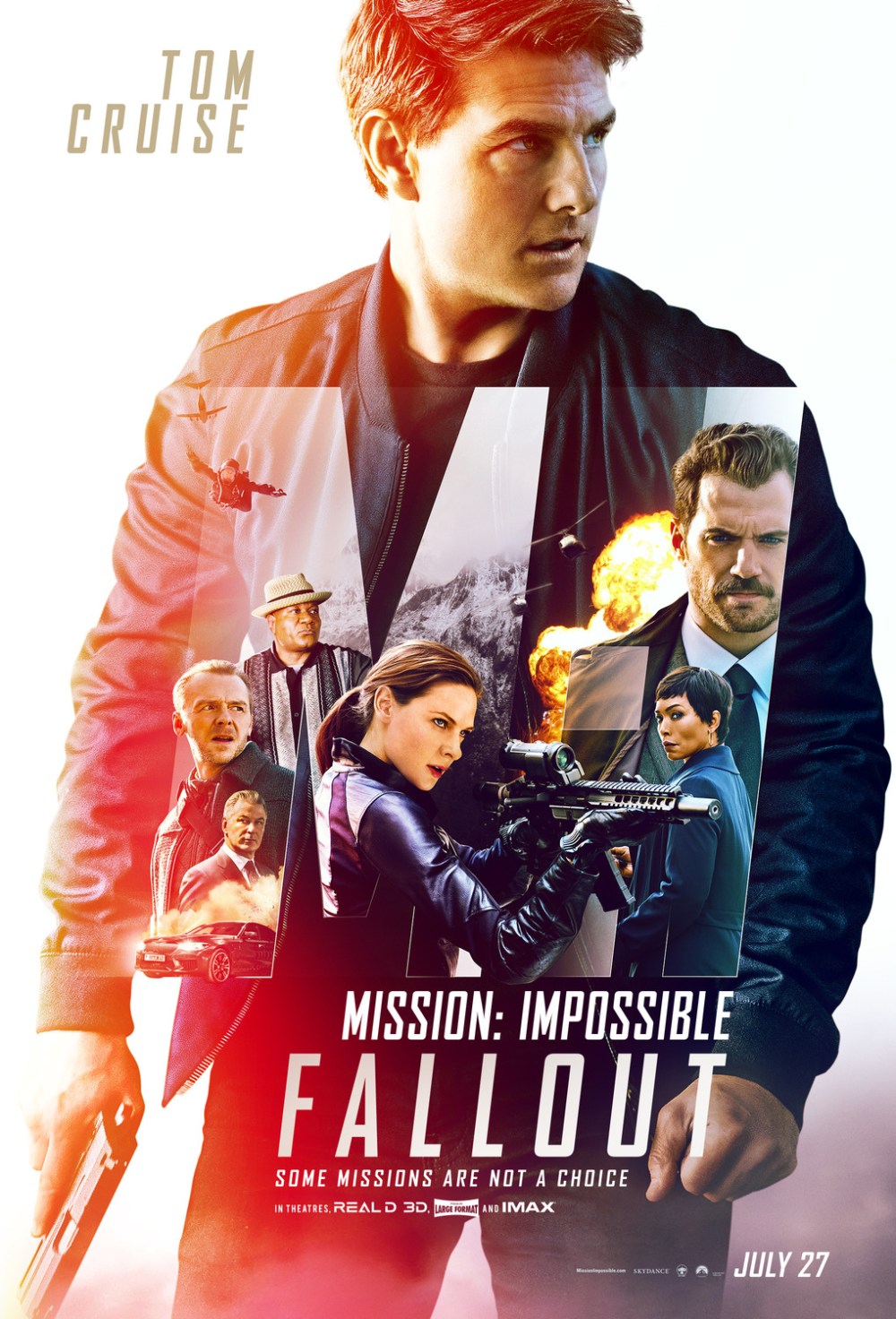
‘Mission: Impossible – Fallout’ is a Thrilling Spectacle From Start to Finish

Mission Impossible Fallout poster

This is never supposed to be the case. Movie franchises are not supposed to improve with each sequel. We all expect them to get worse and worse to where you wonder why the filmmakers even bother making them anymore. But with the “Mission: Impossible” movie franchise, actor and producer Tom Cruise continues to work closely with gifted filmmakers to create motion pictures which defy expectations as he is intent on topping what came before. “Mission: Impossible – Fallout” is the sixth film in a series which began back in 1996, and it proves to be the most thrilling installment yet. I cannot wait to see it again, and I am determined to see it in a IMAX theater as this sequel demands to be seen on the biggest screen in town.

The plot of “Mission: Impossible – Fallout” is a bit convoluted, but I will give you the gist of it. The terrorist group from “Rogue Nation” known as The Syndicate has since reformed into The Apostles, and Ethan Hunt (Cruise) is tasked with intercepting the sale of three plutonium cores to them. But despite the presence of team members Luther Stickell (Ving Rhames) and Benjamin “Benji” Dunn (Simon Pegg), the mission is thwarted and the plutonium is stolen right out from under them. From there, they are determined to get the cores back, and their latest impossible mission has them meeting up with characters old and new to where alliances and methods are questioned endlessly. It all reminded me of what Mary Elizabeth Mastrantonio told Willem Dafoe in “White Sands:”

“You’re honest, even when you’re lying.”

Does everything we see here make perfect sense? No, but I really didn’t care. Even at 147 minutes, “Mission: Impossible – Fallout” never drags, and it is a movie I am happy to describe as exhaustively thrilling as it kept me on the edge of my seat throughout. Just when you think it’s over, we are pulled back into another astonishing action set piece which leaves us out of breath.

Let’s talk about the stunts, shall we? Among the first is the HALO (high altitude, low opening) jump which is a skydive from a seriously insane height. We all know how Cruise is a stickler for doing his own stunts, and while the average skydive is done from 7,000 to 9,000 feet, a HALO jump is often done from 15,000 feet and with the aid of oxygen. Taking this all into account makes this particular sequence all the more thrilling as it is done in what seems like an unbroken shot which would make even Alejandro Inarritu stare at the screen in awe.

There’s also a motorcycle chase through the streets of Paris, and I kept waiting for the characters to get seriously injured or killed as no one can navigate traffic like that in real life. And yes, it is indeed Cruise jumping from one building to another. Everything culminates in a thrilling helicopter chase which outdoes the ones I loved watching in “Blue Thunder,” and it is in this sequence where Cruise and company attempt to complete the most impossible mission of all as what they are tasked with doing has a higher probability of failure than success.

Cruise is now 56 years old, and he shows no signs of slowing down. While many be telling him to act his age, a term which has now lost all its meaning to me, he continues to defy the odds and show just how far he is willing to go to make an action movie which is anything but average. The scenes of him “grinning like an idiot every 15 minutes” are few and far between this time around as we instead see him playing mind games with actors who are playing characters not entirely trustworhty. And yes, there is the obligatory scene of him sprinting at warp speed, and I hope I am able to run like he does when I reach his age.

“Fallout” almost marks the return of writer and director Christopher McQuarrie, making him the first filmmaker to direct more than one “Mission: Impossible” movie. “Rogue Nation” was terrific entertainment, but he really outdoes himself this time out. His screenplay is full of endless plot twists and enigmatic characters to where I was quickly reminded of he was the same man who wrote the screenplay for “The Usual Suspects.” Seeing him balance various plot threads makes me admire him as a director even more as he brings everything together for a furious climax which is just staggering.

Simon Pegg has been great fun in the “Mission: Impossible” movies, but in “Fallout” we see his character of Benji Dunn evolve a bit. Granted, Benji has always served as the comic relief, but we see him become a better field agent to where, even when he whines about the things he doesn’t want to do, he can hold his own with Ethan to where he doesn’t have to perform a HALO jump to make this clear. Pegg has always been a great comedic talent, but he’s also a better actor than people give him credit for.

Ving Rhames continues to make Luther Stickell the uber cool IMF agent, and Luther has evolved to where he is not as concerned about his expensive taste in clothes anymore. Rebecca Ferguson, who all but stole “Rogue Nation” as Ilsa Faust, once again makes her character wonderfully enigmatic to where I was desperate to get at the secrets inside Ilsa’s brain. Alec Baldwin has more fun this time around as Alan Hunley, Sean Harris makes “Rogue Nation” baddie Solomon Lake even more sadistic than ever before, and Michelle Monaghan once again provides this franchise with a warm human presence as Ethan’s ex-wife, Julia.

We also get introduced to some new characters including Erica Sloane, the new CIA director played by Angela Bassett. Although we don’t get to see much of Bassett here, she reminds us of how badass she remains after all these years. It has been 25 years since she broke through as Tina Turner in “What’s Love Got to Do with It,” and she hasn’t let us down since.

Acclaimed stage actress Vanessa Kirby makes her American film debut as White Widow, a black-market arms dealer. Kirby makes this character such an alluring presence as she keeps her cool even as her life is constantly being threatened and as she dangles a plutonium core right in front of Ethan’s eyes, knowing full well just how much he wants it.

And, of course, we have Henry Cavill who gets to take some time off from his day job playing Superman to portray CIA assassin August Walker. Cavill is a bit stiff in some early scenes to where he threatens to get upstaged by his mustache, the same one he was unable to shave off for “Justice League” reshoots. For a time, I kept waiting for him to say, “It’s just you, me, and my mustache” as such a big deal was made about it having to be digitally removed. But as “Fallout” goes on, Cavill makes August into an especially dangerous character who is never to be trifled with. And while he may not be playing the Man of Steel here, he throws punches which had me thinking his arms were made of steel.

Seriously, “Mission: Impossible – Fallout” is the best movie yet in this franchise, and it may very well be the best action movie of summer 2018. Just when I thought nothing could top the sight of Cruise climbing the Burj Khalifa tower in “Ghost Protocol,” we are given some of the most amazing stunts, and they are coupled with characters busy playing mental chess games with one another as what the eyes reveal can be even more threatening than a bullet to the head. “Fallout” is a thrilling spectacle, and it makes me wonder if Cruise and company can possibly top what they have accomplished here.

Cruise had a tough time in 2017 as “The Mummy” reboot proved to be a critical and commercial bomb, and the biographical crime film “American Made” underperformed at the box office. It’s a good thing he still has “Mission: Impossible” to fall back on as he always pushes himself to outdo what he did previously as an actor and producer. Just when I thought his career would self-destruct in 5 seconds, he manages to come back with a vengeance.

* * * * out of * * * *

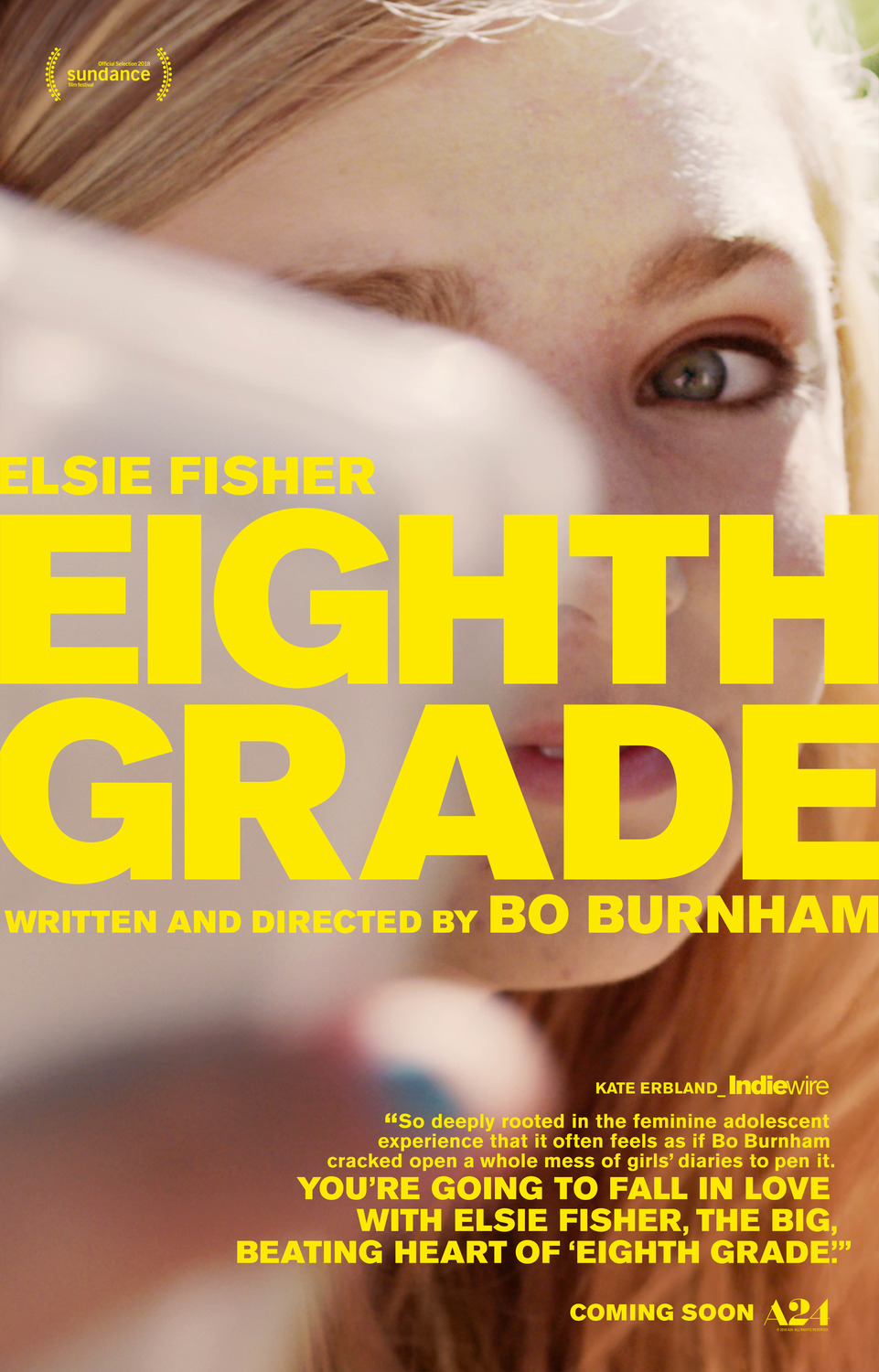
‘Eighth Grade’ Never Shies From the Terrors of Being a Teenager

Eighth Grade movie poster

I remember eighth grade very well. It started with me running cross country and being elected Treasurer to the student council. I stole a line from Chevy Chase as I told my fellow students, “Hi, I am Ben, and you’re not.” They laughed hysterically and cheered me loudly, and I lived for this kind of reaction back then. I felt like I was on top of the world, but then things changed to where I felt completely out of place and unsure of how to talk or act around people my age. I became socially awkward and felt very isolated from everyone around me, and the year ended on what seemed like a disastrous note as I became the center of attention in a negative way, something I hoped and prayed would never happen.

Those memories were brought right back to the surface as I watched “Eighth Grade” which stars Elsie Fisher as Kayla Day, a teenage girl on the verge of graduating from junior high school. When we first meet her, she is making her latest YouTube video in which she is telling her audience about the importance of being yourself, and she comes off looking very confident. But then we see her in the real world and discover she is a deeply introverted young woman who is socially awkward and introverted. Her class ends up voting her “Most Quiet,” and the look on her face when she is told this says so much as even she cannot deny this being true.

Granted, Kayla is growing in a time where social media is everywhere, and she is addicted to her cell phone as much as the next person. But while I did not grow up in a time of cell phone addiction, social media oversaturation, Facebook, Instagram or Twitter among other things, the feelings she experiences as she navigates the cruel realm of middle school feel very real, and I relate to them more than I ever could have expected to after all these years.

Eighth Grade” has many moments which speaks volumes. The scene where the mother of Kennedy, the most popular girl at school, invites Kayla to her daughter’s birthday party is one of the most emotionally piercing. As the mother speaks, the camera has her face out of focus and instead offers a closeup on Kennedy who refuses to even look at Kayla, her face full of disgust to where she looks like she wants to say to her mom “do we have to invite her?” Being on the receiving end of a face like this when you were a teenager always felt really brutal, as our emotions at that age always felt epic to where dejection felt more common than happiness.

This is followed up by the movie’s most horrifying scene: a pool party. Just seeing Kayla stare out a window at the kids laughing and having fun in the pool as if she were a prisoner behind bars proves to be as unsettling as watching Dawn Weiner look for place to sit in the school cafeteria in “Welcome to the Dollhouse.” Kayla suffers a panic attack as she puts on her swimsuit, and when she does go into the pool, I kept waiting for her to have a Dustin Hoffman “Graduate” moment when she finds solace underwater. Kayla, however, can only stay underwater for so long as the noise in her head proves to be louder than everything going on outside of her.

Kayla does get a reprieve when she attends a high school shadow program and meets a really nice young woman named Olivia (Emily Robinson) who is very eager to introduce Kayla to the new school she will soon attend. Watching Kayla interact with Olivia reminded me of how I got along better with kids older than me than I did with those my own age. Her newfound friendship, however, hits a major snag when one of Olivia’s friends invites Kayla to play a game of truth or dare. I kept praying Kayla would not say the word “dare,” and when she does…

While watching “Eighth Grade,” I was reminded of the following exchange of dialogue from Sofia Coppola’s “The Virgin Suicides:”

“What are you doing here, honey? You’re not even old enough to know how bad life gets.”

“Obviously, Doctor, you’ve never been a 13-year-old girl.”

Writer and director Bo Burnham, one of the first performers to become a star on YouTube, has brilliantly captured all the angst, horror and awkwardness of these crazy years we would rather put behind us. Clearly, he was never a teenage girl himself, but this quickly becomes irrelevant as anyone who has ever felt left out or at the bottom of the social ladder can easily relate to what Kayla experiences from start to finish. His screenplay feels very true to life, and not once does this movie feel like an average episode of “Saved by the Bell” or “Beverly Hills 90210.”

As Kayla, Elsie Fisher has such a winning presence to where you root for her right from the start. Her face, which has evidence of pimples, is not the kind we see in Clearasil commercials, and I applaud her for not trying to cover this up. In moments where she has no dialogue, Fisher shows us exactly what is going through Kayla’s mind as she is unable to hide the confusion and uncertainty of how to act around others. It’s a wonderful performance which feels true to life, and Fisher makes her final moments in “Eighth Grade” count for so much as she prepares to start the next stage of her life with newfound confidence.

The other performance I loved was from Josh Hamilton who plays Kayla’s father, Mark Day. At first, it looked like he is portraying a hapless dad who is simply here for comedic effect, but Hamilton gives this character dimensions which truly surprised me. Mark could have been like any other father we often in see in movies, but Hamilton digs deep to find the bruised heart of one who is just trying to do the best he can. It all leads to a wonderfully acted scene where Mark tells Kayla how she can never make him sad, and it is one of the more original moments I have seen between a parent and their child in recent years, and I am certain I will never forget it.

It gives me great pleasure to add “Eighth Grade” to my list of the best and most realistic motion pictures ever made about teenagers. Movies like “Pump Up the Volume” proved to be a godsend for me as they dealt with real teenagers going through problems I could actually relate to, and kids today need these movies as a healthy alternative to the more flaccid and shallow portrayals of their age set which do not reflect their reality. While much of what I saw was unnerving to where I was instantly reminded of far too many embarrassing moments from my junior high school days, it is always refreshing to get a movie from a filmmaker who takes the time to listen to teenagers instead of talking down to them. John Hughes may be gone, but there are other filmmakers more than willing to carry his torch for another generation.

Regardless of its R rating, I hope those who are in the eighth grade or have just graduated from junior high school get to check this movie out as I believe they will benefit greatly from watching it. I also have to say if adults are intent on saying the word “lit” in videos aimed at teenagers, they need to understand how kids use this word. Trust me, kids see through your façade, and your attempts to look cool to them will make you appear far too desperate for their approval.

* * * * out of * * * *