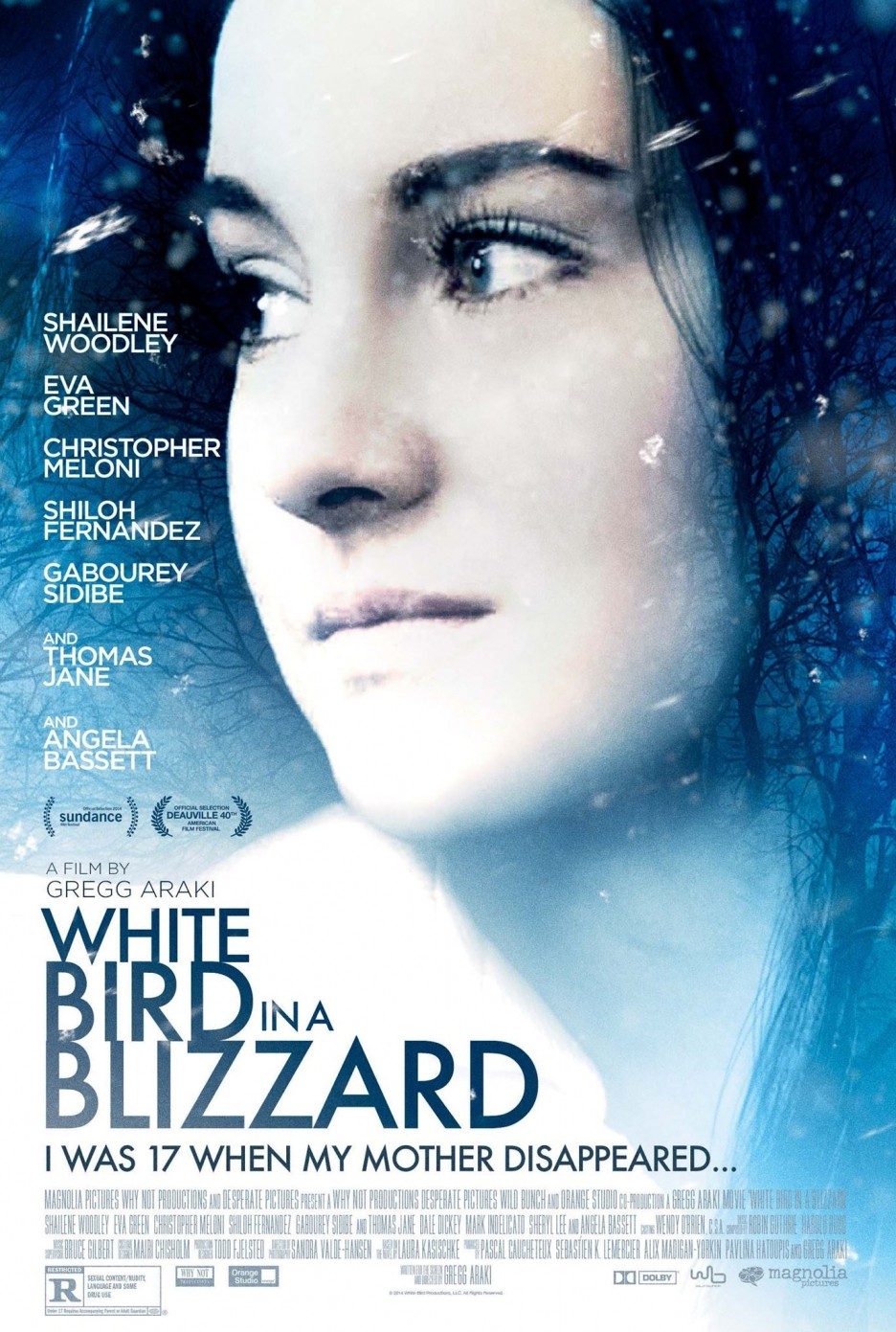
With “White Bird in a Blizzard,” Gregg Araki deals with the life of an adolescent once again. Based on the book of the same name by Laura Kasischke, it takes place in the 1980’s and stars Shailene Woodley as Kat Connor, a young woman whose mother ends up disappearing from her life. This happens at the same time she is discovering her sexuality with the next-door neighbor, Phil (Shiloh Fernandez), and she doesn’t seem too phased by her mother’s sudden absence. Her father, Brock (Christopher Meloni), has long since become a complete wimp, and his emotional repression prevents him from dealing with this situation in a rational manner. We follow Kat as she goes from high school to college, and eventually, she comes to see just how deeply affected she was by her mother’s disappearance and becomes determined to find out what happened to her.
Many of Araki’s films deal with the lives of teenagers, and he deals with them in a way which feels both honest and emotionally raw. “White Bird in a Blizzard” is the latest example of this, but while it deals with similar themes, it also feels somewhat unique to what Araki has given us before. He appeared at the Four Seasons Hotel in Los Angeles, California for the movie’s press conference, and I asked him if his view of adolescence has evolved much from one movie to the next. Araki replied it definitely has.
Gregg Araki: Back in the 90’s I did a series of three films (“Totally Fucked Up,” “The Doom Generation” and “Nowhere”) that I have become sort of famous or infamous for that were kind of a trilogy about being a teenager. It was called the “Teenage Apocalypse Trilogy” and they were very unhinged in a way and a little bit chaotic. I made those films 20 years ago and I definitely feel like in that time I’ve become older for sure and I think more mature and I’m more developed. I don’t really think I had a film like “White Bird” in me then. The analogy I make is that in this film I did called “The Doom Generation” which is also about young people, those kids have no parents. They have no house and they have no family; it’s just these kids doing crazy stuff. And in this movie Shailene does play somebody who is 18 and Shiloh (Fernandez’s) character is 18, and so they have their teenage moments and they meet in a Goth club and dance and they have that sort of carefree youth about them. But at the same time, this film is so much more about the family. Kat’s relationship with her mother or father, her parents’ marriage and just that whole world that, to me, like “American Beauty” or “The Ice Storm,” is about the world of the American dream and what is underneath the surface of it all. To me, that’s much more this film than my earlier movies about young people.
It’s always great to see a movie which takes adolescence seriously, and “White Bird in a Blizzard” does qualify as one. It also allows Woodley the opportunity to give another great and honest portrayal of a teenager just like she did in “The Descendants” and “The Spectacular Now,” and it shows how Araki, even at the age of 54, still truly understands what teenagers go through. But moreover, it shows how far Araki has come as a filmmaker, and it will be interesting to see where his career goes from here.
“White Bird in a Blizzard” is now available to own and rent on DVD, Blu-ray, and Digital.
Here is a video interview I did with Araki, Woodley and Chris Meloni which I did for the website We Got This Covered.
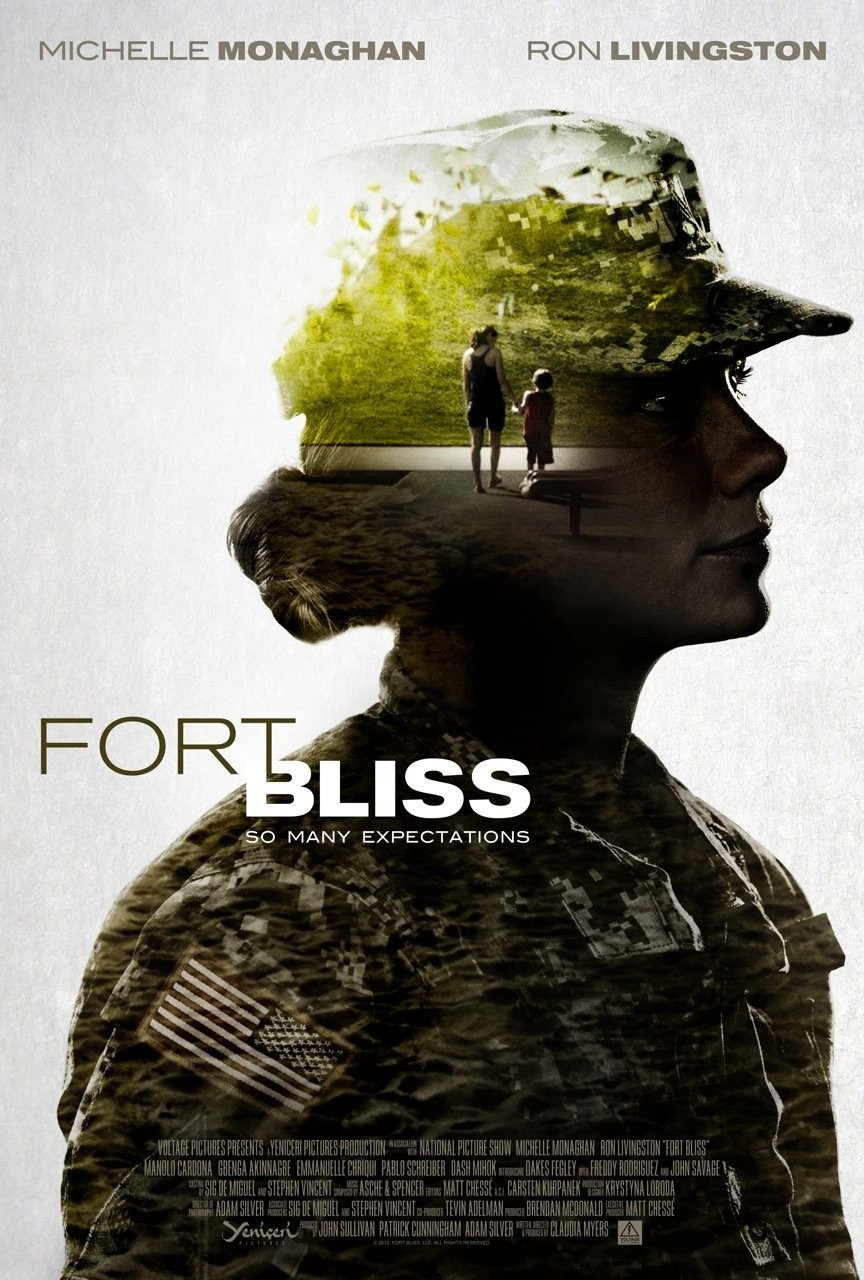
Claudia Myers’ “Fort Bliss” deals with something we don’t see much in movies: the challenges of being a female soldier and a single mom at the same time. The movie stars Michelle Monaghan as U.S. army medic Maggie Swann who has just returned home after serving a tour of duty in Afghanistan. But instead of arriving to greet her son Paul (Oakes Fegley) at the air base, she instead finds him back at home with his dad, her ex-husband Richard (Ron Livingston), and stepmom, and he doesn’t really remember her much. From there, Maggie works to repair the bond between her and Paul before her duties in the military threaten to tear them apart yet again.
Both Monaghan and Livingston dropped by the SLS Hotel in Los Angeles, California for the “Fort Bliss’” press day, and it was fascinating to hear about their experiences making this particular movie. This was a very low budget production, so there wasn’t much time for anyone to waste. I always wondered how actors deal with the lack of time because we are led to believe they are used to working on movies which allow them to take a nap in their trailers between takes while the crew sets up for the next shot. But while having fewer resources can seriously affect some actors, Monaghan and Livingston did not let any limitations stand in their way.
“There’s something really exciting about the idea that they just don’t have time to micromanage you in your performance, so there’s a lot more responsibility to just show up,” Livingston said. “Your first take on it is gonna be the take that goes into the movie by and large unless it’s really egregious because there’s not a lot of time to waste tinkering with it, you know?”
“It is true that you don’t have a lot of time to play with it,” Monaghan said. “I think that’s why the prep time becomes so essential for an independent film. It’s your responsibility as an actor or a director or a writer to really play your part. You can’t just turn up and expect all these experts to show you something on the day. That’s really, really important. That’s a part of our job, and also we shot this movie in 21 days. It was so incredibly exciting because we were living, eating and breathing it. We shot in two different locations in and around Los Angeles and then Fort Bliss (in El Paso, Texas) with the help of the Army. With all their resources, the production value looks by far more than what we had for it.
“21 days with combat sequences is pretty incredible,” Livingston noted.
Again, I imagine some actors would have preferred to have more time to prepare for the roles, but they don’t always have that opportunity. When it comes down to it, they have to work with what they are given instead of complain about what’s working against them. For Monaghan, the fact there wasn’t a lot of down time on the set of “Fort Bliss” didn’t affect her too much.
“There’s not (a lot of down time), but I always tend to find that I feel the strongest about performances in general when they’re shot in that way because you’re in it,” Monaghan said. “You are in the thick of it, and to say that I go to sleep at night and dream about the character and the role, you are. It’s 21 days where you’re attacking it for that period of time, and you don’t have time to think about it. Good things tend to come from that.”
One of the best scenes in “Fort Bliss” comes at the beginning when Maggie and dozens of other troops are returning home from Afghanistan. It looked like the production succeeded in hiring the best background extras they could find as they looked so incredibly enthusiastic in welcoming the soldiers home, but it turns out there was a lot more authenticity involved than we realized.
“When you see the coming home scenes at the beginning, it was truly people of soldier’s families, military wives, husbands, and children that two days prior had just welcomed one of those big planes home,” Monaghan said. “Fort Bliss sent out an email saying, ‘Would you guys come back two days later to shoot a scene?’ So they brought back all their signs and it was amazing. The military band was there and even the Harley Davison guys came back and all the former vets with their bikes and everything. Everybody was so proud to be there. That’s so profound to be able to have that experience and to feel that energy of what it’s like and everybody hugging one another. To be able to have that access and that resource was so invaluable. We constantly had that throughout the process of filming. I say this film has been so blessed, but it has. I’m so grateful to everybody in how far reaching the efforts that everybody has gone to.”
“Fort Bliss” may be coming in under the radar, but it is truly deserving of your attention. It deals with the female perspective of war and how women still have a stigma attached to them whenever they serve in the military. Many expect women to stay at home and be a mother to their children instead of fighting wars overseas, but life continues to be more complicated than we expect it to be, and nothing is ever that simple.
You can also check out this video interview I did with Monaghan and Livingston which I did for the website We Got This Covered.
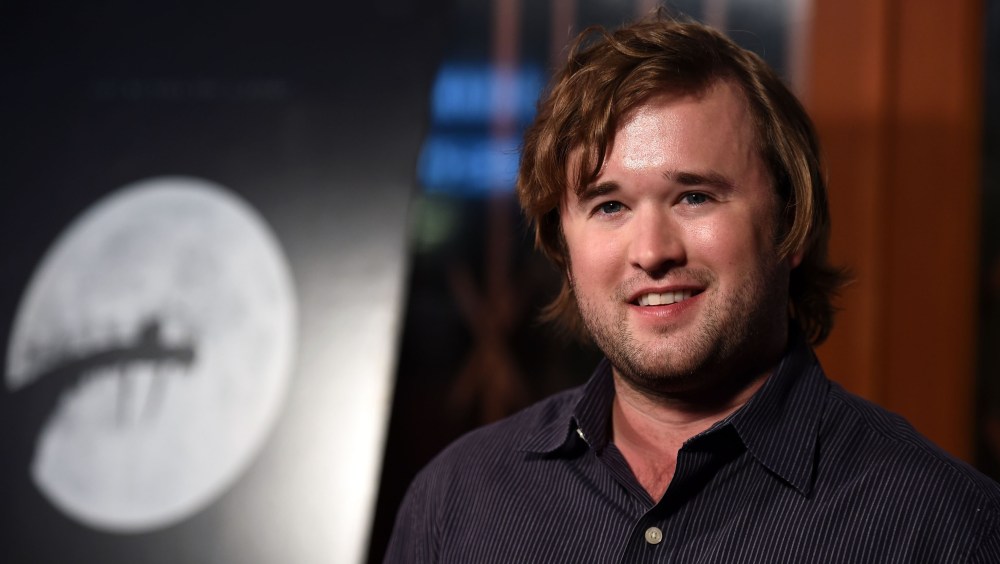
It feels like it has been forever since we have seen Haley Joel Osment in anything. Ever since his unforgettable Oscar-nominated performance as Cole Sear in “The Sixth Sense,” he has gone on to do memorable work in Steven Spielberg’s “A.I.,” “Pay it Forward” and “Secondhand Lions” in which he co-starred with the actor who beat him out for the Best Supporting Actor Oscar, Sir Michael Caine. But after that, he disappeared to where we thought he had become just another child actor who couldn’t make the transition to an adult acting career like Kurt Russell and Jodie Foster did.
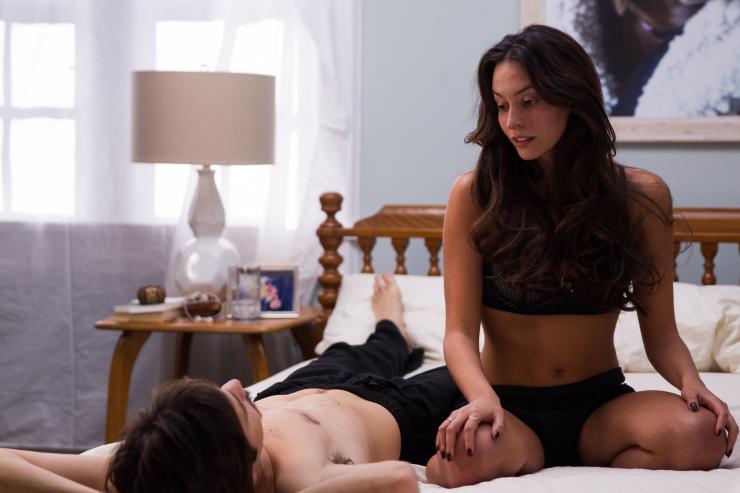
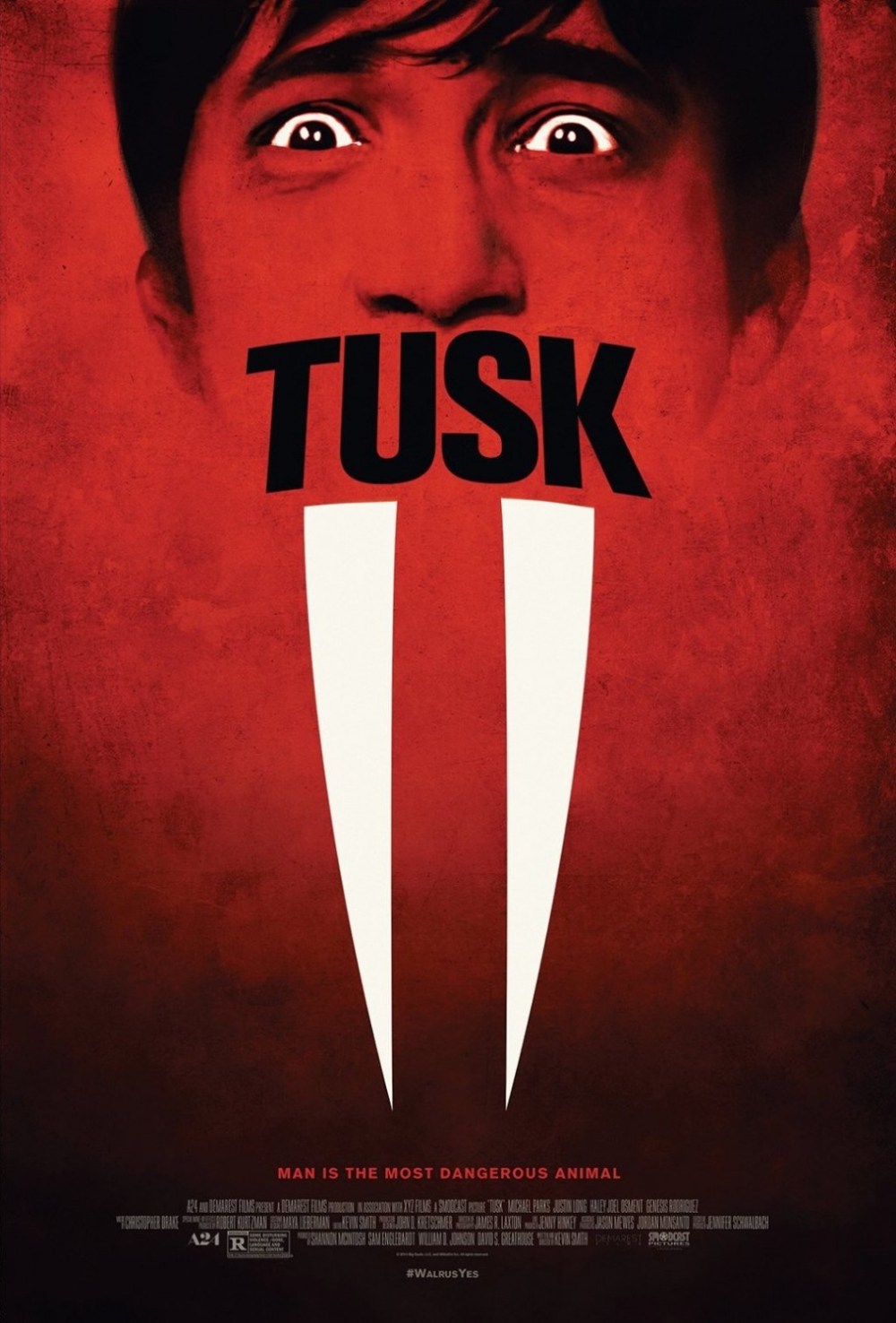
Well, it turns out he was away at New York University studying experimental theater, and this later led to him making his Broadway debut in a revival of David Mamet’s “American Buffalo.” These days he does a lot of voiceover work, he has a recurring role on the Amazon series “Alpha House” and he is starring in Kevin Smith’s latest film “Tusk.” In it, he plays Teddy Craft who, along with his friend Wallace Bryton (Justin Long), hosts a podcast show called “The Not-See Party.” When Wallace suddenly goes missing while he’s in Canada, Teddy and Wallace’s girlfriend Ally Leon (Génesis Rodríguez) travel there to find him, and what they discover is… Well, just see the movie.
Osment looks like he’s having a lot of fun as Teddy, and you really get the sense he is a natural for podcasting. “Tusk” is certainly one of the weirder and more original movies to come out in a while, and he explained what drew him to it.
“The writing was so good,” Osment said of Smith’s screenplay. “The characters were clear and then he (Smith) kind of does this cool thing where, once he got to know us on set, he would just generate material based on just starting to know us more. He wrote that great monologue for Genesis and an extended podcasting scene for me and Justin. He will answer any question you ask him, but his big thing was always saying ‘remember to have fun’ and stuff like that. He isn’t someone saying, ‘Hey, remember to get this part of the character’ or something. He trusts his actors to do that.”
For me, I was very interested in how Osment made the transition to becoming an adult actor. It’s never easy, and Hollywood does have a reputation for chewing up actors and spitting them out. But Osment has come out on the other side looking like a wonderfully down to earth human being, and he remains a terrific actor after all these years. When I asked him how tough his career transition was, his response was simple and to the point.
“As an actor, I feel really lucky because I have been lucky enough to have a lot of experiences on sets and still be relatively young,” Osment said. “It’s fun because your body is kind of your instrument and, if you’re getting old over a period of time and everything, I just remember doing characters as a kid. Now being an adult and having a romantic interest and things like that, the variety is just really exciting so I guess I feel lucky.”
Seriously, it’s great to see Osment keeping busy. I imagine we will see a lot more of him soon, and it will be interesting to see where his career goes from here.
She has left her mark in a number of Telemundo telenovelas as well as in movies like “Identity Thief,” “The Last Stand” and “Casa de mi Padre,” but in Kevin Smith’s “Tusk,” Génesis Rodríguez shows the world just how good of an actress she can be. She plays Ally Leon, the girlfriend of Wallace Bryton (Justin Long), and she tries to make him see what a selfish person he has become thanks to the fame his podcast “The Not-See Party” has brought him. But as much as Ally criticizes his shortcomings, she is reduced to tears when she accepts the fact they come to mirror her own.
“Tusk” has been the subject of a lot of talk ever since Smith announced it as his next project. The idea came about from an episode of “SModcast” where he and co-host Scott Mosier read an ad about a man offering a rent-free situation for a tenant who is willing to dress up as a walrus and make walrus sounds all day long. It makes for one of the more unique movies, and many were eager to find out what exactly drew the actors to be in it.
Rodríguez was at “Tusk’s” press day held at the London Hotel in West Hollywood, California, and she was asked about her initial reaction to Smith’s screenplay.
“Reading the script, I made the big mistake of reading it at midnight,” Rodríguez said with a laugh. “I know, big mistake, so I couldn’t go to sleep. I literally thought about the walrus all night. I started listening to The Beatles and it was just like I went ‘goo goo goo goo joob’ totally. And then afterward I heard the SModcast episode and then I became obsessed with the idea. It was like, okay, this is the kind of movie I want to do. It’s clearly not a remake (laughs) so it’s good to be a part of something so unique and so different and to leave your little mark on such I thought was gonna be, the minute I read it, a cult favorite whether you hate it or love it. It’s that kind of movie. It’s memorable, that’s for sure (laughs).”
For me, the highlight of Rodríguez’s performance was her close-ups in which she confesses to Long her confused emotions which are tearing her apart. It turns out Smith, once he got to know her better, wrote a monologue for her to perform, and she ends up performing it in a truly riveting fashion. Seeing the stream of emotions crossing her face during this close-up held my attention to where everything else around me went completely silent. I was eager to learn how she pulled this monologue and the close ups off, and her answer implied it involved her not knowing one specific thing.
“Thankfully, I didn’t know how close up they were,” Rodríguez said of the cameras. “It kind of freaked me out, but I just let the dialogue guide me to an emotion and I tried to make it as honest as possible. I’ve never had that shot to really show that side of myself in the movies, so I just wanted to do Kevin justice, and he took a chance on writing me that monologue. I hope I did him proud.”
To be honest, I’m glad Kevin Smith hasn’t retired from filmmaking (or at least, not yet). I’ve enjoyed all his movies except for “Cop Out,” which I’m sure he doesn’t care for either. When it comes to “Red State,” I found it to be a major leap out of Smith’s safety zone which resulted in his best directorial effort yet. Now we have “Tusk,” his second visit to the horror genre and one of the more original and bizarre movies to come out in a long time. It has its moments of comedy, but it is mostly a serious film dealing with one American’s journey into Canada and of the horrific fate awaiting him there.
Justin Long stars as Wallace Bryton, one of the hosts of a popular podcast called “The Not-See Party” (get it?), and he and his good friend Teddy Craft (Haley Joel Osment) live to have fun at the expense of others. Their latest target is the “Kill Bill Kid” who accidentally sliced off one of his legs with a sword while attempting to perform one of that movie’s famous moves, and Wallace decides he and Teddy should travel to Canada to interview him. Teddy, however, doesn’t like to fly, so Wallace goes over there all by his lonesome.
When Wallace gets to Canada, he discovers the “Kill Bill Kid” has died which leaves him without an interview. Despondent, he stops by a bar where he discovers a handbill from a man who claims to have a lifetime of stories to tell, and he is offering free room and board to those interested in hearing him out. Wallace jumps at the chance to listen to what he has to say and travels out to the man’s house which, like in any other horror movie, is located in the middle of nowhere. It is there he meets Howard Howe (Michael Parks), a wheelchair-bound old man who regales Wallace with tales of his life at sea. One of those tales involves a ship he was on which sank and led to him meeting a walrus who saved him from drowning. Howard came to name the walrus Mr. Tusk, and he still considers Mr. Tusk to be the best companion he ever had.
As Howard continues to talk, Wallace begins to lose consciousness as, like those horny teenagers in “Red State,” he has been drugged and eventually passes out. When Wallace wakes up, he finds himself in the hands of a man intent on turning him into a walrus. We all know what curiosity did to the cat, but Wallace looks to be heading towards a fate far worse than death here.
I don’t think it’s any secret of what happens to Wallace in “Tusk,” and perhaps it is best for those who haven’t seen the movie yet to stop reading this review now. The inspiration for this movie came from “SModcast,” a weekly podcast Smith does with Scott Mosier. On one episode they talked about an ad from a British website where a man was offering free room and board for anyone willing to dress up in a walrus suit and make walrus noises while he throws them fish and crabs to eat. We get to hear some of this episode during “Tusk’s” end credits, and Smith and Mosier are laughing their asses off as they discuss how the movie would play out. Seriously, it got to where I was kind of amazed at how the story evolved from the podcast to this finished movie.
Like “Red State,” “Tusk” is not the kind of horror movie designed to make you jump out of your seat every five minutes. Instead, it is more about people confronted with a terrifying situation which proves to be way beyond their control, and just when you think things can’t get any worse, they do. Robert Kurtzman was the effects artist, so that should give you an idea of just how horrific Wallace’s transformation is. It may not quite equal what Jeff Goldblum went through in “The Fly,” but it does provide the audience with a very unsettling visual.
Long has a tricky role to play as Wallace is a very obnoxious dude who almost doesn’t yet realize just how rude he is to others. His interactions with Canadian residents provide “Tusk” with some of its most amusing moments, and that’s especially the case when he meets a border agent played by Harley Morenstein who doesn’t hesitate to explain the differences between the United States and Canada. You can’t help but feel bad for Wallace even though he’s a bit of a jerk. I like to think this gave Long an interesting arc to play as he goes from being an egotistical prick to a helpless victim who is not exactly deserving of the fate which awaits him.
We do get a few flashbacks which show Wallace hanging out with his girlfriend Allison (Genesis Rodriguez) who is starting to accuse him of being a sellout, and she admits to missing the old Wallace as a result. Wallace, however, is more smitten with the new version of himself and doesn’t want to go back to the way he was. To say that this comes back to haunt Wallace is the understatement of the year.
Rodriguez, I have to say, has some really strong close-ups here where she holds the audience at bay with her emotional conflicts. As much as she loves Wallace, she is not blind to his misdeeds which eventually come to reflect her own. Rodriguez previously appeared in “Identity Thief” and “Casa de mi Padre,” and she looks almost completely unrecognizable here. Gloria Swanson may have told Mr. DeMille in “Sunset Boulevard” that she was ready for her close-up, but she wasn’t as ready as Rodriguez is here.
It’s also great to see Osment here whom we all remember from “The Sixth Sense.” He’s grown up now (deal with it) and gives a multilayered performance here as Teddy. Explaining why is tough because it would be giving away one too many things, but it shows that Osment has entered into an adult acting career with confidence, and I look forward to seeing more of his work in the future.
But let’s be honest, the real reason to see “Tusk” is Michael Parks. His performance as Howard Howe is truly a master class in acting, and he takes what could have been an utterly ridiculous character and turns him into a pitiful and truly haunted soul, not to mention an utterly terrifying one. Seeing him dive right into this role with such a giddy exuberance and spout off classic lines of literature is invigorating, and it quickly reminded me of how annoyed I was that he didn’t get an Oscar nomination for his work in “Red State.”
“Tusk” does, however, fall apart a bit during the second half when we get introduced to a French-Canadian detective named Guy LaPointe. His appearance comes out of nowhere, and it leads to a cameo which goes on for far too long. Now you may or may not know the identity of the actor playing LaPointe, but I’m not going to reveal it here because it honestly took me a minute or two to realize who it was. There is something to be said for an actor who disappears into their part, and this one succeeded in doing so thanks to a nice nose job. Still, the character feels out of place.
It’s best to go into “Tusk” with an open mind, and this especially goes for Kevin Smith fans. Some may say he is traveling through familiar territory here, but I don’t think he is. True, it does have a couple of convenience store clerks (both of whom will be appearing in Smith’s next movie, “Yoga Hosers”) and there are a lot of in-jokes throughout, but here he is exploring the possibility of a man’s humanity surviving a cruel and life altering event.
I also got to say, looking at this movie’s title, that I kept wondering if the Fleetwood Mac song “Tusk” would be featured here. Is it? Well, see the movie to find out.
Will there be a more perfectly executed movie in 2014 than “Birdman?” It’s hard to believe there will as director Alejandro González Iñárritu succeeds in giving us a truly brilliant movie going experience which combines amazing technical aspects with a strong story and actors who give some of the best performances of their career. Your eyes will remain glued to the screen from start to finish as “Birdman” takes you on a cinematic journey we seldom go on, and you will leave the theater feeling mesmerized and in awe of what everyone managed to accomplish with a budget which is a mere fraction of today’s average blockbuster.
I’m always happy to see Michael Keaton in any movie he appears in, and he is crazy brilliant as Riggan Thomson, an actor who became a star after playing the superhero Birdman in a movie trilogy. As we catch up with him, he is now a washed-up actor whose glory days have long since passed him by. In an effort to restart his career and achieve true greatness as an actor, he decides to mount his own production of “What We Talk About When We Talk About Love,” a play which is based on the short stories of Raymond Carver. Riggan has put everything he has into this project and has even mortgaged his home to put up the capital for it. It’s hard not to sense his desperation as this play which he adapted to the stage, produced, directed and stars in threatens to become a total disaster.
Suffice to say, things are not going well as one of the cast members gets seriously injured before previews are set to begin, Riggan is trying to repair his relationship with his family while having an affair with one of the actresses, his daughter has just gotten out of rehab and is working as his assistant, and he has just cast a new actor whose ego is every bit as big as his talent. As his stress level increases, he begins to lose touch with reality and soon finds himself haunted by his most famous character who constantly urges him to take matters into his own hands.
Now many are calling “Birdman” Keaton’s comeback movie, but this is not entirely fair. Keaton never disappeared from the limelight, and while his career may not be as hot as it once was when he appeared in Tim Burton’s “Batman” movies, he remains a standout in each film he appears in whether it’s “The Other Guys” or “Toy Story 3.” But with “Birdman,” Keaton gets a role which is more than worthy of his talents, and he makes the most of this opportunity and then some. As unlikable as Riggan may be when it comes to how he treats others, Keaton makes you empathize with him as he tries to do right by himself as the play’s premiere comes at him sooner than he thinks. It’s a tour de force performance, and hopefully it will bring Keaton the Oscar nomination he should have gotten years ago for “Clean & Sober.”
But the real stars of “Birdman” are Iñárritu and his cinematographer Emmanuel Lubezki who brilliantly succeed in making this movie look as if it was all shot in one take. They make us feel like we are floating along into these characters’ lives as they struggle to make this play the best anyone in New York has ever seen. Even if you think you can spot where and when Iñárritu cuts from one scene to another, the movie still feels remarkably seamless from start to finish. Some filmmakers value the visual aspects of a movie over the acting or vice versa, but Iñárritu manages to balance out both to brilliant effect, and it makes for one heck of a cinematic experience. Heck, you can’t even help but wonder about what the cast and crew went through while making “Birdman” because there’s no way this could have been a walk in the park for anybody.
It’s impossible to think of an actor other than Edward Norton who could play the infinitely egotistical actor Mike Shiner so perfectly. Director Brett Ratner once described Norton as being someone whose mission it was to save a movie and of how this can be your best asset or your worst nightmare. I couldn’t help but think about what Ratner said as I watched Norton burst onto the scene and insinuate his character into a play about to be previewed to an audience. When it comes to method actors, they can take things too literally and Norton shows just how ridiculously far one can go. It’s one of his best performances to date.
I also loved watching Emma Stone who plays Riggan’s daughter, Sam. Stone has been a fiery actress ever since we first saw her, and you can’t take your eyes off of her whenever she’s onscreen. Stone makes Sam into a wonderfully realized character who is trying to stay one step ahead of what has brought her down in the past, and she gives a riveting performance which shows just how far her range as an actress can stretch. While she may not have been able to save “The Amazing Spider-Man 2” (in all fairness, no one could), she is a truly unforgettable presence here.
Other great performances in “Birdman” come from Naomi Watts who plays the amazingly insecure actress Lesley, and I have yet to see her suck in any movie she appears in. Andrea Riseborough, who stole a number of scenes from Tom Cruise in “Oblivion,” is wonderful as Laura, the actress Riggan may or may not have gotten pregnant. Zach Galifianakis takes on an unusual role for him as Riggan’s best friend and producer, Jake, who goes through hell in order to get this play off the ground. And then there’s Amy Ryan who plays Riggan’s ex-wife Sylvia who still has feelings for him even as he continues to do her wrong. Ryan never disappoints, and I love how she finds the good in Riggan when no one else can.
“Birdman” is the kind of movie which makes seeing movies on the big screen a sheer necessity. It challenges the realm of cinema to show what can be accomplished, and it gives us quite the kind of ride movies should be taking us on in a much more frequent way. In a year overwhelmed with tent pole franchises and a barrage of superhero franchises, this movie stands out as brilliantly unique and impossible to dismiss or forget.
David Fincher’s “Gone Girl” is a deliciously twisted masterpiece, a shocking and at times darkly comic look at marriage. I had an insanely good time watching it and I can’t wait to see it again, and that’s even if it’s just to watch the audience react so strongly to it. There’s no way you can come out of this movie and say you weren’t the least bit enthralled by the nasty journey Fincher takes us on. Just when you think “Gone Girl” couldn’t get any more twisted, it does. Based on Gillian Flynn’s best-selling novel (she also wrote the screenplay), he succeeds in getting away with a number of things in this movie just as he has with his past work.
“Gone Girl” opens on Nick Dunne (Ben Affleck), a frustrated writer who drops in one morning at the bar he owns (which is literally called “The Bar”) where he talks with his sister Margo (Carrie Coon) about the state of his marriage to Amy (Rosamund Pike). It happens to be their fifth wedding anniversary, and Nick celebrates it with a couple of glasses of bourbon which should give you an idea of how messed up things are between them. But then Nick comes home to find Amy gone and smashed furniture and glass scattered all over the floor, a sure sign something bad happened while he was gone. Suspecting Amy has been kidnapped, Nick calls the police and from there the search is on to find her before she disappears forever.
Now “Gone Girl” is a movie with an insane number of twists which makes it hard to talk about because it’s not worth spoiling any of them. But what I really loved is how it works on a number of different levels. Many movies can be boiled down to one sentence, but not this one. “Gone Girl” is a critique of a marriage that started off passionately but which has since been devoured by bitterness and resentment, and it makes you wonder why we tend to hurt the ones we love most. It takes a number of jabs at social media and people consumed with exploiting the trials and tribulations of others for the sake of ratings while the truth threatens to get lost in all the hoopla. It also serves as an indictment of a society quick to believe what they are told instead of recognizing a person is innocent until proven guilty. But at the heart of the movie is this question; how well do we know the person we choose to spend the rest of our lives with?
We see people reaching out to Nick Dunne in sympathy, but they just as quickly turn on him when evidence suggests he may have murdered his wife. From there, it becomes a constant game of media manipulation as the characters work furiously to get the upper hand on those who have deceived them and to sway public opinion in their favor. We live in a world of sound bites where information comes to us quickly and not always in an accurate manner. By the time we get to the truth, it may already be too late to view it objectively.
Over the years, many have described Ben Affleck as being this horrible actor who never had any business working in movies, but I’ve never agreed with this assessment. Yes, he has given some bad performances in “Pearl Harbor” and “Gigli,” but then again “Gigli” didn’t do anyone any favors. In “Gone Girl,” Affleck succeeds in giving one of his best and most naturalistic performances to date as he gives us a character who is not altogether likable, but who is still a complex individual caught up in a situation beyond his control. Nick is a complicated character who we are quick to make assumptions about, but what we think of him ends up saying more about us. I love how Affleck makes Nick a deeply mercurial character whose motives you can’t help but be suspicious of, and a scene where he sways the public back to his side during an on-camera interview with shows him at his conniving best.
I remember Pike from her early appearance as a Bond woman in “Die Another Day,” and she has gone on to give unforgettable performances in “An Education,” “Barney’s Version” and “The World’s End.” But when it comes to describing her work in “Gone Girl,” a flurry of adjectives cross my mind to where I have to be careful of what I say. What I can say is she is endlessly mesmerizing in a role which has her exploring every single facet of her character to where she surprises us in such an unnerving fashion. It’s a truly fearless performance you won’t soon forget after you leave the theater, and Pike doesn’t hold anything back.
“Gone Girl” also has a great supporting cast, and each actor sinks their teeth into their roles with relish. Kim Dickens is a delight as the cynical and yet slightly mischievous Detective Rhonda Boney, and she is blessed with a lot of great dialogue throughout. Patrick Fugit, almost completely unrecognizable from his “Almost Famous” days, is a snarky delight as Rhonda’s partner Detective Jim Gilpin. Neil Patrick Harris gives a charming and yet enigmatic performance as Desi Collings, Amy’s ex-boyfriend who looks like he can be trusted, but there’s a certain creepiness about him to where you wonder what’s really going on in his head.
Even Tyler Perry shows up in a very non-Medea-like role as Tanner Bolt, a somewhat devious attorney far more interested in winning the most impossible to win cases in court and playing the media like a piano to his clients’ benefit. Knowing how Perry caters mostly to the church going audience, I’ll be interested to see what they make of his time in Fincher’s dark world. I got a kick out of watching Perry here as he keeps his cool even as Nick’s case spins out of control.
You also have Missi Pyle on board as Ellen Abbott, a character clearly designed to remind you of Nancy Grace and of how annoyingly abrasive television hosts like her can be. Acting so entitled to her point of view even if the truth is not in her favor, Pyle makes her into a shameless individual who doesn’t apologize for anything even when she’s proved wrong.
But one supporting performance I really got a huge kick out of in “Gone Girl” was Carrie Coon’s as Margo. Coon is sarcasm incarnate right from the first moment she appears onscreen, and her scenes with Affleck are filled with love and devotion as well as a lot of anger at his foolish mistakes. I’m not too familiar with Coon’s work as she has appeared mostly in television and made a name for herself in various productions of the famed Steppenwolf Theatre Company, but I hope to see more of her in the future. She makes Margo a strong and fiercely independent character in a movie filled with so many morally clueless ones who get away with far too much.
The movie also marks Fincher’s third collaboration with composers Trent Reznor and Atticus Ross, and the two succeed in putting together another unforgettably creepy film score. What’s fascinating about their music here is it starts off sounding nice and inviting, but soon it becomes overcome by discordant sounds which imply there is something seriously disturbing going on in this quiet suburban neighborhood. Just when you think you can pull yourself away from the nasty voyage Fincher is taking you on, Reznor and Ross’ atmospheric score sucks you right back in and refuses to let you go.
Fincher’s “Gone Girl” is definitely a movie for these crazy times we live in now, and it is likely to make many out there think twice about getting married. Heck, even eloping sounds like a bad idea after watching this. But amid this tale of deeply flawed individuals and industry types more interested in their own celebrity than anything else, it makes one wonder whether we can ever really know someone completely. We’d like to think we know everything about our significant other, but can we really? This movie seems to imply we can’t, and Fincher makes you see this is one of the most frightening truths of all.
Fincher is a guy who never plays it safe, and “Gone Girl” is the latest example of that fact. Seriously, this is the most subversive and darkly funny take on marriage since Danny DeVito’s “War of the Roses.” I have not yet read Gillian Flynn’s book, but I really want to now. A woman sitting next to me at the screening confirmed the book is a great read and that she was very satisfied with Fincher’s adaptation of it. I’m fairly certain she is not the only one who feels this way.
I have not read any John le Carre novels as of yet, but I have seen many movies based on them. Whether it’s “Tinker Tailor Soldier Spy” (be it the miniseries or the film), “The Constant Gardner,” “The Tailor of Panama” or “The Russia House,” all of Carré’s stories deal with people who have seen it all and have long since been burned out by the possibility of changing the way people exist in the world. Since he was once an employee of the British intelligence agency MI6, Carré’s books generally deal with spies who are not like the ones we remember from James Bond or Jason Bourne movies. Instead, these are spies who inhabit a morally duplicitous world they have to struggle in even as it tears away at who they once were. They claim to be doing this work for the sake of peace, but after a while, you begin to wonder how much they believe this as they soon look like they are kidding themselves.
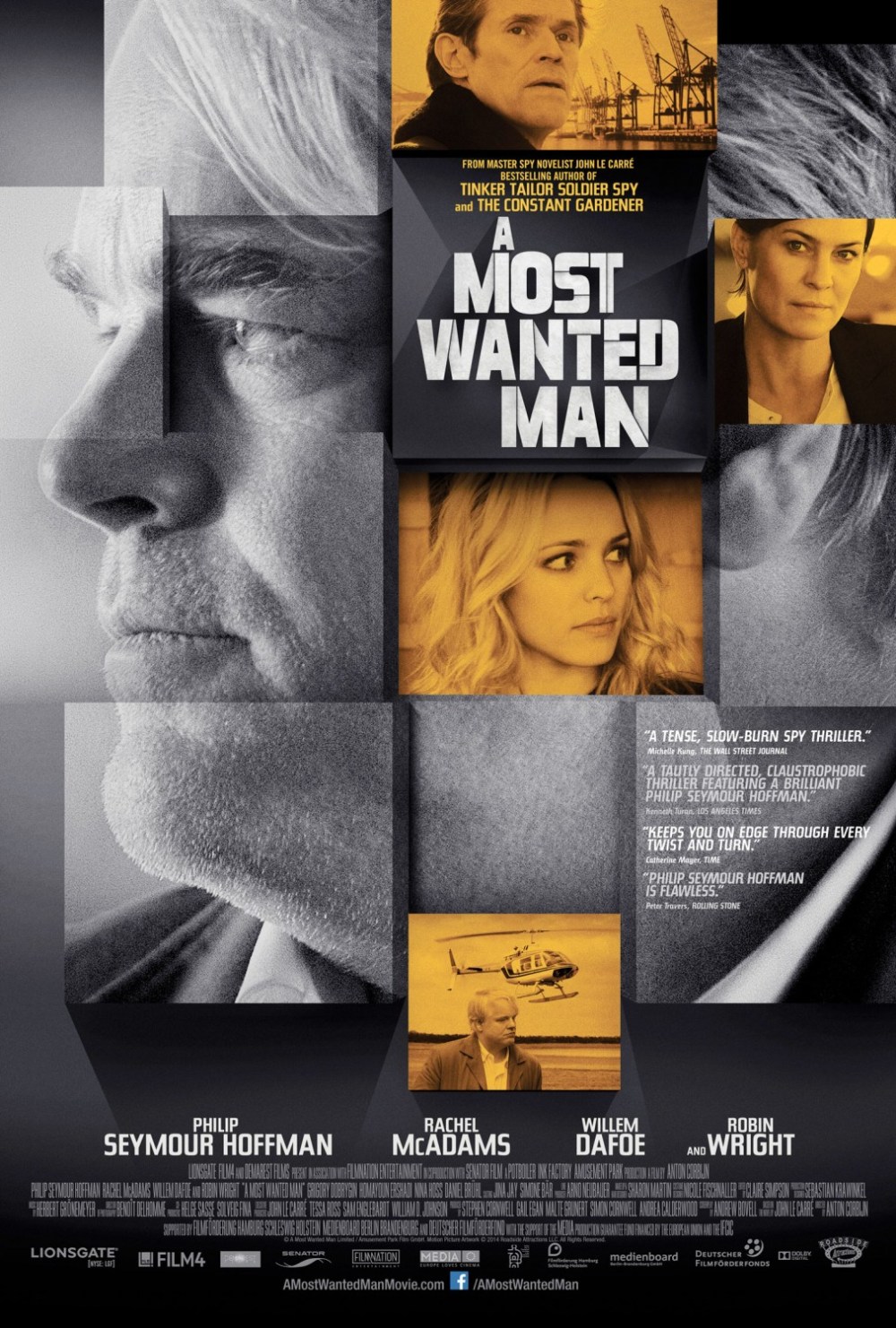
“A Most Wanted Man” is the latest Carré cinematic adaptation, and it is a perfect example of the kind of spies he has become famous for writing about. This film has also taken on an added importance as it features the very last lead performance from the late Phillip Seymour Hoffman who plays Günter Bachmann, the weariest looking spy who has ever walked the face of the earth. Only Hoffman could have inhabited such a worn-out character and make him so endlessly fascinating as Günter goes through this movie looking like he barely has a pulse.
This movie starts off with a note saying the German port city of Hamburg is where Mohammed Atta and his collaborators planned the September 11th attacks. The fact Atta was able to plan the attacks without being caught beforehand was due to failures in intelligence among other things and, as a result, the intelligence operatives continue to work as hard as they can to make sure this never happens again. The story takes place over a decade after 9/11, and it doesn’t take too long to see how these characters still treat the horrific day as if it just happened yesterday.
Günter is the leader of an anti-terrorism team which seeks to develop sources within the Islamic community in the hopes of getting leads on high-profile subjects. His team eventually finds one in Issa Karpov (Grigoriy Dobrygin), a half-Chechen, half-Russian who has just immigrated to Hamburg illegally after suffering torture and imprisonment which has made him look like a walking corpse. At the same time, he is also on the verge of claiming an inheritance worth millions in Euros. The question is, will any of this inheritance go towards funding terrorist groups, or will Issa make sure it goes to who needs it the most?
“A Most Wanted Man” was directed by Anton Corbijn, a Dutch filmmaker who previously directed George Clooney in another spy movie called “The American,” and he is not out to give us the typical spy thriller designed to give the audience a potent adrenaline rush. The spies here are all about playing mind games with their prey as well as with those from another country than they are in getting into gun fights and car chases. This might frustrate some viewers who prefer their spy movies to exhilarate like few other cinematic experiences can, but Corbijn is intent on taking his time with this story at a pace which befits the le Carre novel it is based on. For those of you who have seen “The American,” this should not come as a surprise.
Seriously, not enough can be said about Hoffman’s performance. You never really catch him acting here. Hoffman simply becomes Günter right before our eyes, and he makes you feel his character’s weariness for all it’s worth. Watching Hoffman is heartbreaking because he really does give us a master class in acting here, and this sadly is one of the last times we will ever get to see him do that.
Among the highlights of “A Most Wanted Man” are the scenes Hoffman has with Robin Wright who plays CIA agent Martha Sullivan. Currently on a critical high from her work on the Netflix series “House of Cards,” Wright matches Hoffman scene for scene as these two play a mental game of chess, trying to guess what the other is thinking without revealing too much of themselves in the process. Looking into the eyes of both these actors, you can tell how much fun they have sparring with one another. When they tell one another they are trying to make the world a safer place, you can smell the deceitful sarcasm dripping from their mouths as their jobs now force them to become competitors over nabbing the next big terrorist suspect.
Granted, Hoffman’s German accent is a little off-putting at first, but we do get used to it eventually just as we do with the one Rachel McAdams pulls off. McAdams portrays Annabel Richter, a deeply passionate human rights attorney who does her best to protect Issa from unnecessary prosecution. However, when Annabel is put in a position where she is forced to betray those closest to her, McAdams makes you feel her character’s agony without even having to use words to express it. As for Willem Dafoe who plays bank manager Tommy Brue, you can never really go wrong with him in anything he’s in.
“A Most Wanted Man” is, at times, a little hard to follow to where you may come out of it thinking the plot was a little too convoluted for its own good, but most viewers should be able to get the gist of the story. The pace is also a little too slow at times although things do pick up before the end. Whatever the case, it is definitely worth seeing for the performances, especially the ones given by Hoffman and Wright. It will be hard to escape the bittersweet feeling this movie leaves you with as this is one of Hoffman’s last, and I came out of it wondering if we would ever see an actor like him ever again; one who doesn’t look like a movie star but whose talents have more than earned him the right to be one.
Leave it to “Saturday Night Live” alum Bill Murray to play the ultimate sad sack loser whom you manage to find some empathy for. Other great actors have played this kind of role to great effect like Al Pacino, Gene Hackman, and Billy Bob Thornton, but I am convinced after watching the movie “St. Vincent” that no one does it better than Murray. Even if the character he plays appears to be an irredeemable jerk, Murray still makes you see there is at least one redemptive quality in this infinitely cynical soul.
Murray plays the Vincent of the movie’s title, but he doesn’t look anything like a saint when we first meet him. We see him getting liquored up frequently and betting on the horses, and he clearly he has more luck getting drunk than he does at gambling. Then he comes to discover he is beyond flat broke (there is such a thing) as he borrowed money against his house to an alarming degree, and a local bookie named Zucko (Terrence Howard) informs him he has a serious debt to pay.
We watch Vincent dance all by himself to Jefferson Airplane’s “Somebody to Love,” and we can’t help but wonder if he cares if anyone loves him in the slightest. In case you haven’t noticed, Vincent is not the nicest person to be around.
As his troubled times ramble on, Vincent suddenly discovers he has some new neighbors which include the recently divorced Maggie (Melissa McCarthy) and her 12-year-old son Oliver (Jaeden Lieberher). They don’t get off to a good start as their moving van accidentally hits a tree and damages Vincent’s fence and his “antique” car. Vincent doesn’t seem the slightest bit interested in giving them a warm welcome as he is in getting reimbursed for the damage done, but when Maggie finds herself forced to work long hours, she has no choice but to let Vincent babysit Oliver while she’s away.
Vincent’s idea of taking care of Oliver includes going to the racetrack where his luck with the horses changes dramatically, and he teaches Oliver to defend himself which comes in handy when he has to get back at the school bully. Now these are not the kind of things you teach a child, but it helps break the ice between them to where they come to enjoy each other’s company.
Murray does not need to win an Oscar to show us all what a great actor he is because we have known this for years now. His performances in “Rushmore,” “Lost in Translation” and “Groundhog Day” show just how far his range stretches, and he does wonders with a character we would be quick to hate in real life. Even when “St. Vincent” becomes a little too sentimental for its own good, Murray never fakes an emotion and we feel for him regardless of how he treats others. The sad look in his eyes speaks volumes and tells us what we need to know about Vincent without him having to spell it out for everyone.
It’s also nice to see Melissa McCarthy in a good movie for a change. Ever since her brilliant supporting turn in “Bridesmaids,” she has been stuck doing solid work in bad movies like “Identity Thief” and “Tammy,” but here she is served by a good script and a role which allows her to take a more serious turn. She’s wonderful here as Maggie, a single mom who’s doing the best she can under difficult circumstances, and she scores some funny moments as well, especially when it comes to a certain plant.
Seeing Chris O’Dowd play Catholic school teacher Brother Geraghty is amusingly ironic as we last saw him as a very anti-Catholic character in “Calvary,” and he is wonderful to watch here. As for Terrence Howard, he has this brilliant ability to take stock characters like the angry bookie and make them seem not the least bit cliché, and his performance as Zucko is yet another example of that. And then there’s Naomi Watts who knocks it out of the park as pregnant Russian stripper Daka, and she gets the accent down perfectly.
But seriously, the performance I was most impressed with in “St. Vincent” was Jaeden Lieberher’s as Oliver as he gives us the perfect example of a child who can see right through adult hypocrisy. It’s such a genuine and unforced performance to where Lieberher inhabits Oliver more than plays him, and he makes this young man come across as smarter and far more mature than the adults around him.
“St. Vincent” was written and directed by Theodore Melfi, and he travels through the familiar “Scent of a Woman” territory to where you have a good idea of where this movie is heading. As I said earlier, it does get a little too sentimental at times, but Melfi throws some interesting twists into the mix I didn’t see coming. I also like how Oliver fights off the school bully and then becomes really good friends with him. It’s not often in movies that you see something like that happen.
When it comes down to it, “St. Vincent” doesn’t reinvent the wheel, but it is very well made and features some truly memorable performances. Will Murray get an Oscar nomination for his work here? Probably not, but that’s because he gives a subtle performance the Academy never appreciates enough. Regardless, he continues to turn in one great performance after another, and his work in this movie is just the latest example.
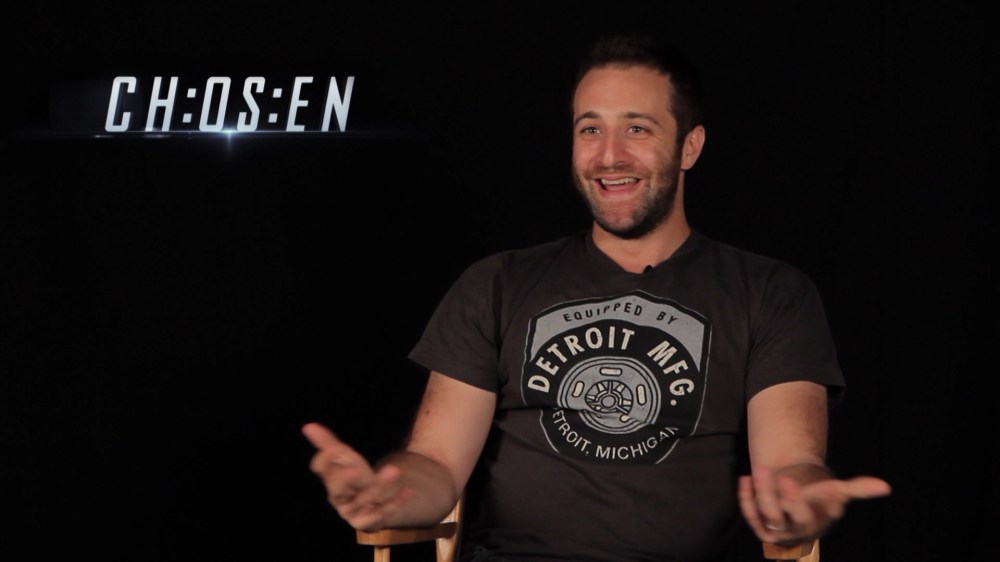
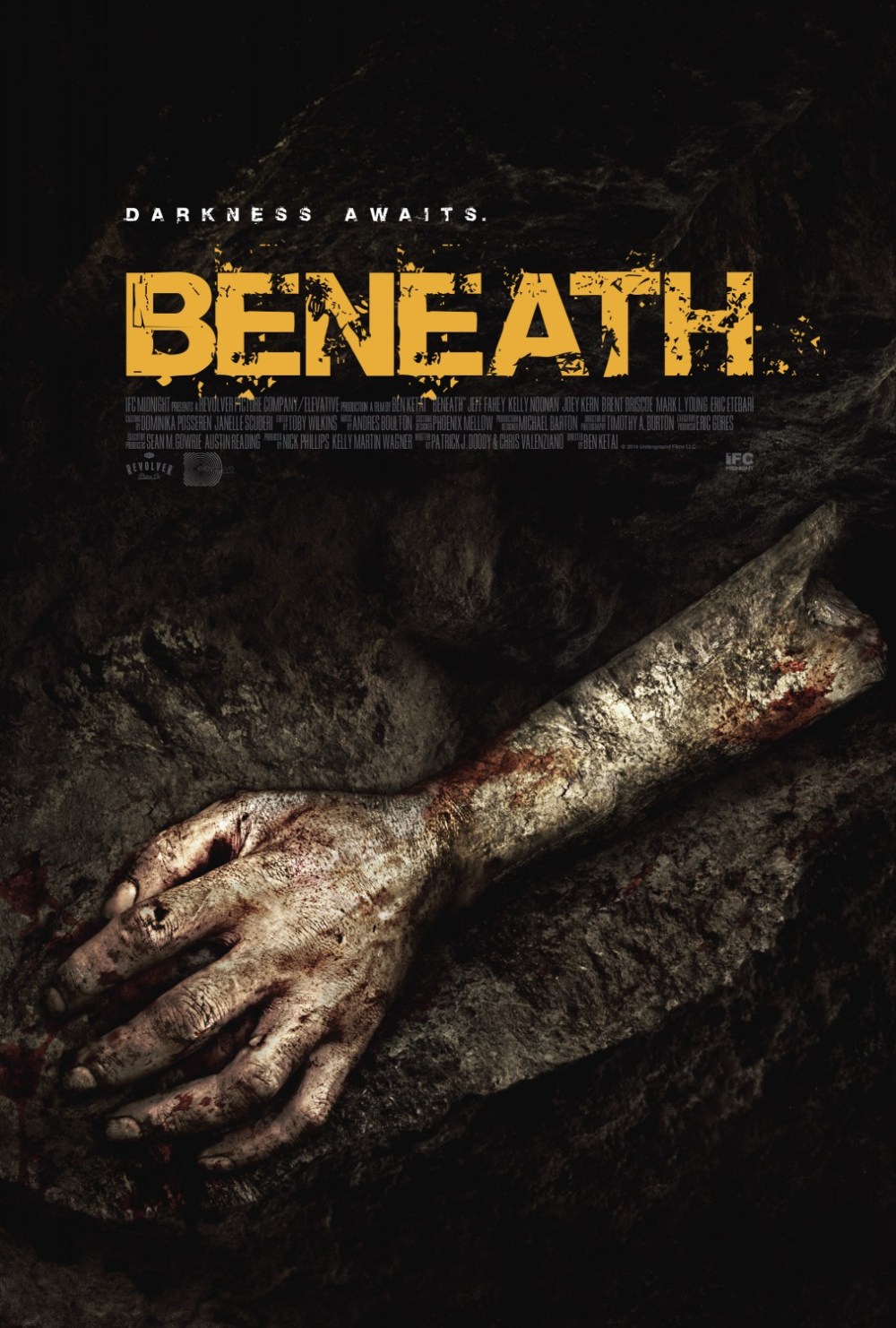
He has made a place for himself in the horror genre with the “30 Days of Night: Dust to Dust” miniseries and the web series “Chosen.” Now with “Beneath,” Ben Ketai breaks into the feature film realm with a story about a bunch of coal miners who get trapped several hundred feet underground after a catastrophic accident. The movie stars Jeff Fahey as veteran coal miner who spends the last day on the job with his co-workers and his daughter Samantha (Kelly Noonan) when the accident happens, and they have to work together to escape the mine before madness and toxic gasses kill them.
I got to speak with Ketai over the phone, and it was great fun talking with him as he explained what it was like working with Fahey, the challenges of maintaining a strong level of suspense for ninety minutes, and the research he did on coal miners for this movie. “Beneath” might look like your typical horror movie, but in many ways, it isn’t.
Ben Kenber: I thought this movie was very riveting and I like how you managed to keep the suspense up until the very end. How much of a challenge was it to maintain that suspense from start to finish? It could not have been easy.
Ben Ketai: One of the challenges when doing a horror movie like this where you are stuck in one space for the entire film, and I give all the credit to Chris (Valenziano) and Patrick (Doody), the writers, is figuring out how to build a proper level of escalation that keeps the story moving without breaking the suspense until the very, very end. It definitely makes my job much easier when you have a creative group of people like that.
Ben Kenber: This is definitely an interesting story for a horror movie. There have been a lot of stories in the news over the past years of mines collapsing and miners being trapped for an agonizing period of time. Was there a specific event that inspired the story for this film?
Ben Ketai: It was really, for Patrick and Chris, the Chilean coal miners and what they went through was the first seedlings of the idea. And then while they were working on it, I think there were a couple more incidents that came along and so we had a lot of different unfortunate happenings that allowed us to draw inspiration from. A lot the inspiration for the film also comes from just coal miners who haven’t been in collapses, and Chris and Patrick did extensive research while writing the script talking to coal miners and visiting coal mines in West Virginia. We had a recently retired coal miner talk to our cast before production. It was like a little seminar on what it’s like to be a coal miner. There were lots of wonderful sources of inspiration.
Ben Kenber: Where exactly was this movie shot? It looks like a real coal mine, but I came out of it not knowing if it was actually a movie set or not.
Ben Ketai: We actually shot it on a soundstage in Culver City, and pretty much everything you see inside the mine was constructed by our brilliant and very resourceful production designer Michael Barton.
Ben Kenber: At times, I thought it looked so real.
Ben Ketai: I had to remind myself sometimes when we were actually on set. I would start to get claustrophobic, and I had to remind myself that we were on a soundstage and that there was sunlight outside.
Ben Kenber: While watching “Beneath,” I was reminded of a number of other movies like “The Descent” where a group of women went cave dwelling and encountered a bunch of vicious monsters. Was there any movie which inspired you or played through your mind while you were making “Beneath?”
Ben Ketai: We actively tried to avoid “The Descent” and other movies like it because we knew it would draw such strong comparisons just because of the subject matter. But of course we watched “The Descent” and we looked at what works best in that movie, and then also what signifies what that movie is and what that movie looks like it feels like. It sounds too derivative, but while making the movie and immersed in the experience I tried to pull from movies that aren’t actually entirely of the genre. I wanted to try to put something more human to the horror experience. Honestly, one of the movies that my crew and I watched the night before we shot was “Friday Night Lights” simply because it’s a film to me that just does a great job of capturing real camaraderie, and also it has a very piece of life feel to it. That was something that we wanted to bring to a movie like this and to try to make the characters feel like real people that we love and care about, and if we can do that then the horror is going to take care of itself. “The Wrestler” was another movie we watched, and it did such a great job of getting the camera to capture the world of wrestling in such a personal way. I wanted to do that same thing with coal miners and have that same sensation.
Ben Kenber: I’m assuming that you did a lot of research on coal miners and mining accidents, and I imagine that when you have a lack of oxygen down there beneath the earth that you start seeing things that may or may not actually be there. What kind of research did you do in preparation for directing this film?
Ben Ketai: All sorts really. The writers had a great head start obviously and they worked on the script for about a year and a half. When I came onto the project just a couple months out from production, they kind of dumped all the research into my lap and I had to do a crash course and catch up fast with them. We were developing the script through craft and with the actors. We just gathered as much information as we could about what happens to your brain during oxygen deprivation, and not only that but what happens when you were trapped in a coal mine. It’s not just that you are running out of oxygen, but the air itself is becoming toxic. There are always toxic gasses that are leaking into the coal mine, and usually if the mine hasn’t collapsed there is stuff that extracts that from the working environment. When the collapse happens, it basically cuts off their flow of fresh air, and things like methane and poisonous gasses continue to build up. All the crazy things that can happen to you like hallucinations to total personality changes, that was really the most exciting thing to me. We had this great device that creates a real-life thing that could explain away all those supernatural things. We really wanted to make it all ambiguous, and we did.
Ben Kenber: The cast for this movie is really spot on. All the actors look like they have worked in a mine for a long, long time. What was it like casting this film?
Ben Ketai: The casting process on this movie was awesome. It was probably the most enjoyable process that I ever had working on movies because we didn’t have a studio looking over our shoulder and we didn’t have foreign sales companies to answer to. So we really just got to do it the old school way and we just had auditions. We really took our time to figure out who were the best people to embody these characters, and we managed to assemble what I felt was a cast of just all incredibly talented and incredibly realistic people/actors.
Ben Kenber: What was it like working with Jeff Fahey?
Ben Ketai: It was a really, really incredible experience. I’ve always been a fan of his. I was probably 12 years old when I first saw “Lawnmower Man.” I grew up with Jeff Fahey. It’s kind of a dream to get to work with a guy like this, and not only that but he’s got so many years of experience under his belt and so much passion for his craft that working with him is sort of like… You turn him loose in a scene and his energy and his expertise kind of permeates to the rest of the cast. I think it really helped pull everything together. I feel like, as a director, I’m just lucky to be able to put that in front of the camera.
Ben Kenber: Robert Rodriguez once said having less money to work with forces you to be more creative. Was that the case for you on this movie, and did you have to cut any corners to get the shots that you wanted?
Ben Ketai: It definitely forces you to be more creative, and I really actually think in many ways it’s what gives the movie its voice and personality. We had to spend so much money building the set itself because we couldn’t film in a coal mine. There really wasn’t much left for anything else. When I came onto the film as director, my first role was to try to make everything feel as real as possible. Myself and Tim Burton, my cinematographer, we wanted to make it feel like we were down in the coal mine with flashlights and headlamps. So what you actually see onscreen is lit with practical lights. Instead of spending our time and our electric budget on a huge lighting truck like you would get on a big studio movie, we were at Home Depot looking at different kinds of flashlights.
I want to thank Ben Ketai for taking the time to talk with me. “Beneath” is now available to own and rent on DVD, Blu-ray, and Digital.



 The Ultimate Rabbit