Spike Jonze’s ‘Where the Wild Things Are’ Deserves Another Look

Back when I saw it in 2009, Spike Jonze’s take on Maurice Sendak’s “Where the Wild Things Are” proved to be one of the few movies which I felt really dealt with real kids instead of the cliched ones which inhabit far too many motion pictures. Here, we get a young boy who has quite a vivid imagination which he retreats to when the real world becomes too scary to deal with, and who comes from a broken family where the father is not present. It was nice to see kids, one in particular, treated as intelligent and capable of learning more than they knew, and it combines them with things which are real, imaginary and, of course, wild.

The kid here is Max, and he is played by Max Records in one of the best performances I have seen from a child actor. Seeing him build an igloo out of a snow pile or making a spaceship in his bedroom with his stuffed animals as willing passengers brought back great memories from when I was a kid. But reality rears its ugly head when other kids thoughtlessly destroy his igloo, not thinking of what it meant to him. Then we see him in elementary school as his teacher explains how the sun will die one day. This is one of the funnier moments as the teacher just can’t stop talking about all the different ways our planet will die. Granted, this won’t happen for another billion years, but when you’re a kid, this can feel like it is just around the corner.

Everything comes to a head as Max becomes very resentful of his mother (the always terrific Catherine Keener) when she brings home a new boyfriend (played by Mark Ruffalo). The bond Max shares with his mother is very strong, but when he is no longer the center of her attention, he rebels and ends up biting her on the shoulder. Horrified at what he did, Max runs away from home and sails to a distant island where he does indeed come across the Wild Things of the title, and this is where the rumpus truly begins…

The Wild Things are a combination of puppetry and CGI effects, and it makes them all the more real as a result. The visual effects are used to give them facial expressions which vividly captures their happiness and sadness. As a result, it never ever felt like I was just watching a whole bunch of special effects. It really felt like I was watching creatures I could actually interact with.

Of all the monsters, the one with the most recognizable voice is the late great James Gandolfini who plays the most prominent Wild Thing, Carol. We first see Carol destroying some dwellings he had just built. For Max, breaking things has a wonderment to it, and Carol links on to this with the upmost enthusiasm. Gandolfini is wonderful, and at times truly heartbreaking as he takes Carol from utterly enthusiastic highs to downright angry lows. This is not him doing Tony Soprano as if he was all covered with fur. Also, Carol’s last scene is one which really choked me up, and Gandolfini sells it for all it is worth.

Among the other voices are Catherine O’Hara’s, and she plays Judith, the one monster who is very mistrusting of Max. Paul Dano plays the ever so sensitive Alexander, and he captures the painfully shy nature of this monster in a very truthful way. Forest Whitaker portrays Ira, and I barely recognized his voice here which is pretty impressive. Lauren Ambrose voices KW, and the moments she shares with Max form some of the movie’s best moments.

You know the saying of how we have met the monster, and the monster is us? Well, that is very much the case here. The Wild Things clearly represent the different parts of Max’s personality, and he soon comes to see himself in all of them. As a result, Max manages to see things a little more clearly in relation to his own family, and especially his mother. By becoming the monsters’ king, he realizes he has become much like his mother.

I really mean it when I say Records gives one of the best child actor performances I have ever seen. The whole movie really rests on his shoulders, and that is a lot to put an 11-year-old through. Jonze really lucked out getting him to play this part as the young actor makes his character’s transition from being just a kid to someone who is more mature and understanding very believable, and this really shows in the movie’s last half.

Jonze shot a good portion of the action with handheld cameras to give the proceedings more of an immediacy, and he thankfully does not overdo it. Some filmmakers fail to reign this camerawork in a lot of times to where it is hard not to feel sea sick. This was only his third movie as a director, following the creative triumphs of “Being John Malkovich” and “Adaptation,” and his directorial vision remains a very original one.

“Where The Wild Things Are” was originally supposed to be released in 2008, but Warner Brothers had considered reshooting the whole thing. It turned out Jonze’s vision was a lot darker than they expected it to be for something they thought would be an average family movie. The fact that Jonze’s take on this classic children’s book did make it to the silver screen and was not buried in a deep dark dungeon like “Batgirl” feels like a miracle. While it was not the box office hit the studio hoped it would be, it continues to have a long shelf life.

It also has a wonderful soundtrack done by Karen O and the Kids. It’s one of those soundtracks which has really great songs which are never easily forgotten, and it adds vividly to the strong emotions generated throughout.

Is this movie appropriate for kids? Well, it depends. If they are 6 years or younger, you may want to see it before they do. I was sitting near a boy and his mother, and the boy did get a little freaked out at times. Still, it is nowhere as traumatic as “Watership Down” or “The Neverending Story” was. If your kid can handle “Bambi,” they can handle this one as well.

One of my favorite scenes comes when Max and the monsters are jumping all over the forest, and Carol was creating big dust clouds when he landed. This all leads to a wonderfully heartwarming moment where the wild things pile on top of each other and fall asleep. Seeing Max befriend the somewhat alienated KW is especially great because their individual differences just evaporate at that point. These are two who can relate and sympathize with one another as they both come from worlds where they feel like outcasts.

If there is one weakness to be found here, it is that the plot does not always hold together. There are some moments which drag, and it takes a bit for the pace to recover. Then again, this movie is based upon a book that is only ten sentences long. The fact Jonze and co-writer Dave Eggers were able to craft a story for a feature length movie out of it is pretty amazing. But when you read or re-read the book, I think you will find that there is more to it than its simplicity of story might imply.

There was a bookstore next to the theater I saw the film at, and I dashed in there to read the book. I can’t even remember the last time I read this Caldecott award winner, and there is a lot of different ways you can look at it. You can see it as a story of how kids do not easily separate from their parents, and of how the further away from home they get, the more they realize the importance of a home. Or maybe you will see it as a story of the one person who becomes king and gets what he wants, but then finds it deeply unfulfilling and bereft of love and family which we largely thrive upon.

I think Jonze saw “Where the Wild Things Are” as a story which clearly take in a child’s point of view. Just about everything in this movie made me feel like I a child again, and of how we become shaped by the things which make us happy and sad. It is not meant to break down the imaginary worlds we create for ourselves, but of how they can make us understand the world around us and the people who figure most prominently in our lives better. Max comes to see why his mother treated him the way he did, and he grows up a lot quicker than most others his age do in the process.

For me, this film was something of a godsend when I first watched it. We see kids treated like real kids, and there is a wealth of genuine imagination and emotions throughout. While it doesn’t always hold together, it is a much more accomplished film than many others which get passed off as “family entertainment.” Too many movies then and now are dumbed down for audiences, and they often don’t treat children like the intelligent creatures they can be,

Indeed, no one could have brought this classic book to the silver screen the way Jonze did. And after all these years, it is definitely worth another look.

* * * ½ out of * * * *

The ‘Friday the 13th’ Reboot – Jason is Vicious, But the Movie is Bland

WRITER’S NOTE: This review was written back in 2009 when this reboot was released.

What better way to spend Singles Awareness Day (a.k.a. Valentine’s Day) than with an old friend who butchers camp counselors because they didn’t keep him from drowning, or supposedly so? I somehow doubt you can call this latest slasher adventure of Jason Voorhees a remake. Each sequel to the original “Friday the 13th” was basically a reworking of the first sequel which introduced Jason as the main killer of the franchise. Watching each successive sequel has been like witnessing a perverted sports event. How is Jason going to kill off those promiscuous teenagers? What weapons will he use? Will the ladies be as cute as they were in the previous movie? Will the guys be every bit as gullible as before? I think this is what makes people keep coming back to this never-ending franchise. We are curious to see how Jason will dispatch his latest batch of victims before he gets laid waste to by the final girl. John Carpenter said evil never dies, and Jason Voorhees is proof of this.

This “Friday the 13th” comes to us from Platinum Dunes, Michael Bay’s film company which made such unnecessary remakes of “The Texas Chainsaw Massacre,” “The Hitcher” and “The Amityville Horror.” A lot of people complain about Bay the director, but I am more worried about Bay the producer. Still, the idea of bringing back Jason was too intriguing even for me to pass up.

In this particular “Friday,” Jason more threatening here than he has been in ages. For the last few movies, he has become a figure of such unbridled camp that he comes across as more of a joke. Here, he is as vicious as ever. This Jason does not just walk at lightning speed like he did in “Part VIII: Jason Takes Manhattan.” Here, he thrusts his weapons and impales his victims with sheer velocity. His mommy issues have never been more deeply rooted than they have been since the franchise first began.

The movie starts off more or less condensing the original, as it was Jason’s mother who was the brutal killer in that one. We see Jason’s mother, played by Nana Visitor from “Star Trek: Deep Space Nine” (never piss off a Bajoran), get decapitated by the one camp counselor, female of course, who she couldn’t kill. We all know how seriously pissed she was at the counselors who let her son Jason drown, and now Jason will carry on her vengeance. The prologue is much longer than I ever could have expected, and in it we meet a bunch of kids who are seriously interested in obtaining a huge quantity of marijuana. Jason, however, is there with a bag over his head, the iconic hockey mask gets introduced later, killing off potential profiteers. It made wonder if Jason was actually a drug dealer as he apparently lives near such a big farm of green.

These kids meet a gruesome end (is there any other kind?), and the movie then moves ahead a couple of months to introduce us to a new set of victims. These ones though are not there to be camp counselors, but instead to stay in a house by the lake to have a “relaxing” weekend. The house belongs to the father of a snobby little spoiled brat named Trent (Travis Van Winkle), and his name wreaks of snobbery whether he likes it or not. Along with him is his girlfriend Jenna (Danielle Panabaker) who has no business being with a guy like him, an Asian smarty named Chewie (Aaron Yoo) who has yet to get laid, and a couple others who, whether they get laid or not, will most likely not live through the weekend. You also have the sole black man, Lawrence (Arlen Escarpeta), who loves to mess with white people and their prejudices they are blind to. Arlen has one of the best lines of dialogue, and you will know it when you hear it.

What makes this particular “Friday the 13th” different from the others? Not much. It has the requisite killings and naked breasts. Sean S. Cunningham, the director of the original, is along for the ride as a producer, and he is intent on giving the audience what they expect from a movie like this. What makes this franchise reboot different is it is a lot bleaker and more unrelenting than the other sequels.

Marcus Nispel directed this installment, and he also directed the Platinum Dunes remake of “The Texas Chainsaw Massacre.” He gives it a washed out look, and it gives the proceedings a more realistic feel as well as a foreboding one. The tension is thick in the air, and even though the scares are pretty much where you would expect them to be. The killings are effectively brutal, but Nispel doesn’t dwell so much on the blood and gore as much as you might expect.

As for the characters, they really didn’t stick in mind for long after I left the theater. That’s the problem with movies like these. Not that I expect them to be in depth character studies, but it is clear these characters are presented as being ones who are quickly disposable. There are those who you want to live through the night, and there are others whose demise constantly root for, especially Trent. In the end, they are all fair sport for Jason who kills everything in his path. Having an Asian and a black character also shows how this masked killer knows no racial boundaries when it comes to slashing trespassers. After all these years, Jason Voorhees remains an equal opportunity murderer.

Jason is played in this incarnation by Derek Mears, an actor who played the Chameleon character in that awful sequel, “The Hills Have Eyes 2.” I liked how he gave Jason a fury we have not seen from in over a decade. Not that I want to take away from Kane Hodder, but Mears gives Jason a viciousness which makes him feel more dangerous than ever before.

Regardless of these positives, there is nothing particularly special to this “Friday the 13th.” Despite a higher standard of production values the other sequels never got, it still feels like an ordinary run of the mill slasher movie to where the one word I can best describe it as being is bland. It’s the kind of movie which doesn’t stay in the brain too long after you have seen it. While Jason may be more threatening than ever, it is not enough to make this movie seem altogether satisfying.

Also, I am really getting sick of this plot device in which cell phones do not work. I find it hard to believe there are places on this planet which do not have cell phone signals. Granted, the Hollywood Hills never seem to have them, but still, while this scenario worked fine in “The Hills Have Eyes” remake, this singular excuse to isolate these dumb characters continues to get weaker and weaker.

For what it’s worth, this is the first “Friday the 13th” movie I have ever seen in a theater. I always kept hearing about these movies as a kid, and I was fascinated with them even while Siskel & Ebert kept tearing them apart as “cynical filmmaking.” It took me a while to get around to actually watching them, and even then, I had the volume turned down. I also kept hearing from my friends how people reacted during them. One told me how, when he saw “Friday the 13th Part VII: The New Blood,” everyone started a chant when it looked like the most unlikable character, a horribly spoiled girl with no manners whatsoever, was about to get killed off. This led the audience members to start chanting:

“Kill the bitch, kill the bitch, kill the bitch, kill the bitch, KILL THE BITCH! KILL THE BITCH!! KILL THE BITCH!!! KILL THE BITCH!!!!!!”

That would have been fun to witness, and the fact that this “Friday the 13th” movie did not have it took away from the experience. While I admire how they made Jason more lethal, part of me missed the tongue in cheek qualities of this franchise. You know, the moments which reminded you it was just a movie, and how some critics take them way too seriously. Looking back, I feel like I missed out on something.

Jason should really engage in a group therapy session with Norman Bates because they have more in common than they realize. Of course, Jason doesn’t talk, but maybe Norman could get him to or perhaps teach him sign language. Hey, anything is possible, right?

* * out of * * * *

‘Moon’ – Sam Rockwell Lost in Space

WRITER’S NOTE: This review was written in 2010, long before a certain actor in this film became quite the pariah.

You know, in retrospect, maybe 2009 wasn’t such a bad year for science fiction movies. It’s just that the stench from some of the biggest movies in that genre lasted much longer than the memories we had of the movies we saw.

With “X-Men Origins: Wolverine,” we sadly watched a strong franchise fall victim to a prequel which lacked the thrills and the complex characters that made the three previous entries so good. “Terminator Salvation” will probably be remembered best for Christian Bale’s angry rant on set than with what ended up onscreen.

And then came “Transformers: Revenge of the Fallen,” and I still have the impulse to bitch and moan about that sequel whenever necessary. Michael Bay left a giant robot turd for us which we just couldn’t resist seeing, so it of course made hundreds of millions of dollars. It put such an enormous dent in my enjoyment of things science fiction, and I am still getting over my frustration with it even after all this time.

But getting past that awful stench, there were a number of sci-fi gems to be found in 2009. “Star Trek” turned out to be an enormous surprise and a fantastic piece of entertainment. Imagine that, a prequel heading in unpredictable directions. And although I keep running into more and more haters of this one, “Avatar” for me was a great reminder of why experiencing movies on the big screen with an audience can be so much fun. And let us not forget “District 9,” a film that paralleled the Apartheid movement which overtook South Africa for far too long. These films were so good that I believe they will stand the test of time as opposed to the others which let me down to an infinite degree.

And then there is “Moon” which came out in limited release and did not have the same publicity as those big blockbusters did. This one proved to be the most thought provoking and original sci-fi movie of 2009. Granted, it does borrow from many classics of the genre like “2001” and “Alien” to name a few, but first-time director Duncan Jones takes all these influences and molds them into a motion picture which feels very fresh compared to what we generally get year to year. Jones is also aided greatly by another in a long line of superb performances from Sam Rockwell who is more or less doing a solo show this time out.

Rockwell plays Sam Bell, an employee of Lunar Industries who is under a 3-year contract to extract Helium-3 from the moon’s surface; a natural gas which will provide much needed clean energy back on Earth. You would figure he would get more than just a robot companion as company during all this time far from home. But I guess corporations managed to find a way to cut the whole workforce down to one person in the future, hence saving them an obscene amount of money for themselves. Sam’s only human contact is the messages he gets from his wife and infant daughter as well as his superiors who are always checking on his progress. For him, it must be like staying at “The Shining’s” Overlook Hotel with outer space to deal with instead of snow. But at least here, he is spaced out instead of snowed in.

While doing his daily work on the land rover, Sam crashes and is knocked unconscious. When Sam comes to, he is back in the lunar base but has no idea of how he got back. He also ends up hallucinating to where he sees a little girl he does not know. In short, a number of things happen to where he goes outside the base and back to the damaged harvester to find someone barely alive: himself. To reveal more would be criminal because it would spoil the many surprises this film has for you.

For a moment, I thought “Moon” was an adaptation of another Philip K. Dick novel like “Blade Runner” or “Total Recall.” It turns out, however, it is not, but “Moon” does deal with some of the same themes. How would you feel if one day you woke up and found you were not who you thought you were? Would you continue on in life if you found you were nothing more than a copy of another person? How long can a secret be kept before it comes out into the open? While scientists may continue to play around with the evolution of human beings, they can never fully control the desires and actions of them. Throughout history, humanity has always found a way to break through its collective suppression to get at a reality which cannot be forever contained.

As I said, “Moon” borrows from many other sci-fi movies. The design of the lunar base looks much like the Nostromo from “Alien,” and a lot of the lettering and fonts seem very similar to those seen in “Aliens.” And there is no mistaking the influence “2001: A Space Odyssey” had on this film, especially with Sam’s robot companion GERTY (voiced by Kevin Spacey). Instead of an eerie looking red dot like HAL, GERTY has a smiley face which illustrates the different emotions which better relate to Sam’s emotional needs. This is that same smiley face Wal-Mart co-opted, and although this company is not mentioned here, seeing that icon makes me believe this particular corporate monolith may very well have the last laugh on the unions and remain more dominant in the future. Be afraid. Be very afraid…

Other directors would just take these elements and throw them up onto the screen without much forethought. Jones, however, takes all these familiar elements and more than makes them his own. “Moon” looks familiar in some ways, but it feels quite unique in others.

But what is especially impressive about “Moon” is how it was made for only $5 million dollars. Most sci-fi movies these days cost at least $150 million, and this does not include advertising and other promotion costs. Heck, when I see a sci-fi movie that costs only $30 million, I expect subpar effects and am usually forgiving about them. But Jones takes the budget he has and makes everything look like it cost ten times as much. I guess this further proves what Robert Rodriguez said about having less money forces you to be more creative.

“Moon” also benefits from an excellent music score by Clint Mansell whose career as a film composer keeps getting better and better. His music adds a strong emotional quality that strengthens our need to understand Sam on an emotional level. Ever since “Pi” and “Requiem for a Dream,” Mansell has proven to be one of the most original sounding composers working today, and the musical themes he typically deals with are perfectly suited to this kind of material.

In the end though, this is Rockwell’s show, and he has quite a challenge as he is essentially acting opposite himself. You have to wonder how an actor plays off of himself and yet makes it look so natural at the same time. Rockwell has become better known for playing bad guys or heavies in mainstream movies, but he is more than capable of playing outside of that and continues to prove so in movies like this, “Frost/Nixon,” and “Choke” to name a few. In giving his character a strong complexity to someone who may not really actually be human ends up forcing you to identify more with something which may simply look like a machine from the outside. As a result, you could say that “Moon” also has a bit of “A.I.: Artificial Intelligence” in it as well.

And I do not want to leave out Kevin Spacey whose voice as GERTY creates a soothing trust Sam wants to hold on to and, at other times, test. GERTY is HAL but without the homicidal tendencies, and that has to be reassuring if you are stuck on the moon with no one else but a robot. Spacey makes GERTY seem like more than just a robot, and he makes us see how GERTY more in common with Sam than at first glance.

“Moon” is easily one of the most intelligent sci-fi movies of 2009, and it got lost in the shuffle of all the other big Hollywood releases, both bad and good. It deserves a long shelf life at your local video store, if there are any left where you live. In the end, it will last much longer in the memory than Michael Bay’s desecration of all things Hasbro. But enough of that one already…

* * * * out of * * * *

Favorite Opening Titles: ‘Enter the Void’

I will never forget the first time I watched this Gaspar Noe film. “Enter the Void” was screening at the Laemmle Sunset 5 (which has since become another AMC Dine-In Theater), and I had been very, very eager to check out his long-awaited follow-up to his powerful and devastating “Irreversible.”

Noe has always been a playful filmmaker when it comes to title credits, regardless of whether appear at the start or the end of his works. “Irreversible” started with the end credits and went backwards from there, “Climax” did not dare to reveal its title until the film’s final moment and spread its opening credits throughout, and “Vortex” started with its end credits in a solemn fashion which indicated we would be following a pair of characters to their last dying breath.

With “Enter the Void,” Noe zooms through the end credits super-fast to some hypnotic sound which acts like a flashing light. Once they are finished, he thrusts int the opening credits which look like they came out of some kind of modern disco while the song “Freak” by British electro artist LFO plays loudly over the speakers. This is Noe’s way of telling the audience they were about to go on quite the cinematically visual ride.

The opening titles of “Enter the Void” are among my favorites as they are unlike any others I have seen before and after it. Seeing the different visual styles employed for it is endlessly fascinating as it made me wonder just how many styles they came up with. When it comes to LFO’s “Freak,” it proves to be the perfect music cue to score these titles. And when these titles concluded to where we came to “enter” this motion picture, the small but attentive audience at the Sunset Laemmle, including myself, burst into applause. Opening titles are never quite this exhilarating when it comes to your average motion picture.

According to Noe, “Enter the Void” was screened at various film festivals without any titles, be it opening or closing. The title logo was designed by German experimental filmmaker Thorsten Fleisch, and the opening titles were designed by Franco-Japanese filmmaker and designer Tom Kan whose other works include “The Matrix Reloaded” and “The Matrix Revolutions,” “Speed Racer” and “Cloud Atlas.

There is a great article and interview about the “Enter the Void” titles which can be found at the Art of the Title website. Click here to read it.

Check out the opening titles of “Enter the Void” down below.

Revisiting ‘Avatar’ in its IMAX Special Edition

Avatar-rerelease-movie-poster-limited

WRITER’S NOTE: This review was written in 2010.

I really did mean to see “Avatar” in IMAX while it was still playing in theaters, but I never got around to it, unfortunately. After a bit, all the hoopla surrounding the movie was met with people deriding it and calling it a remake of “Fern Gully: The Last Rainforest” or “Dances with Wolves,” and I got worn out from hearing all the complaints. I knew “Avatar” was not going to have an original storyline, so there was no way I could have been disappointed. But after watching it on a regular screen in 3D, I was really eager to see how it played on in IMAX. With Cameron, you can always count on seeing his movies being made with the utmost technical precision. If there is a technological glitch anywhere, it’s someone else’s fault, not his.

At the end of August 2010, “Avatar” got re-released specifically in IMAX theaters around the country, and it had been extended to include scenes that were not in the original theatrical version. There is a total of 9 minutes of extra footage here, and Cameron succeeded in blending these new scenes into the film seamlessly. The new footage includes the following additions:

  • There are more of the Stingbat and Sturmbeat creatures which had their own standout scenes in the first version. The Stingbats look even more wonderful than they did previously, and that’s saying quite a bit.
  • You get more hunting sequences including one in which Jake and Neytiri fly up in the sky and shoot at the animals down below with arrows. This adds more to how Jake interacts and learns from the Na’vi, and how he becomes more open to being taken in by them.
  • There’s an additional sequence where Jake, Grace, and Norm visit a school where Grace taught which has since been turned into a storage space (and not a carefully looked after one). The moment when Jake spots bullet holes in the chalkboard says a lot about how the military infrastructure on the planet is causing more harm than doing any good for the people. It’s a haunting image that filled me with things I did not want to think about as school violence appears to be rising.
  • We get to see a Na’vi counterattack after the bulldozers have laid waste to some of the most sacred parts of Pandora. It is a foreshadowing of the devastating battle the humans will soon bring to the planet’s inhabitants, and of how fighting fire with fire does not always work to one’s advantage. This is especially the case when the other side has more firepower.
  • The sex scene between Jake and Neytiri is longer, but don’t get too excited about it. There’s no insertion of anything or any penetration on display (this is a PG-13 movie after all!), just more hugging and cuddling. We still have yet to see how the Na’vi makes out with one another. I guess we’ll have to wait for the “unrated” edition to see that (lol).
  • There’s a strong emotional scene towards the end between Jake and the Na’vi which reminded me of the final moment between Tom Cruise and Ken Watanabe in “The Last Samurai.” However familiar or similar this scene may seem, it still adds much to the story as it makes Jake’s destiny on Pandora all the more important.

Basically, all the scenes don’t ever feel extraneous, and each adds much to what we had previously seen in theaters back in 2009. Say whatever you want about Cameron’s dialogue or lack of original storylines, but he remains one hell of a storyteller. Clearly, this whole movie was in his head for years and years, and he got every last detail down perfectly. Considering how long he worked on “Avatar,” it’s safe to say he waited extremely patiently until technology finally met up with him so he could tell this tale properly.

Now I’m not going into another long-winded review of “Avatar” as many of my thoughts on the movie have not changed. I do have to say, however, that it was worth the $20 bucks (yes, it was that much) to see it in IMAX. The movie didn’t fill the entire screen, more like three-quarters of it actually, but that was fine. Witnessing Cameron’s film in this format made the experience of watching it all the more immersive. I got serious vertigo watching this special edition at times as it felt like I was moving along with the characters at certain points. I had this same experience when I watched “The Dark Knight” in IMAX, and there were a number of scenes that were shot in the actual IMAX format in that one. I felt like I was floating along with the camera and wherever it went, and it is a feeling I never get enough of at the movies.

I noticed even more that the 3D really brings you into the movie more without calling too much attention to itself with scenes featuring ash falling through the air after the humans wipe out certain parts of Pandora, it started to feel like the debris was coming right off the screen.

Also, it should be clearer than ever that “Avatar” is a powerful anti-imperialist movie, and that it is not a fan of Americans invading other countries. There’s no respect for the rights of the indigenous population on Pandora, and we keep seeing this going on right here on Earth. It makes me wonder if history will ever stop repeating itself.

Seeing “Avatar” on the average-sized movie screen at your local theater is quite something, but watching it in IMAX is a whole other thing. No wonder this has been such an enormous hit around the world. Cameron sucks you visually and emotionally in ways most filmmakers only think they can. Most people I know of these days would prefer to wait until a movie comes out on DVD so they can watch it at home, but this is the kind of motion picture which was made to be seen in a cinema, let alone in IMAX.

* * * * out of * * * *

James Cameron’s ‘Avatar’ – A Cinematic Spectacle Like Few Others

WRITER’S NOTE: This review was written back in 2009.

“That is our (USA) job around the world; run in, free some people, and whip a little industry on them. So they can enjoy the benefits of industry that we have come to enjoy (cough).”

-George Carlin from “Class Clown”

“Some of the darkest chapters in the history of my world involve the forced relocation of a small group of people to satisfy the demands of a large one. I’d hoped that we had learned from our mistakes but it seems that some of us haven’t.”

“Jean-Luc, we’re only moving 600 people.”

“How many people does it take, Admiral before it becomes wrong? A thousand? Fifty thousand? A million? HOW MANY PEOPLE DOES IT TAKE, ADMIRAL?!”

-Patrick Stewart and Anthony Zerbe from “Star Trek: Insurrection”

We waited for this one almost as long as we waited for the release of Guns ‘n’ Roses’ “Chinese Democracy,” and now it is here. James Cameron has been at it again, making the most expensive movie ever, but this is nothing new and I am so burned out from hearing all the gossip about his movie budgets. The naysayers were out in full force proclaiming this would be a disaster as its release was delayed a number of times. But “Avatar” once again shows there is no one more equipped than Cameron to change the way we look at movies. With his latest epic, he has achieved the impossible and completely blurred the line between what is real and what is a special effect, and I could never tell the difference from start to finish.

You have to give a lot of credit to this ambitious director for being ever so patient. Cameron waited years for the technology to catch up to where he could tell this story most effectively, and he even invented a new camera with his brother to make the most convincing 3D movie we could ever hope to see. So many others would be in a hurry to get a movie up on the screen to where nothing but shortcuts are taken, but “Avatar” had a two year post production period (the longest ever) to get every little detail covered. This movie needs to be seen on the big screen as it was made for it. Waiting for a physical or digital release to watch it on would be tragic.

“Avatar” stars Sam Worthington as Jake Sully. Jake is a former marine who is now paralyzed from the waist down, and he does not ask for sympathy or pity. He ends up being recruited for a mission on Pandora, a moon on the far reaches of space. This mission was originally meant for his brother, but he passed away before he could take it on. Pandora is inhabited by very tall blue creatures called the Na’vi, and avatars of them have been created so that humans can walk among them undetected so they can be studied more closely.

Of course, these avatars are also being closely observed by the military as they plan to infiltrate the Na’vi and force them off their sacred land. For what reason? So that the greedy corporation (is there any other kind these days?) can get at the mineral called unobtanium (nice play on words). This mineral represents an enormous cash cow for soulless investors back on Earth, and it also serves as a much-needed source of energy it desperately needs. In the future, it appears humanity has extended the manifest destiny policy from other countries to the far reaches of space. I mean, heaven forbid we allow other cultures to handle their precious resources without our unsolicited advice! Do we ever learn?

Anyway, the story of “Avatar” has been told many times before; a disillusioned military officer comes face to face with people he has been fighting, and soon he becomes enamored with their lifestyle and code of honor to where he is integrated into their society. This has been the basis for “Dances with Wolves” and “The Last Samurai” and even “The Emerald Forest.”. We know the setup and how it’s all going to go, but Cameron still makes it work by having us invest emotionally in these characters. By doing so, all the action and the visuals presented to us become all the more enthralling.

Seriously, Cameron has been one of the very best storytellers in movies for decades now. This at times gets lost on people because his dialogue can be quite cringe inducing. You want to go up to him and make him realize people don’t talk to each other the way he thinks they do. It constantly reminds me of what Harrison Ford told George Lucas about his script for “Star Wars”:

“You can type this shit, but you sure as hell can’t say it!”

For what’s it worth, however, Lucas makes Cameron sound like David Mamet.

Regardless, the strength of the story he has concocted makes the visuals on display all the more exhilarating. My big issue with most effects driven movies is you can tell when you are watching a CGI effect. All this does is completely take me out of the movie to where I roll my eyes and wonder why Hollywood regularly underestimates audiences.

Now at the start of “Avatar,” when Jake is looking at the creature he will be, you can definitely tell what is real and what is computer generated. But as the movie goes on, I honestly couldn’t figure out which was which. I tried, believe me I tried to see the difference, but there was just no way. Plus, the motion capture they used on the actors is astonishing. The avatars are made to look like the actors playing them, and the movements are so amazingly lifelike to where it makes every other 2009 movie see, like it was made back in 1987. That description may be stretching it a bit, but I couldn’t resist.

The art direction in this movie is incredible, and the color blue (my favorite) is used quite a lot. There are other astonishingly breathtaking visuals like the floating mountains which looked quite real…. Damn it! I am running out of words to describe what I saw. You have to see it for yourself.

As Jake Sully, Worthington keeps him from being a complete cliché and infuses him with a nobility which has served him well in life. But one of the most welcome actors here is Sigourney Weaver who is appearing in her first Cameron movie since “Aliens.” Weaver plays Dr. Grace Augustine, the head of the Avatar program. While the military wants to use her work for their own manipulative methods, she uses them to help gain the trust of the Na’vi and study their world for peaceful and scientific purposes. She is the classic Cameron female character; tough as nails, controlling, and never ever a pushover Apparently, Weaver based her character on Cameron to an extent. To steal a line from “Up in The Air,” Dr. Grace Augustine may very well be James Cameron with a vagina.

Another classic Cameron female is played by Michelle Rodriguez, still looking as hot as she did in “Fast & Furious.” Her character of helicopter pilot Trudy Chacon is somewhat similar to Jeanette Goldstein’s character of Vasquez from “Aliens”; a badass soldier who is as tough as the men, maybe even tougher. She’s certainly a lot more morally conscious than the majority of the marines in the film, and Rodriguez makes sure you never forget that.

You also have Giovanni Ribisi playing Parker Selfridge (yes, his last name rhymes with selfish), the corporate manager in charge of the mining operation on Pandora. Like Paul Reiser’s character from “Aliens,” he is only interested in making a gigantic profit which will set him up for life. I love how Ribisi plays Parker as a pragmatic ass with absolutely no moral scruples whatsoever as this character is ever so gleeful about what is in store for him once this mineral is sufficiently mined. The way he sees it, what’s the big deal?

But one of the best performances comes from Stephen Lang who plays the brutal Colonel Miles Quaritch. Despite some of the ridiculous dialogue which comes out of his mouth, Lang completely makes Miles into a soldier you would be incredibly foolish to mess with. Like Tom Berenger in “Platoon,” his face is deeply scarred, and he does nothing to hide that. Miles simply sees it as an illustration of how nasty the moon of Pandora is. His flaw, however, is that he cannot see who the Na’vi really as his anger against them has long since powered by an everlasting fear which he cannot overcome.

Now let’s talk about the Na’vi, those big blue creatures who are tall enough to play for the Los Angeles Lakers or the San Antonio Spurs. They could have made or have broken “Avatar.” Cameron has said he thought about the story long before he began working on “Titanic,” and that he even thought about these characters when he was a kid. Now having an original race of people who speak their own language may work well on “Star Trek,” but in other shows and movies, it looks more comical and ridiculous than was originally intended. This is not the case here.

This brings me to the performance of Zoë Saldaña, who you may remember as Uhura in J.J. Abrams’ “Star Trek.” She plays Neytiri, Princess of the Na’vi tribe Omaticaya. Neytiri is the first real Na’vi to come in contact with Jake Sully, and she later falls in love with him. In essence, a lot of “Avatar” rests on her performance, and she succeeds in making you believe in this race of beings to where you see them as more than just an amazing series of special effects. This ends up making it easier for other actors like Wes Studi and CCH Pounder to portray their characters without having to expend too much effort in helping you buy into these extra-terrestrials. Saldana sets up the groundwork, and everyone follows her from there.

“Avatar” deals with many of the same themes Cameron has dealt with throughout his career: military intervention into a foreign land, machines versus nature, love found between beings from different worlds or societies, how scientists and those with curious minds seek to understand the aliens and make peace with them, and how corporations will do anything for a profit. The parallels between what the military forces are doing in Pandora and our wars in Vietnam and Iraq, not to mention our current escalation in Afghanistan, are clear as day, and it does make the movie feel timely.

But one of the especially interesting things here is how Cameron utilizes a lot of the technology which was on display in his previous films. Those armed walkers Colonel Quaritch uses look to be an upgrade of the driver Weaver used in the climax of “Aliens” (which the Wachowski brothers all but ripped off for “The Matrix” sequels). The mind devices used to control the avatars looks a lot like the head pieces used in “Strange Days.” The scenes of humans interacting with otherworldly creatures bring to mind similar scenes from “The Abyss.” And you have characters who go from being antagonists to becoming the good guys (“Terminator 2” was a classic example of this). With all this in mind, I thought Cameron was running out of new ideas, but I love how he combines them all up to good use in “Avatar.”

But enough of me babbling about “Avatar.” Whatever weaknesses this movie may have are undone by its well-earned achievements. Once again, see this movie in a theater! I don’t care if you hate going to the movies. “Avatar” is a great and reinvigorating reminder of how sitting in a darkened movie theater can be so thrilling.

Now, if you’ll excuse me, I have to find an IMAX theater playing this movie that is not sold out for weeks in advance. Seeing something like this on the silver screen once is never enough, ever.

* * * * out of * * * *

‘Bad Lieutenant: Port of Call New Orleans’ – No, it is Not a Remake

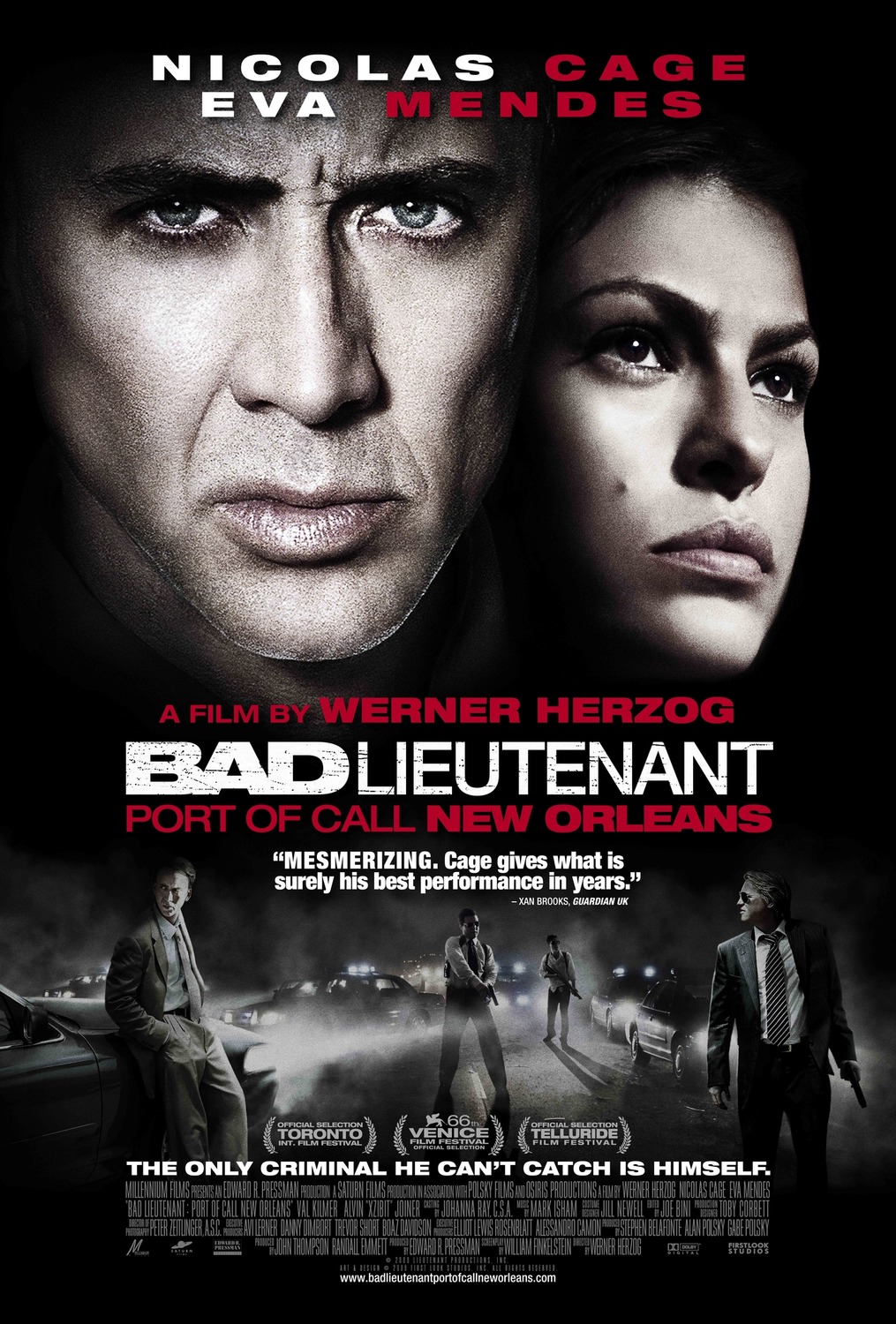
Alright, let’s get this out of the way; Werner Herzog’s “Bad Lieutenant: Port of Call New Orleans” is not a remake of Abel Ferrara’s 1992 film “Bad Lieutenant” which, as a friend of mine from high school pointed out “made ‘Taxi Driver’ look like ‘Alice in Wonderland!’” The only thing these films have in common is they have a main character who is a police lieutenant with serious gambling and drug addictions which suck them deep into a realm of immorality. Other than that, they are completely different cinematic works which somehow ended up with the same darn title. Comparing the two films, while in some respects inevitable, does neither any favors. Then again, they do have the same producer, Edward R. Pressman.

I do have to confess this is the very first feature length movie from Werner Herzog I have ever watched. Yes, I did see “Grizzly Man” and “Encounters at the End of the World,” but they were documentaries (brilliant ones might I add). Being the big movie buff that I am, you will likely find this shameful on my part, and it probably is, but you won’t have to worry about me comparing “Bad Lieutenant: Port of Call New Orleans” to all his other works. From what I have heard, Herzog’s films deal with human psyches in a most extreme and uncontrollable state, so this film must be right up his alley in terms of themes he has dealt with throughout his career. It also allows Nicolas Cage a role where he can (and does he ever) go completely crazy in the only way Cage can.

Cage stars as Terence McDonagh a sergeant with the New Orleans police force. We watch as Terence enters the severely damaged police department with his partner Stevie Pruit (Val Kilmer) as they try to salvage some stuff which was not laid waste in the aftermath of Hurricane Katrina. They end up coming across a prisoner still in his cell who should have been evacuated, and he is running out of time as the water level rises. Bothe Terence and Stevie seem perfectly willing to let this unlucky schmuck drown, but when Terence sees him start to pray, he quickly jumps into the contaminated water to rescue him. While he succeeds and is later made a lieutenant as a result, he also ends up with a serious back injury which requires medication he is told to take indefinitely, probably for the rest of his life.

Terence starts off being prescribed Vicodin by his less than hopeful doctor, something I had when I got my wisdom teeth taken out, and which my mother became terrified I would get addicted to. It’s all downhill from there as Terence quickly moves from Vicodin to cocaine, and then to crack or whatever else he can smuggle out of the evidence room. And just when you think he could not sink any deeper, he does. Eventually, he gets involved with local drug dealer Big Fate played by rapper Xzibit, looking livelier here than he did in “The X-Files: I Want to Believe.” By collaborating with Big Fate, Terence hopes to pay off his mounting debts. Throughout this twisted voyage, he is also met by a pair of iguanas who keep following him. Of course, no one can see them except him.

As dark and immoral as the plot and the characters are, I actually found this film to be shockingly funny. Seriously, “Bad Lieutenant: Port of Call New Orleans” has moments which are laugh out loud funny, and I couldn’t believe how much I was enjoying myself while watching this insanity. What’s on display here gives “Observe and Report,” the blackest of black comedies, a big run for its money in the perversely funny department. The audience I saw it with were also laughing as loud as I was as the utter madness constantly left us in complete hysterics.

But the big delight I got was watching Cage act in a totally unhinged state to where you would think this was a sequel to “Wild at Heart.” This collaboration with Herzog brought Cage back to the kind of role he does best. In films like “Leaving Las Vegas” and “Face/Off” among others, he proves to be a master of pulling off over the top performances which are infused with endless creativity. Herzog simply sets him loose to play a character whose mind is in a constant state of implosion which exposes a soul most corrupted.

One key scene comes when Terence pulls over a young couple driving home from a club. Cage plays the scene straight as he gets from these two what he wants and knows they have on them, and then he switches gears when the lady gives him a hit from what she is smoking. In the process, he begins to make out with her while her stunned schmuck of a boyfriend is forced to watch. This scene is as horrifying as it is hilarious, and only an actor as risk taking and reckless as Cage could possibly sell us on it.

So, what’s Herzog’s “Bad Lieutenant: Port of Call New Orleans” really about? I’m not entirely sure. It could be he is forcing us to look at a man whose soul is as toxic as the water that submerged much of New Orleans after Hurricane Katrina, and of how this man is forced to descend into hell in order to find of redemption. But considering how over the top this film is in portraying Terence’s increasingly manic state, you have to wonder if Herzog is more interested in the journey Terence is taking as opposed to where he ends up. It didn’t matter much to me in the end because I was enjoying myself too much, and that’s even if it was for all the wrong reasons.

Cage is also surrounded by a good cast of actors who do memorable work here as well. It was nice to see Brad Dourif here, having seen and liked him in Rob Zombie’s “Halloween II,” as Terence’s bookie whom he is heavily in debt to. Kilmer is very good as Terence’s corrupt partner, and that’s even if he has to stand in the shadow of Cage throughout. I have to say I was very surprised to Jennifer Coolidge cast as Terence’s stepmother. Having seen her in so many comedic roles, it was interesting to see her to take on something different and more dramatic. Vondie Curtis-Hall appears as well playing Terence’s superior, Captain James Brasser, and Tom Bower rounds out the cast by portraying his alcoholic father, Pat McDonagh.

Eva Mendes is also on board here as Terence’s prostitute girlfriend, Frankie. She previously co-starred with Nicholas Cage in “Ghost Rider,” and she plays the same kind of role she played in “We Own the Night;” a party girl whose boyfriend supplies her with all the fun and drugs she ever needs. On the basis of her performance here, I hoped she would get stronger roles in the future as she makes Frankie’s transition from being selfish to getting saved from herself very believable. She has since gone on to give excellent performances in “The Other Guys,” “Holy Motors” and “The Place Among the Pines.”

Herzog gives this film a rough and dirty look which all but suits the characters and the sleaze they submerge themselves in. The whole shebang could have been ruined if he shot the whole thing in high definition, for it would have made the visuals look much too tidy. This is not a movie you want to look all smoothed over and polished at the surface. It requires an atmosphere thick with humidity and with slime dripping off of everything as it eats away what is left. For all I know right now, Herzog is not a director who is even remotely interested in sweetening up story and characters in order to make his movies more available to a mainstream audience.

“Bad Lieutenant: Port of Call New Orleans” deserves to be taken on its own terms and not compared to Ferrara’s film in which Harvey Keitel went for the “Full Monty.” Its story is not always easy to follow, but it is endlessly entertaining for those in the mood for something bizarrely funny and far from normal. It also allowed Cage a temporary haven from the junk he has been forced to star in, and he gets free rein to go wild and crazy like no one else can. Thus, Cage reminds of us here that he is still more than capable of giving a brilliantly entertaining performance, not that we should have doubted that in the first place. While his career looks to having him churn out one straight to video movie after another, there is always those gems like this, “Joe” and “Pig” to remind us of what a tremendous talent he is.

Now, if you will excuse me, I have a ton of Herzog films to catch up on. I am behind enough on his work as it is.

* * * ½ out of * * * *

‘Public Enemies’ – Michael Mann and Johnny Depp Take on John Dillinger

“The reason you caught me, Will, is we’re just alike! You want the scent? Smell yourself!”

-Dr. Hannibal Lecktor (Brian Cox) speaking to Will Graham (William Peterson) from a scene in Michael Mann’s “Manhunter.”

After all these years, Michael Mann still has a strong fascination with criminal masterminds and those who spend their careers chasing them down. Film after film, he has spent his time delving into how the “good guys” and “bad guys” feed off of one another, and if they could not exist without one another. “Public Enemies” reminded me a lot of “Heat” in that respect, and it shares a lot of similarities as it looks at the famous John Dillinger, played here by Johnny Depp, and at the man sent to catch him, Melvin Purvis. It’s not as great a film as “Heat” was, but it is still a masterful piece of filmmaking and the kind we have come to expect from director Michael Mann.

“Public Enemies” starts with Dillinger and his friends breaking out of a maximum-security prison, something which seemed easy to do back in 1933. It turns out Dillinger is actually quite the celebrity and can find safe havens in one town or another. To many he is seen as a hero, and to others he is nothing more than a criminal. But as Dillinger continues to rob more banks, the FBI and J. Edgar Hoover (played by Billy Crudup) become increasingly persistent in bringing him to justice. In the process, Hoover turns to Melvin Purvis (played by Christian Bale) who subsequently leads a manhunt to take down Dillinger, and in the process changes from the person he thought he could be to the one he is chasing after.

One thing which has not changed about Mann’s movies is he still knows how to stage one hell of a gunfight. Back in 1995, he gave us one of the greatest in Downtown Los Angeles with “Heat,” and he has lived in the shadow of that brilliantly staged moment ever since. Sure, he has choreographed gun battles every bit as effectively brutal like in “Collateral” and his film version of “Miami Vice.” In his films, you don’t just watch guns go off, you feel them going off. When a bullet hits a body, characters don’t just fall down like in an old western. Their bodies are forever shattered, and the wounds they carry last long after the end credits have finished. There are a lot of strong action scenes like this throughout “Public Enemies,” and each one is equally hair raising. While “Heat” may remain his masterpiece, his other works do not pale in comparison necessarily.

Having Johnny Depp cast as Dillinger must have seemed like a no brainer. They appear to share some similar tastes minus the heavy gunfire, given Depp’s previous reputation as a “wild boy:”

“I like baseball, movies, good clothes, fast cars… and you. What else you need to know?”

-Johnny Depp as John Dillinger from “Public Enemies”

Depp remains one of the best actors of his generation, and he has constantly challenged himself to where this particular role is no exception. Dillinger was a criminal celebrity, perhaps one of the first, and Depp effortlessly shows you how Dillinger made this seem possible. With his eyes, Depp can still seduce the most knowledgeable and naïve of women without even having to try too hard. The actor also clearly brings out the joy Dillinger gets out of life, and he also gets at the depth of pain he experiences as those closest to him leave him, cut him loose, or get killed.

As Melvin Purvis, Christian Bale delves into many of the same situations which haunted Bruce Wayne/Batman in “The Dark Knight.” Melvin starts off as a man who is dedicated to the law and follows the rules and regulations to the letter. But after some serious setbacks, Melvin finds he has to use different methods in order to get his man. These methods include acts and people which and who work outside of the law. In the process, he comes to see what he has to become in order to capture Dillinger. But unlike Bruce, Melvin may not be able to live with himself when this is all through. Bale pulls off a really solid accent while playing Melvin, and he has a much more nuanced character to play here than he did in movies like “Terminator Salvation.”

But the one performance I enjoyed most in “Public Enemies” was Marion Cotillard’s who plays Dillinger’s girlfriend, Billie Frechette. Cotillard won the Best Actress Oscar for giving one of the greatest performances of all time in cinematic history in “La Vie En Rose.” She shares great chemistry with Depp throughout, and she is delightful to watch as Billie is ever so quickly drawn into Dillinger’s dangerous world. Billie does sense the trouble which lies ahead, but everything happening is too exciting for her to pass up. Showing both fear and excitement in a film scene without words is easier said than done, and she pulls it off like it’s no big deal.

If there’s anything which takes away from “Public Enemies,” it is that it doesn’t delve as deeply into the characters’ lives as I had hoped it would. If anything, this film would have benefited more from a back story, especially for Dillinger as to why and how he became a bank robber. It was also said that Dillinger was a hero because the banks he robbed ended up freeing things up for those who were economically challenged because of the Great Depression. I would have liked to have seen more of this because Mann may have thought this was clear from the way regular people treat Dillinger, but it doesn’t feel like they have a good enough reason to. Had there been a little more depth to these characters, this could have been as great a movie “Heat.”

Still, “Public Enemies” is fine filmmaking and continues Mann’s theme of looking at how the line between cops and criminals is often blurred and how both are actually one and the same. You could almost call this “Heat” as a period piece. Mann makes you wonder if a criminal can ever find and hang onto a love despite their law-breaking nature, and if the cop can ever lead a normal life outside their career of going after the crook. From William Petersen trying to think like the killer in “Manhunter” to James Caan trying to leave a life outside of crime in “Thief,” it’s a thin line indeed. Perhaps Mann keeps pursuing this theme in hopes that there will be a tomorrow for characters like these regardless of their opposing natures. Maybe he will find the answer in a future motion picture, and hopefully we will not have to wait too much longer for such a cinematic work.

* * * ½ out of * * * *

Underseen Movie: ‘The Men Who Stare at Goats’ – A Highly Unusual War Movie

WRITER’S NOTE: This review was written in 2009.

“More of this is true than you would believe.”

You know something? It’s really nice to see a movie use a phrase other than “based on a true story” or “inspired by true events.” Those descriptions have all but lost their meaning because even if what we are seeing actually did happen, it has all been watered down into a formulaic feel-good movie we have seen over and over again to where we want to gag. Even worse, we keep getting suckered into seeing them even when we should know better. Either that, or there’s nothing better to watch. But this year has proven to be great as filmmakers have worked hard to subvert those worthless phrases with movies like “The Informant.” That Steven Soderbergh film made it very clear how it was based on actual events but that certain parts had been fictionalized, and it ended by saying:

“So there!”

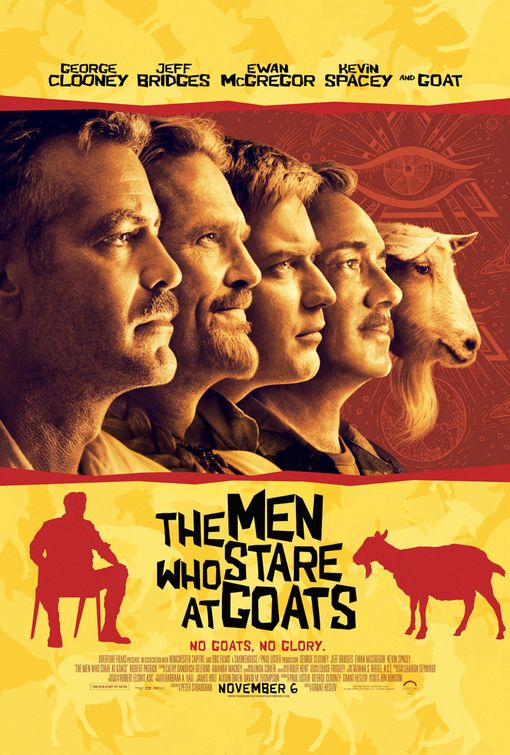
Now we have “The Men Who Stare at Goats” which opens with the sentence at the top of this review. The story behind this one is so bizarre to where it’s almost impossible to believe any of what we are watching could ever have happened. All the same, it appears a good portion of these happenings did take place, and it makes for what is truly one of the more unique war movies I have seen in a while. The film is based on a non-fiction book by Jon Ronson which looked at how US military forces used psychic powers against their enemies. They look at New Age concepts as well as paranormal activities to achieve these goals, and of how they worked to use these methods to their advantage. The movie takes place during the Iraq war, but not to worry, the filmmakers is not trying to shove any politics down your throat (not consciously anyway).

Ronson serves as the inspiration for Bob Wilton, an investigative journalist played by Ewan McGregor. Bob’s wife has just left him for his editor and, of course, he is depressed and decides he needs to do something more important with his life in the hopes he can win her back. As a result, he travels to Kuwait to do firsthand reporting of the Iraq War, with hopes of finding someone who can get him across the border. Bob ends up having a chance meeting with a Special Forces operator named Lyn Cassady (George Clooney) who was in the military, but now runs a dance studio. Lyn reveals to Bob he was part of an American unit that was trained to be psychic spies or, as he eventually calls them, “Jedi warriors.” From there, Bob learns everything about this special unit which sounds like something out of a science fiction novel.

I love the irony of all the talk about “Jedi warriors” here, especially since McGregor played one in the “Star Wars” prequels.

Anyway, “The Men Who Stare at Goats” is really a cross between a war movie and a road movie as Lyn and Bob traverse the sandy dunes of the Middle East to where not everything is as it appears. This film is also a mix of comedy and drama the same way “Three Kings,” another war movie which starred Clooney, was. While the tone is largely uneven, especially towards the end, this was definitely an inspired film which kept me entertained throughout and proved to be quite unpredictable.

McGregor is playing the main character here, but let’s face it, Clooney steals the show right out from under his feet. His performance as Lyn Cassady is truly one of his most surprising and inspired. Despite how ridiculous Lyn may seem, Clooney plays him straight and never appears to be self-conscious. Seeing Clooney trying to burst clouds with his mind, and trying to reach into his enemy’s mind by staring right at them has the actor going through emotions ranging from serious to funny to downright tragic. Having gone from playing dramatic roles in movies like “Syriana” to “Michael Clayton,” Clooney once again shows he is really good at comedy and never has to strive hard for a laugh.

I don’t want to take away from McGregor though, who pulls off a convincing American accent. In many ways, his role is more of a reactionary one as he is subjected to conditions one is never fully prepared for. Bob is bewildered at what Lyn is telling him, and yet he still wants to journey further and further into Lyn’s head. I also have to give McGregor a lot of credit because he could have made it look like he was consciously aware of all those “Star Wars” references, but he never did.

But one of the great delights is watching Jeff Bridges channel his inner-dude-ness from “The Big Lebowski” into his role of Bill Django, a military leader who, after being wounded in Vietnam, has a New Age vision of combat he wants to develop. This leads him to study concepts which he incorporates into a special unit called the New Earth Army. Bill becomes a teacher of using non-lethal techniques to gain advantage over the enemy, and his training techniques are unorthodox to say the least. Bridges plays the character broadly, but not too broadly. As funny as Bridges is, he infuses Django with a disappointment which threatens to render him useless to those around him, and with a deep sense of fear and tragedy as his techniques are misused or taken advantage of by those who seek to profit from them.

Having been in London doing tons of theater, it seemed like it would require a herculean effort to bring Kevin Spacey back to the big screen. Seeing him here is a kick as he plays the real antagonist of the film, Larry Hooper. Larry is basically the Darth Vader to Bill’s Obi Wan Kenobi and Lyn’s Luke Skywalker as he takes the non-lethal methods of the New Earth Army and ends up using them for more lethal purposes. Larry ends up doing this not so much out of greed as he does resentment since Django does not consider him in the same light as Lyn. His actions bring about the downfall of the New Earth Army, and he turns all these abilities they developed into something far more insidious. From there, you will see why the movie and the book it is based on has the title it does.

Spacey has great fun as he channels the inner smugness which has enveloped Larry over time. While his role is a little more serious than the others, he still has great moments of comedy which remind us of what a talented actor he is as he balances out the serious and comedic aspects of Larry without tilting too much in one direction.

“The Men Who Stare at Goats” was directed by Grant Heslov, Clooney’s business partner on many films. He has his work cut out for him here as he must find a balance between the humorous and dramatic aspects of the story. Granted, Heslov doesn’t always succeed but he creates a most unusual war movie, and it is all the more entertaining as a result. Even more telling is the way he portrays the Iraqi people in certain scenes. They are not shown as gun toting terrorists, and he captures the look of their helplessness in having to deal with a military occupation they did not ask for.

Like I said, there’s no serious politicizing of the Iraq war in this movie, so don’t feel like you are walking into some sort of trap. Like “The Hurt Locker,” it merely focuses on what those Americans in Iraq were doing in the midst of the chaos, albeit in a more comical way. “The Men Who Stare at Goats” seems almost far too bizarre to be real, but a part of you just might want it to be real. One thing’s for sure, you will never look at “Barney and Friends” in the same way ever again, assuming you ever watched it in the first place (c’mon! Don’t deny it!).

* * * ½ out of * * * *

‘Adventureland’ – A Ralph Report Video Vault Selection

WRITER’S NOTE: This review was written back in 2010. I applaud Eddie Pence for featuring this as a Video Vault selection on “The Ralph Report.”

It’s always those low paying jobs you had as a teenager during the summer months which helped mold you into the person you are today. It sucks how it takes you another decade or so to realize this upon closer reflection. Being there at the cash register, ringing up orders for customers in the real world, this all shows you things people they don’t teach you in high school or college. So yes, even those cumbersome jobs I had such as cutting the guts out of fish, teaching little kids how NOT to fish (and they still didn’t listen to me), shoveling popcorn constantly to where I came home reeking of it, and selling overpriced drinks at the movie theater (because that’s where they get their profit from folks) made me wise up to things which would eventually benefit me later in life. It also taught me how to take control and responsibility for my life. Still, it would have been nice if they paid me more an hour. Minimum wage was around four dollars back then. I wouldn’t be able to live on that today.

Adventureland” follows the exploits of James Brennan who is forced to take a summer job upon graduating from Oberlin College. His dad just got laid off to where neither of his parents will be able to support him financially either for the summer vacation in Europe he was hoping to take, or for his first year at Columbia College where he was planning to study journalism. Despite gloating over the great vacation he cannot go on now, James applies for different jobs around his hometown, but even his impressive transcript from Oberlin can’t land him a decent paying job. Adventureland Park, however, is hiring just about anyone with a pulse who fills out an application. Heck, I bet they even hire people they call the cops on! James tries to get a ride operator position, but managers Bobby and Paulette (played by Bill Hader and Kristen Wiig) are convinced he is more of a games person, so he unenthusiastically takes on the job only out of a financial need.

This is one of those movies which unfortunately got lost in the shuffle due in part to Miramax’s promoting it in the wrong way. The posters kept screaming out how it was from the director of “Superbad,” Greg Mottola. But despite the fact both movies have the same director, they are very different from one another. While “Superbad” was a broadly comic farce (one of the most gut-bustlingly hilarious ones from this past decade might I add), “Adventureland” is more of a serio-comic story and one of the more realistic coming of age movies I have seen in a while. Don’t get me wrong, there are some very funny moments to be found here, but you really can’t walk into this movie expecting another “Superbad.” If you do, you will be disappointed for all the wrong reasons.

The Adventureland Park itself is like one of those travelling carnivals you see come into town once or twice a year. You know, the ones with those rides which are in a constant state of disrepair which no cleverness can ever hide. The games they have like the ring toss and dart throwing are all designed to be unwinnable. This doesn’t stop people from still paying to play them though, hence the profit. Plus, like all amusement parks, they play the same damn songs over and over to where the employees are driven to insanity. I remember working at a park like this once, and I endured the same exact daily irritations. Where James and his colleagues have to listen to Falco’s “Rock Me Amadeus” every other five minutes, we kept getting subjected to Tom Petty & The Heartbreakers… Well actually, I do like Tom Petty, but I just realized I don’t listen to him as much as I used to.

I love how “Adventureland” gets all the specific details down to where it resembles just about any job I could have had as a youth. I actually worked at Disneyland for a couple of years myself, and while Adventureland is a pale imitation of it, many of the same rules I lived under were reflected by the park employees here. What this park has over that corporate monolith, however, is that the rules are much looser, and the working environment is nowhere as stressful.

Jesse Eisenberg plays James Brennan, and right now he is going through that Michael Cera phase of playing the young adult who is not always of sure of what he is supposed to say, think or do most of the time. He is best known for starring in “Zombieland” opposite Woody Harrelson or from “The Squid & The Whale” where he held his own opposite the great Jeff Daniels. Eisenberg is perfect as James in how he finds things to savor at Adventureland even though he would rather be vacationing in Europe. He never overplays or underplays the part to where he becomes ingratiating to watch. Somehow, this actor finds the perfect note to play James to where we like this guy and want to follow him on his post-graduate summer from start to finish.

The other big star here is Kristen Stewart who we all know of course from those darn “Twilight” movies. I haven’t seen any of them but, from what I have been told, I haven’t missed much. My friends keep telling me Stewart cannot act and how she looks all vacant whenever she is onscreen. Well, they didn’t check her out in “Adventureland” because her talent really shines through. Her character of Emily Lewin is the most complex here as she is dealing with a lot of problems which make her yearn for an escape out of town. Emily’s dad is actually a rich lawyer whom she resents for remarrying so soon to a woman she cannot stand. She really doesn’t need to work a part time job, but she does so just to get out of the house. Her methods of escape end up getting her into a relationship with Mike Connell (Ryan Reynolds), a married man who also works at the park.

Stewart does great work in portraying a character who yearns to be with someone who really sees her for who she is, but ends up running away from that particular someone when she becomes seriously afraid of messing everything up. You care about Emily because we can all relate to being confused about our place in life and of wanting to escape an environment which feels too confining. As a teenager, you can really feel like a prisoner in your hometown, especially if you don’t have a driver’s license. There are only so many places you can go to, and there is a strong need to break the boundaries holding you back. Stewart and the rest of the cast really show this throughout.

Another actor I want to give a lot of credit to is Martin Starr who plays Joel, the sarcastic co-worker who shows James around the park and makes him see how everything works. Starr has an amazingly dry sense of humor which has served him very well ever since appeared on the depressingly short-lived show “Freaks & Geeks.” This role is perfect for him as he embodies the antisocial misfit we remember from school, and who proves to be far more interesting than the jocks who were the stars on campus. Starr also gives his role an unexpected depth as we see him getting involved with a girl who ends up thoughtlessly rejecting not for who he is, but of what she and her family sees him as. It’s one of the film’s most honestly painful moments which rings true in ways too real to discuss openly.

And, of course, I can never get enough of Bill Hader and Kristen Wiig, some of the funniest people working today on “Saturday Night Live.” They are great together as the managers of this barely average amusement park and provide some of the biggest laughs as they take care of business as professionally as they can. Just make sure not to litter around Hader’s character because this will set his fuse off almost immediately,

With “Adventureland,” Mottola really captures how those jobs we worked for little money growing up toughened us up and helped in our evolution. I think it will be seen in the future as one of the most vastly underrated coming of age movies ever. It deals with the painful truths of growing up, and of experiences we had which molded the way we think and acted from there. Hopefully it will find the audience it deserves on cable and physical media. And for those of you who still think Kristen Stewart cannot act, get a clue, please.

* * * ½ out of * * * *