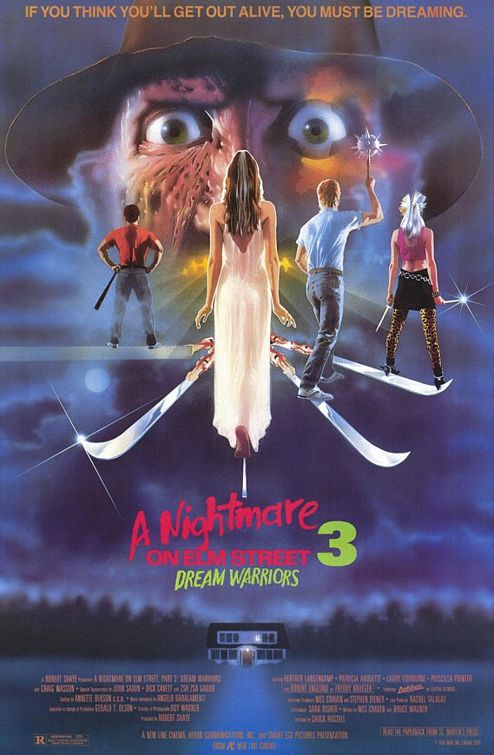
On Monday, August 13, 2012, the Chinese Theatres in Hollywood presented a screening of “A Nightmare on Elm Street 3: Dream Warriors” in honor of its 25th anniversary. This event was put together by Mad Monster, a monthly genre print magazine made by and for the modern monster fan, and they ended up giving us quite a show. They had several giveaways of signed posters and tickets to horror conventions, a costume contest which had the audience cheering loudly for those best dressed, a musician doing an acoustic version of the Dokken theme song “Dream Warriors” and the evening culminated with the appearance of the sequel’s co-stars Rodney Eastman and Jennifer Rubin.
Eastman played Joey Peterson, the mute patient who refuses to speak or sleep after experiencing horrific nightmares. Rubin portrayed Taryn White, a former drug addict who also suffers from nightmares and is harassed by male orderlies at the hospital she is at. Both actors were asked if they were aware of the other “Nightmare” movies before they were cast in this one.
“I was 19 and I came of age during the era of the original slasher movies,” Eastman said. “I had almost given up on acting and this audition came to me out of the blue. I was excited to be a part of it, but it still felt like just another low-budget horror movie. It was not an iconic movie then like it is now.”
As for Rubin, she said, “I knew of the other two ‘Nightmare’ movies, but I did not see either of them before I auditioned for this one.”
Eastman and Rubin were then asked if anything happened during filming; like if any actors fell in love with one another or some other gossipy stuff. Both Eastman and Rubin had the same answer to that question, “No.”
When this sequel was released, it lifted the “Nightmare on Elm Street” franchise out of cult film status and into mainstream commercial success. Eastman and Rubin were asked if they were surprised by this sequel’s success.
“I had done the ‘Never Sleep Again’ documentary, and after that people were jumping out at me from the bushes,” Rubin said. “I had no idea it was for this film.”
“I was blissfully unaware of the world around me back then,” Eastman said. “It’s only in retrospect that I see the impact it has had. I wasn’t stopped in the streets and no one jumped out at me back then.”
Eastman got to reprise his role of Joey in “A Nightmare on Elm Street 4: The Dream Master,” and he was asked by an audience member which he preferred more; being in “Part 3,” or getting killed in his water bed in “Part 4.” Eastman made his answer crystal clear, “I prefer ‘Nightmare 3’ over the water bed death scene. Plus, Patricia Arquette was the hottest girl in that movie.” Then he remembered that Rubin was standing right next to him and quickly added, “I mean Arquette was the sexiest actress on set next to Jennifer here.” Of course, by then, the audience agreed it was a little late for Eastman to find forgiveness.
One audience member asked the two actors if they ever got to meet the members of Dokken. Eastman replied he, unfortunately, didn’t have the pleasure of meeting them, but Rubin ended up telling a funny story regarding the 80’s heavy metal band. “Their mail ended up coming to a house that I was house sitting at the time,” Rubin said. “So, I took the mail to their house, and it turns out there was nobody home.”
When asked what it was like working with Robert Englund, the actor who gave life to Freddy Krueger, Eastman said it was pretty incredible and went on to describe him as one of the smartest, most entertaining and brilliant conversationalists he has ever met. He also added that Englund was a wild man back in the 80’s. Rubin agreed with what Eastman on that, and she also had this to say about another important person in the “Nightmare on Elm Street” franchise, “Wes (Craven) was weird!”
All in all, this was an endlessly entertaining evening for fans of “A Nightmare on Elm Street 3: Dream Warriors.” Granted, the screening of the movie elicited many laughs which were not present when it came out in 1987, and it’s safe to say that certain parts of it have not aged very well. But none of that mattered because everyone came to have a great time at the movies, and that’s what they got.
As soon as you see the above quote which opens “A Nightmare on Elm Street 3: Dream Warriors,” you know Wes Craven is back on board in some capacity. After directing the original, one of the all-time great horror classics, he bailed out of the first sequel which he felt betrayed the logic of Freddy Krueger’s character and how he existed in the realm of dreams. This third entry ended up defining the look of the rest of the series until “Wes Craven’s New Nightmare” came along. This one brought forth a Freddy who, while still scary, was more of a stand-up comic with one-liners flying out from his charred face in rapid succession.
“A Nightmare on Elm Street 3” starts off with the character of Kristen Parker (Patricia Arquette, in her film debut) having the first of many nightmares. Freddy’s attack on her is made to look like she tried to commit suicide, and it gets her thrown into a psychiatric hospital with others suffering from serious mental health issues. Of course, when doctors try to give her a sedative to help her sleep, she naturally freaks out and grabs a knife to fight off those who don’t have a clue as to what she’s really up against. This is where she meets up with Nancy Thompson, played once again by Heather Langenkamp.
We learn Nancy has since gone to graduate school where she studied extensively about the nature of dreams. Here she gets assigned to this psychiatric ward where young teenagers are being stalked by the man with razors for fingers. They are being cared for by Dr. Neil Gordon (Craig Wasson) who has long since gained their trust, but he has yet to realize how he can really help them. Nancy sees right away it has everything to do with Freddy, and when she shares this information with the kids they stand at attention and are shocked to realize they have all been dreaming about the same person.
With a budget of around $5 million dollars, the special effects are more impressive than you would expect them to be. It’s always a gas to see what people can do with very little money. There’s one great effect where Freddy comes to life as a marionette, and he immediately returns the favor to its creator by pulling out the veins in his arms to use as strings. Ouch! The sets never reek of cheapness, and the imagination put into this movie is always on display as we see the dreams of the different characters and the forms they each take.
Bringing Craven back to help write the screenplay was a smart move, and he changes the formula to keep it from being just another single kid being chased by Freddy. Also, these kids fight back to stay alive and prepare themselves a lot quicker than the others did in the previous films. One of the screenwriters on “Dream Warriors” is Frank Darabont who later made one of the greatest movies ever, “The Shawshank Redemption.” There is a good amount of work done with the characters here to where they are not your usual one-dimensional horny teenagers which make up the average “Friday the 13th” movie.
The movie also digs deeper into Freddy’s past to make us see how he came to be. Before this film, we knew he was a child murderer who was brought to court but got off on a technicality, and he was later burned by the parents of the town. Dr. Neil Gordon is visited by a mysterious nun who informs him Freddy’s mother, Amanda, was accidentally locked in an insane asylum with the most mentally unstable people one could ever find, or hope to avoid, on the face of the earth. Amanda was raped over and over, and this led to the conception of Freddy who, as the nun puts it, is “the bastard son of a hundred maniacs!” This would make a great title for a movie.
Unlike other horror movies, you care about the characters and what happens to them. Most of these slasher movies have stock characters you hate and root for to die. In all fairness, it makes watching them more fun to watch in a theater, but here the characters, while dealing with obvious stereotypes, are interesting in their own way. Some are geekier than others (don’t get me started on the “Wizard Master”), but they are more real than your average teenagers dealing with ballistic hormones.
“Dream Warriors” is also proof of how wet dreams never end the way we want them to. One of the characters has an understandable crush on a nurse, and he ends up getting seduced by her. Some people get so lucky, but not this kid. What happens to him gives new meaning to the term “tongue-tied.”
Also in the cast is Laurence Fishburne who did this movie before “Boyz N the Hood.” He plays male nurse Max who is one of the more down to earth characters you could ever hope to find in a horror movie. The great John Saxon also returns as Nancy’s father, Lt. Donald Thompson. His character figures prominently in the film’s climax as they find that the only way to defeat Freddy is by burying his remains in consecrated grounds.
It’s hard to believe this was Patricia Arquette’s first film. She has since gone on to a successful career and appeared in great movies like “True Romance,” David Lynch’s “Lost Highway” and “Boyhood” which won her the Oscar for Best Supporting Actress. She creates one of the more sympathetic heroines in a horror movie who has a mother that, of course, does not understand what her daughter is actually going through. No one does initially, but if they did, there wouldn’t be a movie.
And, of course, we have Robert Englund returning as Freddy. In many ways, this was the last “Nightmare” movie where Freddy felt like a truly threatening presence. Just the thought of him was scary, and you didn’t need to show much of him to prove that. After this movie, he became more of a standup comedian than anything else. We had to wait until “Wes Craven’s New Nightmare” for him to come across as a viciously scary presence again. Still, Englund embodies this character in a way no one else could.
While Freddy ended up having an artistic downslide from here, “A Nightmare on Elm Street 3: Dream Warriors” is still one of the best movies in this long-running franchise, and it’s always fun to revisit this entry whenever it is showing on cable.
It was a huge shock to learn Bill Paxton just passed away at the age of 61 due to complications following heart surgery. He was an actor who was always working and never seemed to be lacking for jobs in front of or behind the camera. His sudden passing sent shock waves through Hollywood and movie fans everywhere, and we are all mourning the actor who was unforgettable in “Aliens,” “Apollo 13,” and the HBO series “Big Love.” The following article is one I wrote after I attended a screening of vampire movie he was gleefully fantastic in, “Near Dark.”
Bill Paxton and Jenette Goldstein stopped by New Beverly Cinema on Thursday, May 6, 2010, to introduce a screening of “Near Dark.” The cult classic was a vampire western horror hybrid made back in 1987 by Kathryn Bigelow, and it was being shown as a double feature with her Oscar-winning triumph, “The Hurt Locker.” It was not a sold-out screening, but this ended up making it all the more intimate for those who showed up. Paxton looked especially happy to be there as he was astonished there was actually a print of this movie still in existence.
When Paxton and Goldstein made “Near Dark,” they were just coming off of James Cameron’s “Aliens.” Paxton played Hudson, the soldier who thought he was so bad ass, and later turned into perhaps the single most annoying coward in cinematic history. Goldstein played Private Jenette Vasquez, one of the fiercest soldiers you could ever hope to meet and who, unlike Hudson, remained just as fierce when things got worse. Bigelow, who would later marry and divorce Cameron, called him to ask if it was okay to use some of his “Aliens” actors for “Near Dark.” Clearly, he said yes, so Paxton and Goldstein, along with Lance Henriksen, got parts in Bigelow’s movie. Paxton even said in one scene from “Near Dark,” the man who ends up sticking his hand out the car and giving him the finger was Cameron himself.
Having gone through what Paxton described as the “baptism of fire” with Cameron on “Aliens,” he, Goldstein and Henriksen formed a strong family unit as a result which made the making of “Near Dark” feel like a homecoming. When someone asked what the difference was in directing styles between Cameron and Bigelow, Paxton said bluntly, “No one else is like Cameron.”
As for Bigelow, Paxton described her as the prettiest director he has ever worked with. According to him, she absolutely loves actors and encouraged them to come up with stuff for their characters throughout the shoot. Goldstein went on to talk about how the actors did an improvisation on how they would block out the sun in the car while driving around town in broad daylight. They came up with the idea of putting aluminum foil on the windows which blocked out the rays that would have immediately broiled their fragile skin and reflected them away so they could live on to do what they did best, suck the blood out of clueless human beings. The way Paxton saw it, most of “Near Dark” was improvised, and he said it was great to work with a director who was so excited to work with actors.
In regards to Henriksen, Paxton described him as “a guy you could never really read.” Back then, Henriksen had these intense finger nails which he had to cut off as Paxton described it, and Paxton even went on to talk about the time he and Henriksen were driving down the highway and got pulled over by the police. As the police officer was getting out of his patrol car, Paxton said Henriksen looked at him and said, “Should we take this guy out?”
Actually, that led to Paxton telling a story which Henriksen just loves to tell about “Near Dark.” During the times they were shooting at night, Paxton, who was made up in his gory vampire makeup as though half his face was chopped off, kept going up to people driving through town, telling them he had just been in a horrible car accident. This little prank always ended with Henriksen saying, “If you think he looks bad, you should see the other guy!”
Paxton said he saw “Near Dark” as a “Bonnie & Clyde” vampire movie. Tangerine Dream composed the movie’s score which is fantastic, and the movie is filled with other memorable musical selections. There was a great cover of “Fever” by The Cramps which was used in the pivotal bar scene where everything gets turned into a bloodbath. But Paxton said his favorite piece of music used was “Naughty, Naughty” by John Parr as it really sets the scene for when the vampires end up depriving a saloon in the middle of nowhere of its customers and employees. Apparently, Bigelow ended up paying for the rights to the song out of her own pocket.
One audience member asked Paxton and Goldstein if they had any Tim Thomerson stories to tell us. Thomerson played Caleb’s father in “Near Dark,” but he is best known for portraying Jack Deth in “Trancers” and its numerous sequels. Both actors said they had many great stories about Thomerson to tell us but basically summed him up as a great guy to hang out with who did so many great impersonations, his best being of John Wayne forcing himself on Walter Brennan.
In regards to character, Paxton saw his character of Severen as a Billy the Kid kind of vampire, wild and reckless in how he conducted business. He also said “Near Dark” owes a great debt to Anne Rice and her Vampire Chronicles which includes the books “Interview with A Vampire” and “Queen of The Damned.” To get into character, Paxton said he read Rice’s books throughout the shoot.
Goldstein said she saw her character of Diamondback as someone out of the Depression era or “The Postman Always Rings Twice,” someone who got by and survived any which way she could. She was perfectly cast in the role as very few actresses back then were allowed to play tough female characters who didn’t need a man to defend them at all.
Another audience member told Paxton he was a big fan of “Frailty,” his directorial debut from a few years back, and wanted to know if he was planning to direct again. Looking back on “Frailty,” Paxton said he had a great experience making it and would love to direct again if he can ever get out of “this damn show” he’s on (you may have heard of it – “Big Love” on HBO). Currently, he is looking over a few projects he is interested in helming and hopes to work behind the camera again really soon.
It was great to see Paxton and Goldstein come out and speak with the fans. Surprisingly, a large portion of the audience had never seen “Near Dark” before, so neither of them wanted to keep the audience waiting too long to see it on the big screen. “Near Dark” may not have been a big hit when first released, but it has more than earned its cult following especially in light of Bigelow’s deserved Oscar win, something which was a long time coming.
Actually, my favorite moment of the evening happened as Paxton and Goldstein were on their way out of the theater when an audience member brought up the subject of another HBO show, to which Bill replied, “Fuck ‘True Blood!’ We were doing this 20 years ago!”
“Empire of the Sun” is one of the few Steven Spielberg movies which has eluded my watching it for far too long. I remember when it was released back in 1987, and my brother and I watched a documentary on its making. What we saw did not make it look like the typical Spielberg crowd-pleasing movie people had come to expect from him back then. It also dealt with a young boy who is separated from his parents, and separation anxiety was a HUGE thing for me back in the 80’s. But with it now at its 30th anniversary of its release, and having the opportunity to see it on the big screen at New Beverly Cinema in 35mm, the time had come to give what is largely considered to be one of Spielberg’s more underrated films a look.
Based on the semi-autobiographical novel by J.G. Ballard, “Empire of the Sun” takes us back to the days of World War II where we meet Jamie Graham (Christian Bale in his film debut), a young schoolboy who lives a privileged life with a wealthy family out in the Shanghai International Settlement where he sings in the school choir, rides his bicycle everywhere and anywhere, and has a love of airplanes which knows no bounds. A key shot for me comes early on when we see Jamie taking some food out of an overstocked refrigerator which is filled with goodies as it shows how easy things come to this young lad to where he can boss the Japanese maid around like his parents do.
Of course, this all changes when the Japanese invade the settlement following their bombing of Pearl Harbor, and Jamie and his family are forced to flee their home and escape with their lives. In the process, Jamie gets separated from his mom after he picks up his metal toy airplane which he dropped on the ground, and he is forced to fend for himself as he is swept into a conflict far beyond anything he could have imagined.
When it comes to “Empire of the Sun,” it was no surprise to learn David Lean was originally going to direct this adaptation as Spielberg certainly made it look like a Lean movie with scenes filled with crowds of people struggling to survive in life during wartime. Spielberg ended up putting together scenes which must have made Lean proud as it brings to mind the epic shots the director pulled off in his masterpiece “Lawrence of Arabia.” Today, most of those shots would have been accomplished with the use of CGI effects, but “Empire of the Sun” was made back in a time where they weren’t so readily available.
Watching this movie reminded me of how brilliant Spielberg is at taking us back to a day and age many of us were not alive to see, and he does it so vividly to where we can never doubt his authenticity to the period. Spielberg has visited the era of World War II time and time again to amazing effect whether it’s the Indiana Jones movies or “Saving Private Ryan,” and he never seems to miss a detail in the process.
And then there’s Christian Bale who made his film debut in “Empire of the Sun,” and he brings to this role the same kind of intensity he would later bring to his work in movies like “American Psycho” and “The Fighter” among others. I could never take my eyes off of him as he takes Jamie from being a privileged young man to one who struggles for even the smallest reward like a Hershey chocolate bar. Was there another young actor who could have pulled off such a brave and emotionally honest performance as Bale does here? I think not.
Another great performance to be found here is from John Malkovich who plays Basie, an American ship steward stranded in Shanghai who befriends Jamie in his most desperately hungry state. Basie looks to be the Han Solo kind of character who befriends a young innocent who has yet to learn how cruel the world can be, but he turns out to be more of a manipulator than a hero in the making. Malkovich makes Basie into a fascinating study of someone who seeks to benefit themselves more than anyone else, and he constantly leaves you wondering if his character can rediscover whatever humanity he has left.
In addition, there are fine performances from Miranda Richardson as a neighbor of Jamie’s, Nigel Havers as a doctor who desperately tries to teach Jamie about humility, Joe Pantoliano has some choice moments as a companion of Basie’s, and Burt Kwouk, best known as Cato from the “Pink Panther” series, shows up in a small role which he is almost unrecognizable in. Heck, even Ben Stiller shows up here as an American soldier. Seeing him at first is a bit disorienting as he has since become a big comedy star to where he now seems out of place here, but I’ll chalk that up to one of the disadvantages of watching this movie at a later date.
Looking back, I feel “Empire of the Sun” was Spielberg’s first real foray into darker material which would soon pave the way for films like “Schindler’s List,” “Saving Private Ryan” and “Munich.” While it feels like he was taking baby steps here, as those aforementioned films proved to be much darker than this one, it was a giant cinematic leap for him to tackle something like this back in the 80’s.
Still, part of me wonders if he played a little too nice with the source material. Being that this was an adaptation of a J.G. Ballard novel, the same writer whose controversial books “Crash” and “High-Rise” were adapted into deliriously dark motion pictures by David Cronenberg and Ben Wheatley, I can’t imagine “Empire of the Sun” was any easier of a book to read. Ballard wrote some pretty dark stuff, and it makes me wonder just how dark his novel “Empire of the Sun” was compared to Spielberg’s film.
All the same, “Empire of the Sun” is an amazing achievement to watch today as he managed to pull off many epic scenes long before the use of CGI effects. Part of me wishes I had watched it when I was younger as it would have had a more powerful effect on me emotionally, but better late than never with a film like this. Along with cinematographer Allen Daviau, composer John Williams, writer Tom Stoppard and editor Michael Kahn, Spielberg created a World War II epic which stands out among the most memorable of them all, and it deserves more attention than it received upon its release thirty years ago.
I got the Blu-ray of “Poltergeist” around the time Circuit City was closing all their stores forever. I had seen bits and pieces of the movie before, but I had never watched it all the way through until a couple of years ago. What finally spurred me to watch it was having watched “Poltergeist III” on cable, and that sequel was a true abomination. I figured what came before that needless sequel had to be so much better. Getting past all the trivia surrounding “Poltergeist” and its so-called “curse,” it remains remarkably frightening for a PG-rated movie.
Actually, it’s quite fitting I watched “Poltergeist” during the period of the wildly successful “Paranormal Activity” movies since they all focus on the strange and bizarre happenings around suburban households. These days it seems like the “found footage” genre is the only way to make a horror movie set in the suburbs seem all the more frightening. But “Poltergeist” showed if you get the details just right, then you can find yourself relating to characters and their surroundings completely and without any question.
“Poltergeist” was directed by Tobe Hooper, but Steven Spielberg’s name is all over the movie as he came up with the story, co-wrote the screenplay and served as one of its producers. It’s hard to escape the influence he had over this production as, like “E.T. The Extra Terrestrial,” it takes place in the suburbs of America where many of us grew up.
We drop in at the home of the Freeling family which is located in the nice, clean California town of Cuesta Verde, and it’s the kind of neighborhood where the houses don’t look all that different from one another. The cars are parked out front because they aren’t parked in the garage for some odd reason, and the kids are riding their bikes all over the neighborhood.
Steven (Craig T. Nelson) is a successful realtor and his wife, Diane (JoBeth Williams), is a stay at home mom caring for their children Dana, Robbie and Carol Anne. One night, Carol Anne goes downstairs and sits in front of the television which is showing nothing but static. It’s an especially frightening image on the Blu-ray release as the flickering creates an eerie strobe light effect as if the house’s inhabitants are in the process of being brainwashed. Carol Anne begins talking to the television as if she’s having a conversation with someone invisible to everybody else. We can’t even hear what that someone is saying to her, but we believe Carol Anne is communicating with another and our imagination runs amuck at who that might be.
Following this, strange things begin to happen around the Freeling household like chairs moving by themselves and the furniture being rearranged in a heartbeat. One night while sitting in front of the television, a hand reaches out and pushes Carol Anne away which is followed by a force of energy penetrating the walls. Her parents wake up to see their daughter telling them, “They’re here…”
What makes “Poltergeist” so effective is how the filmmakers play on those childhood fears we all had. Whether it’s that creepy looking tree outside the bedroom window or the clown puppet which you fear will come alive and attack you in the night, we can all relate to what goes on here except, of course, for being sucked into another dimension. I remember always asking my mom to put my AT-AT toy, the Imperial walker from “The Empire Strikes Back”, on its side so it wouldn’t crawl over to me while I slept. I also kept having these dreams where this green school desk I had would end up rushing at my bed to attack me. Now imagine if these things happened in real life, and you will get a sense of what “Poltergeist” is all about.
There’s nothing too unique about the characters who live in Cuesta Verde, and this makes them all the more relatable. Seeing the kids’ room with those “Star Wars” posters and bed covers bring back a lot of memories. When these supernatural occurrences start happening and get increasingly worse, we can easily see it happening in our own homes. Then again, this might make our own households far more exciting than they usually are as living in the suburbs can be too low key for some.
“Poltergeist” is also perfectly cast with actors who inhabit their suburban characters with what seems like relative ease. Nelson and Williams still seem like the typical American parents we all know. Heather O’Rourke, Dominique Dunne and Oliver Robins are perfectly natural as their children, and they appear very comfortable in front of a camera. You also have Beatrice Straight as Dr. Lesh, a parapsychologist, and she gives this movie a strong dramatic weight.
There is also something to be said for Zelda Rubinstein’s performance as spiritual medium Tangina Barrons. While her high-pitched voiced might seem a little annoying, she makes her strange dialogue sound very believable as Tangina becomes the family’s last hope to save Carol Anne. It’s no wonder her presence in “Poltergeist” is so unforgettable, and not just for her immortal line, “This house is clean.”
Movies like “Poltergeist” usually have filmmakers getting too caught up in perfecting the special effects at the expense of everything else, but Hooper manages to balance everything out to create one of the most terrifying haunted house movies ever. As much as Spielberg’s name is all over this movie, I have to believe Hooper is the one who made this movie as scary as it is. While it may not be as unnerving as “The Texas Chainsaw Massacre” (and very few movies are), he really packs in a lot of scares for a PG-rated movie.
You could also say that “Poltergeist” is a serious dig at the cutthroat world of real estate as Steven makes the horrifying discovery of how certain sacred things which were not moved from their original location. People will do anything for the perfect property when there’s a ton of money involved, and if they can cut corners to make house building go faster they will. Heck, this almost sounds like a supernatural version of David Mamet’s “Glengarry Glen Ross.”
I can’t help but wonder if home insurance even covers supernatural occurrences like this. Would the Freeling’s insurance carrier find an excuse to deny them any financial compensation? Could you imagine the looks on their faces if their agent denied their claim for negligence as if it’s their fault for not reporting this to the authorities sooner? If I were on the receiving end of that, I would be pissed!
It says a lot about an 80’s movie like “Poltergeist” that it still holds up so well all these years later. Its portrayal of suburban America doesn’t look much different from what we see today. I guess the only real difference, aside from cell phones and iPads, are the number of bank foreclosures going on, and you certainly don’t see this happening here. While it may have been ruined a bit by sequels (and this movie really didn’t need any), it still is worth re-discovering and would make an interesting double feature with “Paranormal Activity.”
One other thing; is it just me or does that white spidery creature who blocks Williams from her children’s bedroom have the voice of MGM’s roaring lion?
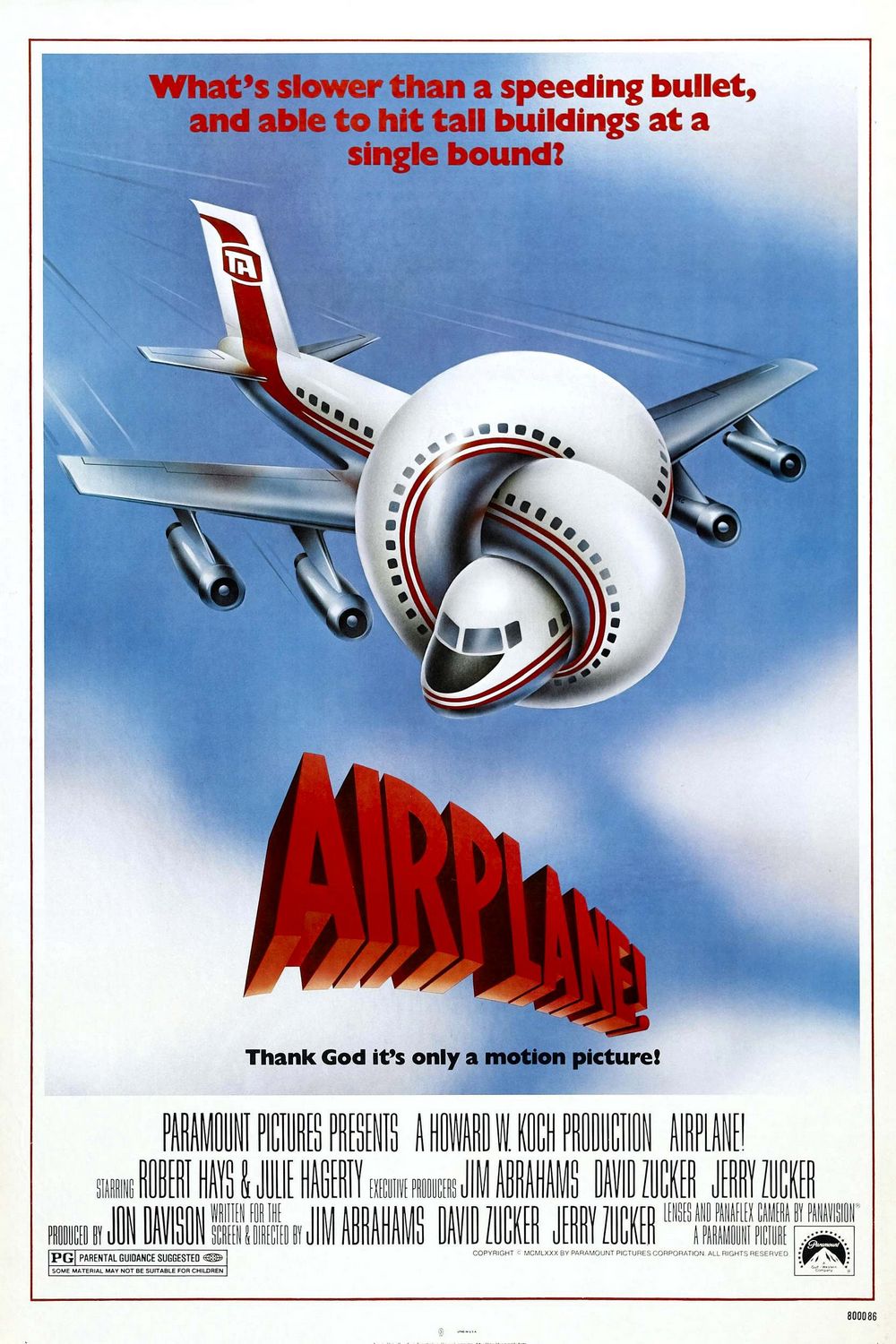
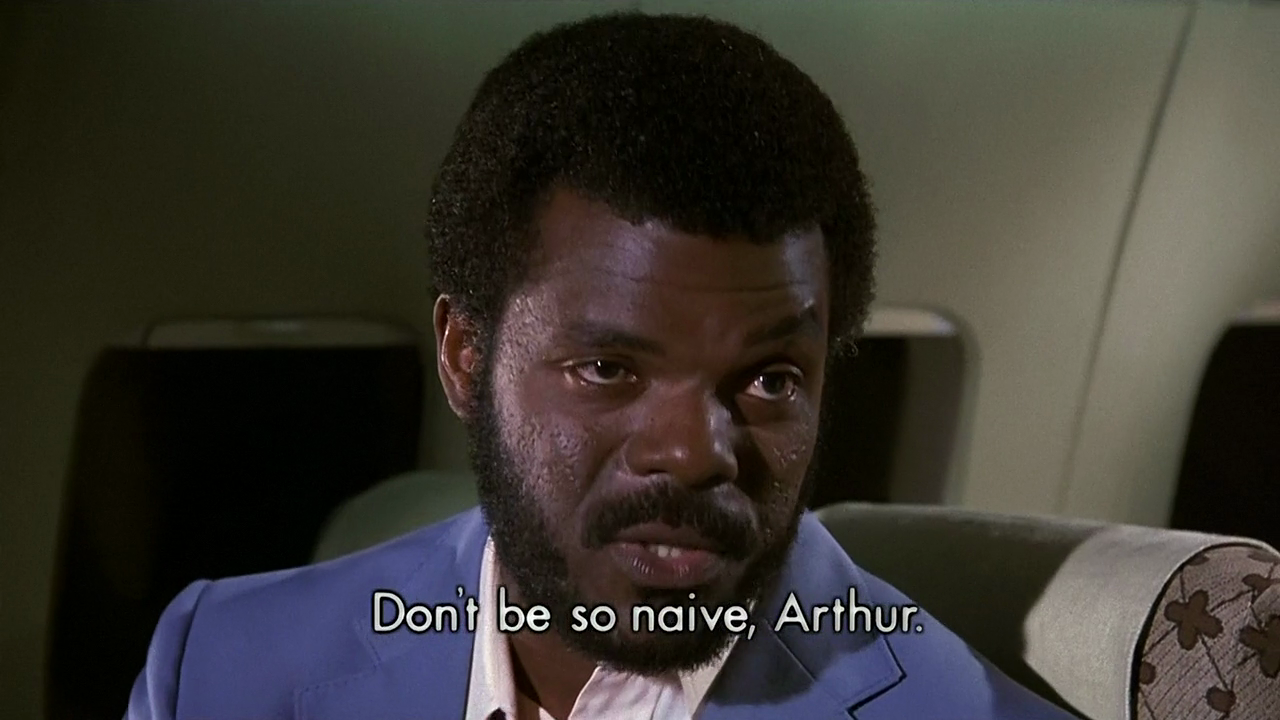
New Beverly Cinema was packed more than usual when the revival theater screened one of the funniest comedies ever made, “Airplane,” in honor of its 35th anniversary. After the movie was over, the audience got treated to a special appearance by Al White, the actor who played one of the jive talking passengers in the satirical comedy (to be more specific, he was the one with the beard). He ran up to the front of the theater to a thunderous applause and remarked how the movie still holds up after all these years, and the only thing which has changed about it is the color of his hair.
White was born in Houston, Texas but was raised mostly in San Francisco, California, and he decided to pursue an acting career after working as a janitor at Golden Gate Park for eight years. In addition to his role as the jive talking dude in “Airplane,” a role he would reprise in “Airplane II: The Sequel,” he also had a memorable role in “Back to the Future Part II” as an angry homeowner who tries to beat up Michael J. Fox with a baseball bat. He was also a member of the American Conservatory Theater for several years and originated the role of the military officer in the Tennessee Williams play “This is an Entertainment.”
White told the New Beverly audience that making “Airplane” proved to be a lot of fun. While the movie was distributed by Paramount Pictures, much of its filming took place in Culver City, California.
Acting opposite White as the other jive-talking man in the movie was Norman Alexander Gibbs whom has since moved back to the east coast of the United States. White remarked at how Gibbs talked so much to where he didn’t want to compete with him, so he tried to fill in the blanks when Gibbs wasn’t saying anything. That made for one wonderful scene after another in this comedy classic.
Many in the audience were curious about the jive language White, Gibbs and Barbara Billingsley, who played the elderly white woman who understood what they were saying, said throughout and if it was a real language. White said it was something he and Gibbs worked on throughout shooting. The movie’s writers and directors, Jim Abrahams, David Zucker and Jerry Zucker, apparently got the idea for the jive talking guys while they were in a restaurant and sitting next to some black men who spoke in a language they couldn’t understand.
Jeff Zucker, the one who worked with the actors on set the most, gave the actors free range to come up with dialogue, and White described how a line of dialogue like “each of us faces a moral choice” turned into “that gray matter backlot perform us DOWN, I take TCB-in’, man!”
Following the screening of “Airplane,” White hung out in the lobby to sign autographs and talk with the fans. I thanked him for coming down to the New Beverly and told him how I always wondered if the jive language was real or if it was gibberish. He replied, “It’s gibberish to those who don’t understand it, but it makes perfect sense to those that do understand it.”
The genius of “Airplane” is that all the actors never played their roles as if they were in on the joke, and that’s a lesson lost on many filmmakers today when they make satires. These days, filmmakers seem far more concerned about the jokes than anything else, and the movies they make suffer as a result. To this White replied, “The old stuff is better.”
It has been a year since filmmaker Wes Craven passed away after a long fight with brain cancer. Despite the fact he was 76 years old, it still feels like he left this world far too soon. The following article is about a screening of perhaps his most famous film which I attended seven years ago, and it remains one of the most enjoyable, informative and entertaining screenings I have ever attended in Southern California.
Wes Craven made a special appearance on March 29, 2009 at the Aero Theatre in Santa Monica for a special screening of the original “A Nightmare on Elm Street.” This horror classic was released back in 1984 by the then fledging distributor New Line Cinema, and it remains one of the great horror classics of all time. This screening was sold out as Craven was there to do a live commentary of the film, and he was joined by director Mick Garris who started things off by saying, “I hate those people who talk through the movie!”
What shocked everyone the most was that the 35 mm print of “A Nightmare on Elm Street” was in pristine condition to where it looked like it had never even been run through a film projector before. Both Craven and Garris gave their compliments to the Aero Theater for getting their hands on such a beautiful print, and the audience applauded in agreement.
Garris started off with the question Craven must get every single day of his life: “Where did you get the idea for this movie?”
Laughingly, Craven said the idea for “A Nightmare on Elm Street” came when he was watching late night television, and a story came on regarding a young man who had died after having horrible nightmares. This case led to a series of articles in the Los Angeles Times about the boy and how he told everyone there was a man inside his dream trying to kill him. His father, a doctor, kept giving him sleeping pills to help him rest more easily. But when the police found the boy’s lifeless body, they also found all the sleeping pills his father gave to him underneath his bed. He never took a single one.
Craven also said the film was inspired by a dream sequence he did in “The Last House on the Left” where a character named Weasel has this nightmare where he is strapped down on an operating table with the parents of one of his victims hovering over him in and dressed in scrubs. The husband ends up taking a hammer and a chisel and places the chisel right on Weasel’s front teeth. The hammer comes down with a thrashing blow, and Weasel suddenly wakes up. Craven said when people talk about “Last House on the Left,” it is always this particular scene they bring up which astonishes him. Turns out it stayed with him to the point where someone suggested he make a movie out of a dream. Guess what happened next.
Craven also made it clear that “A Nightmare on Elm Street” was not inspired by any specific episode of “The Twilight Zone.” Instead he said he was trying to establish the world of dreams as he finds them, as we all do, endlessly fascinating. Throughout the movie, he discussed the subject of dreams at length and talked of how they have no rules to them. Dreams seem to revolve around the violence and darkness we experience in the world either through the news or firsthand, and Craven discussed how they seep into our subconscious all the time by saying, “If we were ever fully conscious of all the bad things that were happening to us, it would be too painful for us to handle.”
When Craven he took his script to every studio in Hollywood, he said the executives all rejected it because they found it to be ridiculous. But even as he got more and more broke, he kept shopping it around until he met Robert Shaye, the head of New Line Cinema, at a party in New York. Back then, New Line Cinema existed merely as a storefront in downtown New York, and it would have gone bankrupt had this movie not been successful. Indeed, New Line Cinema will forever be known as the house Freddy Krueger built.
Craven also remarked about how he didn’t know much about signing contracts at the time when he signed with Shaye to “A Nightmare on Elm Street.” Since he was already so broke and filled with doubt of what he could do, he felt he had no choice but to sign the contracts given to him. But what he thought would be a 50-50 situation turned out not to be the case, and from that point on New Line Cinema owned the movie and Freddy Krueger. The realization of this brought forth many hisses from the audience.
But when he was asked to make another “Nightmare” movie, which became “Wes Craven’s New Nightmare,” Craven asked for profit participation in the franchise he did not previously have. Shaye later told Craven he agreed that he was not treated fairly, and the deal between him and New Line got restructured to where Craven got what he rightfully deserved.
Garris pointed out how “A Nightmare on Elm Street” had an amazing cast for a genre film and asked Craven about his casting process. Craven replied he looked for actors who didn’t have a lot of credits to their name in the hope of getting people who could act more naturally. This was actually Johnny Depp’s very first movie, and Craven recalled how incredibly nervous Depp was throughout the shoot. Depp did manage to get a friend of his to help him out, and that same friend got cast as a coroner.
Of all the young actors, the most experienced was Amanda Wyss who played Tina. Amanda also starred in “Better Off Dead” as the girlfriend who thoughtlessly breaks John Cusack’s heart.
In casting Heather Langenkamp as Nancy Thompson, Craven said he chose her because she was basically “solid peasant stock” (the audience was shocked at this description) and looked like an “every woman.” This was what he wanted for this part, and Langenkamp turned in an excellent performance playing a character everyone could relate to. Nancy was also the first of many strong female characters Craven would utilize in his movies.
Garris then asked Craven how he created Freddy Krueger. Craven replied the inspiration for Freddy arose when he came across a homeless guy with a bowler hat who was shuffling his way slowly down the sidewalk, his face a mask of nasty scars. He said the sight of this man creeped him out a lot, and the image of the man stayed with him long after he vanished. The name Freddy came from a kid who Craven said used to beat him up at school, and he was at one time going to be based on a janitor he remembered from school who frightened him and his classmates. He was also adamant that Freddy not have a mask since this had already been done to death in the “Halloween” and “Friday The 13th” movies.
Krueger was also originally envisioned as being older, but this changed when Robert Englund came in to read for the part. Unlike other actors who were reluctant to portray such a dark and evil character, Englund was not intimidated by it and was willing to be serious with the material. Craven said Englund took a great delight in playing Freddy, and his audition convinced him the character did not have to be an old man for it to work. When an audience member asked if there was some sort of sound device or technique used to make Freddy’s voice sound deeper, Craven answered by saying, “Robert’s voice was all Robert’s.”
The budget for “A Nightmare on Elm Street” was around $1.8 million, but a big chunk of financing fell through two weeks into the shoot, putting the cast and crew in a position where they would not get paid. But once Shaye explained the situation to them all, not one crew member left the set. When the movie opened, it earned back its $1.8 million budget in just one weekend.
Craven also described how the special effects were created and what inspired them:
During the scene where Nancy falls asleep in her high school English class and sees Tina being dragged away in a body bag, the trail Tina leaves behind her was inspired by the slime trails left by snails.
When Nancy gets stuck on the stairs while running away from Freddy, the goo she steps in was actually oatmeal.
When the centipede comes out of Tina’s mouth, it apparently got lost on the set and the bug wranglers couldn’t find it. When the crew broke for lunch, none of them came back.
When Nancy cornered Freddy in the downstairs basement and set him on fire, the man doing the stunt was Craven’s racquetball partner.
In regards to the montage of Nancy setting up the traps to take Freddy down, the book she uses as a manual was actually a World War II manual on booby trapping.
Craven didn’t hesitate to bring up the constant fights he had with the Motion Picture Association of America (MPAA). When Tina’s bloody body, after being dragged over the ceiling, is dropped on the bed, the splash of blood when she landed was quite enormous. The MPAA asked him to cut down the scene to avoid an X (now NC-17) rating. Craven recalled these experiences as both very painful and never ending for him as they occurred with just about every film he made (“Music of the Heart” might have been an exception).
Those fights with the MPAA continued on with “Scream,” and Craven admitted he was baffled why none of the members realized that it was a satire. They even suggested the third act be completely cut, and this illustrates one of the many horrendous suggestions the MPAA comes up with when they judiciously give ratings.
One audience member asked Craven why he used teenagers instead of adults in the movie, and he replied very simply, “Adults would never have watched it.”
One of the funniest moments of the evening was during the scene where Freddy attacks Nancy’s mother, and how her burnt corpse descends into the mattress beneath her. Craven didn’t even try to hide the fact this was one of the least successful special effects in the movie. Regarding John Saxon, who played Nancy’s father, and his expression in the scene, Craven said, “John’s not upset that his wife just died. It was the special effects that tore him up!”
Charles Bernstein composed the movie’s unforgettable and unnerving score, and Craven praised his work as Bernstein had very little money to work with. Craven said he wrote the “1, 2, Freddy’s coming for you” poem, and Bernstein put music to it and took it from there.
As the evening continued on, we got to know more about Craven more as a person. In regards to his career as a horror filmmaker, he told Garris it was all a roll of the dice. When his good friend Sean S. Cunningham asked him to make “The Last House on the Left,” Craven remembered telling him, “I don’t know anything about making a scary movie.”
The audience was also surprised to learn Craven was not allowed to see movies as a kid, and it was not until much later that he finally got the nerve to sneak out of his parents’ home to see one. He credits “To Kill a Mockingbird” as the movie which changed his life and said the original “Texas Chainsaw Massacre” frightened him to death and left him in an unnerved state for months. But even after he had kids of his own, Craven said he never really changed as a director or in the kind of films he made.
When a movie of his opens in theaters, Craven said he always gets out of town as soon as possible. Life can get very miserable if your movie turns out to really suck. When Garris asked Craven if he got to see “A Nightmare on Elm Street” when it opened, Craven made it clear he hates watching his movies in a theater because he is usually driven mad by problems with the sound and projection.
There has never been any doubt Craven is an extremely intelligent filmmaker and human being. To hear him talk about the themes embedded in “A Nightmare on Elm Street” as well as the importance of horror movies made this live commentary all the more fascinating. Freddy Krueger became so popular with audiences because bad guys are far more interesting than the good guys. Another way of looking at this is of how the devil is more interesting than God because he is not bound by any moral obligations, and there is no rule he is not willing to break.
The way Craven sees it, horror is good for you as it forces you to deal with the chaotic. While other filmmakers are busy making “torture porn” movies, which Craven is not a fan of, he said he never tries to make horror look cool. Eventually, we all have to deal with the chaos of life, and we cannot spend the rest of our lives hiding from reality. If you watch the news, violence surrounds us in our everyday lives and gets deeply rooted in our subconscious mind. Horror films are affected by current events of the time they were filmed in
One of the best points that Craven made was that if you don’t know what darkness is inside of you and turn a blind eye to it, then you are in deep trouble. You cannot hide away from your dark side, and you need to be fully aware of what extremes people will go to in order to survive.
In the end, this is what makes Nancy so brave; she is the only one in “A Nightmare on Elm Street” capable of dealing with reality. This is in direct contrast to Nancy’s mother, Marge (Ronee Blakley), an alcoholic who hides vodka bottles in different parts of her house. She also becomes overly protective of her daughter by having metal bars put up on the doors and windows. Her way of dealing with reality is not healthy, and it is endemic of the other characters as they are not handling it very well either. But in the end, kids need to know they have allies in their parents, and Nancy manages to find one in her father.
“A Nightmare on Elm Street” still holds up after all the years despite the dated styles and special effects. Garris said he loved how everything keeps building up and of how there is an increasing sense of dread throughout. This movie taps into those terrifying dreams we all had when we were young, and this is just one of the reasons why it remains so terrifying to this day; it deals with the never ending fascination we have with dreams, and it creates a world for them to exist where anything can happen.
Jessika Van returns to the silver screen in “Seoul Searching,” a comedy by Benson Lee which follows a group of Korean teens from all over the world who are sent to a cultural heritage school in Seoul during the summer of 1986. Van plays Grace Park, a pastor’s daughter from Cherry Hill, New Jersey who worships Madonna the way her father worships God. Grace doesn’t even need to point that Madonna is her favorite singer as she dresses exactly like the Material Girl and even performs an acapella version of “Like a Virgin.” She also excels at teasing all the young boys who lust after her constantly, but she soon meets her match when an especially rebellious teenager catches her eye.
Van started her career in music where she was a classically-trained pianist and singer, and she won various awards and even performed for the Duchess of York, Sarah Ferguson. She made her breakthrough as an actress playing Becca, Queen of the Asian Mafia, on MTV’s critically acclaimed comedy “Awkward,” and she trained in weapons and martial arts for her role in the first-person shooter game “Battlefield 4.” Videos of her work can be found on her YouTube page.
I spoke with Van while she was in Los Angeles to promote “Seoul Searching.” She talked about the research she did into the 1980’s and Madonna to prepare for her role, what she learned about Korea while filming there, and of how she managed to peel back Grace’s emotional armor to reveal the person hiding underneath. She also spoke of how “Seoul Searching” is much more than just an Asian American film as it touches on issues that are universal to everybody and anybody.
Check out the interview below and be sure to visit the movie’s website (www.seoulsearchingthemovie.com) for more information.





 The Ultimate Rabbit