Actor, writer and filmmaker Bryan Fogel first came to the world’s attention with “Jewtopia,” a play he co-wrote and starred in which went on to become one of the longest running shows in off-Broadway and Los Angeles history as it was seen by over a million viewers. Now he is set to reach an even larger audience with his documentary “Icarus” which will debut on Netflix on August 4.
“Icarus” follows Fogel as he went on a mission to investigate doping in sports. Like Morgan Spurlock in “Super Size Me,” he becomes the main experiment of his own documentary as he dopes himself with performance enhancing drugs to observe the changes they have on his body, and to see if he can avoid detection from anti-doping officials. By doing so, he aims to prove the current process of testing athletes for performance enhancing drugs does not work in the slightest.
During this process, Fogel comes to meet Dr. Grigory Rodchenkov, a pillar of Russia’s “anti-doping” program who aids the filmmaker in avoiding doping detection through various processes which include being injected with various substances as well as collecting daily urine samples which will be smuggled from one country to another. But as Fogel becomes closer with Rodchenkov, he soon discovers the Russian is at the center of his country’s state-sponsored Olympic doping program. From there, “Icarus” goes in a different direction as it delves deep into Russia’s program and discovers the illegal activities go all the way up to the country’s highest chain of command which includes Vladimir Putin. The deeper this documentary goes, the more aware we become of how truth can be an easy casualty as others die under mysterious circumstances.
I had the opportunity to speak with Fogel about “Icarus” while he was in Los Angeles to promote it. He spoke about the documentary’s evolution from being a simple exploration into sports anti-doping programs to becoming a geopolitical thriller where witnesses are forced to go into hiding. Also, he spoke of how Lance Armstrong’s admission of using performance enhancing drugs was merely a needle in the haystack as many athletes were utilizing the same chemicals and threw him under the bus to save their own careers.
“Obvious Child” marks the feature film directorial debut of Gillian Robespierre, and it is one of the most assured directorial debuts I have seen in some time. It tells the story of aspiring stand-up comedian Donna Stern (Jenny Slate in a star making performance) whose life has just hit rock bottom. As the movie starts, she gets dumped by her boyfriend, fired from her job, and then finds herself pregnant after a one-night stand. Suffice to say, this is not the best of times for her. But at the same time, what happens from there results in one of the best romantic comedies you could ever hope to see.
Now since Donna decides to get an abortion, “Obvious Child” has been labeled by many as the first ever “abortion comedy.” But while Robespierre is glad this has given her movie far more attention than she ever expected, she does not share this point of view. During an interview at the Four Seasons Hotel in Los Angeles, she made this very clear.
Gillian Robespierre: That’s not why we made this movie, to be called an abortion comedy, because we don’t think it is. I don’t think abortions are funny or hilarious, and I think that shorthand leads to believe we’ve been flippant or glib with the topic. We wanted to accomplish a couple of things with making this movie, and one was making a romantic comedy that was very entertaining, had a lot of romance, had a really funny leading lady, and had somebody who was recognizable onscreen who felt like she could be you or your sister or your best friend. And her parents were recognizable and her best friends were recognizable in a genre that sometimes doesn’t seem relatable. That’s what we wanted to do and really wanted to show. And we wanted to take some stigma away from abortion at the same time and show a procedure that was not full of regret and shame. Donna doesn’t put it on herself and her friends and the characters around her don’t put it on her either. That’s simply all we wanted to accomplish.
Indeed, the movie is really about how Donna picks herself up from her depressed state, comes to empower herself, and eventually learns to trust other people again after getting her heart shattered. This allows Robespierre to find humor in the more serious moments, and at the same time she succeeds in keeping things both human and intimate. These days it seems incredibly difficult to make a movie with such down to earth characters, but she pulls this off with what seems like relative ease.
GR: I think when we talk sometimes even in one sentence, offstage or on stage in a movie or in real life, sometimes we write comedy and tragedy in one beat. I think we’re just trying to take that sort of natural tone that we have and put it on the screen and cut out all the fat that movies and romantic comedies have and have the tone just be very realistic. Donna is a naturally funny character so in one beat she’ll be saying something very self-deprecating, and in the next second she’ll be saying something very sweet and heartfelt. I think that’s just how we interact with each other. To me, it’s just a realistic portrayal of how modern people speak to each other.
When it came to the movie’s title, Robespierre admitted it came from the song of the same name by Paul Simon. She explained why she chose it.
GR: I don’t think Donna is a child or an obvious child. I think Donna is somebody who’s not ready for what the late 20’s is giving her, and she thought she would be someplace else,” Robespierre said. “She didn’t know that the late 20’s is just as hard as her early 20’s, and she’s just trying to figure out how to be confident in where her voice is on and offstage. She’s just trying to figure out how to take over this passivity that seems to be a running narrative in her life, and I think she’s mature and thoughtful, and I think she’s doing something that needs to be done.
The fact Robespierre chose the title of a Paul Simon song for her movie made me wonder if the lyrics played a big part in her decision.
GR: I’m a rhythm girl. I do know the lyrics to the song, I’ve read the liner notes, and I think that determines the feel of the song. It’s not just like drum and bass, it’s obviously Paul Simon’s beautiful poetry that he’s written. But I just liked it for nostalgic reasons and I’m a sucker for nostalgia. I listened to that song a lot when I was little in my car looking out the window, making up my little movie ideas; ‘Oh look at that tree, I feel like I’m in a movie.’
Of course, with this movie being a comedy, you come out of it wondering how many of its scenes were improvised instead of scripted. When you have a strong comedic talent heading your cast, we are quick to believe the director had no choice but to let their main star rewrite the screenplay themselves. But to hear Robespierre say it, the job of a director is to work with people instead of for them.
GR: I think filmmaking makes me really excited about being a filmmaker, and wanting to do this in the first place is that you get the chance to collaborate with a lot of smart, creative, intelligent actors, cinematographers, and editors. Every step of the way is collaboration, and what Jenny and I found in each other was a tone of how we like to speak with one another, and a comfortability of where our parameters are. I was very comfortable with letting Jenny go because she knows Donna just as well as I do, and we were really on the same page. So if a word didn’t feel true and if a sentence would have been funnier this way, I was very malleable. I have an ego, but it’s a different kind of ego.
“Obvious Child” started off as a short film Robespierre made, and it made me wonder about the differences between making a short as opposed to a feature length movie. Her immediate response was time and money as she never had enough of either, but she did go into more detail about what she had to deal with this time around.
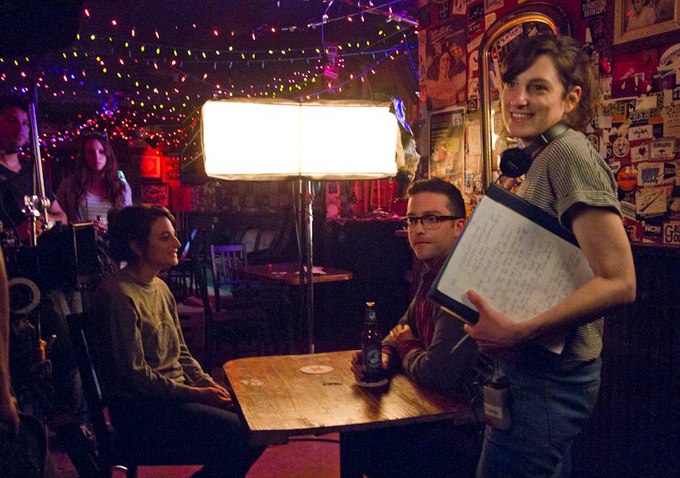
GR: We had a crew of 30 people which was very new for me. The short was just four or five people all from film school. This was a real movie set where my producer Elizabeth (Holm) and I worked really hard to hire a crew. We were a boss and paid thirty people, and there’s something really exciting about that and really scary about that. To be somebody’s employer comes with, I think, a lot of heaviness and respect for the people who work for you and who were coming in every day and bringing in so much of themselves to their roles whether it’s Jenny coming in every day focused, but also the crafty person and the DP and the gaffer. Everybody was full-fucking focused.
Still, with “Obvious Child” dealing with the divisive issue of abortion, people can’t help but think pro-life supporters have been giving the filmmakers and actors a lot of grief. Robespierre responded she hasn’t personally received any feedback from any pro-life groups, and she again reiterated her movie is not an abortion comedy. In my opinion, I liked how it dealt with abortion in an intelligent and refreshing manner. Movies like “Juno” and “Knocked Up,” both which I loved, sidestep abortion in favor of dealing with unplanned pregnancies in another way. But in this post Roe vs. Wade world, it’s surprising we haven’t had more movies like “Obvious Child.” But while it may seem like a revolutionary movie, Robespierre made it clear she wasn’t out to reinvent the wheel.
GR: There’s room for other storytellers out there. I think just because one movie is tackling unplanned pregnancy that ends in childbirth, that’s a real narrative and that’s a story that happens. We’re tackling it in a different way but also making it a comedy using a genre that we love which is the romantic comedy. I was just watching “Knocked Up” last night, it was on TBS, and I laughed my head off.
“Obvious Child” was, in my opinion, one of the ten best movies of 2014. While Jenny Slate is getting the praise she deserves for her performance, the movie’s success is really thanks to Gillian Robespierre whose work here bodes well for the great future she has ahead of her. In a sea of independent films which constantly get lost in the shuffle of all the superhero blockbusters being unleashed on us, it’s great to see a movie like this get the attention it deserves.
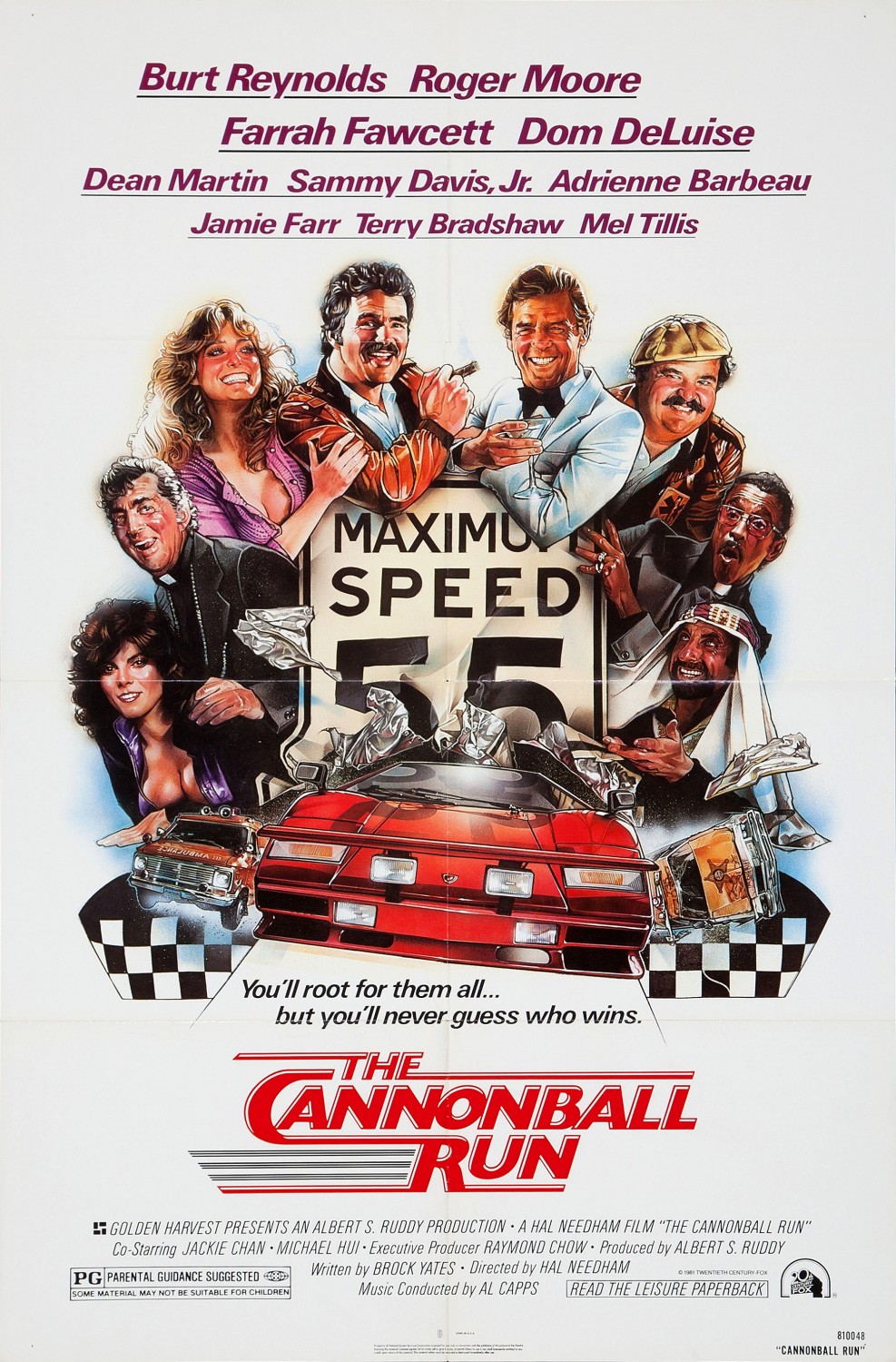
So sue me, I still enjoy watching “The Cannonball Run” after all these years. The critics eviscerated it upon its release, especially Roger Ebert who awarded this movie half a star out of four, but my enjoyment for it has only dampened so much. I was just a kid when I saw first watched it with my brother, and I had yet see “Smokey and the Bandit” which we can all agree is a better movie. Looking back, I dug Burt Reynolds’ ever so cool demeanor, Dom DeLuise’s over the top performance, the ever so beautiful Farrah Fawcett who makes you want to love trees as much as she does, Roger Moore gleefully spoofing his role as James Bond, and Jackie Chan kicking Peter Fonda’s butt among others. Hal Needham may have never directed a motion picture worthy of being compared to “Vertigo” or “Citizen Kane,” but he sure did know how to give audiences a fun time (this time around anyway).
recently got to revisit “The Cannonball Run” when New Beverly Cinema screened it as part of a tribute to the late Roger Moore. This offered me my first chance to see it on the big screen after seeing it on television time and time again, and I couldn’t resist the opportunity. After all this time, I still have a blast seeing the filmmakers have fun with the 20th Century Fox logo as a couple of cars keep crashing into those famous spotlights.
For those who have avoided “The Cannonball Run” because of the dreadful reviews, it is about a variety of different personalities who participate in a highly illegal cross-country race which takes them from Connecticut all the way to California. For these drivers, the speed limit of 55 miles per hour means nothing, and they have their own individual plans for reaching the finish line before everyone else. The most prominent of these drivers is J.J. McClure (Burt Reynolds) who is joined by his best friend Victor Prinzi (DeLuise) who at times breaks out into his alter ego of Captain Chaos when times get rough.
Watching “The Cannonball Run” today, I am reminded of what filmmakers used to get away with in a PG-rated movie. You have Terry Bradshaw and Mel Tillis driving their Chevrolet Malibu NASCAR Grand National race car with a pathetic paint job while having dozens of Budweiser Beer cans clearly visible in the back seat. When they are intercepted by the uptight antagonist Arthur J. Foyt (George Furth) at a road block, it’s astonishing they get busted for participating in the Cannonball instead of having an infinite supply of Budweiser on display, let alone open cans in their hands. Foyt is determined to stop the race, but drunk driving doesn’t appear to be as big a concern to him. Go figure.
Heck, most of the drivers we see here are as interested in getting hopelessly inebriated as they are in winning this illegal race. Jamie Blake (Dean Martin) and his partner Morris Fenderbaum (Sammy Davis Jr.) are unsure of who should be at the wheel as they are both sloshed to the point where they should get a designated driver like Richard Petty. J.J. McClure is flying a plane and becomes pissed upon realizing he and Victor are out of beer and ends up landing in the middle of a street near a convenience store where Victor can rush in to get a 6-pack. Seriously, the last 80’s movie I can remember its characters having too much alcohol was “Star Trek V: The Final Frontier,” and that also had a PG-rating.
The first time I saw Jackie Chan in anything was in “The Cannonball Run” where he played a version of himself as a talented race car driver who, along with Michael Hui, navigates a super high-tech Subaru across America. Seeing Chan beating up members of a motorcycle gang was awesome to a 10-year-old like myself, and it was hysterical watching him cover up the rips in his jeans after knocking two guys out. Chan also showed us the future of texting while driving as he watched the Marilyn Chambers porn classic “Behind the Green Door” while behind the wheel. I would like to think this movie predicted the future where drivers stopped paying much attention to what was on the road ahead of them, but I’m pretty sure few would be willing to give Needham and company the credit.
“The Cannonball Run” was also my introduction to Rick Aviles, an actor and comedian who would later become famous for doing the unthinkable in a 1990’s movie, killing Patrick Swayze in “Ghost.” We get a taste of his comedic acting here which wasn’t as present in other movies he appeared in, and he does a Richard Nixon impersonation which still has me in hysterics. What a shame Aviles’ life was cut short at the age of 42.
Burt Reynolds has gone on the record to say “The Cannonball Run” is not one of his favorite movies, and to be honest, he does look to be coasting on his natural charisma as J.J. McClure. Regardless, I still loved how he coasted on it here as it makes his job seem ever so easy. All he needs to do is give you a certain look, make a certain sound, or just twist his mustache in a certain direction to get your full attention. Now how cool would it be to go through life being so cool without putting too much effort into it? Like Rod Stewart said, some guys have all the luck.
It’s a shame Dom DeLuise is no longer with us. Whether he was in the best of movies or the worst of movies, he was such a delightful presence in them all. His character of Victor Prinzim has an upbeat attitude about himself even as J.J. tries to keep it under control, especially when Victor talks about “him.” The him is Captain Chaos, Victor’s alter ego who jumps into action when things get threatening or when he finds himself falling behind in the race. Watching DeLuise become Captain Chaos is a blast, and this is even though he saves the day one time too many near the finish line.
For me, Roger Moore was the James Bond I grew up on, and seeing him here shows what a great sense of humor he had about his tenure as 007. Moore never ever plays his role of Seymour Goldfarb, a Jewish heir to a family fortune pretending to be a movie star named Roger Moore, as if he is in on the joke. Seeing him keep his cool even as the police pursue his speeding silver Aston Martin is great fun, and you know Sean Connery and Daniel Craig would never be quick to do the same thing. George Lazenby maybe, but never Connery.
Watching Jamie Farr as the oil-rich Middle-Eastern sheikh Abdul ben Falafel serves as a reminder of how there is more to this actor than him playing Maxwell Klinger on “M*A*S*H.” Some may consider his performance to be an offensive caricature, but he is so wonderfully over the top here as he proclaims his driving is only rivaled by the lightning bolts from the heavens to where it is a waste of time to take what he does here seriously. Farr makes his character’s unchecked ego all the more palpable, and the scene where he essentially flips the bird to the cops is one to cheer for if you have ever been given a speeding ticket. And yes, Farr makes you believe this is a character who knows when you have had too much couscous.
Was there anything I saw in “The Cannonball Run” that I had not seen before when watching it at New Beverly Cinema? Yes, a few actually. The grotesque Doctor Nikolas Van Helsing (Jack Elam) announces himself to be a proctologist to where a certain finger on his hand becomes far more frightening to me now than ever before. Then again, I had no business knowing what a proctologist does when I was a pre-teen.
Also, Farrah Fawcett’s nipples are much more present as they poke prominently through her dress during the scene where she first catches the attention of Reynolds. Then again, there is an enormous amount of cleavage on display from start to finish, much of it courtesy of Adrienne Barbeau and Tara Buckman who use their sex appeal to avoid the much-deserved speeding tickets which should automatically come with the purchase of a Lamborghini, any Lamborghini.
But after all these years, I still get won over with moments like when Fawcett bonds with DeLuise as he talks about the first appearance of Captain Chaos in his life, or when Reynolds tells Fawcett why he races cars. This might seem like a movie too shallow to contain moments like these, but they were pretty deep to me when I watched “The Cannonball Run” back in the 1980’s, and today they still are.
I don’t know, maybe my opinion of this movie would be different had I seen “Cannonball” or “The Gumball Rally” beforehand, both of which are said to be much better than “The Cannonball Run.” Well, fate had it that I would watch Needham’s 1981 comedy ahead of them, and I still enjoy watching it despite the numerous detractors it has. For those who think this is a prime example of lazy filmmaking, check out “Cannonball Run II” which is exactly that (or better yet, don’t bother).
I feel like I should apologize liking “The Cannonball Run” as much as I do, but I am sick and tired of apologizing for who I am. Besides, this movie remains a prime example of the things filmmakers could get away with in a PG-rated movie back in the 80’s. They wouldn’t get away with any of this today.
Uh-oh, I think I’m becoming a fan of romantic comedies. For the longest time, I have been avoiding them like the plague as they feature characters whose problems don’t even compare to what I go through, dialogue which makes me cringe in such an incredibly painful way, and acting that is embarrassing and flat. But just as the genre looks to be finally dying out, 2014 brought us movies like “What If” and “The One I Love” which succeed in reinvigorating it to where I got surprised in a way I didn’t expect. But moreover, these movies have provided us with down to earth characters we can actually relate to instead of sneer at in bitterness.
Of all the romantic comedies released in 2014, I doubt I will see one better than “Obvious Child.” It marks the feature film directorial debut of Gillian Robespierre, and it’s a very confident and assured debut as she follows the trials and tribulations of a twenty-something woman whose life hits a low point which leaves her in a depressed funk. It also deals with a very touchy subject in a way both intelligent and very refreshing, and that makes this rom com a brilliantly subversive one.
Former “Saturday Night Live” star Jenny Slate stars as Donna Stern, a comedian and bookstore employee who is about to go through one of the worst periods of her life. “Obvious Child” starts with Donna’s boyfriend dumping her which leaves her utterly devastated, and then she is informed the bookstore she works at will be closing which will leave her out of a job. This leads her sinking into a depressed state which results in one of her worst stand up gigs ever, but on that same night she meets a really nice guy named Max (Jake Lacy) with whom she strikes up an easy-going conversation. From there, the two of them have a night of fun where Max accidentally farts in Donna’s face, and they end up having sex after an exuberant dancing session to Paul Simon’s “The Obvious Child,” a song from which this movie gets its name.
Not long afterwards, Donna discovers this one-night stand has gotten her pregnant, something she is not the least bit prepared for. As a result, she decides to get an abortion but finds she has to wait a few days before the doctors can perform the procedure. During this time, she wonders about whether or not to tell Max about her decision, and the movie chronicles her journey towards the best/worst Valentine’s Day she has ever had.
Many have been describing “Obvious Child” as the first ever abortion comedy, but that description doesn’t do it justice. Yes, abortion is a theme here, but it’s not what this movie is about. The main focus is on how Donna’s unplanned pregnancy forces her to confront the realities of independent womanhood for the first time in her life, and it proves to be a journey both rough and, at times, truly hilarious.
Many of us remember Slate from her brief stint on “SNL” where she accidentally let the F-word slip out of her mouth. She left after only season, but she has since made a name for herself on “Parks & Recreations” and “Marcel the Shell with Shoes On.” Slate’s performance in “Obvious Child” proves to be a huge breakthrough for her, and you just want to hug her after watching this movie. She infuses Donna with a lot of heart and makes you relate to her struggles as life constantly throws an endless number of curveballs in her direction, and we get so emotionally absorbed in Donna’s journey as she faces up to her responsibilities and rises above her misery which threatens to consume her completely. Slate is both warm and funny at the same time, and that’s not always an easy combination to pull off. It’s one of the best performances from an actress I have seen this year.
Slate is also backed up by a terrific supporting cast which features characters who come to reveal things about themselves we wouldn’t otherwise have known. Gaby Hoffmann is wonderful as Donna’s friend and roommate Nellie, Richard Kind is drolly amusing as Donna’s father Jacob, Polly Draper has some very moving moments as Donna’s mother Nancy, Gabe Liedman is a hoot as everyone’s gay best friend Joey, and David Cross has some hilarious scenes as Sam, a comedian and a guy who just doesn’t get what’s going on around him.
I also have to give Jake Lacy a lot of credit as he makes Max a truly nice guy we never find ourselves snickering at. Roles like these are often very bland and don’t give actors a lot to work with, but Lacy makes you believe Max is the real deal and the kind of significant other we all hope to find in our own lives. Max could have been the most boring and thankless character in “Obvious Child,” but Lacy keeps him from becoming this with a lot of humor and charm.
When it comes to the abortion issue, which has already split people on “Obvious Child” (particularly those who haven’t even bothered to see it), Robespierre handles it in a manner which is actually very refreshing. She’s not out to demonize abortion, but she also doesn’t make light of it either. In this Roe vs. Wade world we have been living in for the past few decades, I’m surprised we haven’t had more movies like this one.
Robespierre has created a truly wonderful film I am very eager to see again soon, and it’s one of the most intelligent rom-coms to come out in some time. “Obvious Child” really left a smile on my face as I walked out of the theater. Regardless of whether or not you have gone through what Donna has, or whether you’re a man or a woman for that matter, you can sympathize with what she goes through as we have all hit a rocky point in our lives. What’s great is how she rises above her problems and becomes a stronger person as a result. Robespierre and company confront the painful moments in these characters lives with a lot of intelligence and warmth, and it’s also really funny. It’s deep, but it also had me laughing a lot.
David Cronenberg’s remake of “The Fly” was released in 1986, a year filled with everlasting cinematic classics like “Aliens,” “Ferris Bueller’s Day Off,” “Star Trek IV: The Voyage Home,” “Platoon,” and “Top Gun.” More importantly, it came out during a time where remakes were very rare compared to today, and also when remakes were actually worth watching. Whereas remakes these days serve to capitalize on a known quantity or are being exploited for the sake of some potential franchise, “The Fly” is one where the director took what came before and made it completely his own.
You should all know the story by now. Seth Brundle (Jeff Goldblum) is a brilliant and eccentric scientist who has invented a set of telepods which allow objects to travel instantaneously from one pod to another. Seth shares the story of his invention with science journalist Veronica Quaife (Geena Davis) as he attempts to test teleportation on living subjects. Eventually, Seth decides to test it on himself, but he doesn’t realize a common housefly has entered the telepod with him, and the computer gets confused and ends up merging the two lifeforms at a molecular-genetic level. Seth believes the teleportation has purified his body as he discovers a strength he didn’t previously have, but it’s all a build up for a transformation which becomes all the more horrifying as “The Fly” reaches its gruesome climax.
What I love about “The Fly” is its slow build as Cronenberg makes Seth’s transformation into “Brundlefly” all the more unnerving by taking it one step at a time. We first see him engaging in an extraordinary set of gymnastics we would all love to be capable of, and then we watch as he puts an enormous amount of sugar into his coffee at a local diner. This leads Veronica to ask him, “Do you normally take coffee with your sugar?” While I expected a reply along the lines of Christian Slater’s in “True Romance” where he said, “I’m not satisfied until the spoon is standing straight up,” it is immediately clear that Seth is too involved in his own process to see the damage it is doing to his body.
Seth’s face comes to look like it is riddled with severe acne scars, and this brought about a number of PTSD flashbacks for me of when I dealt with my own acne outbreaks back in high school. But the key moment doesn’t come when Seth snaps a guy’s arm in half during an arm wrestle contest (it’s always painful to see a bone sticking out of a person’s body), but instead when he finds himself pulling out his own fingernails. Just the idea of pulling out your own fingernails is painful in itself, but seeing Seth pulling his out to where a great deal of puss explodes from his fingers proves to be even more painful than watching George Clooney getting his fingernails pulled out with a pair of plyers in “Syriana.”
At this point, I want to point out one of “The Fly’s” biggest stars which is Chris Walas. Walas won an Academy Award for Best Makeup for his work here, and it should go without saying just how much he deserved it. As Seth’s body continues to deteriorate in the midst of an unwanted, let alone unexpected, transformation, Walas makes each moment sting with a thankfulness we are not going through what this misguided scientist is. He also gives you the assurance that he and his colleagues have researched all there is to know about this kind of metamorphosis, and this makes Seth’s transformation all the more horrifying. Walas makes you believe something like this could actually happen to where you cannot help but react strongly to everything unfolding before you.
1986 was a big year in science fiction as Sigourney Weaver not only had the lead role in “Aliens,” back when it was rare for an actress to have such a role in a movie, but she also scored an Oscar nomination for her performance which was well-deserved. It’s a shame Goldblum didn’t get the same respect from the Academy as his performance is truly brilliant and wholly original. Just as Weaver dominated all those special effects in “Aliens,” Goldblum makes it clear the makeup is not doing all the acting for him as he fully inhabits Seth Brundle at every stage of his transformation. For the actor, the makeup becomes a costume which comes to inform his character throughout, and Goldblum is fearless in portraying this scientist’s descent into an unwanted fate.
Scientists in movies tend to be either over the top or exceedingly modest and timid, but Goldblum gives us one whose eccentricities make him more alluring than the average one. The actor even sells us on a wonderful moment where he explains why he wears the same suit, shirt and tie each day, and seeing his closet reminded me of a number of movie spoofs where this same situation was used for sheer comedic effect. Even as Seth becomes increasingly unpredictable, let alone unlikable, to be around, Goldblum seduces us deeply into his strange plight which brings about a change he never saw coming.
But let’s not leave out Geena Davis who shares a strong chemistry with Goldblum throughout, and this only makes sense as they were a couple at the time and were briefly married. As Veronica Quaife, Davis creates a complex character whom is eager to take advantage of Seth’s invention for the story of the century, but she soon finds herself falling for him to where she cannot tear herself away from his hideous transformation. The scene where she hugs him after getting her first glimpse at the horrific changes his body is going through brought about a loud gasp of disgust from the audience I watched this movie with at New Beverly Cinema, but it shows just how powerful her performance is. Veronica is at once mortified at how bad things are getting for Seth, and yet she can’t tear herself away from him because she is too emotionally involved to just give up on him. Davis’ commitment to her performance shows the range which would eventually earn her an Academy Award for her work in “The Accidental Tourist.”
Many see Cronenberg as a filmmaker who makes nothing more than gross-out horror movies, but they neglect to see the intelligence and thought he puts into each movie he makes. Whether it’s “The Fly” or “Rabid” or “Scanners” or “Dead Ringers” or “eXistenZ,” Cronenberg has fearlessly explored the phobias we all have of bodily transformation and disease to unforgettable effect. His movies are not designed to make you throw up, but instead to confront how our bodies deteriorate in one way or another. His remake of “The Fly” is one of his most unforgettable motion pictures as we can’t take our eyes off the screen even as Seth Brundle’s transformation becomes all the more disgusting. Its power comes from how it draws you in emotionally more than anything else, and we have as much luck at disconnecting ourselves from Seth’s unnerving plight as Veronica does.
Watching “The Fly” again, it is clearer than ever that this movie is about a tragic romance more than anything else. Heck, Shakespeare would have been proud to have written a tragedy like the one presented here. While much of the attention on this remake is forever directed at the makeup design which still grosses audiences out to this very day, it is the romance between Seth and Veronica which drives the story more than anything else. The two of them want to tear themselves away from one another, but deep down neither of them can truly bare to do so, and they are the kind of couple U2 sang their song “With or Without You” about.
If there’s anything wrong with “The Fly,” it’s the ending as things are resolved in a way which is not altogether satisfying. We are left with questions which would not be answered until “The Fly II,” and while that sequel had its moments, it’s no surprise how it paled in comparison to Cronenberg’s remake.
Horror movie remakes are a dime a dozen these days, but Cronenberg’s “The Fly” remains one of the best and most visceral. It is still the director’s biggest commercial hit to date, and I prefer to see this as proof of how his unique style of filmmaking can reach a wider audience than we typically realize. All these years later, Cronenberg remains one of the most original filmmakers working today, and we eagerly await his next cinematic opus with great anticipation.
This never seemed like a good idea for a movie. Sure, there was “Toy Story” which brought those toys we grew up playing with to wonderful life, and we had “The Lego Movie” which featured those building blocks in a story which had profound things to say about the power of our imagination. But emojis? Seriously, where can you go with those things? They are just faces with one single emotion to exhibit. How can you possibly make a movie out of them?
Going into “The Emoji Movie,” I was reminded of an episode of “Hollywood Babble-On” in which Ralph Garman and Kevin Smith ranted about the news of this movie being made following a bidding war between three studios.
“To go into a room and say, ‘Guys, I got the idea. You know the fucking face at the end of your text with the fucking tongue out and one eyebrow is up and shit? You know that shit? Here’s my idea. Hey, bring out my Power Point presentation. See that fucking round yellow face? That’s going to be my new movie!’ WHO FUCKING THINKS LIKE THAT?!”
“We could go pitch ‘Hieroglyphics: The Movie!’”
“But ‘The Emoji Movie?’ A movie about the emojis? What’s it going to be, the fucking family of emojis going on vacation together and, oh no, Tongue-Out is upset because Cross-Eyes is pissed off that Thumbs-Up is hogging the backseat? WHAT THE FUCK?! Seven figures they paid for this idea! Seven figures!”
Actually, what Garman thought the story would be could have been more interesting than this. ‘The Emoji Movie,” like its main character, proves to be a meh affair with jokes which fall flat more often than not, a voice cast which cannot lift the material up beyond its banal confines, and ideas which were dated by the time this movie went into pre-production. The fact it is coming out at a time when GIFS are proving to be very popular doesn’t help either.
For the most part, “The Emoji Movie” takes place within the cell phone belonging to Alex (Jake T. Austin), a human teenager who lives and sleeps with his phone like every teenager does to where kids colliding with each other because they can’t take their eyes off their devices is to be expected. Fortunately, there are no scenes of teenagers texting while driving which is a relief. Imagine how traumatic it would be for children to watch them getting into a car crash because the characters were texting each other about the latest school gossip.
Anyway, inside Alex’s phone live the emojis who are always around to help provide him with text responses which need no description with words, and among them is Gene (T.J. Miller), a meh emoji, who is super-excited about going to his first day at the office. Gene just wants to be a normal emoji like everybody else, but we soon discover he is capable of exhibiting multiple expressions and ends up having a panic attack which shows him to be anything but meh. Smiler (Maya Rudolph), whose infinite smile cannot hide her vindictive nature, orders Gene to be deleted from the phone. Of course, Gene manages to escape her cheerful façade and goes on a mission to become a normal emoji like all the others.
Director Tony Leondis was interested in exploring life inside a phone, and he also explored the plight of being different in a world which unrealistically expects everyone to be the same. The latter part is noble as we need movies which remind us all of how we should not exclude those who are different (you listening Donald Trump?) as this world is hard enough without people ostracizing others who are not seen as the norm. Even in this day and age, we need these stories as life seems to mostly be about conforming to societal norms, and not everything can or should be the same.
Regardless, this movie never has enough to work with. The problem with emojis is they, as characters, are far too simplistic. You cannot do much with them as their role in life or, in this case, Alex’s phone has been decided from the get go to where, even if they tried to do something, there’s no real reason to expect anything different from they are already programmed to do.
The plot of “The Emoji Movie” also suffers as it is the same kind of story where the underdog goes on a journey which will eventually lead him to becoming the hero, at which point everyone will accept him for who he is. It sucks a lot of times when you know the outcome long in advance, and it really tears away at the inspired movie this one could have been.
Leondis was clearly inspired by the “Toy Story” movies as well as “The Lego Movie,” but those movies managed to surprise us not just with their splendid animation, but with their stories which took audiences on rides they weren’t really expecting to go on. “The Emoji Movie,” however, isn’t much more than your typical outsider movie, and this is a shame as so much more could have been done here. This could have been an insanely inspired movie, but instead it travels down a road many of us have already traveled one too many times. Kids may get a kick out of it, but adults will be left wondering why this one couldn’t be as good as anything Pixar puts out.
Many shots are taken at various mobile apps like YouTube, Instagram, and even Candy Crush, a game for which I still get countless invitations to play (FYI, I’m not interested). Even Pikotaro’s “Pen-Pineapple-Apple-Pen” video makes a brief appearance, reminding us it was 2016’s most viewed video on YouTube. However, Leondis and his screenwriters, Eric Siegel and Mike White, don’t mine this material enough for all the satirical value it holds. Moments like the reveal of Candy Crush generate a chuckle, but nothing in the way of real laughs.
It’s a real shame because the voice cast is nothing short of terrific. T.J. Miller of “Silicon Valley” fame makes Gene an emoji we want to follow along with, and Anna Faris lends her everlasting charm to the codebreaker emoji Jailbreak. Maya Rudolph makes Smiler a wonderfully devious presence as her infinitely cheerful demeanor and pearly white teeth reveal her to be anything but truly happy. James Corden brings the same giddy energy he brings to his late-night CBS show to the role of Hi-5, and he steals just about every scene he has. I also have to say the casting of Steven Wright as Gene’s father, Mel Meh, was priceless.
Sir Patrick Stewart, however, is wasted in a role I expected to be the real scene stealer here, the poop emoji. Stewart has some choice moments which had me chuckling a bit, but he disappears from this movie too often to where I wondered why the filmmakers bothered to cast him. And the scene where poop is in the cube shouting “red alert!” makes me pine for another “Star Trek: The Next Generation” movie which will probably never happen. Regardless of how you felt about “Star Trek: Nemesis,” the “Next Generation” crew still deserves a better curtain call.
There was an animated movie which came out earlier this summer called “Captain Underpants: The Epic First Movie” which I wasn’t expecting much from when I walked into the theater. I came out of the movie pleasantly surprised as it proved to be very entertaining, full of imagination, and wonderfully subversive. I was hoping “The Emoji Movie” would surprise me in the same way, but the cards were stacked against this one right from the start. Emojis only have one function, to show a specific emotion. While Gene can show off many different emotions, it doesn’t change this fact. What we are left with is a thin story with jokes which are as funny as the hopelessly corny ones at all those Disneyland park shows, and animation which, while not at all bad, never comes across as the least bit wondrous. And yes, there is a post-credit sequence, but don’t bother waiting for it. All it does is show the fate of a certain character, and the moment is over in a flash.
“The Emoji Movie” does have a short-animated film preceding it called “Puppy!” which is based on the “Hotel Transylvania” franchise. It has Dennis getting a puppy, albeit one which is almost as big as King Kong. This short might pale in comparison to the ones Pixar makes, but it is very funny and playful and everything “The Emoji Movie” could have been.
Perhaps Garman was right. It would have been better to do an emoji road movie. Leondis would have had more luck with this genre than “The Diary of a Wimpy Kid: The Long Haul” did.
Grauman’s Chinese in Hollywood had a special screening of “Twilight Zone: The Movie” in honor of its 30th anniversary, and the screening was put together by Mad Monster. Before fans got to watch the movie in its pristine digital presentation, there was a Q&A with one of the movie’s stars, Jeremy Licht. Perhaps best known for his work as a child actor on television shows like “The Hogan Family,” Licht was very happy to share his memories of making this film.
Licht appears in the movie’s third segment, “It’s a Good Life,” in which he plays Anthony, a young boy who is suddenly befriended by schoolteacher Helen Foley (Kathleen Quinlan). But when Anthony takes Helen home to meet his “family,” she ends up meeting a group of people who live in sheer horror of Anthony as he lives to terrify them if he suspects they disapprove of him.
The movie is the theatrical version of Rod Serling’s classic television series “The Twilight Zone,” and it is essentially an anthology of four different films by four directors. Licht described the audition process for it as being “really interesting” and that he was not hired until after the filmmakers started shooting the first couple of segments.
“I auditioned a couple of times and knew it was starting to get close, and it was really exciting,” Licht said of the process. “On the second audition that I had, Joe Dante was in there (who directed “It’s a Good Life”). It wasn’t often that I got star struck, but I was kind of in awe of him because of what he had done. He had made ‘Piranha’ which I’m sure you all know more than I do.”
Of course, it’s impossible not to talk about “Twilight Zone: The Movie” without mentioning the tragic accident which still casts a heavy shadow over it. During the filming of the first segment, “Time Out” directed by John Landis, a helicopter crashed and killed actor Vic Morrow and two child actors, Myca Dinh Le and Renee Shin-Yi Chen. Licht got the news about the accident a week after his second audition.
“I figured that was it. That was the end of it and they were going to shelve the film,” Licht said. “About six months later, I ended up getting a call from my agent that they were actually back in production and that they had wrapped up that segment (“Time Out”), and to come back and for a third audition. I went back in, and at this point I knew it (the material) back and forth, and I walked in and there was Steven Spielberg. He had just come off of ‘E.T.’ and it was really an amazing audition. By the time I had gotten home from that audition there was an offer. It was extremely exciting time for me and for my family and we accepted the offer, and we wound up on the Warner Brothers soundstage in Burbank within a week and we spent three months in principal photography.”
“It’s a Good Life” was a remake of the classic “Twilight Zone” episode of the same name, but Licht said he never watched it until after filming was complete. It also turns out Bill Mumy, who played Anthony in the original episode, makes a cameo appearance as a restaurant patron who intervenes when his friend starts pushing Licht’s character around.
But unlike the original television episode, Dante ended up taking “It’s a Good Life” in a different direction as it was more cartoony. Licht went on to describe Dante as a very “hands-on” director as well as a “big kid,” and that this movie was “his playground.”
“Working with a director like him truly was a treat,” Licht said of Dante. “He was really into letting the actors find what they were looking for. Obviously it was over the top; he was looking for that. He was looking for that cartoonish, extremely uncomfortable feel which I think we certainly accomplished.”
In terms of what was the most rewarding thing about doing “Twilight Zone: The Movie,” Licht replied it was being part of a film which has a huge following. The television series was always unpredictable in how you never knew what direction it would take from episode to episode, and it made fans wonder what the movie was going to be like. Having acted mostly on television and in several “movies of the week,” Licht also came to discover how fortunate he was to play Anthony in this film.
“It’s very rare as a kid, let alone at 13, to be asked to lead or be one of the principals in a film or play a character where nothing is what you think it is,” Licht said. “It’s rare to have that kind of a script, to have something like that come to you, let alone be asked by Joe Dante or Steven Spielberg to be in it. I was pretty honored and pretty humbled, and I am to this day really.”
As for the question Licht gets asked the most about “Twilight Zone: The Movie,” he said it was if the cast really had to eat those peanut butter covered hamburgers.
“I read the script and I thought, ‘Wow, that is really vile! I can’t imagine doing that,’” Licht said of this unusual meal. “The day that we shot it, they actually brought in McDonald’s hamburgers and basically we tried it. First of all, if you’re peanut butter person, it’s really not bad. The problem is, good luck saying your lines with a mouthful of peanut butter!”
Licht retired from acting in the 1990’s although he did appear in a short film in 2009 called “The Closer.” These days, he has his own financial planning company called JL Capital Management which has turned out to be very successful. For a former child actor, he has done very well for himself, and he has not allowed himself to be swallowed whole by the kind of vices which have destroyed so many lives. When asked why some child actors easily transition to an adult career while others don’t, Licht sounded very level-headed in his explanation.
“When I was doing it, there were paparazzi but nothing like things are now where every moment is recorded and every stumble that you take is magnified,” Licht said. “I’ve seen it all. I’ve had friends that have had very successful careers, and sadly I’ve had friends that have fallen. I grew up with good people around me and I still do surround myself with good people. My folks are important and my family is really important. I got into the business very young, but not necessarily at the urging of my family. I wasn’t supporting my family. It (acting) was a hobby that sort of took off. My parents said to me the whole time, ‘If you stop liking this or you become unpleasant to be around, you’re out. You’re gone because this is not what that’s for.’”
“I think a degree of it is luck, I think a degree of it is also upbringing and family, but I think a lot of it is luck,” Licht continued. “It’s like any of your lives growing up, but under a big microscope. I’m sure that we’ve all had times in our life, if you can imagine if cameras were on you, when you stumble the hardest, and how can you recover from that? You can recover privately, but when everybody’s watching you and judging you it’s a tough deal.”
We keep hearing stories day after day of child actors going bad, but we never hear enough about the ones who don’t. Licht is one of those former child actors who has done very well for themselves, and it would be great to hear more about people like him instead of getting all these random updates on others who don’t have the same support.
I remember being fascinated and terrified by outer space movies when I was a young boy. Seriously, I kept getting vertigo when I saw all those stars shining brightly to where I was afraid I would fall into space and be lost forever. Of course, back then I still had a lot to learn about gravity. It’s been a long time since an outer space movie gave me this kind of sensation. The last one was Ron Howard’s “Apollo 13” which, when it came out in 1995, was perhaps the most realistic motion picture about life in space and of how dangerous it can be. But now that same sensation has come back in an exhilarating rush with Alfonso Cuarón’s “Gravity,” which may very well be the greatest movie about life in outer space I have ever seen.
“Gravity” is an amazing movie, just amazing. It left me speechless with its amazing visual effects and the tour de force performances from George Clooney and Sandra Bullock, and it made me feel like I was right up there in outer space with them both. The movie opens with the following:
At 372 miles above the Earth
There is nothing to carry sound
No air pressure
No oxygen
Life in space is impossible
For 90 minutes, Cuarón never lets you forget this as we watch astronauts Matt Kowalski (Clooney) and Dr. Ryan Stone (Bullock) struggle to survive after their space shuttle is destroyed by debris from a satellite. From there, they are floating in space with little oxygen and very few options. It may sound like a thin plot for a movie, but it’s more than enough to make “Gravity” one of the most nail biting films to sit through in some time.
I almost don’t want to know how the special effects were accomplished for fear the film’s magic will forever be ruined for me. “Gravity” reminds you of how great going to the movies can be as it sucks you right in to a world many of us have never seen up close. Cuarón shows the inherent dangers of space as well as the sheer beauty of it, and there’s no beating the view of planet Earth hundreds of miles above its surface.
Cuarón, just as he did with “Children of Men,” gives us truly brilliant scenes which look like they were all done in one shot. I’m still trying to wrap my head around how he managed to keep the camera rolling for such a long period of time. “Gravity” starts in space and pretty much ends there, and it’s the lack of gravity which makes the film seem like a new kind of roller coaster ride. I bet a number of audience members will get motion sickness while watching this movie as they’ll be struggling to find their center of balance just like Bullock does when she becomes untethered from the space shuttle. I remember all those trailers for horror movies like “Dawn of the Dead” which said the theater had barf bags available for those who needed them. Well, “Gravity” is proof movies don’t have to inhabit the horror genre for you to need a barf bag. Anyway, that’s more information than you need to know.
But as technically brilliant as “Gravity” is, it never forgets the human element which other filmmakers don’t pay as much attention to. We come to care deeply about the characters Clooney and Bullock play because they are not just a couple of stereotypical astronauts spouting clichéd dialogue. They are flesh and blood human beings with needs and desires, and they need each other to survive. Seeing them tumble through space will make you appreciate the brakes you have on your car.
Clooney rarely, if ever, lets us down as an actor, and he is perfectly cast as the veteran astronaut Matt Kowalski. He immediately gives the sense Matt has been to outer space countless times without having to point it out. From start to finish, Clooney is the calm center in the middle of the storm, and he gives the movie the positive energy it needs. Even as things get worse, he gives Dr. Stone a reason to keep on going.
But when all is said and done, “Gravity” really belongs to Bullock. She may still wonder if she deserved her Oscar for “The Blind Side,” but after watching her here, it’s clear she did, and she may be getting another one. Bullock gives the performance of her life as she reveals her character’s inner struggles which illustrate how there’s more going on with her than just trying to stay alive. The more we learn about Dr. Stone, the more we see this is not so much a movie about a woman lost in space as it is a woman trying to escape the darkness which has engulfed her soul.
Bullock can just draw you into a scene with her eyes which easily reveals much of her character’s inner torment as her oxygen continues to run out. I’ve always admired her as an actress, and her roles in “Demolition Man” and “Speed” showed her to be an unforgettable talent. In recent years, we have seen her do an endless number of romantic comedies, so it feels rare to see her in a dramatic film. But Bullock is so enthralling to watch here, and there is not a single false note to be found in her performance.
I don’t think it’s too much to say Cuarón is a magician when it comes to making a movie. He gave us an enchanting childlike vision of the world with “A Little Princess,” a marvelous coming of age story with “Y Tu Mamá También,” the first truly great Harry Potter movie with “Harry Potter and the Prisoner of Azkaban” and one of the more unique dystopian science fiction movies of recent years with “Children of Men.” From one film to the next, he has given us astonishing visions which have us in awe over what he can accomplish. Cuarón leaves you with a strong sense of wonder with “Gravity,” and it’s a quality seriously lacking in most movies these days.
Cuarón is also aided tremendously by a strong creative team which includes his son Jonás who co-wrote the screenplay with him, Steven Price who composed the movie’s hypnotic score, cinematographer Emmanuel Lubezki who makes space look as beautiful and inhospitable in equal measure, and David Heyman who makes this his first film as a producer outside of the “Harry Potter” franchise. All have come together to create something which redeems our collective hope in the possibility of cinema.
“Gravity” demands to be seen in a movie theater and, yes, I’m going to say it, in 3D. Few film going experiences have been as enthralling as this one, and it is not to be missed. Thank you Cuarón for this film and reaffirming what can be accomplished in Hollywood today. But more importantly, thanks for creating a movie which gave me the sensation of being in outer space I used to have as a child.
With “The Dark Knight Rises,” filmmaker Christopher Nolan has completed one of the greatest trilogies in cinematic history. It is a thrilling spectacle with tremendous emotional power, and I came out of it not just fulfilled, but quite shaken. Regardless of whatever plot holes this movie may have, or if it has one too many characters to deal with, it is still as brilliant as its predecessors.
Now I’ll give you more or less a brief outline of “The Dark Knight Rises” without giving away major plot points. I know you all have been seriously pissed about reviewers ruining this movie for you like Homer Simpson ruined “The Empire Strikes Back” for a crowd waiting to see it outside a Springfield movie theater on “The Simpsons,” and I wouldn’t dare to do the same thing here.
Eight years have passed since Batman/Bruce Wayne (Christian Bale) took the fall for Harvey Dent’s death in order to hide the murders he committed and let him remain a hero in the eyes of Gotham’s citizens. Since then, Gotham has entered a time of peace and prosperity, all of which is based on a lie. Enter Bane (Tom Hardy), a brutal and methodical terrorist who plans to reduce Gotham to ashes slowly but surely. This brings Batman out of hiding, but he also has to deal with cat burglar Selina Kyle (Anne Hathaway) who catches him off guard, a beautiful corporate executive named Miranda Tate (Marion Cotillard), and the idealistic young cop John Blake (Joseph Gordon-Levitt) whose “hot head” ways make him much smarter than his fellow officers. So that’s it for the movie’s story.
Actually, to go into full detail over the plot of “The Dark Knight Rises” would take forever as it goes in various directions to where seeing it once is not enough to take everything in. Nolan has said part of his inspiration for this film was Charles Dickens’ “A Tale of Two Cities” which is known for this famous quote:
“It was the best of times; it was the worst of times.”
Now while this quote is never spoken in “The Dark Knight Rises,” it never needs to be. Nolan is fascinated with how the lie over Dent’s death has helped Gotham while at the same time turned it into a prison state where freedoms are eroded. It also parallels current events in the real world by taking into account the continuing gap between the rich and the poor and how people will go out of their way to manipulate the collective anger regarding it. This movie is a huge action spectacle, but it has a lot of things to say about the world we live in today which makes it all the more powerful.
Many have been calling this the “darkest” Batman movie of them all, as if the two which came before it were a sunny paradise in the realm of “Batman & Robin” (they most certainly were not). But while “The Dark Knight Rises” is indeed a dark vision of a city under siege, it also has a strong ray of hope emanating from it. Bruce Wayne has always wanted to hold Batman up as a symbol to inspire people, and you revel in seeing the impact he has on the characters around him.
People have also been saying Nolan has put far too many characters into this movie. Newsflash, Nolan has done this with each of his “Batman” movies, but what truly amazes me is how he has gotten away with doing so each time. Every single character in “The Dark Knight Rises,” from Matthew Modine’s bone-headed Deputy Commissioner Peter Foley to Ben Mendelsohn’s greedy businessman John Daggett, informs the movie’s main characters and overall themes throughout. Not a single one of them feels extraneous to the plot as each illustrates examples of justice and personal responsibility, and of how easily misconstrued they can end up being.
Christian Bale completes his tour of duty as Batman with a deeply felt performance. In many ways, “The Dark Knight Rises” is more about the rise of Bruce Wayne than anything else as he is forced to deal with who he is than what his alter ego can do. While Spider-Man and Superman are endowed with super powers, this movie renders him all the more vulnerably human as he starts off walking with a cane and dealing with injuries not easily healed. It’s those human flaws, however, which make Bale’s portrayal of Bruce Wayne all the more powerful and enthralling.
With Bane, Nolan has fashioned a villain far different from Heath Ledger’s Joker which was a smart move. While the Joker was far more desirous of watching the world burn, Bane simply wants it to suffer right down to its dying breath. With Tom Hardy, Nolan has found the perfect actor to portray Bane as he brings to life the character’s twisted code of ethics and his utter brutality which allows him to batter his helpless opponents with sheer efficiency. Thanks to Hardy, Bane proves to be Batman’s most formidable foe yet.
As for Anne Hathaway, she is excellent as the character known as Catwoman but who is never actually called Catwoman in “The Dark Knight Rises.” Her portrayal of Selina Kyle never invites easy comparison with the actresses who played her in the past as her version exists in the world of realism created by Nolan. Hathaway succeeds in giving this movie the feeling of exuberance and fun it needs from time to time, and she more than holds her own against Bale and Hardy. But then again, this should be no surprise to those who remember her Oscar nominated performance in “Rachel Getting Married.”
And, of course, you have the usual cast of supporting characters played by Sir Michael Caine, Morgan Freeman, and Gary Oldman. All of them are fantastic as always, and they give this movie the emotional heft it calls for throughout. We also get a great bunch of franchise newcomers like Joseph Gordon-Levitt who is sensational as the intelligent John Blake, and Marion Cotillard who radiates both beauty and mystery as Miranda Tate.
Technically, “The Dark Knight Rises” looks flawless with cinematographer Wally Pfister capturing the dark corruption consuming the citizens of Gotham which they are forced and inspired to rise out of. And with Hans Zimmer, minus James Newton Howard this time around, we get another rousing and thrilling music score which keeps our adrenaline pumping along with movie’s thrilling action set pieces.
Yes, the movie has some plot holes which I’m sure you will discover for yourself. None of them, however, were enough to derail my enjoyment of this awesome spectacle Nolan and company have put together. I’m not sure where I would rate this in the series, but while it doesn’t best “The Dark Knight,” it still comes very close to doing so and continues Nolan’s reign one of the best movie directors working today. I don’t think I am overreacting in the least when I declare “The Dark Knight Rises” to be a brilliant motion picture.
Oh yes, some will say that the movie’s final scenes seem to spell out a potential new direction for this franchise to take as if it were a set up for a sequel. I’d like to think it speaks to the influence Batman hoped to have on the citizens of Gotham, to inspire them to do good. Thanks to Nolan, Batman is a hero we can appreciate and applaud.
-from “All I Have To Do Is Dream” by the Everly Brothers
“It’s too bad that all these things
Can only happen in my dreams”
-from “In Dreams” by Roy Orbison
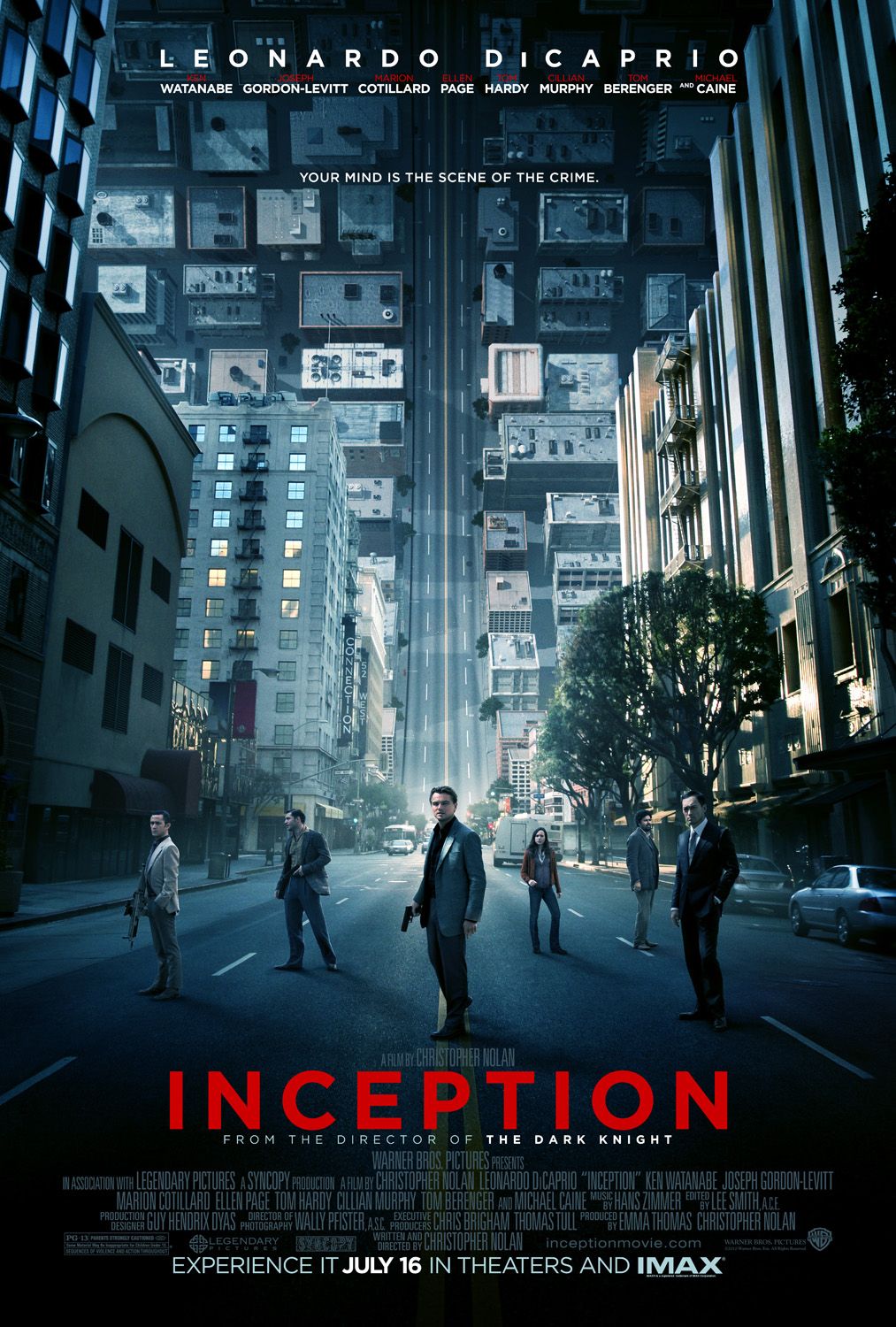
My reaction upon seeing “Inception” was pretty much the same one I had after I saw Christopher Nolan’s last movie “The Dark Knight:” BRILLIANT!!! In a summer movie season which has been largely bland and seriously lacking in excitement, Nolan once again stimulates the imagination by giving us a very well thought out story with complex characters. This is all in addition to the slam bang entertainment we expect from a summer blockbuster, and Nolan delivers on both fronts. Seriously, this movie feels like a godsend in a time where studio executives are way too risk adverse. Even if “Inception” borrows from movies like “Blade Runner” and “The Matrix,” Nolan still makes it all his own. I’ve already seen “Inception” twice in one week, and there is just as much to discover about it the second time around as much as the first.
Nolan has actually been working on this screenplay for over a decade, and it is an intricate puzzle of a flick which might seem difficult to follow, but not really. Leonardo DiCaprio stars as Dominic Cobb, a highly experienced dream infiltrator who works at extracting precious information from his targets. Basically, he steals ideas from his clients before they even realize it, and they are very valuable ideas which will put him and his crew on easy street for a time. Working with him is his partner Arthur (Joseph Gordon-Levitt) whose job is to research the clients’ history and see if they have any mental defenses built up which could hinder their mission. As we first see them in “Inception,” they have seemingly failed a mission, but they soon find out it was actually an audition.
Their target, Saito (Ken Watanabe), a wealthy businessman, offers a job which will have them doing the opposite of their job description. This brings us to the movie’s title which means planting an idea in the mind of their target’s subconscious. Although thought to be impossible, Cobb says it can be done because he has succeeded in doing it before. “Inception” then takes Cobb and his team on an adventure which will go into a dream, and then into another dream within that dream. Just when you think they couldn’t go any deeper, they do. It sounds confusing, but it was easier to follow than I thought. You want a tough movie to follow? Check out the first “Mission Impossible” movie which Brian DePalma directed. After all these years, I still can’t figure out what it was about (the stunts were cool though).
The concept of entering a person’s dream is fascinating because it gives the story infinite possibilities to explore, and all sorts of directions to take it in. Dreams themselves still fascinate us as we still have no clear idea what generates them. They can be very unpredictable and go from one place to another before we know it. Dreams could be our subconscious minds trying unburden itself of all the baggage we bury down into its recesses in the hopes of forgetting the most painful things in life. Looking back at the dreams I have had which have stayed with me, be it good or bad, they continually astonish me with their vividness and how our brains and imaginations can conjure up such amazing images as we slumber away in beds which are hopefully kind to your back. You’d think after all these years we would be able to be consciously aware of when we are in a dream and control it to our advantage, but no such luck. When you’re deep into one, the difference between what is real and what is not becomes irrelevant.
That’s the other thing I loved about “Inception;” you are always questioning whether you’re in a dream or wide awake. Even if you already know how the movie ends, it couldn’t possibly spoil the experience for you when you witness it. As in “Total Recall,” reality is always in question and open to interpretation, and it’s unlikely everyone will come to the same conclusion. I was also reminded of David Cronenberg’s “eXistenZ” which ended on a note of sheer ambiguity as the line between what’s real and what is not becomes permanently blurred. “Inception” all but starts out this way, and the theories behind the action and what’s really going on continue to abound. How cool it is to have a movie of this size and scope which really gets you to think!
For a moment, I thought DiCaprio was going to portray the same character he played in Martin Scorsese’s “Shutter Island,” Teddy Williams. Both characters have inescapable similarities; they are tortured by memories and actions they cannot repair, they are married to beautiful women whose current state of mind is in question, and they are both really moody guys who are not a barrel of laughs to be around. Oh yeah, both are also struggling with the reality of everything happening around them. I guess what Cobb has over Teddy is his grip on reality is much firmer, but even Cobb’s sanity comes into question throughout “Inception.”
DiCaprio continues to prove he is not only one of the very best actors working, but also one of the few stars who genuinely take risks. Not content with being forever imprisoned as a movie star, he nails the complexities of Cobb to where we see the various dimensions of his character. In essence, Cobb is a thief after the big score, and he shuts himself off to other people. But DiCaprio really gets at what is beneath his character’s guilt and shame, and he makes us want to join him in his dream exploits. For him, it is never about just making the character a likable one.
It’s also great to see Levitt here as well. Having been the indie darling for a few years, turning in one great performance after another, and he more than holds his own here. When everyone else is in a state of uncontrollable panic, Arthur always keeps his focus clear which allows him to stay on top of things. His method of preparing his team members for “the kick” in one dream is ingenious. Watching Levitt here almost makes me forget he was on “3rd Rock from The Sun” all those years ago.
Then you have the beautiful Marion Cotillard, plays Cobb’s late wife, Mal. While Mal may be short for Mallorie, in Latin it means “evil,” and she exists only within Cobb’s dreamscape as he has buried her deep in his memories. However, his control over her continues to erode as Mal continues to intrude in different dreams he has as she gets the upper hand and continually threatens to ruin anything and everything. Cotillard plays Mal with a cold detachment as well as a deeply wounded person who feels betrayed by her husband. As the movie goes on, you begin to wonder if she is truly dead or alive.
At first, having Ellen Page in this movie might seem weird as we all still identify her with her character from “Juno.” It’s been easy to forget what a wide range she can have as an actress, but this is not the case here as she acts as the guide for the audience in the world of dreams. Her character of Ariadne is the architect, the one who constructs the world of the dream which the team will enter into. She also acts as the conscience Cobb needs as he continues to be drawn by Mal into a state of limbo which he may never return from. As a result, Ariadne is the strongest, most objective and levelheaded in the group because she sees what consumes Cobb and how it can endanger everyone. She becomes the voice of reason Cobb must listen to if he hopes not to drown in his own guilt. It feels like it has been too long since I have seen Page in anything, and she once again proves to be another fantastic actress of her generation.
Tom Hardy, who plays the forger Eames, is fun to watch here as he approaches the role with a touch of irresistible sarcasm as he gleefully plays around with the other team members and their self-consuming seriousness. Eames gets an especially big kick in getting a rise out of Arthur who takes his work perhaps more seriously than most. Throughout the movie, Hardy’s presence proves to be one of the film’s most entertaining, and his star continues to rise.
Nolan also brings some of his “Dark Knight” cast members along for the dream ride including Sir Michael Caine and Cillian Murphy. Both are terrific in any role given to them, and the performances they both give in “Inception” are no exception. Another supporting actor worth noting here is Dileep Rao who plays Yusuf, the chemist who formulates the sedatives which put the group and the target under so they can complete their mission. I think he deserves to be mentioned in the same breath with all the other actors whose names appear on the posters.
But the big surprise in “Inception” is the appearance of Tom Berenger, a well-known actor who has for far too long been relegated to the realm of straight to DVD movies. It’s so nice to see him here in something other than a “Sniper” sequel (how many have there been anyway?), and he hasn’t missed a step as an actor after all these years.
With movies like “Inception,” we have come to expect directors will spend more time on the visual element to where they inadvertently forget the other important ones like dialogue and acting. Having made several movies already, Nolan proves to be one of the best directors working today as he handles each part of a movie with the same amount of attention, something increasingly rare among filmmakers.
Nolan fills the movies with such inventive images as Arthur fights off armed men while the dream he is in is thrown out of balance as it spins him from the floor to the ceiling. Levitt really sells the scene by showing his character struggling to maintain control as he is forced to crawl over the place when gravity no longer works in his favor. Then there is the final scene, which I won’t dare to give away, but taking in the audience’s strong reaction showed just how successful Nolan was in holding us firmly within his grasp. I loved the inescapable ambiguity of the film’s conclusion and how it drove some audience members crazy.
Plus, Nolan once again employs Hans Zimmer to do the score, and what he brings us is not another rehash of the Caped Crusader’s music. Zimmer gives a strong score dominated by electronics, drums, and brass instruments which are primed to blow out the speakers at a theater near you. Capturing the scope of the visuals in “Inception” which are quite immense, Zimmer once again gives great power to Nolan’s amazing concepts which Warner Brothers was smart enough to let the director run wild with instead of just containing his imagination in fear of releasing something which might seem “uncommercial.”
In a sea of endless remakes, questionable reboots, and half-assed concepts which somehow got a green light from studio executives, “Inception” is a rare breed of film which is as thought provoking as it is entertaining. It also makes clear Nolan is a genius filmmaker who has set the bar high for summer tent pole movies just like he did with “The Dark Knight.”






 The Ultimate Rabbit