No, I Haven’t Seen It Until Now: ‘The Incredible Shrinking Man’
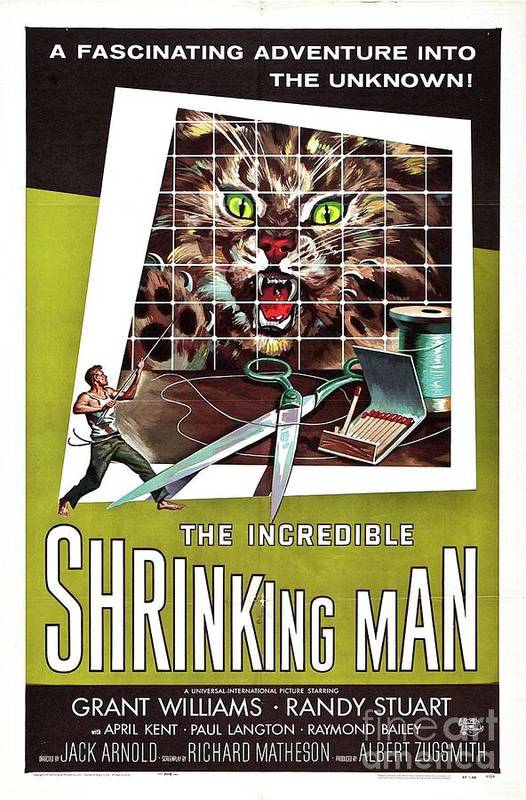
The Incredible Shrinking Man” comes from a genre I feel I know a lot about but have actually not seen many movies from: 1950’s science fiction. I went into it thinking it would look horribly dated and laughable for all the wrong reasons. What I instead discovered was a film which actually holds up very well after half a century with its terrific special effects and strong performances. It also deals with themes and situations which prove to be as relatable today as they were back in the time this film was released.

Scott Carey (Grant Williams) is spending an enjoyably sunny day on a boat with his wife, Louise (Randy Stuart), when a strange mist passes through him and spills some glittery substance over his body. Louise manages to not get covered by this same substance as she was down below getting a beer for her husband because men can be schmucks when they ask their spouses to get them things they should be able to get themselves (that’ll show him!). Now Scott thinks nothing of what happened until he suddenly notices his shirt is now too big for him, and then his wedding ring falls off his finger which is clearly not a good omen.

After being examined by his doctors, Scott discovers that the glittery substance is not the same kind gay groups doused Newt Gingrich with during his needless run for President of the United States. Whatever is causing him to shrink, his attempts to reverse this unfortunate condition his fail. At one point, Scott becomes so tiny to where he is forced to seek refuge in a doll house for his own safety. This makes sense until the household cat ends up mistaking him for a mouse, and he ends up running into the basement where he is forced to face dangers no human being should ever have to.

What I found endlessly fascinating about “The Incredible Shrinking Man” is that what people end up enduring after attaining an odd and unwanted fame is not much different from what anyone would experience today. Scott ends up selling his story to the press not to become famous, but because he no longer has a job and needs the money for his wife and himself to survive. The more of a curiosity he becomes, the less human he is seen by the world.

Today, if someone were going through this, we might expect them to be more forthcoming about becoming famous for something they did not exactly want to become known for as there is much money to be made, and an obscene amount at that. In the process, it is easy to forget the humanity of certain people involved, and “The Incredibly Shrinking Man” deals with the inescapable loneliness which results.

Scott clearly does not want all these photographers parked outside his front door, but he is helpless to stop their onslaught. Then again, imagine if he was dealing with this today; he would have no privacy whatsoever. It would not matter if he spent his days indoors because the damn paparazzi would find a way to get inside and snap a picture of him. Even though Scott vents at his wife against his better judgment, you I could not help but feel for him as he goes through a process no one would want to endure. That is, unless they were ridiculously desperate for some kind of attention.

“The Incredible Shrinking Man” really picks up an extraordinary amount of tension when Scott gets stuck in that basement. The special effects up to this point are very well executed, but they take on a bigger challenge when Scott is no bigger than the match box he hides in. The use of forced perspective and real physical structures makes his predicament all the more thrilling and emotionally involving. The simple act of getting food becomes a life-or-death struggle, and I felt for him as he was forced to climb up towards a stale piece of bread using only a needle and thread.

Even the simplest effects make Scott’s struggle all the more brutal as the merest failure will force right back to the start, and we can identify with the infinite frustration this causes no matter how big or small we are. But what makes his fight for survival all the more viscerally frightening is the scary-looking spider (is there any other kind?) he is forced to do battle with. It is moments Scott shares with this spider which had me the most frightened and on the edge of my seat. For a film which is now a century old, this is saying a lot. That, and I cannot stand spiders in general.

Much credit should be given to Williams here as he does not always make Scott the most likable human being. Still, whatever you may think of him, Scott is made to experience something no other human being has. While you may want to chide Scott for the way he unloads his frustrations on those closest to him, watching him makes me wonder if I would have reacted any differently. I would like to think so, but perhaps a lot of wishful thing is involved there.

“The Incredible Shrinking Man” is based on a book by Richard Matheson entitled “The Shrinking Man” (he found the “Incredible” adjective to be unnecessary). Matheson has been responsible for some of the greatest science fiction stories ever told such as “I Am Legend,” various episodes of “The Twilight Zone” like “Nightmare at 20,000 Feet,” and the short story “Button, Button” which became the basis for “The Box.”

I think “The Incredible Shrinking Man” represents one of the finest adaptations of Matheson’s work as it deals with the humanity of Scott’s situation as much as it does with visual effects. The effects are great, but it is our relation to Scott and what he is going through that makes this movie work so effectively. No one wants a household spider to suddenly become bigger than they are, but this film forces you to deal with these fears to where they are more real than you could ever expect them to be.

This is also a film which has a voiceover narration to accompany its events. When it comes to this way of telling a story, it can go either way; At times, it can tell us things we do not need spelled out to us, but here it also gives great depth to the film’s themes as it makes Scott’s view of his existence change throughout in ways both positive and negative.

The ending still haunts me even long after I watched it. The conclusion is solemn in a way as Scott becomes resigned to his downsized fate, but it is also strangely hopeful as he becomes convinced he will still be a part of this vast universe no matter how small he gets. Even in the 1950’s, filmmakers did not take the easy way out when wrapping up a motion picture. It is not an “everything is going to be okay” ending, but it is not a complete downer either.

I was surprised at just how much I got into “The Incredible Shrinking Man.” The title seems to imply we are about to see something endlessly cheesy, but this film proved to be thrilling and had me on the edge of my seat throughout. I imagine Hollywood will eventually remake it someday and turn it into a comedy, but they will not be able to touch the deeper meanings of what Richard Matheson was getting at. Please feel free to prove me wrong, but you will need a lot of luck in the process.

* * * ½ out of * * * *

WRITER’S NOTE: This film is now available in a special edition from the Criterion Collection. Click here to find out more.

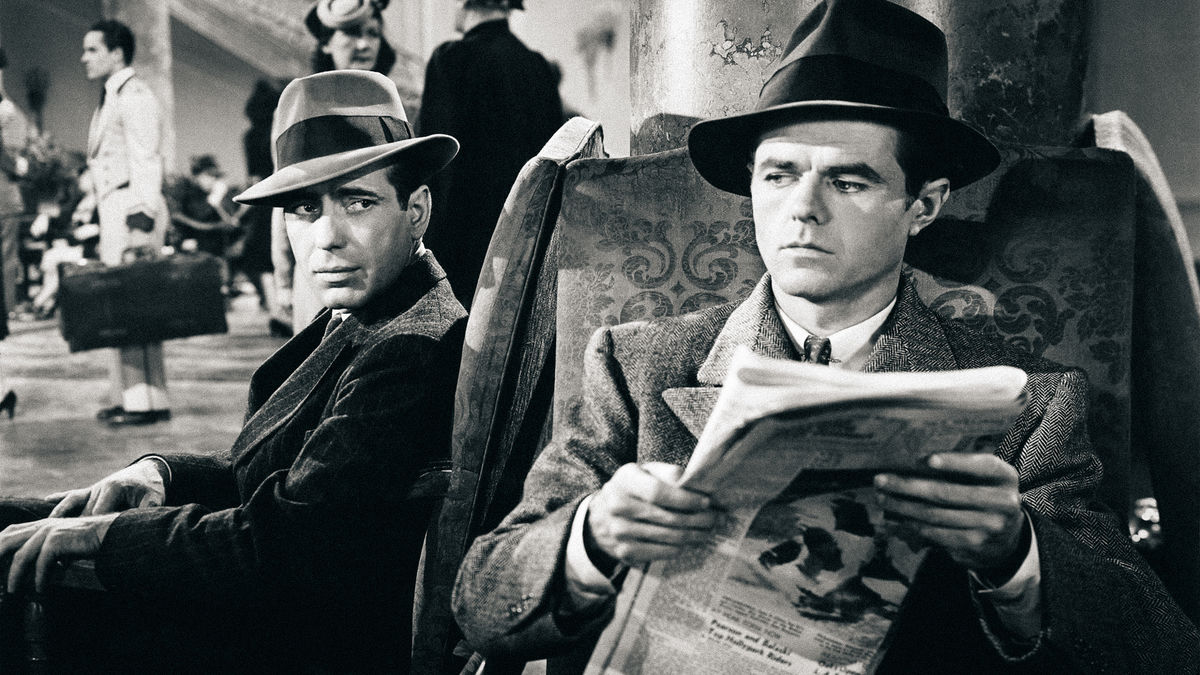
‘The Maltese Falcon’ Movie and 4K Review

The following review was written by Ultimate Rabbit correspondent, Tony Farinella.

The Maltese Falcon” is a film I imagine I will enjoy a lot more on a second viewing, as this was my first time watching it. The reason I say this is because there are a lot of moving pieces in this film, and it is never boring.  However, at times, I found myself trying to follow the story and the plot instead of being as immersed in the story as I would have liked to have been.  Many people have called it the first-ever film noir.  Film noir is a genre that Humphrey Bogart excelled in throughout his career.  He had a rough look and a gruff voice.  He wasn’t going to take any nonsense from anyone, and no matter how dire a situation was, he always seemed to know what was going on, and he was not going to be rattled by the circumstances around him.

Humphrey Bogart plays a private investigator named Sam Spade.  He is in business with his partner, Miles Archer (Jerome Cowan).  One day, a woman walks into their office by the name of Ruth Wonderly (Mary Astor), claiming her sister ran off from New York to San Francisco with a man named Floyd Thursby.  She is hoping that Spade and Archer can help her find her sister.  Archer agrees to look into it, but he ends up dead along with Floyd Thursby.  This captures the attention of Sam Spade, who is beginning to wonder the validity of her story.  Before long, he discovers that her real name is actually Brigid O’Shaughnessy.

Throughout all of this mystery and intrigue, Sam finds himself in the crosshairs of Joel Cairo (Peter Lorre), who offers Sam some money for a highly valued falcon statue.  There is also a young man named Wilmer (Elisha Cook Jr.) who is keeping his eyes on Sam along with Kasper Gutman (Sydney Greenstreet), a rotund money man who will stop at nothing to get his hands on this bird. Throughout all of the twists and turns, Sam isn’t sure who to believe, who to trust, and who is telling the truth. He stays in control and makes smart decisions, even when people are pointing their guns at him or he’s suspected of murder by the police.

One of the strong points of “The Maltese Falcon” is the running time. At 100 minutes, there is not a dull moment in the film.  It is paced perfectly and directed with great skill by John Huston. It has the look and feel that one would expect from a film noir.  You have your femme fatale in Mary Astor.  She’s brilliant here, as she’s able to go from vulnerable and naïve to cunning and savvy in the blink of an eye. Of course, you have Bogart, who made a living in Hollywood playing this type of character.  Guys liked and respected him, and women were drawn to his tough exterior. As mentioned earlier, he is always able to stay level-headed, even in life-or-death circumstances.  He still seems to know what to do and what to say to get himself out of a jam.

In the end, I respected and admired “The Maltese Falcon” as a film.  I can’t say I enjoyed it a ton because of the storytelling.  It’s not an overly complicated film, but at times, there are too many twists and turns happening at once.  That being said, I think the more I watch this film, the more I will enjoy it and have a better understanding of everything.  Because of the deception happening on screen and characters coming and going, it’s not that it was hard to follow, it’s more that I was keeping up with the plot instead of getting lost in it. I look forward to watching this film many more times in the future, as I think I will gain an even greater appreciation for the skilled acting and directing on display.

* * * out of * * * *

4K Info: “The Maltese Falcon” is released on a two-disc 4K/Blu-ray combo pack from Warner Brothers Home Entertainment. The film has a running time of 100 minutes.  It also comes with a digital copy of the film. As far as the film’s rating, it is not rated, but that is not because it’s a raunchy film. It was released in 1941 and is very tame.

Video Info:  Ultra High Definition HDR always stands out on older films.  A lot of movie buffs like to talk about how older films are enhanced by a 4K transfer, and that is certainly the case here. From the swift movements of the characters to the deep blacks, this is a stunning transfer of a black and white film. Right now, 4K is doing some truly amazing work with classic Hollywood films.

Audio Info: The film is presented on the following audio formats: DTS-HD MA: English 2.0 Mono and Dolby Digital: Spanish. Subtitles are included in English and Spanish as well.  The audio is crisp, clear, and all of the great dialogue you would expect from a film noir is easy to digest while watching this film.

 Special Features:

 Commentary by Humphrey Bogart Biographer Eric Lax

“Warner Night at the Movies”

“Sergeant York” Trailer

“New Highlights of the Roosevelt Churchill Parley” (newsreel)

“The Gay Parisian” (1941 WB short)

“Meet John Doughboy” (1941 WB cartoon)

The Maltese Falcon: One Magnificent Bird

Becoming Attractions: The Trailers of Humphrey Bogart

Breakdowns of 1941 (WB short)

Make-up Tests

2/8/43 Lux Radio Theater Broadcast

9/20/43 Screen Guild Theater Broadcast

7/3/46 Academy Award Theater Broadcast

Trailers

1936 “Satan Met a Lady”

1941 “The Maltese Falcon”

Should You Buy It?

I don’t feel like I am really giving this film the credit it deserves, but keep in mind, this was my first time watching it.  I have always been a big believer that you need to watch a great film a few times in order to fully appreciate it.  It doesn’t always strike on the first chord.  There is a lot to like, especially the acting and the pacing of the plot, but the story took me out of it at times.  With all of that being said, if you are a fan of “The Maltese Falcon,” you owe it to yourself to buy it on 4K.  It looks fantastic here in black and white and in high dynamic range with its 4K transfer.  It’s such a moody film noir that truly gets a boost from 4K.  The special features are transferred over from the previously released Blu-ray, so if you are looking for anything new here, you are not going to find it, but I don’t expect anything new from a film that was released in 1941 as most, if not all, of the actors have passed away.  If you are a first-time viewer like myself, I still think you should buy it as you will get the slipcover and might enjoy it more than I did.  If you love the film and have seen it many times, you will enjoy it even more on 4K. I look forward to seeing what else Warner Brothers is going to be releasing throughout the year during their 100th year anniversary.

**Disclaimer** I received a copy of this film from Warner Brothers to review for free.  The opinions and statements in the review are mine and mine alone.

No, I Haven’t Seen It Until Now: ‘Paris, Texas’

Until this past week, the only Wim Wenders film I had ever seen was “The Million Dollar Hotel.” That one was a fascinating motion picture which dragged at times but still had moments that held me in a grasp few other filmmakers could ever hold me in. When all is said and done, the one thing we can all agree on is that it had a terrific soundtrack by U2, and that Mel Gibson should have kept his mouth shut during the film’s press day when he was caught saying it was “boring as a dog’s ass.” This proved to be one of the many times Gibson was obligated to apologize for saying something he never should have said.

But whether you consider “The Million Dollar Hotel” one of Wenders’ best or worst, films, you have to admit “Paris, Texas” shows him working at his filmmaking best. I caught a screening of it at the Nuart Theatre in West Los Angeles as this was a film crying out for me to watch it not at home, but on the silver screen in a darkened theatre. Knowing of its reputation as a Palme d’Or winner at the Cannes Film Festival in 1984 and having a beautifully subdued music score by the great Ry Cooder, I knew I was in  for quite a unique cinematic treat.

We open on the driest of deserts in West Texas to find a drifter named Travis Henderson (Harry Dean Stanton) wandering aimlessly while trying to find some water to drink. After passing out in a nearly empty saloon, he awakens in a clinic where a German doctor cannot get a single word out of him. Frustrated, the doctor calls a phone number Travis just happens to have on him, and it is answered by his brother, Walt (Dean Stockwell), who lives out in Los Angeles. It turns out Tavis disappeared without a trace four years ago, leaving behind his wife Jane (Nastassja Kinski) and their son Hunter (Hunter Carson). Why did Travis just up and leave? Well, much of “Paris, Texas” is dedicated to figuring this out, and the answers are never made easy to come by.

The first thing I have to say about “Paris, Texas” was how amazing and mesmerizing it was. Not once could I take my eyes off the screen as Wenders captured a Texas which was at once beautiful and haunted by a past its characters want to, but cannot, recapture or escaoe. It is also an unforgettable time capsule of life in the 1980’s in America as the story takes place in a time when you needed maps instead of GPS to find your way from one place to another, smoking was allowed on airplanes, and regular unleaded gasoline was only $1.07 a gallon (shit). But while things have changed a lot since then, the themes this film deals with still have a lot of resonance in this day and age.

For a moment, I thought Harry Dean Stanton and Dean Stockwell would go on the same kind of road trip Tom Cruise and Dustin Hoffman went on in “Rain Man,” and this was especially the case after we see their characters suddenly get off a commercial airplane and instead travel back to Los Angeles by car. “Paris, Texas,” however, speeds things up and has the two arriving in Los Angeles where Stanton’s character slowly starts to acclimate to civilization and his new environment while trying to reintroduce himself into his son’s life.

Stanton has gone on record in saying “Paris, Texas” is his favorite film out of all the ones he has done, and his performance as Travis may very well be the best of his career outside of “Repo Man.” His face is like a well-trodden landscape which says so much, and it is important to note this as Stanton does not say a single word for the first 26 minutes. It is fascinating to watch him act in a childlike manner as he sits in the backyard of Walt’s home while watching the airplanes fly in and out of Burbank Airport with a pair of binoculars. I also loved the interaction between him and Hunter as he slowly gains the trust of a long-lost son who, very understandably, is not quick to connect with him.

Dean Stockwell was on the verge of quitting acting and going into real estate when he got cast in “Paris, Texas,” and his performance shows how lucky we were that his talents were not robbed from us. What a shame it would have been if we did not get his Oscar-nominated performance in “Married to the Mob” or his co-starring role in the television series “Quantum Leap” had he not appeared here. In this film, he is the audience surrogate as, like him, we are desperate to figure out what Travis has been through in the four years he has been missing. Moreover, Walt must figure out how to deal with how he and his wife Anne (played by Aurore Clément) consider themselves the real parents to Hunter while trying to help Travis make a connection with someone whose life he was always supposed be a part of.

As for Hunter Carson, the son of this film’s co-writer, L.M. Kit Carson, he is perfect for something like this. “Paris, Texas” is a film which demands its actors inhabit their roles naturally rather than act or perform them, and Hunter is a kid who was clearly not brought up by stage parents thank goodness. He simply exists here as any other young child would which makes his scenes with the other actors even more authentic and moving, and this is especially the case in this film’s final moments which are as emotionally moving as one would expect them to be.

But the scenes which had me mesmerized the most were the ones between Stanton and Nastassja Kinski where Cooder’s score was not needed as their acting with one another via a one-way mirror and a telephone proved to be as subtle and intense as any onscreen acting I have ever witnessed. It is always a gift to be held at attention by two wonderful actors who give their roles every ounce of their being, and this is no mere exception in the slightest.

And when it comes to Kinski, who looks so much different than she did in “Cat People,” we do not see her appear onscreen until 53 minutes into this film. And yet somehow, her character Jane’s presence is felt deeply throughout. It is said Kinski wrote a diary for Jane, and it shows how deep into this character she got as her first appearance shows us someone who has lived a long beyond her years, and she was still quite young when “Paris, Texas” was filmed. Watching her react to what Stanton is telling her proved to be utterly enthralling as I wanted Jane to realize something which was right in front of her, and it makes Kinski’s performance all the more inspired.

Now on one hand, I am tempted to say how shameful it is that I did not watch “Paris, Texas” years ago. By that, I do not mean when it came out in 1984 as I was only nine years old back then and not about to take in the impact the Ronald Reagan Presidential years had on the world at large. I am thinking more of when I was in college and watching “A Clockwork Orange,” “Full Metal Jacket,” “Apocalypse Now” and “Taxi Driver” which took my moviegoing to a whole other enthralling level. “Paris, Texas” is a motion picture that does not play by any cinematic rules as it keeps you waiting and longing for certain things to happen, and in a good way. It also dares to leave story threads hanging in an ambiguous fashion which, while some will feel frustrated by this, will make the more adventurous viewers think deeply about what they just saw.

As for myself, I have a lot of Wim Wenders films to catch up on like “Wings of Desire,” “Pina,” “Buena Vista Social Club” and “Until the End of the World.” For what it is worth, I have seen the American remake of “Wings of Desire” which is called “City of Angels,” and it came out in 1998 and starred Nicolas Cage and Meg Ryan. That remake broke my heart, and it makes me wonder if the original will do the same. Perhaps I am afraid to find out.

* * * * out of * * * *

No, I Haven’t Seen It Until Now: ‘Cannonball Run II’

Copyright HAG ?2008

I remember almost renting “Cannonball Run II” on VHS from Nino’s TV and Video in Thousand Oaks when I was a kid. I enjoyed the first “Cannonball Run” movie a lot and watched it many times, and these days I rate it as an Ultimate Rabbit guilty pleasure. But when I presented it to my dad as the movie I wanted to rent for the weekend, he looked at me and said, “Are you sure you want to rent this? It’s really awful.” This shook my courage in renting movies for a time as I began to doubt my taste in film. As a result, I put this one back on the shelf even though its poster looked ever so cool.

Well, while my dad’s pleas failed to keep me from renting the Clint Eastwood comedy “Every Which Way But Loose,” it did keep me from checking out “Cannonball Run II” for many years. But at a time when I should have been watching such films as “Tar,” “The Banshees of Inisherin” and “Black Panther: Wakanda Forever,” I found myself watching this 1984 sequel as it was available to view for free on You Tube (with ads of course). And though I was not expecting a good movie in the slightest, I was stunned at just how amazingly atrocious this follow up was as everyone involved cannot even bother to give the proceedings a mere 50% of their energies.

This sequel starts off with the Sheik Abdul ben Falafel (Jamie Farr) being berated by his father (played by Ricardo Montalban) for losing the Cannonball Run race last year. Having embarrassed the Falafel family (you read that family name correctly), Abdul’s father orders him to win another Cannonball Run in order to restore the family name. The problem is, there is no Cannonball Run race happening that year, so Abdul is told to buy one, and the grand prize is a million dollars.

From there, “Cannonball Run II” begins its arduous task of reintroducing characters from the original as well as introducing a whole bunch of new ones who could only dream of being as funny as Roger Moore was when he played  Seymour Goldfarb, Jr. In fact, Hal Needham, who returns to direct this misbegotten sequel, spends more time with these characters than he does with the race itself.

Burt Reynolds is back as J.J. McClure, and he looks like he can save this motion picture with his charisma and sexy mustache. Dom DeLuise also returns as J.J.’s partner Victor Prinzi and his alter ego of Captain Chaos. These two always look to be having the time of their lives when they work together, but the fun they have does not translate over to the audience as it did for me in the original. This is especially the case when you watch the outtakes which play over the end credits, and you wonder what made the cast enjoy themselves endlessly as their laughter speaks more of a desperation to make this sequel worth watching.

When it comes to racing partnerships, there are a few changes. Jackie Chan is joined this time in his Mitsubishi car by Richard Kiel who plays his driver, Arnold. Doctor Nikolas Van Helsing (Jack Elam), J.J. and Victor’s partner in crime previously, is now working with Sheik Abdul to keep his ulcer in check. And Susan Anton and Catherine Bach are here to replace Tara Buckman and Adrienne Barbeau as those sexy women behind the wheel of a Lamborghini. Still, as Snake Plissken kept saying in “Escape From L.A.,” the more things change, the more they stay the same.

In directing “Cannonball Run II,” I had to wonder what was going through Needham’s mind. Was he just telling a cast which included Shirley McClaine, Dean Martin, Marilu Henner, Sammy Davis Jr., and Tony Danza among others to just go out there and be funny? If so, it did not work to anyone’s advantage as everyone looks to be either phoning it in or trying way too hard to put a smile on our faces. And if you thought the stunts from the original were lacking, the ones here are generic and pedestrian at best.

The only decently funny moment for me was at the beginning with Ricardo Montalban who plays his role as if he is not in on the joke in the slightest. Heck, he even makes the word falafel sound vaguely amusing in a way Bill O’Reilly only thinks he can. Perhaps if the rest of the cast had followed suit, this sequel might have been slightly better than it ever could have hoped to be.

I also keep thinking Needham and company kept looking at this sequel and its making to where he believed he could solve anything and everything in post. There’s a subplot involving mobsters which goes nowhere and has actors like Abe Vigoda being cast just for old time’s sake. And, yes, there is an orangutan driving a car, but he can only hope to be as memorable as Clyde was in “Every Which Way But Loose.”

So much time is spent on such overly broad character moments that Needham and his collaborators kept forgetting there was a long-distance race involved in this movie’s plot. As a result, they brought in Ralph Bakshi to animate the race’s climax in order to give it some momentum, but it doesn’t do much to speed things up, especially after a cameo with Frank Sinatra who plays himself. And yes, it is ever so easy to tell that Sinatra filmed his scenes in a studio by his lonesome. Not once do we see him and actors Reynolds, DeLuise and others in the same scene together.

“Cannonball Run II” will at best be remembered as a footnote in history for the following reasons: it marked Frank Sinatra’s final role in a theatrical motion picture, it is the final action stunt comedy for Reynolds following such films as “Smokey and the Bandit” and “Hooper” among others, it was the last film for Dean Martin, Molly Picon and Jim Nabors who is essentially parodying his character of Gomer Pyle. Other than that, this one is a certifiable waste of 108 minutes out of your life.

What is my excuse for wasting my precious time with “Cannonball Run II?” I will treat that as a rhetorical question. Still, its poster does looks really cool.

½* out of * * * *

‘The Lost Boys’ Movie and 4K/Blu-ray Review

The following review was written by Ultimate Rabbit correspondent, Tony Farinella.

The Lost Boys” falls into the category of a great horror film I have never seen before until now.  With its release on 4K and Halloween a little over a month away, I couldn’t wait to take a bite into this movie (see what I did there?).  Vampires, zombies and werewolves are familiar creatures used in horror films.  The thing which separates the good films from the bad are two things: the characters and the story.  Are we invested in the characters? Is there a compelling story? In the case of “The Lost Boys,” the answer is a resounding yes.  I loved this film, and even though I’m late to the party in watching it, it’s better late than never.

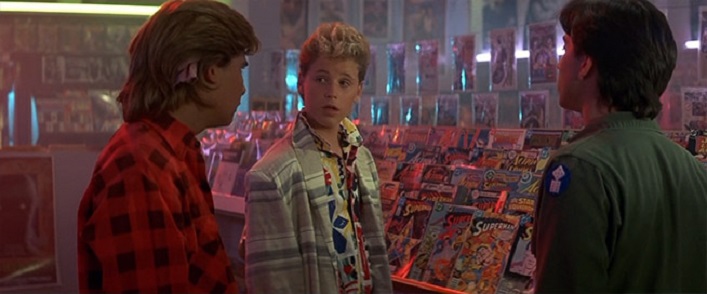
Lucy (Dianne Wiest) and her two sons Michael (Jason Patric) and Sam (Corey Haim) have relocated to Santa Carla, California following her divorce.  They end up living with her eccentric, oddball father played brilliantly by Barnard Hughes, and he doesn’t want anyone to touch his root beer or his Oreos.  He also spends a lot of time dabbling in taxidermy and often gives Sam some unwanted presents.  Sam is also flanked by his loyal dog Nanook, an Alaskan Malamute. Sam is doing his best to adjust to this beach town by catching up on some comic books. He ends up getting to know the Frog Brothers, Edgar and Allan, played by Corey Feldman and Jamison Newlander, who know a lot about vampires and comic books.  Their performances are comedy gold in this film, and they are their own little “Strangers Things” group here.

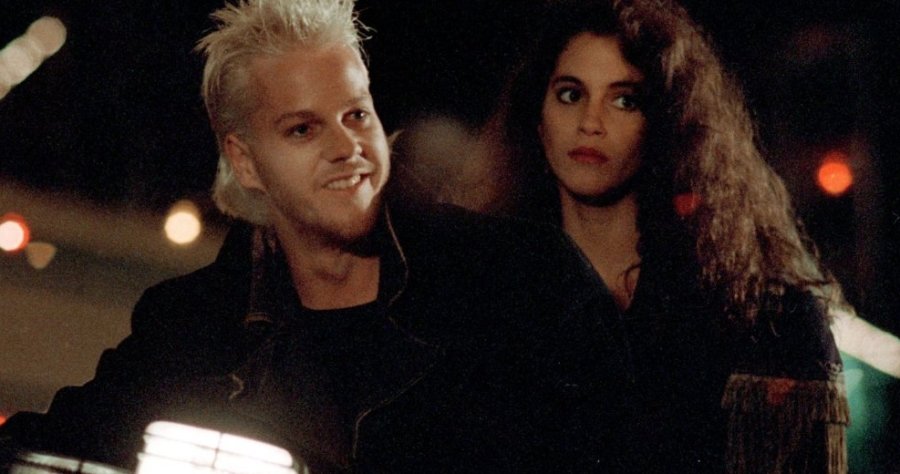
Michael ends up falling for a young lady named Star, played by Jami Gertz. She hangs around a biker gang led by David (Kiefer Sutherland).  Something is clearly unusual and odd about them, but Michael is hoping that if they accept him, he can get to know Star.  Lucy ends up getting a job at the local video store which is owned by Max (Edward Herrmann).  Max is a dorky putz, but he means well and seems genuinely interested in getting to know Lucy.  This in spite of the fact that their dates usually always end up in disaster because Sam is convinced something is off with Michael.  Sam wants to protect Michael because that’s his brother, but he’s not entirely happy with how he’s acting lately.  Michael is sleeping all the time and coming home very late now that he has his new friends.

There is plenty to enjoy with “The Lost Boys,” but the key ingredient is the cast.  The actors really sell this material with just the right amount of humor and terror.  Director Joel Schumacher also knows how to get the most out of every single scene.  This film is 97 minutes and frankly, it is the perfect running time for a film like this. We get to know the characters, their dilemma unfolds, and it ends with a bang, literally and figuratively speaking. I really enjoyed the fact the filmmakers went with an R rating.  They build up to the violence, so it really means something when the bodies start to explode and heads begin flying off.  The special effects and make-up are top notch.  When you add in the fact this is a 4K release, everything is enhanced to an even greater degree.

The film also doesn’t lean in too heavily with the vampire gimmick.  Yes, there are characters who are vampires and there are rules to follow, but at the end of the day, it’s a film about a mother and her two sons trying to survive.  Dianne Wiest, a favorite actress of mine, is perfect as the concerned but confused mother.  The late Corey Haim is also top-notch here.  I know I’m singling out their work, but there is not a bad performance in this film.  It also helps that the atmosphere goes back and forth between day and night.  It’s an atmospheric and intense flick which hits all of the right notes you would want in a film like this. I went into it not knowing what to expect, and I ended up having a big smile on my face when the credits were rolling at the end.

“The Lost Boys” is an 80’s gem which deserves to be seen on 4K.  It’s one of those rare examples of a film where everything falls into place: the cast, the acting, the director, the writing, the blood and guts and the twists and turns.  The comedy is done at just the right moments without being too hokey or phony. The action and violence are really turned up a notch without being too much or overdone. This is the perfect Halloween movie to pick up in time to watch for the holiday.  Trust me when I tell you this: You won’t regret it, and you will love it. If you have already seen it, you will love it even more with the 4K upgrade.

* * * * out of * * * *

4K/Blu-Ray: “The Lost Boys” is being released on a two-disc 4K and Blu-ray combo pack from Warner Brothers Home Entertainment. It also comes with a digital copy of the film as well.  It is rated R and has a running time of 97 minutes.

Video Info: The 4K of this film comes with stunning High Dynamic Range (HDR), and it looks incredible.  As I mentioned earlier in my review, the outdoor shots of California are absolutely stunning. When the film is darker and more brooding, it switches to that tone with its color palette.  This is a terrific-looking 4K, and I enjoyed taking it all in for the first time.

Audio Info:  I was hoping they would have a Dolby Atmos track as the audio is good but it’s a little inconsistent at times. It comes on a DTS-HD MA: English 5.1 audio track along with Dolby Digital audio tracks in French and Spanish. Subtitles are in English, French, and Spanish.

Special Features:

4K UHD Disc

·           Commentary by Joel Schumacher

Blu-ray Disc

·           Commentary by Joel Schumacher

·           “The Lost Boys: A Retrospective”: 24:00

·           “Inside the Vampire’s Cave: A Director’s Vision”: 6:58

·           “Inside the Vampire’s Cave: Comedy vs. Horror”: 4:44

·           “Inside the Vampire’s Cave: Fresh Blood-A New Look at Vampires”: 4:23

·           “Inside the Vampire’s Cave: The Lost Boys Sequel?”: 2:25

·           “Vamping Out: The Undead Creations of Greg Cannon”: 14:02

·           “The Return of Sam and the Frog Brothers: Haimster & Feldog-The Story of the 2 Coreys”: 4:30

·           “The Return of Sam and the Frog Brothers: Multi-Angle Video Commentary by Corey Haim, Corey Feldman and Jamison Newlander”: 18:23

·           The Lost Scenes: 15:16

·           Lou Gramm “Lost in the Shadows” Music Video: 4:35

·           Trailer: 1:26

Normally, I would complain about the fact they don’t have any new special features for the 4K here, but considering this was my first time watching the film, all of the special features were new to me.  There is a commentary track with the director and plenty of lengthy special features discussing the film.  Based on the quality of the movie, the 4K upgrade, and the special features, this one comes highly recommended as a day-one purchase.  If you are a horror enthusiast, you owe it to yourself to watch this film at the highest quality available.  As far as the film itself, there is so much to like about it. Even though the film is a vampire film, it doesn’t feel like a vampire film.  I felt the vibes of It and Stranger Things mixed with a family drama.  The acting is really, really good, and it’s a big reason why it’s such an effective film.  The kills featured in the film are also really grisly and blood-soaked.  I loved this movie! I’m really enjoying the fact that Warner Brothers Home Entertainment is going into their vault and releasing a lot of their older titles on 4K.  This is a top-of-the-line upgrade with bright colors and a vivid picture. If you are like me and haven’t seen this movie, you owe it to yourself to add it to your collection.

**Disclaimer** I received a copy of this film from Warner Brothers to review for free.  The opinions and statements in the review are mine and mine alone.

No, I Haven’t Seen It Until Now: Akira Kurosawa’s ‘Ran’

I pride myself on having a vast knowledge of movies. While my many of my friends stumble across a movie they don’t recognize, I am usually quick to name it even if I have never watched it before. Everyone is amazed at how I could know such things. Still, when it comes to older movies and the great filmmakers who ever lived, there are still many I need to catch up on.

One of those filmmakers I really need to catch up on is Akira Kurosawa who is considered by many to one of the greatest of all time. Until I saw “Ran,”, the only movie of his I had previously watched was “The Seven Samurai” which really is one of greatest movies ever made. Of course, I got exposed to the American remake, “The Magnificent Seven,” beforehand, but anyway.

“Ran” was the very last movie Kurosawa made on such an epic scale, and as amazing as it looked when it was first released, this is even more the case more than 30 years later. Kurosawa clearly had the power to request literally thousands of extras, and it is easy to see well-dressed studio executives looking at him to where, had he made this movie today, would have asked him:

“Can’t you just add all these people in with CGI? Wouldn’t it be easier and cheaper just to hire like 50 guys instead of 1200?”

If they didn’t ask them that, they would obviously come up with the obvious solution:

“We’ll solve it in post!”

Looking at the title and scenes from the movie trailer, I figured the title “Ran” meant the main characters were running from certain doom throughout like it was a big chase. This should show you what I know about the Japanese language, and that is not much. “Ran” actually means “revolt” or “chaos,” and Kurosawa’s movie is filled with so much of both to where this is ends up being a cinematic experience both physically and emotionally draining.

Kurosawa based the story on the legends of the daimyo Mori Motonari and of how he had three sons who were intensely loyal to him. This led him to look at the story a little differently and say the following:

“When I read that three arrows together are invincible, that’s not true. I started doubting, and that’s when I started thinking: the house was prosperous and the sons were courageous. What if this fascinating man had bad sons?”

Of course, anyone familiar with William Shakespeare will say that “Ran” is heavily influenced by the tragedy of “King Lear.” Indeed, the story very much resembles that of “King Lear” as we watch a powerful leader abdicate his throne, and he ends up being betrayed by his own blood in the process.

The powerful leader at the center of “Ran” is Hidetora, leader of the Ichimonji clan. The story starts with Hidetora abdicating his throne to his three sons Taro, Jiro, and Saburo. The majority of the power is given to Taro who is his eldest son, and Jiro and Saburo are ordered by their father to support him no matter what. Saburo, however, does not agree with Hidetora’s decision to disperse all of his powers, reminding him how his kingdom came about through his own treachery and massacre of others. Hidetora starts acting all uppity as if he’s a superstar celebrity who is not used to hearing the word “no” much, and he banishes Saburo from the clan as well as his servant Tango who speaks in Saburo’s defense. It’s amazing what breaking three arrows together can do to a man’s ego.

From there, it is a vicious downfall for Hidetora as he is banished from his kingdom ever so coldly. Many characters here profess to believe in a god, be it Buddha or someone else, and they pray for their assistance in this little world which is quickly collapsing. If there is a god watching over them, he, or she, is blind to their sufferings or deaf to their endless prayers. Hence, this is quite a bleak movie from a thematic and visual standpoint.

After watching “Ran,” I was compelled to learn more about it. While researching the movie more deeply, It turns out “King Lear” never really entered Kurosawa’s mind until he was deep into pre-production. Along the way, he did incorporate different elements of the play into it, and he had this to say about Shakespeare’s classic tragedy:

“What has always troubled me about ‘King Lear’ is that Shakespeare gives his characters no past. … In Ran, I have tried to give Lear a history.”

Now this is what gives Hidetora, among others characters, such gravity throughout the nearly three-hour running time. He was not a leader who earned his kingdom through family succession, but through the pillaging of villages and murdering those who were against them. Perhaps he would like to forget this, but his power and family are forever stained by his deeds, and he is reminded of this in the most painful of ways.

With this in mind, it is no wonder two of Hidetora’s three sons end up turning against him. What his legacy has taught them is you can’t get anywhere in life without beating the crap out of the other guy and stealing everything he and his followers have. Only Saburo is fearless and selfless in telling him this and of pointing out the fact he will always be seen as a killer. Saburo at least cares enough to tell him this instead of just sucking up to him like his brothers do. Some people hear the word “yes” once too often when they need some others say “no” every once in a while.

As we see Hidetora losing his mind and in a state of disbelief, I was reminded of Will Munny, Clint Eastwood character from “Unforgiven.” Both these characters become sick, and in their feverish state they become haunted by the lives they ended ever so coldly. They have tried to convince themselves they are not the same people they once were, and Hidetora appears to develop amnesia in an effort to block his mind of his past deeds. But nightmares abound in his sleep reminding him of the price he has yet to pay. You could even compare this character to Anakin Skywalker who becomes the very thing he fought against in “Star Wars Episode III: Revenge of the Sith.” In the process of trying to prevent the love of his life from dying, he gives up everything he believes in. Hidetora believes that by passing the leadership duties to his oldest son his clan will continue to prosper. The more we fear of something bad happening, the more likely that bad thing will happen.

Taking this into account makes me realize one of the most important elements in the Kurosawa movies I have seen; they are very dependent on the depth of their characters as much as they are on spectacle. Granted, this is only the second movie of his I have seen, but it feels like just enough to understand why his cinematic works made such a strong impression on Steven Spielberg and George Lucas (“The Hidden Fortress” is said to have been a huge influence on “Star Wars”). Most movies today are just about spectacle, and the characters are usually a distant second to it. But it is this focus on character which makes “Ran” so involving and gives its epic scope much more meaning.

But let’s talk about the spectacle of “Ran” which is incredible to say the least. One of the key sequences is the horrific massacre which takes place at the third castle where Hidetora takes refuge. What really struck me was how Kurosawa put Tōru Takemitsu’s music score over the sounds of violence perpetrated by his sons as it gives what is being presented to us with far more emotional power. Takemitsu’s music further illustrates the immense tragedy tearing this powerful clan apart which leaves Hidetora in an endless state of shock. Without the music, it would still be a cinematic high mark of capturing battle on celluloid, but it would not have the same effect.

The bloodbath of the massacre is made all the more vivid by Kurosawa as “Ran” was made long before the advent of CGI effects. With this sequence, Kurosawa brilliantly captures the ugliness and viciousness of war, and of the cruel nature which dominates these characters’ humanity.

All the acting is nothing short of excellent from as the entire cast invests each of their characters with various complexities which allow them to surprise us in unexpected ways. Hidetora is played by Tatsuya Nakadai, and he immerses himself completely into playing a man whose own pride and self-righteousness proves to be his undoing. Without saying a word in the last half of the massacre, Hidetora communicates his utter regret of his thoughtless decision making which has led to the decimation of what he once had. Nakadai makes Hidetora’s eventual descent into madness all the more vivid, and his performance never ever descends into camp.

I also loved Mieko Harada’s performance as Lady Kaede, Kurosawa’s version of Lady Macbeth. Through her deceitful ways, viciousness and endless manipulation, she always seems to get her way and turn the men around her into quivering jelly. Harada’s moments onscreen are among my favorites as she exploits the fears of the men around her and seduces them despite their mistrust of her. Never let it be said that Kurosawa ever writes weak roles for women because it certainly isn’t the case here. Lady Kaede wants to maintain her high status in the clan, and she is ruthless in how she pursues it.

You could say they don’t make movies like “Ran” anymore, but it did come out in a time when they weren’t being made much. For many, it serves as the culmination of all his talents, of what he has accomplished in his career, and of all the struggle and tears he shed while making this movie. During the making of “Ran,” Kurosawa’s wife passed away. By the time he got around to shooting the movie after working on the script for ten years, he was almost completely blind. Regardless of these setbacks, nothing stopped him from making this movie.

Years after its release, “Ran” stands as one of the classic movies from one of the best filmmakers ever. No one can or should doubt the heart and soul Kurosawa put into it for years and years, and getting to see it on the silver screen was a real treat. When all is said and done, the silver screen is where this movie belongs.

* * * * out of * * * *

No, I Haven’t Seen It Until Now: ‘The Room’ (2003)

After all these years, I finally took the time to watch Tommy Wiseau’s “The Room” from start to finish. I have viewed some of its most infamous scenes on You Tube from time to time, but upon learning it was going to be showing at the Landmark Theater in Westwood, my procrastination in viewing it came to an end.

When I interviewed director Jan Komasa and actor Bartosz Bielenia about their religious drama “Corpus Christi,” I wore the following t-shirt:

The two of them got a huge kick out of this shirt and encouraged me to check this cult classic on the silver screen with an audience. The way they saw it, this is the best way to experience this hopelessly bizarre motion picture as it had already become the next generation’s “Rocky Horror Picture Show.” Watching “The Room” just for the drama is not enough. It’s the audience participation which makes it all the more worthwhile as the most devoted fans are quick to seize the moment and celebrate this film’s most glaring mistakes with tremendous glee.

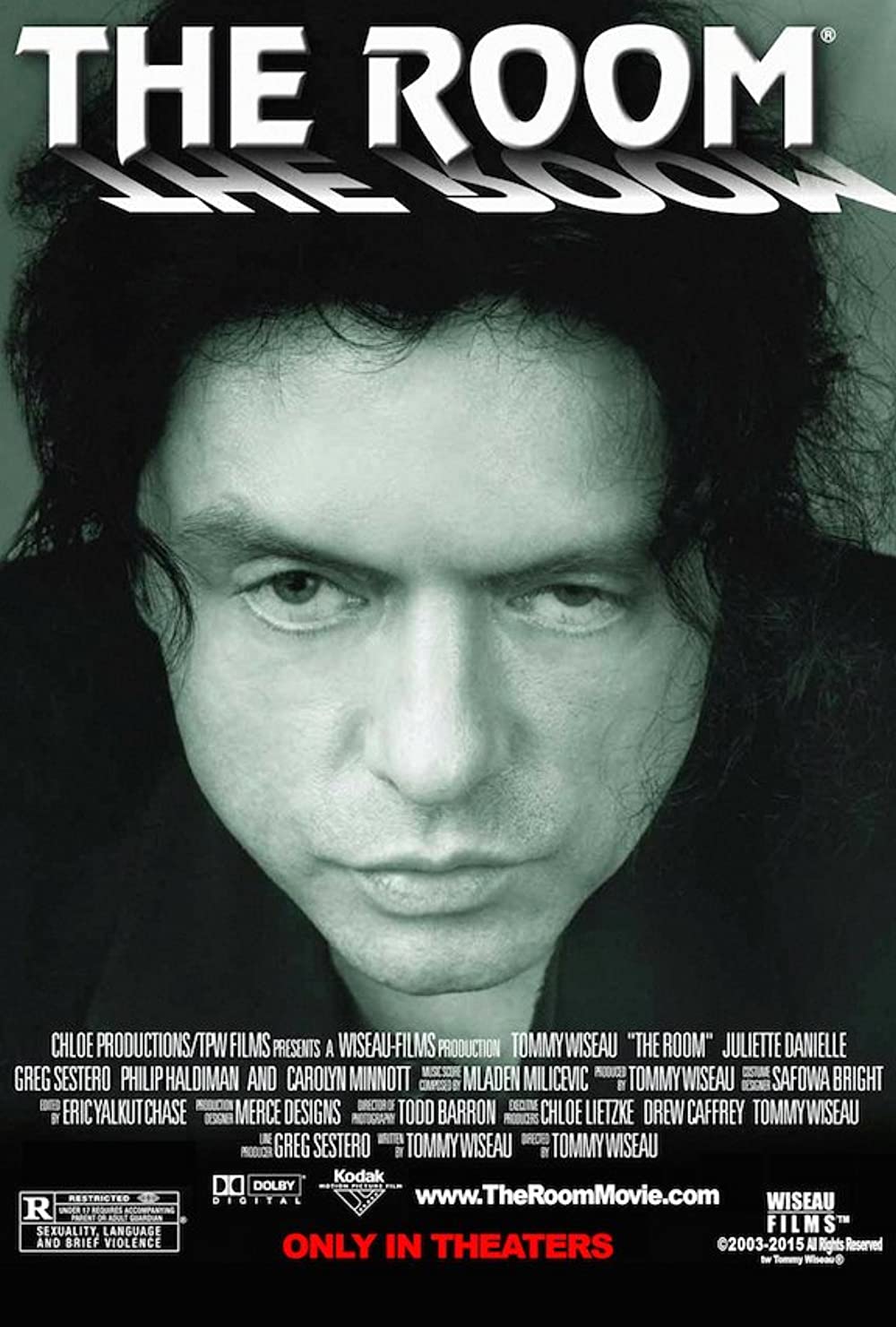
Wiseau, whose name is plastered over the opening credits, stars as Johnny, a man who is expecting to receive a big promotion at work and is madly in love with his girlfriend Lisa (Juliette Danielle). But at the same time, Lisa is having a torrid affair with Johnny’s best friend, Mark (Greg Sestero, who I went to junior high school with, believe it or not), and this leads to inadvertently hilarious sex scenes which almost had me believing Wiseau and company were actually trying to sell “The Room” to Cinemax as opposed to a major Hollywood studio. Let’s face it, these “love-making: scenes are so ridiculously staged and choreographed to where they make the average episodes of “Red Shoe Diaries” and “Beverly Hills Bordello” rise to the level of high art. Watching Wiseau and Sestero make out with Lisa also reminded me of what Robin Williams once said:

“Men can’t fake orgasms! Who wants to look that dumb?”

Into this tragic love triangle comes a variety of characters, many of whom forget to close the door to Johnny and Lisa’s apartment upon entering it. There is Lisa’s mother, Claudette (Carolyn Minnott), who is far more concerned with her daughter marrying Johnny for financial security than she is in her recent breast cancer diagnosis. Then there’s Denny (Philip Haldiman), a young college student who is supported financially and emotionally by Johnny and is quite smitten with Lisa (who isn’t?). And let us not leave out Michelle (Robyn Paris) and Mike (Scott Holmes), the couple whose love for chocolate provides this movie with its “9 ½ Weeks” moment.

What can I tell you? “The Room” is filled with gloriously hammy acting and terrible one-note performances. Certain scenes are clearly shot in front of a green screen, and many images of San Francisco float cross the screen for the sake of making this movie look like it takes place in more than one room. Certain camera moves look to be shot on a tripod in need of some serious tightening, and the movie suffers from a terrible editing job as scenes feel as though they are put into the wrong place. To all aspiring filmmakers out there, you may fear your debut feature will look a cinematic abomination, but whatever happens, there is no doubt it will look far more professional than Wiseau gave us here.

And yet, as terrible as “The Room” is, watching it provided me with the most enjoyable times I have ever had at a movie theater. I haven’t laughed this hard at a motion picture since “Deadpool 2,” and unintentional hilarity hasn’t felt this inspired for me since “Troll 2” or Tyler Perry’s “The Single Mom’s Club.” Any film which has me laughing so hard to where I get lightheaded and almost pass out will always hold a special place in my heart, and this one is honestly no exception.

Granted, there are many movies out there which are truly awful, but the worst are usually multi-millionaire dollar feature films which are made with nothing more than the thought of a potential franchise that can keep the money train rolling in for years. Those ones end up having more money spent on promotion than on the actual movie, and what we get is an overhyped event where the anticipation proves to be more exciting than the final cut. Those are movies made without heart, and it shows in an inescapably depressing way.

When it comes to “The Room,” however, it is a movie made with a lot of heart but not a lot of thought, and it shows its heart right on its sleeve without any shame. The screenplay introduces us to far too many characters it can possibly deal with, and several subplots are never brought to a satisfactory conclusion. All of this reminds me of one of my favorite guilty pleasures, “Star Trek V: The Final Frontier” which has many of the same problems but had a slightly higher budget regardless.

Wiseau remains an enigma years after “The Room” was released as many wonder about his past and present. He certainly has an unusual look which some might scoff at, but to others it shows a life lived long and hard. Regardless, his line readings of dialogue are ever so memorable even if they show how he emotes more than acts. “You’re tearing me apart Lisa” will never sound the same when uttered by another individual, and another’s denial of not hitting another will sound hollow in comparison. While harsh criticism is needed in situations like these, they are not worth the trouble here as they would simply take away from our enjoyment of this cinematic spectacle, regardless of how poorly realized it may be.

A lot of people who aspire to make a movie many times do so to leave their mark on the world. Wiseau’s path in making “The Room” is not all that different from what Rudy Rae Moore aspired to do when he made his first “Dolemite” movie. While the finished result did not merit a single Oscar nomination, it left its mark on those who were quick to watch it. The same goes with Wiseau who wanted “The Room” to be an epic of sorts. Well, his work is epic alright, but not for reasons he intended. Still, his film has given millions of moviegoers great joy even if it was of the unintentional kind. Perhaps making any kind of mark with a motion picture like that is better than letting it sink into the realm of streaming where it could easily get lost in an overcrowded cinematic ocean.

While Wiseau is in intent on making us believe he always meant for “The Room” to be a dark comedy, it is clear he wanted this film to be something else. But whatever the case, it is a memorable motion picture which will never be easily forgotten, and you don’t want anyone to forget what you did, you know? Besides, the term “male bonding” will never sound the same ever again.

One other thing; I was reminded of the following dialogue between Teasle and Trautman from “First Blood” in which they talked about capturing John Rambo:

Teasle: “Are you telling me that 200 of our men against your boy is a no-win situation for us?”

Trautman: “You send that many, don’t forget one thing.”

Teasle: “What?”

Trautman: “A good supply of body bags.”

Well, when it comes to “The Room,” I say don’t forget this: a good supply of plastic spoons!

WRITER’S NOTE: I am not going to bother giving this movie a star rating. Seriously, what’s the point?

No, I Haven’t Seen It Until Now: ‘Hardcore’ (1979)

Paul Schrader’s 1979 film “Hardcore” is one I have been meaning to watch for years. Many of my film friends have sung its praises, and I have been a big fan of Schrader’s work both as a screenwriter (“Taxi Driver”) and as a director (“First Reformed” and “Patty Hearst” among others). Regardless, this quickly became one of the many films I kept promising myself I would watch but never got around to it. But then one evening, I saw it was playing at the Nuart Theatre in West Los Angeles, and I realized the time had come to finally give it a look. Besides, this might be my only chance to see it on the silver screen.

“Hardcore” opens up on Christmas in Grand Rapids, Michigan to the tune of Susan Raye’s “Precious Memories.” Schrader quickly settles us into the peaceful and family-oriented environment which looks to be filled with church-going people who love and fear God in equal measure. You just might mistake it for the average Norman Rockwell painting which often gave us images that were all too wholesome to be believed. Everything looks to be together on the same page while singing faith-based songs and sharing in traditional ceremonies without question. Of course, it’s scenes like these that make me wonder when the cracks in this atmosphere will begin to show.

The main character of this piece is Jake Van Dorn (played by George C. Scott), a well-to-do businessman with strong religious beliefs. Originally, this part almost went to Warren Beatty, but as great an actor as Beatty, he would have been wrong. Scott is perfectly cast as he has the face of someone with deeply held beliefs to where questioning them could be hazardous to your health. Eventually, you know these beliefs will be tested in the extreme as the title “Hardcore” refers to more than the sexuality on display here.

Jake’s peaceful existence becomes undone when his daughter Kristen (Ilah Davis) goes missing while on a church-sponsored trip in California. He enlists the help of the police, but after seeing all the photos on the wall of missing children, some of who still haven’t been found in years, he decides to hire a private investigator named Andy Mast (Peter Boyle) to dig a little deeper. But what Andy finds is something Jake never could have expected nor be the least prepared to deal with.

Watching Jake view a porno film in which his daughter Kristen is having sex with two men is an unnerving scene as Scott portrays a deep shock and grief which illustrates the living nightmare any parent would be thrilled to avoid. While it threatens to contain, as Ralph Garman and Kevin Smith would call it, “exquisite acting,” and the scene has become an infamous meme for many, I am curious as to what depths Scott dug to capture such an unforgettable moment of devastation. Such a scene is impossible to erase from the memory once it is viewed, and it comes to inform the relentlessness and anger he will come to experience up to the movie’s end.

From there, Jake ventures into the seedy underworld of Los Angeles, or the one which existed back in the 1970s. Like “Taxi Driver’s” Travis Bickle, he is “God’s Lonely Man” as he ventures into a place he does not belong. His brother-in-law tells him early on that God is testing him, and it is clearly the case as ventures deeper and deeper into the city’s sleazy subculture where there are an endless number of sex shopkeepers, adult theaters, and massage parlors that do more for their clients than a simple rub down. At one point, he even disguises himself as a pornography producer in an increasingly desperate effort to find his daughter, and I kept wondering if and when he might give in to temptation.

“Hardcore” was Schrader’s second film as a director, following his brilliant debut with “Blue Collar.” As with “Blue Collar,” he had quite the time wrangling his cast. Scott was said to have not gotten along with Schrader, and at one point promised the director he would finish the film only if he vowed never to direct another motion picture ever again. Well, we know Schrader promised Scott just that to get him back on set, but thank God the filmmaker never followed through on his word. This is just as well as we still had other films like “American Gigolo,” “Cat People,” “Light Sleeper” and “Affliction” to look forward to.

Indeed, this is a film that could have been upstaged by its behind-the-scenes drama which, in addition to Scott’s behavior, included an ending forced on Schrader by the studio. Indeed, the ending is “Hardcore’s” biggest flaw as it doesn’t jibe well with all which came before it, and it feels lazily staged with a shootout that feels tacked on above all else. It is thanks to Scott’s performance in the final moments that I am willing to forgive the conclusion as he keeps it from ringing completely hollow.

Still, I think “Hardcore” is a triumph for Schrader as it allows him to dig deep into themes he has explored in his many works such as the conflict between man and immorality. Moreover, there is authenticity on display here which would be hard to find today as Schrader managed to gain access to real-life sex houses and adult theaters to where there is no doubt we are dealing with the real thing and not just some cheap set. Certain sticky stains on the windows make this abundantly clear by the way.

Looking at the credits, Schrader had quite the crew to work with. The film was executive produced by John Milius who remains one of the best screenwriters ever, the score was by Jack Nitzsche who helps add even more of a lurid feeling to the sights Jake is forced to take in, and the cinematography was by Michael Chapman who performed visual wonders on both “Taxi Driver” and “Raging Bull.” Seriously, the color palette Chapman uses here aids the story considerably, and I cannot help but believe it greatly influenced the later works of Gaspar Noe and Benoit Debie.

I enjoyed Peter Boyle’s performance as private detective Andy Mast as he makes this character look all too comfortable in a city that thrives on decadence than what might appear on the surface. Even as Andy gives in to his baser needs and desires, he knows how the story is going to end and makes very few apologies for who he is. While the ending feels a bit too similar to the one from “Chinatown,” Boyle makes it work as his dialogue rings very true in a cynical and sad way.

But another performance worth singling out here is Season Hubley’s as Niki, a prostitute and part-time adult actress who aids Jake in his search. The scenes she has with Scott represent the best “Hardcore” has to offer as their dialogue regarding both sex and religion illustrates their differences and similarities in ways only Schrader could have pulled off. She fully inhabits this character to where I never doubted how much of a survivor Niki was and will continue to long after the end credits have finished.

Like William Friedkin’s “Cruising,” “Hardcore” is a journey into a subculture that no longer exists in today’s world. These days, it is much easier to gain access to pornography through the internet, and it makes me wonder how Jake would deal with a similar situation in today’s world. Things would be a bit easier to trace, and that’s even though some lost children might forever stay lost (please feel free to prove me wrong on this). As devoutly religious as Jake is, I imagine in a time where the world wide web and cell phones control our lives more than ever, he would most likely be more isolated and closed off from those around him than ever before.

“Hardcore” is indeed classic Paul Schrader even with its inescapable flaws, and I have no doubt “8MM,” the 1999 film directed by the late Joel Schumacher and written by Andrew Kevin Walker, would not have existed without it. “8MM” also pales in comparison to it by the way. I look at movies like these and wonder why studios won’t leave the filmmakers alone in making them. You know how dark the material was when you started funding the project, right? So why insult everyone’s intelligence by trying to make things a little less dark?

* * * ½ out of * * * *

‘Singin’ in the Rain’ Movie and 4K/Blu-ray Review

The following review was written by Ultimate Rabbit correspondent, Tony Farinella.

Even though “Singin’ in the Rain” is celebrating its 70th anniversary with this 4K release, in my 36 years on this planet, I have yet to see it until now. I was familiar with a few of the songs from the film, as they are part of cinema history, but I never sat down to view it from start to finish.  It’s better late than never!  That is the beauty of film: even if you think you have seen all of the classics out there, there is always one that slips through the cracks from time-to-time.  “Singin’ in the Rain” is one of the best 4K releases of this year so far with its vivid colors, lifelike images, and crystal-clear picture.  It is truly a treat to enjoy.

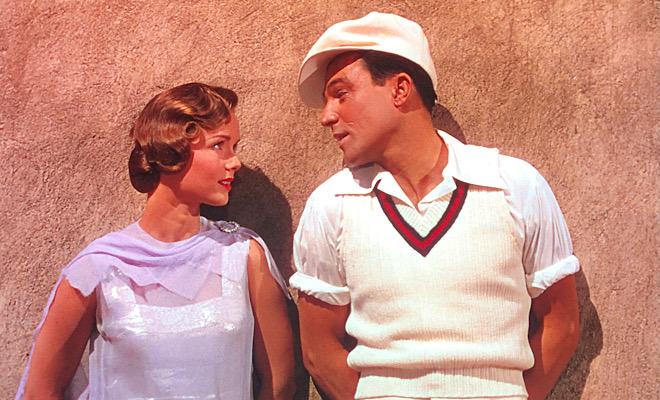
The film stars Gene Kelly as Don Lockwood, a Hollywood stuntman and hoofer.  He is quite popular in silent films and lives by the motto, “Dignity. Always dignity.”  It’s appropriate for his performance in this film, as it’s dignified and classy.  You can’t keep your eyes off him whether he is dancing, singing, or acting.  He has the “it” factor on screen in this film. He was also the co-director on the film along with Stanley Donen. Don’s leading lady, Lina Lamont (Jean Hagen) is the complete opposite of him as she’s superficial, selfish and rude throughout their time together.  Monumental Pictures, the studio behind Lockwood and Lamont, tries to put out this image of the two of them together as a happy couple in order to better increase the gate on their films together.

Don, on the other hand, sees right through Lina and tries to distance himself from her as much as possible. Don’s best friend is Cosmo Brown, played brilliantly by Donald O’Connor. He’s always there to listen, come up with ideas for Don and support him.  He understands why Don has to get as far away as possible from Lina at times.  It causes him to jump into the car of Kathy Selden (Debbie Reynolds), a stage actress who doesn’t think too highly of the movies Don Lockwood is putting out there.  She is there to tell him the truth about exactly what she thinks of him, which opens up Don’s eyes, as he’s used to people telling him how great he is all the time. He sees she is talented and smart, and he quickly takes a liking to her.

With the success of “The Jazz Singer,” talking pictures are becoming more and more popular in Hollywood.  This puts Lamont and Lockwood in a position where they have to learn a new way of doing things. Don is a natural and is also willing to put in the work to adapt to the new way of Hollywood.  Lina, on the other hand, has a voice which is rough on the ears.  However, people are used to seeing the two of them in films together.  Because of this, Cosmo comes up with the idea of dubbing over Lina’s lines with Kathy’s voice in an upcoming musical.  This idea is spawned after the public laughs at a screening when they hear Lina’s voice and mistakes throughout one of their films.

Kathy and Don start to become closer and closer, which does not make Lina happy at all.  She is still unwilling to see her flaws or work on her craft to get better.  Kathy, on the other hand, is immensely skilled and talented.  I must admit I am not the biggest fan of musicals as it’s not one of my favorite genres.  The beauty of “Singin’ in the Rain” and why it’s a classic is the fact they know when to have music and dancing, but also know when to focus on the actors and give them the space they need to act and develop their characters.  When the musical numbers hit, they are out of this world.  The songs are memorable, and they will stay in your head after the film is over.  That is huge in a musical.

The dancing is also top-notch and terrific. There are certain scenes where they keep the camera on the actors dancing, and my eyes were glued to their movements and the poetry in which they were moving.  It was truly something to behold.  The amount of work, preparation, and time it took to pull this off is why people are still interested in watching this movie 70 years later.  It holds up incredibly well.  I’ve always been a fan of old-Hollywood.  The 50’s created some of the most iconic movies, and “Singin’ in the Rain” is up there.  I’m just disappointed it took me this long to check it out.  Now, I want to watch it again and again.

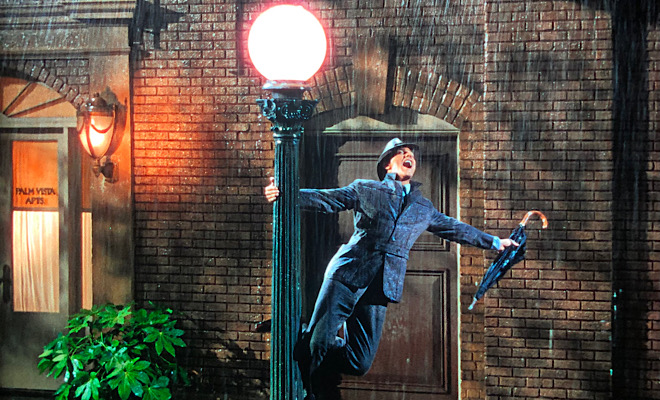
For me, the two stand-outs in the film are Gene Kelly and Debbie Reynolds.  Kelly has an effortless charm and is so darn likable.  He’s the perfect actor for this role.  Reynolds is elegant and pure class in her role.  As an audience member, I was really rooting for them to end up together. Of course, the “Singin’ in the Rain” moment is one even I was familiar with, even though I hadn’t seen the film.  It’s a gorgeous scene to watch and it just put a big smile on my face.  This film has it all: humor, romance, heart, love and great, great music. People will still be talking about “Singin’ in the Rain” 70 years from now.

* * * * out of * * * *

4K Info: “Singin’ in the Rain” is released on a two-disc combo pack from Warner Brothers Home Entertainment. It has a running time of 103 minutes and is rated G.  It comes with the 4K, Blu-ray and a digital code as well.

4K/Blu-ray Info: The film is released in 2160p High Definition, and it’s leading the way as one of the best 4K releases of 2022.  The film might be 70-years-old, but it looks incredible. With high dynamic range, you see every color come to life on screen.  This is a visual feast for the eyes.  As mentioned earlier, this film was made for 4K.  It is a huge improvement over the previous releases.

The Blu-ray comes in 1080p High Definition. The 4K comes with the following audio formats: DTS-HD MA: English 5.1, English Mono, Dolby Digital: French and Spanish. Subtitles are in English, French and Spanish. For the Blu-ray, it comes on DTS-HD MA: English 5.1 and Dolby Digital: French and Spanish. The subtitles are also in English, French, and Spanish.

Special Features:

Commentary by Debbie Reynolds, Donald O’Connor, Cyd Charisse, Kathleen Freeman, Stanley Donen, Betty Camden, Adolph Green, Baz Lurhmann and Rudy Behlmer

“Singin’ in the Rain:” Raining on a New Generation Documentary

Theatrical Trailer

Should You Buy It?

If you are a hardcore physical media collector like yours truly, this one is a no-brainer.  If you have seen the film before and don’t own it, it’s an even bigger no-brainer.  The one disappointment I always bring up with some of these 4K releases is they are still using previously released special features.  I know it’s a 70-year-old film, but I still think you can add a modern-day special feature with new interviews from film historians and actors to the 4K release instead of just recycling the old ones.  For the price point and the look of the film, Warner Brothers has knocked it out of the park with this 4K release.  It’s simply mesmerizing.  As far as the film itself, it’s one of the greatest of all-time for a reason.  If you own a 4K TV and player, this is the movie you need to buy right now.  You won’t be able to take your eyes off the screen.  This one comes highly recommended!

**Disclaimer** I received a 4K/Blu-ray copy of this film from Warner Brothers to review for free.  The opinions and statements in the review are mine and mine alone.

‘A Clockwork Orange’ Movie and 4K/Blu-ray Review

The following review was written by Ultimate Rabbit correspondent, Tony Farinella.

As a film lover and someone who considers themselves well-versed in the world of cinema, I’m sad to report this was my first-time watching “A Clockwork Orange.” I feel like no matter how many films you have seen, there are usually a dozen or so that have just slipped through the cracks. This is the 50th anniversary of this Stanley Kubrick classic and, as a first-time viewer, I can’t imagine the impact it had on viewers when it first came out. I know from reading up on it, it was quite controversial and misunderstood, but it ended up gaining a cult following. After watching it last night, I can’t wait to watch it again.  Kubrick is truly a genius when it comes to cinema. There is always so much happening in his films, but everything is happening for a specific purpose.

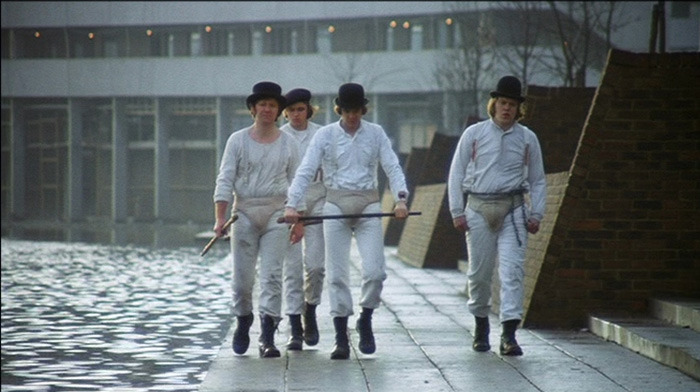
The first forty-five minutes or so of “A Clockwork Orange” are a little out there and a little frustrating from a narrative perspective. The film is set in a dystopian Britain where a group of young gang members run around terrorizing anyone who gets in their path. For example, when they run into a homeless man, they beat him up simply because they find it amusing and comical.  In another instance, they go out of their way to create chaos and havoc for a writer and his wife by attacking them in the middle of the night.  One night, this group of four young men takes it too far when one of their members, Alex (Malcolm McDowell) ends up killing a wealthy woman. His three fellow gang members leave him behind, the police catch him, and he is sentenced to fourteen years in prison.

The early part of “A Clockwork Orange” is not necessarily hard to watch as I’m used to movie violence, and it takes a lot to upset me or really get under my skin.  It’s more so that Alex and his “droogs” are unpleasant to spend time with, which I would venture to guess was Kubrick’s intent as a filmmaker. This film is based on the novel by Anthony Burgess. I think they could have trimmed out some of their antics in the film as, at times, it’s beating the audience over the head with violence and becomes repetitive and dull.  However, when Alex is sent to prison, it is when the film becomes really, really interesting and takes off.

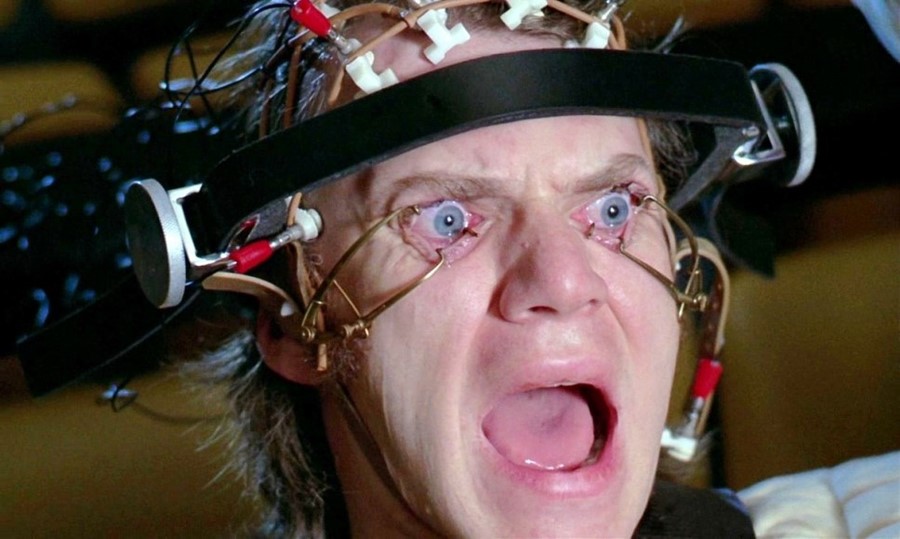
After being well-behaved in prison for two years, Alex hears about this experiment which allows someone to be cured almost instantly of their bad thoughts and impulses. They start to think and behave without any lust or violence.  The experiment exposes them to footage of violence, rape, and other heinous acts.  When they see this footage, they start to become sick.  Because of this, if they ever have the urge to misbehave again, it is quickly stopped because of how they feel after the aversion therapy.  The prison chaplain tries to warn Alex against it by telling him the good should come from inside of him and the choices he makes.

What happens from there makes for an incredibly thrilling and intense final act. The beauty of a Kubrick film is the details all around you that are happening in a scene.  For example, when Alex returns home, the way his house is shot is gorgeous.  Kubrick is never afraid to use colors and lots of them. He knows the beauty of imagery, color and scenery, and it makes the scenes much more effective. There is also his use of music.  I don’t think I’ll ever be able to listen to “Singing in the Rain” or anything from Beethoven again without thinking of this film. There is a purpose for everything in his films from a visual and audio standpoint.

I could go on and on about “A Clockwork Orange.”  The best praise I could give the film is that I want to watch it again and again.  Kubrick was a true visionary of cinema.  This film also has a lot to say about politics, drugs (think of the milk featured here), violence, sex, karma and so much more.  After I woke up today to write this review, the film was still in my head.  His films really stay with you and mess with your head in the best possible way.  On 4K, the brightness is taken to a whole new level.  I know I’m stating the obvious here, but Kubrick’s “A Clockwork Orange” is a masterpiece. I absolutely loved this film.  It’s a great reminder of how great movies will always stand the test of time, no matter when they were released.

* * * * out of * * * *

4K/Blu-Ray Info: “A Clockwork Orange” is released on a 4K/Blu-ray combo pack from Warner Brothers Home Entertainment. It comes with the 4K, Blu-ray, and also a digital copy of the film as well. It has a running time of 137 minutes and is rated R.

Video Info: The 4K of the film comes in 2160p Ultra High Definition with a ratio of 16×9 1.66:1.  If any film ever deserved the 4K treatment, it is “A Clockwork Orange.” I plan on watching the Blu-ray of the film at some point, but the high dynamic range and the colors are on full-display with the 4K.  The film is mesmerizing to watch on 4K. This is the reason why more and more people are getting 4K TV’s and players for films like this. They were made for 4K.  There is no other way to watch it at home. The Blu-ray of the film comes in 1080p High Definition with a ratio of 16×9 1.66:1.

Audio Info: The audio for the film is presented in DTS-HD MA: English 5.1, Dolby Digital: English, French and Spanish. Subtitles are in English, French, and Spanish as well. This applies to both the 4K and Blu-ray discs.

Special Features:

Commentary by Malcolm McDowell and Nick Redman

Still Tickin’: The Return of Clockwork Orange [2000 Channel 4 Documentary]

Great Bolshy Yarblockos! Making A Clockwork Orange

Turning Like Clockwork

Malcolm McDowell Looks Back

O Lucky Malcolm!

Should You Buy It?

According to the press release, the special features are the same released on the previous Blu-ray of the film, which is a bit of a bummer.  One would have hoped they would have done an updated version of the special features, especially with it being the 50th anniversary of this film.  If you haven’t seen “A Clockwork Orange” before, you are missing out! I can vouch for that.  This one is a no-brainer to add to your collection for the film itself and the visual aspects of 4K. 

This film is going to stay with me for a long, long time, and I get to watch it again on Blu-ray and 4K.  I can even watch it on my iPad because of the digital copy which comes with this combo pack.  However, as Spike Lee says, do the right thing and watch it on 4K. There will never be another director like Kubrick.  Kudos as well to Warner Brothers for their recent upgrades of classic films like “A Clockwork Orange” and “The Shawshank Redemption.” They are on a roll lately!

**Disclaimer** I received a Blu-ray copy of this film from Warner Brothers to review for free.  The opinions and statements in the review are mine and mine alone.