‘I Saw the Devil’ Serves Up Revenge at its Coldest and Most Brutal

I Saw the Devil movie poster

Many people will be quick to criticize “I Saw the Devil” as being excessively and unnecessarily violent. Indeed, it is an unrelentingly grim cinematic experience as we watch a serial killer chop up beautiful young women into little pieces and the boyfriend of one of them getting his revenge on the evil bastard. I’m guessing there will be a number of critics as well who will say Americans would never come up with such graphic depictions, but we know otherwise (“Saw” or “Hostel” anyone?).

But unlike other horror movies, “I Saw the Devil” does not exist to simply gross us out or make us uncomfortable as humanly possible. There’s a real story here amidst all the carnage about the hollowness of wanting revenge and of what it does to those who seek and get it. But Jee-woon Kim, the same man who directed “The Good, The Bad, The Weird,” has created a motion picture which finds brutally fresh new twists that keep us pinned to our seats for the entire two and a half hour running time. Yes, it is truly unrelenting.

The movie starts off with the beautiful Joo-yeon (Oh San-Ha) talking with her fiancé Soo-Hyun (Lee Byung-hun) on the phone while she is waiting in her car on a snowy road out in the middle of nowhere. Before you know it, a man by the name of Kyung-chul (Choi Min-sik) viciously attacks and knocks her out. Back at his grungy workshop, Joo-yeon begs for her life and tells Kyung-chul she is pregnant, but it does no good. Kyung-chul’s face is an enigma as you are not sure what he is feeling at the moment. You want to think he has some form of empathy in his rotten soul, but to him this is a luxury he cannot afford. Either way, it doesn’t stop him from chopping away at Joo-yeon with a rusty hatchet.

Upon finding her severed head in a nearby lake, Soo-Hyun, a special agent, vows to make her attacker feel the same exact pain he made his victims feel. From there, the movie turns into a cat and mouse game, and we begin to wonder which of them is the more vicious and violent. Unlike most American revenge thrillers where we can tell the hero apart from the bad guy, the line between them is hard at times to make out.

The first thing I want to say about “I Saw the Devil” is just how beautiful the cinematography by Lee Mo-gae is. It’s kind of a cross between the vivid colors of Dario Argento’s “Suspiria” and the immensely cold and snowy landscape of “Let the Right One In.” I’m guessing Kim Jee-woon and Lee Mo-gae were inspired by the filmmakers of both movies, and even he succeeds in finding a beauty amidst all the hideous carnage which goes on. The image of the snow proves to be a metaphor for how cold the soul of the two main characters are or have since become, and things grow colder for them all the way towards the movie’s messy climax.

In terms of acting, Choi Min-sik’s performance stands above everyone else’s here. Choi is best known for his amazing and unforgettable performance in Park Chan-wook’s “Oldboy.” Throughout the movie’s running time, he never tries to hide the fact his character of Kyung-chul is a pure psychopath and a manipulator of emotions he is unable to fully experience on his own. It’s a brave performance which doesn’t hold back anything, and it makes you wonder what depths the actor went to in playing such a twisted human being.

Lee Byung-hun also deserves points for bravery as the now fiancé-less Soo-Hyun. This is the character we most easily identify with here, but he soon becomes “I Saw the Devil’s” most tragic one as well. We can’t really blame him for wanting revenge and to torture this killer without a conscience, but as the movie goes on, we see how his quest for vengeance it is destroying whatever is left of his damaged soul. Lee makes us care about this man even as he becomes almost as depraved as Kyung-Chul. Even when he slices off a key part of Kyung’s body, we still follow him even if we are increasingly repelled by his actions. His conscience comes out in the form of Soo-Hyun’s family, but their sane take on the situation is not enough to pull him back from the abyss of hatred he is forever trapped in.

Make no mistake, “I Saw the Devil” is a seriously violent motion picture. It feels like forever since I’ve seen so much blood spurting out of the human body on the silver screen. I also can’t remember the last time a guillotine was used so predominantly in a movie either. All the same, like any great Argento movie, it’s rendered in the most beautiful cinematic fashion. This is not your average “Friday the 13th” sequel where things are thrown together in the cheapest way possible. The colors are vividly realized, making everything we see here all the more cinematically gruesome.

Once you get past the seemingly unending carnage, you will see how these two men pretty much deserve one another. “I Saw the Devil” is a strong character piece featuring people who, in any other movie, would be at opposite ends of the law-abiding spectrum, but who have more in common with one another than they initially realized. While a part of us wants to see this sick bastard suffer horribly, there’s another part slowly reminding us how we can suffer just as much in wanting an eye for an eye. It’s also full of twists and turns you cannot see coming, and none of them seems convoluted in the slightest. The movie is full of surprises, many of them incredibly grim. If you thought “Harry Brown” was dark, this will redefine the term for you.

Now look, I am not saying it is bad to like revenge/retribution movies. Lord knows we need them every once in a while in order to exercise the parts of our psyche which are hopefully ruled over by common sense. But sometimes we need a cinematic reminder of how wrong it can be to get what you wish for. Gaspar Noe’s “Irreversible” was one of the harshest examples of this, and “I Saw the Devil” is not far behind.
* * * * out of * * * *

John Carpenter’s ‘The Fog’ Covers the Coastal Towns Again in a Beautiful 4K Restoration


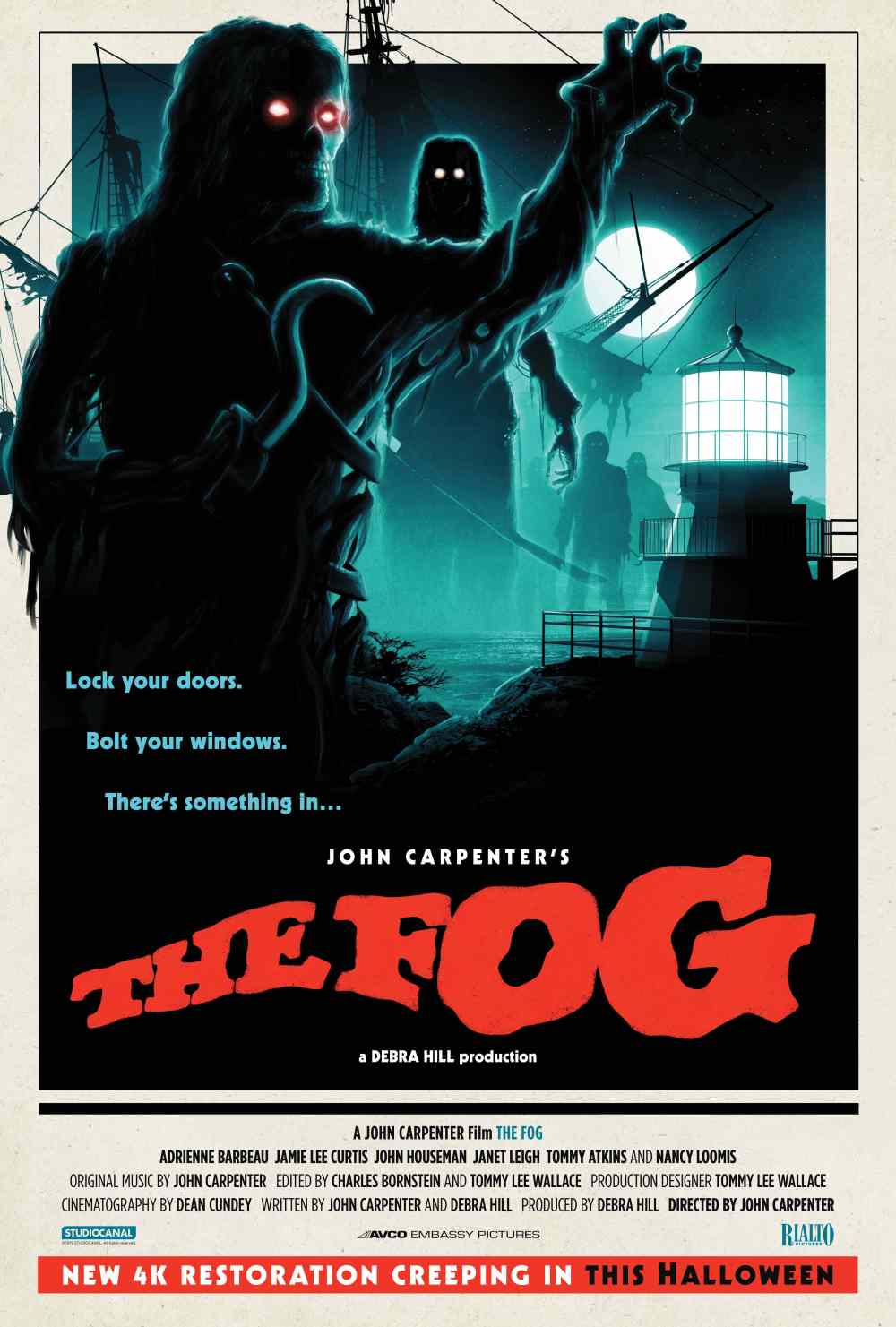
The Fog 4K Restoration posterThe Fog” remains one of my favorite John Carpenter movies. Every time a fog bank appears in whatever town I happen to be in, I immediately put on his score to the film and start playing its theme song. Like Alfred Hitchcock’s “The Birds,” “The Fog” is, for me, one of the most iconic Northern California horror movies ever made as it captures the beauty of coast near Bodega Bay and beyond while enthralling you with a number of terrifying images.

Rialto Pictures has now released a 4K restoration of “The Fog,” and seeing it again on the big screen proves to be a real treat. Granted, this Carpenter movie has been restored previously for the special edition MGM DVD and Shout Factory’s Blu-ray collector’s edition, and the results were truly astonishing. But just when I thought the image couldn’t be improved upon any further, along comes this restoration which looks truly pristine and clear to where the image, if you’ll excuse the expression, isn’t as foggy as it once was.

“The Fog” takes place in the coastal town of Antonio Bay which is about to celebrate the 100th anniversary of its formation, but we soon discover it was actually built on blood and theft. Father Malone (the great Hal Holbrook) discovers a diary hidden in the walls of his church written by his grandfather, and it tells of how he and five of the town’s founders deliberately plundered and sunk a clipper ship named the Elizabeth Dane. The owner of the ship was Blake, a wealthy man looking to establish a leper colony, but he and his crew ended up being murdered, and the gold found on their ship was used to build the town and its church.

Now Blake and his crew are back to get their revenge against the offspring of the town’s founders and retrieve their gold. Once you are surrounded by the fog to where Blake and his crew have you in their sights, it is too late to escape. There is a Klingon proverb which tells of how revenge is a dish best served cold, and it is served here very coldly to where we are quickly reminded of the movie’s tagline:

“It won’t hurt you. IT’LL KILL YOU.”

Watching “The Fog” for the umpteenth time, I am reminded of what a brilliant cinematographer Dean Cundey is as his lighting helps to make the movie’s central nemesis all the more mysterious and devilishly suffocating. The dark of the night is made to look especially chilling as things constantly leap out of it, and Blake and his crew are largely kept in the shadows as neither Cundey or Carpenter want to reveal too much of the monster to the audience.

This was Carpenter’s and the late Debra Hill’s first movie after “Halloween,” and I can understand why audiences felt a little let down by “The Fog” when it arrived in theaters. The anticipation for something usually ends up being more exciting than the finished product as our minds are filled with the possibilities of what we think will end up on the silver screen, but not everything comes out the way we want it to. It’s an unfair obstacle that filmmakers often have to deal with when following up such a successful motion picture, and sometimes we need to revisit certain movies like these years later to give them a much-needed reassessment.

More than 30 years have passed since Carpenter’s “The Fog” was released, and I like to think it has gotten better over time. In terms of atmospheric horror movies, I see it as one of the best. Those low-flying clouds are always a fascinating sight as well as a scary one. When the visibility is practically zero, you cannot help but feel trapped in the fog as it makes you believe the world has cut you off. Carpenter captures this feeling here as the fog proves to be thick and infinitely suffocating. There’s no escaping it or what is inside of it as those not smart enough to run away from it are almost deserving of the fate about to greet them.

Carpenter assembled a terrific cast of actors for “The Fog,” many of whom became regulars in his later movies. John Houseman gets things off to a chilling start as he recounts the story of the Elizabeth Dane in a way which feels vivid and probably helped the producers save money to where an actual recreation of the event he talks about proved completely unnecessary. Houseman was a brilliant actor who somehow managed to walk the line of doing work for either the love of the theatre or instead a nice paycheck, and I like to believe he did “The Fog” for the former. Still, I am often reminded of what the late Robin Williams said about the advice Houseman gave him while he was a student at Julliard:

“The theatre needs you. I’m going off to sell Volvos.”

Tom Atkins co-stars as town resident Nick Castle (lol) who is quick to pick up hitchhiker Elizabeth Solley (Jamie Lee Curtis) and later have sex with her before asking the question often heard in movies of the late 70’s and early 80’s, “What’s your name?” Atkins showed what a confident lady’s man he was here, and he later built on this confidence to terrific and hilarious effect in “Halloween III: Season of the Witch.”

“The Fog” also marked the film debut of Adrienne Barbeau, and the camera loves her here. As single mom and local radio disc jockey Stevie Wayne, Barbeau gives this Carpenter movie the strong female character it needs and deserves. Stevie is not a person to back down from danger and, like Laurie Strode, she is very observant of everything going on around her. When Barbeau’s voice is giving you more than enough of a reason to listen to jazz music on a regular basis, she keeps you on the edge of your seat as she fends off the bloodthirsty mariners hiding in the fog in ways her male counterparts fail to.

And, of course, I have to mention Carpenter’s score as I remain as big a fan of his music as I do of his movies. His main theme for “The Fog” is one of his most memorable as it has the same rapid pace of his “Halloween” theme. The musical stings pack a wallop in certain scenes where ghostly hands reach out of the fog to grab at unsuspecting victims who think this is the work of kids, and his other big theme in “The Fog” is “Reel 9” which brings the movie to its riveting climax in which the mariners close in on the townspeople who have no place to escape certain death.

Carpenter has described “The Fog” as being one of his least favorite movies as its initial cut proved to be very disappointing, and he had to reshoot and rescore much of it before its release. Whatever the case, it is a wonderfully atmospheric horror movie which stands among his finest works, and watching this 4K restoration of it reminds one of why certain movies play best on the silver screen.

It’s also fun to watch a movie made back in the pre-digital age when cell phones and GPS were not around to save our heroes. Instead, they had to deal with landlines, a desperate DJ and the limits of technology. After watching “The Fog” again in this day and age, I kept waiting for one of the characters to say the following:

“It’s just you, me, and my Thomas Guide.”

* * * * out of * * * *

‘Bohemian Rhapsody’ Takes Us Back to When Queen was King

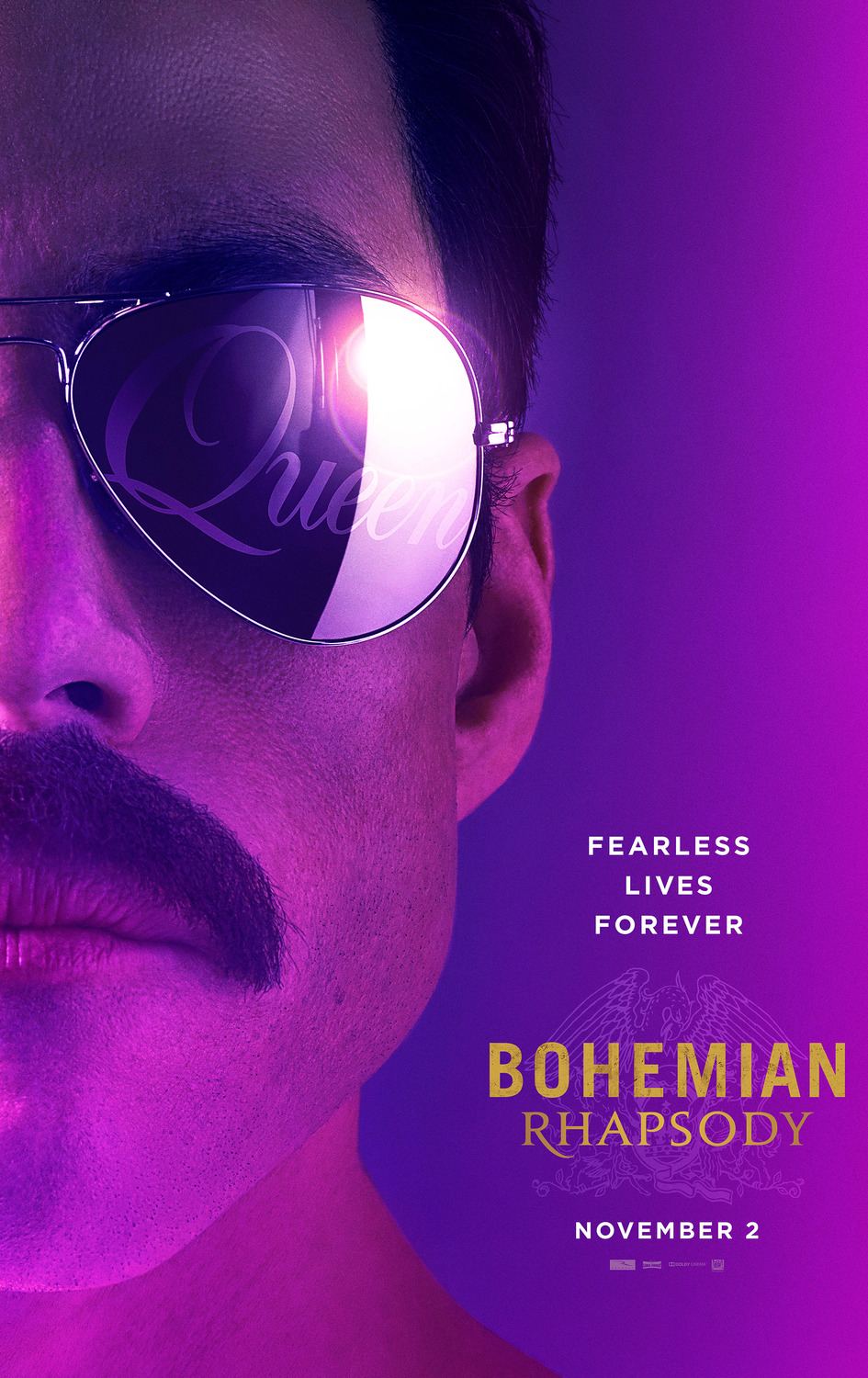
Bohemian Rhapsody poster

Many will say this in their reviews of “Bohemian Rhapsody,” and I have to as well: Freddie Mercury was a one-of-a-kind performer. Whenever he was onstage, he had a commanding presence only a handful of artists could ever hope to equal. Nothing seemed to ever hold him back as he rocked us in a way few others, if any, ever could. Watching him and Queen perform in front of thousands of fans also had a cinematic quality to it, and I went into this biopic hoping Bryan Singer (and Dexter Fletcher who replaced him as director) could capture the exhilaration of their live performances. Could such a thing even be possible?

Well, right from the start when Queen performs their own kick-ass version of the 20th Century Fox fanfare, “Bohemian Rhapsody” proves to be an exhilarating ride. While there were times when I thought the filmmakers could have dug even deeper into Freddie’s life and the lives of his fellow bandmates, Brian May, Roger Taylor and John Deacon, it proves to be a biopic which takes you back in time to when Queen was the biggest thing in music, let alone in the world. But at its center is an iconic singer who is on a long journey not to stardom, but finding respect for himself.

When we first meet Freddie, we learn his birth name was Farrokh Bulsara and that he was the child of a Parsis couple, something I was previously unaware of. His mother Jer (Meneka Das) proves to be a loving presence, but his father Bomi (Ace Bhatti) doesn’t even try to hide his disappointment over the lackadaisical way in which his son lives his life. By day he works as a baggage handler at Heathrow Airport, and he spends his nights at a local club where a band named Smile performs to an enthusiastic audience. When the lead singer quits, Freddie seizes the opportunity to grab the job, but Brian and Roger feel his overbite will easily upstage him. That is, of course, until they hear him sing.

“Bohemian Rhapsody” at times speeds through the history of Queen to where I wished they would slow down a bit and focus on bits and pieces which haven’t been covered as much in the past. I kept hoping there would be a sequence on the making of the “Flash Gordon” soundtrack, one of the best soundtracks ever. The filmmakers don’t even get around to dealing with the songs they did for “Highlander,” and that was a real bummer. Still, we get to learn about the beginnings of some of their most famous songs like “Another One Bites the Dust” which features one of the greatest bass lines in the history of music, and the immortal rock anthem that is “We Will Rock You.”

One of the movie’s centerpiece’s is the creation of the song “Bohemian Rhapsody” which allowed Queen, as the Beatles did with “Sgt. Pepper’s Lonely Hearts Club Band,” to push the boundaries of mainstream music to create something truly unique. This all leads to a scene where the exasperated EMI executive Ray Foster (a priceless Mike Myers) explains how no radio station is about to play a six-minute song, especially one which features opera in it. While it is seen as one of the greatest rock songs ever created, this doesn’t stop the filmmakers from throwing out initial reviews of it which showed anything but admiration. It’s only over time that something can ever be truly considered a classic.

Looking at Freddie’s life overall, it does seem deserving of an R-rating. But for a PG-13 movie, I felt “Bohemian Rhapsody” dug deep enough into the man’s life in ways I usually expect a PG-13 movie to avoid. Some may say this is a sanitized biopic, but I was surprised at how willing the filmmakers were to portray Freddie’s debauched lifestyle and of the underground worlds he chose to delve into. The scene in which Freddie learns he has AIDS is especially devastating, especially when scored to the song “Who Wants to Live Forever.” There is even video footage of people with AIDS, and seeing Freddie watching it is especially heartbreaking as it gives him a glimpse as to what is in store for him.

When it comes to music biopics, I keep thinking of ones like Oliver Stone’s “The Doors” and “I Saw the Light” and of how they kept their main subjects at a distance. This proved to be especially frustrating as I felt like I never got to know more about their main characters, Jim Morrison and Hank Williams, and even wondered why anyone would bother to spend time with them. “Bohemian Rhapsody” doesn’t make this same mistake nor does it hide from Freddie’s flamboyant lifestyle which alienated many of his closest friends. It’s not afraid to make the singer unlikable at times, but it also pays him the respect he deserves especially when he humbly reunites with his bandmates who, unlike other musicians, were never afraid to tell him no.

Rami Malek gives a truly phenomenal performance as Freddie Mercury. If you are still wondering what this movie would have been like had Sacha Baron Cohen not dropped out, Malek will silence those thoughts immediately. It’s as if the actor is possessed by Freddie’s spirit as he inhabits the role with a fearlessness and a gusto to where it is impossible to think of someone who could have been better suited to play the lead singer of Queen. Malek owns the movie from start to finish, and you can’t take your eyes off of him.

Malek also does a brilliant job of letting you see Freddie’s inner turmoil as he struggles with who he is and his sexuality. In many ways Freddie was a social outcast before he came to be the lead singer of Queen, but he becomes even more of an outcast at the height of his fame. Seeing him in almost near isolation from the rest of humanity is distressing, and it reminds me of what the late Robin Williams said in “World’s Greatest Dad:”

“I used to think the worst thing in life was to end up all alone. It’s not. The worst thing in life is ending up with people who make you feel all alone.”

Kudos also goes out to Lucy Boynton who proves to be a fetching presence as the love of Freddie’s life, Mary Austin. Boynton, whom you may remember from “Murder on the Orient Express,” makes you believe how Mary was a huge lifeline to Freddie, especially when he became deluded and was ruthlessly manipulated by those who never had his best interests at heart. Even as their loving relationship was torn apart, they remained the best of friends, and I believe Freddie when he was quoted as saying how Mary was really his one true friend in the world.

But if you need only one reason to buy a ticket to “Bohemian Rhapsody,” it is Singer’s (and Fletcher’s) recreation of Queen’s epic performance at Live Aid in 1985. I’m sure you have all seen footage of this concert on YouTube, but I was enthralled at how the filmmakers made us feel like we were right there in Wembley Stadium where the band played to the largest crowd any band could ever play to. This recreation proves to be one of the most exhilarating sequences I have seen in any 2018 movie, and it is the perfect way to cap off this biopic.

Could a better movie have been made about Freddie Mercury and Queen? Perhaps, but I find it tiring to think of what could have been and would much rather deal with what ended up on the silver screen. “Bohemian Rhapsody” proved to be an immersive cinematic ride which brings back to life an amazing performer who left the land of the living far too soon, but whose role in music history will never ever be forgotten.

Regardless of who deserves the most credit, we owe Dexter Fletcher many thanks as he managed to bring this chaotic production to the finish line and oversaw it during post-production. Without him, I wonder if this movie would have ever been completed.

* * * ½ out of * * * *

David Gordon Green’s ‘Halloween’ is the Sequel We Have Been Waiting For

Halloween 2018 theatrical poster

Why do filmmakers constantly insist on doing a retcon of the “Halloween” franchise? Every once in a while, the continuity of the series is tossed to the wayside, usually for profit and greed, but perhaps deep down there are those out there who remain infinitely eager for another and more fulfilling showdown between Laurie Strode and Michael Myers. We thought we got it in 1981’s “Halloween II,” but even Michael couldn’t stay down after being burned beyond recognition. Then there was “Halloween H2O: 20 Years Later,” but that was really a “Scream” movie disguised as a “Halloween” movie, and what resulted did not feel particularly compelling.

But just when you thought it was time to lay this long-running franchise to rest, along comes the simply titled “Halloween” which wipes the slate clean to give us the true sequel fans of the series have been waiting 40 years for. Once again, Michael Myers breaks free and heads back to Haddonfield, Illinois for a bloody homecoming. But this time, Laurie Strode is ready and waiting, and she is not about to take any prisoners. As this “Halloween” unfolds, you will see what Sylvester Stallone meant when he said, while in pursuit of Wesley Snipes in “Demotion Man:”

“Send a maniac to catch a maniac.”

In this alternate timeline, Michael did not escape at the end of John Carpenter’s “Halloween,” but was instead captured and sent back to Smith’s Grove Sanitarium and has remained there for the last 40 years. His latest psychiatrist, Dr. Ranbir Sartain (Haluk Bilginer), insists Michael can talk but chooses not to, but this doesn’t stop a pair of true-crime podcasters, Aaron Korey (Jefferson Hall) and Dana Haines (Rhian Rees), from trying to make him say something, anything. But once Aaron pulls Michael’s old mask out of his bag, we know it won’t be long before they are reminded of what curiosity did to the cat.

This particular “Halloween” was directed by David Gordon Green and co-written by him, Jeff Fradley and actor Danny McBride, and the respect they have for Carpenter’s 1978 horror classic is on display throughout. They even bring back the serif font from the original’s credits as they are determined to make us accept this is a direct sequel to the one which started it all. I admired how the credits started off with a pumpkin which looks to have been stomped on one too many times and which reforms slowly but surely. It’s almost like a metaphor for this franchise as many continue to resurrect Michael, or “The Shape” as he is often referred to, with varying results.

Green is one of those filmmakers who can go from making independent films like “All the Real Girls” and “Joe” to more mainstream fare such as “Pineapple Express” and “Stronger” with relative ease. With his “Halloween,” he gives a slow-burn thriller which thankfully doesn’t peak too soon. Many horror movies give us their best moments far too early these days, so it’s nice to see Green not making this same mistake here as he gives us a deeply suspenseful thriller which builds up and up to its much-anticipated climax.

I also have to give Green and his collaborators credit for giving us characters we care about. It is impossible not to relate to them in one way or another as we remember having their same needs and desires when we were their age. Many of the “Friday the 13th” sequels kept giving us characters we couldn’t wait to see get killed off as we were made to hate them, but when the residents of Haddonfield are killed off, you cannot help but feel for them, and not just because they never got the chance to lose their virginity.

The real big news, however, about this “Halloween” is John Carpenter is back. It marks his return to the franchise he created for the first time since “Halloween III: Season of the Witch.” I imagine money was a big motivating factor, but I do believe Carpenter when he said how enthusiastic he was about Green and McBride’s pitch for this movie. In addition to acting as executive producer, Carpenter also scored the movie along with his son Cody Carpenter and Daniel Davies, and they give the brutal proceedings here an extra hard kick in the ass (click here to check out my review of the soundtrack).

But let’s face facts, the real star of this “Halloween” movie is Laurie Strode. Jamie Lee Curtis returns to her iconic role with a real vengeance, and she plays Laurie to the hilt in this installment. When Curtis first played Laurie, she was a kind, shy and innocent young woman. 40 years later, Laurie is a shell of her former self as her life has been severely undone by PTSD, alcoholism and agoraphobia. She has spent the past few decades training to be a survivalist as her life is now dedicated to removing Michael from the face of the earth, and it has all come at the expense of caring for her own family.

Curtis has always put in a great performance in each movie she appears in, be it a good or a bad one, but she really hits it out of the park here. She succeeds in turning Laurie Strode into a bad ass warrior who is never determined to suffer in the same way she did before, and at times she threatens to be more frightening than Michael herself. Just check out the scene when Laurie breaks into her daughter Karen’s (Judy Greer) house and reminds her bluntly of how unprepared she is for the oncoming slaughter.

Moreover, Curtis really makes us sympathize with Laurie Strode throughout. We know all what she has been through, and to see the effect it has on those closest to her is heartbreaking. We learn she has been divorced twice, and her daughter Karen wants little to do with her and constantly begs her to get help. Even when Laurie absent-mindedly takes a drink from a glass of wine like as it it were was an automatic impulse, we feel for her as no one can see Michael Myers as being the embodiment of pure evil the way she can.

Watching Curtis as Laurie here quickly reminded me of a line the late Natasha Richardson said in “Patty Hearst:”

“I finally realized what my crime was, I lived. Big mistake. Very messy.”

The cast overall does really good work, and they are made of very likable and dependable actors which include Judy Greer and Will Patton who make their characters seem very down to earth in a way you want them to be. One real standout here is Andi Matichak who plays Allyson, Laurie’s granddaughter and the only one capable of having a meaningful relationship with her. Matichak proves to be a very appealing presence here, and she makes Allyson into a strong and defiant young woman who is not about to suffer fools in the slightest.

As “Halloween” builds up to its inevitable climax, Green keeps increasing the tension throughout. He smartly leaves Michael in the shadows, and you can’t help but wondering when he is going to jump out next. Green also leaves you wondering if we might actually see Michael’s face or even hear him speak. Does he? Wouldn’t you like to know?

This “Halloween” is not at all groundbreaking, but then again neither was Carpenter’s film. The 1978 “Halloween” owed a lot to the works of Alfred Hitchcock among others, but it also managed to give a freshness to the horror genre in the same way “Psycho” did years before. With any “Halloween” follow-up, we can only hope for it to be as good, if not better, than the original. There’s no way you can top what Carpenter pulled off 40 years ago as none of us saw Michael Myers coming. But with this “Halloween,” we get the true sequel the original never quite received, and it proves to be well worth the wait.

There is also something very cathartic about watching this one in the midst of the #MeToo movement. Essentially, we are watching a woman take revenge on a man who thoughtlessly ruined her life years before, and seeing her do battle with him makes this “Halloween” especially thrilling. Lord knows women have been forced to be silent for far too long, so seeing one get her revenge feels much, much overdue.

By the way, I think I’m going to start calling this one “Halloween: 40 is the New 20.” It seems appropriate, don’t you think?

* * * ½ out of * * * *

WRITER’S NOTE: A lot of people have been getting mad at Jamie Lee Curtis recently. We see her wielding many different weapons and firearms in this movie as Laurie Strode, but some have been quick to call her a hypocrite for doing so as her stance on gun control and the need for it has been well-documented. Why is she appearing in this movie armed to the hilt and yet complaining about gun violence in real life? Ladies and gentlemen, what Curtis is doing in this movie is called ACTING. SHE IS PLAYING A CHARACTER. Whatever happened to make believe anyway? Not all actors are out to put their political issues into each movie they do. Do yourself and everyone else a favor and stop blurring the line between fiction and non-fiction. That is all.

‘Bad Times at the El Royale’ Invites You to Peel Back its Many Layers

Bad Times at the El Royale poster

Bad Times at the El Royale” is one of those movies I have really come to deeply admire as it is like an onion you keep peeling at continually to see what’s underneath. Just when I thought I knew where things were heading, the story heads in another direction to where what we were initially introduced to is not all what it seems. As Bo Diddley once sang, you can’t judge a book by looking at the cover, and while this movie’s poster tells us what we need to know before going into the theater, there is more to discover than we could ever anticipate.

The El Royale of the movie’s title is a hotel which, at one time, was one a glorious place to visit, but it has since fallen into disrepute. The first sequence shows a man entering a room there, digging beneath its surface to play a bag of money beneath it. He is later greeted by another man who he kindly welcomes in, but who quickly shoots him dead with a shotgun. It’s a wonderfully elaborate sequence which brings us into a motion picture which promises not to be the usual mainstream fare.

We then move to 10 years later when a number of visitors arrive at the El Royale to stay for a night or two. They include the kindly priest Father Daniel Flynn (Jeff Bridges), aspiring singer Darlene Sweet (Cynthia Erivo), vacuum cleaner salesman Dwight Broadbeck (Jon Hamm), and a young hippie named Emily Summerspring (Dakota Johnson). All of them are greeted by the hotel’s concierge and apparently its only employee, Miles Miller (Lewis Pullman), who gleefully illustrates the location’s history and amenities for all of those willing to hear him out.

Revealing more from here would spoil one too many surprises as we discover not everyone is who they appear to be, but I can tell you the characters soon find themselves on a road to hell as their sins rise to the surface for everyone around them to see. In one way or another, everyone is either trying to escape their past or reclaim it in a way which offers no promises, and not everyone is going to make it out of their predicament in one piece.

“Bad Times at the El Royale” was written and directed by Drew Goddard who wrote the screenplays for the highly-entertaining “Cloverfield,” “World War Z” and “The Martian,” the one Ridley Scott movie in recent years which we can all agree on (in that it was great). Goddard also wrote and directed the horror comedy “The Cabin in the Woods,” a movie I should have seen already, but anyway. He composes this movie in vignettes just as Quentin Tarantino composes his with chapters out of a novel. Each one allows us to learn more about the characters and what brought them to this once glorious resort. The question is, do they all know about the valuables buried beneath one of the rooms?

I enjoyed how Goddard kept peeling away at each of these characters’ identities as we learn more about them in ways which are both illuminating and shocking, and it kept me guessing as to where things were going to go next. There’s even a scene of shocking violence involving a wine bottle which just comes out of nowhere, and it slammed me back into my seat in a way such a scene has not in recent years.

The movie, however, does suffer as it goes on. You should have heard the collective gasp from the audience at the press screening I attended when they were told the running time would be two hours and 21 minutes. Most Hollywood studios these days would never dare to let one of their releases last more than 90 or 100 minutes, so the amount of freedom Goddard got here seems astonishing in retrospect.

I have nothing against movies which last over two hours as long as they are able to justify their length. It is far too easy for a filmmaker to become self-indulgent. In retrospect, “Bad Times at the El Royale” could have used some tightening in the editing room as the story slowly drags towards its conclusion which involves a charismatic cult leader named Billy Lee (Chris Hemsworth, taking a much-needed break from the Marvel Cinematic Universe) and his much-too devoted follower, Rose (the wonderfully possessed Cailee Spaeny). By the time we finally arrive at the ending, it feels like everything is concluding on the wrong note. This could have been an even more frustrating ending than the one in “The Matrix Revolutions,” but saying so is a little too punishing.

Still, there is much to admire here such as the cinematography by Seamus McGarvey, the terrific set and art direction and, of course, the great cast that tears into their roles with great gusto. Jeff Bridges continues to remain one of our finest actors as he inhabits his role of Father Daniel Flynn in a way few others could. Cynthia Erivo proves to have quite the vocal chops here as her singing left the audience I saw this movie with in almost total silence. Dakota Johnson, finally freed from those god-awful “Fifty Shades of Grey” movies, gets to show an enigmatic side of her acting that makes it clear how we have no business dismissing her as just another pretty face. As for Jon Hamm, he is as charming as ever, and watching him hustle the other characters almost effortlessly makes me believe he will be the next Batman.

“Bad Times at the El Royale” is a flawed movie, but for me, its strengths more than outweigh its weaknesses. I am curious to see how audiences end up reacting to this as it is coming out in a cinematic time dominated by superheroes. Goddard’s film definitely stands outside the norm, but my hope is audiences will take the time to discover something a little different from what they are used to.

Whatever you think of “Bad Times at the El Royale,” you have to admit it allows Jeff Bridges to utter one of the best lines of dialogue in recent years:

“Shit happens… Get the whiskey.”

* * * out of * * * *

Wes Craven’s ‘The Last House on The Left’ Remains a Highly Disturbing Cinematic Experience Years Later

The Last House on the Left 1972 poster

“To avoid fainting keep repeating,

It’s only a movie

…Only a movie

…Only a movie

…Only a movie”

Exploitation movies, or “video nasties” as they are called in certain countries, have a power most do not have. They shock even the most jaded and seasoned of movie fanatics, and they burn into your subconscious in a way which cannot be undone. A lot has been written about Wes Craven’s “Last House on The Left” and of the impact it had on audiences upon its release. Like Gaspar Noe’s “Irreversible,” it’s a movie I was bound to see at some point. Many would prefer to stay far away from movies like this, but I don’t want to be like everyone else. I don’t want to be put off watching a movie just because it shocks more than half the world. Who am I to talk or criticize a particular movie if I haven’t seen it anyway?

“The Last House on the Left” was Craven’s directorial debut, and he made it with future “Friday the 13th” director Sean S. Cunningham on a very low budget. While many of Craven’s later movies deal with horror on a fantasy level like “A Nightmare on Elm Street,” this one deals with the horrors of real life. It deals with real people and situations any of us could fall victim to. While it was made back in 1972, it still has the power to completely unnerve anyone who sits through it to this very day. Even though I had a pretty good idea of what was in store, this movie proved to be a true endurance test more than others of its genre. And like many horror movies of the past, it just had to be remade years later.

To dismiss “The Last House on The Left” as pure exploitation is not altogether fair. There is extreme violence, naked bodies and a lot of blood and gore, but there is more going on here than what we see on the surface. Throughout Craven’s long career, he has made movies which work on an intellectual level as well as a visceral one, and this one is no exception. Craven said he made this movie in response to the Vietnam War which was going on at the time. I can certainly see that, but I think it also deals with the death of the 1960’s as well as the destruction of innocence. This film also deals with humanity at its most depraved and animalistic and of how no one can ever go back to who they once were. Everything is changed when the movie is over, and so are we for having watched it.

This movie’s story is somewhat inspired by Ingmar Bergman’s “Virgin Spring,” and it follows two teenage girls, Mari and Phyllis, as they head into the city to go to a concert. While in town, they decide to score some grass and go to a total stranger named Junior who ends up taking them back to his place. But what the ladies find instead are a couple of escaped convicts and their girlfriend who proceed to torture them to their last dying breath. You can see why the tagline fits the movie so perfectly. You have to keep reminding yourself this is only a movie as everything we are forced to witness is all too evil to process right away.

As this twisted family of psychos viciously rape and torture the two girls in the woods right near where one of them lives, it is intercut with scenes of one of the girl’s parents baking a cake and preparing a birthday party for her. There is an innocence on display in these scenes with the parents, and it serves to make all the sheer brutality even more disturbing to sit through. You don’t watch a movie like “The Last House on The Left” as much as you experience it, and movies don’t get much bleaker than this one.

Once the group has finished their dirty work, their car breaks down and they end up staying as guests of one of the girls’ parents who just welcome them into their home, completely unaware of who they actually are. They even take the time to make dinner for their guests and give them wine to drink. You would never ever see that happening today, ever. Perhaps it was the custom of people in the 1960’s to be hospitable to total strangers.

During the evening, however, the wife discovers a necklace one of their guests is wearing as being the same one she and her husband gave to their daughter before she went off with her friend. This leads to her discovering bloody clothes in one of their suitcases, and she and her husband rush off to the lake where they find their daughter dead. From there, both carry out bloody revenge against their guests, and it leads to one of the bloodiest conclusions ever in a motion picture.

To watch a movie like “The Last House on The Left” is to witness how brutal human nature can get, and it makes you wonder how someone could do something so incredibly. It’s easy to see why Craven saw this movie as a response to the Vietnam War. We went into that country and raped it without much thought of what would happen to us, and this conflict bled deeply into our country and its citizens. This war been covered in many movies like Brian De Palma’s “Casualties of War” and “Redacted” as well as Oliver Stone’s “Platoon.”

You have to give the actors a lot of credit here as they don’t play their characters as much as they inhabit them. Medals of bravery should be given to both Sandra Cassel and Lucy Grantham who play Mari and Phyllis as both are forced to suffer indignities no human being should ever endure. They are beaten, humiliated, stripped naked and violated in the worst ways imaginable.

But it’s not just the girls who die, the killers do as well, but not just in the literal sense. There is a perverse ecstasy they take in degrading their hostages, but killing them off leaves them with nothing much in the way of emotion. Seeing the looks on their faces after killing the girls proves to be one of the most fascinating moments in “The Last House on the Left” as we can see how each has lost any chance at redemption they could ever hope to get.

The late David Hess gives us one of the most despicable and vile villains in movies as Krug Stillo. There is no redeeming value to this character, and he sinks even deeper into a moral black hole when you realize he controls his son, Junior, through the use of drugs. Hess also did the music score which, to put it mildly, sounds utterly bizarre.

One other important thing to note is this is not the kind of movie where you cheer on the good guys. When the parents get their revenge, there is no joy to be taken in it and you are as emotionally drained as they are when the screen fades to black. Many people complain about the unspeakable violence in this movie, but then they go out to see the latest action extravaganza which features dozens of exploding limbs and severed body parts (not that there’s anything wrong with that). Don’t get me wrong, I like those movies as well, but it is hypocritical to get furious at one violent movie while excusing another one.

I should also add that one of idiotic cops we see in this movie is played by Martin Kove, the same actor who would go on to play Kreese in “The Karate Kid” movies. Kove seems to have been the only actor here to come out of this movie with a successful acting career.

With all the unpleasantness surrounding “The Last House on The Left,” why would I give it a positive review? Because it stands out from the average exploitation fare of the time, and there was a good deal of thought put into it. No, it is not enjoyable to sit through, but not all movies are meant to be enjoyed. Craven doesn’t hold anything back, and he gets to the ugliness humanity has to offer the innocent and the unsuspecting.

It says a lot about a movie when it can still retain its power to shock and unnerve audiences even decades after its release. “The Last House on The Left” belongs in the same company with the original “Texas Chainsaw Massacre” as neither have lost any of their visceral power. You don’t like unpleasant movies? Stay miles away from this one. For those willing to endure it, just remember it’s only a movie …Only a movie …Only a movie …Only a movie …With an utterly bizarre music score!

* * * ½ out of * * * *

‘Venom’ is a Mixed Bag But Never Boring

Venom movie poster

My feelings about “Venom” are decidedly mixed. On one hand, I came out of it thinking a better movie could have been made out of this material. On the other, I cannot deny I found what ended up onscreen to be very entertaining. There are times where I wanted filmmakers to realize how less is more and how silence can be golden, but you don’t go into a comic book movie like this expecting a Terrence Malick film, and its tagline of “the world has enough superheroes” serves as a way to make it stand out among others of its genre. With this one, we can expect a little more nastiness than usual, albeit of the PG-13 variety.

The character of Eddie Brock and his alter ego of Venom has been begging for a proper cinematic treatment ever since he made his debut in the highly disappointing “Spider-Man 3.” In that ill-fated sequel, Venom was introduced almost as an afterthought to where it seemed like the bosses at Sony and Columbia Pictures forced Sam Raimi to add the character into a movie which was already overflowing with them. Well, this time Venom gets his own movie which feels long overdue, and he is played by the great Tom Hardy who has played his share of larger than life characters to where he is right at home with this one.

“Venom” starts off like the average “Predator” movie does, with a spacecraft of some kind crashing down violently on planet Earth and introducing a foreign organism, in this case a symbiote, which will soon wreak havoc on humanity. This, however, doesn’t stop Carlton Drake (Riz Ahmed), a brilliant inventor, from experimenting on them with the help of desperate human subjects who just want a place to sleep and food to eat.

Meanwhile, we are introduced to Eddie Brock, an investigative journalist who is infinitely determined to get to the truth no matter what the cost. Eddie has a nice apartment in the great city of San Francisco and a loving girlfriend in district attorney Anne Weying (Michelle Williams, who looks lovelier in each movie she appears in), but all of this disappears when he goes after Carlton in an effort to expose his corruption. But with greed taking precedence over ethics, Carlton succeeds in ruining Eddie’s life and gets him fired from his job, and Anne breaks up with him upon learning he got into her email which contained confidential information. It makes you want to smack Eddie for not realizing he could have clicked on the “mark as unread” button to cover his tracks.

“Venom” then moves to several months later where Eddie is now living by himself and lamenting his present state where, when someone asks if he is Eddie Brock, he responds he used to be, a cliché which has been used one too many times. However, he gets a chance to be an investigative reporter again when the ethical and concerned Dr. Dora Skirth (Jenny Slate) informs him of the experiments Carlton is doing with the alien symbiotes. But when Dora sneaks Eddie into the Life Foundation which Carlton oversees, he ends up getting infected by a symbiote and inherits superpowers no mere mortal can easily handle.

It takes a bit for “Venom” to get things going as the filmmakers are not quick to see Eddie get infected by a symbiote. Once he does get infected, it provides Hardy with an interesting acting challenge as he has to play someone inhabited by another personality. Steve Martin did this to perfection in “All of Me,” and it is never as easy as it looks. As Eddie struggles to maintain some semblance of sanity while Venom seeks to dominate his body and soul, Hardy illustrates this uneasy balance with believability and a good dose of humor. Seeing him dive into a lobster tank in a restaurant just to bring down his temperature is a gas, let alone watching him eat constantly and not look like he’s gaining weight.

I was also surprised at how good Hardy’s American accent is here. The trailers for “Venom,” which did not do this movie many favors, made Hardy’s accent sound bizarre and out of place, so it’s a relief to see him pull it off without any hitches. In addition, the actor provides a perfectly ominous voice for Venom which comes close to equaling the one he gave Bane, and it is fun to watch Hardy essentially talk to himself as he races through the streets of San Francisco and reaching heights Steve McQueen never did in “Bullitt.”

The story reflects present day events as we have watched the most ethical of reporters get hammered by certain people who have made the terms “fake news” and “alternative facts” unforgivably popular. Fake news may just be smoke, but for some it is thick enough to hide behind. It’s also interesting to see Riz Ahmed play his villainous character of Carlton Drake as if he were a variation on Elon Musk. Ahmed portrays Carlton not so much as an evil mastermind, but instead as someone whose ambition cannot be reigned in, and it gets to where all sense of morality is lost to him as he convinces himself he is the one to save humanity from certain destruction.

“Venom,” however, does get bogged down a bit by needless clichés which I could have done without. As we watch Eddie drink away his sorrows in a lonely bar, someone asks if he is Eddie Brock. His answer of “I used to be” is a piece of dialogue I have heard far too many times. After watching “The Predator” in which Shane Black laid waste to a number of action movies clichés, I came into this one hoping Ruben Fleischer, the director of “Zombieland,” would inject a bit more freshness into these proceedings than he did.

Also, is it just me, or does Scott Haze, who plays evil henchman Roland Treece, look like Billy Corgan? Haze doesn’t get much of a chance to make Roland more than the average bad guy, and I kept waiting for Eddie to tell Roland he liked him better as the lead singer of Smashing Pumpkins. No such luck though.

The movie climaxes in a chaotic fashion with loud noises and explosions, and there are a couple of post-credit scenes which do deserve your attention. One of those scenes promises a follow-up with a character who aims to be as brutal as his name. There’s also a kick ass theme song done by Eminem in which the artist continues to spit out rhymes at lightning speed, although it might have been cooler to see it put at the movie’s beginning instead of being played during the end credits. I also could have done with more of Jenny Slate in the movie. She disappears from it way too soon.

Again, I left “Venom” with mixed feelings as I felt a better version of this material could have been brought to the silver screen. Still, what I did see was never boring, and watching Tom Hardy taking on such an iconic role was alone worth the price of admission. How you feel about the movie may depend on how familiar are with this comic book character. I myself never really read many comic books as a kid, so I am unsure how the most die-hard of fans will react to this finished product. My hope is more of them will get a kick out of it than not, but they can be infinitely critical to no end.

* * * out of * * * *

‘Love, Gilda’ Shows How the Late ‘SNL’ Comedienne Never Really Left Us

Love Gilda poster

You cannot help but fall in love with Gilda Radner. Even in death, her spirit radiates with a power nothing can destroy. Her smile stretched for miles whenever she appeared on “Saturday Night Live,” and it never faded from our sight even as she fought a tough battle against ovarian cancer. When she passed away on May 20, 1989 at the age of 42, it really felt like a national tragedy, and I remember Steven Martin paying tribute to her on the “SNL” stage while on the verge of tears. After showing a video of him dancing with Gilda, he said the following:

“You know when I look at that tape I can’t help but think how great she was and how young I looked. Gilda, we miss you.”

It’s now been almost 30 years since Gilda died, and she is still missed. But with the documentary “Love, Gilda,” she is brought back to life for a time, and we get to see sides of her many have not seen previously. Granted, her life has been documented endlessly on various shows and in numerous books, but we get to see home movies of her youth and journal entries, most of which were previously unseen. Whether or not you think this documentary touches on anything new, just the chance to spend time in her company makes it a must see.

Among the most memorable images we get of Gilda are in home movies made when she was a child. Even back then she had a big smile on her face and a zest for life which never faded. We also see how she was overweight as a child to where she talked of how kids at school teased her viciously. One family member told her to make a joke about her weight if they made fun of her again, and this proved successful. From there, I think it’s safe to say comedy was Gilda’s weapon of choice for all the obstacles life would throw at her.

It’s a treat to watch “SNL” regulars like Amy Poehler, Maya Rudolph, Bill Hader and Cecily Strong among others reading from Gilda’s journals as it is clear on their faces the love they had for her work, and of the effect she had on theirs. Poehler even admits many of the characters she created on “SNL” were essentially B-versions of Gilda’s characters, but her work still stands on its own regardless. I envied these celebrated performers as they got a glimpse of Gilda’s actual handwriting which gives a glimpse into her wonderful mind.

As “Love, Gilda” moves on, we see her reflecting on the fame she achieved through “SNL” and the overall effect it had on her. I believe her when she reveals how she was unaware of how famous she had become until the cast visited New Orleans. We also come to see how fame at times served to keep her chained to a certain place in life, and of the pressures it brought on which made her eating disorder even worse. Once again, comedy becomes her weapon as she finds ways to make fun of being famous as her spirit remains strong. While she came to fame in a time before the advent of social media and cell phones, being in the public’s eye probably wasn’t much easier.

This world can really beat you down to where we become overcome with disappointments and bitterness, and many often feel like happiness is a commodity far out of their reach. So, it’s always great to know that one person who maintains a strong spirit and a wonderful view of life in the face of personal tragedies. Even as we watch Gilda Radner in her most harrowing moments, going through chemotherapy and losing the ability to bear children, she still has a big smile on her face and an infinitely strong spirit which never faltered even in her dying moments. She also had the love of her life, the late Gene Wilder, at her side through it all. I can only hope to be as lucky.

Could director Lisa D’Apolito, who had the privilege of appearing in my all-time favorite movie, Martin Scorsese’s “Goodfellas,” have dug deeper into Gilda’s life? Perhaps. Some parts are given short shrift like her brief marriage to guitarist G.E. Smith and her movie career which ended after the critical and commercial failure of “Haunted Honeymoon.” D’Apolito also uses audio of Radner reading from her autobiography “It’s Always Something,” which remains one of my favorite books ever. Anyone who has read it can testify just how revealing Radner is about her struggles, and it threatens to make this documentary pale in comparison.

Regardless, D’Apolito does excellent work in making us see what a strong human being Gilda Radner was, and of how her spirit and influence remain incredibly strong even years after her death. The “SNL” cast member was made to endure terrible things in her life and left us at far too young an age, and yet she came out fighting and left us laughing hysterically. She even found humor in her cancer battle and demonstrated this when she guest starred on “It’s Garry Shandling’s Show,” and her entrance was one full of victory. Nobody dared to make jokes about cancer back then, but she showed no fear in making fun of the most hideous of diseases. Even if it feels like there could have been more to this documentary than what we are shown, D’Apolito makes us see how Radner lives on in many ways.

Wilder founded “Gilda’s Club,” an organization where people with cancer can meet to build emotional and social support, after her death, and there are now over a dozen of them throughout America. Her book “It’s Always Something” is still in print, and I cannot recommend it more highly. And, of course, you can always catch her in “SNL” reruns which continue to entertain audiences of many generations. She may be gone, but “Love, Gilda” shows she never really left us. With a spirit as strong as hers, she never will.

* * * ½ out of * * * *

‘Fahrenheit 11/9’ is Michael Moore’s Angriest and Most Vital Documentary to Date

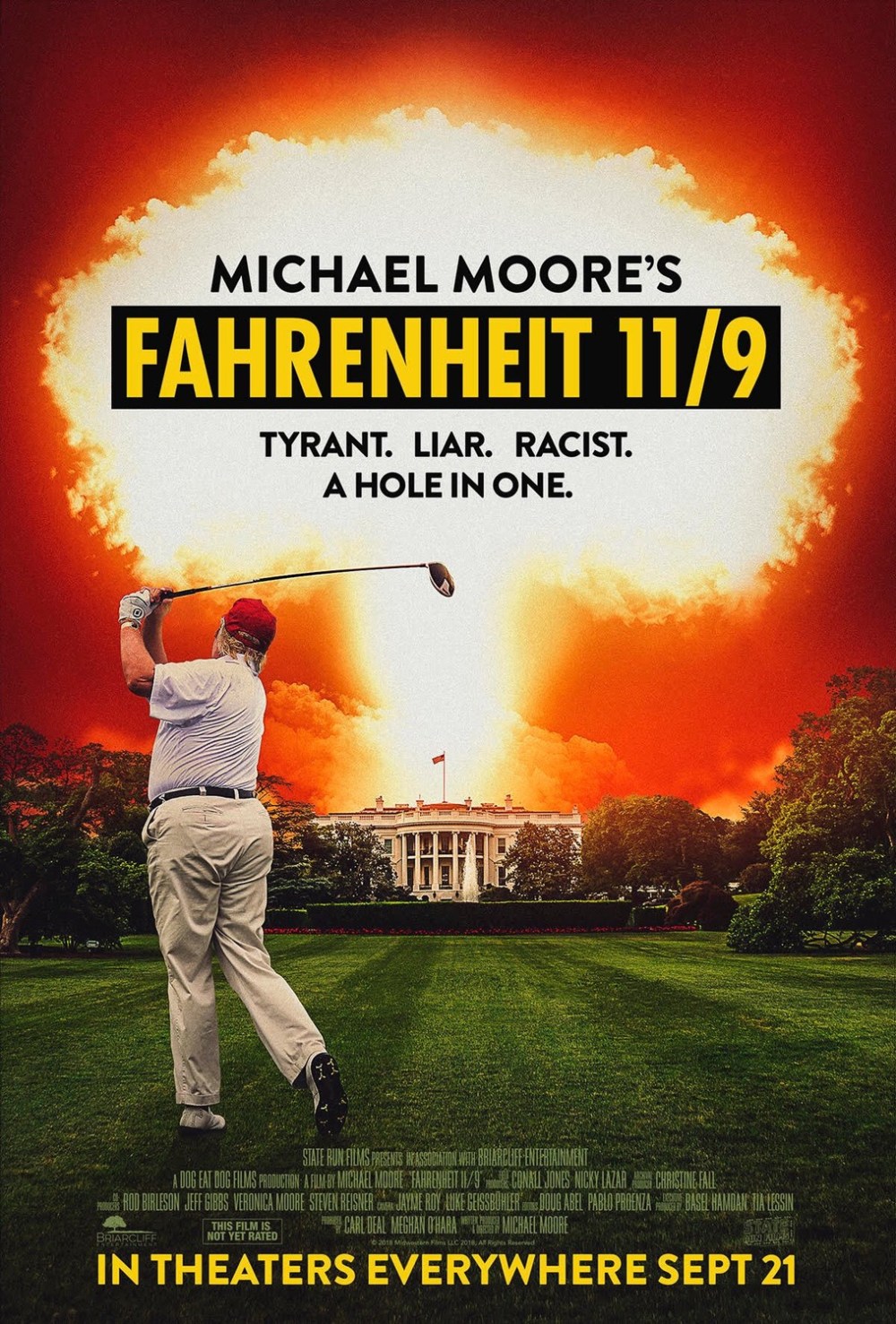
Fahrenheit 119 teaser poster

It’s bad enough Donald Trump is still living in the White House, so making a movie about the damage he is doing is pointless, right? Well, Michael Moore’s documentary “Fahrenheit 11/9,” you may be surprised to learn, is not just about Trump. In fact, we only see Trump on screen for 20 minutes at the most here. Instead, Moore is far keener to explore the state of America and how it led to the former host of “The Apprentice” to being elected to the highest office in the country. It has been almost two years, but even Moore still asks the question many of us asked on election night, “How the fuck did this happen?” What results is Moore’s angriest documentary yet, and one of the most vital he has ever made.

Like Dinesh D’Souza’s propaganda colostomy bag “Death of a Nation,” Moore takes us back to the months and days leading up to the election as we see George Clooney declaring Donald Trump will never be President, and media pundits laughing at the thought of it ever becoming a reality. Like many, I assumed Hillary had the election in the bag, but Moore knew better than anyone Trump would end up in the White House, and he takes us right back to the night of November 8, 2016 which started out with hope and euphoria, and ended with utter devastation as a certain victory proved to be anything but certain, and the man who captured the Presidency did not look all that excited about his win. Moore is in a perfect position to tell us “I told you so” in this documentary, but I appreciated the fact he did not.

“Fahrenheit 11/9” is of course a play on the title of another Michael Moore documentary, “Fahrenheit 9/11,” but it also refers to the date of November 11, 2016 in which the Electoral College, a political body which truly needs to be abolished, certified Trump’s victory after bringing in their ballots to Congress in containers which Moore loving describes as “baby coffins.” The fact Hillary steamrolled Trump in the popular election by almost 3 million votes did not matter as the Electoral College had the final say, and the world just had to live with it.

Moore does spend some time on Trump, reminding us of the unhealthy and troubling attraction he has to his daughter Ivanka, of how he walked in on Miss America contestants while they were naked, and of how he gleefully plays the media for suckers. There’s a montage of a press conference he arrived very late to, and we watch as the media outlets continue their coverage while endlessly waiting for him to appear. As tempting as it is to call Trump stupid, he is very smart in the ways of manipulation, and those at major networks (Les Moonves in particular) revel in the amount of money they are making off of his campaign.

But soon afterwards, Moore switches gears as he knows much of the information he is presenting us is nothing new, and we have certainly become attuned to Trump committing his crimes in plain sight. So instead, Moore focuses on the state of our union leading up to his shocking victory, and he makes us realize how we should have seen this coming as his political campaign was not as unique as we believed.

One of Moore’s big targets is Michigan Governor Rick Snyder whose actions in part led to the poisoning of Flint’s water supply and its residents developing high levels of lead, the kind of mineral which never leaves the body. What I did not realize about Snyder beforehand was how he had no political experience before taking office, and he was best known back then as one of the richest men in America. Moore ponders if Trump looked at what Snyder did, privatizing public services in order to make more money, and used this as one of many excuses to run for President. Looking at Snyder ends up reminding me and others of how Trump was never the first person to get elected despite having no political experience, and we are again made aware of how many Americans continue to vote against their own best interest.

Once again, Moore visits his hometown of Flint, Michigan to observe its still constant decay as it has long since become the town America has forgotten. Residents are eager to move, but no one will buy their homes. Medical professionals and social service workers alert Snyder and his cronies to the water poisoning situation, and they are silenced. Others complain about how high the water bill remains and of having to decide to pay it instead of getting food. Moore’s first documentary, “Roger & Me,” showed Flint at the beginning of its economic devastation, and it is devastating to see the city in an even worse condition now.

But while Moore has the Republicans in his sights, he is not about to leave Democrats off the firing line. Despite supporting the campaigns of Hillary Clinton and Barack Obama, he doesn’t hesitate to go after them, nor should he. President Obama gets it especially hard as his visit to Flint, Michigan resulting in filling his supporters with hope, and instead leaves them devastated to where they lose faith in the political system. Like Moore, I believe Barack Obama is the greatest American President of my lifetime so far, but the barbs Moore hurls at him here are justified as he attempts to drink a glass of Flint water and instead merely wets his lips with it.

Hillary gets some harsh criticisms thrown her way as well and for good reason. In reviewing her loss, we see the glaring mistakes her campaign made such as not visiting states like Wisconsin, and her ties to Wall Street were impossible to ignore. And yes, there were those damn emails which were brought up constantly. Despite many Americans getting sick of them being brought up, her political opponents never let the subject go.

But perhaps most damming is when Moore reveals how the Democratic National Committee, not Hillary, threw the election to ensure that Bernie Sanders would not get the party’s nomination. In an all-too-brief interview with Moore, Sanders admits the Democrats saw him as big threat to their platform, and had he clinched the nomination, he probably would have won the Presidency. As much as I wanted to believe the DNC would not stoop to such levels, the evidence presented here is impossible to deny. We even see a supporter from a certain state hold up a sign saying how Sanders won all the counties even though its delegates went on to favor Hillary.

But as bleak and angry as “Fahrenheit 11/9” is, there are moments of humor and hope. Moore limits the number of shenanigans this he performs time around, but we do see him trying to maker a citizen’s arrest of Rick Snyder and later spraying his mansion with water from Flint, Michigan. He even pulls an Erin Brockovich on one Snyder’s advisors by inviting him to drink a glass of Flint water, and the man’s reaction is not a big surprise. One of the biggest laughs comes when Moore accuses Gwen Stefani of being the reason why Trump decided to run for President as Trump discovered she was getting paid more for being a judge on “The Voice” than he was for being the host of “The Apprentice.” Granted, this is probably not altogether true, but considering how thin-skinned Trump is, it makes a hilarious amount of sense.

However, Moore makes us see there is still hope for America as we are shown images of its citizens marching against gun violence and in support of underpaid teachers as they are doing what he wants all of us to do, make our voices heard and to do something about our anger. We see people like Alexandria Ocasio-Cortez running for political office out of a need to make things better for Americans and make things like health care available for all. Susan Sarandon remarked recently how the election of Trump has inspired many people of color and different faiths to run for office. I initially rolled my eyes after hearing this, but after watching “Fahrenheit 11/9,” I believe she has a point.

We also see Moore with survivors of the Parkland, Florida shooting including David Hogg whose activism has become an inspiration to many horrified by the number of school shootings in the United States which continue to occur with frightening regularity. As teenagers, we become quick to see through the hypocrisy of adults and are much more tuned in to issues many politicians will not even acknowledge. Hogg has taken things further with his fellow classmates as we watch them have an effect on the realm of politics and encouraging others to help bring about a much-needed weapons ban.

I came out “Fahrenheit 11/9” shaken and saddened as, like Moore, I wonder if the democracy Americans continue to fight for ever really existed in the first place. Many of the assertions he makes may not stand up to scrutiny, and the documentary at times seems a bit unfocused, but his point of view remains as strong as ever. His critics will be quick to call this one liberally biased, but Moore shows no real bias here as he shows we are all complicit in America being where it is today, and that we will be even more complicit if we don’t get out the vote in November. After all these years, Moore is still passionate about fighting for America its citizens deserve, and he is not about leave it behind.

And yes, Moore does take the time to make comparisons between Trump and Adolf Hitler. Just keep this in mind: Like Trump and Snyder, Hitler had no political experience when he took office.

* * * * out of * * * *

‘Where to Invade Next’ Proves the American Dream is Still a Reality, Just Not in America

Where to Invade Next poster

With his documentary “Where to Invade Next,” Michael Moore comes into it looking more run down than usual. It’s been a few years since “Capitalism: A Love Story” in which he railed against the economic order of America and the consequences of runaway greed, and since then he has weathered through numerous events including a divorce and a bout with pneumonia. However, he still has enough energy to continue his fight to make America a better place.

“Where to Invade Next” starts off with a brief history of America and the countries it has invaded, and it also makes clear how World War II was the last big war America ever won. Since then, America has been engaged in highly unpopular conflicts in Iraq and Vietnam, and it has suffered greatly in the wake of 2008 economic crash. In an effort to find ways to make America better, Moore decides to playfully invade other countries to steal their good ideas and bring them back stateside to be put to good use.

As always, Moore gives us a very entertaining time filled with unforgettable moments and laughs designed to stick in your throat when you realize how workers in other countries have it better than Americans. He interviews an Italian couple who describe in detail how they get eight weeks of paid vacation time, and they look utterly shocked when he tells them Americans only get two. There is a scene where he sits with a group of French children at lunch and sees how they are eating very healthy meals of the high-end restaurant quality, and none of them drink Coca-Cola. When those same kids look at the school lunches Americans have, they understandably recoil in disgust.

Yes, Moore is cherry picking facts here and all these countries seem to look rosier than they probably do outside of this documentary, but he admits early on he is there to “pick the flowers, not the weeds.” He’s not here to give us an in-depth overview of the places he visits, but instead to show how other countries treat their people and workers as compared to how they are treated in America. One country does not charge college students tuition, so the term “student debt,” a huge problem in America, has no real meaning. Another country offers its citizens a yearlong maternity leave as they feel the bond between a parent and their child must be formed as soon as possible. A lot of these ideas are frowned upon in the United States, and the documentary leaves you wondering why this is the case.

In some ways “Where to Invade Next” covers the same ground as “Sicko” as Moore talks with Americans who have since moved to other countries where they discover more opportunities than they ever had back home, and he talks with people of other cultures who react with horror as to how America handles education, health care and workers’ rights. It gets a little old after a while as he’s treading through familiar territory, but you have to applaud those educators who say America should do away with standardized testing.

The documentary does have one pivotal moment, however, when Moore visits Norway and talks with a father whose son was murdered. The man who committed the crime is about to be sentenced, but the father doesn’t wish him dead or yearn for revenge. His reasoning is it will not make his or anybody else’s life any better and will just crush his spirit. Now there are many people in America who think like this, but the whole “eye for an eye” saying in the Bible seems to be more preferable to the most vocal of its citizens.

Many prefer to label Moore as being “anti-American” among other things, but he’s still living in America and looking for ways to improve life for its inhabitants whether they are immigrants or natural-born citizens. Why doesn’t he just move to another country if he finds so many others to be better, you ask? Because he loves America and continues to speak out against those who greedily take away from the middle and lower classes just because they can.

Seriously, who in America thinks two weeks of vacation time is more than enough? There are many who work 40 hours a week and yet still live in poverty. Despite the advances of the Affordable Care Act, many in America cannot afford health insurance. Those who lost their jobs and savings have ended up taking jobs offering no benefits of any kind because they have little choice. If none of this bothers you, then you need to take a much more observant look of the country you live in. Many say America is still the greatest country in the world, but there’s more than enough evidence to suggest it is not even close.

More importantly, “Where to Invade Next” shows Moore at his most hopeful. He doesn’t have an axe to grind this time around and does not lash at anyone in particular. Considering how he comes to use the words of our last few Presidents against them, this never comes across as a liberal or a conservative documentary. This is one any audience can and should be able to appreciate even though it will mainly appeal to his base and not those outside of it.

But what’s especially invigorating about “Where to Invade Next” is it shows the American dream is still alive and well. Looking closely at other countries, Moore shows how their ideas have been shaped by ones which originated in America. Now if we could only make that dream a reality again in America, things would be much better.

“Where to Invade Next” may not be one of Moore’s best documentaries, but it is still very entertaining and will have you laughing as well as informed about the world around you. Moore does look beaten down after all these years, but he’s still there fighting for his home country and looking for ways to make it great again, unlike the current resident in the White House.

For those who still think this Oscar-winning filmmaker doth protest too much and should shut up, keep in mind this following quote from Oliver Stone’s “Born on the Fourth of July:”

“People say that if you don’t love America, then get the hell out. Well, I love America.”

* * * ½ out of * * * *