Tilda Swinton on Playing a Vampire in ‘Only Lovers Left Alive’

This image released by Sony Pictures Classics shows Tilda Swinton in a scene from “Only Lovers Left Alive.” (AP Photo/Sony Pictures Classics, Sandro Kopp)

WRITER’S NOTE: This article is in regards to a press day which took place back in 2014.

Scottish actress Tilda Swinton is not just an excellent actress but a unique one as well. She doesn’t invite easy comparisons amongst her peers because she stands out in a way few other actresses do. She is lovely in the way she portrays a character, lovely in the way she moves onscreen, and, as we learned when she appeared at the Four Seasons Hotel for the press conference on “Only Lovers Left Alive,” she speaks lovely about her work and of the vampire she portrays in this film.

Written and directed by acclaimed independent filmmaker Jim Jarmusch, “Only Lovers Left Alive” tells the tale of two vampires who have lived through countless centuries and, as the movie starts, have reunited after being apart on different continents. Swinton plays Eve who remains optimistic about the world’s future even after all she has seen, and her lover Adam is played by Tom Hiddleston (Loki of “Thor” fame) who is more pessimistic about where things are heading. You might mistakenly dismiss Jarmusch’s film as just another vampire film, but it proves to be much more than that as it deals with love and death in equal measure.

Everyone was understandably interested in what attracted Swinton to the role of Eve, and she went out of her to explain what her favorite characteristic of Eve was.

Tilda Swinton: She has this perspective, that she doesn’t sweat the small, the medium or the big stuff, and that she’s full of wonder. She’s always looking up which feels to me pretty much the prerogative of people who have lived that length of time.

This film also marks the third time collaboration between Swinton and Jarmusch. She previously appeared in “Broken Flowers” and “The Limits of Control,” and off-screen she is really good friends with the filmmaker as well. We all wondered what kind of direction Jarmusch gave Swinton on this particular movie. This led Swinton to discuss the number of years it took to get “Only Lovers Left Alive” made, and how this length of time benefited both her and Jarmusch.

TS: We talk all the time. Whether we talk about anything that’s pertinent to the making of the movie, I don’t know. We’re friends now and part of the reason that I love to work with him is it means that I get to hang out with my pal for longer than if I wasn’t shooting with him. This one was another long gestation. It was seven or eight years since now when he first rang me up and said, Hey there, let’s make a vampire film. So that means a lot of conjuring, many breakfasts when I was flying through New York saying so where are we, many moments on the phone and many conversations in dark corners about where we were going to go next over the years. When we came to shoot, the lovely thing about those long developments is that when you come to shoot, it’s just grace. You’re so relieved to finally be putting it down and you’ve also had that length of time to talk about it. You really don’t need to talk about that much.

One truly unforgettable thing about Swinton in this role, or in any other role she has played thus far, is how beautifully she moves. The physicality she shows off from moment to moment is incredible, and we all wanted to know how she came up with it. The fact she’s playing a vampire here makes her performance all the more fascinating as a result.

TS: We talked a lot about what it would be if you were that unsocialized because they’ve kind of been lifted out of human society, and very quickly we started to talk about them as lone wolves so we talked about them as animals. When we were putting together the look, we ended up filling those wigs with yaks’ hair and wolves’ hair, and there’s a heartbeat in the film that comes up and down in the soundtrack which is actually a wolf’s heart. So, I thought a lot about wolves when we were thinking about how Eve would walk about. If you’re not in the pack, if you’re alone at night, you can take your time. You can pick your rhythm. The music is very important life blood, but also the camera, the move and the feeling of the movement is always very important to Jim, and this one particularly because of this passage through these two different wildernesses.

After watching “Only Lovers Left Alive,” many wondered about the relationship between Adam and Eve and how they have lasted so long as a couple. At the start, they reside on different continents before they reunite. We asked Swinton what she did to create the really comfortable long-term bond between Eve and Adam. In the process, she brought up one of Jarmusch’s main inspirations.

TS: One of the first bits of sand in the oyster for Jim, which he immediately told me about on that telephone call eight years ago, was this book by Mark Twain, “The Diaries of Adam and Eve,” which is so delightful and playful. It’s sort of fictional or maybe not diaries of the original Adam and Eve which spells out very clearly that this is an enormous love affair between two opposites. That was a foundation in stone for us that they would be in it for the long haul, but completely different. That I find really enticing, to show two people really loving each other, but not being like each other at all. So, we talked a lot about that and that was fun because that feels really human, playing with that. Also, as you notice, we wanted it to be about a marriage in which they talk as long relationships do. There’s a sort of tradition of showing people coming together and then the end, and you never really see them actually living it out and living the ups and the downs and talking it through. We really spent a lot of time wanting to get that tone of two people who were family. It’s a long, long marriage. They are family, and that’s why they still dig each other even though they are so different and he is so tricky to live with and she is such a space cadet. They have this communication thing going and they really like talking about stuff. We really wanted to show that it felt like it was something we haven’t necessarily seen before.

Another big relationship Eve has is with playwright Christopher Marlowe, played here by John Hurt. In the universe this film takes place in, Marlowe has been proven to be the real writer of William Shakespeare’s plays, and he at one point ends up calling Shakespeare an illiterate at best. When Swinton asked about how she and Hurt established the rhythm of their characters’ relationship, she pointed how this relationship differed between the one Eve has with Adam.

TS: The relationship with Marlowe is a very precious part of the film for me. Honestly, partly because it felt very close to my own experience having a very close relationship with, in particular, Derek Jarman whose disappearance from the building I had to witness. But him being a partner, a different kind of partner for her, he’s her neighbor and he’s her companion in a way that Adam isn’t. It just felt completely alive and fresh. I just know that relationship inside out, and John does too and he was the perfect dance partner to play that out with. Our references are kind of similar. He feels like family and we just put that into the film.

One of the great joys of watching “Only Lovers Left Alive” is realizing it is not a “Twilight” wannabe. Then again, we should know Jarmusch is the last kind of filmmaker to follow current trends. The characters of Adam and Eve are unlike any vampires we have seen, and their love affair is proof of how opposites attract. While Eve is more optimistic and lives to celebrate each and every period of Earth’s history, Adam is far more cynical about the present day. We all wondered how Eve could stay so upbeat even when in Adam’s company, and her explanation of why was both fascinating and amusing.

TS: Well, he’s very young. He has yet to learn. He’s only 500 years old. She’s 3,000 years old. She seen it all and she knows that survival is possible if one keeps one’s eyes open and takes it all in. It’s not like she’s recommending a journey one space away. She talks about witnessing the Inquisition and the Middle Ages. She’s witnessed all the holocausts there have been, and yet she’s still seen humanity and spirit and nature survive those things. So, she knows that as long as one keeps looking up and as long as one keeps breathing and keeps one’s perspective, survival is possible. She’s got her priorities right. I love the fact that what Jim’s looking at here is how one goes on living, how one goes on loving, how one goes on renewing and, as they say, rebooting one’s sense of wonder and engagement. It feels strangely radical and unfashionable; the very fact that they are trying not to be young, but instead they are trying to survive youth.

Another thing that stood out to me is how the fact Adam and Eve were vampires really became secondary to the story. After a while, you don’t see them as vampires but more as a loving couple dealing with the trials and tribulations of life. Also, Adam has a heartbeat which is something we usually don’t expect vampires to have. Swinton explained this was done intentionally.

TS: We were slightly messing with the form. We’ve all seen a lot of vampire films and we like the idea of disconnecting some of the myths, some of the tropes and then also inventing some new ones. So, we’re hoping that all the vampire films from now on would involve these gloves that we actually put out there in the first place. I think we all felt the same that being vampires, very evolved vampires, very humane, virtually vegetarian vampires is secondary I would say to the idea of them being immortal and being lovers in a way that only lovers can really be immortal because they live on in each other’s spirits.

Another big question was why Detroit and Tangier were chosen as the main locations. Both prove to be major characters as they come to inform Adam’s and Eve’s individual worldviews. Detroit, which is better known these days for its problems more than anything else, suits Adam’s sensibilities perfectly while Tangier appeals to Eve in a whole other way.

TS: Detroit was always going to be a very important character in the film. My sense is that Detroit was like the Emerald City for Jim, so for him it’s really a love story to make a film there. Tangier was a kind of newer idea. There was a moment where we were going to make it Rome, and for all sorts of reasons Rome sort of detached. And then we wanted very much to making a home on the African continent, and then it became Tangier. Tangier seems to be such a natural home for her. It’s a different kind of wilderness. It’s packed full of people from all corners of this particular planet and probably others and from all particular centuries. It’s got that sense of all corners of time and space, end and start in Tangier, and you can also walk around Tangier at night and cause absolutely no ripples at all even with a massive, great wolf’s hair wig on and fantastic pants. It’s just a sort of hot spot of spirit, and it felt like a very nice partner to this relatively unpopulated Detroit where people are rare and relative to empty windows and grass and wolves. Once we settled on Tangier that really felt like the right place for her.

Tilda Swinton remains one of the best and most fascinating actresses working today, and she will continue to be as long as filmmakers are smart enough to give her free reign. She has been able to go from making independent films to studio movies with relative ease, and she still has an endless number of great performances to give. Some actors might get stifled when going from the indies to a film with an enormous budget, but this doesn’t look like it will happen to Swinton anytime soon.

TS: It’s all endlessly fascinating. It’s just a different caliber. It’s like getting a finer tooth to it. It’s only relatively rare because I come from a kind of cinema that grew out of the art world. Working with a sort of naturalistic grain is something I’ve rarely done, but when I have done it, I’ve really enjoyed it and found it just a special atmosphere. For example, in something like “Michael Clayton” or even “We Need to Talk about Kevin,” that sort of realism, just trying to spin the realism, has been really interesting. Maybe I’d always want to spin it, but to spin it with that kind of naturalistic grain like deep cover. It has been very interesting although I’ve done it very seldomly. It’s all fun to me. It’s all dressing up and playing whether it’s dressing up as a corporate lawyer or dressing up as someone of 96.

More power to you Tilda!

PLEASE CHECK OUT THE EXCLUSIVE VIDEO INTERVIEW I DID WITH TILDA SWINTON FOR WE GOT THIS COVERED DOWN BELOW:

WHILE WE ARE AT IT, CHECK OUT TILDA’S REACTION TO ME COMPLETING THE 2014 LOS ANGELES MARATHON THE DAY BEFORE THIS INTERVIEW:

Ronald Krauss and Kathy DiFiore on the Making of ‘Gimme Shelter’

WRITER’S NOTE: This interview took place in 2014.

Gimme Shelter” gives audiences one of the most intimate looks at life inside a shelter for those in need they could ever hope to see. It stars Vanessa Hudgens who turns in an astonishing performance as Apple Bailey, the child of an abusive and drug addicted mother. At the film’s beginning, Apple runs away from home and seeks out her biological father, a Wall Street banker named Tom Fitzpatrick (played by Brendan Fraser) who does what he can to help her out, but she ends up running away upon discovering she’s pregnant, and because Tom isn’t excited about her wanting to keep the baby. After a couple of nights on the streets and a nasty car accident, Apple finds her way to a shelter for young pregnant women run which is run by a spiritual woman, and it is there that she begins to feel a sense of hope for the first time in her life.

“Gimme Shelter” was written and directed by Ronald Krauss who actually spent some time in an actual women’s shelter run by Kathy DiFiore, a once homeless woman who eventually turned her life around and founded Several Sources Shelters which is dedicated to helping women in need. Krauss’ original plan was to make a documentary out of all the interviews he did with residents of the shelter, but in an attempt to show the world of the importance of the work DiFiore has done and to keep her legacy going, he decided to make a feature length movie instead.

I got to meet with Krauss and DiFiore during a roundtable interview at the “Gimme Shelter’s” press day held at the SLS Hotel in Beverly Hills, California. It was especially nice to see DiFiore there as she does not do a lot of publicity. DiFiore talked about why she decided to let Krauss make this movie which was inspired by her work. Krauss went into detail about his experiences at the shelter, and he also explained how he came to cast Hudgens in the lead role.

Question: How are you?

Kathy DiFiore: Good but a little tired. I’ve never been to so many interviews (everyone laughs).

Question: Welcome to our world. So, what did you think when this guy (Ronald Krauss) shows up on your doorstep? I guess you’re used to having people show up on your doorstep, but this guy…

Kathy DiFiore: Usually they’re pregnant women (laughs).

Question: Yeah right. This guy shows up and I doubt it went like, “Uh, can I stay here because I’m doing research for a movie.” But how did you feel when he proposes the idea of doing a movie based on your thing?

Kathy DiFiore: Well, it didn’t happen that way. It happened more like he was visiting his brother who happens to live a mile and a half from the shelter, and he had heard about my work through a friend of a friend of a friend of a friend of a friend, and he volunteered. It was Christmas time and I let people come in to volunteer all the time, especially someone that has the talents he has. He eventually said, “Maybe I could film some of what you’re doing” which I wasn’t fond of because of the $10,000 fine. I didn’t want any publicity. I thought, let me just go quietly. No public relations. Over the course of time, and it took several months as he was doing the work speaking with the young mothers and they got to know him, they would come to me and tell me how much they respected him and how much he respected them. He felt they were giving him private information, but he was treating them with such dignity. You don’t hear those types of words coming out of the women that come to me. They’ve been abused and abandoned and are really confused by so many, particularly men, in their lives. And then I heard a little voice inside my head, I’m a very prayerful woman and I was asking God for guidance, and I heard, “Trust him.” And when I heard “trust him,” it kept going on. Trust him, trust him, trust him. I thought, okay holy spirit, okay, and then he and I talked about some of the things he looked at.

Ronald Krauss: I didn’t really have any sort of agenda when I met Kathy. I wasn’t really setting out to make a film. It just so happened that her shelter was a mile from my brother’s house and it was at Christmas time. Usually during the holidays I’m, like a lot of people, at food banks or something or shelters just reaching out to people who are less fortunate. I remember the first time I was there visiting Kathy and walked into that shelter for the first time and saw mothers and children walking around and it was really fascinating. It’s exactly what you see in the film because we shot the film at the real place. I had learned that Kathy had not done any publicity in her work. For the last 30 years she remained anonymous other than when she started with the $10,000 fine, and that was news of a woman who was homeless and was trying to give back to society by turning her own home into a shelter. The state came down on her, and that’s a whole other story. She reached out to Mother Teresa, and Mother Teresa came by her side and together they changed the laws in the state of New Jersey, and she was honored in the White House with Ronald Reagan. I learned all of this which was fascinating and I was sort of intrigued by her, but I was more intrigued by… the young women that struggled and were finding their way in life and the woman that was sort of selflessly helping them with her work in this shelter and five shelters she has now; some just for homeless women and some for teenagers and different things. My first thing was to sort of really help her organize so that her legacy and her work would continue. I didn’t realize that I was planting the seeds for a film that I was really trying to say that people need to learn about your work. I was thinking at first that I was going to document her work just for her own purpose so people could find out later. With any device that I found there, and I actually borrowed her camera, I started to interview the girls and record the girls and go through her boxes and look at all her old videotapes. It was a lot of stuff. I started filming one girl after the next, one after the next, interview and asking where they were from, how they ended up here, where’s their parents, where’s all these things and the tapes started piling up. I would put them in Kathy’s office in the back, and before I know it there was a whole stack of tapes of these girls and their stories and they were all very similar. They were all stories of abuse and neglect and abandonment. It was both something like a bad mother, bad father, nobody cared and the thing they had in common is that they didn’t pick this life. They didn’t pick these parents. They didn’t pick up parent who was a drug addict or an alcoholic, it just happened. And what do people do when these things happen? They just get abused and they struggle in life, and they think there’s no hope. A lot of times the will of the parents and the people who are bad, it gets thrown onto the kids and they become angry and bitter and they fight and rebel and they run away and become homeless, and so it’s a vicious cycle. I think the turning point of the whole thing for me was I kept going back and back and weeks were passing and peoples’ lives were passing through my life, and they were touching me but I was sort of a little bit removed in a sense. Then one day I showed up at the shelter at about 7 o’clock at night and there was a young girl standing there in front of the shelter; an African American girl about 18 years old. It was about 15 degrees out, she had no jacket on and she was just standing there and I said, “Can I help you? Why don’t you come inside? What are you doing out here?” I thought she lived in the shelter but she didn’t and she thought I worked there and I didn’t obviously work there, so we were kind of misleading each other. Then Kathy shows up and I’m standing in the living room with this girl and Kathy says, “Who’s this girl?” And I said, “I don’t know. She was in front of the shelter.” And she comes over and says, “Never let anybody in the shelter. These are the rules here.” She kind of dug into me a little bit, you know? And I was like, “Okay but this girl, she didn’t have a place to go. She’s by herself, she doesn’t have a jacket, she has nothing.” And she says, “Let me talk to her.” Kathy’s very seasoned obviously and knows what to look for in these people because they could be deceiving, and she interviewed her and she came back to me and said, “It just so happens that we have one bed left in the shelter. Why don’t you tell this girl that she could stay here.” And so I went up to her, her name was Darlecia, and I said, “Hey Darlecia, they have an extra bed here for you to stay. You can stay here” and this girl… I’m sorry (Ronald started to get teary eyed) … Anyway, this girl, she hugged me so hard that she almost knocked me over.

Question: Is she the one that you based Vanessa Hudgens’ character on?

Ronald Krauss: Yeah. It was a jolt into my heart about that there were many young girls like this out there and that could use help. That’s what inspired me and made me think if I was to make a film it could create awareness for other people. I asked Kathy about it and she said absolutely not, of course. And then time went on and she came to me and said, “You know the girls really respect you and trust you in terms of the care of what you’ve been doing, and perhaps you’re right. Maybe some sort of film could really help to spread the word that shelters like this exist and that other people can be kind, and maybe someone will open a shelter if they see a film like this.” But no one ever anticipated it would be a film like this.

Question: What made you choose Vanessa Hudgens for the role of Apple Bailey and what was it like to work with her?

Ronald Krauss: I never thought that a Hollywood actress could really play the role like this after living there for like a year. I lived there for a year writing this script. And there are a lot of famous actors that wanted to do it and had auditioned and some of them were really well known, and then someone mentioned Vanessa Hudgens and I didn’t really know who she was. I met with her and she was very passionate to play this role. She believed in herself that she could really do it. There was something inside of her. She turned in a great audition, she was persistent, and the turning point was that I had taken all the auditions, there was about seven or eight that I liked, and I sent them to the shelter. I didn’t tell them who I was thinking about. And when they saw the link of the girls, they unanimously picked Vanessa. They said this is the girl who should play this part, and that was the confirmation. She dove into this thing, she lived in the shelter, cut her hair off, she gained 15 pounds and besides the physical transformation, she transformed inside and she bonded with Kathy and the girls and they trusted her and they opened up to her.

Question: Kathy, what did you think of the final film?

Kathy DiFiore: (It’s) perfect. It still makes me cry when I watch it. There are women who have left Several Sources that want to come and see it and I can’t wait for that. It’s a legacy for us.

“Gimme Shelter” is now available to own and rent on DVD, Blu-ray and Digital.

Max Thieriot on Playing Ryan in ‘House at the End of the Street’

WRITER’S NOTE: This article was written back in 2012.

Max Thieriot’s acting career has been on the rise ever since his film debut in “Catch that Kid,” and now he gets one of his biggest roles to date in the horror movie “House at the End of the Street.” In it, he plays Ryan Jacobson, a sole survivor of a vicious attack which claimed the lives of his immediate family. Thieriot talked about how he prepared for the role and of what it was like working with Jennifer Lawrence who co-stars as the new girl in town, Elissa.

Thieriot got really excited about playing Ryan after he read the script, finding him very complex and full of many layers which get peeled back as the screenplay unfolds. The challenge of the role for him was to find a way to make this soft spoken and quiet character more unique than the ones which usually inhabit horror movies.

“I watched a lot of videos, and all sorts of stuff on people with different issues, and tried to find some common ground and similarity between them and their actions, and Ryan,” Thieriot said. “I put together a lot of stuff, and came up with what I did.”

Like many horror and thriller movies, “House at the End of the Street” contains endless twists and turns as filmmakers love to keep audiences guessing. Thieriot said it is actually rare for him to find a script like this one which has twists he did not see coming. The trick became to not reveal too much as it can be ridiculously easy to give a lot of things away.

“One of the hardest parts is when you’re playing a character and you know what’s going on with the character, it’s easier to not show it,” said Thieriot. “In this film, there are moments where you reveal little secrets without telling people that it’s happening – whether it’s a look and being able to have them noticeable enough that when you finish the movie, you go, ‘Oh!'”

Of course, many people have asked Thierlot what it was like working with Jennifer Lawrence whose career has gone into hyper drive thanks to the success of “The Hunger Games.” He spoke very highly of Lawrence and described her as really cool and that he had a lot of fun playing off her and working with her. What also made them work so well together in “House at the End of the Street” is they have similar backgrounds in regards to how they grew up.

“Immediately, I could tell she was a fantastic actress. It was always very real with her. It made it so much easier for me to come off like that,” Thieriot said. “She was a down-to-earth, small-town girl. I’m from a small town in Northern California. We understood each other. It (this movie) was before any of her success. Nobody in the industry knew her. That’s how it always is – you’re unknown until you get that one chance to show it.”

Up next for Max Thieriot is playing Norman Bates’ older brother Dylan in the upcoming A&E drama series “Bates Motel.” He has previously only been in one horror movie before “House at the End of the Street” (Wes Craven’s underappreciated “My Soul to Take”), but he is certainly making his presence felt in this genre. It will benefit from actors like Thieriot who are out to give audiences something that’s not just the same old thing.

SOURCES:

Christina Radish, “Max Thieriot Talks HOUSE AT THE END OF THE STREET, PSYCHO Series BATES MOTEL, and DISCONNECT,” Collider, September 20, 2012.

Joel D. Amos, “The House at the End of the Street: Max Thieriot Explores His Dark Side,” Movie Fanatic, September 20, 2012.

Michael Pena on Getting Real in David Ayer’s ‘End of Watch’

WRITER’S NOTE: This article was written back in 2012.

Actor Michael Peña has already played a few cops in his career, but in David Ayer’s “End of Watch” he gets to play his most realistic one yet. It also marks the biggest role Peña has had so far in a career which has seen him give excellent performances in “Crash,” “World Trade Center” and “Observe and Report.” Taking on the role of LAPD officer Mike Zavala reminded Peña of his days growing up in Chicago, and his preparation proved to be far more intense than he ever expected it to be.

Peña grew up in a particularly rough area of Chicago where the lure of gang life was always strong. The actor, however, said he “never wanted to be in a gang” and that he “didn’t want to follow anybody’s orders” as he always thought of himself as an individual even when he was really little. Still, playing Mike Zavala brought up a lot of memories of those days:

“I grew up in the ghetto, and the thing is when there were problems, I knew when to get away. But police go to the problems,” said Peña. “I didn’t do that growing up. Seeing it through Jake (Gyllenhaal’s) eyes, it re-ignited what I always knew, but I guess I had buried it. I’ve been living in Hollywood for the past 15 years. And reality just smacks you in the face – that feeling of potential danger everywhere.”

Like his co-star Jake Gyllenhaal, Peña spent five months training with the Los Angeles Police Department which included ride-alongs which lasted 12 hours a day. There was also a good dose of weapons training, martial arts, boxing workouts, and lugging around chest cameras which were also called body cams.

“We did so many damn ride-alongs, dude,” said Peña. “At first it’s brand new, it’s awesome, and it’s amazing. You almost glamorize it in a way. Then you do ten more, and you start getting a little bored. Then ten more after that, you really get into the spirit of it. It was almost like a sport. We really wanted to get into the mindset of what it’s like to be a police officer.”

As for the body cams, Peña remembered them being “so heavy” and “gnarly.” It turned out though that some of the hardest things he had to do in “End of Watch” were not actually physical.

“I was driving a whole bunch,” Peña said. “Then you have the director (David Ayer) in back, which can be pretty nerve-wracking. Sometimes I didn’t know where life began and where the acting started.”

Pena and Gyllenhaal had never worked together before making “End of Watch,” and it apparently took some time to get the sense of brotherhood two cops can have.

“It took three months to click,” said Peña. “There’s a lot of pressure to play like brothers. We had to spend a lot of time together to opening up to each other as well as tactical training, rehearsing. Three months later we had a good rapport and we put that in the movie.”

It was also all the hard-hitting dialogue which Ayer came up with that made the working relationship between Peña’s and Gyllenhaal’s characters feels like a real brotherhood. Peña also admitted he and Gyllenhaal did very little in the way of improvisation on the set as neither of them wanted to mess with the director’s script.

“Nine times out of 10, you aren’t going to come up with something better,” Peña said.

Peña has certainly earned his moment in the spotlight, having given one memorable performance after another. His terrific work in “End of Watch” is not only a major step forward for him, but it also allows him to break through certain barriers which have been placed upon actors throughout the years:

“The script was written for actors like Jake Gyllenhaal and me – a Latin dude. It had to be a Latin dude, there is so much Latin (material) in it. Ten years ago, I don’t know if that would have been the case. I don’t know if it would have been so easy to do.”

SOURCES:

Brian Brooks, “‘End of Watch’ Star Michael Peña Sees Racial Barriers Coming Down in Hollywood,” Movieline.com, September 19, 2012.

Chris Vognar, “Michael Peña on ‘End of Watch:’ ‘We did so many damn ride-alongs,’” The Dallas Morning News, September 21, 2012.

Madeleine Marr, “Talking to ‘End of Watch’ star Michael Peña,” The Miami Herald, September 20, 2012.

Sam Rockwell on Playing Billy Bickle in ‘Seven Psychopaths’

It is so much fun watching Sam Rockwell in Martin McDonagh’sSeven Psychopaths.” In the movie he plays Billy Bickle, an unemployed actor and friend to alcoholic screenwriter Marty Faranan (Colin Farrell). In addition, Billy is also a part-time dog thief who, along with his partner Hans (Christopher Walken), kidnaps dogs and then returns them to their owners who offer them a generous reward for their return. But Billy’s criminal deeds come back to haunt him when he steals a Shih Tzu which belongs to the vicious gangster Charlie Costello (Woody Harrelson), and Charlie will stop at nothing to get his beloved dog back.

Rockwell described the screenplay for “Seven Psychopaths” as great and said the part of Billy was “amazing.” You couldn’t agree with him more as this role gave him the opportunity to really chew up the scenery. Throughout, Billy fools around with his friend, unveils parts of his psyche which we do not see coming, and he eventually comes up with what he believes to be the mother of all action movie climaxes.

It’s also no mistake how Billy Bickle shares the same last name with Robert De Niro’s famous character of Travis Bickle from Martin Scorsese’s “Taxi Driver.” However, it was another De Niro character which came to inform Billy more for Rockwell.

“Johnny Boy (from ‘Mean Streets’) is definitely a template for Billy, probably more than Travis Bickle I think,” said Rockwell. That kind of flamboyance that De Niro has in that and also in ‘New York, New York’ and ‘Midnight Run.’ He has a kind of flamboyance that is particular to those films.”

Other characters which inspired Rockwell’s performance in “Seven Psychopaths” were Annie Wilkes (played by Kathy Bates) in “Misery,” and Timothy Treadwell who was the subject of Werner Herzog’s brilliant documentary “Grizzly Man.”

In regards to the friendship between Billy and Marty, Rockwell remarked he found inspiration through the performances of Jeff Bridges and Robin Williams in “The Fisher King” as well as the work of Kevin Spacey and Sean Penn in “Hurlyburly.”

“There are many examples of that kind of codependent, male-bonding relationship. Alpha-beta and beta-alpha switching,” Rockwell said of the above movies.

When it came to fleshing out the relationships of the characters played by Rockwell, Farrell and Walken, Rockwell said they all took the time to form a bond before shooting began. To that effect, they rented a house near Joshua Tree Park which is where the last half of “Seven Psychopaths” takes place. As for the bear hat Rockwell wears, Farrell ended up picking it out after finding it at a rest stop.

Many will come out of “Seven Psychopaths” saying Rockwell’s best scene comes when he discusses his idea for an action movie climax in a cemetery. In his best roles, Rockwell has such an unpredictable energy which continually makes him so fascinating to watch. It makes one wonder how much of this scene was scripted and what parts of it were improvised. Hearing Rockwell explain it is very interesting.

“It has to be in the writing or you can’t do it,” Rockwell said. “But certainly, all actors want to be spontaneous that’s the trick of acting, to be truthful under imaginary circumstances. You want it to be truthful, meaning it has to be fresh, it has to be spontaneous, so you have to trick yourself that it’s happening for the first time and trust this actor’s faith, so to speak.”

“I think that’s the little kid part of acting. Being with a kid is like hanging out with a drunken person or schizophrenic,” Rockwell continued. “One moment they’re crying and they’re sad, then they’re like hitting things, and that’s what actors have to do. They have to manipulate their emotions. You just got to really go back to that place of spontaneity and no boundaries.”

Watching “Seven Psychopaths” makes you realize just how much fun these actors had playing their roles. This is especially the case when you watch Sam Rockwell here, and his performance as Billy Bickle is another reminder of just how endlessly creative he is. To hear him talk about it, this was clearly one of his best experiences he has had so far in his career.

“What’s memorable for me is the experience that we had on the film. It was such a great experience,” Rockwell said. “We took our jobs very seriously, but we also had a lot of fun, and that’s what is really memorable for me. Of course, we want the movie to be a smash hit, but who knows what’s going to happen. I have memories of films that nobody ever saw, that I was very proud of, and those are still great memories. It would be great, if people saw this movie. It’s a cool movie.”

SOURCES:

Steven M. Paquin, “Exclusive Interview: Martin McDonagh and Sam Rockwell talk ‘Seven Psychopaths’ and Writing for Women, Psychos, and More,” Just Press Play, October 12, 2012.

Christina Radish, “Sam Rockwell and Christopher Walken Talk ‘Seven Psychopaths,’ What Inspired Their Performances, Memorable Moments, and More,” Collider, October 11, 2012.

Karl Urban on Playing Judge Dredd in ‘Dredd’

WRITER’S NOTE: This article was written back in 2012.

With “Dredd” now out in theaters, people can now see what fans and critics are so excited about. Distancing itself from the 1995 misfire “Judge Dredd” which starred Sylvester Stallone, this film hews more closely to the character’s comic book origins and aims to be more serious than campy. But what everyone should be especially excited about is that the filmmakers chose the right actor to play the famous Judge, Karl Urban. Having made such memorable appearances in “The Lord of the Rings” trilogy, “The Bourne Supremacy” and giving a pitch-perfect performance as Dr. McCoy in “Star Trek,” Urban looks to be the only actor to give this character the cinematic respect he deserves.

In an interview with Entertainment Weekly, Urban said he was first introduced to the comic books of “Judge Dredd” when he was 16 years old. Recalling a pizza parlor he worked at in Wellington, New Zealand, the manager there told him all about the character.

“It was kind of ironic at the time because most teenagers do rebel against everything to do with authority and the law and all that sort of stuff,” Urban said. “I really gravitated towards this ultra-brutal representative of the law. I just loved it. I’ve always had a passion for science fiction.”

In preparing to play Judge Dredd, Urban said he spent more than three months “lifting heavy things” in order to get the character’s physique down. When it came to wearing the costume, he wore it every day for three weeks before shooting began. Urban did this so he could get used to what the Judge wore and to learn how to move in it and discover its limitations. Of course, the biggest challenge was wearing the costume while filming in South Africa during a blazingly hot summer.

Many have asked Urban what it was like to wear the helmet Dredd is famous for wearing, and he described it as being “a bitch to wear” but that he liked in a “sado-masochistic way.” Regardless of the discomfort, Urban stayed very true to Judge Dredd’s refusal to ever take it off.

“To me, that’s (the helmet) essential,” Urban told MTV. “That’s part of his enigma. That’s part of who he is. To do something contradictory to the way the character was originally created… it was certainly a choice that was never considered by myself or anyone else on this production.”

Of course, acting with a helmet forced Urban to convey emotions without the use of his eyes. When it comes to film acting, the eyes can speak louder than words ever can, but he was forced to use other tools to show what Dredd was going through. The one tool which became especially important was the character’s voice, and Urban spoke with Matthew Jackson of the Blastr website about how he came up with it:

“The voice isn’t out of any attempt to emulate or copy anything that has come before,” said Urban. “It’s purely and simply a fact that in my research of the comic book I discovered a description of Dredd’s voice and it said that it sounded like a saw cutting though bone. The voice is my interpretation of what that is. I didn’t want to play this character as a bellowing, posturing Dredd, shouting out lines. For me, it’s far more interesting to have the character contain the rage and the violence. Without the use of my eyes, I had to figure out where that voice was going to sit to maximize the opportunity to express in any given moment.”

Many were worried it might be too soon for a cinematic reboot of Judge Dredd, but it looks like the filmmakers got the details right this time around. As for Karl Urban, getting to play this role must be a dream come true for him. Hearing him talk about his preparation is a great reminder of how much fun it is to hear actors explain their process of portraying a character, and he looks to deliver the goods as this brutal enforcer of justice.

SOURCES:

Clark Collis, “Karl Urban talks ‘Dredd 3D,'” Entertainment Weekly, September 16, 2012.

Ryan Turek, “Fantastic Fest Interview: Karl Urban on Dredd, Returning to Riddick,” Shock Till You Drop, September 20, 2012.

Kevin P. Sullivan, “Keeping ‘Dredd’ Helmet on Was ‘Essential’ For Karl Urban,” MTV.com, September 20, 2012.

Matthew Jackson, “Karl Urban explains how he came up with that gritty Dredd voice,” Blastr, September 6, 2012.

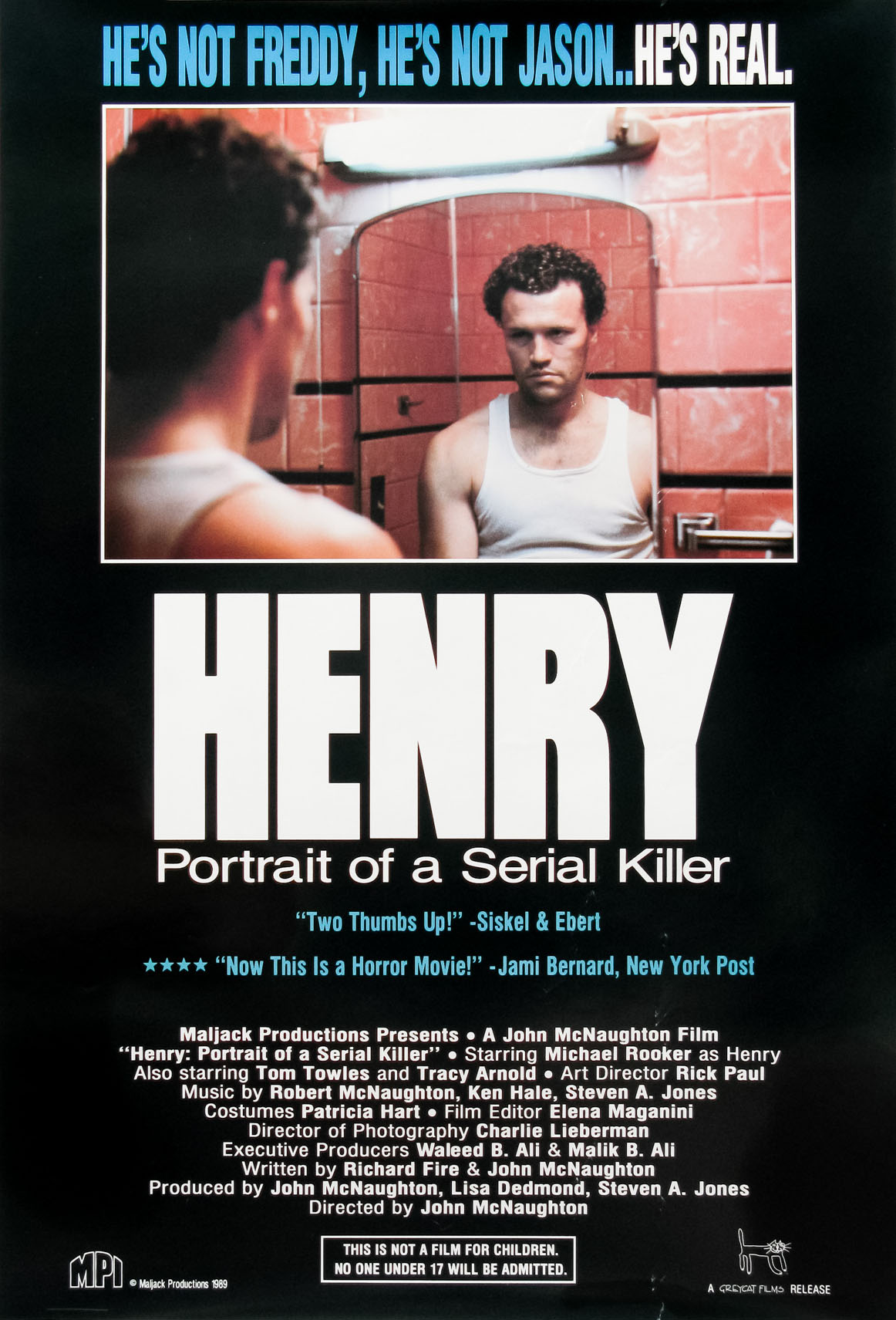
The Initial Reaction Audiences Had to ‘Henry: Portrait of a Serial Killer’

John McNaughton’s “Henry: Portrait of a Serial Killer” was made back in 1986, but it did not get a theatrical release until 1990. All these years later, it remains a very disturbing look at a murderer lacking a conscience who essentially kills at random. For those who’ve seen “Henry,” you know how unnerving it gets, and the fact it got released at all is amazing.

Michael Rooker, who plays the Henry of the movie’s title, appeared at the Egyptian Theatre back in 2011 to talk about audience’s initial reaction to it. Neither he nor anyone else involved in its making believed it would ever get any response whatsoever. They filmed what they thought people wanted to see, a scary movie, but this was no average horror flick like “Halloween” or “Friday the 13th.” “Henry” involves real life horror, the kind we often do not go to the movies to see. And in the end, what’s scarier than real life violence?

Chuck Parello, who would later direct “Henry: Portrait of a Serial Killer, Part II,” managed to get the film screened at the 1989 Chicago Film Festival, and this later led to it being shown at the Telluride Festival. Rooker recollected about the first time he saw “Henry” in a theater, and he said there was around forty people in the audience. There were not a lot of sounds coming from them, and no laughter. This led Rooker to say that, after you’ve watched “Henry” twenty times, you begin to see the humor in it. For the record, I completely agree with him on this.

“Henry’s” most disturbing and controversial scene comes when Henry and Otis (Tom Towles) do a home invasion and murder an entire family. We watch these two as they view the video they shot of them killing each member, and Otis finds watching it once is not enough. After this scene ended, Rooker said more than 60% of the audience left after this scene, and they all left at the same time. Many of them were vocal about what they had witnessed:

“Fuck this shit!”

“This is bullshit!”

“This is what cinema’s coming to?”

Rooker was sitting with the producers when this happened, and he freely admitted how they all loved the response “Henry” was getting.

People came out of the film stunned and silent, and Rooker remembered seeing one guy walking out of the Nuart Theatre in Los Angeles with his hands shaking. The actor also said a friend of his yelled at him because the film made him think “those thoughts.” There were no car chases, no gratuitous violence, and the violence shown in “Henry” is mostly minimal. Many of the murders Henry commits are never shown but heard as the camera circles around the bodies of his victims as we hear them take their last breath over the speakers. It ends up leaving a lot of room for imagination as you can’t help but think about what you didn’t see. Sometimes it is what you don’t see which is the most frightening thing of all.

But the most memorable incident for Rooker happened when he arrived late to one screening. As he headed into the theater, a woman, who was not walking but running out of the movie, ran right smack dab into him. When she realized who he was, she screamed and raced to the women’s bathroom. The ushers and producers had to come out and calm her down, saying to her over and over, “He’s really an actor. “

“Henry: Portrait of a Serial Killer” is seriously disturbing, but for good reason. Unlike other horror movies which revel in blood, gore and vicious fantasies, this was one which dealt with horror of real-life viciousness. Every once in a while, you need a film like this one to remind people of the ugliness of violence, and to make us realize we are not as desensitized to it as we may think. If “Henry” didn’t cause a good portion of moviegoers to walk out, then the filmmakers would not have succeeded in making this point clear.

Michael Rooker on ‘Henry: Portrait of a Serial Killer’

WRITER’S NOTE: This article is about a screening which took place in 2011.

Actor Michael Rooker appeared at the Egyptian Theatre for the 25th anniversary screening of the film in which he made his acting debut, “Henry: Portrait of a Serial Killer.” Even with the passing of time, it remains as infinitely disturbing as it did when it was first released. Rooker discussed how he got cast and of what went on during its making. He also told the audience this was the first time he had seen the film since it first was released back in 1986.

Rooker said he started out as a theatre actor in Chicago after graduating from the Goodman School of Drama. At the time casting began for “Henry,” he was in a play called “Sea Marks,” and the director was doing the prosthetics for it. Rooker said he didn’t care if the screenplay was good or bad because he just wanted to do a movie. Doing “Henry” was a test for Rooker to see how working while shooting out of sequence would work for him.

For research, Rooker said he read several books about serial killers which were written by doctors, but he found them to be “mostly crap.” He ended up getting more from the Texas Rangers who interviewed the man this film was more or less based on, Henry Lee Lucas. Also, the director, John McNaughton, asked him and the other actors to write character sketches. Rooker said he did not want to do that though because he did this endlessly in college and was now “sick of writing stuff down.” Instead, he recorded an audio tape of himself speaking in character.

During shooting, Rooker said he tried staying in character all day long. This led to a lot of strange times on set as actors and the crew were not sure if they were talking to him or Henry. McNaughton also got him a room for him to hide out from the actors and crew, and it was filled with mirrors which Rooker later covered up with trash bags. He stayed in the room all day until he was called to set.

The budget for “Henry” was a mere $120,000 according to Rooker, and the guy selling him cigarettes towards the film’s end was the one who financed it. Being an independent film, the filmmakers had no permits and had to hide whenever the cops were in the area. Once they were gone, the crew went right back to filming. They did, however, get busted during a pivotal scene in which Henry is shown throwing a body into the river. While shooting, four police cars came out of nowhere, and one policeman got out and asked, “Are you throwing bodies into the river?”

Once they looked in the bag Rooker was about to hurl over the side, they started laughing uncontrollably and ended up leaving the crew alone.

“Henry: Portrait of a Serial Killer” opened up a lot of doors for Michael Rooker, and it even scored him a role in John Sayles’ “Eight Men Out.” His terrifying performance is still embedded in the minds of so many who dared to view it either on the silver screen or on their own television sets, and they still cannot get it out of their heads. Since then, he has had a great career which has allowed him to play both good and bad guys with relative ease. Michael still has many great performances left to give, but don’t count on him doing a “Henry” sequel unless he can be convinced it can be turned into a musical.

Joaquin Phoenix on His Brutally Physical Performance in ‘The Master’

WRITER’S NOTE: This article was written back in 2012.

It has been two years since we saw him in “I’m Still Here,” the mockumentary on his alleged retirement from acting and bizarre transformation into a hip-hop artist. Now, thankfully, Joaquin Phoenix has returned to acting in Paul Thomas Anderson’s cinematic triumph “The Master.” Justin Craig of Fox News calls Phoenix’s performance “brutally physical,” and Peter Travers of Rolling Stone says the actor gives “the performance of his career” as Freddie Quell, a deeply disturbed World War II veteran. Just watching the various movie trailers for “The Master” reminds us of how emotionally raw Phoenix can get whenever he is onscreen, and it is both amazing and scary as there is no doubt as to how far he will go in preparation to play a character.

It turns out Anderson had Phoenix in mind when he was writing the role of Freddie, and he admitted to being amazed at Phoenix’s acting abilities and of his discipline while on the set.

“He’s like Daniel Day-Lewis in his level of concentration. He just got in character and stayed there-for three months he didn’t stop. Joaquin is very unpredictable. A lot of the time I didn’t know what he was going to do,” Anderson said.

Phoenix himself only says so much about how his preparation for a role as he compares actors to magicians in that they “don’t talk about how their tricks work, because people would go, ‘Oh, that’s all you do?'” He did say, however, how Anderson set up two cameras for certain scenes between him and Philip Seymour Hoffman who plays the charismatic Lancaster Dodd. This allowed both actors to “be in the moment and not be worried about shooting the one side and then re-lighting and shooting from the other side.” Phoenix described this as making a huge difference for him while portraying Freddie.

There is also the story of how Anderson showed Phoenix a video of a monkey falling asleep and told the actor the monkey was him.

“Paul called me Bubbles on the set,” Phoenix said. “Bubbles was Michael Jackson’s pet monkey, and I was Paul’s pet monkey. The key to Freddie is an animal, just pure id. For the scene where he’s arrested and put in jail and all that, I just watched videos of wild animals that get into suburbia. If you’ve seen video of a deer or a bear that finds its way into suburbia and the cops have to tranquilize it, it seems as if the brain stops working. If they’re cornered, they’ll slam into walls, or one leg tries to go left while the other is going right. Its complete fear and chaos. They can’t control themselves at all. That was the key to Freddie. And Paul certainly called me his pet monkey.”

While Phoenix still says he experiences problems with acting, it does look like he has rediscovered his love for it in “The Master.” Hearing him talk about being an actor shows how much he has struggled with his gift to where he had to rediscover a whole new way of doing it.

“Part of why I was frustrated with acting was because I took it so seriously,” said Phoenix. “I want it to be so good that I get in my own way. It’s like love: when you fall in love, you’re not yourself anymore. You lose control of being natural and showing the beautiful parts of yourself, and all somebody recognizes is this total desperation. And that’s very unattractive. Once I became a total buffoon, it was so liberating.

“I’d see child actors and I’d get so jealous, because they’re just completely wide open. If you could convince them that something frightening was going to happen, they would actually feel terror. I wanted to feel that so badly. I’d just been acting too long, and it had kind of been ruined for me. I wanted to put myself in a situation that would feel brand-new and hopefully inspire a new way of approaching acting. It (“The Master”) did do that for me.”

SOURCES:

Justin Craig, “Joaquin Phoenix’s performance in ‘The Master’ has Oscar written all over it,” Fox News, September 13, 2012.

Peter Travers, “The Master” movie review, Rolling Stone, September 10, 2012.

David Ansen, “Secrets of ‘The Master’,” The Daily Beast, August 20, 2012.

Jessica Winter, “‘The Master’s’ Joaquin Phoenix on Animal Inspirations, Curb Your Enthusiasm and the Pleasures of Discomfort,” Time, September 13, 2012.

Jake Gyllenhaal on His Intense Police Training for ‘End of Watch’

As Los Angeles Police Department (LAPD) officer Brian Taylor, actor Jake Gyllenhaal finally gets to play a cop for the first time in “End of Watch.” Written and directed by former South Central Los Angeles resident David Ayers, the movie follows two young police officers played by Gyllenhaal and Michael Pena who are marked for death by a notorious cartel after they confiscate money and firearms from them. Although it was shot in 22 days on a budget of just $7 million, Gyllenhaal did not skimp on the details and went through a seriously intense preparation which extended far beyond him simply getting a buzz cut.

Gyllenhaal underwent five months of serious training with the LAPD, and this included going on 12-hour ride-alongs through various crime-ridden neighborhoods. These ride-alongs had a schedule which started at 4:00 p.m. and went through to 4 a.m., and he went on them as much as three times a week.

“On my first ride-along in Inglewood, someone was murdered. We were the second car on the scene,” Gyllenhaal said of his experience. “That was definitely a wakeup call. We were involved in stolen vehicle chases. You see domestic violence, disputes that turn violent. You really see your city differently after that.”

Gyllenhaal admitted to getting a little nervous at times as he and the police rode up on crimes involving domestic disputes, attempted murders and stolen cars. The actor pointed out, however, that he was with some pretty amazing officers who made him feel very protected in such a dangerous environment. In addition, he went to a dojo in the mornings for fight training and also got a lot of exposure to weapons and tactical training as well.

“We did training with live ammunition and training with the SWAT Team a few times a week for six-hour sessions,” Gyllenhaal said. “We had to learn tactic exercises and moving exercises with live ammo and then we did fight training in Echo Park. David Ayer, our director, his best friend has a dojo, so we trained there in MMA (Mixed Martial Arts) fighting too. Eventually, after getting the crap beaten out of you and being on the street, you start to actually come into the role and feeling like you really can play the part.”

But one of the most interesting stories regarding his preparation to play Officer Brian Taylor involved him getting shot by a taser.

“I did get tased. We were at the police academy, and they asked us if we wanted to try it out and me being me said, ‘Yeah, of course, yeah!’ Actually, they gave us a choice between pepper spray and being tased,” Gyllenhaal recollected.

When it came to choosing getting tased or pepper sprayed, Gyllenhaal’s decision proved to be a well-informed one:

“Pepper spray is long and painful, it lasts for like 45 minutes and the taser just lasts for five second,” Gyllenhaal said. “But afterwards it’s actually kind of relaxing. After you’ve had thousands and thousands of volts of electricity going through your body.”

It looks like Gyllenhaal’s preparation for “End of Watch” has really paid off as he is getting some of the best reviews of his career. It is clear playing a police officer has had a tremendous impact on him as he talked of the stigma cops constantly deal with when they are out on the street in uniform. He has also gone on to say how the experience of making this movie has completely transformed not just his idea of law enforcement but of Los Angeles as well. When all is said and done, watching this film will do the same for the audience.

SOURCES:

Colin Covert, “Jake Gyllenhaal’s education on the mean streets,” Star Tribune, September 22, 2012.

Zac Shull, “Q&A: Jake Gyllenhaal Talks ‘End of Watch,’ Training with Police & If He Gets Pass for Speeding,” Baller Status, September 21, 2012.

Justin Harp, “Jake Gyllenhaal: ‘I was tased while preparing for End of Watch,'” Digital Spy, September 18, 2012.