James Franco Undergoes One Hell of a Transformation in ‘Spring Breakers’

James Franco in Spring Breakers

WRITER’S NOTE: This article was originally written in 2013.

It almost shouldn’t work. James Franco as a Florida-based rapper in Harmony Korine’s “Spring Breakers?” Just the thought of it sounds utterly laughable as we are so used to him playing such clean-cut characters in the “Spider-Man” trilogy, “Rise of the Planet of the Apes” and “Oz the Great and Powerful.” But then again, he did play the ultimate stoner in “Pineapple Express,” so there is that. In the end, while Franco does have some laughable moments as the crazy rapper Alien, the role allows him to give his best performance in a movie ever since his Oscar nominated turn in “127 Hours.” There’s no doubt as to how much research Franco did, and this is one of the first great actor transformations of 2013.

After watching “Spring Breakers,” you desperately want to find out what made Franco take on this role as it is so very different from any he has played previously. Clearly, he was drawn to working with Korine who is best known for writing the screenplay to the highly controversial “Kids,” and maybe he has a thing for rap music which we did or did not know about. But in a conversation with Roger Moore of RedeyeChicago.com, Franco discussed one of the main reasons why he chose this particular project.

“None of us had ever experienced spring break, really,” Franco said of himself, Korine and the rest of the cast. “Actors who start their careers early miss some key experiences in life. I didn’t go to prom. Well, I was dating a theater nerd so we went to a theater festival back in Aspen, Oregon instead. I experienced prom, for the first time, on film. Same with spring break. This is my spring break. And I was over 30 when I got around to it.”

Many have said Franco based Alien on the rapper Riff Raff (and this includes Riff Raff himself), but the actor said his main inspiration for the character was another rapper named Dangeruss. Dangeruss is a local Florida rapper who is still relatively unknown, but he lived in the same area of Florida which Alien lives in and has the same kind of lifestyle. Franco ended up writing a long essay which was featured on the MTV website, and in it he explains how big of an influence Dangeruss was on him.

“I met Dangeruss through Harmony,” Franco wrote. “Before I went down to St. Pete to play Alien in ‘Spring Breakers,’ Harmony sent me innumerable videos and photos as references for my character. He drowned me in them. Harmony is a master of online research. Once he chooses a location to shoot, it turns out he is also a master at finding the most interesting and odd local places and characters. One of the last videos Harmony sent me was of a white guy in dreads, sitting in his car, rapping about Dope Boyz. This turned out to be Dangeruss, a local rapper who Harm had met at an audition and knew immediately that he was the real deal.”

“The same day I arrived, Harmony had me visit Danger at his apartment,” Franco continued. “I was surprised when we pulled into a rather nice sprawling housing development, country-club style, with fountains and manicured grass. I think there was even a driving range. When I met Danger, he was tall, thin as a stick, covered in tats and humble as hell. He was willing to help in any way. He told me about growing up in the bad part of town and having poetry as his only recourse when things got ugly. His involvement with the street and his involvement with hip-hop developed simultaneously. ‘While Peter Piper was picking peppers, I was selling yola at the corner store.’ His lyrics are the highly autobiographical chronicle of surviving on the streets of St. Pete.”

Then there’s the question of where Franco got those cornrows done. Looking at someone with cornrows, it makes me think of how painful the process of getting them must be as it involves a lot of hair being twisted around in unusual directions. However, in an interview with GQ, Franco described to Matthew Serba what it was like having them done.

“We had a local artist down in St. Petersburg, Florida do it,” Franco told Serba. “I think it took about five hours total, only because we had to try different cornrow configurations. It doesn’t hurt that much, but it does get very itchy because you can’t get them wet.”

Korine himself has stated in an interview with Joel D. Amos of Movie Fanatic of how impressed he was with Franco’s transformation into Alien. It turns out that the two of them spent a lot of time working on the character even before the cameras began rolling, but once Franco arrived on set, Korine was stunned at what he was witnessing.

“I couldn’t believe it,” Korine told Amos. “I spent a year just sending him images and talking to him, designing the character. I never saw him do it. He didn’t want to rehearse. When he put in the cornrows and the gold teeth and I heard the accent… I was like ‘whoa.’ He was a maniac.”

James Franco’s performance as Alien in “Spring Breakers” is really just another reminder of what an amazing actor he can be when you give him the right material to work with. While he may be getting more attention for the box office blockbuster “Oz the Great and Powerful,” it’s this movie which is bringing him the critical raves he deserves. Watching here makes you excited for what he has in store for us next.

SOURCES:

Roger Moore, “James Franco finally gets his spring break,” RedeyeChicago.com, March 21, 2013.

James Franco, “James Franco: The Inside Story of My ‘Spring Breakers’ Gangster,” MTV.com, February 20, 2013.

Matthew Serba, “Last Night…Talking Cornrows with James Franco,” GQ, May 1, 2012.

Joel D. Amos, “Harmony Korine on James Franco in Spring Breakers: What a Maniac!,” Movie Fanatic, March 21, 2013.

Geretta Geretta Looks Back on ‘Demons’ at New Beverly Cinema

Geretta Geretta Demons photo

WRITER’S NOTE: This article was written in 2013 when this screening took place.

Actress Geretta Geretta (a.k.a. Geretta Giancarlo) was the Grindhouse Film Festival’s guest of honor at New Beverly Cinema where they were screening a very nice print of Lamberto Bava’s “Demons.” This Italian cult horror film from 1985 stars Geretta as Rosemary, one of several people attending a special screening of a horror film at a local theater. Before the screening starts, however, she ends up putting on this weird looking mask she finds in the lobby which ends up scratching her face. Eventually, the scratch infects the rest of her body and turns her into a bloodthirsty demon. In short, she is the character who dooms everybody else in this film. Way to go Rosemary!

Geretta was extremely excited to be seeing “Demons” with the sold-out audience at the New Beverly, and she even brought some bobblehead figures of her character Rosemary, created by Cult Collectibles, with her to sell. Before the film began, Geretta asked everyone if there were any “Demons” virgins (a.k.a. people who hadn’t seen the movie before), and it turns out there were quite a few. To this, she responded, “This is good! You guys are in for a treat!” She also rattled off in rapid succession a few things for everyone to keep in mind while watching this film.

Geretta Geretta: This is a movie, we did it in Italy. I’m American, I have an Italian name, my family is Italian, but I went there, I was a model, I made a bunch of Italian movies, this is one of them, I made ten. We sound funny and our lips are moving in funny directions but not mine because I am actually speaking English when we shot the movie.

Grindhouse Film Festival emcee, Brian J. Quinn, was quick to say how all the other movies Geretta did while she lived in Italy such as “Murder Rock: Dancing Death” and “Rats: Night of Terror” are all worth seeking out as they are “good and entertaining.”

After we finished watching “Demons,” Geretta came up front to talk about its making and took questions from the audience. She told Quinn that making this film wasn’t a lot of fun as there was a lot of work involved like on any other film, but the set was never unpleasant or difficult. She also pointed out while most horror movies made today with similar special effects are done on very low budgets, the budget for “Demons” was actually a million dollars. Only the great Italian filmmaker Federico Fellini could get a movie made for millions back then, so this made “Demons” a special picture in that regard.

Geretta talked about how she auditioned for Bava and Dario Argento who produced and co-wrote the movie, and she also described the differences between how movies are cast in Italy as opposed to in America.

GG: You don’t really go in and do something. First of all, they cast by picture because they go by look first. So if you look the part then that’s enough for them because they figure they can direct and can get you to do what they want you to do, and it’s very rare everyone would be speaking the same language on the set, so really what difference does it make your mumble?

Most of the exteriors in “Demons” were actually shot in Germany, and the movie theater where the majority of the action takes place was in the process of being destroyed. Geretta was working on a television series at the time, and it was a two-and-a-half-hour drive from that set to where “Demons” was being filmed.

Geretta also pointed out how you never see Rosemary die in “Demons” and, having seen the movie a couple of times, I can verify this to be true. She joked how she was plotting the whole time to make sure her character would not die so she could be cast in the sequel. But when the time came to make “Demons 2,” Geretta was unfortunately out of town.

One audience member asked about the vomit which comes out of the zombies’ mouths, and the vomit does look appropriately disgusting. Geretta described its ingredients in detail as well as what was in everybody’s hair.

GG: The vomit that comes out of any orifice or anybody’s mouth is food coloring, Alka-Seltzer, and some other liquid. The stuff that’s in our hair is yogurt, food coloring and milk, and these are serious folks (the filmmakers) so none of us could change any of our clothes the whole shoot.

The audience reacted loudly to this particular description and understandably so. You’re dealing with ingredients which not only have an expiration date, but which let you know when they have expired. Can you imagine how smelly the set became? Yuck! Geretta then went on to say the film crew had to redo her hair every single day so it would match with what she called “dead yogurt.”

“Demons” was shot in twenty days, and Geretta said she was on set for ten. But while many American actors have found shooting on Italian film sets to be very different and at times very distracting with the film crews yelling at each other back and forth, she said she had no problem adapting to the “Italian style.”

GG: I did come to like things that are done the Italian way. In the Italian way you have lunch on the set, and hey it’s Italy, so you’re gonna have your choice of red or white wine which would never happen on an American set. Things are very calm and it’s more like a family, so maybe if there is some yelling or something it’s just like a family in the background. You tend to work with the same people over and over and over, and it’s just great. I loved it. In America you’re as famous as your last picture, and in Italy you’re as famous as whatever made you famous. It doesn’t matter what you did and it doesn’t matter how long ago, you stay the same. There’s a real appreciation for what you did, so it’s nice.

Ever since she starred in “Demons,” Geretta Geretta has proven to the world just how multi-talented she is. In addition to acting, she has gone on to write, direct and produce her own movies, and her career has also taken her to many different countries such as Italy, Ireland, South Africa and Switzerland. She shows no sign of slowing down anytime soon, and it was great to see her at New Beverly Cinema. Many actors get sick of the movies they star in, but she made it clear how grateful she was that everyone showed up in droves to see “Demons” which she made so long ago. Just don’t ask her how long ago it was.

Corbin Bernsen on Stepping Up to the Plate in ‘Major League’

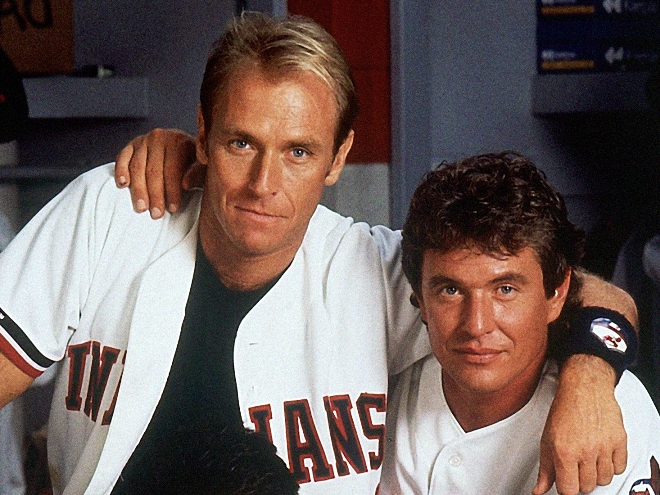
Major League Corbin Bernsen

WRITER’S NOTE: This article was originally written back in 2012.

Corbin Bernsen’s role as Cleveland Indians third baseman Roger Dorn in “Major League” marked a big breakthrough for the actor who at that point was best known for playing divorce lawyer Arnie Becker on “L.A. Law.” The actor was one of the guests who attended a reunion screening of “Major League” at the Aero Theatre in Santa Monica which brought out fans who were excited to see it on the big screen.

“Major League’s” writer and director David S. Ward talked said he only casted people who could play baseball, and he talked about how Bernsen had been a ballplayer for a long time. Bernsen played with the Hollywood Stars baseball league, and he also played in many MTV celebrity “Rock N’ Jock” softball games as well.

The movie was shot in Milwaukee, Wisconsin, and one day had the filmmakers inviting 27,000 residents to portray Indians fans at the baseball stadium there. Grant Moninger, programmer for American Cinematheque and moderator of the “Major League” Q&A, asked Bernsen what it was like to play baseball in front of all those people.

Corbin Bernsen: The night that all those people were there was just one of the most exciting times in my life. You’re wearing the real uniform on a real field, and you’re playing it. I was a pretty good fielder in my day but I wasn’t much of a hitter. That last setup where I get the single and then Dennis (Haysbert) comes in and hits the home run to get me on base, I remember David saying, “I need you to hit the ball somewhere in left field preferably between shortstop and 2nd base.” And I’m thinking, you’re gonna be lucky if I just hit the ball man! I’m not a hitter. But he wants it directly there and it’s got to be a line drive at a certain height and all that. I kept thinking he’s going to fire me because I can’t do this, and the balls are coming in and I kept swinging and missing and swinging and missing and I finally, with all these people there, connect with one and the ball takes off and this fucker is flying to the wall! I’m standing there and I see David and he’s saying “RUN! RUN! RUN!”

Bernsen went on to say he still sees a lot of stuff on the internet about “Major League” which say “great movie, one of the best baseball movies, but Corbin Bernsen sucks and he can’t play baseball.” He ended up getting a hold of some guy from Philadelphia who had been dissing him and told the guy, “Hey! I’m not supposed to be able to play baseball in the movie you a-hole!” From there, Bernsen even challenged him to a throw off from centerfield every year and told the guy, “I will stand in Philadelphia on your field on the warning track and I will throw a fucking line drive to second base a-hole and then you shut up!” That guy from Philadelphia never took Bernsen up on this challenge.

To our surprise, it turns out Bernsen was actually not the original choice to play Roger Dorn in “Major League,” and he only got the part after the actor cast before him, whose name he couldn’t remember, ended up dropping out. Getting cast, Bernsen said, was one of the luckiest things which ever happened to him, and he was thrilled to be in it. He also made clear why he feels the movie holds up so well, and it is because of Ward’s excellent script.

CB: When you read a solid script, that’s like a blueprint that’s just gold. I would urge everyone, if you’re interested in film, to read the script for “Major League.” Everything that’s supposed to happen in a story happens on the exact page it’s supposed to happen on. Yeah, it’s a funny little comedy baseball movie, but I just think it’s one of the most solid scripts that I have ever read. Clean, lean and to the point. That’s all David Ward.


Tom Berenger Reflects on the Making of ‘Major League’

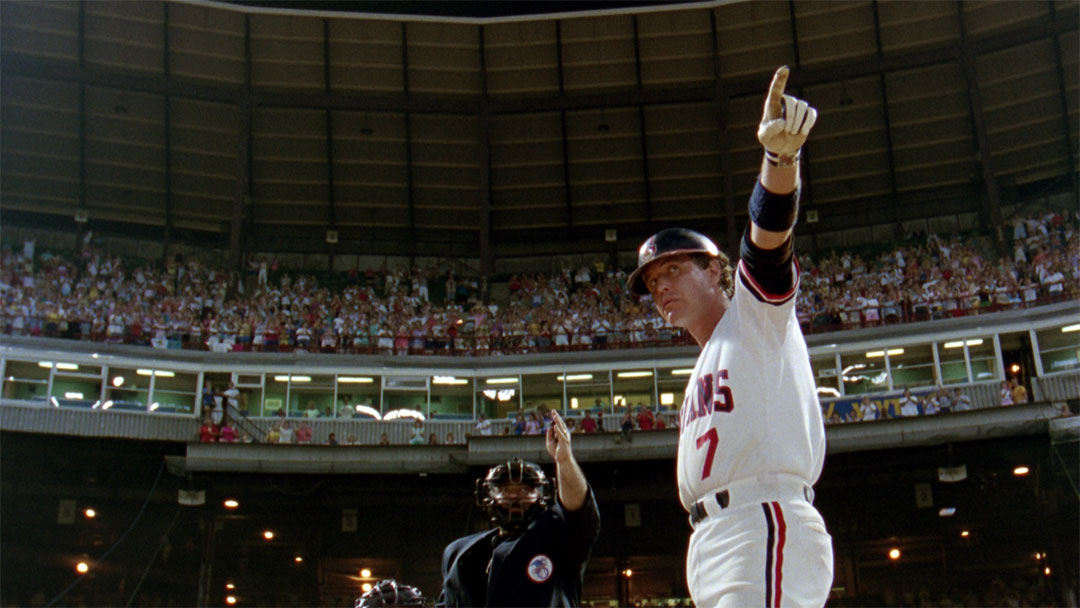
Major League Tom Berenger

WRITER’S NOTE: This article was originally written in 2012 when this screening took place.

Among the guests at a recent reunion screening of “Major League” at the Aero Theatre was actor Tom Berenger who played veteran baseball catcher Jake Taylor. It is still one of Berenger’s best known roles as we watch his character go through another baseball season which may very well be his last while trying to win back his ex-girlfriend Lynn Wells (Renee Russo in her film debut). And like his fellow co-stars, Berenger proved to the filmmakers he could play baseball.

Berenger did have some experience playing little league when he was growing up, and he played some more ball after that but never professionally. “Major League’s” writer and director, David S. Ward, also said “you could watch Tom swing a bat and you could tell he could play baseball.” Berenger said he played on third base and left field, but “Major League” had him taking the catcher position for the first time ever. What made the difference in preparing for this role was who he had to work with.

Tom Berenger: I had a great teacher which was (Steve) Yeager who had been a catcher for the Dodgers. Besides being a great player, he was also a great teacher which is important, and he worked with Charlie (Sheen) and I and we started probably six weeks before the other guys came in.

Berenger even talked about how he got Yeager and some of the cast to come back to his hometown in South Carolina so they could practice there. His thought was that practicing at Pepperdine University near Malibu with the “dry air” and “breeze coming off of the ocean” was “a little deceiving” as real ballplayers deal with more humid conditions.

TB: We raised a little team so we could do infield practice and drills and things like that, and it was all these guys who were on softball leagues that had once played baseball. They loved it. It was great. I had a friend that was head of maintenance for the public schools, and he got us a field at one of the high schools that was totally blocked off. It was just screened by Palmetto trees, Live Oaks and stuff. He gave us the key to the gate to get in and he brought all his equipment out there and he recut the field, he redid the mound, he gave us a pitching machine so I could practice pop-ups and we could do batting practice.

Berenger said this worked out great for everyone there because they all were forced to deal with humidity, and it was this same humidity which the cast and crew faced in Milwaukee, Wisconsin where “Major League” was filmed. The movie was shot in 1988 during the hottest summer in Wisconsin since 1938, and he remembered it being brutal to work during the day as a result. While the training done in South Carolina certainly prepared many for day shooting, Berenger looked more forward to working nights when it was cooler.

Watching the movie again had Berenger getting nostalgic for the old Cleveland as it appears in the movie’s opening credits, and it is one of the few parts of the movie which was actually shot there.

TB: I’m looking at it and I’m going wow, look at that industrial town. That’s what we used to be. And that makes me a little sad, you know? Chicago and Cleveland and Pittsburgh and Bethlehem and Allentown; all those towns were like that and they’re not there anymore, and I find that really sad because I think they were the backbone of this country.

“Major League” still holds a place in all our hearts thanks to its humor and deeply felt moments which have stayed with us long after the end credits are done. Even Berenger admitted the movie still has a profound effect on him more than 20 years after its release.

TB: I have to say that I just love this film. I cry at the end every time I watch it. It’s a comedy but it’s got so much heart and great writing and direction.

So Bad It’s Good: Ed Adlum on the Making of ‘Shriek of the Mutilated’

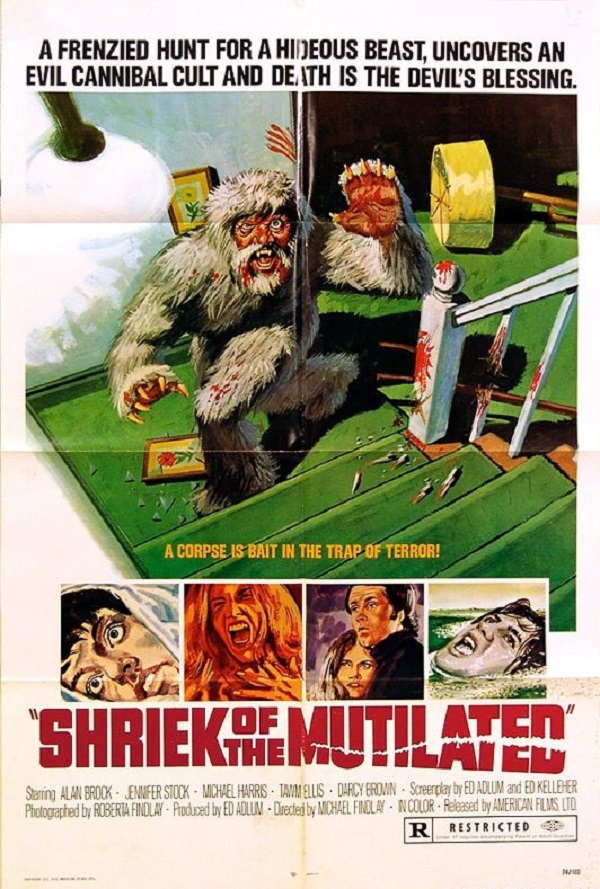
Shriek of the Mutilated movie poster

“The picture you are about to see… is not good.”

So said filmmaker Ed Adlum who introduced the screening of the 1974 cult horror movie he wrote and produced called “Shriek of the Mutilated.” This film played as part of a double feature along with another movie of his, “Invasion of the Blood Farmers,” for the Grindhouse Film Festival’s tribute to him at New Beverly Cinema back in September of 2012. Adlum also brought up a conversation his daughter Ingrid got involved in while she was a student at UC Irvine of what the worst movie ever made was. Ingrid said it was “Plan 9 from Outer Space,” but another student ended up saying:

“There’s one worse than that. It’s called ‘Shriek of the Mutilated.'”

“My father made that movie!” Ingrid said.

After Adlum’s introduction we watched “Shriek of the Mutilated,” and while it is far from brilliant to put it mildly, everyone in the audience had fun watching it. The movie even had the techno-pop song “Popcorn” by Hot Butter playing in a party scene, and listening to the song proved to be more exciting than the party. Brian J. Quinn, one of the programmers of the Grindhouse Film Festival, defended it by saying the worst movie ever made is a $100 million-dollar blockbuster which is a piece of crap, and “Shriek of the Mutilated” is certainly not that kind of movie.

“I don’t know about you but I had a ball,” Adlum told the audience after the movie had finished. “The thing isn’t as bad as I remember. The unintended laughs of which there were about 115 are really the best part of the picture. The things I can see that you can’t see like the guy wheeling Karen (Jennifer Stock’s character) into the room and banging into the door, I remember all of that stuff!”

There’s one moment where Lynn (played by Darcy Brown) is walking outside and picks up a broom and starts sweeping for no discernible reason before putting it back down. Adlum said it was “just a piece of business to do as she walked from here to there” and that “acting wasn’t essential” for anyone to be in this movie.

Adlum talked a bit about actor Alan Brock who played Dr. Ernst Prell, the professor who assembles a group of his students for a field trip to search for a dangerous creature known as a Yeti.

“Alan Brock was at one time a child star on film and hadn’t worked in years,” Adlum said. “He still lived with his mother and even though he was well into his 60s, he was so immature in that he had to be driven home every night instead of staying at the motel with all the other players and the crew. He had to be in his house and in his own bed, then I would pick him up in the morning and bring him back up to the woods (in Westchester County, New York) to do the film.”

The director of “Shriek of the Mutilated” was Michael Findlay, an exploitation filmmaker, and Adlum said the movie was his gift to Findlay for editing “Invasion of the Blood Farmers.” Adlum said he and Findlay were “fierce friends” as they “drank their brains out,” and he described him as knowing more about films than anybody else. For Findlay, “Shriek of the Mutilated” represented his chance to make a real movie as compared to the ones he was famous for like “Take Me Naked” or “The Touch of Her Flesh.”

Sadly, Adlum and Findlay had a big falling out at one point to where Findlay ended up calling Adlum a Nazi for some odd reason, and they didn’t speak again for years. Findlay died in 1977 on top of the Pam Am Building in New York City when a helicopter crashed and killed him and two other people. Upon hearing of his death, Adlum said he cried harder than when he found out his parents had died.

One audience member described “Shriek of the Mutilated” as starting off like a Bigfoot movie but then ends like a Manson cult movie, and he asked Adlum if this was always his plan.

“No, a lot of stuff was done on the fly and it kind of morphed into that,” Adlum said. “You think of stuff while you’re standing there. You may find a prop and work that into the film. Then when you’re all done with the picture and you’re editing it you say, these eight minutes is boring, let’s do something. So, you come up with what we call inserts, and sometimes inserts have nothing to do with the plot but they’ll make people go, oh!”

In talking about the music used in the movie, Adlum said it came from the Prague Philharmonic. This was back in the day of the Iron Curtain and the Eastern Bloc had no intellectual property rights with America, and America didn’t have any with them.

“I bought the record in the bargain bin, and I bought it for $2.98 with the express purpose of using it as background music in the movie” Adlum remembered. “The guy at the counter says to me, what are you doing with that? And I tell him and he says, well you better keep the receipt so that you can prove you have the rights!”

It also turns out Ivan Agar, the man who played the Indian Laughing Crow, was actually a chiropractor from Brooklyn, New York. Adlum said Agar had the funniest scene in the movie where a big line of drool comes out the side of his mouth, but this scene unfortunately didn’t make it into the final cut.

So yeah, “Shriek of the Mutilated” is not on the same level of filmmaking as Alfred Hitchcock’s “Vertigo,” but it was fun to watch even if we enjoyed for all the wrong reasons. It was a treat for us to hear Ed Adlum talk about its making, and you have to admire the sense of humor he has about the finished product. While he thought we would all head home after his Q&A, everyone stayed to watch “Invasion of the Blood Farmers” which showed just how much we appreciated him spending some time with us.

Jamie Foxx on Saddling Up For ‘Django Unchained’

Jamie Foxx in Django Unchained

WRITER’S NOTE: This article was written in 2013.

It was a role originally meant for Will Smith, but after watching “Django Unchained” it will be hard to think of any actor who could have played Django better than Jamie Foxx. The Oscar-winning actor came from the world of comedy where he has done hilarious work, but he continues to impress us with one terrific dramatic performance after another in films like “Collateral,” “Ali” and “Any Given Sunday.” The role of Django is one of the biggest and most challenging Foxx has taken on, and he convincingly takes this character from being a helpless slave to becoming a slick bounty hunter in splendid fashion.

When it comes to working with Quentin Tarantino, he’s always ready to show his actors movies they can base their characters on. Foxx was no exception to this, and Tarantino got him to watch Sergio Corbucci’s 1966 Spaghetti Western “Django,” a movie which serves as one of “Django Unchained’s” biggest inspirations. It starred Franco Nero as a coffin-dragging gunslinger who comes into town and gets caught up in a feud between the KKK and a bunch of Mexican bandits. While talking with Rebecca Murray of About.com, Foxx explained what impact watching “Django” had on him as well working with Nero who has a cameo in “Django Unchained.”

“I was like, wow, it was amazing. And then to actually have the original Django in the movie. I don’t know if you’ve ever met him but he was the biggest star on the set,” Foxx told Murray. “For him to give his blessing, and I think it really follows true to it and I think that’s what’s going to be the pleasant surprise to people, that it’s a Western and that it stays along the lines of a Western that happens to be in the backdrop of slavery. Slavery almost becomes secondary at a certain point because at the beginning it’s traditional, slave. Then once he becomes this bounty hunter, that’s the backdrop. Now it’s about revenge and about getting this girl, so he stayed true to that and that’s cinematic.”

While at the “Django Unchained” press conference, Foxx made it clear he was ever so eager to work with Tarantino on it. He had no qualms about playing a slave, and what attracted him to the role was Django’s uprising. Movies have always been an outlet for the artists who make them and the audiences that watch them, and Foxx explained what makes this one particularly cathartic.

“When you see movies about slavery…we never get a chance to see the slave actually fight back, actually do for himself, and in this movie there are a lot of firsts,” Foxx said.

Despite the fact it is a genre movie and a revenge fantasy of sorts, “Django Unchained” does deal with America’s dark history of slavery. Tarantino never sugar coats it for mass audience consumption, but then again, why should anyone? It’s an ugly part of the past we’d like to ignore, but it needs to be acknowledged so we can learn from it in the hopes of never repeating it again. As a result, the movie has been greeted with controversy over its subject matter and the frequent use of the n-word with many people (and not just Spike Lee) complaining loudly about it. But Foxx, in an interview with Keith Staskiewicz of Entertainment Weekly, said he is not surprised at the strong response “Django Unchained” has been getting and doesn’t think anyone else should be either.

“You know it’s going to be controversial!” Foxx told Staskiewicz. “That’s what’s been blowing my mind, people saying, did you know this was going to be controversial? It’s like, come on man! Did you read the script? Why would Quentin Tarantino do anything that wasn’t controversial? What movie of his have you seen where you went, oh, this is a Hallmark Movie and rated G? That’s not what you sign up for. You don’t sign up for that.”

Still, Foxx admitted it was a tough movie to make considering part of it was shot at the Evergreen Plantation in Louisiana. It was at this same plantation where slaves were made to work, and they suffered and toiled under brutal conditions. Being there must have been deeply unsettling for everyone involved in the movie’s making, and it certainly had a strong impact on Foxx which he wasn’t about to ignore.

“It’s tough shooting when you’re in plantation row and that’s where your ancestors were persecuted and killed, and we were respectful of that,” Foxx told Staskiewicz.

Regardless of the controversy, “Django Unchained” proved to be one of the most entertaining movies of 2012 thanks to Tarantino’s clever screenplay and direction, and also because of the sensational performances from the cast. Jamie Foxx can add Django to his roster of great screen roles in a career which still has many more to be revealed. Foxx also made a very good point about the film’s subject matter to Adam Edelman of the New York Daily News which people really need to think about.

“Every two, three years there is a movie about the Holocaust because they want you to remember and they want you to be reminded of what it was,” Foxx said. “When was the last time you seen a movie about slavery?”


SOURCES:

Rebecca Murray, “Interview with Jamie Foxx from ‘Django Unchained,'” About.com

Matt Donato, “Interview With The Cast Of Django Unchained,” We Got This Covered

Keith Staskiewicz, “‘Django Unchained’: Jamie Foxx on portraying slavery and filming on an actual plantation,” Entertainment Weekly, December 14, 2012.

Adam Edelman, “‘Django Unchained’ star Jamie Foxx: ‘Every single thing in my life is built around race,'” New York Daily News, December 14, 2012.

Michael Shannon on Playing the Notorious Richard Kuklinski in ‘The Iceman’

Michael Shannon in The Iceman

WRITER’S NOTE: This article was originally written back in 2013.

Thanks to his unforgettable performances in “Bug,” “Revolutionary Road,” “The Runaways” and “Take Shelter,” Michael Shannon has long since become one of the best character actors working in movies today. It’s fascinating to watch him go from playing one kind of role to another which is completely different from the last, and his range as an actor has kept him from getting easily typecast in ways most actors cannot help but fall victim to. Now he takes on perhaps his most challenging role yet as the cold-blooded killer Richard Kuklinski in Ariel Vromen’s “The Iceman.”

Based on, yes, a true story, Kuklinski was convicted in 1986 of murdering 100 men for different crime organizations in the New York area. At the same time, the movie shows him to be a loving husband to his wife Deborah Pellicotti (Winona Ryder) and their children. We would later learn of his crimes in more detail in Anthony Bruno’s book “The Iceman: The True Story of a Cold-Blooded Killer” as well as in James Thebaut’s documentary “The Iceman Tapes: Conversations with a Killer.” The documentary is especially interesting to talk about as Kuklinski described his various crimes without a hint of remorse. His only true regret was the irreparable damage he did to his own family, and it is this confession which ends up bringing him to tears.

Shannon was at the Four Seasons Hotel in Beverly Hills, California for “The Iceman” press day, and he took the time to talk with me and several others about his experience making this particular film. He described the role as being very frightening, came to make some discoveries about the character which he didn’t see coming, and he admitted a truth about Kuklinski we are understandably hesitant to say out loud.

Michael Shannon: This is a very intimidating part to play. This character is so far removed from my own personal experience, and to try to play the part with any authenticity was a very daunting challenge. Sometimes I think I’m alone in this regard, but then sometimes I think maybe other people feel the same way and they’re just afraid to say it, but I actually kind of like the guy when I was watching the interviews. I think people are very adamant about, he’s a psycho, he’s a cold-blooded killer, he’s remorseless and so on. The fact of the matter is when you’re watching him in those interviews, he’s been arrested, he’s been caught, he’s not going to kill anybody else, his entire life has been ruined and he’s going to rot in jail until he dies. What good is it going to do him to cry on camera? It’s really none of our business, and in a way we’re all being peeping toms on this guy’s pretty cruddy life at this point. I looked at him as a pretty empathetic figure. If you look at his childhood at least as it’s described in the books that I read, it was absolute torture. He was tortured and it was very sad. So, these poor unfortunate parents created this monster, and he didn’t know how to… He wanted to be something other than he was. He even says it in the interview, he says it in the movie. He says, “This would not be me. This would not be me.” So, for all the people who say that he’s cold-blooded, why would he be saying that then? I found him a very sad, lonely person, and I felt like he deserved some sort of exploration into why he wound up the way he wound up.

Indeed, it’s hard to completely hate Kuklinski as he is presented in “The Iceman” as a devoted family man, and life had dealt him a bad hand which left him little in the way of skills to make a normal career out of. He did have a set of rules he set down for himself which dictated he did not kill women or children, and most of the people he killed were criminals and degenerates who weren’t doing society any favors. At the same time, it was not lost on Shannon or any of us that Kuklinski needed to be arrested and brought to justice for the murders he committed, but to dismiss him as some one-dimensional bad guy is to miss the bigger picture.

MS: This enterprise of making movies about people seems to be in service of trying to understand them, and that’s what I tried to do. He dropped out of school and he had a very low opinion of himself. I don’t think he thought he was a great person, and I think he was fighting lot of demons.

Shannon said he never talked to Kuklinski’s wife or any of the family members in preparation to play him, but this is understandable considering the subject matter. To ask them to participate in the production of “The Iceman” would be like asking them to relive a nightmare they may still be trying to wake up from. In terms of research, Shannon ended up relying on other resources.

MS: I did talk briefly to (Anthony) Bruno, the author who interviewed him. He talked with me for ten minutes and he told me the story of the first time he went to interview him and how just horrifying it was to be in the same room with him. He made the interviewer sit with his back to the door and Kuklinski would sit and look through the window, so Kuklinski knew when there was somebody out there like a guard or whatever and the interviewer didn’t. There was nobody that knew him that wanted to be involved with this I don’t think.

In the end, “The Iceman” is not out to change anyone’s mind about Kuklinski as a person. People have long since made up their minds about this man who murdered so many, but there is no denying Michael Shannon is a fantastic actor who continues to give one great performance after another. As Kuklinski, he allows us to peek inside this man’s twisted psyche to see the human being underneath all the notoriety, and it makes for a truly compelling portrait of a man whose name will forever live in infamy. Up next for Shannon is “Man of Steel” in which he will play Superman’s nemesis, General Zod. Like all of you, I can’t wait to see him in that superhero flick.


Chris Tucker Gets Super Positive in ‘Silver Linings Playbook’

Chris Tucker in Silver Linings Playbook

WRITER’S NOTE: This article was written back in 2012.

We should no longer be surprised at how it’s been several years since Chris Tucker appeared in a movie. Tucker has taken a number of years off between doing those “Rush Hour” movies, and he has made enough money to where he can actually afford to be choosy on which projects he does. Instead, what really should surprise us is how effectively he drops his manic, motor-mouth persona he became famous for in David O. Russell’s critically acclaimed “Silver Linings Playbook.” It’s a more serious role for Tucker compared to what he’s done in the past, and yet he still gets to add some of his own infectious wit to it.

In “Silver Linings Playbook” Tucker plays Danny, a friend of Pat Solitano (Bradley Cooper) whom he spent some time with in a Baltimore mental health facility. Tucker makes Danny into an endearingly likable individual who is full of positive energy even as he eventually discovers he’s leaving the mental facility a little too soon. With this description, you might think this would be the perfect movie for him to perform his fast-talking shtick, but what’s great about his performance is how he underplays the role and never tries to be the least bit bombastic in his portrayal.

The first question everyone has for Tucker is why he took so long to do another movie. While talking with Marlow Stern of The Daily Beast, Tucker explained he went back to doing stand-up comedy for a while and that a film he was planning to do with director Brett Ratner called “Mr. S: My Life with Frank Sinatra” fell through unexpectedly. But for Tucker, there was a little more to it.

“Well, the break wasn’t planned – it just happened that way,” Tucker told Stern. “I waited a long time and the right things weren’t coming to me – the roles I was offered weren’t that challenging-so I started trying to develop a bunch of projects for myself. I was always looking and hoping the right thing would come. I knew stepping back a bit and going back to my stand-up roots would help me gain perspective.”

When it came to doing “Silver Linings Playbook,” Tucker told Scott Huver of NBC New York he liked how his character Danny would just “come out of nowhere.” In essence you could say this about a lot of the characters in this movie as they go in all sorts of directions you don’t expect them to, and this must have made it a fun project for everyone involved including Tucker. The other thing which attracted him to playing Danny was that he would be working with writer/director David O. Russell, and he’s a filmmaker who is known for keeping all the actors he works with fully energized from take to take.

“We knew that he (Russell) would probably do something, make it even a little bit more special because that’s how he works, because he’s so creative,” Tucker said to Huver. “David is such a great writer, and the rhythm and the way that he writes, it’s just really helpful. Then he’s like that with creating and changing stuff, and so I like that it frees you up to not worry about knowing your lines exactly. He just makes sure you feel like you can just be good, get into character.”

In talking with Wilson Morales of Black Film, Tucker said he also liked how the role had a lot of depth and that it was more serious than what people are used to seeing him do. But he also pointed out how a lot of comedy comes out of the emotionally fraught situations the characters endure throughout which is true. “Silver Linings Playbook” is one of those movies where you laugh with the characters instead of at them, and this is what makes it as joyous and positive as Danny is.

When it came to doing research, Tucker admitted he did a little bit but not a whole lot. It turned out what was already on the page was enough for him to work with.

“I just talked to the director (Russell) a lot because he knew the character,” Tucker told Morales. “He wrote the script so that was a good thing working with a writer/director because they have an idea of the character. I talked to him a lot and I didn’t read the book (by Matthew Quick, which the movie is based on) because I felt like Russell made the character even better in the movie. I basically took the director’s lead on it.”

Next up for Chris Tucker is a stand-up comedy movie he made which is coming out next year, and there are rumors he just might be up for another “Rush Hour” sequel. Many people are eager to see Tucker get back to doing the kind of comedy he’s famous for, but I hope he gets more opportunities to do films like “Silver Linings Playbook” because I think it brings out the best in him. It’s another one of those performances which proves comedians can do drama as well as they do comedy, and this is something no one should have to prove to anyone anymore.

SOURCES:

Marlow Stern, “Chris Tucker’s Journey from Tax Problems to ‘Silver Linings Playbook,'” The Daily Beast, November 14, 2012.

Scott Huver, “Chris Tucker: Quietly Comic For ‘Silver Linings Playbook,'” NBC New York, November 20, 2012.

Wilson Morales, “Chris Tucker talks ‘Silver Linings Playbook,’ his absence from films, and why he won’t do another ‘Friday’ film,” Black Film, November 16, 2012.

Jessica Chastain on Portraying an Infinitely Determined CIA Agent in ‘Zero Dark Thirty’

Jessica Chastain in Zero Dark Thirty

WRITER’S NOTE: This article was originally written back in 2012.

It’s utterly fascinating to watch Jessica Chastain go from playing the embodiment of grace in “The Tree of Life” to portraying a willfully determined CIA agent in “Zero Dark Thirty.” The role of Maya represents a huge change of pace for her as she gives this character a razor-sharp focus as she relentlessly pursues Osama Bin Laden and bring him to justice, and she is riveting to watch throughout the movie’s two and a half hour running time. After watching Chastain in Kathryn Bigelow’s critically acclaimed film, I am convinced she can play any role given to her.

I was lucky enough to go the “Zero Dark Thirty” press conference which was held at the Beverly Wilshire Hotel. Chastain said she had three months to prepare for this role, and she went through the screenplay with its writer Mark Boal throughout the production. She ended up nicknaming Boal “the professor” as he had spent several years doing research on the Bin Laden manhunt, and he clearly knows as much as anyone should on the subject. But the real challenge Chastain faced in playing Maya was the fact this character was based on a woman she could not meet, and this forced her to get especially creative.

“Because I was never able to meet the real woman my character’s based on because she’s an undercover agent, I had to use my imagination to fill in the blanks where the research couldn’t answer the questions,” Chastain said. “I tried to answer things like why she was recruited out of school. There’s a child’s drawing in Pakistan and other certain things which would be reminders of the life she was becoming a stranger to. I had to create on my own but still stay faithful to the woman I am portraying.”

One of the most talked about elements of “Zero Dark Thirty” are the torture scenes which have given some the impression that Bigelow has made a pro-torture movie (she has not). Acting in those scenes could not have been much fun, and Chastain acknowledged this in an interview with Christine Kearney of Reuters. In talking about her experience, Chastain makes it clear nobody was about glamourize this part of the story and how it made her fully aware of the differences between her and Maya.

“We filmed in a real Jordanian prison, in the middle of nowhere. The environment wasn’t great, especially as a woman,” Chastain told Kearney. “They had a lot of trust between the actors, nothing was dangerous or unsafe. There was a lot of discussion to make sure that we weren’t doing something that was going to be salacious. They just wanted it to be accurate.”

“I know I am playing a character who has trained to be unemotional. But I have spent my entire life allowing myself to be emotional, and allowing myself to feel everything,” Chastain continued. “There was actually one day that we were doing a scene, and I said, ‘I am sorry’ and I just had to walk away, and I just started crying … it was a very intense experience.”

Chastain is a classically trained actress who earned a Bachelor of Fine Arts degree from Julliard, one of the most prestigious performing arts conservatories in the United States. Now I have heard people say how actors can get trained too much at schools like this one to where they can’t appear natural in film and television. I am always annoyed to hear someone, let alone anyone, say this, so it’s great to see Chastain prove them wrong with her Oscar worthy performance. While at the press conference, she explained how being a student at Julliard prepared her for a movie like “Zero Dark Thirty.”

“I spent four years studying Shakespeare and iambic pentameter and all that, and to be honest this text was more difficult than that,” Chastain said of the screenplay. “Not only has Mark taken the facts of what happened, but he’s also created a subtle character arc within it, and you find the humanity within what he’s created. So Julliard absolutely helped me when preparing to speak very complex language and it gave me the tools for the research I would need to do in order to be believable as a CIA agent.”

What’s beautiful about Chastain’s performance is not just how she takes Maya from being out of her element to becoming an obsessed CIA agent, but also how she imbues the character with such a strong humanity. Chastain also makes us respect not just Maya, but all those who worked diligently alongside her behind the scenes to bring down Bin Laden and continue to fight against terrorists both foreign and domestic. In talking with George Pennacchio of ABC News, Chastain sees her performance as a tribute to the real-life person her character is based on.

“She worked for a decade; she gave up so much. She basically became a servant to her work,” Chastain told Pennacchio. “In a way, making this movie is like acknowledging the sacrifices she’s made and thanking her for what she’s done.”

SOURCES:

Ben Kenber, “Interview with Jessica Chastain, Mark Boal and Kathryn Bigelow On Zero Dark Thirty,” We Got This Covered, December 18, 2012.

Christine Kearney, “A Minute With: Jessica Chastain on ‘Zero Dark Thirty,’” Reuters, December 19, 2012.

George Pennacchio, “Jessica Chastain compares herself to ‘Zero Dark Thirty’ character,” ABC, December 19, 2012.


Bradley Cooper Shows How Far His Acting Range Goes in ‘Silver Linings Playbook’

Bradley Cooper in Silver Linings Playbook

WRITER’S NOTE: This article was originally written back in 2012.

We remember him best from “The Hangover” movies and for being one of People Magazine’s Sexiest Men Alive, but you will get to see actor Bradley Cooper in a whole new light after watching him in David O. Russell’s “Silver Linings Playbook.” In the movie he plays Pat Solitano, a former school teacher who has just been released from a mental institution after eight months. Pat was sentenced there after beating up a man who was having an affair with his wife. Having lost his wife, job, home and been diagnosed with bipolar disorder, Pat moves back in with his parents (played by Robert De Niro and Jacki Weaver) in an attempt to put his life back together. In the process, he meets the mysterious Tiffany (Jennifer Lawrence) with whom he instantly forms a strong connection.

In talking with Jen Chaney of the Washington Post, Cooper said he researched his role by watching documentaries and interviews with people who suffer from bipolar disorder. However, he found what really helped him was looking at what specific problems the character of Pat had. This is what makes Cooper’s performance so good because he is not simply out to play your average bipolar patient, but instead an individual with problems which are not necessarily like everyone else’s. Cooper told Chaney, “bipolar is like snowflakes – no two are the same. It’s not like there’s a general thing where, oh, I’m going to play bipolar now.”

“There are very specific things like, for example, he really goes off the rails when he’s triggered by something that reminds him of a traumatic event that stunted him in some way emotionally. And one of those events we see is when he walks in on his wife sleeping with another man in his bathroom,” Cooper said. “And then that Stevie Wonder song ignites that and sends him into a manic state. We pretty much blocked out what specifically it was with him, and then it was just modulating it on the day, on set, in front of the camera.”

The trick, however, of playing a character like Pat is to make him relatable to where the audience will want to follow him despite his psychological problems. Some actors make the mistake of focusing too much on playing the ailments afflicting their character than they do on just playing the character, and people can get easily turned off watching someone do that. Cooper went on to tell Chaney of how both he and Russell wanted to make certain they didn’t alienate audiences with Pat’s actions.

“Pat is the foil through which we learn about all the other characters and their stories, so if he’s too extreme the audience is never going to come onboard,” Cooper said. “So it was really about modulating him, which I thought was a really smart thing that we did. Otherwise we could have been in trouble.”

Jessica Winter of Time Magazine remarked how Pat has “so much passion and energy and exuberance that it’s almost enviable.” For actors, there is always something very appealing about playing a character who throws caution to wind as we all develop inhibitions over time to where we feel we can never fully express ourselves and constantly worry about what others will think of us. We all want to find ourselves living life to the fullest, so despite the problems Pat is going through, part of us wants to be like him as nothing seems to be holding him back. Cooper shared the daily excitement he had playing Pat with Winter.

“I felt that every day when I showed up as Pat. I was happy that he had such a zest for life. It was intoxicating,” Cooper said. “It’s almost as if every moment that he exists is somehow fueled with more energy than anyone else. Sometimes people who are dealing with those issues, the minute they enter the room you feel it, and it changes the energy in the room. It’s like a vibration.”

Cooper also got an opportunity many actors always dreamed of: to work with Robert De Niro. Granted, he had already worked with De Niro previously on “Limitless,” but that one had them playing each other’s adversary. In “Silver Linings Playbook,” they are cast as father and son, and their characters have a fractured relationship they both are trying to work on. In talking with Rob Lowman of Press-Telegram, Copper explained how working with De Niro previously really helped him in playing Pat.

“It was a real blessing coming into this film knowing that I was going to play Bob’s son because I love him,” Cooper says. “So it was very easy for me to say the word dad and have it resonate within my body as I said it and make myself believe it. It helped me anchor the character in the same way it was to have a Philadelphia Eagles jersey on.”

Bradley Cooper has always been a really good actor, but in “Silver Linings Playbook” he gets to show a range we haven’t seen him portray previously. The film proves to be one of the best and most entertaining movies to come out in 2012, and here’s hoping he scores some major wins this awards season for his work. Next up for Cooper is “The Hangover Part III.”

SOURCES:

Jen Chaney, “Bradley Cooper: On ‘Silver Linings Playbook,’ football and reading falsehoods about his love life,” The Washington Post, November 14, 2012.

Jessica Winter, “Q&A: Silver Linings Playbook’s Bradley Cooper and David O. Russell,” Time, November 15, 2012.

Rob Lowman, “Bradley Cooper, Jennifer Lawrence expand their range with ‘Silver Linings Playbook,'” Press-Telegram, November 15, 2012.