Ewan McGregor on Surviving ‘The Impossible’
Ewan McGregor in The Impossible

WRITER’S NOTE: This article was written back in 2013.

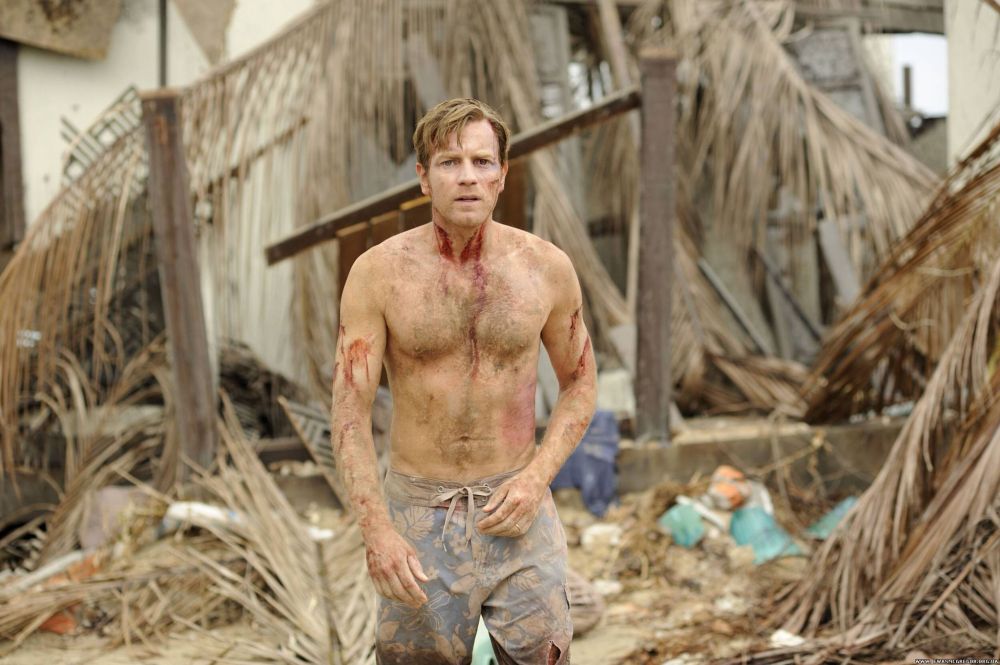
While we endlessly applaud Naomi Watt’s emotional powerhouse of a performance in J.A. Bayona’sThe Impossible,” there’s no leaving out Ewan McGregor who is every bit as good. McGregor stars as Henry, husband to Watt’s character of Maria and the father of three young boys. After the Thailand beach resort they are staying at is laid waste by the 2004 Indian Ocean tsunami, Henry goes on a desperate search for Maria and his eldest son Lucas who are separated from him in its aftermath. McGregor convincingly portrays a man physically and emotionally battered by this horrific tsunami which destroyed thousands of lives, and he gives the movies of 2012 one of its most heartbreaking moments with a cell phone call back home.

I got to catch up with McGregor at the Los Angeles press day for “The Impossible” which took place at the Four Seasons Hotel in Beverly Hills. While there, he said what made him want to do the movie was the script by Sergio G. Sánchez which he described as “an amazing read.”

“I didn’t know that it was a true story when I read it but I was grabbed by how there was something very honest and true about it,” McGregor said. “So, when I found out that it was a true story, it wasn’t a surprise. Some of the lines of dialogue were very extraordinarily accurate and powerful.”

Now whereas Watts got to meet Maria Belon, the tsunami survivor her character was based on, McGregor admitted he did not get to meet his real-life counterpart before shooting began. While this might have put the actor at a disadvantage, he was still able to use his imagination for the role and did get the opportunity to talk to other survivors as well.

McGregor in real life is the father of four girls, and we could not help but wonder if he thought about what he would do if they were caught up in the tsunami. Acting sometimes has you asking questions you may not want to know the answers to, but those questions are still hard to ignore. McGregor’s performance feels so emotionally honest to where it seems like he did ask himself that question, but when we asked him if being a father affected his work here in any way, he made it clear to us what his acting process is.

“Well I suppose you’re always acting from two things: your imagination and your experience in life. But it’s not very nice to think about those things and I tried not to make myself think about my kids because I wouldn’t do that,” McGregor said. “But I had these great little boys, these three fantastic kids that Naomi and I were lucky to work with. I was able to think about them and we created this family that I believed in, and it felt that there was a reality to what we created that I was able to use. I just thought about them really and how desperate it would be to be in that situation.”

Speaking of which, McGregor considers his role in “The Impossible” to be the first film where he explores what it is to be a parent. Now while he may have played a dad in other movies, none of them spring to mind as quickly or are anywhere as memorable as this one. McGregor talked about this in more detail with Damon Wise of The Guardian and told him the only other film he could think of where he played a dad was “Nanny McPhee Returns.”

“I’ve certainly never made a film that felt to me like an exploration of that, of what it means to be a parent and that love you have for your kids,” McGregor told Wise. “This is something I’ve been experiencing for 16 years of my life, and it’s not in my work really anywhere. I thought – albeit a really extreme version of that – it was a nice way to look at that specific and unique love you have for your kids.”

“The Impossible” has been criticized in recent months for focusing more on an English family when the real-life family which inspired this movie was Spanish, and for also leaving the Thai people on the sidelines. Those who have seen the movie, however, can verify this criticism is not true and is deeply unfair to the filmmakers who have made a movie which is actually about many families and not just one. McGregor, in his conversation with Wise, was not the least bit surprised by this criticism and went on to describe it as being “not very clever.”

“The truth is it’s a story about this family, this western family, who are on holiday there. And that story is many, many people’s story,” McGregor explained. “But to say that it doesn’t tell the Thai people’s stories … Naomi’s character is saved by a Thai man, and taken to safety in a Thai village where the Thai women dress her. It’s one of the most moving scenes in the film, really. In the hospital they’re all Thai nurses and Thai doctors – you see nothing but Thai people saving lives and helping. Most of the survivors we spoke to had nothing but amazing things to say about the Thai response to the tsunami, in that they mobilized themselves very quickly.”

Ewan McGregor’s defense of “The Impossible” speaks volume of how emotionally involved he became with the film’s story, and it resulted in one of the very best performances he has given to date. Whether or not he gets serious Oscar consideration for his work, you will never be able to forget the impact he has on you here. And once again, the scene where he’s on the cell phone will break your heart.

SOURCES:

Ben Kenber, “Interview With Ewan McGregor On The Impossible,” We Got This Covered, December 19, 2012.

Damon Wise, “Ewan McGregor: ‘The Impossible is my first film about being a parent,'” The Guardian, December 27, 2012.
Matthew Fox On His Grueling Physical Transformation for ‘Alex Cross’

Matthew Fox in Alex Cross

WRITER’S NOTE: This article was written back in 2012.

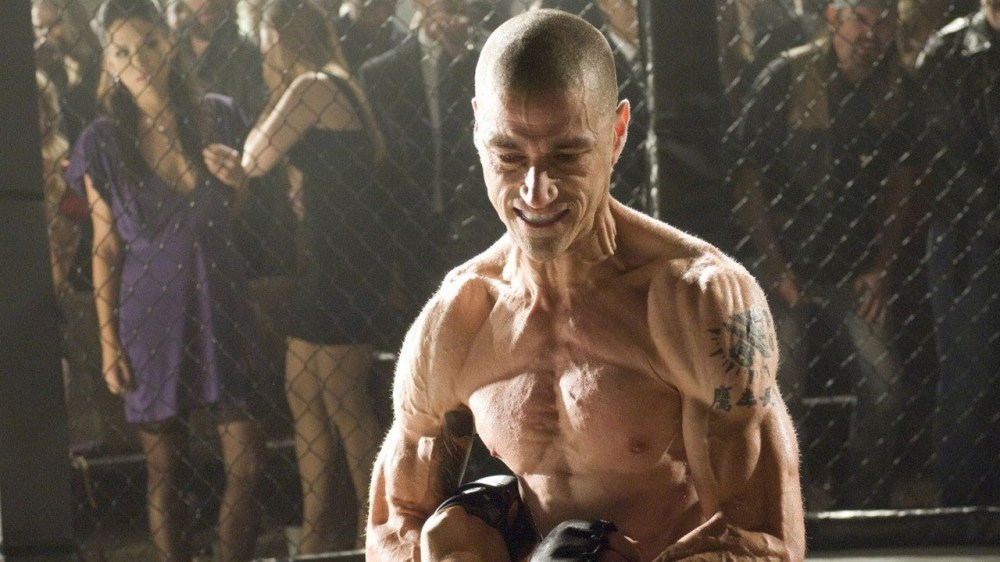
Audiences may have a hard time recognizing Matthew Fox when they see him as serial killer Picasso in Rob Cohen’s “Alex Cross.” The actor, best known for his roles on “Party of Five” and “Lost,” underwent one of the most visceral transformations any actor has gone through in a 2012 movie as he slimmed down, donned some tattoos and trained very hard to portray one of the scariest psychopaths we have seen in a movie. After watching him in “Alex Cross,” you will be ever so eager to find out how Fox pulled off such a stunning transformation.

Fox ended up losing 40 pounds to get Picasso’s toned physique down just right, and it forced him to give up eating all the things he likes to eat. This was especially hard on Fox’s mom whom he described as Italian and a fantastic cook to boot. Her favorite thing to do is feed her son great food, and unfortunately she couldn’t do so for several months when he signed up to play Picasso. According to Fox, his mom could not stand the fact he had to lose all this weight and that it really upset her. I imagine, however, now that the movie is being released, she can feed her son everything he could ever want to eat.

Fox worked with Simon Waterson, a personal trailer whose credits include helping Daniel Craig achieve the ripped body he needed to play James Bond, working with Jake Gyllenhaal on “Prince of Persia,” and in assisting Chris Evans to become the best Captain America he could ever hope to be. Fox went about describing the training he endured under Waterson’s tutelage.

“We worked really hard on this for five months,” Fox said. “The training sessions were mostly circuit training. You’re going non-stop from exercise to exercise, never taking any breaks for about an hour and a half. I was burning a lot of calories and working on certain muscle groups. It was very strategic on his part and very gradual.”

The role of Picasso forced Fox to travel to some dark places in order to better understand this particular serial killer. As a result, it challenged the actor to adopt a mindset no sane person would ever dare explore. However, it also allowed Fox to play a character which strongly differed from the ones he previously portrayed.

“It was very liberating to some degree to be able to play a guy that has no moral compass and is sort of supremely arrogant about the notion that he doesn’t have a moral compass and is out to prove to the world that a moral compass is weakness and is false actually,” Fox said.

“It was also interesting to think about what it would be like to really truly believe that and to really hold yourself that arrogantly above the rest because you can do the things that nobody else can or thinks that they can’t,” Fox continued. “A sense of power comes along with that when a guy like that feels like he has the ultimate trump card, like he cannot be trumped and he goes into every human interaction that usually ends up with him slowly snuffing out a life. He would look at that as giving a gift so it’s a very powerful place to exist, sort of invincibility.”

The lengths Fox went to in portraying Picasso greatly impressed his “Alex Cross” co-stars, especially Tyler Perry who plays the title role.

“He is brilliant,” Perry said. “The amount of dedication and the weight loss is this much of where he went. He really went to where ever he had to go. I don’t even want to know what dark places he went to to get that character, but he was amazing.”

After watching Matthew Fox in “Alex Cross,” you will find yourself in complete agreement with what Perry said. Actors revel at the chance to reinvent themselves when playing a character, and Fox got the chance to do just that with this role. Movies are full of crazy characters who haunt our dreams, and Fox’s Picasso is just the latest.

SOURCES:

Marc Malkin, “Matthew Fox Explains Shocking Weight Loss for ‘Alex Cross,’” E! Online, September 18, 2012.

Fred Topel, “Freaking Me Out: Matthew Fox on ‘Alex Cross,’ ‘World War Z’ and ‘Lost,‘” Crave Online, October 15, 2012.

Kevin P. Sullivan, “Matthew Fox Went To ‘Dark Places’ For ‘Alex Cross,’ Tyler Perry Says,” MTV Movies Blog, June 27, 2012.

James Patterson on Alex Cross and Bringing Him to the Silver Screen

Alex Cross movie poster

WRITER’S NOTE: This article is in regards to a press day which took place in 2012.

It has been over ten years since the last Alex Cross movie, “Along Came a Spider,” made it to the big screen. But now director Rob Cohen, who directed “The Fast and The Furious,” has brought the heroic detective and psychologist back in a reboot which is simply entitled “Alex Cross.” No one appears to be happier about Cross’ return to the world of film than the man who created him, James Patterson. The writer was recently at a press junket for “Alex Cross” at the Four Seasons Hotel in Beverly Hills, and he shared his thoughts on the new movie and the character he created.

James Patterson: I think it turned out great. Summit Entertainment (which is distributing it) has been fabulous to work with and they didn’t get in the way. They were helpful and supportive in every aspect. I think Rob did a terrific job especially given the budget ($24 million) which was not enormous and about a quarter of what he’s used to.

There was also the talk of Tyler Perry taking over the role of Alex Cross from Morgan Freeman who portrayed the character in both “Kiss the Girls” and “Along Came a Spider.” Many were baffled as to why Perry was cast, and they were also intrigued as to what Patterson thought about him in the role instead of Freeman.

JP: Morgan is Morgan, but Tyler is much closer to the character in the books. The character in the books is bigger, he’s physical and he’s bright and I think Tyler did a great job. I think he’s going to blow people’s minds with this. When I went to Atlanta to meet with him, he said to me “James, I wouldn’t do this if I wasn’t sure that I could pull it off. And I’m going to give myself over to Rob. I’m not going to be the director.” And I think that’s what he did, and he took off some weight and bulked up as well.

As for Freeman, Patterson said the actor was never contacted about this movie. Like everyone else, he thinks Freeman is a wonderful actor but remarked how he is now 77 years old, and having him play a detective at that age was not going to work this time as Cross is around the age of 40 in the books.

Patterson was actually involved in the production of “Alex Cross” and even wrote the first draft of the screenplay. He had a lot of input as he owns 40% of the movie, but he was also able to step back and stay out of the way which he said is “the most useful thing that you can do sometimes.” The script did change a lot from what he originally wrote, and Patterson said he was perfectly alright with that.

When asked how he created Alex Cross, Patterson said he grew up in a town which eventually became known as “the murder capital of New York State,” and it was half black and half white. His experiences in this town enforced his reaction to the way blacks were treated in the media.

JP: I felt for a long time that the way movies were portraying African Americans was kind of stupid. I wanted to create a hero who really was a hero; an African American guy who is bright and anti all the stereotypes. Here’s a guy who’s taking care of his family, and this movie gets more into family than the first two did. He’s taking care of his kids, he’s cool with their grandmother, he’s well educated and a graduate of John Hopkins University, etc. So, I just wanted to go against the stereotypes, and I think that has worked and that’s what I’m happy about.

Returning to the movie, Patterson said one of the things which makes “Alex Cross” especially good is it has moments that are “really emotional,” and you don’t always have those moments in a film like this.

JP: Film crews can sort of not really be into the movie they’re working on that much, but there were times where they were watching the monitor and they were crying. It was very very emotional stuff and I think that’s unusual in a movie like this.

In talking about Matthew Fox who plays Michael “Picasso” Sullivan, Patterson described him as terrific and that his performance is one of the best and most original things about the movie.

JP: I think Matthew wanted to show everyone that he had this tremendous range which he does, and he wanted to be a bad guy. Once he got the part, he really pushed it. He took off a lot of weight because he wanted to have a certain look, and he was the madman.

Patterson believes what makes “Alex Cross” work so well as a movie was everyone went into it with a real hunger to do it. Cohen wanted a hit, Perry wanted to do something different and to show he had different skills than people thought he had, QED International (one of companies producing the movie) wanted to do something which would be a break out hit, and Patterson himself wanted another movie made about this character.

JP: Everyone was hungry and I always think that’s great. That does tend to produce a pretty good product.”

This was certainly the case here as “Alex Cross” proved to be a riveting action thriller with great performances from the entire cast and a lot of real emotion which never feels faked. Here’s hoping it finds the audience it deserves when it is released on October 19, 2012.

Click on the links below to check out the exclusive interviews I did with two people involved with the making of “Alex Cross.” These are interviews I conducted on behalf of the website We Got This Covered.

Rob Cohen

Ed Burns

William Friedkin Talks About ‘Killer Joe’ at Landmark Theatres

Killer Joe movie poster

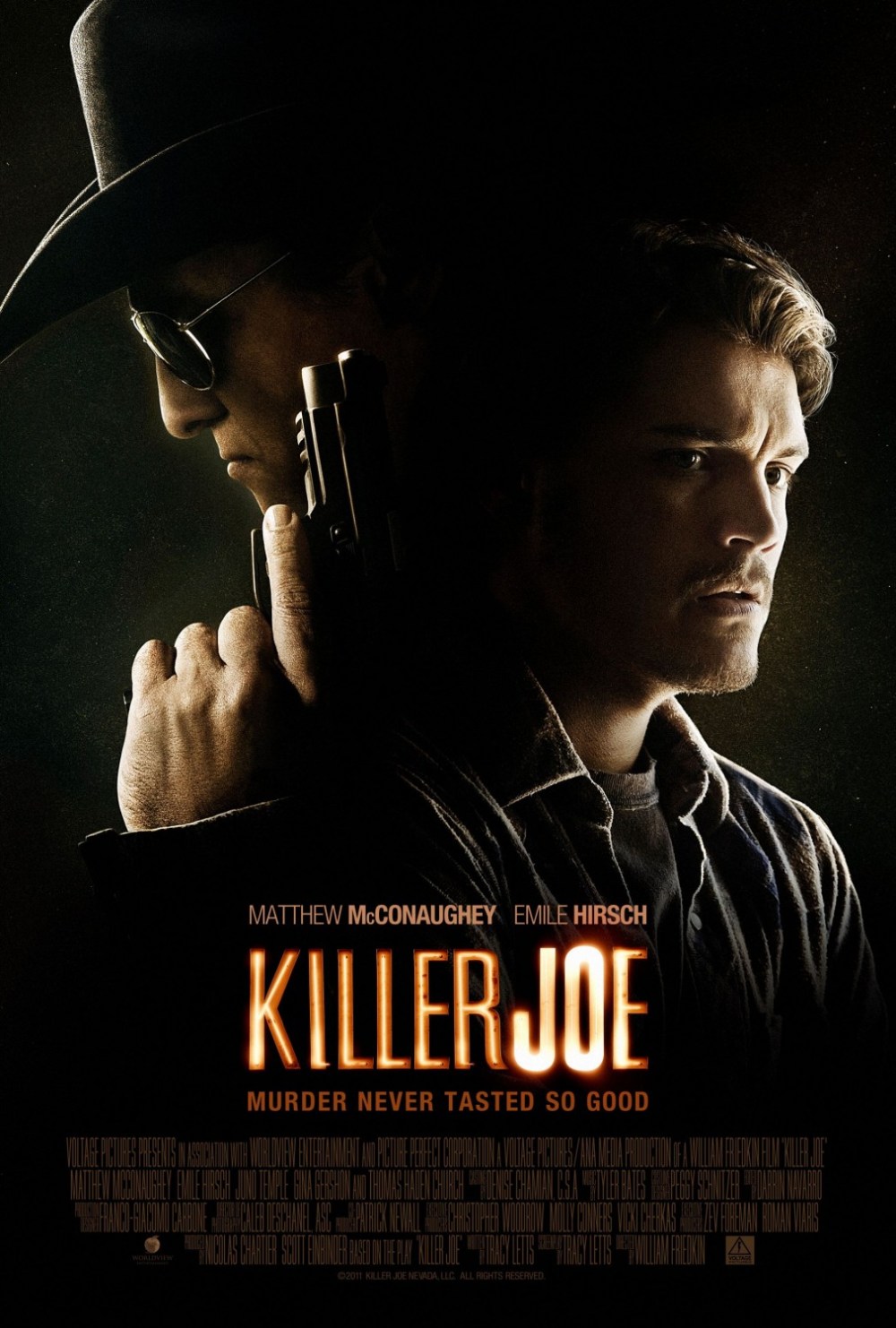
Oscar winning director William Friedkin made a special appearance at Landmark Theatres in West Los Angeles on August 3, 2012 to talk about his film “Killer Joe.” He appeared in front of a sold-out audience who had just finished watching it, and Friedkin ended up paraphrasing a review from the Los Angeles Times by saying, “Welcome to the abyss!”

This remark was in reference to the fact that “Killer Joe” has already earned a bit of notoriety after receiving an NC-17 rating from the MPAA for what they described as “graphic disturbing content involving violence and sexuality, and a scene of brutality.”

At the start of this Q&A, Friedkin went over the three things a director needs to consider before they begin working on a project:

  1. Choose the material you want to do. Friedkin said this is very important as you will have to “live with it for a year.”
  2. Cast the film with the right actors. Friedkin said if anything goes wrong with the movie, it won’t matter how good the cast is because odds are the director has chosen the wrong actors for it.
  3. You need to create an atmosphere where the actors are comfortable enough to do the work. Friedkin remarked this is 75% of what a director does, and that the remaining 25% has the same person figuring out how to put their movie together.

When it came to casting “Killer Joe,” Friedkin said he went to actors Emile Hirsch and Thomas Haden Church first as he was familiar with their work. These days, Friedkin says he continues to watch “old movies” as they continue to inspire him, and he doesn’t watch new movies much.

Friedkin also admitted he has “never seen any of Matthew McConaughey’s films” before casting him here, and he originally wanted someone “more grubby” and with “a more evil look.” However, after watching McConaughey being interviewed by Charlie Rose where he was just being himself, he realized someone like McConaughey would be more interesting as opposed to what some would call a “more obvious choice.”

McConaughey, however, read and hated the script to “Killer Joe” and that he “wanted to take a bath with a wire brush” after reading it. Regardless, McConaughey read the script again because he couldn’t get it out of his head, and he told Friedkin he found it “absurd and hilarious in a dark way.”

Friedkin also admitted he knew nothing about Juno Temple before casting her as Dottie. He was originally going to go with one of three beautiful actresses for this role, but he ended up watching an audition tape Temple put together in which she read the script along with her 10-year old brother who played the part of Joe, the cold blooded cop and contract killer played by McConaughey. Friedkin said he loved what he saw but that he was worried about her “thick British accent.” He ended up asking the cast to tell Temple when she was speaking in a way which didn’t sound like she was from Texas. From what we saw onscreen, the cast helped Temple out big time.

In talking about Gina Gershon (the mention of her name got the audience to applaud loudly), Friedkin said she was not his first choice for the role of Sharla. When it came to casting this particular role, Friedkin said he saved this question for last when interviewing prospective actresses, “Can you handle the sex and violence that is presented in this script?” It should go without saying Gershon could, and Friedkin described her as being “courageous” in playing Sharla. She is asked to portray some of the hardest things any actor is asked to do, and I don’t just mean the scene involving her and that piece of fried chicken.

“Killer Joe” marks the second film Friedkin has made from a play written by Tracy Letts whose “Bug” he turned into a film back in 2006. Friedkin said he and Letts “share the same worldview” as they both “see the absurdity of the many facets in life.” Their projects, as Friedkin sees it, deal with people “stuck in their realities and willing to do anything to get out of them,” and that neither of them is “fond of violence.”

Still, Friedkin said he did not expect the NC-17 rating the MPAA gave “Killer Joe,” but he thinks it is somewhat correct as he was not targeting young teenagers for this movie as they are more impressionable. Both he and LD Entertainment, which is distributing the film, fought the MPAA over the rating, and in trying to get it down to an R, they ended up cutting not scenes but instead frames of footage. This, however, was not enough, so Friedkin and LD Entertainment ended up appealing the decision. Friedkin joked how they “narrowly” lost the appeal (13 to nothing) and that he felt he “had to destroy the movie in order to save it.” But after all the fights he had over movies like “The Exorcist,” Friedkin declared he is “too old to get down on my knees and change the picture” for them.

When asked what the tone on set was, Friedkin described it as “light” because he and the actors already knew what was in the script. Friedkin also said he only does “one or two takes these days” when making a movie as opposed to the “15 or 20” he did when he was younger and “praying for miracles.” These days, he looks for spontaneity in his actors, and he finds the first take they give him is often the “most spontaneous” of all.

Whatever you end up thinking about “Killer Joe,” it is clear Friedkin is still a masterful filmmaker who has not lost his touch. The characters may be beyond redemption, but he is quick to point out we are all sinners, and this is an inescapably true fact. After all these years, Friedkin continues to challenge his audience, and we should be thankful for this in a time where most filmmakers choose to play it safe and to their own detriment.

Joe Dante Talks About the Making of ‘Innerspace’ at New Beverly Cinema

Innerspace movie poster

On August 22, 2012, UCLA’s Association of Movie Archivists (AMIA) student chapter concluded its “Something Old, Something New” festival at New Beverly Cinema with a double feature of “The Incredible Shrinking Man” and “Innerspace.” The audience also got a special treat when the director of “Innerspace,” Joe Dante, stopped by, and he took great delight in sharing his experiences in making the 1987 science fiction comedy.

Dante pointed out how both movies actually have something in common; William Schallert, who played Grant Williams’ doctor in “The Incredible Shrinking Man,” also plays Martin Short’s doctor in “Innerspace.”

“Innerspace” was originally meant to be a “serious spy movie” when Dante first heard about it, but he said wasn’t interested in directing it. Warner Brothers at one point even thought about making it into a movie about a crew exploring the human body, and Dante said he didn’t have the heart to tell the executives there was already a movie about this subject which was called “Fantastic Voyage.”

But when Jeffrey Boam, who would later write the screenplay for “Indiana Jones and the Last Crusade,” rewrote the script, he turned it into a comedy. Boam described his script to Dante as “Dean Martin being shrunk and then put into Jerry Lewis,” and this got Dante interested in making the movie. The only thing was Steven Spielberg’s production company, Amblin Entertainment, was making the movie, and Spielberg wanted his protégé Robert Zemeckis to direct it. Zemeckis, however, decided he didn’t want to direct, and Dante said he “inherited it” as a result.

Dante said he had a “wonderful experience” making “Innerspace” mainly because of the cast which included actors Dennis Quaid, Martin Short, and Meg Ryan among others. The movie was shot in San Francisco, and things went fine even though Senator Dianne Feinstein apparently hates it when filmmakers come up north to shoot there.

In talking about working with Short, Dante said the actor “liked doing many takes” and that he “did a lot of improvisation” throughout. But when Dante had to tell Short that they had “more than enough takes” to work with, Short got on his knees and told him in his Katherine Hepburn voice, “No Joe! Please let me do just one more!”

What made “Innerspace” less fun for Dante, however, was that the studio found it to be “not funny.” After one particular day of filming, Dante recalled studio executives from Warner Brothers invited him out to lunch and told him what he was doing wasn’t funny and they thought he “should know that.” They also described Short as being “not very attractive” and wanted to recast the role with someone like Dennis Quaid instead. Upon hearing this, Dante asked them, “Did you even read the script?!”

Dante reflected there are many executives involved in the making of any movie, and they all want to “have their say” in what ends up onscreen. After hearing what they had to say, Dante said he wondered if he was the only one on the set who thought what he was doing was funny. While this conversation left him with a lot of anxiety, he decided to “plow on” and just make the movie he always intended to make.

When it came to test screenings, Dante said “Innerspace” got “one of the best previews” of any movie he had ever worked on. He even recalled how the studio executives who once doubted him were “high-fiving each other” and believed they had such a hit to where “they didn’t think it needed any advertising as a result.”

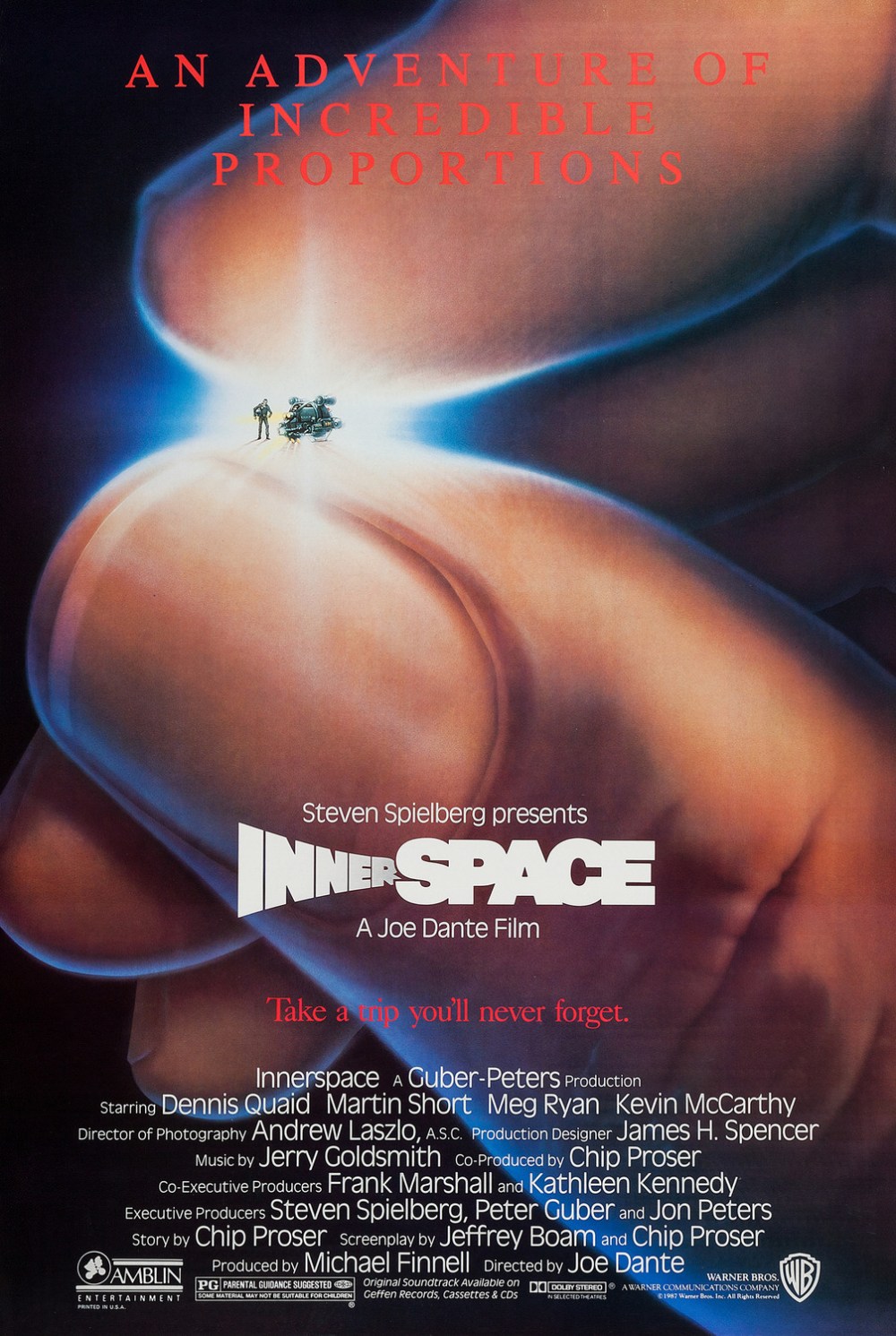
“Innerspace,” however, ended up flopping at the box office in the summer of 1987, and Dante said this was because Warner Brothers did not know how to promote it and that the original poster failed to include the movie’s actors on it. Dante even recalled the review from Los Angeles Times which said the movie “crashed and burned.” Regardless, it later became one of the first movies to find the audience it deserved on videotape and DVD, and it has since developed a strong cult following. It also won the Oscar for Best Visual Effects, and this was back when CGI effects were far from ever becoming a reality. Film critic Roger Ebert apparently thought the red blood cells we see in the movie were actually real, and Dante ended up having to tell him they were not.

Joe Dante said most comedies don’t work unless they are seen in a movie theater, and “Innerspace” is definitely proof of this. The audience at New Beverly Cinema was laughing constantly throughout, and the movie still holds up very well to this day. It was great to see Dante this evening as his presence was once again a reminder of how delightfully entertaining a filmmaker he truly is.

Nicholas Meyer on the Making of ‘Star Trek VI: The Undiscovered Country’

Nicholas Meyer on the set of Star Trek VI

WRITER’S NOTE: This article was originally written back in 2011.

With “Star Trek VI: The Undiscovered Country,” co-writer and director Nicholas Meyer described it as being different from the previous films in the franchise due to it being “political in context.” At a Q&A which was held after a screening of it at the Egyptian Theatre, Nicholas said the story came about when he met with Leonard Nimoy. The story focuses on the Federation making an uneasy truce with their longtime enemies the Klingons, and it deliberately reflected the relations between the United States and Russia at the time the film was made.

Nimoy described the idea of having an “intergalactic Chernobyl” and of “the wall coming down in space” to Meyer, and the story came out from there. As it happens, the coup which took place in Russia happened around the time “Star Trek VI” was released, and Meyer said his dentist saw how the film predicted it would happen. His response was to see “The Undiscovered Country” again as he didn’t realize this was the case.

Watching it today made Meyer realize there was no way anyone could have anticipated the changes coming, be it the collapse of the Soviet Union or the current events in the Middle East. He said it all makes the Cold War seem good in retrospect. Indeed, with the wars being fought in Iraq and Afghanistan, the scene where Spock forces a mind meld on Lieutenant Valeris to get information now seems like torture. Although Meyer said Spock’s intention in the scene was to just get information, he winces at it now and says it’s hard to watch when Valeris moans in Vulcan agony.

For the character of Klingon General Chang, Meyer freely admitted he wrote the part with Christopher Plummer in mind. This was largely due to how he loved listening to Plummer’s recording of “Henry V,” and he made it clear to the film’s casting director, Mary Jo Slater, that she should not come back to Hollywood without him. Incidentally, Mary’s son, whom you just might recognize, makes a cameo in the film as an officer aboard the Starship Excelsior.

“Star Trek VI” was the last movie which featured the original crew of the starship Enterprise. Meyer described every day as being “normal” until the last one. At that point, the whole cast became very cranky, and they forgot lines of dialogue which some of them did not like in the first place. The whole cast had been together for 30 years, and since they go back a long way, they approached the end of it all in a very “bewildered” state. One thing’s for sure, the signatures from the cast at the movie’s end were not hokey in the slightest.

This also turned out to be the last “Star Trek” movie which series creator Gene Roddenberry got to see before he died. Meyer said his interactions with Roddenberry were “minimal” as Roddenberry was not officially involved with the movies after “Star Trek: The Motion Picture” and was relegated to being an “executive consultant.” Apparently, Roddenberry was incensed that the screenplay for “Star Trek VI” made the crew out to be racist, but it did give this movie its much needed dramatic conflict. He died three days after he viewing a rough cut of it, and the movie is dedicated to his memory just as it should have been.

Looking back, “Star Trek VI” questions whether we have reached the end of history, and it is clear we have certainly not. It served as a perfect swan song for the original cast and was a much better movie than its predecessor (“Star Trek V: The Final Frontier”) which almost destroyed the franchise. It also provided us with one of the greatest pieces of dialogue ever in a “Star Trek” movie:

“You’ve never experienced Shakespeare until you’ve read him in the original Klingon.”

So true!

George Takei Reflects on the Significance of ‘Star Trek II: The Wrath of Khan’

George Takei in Star Trek II

WRITER’S NOTE: This article was originally written back in 2011.

George Takei stopped by the Egyptian Theatre for American Cinematheque’s tribute to the first six “Star Trek” movies. Showing on this particular evening was “Star Trek II: The Wrath of Khan” and “Star Trek III: The Search for Spock.” After watching “The Wrath of Khan,” he remarked it’s still a “rip-snorting good space opera” and that Nicholas Meyer deserves all the credit for its critical and commercial success as he added so many layers to the story along with unforgettable literary quotes like the following one by Charles Dickens:

“It was the best of times; it was the worst of times.”

Takei said watching “The Wrath of Khan” proved to be very poignant for him as he looked over the beginning credits and remarked how DeForest Kelley and James Doohan are no longer with us. He also talked about Merritt Butrick who played Dr. David Marcus in “Star Trek II & III.” Merritt sadly passed away from AIDS back in 1989, but Takei said he got the chance to see him in a two-character play in which he portrayed a sick gay hustler. Even though Butrick was very sick during this time and had to rest in between his scenes, Takei confirmed that he showed full commitment to his role and kept on with acting to his life’s end. RIP Merritt.

Takei then brought up Spock’s speech towards the end of “Star Trek II” of, “The needs of the many outweigh the needs of the few.” Hearing this again made him think about all the workers going into the damaged nuclear power plants in Japan, knowing full well what they were going to face. The deadly earthquake and tsunami which has shattered the country has been very painful to him, and he feels a deep connection with all those suffering there as the calamities keep piling on top of each other. George recently filmed a PSA asking for funds to help the people, saying these are indeed the worst of times, and at times like these “we are all Japanese.”

We are now approaching the 45th anniversary of “Star Trek,” and Takei says he owes all the success of it to Gene Roddenberry and his great taste in casting. When he got the job, he was doing guests spots on various TV shows, and he described the idea of steady employment as being “very enticing.” He also remarked how science fiction can play a big part in the future as the character of Pavel Chekov, a Russian was made a part of the Enterprise bridge crew while the world was dealing with the Cold War. There’s also the International Space Station whose crew is made up of people from all over Earth. Just try and convince us that “Star Trek” had nothing to do with any of this, I dare you!

George Takei remains a popular and well-respected actor to this very day. This July, he will be co-starring in “Larry Crowne” along with Tom Hanks (who also directs) and Julia Roberts. His character ends up falling in love with one of them, but you’ll have to see the movie to find out whom. In addition, he is playing a hologram of a character in “Super Ninjas” who is jokingly called “Hologramps,” and he is working on a musical about his experience living in a World War II internment camp with other artists called “Allegiance,” and they plan to take to Broadway. He also continues to reach a new demographic on the Howard Stern radio show, to which he replied, “Oh my!”

Live long and prosper George, and thanks for taking the helm on such a fun evening!

Walter Koenig Looks Back at ‘Star Trek IV: The Voyage Home’

Walter Koenig in Star Trek IV

WRITER’S NOTE: This article was originally written in 2011.

Fifty years after his screen debut, Walter Koenig took a trip down to the Egyptian Theatre which was showing “Star Trek IV: The Voyage Home” and “Star Trek V: The Final Frontier.” By that, I mean he literally tripped while making his way to the front of the audience. Fortunately, he was unharmed and said he always planned to do that.

Koenig played Pavel Chekov on the original “Star Trek” TV series as well as in the first seven movies of the franchise. Of all the movies, he declared “Star Trek IV” to be his favorite and reveled in how Chekov actually had his own theme music. “The Voyage Home,” he said, reflected the best things about the show and had a strong sociological statement. It also had soul and got you really involved with the characters, and it showed the connection they had with the audience whether or not they were Trekkers.

Koenig also called “The Voyage Home” the most ensemble film of the film series as each actor had their own stand out moment. That is, except for George Takei who was supposed to have a scene where Sulu meets his great grandfather. Koenig described the kid who was cast in the role as being “a real pain in the ass.” Every time the crew was ready to shoot, the young boy would say, “I don’t wanna!” By the time he did want to shoot, the sun had gone down and the crew lost the shot. Suffice to say, Takei was not happy about that.

Koenig also took the time to applaud the audience for what he called their “Pollyannaish” devotion to “Star Trek: The Motion Picture.” When it first came out, he said the reviews were “brutal” and that critics complained the cast was “too old” and should “only be on TV.” At the time, Koenig considered himself “anonymous” compared to the rest of the cast, but he found this to be great because his name was never mentioned in the reviews. Looking back, he figured they forgot he was in the movie.

When it came to “Star Trek: Generations,” Koenig knew going into it he would have nothing more than a cameo. Initially, the whole Enterprise crew was supposed to be in it, but Takei, Leonard Nimoy, and DeForest Kelley considered their parts to be not worthy, and Koenig said they were right. In the end, it came down to William Shatner, the late James Doohan and him acting as the bridge to the “Next Generation” cast.

When it came to “Star Trek: Generations,” Koenig originally said no to it because, despite the six-figure salary, he felt he had done this before and that there was nothing new for Chekov to do. The movie’s producer, Rick Berman, met with him, and Koenig suggested they add a scene which would make Chekov a bit deeper, and this involved when he was with Scotty after Captain Kirk got blasted into space. The end result of what Koenig did brought a half dozen people on the set to tears, but in the end it got cut out in the editing room. Koenig said he believed it was all a Machiavellian setup designed to get him involved and that they never planned to put the scene in the final cut.

It was great to see Walter Koenig in such good spirits considering the personal tragedy he endured when his son Andrew committed suicide, and he left the audience with a great treasure trove of behind the scenes stories to remember. He left us to find those “nuclear wessels” as he sarcastically said we were probably all waiting to see “Star Trek V.”

Thanks for a fun evening Walter!

Grindhouse Film Festival’s Screening of ‘Blood Beach’ at New Beverly Cinema

Blood Beach poster

WRITER’S NOTE: This screening took place back in 2011.

With the beginning of the fall season, the Grindhouse Film Festival screened a movie at New Beverly Cinema to let the feeling of summer linger just a little bit longer: “Blood Beach.” This 1980 low-budget horror flick has been out of print for many years, and it still has not seen a DVD release in America. It’s amazing anyone was able to find a print of it to show on this particular evening of November 8, 2011. Joining the audience for a Q&A following the screening were the movie’s writer and director Jeffrey Bloom, director of photography Steven Poster, and actor John Saxon.

Bloom told the audience he had not seen “Blood Beach” in 30 years, and Saxon said he remembers its first screening but doesn’t remember audiences laughing at it like they did at this one. Poster sees it as his first real feature, and this is despite the fact he had worked on other movies beforehand, and Saxon confirmed this was the first time he ever played a police chief in a movie. Looking back, Bloom described it as a “beautiful looking film” even if we couldn’t tell it from the faded print which looked like it had been mostly drained of its color.

This was a very low budget production which found life through an Asian financier who was looking to do horror movies. Bloom recalls writing the script for “Blood Beach” in a week and a half, and he had a celebration in order to promote it which had buttons with the following saying: “Blood Beach Sucks You In!”

At this same party, a movie executive accosted Bloom, saw his button and subsequently told him, “Artists don’t promote their movies like this!” He then tried to rip the button off of Bloom’s shirt until Bloom explained to him why he was wearing it in the first place. From there the executive told Bloom, “Give me the script!”

Two weeks later, “Blood Beach” started production.

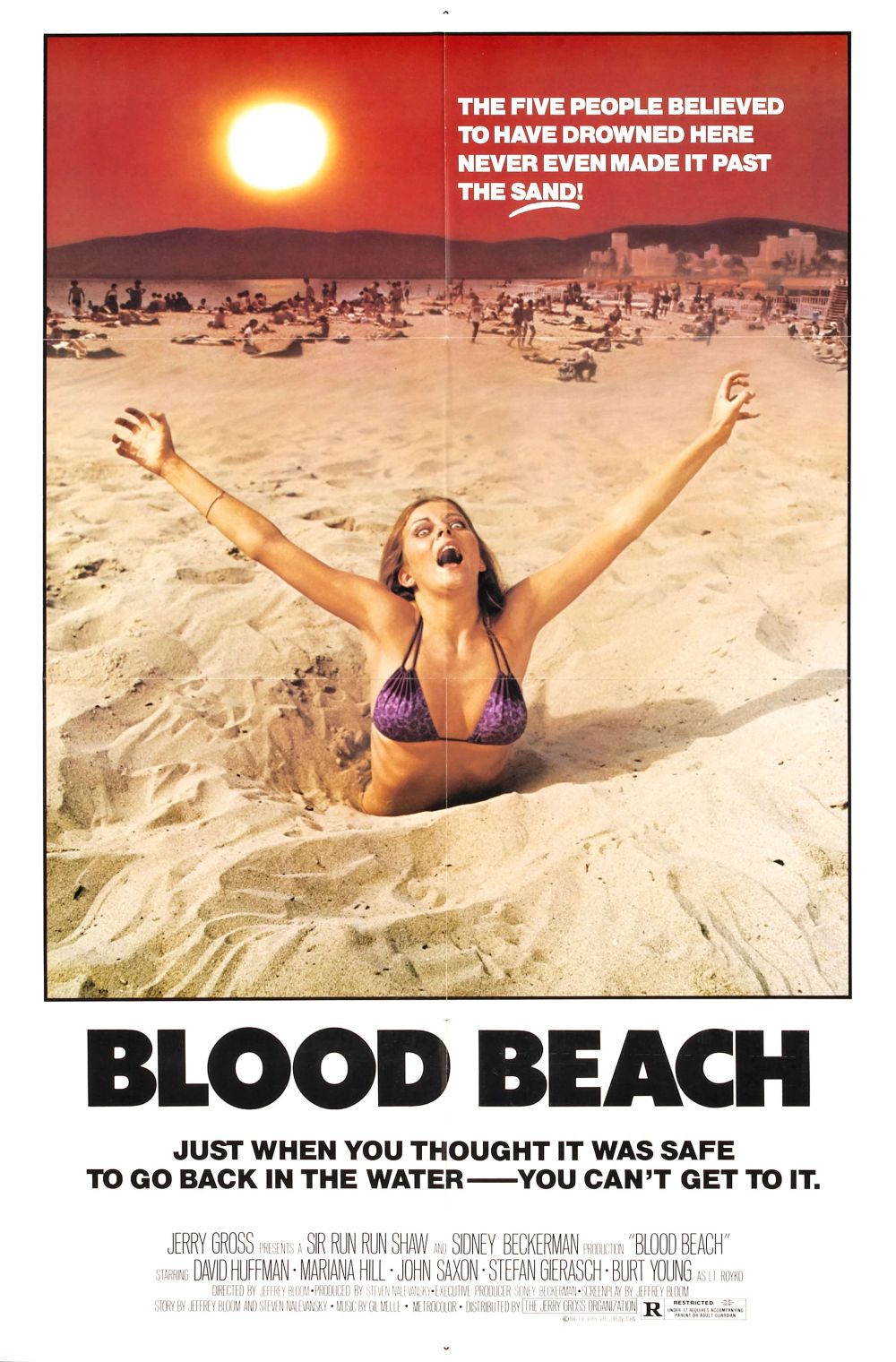
The special effect of sucking victims into the sand proved to be quite effective, as you can tell from the movie’s poster. To achieve this frightening effect, Bloom said tractors were brought in to dig into the sand. Afterwards, the crew built a platform where a “membrane” was placed where the actors could easily be pulled into the sand. This led to the movie’s clever take on a famous catchphrase from “Jaws 2:”

“Just when you thought it was safe to go back into the water … you can’t get to it!”

As for the monster causing all the murderous havoc, the cast and crew agreed its reveal proved to be a “big disappointment” and that it looked like nothing more than a “giant artichoke.” One audience member asked what the concept of the creature was, and Bloom replied they never had one which was the problem. No one had bothered to draw up pictures as to what they wanted this monster to look like, leaving it up to the creature designer to come up with something.

Poster laments how no one can seem to find out who owns the rights to “Blood Beach.” He has had the opportunity to remaster a lot of the movies he has worked on like “Dead and Buried,” and he says it’s a shame he can’t do more work on this one: It’s a better film than he remembers it being. There is a lot of humor to be found in this low budget horror flick which has since gained a cult following, and critics overseas found it to be hilarious. Like many lost movies out there, hopefully this one will eventually find its way to a digital release.

Since writing this article, there have been a few updates regarding “Blood Beach:”

As of 2012, it has only been officially released on DVD in Germany.

In 2015, Alamo Drafthouse Cinema re-released it in 35mm as part of the “NY! Hudson Horror Show” which was held in Yonkers, a city in Westchester County, New York. It was promoted by a new theatrical poster designed by artist Stephen Romano.

Quentin Tarantino and His March Madness at New Beverly Cinema

Quentin Tarantino New Beverly Cinema photo

WRITER’S NOTE: This article was written back in 2011.

With his birthday falling on March 27th, actor, writer and director Quentin Tarantino plans to celebrate the month of his birth at New Beverly Cinema in Los Angeles, the same theater he saved from becoming just another Supercuts. The theater’s calendar for March includes a number of exploitation classics, some animated movies that Walt Disney would never have even thought of making, and several other films which are not currently available on DVD. Many of these cinematic experiences are very rare, and it is highly unlikely you will see them anywhere else.

Tarantino ended up making a surprise appearance at the New Beverly on March 1st, 2011 to introduce the first double feature of his month of programming: “Crack House” and “Redneck Miller.” Now “Crack House” was one of the myriad releases from Cannon Films during the 1980’s, and it follows young lovers Rick and Melissa whose relationship gets torn apart when Rick’s brother gets shot to death by a rival gang, and Rick quickly rejoins the gang he left for a better life to avenge his brother’s senseless murder. Of course, this all goes awry when Rick gets sent to prison while Melissa falls in with a drug dealer and gets hooked on crack cocaine.

Tarantino described “Crack House” as being very, very special to him as it came out in 1989, the very last year in which exploitation movies played in movie houses. From when he was young, he talked about making a list each year of the ten best exploitation movies that came out, and among his top picks was George A. Romero’s “Day of The Dead.” “Crack House” got the very last exploitation movie of the year award from Tarantino before these lists were rendered obsolete.

With exploitation movies, Tarantino said we were all attracted to them through their “50’s-ness of juvenile delinquentness.” Basically, these films were the bad boys of cinema, the ones which didn’t follow the rules nor did they ever apologize for being trashy entertainment. From the 1950’s onward, exploitation cinema succeeded in reflecting the juvenile delinquents of each passing decade. But when it came to the 1980’s, these same movies suddenly became unwatchable because, as Tarantino correctly pointed out:

“The 80’s were one fucked up decade!”

But “Crack House” is one of those rare 80’s exploitation flicks which does get better as it goes along. Even Tarantino admitted how shocked he was to find he actually “gave a fuck” about these characters who might seem like stereotypical bad boys to everyone else. The “Pulp Fiction” director also acknowledged the terrific “guest star” cast which included Richard Roundtree (the original Shaft) as a no-nonsense cop, and all-time football great Jim Brown as a vicious drug kingpin.

Tarantino’s brand of March Madness at the New Beverly will culminate in a week long showing of “Kill Bill: The Whole Bloody Affair.” This is the combined version of both films into one single movie which screened at the Cannes Film Festival and has never been seen before in the United States. At four hours long, there was no way New Beverly was just going to show it two nights of the week! However, as I write this, all advance tickets for each night are now sold out (NOOOOO!!!). Your best bet is to get to the theater really early in the hopes you can get in through the standby line.

In any event, here’s to a month of great, unabashed entertainment at the New Beverly Cinema!

Top photo courtesy of Los Angeles Times.