‘Creepshow’ Remains a Benchmark in Horror Anthologies

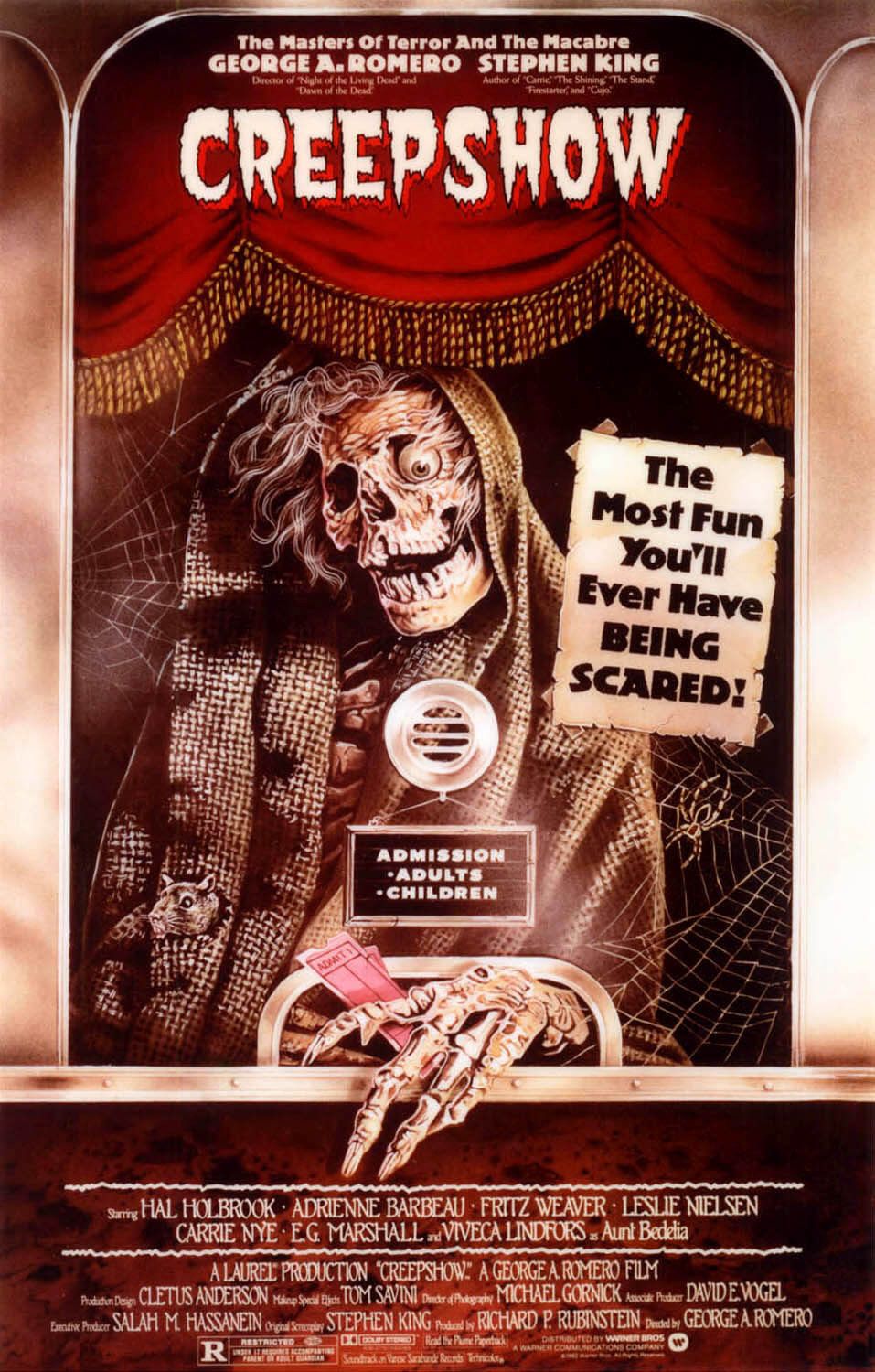
Creepshow movie poster

Ah, “Creepshow!” One of the best horror anthologies to come out of the 1980’s, and it is immensely enjoyable if you’re into this sort of movie. It brings us the combined talents of Stephen King and George Romero as they give homage to the E.C. comics of the 1950’s with five different stories of terror. In some ways, this can be seen as more of a comedy than a horror movie. Granted, it does have its scary moments, and a hand coming out of a grave is always good for a jolt, but it is presented in such an over the top fashion to where you have to thank both King and Romero for not taking the things too seriously.

As I write this review, filmmaker Eli Roth is having a two-week festival of his favorite movies at New Beverly Cinema in Los Angeles. This film was playing on a double bill with “Mother’s Day” which I missed, unfortunately, but it was probably because I was more excited about seeing this one. I vividly remember seeing the trailer for it when I went to see, and cry again at, “E.T.” When the image of The Creep first appeared, my brother responded by saying, “Whoa!”

The trailer was amusing and funny, at least until those cockroaches came in during which I had to cover my eyes. Granted, it would years and years before I would have the stomach, let alone the time, to check this one out. Anthology movies and series like “Masters of Horrors” are always intrigued me because they were filled with so many possibilities. Going from one story to the next, you are eager to see where it takes you. The only downside with anthologies is there is usually a weak story among the whole bunch which can weigh down the whole enterprise, but “Creepshow” doesn’t have this problem and is endlessly enjoyable to sit through.

The movie opens with a prologue where a father (Tom Atkins) berates his young son (Joe King, Stephen King’s son) for reading these “crappy” horror comics. The kick of the scene comes from the son calling out his dad for the hypocrite he is when he points out it’s a lot better than the magazines he reads. I couldn’t help but think this kid’s dad has a wide variety of porno magazines hidden where his wife can’t find them. It’s funny how we see fathers not wanting their kids to read “crap,” and then they sit in a recliner with a can of beer boasting of how God made fathers. Poor schmuck.

“Creepshow” then goes straight into its first episode entitled “Father’s Day,” a story of revenge. The patriarch of a family was murdered for being an annoying prick as he furiously demanded his cake to be brought out to him, and now he’s come back from the dead to get that tasty cake he has long been denied. Of all the stories, I consider it the weakest because “Father’s Day” is very short and threatens to be pointless. It does, however, succeed in defining the look of the movie. The acting is over the top, and there is a fantastic use of colors which dominates the movie and gives it a wonderfully pulpy feel. If Dario Argento had ever created a comic book, I’m sure it would look like this.

The great about “Father’s Day” is it allows us to see Ed Harris in a role where he is loosened up. Harris is a great actor who plays mostly dramatic roles in movies, and one day he will win an Oscar. But here, we see him get his boogie on while dancing to some crappy disco music which somehow sneaked its way into a 1980’s movie. You listen to that music, and you’d figure it would have died a fiery death before the 70’s ended. No such luck.

The next story, “The Lonesome Death of Jordy Verrill,” is both funny and sad. It features King in one of his few acting performances as the title character, a dimwit farmer who discovers a meteor which has crashed into his backyard. Jordy gets excited at the prospect of selling this meteor to the local college for a handsome profit, but when he tries to salvage it, it breaks into two and a liquid quickly seeps into the barren ground of the farm. Soon after, everything it touches starts growing green plant life which cannot be contained. It also grows on anything it touches, including Mr. Verrill himself. Seeing King turn into a bush is frightening and morbidly amusing. King may say he is a better writer than an actor, but you can also say he is a better actor than a director (“Maximum Overdrive” anyone?). In the end, he is perfectly cast as the seemingly brainless farmer, and his performance fits both the story and the film.

After that, we get “Something to Tide You Over,” and this one was my favorite of all the stories in the movie. It stars Leslie Nielsen, before his image was permanently altered by “The Naked Gun” movies, as a millionaire husband who takes his revenge on Harry (Ted Danson), the man having an affair with his wife. The way he lures Danson’s character out to the beach and gets him to bury himself in the sand up to his neck is priceless, and you can say there is a bit of “The Vanishing” here as we have a man willing to do anything to find out the fate of his loved one. Danson’s fate, being stuck in the sand as the tide rushes over him is frightening and unnerving to witness. You feel stuck in the sand with him, and it shows how fiendishly clever both King and Romero are at exploiting what we fear the most in life.

Watching this segment today may seem weird as Nielsen is forever known as Lt. Frank Drebin of “The Naked Gun” movies, and Danson is best known for playing Sam Malone on “Cheers.” Seeing them in a serious, albeit a highly exaggerated, story might be hard, but these actors have their serious chops as well as their comedic ones, and both talents serve them well here. Nielsen is a particular hoot as a man so confident of his deviant plan of revenge, yet quickly haunted by the possibility of his crimes coming back to do him in. Nothing can stay buried forever.

Next, we have “The Crate” which features Hal Holbrook as a Professor at a New England college who is saddled with an eternally inebriated wife (played by Adrienne Barbeau) who constantly embarrasses him and herself in front of anybody who happens to be watching. Holbrook’s character is a coward who doesn’t have the cojones to stand up to his wife, but then a colleague of his and a janitor discover a crate beneath the stairs which has not been opened for decades. It turns out to contain a monster who eats human beings whole. After Henry hears of this, he concocts a plan to lure his abusive wife over to the crate.

Holbrook is great at making you feel sorry for his character even while we berate him for being a wimp and not standing up to his wife. Barbeau gives a one-note performance as a humongous bitch with no real redeeming features whatsoever. In the end, this is not a big criticism because Barbeau is given a one-dimensional character to play. The characters are not meant to be complex in the way they handle themselves, and they are here to represent different types of people who meet their predestined fate.

Then comes the last story of the movie, appropriately titled “They’re Creeping Up on You.” This one I had the hardest time sitting through, and I doubt it will be easy for you either if you have an intense phobia of bugs. E.G. Marshall plays Upson Pratt, a thoughtless and hateful bigot who has no sympathy for anyone other than himself. He gleefully takes delight in the suffering of others and lives in a completely sterile apartment which makes him look like he’s a doctor. But his problem now is with the bugs in his apartment, specifically cockroaches. They keep popping up out of nowhere, and their numbers keep growing and growing…I found myself looking at my shoes a lot during this segment, and it reminded me I need to get a new pair soon.

I remember watching one of those “scariest moments in movies” episodes on the Bravo channel. They featured the cockroach segment from “Creepshow” in it, and it turned out the segment was more of a socially conscious piece than people realized. This is after all a Romero film whose “Dead” movies are loaded with social commentary, and the whole point of the “Creeping” segment was to look at bigotry how what we fear the most we end up empowering. We invite our fears to mess with us, and sometimes they eat us whole. Suffice to say, this is very much an anti-racism piece, and it’s the strongest episode in the movie. Marshall gives a brilliantly zany performance as a man who cannot control the world around him any longer, and who could never really control it in the first place.

Eli Roth had programs for his festival entitled “The Greats of Roth,” and in it he summed up this “criminally underrated” movie perfectly:

“It’s amazing to see how many comic book and graphic novel adaptations today are praised for getting the ‘look’ of the comic perfect, and nobody ever seems to mention this film. This was the first time that Romero was really surrounded with a star-studded cast, and you see Romero, King and Tom Savini all coming together to create one of the most visually spectacular and fun horror films of all time. They set out to recreate the look and feel of the old E.C. Comics and nailed it perfectly.”

“Creepshow” is indeed one of the most deliriously entertaining horror movies ever made, and it is a visually stunning achievement made on what must have been an especially low budget. There were many other movies to come out of this which tried for the same look, but none of them succeeded at it quite like this one did. This is just a fun, fun, fun movie for people who dig this sort of thing, and to see it on the big screen was a real treat. As the movie’s tagline says, it is the most fun you will ever have being scared.

* * * * out of * * * *

WRITER’S NOTE: This review was originally written in 2008.

Save

The Performances Make ‘3 Generations’ Worth a Look

3 Generations movie poster

I prefer to review movies for what they are as opposed to what I wanted them to be, but with “3 Generations,” this proves to be a bit of a challenge. For the most part, I think it is a sweet and thoughtful movie about transgender issues. But yes, it could have dug deeper into an issue many struggle with in life as this one touches on the family dynamics at play when one member decides to transition to another gender. For many, this is a volatile issue with many psychological scars being inflicted on those who do not deserve to be misunderstood, but director Gaby Dellal and her co-writer Nikole Beckwith at times take this story in a comical direction to where it borders on becoming a sitcom. Still, I can’t help but like this movie for what it is as deals with its subject matter in a sympathetic way and features three terrific performances which alone make it worth the price of admission.

Elle Fanning stars as Ramona who is now going by the name Ray because she sees herself as “a boy with tits.” Ray sees herself (excuse me, himself) as a boy trapped in a girl’s body, and he is determined to undergo gender reassignment to correct this. The main obstacle, however, is getting the consent of her parents to go through with it. His mother, Maggie (Naomi Watts), is willing to sign off on the procedure even though her anxiety and concerns over Ray’s decision make her smoke close to a full pack of cigarettes a day. His father, Craig (Tate Donovan), has been out of the picture for so long that Maggie would rather everyone believe he is dead. As for Ray’s grandmother, Dolly (Susan Sarandon), she wonders why he can’t simply be a lesbian like her.

At the center of “3 Generations” is Fanning who gives an excellent and heartwarming performance as Ray, and she fully invests in her character’s commitment to changing his identity into something far more acceptable to himself. Watching her is also a strong reminder of how teenagers are brilliant at seeing straight through their parents’ hypocrisy and bullshit to where they threaten to be more mature than those raising them. Whereas the other characters around him face an intense level of worry and anxiety, Ray knows exactly what he wants and shows zero doubt over what he feels he needs to do, and it represents the bravery I wish I had as a teenager.

You can never go wrong with Watts in anything she appears in, and she inhabits Maggie as your average mother; always wanting the best for her child while constantly worrying about the future. Maggie is almost convinced Ray will come to her one day with a beard on his face saying he made a mistake, but she is also the one closest to him willing to grant his wish to become a boy. Watts makes Maggie’s suffering all the more relatable as she reminds us all of how life is all about suffering, but through it all, we can find a happiness which a lot of times feels out of reach.

Sarandon is a wonderful presence here as Dolly who lives with her lover Frances (Linda Elmond), Maggie and Ray all under the same roof in a big apartment in New York’s West Village. This Oscar-winning actress is always great at playing the veteran mother who has seen it all and approaches her daughter’s problems like the pro she is. At the same time, her scenes tend to get overwhelmed by sitcom-like humor which threatens to take away from this movie more often than not. Still, Sarandon won me over as she always does, and the moments with Elmond remind us of the constant struggles couples go through. And by this, I mean any couple.

“3 Generations” works best when it focuses on Ray and his struggle become the boy he was always meant to be. We see him working out trying to build muscle, and he is determined to switch schools in order to get a fresh start in life once his transition is complete. At times, it focuses a little too much on the adults in this situation, and this is even though their concerns deserve our attention as well. While humor does come in handy in stories like these as they can become painfully too real, the filmmakers go a little overboard especially in a scene where Watts and Sarandon try different ways to treat Ray’s black eye.

Yes, this is a flawed movie that should have been better, but I still found myself liking “3 Generations” quite a bit as the performances are strong, and it has some surprises up its sleeve as it heads towards the finish line where we are reminded of how parents are never, ever perfect human beings. It all leads up to a final scene between a mother and her child which brought a real smile to my face as the constant struggles we face in life can lead to moments of true happiness.

Perhaps the transgender community deserves a strong movie than “3 Generations,” or maybe there are several out there we haven’t bothered to watch yet. All the same, I enjoyed this movie for what it was, and for me, that was enough. Still, it is a little hard to believe a family like this can afford such a big apartment in New York. You know the rents out there are ridiculously expensive, right?

* * * out of * * * *

“3 Generations” was originally given an R rating, but The Weinstein Company managed to succeed in getting the MPAA to give it a PG-13 which makes a lot more sense. This movie is certainly appropriate for teenagers, and this subject matter really shouldn’t be off limits to them. Then again, the MPAA has made many mistakes throughout the years, and it is unlikely this will be their last.

‘Risk’ Invites You into WikiLeaks’ Inner Circle… Somewhat

Risk documentary poster

Laura Poitras’ “Risk” is one of those documentaries which had me believing the scenes left on the cutting room floor were as, or perhaps even more, riveting as what ended up on the screen. It offers us a look into WikiLeaks and its creator Julian Assange, and it is a very intimate look which I was never sure we could ever get. What we get is a very compelling look at the inner workings of this organization which thrives on getting to the truth which is more often than not kept away from our prying eyes, and we see how this organization is constantly threatened by its infinitely powerful adversaries and perhaps by Assange himself. Yet at the same time, it feels like there is much more to the story than what we see onscreen.

Poitras filmed this documentary over the course of six years and was granted an astonishing amount of access to WikiLeaks and Assange. It starts off with Assange trying to get in touch with former Secretary of State Hillary Clinton as the security of WikiLeaks has been breached to where Clinton’s emails are about to be revealed to a public eager to sift through them voraciously. Assange has been accused of conspiring with the Russian government to interfere in the 2016 Presidential election, but he is shown here to be very eager to inform Clinton of how her problems are going to be much bigger than his own.

The most introspective moments in “Risk” happen near its start as Assange talks about what drew him to the work he does today. In a talk with Poitras, he says he doesn’t believe in being a martyr as much as he does in those who take risks for the things they care deeply about. The way he sees it, it is far more dangerous to do nothing than it is to do something, and the inaction of many has certainly led people to go against their best interests for no intelligent reason.

As the documentary goes on, however, the focus of it becomes a bit muddled as Poitras admits she is not sure what to make of Assange after a while. We never see her onscreen, but she does provide narration at various points where she admits she can’t ignore the contradictions of Assange’s character and is convinced he doesn’t like her. There is a scene where he and a fellow lawyer retreat to the woods for a private conversation, and at times he urges Poitras to take her camera off of him as he shares something he doesn’t want her to know. Towards the end, she says her friendship with Assange deteriorated to the point where they were constantly yelling at each other. Taking this into account, it makes you wonder just how much access she really had to his world as he remains so close and yet so far away.

One thing which cannot be denied is the size of Assange’s ego as he confronts many obstacles and impediments with a strange confidence even while the odds are stacked against him. We can’t help but laugh at scenes where those who work closest to him exhibit an exasperation as they clearly more aware of the ramifications of his actions more than he ever bothers to. He also manages to keep Poitras and even Lady Gaga at a distance as he is questioned about his intents and of what might happen if WikiLeaks one day comes to a sudden halt.

Assange does address the sexual assault charges in how he feels the U.S. government will exploit them for the sake of turning the American people against them. Still, in her director’s statement, Poitras says there was legal and personal pressure and demands by him and his colleagues to remove scenes which deal with the sexual assault investigations, and this was further complicated by another member of his staff being accused of the same thing. “Risk” does not imply guilt on Assange’s part, but it also doesn’t prove he is innocent either. This, more than anything else, makes me wonder what was left out of the final cut. Assange appears assured that WikiLeaks can never be taken down, but it feels like his inner circle sees the dominoes falling down a lot quicker than he does.

Looking back, “Risk” is really more about Poitras than it is about Assange. We never see her face, but we do get narration from her throughout. On one hand, she has the kind of access so many others can only dream of having, but you feel her growing confusion as she continually wonders if she can ever figure this man out fully. At the end, it seems like she may never know as he becomes more and more remote to where she wonders if she has just been used to further his agenda.

Certainly, no one knows more about risk than Poitras as she has been constantly interrogated and detained by U.S. officials whenever she traveled internationally, but this has not deterred her from reporting on mass surveillance and getting Edward Snowden on camera to discuss what he knows about it. Her previous documentary, “Citizenfour,” quickly became one of the most politically potent films ever made about the power a government can have over its citizens and its quest to silence those who dissent. “Risk” finds her continuing her quest for the truth even as her main subject is at times elusive as the forces surrounding him become more determined to shut him down for good.

I wish the film had been more probing into Assange’s life as he still remains a bit of an enigma, and there will always be a cloud of distrust hanging over him until the day he dies. Still, “Risk” gives us the closest of looks at an organization which continues to expose the things your government doesn’t want you to know about. If you can get past its flaws, it is a compelling watch which will have you contemplating the future of the free press and the first amendment. It ends on an ominous note as the FBI is determined to prosecute anybody and everybody involved with WikiLeaks, and I left the theater wondering how much longer we will have the First Amendment to fall back on. Hopefully, it will never disappear, but with the Trump administration, many unthinkable things have suddenly become possible.

* * * out of * * * *

Birdman or (The Unexpected Virtue of Ignorance)

Birdman movie poster

Will there be a more perfectly executed movie in 2014 than “Birdman?” It’s hard to believe there will as director Alejandro González Iñárritu succeeds in giving us a truly brilliant movie going experience which combines amazing technical aspects with a strong story and actors who give some of the best performances of their career. Your eyes will remain glued to the screen from start to finish as “Birdman” takes you on a cinematic journey we seldom go on, and you will leave the theater feeling mesmerized and in awe of what everyone managed to accomplish with a budget which is a mere fraction of today’s average blockbuster.

I’m always happy to see Michael Keaton in any movie he appears in, and he is crazy brilliant as Riggan Thomson, an actor who became a star after playing the superhero Birdman in a movie trilogy. As we catch up with him, he is now a washed-up actor whose glory days have long since passed him by. In an effort to restart his career and achieve true greatness as an actor, he decides to mount his own production of “What We Talk About When We Talk About Love,” a play which is based on the short stories of Raymond Carver. Riggan has put everything he has into this project and has even mortgaged his home to put up the capital for it. It’s hard not to sense his desperation as this play which he adapted to the stage, produced, directed and stars in threatens to become a total disaster.

Suffice to say, things are not going well as one of the cast members gets seriously injured before previews are set to begin, Riggan is trying to repair his relationship with his family while having an affair with one of the actresses, his daughter has just gotten out of rehab and is working as his assistant, and he has just cast a new actor whose ego is every bit as big as his talent. As his stress level increases, he begins to lose touch with reality and soon finds himself haunted by his most famous character who constantly urges him to take matters into his own hands.

Now many are calling “Birdman” Keaton’s comeback movie, but this is not entirely fair. Keaton never disappeared from the limelight, and while his career may not be as hot as it once was when he appeared in Tim Burton’s “Batman” movies, he remains a standout in each film he appears in whether it’s “The Other Guys” or “Toy Story 3.” But with “Birdman,” Keaton gets a role which is more than worthy of his talents, and he makes the most of this opportunity and then some. As unlikable as Riggan may be when it comes to how he treats others, Keaton makes you empathize with him as he tries to do right by himself as the play’s premiere comes at him sooner than he thinks. It’s a tour de force performance, and hopefully it will bring Keaton the Oscar nomination he should have gotten years ago for “Clean & Sober.”

But the real stars of “Birdman” are Iñárritu and his cinematographer Emmanuel Lubezki who brilliantly succeed in making this movie look as if it was all shot in one take. They make us feel like we are floating along into these characters’ lives as they struggle to make this play the best anyone in New York has ever seen. Even if you think you can spot where and when Iñárritu cuts from one scene to another, the movie still feels remarkably seamless from start to finish. Some filmmakers value the visual aspects of a movie over the acting or vice versa, but Iñárritu manages to balance out both to brilliant effect, and it makes for one heck of a cinematic experience. Heck, you can’t even help but wonder about what the cast and crew went through while making “Birdman” because there’s no way this could have been a walk in the park for anybody.

It’s impossible to think of an actor other than Edward Norton who could play the infinitely egotistical actor Mike Shiner so perfectly. Director Brett Ratner once described Norton as being someone whose mission it was to save a movie and of how this can be your best asset or your worst nightmare. I couldn’t help but think about what Ratner said as I watched Norton burst onto the scene and insinuate his character into a play about to be previewed to an audience. When it comes to method actors, they can take things too literally and Norton shows just how ridiculously far one can go. It’s one of his best performances to date.

I also loved watching Emma Stone who plays Riggan’s daughter, Sam. Stone has been a fiery actress ever since we first saw her, and you can’t take your eyes off of her whenever she’s onscreen. Stone makes Sam into a wonderfully realized character who is trying to stay one step ahead of what has brought her down in the past, and she gives a riveting performance which shows just how far her range as an actress can stretch. While she may not have been able to save “The Amazing Spider-Man 2” (in all fairness, no one could), she is a truly unforgettable presence here.

Other great performances in “Birdman” come from Naomi Watts who plays the amazingly insecure actress Lesley, and I have yet to see her suck in any movie she appears in. Andrea Riseborough, who stole a number of scenes from Tom Cruise in “Oblivion,” is wonderful as Laura, the actress Riggan may or may not have gotten pregnant. Zach Galifianakis takes on an unusual role for him as Riggan’s best friend and producer, Jake, who goes through hell in order to get this play off the ground. And then there’s Amy Ryan who plays Riggan’s ex-wife Sylvia who still has feelings for him even as he continues to do her wrong. Ryan never disappoints, and I love how she finds the good in Riggan when no one else can.

“Birdman” is the kind of movie which makes seeing movies on the big screen a sheer necessity. It challenges the realm of cinema to show what can be accomplished, and it gives us quite the kind of ride movies should be taking us on in a much more frequent way. In a year overwhelmed with tent pole franchises and a barrage of superhero franchises, this movie stands out as brilliantly unique and impossible to dismiss or forget.

* * * * out of * * * *

‘Gone Girl’ is a Deliciously Twisted Masterpiece

Gone Girl movie poster

David Fincher’s “Gone Girl” is a deliciously twisted masterpiece, a shocking and at times darkly comic look at marriage. I had an insanely good time watching it and I can’t wait to see it again, and that’s even if it’s just to watch the audience react so strongly to it. There’s no way you can come out of this movie and say you weren’t the least bit enthralled by the nasty journey Fincher takes us on. Just when you think “Gone Girl” couldn’t get any more twisted, it does. Based on Gillian Flynn’s best-selling novel (she also wrote the screenplay), he succeeds in getting away with a number of things in this movie just as he has with his past work.

“Gone Girl” opens on Nick Dunne (Ben Affleck), a frustrated writer who drops in one morning at the bar he owns (which is literally called “The Bar”) where he talks with his sister Margo (Carrie Coon) about the state of his marriage to Amy (Rosamund Pike). It happens to be their fifth wedding anniversary, and Nick celebrates it with a couple of glasses of bourbon which should give you an idea of how messed up things are between them. But then Nick comes home to find Amy gone and smashed furniture and glass scattered all over the floor, a sure sign something bad happened while he was gone. Suspecting Amy has been kidnapped, Nick calls the police and from there the search is on to find her before she disappears forever.

Now “Gone Girl” is a movie with an insane number of twists which makes it hard to talk about because it’s not worth spoiling any of them. But what I really loved is how it works on a number of different levels. Many movies can be boiled down to one sentence, but not this one. “Gone Girl” is a critique of a marriage that started off passionately but which has since been devoured by bitterness and resentment, and it makes you wonder why we tend to hurt the ones we love most. It takes a number of jabs at social media and people consumed with exploiting the trials and tribulations of others for the sake of ratings while the truth threatens to get lost in all the hoopla. It also serves as an indictment of a society quick to believe what they are told instead of recognizing a person is innocent until proven guilty. But at the heart of the movie is this question; how well do we know the person we choose to spend the rest of our lives with?

We see people reaching out to Nick Dunne in sympathy, but they just as quickly turn on him when evidence suggests he may have murdered his wife. From there, it becomes a constant game of media manipulation as the characters work furiously to get the upper hand on those who have deceived them and to sway public opinion in their favor. We live in a world of sound bites where information comes to us quickly and not always in an accurate manner. By the time we get to the truth, it may already be too late to view it objectively.

Over the years, many have described Ben Affleck as being this horrible actor who never had any business working in movies, but I’ve never agreed with this assessment. Yes, he has given some bad performances in “Pearl Harbor” and “Gigli,” but then again “Gigli” didn’t do anyone any favors. In “Gone Girl,” Affleck succeeds in giving one of his best and most naturalistic performances to date as he gives us a character who is not altogether likable, but who is still a complex individual caught up in a situation beyond his control. Nick is a complicated character who we are quick to make assumptions about, but what we think of him ends up saying more about us. I love how Affleck makes Nick a deeply mercurial character whose motives you can’t help but be suspicious of, and a scene where he sways the public back to his side during an on-camera interview with shows him at his conniving best.

I remember Pike from her early appearance as a Bond woman in “Die Another Day,” and she has gone on to give unforgettable performances in “An Education,” “Barney’s Version” and “The World’s End.” But when it comes to describing her work in “Gone Girl,” a flurry of adjectives cross my mind to where I have to be careful of what I say. What I can say is she is endlessly mesmerizing in a role which has her exploring every single facet of her character to where she surprises us in such an unnerving fashion. It’s a truly fearless performance you won’t soon forget after you leave the theater, and Pike doesn’t hold anything back.

“Gone Girl” also has a great supporting cast, and each actor sinks their teeth into their roles with relish. Kim Dickens is a delight as the cynical and yet slightly mischievous Detective Rhonda Boney, and she is blessed with a lot of great dialogue throughout. Patrick Fugit, almost completely unrecognizable from his “Almost Famous” days, is a snarky delight as Rhonda’s partner Detective Jim Gilpin. Neil Patrick Harris gives a charming and yet enigmatic performance as Desi Collings, Amy’s ex-boyfriend who looks like he can be trusted, but there’s a certain creepiness about him to where you wonder what’s really going on in his head.

Even Tyler Perry shows up in a very non-Medea-like role as Tanner Bolt, a somewhat devious attorney far more interested in winning the most impossible to win cases in court and playing the media like a piano to his clients’ benefit. Knowing how Perry caters mostly to the church going audience, I’ll be interested to see what they make of his time in Fincher’s dark world. I got a kick out of watching Perry here as he keeps his cool even as Nick’s case spins out of control.

You also have Missi Pyle on board as Ellen Abbott, a character clearly designed to remind you of Nancy Grace and of how annoyingly abrasive television hosts like her can be. Acting so entitled to her point of view even if the truth is not in her favor, Pyle makes her into a shameless individual who doesn’t apologize for anything even when she’s proved wrong.

But one supporting performance I really got a huge kick out of in “Gone Girl” was Carrie Coon’s as Margo. Coon is sarcasm incarnate right from the first moment she appears onscreen, and her scenes with Affleck are filled with love and devotion as well as a lot of anger at his foolish mistakes. I’m not too familiar with Coon’s work as she has appeared mostly in television and made a name for herself in various productions of the famed Steppenwolf Theatre Company, but I hope to see more of her in the future. She makes Margo a strong and fiercely independent character in a movie filled with so many morally clueless ones who get away with far too much.

The movie also marks Fincher’s third collaboration with composers Trent Reznor and Atticus Ross, and the two succeed in putting together another unforgettably creepy film score. What’s fascinating about their music here is it starts off sounding nice and inviting, but soon it becomes overcome by discordant sounds which imply there is something seriously disturbing going on in this quiet suburban neighborhood. Just when you think you can pull yourself away from the nasty voyage Fincher is taking you on, Reznor and Ross’ atmospheric score sucks you right back in and refuses to let you go.

Fincher’s “Gone Girl” is definitely a movie for these crazy times we live in now, and it is likely to make many out there think twice about getting married. Heck, even eloping sounds like a bad idea after watching this. But amid this tale of deeply flawed individuals and industry types more interested in their own celebrity than anything else, it makes one wonder whether we can ever really know someone completely. We’d like to think we know everything about our significant other, but can we really? This movie seems to imply we can’t, and Fincher makes you see this is one of the most frightening truths of all.

Fincher is a guy who never plays it safe, and “Gone Girl” is the latest example of that fact. Seriously, this is the most subversive and darkly funny take on marriage since Danny DeVito’s “War of the Roses.” I have not yet read Gillian Flynn’s book, but I really want to now. A woman sitting next to me at the screening confirmed the book is a great read and that she was very satisfied with Fincher’s adaptation of it. I’m fairly certain she is not the only one who feels this way.

* * * * out of * * * *

Nicholas Meyer Talks About ‘Star Trek II: The Wrath of Khan’ at New Beverly Cinema

Star Trek II movie poster

Nicholas Meyer was the guest of honor at New Beverly Cinema on August 12, 2012 where “Star Trek II: The Wrath of Khan” was being shown. This classic sequel was being screened as a double feature with John Carpenter’s “The Thing” as part of the New Beverly’s tribute to movies from the summer of 1982. Meyer thanked the sold-out audience for showing up and admitted it was “preferable to being outside in this weather” where the temperature was inching closer to triple digit territory.

Actually, seeing Meyer appear in person for a screening for “Star Trek II” was a bit of a surprise. Last year, American Cinematheque presented a film program of the first six “Star Trek” movies, but Meyer politely declined to appear for the “Star Trek II” screening because he felt his head would explode if he was asked another question about it. In a sense, you have to be sympathetic to him because this is now a 30-year-old movie, and he has probably been asked every conceivable question about it. Meyer even went out of his way to tell audiences at the start, “I’m sorry if you’ve heard all these stories before. These stories can also be found in my memoir entitled ‘The View from The Bridge: Memories of Star Trek and a Life in Hollywood.’”

Meyer recalled how, after directing “Time After Time,” he wanted to do an adaptation of a Robertson Davies novel and would not consider anything else. But one evening while he was “flipping burgers” in his backyard, Meyer said a friend of his, an executive at Paramount Pictures, encouraged him to meet with producer Harve Bennett about the new “Star Trek” movie. Meyer ended up asking his executive friend, “Is that the show with the man with pointy ears?”

He met with Bennett who had gotten his start as a television producer on shows like “The Mod Squad” and “The Six Million Dollar Man,” and Meyer said they both remain friends to this day. Bennett ended up getting Meyer to watch “Star Trek: The Motion Picture” and episodes of the original “Star Trek” series so he could get familiar with the show and its characters.

Watching the show, Meyer said, “reminded me of something I loved as a kid” but he couldn’t recall what exactly. But it was late one night when he woke up at 4 a.m. in the morning that Meyer suddenly remembered: “Star Trek” reminded him of Captain Horatio Hornblower, a fictional sea captain who sailed the sea during the Napoleonic Wars in novels written by C.S. Forester. Meyer then envisioned this movie as “Captain Hornblower in space,” and from there he said he got a “hard on for doing a space opera.”

Four drafts had already been written for “Star Trek II,” and Bennett told Meyer Paramount was currently waiting on number five. Meyer said he had asked Bennett for the fifth draft and eventually got it after a delay, describing it as being 180 pages long and that he didn’t understand what he was reading. Meyer said he then asked Bennett if he could read the fourth draft, and he said Bennett ended up telling him, “Look kid, you don’t understand, all those previous drafts were just attempts at making a second ‘Star Trek’ movie.”

Meyer said he then suggested to Bennett they get all the previous drafts, read them over and then make a list of things they liked so he could try and weave them into a new script. The only problem was Industrial Light & Magic needed a script in 12 days so they could prepare the special effects for the opening. Meyer said he then asked Bennett, “What opening?”

“Star Trek II” already had a date it was set to arrive in theaters on, and this made writing a new script problematic. Bennett said it would take too much time to make Meyer a deal to get an additional writing credit, and Meyer ended up telling him, “Look, forget about the deal, forget about the writing credit, forget about the money. We don’t work on this new script now, there will be no movie.” Among the ideas kept from the previous drafts were the Genesis Device, Lieutenant Saavik (played by Kirstie Alley), and Captain Kirk as a dad.

When asked about what it was like working with the “Star Trek” actors, Meyer responded, “Have you seen the movie ‘Galaxy Quest?’ That movie was made for me!”

Meyer said the actors were very helpful in terms of crafting the script as they had already inhabited these characters for many years. Much of the talk, however, was on William Shatner whom Meyer described as “a very good actor.” Meyer also said Shatner was “very protective” of Kirk and that he is always the hero and in your face. In directing Shatner, Meyer described him as getting better the more he did a scene because he started getting bored to where he stopped striking an attitude and just became Kirk. This led Meyer to creating excuses to shoot scenes with Shatner over and over again like saying, “The sound’s not right there…”

There was also much talk about the late Ricardo Montalban who played Khan, and Meyer recollected he gave Montalban a copy of “Moby Dick” when they first met to talk about the movie. As an actor, Meyer said Montalban “hit all his marks” perfectly, but that he had to rein the actor in during Khan’s introduction. The character’s opening scene sounded like a rant, Meyer said, when Montalban first performed it, and he ended up taking the actor to the side and told him about a famous piece of acting advice once given by Sir Laurence Olivier:

“You shouldn’t show the audience your top because if you do, then you will have nowhere to go.”

When asked why Kirk and Khan never shared a scene together, Meyer said he didn’t realize this was the case while he was writing the script, and he found it impossible to put them together in a two-shot. Meyer then joked that these characters have Skype and that their conversations had to take place this way. He also answered the question he is most asked when it comes to talking about Montalban, “Yes, that is his real chest.”

Looking back at “Star Trek II: The Wrath of Khan” these days, it does appear to represent one of Hollywood’s first attempts at a franchise reboot as the original, while a commercial success, was not well-received critically. While he probably has answered every conceivable question regarding this movie, it was still great to see Nicholas Meyer at New Beverly Cinema as he has been responsible for some of the very best “Star Trek” movies made so far, and his talent as a writer and director remains strong to this day.

Sandy King Revisits John Carpenter’s ‘Body Bags’ at Cinefamily

Body Bags Blu-ray cover

Remember John Carpenter’s “Body Bags?” It was a horror anthology containing three stories: “The Gas Station” which has a female college student working a graveyard shift and getting terrorized by a serial killer, “Hair” about a hair transplant which goes horribly wrong, and “The Eye” where a baseball player loses an eye and gets a new one from a recently executed murderer. Many see it as Showtime’s answer to HBO’s “Tales from the Crypt” as it featured Carpenter as a creepy-looking and deranged coroner who introduces the three stories while drinking formaldehyde as if it were a martini, and it looked like the start of a wickedly demented series. Was it meant to become a series, or was it simply intended to be a single movie? These questions were answered by Sandy King, the producer of “Body Bags” and Carpenter’s wife, when she dropped by Cinefamily which showed 1993 horror anthology as part of its Friday Night Frights series.

King told the audience Showtime originally wanted a 3-story movie and that it was supposed to be a one-shot movie for her and Carpenter. As soon as they were done, they would be off and running to their next project. King remarked how anthology movies were very hard to finance as they were typically not successful at the box office, so bringing one to a cable channel like Showtime made more sense. When it was finished, Showtime then decided they wanted to turn it into a series, but King explained why she and Carpenter decided against it.

“We shot it in California, mostly in Los Angeles, which allowed us to get a lot of the great cameos with Wes Craven, Sam Raimi and Roger Corman,” King said. “Showtime, however, wanted to lower the budget and shoot the series in Canada, and we felt the amount of money they were putting into was not going to be enough to get it right. Plus, shooting in Canada would have made it enormously difficult to get the cameos we got. So, we basically told Showtime thanks, but no thanks.”

“Body Bags” was in many ways a family affair as it involved King and Carpenter working with people they worked with in the past. King had previously worked with Bobby Carradine and Stacey Keach on the Walter Hill western “The Long Riders,” and she had worked with Mark Hamill as well. Peter Jason has appeared in many of Carpenter’s films, and he even used his own car for his appearance in “The Gas Station.” As for the cameos from Craven, Raimi and Corman, she reminded the audience that the horror community is a small and tightly-knit one as everyone knows each other in it.

Carpenter has never seen himself as much of an actor for those who have listened to his various commentary tracks on the movies he has done. After making a Hitchcockian cameo at the beginning of “The Fog,” felt he would be better off behind the camera instead of in front of it. Still, King said she wanted him to play the Coroner in “Body Bags” and that it actually didn’t take much to convince him. She also described Carpenter as an “inner looney” to where he allowed himself to let loose, with the help of Rick Baker’s makeup, on set. Also, Carpenter did not direct himself as the Coroner as King said a friend was brought in to handle his performance and to make sure he hit all his marks. Truth be told, casting him as the Coroner was very inspired.

King said she and Carpenter worked on “Body Bags,” “In the Mouth of Madness” and “Village of the Damned” all in a row. It was originally planned that Carpenter would direct all three stories in “Body Bags,” but as he was already in post-production on “In the Mouth of Madness,” she said Carpenter told her he couldn’t direct all three. To this, she replied, “Okay, we’ll get Tobe.”

The Tobe she was referring to was Tobe Hooper, director of the horror classics “Poltergeist” and the infinitely terrifying “Texas Chainsaw Massacre.” Getting Hooper to direct “The Eye” was a bit tricky as he was very disturbed by the material which had a husband attempting to kill his pregnant wife, but King told him it would be fun and that he could make it work. She also said it was fun to watch Hooper do comedy as he had a cameo at the end with Tom Arnold in which they play two morgue workers who perhaps enjoy their jobs a little too much.

It was great fun to watch “Body Bags” on the big screen and with an audience at Cinefamily, and it was especially nice to see Sandy King drop by and talk about its making and development. She even brought some Shout Factory Blu-rays of Carpenter’s movies to give away, and this writer was lucky enough to win a copy of the one for “Body Bags.” For Carpenter fans, the Blu-ray is a must as it features a great commentary track, a wonderful making-of documentary, and a trailer for the movie as well. It had been out of print for years, and the previous DVD released by Artisan Entertainment gave us a severely edited version which took out a lot of things like Craven’s inspired cameo and some especially gruesome moments. “Body Bags” may not be epic filmmaking, but it sure is a lot of fun for horror fans.

Poster and trailer courtesy of Shout Factory.

Save

James Gunn Looks Back at the Making of ‘Tromeo & Juliet’

James Gunn photo

The screening of “Tromeo and Juliet” at New Beverly Cinema brought many people to the theater who were involved in its making. Among them were the movie’s director and co-founder of Troma Entertainment Lloyd Kaufman, actor Will Keenan who played Tromeo, and actors Sean Gunn and Stephen Blackheart among others. But the real star of the evening was filmmaker James Gunn who entertained the devoted audience with many anecdotes about “Tromeo and Juliet’s” making. Best known these days for his films “Slither,” “Super,” for writing the script to the “Dawn of the Dead” remake and most especially for “Guardians of the Galaxy,” “Tromeo and Juliet” was one of his first jobs in the movie business.

Tromeo and Juliet movie poster

“Tromeo and Juliet” is, of course, loosely inspired by William Shakespeare’s classic “Romeo and Juliet,” and Kaufman said he and Troma Entertainment had tried to write the script for three or four years and could not get it right. It was his sister’s best friend who sent Gunn’s resume to Kaufman’s attention, and at that point Gunn had already graduated from Columbia University with an MFA in Writing Fiction. Kaufman, however, noticed something different about him.

“What caught my attention was he vomited onstage, that he was a performance actor who vomited onstage,” Kaufman said about Gunn. “I didn’t know whether he vomited because he was nervous or because it felt it was entertaining or because perhaps he had studied all the work of Terence Malick. But whatever it was, it was sort of like that moment in ‘The Producers’ when Zero Mostel sees his Hitler and says ‘you’re my Hitler!’ James Gunn was ours.”

Gunn said he didn’t actually vomit onstage and that Kaufman may have read someone else’s resume, but it didn’t matter because he got the job.

Keenan said he had not seen “Tromeo and Juliet” in fifteen years before this night and he joked that it looked twenty years old when it first came out. But for Gunn, this was part of the movie’s design.

“When we were doing the movie, I remember that I wanted it to look really dated,” Gunn said. “I used to love ‘Valley Girl’ and I loved looking back at it because it looked so 80’s. And I wanted to make this one look as 90’s as possible (it came out in 1997).”

Gunn recalled writing the first draft for “Tromeo and Juliet” in about a week and a half, and he gave it to Kaufman and assumed he was going to love it. Kaufman, however, found Gunn’s script to be “too filthy,” and this is saying a lot because Troma Entertainment movies usually revel in being filthy. Kaufman said there were about “8 scenes of urination” in the script, and Juliet was originally written to make her first appearance in a porno booth which is where the initial conversations between her and Tromeo would have taken place. Kaufman complained “Shakespeare didn’t have that in mind” when he wrote “Romeo and Juliet.”

There was also a bit said about Jane Jensen who played Juliet. She was not able to attend this screening, but Gunn talked of how he joked around with her throughout shooting. One scene from “Tromeo & Juliet” has her character’s stomach opening up to reveal popcorn and then rats and maggots. Jensen apparently had a near nervous breakdown shooting it as she had a major phobia of the maggots and was screaming her head off as the cameras rolled. Gunn recalls exactly what was going through his head at that moment.

“Wow! Jane’s acting is really good in this scene,” Gunn said. “And then all of a sudden I go ‘holy shit! I think that maybe this is real!’ And then I had that evil filmmaker moment where you go ‘do I keep filming?’”

Gunn ended up reminiscing about a review of “Tromeo and Juliet” he read in Film Threat Magazine, and he felt it captured the movie perfectly.

“They said, ‘I don’t know how to review this film because you can’t win,’” Gunn reminisced. “’If you say that there’s something stupid in here, they (the filmmakers) are going to say yeah, we meant to do that. And if you say there’s something great in here, they’re going to say yeah, we meant to do that.’ And that’s totally true! That is what it is!”

For those of us who have seen “Tromeo and Juliet,” we have to agree the review is really dead on. The movie wallows in bad taste and never apologizes for it, and it becomes all the more entertaining as a result. It was great to see James Gunn at New Beverly Cinema talking about this cult classic because his enthusiasm for this project was contagious. It’s this same enthusiasm which carried over to the movies he worked on from there, and not just “Guardians of the Galaxy.”

‘Rachel Getting Married’ is one of Jonathan Demme’s Best Films

Rachel Getting Married movie poster

One of the many things I have discovered about life is it is really easy to hate someone or be angry at them. As negative an emotion as it is, there is an unmistakable power from it which really makes you feel alive. At the same time, it is much harder to forgive that person for what they have done to you. You get so sick of someone getting the best of you to where you desperately don’t want to look like the fool. But eventually, it should become clear that the one person you really need to forgive most is yourself. This can be much harder than forgiving someone else, but it is necessary as it keeps you from sinking into the hideous swamp of bitterness which can eat you up. But can you forgive yourself when you have done something horrible and can’t you wipe away the cloud hanging over your existence because of what you have done? I would like to believe the answer is yes, but others may disagree.

Rachel Getting Married” is a movie about forgiveness, and the rough road people travel to get to it. It is also a movie about family and togetherness, and the joy of life. It almost moved me to tears the same way “Lars and the Real Girl” did as it deals with the saddest of things while surrounding itself in an atmosphere of love and much-needed togetherness. This is one of Jonathan Demme’s best movies as well as one of the very best of 2008. I really loved “Rachel Getting Married” and found myself wanting to hug all the characters in it. It is a movie of raw emotions, and I love seeing movies with this kind of power more often than not.

Anne Hathaway gives a phenomenal performance as Kym, the wild child of a Connecticut family who gets a vacation break from her current rehabilitation facility to go home for her sister Rachel’s wedding. It doesn’t take long to get an idea of how much of a “bad egg” she appears to be to everyone around her. As she goes into a convenience store to get a Pepsi, the female cashier behind the counter says, “Didn’t I see you on ‘Cops?’”

Kym is a full-blown drug addict and has been for several years, and while her family is happy to have her home, there are also raw emotions simmering just below the surface and waiting to come out into the open. We feel this tension from the very start, and it is illustrated in Hathaway’s face as we see her feeling like the wallflower at a party. While everyone is happy for the bride and groom, she is sullen and lost in a moment she cannot escape from. As the movie goes on, we come to see the reason for her self-destructive behavior and why she acts the way she does. I will not mention what it is here as it might take away from the emotional impact you will experience watching this movie.

This movie feels a lot different from others Demme has made in the past. He filmed the movie with high definition cameras to capture the movie on a more intimate level, and it feels like he really let the actors loose from start to finish. It is handheld camerawork going on here, so this will probably drive those who couldn’t stand all the shaky camerawork in “The Bourne Ultimatum” or “Cloverfield” crazy. While some people may experience motion sickness from this, I had no problem with it as the camerawork helped illustrate the emotionally fragile ground the characters are walking over, and how easily everything could come tumbling down.

What is so great about Demme’s direction is how he makes us feel like we really are attending the wedding along with these characters and sharing in the joys and sorrows of everyone involved. These characters feel so real, and it is so great to see no Hollywood artifice on display here. There have been so many big Hollywood movies dealing with families and marriage, and I find myself increasingly avoiding them. But the actions in “Rachel Getting Married” never felt staged for a second, and I loved that. Everyone in this movie feels like people we know from our own lives, and it connects us all the more strongly to what they go through.

“Rachel Getting Married” also, like all of Demme’s movies, has a very eclectic mix of music in it from the offbeat to the international. His movies don’t just have their own signature look, but their own significant sound. One character makes beautiful use of a Neil Young song as he sings it to another person. The audience I saw this with at Landmark Theaters in West Los Angeles were as silent as the characters onscreen during this moment, and I’ll never forget that.

I also loved how the soon to be married couple is an interracial couple, and no one ever brings this up at all. I guess none of the characters see it as an issue worth addressing. Hallelujah!

The script was by Jenny Lumet, and she gives her characters a vibrancy which elevates it from the couples we usually expect to see in movies like these. Her screenplay does tread familiar scenarios and storylines of the addict trying to go straight, but it finds its own voice and way of saying things to where everything feels fresh and new.

Demme always brings out the best in all the actors he has ever worked. There are many great performances to be had here, not just Hathaway’s. Rosemarie DeWitt plays Rachel, and she is a wonderful and real presence to be had in this movie. She goes from being so happy to seeing her sister Kym to being utterly exasperated and strung out that she is at home. It is clear that Rachel wants Kym to be well, but she constantly worries Kym will ruin the wedding in one way or another. Both Hathaway and DeWitt work really well off of each other as two sisters desperate to connect with one another despite the emotional damage between them. There’s a touching moment where Kym comes back from a rough night, and Rachel washes her clean in the shower as if she is washing her sins down the drain.

I also really liked Bill Irwin as Paul, Kym and Rachel’s dad, who is so happy to see his daughters under one roof, while at the same time harboring scars which will never fully heal. We also have Debra Winger, an actress we don’t see much of these days as the girls’ mother, Abby. She has great scenes with both daughters as she allows us to see beneath her seemingly calm exterior to the distrust she has had for Kym after all this time. The big scene between Hathaway and Wagner where the truth comes to a head is riveting and painfully raw as they each try to come to grips with the tragedy they both had a part in but are hesitant to take full responsibility for.

“Rachel Getting Married” is not just a triumph of acting, but also of writing and direction. All three elements come together to create a powerfully moving film about the flawed and fragile nature of humanity, and of the struggle for forgiveness. The movie has a very improvisatory feel to it and, despite the serious nature of the film, you cannot help but feel everyone had such a great time making it. You feel like you are with these families every step of the way, and you revel in their celebration of two families coming together as one. The reception near the end of the movie is one of ecstatic joy and happiness, even while some have wounds which take them out of the present.

But the person who carries this movie from beginning to end is Hathaway. Many see this as her escape from those “Princess Diaries” movies as she rids herself of the ever so clean image we have had of her. Truth be told, she has been doing this already with “Brokeback Mountain” and “Havoc,” but this should fully complete her transition to becoming an adult actress. All the Oscar talk she has been getting is justified. Kym is not an easily likable character, but Hathaway gives her a heart and soul and makes you care deeply about Kym all the way through. The moments where Hathaway does not say a word, her face does the acting and reveals a very uncomfortable soul trying to fit into a place which was once her home. She does brave and amazing work here, and she proves to be a dramatic force to be reckoned with.

“Rachel Getting Married” further shows how brilliant Demme is in getting to the wounded humanity of all the characters he observes. There is not one moment which feels faked in this movie, and it never really falls victim to any clichés that could easily tear it apart. This is another movie you don’t watch as much as experience, and I am always on the lookout for those. It also kept reminding me of the song “To Forgive” by The Smashing Pumpkins which kept playing in my head throughout:

“Holding back the fool again
Holding back the fool pretends
I forget to forget nothing is important
Holding back the fool again.”

Funny, I thought Billy Corgan was saying “forgive” instead of “forget.”

* * * * out of * * * *

Jonathan Demme’s ‘Something Wild’ Takes Us on an Irresistible Journey

Something Wild movie poster

I got to revisit “Something Wild” recently at New Beverly Cinema, and it quickly reminded me of what a unique filmmaker Jonathan Demme was back in the 1980’s. He had a wonderfully offbeat approach to making movies few others did at the time, and they functioned as parties he gleefully invited us to time and time again. This style of filmmaking disappeared in the 1990’s when he made “The Silence of the Lambs,” and while it is one of the best movies ever made, it marked the beginning of his work having a darker and less playful look to them. This is not to take away from his resume since as it includes such great movies as “Philadelphia,” “Rachel Getting Married” and a number of Neil Young documentaries, but watching “Something Wild” made me realize how much I miss Demme’s earlier style of filmmaking as it was more joyous and anarchic than much of what he has made since.

Jeff Daniels stars as Charles Driggs, a conservative looking banker whose wife and kids have since left him. We catch up with him while he is eating at a diner in the urban part of New York, and he suddenly decides to leave without paying his check. However, he is caught in the act by Lulu (Melanie Griffith) who confronts him about his felonious act and sees a rebellious side in him she is eager to exploit. From there, she offers to drive him back to his office and ends up kidnapping him on an adventure which flies in the face of everything considered conformity.

When Lulu gets a hold of Charles’ pager (yes, this movie was made a long time ago) and throws it out her car window to his utter shock, we are along for the ride as she brings out a side of him he has not exercised for quite some time. What I love about “Something Wild” is that, while Lulu essentially kidnaps Charles against his will, it tapped into something deep within me to where I would be open to her taking advantage of me. What Lulu does is force Charles to abandon his normal lifestyle and engage in something adventurous, and there’s a point in all our lives where we want to break out of a lifestyle which eventually becomes much too stifling for our own good. Granted, common sense usually kicks in as we can’t afford to get into the kind of trouble they get into in this day and age, but this is why we go to the movies: to experience things we have the knowledge to avoid in real life.

We are with Charles as Lulu takes him on an adventure no one could easily prepare for, and it makes what we watch in “Something Wild” all the more exciting. The movie digs into our deepest desires as these two engage in an unexpected road trip which has the two of them falling in love. Things, however, take a sharp turn when Lulu’s husband, Ray Sinclair (Ray Liotta), comes back into the picture and threatens to destroy their newfound coupling with his Svengali and violent ways.

It’s fun to watch Daniels in this role as he makes the squarest of human beings appear more charismatic than what was on the written page. This could have been a thankless role in the hands of another actor, but Daniels makes Charles’ transition from a conventional banker to a love-struck man determined to save the woman he has fallen in love with very believable to where we are with him every step of the way. Daniels’ career had nowhere to go but up from there as he went on to deliver brilliant performances in “The Squid and the Whale,” “Steve Jobs” and “Dumb and Dumber.”

Griffith’s career was at its height in the 80’s as her performances in “Working Girl,” “Body Double” and “Stormy Monday” showed us she was an actress who did not back down from a challenge. Her performance as Lulu, who is later revealed to be Audrey Hankel, is one of her best as she fearlessly portrays a character who is as free-spirited as she is reckless in her law-breaking ways which allow her to live life on the edge. At the same time, Griffith gives Lulu/Audrey a vulnerability which makes her performance all the more fantastic as even she comes to see her fling with Charles has become much more than that.

But then along comes Ray Liotta as Audrey’s violent ex-husband, Ray Sinclair, who steals the show. The audience at New Beverly Cinema applauded loudly when the actor made his first appearance in “Something Wild,” and it’s not hard to understand why. From the moment he arrives onscreen, Liotta gives us an infinitely charismatic villain we can’t take our eyes off of. We know he’s dangerous, but like Daniels’ character we can’t help but go along with him on a ride. You know he’s bad for you, but Liotta’s unpredictability keeps us pinned to our seats. He is mesmerizing as he fights to get Audrey back into his life even as she struggles to break free of him once and for all, and he makes it easy to see why it is not at all easy to get rid of him.

Demme pulls off the impossible here as the screenplay written by E. Max Frye starts off as a road movie and then turns into a domestic thriller. Such a shift can be jarring in a movie, but Demme keeps everything running smoothly even as the story heads into darker territory. By the time we are introduced to the devious Ray Sinclair, we have come too far with Charles and Audrey to just give up on them.

The director also works with a colorful palette which keeps things feeling light even as we head towards a violent conclusion. He also provides us with a terrific soundtrack with choice tunes from Fine Young Cannibals, New Order, Oingo Boingo and David Byrne. This is not to mention Demme’s usual cast of actors he has worked with constantly like Charles Napier, Tracey Walter, Sister Carol and Gary Goetzman who bring their unique energies to the roles they are given, and they make us remember their characters long after we have left the theater. There are also some inspired cameos from filmmakers John Sayles and John Waters, and Waters’ cameo is as priceless as the expression on his face when Audrey offers him a bribe.

Looking back at “Something Wild” makes me realize what a uniquely talented filmmaker is as he cheerfully invites us on a ride which goes against what’s normal and becomes all the more exhilarating as a result. Some filmmakers try to keep you at a distance from their characters’ exploits, but Demme instead offers you a front seat to the action, and it results in a truly irresistible time at the movies. In addition, his casting choices here are perfect, and you can tell the actors are having a blast with the material they have been given.

I find it good to see a movie like this every once in a while as it makes me question whether I have become too complacent in my life. Granted, I wouldn’t be that quick to jump into a car with a complete stranger behind the wheel unless it was a Lyft ride I requested, but to be taken on a ride which allowed me to break out of the routine of life feels absolutely necessary as time continues to speed up as we get older. Demme understands this, and he makes “Something Wild” into an invitation we movie buffs would be foolish to turn down. It remains as entertaining today as it did back in 1986.

* * * * out of * * * *