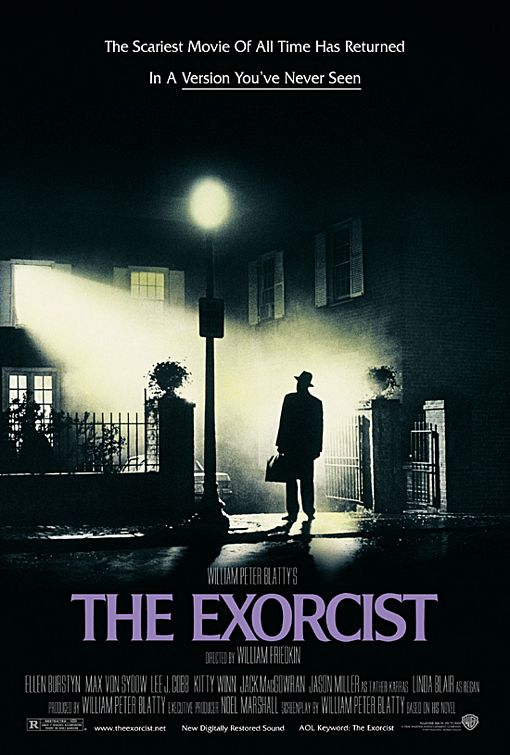
There are several trailers out there for William Friedkin’s “The Exorcist” which are very memorable, but the one which stands out for me is the one made for its rerelease back in the year 2000. In some ways, it is a huge surprise that this trailer was not treated like a red band trailer as the film remains ever so shocking after all these years. Regardless, it does a great job of reminding audiences, old and new, of what an incredibly unnerving and unforgettable experience this 1973 film was when it first came out, and how it remains so all these years later. Even if there was no new footage made for this release, this trailer made seeming it back on the silver screen an offer no movie buff could ever refuse.
I have to tell you, seeing this version on “The Exorcist” at a celebrated movie theater in Westwood, California provided me with one of the best cinematic experiences I ever had. On top of this film never having lost any of its power, as it contains scenes no studio would allow any filmmaker to capture on film today, the theater had the most extraordinary sound system which made watching it all the more adrenaline-inducing, exhilarating and enthralling to sit through. This trailer gave me such a great reason to check it out on the biggest silver screen in my neighborhood.
To date, there has yet to be an “Exorcist” sequel or prequel which can at the very least equal Friedkin gave us half a century ago.
Please check out the re-release trailer down below.
William Friedkin’s “The Exorcist” was such a singular cinematic experience, let alone a singular horror film like few others, that making a sequel to it had to seem like a truly insane prospect. “The Exorcist II: The Heretic” proved to be as hideous piece of celluloid as the original was a brilliant one, “The Exorcist III” was undone by needless studio interference which made it look pitiful for no good reason, and the attempts to make a prequel got so messed up to where two versions of it were made, both of which proved to be quite flawed. Looking at this franchise, one which is quite accidental, it seems like one driven by profit more than anything else. Granted, sequels are generally made because the original was a big box office hit, but not all of them exist simply because of financial benefits for everyone involved.
Now we have “The Exorcist: Believer” which comes to us from David Gordon Green and his fellow filmmakers who gave us the recent “Halloween” trilogy which proved to be worthy sequels to a celebrated classic. And yes, I do include “Halloween Ends” which many despised. Like those films, this “Exorcist” installment serves as a direct sequel to Friedkin’s original, it completely ignores the other sequels to create its own cinematic path. What results is a motion picture which is not terrible, and I went into it refusing to expect it to be any equal to the original, but it still proves to be inconsequential and unnecessary as Friedkin’s film continues to be extremely difficult to make a sequel to.
We are introduced to professional photographer Victor Fielding (Leslie Odom Jr.) who is raising his daughter, Angela (Lidya Jewett), as a single parent following the tragic death of his wife. One day, Angela asks her dad if she can go over to her friend Katherine’s (Olivia O’Neill) to study. That’s okay, Victor says, but she needs to be prompt about returning home for dinner. When Angela fails to do so, and she and Katherine go missing, the whole town goes looking for them. Eventually, they are found alive 30 miles away from their home addresses, but both are convinced they were only gone for a few hours.
As you can expect, both Angela and Katherine turn out to be possessed, and Victor turns to others to help the girls before any more lasting damage can be inflicted. Among them are Ann (Ann Dowd), a nurse at a local hospital and a fallen Catholic, and Chris MacNeil (Ellen Burstyn), an actress turned exorcism researcher who has since become renowned for her studies and her best-selling book on the subject. From there, we know we are in store for an exorcism, albeit one which cannot possibly be as intense as the one Friedkin gave audiences half a century ago.
Now you cannot go into “The Exorcist: Believer” expecting something along the lines of Friedkin’s original film as that is asking to be severely disappointed in the process. None of the sequels or prequels could touch it as the 1973 film is a cinematic experience not easily duplicated. But even with reserved expectations, “The Exorcist: Believer” just doesn’t work. It has some strong performances from Odom Jr. and Dowd, and there are some clever jump scares, but there is not enough to justify this as a significant follow-up to a celebrated classic.
The big news with this one is that Ellen Burstyn returns as Chris MacNeil for the first time since the first “Exorcist” film. But while Jamie Lee Curtis’ character of Laurie Strode was a major component of the recent “Halloween” trilogy, Chris MacNeil’s presence in “The Exorcist: Believer” feels like an afterthought, and while Burstyn is great as always, the character does not feel especially necessary to this installment. While it may give this film some legitimacy, Burstyn is barely in this film and does not get a lot to do.
When it comes to the climactic exorcism which the film’s title and its trailers have promised us, it is no surprise to find it utterly lacking in tension. Sure, there is some suspense as the adult characters are forced to make a choice no one wants to make, but it all feels lacking in the long run. As much as I wanted to view this film on its own instead of in comparison to the classic original, I could not help but be reminded of how intense and unnerving Friedkin’s film was. I wanted this exorcism to have the extreme intensity of what came before, and I knew that was not going to be the case which made this direct sequel all the more frustrating.
David Gordon Green is a terrific filmmaker. In addition to his “Halloween” trilogy, he has also directed films in various genres. He has given us “George Washington,” “Pineapple Express,” “All the Real Girls,” and “Joe” which features not only one of Nicolas Cage’s best performances, but also one of his most subtle, and that is saying a lot. I cannot help but wonder what made him, Scott Teems, Danny McBride, Jason Blum and all of Blumhouse were hoping to accomplish here. Were they hoping to make something which could stand alongside the original proudly, or at least be considered its equal?
For a moment, I thought Green might have some luck as the opening scenes in Haiti do have a documentary feel to them like the original did. But after a bit, it just felt like I was watching a movie. This is the biggest problem with “The Exorcist: Believer;” you watch it more than you experience it. You can see how the screws go in, and it does not help that the CGI effects utilized here are not all that great. Then again, I have long since been spoiled by the visual wonders of “Avatar: The Way of Water,” so nothing else can possibly compare.
Making a sequel or any kind of follow-up to “The Exorcist” is no different than anyone trying to make one to “The Texas Chainsaw Massacre.” Both those horror classics gave audiences a cinematic experience like few others, and they still remain enthralling and greatly unnerving so many years later. And yet, there are those who have turned these movies into franchises which may succeed financially, but never critically. They will forever be shadowed by a predecessor which can only make the best efforts look ever so pale in comparison, and yet people keep trying futilely to give us something worth watching. The fact that no one has succeeded in doing so should not come as a surprise.
Nevertheless, another “Exorcist” movie is set to be released in 2025, and the best way to look at this situation is to say Green and company have nowhere to go from here but up. Perhaps if they played around with the formula, they could audiences something more original which will stand on its own. Until then, I wonder if the ghost of William Friedkin will haunt Green just like he promised.
The following review was written by Ultimate Rabbit correspondent, Tony Farinella.
It’s crazy to me to know “The Exorcist” is now celebrating its 50th anniversary. Unfortunately, we lost its legendary director recently in William Friedkin, a trailblazer who was not afraid to push the envelope and do things his own way in films such as “Cruising,” “The French Connection,” and “To Live and Die in L.A.” He was an outspoken and passionate filmmaker who never backed down from his vision and his principles. I think it’s safe to say his most talked about film of all-time is “The Exorcist” which recently got a 4K upgrade from Warner Brothers Home Entertainment. Even to this day, people go to their local theater to watch it on the big screen, or they revisit it on home video when it’s spooky season.
There is quite an infamous backstory to the making of this film and getting it off the ground. It’s a legitimate miracle the film was able to be made considering all of the roadblocks and obstacles the director and his crew had in making it. I could go into detail here, but it’s best to Google it, as it’s lengthy and strange. I’ll just say this–many thought the film itself was cursed because of all the odd occurrences which happened to this production. People would also heavily protest the film, and many filmgoers would faint and get sick while watching it. The film has certainly developed quite a reputation over the years for a variety of reasons.
“The Exorcist” is set in Georgetown, Washington, D.C. and introduces the audience to actress Chris MacNeil (Ellen Burstyn) and her twelve-year-old daughter Regan (Linda Blair). They are renting a house while Chris works on a film directed by Burke Dennings (Jack MacGowran), someone she considers a close friend. We are also introduced to Father Damien Karras (Jason Miller), a psychiatrist at Georgetown University who works with fellow priests. Father Karras is struggling with guilt as he wishes he was spending more time with his mother, who is elderly, frail and unwell. He is also having a crisis of faith as well. At a party Chris is hosting, she notices some unusual behavior from Regan, and Regan is also talking about strange and weird noises in the attic.
From here, things only get worse for Regan as she starts to become vulgar, aggressive and develop facial sores. She has baffled modern science as they can’t understand what is wrong with her. They think it has something to do with her brain, but it still doesn’t explain her actions or her superhuman strength. Once Regan becomes a danger to herself and others, they decide the only solution is to tie her to her bed and perform an exorcism. There is a lot of hesitation on the part of Father Karras, as he doesn’t think it will turn out well and might only further damage young Regan. However, if a more experienced priest helps him, he will do it. This is where Father Merrin (Max von Sydow) comes in to help Father Karras with the exorcism that will hopefully save the child.
I’ve seen “The Exorcist” three times now, and I’ve really, really wanted to fall in love with it, but for whatever reason, it is a film I respect and admire but don’t love. I can see the great acting on display from Jason Miller, Ellen Burstyn, and Linda Blair. It’s impossible to ignore their range of emotions and their ability to sell this material and make it work. My issue is with the pacing of the film. I’m all about letting things breathe and building up to something, but this is very much an all-or-nothing film at times. At times, it’s moving a little too slowly without enough character build-up, and the plotting can be a little tedious. At other times, it’s in-your-face, intense, and really mind-blowing. There is really no middle ground with “The Exorcist.”
At fifty-years-old, “The Exorcist” is still an impactful horror film, without question. I just wonder if it’s more built on its reputation and folklore at this point. One might even argue if it’s a horror film or a thriller. It is a little bit of both, which I think most horror films are to some degree unless they are just flat-out horror with no plot. There is a plot here and a rhyme and reason to what unfolds, but it feels a little dated, in my opinion. All in all, I think “The Exorcist” should get its flowers for being a horror film that was ahead of its time and has really opened the door for a lot of the supernatural horror films we see today from “The Conjuring” and “Insidious” world. However, it’s a good yet flawed film, overall. As I stated earlier, I like it and it stays with me, which is a good thing, but I don’t love it and it doesn’t impact me, as much as I feel like it should, considering its place in film history.
* * * out of * * * *
4K Info: “The Exorcist” is released on a two-disc 4K release from Warner Brothers Home Entertainment. It comes with two different 4K versions of the film. One version is the theatrical cut, which is 122 minutes. The second disc is 132 minutes and features the extended director’s cut of the film in 4K.
Video/Audio Info: Warner Brothers did a pretty good job of cleaning up this film. However, they didn’t clean it up so much that you aren’t able to enjoy the dark and moody look of the film. I would say it’s a good but not great transfer of the film. I’ve seen better transfers of older films from Warner Brothers. It does come with a very, very good Dolby Atmos soundtrack for the film, though. I was really blown away by how good the film sounds. It also comes with subtitles in English, French, and Spanish.
Special Features: The theatrical version comes with the following special features: an introduction by William Friedkin, a commentary track by Friedkin, and a commentary track by William Peter Blatty, who wrote the novel and the screenplay for the film, with special sound effects. The unrated version of the film also comes with a commentary by Friedkin. These are all older commentary tracks and the introduction is much older as well. The big issue here is the fact they didn’t have a third disc with some of the special features from the previous Blu-ray release.
Should You Buy It?
This is a rather tricky one. I’ll say this–if you love “The Exorcist” and it’s one of your favorite films of all time, the transfer makes it worth the upgrade, even though I didn’t think it was a great transfer. It has its issues, as, at times, it can be a little unfocused and not super clear. If you own the Blu-ray, you should keep and not sell it because you will lose your special features with this 4K as it only has the commentary tracks and an introduction from the director. They really should have added a third disc just for the special features. Overall, “The Exorcist” is a film that has earned its place in horror film history based on it being released at the right time with the right director and the right cast and crew. It’s a good film. However, I don’t think it’s a great film in my personal opinion. If you love the film, I think you will be happy with what Warner Brothers has done with the transfer. It’s not a bad transfer by any means. It’s just not a transfer that is going to “wow” you. You will probably be very disappointed they didn’t port over the special features from the Blu-ray. However, if this is your favorite horror movie, you want to own it on the best format out there right now, which is 4K. If you are lukewarm on the film or think it’s merely good, you can keep your Blu-ray if you already own it.
**Disclaimer** I received a copy of this film from Warner Brothers to review for free. The opinions and statements in the review are mine and mine alone.
On January 22 & 23, 2011 at the Aero Theatre in Santa Monica, American Cinematheque presented a tribute entitled “Strangle-Hold: The Gripping Films of William Friedkin.” Featured were four of the director’s most noted movies: “The French Connection,” “To Live and Die In LA,” “Sorcerer,” and “The Exorcist.” Mr. Friedkin was there both nights to talk about his work and filmmaking, and he was greeted by sold out audiences who gave him with a standing ovation.
It’s been a long road for Friedkin. Despite the many ups and downs of his long career, he still directs movies even though his work these days is constantly, and unfairly, stuck in the shadow of his greatest work. Back in the 1970’s, he gave us two of the greatest movies ever with “The French Connection” which has one of the greatest cinematic car chases ever, and “The Exorcist” which is as powerfully unnerving today as it was when it first came out. Since then, however, he was seen as stumbling both critically and commercially with movies like “Deal of The Century” and “The Guardian” to name a few.
But Friedkin has now rebounded with “Bug” starring Ashley Judd, and the re-release of “The Exorcist” which was a big hit despite it being readily available on video and DVD. Even his flops like “Sorcerer” and “Cruising” have been critically re-evaluated and gained strong cult followings in recent years. Today, he is directing Matthew McConaughey in “Killer Joe.”
Friedkin started off by remarking how the Aero Theatre’s marquee said “William Friedkin Live” and how glad he was to see that at his age. From there, he told a story about his friendship with the great writer/director Billy Wilder and how they had lunch together often at Johnny Rockets. At one point, Wilder said to him:
“You and I have something in common; we both want to make commercial films for a large audience. So don’t look for your films to get shown at the Cinematheque!”
It may have taken long enough, but American Cinematheque did come through for him!
When working with actors, Friedkin said he does not put his personal style on them, and that he always creates an atmosphere for actors to work in which allows their creativity to flow. If the actors come up with something better, he is more than willing to let them roll with it to see where it would take the movie. This aided tremendously in his job of deeply immersing the audience in the story as much as possible.
Some in the audience asked him if he had any advice to pass on to filmmakers. Friedkin was quick to the point:
“Don’t go to film school!”
Friedkin claimed he never had a single lesson in filmmaking, and he said everything he learned came from “the masters who broke the rules” like Orson Welles and Alfred Hitchcock. In fact, he encouraged everyone to get out of the classroom and watch all of Hitchcock’s movies. While they may vary in quality, he said the master of suspense’s genius is present in every shot he took.
Friedkin also encouraged aspiring directors to not even bother with the preview process or audience testing. None of his movies have ever been altered by these processes, and he really doesn’t like them anyway. Had “The Exorcist” been previewed, he said, it would not have ever have been released!
In selecting movies to make, Friedkin says the movie comes to him more than he goes to it. But the one theme which runs through each and every motion picture he has helmed is ambiguity. The works he admires the most are the ones which ask questions but don’t provide answers. As he sees it, the quest is far more interesting than the end of the journey as there are no ultimate answers, only great questions.
Friedkin also loves playing with the thin line between good and evil. Case in point is “The French Connection” where Popeye Doyle, played by Gene Hackman, is a racist and a womanizer while the drug dealer is a gentleman with manners and who loves his wife dearly. There’s only so much that separates the good guys from the bad ones, and movies like this serve as a very strong reminder of that.
Though his glory days might be behind him, William Friedkin remains a director with an unwavering vision on each film he does. This proves to be the case even in his weakest movies as even they show how fully in control of the craft he is. I look forward to seeing what he comes up with next.
WARNING: DO NOT EAT FRIED CHICKEN BEFORE OR WHILE WATCHING THIS MOVIE.
William Friedkin’s “Killer Joe” got my vote for the WTF movie of 2012. It wallows in the sheer depravity of its deliberately idiotic characters without apology, and it is one of the most darkly hilarious movies I have seen in some time. Seriously, I would put this film on a par with “Bad Lieutenant: Port of Call New Orleans” and “Observe and Report” as they are equally fearless in the places they dare to take us. “Killer Joe” also marks the second collaboration between Friedkin and playwright Tracy Letts whose play “Bug” Friedkin previously adapted into a motion picture. With this film, neither is out to show the audience any mercy as they challenge them in a way most filmmakers don’t bother to these days, and it wears its NC-17 rating with pride.
The movie takes place in Texas and features some of the dumbest or, to be polite, the most dimwitted characters on the face of the earth. Chris Smith (Emile Hirsch) is a drug dealer who is in debt to his suppliers by several thousand dollars, and his solution is to have someone murder his mother as she has a $50,000 insurance policy. His father, Ansel (Thomas Haden Church), shows only the slightest moral opposition to this plan as he divorced Chris’ mother a long time ago and has since gotten married to the conniving Sharla (Gina Gershon), and Chris already has one person in mind to carry out this cold-hearted assassination.
That person is Joe Copper (Matthew McConaughey), a police detective who works as a hired killer on the side. Now Joe demands an upfront payment of $25,000 for his services, but Chris and Ansel can only pay him after receiving the insurance payout. As a result, Joe ends up taking a retainer to make up for that: Ansel’s daughter and Chris’ sister, Dottie (Juno Temple). As with all crimes based on greed, all the careful preparation cannot keep these characters from falling into the nasty realm of disaster. But long before the movie’s end, you will agree they have all earned the fate they ever so thoughtlessly brought on themselves.
If this seems like an unusual movie for Oscar winning director Friedkin to make, it shouldn’t. Friedkin’s movies in general, with the exception of “The Exorcist,” have never contained characters easily deserving of redemption. “Killer Joe” will be seen by many as a bold motion picture of his, but his movies show he has never passed judgment on any of the characters inhabiting his movies. He is also a brilliant filmmaker as he surrounds himself with a cast of actors who don’t easily judge their characters either.
McConaughey has been on a roll ever since he gave up making those dopey romantic comedies for movies like “The Lincoln Lawyer” and “Dallas Buyers Club.” With “Killer Joe,” he ends up giving one of the bravest and boldest performances of his career as Joe Copper is as immoral as characters can get. We never learn why he decided to get into this line of work while being employed as an officer of the law, but it doesn’t matter. McConaughey gives us a mesmerizing portrait of a character who is more than aware of how evil he is, and he is not about to apologize for it.
The other actors like Emile Hirsch and Thomas Haden Church deserve a lot of credit as they portray the dimwitted characters perfectly without ever just playing it for laughs. They play each character as being serious in what they say and do, and this makes us laugh uncontrollably at certain moments because we almost won’t believe how badly they screw things up. They also invest their characters with a history which shows on their faces and doesn’t need to be spelled out for the audience.
A special badge of courage, however, needs to go to Gina Gershon who plays Sharla as “Killer Joe” shows just how deep into a role she is willing to go. Her character thinks nothing of opening the front door without wearing anything from the waist down, and this is not to mention what McConaughey ends up making her do with a piece of fried chicken. Even as Sharla wears too much makeup to where her mascara runs down her face, making her look like the Joker from “The Dark Knight,” Gershon gives a truly fearless performance as someone who thinks she’s better than the people around her. But of course, Sharla finds out in the worst way possible that she is not.
The one person who really caught my eye though was Juno Temple who portrays the youngest child of the Smith family, Dottie. You may remember Temple as Selina Kyle’s street-smart friend from “The Dark Knight Rises,” and she makes Dottie a fascinating enigma. Her character is at times willfully innocent, seemingly naïve, but she actually becomes the only member of this trailer park family with anything resembling intelligence. Temple is utterly beguiling in “Killer Joe,” and I look forward to seeing more of her in the future.
“Killer Joe” was already earning infamy before its release with the MPAA giving it the dreaded NC-17. Did it earn this rating? Well, yes and no; this is certainly no movie to take your kids or impressionable teenagers to see. Then again, if “Killer Joe” were released by a major movie studio, it would have somehow gotten an R despite its content. Whatever you think this movie deserves the NC-17 rating or not, the hypocrisy of the MPAA remains maddening and never ending.
Friedkin has been leaving in the shadow of his most famous work for years as if no one would ever let him get past “The Exorcist,” “The French Connection” or even “Sorcerer” which is now being seen as the masterpiece it always was. The truth however is he has not lost his talent in setting up scenes which contain tremendous suspenseful impact. This is especially the case whenever McConaughey is onscreen because when he appears you know things are going to get really bad. Friedkin also is well served by his collaborators such as cinematographer Caleb Deschanel who finds a twisted beauty in such utter depravity, and composer Tyler Bates gives the most suspenseful and horrifying moments a strong atmospheric quality which makes the story all the more claustrophobic.
It’s hard to say where exactly “Killer Joe” ranks on William Friedkin’s long resume of work, but it is safe to say it is far more accomplished than his other works like “Deal of the Century,” “The Guardian” and “Jade.” With this film he gives willing audience members an experience they will not easily forget, and he directs Matthew McConaughey to one of the best and most explosive performances of his career. Those in the mood for the most disturbing of black comedies should not pass up “Killer Joe.” Just remember, it may be a while before you find yourself eating fried chicken again after you watch it.
Michael Biehn and his wife Jennifer Blanc reappeared at New Beverly Cinema on September 11, 2012 to do another Q&A on his directorial debut of “The Victim.” It had been playing at the famed revival movie house since Friday, September 7, and Biehn and Blanc were determined to make as many appearances there as they could to promote their fun little grindhouse flick. This particular evening had Biehn talking about its making, another movie he was involved in which did not get much of a release, and there was also a big surprise in store for yours truly.
Biehn first made his presence known to the small audience on this evening when the end credits for “The Victim” began, and he ended up doing a running commentary as they played on how he got everyone’s picture on screen whether they were acting in the movie or working on it behind the scenes. He once again alluded to the fact he had such a low budget to work with, and he described how most films don’t have end credits like this one, nor are they as fun to watch.
Among the people in the audience was Brian McQuery who served as the movie’s assistant director, and Biehn pointed out how McQuery worked 4 or 5 days “for nothing.” Biehn said this was the result of a “friend helping out a friend,” and he got the audience to applaud McQuery for his selfless efforts.
During the Q&A, Biehn talked about when he worked with filmmaker William Friedkin on the movie “Rampage” and how the filmmaker kept calling everyone on his set “Moe.” Biehn ended up working on two movies with Friedkin and he remarked how no other actor has worked with him twice. It turns out no one saw “Rampage,” Biehn said, because Dino De Laurentis’ company, which produced it, ran out of money and was not able to give it a proper release. Biehn did say he liked “Rampage” a lot and thought Ennio Morricone’s film score to it was fantastic.
Biehn also pointed out how he got some of the best directing advice ever from Friedkin. When Biehn asked Friedkin where he decides to put the camera when filming a scene, Friedkin ended up telling him, “I just think of where I would like to see the scene from, and I put the camera there.”
Even after making “The Victim,” Biehn told the audience he does not consider himself a director as he “never had a feeling for the camera, lenses, angles or close ups.” This was the result of him always being so focused as an actor to where he never learned all that stuff. Although he said he is never going to be a great director, his directorial debut showed he is better and cleverer at this job than he gives himself credit for.
Blanc also went out of her way to say that Biehn is a “phenomenal director” and that she “always looks to him for audition help.”
Biehn went on to talk about how a movie needs to be in escrow before it even gets made, and this led to him discussing how he got the money to make “The Victim.” At the time he was recovering from a hernia operation and was on Vicodin when he took a meeting at a restaurant with some guys looking to finance a movie. They told Biehn how they wanted to work with him and that they had “a small amount of money” to make a film with. Biehn, in his drugged out state, told them he would do the project but only if he had total creative control over it. They ended up agreeing to this, and the next day Blanc told Biehn the check those two gave him had cleared. Biehn, now off the Vicodin, ended up saying out loud, “What the fuck?!”
Whatever the case, Biehn clearly put a lot of effort into making “The Victim” with the limited resources he had. He described how the film was shot most days from 6 a.m. in the morning to 6 p.m. at night, how he had to write the script and do pre-production in just three weeks, and all the driving scenes were shot on some guy’s driveway which had bushes on both sides. Biehn also said the character he plays is like him but “with a few problems.”
There were also days on set where he got so upset to where Biehn became like “William Friedkin, Michael Bay, James Cameron and Val Kilmer all together on their worst day.” Blanc said his temper tantrums among other behind the scenes fodder can be found on “The Victim’s” Blu-ray which will be released on September 18, 2012.
Ok, now I don’t brag about myself too much but this is something I have to talk about: I was sitting in the front row of the New Beverly taking notes down in my journal of what was being said during this screening, and Biehn saw me writing furiously and asked me, “Are you a reporter?”
“No,” I said (for some reason, I did not consider myself an official reporter back then).
“Oh, okay,” Biehn said. “You’re not gonna write a bad review of this, are you?”
I assured him I had already written my review of “The Victim,” and that it was good. Blanc then asked who I was and I told her my name and the websites I submit reviews to. It turns out she actually read my review and thought it was awesome, and she ended up coming over to give me a hug.
Biehn then asked his wife, “was it a good review?”
“It was fantastic,” she said.
Biehn then looked right at me with open arms and said, “come here!”
Who would have thought I would get a hug from the man who played Corporal Dwayne Hicks in “Aliens,” Kyle Reese in “The Terminator” and Navy SEAL Hiram Coffey in “The Abyss?” When things like this happen while you live in Los Angeles, it reminds you of how magical this town can be.
Oscar winning director William Friedkin made a special appearance at Landmark Theatres in West Los Angeles on August 3, 2012 to talk about his film “Killer Joe.” He appeared in front of a sold-out audience who had just finished watching it, and Friedkin ended up paraphrasing a review from the Los Angeles Times by saying, “Welcome to the abyss!”
This remark was in reference to the fact that “Killer Joe” has already earned a bit of notoriety after receiving an NC-17 rating from the MPAA for what they described as “graphic disturbing content involving violence and sexuality, and a scene of brutality.”
At the start of this Q&A, Friedkin went over the three things a director needs to consider before they begin working on a project:
Choose the material you want to do. Friedkin said this is very important as you will have to “live with it for a year.”
Cast the film with the right actors. Friedkin said if anything goes wrong with the movie, it won’t matter how good the cast is because odds are the director has chosen the wrong actors for it.
You need to create an atmosphere where the actors are comfortable enough to do the work. Friedkin remarked this is 75% of what a director does, and that the remaining 25% has the same person figuring out how to put their movie together.
When it came to casting “Killer Joe,” Friedkin said he went to actors Emile Hirsch and Thomas Haden Church first as he was familiar with their work. These days, Friedkin says he continues to watch “old movies” as they continue to inspire him, and he doesn’t watch new movies much.
Friedkin also admitted he has “never seen any of Matthew McConaughey’s films” before casting him here, and he originally wanted someone “more grubby” and with “a more evil look.” However, after watching McConaughey being interviewed by Charlie Rose where he was just being himself, he realized someone like McConaughey would be more interesting as opposed to what some would call a “more obvious choice.”
McConaughey, however, read and hated the script to “Killer Joe” and that he “wanted to take a bath with a wire brush” after reading it. Regardless, McConaughey read the script again because he couldn’t get it out of his head, and he told Friedkin he found it “absurd and hilarious in a dark way.”
Friedkin also admitted he knew nothing about Juno Temple before casting her as Dottie. He was originally going to go with one of three beautiful actresses for this role, but he ended up watching an audition tape Temple put together in which she read the script along with her 10-year old brother who played the part of Joe, the cold blooded cop and contract killer played by McConaughey. Friedkin said he loved what he saw but that he was worried about her “thick British accent.” He ended up asking the cast to tell Temple when she was speaking in a way which didn’t sound like she was from Texas. From what we saw onscreen, the cast helped Temple out big time.
In talking about Gina Gershon (the mention of her name got the audience to applaud loudly), Friedkin said she was not his first choice for the role of Sharla. When it came to casting this particular role, Friedkin said he saved this question for last when interviewing prospective actresses, “Can you handle the sex and violence that is presented in this script?” It should go without saying Gershon could, and Friedkin described her as being “courageous” in playing Sharla. She is asked to portray some of the hardest things any actor is asked to do, and I don’t just mean the scene involving her and that piece of fried chicken.
“Killer Joe” marks the second film Friedkin has made from a play written by Tracy Letts whose “Bug” he turned into a film back in 2006. Friedkin said he and Letts “share the same worldview” as they both “see the absurdity of the many facets in life.” Their projects, as Friedkin sees it, deal with people “stuck in their realities and willing to do anything to get out of them,” and that neither of them is “fond of violence.”
Still, Friedkin said he did not expect the NC-17 rating the MPAA gave “Killer Joe,” but he thinks it is somewhat correct as he was not targeting young teenagers for this movie as they are more impressionable. Both he and LD Entertainment, which is distributing the film, fought the MPAA over the rating, and in trying to get it down to an R, they ended up cutting not scenes but instead frames of footage. This, however, was not enough, so Friedkin and LD Entertainment ended up appealing the decision. Friedkin joked how they “narrowly” lost the appeal (13 to nothing) and that he felt he “had to destroy the movie in order to save it.” But after all the fights he had over movies like “The Exorcist,” Friedkin declared he is “too old to get down on my knees and change the picture” for them.
When asked what the tone on set was, Friedkin described it as “light” because he and the actors already knew what was in the script. Friedkin also said he only does “one or two takes these days” when making a movie as opposed to the “15 or 20” he did when he was younger and “praying for miracles.” These days, he looks for spontaneity in his actors, and he finds the first take they give him is often the “most spontaneous” of all.
Whatever you end up thinking about “Killer Joe,” it is clear Friedkin is still a masterful filmmaker who has not lost his touch. The characters may be beyond redemption, but he is quick to point out we are all sinners, and this is an inescapably true fact. After all these years, Friedkin continues to challenge his audience, and we should be thankful for this in a time where most filmmakers choose to play it safe and to their own detriment.
This is the movie that almost completely destroyed filmmaker William Friedkin. “Sorcerer” came into theaters with a high level of anticipation, which was understandable as it was made by the same man who gave us “The Exorcist” and “The French Connection.” Lines were wrapped around the block when it opened at Mann’s Chinese back in 1977, but by the second week the theater was practically empty. “Sorcerer” was considered to be a critical and commercial failure, and Friedkin’s career has never been the same since. Of course, it opened around the same time as a small independent feature which blew away the competition. You may have heard of it, “Star Wars?”
Well, they say time heals all wounds, and “Sorcerer” has been critically re-evaluated to where it has received the critical acclaim it long deserved. The film is quite an accomplishment and a fascinating study in madness and redemption, and you will never look at truck driving the same way again after watching it. Depending on who you ask, it t is a remake of Henri-Georges Clouzot’s “The Wages of Fear” (Friedkin denies it is). The Oscar-winning director put his heart and soul into “Sorcerer,” and it pins you back into your seat and thoroughly exhausts you long before it ends. Like many great movies, it is one you experience more than watch.
“Sorcerer” takes its time getting started as we watch the back stories for its four main characters and of how they ended up at where they are. We meet hitman Nilo (Francisco Rabal) who takes down a target with a simple bullet, Kassem (Amidou) as he bombs a local church with the help of his friends, investment banker Victor Manzon (Bruno Cremer) who is about to be jailed for fraud, and then there’s Jackie Scanlon (Roy Scheider) who is marked for execution after his gang robs a church and accidentally kills a priest.
After this protracted prologue, the action moves to an unnamed location in a Latin American country which these four people have escaped to and seek refuge in. The utter squalor these men are forced to live in is so vivid to where it feels like the flies and stench of the environment doesn’t stop at the silver screen. You know how some people look at a movie and say it really made them want to take a cold shower? One shower is not enough to get past the filth these characters are forced to live in from day to endless day. This place is hell on earth for anyone, but these men obviously prefer it to death. They managed to avoid prison, but they came to a different kind of prison they are now ever so desperate to escape.
The chance for escape comes when an oil refinery suddenly explodes into a fireball, and the firefighters are unable to put the fire out without the help of explosives. Company executives manage to find a surplus of nitroglycerin sticks which can do the job, but the only catch is these sticks have not been turned and, as a result, have become highly sensitive and to where the slightest vibration could make them explode. So when an offer comes to drive this unstable set of explosives to the burning oil field for a high reward, these four jump at the chance to do the job. The rest of the movie follows their treacherous journey in trucks to deliver the explosives and hopefully not lose their lives in the process.
One thing I really admired about “Sorcerer” is how Friedkin dared to give us characters who were not altogether sympathetic. They are criminals of one kind or another, and yet we follow them every step of the way through their treacherous trip. Friedkin saw their incredibly dangerous journey as their chance not to just escape the filthy poverty they were stuck in, but also as an opportunity to redeem themselves for whatever bad deeds they committed. But their entire journey is a lot like sailing down the river Styx as they have to travel to through hell in order to escape it.
Friedkin does a great job of sustaining the tension as these men drive the trucks over terrain which looks like it’s on the verge of collapsing, and who encounter unwanted guests that have no idea of the cargo they are carrying. But the movie’s big action centerpiece is when they are force to drive the trucks over a suspended bridge which looks more than ready to completely fall apart. Add to that some furious rainstorms, and you have yourself one hell of a sequence which leaves you wrung out by the end.
Of all the actors in the cast, the most recognizable is Scheider. As a man on the run from the mob, he gives a performance which is never less than compelling, and you can only imagine the hell Friedkin put him through to play this role. The journey these men go on is not just dangerous physically, but also psychologically. Scheider does great work here as he is constantly on the verge of losing his mind, and this is especially in the movie’s second half.
Francisco Rabal, Amidou and Bruno Cremer are equally as good as they show the exhaustion and determination their characters have to complete this mission, and they too are put through the wringer to where they never seem to be acting their roles, but instead living them. You feel every bead of sweat which drips from their faces, and it makes “Sorcerer” even more of a visceral cinematic experience.
The imagery Friedkin captures is incredible as he shows us the squalor and unhealthy environment these characters live in so well, you can’t help but feel as trapped in it as they are. Friedkin has gone on record to say this film was the toughest for him to make, and I don’t doubt that for a second.
One of the other big pluses of “Sorcerer” is the brilliant score composed and performed by Tangerine Dream. Interestingly enough, they never saw a frame of the movie’s footage while working on the music, and yet they capture the events and psychology of the characters ever so perfectly. Like many of Tangerine Dream’s movie scores from “Thief” to “Risky Business,” this one is highly original and hard to compare to others. The soundtrack is still available on compact disc if you look hard enough for it.
After all these years, “Sorcerer” can no longer be mistaken as one of Friedkin’s misfires as it is now seen as one of his greatest cinematic achievements. It has since gained a strong cult following and is truly one of the most underrated movies of the 1970’s. It is unlikely we will ever get to see a movie made the way this one was ever again, and this makes it a must see for every and any film buff out there.
So, without further ado, I present to you my list of my top ten movies to watch on Halloween night, and they are presented here in no particular order:
“John Carpenter’s Halloween”
Despite the many imitators and endless sequels, not to mention the two movies directed by Rob Zombie (which was actually pretty good), there’s no beating the granddaddy of them all. Carpenter’s film is a true horror classic with a music theme I never get sick of listening to. All these years later, the original “Halloween” has lost none of its power to creep you out as it offers audiences a truly terrifying experience.
There are moments which have stayed with me long after I saw “Halloween” for the first time. That moment where Michael Meyers kills the boyfriend and then tilts his head from side to side always gets to me. Plus, the ending leaves you with the unnerving truth of how evil never dies.
“John Carpenter’s The Thing”
While his original “Halloween” remains a true classic, Carpenter’s remake of “The Thing” is his masterpiece. The film bombed back in 1982, but it has since gained a huge cult following and is now considered one of the best horror films ever made. The story of a group of scientists doing research in Antarctica, one of the most isolated places on Earth, who get copied almost perfectly by an alien is far more effective today than when it first came out. “The Thing” is a great example of how to keep escalating tension throughout a movie’s entire running time, and Rob Bottin’s incredible work on the makeup and effects still looks disgustingly brilliant to this very day.
“The Texas Chainsaw Massacre”
I finally got to see this movie all the way through for the first time a couple of years ago when I rented it from Netflix. What I thought would be a fun and hopelessly dated 1970’s movie turned out to be more horrifying than I ever could have imagined. Even while watching it on my 32″ television, “The Texas Chainsaw Massacre” proved to be a brutal cinematic experience which has lost none of its power to make you shrink in your seat. With a movie like this, it’s not what you see that gets to you; it’s what you don’t see which messes with your head, and that makes this classic of the most unnerving movie going experiences you will ever endure.
“Suspiria”
It was released 40 years ago, and it remains Dario Argento’s true masterpiece of horror. There are very few directors who can make a grisly death look like a beautiful work of art. The tale of an American female dancer who comes to a ballet school which turns out to be a witches’ coven doesn’t always make sense, but then again, a lot of Argento’s movies don’t. The movie is still scary as hell and beautifully horrific in a way most horror films can only dream of being today. A friend of mine once told me that if she were ever to be murdered (heaven forbid), she wants it to look like something out of a Dario Argento movie. I see what she means.
“Alien”
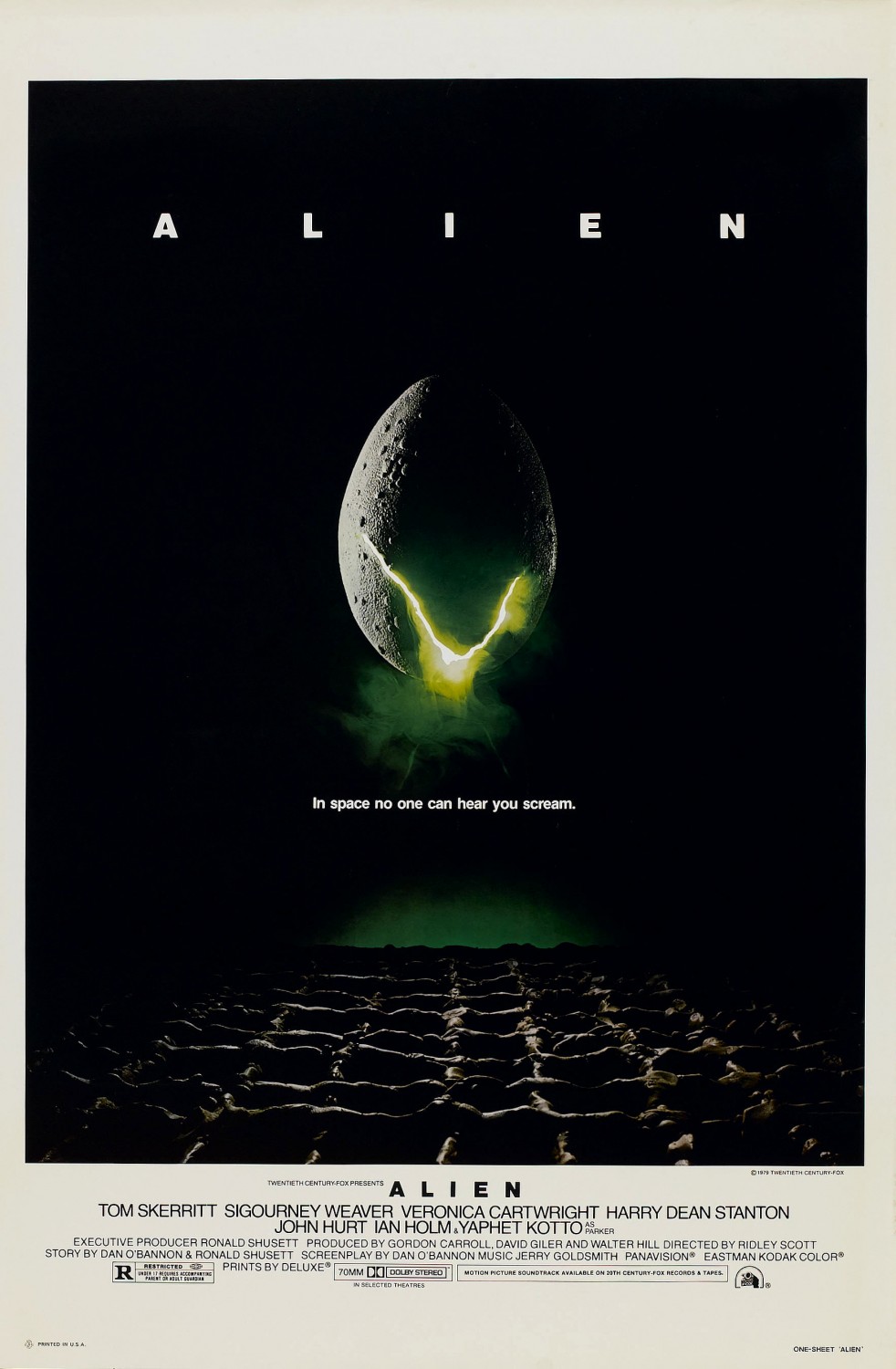
Be it the original version or the director’s cut, Ridley Scott’s “Alien” is still an overwhelmingly terrifying experience to sit through. When I rented this one on videotape years ago and watched it on my parents’ 13-inch television set in their bedroom (they robbed me of using the family room), I found myself hiding my eyes at key moments. The silence really got to me, and I impatiently waited for Jerry Goldsmith’s score to come back on. Keep in mind, I actually saw James Cameron’s “Aliens” before I saw this one, and it still scared the hell out of me!
“The Exorcist”
I tell you, these horror movies from the 1970’s still have the same power to shock you today as they did when first released. When William Friedkin’s “The Exorcist” was re-released in “the version you’ve never seen,” it still had a visceral power to unsettle us regardless of the passage of time. The story of a girl who becomes possessed by an ancient demon benefits greatly from a documentary feel which has that “you are there” feel, and it almost felt like I wasn’t watching a movie, but instead a real-life event which somehow all got caught on camera.
“Evil Dead 2: Dead by Dawn”
All the “Evil Dead” movies are great fun, but if you have to go with just one, then I recommend “Evil Dead 2: Dead by Dawn.” On a budget of $3 million dollars, maybe even less than that, director Sam Raimi gave us one of the most endlessly creative and hilarious horror movies you could ever hope to watch. After all this time, it remains as scary as is funny. Plus, you have Bruce “Groovy” Campbell in his most iconic role as Ash, the pussy whipped salesman from S-Mart who keeps getting chased by the demons he was dumb enough to awaken from their slumber. Campbell gives a fantastic performance even if he keeps telling us he’s not much of an actor. This is so far from the truth, but you do have to admire the sense of humor he has about himself, and you haven’t lived until you listen to one of his “Evil Dead” commentary tracks.
“28 Days Later”
“Slumdog Millionaire” director Danny Boyle was said to have reinvigorated the zombie genre with this propulsive horror thriller where they are anything but slow. In this film, the zombies, or the infected as they are referred to are not the real enemy, we are. The virus the infected have been stricken with represents our inability to face the darkness inside of ourselves which sooner or later rises to the surface. There is no let up on the tension in this movie, and the thrills come fast and furious.
“Dawn of the Dead” (the original and the remake)
This one is a tie because both versions of this movie stand strongly on their own merits. George Romero’s brilliant sequel to his classic “Night of the Living Dead” is really a satire of the consumerist society we all live in. You know, the one which encourages us to buy all sorts of things which are said to make you happy, and yet all the money and objects you purchase end up making you feel empty inside. This is what Romero is saying with this film, and he does this while providing us with a great deal of blood, gore, beheadings, eviscerations, decapitations, and whatever else he could afford when he made “Dawn of the Dead.” All of you in the Fangoria crowd will be more than satisfied with this one, but you knew that already.
Zack Snyder, who later went on to direct “300,” “Watchmen” and “Batman vs Superman: Dawn of Justice” helmed this remake which turned out to be the best of its kind since “John Carpenter’s The Thing.” This one is more of a straight forward horror action film with a surprising amount of emphasis on character development. It also features Canada’s greatest import in the lead role, Sarah Polley. The remake of “Dawn of the Dead” turned out to be a visceral thrill ride, and it allowed us to invest in the characters in ways most horror movies typically avoid.
“The Silence of the Lambs”
The specter of Hannibal Lecter, as portrayed by Anthony Hopkins, never fails to unnerve me like he did when I first saw this movie on the big screen. Jonathan Demme’s Oscar winning classic remains one of the definitive serial killer films ever made. Hopkins’ performance is like a perverse love letter to HAL from Stanley Kubrick’s “2001” whose voice inspired his performance. We also get one of cinema’s greatest heroines with Clarice Starling, brilliantly played by Jodie Foster.
Director William Friedkin declared “To Live and Die in L.A.” to be one of his personal favorites of his career when he dropped by the Aero Theatre in Santa Monica. The film was being shown as part of American Cinematheque’s tribute to him, and it played as a double feature with “The French Connection.” But while Friedkin was scheduled to be there, he brought along two of the movie’s stars as surprise guests: William Petersen who played Secret Service Agent Richard Chance, and Darlanne Fluegel who portrayed his “girlfriend” and informant Ruth Lanier.
With “To Live and Die in L.A.,“ Friedkin worked with casting director Bob Weiner who had also worked on “The French Connection.” With this film, Friedkin didn’t want any stars and could only consider no-name actors as the budget was only $6 million. In a sense though, casting unknown actors was a plus for this film as the characters they play walk a thin line between good and evil, and having recognizable stars might affect how this came across.
Known these days for “C.S.I.,” it was a shock to realize that “To Live and Die in L.A.” was Petersen’s first lead role in a movie (he previously had a small role in Michael Mann’s “Thief“). Weiner discovered the actor when he was playing the lead in a Canadian production of “A Streetcar Named Desire.” Petersen said he hadn’t done any movies nor did he have an agent at the time. All he knew about Friedkin was the films he directed, and they met in New York to do a scene together. But Petersen didn’t ever get around to finishing when Friedkin interrupted him to say, “That’s good enough for me. You got the part!”
From there, Petersen said he didn’t know what to do. Excited as he was for the opportunity, he was already scheduled to be in another play soon and wasn’t sure how to go about negotiating with Friedkin or the studio. It didn’t even occur to him he would be making $400 a week! So, he ended up talking with John Malkovich, who knew him from Steppenwolf, to get advice on what to do. Later, Petersen went back to Friedkin saying he wouldn’t be able to play Richard Chance due to his prior theatrical commitment. To this, Friedkin told him, “No problem. We’ll wait for you.”
Now how cool was that?! Seriously, how many other directors, let alone movie studios, would wait on an actor who is not even an established name yet? Considering the sheer charisma Petersen exudes onscreen just from one look on his face, it makes perfect sense why Friedkin waited on him before he started production.
Although he was used to doing theater more than film, Petersen said he found making “To Live and Die in L.A.” a “freeing, fun experience” and thought all movies would be exactly like it. This, of course, got a good dose of laughter from the audience as we know they are not. Despite the long hours on set, Petersen was never tired at day’s end.
In researching his role, Petersen worked with Gerald Petievich, the former Secret Service Agent who wrote the book this movie is based on, and with criminals including actual counterfeiters. This led Friedkin to tell the audience how Petievich ended up getting a counterfeiter paroled from jail just so he could create the fake money they needed. Friedkin even admitted he passed so many fake bills to where he concluded the government’s money was worthless and only paper. Some kids of the special effects supervisor were not as lucky as they ended up taking some of the fake money to buy candy, and a Treasury Agent got called on them in ten minutes flat.
Fluegel was shocked about getting a part in “To Live and Die In LA,” and she created one of the film’s most unforgettable characters. She said working with Petersen was “so easy,” and they both agreed there never was a moment between them which didn’t feel real. We always hear these stories about how actors don’t like doing sex scenes and how awkward they can get, but Fluegel said they were actually easy to do. She also made it clear neither of them actually had sex onscreen even though it looked like they did. When they worked together, everything always flowed perfectly.
But one great behind the scenes story Petersen told was when they were at the airport and Chance was chasing down John Turturro’s character of Carl Cody. This had Petersen jumping on top of the moving walkway while in pursuit, but in rehearsing it, security came over and told him and Friedkin it was against safety regulations and didn’t want him to do that again. Petersen, however, was insistent as it was easier for him to jump on top, and it worked better for the scene. So, when security was out of hearing range, Friedkin told Petersen to jump on top anyway when he said action, and that after he said cut, Friedkin would yell at him not do it again, making it look like he didn’t forget what security said previously. Once again, Friedkin does movies his way regardless of the warnings others throw at him.
Like several of William Friedkin’s movies which came out after his heyday with “The French Connection” and “The Exorcist,” “To Live and Die in L.A.” was not a big hit when first released. It was only after its debut on video and DVD when it gained a cult following which has gotten bigger and bigger over time. Seeing it on the big screen was a blast, and it deserves to be ranked alongside the best movies of Friedkin’s career. Besides, this is much more preferable to watching him pick his feet in Poughkeepsie.




 The Ultimate Rabbit