No, I Haven’t Seen It Until Now: ‘Cujo’
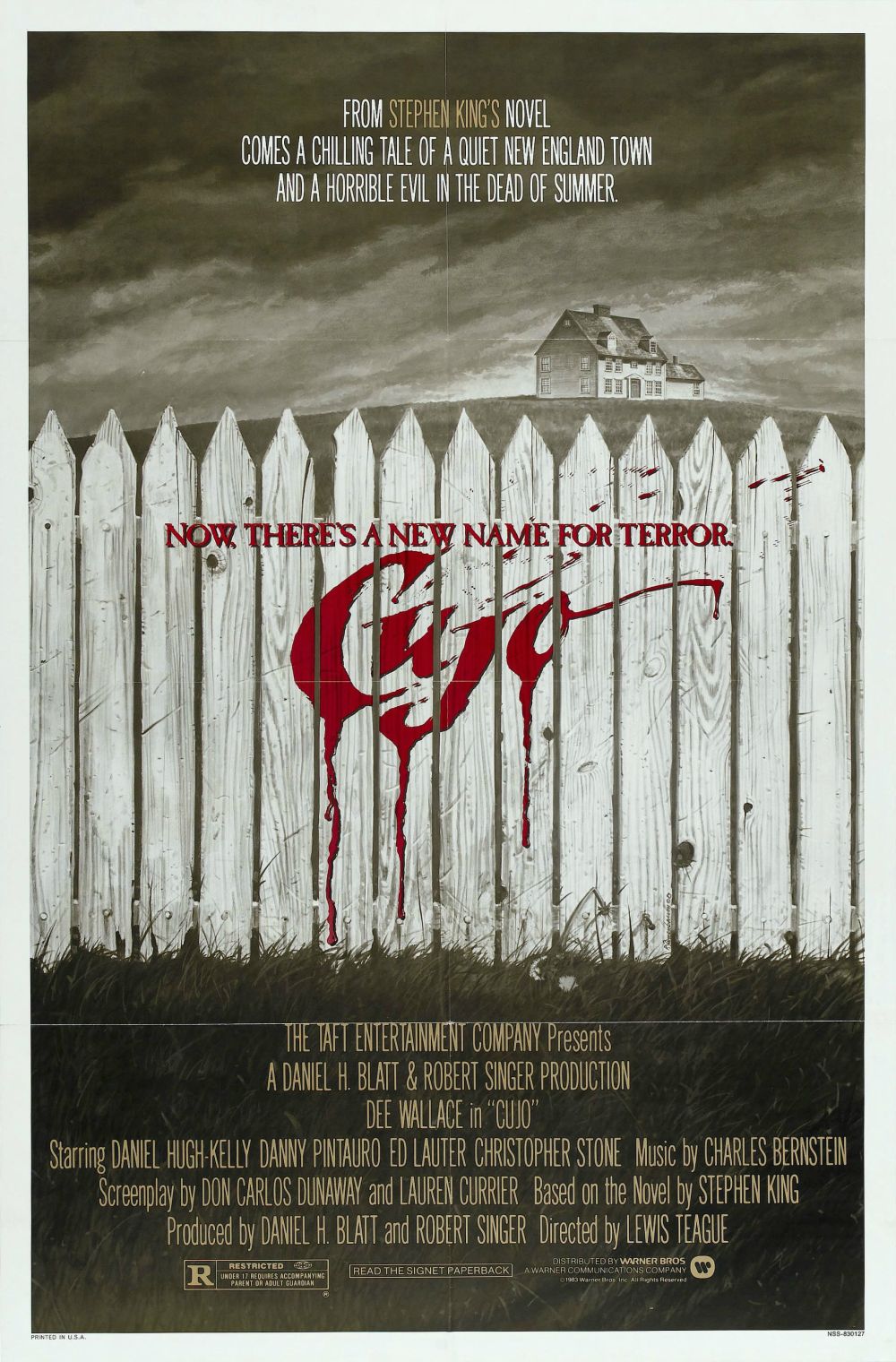
Cujo movie poster

It took Cinematic Void putting together a Stephen King film festival at the Egyptian Theatre in Hollywood to give me a reason to finally check out the cinematic adaptation of “Cujo.” It was a movie I have heard a lot about, and I remember the book’s original artwork with those growling teeth which indicated this particular dog was looking for more than puppy chow and snausages. Moreover, the word Cujo has long since been burned into my consciousness, and it seems to exist as a description of a dog who has gone mad and cannot be mistaken for man’s best friend. In “Fletch,” it made perfect sense when Chevy Chase said “Cujo” as he wandered through a seemingly abandoned house in Utah. Considering he was attacked by a Doberman Pinscher earlier in the film, his fear of being attacked again was completely understandable.

“Cujo” was released in 1983 during a decade when adaptations of King’s work were plentiful and varied in quality. While some were exceptional (“Stand by Me,” “The Shining,” and “The Dead Zone”), others like “Maximum Overdrive” just didn’t work. “Cujo,” however, proves to be an above average adaptation of his work as well as one of the more unusual. While many of his books deal with the supernatural, this one deals more with the horrors of real life instead of just monsters.

I’m sure you all know the story to “Cujo” by now. In case you don’t, it involves a beautiful St. Bernard who, at the movie’s start, chases a rabbit through the woods. In the process, he gets his head stuck in a cave filled with bats, one of which bites him on the nose. From there, he goes from being a lovable household pet to an infinitely vicious one as he attacks any and every human being in his sight.

From the outside, “Cujo” seems to have a very straightforward plot which indicates to the viewer it will be one of those animal attack movies we have seen time and time again. But what really surprised me most is how it focused more on the human element to where I realized the dog was really a supporting character more than anything else.

You have Vic and Donna Trenton (Daniel Hugh Kelly and Dee Wallace), a married couple and the proud parents of a highly imaginative boy named Tad (Danny Pintauro). But while they appear to be leading the perfect life in Castle Rock, Maine, there are cracks beneath the surface which will inevitably become visible to everyone. Vic is increasingly concerned with economic security, something even more understandable these days. Donna is having an affair with Steve Kemp (Christopher Stone), her ex-boyfriend from high school, as she is terrified of being trapped in a small town for the rest of her life. And Tad, he is still at an age where it’s far too easy to believe monsters are hiding in the closet and waiting to jump out at him. Seriously, seeing Tad race to his bed after turning off the light and hiding under the covers brings back a lot of memories.

Taking the fears of each character into account, it serves as a reminder of how brilliant King is at examining not just horrors of the unknown, but also the ones we are forced to experience in the real world. This makes “Cujo” especially effective as the obstacles these characters are forced to deal with feel almost as scary as the thought of this dog tearing their flesh apart.

“Cujo” was directed by Lewis Teague who also helmed the Stephen King anthology film “Cat’s Eye” as well as the cult classic “Alligator” and “The Jewel of the Nile.” Teague was lucky he got to make “Cujo” back in the 80’s, a decade where filmmakers had the opportunity to build up to a furious climax instead of being forced to rush straight to one. These days, studio executives would have begged, if not ordered, him to rush right into the sequences where the dog attacks the hapless humans and increase the blood and gore horror fans are expecting. Instead, Teague got to take his precious time introducing us to characters who are not mere stereotypes and whose struggles will soon pale in comparison to the dog whose appearance becomes increasingly dirty and slimy.

This movie’s major set piece comes when Donna and Tad become trapped in a Ford Pinto as Cujo thrashes away at it, trying to get inside. From there, “Cujo” becomes a major exercise in sheer intensity as we watch Donna do what she can to save herself and her son before the dog makes chop suey out of them both. But if the dog doesn’t get to them, the sweltering summer heat may do them in instead. Suffice to say, they cannot stay in the car forever.

It’s interesting King chose a St. Bernard as the type of dog instead of another like a Doberman Pinscher. Of course, casting a Doberman might have seemed like typecasting as they have always been the villains of dogs. St. Bernard dogs seem more like comic relief, and this was made clear back in the 1990’s with those “Beethoven” movies starring Charles Grodin. Therefore, choosing a St. Bernard as a dog is an inspired choice as it shows how easily a dog, any dog, can turn deadly after being bitten by a bat. When we first see Cujo, he is a beautifully groomed dog you just want to hug. But he soon becomes a dog in desperate need of a shower as he looks disgustingly slimy and has what looks like an abundance of snot sliding off his face. Eventually he becomes an evil force to be reckoned with, and it’s easy to understand how no one could have prepared for him.

But while this dog looks to be the main star of “Cujo,” he is not. The real star is instead Dee Wallace who, just as she did in “E.T. The Extra Terrestrial,” gives us a mother who cannot be mistaken for the average movie mother. I love talking about when actors inhabit roles more than play them, and it is certainly the case with Wallace here as she gives a performance best described as emotionally blistering. She makes us feel Donna Trenton’s frantic struggles as well as her mental and physical exhaustion in dealing with a crumbling marriage, an affair, her son and, of course, the dog. Also, she makes us feel every single bead of sweat coming off of her body as she and Tad are trapped not just in the car, but in the sweltering summer heat as well.

There also moments where Donna loses her patience with Tad, and this makes Wallace’s performance feel all the more real. Just as “Cujo” was being released, some associated with its production were keen to cut a scene where Donna snaps at her son as she grows tired of his crying out for daddy. This, however, would have been mistake as all parents lose their patience with their children. Seriously, just as my mom. I’m sure she has tons of stories she would love to share with you.

While I’m at it, let’s not leave out Danny Pintauro whose performance as Tad feels unbearably real at times. Seeing him weep and panic when the dog tries to get at him and his mother makes an already intense motion picture even more intense.

Teague and his collaborators which include composer Charles Bernstein, director of photography Jan De Bont, and editor Neil Travis clearly had more on their mind than giving us the average horror film with “Cujo.” While there is a conventional feel to much of what we see here, the filmmakers were more invested in the human element than the animal one. Lord only knows how this movie would look if it were made today, and I’m stunned it has not been remade yet. As this cinematic adaptation shows, horror movies can’t thrive unless we are emotionally invested in the characters to where they are not just stock or filler. This film may not be a masterpiece, but it proved to be far more effective than I ever could have expected it to be.
* * * ½ out of * * * *

Edgar Wright and Quentin Tarantino Look Back at ‘Dirty Harry’

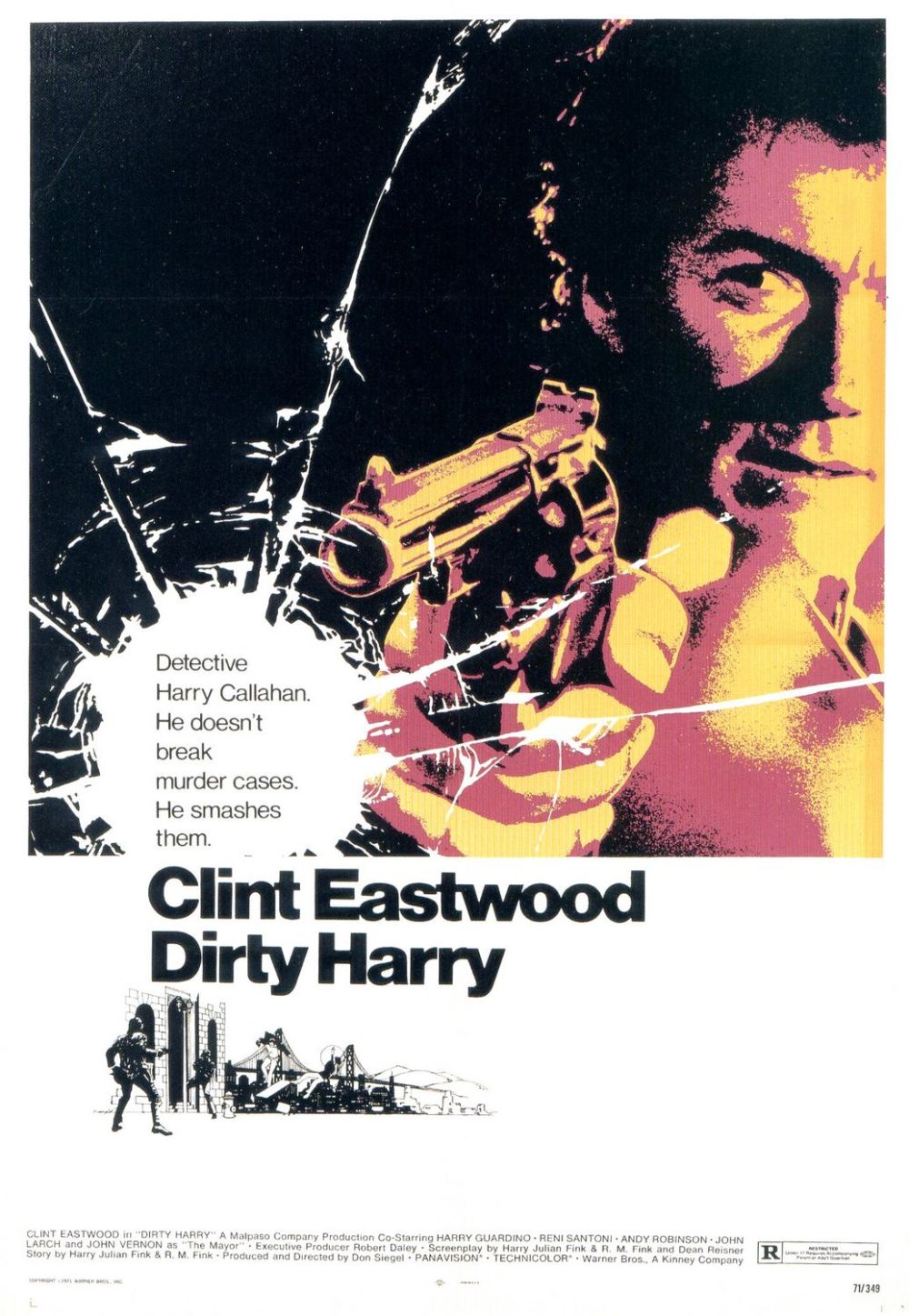
Dirty Harry poster

Of all the movies Edgar Wright selected for The Wright Stuff II Film Festival at New Beverly Cinema, “Dirty Harry” is the one he has watched the most. Wright screened a nice print of the 1971 classic along with another movie called “The Super Cops,” and joining him to talk about it was filmmaker Quentin Tarantino.

They started off riffing on trivia about how the original title for “Dirty Harry” was “Dead Right,” and how it was first going to star Frank Sinatra who later pulled out when the 44-magnum ended up injuring his wrist. It also turned out the late Irvin Kershner, who directed “The Empire Strikes Back,” was the first choice to direct the movie (Don Siegel eventually took the job). Tarantino and Wright also talked about how actor Albert Popwell played a different black stereotype in each “Dirty Harry” film except for “The Dead Pool,” and they both wished he played the mayor in that one.

For Wright, what he loved about “Dirty Harry” was the grittiness of its main character and the atmosphere of San Francisco. On the DVD for “Hot Fuzz,” Wright did a location tour where the film was made, and he even checked out the deli where Eastwood was filmed eating a hot dog when the bank robbery took place. As for the film’s score by Lalo Schifrin, he declared it his all-time favorite saying it marked the birth of “acid jazz.”

But much of the treasure trove of information came from Tarantino who said he first saw “Dirty Harry” when he was five or six years old, and he described it as a “political lightning rod” upon its release. Apparently, it got a lot of crap thrown at it by liberal critics who didn’t want a police fascist solution as well as from right wingers who got freaked out by Scorpio and the ills of society.

The way Tarantino viewed it, however, “Dirty Harry” does have a solid agenda. When Andy Robinson played Charles “Scorpio” Davis, there had never been a villain like him before in movies and, the term serial killer had not really been coined yet. The agenda was for there to be new laws for new crimes, and “Dirty Harry” was screaming for those new laws. Scorpio was not your average villain, and that he got such a kick out of his crimes was easy to see. There was no cure in store for such a psychotic character like this one.

Both Tarantino and Wright agreed “Dirty Harry” really holds up after 40 years. Much of this is due to its sequels treating the iconic character more as a superhero than a regular human being.  With “Magnum Force,” Tarantino felt it was made more for critics of the first movie than its audience as it preached against its predecessor and the character itself by having Harry go after those taking the law into their own hands. This was the same deal with the other sequels, but “Sudden Impact” is the lone exception. Wright remarked at how, along with John Carpenter’s “Halloween,” “Dirty Harry” has one of cinema’s most perfect endings which was eventually ruined by sequels.

They also talked about Siegel who had already been around for a long time before he directed “Dirty Harry.” Siegel was a B-movie genre director from the 1950’s and a Hollywood craftsman who eventually became an auteur. For the most part, Harry Callahan represented the quintessential character of his films; the cop who takes the law into his own hands. Even after directing the 1971 classic, Siegel would continue to have a long and healthy career in films, eventually reuniting with Eastwood on “Escape from Alcatraz.”

Tarantino also described “Dirty Harry” as the single most ripped off and imitated action movie of the 1970’s. He even gave a list of every single movie which stole from it: “McQ,” “Newman’s Law,” “Nightstick,” and everything from Cannon Films. The similar thing about the ripoffs was they lost all the political subtext which made “Dirty Harry” such a strong film. It became all about going after some big drug dealer or crime syndicate, and there was nothing political about that. When it came to 1970’s movies, the only others which were stolen from as much were the ones starring Bruce Lee.

“Dirty Harry” apparently also boasts the first homosexual date in cinema history as seen through Scorpio’s scope rifle. Tarantino said it was the first instance of unforced male sexuality in movies, and he still remembers the audience laughing at this scene when he first saw it. Back then he thought the audience wanted this couple killed, pointing out how they were not as enlightened as we are today, and that they were culpable for their “sinister intentions.”

Hearing these two great filmmakers talk about this Don Siegel/Clint Eastwood classic made for one of the most interesting evenings I have ever spent at New Beverly Cinema. A new generation of audiences will look at “Dirty Harry” differently and may see it as tame compared to plethora of serial killer movies we see today. With the popularity of “The Silence of the Lambs” and the “Saw” movies among others, serial killers have long been the norm in American cinema, so the accomplishments of the 1971 classic threaten to seem diluted as a result.

Thanks to Edgar Wright and Quentin Tarantino, we are reminded of “Dirty Harry’s” place in cinematic history and how it opened doors not just for Eastwood, who made the transition from westerns to other films, but for so many other movies as well for better and for worse.

Jeremy Licht Reflects on the Making of ‘Twilight Zone: The Movie’

Twilight Zone Movie Jeremy Licht

Grauman’s Chinese in Hollywood had a special screening of “Twilight Zone: The Movie” in honor of its 30th anniversary, and the screening was put together by Mad Monster. Before fans got to watch the movie in its pristine digital presentation, there was a Q&A with one of the movie’s stars, Jeremy Licht. Perhaps best known for his work as a child actor on television shows like “The Hogan Family,” Licht was very happy to share his memories of making this film.

Twilight Zone The Movie poster

Licht appears in the movie’s third segment, “It’s a Good Life,” in which he plays Anthony, a young boy who is suddenly befriended by schoolteacher Helen Foley (Kathleen Quinlan). But when Anthony takes Helen home to meet his “family,” she ends up meeting a group of people who live in sheer horror of Anthony as he lives to terrify them if he suspects they disapprove of him.

The movie is the theatrical version of Rod Serling’s classic television series “The Twilight Zone,” and it is essentially an anthology of four different films by four directors. Licht described the audition process for it as being “really interesting” and that he was not hired until after the filmmakers started shooting the first couple of segments.

“I auditioned a couple of times and knew it was starting to get close, and it was really exciting,” Licht said of the process. “On the second audition that I had, Joe Dante was in there (who directed “It’s a Good Life”). It wasn’t often that I got star struck, but I was kind of in awe of him because of what he had done. He had made ‘Piranha’ which I’m sure you all know more than I do.”

Of course, it’s impossible not to talk about “Twilight Zone: The Movie” without mentioning the tragic accident which still casts a heavy shadow over it. During the filming of the first segment, “Time Out” directed by John Landis, a helicopter crashed and killed actor Vic Morrow and two child actors, Myca Dinh Le and Renee Shin-Yi Chen. Licht got the news about the accident a week after his second audition.

“I figured that was it. That was the end of it and they were going to shelve the film,” Licht said. “About six months later, I ended up getting a call from my agent that they were actually back in production and that they had wrapped up that segment (“Time Out”), and to come back and for a third audition. I went back in, and at this point I knew it (the material) back and forth, and I walked in and there was Steven Spielberg. He had just come off of ‘E.T.’ and it was really an amazing audition. By the time I had gotten home from that audition there was an offer. It was extremely exciting time for me and for my family and we accepted the offer, and we wound up on the Warner Brothers soundstage in Burbank within a week and we spent three months in principal photography.”

“It’s a Good Life” was a remake of the classic “Twilight Zone” episode of the same name, but Licht said he never watched it until after filming was complete. It also turns out Bill Mumy, who played Anthony in the original episode, makes a cameo appearance as a restaurant patron who intervenes when his friend starts pushing Licht’s character around.

But unlike the original television episode, Dante ended up taking “It’s a Good Life” in a different direction as it was more cartoony. Licht went on to describe Dante as a very “hands-on” director as well as a “big kid,” and that this movie was “his playground.”

“Working with a director like him truly was a treat,” Licht said of Dante. “He was really into letting the actors find what they were looking for. Obviously it was over the top; he was looking for that. He was looking for that cartoonish, extremely uncomfortable feel which I think we certainly accomplished.”

In terms of what was the most rewarding thing about doing “Twilight Zone: The Movie,” Licht replied it was being part of a film which has a huge following. The television series was always unpredictable in how you never knew what direction it would take from episode to episode, and it made fans wonder what the movie was going to be like. Having acted mostly on television and in several “movies of the week,” Licht also came to discover how fortunate he was to play Anthony in this film.

“It’s very rare as a kid, let alone at 13, to be asked to lead or be one of the principals in a film or play a character where nothing is what you think it is,” Licht said. “It’s rare to have that kind of a script, to have something like that come to you, let alone be asked by Joe Dante or Steven Spielberg to be in it. I was pretty honored and pretty humbled, and I am to this day really.”

As for the question Licht gets asked the most about “Twilight Zone: The Movie,” he said it was if the cast really had to eat those peanut butter covered hamburgers.

“I read the script and I thought, ‘Wow, that is really vile! I can’t imagine doing that,’” Licht said of this unusual meal. “The day that we shot it, they actually brought in McDonald’s hamburgers and basically we tried it. First of all, if you’re peanut butter person, it’s really not bad. The problem is, good luck saying your lines with a mouthful of peanut butter!”

Licht retired from acting in the 1990’s although he did appear in a short film in 2009 called “The Closer.” These days, he has his own financial planning company called JL Capital Management which has turned out to be very successful. For a former child actor, he has done very well for himself, and he has not allowed himself to be swallowed whole by the kind of vices which have destroyed so many lives. When asked why some child actors easily transition to an adult career while others don’t, Licht sounded very level-headed in his explanation.

“When I was doing it, there were paparazzi but nothing like things are now where every moment is recorded and every stumble that you take is magnified,” Licht said. “I’ve seen it all. I’ve had friends that have had very successful careers, and sadly I’ve had friends that have fallen. I grew up with good people around me and I still do surround myself with good people. My folks are important and my family is really important. I got into the business very young, but not necessarily at the urging of my family. I wasn’t supporting my family. It (acting) was a hobby that sort of took off. My parents said to me the whole time, ‘If you stop liking this or you become unpleasant to be around, you’re out. You’re gone because this is not what that’s for.’”

“I think a degree of it is luck, I think a degree of it is also upbringing and family, but I think a lot of it is luck,” Licht continued. “It’s like any of your lives growing up, but under a big microscope. I’m sure that we’ve all had times in our life, if you can imagine if cameras were on you, when you stumble the hardest, and how can you recover from that? You can recover privately, but when everybody’s watching you and judging you it’s a tough deal.”

We keep hearing stories day after day of child actors going bad, but we never hear enough about the ones who don’t. Licht is one of those former child actors who has done very well for themselves, and it would be great to hear more about people like him instead of getting all these random updates on others who don’t have the same support.

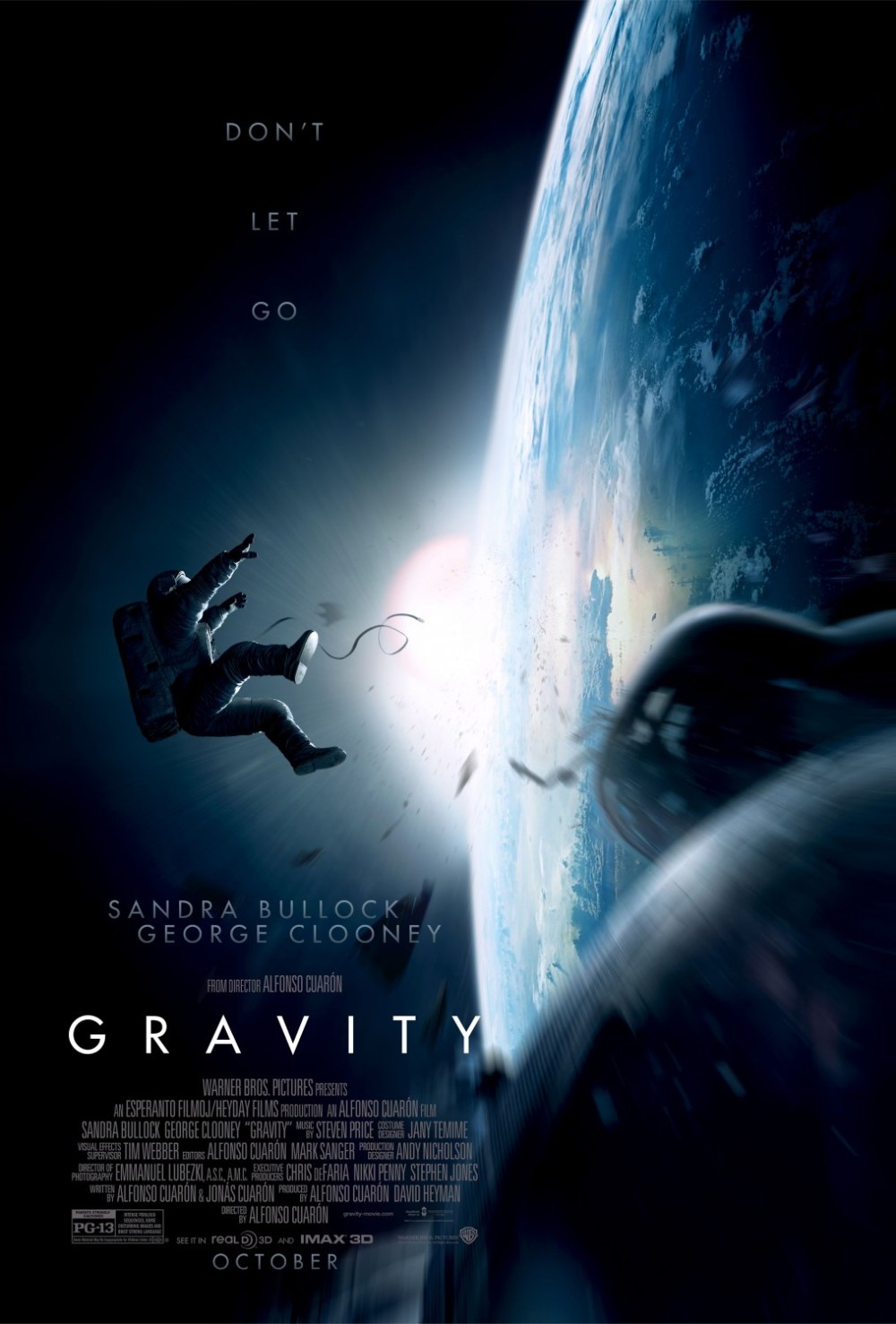
‘Gravity’ is the Ultimate Outer Space Movie

Gravity movie poster

I remember being fascinated and terrified by outer space movies when I was a young boy. Seriously, I kept getting vertigo when I saw all those stars shining brightly to where I was afraid I would fall into space and be lost forever. Of course, back then I still had a lot to learn about gravity. It’s been a long time since an outer space movie gave me this kind of sensation. The last one was Ron Howard’s “Apollo 13” which, when it came out in 1995, was perhaps the most realistic motion picture about life in space and of how dangerous it can be. But now that same sensation has come back in an exhilarating rush with Alfonso Cuarón’s “Gravity,” which may very well be the greatest movie about life in outer space I have ever seen.

“Gravity” is an amazing movie, just amazing. It left me speechless with its amazing visual effects and the tour de force performances from George Clooney and Sandra Bullock, and it made me feel like I was right up there in outer space with them both. The movie opens with the following:

At 372 miles above the Earth

There is nothing to carry sound

No air pressure

No oxygen

Life in space is impossible

For 90 minutes, Cuarón never lets you forget this as we watch astronauts Matt Kowalski (Clooney) and Dr. Ryan Stone (Bullock) struggle to survive after their space shuttle is destroyed by debris from a satellite. From there, they are floating in space with little oxygen and very few options. It may sound like a thin plot for a movie, but it’s more than enough to make “Gravity” one of the most nail biting films to sit through in some time.

I almost don’t want to know how the special effects were accomplished for fear the film’s magic will forever be ruined for me. “Gravity” reminds you of how great going to the movies can be as it sucks you right in to a world many of us have never seen up close. Cuarón shows the inherent dangers of space as well as the sheer beauty of it, and there’s no beating the view of planet Earth hundreds of miles above its surface.

Cuarón, just as he did with “Children of Men,” gives us truly brilliant scenes which look like they were all done in one shot. I’m still trying to wrap my head around how he managed to keep the camera rolling for such a long period of time. “Gravity” starts in space and pretty much ends there, and it’s the lack of gravity which makes the film seem like a new kind of roller coaster ride. I bet a number of audience members will get motion sickness while watching this movie as they’ll be struggling to find their center of balance just like Bullock does when she becomes untethered from the space shuttle. I remember all those trailers for horror movies like “Dawn of the Dead” which said the theater had barf bags available for those who needed them. Well, “Gravity” is proof movies don’t have to inhabit the horror genre for you to need a barf bag. Anyway, that’s more information than you need to know.

But as technically brilliant as “Gravity” is, it never forgets the human element which other filmmakers don’t pay as much attention to. We come to care deeply about the characters Clooney and Bullock play because they are not just a couple of stereotypical astronauts spouting clichéd dialogue. They are flesh and blood human beings with needs and desires, and they need each other to survive. Seeing them tumble through space will make you appreciate the brakes you have on your car.

Clooney rarely, if ever, lets us down as an actor, and he is perfectly cast as the veteran astronaut Matt Kowalski. He immediately gives the sense Matt has been to outer space countless times without having to point it out. From start to finish, Clooney is the calm center in the middle of the storm, and he gives the movie the positive energy it needs. Even as things get worse, he gives Dr. Stone a reason to keep on going.

But when all is said and done, “Gravity” really belongs to Bullock. She may still wonder if she deserved her Oscar for “The Blind Side,” but after watching her here, it’s clear she did, and she may be getting another one. Bullock gives the performance of her life as she reveals her character’s inner struggles which illustrate how there’s more going on with her than just trying to stay alive. The more we learn about Dr. Stone, the more we see this is not so much a movie about a woman lost in space as it is a woman trying to escape the darkness which has engulfed her soul.

Bullock can just draw you into a scene with her eyes which easily reveals much of her character’s inner torment as her oxygen continues to run out. I’ve always admired her as an actress, and her roles in “Demolition Man” and “Speed” showed her to be an unforgettable talent. In recent years, we have seen her do an endless number of romantic comedies, so it feels rare to see her in a dramatic film. But Bullock is so enthralling to watch here, and there is not a single false note to be found in her performance.

I don’t think it’s too much to say Cuarón is a magician when it comes to making a movie. He gave us an enchanting childlike vision of the world with “A Little Princess,” a marvelous coming of age story with “Y Tu Mamá También,” the first truly great Harry Potter movie with “Harry Potter and the Prisoner of Azkaban” and one of the more unique dystopian science fiction movies of recent years with “Children of Men.” From one film to the next, he has given us astonishing visions which have us in awe over what he can accomplish. Cuarón leaves you with a strong sense of wonder with “Gravity,” and it’s a quality seriously lacking in most movies these days.

Cuarón is also aided tremendously by a strong creative team which includes his son Jonás who co-wrote the screenplay with him, Steven Price who composed the movie’s hypnotic score, cinematographer Emmanuel Lubezki who makes space look as beautiful and inhospitable in equal measure, and David Heyman who makes this his first film as a producer outside of the “Harry Potter” franchise. All have come together to create something which redeems our collective hope in the possibility of cinema.

“Gravity” demands to be seen in a movie theater and, yes, I’m going to say it, in 3D. Few film going experiences have been as enthralling as this one, and it is not to be missed. Thank you Cuarón for this film and reaffirming what can be accomplished in Hollywood today. But more importantly, thanks for creating a movie which gave me the sensation of being in outer space I used to have as a child.

* * * * out of * * * *


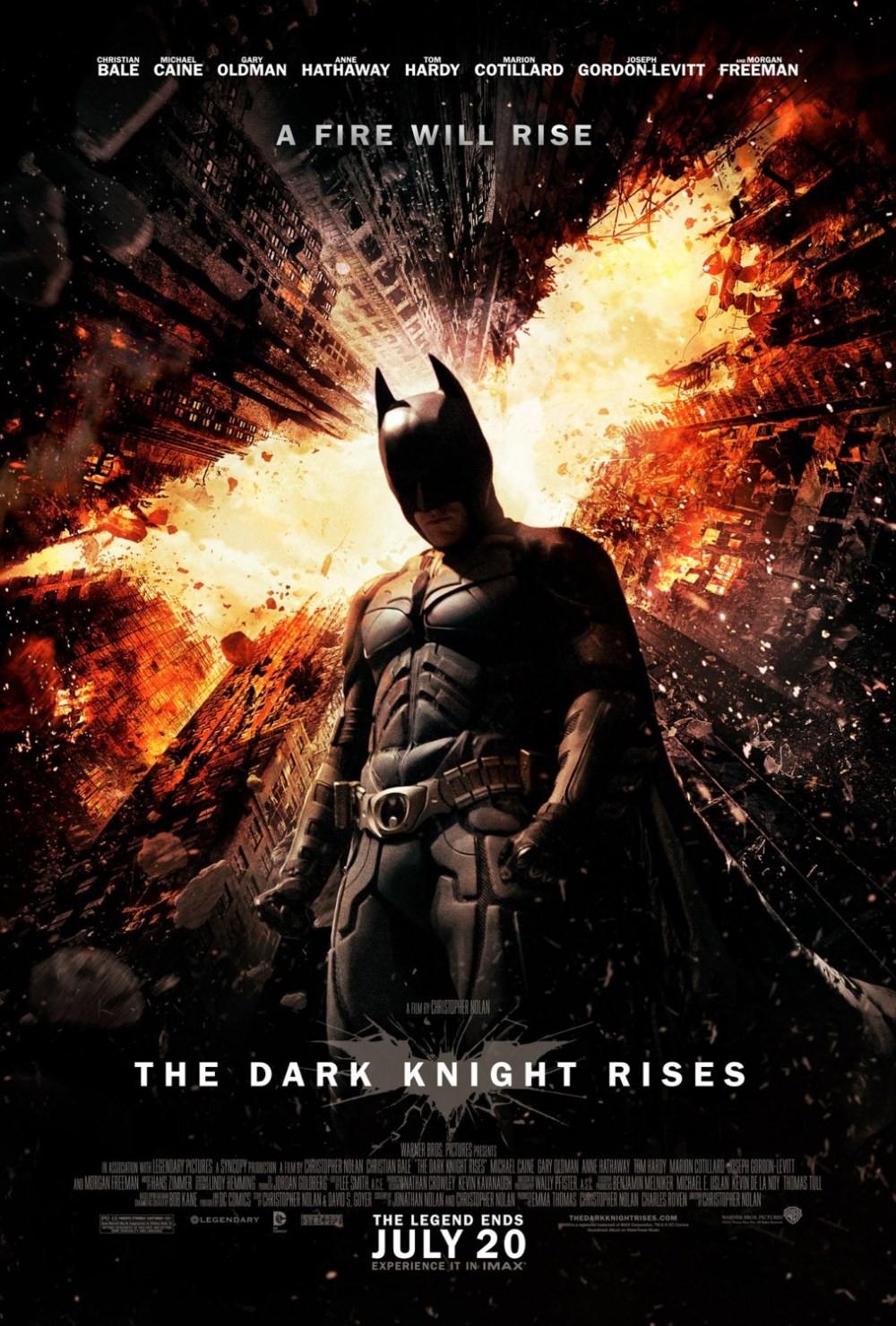
‘The Dark Knight Rises’ Caps Off a Perfect Batman Trilogy

The Dark Knight Rises poster

With “The Dark Knight Rises,” filmmaker Christopher Nolan has completed one of the greatest trilogies in cinematic history. It is a thrilling spectacle with tremendous emotional power, and I came out of it not just fulfilled, but quite shaken. Regardless of whatever plot holes this movie may have, or if it has one too many characters to deal with, it is still as brilliant as its predecessors.

Now I’ll give you more or less a brief outline of “The Dark Knight Rises” without giving away major plot points. I know you all have been seriously pissed about reviewers ruining this movie for you like Homer Simpson ruined “The Empire Strikes Back” for a crowd waiting to see it outside a Springfield movie theater on “The Simpsons,” and I wouldn’t dare to do the same thing here.

Eight years have passed since Batman/Bruce Wayne (Christian Bale) took the fall for Harvey Dent’s death in order to hide the murders he committed and let him remain a hero in the eyes of Gotham’s citizens. Since then, Gotham has entered a time of peace and prosperity, all of which is based on a lie. Enter Bane (Tom Hardy), a brutal and methodical terrorist who plans to reduce Gotham to ashes slowly but surely. This brings Batman out of hiding, but he also has to deal with cat burglar Selina Kyle (Anne Hathaway) who catches him off guard, a beautiful corporate executive named Miranda Tate (Marion Cotillard), and the idealistic young cop John Blake (Joseph Gordon-Levitt) whose “hot head” ways make him much smarter than his fellow officers. So that’s it for the movie’s story.

Actually, to go into full detail over the plot of “The Dark Knight Rises” would take forever as it goes in various directions to where seeing it once is not enough to take everything in. Nolan has said part of his inspiration for this film was Charles Dickens’ “A Tale of Two Cities” which is known for this famous quote:

“It was the best of times; it was the worst of times.”

Now while this quote is never spoken in “The Dark Knight Rises,” it never needs to be. Nolan is fascinated with how the lie over Dent’s death has helped Gotham while at the same time turned it into a prison state where freedoms are eroded. It also parallels current events in the real world by taking into account the continuing gap between the rich and the poor and how people will go out of their way to manipulate the collective anger regarding it. This movie is a huge action spectacle, but it has a lot of things to say about the world we live in today which makes it all the more powerful.

Many have been calling this the “darkest” Batman movie of them all, as if the two which came before it were a sunny paradise in the realm of “Batman & Robin” (they most certainly were not). But while “The Dark Knight Rises” is indeed a dark vision of a city under siege, it also has a strong ray of hope emanating from it. Bruce Wayne has always wanted to hold Batman up as a symbol to inspire people, and you revel in seeing the impact he has on the characters around him.

People have also been saying Nolan has put far too many characters into this movie. Newsflash, Nolan has done this with each of his “Batman” movies, but what truly amazes me is how he has gotten away with doing so each time. Every single character in “The Dark Knight Rises,” from Matthew Modine’s bone-headed Deputy Commissioner Peter Foley to Ben Mendelsohn’s greedy businessman John Daggett, informs the movie’s main characters and overall themes throughout. Not a single one of them feels extraneous to the plot as each illustrates examples of justice and personal responsibility, and of how easily misconstrued they can end up being.

Christian Bale completes his tour of duty as Batman with a deeply felt performance. In many ways, “The Dark Knight Rises” is more about the rise of Bruce Wayne than anything else as he is forced to deal with who he is than what his alter ego can do. While Spider-Man and Superman are endowed with super powers, this movie renders him all the more vulnerably human as he starts off walking with a cane and dealing with injuries not easily healed. It’s those human flaws, however, which make Bale’s portrayal of Bruce Wayne all the more powerful and enthralling.

With Bane, Nolan has fashioned a villain far different from Heath Ledger’s Joker which was a smart move. While the Joker was far more desirous of watching the world burn, Bane simply wants it to suffer right down to its dying breath. With Tom Hardy, Nolan has found the perfect actor to portray Bane as he brings to life the character’s twisted code of ethics and his utter brutality which allows him to batter his helpless opponents with sheer efficiency. Thanks to Hardy, Bane proves to be Batman’s most formidable foe yet.

As for Anne Hathaway, she is excellent as the character known as Catwoman but who is never actually called Catwoman in “The Dark Knight Rises.” Her portrayal of Selina Kyle never invites easy comparison with the actresses who played her in the past as her version exists in the world of realism created by Nolan. Hathaway succeeds in giving this movie the feeling of exuberance and fun it needs from time to time, and she more than holds her own against Bale and Hardy. But then again, this should be no surprise to those who remember her Oscar nominated performance in “Rachel Getting Married.”

And, of course, you have the usual cast of supporting characters played by Sir Michael Caine, Morgan Freeman, and Gary Oldman. All of them are fantastic as always, and they give this movie the emotional heft it calls for throughout. We also get a great bunch of franchise newcomers like Joseph Gordon-Levitt who is sensational as the intelligent John Blake, and Marion Cotillard who radiates both beauty and mystery as Miranda Tate.

Technically, “The Dark Knight Rises” looks flawless with cinematographer Wally Pfister capturing the dark corruption consuming the citizens of Gotham which they are forced and inspired to rise out of. And with Hans Zimmer, minus James Newton Howard this time around, we get another rousing and thrilling music score which keeps our adrenaline pumping along with movie’s thrilling action set pieces.

Yes, the movie has some plot holes which I’m sure you will discover for yourself. None of them, however, were enough to derail my enjoyment of this awesome spectacle Nolan and company have put together. I’m not sure where I would rate this in the series, but while it doesn’t best “The Dark Knight,” it still comes very close to doing so and continues Nolan’s reign one of the best movie directors working today. I don’t think I am overreacting in the least when I declare “The Dark Knight Rises” to be a brilliant motion picture.

Oh yes, some will say that the movie’s final scenes seem to spell out a potential new direction for this franchise to take as if it were a set up for a sequel. I’d like to think it speaks to the influence Batman hoped to have on the citizens of Gotham, to inspire them to do good. Thanks to Nolan, Batman is a hero we can appreciate and applaud.

* * * * out of * * * * 

‘Inception’ May Be the End All of Mind-Bending Motion Pictures

Inception movie poster

“What the hell are dreams anyway?”

“Mysteries, incredible body hocus pocus; the truth is we still don’t know what they are or where they come from.”

                                        -from “A Nightmare On Elm Street” (the original)

“I can make you mine, taste your lips of wine

Anytime night or day

Only trouble is, gee whiz

I’m dreamin’ my life away”

                                    -from “All I Have To Do Is Dream” by the Everly Brothers

“It’s too bad that all these things

Can only happen in my dreams”

                                                -from “In Dreams” by Roy Orbison

My reaction upon seeing “Inception” was pretty much the same one I had after I saw Christopher Nolan’s last movie “The Dark Knight:” BRILLIANT!!! In a summer movie season which has been largely bland and seriously lacking in excitement, Nolan once again stimulates the imagination by giving us a very well thought out story with complex characters. This is all in addition to the slam bang entertainment we expect from a summer blockbuster, and Nolan delivers on both fronts. Seriously, this movie feels like a godsend in a time where studio executives are way too risk adverse. Even if “Inception” borrows from movies like “Blade Runner” and “The Matrix,” Nolan still makes it all his own. I’ve already seen “Inception” twice in one week, and there is just as much to discover about it the second time around as much as the first.

Nolan has actually been working on this screenplay for over a decade, and it is an intricate puzzle of a flick which might seem difficult to follow, but not really. Leonardo DiCaprio stars as Dominic Cobb, a highly experienced dream infiltrator who works at extracting precious information from his targets. Basically, he steals ideas from his clients before they even realize it, and they are very valuable ideas which will put him and his crew on easy street for a time. Working with him is his partner Arthur (Joseph Gordon-Levitt) whose job is to research the clients’ history and see if they have any mental defenses built up which could hinder their mission. As we first see them in “Inception,” they have seemingly failed a mission, but they soon find out it was actually an audition.

Their target, Saito (Ken Watanabe), a wealthy businessman, offers a job which will have them doing the opposite of their job description. This brings us to the movie’s title which means planting an idea in the mind of their target’s subconscious. Although thought to be impossible, Cobb says it can be done because he has succeeded in doing it before. “Inception” then takes Cobb and his team on an adventure which will go into a dream, and then into another dream within that dream. Just when you think they couldn’t go any deeper, they do. It sounds confusing, but it was easier to follow than I thought. You want a tough movie to follow? Check out the first “Mission Impossible” movie which Brian DePalma directed. After all these years, I still can’t figure out what it was about (the stunts were cool though).

The concept of entering a person’s dream is fascinating because it gives the story infinite possibilities to explore, and all sorts of directions to take it in. Dreams themselves still fascinate us as we still have no clear idea what generates them. They can be very unpredictable and go from one place to another before we know it. Dreams could be our subconscious minds trying unburden itself of all the baggage we bury down into its recesses in the hopes of forgetting the most painful things in life. Looking back at the dreams I have had which have stayed with me, be it good or bad, they continually astonish me with their vividness and how our brains and imaginations can conjure up such amazing images as we slumber away in beds which are hopefully kind to your back. You’d think after all these years we would be able to be consciously aware of when we are in a dream and control it to our advantage, but no such luck. When you’re deep into one, the difference between what is real and what is not becomes irrelevant.

That’s the other thing I loved about “Inception;” you are always questioning whether you’re in a dream or wide awake. Even if you already know how the movie ends, it couldn’t possibly spoil the experience for you when you witness it. As in “Total Recall,” reality is always in question and open to interpretation, and it’s unlikely everyone will come to the same conclusion. I was also reminded of David Cronenberg’s “eXistenZ” which ended on a note of sheer ambiguity as the line between what’s real and what is not becomes permanently blurred. “Inception” all but starts out this way, and the theories behind the action and what’s really going on continue to abound. How cool it is to have a movie of this size and scope which really gets you to think!

For a moment, I thought DiCaprio was going to portray the same character he played in Martin Scorsese’s “Shutter Island,” Teddy Williams. Both characters have inescapable similarities; they are tortured by memories and actions they cannot repair, they are married to beautiful women whose current state of mind is in question, and they are both really moody guys who are not a barrel of laughs to be around. Oh yeah, both are also struggling with the reality of everything happening around them. I guess what Cobb has over Teddy is his grip on reality is much firmer, but even Cobb’s sanity comes into question throughout “Inception.”

DiCaprio continues to prove he is not only one of the very best actors working, but also one of the few stars who genuinely take risks. Not content with being forever imprisoned as a movie star, he nails the complexities of Cobb to where we see the various dimensions of his character. In essence, Cobb is a thief after the big score, and he shuts himself off to other people. But DiCaprio really gets at what is beneath his character’s guilt and shame, and he makes us want to join him in his dream exploits. For him, it is never about just making the character a likable one.

It’s also great to see Levitt here as well. Having been the indie darling for a few years, turning in one great performance after another, and he more than holds his own here. When everyone else is in a state of uncontrollable panic, Arthur always keeps his focus clear which allows him to stay on top of things. His method of preparing his team members for “the kick” in one dream is ingenious. Watching Levitt here almost makes me forget he was on “3rd Rock from The Sun” all those years ago.

Then you have the beautiful Marion Cotillard, plays Cobb’s late wife, Mal. While Mal may be short for Mallorie, in Latin it means “evil,” and she exists only within Cobb’s dreamscape as he has buried her deep in his memories. However, his control over her continues to erode as Mal continues to intrude in different dreams he has as she gets the upper hand and continually threatens to ruin anything and everything. Cotillard plays Mal with a cold detachment as well as a deeply wounded person who feels betrayed by her husband. As the movie goes on, you begin to wonder if she is truly dead or alive.

At first, having Ellen Page in this movie might seem weird as we all still identify her with her character from “Juno.” It’s been easy to forget what a wide range she can have as an actress, but this is not the case here as she acts as the guide for the audience in the world of dreams. Her character of Ariadne is the architect, the one who constructs the world of the dream which the team will enter into. She also acts as the conscience Cobb needs as he continues to be drawn by Mal into a state of limbo which he may never return from. As a result, Ariadne is the strongest, most objective and levelheaded in the group because she sees what consumes Cobb and how it can endanger everyone. She becomes the voice of reason Cobb must listen to if he hopes not to drown in his own guilt. It feels like it has been too long since I have seen Page in anything, and she once again proves to be another fantastic actress of her generation.

Tom Hardy, who plays the forger Eames, is fun to watch here as he approaches the role with a touch of irresistible sarcasm as he gleefully plays around with the other team members and their self-consuming seriousness. Eames gets an especially big kick in getting a rise out of Arthur who takes his work perhaps more seriously than most. Throughout the movie, Hardy’s presence proves to be one of the film’s most entertaining, and his star continues to rise.

Nolan also brings some of his “Dark Knight” cast members along for the dream ride including Sir Michael Caine and Cillian Murphy. Both are terrific in any role given to them, and the performances they both give in “Inception” are no exception. Another supporting actor worth noting here is Dileep Rao who plays Yusuf, the chemist who formulates the sedatives which put the group and the target under so they can complete their mission. I think he deserves to be mentioned in the same breath with all the other actors whose names appear on the posters.

But the big surprise in “Inception” is the appearance of Tom Berenger, a well-known actor who has for far too long been relegated to the realm of straight to DVD movies. It’s so nice to see him here in something other than a “Sniper” sequel (how many have there been anyway?), and he hasn’t missed a step as an actor after all these years.

With movies like “Inception,” we have come to expect directors will spend more time on the visual element to where they inadvertently forget the other important ones like dialogue and acting. Having made several movies already, Nolan proves to be one of the best directors working today as he handles each part of a movie with the same amount of attention, something increasingly rare among filmmakers.

Nolan fills the movies with such inventive images as Arthur fights off armed men while the dream he is in is thrown out of balance as it spins him from the floor to the ceiling. Levitt really sells the scene by showing his character struggling to maintain control as he is forced to crawl over the place when gravity no longer works in his favor. Then there is the final scene, which I won’t dare to give away, but taking in the audience’s strong reaction showed just how successful Nolan was in holding us firmly within his grasp. I loved the inescapable ambiguity of the film’s conclusion and how it drove some audience members crazy.

Plus, Nolan once again employs Hans Zimmer to do the score, and what he brings us is not another rehash of the Caped Crusader’s music. Zimmer gives a strong score dominated by electronics, drums, and brass instruments which are primed to blow out the speakers at a theater near you. Capturing the scope of the visuals in “Inception” which are quite immense, Zimmer once again gives great power to Nolan’s amazing concepts which Warner Brothers was smart enough to let the director run wild with instead of just containing his imagination in fear of releasing something which might seem “uncommercial.”

In a sea of endless remakes, questionable reboots, and half-assed concepts which somehow got a green light from studio executives, “Inception” is a rare breed of film which is as thought provoking as it is entertaining. It also makes clear Nolan is a genius filmmaker who has set the bar high for summer tent pole movies just like he did with “The Dark Knight.”

* * * * out of * * * *

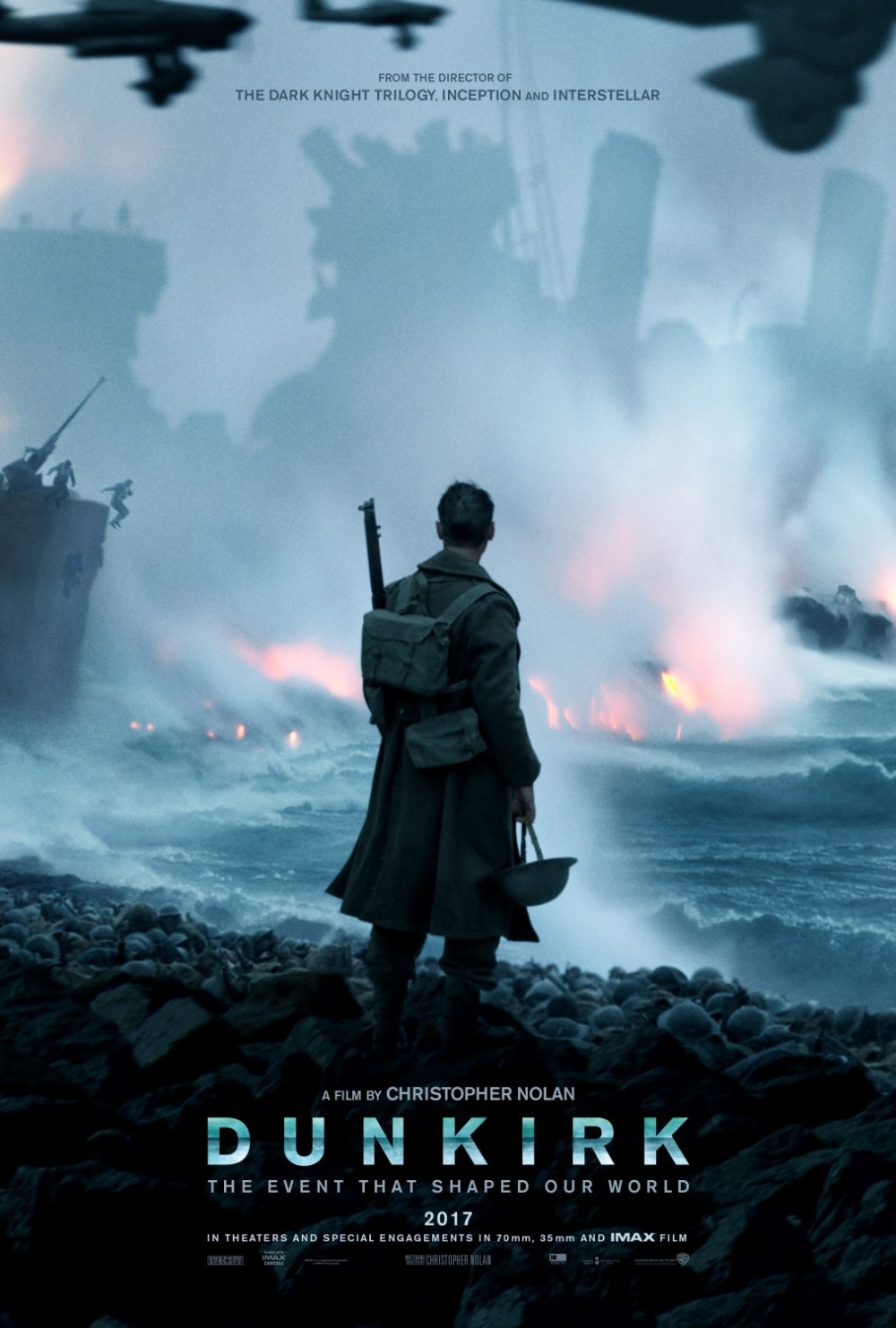
‘Dunkirk’ is Yet Another Brilliant Masterpiece from Christopher Nolan

Dunkirk movie poster

Dunkirk” is the first Christopher Nolan film since “Insomnia” where you see the movie’s title on the screen at the beginning instead of at the end. This surprised me as Nolan always seems determined to suck you right into the movie instead of having you think about its title until the screen fades to black. When it comes to “Dunkirk,” however, I imagine he wanted audiences to have this title firmly implanted in their brains as this particular World War II story is one of character and bravery in the face of such agonizing defeat.

The title refers to the beaches and harbor of Dunkirk, France where thousands of allied soldiers were trapped like sitting ducks as the German army closed in on them during the Battle of France. Now World War II has been a historical event which filmmakers have visited as often as they have the Vietnam War, but “Dunkirk” has a different angle than other films of its genre. There are no American troops to be found here, we never see Germans but feel them closing in on the allies throughout, and the allies are at a complete loss in terms of being able to fight back. What happened at Dunkirk was not at all about victory, but about survival, and sometimes surviving a war is all a solider needs to do.

Nolan, who also wrote “Dunkirk’s” screenplay, tells the movie from three different perspectives: the land, the sea, and the air. On land, we meet British Army Private Tommy (Fionn Whitehead) who barely escapes a German ambush and arrives at the beach of Dunkirk where he befriends Gibson (Aneurin Barnard), another young soldier with whom he desperately tries to escape Dunkirk with on any boat that will take them. On the sea, Mr. Dawson (Mark Rylance) sails his boat out to Dunkirk in an effort to bring stranded soldiers back home, and he is joined by his son Peter (Tom Glynn-Carney) and Peter’s friend George (Barry Keoghan) who is curious to see the war up close. And in the air, Royal Air Force Pilot Farrier (Tom Hardy) and two other Spitfire pilots battle enemy fighters in the sky who are determined to destroy any boat going away from Dunkirk. Everyone is busy as can be as they fight to keep their fellow allies out of harm’s way, and this is even though the situation is growing increasingly dire.

What’s fascinating is how Nolan ends up using very little dialogue throughout a good portion of the film. These characters are too shell-shocked to speak in full sentences after all they have been through, and Tommy and Gibson end up connecting in a way not only wordless but also totally believable. As “Dunkirk” goes on, more dialogue is featured, but Nolan has already managed to set up the atmosphere to where no one needs to say much because their faces and eyes say so much more than words ever could.

Watching all the soldiers on the beach, waiting for a boat, any boat, to take them, I was reminded of Tom Sizemore’s dialogue from “Saving Private Ryan” when he said, “I want plenty of feet between men. Five men is a juicy opportunity. One man is a waste of ammo.” These soldiers are stuck together in bunches, desperate to escape Dunkirk at the earliest opportunity. I felt horrible for them as they all just sitting ducks for German bombers who can pick them off ever so easily. All these soldiers can do, other than shoot back, is to play dead in the sand, but even this may not be enough to save them.

Much of the movie is focused on the endless ordeals of Tommy, Gibson, and another young soldier named Alex (Harry Styles) as they get on different boats to escape from Dunkirk. However, their successes are often thwarted by attacks which sink the ships they are on, and they soon find themselves in even worse situations. Like Adrien Brody in “The Pianist,” these characters are caught up in unthinkable circumstances and are just trying to survive by any means. Many will consider them cowards for trying to flee, but considering the dire situation they are trapped in, it’s hard to hold much of a grudge against them.

With Mr. Dawson and his two young companions sailing out to sea, we see the need these men have to help those in harm’s way. While Dawson is supposed to give his ship over to ship over to the Navy as they are commandeering private boats to help in the Dunkirk evacuation, he simply sails off as he feels it is his duty to rescue as many soldiers as he can since it was his generation who decided to send young men out into the battlefield. As for the two boys, both want to do something noteworthy in this war instead of just staying on the sidelines. In wartime, it doesn’t matter if you are a soldier or not because everyone is involved in one way or another.

For me, the moments in the air were among the most fascinating, and not just because of Hoyte van Hoytema’s beautiful cinematography. Once those pilots and their planes came up on the screen, I figured it would all play into the clichés of war movies or be something like “Top Gun” with characters infinitely eager to be seen as heroes and taking giddy pleasure in shooting the enemy down. But this is not the case in “Dunkirk” as these pilots are simply men doing their job without any fanfare, and they are well aware of the risks and of what could happen if the enemy wins. Farrier, in particular, has even a bigger risk to consider as his fuel gauge is cracked to where he can’t tell how much fuel he has left. He should turn back, but with the allies having little to defend themselves with, his concern for their well-being overrules any thoughts he has for his own safety.

With these three divergent plot points, Nolan has the Dunkirk evacuation surrounded brilliantly. This is not a story about victory in the slightest, but instead one of character and of what people will do in a most precarious situation. Some stand around as others suffer helplessly because they can’t save them, others are desperate to escape by any means as the miracle they pray for doesn’t look to be delivered to them any time soon, and there are those who sail out to the most dangerous place not because they want to, but because they have to. Like I said, “Dunkirk” is a movie about the character of a person and how that character is tested in wartime.

Nolan also ratchets up the intensity throughout as the situation these characters are in becomes increasingly dire as the Germans close in on them. This is especially the case when Tommy, Alex and Gibson join a group of Scottish soldiers who have discovered an abandoned boat in the intertidal zone which they plan to use for their escape when the tide rises. The Germans, however, have already begin using it for target practice, and the holes they put in the boat soon have water coming through them. To stay on the sinking ship is suicide as they will certainly drown, but to go out into the open is no different as they will be shot once they are out in the open. But Nolan squeezes even more intensity out of this scene as it is suddenly revealed one of the soldiers on board might be a German spy, and it becomes a question of not who will survive, but who will die first.

There’s not a weak performance to be found here as every single actor in “Dunkirk” brings their A game to the table. Mark Rylance remains an impeccable actor, and he makes Mr. Dawson into a man determined to do his national duty not just out of necessity, but out of guilt as well. I’m not familiar with Fionn Whitehead, but his work here is exemplary as he doesn’t have much dialogue and instead has to spend most of his performance showing the turmoil Tommy endures through his eyes and actions. Cillian Murphy also gives a strong supporting turn as a soldier who has seen the worst war has to offer, and it becomes clear he will never again be the man he once was. Harry Styles, whom many thought would stand out like a sore thumb, fits perfectly into this ensemble of actors without ever overshadowing them. Even the great Kenneth Branagh shows up as Commander Bolton who oversees the evacuation of soldiers, and the moment where his eyes water up at the sight of those private boats sailing towards the soldiers is a moment of beauty as I wanted to cry with him. To quote the movie’s tagline, these soldiers couldn’t get home, so home came for them.

But one performance I want to point out in particular is Tom Hardy’s as Farrier. Watching the actor here reminded me of his work in “Locke” as, like the character in that movie, Farrier spends the majority of the time in a moving vehicle with only his fellow pilots and his own sense of duty to keep him company. Not once does Hardy try to portray Farrier as some hotshot pilot like Maverick in “Top Gun” or Captain Steve Hiller in “Independence Day,” but instead as a soldier like any other. Even with his face covered by an oxygen mask, Hardy deftly shows the stoicism and determination of his character as he continues to battle his foes in the sky even as his gasoline supply continues to dwindle, and he makes Farrier into the hero this movie very much deserves.

Another big character in “Dunkirk” is the music of Nolan’s frequent collaborator, Hans Zimmer. The German film composer has given us some of the most thrilling music scores of the past couple of decades, and his music here helps to make an intense motion picture experience even more intense than it already is. It essentially acts as a ticking clock, reminding the audience of how time is running out for the allied soldiers as the German forces get closer and closer to their location. Even in its more hopeful moments, Zimmer provides ominous sounds reminding us how the danger is always around the corner, ready to strike without much warning. When Zimmer’s music breaks into a cue scoring the arrival of boats to take the soldiers home, I could help but let out a sigh of relief as he finally had a reason to slow things down a bit and revel in the heroics of those who came to rescue the stranded men.

Does “Dunkirk” stand as one of the greatest war movies, let alone World War II movies, ever made? You bet. Nolan continues to give us one brilliant cinematic masterpiece after another, and whether or not you think this film is his best, it is certainly the most important he has made to date. The story of the Dunkirk evacuation is one the British people were raised on, and the world needs to be reminded again of how important a story this is. On one hand it is a story about military defeat, but it is also about a nation’s character and of how citizens stood up in the face of disaster to help those trapped. All the characters featured here endure different fates, but what they endure says more about them than words ever can. And the movie also reminds us sometimes all you need to do in a war is survive. You may come out of a war not feeling like the hero everyone makes you out to be, but surviving really is more than enough. At the very least, it gives you a reason to carry the story on to the next generation so the sacrifices made by so many will never be lost in the backroom of history.

* * * * out of * * * *

‘Interstellar’ Takes Us on an Outer Space Journey Like Few Others Can

Interstellar movie poster

Christopher Nolan’s “Interstellar” is a film which demands to be seen on the biggest screen nearest you. Like “Gravity,” seeing at home on television will not have the same effect as seeing it in a darkened theater, and that’s even if certain people around you forget to turn off their cell phones (doesn’t anyone ever learn?). Whether or not you think “Interstellar” is Nolan’s best film, you can certainly say it is his riskiest and most ambitious to date as he combines elements from Stanley Kubrick’s “2001,” Phillip Kaufman’s “The Right Stuff,” and even Robert Zemeckis’ “Contact” to make a most enthralling space adventure for us to experience.

“Interstellar” takes place in a not too distant future when Earth is unable to sustain humanity as crops are constantly ravaged by blight, dust storms keep laying waste to towns everywhere, and teachers have changed school textbooks to make children believe the Apollo moon landings were faked (blasphemy). In the middle of all this is farmer, widower, and retired astronaut Joseph Cooper (Matthew McConaughey) who spends his days tending to his farm and raising his son and daughter with the help of his father-in-law Donald (the always dependable John Lithgow). Cooper keeps going about his business but still takes the time to indulge his daughter Murph (Mackenzie Foy) in her curiosities about outer space and the ghost she believes is haunting her bedroom.

One of those curiosities ends up leading Cooper and Murph to a secret NASA space installation out in the middle of nowhere where they meet Professor Brand (Sir Michael Caine) who informs them humanity will not survive for much longer. However, scientists have discovered a wormhole orbiting Saturn, and this presents the possibility of new planets for humans to inhabit. Cooper volunteers to pilot the experimental space shuttle Endurance into the wormhole, and he is joined by a crew of three as well as a couple of multi-purpose robots on a mission which will take several years to complete. But the mission also means Cooper must leave his family behind, and this ultimately devastates Murph who begs him not to go. Cooper promises Murph he will return once the mission is complete, but this may be a promise he might not be able to keep.

I don’t want to reveal much else of what happens in “Interstellar” as it is full of surprises, and it helps to come into this movie free of expectations and knowing only so much about it. We all love his “Dark Knight” films and have been following his work ever since he made his breakthrough with “Memento,” but this is really Nolan at his most emotionally open and, dare I say, sentimental. Almost nothing he has made previously compares to what he has given us here.

The movie does take a while to achieve liftoff (pun intended), and I know many have complained about the “sluggish” pacing in the first half. The way I see it, I admired how Nolan took his time with the story as many other filmmakers would have been pushing to get into outer space a lot sooner. These days we are in such a hurry to get everywhere and nowhere, and cable channels like IFC are content to speed through the end credits of a movie as if none of the hundreds of crew members who worked on it ever mattered. It’s nice we get to know these characters to where they have enough depth which makes us want to follow them on their journey to where no one has gone before.

I also liked how “Interstellar” deals with real science and doesn’t go out of its way to heedlessly disregard the laws of physics and gravity. Granted, there’s a lot of technobabble dialogue here which is at times hard to decipher and makes certain scenes a little confusing, but considering how much work Nolan and his fellow collaborators (which includes noted theoretical physicist Kip Thorne) put into researching space travel, this movie does have the feeling of plausibility throughout. We still may be years away from the kind of space travel presented here, but Nolan and company make you believe it will become a reality at some point.

Along with cinematographer Hoyte van Hoytema, Nolan captures some exceptionally beautiful images as Cooper and company seek out new life and new civilizations. Some of the shots are bound to remind viewers of “2001,” and Kubrick’s classic film is certainly a huge influence on the story. Still, Nolan takes us on a journey which feels surprisingly unique to others captured on celluloid recently and previously.

At this point, it should go without saying that McConaughey is on a roll. When he first made his breakthrough in “A Time to Kill,” many were heralding him as the next Paul Newman when they should have just let him be Matthew McConaughey. This led him to star in a number of dopey romantic comedies which were far beneath him and his fellow co-stars, and many quickly lost faith in him. However, the last few years have seen him turn in one remarkable performance after another in “Mud” and “Dallas Buyers Club.” His work in “Interstellar” is remarkable and heart wrenching as he watches videos of his children who are growing up without him, and he grieves over the things he has missed out on.

Anne Hathaway, who previously worked with Nolan on “The Dark Knight Rises,” turns in a strong performance as Amelia (as in Earhart?) Brand, an astronaut and scientist whose heart threatens to get in the way of her duties as a scientist when hard choices have to be made. David Gyasi is also very good as physicist Romilly, and time proves to be a real burden for him throughout the movie. As for Wes Bentley who plays geographer Doyle, he is underutilized here as he has little to do other than spout off a lot of technobabble, and his character never gets much in the way of development.

But one of the best performances to be found in “Interstellar” comes from Jessica Chastain who plays the older version of Murph. Still resentful of her father for leaving, she channels her anger into her own work with NASA as she works with Professor Brand to bring him back. Even as the film threatens to be a little ridiculous with answers that may have been better left to the imagination, Chastain keeps you hooked into her character’s quiet desperation to find her father and save the world to where you are begging for these two to reunite sooner than later.

Another collaborator of Nolan’s who really challenges himself here is composer Hans Zimmer who has given us some of the most exciting music scores in the last few years. With “Interstellar,” Zimmer abandons the usual thrilling bombast of “The Dark Knight” and “Inception” for something more spiritual and Phillip Glass-sounding. His music acts as a requiem for the wonders and perils of voyaging through space and of the solitude humans are forced to endure when stuck in another galaxy. You can usually notice the Zimmer sound in each film score he does, but his work here sounds so remarkably different from what he has done in the past.

This movie does have its flaws, and there are moments towards the end which strain credibility to where things threaten to become laughable, but its strengths eventually overcome its weaknesses by a large measure. Just when it looks like the plot will go off the rails in an M. Night Shyamalan way, it doesn’t, and it speaks to how deeply Nolan feels about the story and what it implies.

In the end, “Interstellar” is not another science fiction movie about astronauts looking for little green men (it would have been a disaster if it did). It’s about the power of love and how it can transcend both time and space no matter where you are. Regardless of the laws of physics and gravity, love carries on from one galaxy to the next and can never be easily conquered. I came out of this movie happy to know that, even in the deep, dark and silent void of outer space, love can remain constant.

For the record, I saw “Interstellar” at the historic Grauman’s Chinese Theatre in Hollywood in IMAX 70mm. I am more than convinced this is the best way to see it, and it also represents one of the last chances for all of us to see a movie projected on film. I’m sure it looks great in digital, but film still works best for Nolan.

* * * * out of * * * *

‘Batman Begins’ Revisited

Batman Begins poster

Before “The Dark Knight Rises” was released, I took the time to revisit director Christopher Nolan’s first stab at the Batman. I remember seeing “Batman Begins” at Grauman’s Chinese Theater when it first came out and thought it was very good, but I don’t remember thinking it was a masterpiece the way I thought “The Dark Knight” was. But now having watched it again, I have a better appreciation of “Batman Begins” and agree it has earned its place among the best comic book movies ever made.

The real difference here is, unlike the Tim Burton and Joel Schumacher “Batman” movies, Bruce Wayne and his alter ego are not upstaged by the villains. In fact, Bruce Wayne is a much bigger character this time around and also far more complex. This is a credit to both the screenwriters (Nolan co-wrote the screenplay with David S. Goyer) and actor Christian Bale who more than makes this iconic role his own.

We first see Bruce as an 8-year-old (played by Gus Lewis) running around his parents’ garden when he accidentally falls down into a well. It is there he is met by dozens of angry bats, giving him a serious phobia of the creatures. From there, the movie establishes its main theme of fear and how Bruce works to overcome it as well the fears he has about himself.

Now a lot of times when we get a backstory to a character, it ends up taking away their mystery by telling us more than we need to know. Burton’s “Batman” and “Batman Returns” never fully explored how Bruce became this crime fighter, and this proved to be a positive and a negative. While it made Michael Keaton’s portrayal more intriguing, it also made his Bruce Wayne/Batman a lot less complex. But a good portion of “Batman Begins” is dedicated to discovering how Bruce developed his fighting skills, and we get to see different sides of him throughout.

Tortured by the memory of his parents being shot to death in front of him, Bruce yearns for justice. His journey for it takes him from the criminal underworld in South Asia to the temple of the League of Shadows led by Ra’s al Ghul (Ken Watanabe). With the help of Henri Ducard (Liam Neeson), Bruce is trained as a ninja and vows to fight the crime and corruption which is engulfing his hometown of Gotham.

When it comes to origin stories, I get seriously impatient with them as they take too much time to set up a character, and they can simply feel like a commercial for the sequel we know will eventually follow. I have had that issue with many comic book movies like “Blade” to where I feel the movie is nothing more than a setup for a potential franchise. But I never felt this way with “Batman Begins” and was utterly enthralled by Bruce Wayne’s transformation from a man obsessed with vengeance to one determined to not become as bad as the criminals threatening Gotham. Seeing Bruce become this instrument of justice makes him a compelling character you want to keep on watching.

In the past, the “Batman” movies have been dominated by their villains. In “Batman Begins,” the villains come in different shapes and sizes. There’s mob boss Carmine Falcone (Tom Wilkinson), corrupt police detective Arnold Flass (Mark Boone Junior), the greedy CEO William Earle (Rutger Hauer), and the twisted psychopharmacologist Dr. Jonathan Crane (Cillian Murphy) who becomes better known by his alter ego of The Scarecrow. Of all these villains, The Scarecrow proves to be Batman’s most vicious threat here as his fear-inducing toxins devour the human mind into an almost permanent state of psychosis. Murphy, best known for his performance in “28 Days Later,” casts a spell on the viewer as he lets you look deep into his bright blue eyes to where you wonder how nasty the monster inside of him truly is.

Actually, the great thing about “Batman Begins” is how the good guys prove to be far more interesting than the villains. Until this movie came along, who would have ever thought this would be the case in a “Batman” movie?

Bale came to own the role of Bruce Wayne/Batman in a way only Keaton did before him. After Keaton left the franchise, the role basically became interchangeable to where it didn’t matter who played him. But Bale is lucky as he gets to play all the different parts of Bruce here; the vengeful son, the arrogant playboy, and the injustice-fighting warrior who likes to dress as a bat. Bale brilliantly captures each facet of Bruce to where you wish the character was this charismatic in the previous films.

Then there’s Gary Oldman, an actor who has given us some of the most intense and scariest villains in cinematic history, playing the role of Sgt. James Gordon. It would seem almost unthinkable for Oldman to play a good cop, but then again this may show how our respect for him as an actor may not have been as high as we thought. Some of the best actors can go from playing good guys/gals to bad ones with relative ease, and Oldman proves here he can do just this by making Gordon genuine in his intentions and a real cool dude overall.

As Henri Ducard, Neeson does kind of a variation of his Jedi master role from “Star Wars: The Phantom Menace,” and I think we all came out of “Batman Begins” wishing that Qui-Gon Jinn was as cool as Ducard. A man with fighting skills and the confidence to match them, Neeson is perfect in the role as his character trains Bruce without restraint and who ends up going in a different direction than we expect him to.

Katie Holmes plays Rachel Dawes, a character not in the original comic book series. When “Batman Begins” was first released, Holmes was in the midst of her whirlwind romance with Tom Cruise, and the way their relationship was perceived ending up spilling over to how people saw her in this movie. The general feeling at the time was that Holmes was miscast in the role, and many thought she was too young to be playing an assistant district attorney. Looking back though, Holmes was much better than we gave her credit for at the time. Either that, or her brilliantly staged divorce from Cruise gave me a new respect for her I didn’t have previously. Whatever the case, she gives her character a strong intelligence and a beautiful empathy that shines in various scenes, and that’s especially the case in her last scene with Bale.

As for Sir Michael Caine and Morgan Freeman, they are two veteran character actors you can never go wrong with. Caine gives Alfred a tremendous humanity in overseeing not just Bruce but the legacy his parents left behind. And Freeman makes Lucius a really fun character to be around as well as one who deserves the upper hand he eventually gets. Other great performances come from Tom Wilkinson, Linus Roache, and Rutger Hauer.

Watching “Batman Begins” again, I am amazed with what Nolan got away with. Each “Batman” movie he has done has him dealing with a large number of characters to where he should have too many to deal with. But here, each character plays a big part in the overall story, and none of them feel extraneous to it. There was a lot of thought put into this reimagining of the caped crusader, and it paid off big time.

Nolan’s other masterstroke in making “Batman Begins” stand out from its predecessors was in giving it a contemporary realism and humanity. Gone were the gothic qualities of Burton’s movies and the overly campy qualities which waylaid the Schumacher films, and in their place we got a Bruce Wayne we could actually relate to. No longer was this a character we watched from a distance, but one we could get up close and personal with. Bruce, after all, is not an alien from another planet, but a flesh and blood human being with a lot of wealth and emotional problems he needs to overcome. He was never designed to be your average superhero.

“Batman Begins,” when looked at on closer inspection, gave this DC Comics character the respect which eluded him on a cinematic level for far too long. Sure, the Burton movies were great in bringing the character back to the darker realm he originally inhabited, but Nolan was the first director to devote more attention to him as a character over the villains surrounding him. His achievement here has made him one of the best filmmakers working today, and this movie marked the start of one of the greatest movie trilogies ever.

Bring on the Bat!

* * * * out of * * * *

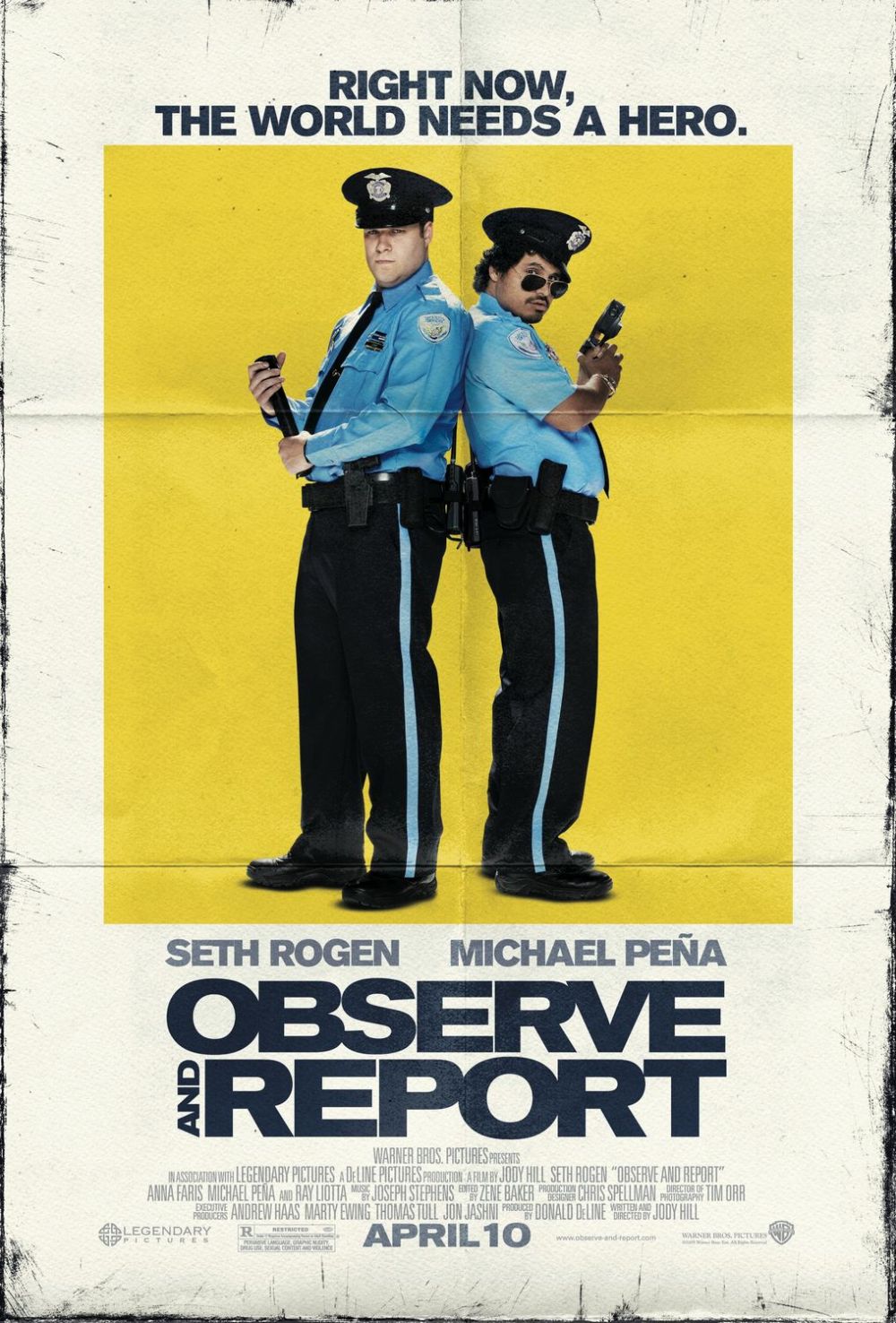
‘Observe and Report’ is the Blackest of Black Comedies

Observe and Report movie poster

I read an article in the Los Angeles Times which had an interview with Jody Hill, the writer/director of “Observe and Report.” Reading it was the best preparation I got for watching the movie as the trailers made it look like the typical Judd Apatow produced, Seth Rogen starring comedy. However, director Hill didn’t really see it as a comedy, and he said the term “dark comedy” didn’t really apply to the film the way he envisioned it. Hell, even Rogen went out of his way to call the film a “dangerous comedy.” I never would have guessed from the trailers which made the film seem like the average formulaic comedy I was more or less interested in seeing. I should have seen it coming it was not going to be what I expected it to be when I realized that Apatow had nothing to do with this.

If you’re thinking “Paul Blart: Mall Cop” redux, you’re dead wrong. With “Observe and Report,” you need to go in expecting “Taxi Driver” or “One Hour Photo” as if they were comedies. This is a very black comedy. We’re talking Martin Scorsese’s “After Hours” black. It touches on several ever so touchy subjects such as drug abuse, date rape, alcoholism, delusional, and racial stereotypes among others. It is also proof of how comedy can be mined out of places and subjects you would never expect to find it in. Hill and Rogen prove to have a large pair of cojones on them as they take big risks with their subject matter and come out of it with many moments which are frickin’ hilarious. It says a lot about this movie how it can break taboos, many of which will easily offend people, and still have you laughing your ass off at the same time.

Rogen stars as Ronnie Barnhardt, the head of Forest Ridge mall security. From the start, we can see this is a guy with a few screws loose. Along with his fellow mall cops, he laments at the fact none of them are allowed guns on the job. Ronnie is a hero in his own mind, and no one takes the job of what is essentially a “rent a cop” position as seriously as him. Ronnie also longs to join the police force, but he is kept from being accepted due to his bi-polar illness which he treats with the typical medication Scientologists rally against. This is not your typical Rogen character where you wonder if and when he will get the girl. Instead, you wonder if this guy is going to have a psychotic break and end up killing someone before it is too late.

Ronnie’s mission in life, however, becomes crystal clear to him when a flasher exposes himself to the girl of his dreams, makeup counter employee Brandi (Anna Faris). So distraught she is after this attack, Ronnie makes it his mission to catch the flasher before he can attack her again. But then the local police department gets involved in the form of Detective Harrison (Ray Liotta at his overplaying best), and Ronnie sees this as a threat to his mission. The way Ronnie sees it, this is his case and no one else’s. To let the local police take over would be the same as giving up control of the mall. Paul Blart may have taken his job as a mall cop seriously, but he has got nothing on Ronnie Barnhardt.

For Rogen, this movie represents a sharp change of pace. Through movies like “Knocked Up” and “Zack & Miri Make a Porno,” he has perfected the role of lovable loser to the point where you could not see him in any other role. This usually results in a career which starts big and then crashes in record time. I was hoping to see him play some other role because I found him to be one of the funniest actors in quite some time, and I was in no mood to see him crash and burn. With his role in “Observe and Report,” Rogen finally breaks out of his comfort zone to play someone who is anything but lovable. He also never plays the role just for laughs which is a major plus. As Ronnie Barnhardt, he manages to find the heart of this delusional character, and he keeps the audience up with him even as Ronnie’s mental state continues to get worse.

Among the supporting cast in “Observe and Report” is Michael Pena. As Dennis, Ronnie’s second in command and best friend, Pena also goes against type to play a role we have never see him in before. He has proven to be the most dependable of supporting actors in movies like “Crash,” “Shooter,” and “World Trade Center” to name a few. As Dennis, he steals scenes from Rogen as his character ends up taking directions you never expect him to take. This is an inspired performance by Pena, and he serves, however briefly, as Ronnie’s conscience when he sees Ronnie is taking himself WAY too seriously. Dennis’ methods of loosening up Ronnie, however, are anything but safe and legal.

Another inspired performance in “Observe and Report” is from Celia Weston who plays Ronnie’s alcoholic mother who still lets her son live under her roof even though he is well into his 30’s. There is no doubt of how much Weston’s character loves her son even when she is hopelessly drunk, and it leads to where she tells one of Ronnie’s fellow mall cops of how she slept with his friends while he was in high school. This could have been a cruel and clichéd character, but Weston makes it a lot more.

You also have to give a lot of credit to Anna Faris who proves here she is not afraid of going to extreme lengths to get laughs. Throughout the movie, she never tries to sweeten her character of Brandi up like many actresses would. Brandi will easily remind you of all those spoiled rotten bitches you had the misfortune of going to high school with. Many may hate the way her character is treated in the movie, but to a large extent, Brandi brings a lot of it on herself. Like Rogen and Hill, Faris does not shy away from the unpleasant extremes of her role.

Then there is Ray Liotta, who will always be best remembered for playing Henry Hill in “Goodfellas.” As Detective Harrison, Liotta is the perfect counterpoint to Rogen’s mentally unhinged mall cop. His strait-laced character has his shit together, but it doesn’t necessarily make him much better. One of the movie’s best moments has him taking Ronnie on a ride along which ends with him stranding Ronnie on a bad corner with a bunch of crack head drug dealers. How Ronnie ends up handling these dealers is something I would prefer not to spoil for you. Just when you think you know where the scene is going, Hill and Rogen pull the rug right out from under you.

Another really nice performance comes from Collette Wolfe who plays Nell, an employee at the mall’s coffee shop who is somewhat hindered by her leg being in a cast. While Brandi really wants nothing to do with Ronnie, Nell pines for him every time he comes to get his free cup of coffee. She also has to deal with an unsympathetic boss (Patton Oswalt) who picks on her whenever given the opportunity. She is a sweet presence in an otherwise nasty movie which seeks to make you uncomfortable and laugh at the same time. For a moment, I thought this would turn into another tale of unrequited love a la “Rules of Attraction,” but Collette’s character gives Ronnie the emotional grounding he DESPERATLEY needs.

Hill’s biggest success with “Observe and Report” doesn’t lie in just the laughs he gets, but more in the fact he and the actors never just play everything just for laughs. There is no winking at the camera in this film. The actors don’t play it completely straight in this movie, but they take their roles seriously and never appear as if they all know they are in on the joke. If they did, the movie would not be anywhere as effective.

Hill’s breakthrough directorial effort was the movie “The Foot Fist Way” which served as the breakthrough for Danny McBride who went on to appear in “Pineapple Express” and “Tropic Thunder.” It is clear Hill revels in the portrait of people who live in their own world and are oblivious to what the world thinks of them. What Hill does here is ballsy to say the least.

“Observe and Report” also serves as a biting satire of the mall culture which serves as the movie’s setting. It ends up being symbolic of the melting pot which is the United States of America. Cultures of all kinds rub up against each other in the mall, and it unsettles our main character at times. Ronnie ends up having a tense moment with a character he thoughtlessly nicknames Sadamn (played by Aziz Ansari) who has filed a restraining order against Ronnie for past transgresses. This leads to one of the movie’s most insanely funniest moments as they say a barrage of “fuck you’s” to each other. The F-bomb is uttered almost endlessly in this scene to where you think they are going to give “Scarface” a run for its money in terms of how much the word is uttered.

This movie also continues the trend started with movies like “Forgetting Sarah Marshall” of showing the penis in all its tiny glory. The audience I saw it with seemed more shocked by the “throbbing python of love,” as Robin Williams once described it, than they were with Rogen’s character holding a gun in his hand. After all these years, American audiences still prove to be an unknowingly hypocritical bunch as they find themselves more comfortable with the sight of a gun than with the appearance of a sexual organ.

Suffice to say, not everything in the movie works perfectly. The ending where Ronnie defends his place in the mall falls a little flat despite the use of Queen’s music from “Flash Gordon.” And granted, the mix of comedy and action and violence is a tricky road, but it is a road bound to have some inescapable potholes.

Still, when all is said and done, “Observe and Report” is a comedy with big cojones which cannot be easily ignored. It is not a movie for all tastes, but for those who are willing to travel a darkly comic path, there is much to find in this crazy film which dares to imagine a Travis Bickle-like character as a funny person despite himself. Do not say you weren’t warned.

* * * ½ out of * * * *