‘Twister’ Movie and 4K Review

The following review was written by Ultimate Rabbit correspondent, Tony Farinella.

Twister” is a film that is currently celebrating its 28th anniversary.  It raises two important questions—where has time gone, and when did I become old?  Watching “Twister for the first-time since its release, it is clear this is a quintessential 1990’s action flick—you have your movie stars, your big budget, and your special effects.  If you are able to shut off your brain and sit back and enjoy the ride, there is plenty to like here. If you are looking for logic or a complex story, you have come to the wrong movie.  Your enjoyment level of this movie is solely dependent on your ability to suspend your disbelief when it comes to flying cows and off-the-wall tornadoes.

In the opening scene, we see a young woman named Jo Harding who unfortunately loses her father in an F5 tornado. This has stayed with her well until her adult life, as she is now entrenched in the world of tornadoes as a professional storm chaser.  She is going through a divorce with her weatherman husband named Bill, played by the late Bill Paxton.  He is hoping she will sign the rest of their divorce papers, so he can finally marry Dr. Melissa Reeves, a reproductive therapist, played by Jami Gertz. Jo (Helen Hunt), however, is dragging her feet as she still has feelings for Bill.  They soon find themselves in a situation where they need to work together in order to survive because a massive tornado is coming their way.
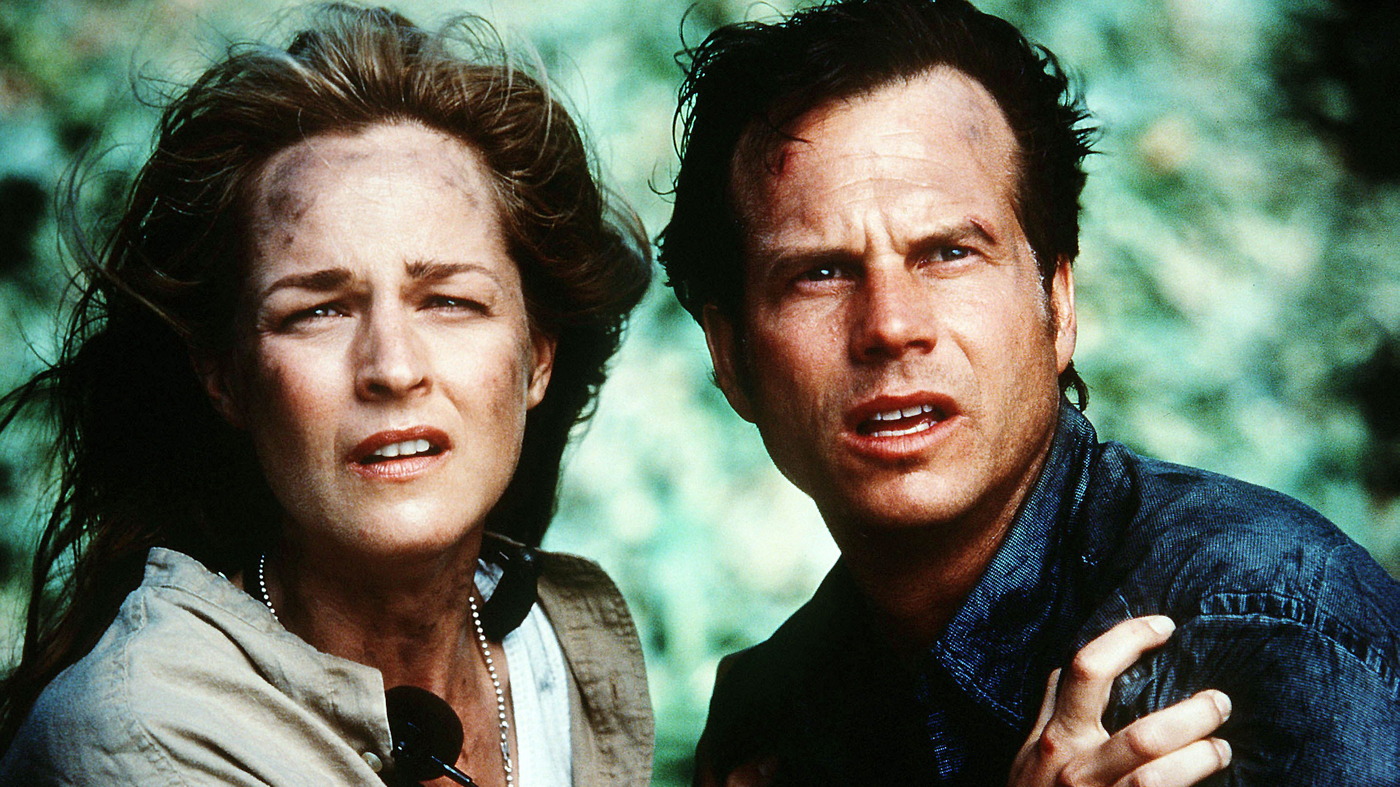
Helen Hunt and Bill Paxton star in Twister.

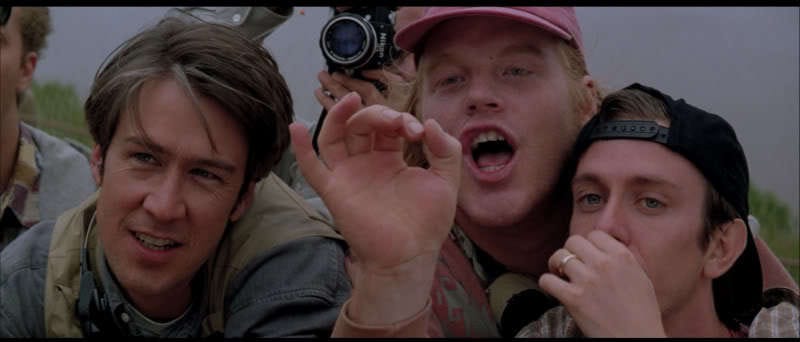
Jo and Bill have created a storm-device called Dorothy, which can predict if a storm is happening fifteen minutes ahead of time as opposed to the usual three minutes. This will give people more time to prepare for a tornado and make sure they find a safe haven for them and their loved ones.  It needs to get close to a tornado in order for the sensors inside of it to track any weather data. Jo has also assembled a talented team which includes Dustin Davis (Philip Seymour Hoffman) and Rabbit (Alan Ruck). The scene stealer here is Philip Seymour Hoffman. I would describe him as Jeff Spicoli if he ever pursued a career as a storm-chaser, and he steals every scene he’s in throughout.  He’s hilarious, charming and off-the-wall.

“Twister” is an incredibly entertaining action picture that works because of the jaw-dropping special effects and its likable cast. Helen Hunt, in particular, is great as a strongly written female character dealing with grief and trauma by trying to make sure no one ever experiences what she went through as a child. Bill Paxton is a cheesy goofball who doesn’t see what’s right in front of him and the fact he’s better off with Jo. Jami Gertz takes a thankless role as the “other woman” and makes it work to where the audience still likes her, even though we’d rather see Jo and Bill together. 
The special effects and tornado scenes are expected to deliver in a film like “Twister,” and they do not disappoint.  The film is wise to take some time to have the characters interact with one another, so that when the storm scenes kick up a notch, we care about what happens to the participants. They also build up the storm scenes so when they happen, we are waiting for them and are emotionally invested.  “Twister” was directed by Jan de Bont, who had previously directed 1993’s “Speed.” He knows how to blend the action scenes in with the character scenes in an effortless way, and he hits the right balance throughout.  After not seeing the film for over two decades, one of my concerns was it would be too action heavy.  I’m glad to see he strikes the right chord with his direction. It helps that the film was co-written by Michael Crichton, the smart and talented author and screenwriter.

“Twister”is about fifteen minutes too long, and sometimes there are too many characters here, some of which I did not mention.  It’s not a perfect film by any stretch of the imagination. However, for a big-budget action flick, it’s exactly what it needs to be and then some.  As mentioned earlier, there is a build-up to the storm scenes, which are bonkers and over-the-top.  It’s about making the little scenes and the big scenes matter and co-exist together in harmony.  It’s also about having fun.  There is a lot of fun to be had with “Twister” even in 2024.  It’s an entertaining action film with some big laughs and even bigger explosions.

* * * ½ out of * * * *

4K Info: “Twister” is released on a single disc 4K from Warner Brothers Home Entertainment. The film has a running time of 117 minutes and is rated PG-13 for intense depiction of very bad weather. This release also comes with a digital copy of the film along with a really cool looking slipcover.

4K Video:  This is one of my favorite 4K releases of the year from a visual standpoint.  It looks gorgeous, clear, and vivid. When I think of this movie, I think of the colors.  The colors really pop here, especially when the sky outside is green.  It’s a tremendous looking 4K and it’s an early candidate for one of the best 4K releases of the year.

Audio Info:  The Dolby Atmos soundtrack is a fantastic touch here, as this is a big screen movie that is being brought right into your home theater.  This film was made for 4K.  The big scenes feel big with this Dolby Atmos track.  It sounded perfect.  It wasn’t too boisterous or in-your-face, but it gets the point across in an effective manner.  They did a great job here, too.

Special Features:

The Legacy of Twister – Taken by the Wind (NEW)

Chasing the Storm: Twister Revisited

Anatomy of a Twister

The Making of Twister

Van Halen Music Video – “Humans Being”

Commentary by director Jan de Bont and visual effects supervisor Stefen Fangmeier

Should You Buy It?

HECK YES! If you enjoy a good action flick in 4K, “Twister”is exactly why they made this format in the first place. It’s the movie you show your friends and family when you are trying to convince them to switch from Blu-ray to 4K.  It also comes with a brand-new special feature, which is rare on catalog titles from studios. You also have the previously released Blu-ray special features, so you can keep the 4K and have everything that came with the Blu-ray as well.  It’s the best of both worlds.  Even though this film looks and feels like a 1990’s summer blockbuster, I found it to be a blast because it holds up well while also being a good nostalgia piece as well.  If I were you, I’d buy this film on day one of its release. It comes highly recommended.

**Disclaimer** I received a copy of this film from Warner Brothers to review for free.  The opinions and statements in the review are mine and mine alone.

James Cameron’s ‘Avatar’ – A Cinematic Spectacle Like Few Others

WRITER’S NOTE: This review was written back in 2009.

“That is our (USA) job around the world; run in, free some people, and whip a little industry on them. So they can enjoy the benefits of industry that we have come to enjoy (cough).”

-George Carlin from “Class Clown”

“Some of the darkest chapters in the history of my world involve the forced relocation of a small group of people to satisfy the demands of a large one. I’d hoped that we had learned from our mistakes but it seems that some of us haven’t.”

“Jean-Luc, we’re only moving 600 people.”

“How many people does it take, Admiral before it becomes wrong? A thousand? Fifty thousand? A million? HOW MANY PEOPLE DOES IT TAKE, ADMIRAL?!”

-Patrick Stewart and Anthony Zerbe from “Star Trek: Insurrection”

We waited for this one almost as long as we waited for the release of Guns ‘n’ Roses’ “Chinese Democracy,” and now it is here. James Cameron has been at it again, making the most expensive movie ever, but this is nothing new and I am so burned out from hearing all the gossip about his movie budgets. The naysayers were out in full force proclaiming this would be a disaster as its release was delayed a number of times. But “Avatar” once again shows there is no one more equipped than Cameron to change the way we look at movies. With his latest epic, he has achieved the impossible and completely blurred the line between what is real and what is a special effect, and I could never tell the difference from start to finish.

You have to give a lot of credit to this ambitious director for being ever so patient. Cameron waited years for the technology to catch up to where he could tell this story most effectively, and he even invented a new camera with his brother to make the most convincing 3D movie we could ever hope to see. So many others would be in a hurry to get a movie up on the screen to where nothing but shortcuts are taken, but “Avatar” had a two year post production period (the longest ever) to get every little detail covered. This movie needs to be seen on the big screen as it was made for it. Waiting for a physical or digital release to watch it on would be tragic.

“Avatar” stars Sam Worthington as Jake Sully. Jake is a former marine who is now paralyzed from the waist down, and he does not ask for sympathy or pity. He ends up being recruited for a mission on Pandora, a moon on the far reaches of space. This mission was originally meant for his brother, but he passed away before he could take it on. Pandora is inhabited by very tall blue creatures called the Na’vi, and avatars of them have been created so that humans can walk among them undetected so they can be studied more closely.

Of course, these avatars are also being closely observed by the military as they plan to infiltrate the Na’vi and force them off their sacred land. For what reason? So that the greedy corporation (is there any other kind these days?) can get at the mineral called unobtanium (nice play on words). This mineral represents an enormous cash cow for soulless investors back on Earth, and it also serves as a much-needed source of energy it desperately needs. In the future, it appears humanity has extended the manifest destiny policy from other countries to the far reaches of space. I mean, heaven forbid we allow other cultures to handle their precious resources without our unsolicited advice! Do we ever learn?

Anyway, the story of “Avatar” has been told many times before; a disillusioned military officer comes face to face with people he has been fighting, and soon he becomes enamored with their lifestyle and code of honor to where he is integrated into their society. This has been the basis for “Dances with Wolves” and “The Last Samurai” and even “The Emerald Forest.”. We know the setup and how it’s all going to go, but Cameron still makes it work by having us invest emotionally in these characters. By doing so, all the action and the visuals presented to us become all the more enthralling.

Seriously, Cameron has been one of the very best storytellers in movies for decades now. This at times gets lost on people because his dialogue can be quite cringe inducing. You want to go up to him and make him realize people don’t talk to each other the way he thinks they do. It constantly reminds me of what Harrison Ford told George Lucas about his script for “Star Wars”:

“You can type this shit, but you sure as hell can’t say it!”

For what’s it worth, however, Lucas makes Cameron sound like David Mamet.

Regardless, the strength of the story he has concocted makes the visuals on display all the more exhilarating. My big issue with most effects driven movies is you can tell when you are watching a CGI effect. All this does is completely take me out of the movie to where I roll my eyes and wonder why Hollywood regularly underestimates audiences.

Now at the start of “Avatar,” when Jake is looking at the creature he will be, you can definitely tell what is real and what is computer generated. But as the movie goes on, I honestly couldn’t figure out which was which. I tried, believe me I tried to see the difference, but there was just no way. Plus, the motion capture they used on the actors is astonishing. The avatars are made to look like the actors playing them, and the movements are so amazingly lifelike to where it makes every other 2009 movie see, like it was made back in 1987. That description may be stretching it a bit, but I couldn’t resist.

The art direction in this movie is incredible, and the color blue (my favorite) is used quite a lot. There are other astonishingly breathtaking visuals like the floating mountains which looked quite real…. Damn it! I am running out of words to describe what I saw. You have to see it for yourself.

As Jake Sully, Worthington keeps him from being a complete cliché and infuses him with a nobility which has served him well in life. But one of the most welcome actors here is Sigourney Weaver who is appearing in her first Cameron movie since “Aliens.” Weaver plays Dr. Grace Augustine, the head of the Avatar program. While the military wants to use her work for their own manipulative methods, she uses them to help gain the trust of the Na’vi and study their world for peaceful and scientific purposes. She is the classic Cameron female character; tough as nails, controlling, and never ever a pushover Apparently, Weaver based her character on Cameron to an extent. To steal a line from “Up in The Air,” Dr. Grace Augustine may very well be James Cameron with a vagina.

Another classic Cameron female is played by Michelle Rodriguez, still looking as hot as she did in “Fast & Furious.” Her character of helicopter pilot Trudy Chacon is somewhat similar to Jeanette Goldstein’s character of Vasquez from “Aliens”; a badass soldier who is as tough as the men, maybe even tougher. She’s certainly a lot more morally conscious than the majority of the marines in the film, and Rodriguez makes sure you never forget that.

You also have Giovanni Ribisi playing Parker Selfridge (yes, his last name rhymes with selfish), the corporate manager in charge of the mining operation on Pandora. Like Paul Reiser’s character from “Aliens,” he is only interested in making a gigantic profit which will set him up for life. I love how Ribisi plays Parker as a pragmatic ass with absolutely no moral scruples whatsoever as this character is ever so gleeful about what is in store for him once this mineral is sufficiently mined. The way he sees it, what’s the big deal?

But one of the best performances comes from Stephen Lang who plays the brutal Colonel Miles Quaritch. Despite some of the ridiculous dialogue which comes out of his mouth, Lang completely makes Miles into a soldier you would be incredibly foolish to mess with. Like Tom Berenger in “Platoon,” his face is deeply scarred, and he does nothing to hide that. Miles simply sees it as an illustration of how nasty the moon of Pandora is. His flaw, however, is that he cannot see who the Na’vi really as his anger against them has long since powered by an everlasting fear which he cannot overcome.

Now let’s talk about the Na’vi, those big blue creatures who are tall enough to play for the Los Angeles Lakers or the San Antonio Spurs. They could have made or have broken “Avatar.” Cameron has said he thought about the story long before he began working on “Titanic,” and that he even thought about these characters when he was a kid. Now having an original race of people who speak their own language may work well on “Star Trek,” but in other shows and movies, it looks more comical and ridiculous than was originally intended. This is not the case here.

This brings me to the performance of Zoë Saldaña, who you may remember as Uhura in J.J. Abrams’ “Star Trek.” She plays Neytiri, Princess of the Na’vi tribe Omaticaya. Neytiri is the first real Na’vi to come in contact with Jake Sully, and she later falls in love with him. In essence, a lot of “Avatar” rests on her performance, and she succeeds in making you believe in this race of beings to where you see them as more than just an amazing series of special effects. This ends up making it easier for other actors like Wes Studi and CCH Pounder to portray their characters without having to expend too much effort in helping you buy into these extra-terrestrials. Saldana sets up the groundwork, and everyone follows her from there.

“Avatar” deals with many of the same themes Cameron has dealt with throughout his career: military intervention into a foreign land, machines versus nature, love found between beings from different worlds or societies, how scientists and those with curious minds seek to understand the aliens and make peace with them, and how corporations will do anything for a profit. The parallels between what the military forces are doing in Pandora and our wars in Vietnam and Iraq, not to mention our current escalation in Afghanistan, are clear as day, and it does make the movie feel timely.

But one of the especially interesting things here is how Cameron utilizes a lot of the technology which was on display in his previous films. Those armed walkers Colonel Quaritch uses look to be an upgrade of the driver Weaver used in the climax of “Aliens” (which the Wachowski brothers all but ripped off for “The Matrix” sequels). The mind devices used to control the avatars looks a lot like the head pieces used in “Strange Days.” The scenes of humans interacting with otherworldly creatures bring to mind similar scenes from “The Abyss.” And you have characters who go from being antagonists to becoming the good guys (“Terminator 2” was a classic example of this). With all this in mind, I thought Cameron was running out of new ideas, but I love how he combines them all up to good use in “Avatar.”

But enough of me babbling about “Avatar.” Whatever weaknesses this movie may have are undone by its well-earned achievements. Once again, see this movie in a theater! I don’t care if you hate going to the movies. “Avatar” is a great and reinvigorating reminder of how sitting in a darkened movie theater can be so thrilling.

Now, if you’ll excuse me, I have to find an IMAX theater playing this movie that is not sold out for weeks in advance. Seeing something like this on the silver screen once is never enough, ever.

* * * * out of * * * *

Exclusive Interview with Tim Smit on His Directorial Debut, ‘Kill Switch’

Tim Smit photo

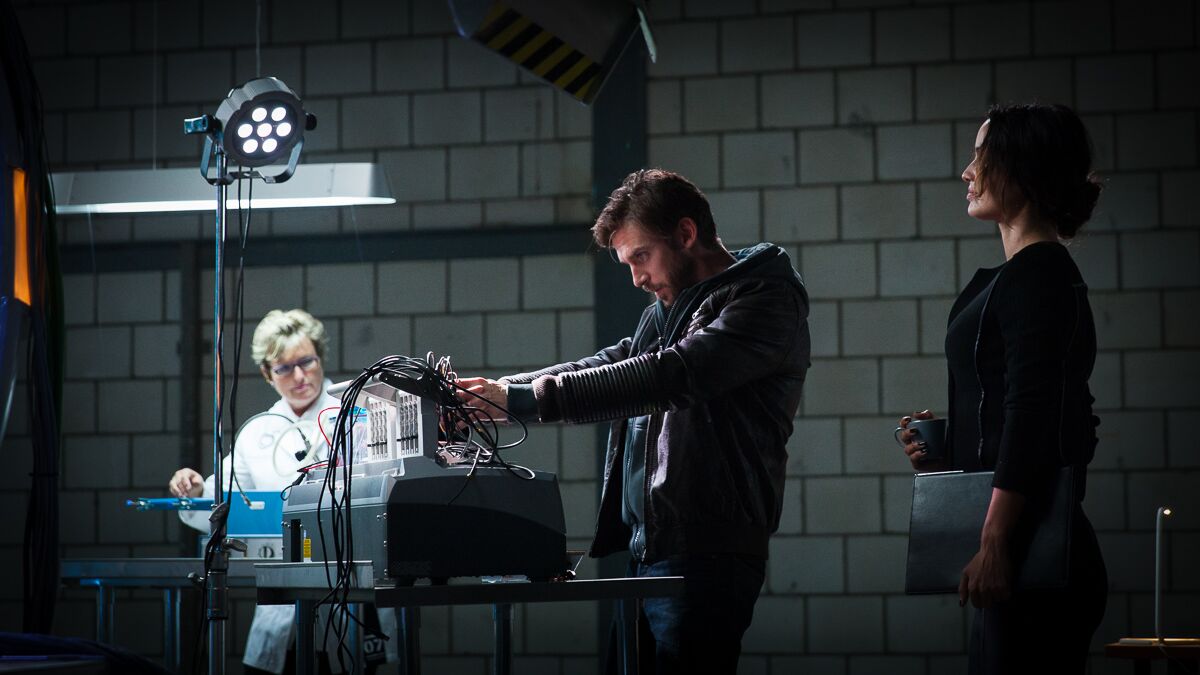
Acclaimed writer, director and visual effects artist Tim Smit makes his feature film directorial debut with “Kill Switch.” Based on his short film “What’s in The Box?” which gathered a large audience on YouTube, it stars Dan Stevens as physicist and NASA pilot Will Porter who is recruited by Alterplex, a power company which has built an enormous tower designed to harness unlimited quantum energy. The company’s vice-president, Abby (Bérénice Marlohe), informs Will a mirror universe has been created solely to drain energy from, and he is sent into it with a device called a “Redivider” which will balance the power between the two universes. But as you can imagine, nothing goes quite as planned as the mirror universe proves to more than anyone thought it could be as Will finds himself on the run from drones, soldiers, and people he is no longer sure he can trust.

“Kill Switch” takes place in a future version of our world, and it is largely a POV movie as we see much of the action from Will’s eyes as he struggles to say alive in an especially hostile universe. I talked with Smit about the movie’s origins, how the story evolved from a short into a feature film, and of how he was able to create a visual effects heavy movie in just 18 days and on a small budget.

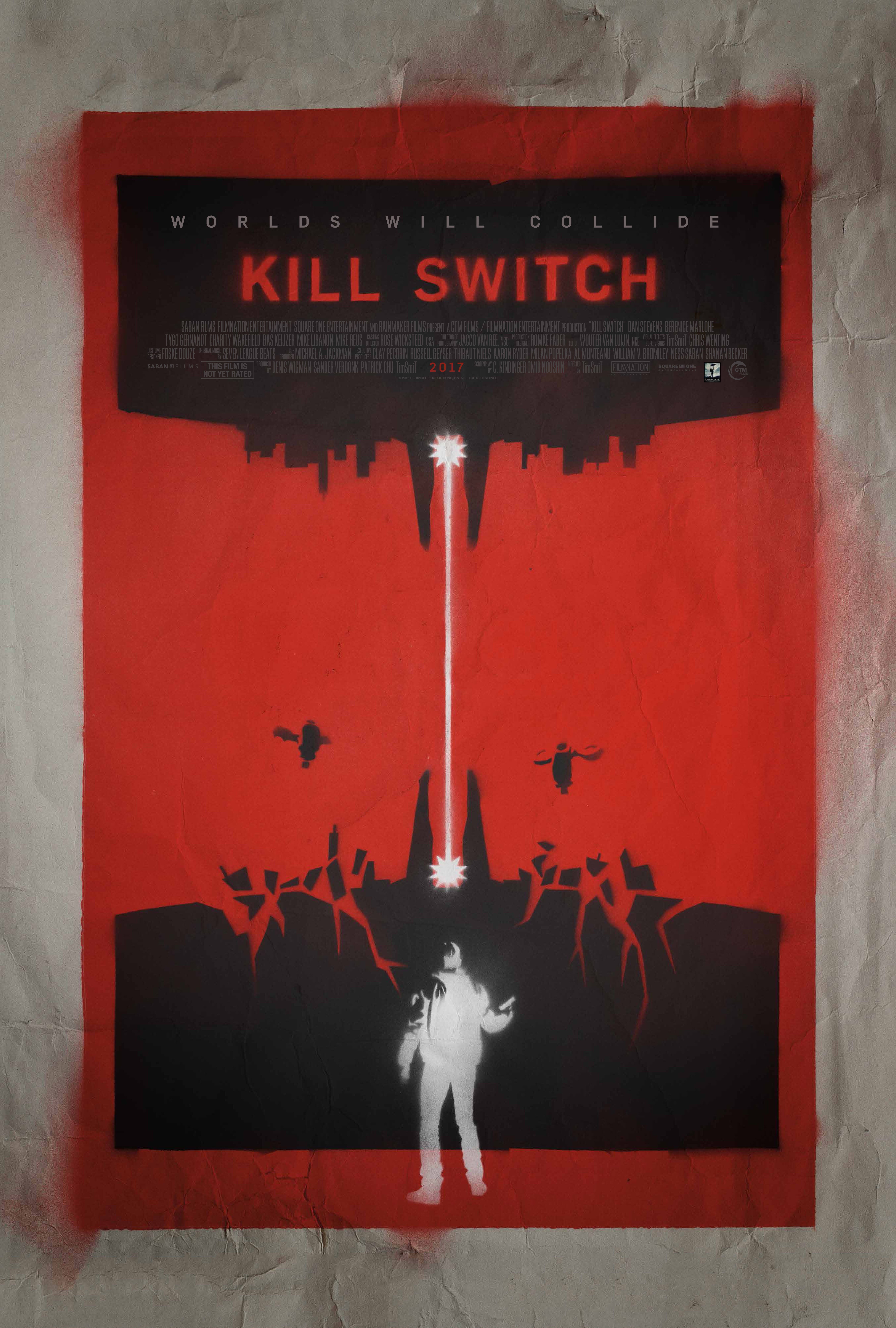
Kill Switch poster

Ben Kenber: I really like the way this movie is set up because you are thrown into this story to where you cannot help but be gripped by everything going on. You’re not sure what is happening and, like Dan Steven’s character, you are desperate to find out. When conceiving “Kill Switch,” did you know how the story was going to end, or did you just start off with the idea and went from there?

Tim Smit: We knew that, when I did the short a couple of years ago, the box was going to be used as sort of a kill switch for destroying a parallel universe meant for energy harvesting. But we never really knew the full arc of the story before we hired the writers to get involved, so it took a while to get to the point we ended up with. It was interesting and a very steep learning curve for me to work on this as a conceptual arc as a writer and also as a director, and of course the visual effects too. It wasn’t fairly clear, but we got there as we developed the kill switch idea.

BK: The screenwriters you hired for this project, Charlie Kindinger and Omid Nooshin, what would you say they brought to this story which wasn’t in your short film?

TS: What they did is they fleshed out the characters much more than we already had in the original short. But they also wrote the dialogue and they did the screenwriting of the story. It was a difficult movie to write because of the whole POV aspect. It’s difficult to tell a story through POV. Also, we did have, for that reason, to introduce the whole flashback storyline to help us with that, and to help provide a rest for the audience so that they do not get POV tired. So, they focused on that the feeding of information so the audience knew enough to keep going with the movie, and they were more associated with that than the base idea.

BK: I did watch the short “What’s in The Box?” which led to the “Kill Switch” feature film, and the whole idea of the parallel universe is something which has been explored in science fiction constantly such as the “Dark Mirror” episode of the original “Star Trek” series. What inspirations did you draw from when putting together the short and the feature film?

TS: So, the main inspiration behind it was a couple of things actually. Visually it was inspired by a couple of video games because this was always meant to be sort of an homage to video gaming, and we used various inspirations like “Half-Life,” “Halo” and games like that. From a physics standpoint, the idea for the parallel world came from the concept of Schrödinger’s cat, a thought concept where you got a box and in it is a cat with a poison. If you keep the box closed, you don’t know if the cat survived because the poison still has a chance to kill the cat. You only know the cat is dead when you open the box. So, this is kind of like the idea for the initial mystery where you’ve got this black box and you don’t know yet what it is and you don’t know what it does, but it triggers you to go along and see what it ends up doing. So, the whole idea of Schrödinger’s cat was the main inspiration behind the short and the box as a MacGuffin.

Kill Switch POV still

BK: The POV shots reminded me a lot of Kathryn Bigelow’s “Strange Days” which also had them. When you put those shots together, did you have a set of rules you wanted your collaborators to follow during shooting?

TS: Yeah, we did a couple of things, some of them worked better than others, which we wanted to explore. One of them was, most of the time, we wanted to see the other actors. As a rule of thumb, we wanted Will Porter to be running behind the other characters so you can actually see what’s happening. So that was something we took into consideration while we filmed this because you are kind of used to the main character taking the lead, but in this case, he’s following them because otherwise it would be difficult to see them. It’s a very simple thing you have to keep in mind, and that was one of the rules we followed.

Kill Switch Dan Stevens

BK: Did Dan Stevens have to do any camerawork himself for the POV scenes?

TS: No. Obviously I would’ve loved to have used him, but we just didn’t have the budget for him for all the days. So, we just hired him on some of the days where he would be the voice, and of course on the days where we would shoot conventional scenes. Our DOP was basically the character, and then Dan came in later and did the ADR for the character.

BK: The special effects are actually pretty good for a low-budget movie like this. We see objects like train cars falling out of the sky. Did you set any rules for yourself as to what kind of objects and vehicles could fall into the echo universe?

TS: So, we focused initially on metallic objects just because that made it easier to create for us. The idea was that this parallel world is being arched for energy, but somehow the original world is fighting back as the universe is trying to balance itself out, and it does so by pulling over objects from the original universe into this echo universe. The rule of thumb was the first thing to be pulled over was small metal objects for various reasons, but you can figure out in physics that there are only four main forces, and one of them is electromagnetic. It is not inconceivable that something like metal will react first or that something else will react to metal first. It made easier for us to make these objects fall down. It’s harder to do entire buildings or something like water. It was a compromise, but I felt it worked from the basic physics ideas as well. We see this boat falling from the sky, it’s not metaphorical.

BK: The whole idea of an echo universe is interesting because the characters say there is not supposed to be any organic life in it, but we can see from the start there is.

TS: Yes, that’s what I like about the movie as well. It’s not as fleshed out as it should be, but the idea is that this company didn’t care. They were just interested in creating this echo universe, and they are telling us that it’ll be fine and there will be no organic life, but they don’t care. They just care about the energy, and of course they didn’t expect it to be that intense or of the rebellion that arrives. But I kind of like that idea of what are your priorities as a company. These huge oil companies are pretty much going across the line, and that’s what drew me to this story as well. That was something I could really personalize.

Kill Switch Berenice

BK: Dan Stevens has a very challenging role because he wasn’t on set too much, but he still had to get to the emotion of what is characters going through. Also, Bérénice Marlohe has a wonderfully intimate presence throughout the film. How did you come to cast both these actors?

TS: It was amazing to work with these two. The great thing about Bérénice and Dan is that they are both so interested in science fiction, and they are both really interested in broadening their own horizons and trying to do something new. It’s an experiment, this film. Let’s be honest, you don’t see a POV movie every day. It’s an attempt to do something new especially with a director that’s also doing all of the effects. It was an experiment on multiple levels, and they were committed and went for it, and that’s what I really appreciated about them. It was a very difficult movie especially for Bérénice because she was acting against I camera where there is no reaction, and most of the enemies are CG. It was very demanding for her to do, but she gave it her best and gave it everything she had. We had 18 days to do everything.

BK: 18 days? That’s very impressive especially for a science fiction movie.

TS: It was something I underestimated when I started working on this. I was experienced as a visual effects artist, but I wasn’t experienced as a character director. You would think shooting this movie, even though it was 18 days, would’ve given you a whole set of problems and obstacles to get over, which we had. But even after it was all done, that’s when the real challenge started. You would think that after having a number of years of the effects experience that it would be easier, but it was actually the other way around. It was very difficult for me to combine the directorial duties and the effects duties at one point. You can get so involved in the technical part that you get sort of a tunnel vision and you still have to be the director. There is the reason why the director is separate from the visual effects department because that makes the movie better.

Kill Switch vessel

BK: “Kill Switch” takes place in a future which seems not too distant from our own. We never get an exact date of the time the movie takes place in. Was that intentional on your part?

TS: Yeah, actually it was, but sometimes in the movie you do see the date on the newscasts, but it was never deliberately mentioned. I felt, in my mind, the movie was in the near future, but the concepts we are introducing we do not have access to in the near future. The problem with going further into the future is your design and your world view changes, and the budget doesn’t allow that. If you really want to know which year it was, it was actually 2043. So, it was further into the future, but not that far. It was a budget reason.

BK: You studied natural sciences as a student. Did those studies inform the science of this movie?

TS: Yeah, the studies did help. A lot of people wonder why I studied natural sciences if you wanted to be a filmmaker, but the way you were trained as a scientist really does help in making movies. There’s a certain amount of problem solving that you are used to which is really helpful as a director, and the visual effects that I did, they tend to be of a physical origin. With physics, you are trying to explain or describe the real world. With visual effects, you are kind of doing the opposite. You are using formulas to create a fake or, at least, a realistic looking fake world. To me, that is really fascinating and the physics background helped in doing that.

I want to thank Tim Smit for taking the time to talk with me. “Kill Switch” is now playing nationwide at the following theaters:

Laemmle Monica Film Center, Los Angeles

Cinema Village, New York

AMC Rio, Washington, D.C.

AMC Methuen, Boston

AMC Southfield, Detroit

AMC Arizona Center, Phoenix

AMC West Oaks, Orlando

AMC Ritz Center, Philadelphia

AMC Woodridge, Chicago

AMC Town Center, Kansas City

Poster, stills and trailer courtesy of Saban Films.

Click here to visit the movie’s website.