‘War for the Planet of the Apes’ Caps Off a Truly Great Trilogy
The summer 2017 movie season hasn’t necessarily been a bad one, but so far it has been overrun by franchise fatigue. Did we really need another “Transformers” sequel? Was the wait for the latest “Pirates of the Caribbean” really worth it? Can’t Pixar do more than just give us another sequel to “Cars?” Some franchises have seriously overstayed their welcome to where it feels like we need to take a LONG break from sequels of any kind, except of course for the next ones coming from the Marvel Cinematic Universe.
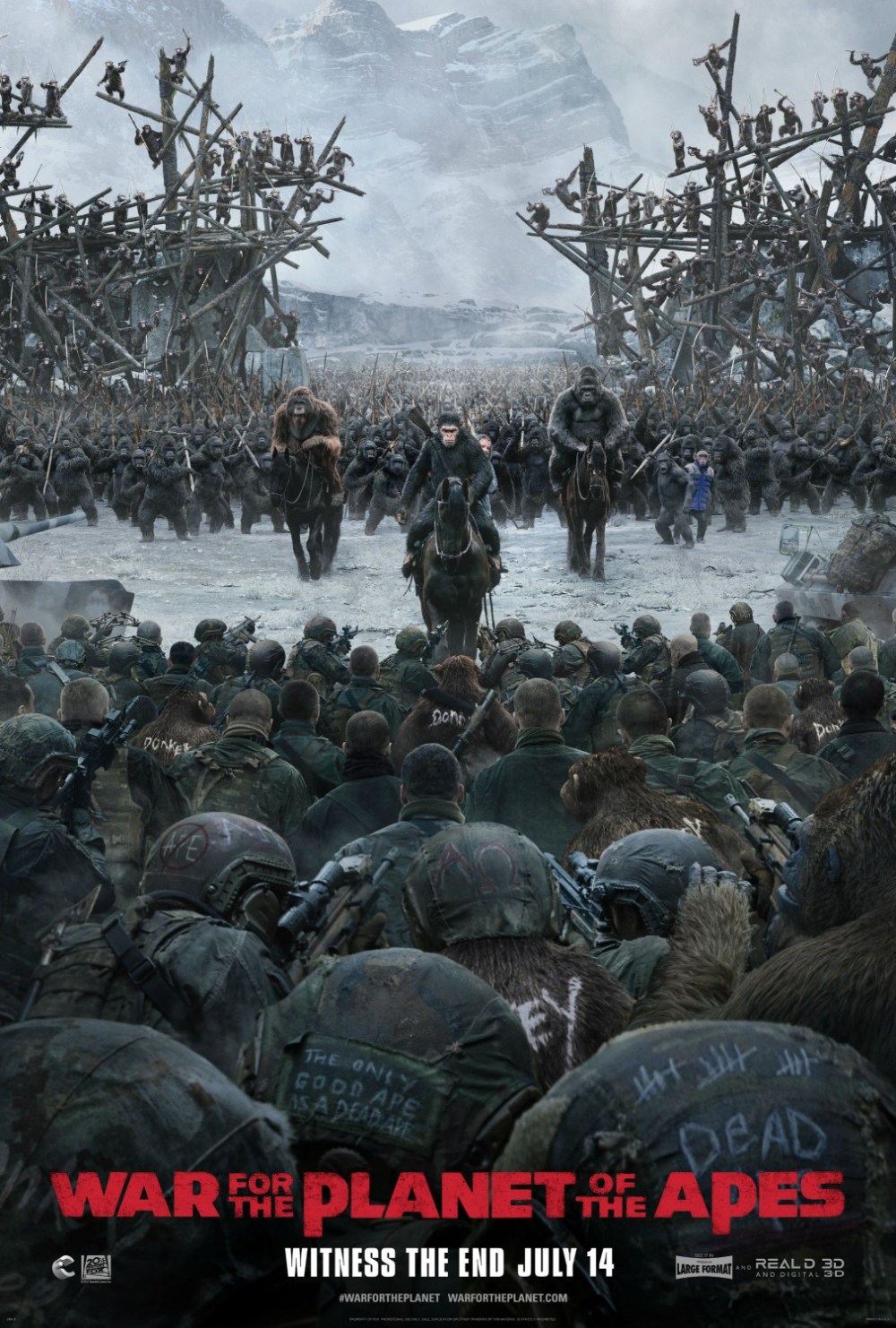
But now we have “War for the Planet of the Apes,” the third in the rebooted “Apes” franchise which is not only the best one to date, but also one of the best movies of 2017. Unlike other sequels which essentially repeat the same story to nauseating effect, “War” is not out to give us a replica of everything which happened before. From the start, we see how far the apes have evolved, and we also see the humans going through a state of de-evolution as well. In this war, it won’t matter who wins because nothing will ever be the same for anybody.
Taking place two years after the events of “Dawn of the Planet of the Apes,” “War” finds the conflict between the apes and the humans getting bloodier and bloodier. Both sides have taken heavy casualties, and the humans have resorted to recruiting apes to betray their own in a desperate effort to gain the upper hand in an escalating conflict. Caesar (Andy Serkis) has now reached a mythic status on the planet as a strong leader, and he now speaks as well as any human. When the movie starts, he has just survived another battle which leaves many dead in its wake, but instead of killing the remaining human soldiers, he sends them back to their base with a message to their leader, leave us alone. At this point, Caesar merely wants to protect his fellow apes and everything which is rightfully theirs.
But after being reunited with his loving family, Caesar suffers an unimaginable tragedy perpetrated by a military unit led by the ruthless Colonel McCullough (Woody Harrelson), and he heads out on a mission of revenge which, to quote a Klingon proverb, will be best served cold. Joined by several of his closest friends which include the wise and benevolent Maurice (Karin Konoval), Caesar comes not just to understand the world around him, but also about himself and of how he may be the maker of his own fate.
Whereas “Rise” dealt with evolution and how humans may not be a superior race of beings, and “Dawn” observed how humans and apes can be their own worst enemies, “War” focuses on the themes of vengeance and hate and what they do to the soul. Caesar’s quest for revenge is completely understandable, but his friends worry about what his hate for the Colonel is doing to his inner self. Caesar finds his strength from within and is as wise as he is strong, but we can see his soul is being corrupted on this mission as he is determined to exterminate his enemy with extreme prejudice.
The cost of revenge is a common theme in many stories, but “War” treats it with a great deal of intelligence. Caesar is constantly haunted by visions of Koba (Toby Kebbell) whose treacherous actions led Caesar to drop him to his death in “Dawn.” Maurice, the Obi-Wan Kenobi of these “Apes” movies, reminds Caesar of how Koba never got past his hate for humans to see the need for peace. But while Caesar convinces himself his motives are far purer than Koba’s, he comes to realize he is no different from Koba as his need to exact revenge takes precedence over everything else which holds great meaning in his life. The question is, can Caesar pull out of this moral nosedive before it’s late, or will he sink into an abyss of hatred which will rob him of all he stands for?
Not enough can be said about Andy Serkis’ performance as Caesar, and his work should have netted him at least one Oscar by now. We have seen Caesar go from being a frightened young ape into a hardened warrior, and Serkis has made every emotional beat count for something deep and true. While the visual effects help to illustrate how he has paid a price for the war being fought, it is Serkis who gives these effects soul and meaning as he plumbs the depths of Caesar to give us a character who is wonderfully complex and haunted by past deeds which cannot be simply washed away.
Woody Harrelson once again reminds us how he can play just about any role given to him these days with his portrayal of Colonel McCullough. His performance draws a bit from Marlon Brando’s in “Apocalypse Now” as, like Colonel Kurtz, McCullough has become a rogue soldier as his need to wipe out the apes and save the humans comes from a place of pain and delusion instead of from a higher military authority. Part of me expected to McCullough to be the usual military antagonist movies of this kind typically employ, but Harrelson gives this character much more dimension than you might be anticipating, and he matches Serkis scene for scene as their characters come to discover how alike they really are.
In addition, Serkis and Harrelson get strong support from Karin Konoval who makes Maurice far wiser than CGI can ever convey, Steve Zahn whose character of “Bad Ape” is kind of the equivalent to “Harry Potter’s” Dobby, and Amiah Miller is a scene-stealer as the mute war orphan who comes to be known as Nova.
Matt Reeves, who directed “Dawn,” returns to helm “War” and tops what he gave us before. The third movie in a franchise usually falls back on a well-trod formula, but he instead advances the plight of the apes to another level which furthers their evolution, and of the humans’ furious attempts to eradicate them which reveals their failings and a tremendous lack of understanding about where we all came from. And while the visual effects are tremendous in how they make the apes look ever so real, they are not the point. Reeves’ focus is more on character and performance more than ever before, and it is those things which make “War” especially epic. A lot of summer blockbusters are geared towards wowing us with special effects to where the human element is lost, but Reeves and company have the special effects serving the movie and its characters in a wonderfully effective way. On top of all this, “War” is well-served by one of Michael Giacchino’s best film scores to date.
The “Apes” reboot trilogy now joins the company of great cinematic trilogies such as Episodes IV, V and VI of “Star Wars,” the Jason Bourne trilogy, and “The Lord of the Rings” among others. It’s so pleasing to see filmmakers give us the kind of summer blockbuster many don’t always expect to see, one filled with great performances and intelligence as well as characters who are very interesting and whom you want to root for. Many blockbusters are the equivalent of a fast food meal which you may have enjoyed eating but which does not leave much of an aftertaste, but this is epic filmmaking which you can’t help but be emotionally drawn into. In a summer movie season which has been lacking to say the least, “War for the Planet of the Apes” is a real winner.
I also have to say “War” kept reminded of a Talking Heads song called “(Nothing But) Flowers.” As apes and humans traverse a landscape dominated by trees, rocks and lakes to where you can’t remember the last time you saw a building, the following lyric kept playing in my head:
“If this is paradise, I wish I had a lawnmower.”

 The Ultimate Rabbit