Toni Erdmann

toni-erdmann-poster

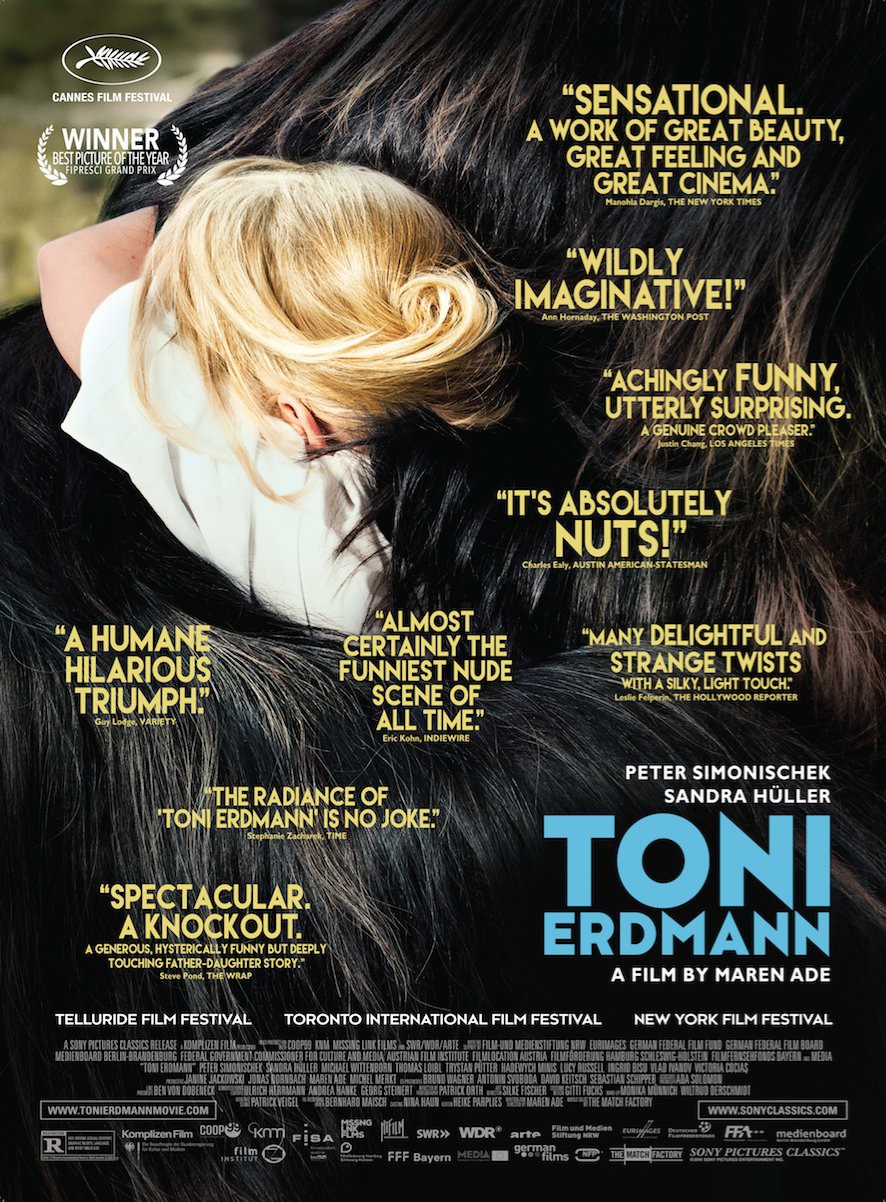
It’s hard to tell you how to go into “Toni Erdmann” as it works as both a comedy and a drama. Some moments are truly hysterical while others are deeply moving as German filmmaker Maren Ade draws us into a story which takes us in completely unexpected directions. These days, only a foreign film can get away with what “Toni Erdmann” does here as it balances out both its hilarious and moving scenes for a nearly 3-hour running time. Yes, it’s that long, but don’t let this and subtitles give you a reason not to sit through it because you will be missing out.

We meet Winfried Conradi (Peter Simonischek), a music teacher who thrives on playing pranks and practical jokes on unsuspecting victims with tremendous glee. Winifred is eager to reconnect with his daughter, Ines (Sandra Hüller), who is currently working in Bucharest, Romania as a business consultant in the oil industry. Ines is hopelessly addicted to her phone, as many of us are from one nation to the next, and she barely has any time at all to spend with her family as she is constantly called away to work. Following a sudden death, Winfried impulsively travels to Romania to spend time with Ines, but his unexpected visit cannot compete with her seemingly ambitious climb up the corporate ladder. Winfried at one point asks Ines what she enjoys most out of life, and she finds she cannot really answer the question as the term enjoyment is impossible for her to honestly define. These days, with everyone struggling to make a living, it’s very hard not to relate to how she feels.

After feeling quite alienated, Winfried decides to leave Romania and let Ines go about her hectic life. A few days later, however, Winfried reappears as Toni Erdmann, his alter-ego who presents himself as a life coach and consultant to Ines and her friends, and it doesn’t take long for him to draw a crowd with his effortless charisma. Ines is at first horrified by what her father has pulled off as she feels her career might be put in jeopardy as a result, but she eventually finds herself playing along as it gives her life a levity which constantly eludes it.

Watching “Toni Erdmann,” I kept thinking how a Hollywood studio would try to dumb down the material and force the director to cut the movie down to 90 minutes so they could maximize the number of screenings which can be shown in a day. I imagine producers were trying to do the same to Ade, but she apparently said deleting scenes would have hurt the movie’s pacing. Keep in mind, she spent over a year editing the movie and even gave birth to her second child in the process, so you cannot say she didn’t put a lot of thought into what she was doing here. The end result is a final cut which doesn’t have a single wasted shot in it as we watch Winfried and Ines struggle with this crazy thing called life.

Both Simonischek and Hüller are exemplary in portraying characters who could have been played far too broadly in any other movie, and the actors fully invest in the emotional natures of Winfried/Toni and Ines to where we are completely caught up in what’s going on in their minds. Just when you think each actor has given their best moment onscreen here, they come up with another one which has you in awe as well as in hysterics in regards to what they succeed in pulling off.

Winfried could have been a completely obnoxious and annoying father like many are in movies these days, but Simonischek makes him a wonderful presence even when Winfried, in his alter-ego of Toni, threatens to overstay his welcome. When he reveals who he really is to another person and why he is putting on such a disguise, it is a wonderfully moving moment as he is not greeted with disdain but instead with understanding and empathy. I imagine most parents are desperate to keep a strong connection with their children after they move away from home, so it shouldn’t be a big surprise when some resort to desperate measures.

Hüller gives us a character ever so serious in advancing her career in a male-dominated business, but she’s also not afraid of showing the bruises in Ines’ armor which come up when her world becomes too much to deal with emotionally. She also brilliantly takes her character in directions you couldn’t possibly anticipate, and this results in a musical scene and a birthday party, both of which need to be seen to be believed. She fearlessly dives into those moments with sheer enthusiasm as she soon finds herself battling against a lifestyle which has become far too suffocating to deal with.

“Toni Erdmann” is in many ways a comedy, but the comedy doesn’t just come out of its hysterical moments. It also comes out of the painful and awkward ones as humor at times becomes the only way to deal with the emotional hurdles life constantly throws in our direction. There is a seriousness to the subject matter as well as life and death are dealt with in equal measure. Taking this into account, it’s best to go in with an open mind as expectations will threaten your cinematic experience rather than inform it. What you can expect are a number of surprises you could never have expected, if that makes any sense.

Every once in a while, we need a movie which reminds us of the importance of living in the here and now as life becomes far too hectic for us to realize it. “Toni Erdmann” never tries to shameless manipulate its audience into feeling anything as we come to fully sympathize with Winfried and Ines to where we do see the importance of stopping to smell the flowers more often. Winfried’s last scene with Ines drives this point through as they come to realize how quickly time passes everyone by to where it is very hard to slow down for just a second. Please don’t try to convince me you don’t relate to this in the slightest.

I am still thinking about that last scene long after the movie ended, and of how Hollywood would never have let Ade get away with a nearly 3-hour running time. I’m convinced they would rather rush to get to the “live in the moment” scene in a mere 90 minutes because more screenings in a day means more money. Sometimes it is worth it to take the time to tell a really good story.

* * * * out of * * * *

The Meddler

the-meddler-movie-poster

When reading the plot synopsis of “The Meddler,” I walked into it expecting a formulaic comedy dealing in stereotypes like “My Big Fat Greek Wedding” did. Not that working with stereotypes is always a bad thing, but it can get old very quickly and leave audiences with not much that is worth remembering when they leave the theater. Plus, the movie’s story deals with a parent interfering in the life of their offspring at the most inconvenient time in their life, and how many times have we seen that before? We all know it will build up to that moment where the offspring will say, “Mom, I love you but will you PLEASE GET THE HELL OUT OF MY LIFE??!!” But despite this inescapable confrontation, we know everything will work out in the end.

Well, “The Meddler” turned out to be a pleasant surprise as it is a movie made from the heart more than anything else. A lot of it has to do with the fact writer and director Lorene Scafaria (“Seeking a Friend for the End of the World”) based the story on her own mother and the relationship she had with her. But while this might sound like a buddy comedy, it’s really more about the mother and it gives Susan Sarandon one of the best roles she has had in recent years.

Sarandon plays Marnie Minervini who, as “The Meddler” begins, is staring listlessly at the ceiling fan in her bedroom. We learn Marnie was recently widowed and has since moved from the east coast to Los Angeles to be closer to her daughter Lori (Rose Byrne). As the title suggests, she endlessly interferes in Lori’s life and then goes on to help others whom she feels need her assistance. But deep down she is still struggling with the loss of her husband, someone she was with for decades and who has now vanished from her life. While she looks very pleasant on the outside, Marnie is still struggling to come to terms with her husband’s death and is trying to find new meaning in her life.

What I loved about Sarandon’s performance is how she avoids the easy trap of turning Minnie into a simple caricature and instead turns this character into this wonderful human who is infinitely generous to a fault. Even as Minnie gets a little too involved in her daughter’s life, Sarandon never makes her seem the slightest bit aggravating. It’s also great fun to see her roam around The Grove as if it were Disneyland because it shows just how new to Los Angeles Minnie really is.

Sarandon also has a great foil to work with in Rose Byrne who plays Minnie’s daughter Lori. Byrne also could have made Lori, a writer for television, into a caricature, but she makes her into someone with work problems we can all relate to regardless of whatever industry we work in. Lori is enduring a lot of problems in her life other than her mother such as being dumped by her celebrity boyfriend Jacob (Jason Ritter) which still weighs heavily on her, and she is not sure how she can move on past her heartbreak. Ever since the scene in “Neighbors” where she succeeded in getting two college students to seduce one another, she has remained a terrific actress and one with very sharp comedic skills.

During “The Meddler,” Minnie is met by a couple of men who are eager to get to know her better. One is Michael McKean’s overly earnest Mark whose idea of a date is to take Minnie to the Holocaust Museum, but it’s hard to imagine anyone getting romantic over there. McKean is always fun to watch no matter what movie he’s in, and he makes the most of his limited screen time as a guy who can’t quite take a hint.

The other suitor is a retired cop turned movie set security guard who goes by the name of Zipper, and he is played in a scene-stealing performance by J.K. Simmons. While being upstaged somewhat by an awesome looking mustache, Simmons makes Zipper into a uniquely lovable guy, and he is wonderful to watch as he introduces Sarandon to his nest of chickens. We’ve seen this Oscar-winning actor go from playing a warm-hearted father in “Juno” to an insanely brutal music instructor in “Whiplash,” and this is not to mention his terrific work in the first three “Spider-Man.” But in “The Meddler” Simmons gets to play a role many of us haven’t seen him play before, a romantic leading man, and he pulls it off beautifully.

What makes “The Meddler” an especially strong movie is how genuine it is in its emotions. Not once did its story feel the least bit manipulative, and its portrait of people trying to move past the loss of a loved one feels authentic in its portrayal. Nothing ever feels cloying or artificial, and it also helps that Sarandon, Byrne, and Simmons are surrounded by a wonderful cast which includes “SNL’s” Cecily Strong, Lucy Punch (the moment where she tosses a baby shower gift aside is priceless), Jason Ritter, Casey Wilson and Jerrod Carmichael. Each actor succeeds in creating unique characters who are fun to hang out with, and watching them is a reminder of how there is never a role too small for an actor to play.

Although it deals with the heavy subjects of grief, heartbreak and losing a loved one, “The Meddler” proves to be a very positive movie which is optimistic in its view of life. In a time where many movies feature infinitely cynical characters, here’s one with a woman of a certain age (and lord knows there’s not enough of those) who is very giving and generous. Even when she appears to be more generous than anyone should be, we keep watching the movie with the hope her spirit will stay strong during even the toughest of times.

“The Meddler” was made on a low budget and on a very shooting schedule, and everyone involved succeeded in giving us something much better than we could have expected. Please don’t let the fact it is not a superhero movie keep you from checking it out.

* * * ½ out of * * * *

Save

Whiplash

whiplash-movie-poster

Yes, I have had teachers in the past who succeeded in shattering my ego to where it took me an incredibly long time to build my confidence back up to where it once was. I think it’s safe to say we all have had at least one vindictive instructor at one time or another who made our lives a living hell and robbed us of our morale to where the emotional scars we received never fully vanished. But the experience does leave us with an important question; did we improve as students under that teacher’s tutelage, or were they just determined to make us feel infinitely miserable to satisfy their own ego? I’d like to think I got something from the most brutally honest teachers I have studied with because it will, at the very least, keep me from spitting in their faces with a bitter vengeance.

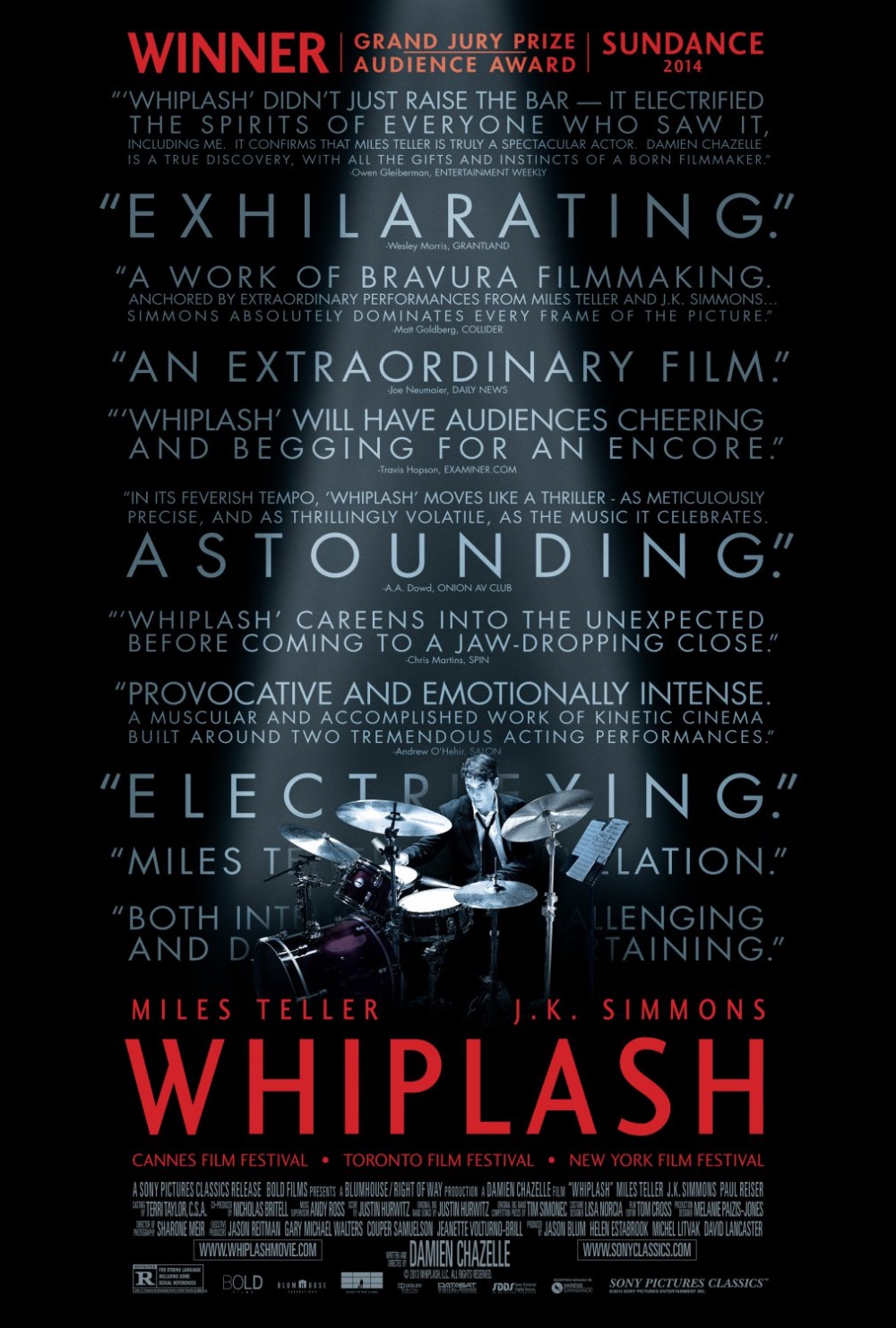
I think it’s likely you will be reminded of those teachers when you watch “Whiplash,” a perfectly titled movie which features the anti-Glenn Holland of music instructors, Terrence Fletcher. Played by J.K. Simmons in an utterly brilliant performance, Terrence is as talented a teacher as he is a terrifying one, and hopefully you have never had to deal with someone like him. But if you have, you have my deepest sympathies and I hope you have found a way to move past such a traumatizing experience.

Miles Teller stars as Andrew Neiman, a 19-year-old jazz drummer who is more than intent on becoming one of the greatest drummers who ever lived. Andrew studies at an elite music conservatory in New York and is working his way up through the ranks when Terrence comes upon him playing one day. Terrence says very little to Andrew and seems eager to see what the young man has to offer. But soon after, Terrence invites him to join his class which has the top jazz ensemble in the conservatory, and this gives Andrew’s ego a major boost to where he finds the courage to ask out Nicole (Melissa Benoist), the girl who works at the concession stand at his favorite movie theater.

Before the start of class, Terrence encourages Andrew to enjoy the process of playing and not to worry too much. But after class begins, Terrence quickly turns into a nasty SOB as he hurls insults as well as furniture at his students if they’re even the slightest bit out of tune. It takes almost no time for Andrew to incur his wrath, and Terrence shows no limit as to how far he will go in verbally abusing a student. He is determined to push Andrew beyond his limits and then some, and this leads to nights when the aspiring drummer becomes a water fountain of sweat and leaves with some nasty cuts on his hands to where band aids cannot stop the bleeding.

The effect Terrence has on Andrew is incredibly profound on him not just as a musician, but as a person as well. While he may be improving as a drummer, Andrew becomes an increasingly difficult person to get along with. At family gatherings, he comes to insult others who look down on his drumming aspirations, and he coldly dumps Nicole when he feels their relationship will get in the way of his mission to become the greatest drummer who ever lived. By the time “Whiplash” reaches its thunderous climax, you’ll be wondering who the victor of this tumultuous teacher/student relationship truly is. When you look at it closely, it could be either of them.

It doesn’t take much to see that “Whiplash” is a very personal story for Chazelle as he himself was a drummer in a high school music conservatory who lived in fear of his teacher and of screwing up a single note. Right from the start, he does an excellent job of setting up just how feared Terrence Fletcher is long before we see him viciously berating his students as if they have no reason to exist. Students stand rigidly at attention whenever he enters the room, fellow teachers don’t even hesitate to step out of his way when he bursts into their classrooms to find new musicians, and heaven forbid if you misplace your music or your drum sticks as you will suffer the man’s wrath in a way which makes you feel like you had it coming.

Now any actor can play a screaming jerk, but it takes a great one to make a jerk of a character into a fascinating and complex human being. This is what makes Simmons’ performance as Terrence Fletcher so damn good; he lets you know what he’s thinking without having to spell it out for the audience. Despite his brutally draconian ways, you can see he is searching for someone truly great and will do anything to get it. Seriously, he will do anything.

This all leads to the “good job” story Terrence tells Andrew, and I’m still thinking about what Terrence said long after the movie ended. On one hand, we cannot condone the way Terrence treats his students, but “Whiplash” has you wondering if being too nice to an aspiring student does them more harm than good. Sometimes brutal honesty is called for to get someone to learn, especially one who is determined to be the best at what they do. Still, there’s got to be a limit to how harshly you can treat a student before they suffer a horrific nervous breakdown.

Miles Teller’s star has been on the rise for a while now, and he’s turned in fantastic performances in the “Footloose” remake and “The Spectacular Now.” Teller was also in “21 & Over,” but the less said about that one the better. As Andrew Neiman, he gives one of the most exhausting performances any actor could have given in 2014, and there is absolutely no doubt he put his entire heart and soul into this character. Teller keeps pounding at those drums as if his life depended on it, and that really is his blood spattered all over the drum set (imagine how much money the studio saved on makeup and special effects). Teller shows a true fearlessness as he takes Andrew from being an easy-going guy to one who reaches his breaking point and then goes beyond it to where Terrence’s intimidating ways will not hold him at bay.

Writer/director Chazelle takes us on a journey which is as cathartic for him as it is for the rest of us, and “Whiplash” stirred up emotions in me I haven’t felt in a long time. It’s an amazing achievement especially when you take into account he had only 19 days to shoot this movie in. Few movies these days take you on such an emotionally pulverizing ride, and this is one of them.

* * * * out of * * * *

Please feel free to check out the interviews I did with Simmons, Teller and Chazelle on “Whiplash” on behalf of We Got This Covered down below.

Paul Verhoeven’s ‘Elle’ Gets a New Trailer and an ‘Empty Stare’ Clip

elle_usposter

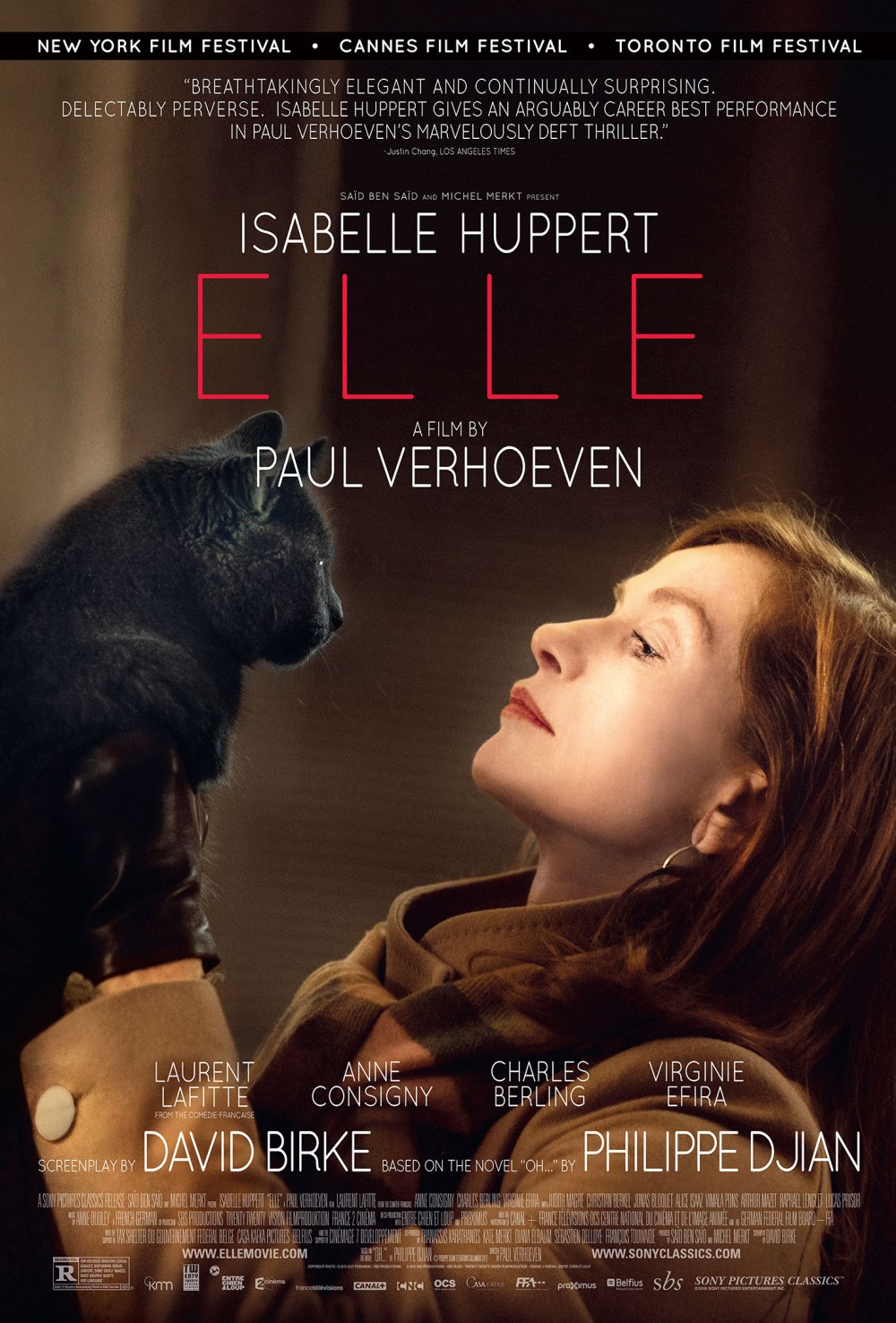
Dutch filmmaker Paul Verhoeven has given us unforgettable movies like “Robocop,” “Total Recall” and “Basic Instinct,” and he had gleeful fun satirizing the war propaganda machine with “Starship Troopers.” Now he returns with his first movie in ten years, his last being the excellent “Black Book,” the psychological thriller “Elle” which stars the brilliant (and not to mention brave) French actress Isabelle Huppert. From watching the trailer, it looks like Verhoeven is up to his usual button-pushing tricks, but the viewer should not go into this expecting “Basic Instinct” redux.

Based on the novel “Oh…” by Philippe Djian, Huppert plays Michèle Leblanc, the head of a leading video game company, and the plot synopsis describes her as seemingly “indestructible” as she “brings the same ruthless attitude to her love life as to business.” As the movie’s trailer begins, Michèle is at a dinner party where she tells a group of friends she was sexually assaulted, and she presents this confession in a calm and collected manner. Whereas you might expect a scene where a rape victim has a nervous breakdown as she accepts the reality of what she’s been through, Michèle doesn’t even blink an eye. Her friends, however, are shocked at this news to where they encourage the waiter, who has just brought a lovely bottle of wine, to come back in a few minutes.

Throughout the trailer, we see Michèle go about her work and life as if nothing has changed, but it becomes clear the attack has forever left a huge psychological scar on her which cannot be wiped away. Her need for revenge is understandable, and Verhoeven’s movies are well known for their characters getting vicious revenge on their attackers, and the trailer shows her as a ticking bomb waiting to go off. In the end, one can remain cool for only so long.

“Elle” is being released by Sony Pictures Classics, and they recently unveiled a clip from the movie titled “Empty Stare.” Watching this clip, there’s no doubt Verhoeven picked the right actress to star here. Huppert has taken on challenging roles in Michael Haneke’s “The Piano Teacher,” Christophe Honoré’s “Ma Mère” and Claude Chabrol’s “La Cérémonie,” and she looks to have risen to the challenges Verhoeven has put in front of her here. As Michèle tells an unsettling story about her father to a male friend, Huppert makes you wonder if she is telling the truth or simply playing around with someone who doesn’t know her very well. The beauty of watching Huppert is how she creates such vivid and frightening imagery with just words. Other directors would add flashbacks to give this scene more emotional power, but Verhoeven doesn’t need to do this when he has Huppert to work with.

“Elle” was shown at the 2016 Cannes Film Festival where it received critical acclaim and a seven-minute standing ovation. Guy Lodge of Variety proclaimed on Twitter that “Isabelle Huppert might be our best living actor, and ‘Elle’ might be Paul Verhoeven’s best film.” Verhoeven has said the movie is not to be mistaken for an “erotic thriller” in the vein of “Basic Instinct,” and that anyone who goes into it thinking it is will be “disillusioned.”

Adventurous moviegoers look to be in for a dark treat when “Elle” opens in New York and Los Angeles on November 11. Please be sure to check out the movie’s trailer and the “Empty Stare” clip below.

Tom Hiddleston Discusses ‘I Saw The Light’ and Singing Like Hank Williams

I Saw the Light movie poster

We all know him as the villainous Loki from the Marvel Cinematic Universe, but now British actor Tom Hiddleston takes on his most challenging role yet as iconic country singer Hank Williams in “I Saw the Light.” Written and directed by Marc Abraham, the movie starts with Hank getting married to the lovely and business savvy Audrey Williams (Elizabeth Olsen), and it follows him from there as he works his way from singing on the radio to becoming a big time star at the Grand Ole Opry. The movie also shows the pain, challenges and addictions he suffered through which led to him creating some of the most memorable country music and his premature death at age 29.

In preparing to play Hank Williams, Hiddleston had to learn his songs and sing them himself. Working extensively with musical coach and veteran country singer and songwriter Rodney Crowell, Hiddleston immersed himself in Hank’s music and worked tirelessly to match his vocals to Hank’s as much as he could. There’s no doubt it was a difficult process for the actor, but watching him in “I Saw the Light” makes you see the tremendous effort he put into his performance.

I attended the movie’s press conference at the London Hotel in West Hollywood, California where Hiddleston was joined by Abraham and Olsen. I was very interested in how Hiddleston managed to get past all the technical aspects of the singing to where he could put all the rehearsal behind him and just sing his heart out. Izumi Hasegawa, a reporter for What’s Up Hollywood and Hollywood News Wire asked him which of Hank’s songs was the hardest to sing, and this would later lead in to my question for him.

Tom Hiddleston: The most challenging song was probably “Lovesick Blues.” “Lovesick Blues” is, I think, of all the songs Hank sang, the hardest, and he probably sang that the most. It was a huge hit for him. He once went up on stage somewhere, it’s on an album called “The Lost Concerts,” and he’s about to introduce it. He says, “I’m going to play a little song for you. I sang this 13,000,001 and a half times and it’s earned us quite a few beans and biscuits.” It was obviously this real hit maker for him and he sang with such control and such authority that he must have done it in his sleep, and I had to accelerate that process because it’s a very technically difficult song. You are yodeling and you are jumping octaves, and so to be on pitch in every note of that song was really challenging. I had days where I felt like I was bashing my head against a brick wall because Rodney Crowell and I would do take after take after take because if I was rhythmically precise the pitch was off, but if the pitch and the rhythm were right Rodney would say, “Well, you weren’t really feeling it. I kind of lost your sincerity, I lost the twinkle, so could you put that back?” And then I’d have the twinkle and I’d go off rhythm again. So yeah, that was probably the most challenging.

Ben Kenber: Clearly you did a lot of vocal work in preparing to sing like Hank Williams. When do you think you got to the point where you stopped worrying about the singing technicality and started to feel the songs instinctually?

TH: It goes back to what I was saying about “Lovesick Blues.” We had to pre-record certain tracks because of the way we were going to shoot them. If Marc was covering a concert performance, it meant he was going to be cutting from wide shots to close-ups to handheld which meant that we had to be very technically precise about the musical track and therefore couldn’t play it live in order for it to cut in. So we had to pre-record the tracks which I would then play and sing along to myself. They each had to have different atmosphere because some of them are radio station tracks, some of them are studio tracks, some of them are live concert performances, and there were some that came very quickly and very easily to me and some that didn’t. I had recorded “Why Don’t You Love Me” in about an hour. It took me about 10 days to record “Lovesick Blues” and I can’t explain why (laughs). Rodney and I used to say that it was like swimming through the ocean, and that I would have to swim for miles and miles through seaweed in order to get to clear water. And that’s how it felt vocally; there would be cracks and strains in my voice. Singing is a physical thing, and once your body and your resonance and your lungs are sufficiently warm, you can actually get to a place where it feels like you’re up at altitude where you are finally in control of the airplane if that makes sense. It’s a fascinating experience for me because I still believe singing is the most naked form of emotional expression. Actors can hide behind characters, writers can hide behind their writing, painters can hide behind paintings, but singers are purely open. The reason we revere the greatest singers is because we feel a raw power to the transmission of their emotions whether it’s Johnny Cash or Amy Winehouse or Nina Simone or Hank Williams or whoever it may be for you. That was challenging because even though there was a technical discipline to it in manipulating my baritone voice to sound like Hank’s tenor, there was still a commitment to emotional sincerity which was really new for me.

Following Hiddleston’s response, Abraham spoke up about what he specifically wanted for this movie.

Marc Abraham: I just want to add something to that because it was a big deal when we decided how we were going to do the music. From the very moment I wrote the script and decided to make the movie, I was intent that we would not have any lip-synching and that whoever played the part was going to have to sing it. I didn’t know they would be able to do it as well as Tom did. I was hoping that would happen, but what’s important to understand and that Tom understood and Elizabeth to some extent when she was even pretending to sing badly even though she gets mad at me for saying she can sing well (she can). Tom and I both knew from the very beginning that he would never sound exactly like Hank Williams. I know Hank Williams like my mother knows her kitchen. There are people who can imitate Hank Williams better than Tom Hiddleston can imitate Hank Williams because he is a natural baritone and Hank’s a tenor, and that’s just reality. What Tom was able to do was to create the feeling not just in his voice and replicate the sounds and the modulations and to get close enough for us, but to inhabit the character. So in the end it didn’t matter that he didn’t sound exactly like Hank Williams. What we wanted was for you to feel that he was Hank Williams, and that was magic. The magic was that he got so close to the music and put so much energy and time and devoted himself so deeply to becoming that character and bring his vocal representation that close, knowing from the very beginning he couldn’t be exactly like Hank. It’s not possible. That was what was really important, and that’s why we didn’t lip-synch it because then you are watching it and you may think you know what it sounds like, but in the end you feel it and you see that character at play and you see Hank singing “Your Cheating Heart” which is done live. That’s Hank Williams.

I want to thank Tom Hiddleston and Marc Abrahams for sharing their thoughts on the making of “I Saw the Light.” The movie is now available to own and rent on DVD, Blu-ray, and Digital.

Copyright Ben Kenber 2016.

Margo Martindale and John Krasinki Discuss an Unforgettable Scene in ‘The Hollars’

The Hollars poster

We all know John Krasinski from his role as Jim Halpert on the American version of “The Office” as well as in movies like “Away We Go” and “13 Hours: The Secret Soldiers of Benghazi.” Now he steps behind the camera to direct his first film since “Brief Interviews with Hideous Men,” and it is called “The Hollars.” In addition to directing and producing this film, Krasinski also stars as John Hollar, a struggling New York City graphic novelist who ends up returning home upon learning his mother Sally (Margo Martindale) has a brain tumor. Once he arrives, John is forced to deal with his past which he has yet to put behind him as well as the possibility that his mother may not be around for much longer.

Both Krasinski and Martindale stopped by the London Hotel in West Hollywood, California to talk about their experiences making “The Hollars.” Martindale showed up first and remarked how she had been travelling to a lot of different places recently. Among those places was San Francisco, and she was stunned to see so many people there wearing jeans and jackets during the summer season. I quickly told her of a quote I heard from the movie “48 Hours:”

“The coldest winter I ever spent was the summer I spent in San Francisco.”

Suffice to say, she and everyone else got a big kick out of that quote.

Once Krasinski came and joined Martindale, the press conference was underway and I asked them both about a specific scene where Martindale ends up acting a monologue (you’ll know it when you see it) which she renders in an amazingly vivid fashion. I asked her how she prepared to deliver this monologue, and her answer revealed there was more to what we saw and the movie’s screenplay written by James C. Strouse.

Margo Martindale: I learned it (laughs), and then I let it happen, and John (Krasinski) wrote it.

John Krasinski: Yeah, it was one of the only scenes that I actually wrote into the script because it was based on an experience that my dad had talked about, so it was bringing a personal spin to it. I talked to Margo about it, and it was just a really special thing to put in there. One of the things I hope for this movie is that you connect to this movie because it relates to your own family, and that the people in the movie stop being family in the movie and starts to become a projection of your own family. So I think innately we put a lot of different stuff from our own families into this movie, and so that was a particular thing I put in.

MM: It’s a beautifully written monologue, and I think probably that you gave me more and more direction on that…

JK: Yes.

MM: Because I needed to know where you wanted it to land and where I was coming from and why was I saying this. So we talked a lot about it, John and I, and I think I probably did that more than any… I don’t know.

JK: I think you did. It was a pretty new addition to the script, so Margo was very good to ask where it was coming from because she knew it was personal.

Please believe me when I say Margo Martindale’s performance is worth the price of admission to see “The Hollars” when it arrives in theaters on August 26.

Copyright Ben Kenber 2016.

Movies My Parents Wanted Me To See: Cache


Cache poster

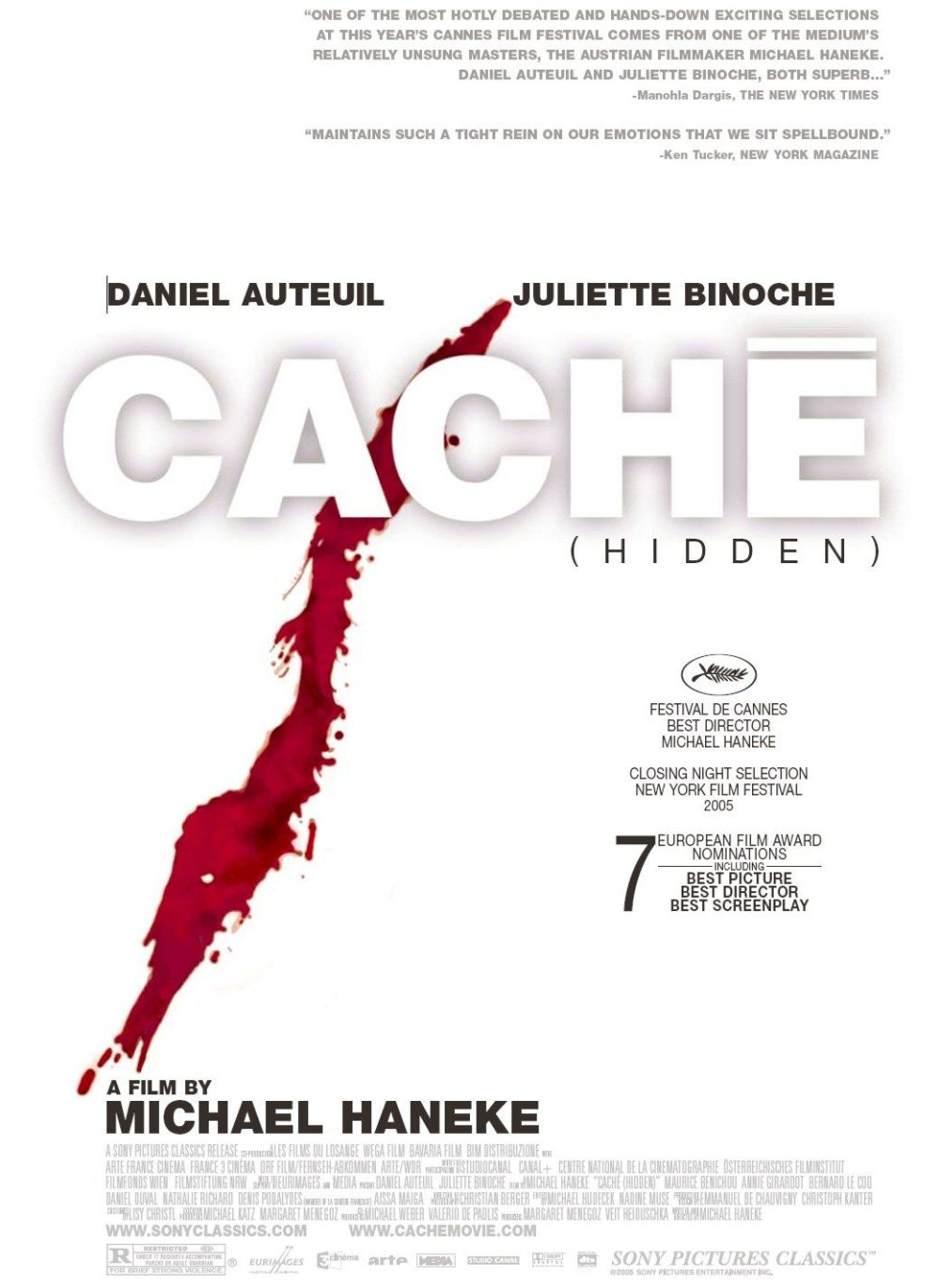
Cache” was written and directed by Michael Haneke who made “Funny Games” (both the original and the remake), “The White Ribbon” and “Amour.” My parents gave me the DVD to this film as a Christmas present, and I went ahead and watched it before going out to see the “Funny Games” remake in theaters. With all the polarizing opinions regarding that film, I felt it was in my best interest to see “Cache” beforehand as I was afraid that if I hated it, then I would never get around to watching the DVD my parents gave me. I have enough trouble as it is watching the other movies they have given me over the years, but this one had a great quote on the DVD cover by Steven Rea of the Philadelphia Inquirer, “Like Hitchcock, only creepier.” I read that quote and was immediately intrigued about what this movie had in store for me.

“Cache” opens up with a long and uninterrupted shot of an exterior of the residence the main characters live in which lasts a good three or four minutes. But suddenly we hear voices and eventually realize we are actually watching a videotape along with two people who rewind it at one point. The couple is made up of TV talk show host Georges Laurent (Daniel Auteuil) and his wife Anne (Juliette Binoche), and they have received this tape from an anonymous person for reasons unknown. As this couple continues to receive more videos, their lives unravel at an increasing rate as the layers of the movie’s story keep getting peeled away.

Describing a movie like this is difficult because its creator makes it ambiguous to the point where we have no choice but to draw our conclusions as to what we have witnessed. These videos reawaken long and dormant memories for Georges as we come to see events from his childhood which may or may not be real, and it uncovers a guilt he thought he had long since made his peace with. But instead, he discovers that deep emotional scar never really disappeared, and now it is being picked at like a nasty scab more than ever before. In the end, it does not matter who is making these videos as much as it does the effect they have on Georges and those closest to him.

It’s clear to me Haneke really likes to play around with the audiences’ expectations. We are so conditioned by the formulaic movies mainstream cinema churns out with consistent regularity to where anything which challenges the norm seems designed to give us unbearable headaches. Those looking for a resolution which tidies up everything to everyone’s satisfaction will be endlessly frustrated with “Cache.” Haneke is not a director interested in spelling out everything for you as he is in trying to get you to figure out the story for yourself.

What is revealed is that Georges did something to another person he never really forgave himself for. Now the past is coming back to haunt him, and it ends up isolating him in his own guilt and fears and alienates him from his family. Anne, Georges’ wife, is incensed she is not being let in on any guesses her husband has as to who might be putting them through such immense anxiety. Georges is never portrayed as a bad person, but it doesn’t matter if he is a good person. Guilt tears away at him, and while some make peace with the past, he may never have that luxury. What’s worse, this guilt may end up being carried on by his son who only has inklings of what is going on between his parents.

Haneke won the Best Director award at the 2005 Cannes Film Festival for “Cache,” and it was probably well deserved. He keeps you hooked into the story which is like an onion that keeps being peeled away, and he succeeds in generating strong tension without the use of a music score. In fact, there is little to no music played throughout the entire movie. The only other movie I can think of which succeeded in keeping us on the edge of our seats without the aid of a music score is “The China Syndrome.”

All the performances are excellent without ever being flashy. Daniel Auteuil creates a morally ambiguous character who is not always easy to get along with, but we still care about what he goes through from start to finish. The most recognizable actor here is Juliette Binoche, and her performance is another in a long line of brilliant ones she has given. Binoche makes Anne’s panic and anxiety all the more real as she keeps getting shut out in the cold as to what’s really going on. Also, Maurice Bénichou, who plays a very pivotal character, brilliantly shows how a person can be threating while remaining perfectly calm.

“Cache” is a brilliant exercise in suspense, and it shows how much of a master Haneke in generating suspense. There are no easy answers to be found here, and the ending itself leaves a lot of things open, but not all movies are meant to be easily understood. Some are meant to engage you mentally so you can draw your own conclusions. What’s wrong with having a movie like that every once in a while? We need challenging movies which break the typical formulas dominating most of American cinema today. “Cache” engages you with the unblinking eye of the camera, and it traps you in the world of its characters to where it is impossible to look away. Movies don’t get more suspenseful than this one.

* * * * out of * * * *

Copyright Ben Kenber 2016.