‘Inception’ May Be the End All of Mind-Bending Motion Pictures

Inception movie poster

“What the hell are dreams anyway?”

“Mysteries, incredible body hocus pocus; the truth is we still don’t know what they are or where they come from.”

                                        -from “A Nightmare On Elm Street” (the original)

“I can make you mine, taste your lips of wine

Anytime night or day

Only trouble is, gee whiz

I’m dreamin’ my life away”

                                    -from “All I Have To Do Is Dream” by the Everly Brothers

“It’s too bad that all these things

Can only happen in my dreams”

                                                -from “In Dreams” by Roy Orbison

My reaction upon seeing “Inception” was pretty much the same one I had after I saw Christopher Nolan’s last movie “The Dark Knight:” BRILLIANT!!! In a summer movie season which has been largely bland and seriously lacking in excitement, Nolan once again stimulates the imagination by giving us a very well thought out story with complex characters. This is all in addition to the slam bang entertainment we expect from a summer blockbuster, and Nolan delivers on both fronts. Seriously, this movie feels like a godsend in a time where studio executives are way too risk adverse. Even if “Inception” borrows from movies like “Blade Runner” and “The Matrix,” Nolan still makes it all his own. I’ve already seen “Inception” twice in one week, and there is just as much to discover about it the second time around as much as the first.

Nolan has actually been working on this screenplay for over a decade, and it is an intricate puzzle of a flick which might seem difficult to follow, but not really. Leonardo DiCaprio stars as Dominic Cobb, a highly experienced dream infiltrator who works at extracting precious information from his targets. Basically, he steals ideas from his clients before they even realize it, and they are very valuable ideas which will put him and his crew on easy street for a time. Working with him is his partner Arthur (Joseph Gordon-Levitt) whose job is to research the clients’ history and see if they have any mental defenses built up which could hinder their mission. As we first see them in “Inception,” they have seemingly failed a mission, but they soon find out it was actually an audition.

Their target, Saito (Ken Watanabe), a wealthy businessman, offers a job which will have them doing the opposite of their job description. This brings us to the movie’s title which means planting an idea in the mind of their target’s subconscious. Although thought to be impossible, Cobb says it can be done because he has succeeded in doing it before. “Inception” then takes Cobb and his team on an adventure which will go into a dream, and then into another dream within that dream. Just when you think they couldn’t go any deeper, they do. It sounds confusing, but it was easier to follow than I thought. You want a tough movie to follow? Check out the first “Mission Impossible” movie which Brian DePalma directed. After all these years, I still can’t figure out what it was about (the stunts were cool though).

The concept of entering a person’s dream is fascinating because it gives the story infinite possibilities to explore, and all sorts of directions to take it in. Dreams themselves still fascinate us as we still have no clear idea what generates them. They can be very unpredictable and go from one place to another before we know it. Dreams could be our subconscious minds trying unburden itself of all the baggage we bury down into its recesses in the hopes of forgetting the most painful things in life. Looking back at the dreams I have had which have stayed with me, be it good or bad, they continually astonish me with their vividness and how our brains and imaginations can conjure up such amazing images as we slumber away in beds which are hopefully kind to your back. You’d think after all these years we would be able to be consciously aware of when we are in a dream and control it to our advantage, but no such luck. When you’re deep into one, the difference between what is real and what is not becomes irrelevant.

That’s the other thing I loved about “Inception;” you are always questioning whether you’re in a dream or wide awake. Even if you already know how the movie ends, it couldn’t possibly spoil the experience for you when you witness it. As in “Total Recall,” reality is always in question and open to interpretation, and it’s unlikely everyone will come to the same conclusion. I was also reminded of David Cronenberg’s “eXistenZ” which ended on a note of sheer ambiguity as the line between what’s real and what is not becomes permanently blurred. “Inception” all but starts out this way, and the theories behind the action and what’s really going on continue to abound. How cool it is to have a movie of this size and scope which really gets you to think!

For a moment, I thought DiCaprio was going to portray the same character he played in Martin Scorsese’s “Shutter Island,” Teddy Williams. Both characters have inescapable similarities; they are tortured by memories and actions they cannot repair, they are married to beautiful women whose current state of mind is in question, and they are both really moody guys who are not a barrel of laughs to be around. Oh yeah, both are also struggling with the reality of everything happening around them. I guess what Cobb has over Teddy is his grip on reality is much firmer, but even Cobb’s sanity comes into question throughout “Inception.”

DiCaprio continues to prove he is not only one of the very best actors working, but also one of the few stars who genuinely take risks. Not content with being forever imprisoned as a movie star, he nails the complexities of Cobb to where we see the various dimensions of his character. In essence, Cobb is a thief after the big score, and he shuts himself off to other people. But DiCaprio really gets at what is beneath his character’s guilt and shame, and he makes us want to join him in his dream exploits. For him, it is never about just making the character a likable one.

It’s also great to see Levitt here as well. Having been the indie darling for a few years, turning in one great performance after another, and he more than holds his own here. When everyone else is in a state of uncontrollable panic, Arthur always keeps his focus clear which allows him to stay on top of things. His method of preparing his team members for “the kick” in one dream is ingenious. Watching Levitt here almost makes me forget he was on “3rd Rock from The Sun” all those years ago.

Then you have the beautiful Marion Cotillard, plays Cobb’s late wife, Mal. While Mal may be short for Mallorie, in Latin it means “evil,” and she exists only within Cobb’s dreamscape as he has buried her deep in his memories. However, his control over her continues to erode as Mal continues to intrude in different dreams he has as she gets the upper hand and continually threatens to ruin anything and everything. Cotillard plays Mal with a cold detachment as well as a deeply wounded person who feels betrayed by her husband. As the movie goes on, you begin to wonder if she is truly dead or alive.

At first, having Ellen Page in this movie might seem weird as we all still identify her with her character from “Juno.” It’s been easy to forget what a wide range she can have as an actress, but this is not the case here as she acts as the guide for the audience in the world of dreams. Her character of Ariadne is the architect, the one who constructs the world of the dream which the team will enter into. She also acts as the conscience Cobb needs as he continues to be drawn by Mal into a state of limbo which he may never return from. As a result, Ariadne is the strongest, most objective and levelheaded in the group because she sees what consumes Cobb and how it can endanger everyone. She becomes the voice of reason Cobb must listen to if he hopes not to drown in his own guilt. It feels like it has been too long since I have seen Page in anything, and she once again proves to be another fantastic actress of her generation.

Tom Hardy, who plays the forger Eames, is fun to watch here as he approaches the role with a touch of irresistible sarcasm as he gleefully plays around with the other team members and their self-consuming seriousness. Eames gets an especially big kick in getting a rise out of Arthur who takes his work perhaps more seriously than most. Throughout the movie, Hardy’s presence proves to be one of the film’s most entertaining, and his star continues to rise.

Nolan also brings some of his “Dark Knight” cast members along for the dream ride including Sir Michael Caine and Cillian Murphy. Both are terrific in any role given to them, and the performances they both give in “Inception” are no exception. Another supporting actor worth noting here is Dileep Rao who plays Yusuf, the chemist who formulates the sedatives which put the group and the target under so they can complete their mission. I think he deserves to be mentioned in the same breath with all the other actors whose names appear on the posters.

But the big surprise in “Inception” is the appearance of Tom Berenger, a well-known actor who has for far too long been relegated to the realm of straight to DVD movies. It’s so nice to see him here in something other than a “Sniper” sequel (how many have there been anyway?), and he hasn’t missed a step as an actor after all these years.

With movies like “Inception,” we have come to expect directors will spend more time on the visual element to where they inadvertently forget the other important ones like dialogue and acting. Having made several movies already, Nolan proves to be one of the best directors working today as he handles each part of a movie with the same amount of attention, something increasingly rare among filmmakers.

Nolan fills the movies with such inventive images as Arthur fights off armed men while the dream he is in is thrown out of balance as it spins him from the floor to the ceiling. Levitt really sells the scene by showing his character struggling to maintain control as he is forced to crawl over the place when gravity no longer works in his favor. Then there is the final scene, which I won’t dare to give away, but taking in the audience’s strong reaction showed just how successful Nolan was in holding us firmly within his grasp. I loved the inescapable ambiguity of the film’s conclusion and how it drove some audience members crazy.

Plus, Nolan once again employs Hans Zimmer to do the score, and what he brings us is not another rehash of the Caped Crusader’s music. Zimmer gives a strong score dominated by electronics, drums, and brass instruments which are primed to blow out the speakers at a theater near you. Capturing the scope of the visuals in “Inception” which are quite immense, Zimmer once again gives great power to Nolan’s amazing concepts which Warner Brothers was smart enough to let the director run wild with instead of just containing his imagination in fear of releasing something which might seem “uncommercial.”

In a sea of endless remakes, questionable reboots, and half-assed concepts which somehow got a green light from studio executives, “Inception” is a rare breed of film which is as thought provoking as it is entertaining. It also makes clear Nolan is a genius filmmaker who has set the bar high for summer tent pole movies just like he did with “The Dark Knight.”

* * * * out of * * * *

‘Interstellar’ Takes Us on an Outer Space Journey Like Few Others Can

Interstellar movie poster

Christopher Nolan’s “Interstellar” is a film which demands to be seen on the biggest screen nearest you. Like “Gravity,” seeing at home on television will not have the same effect as seeing it in a darkened theater, and that’s even if certain people around you forget to turn off their cell phones (doesn’t anyone ever learn?). Whether or not you think “Interstellar” is Nolan’s best film, you can certainly say it is his riskiest and most ambitious to date as he combines elements from Stanley Kubrick’s “2001,” Phillip Kaufman’s “The Right Stuff,” and even Robert Zemeckis’ “Contact” to make a most enthralling space adventure for us to experience.

“Interstellar” takes place in a not too distant future when Earth is unable to sustain humanity as crops are constantly ravaged by blight, dust storms keep laying waste to towns everywhere, and teachers have changed school textbooks to make children believe the Apollo moon landings were faked (blasphemy). In the middle of all this is farmer, widower, and retired astronaut Joseph Cooper (Matthew McConaughey) who spends his days tending to his farm and raising his son and daughter with the help of his father-in-law Donald (the always dependable John Lithgow). Cooper keeps going about his business but still takes the time to indulge his daughter Murph (Mackenzie Foy) in her curiosities about outer space and the ghost she believes is haunting her bedroom.

One of those curiosities ends up leading Cooper and Murph to a secret NASA space installation out in the middle of nowhere where they meet Professor Brand (Sir Michael Caine) who informs them humanity will not survive for much longer. However, scientists have discovered a wormhole orbiting Saturn, and this presents the possibility of new planets for humans to inhabit. Cooper volunteers to pilot the experimental space shuttle Endurance into the wormhole, and he is joined by a crew of three as well as a couple of multi-purpose robots on a mission which will take several years to complete. But the mission also means Cooper must leave his family behind, and this ultimately devastates Murph who begs him not to go. Cooper promises Murph he will return once the mission is complete, but this may be a promise he might not be able to keep.

I don’t want to reveal much else of what happens in “Interstellar” as it is full of surprises, and it helps to come into this movie free of expectations and knowing only so much about it. We all love his “Dark Knight” films and have been following his work ever since he made his breakthrough with “Memento,” but this is really Nolan at his most emotionally open and, dare I say, sentimental. Almost nothing he has made previously compares to what he has given us here.

The movie does take a while to achieve liftoff (pun intended), and I know many have complained about the “sluggish” pacing in the first half. The way I see it, I admired how Nolan took his time with the story as many other filmmakers would have been pushing to get into outer space a lot sooner. These days we are in such a hurry to get everywhere and nowhere, and cable channels like IFC are content to speed through the end credits of a movie as if none of the hundreds of crew members who worked on it ever mattered. It’s nice we get to know these characters to where they have enough depth which makes us want to follow them on their journey to where no one has gone before.

I also liked how “Interstellar” deals with real science and doesn’t go out of its way to heedlessly disregard the laws of physics and gravity. Granted, there’s a lot of technobabble dialogue here which is at times hard to decipher and makes certain scenes a little confusing, but considering how much work Nolan and his fellow collaborators (which includes noted theoretical physicist Kip Thorne) put into researching space travel, this movie does have the feeling of plausibility throughout. We still may be years away from the kind of space travel presented here, but Nolan and company make you believe it will become a reality at some point.

Along with cinematographer Hoyte van Hoytema, Nolan captures some exceptionally beautiful images as Cooper and company seek out new life and new civilizations. Some of the shots are bound to remind viewers of “2001,” and Kubrick’s classic film is certainly a huge influence on the story. Still, Nolan takes us on a journey which feels surprisingly unique to others captured on celluloid recently and previously.

At this point, it should go without saying that McConaughey is on a roll. When he first made his breakthrough in “A Time to Kill,” many were heralding him as the next Paul Newman when they should have just let him be Matthew McConaughey. This led him to star in a number of dopey romantic comedies which were far beneath him and his fellow co-stars, and many quickly lost faith in him. However, the last few years have seen him turn in one remarkable performance after another in “Mud” and “Dallas Buyers Club.” His work in “Interstellar” is remarkable and heart wrenching as he watches videos of his children who are growing up without him, and he grieves over the things he has missed out on.

Anne Hathaway, who previously worked with Nolan on “The Dark Knight Rises,” turns in a strong performance as Amelia (as in Earhart?) Brand, an astronaut and scientist whose heart threatens to get in the way of her duties as a scientist when hard choices have to be made. David Gyasi is also very good as physicist Romilly, and time proves to be a real burden for him throughout the movie. As for Wes Bentley who plays geographer Doyle, he is underutilized here as he has little to do other than spout off a lot of technobabble, and his character never gets much in the way of development.

But one of the best performances to be found in “Interstellar” comes from Jessica Chastain who plays the older version of Murph. Still resentful of her father for leaving, she channels her anger into her own work with NASA as she works with Professor Brand to bring him back. Even as the film threatens to be a little ridiculous with answers that may have been better left to the imagination, Chastain keeps you hooked into her character’s quiet desperation to find her father and save the world to where you are begging for these two to reunite sooner than later.

Another collaborator of Nolan’s who really challenges himself here is composer Hans Zimmer who has given us some of the most exciting music scores in the last few years. With “Interstellar,” Zimmer abandons the usual thrilling bombast of “The Dark Knight” and “Inception” for something more spiritual and Phillip Glass-sounding. His music acts as a requiem for the wonders and perils of voyaging through space and of the solitude humans are forced to endure when stuck in another galaxy. You can usually notice the Zimmer sound in each film score he does, but his work here sounds so remarkably different from what he has done in the past.

This movie does have its flaws, and there are moments towards the end which strain credibility to where things threaten to become laughable, but its strengths eventually overcome its weaknesses by a large measure. Just when it looks like the plot will go off the rails in an M. Night Shyamalan way, it doesn’t, and it speaks to how deeply Nolan feels about the story and what it implies.

In the end, “Interstellar” is not another science fiction movie about astronauts looking for little green men (it would have been a disaster if it did). It’s about the power of love and how it can transcend both time and space no matter where you are. Regardless of the laws of physics and gravity, love carries on from one galaxy to the next and can never be easily conquered. I came out of this movie happy to know that, even in the deep, dark and silent void of outer space, love can remain constant.

For the record, I saw “Interstellar” at the historic Grauman’s Chinese Theatre in Hollywood in IMAX 70mm. I am more than convinced this is the best way to see it, and it also represents one of the last chances for all of us to see a movie projected on film. I’m sure it looks great in digital, but film still works best for Nolan.

* * * * out of * * * *

‘The Thing’ Prequel Should Have Been a Sequel

The Thing 2011 poster

It says a lot about John Carpenter’s “The Thing” that it could generate a prequel almost 20 years after its release. A critical and commercial failure back in 1982, it has since been justly reappraised as a true horror classic and remains Carpenter’s masterpiece. It proved even more terrifying than “Halloween,” and it also holds a special place on my list of my top ten favorite movies of all time. These days, it is even more frightening as the scenario it presents feels all too possible.

Now we have Matthijs van Heijningen Jr.’s “The Thing,” a prequel to Carpenter’s movie which explores the events leading up to it. Remember the Norwegian camp Kurt Russell and Richard Dysart visited which had been completely burned down? Now we get to see how it got laid waste by both the thing and the humans. But therein lies the problem; knowing the events precede those of the 1982 movie and who survives, much of the potential suspense and tension gets drowned out almost immediately.

Frankly, I would much rather see a sequel to Carpenter’s “The Thing” instead of this. His film was very effective because we never had a clear idea of who to trust. But in Heijningen’s film, we know the characters on display will eventually bite the dust, and it becomes a question of when these characters turn into the thing. After a while, it becomes more shocking when a character dies but doesn’t turn into a gooey alien. What spoils it even more is we know of at least one character who will survive what happens very early on, and all we can do is wait impatiently for him to get on the helicopter with his rifle and take shots at the wolf.

Heijningen is respectful of Carpenter’s movie and pays homage to it throughout, but I kept wondering if this was a remake instead of a prequel. Various scenes are clear imitations of the 1982 movie’s most classic moments, and I wish he had worked harder at distinguishing the prequel from it instead of just presenting us with something way too similar. He does wring some suspense and strong tension at different points, and his unique take on the blood test scene is very clever, but he is unable to sustain the tension which made Carpenter’s movie so utterly terrifying.

The special effects are very good, but they pale in comparison to the genius of Rob Bottin. Audiences are always quick to tell when CGI effects are overused. As for the performances, they are generally good even though the characters could have come out of any monster movie.

The best performance comes from Mary Elizabeth Winstead as paleontologist Kate Lloyd. Such a terrific presence in “Scott Pilgrim vs. The World” and “Live Free or Die Hard,” she holds our attention throughout and is one of the best reasons to see this prequel. While Lloyd is predictably inspired by Ellen Ripley from “Aliens,” Winstead makes the character her own and more than just another tough chick which movies like these typically rely on.

“The Thing” prequel is not terrible, but it will be of interest more to those who haven’t seen the 1982 film which itself was a remake and made back in a time when remakes were rare and actually worth watching. This particular version of John W. Campbell’s “Who Goes There?” feels like a lost opportunity, and it gets caught in the prequel trap of busily matching everything up to the film it leads into. It really sucks when you can see a movie’s ending long in advance. I did however admire the ambiguous ending shown before the end credits as it leaves you wondering if the alien really infected one of the last characters standing. Not knowing is always more unnerving than knowing, and at least the director got this right.

* * ½ out of * * * *

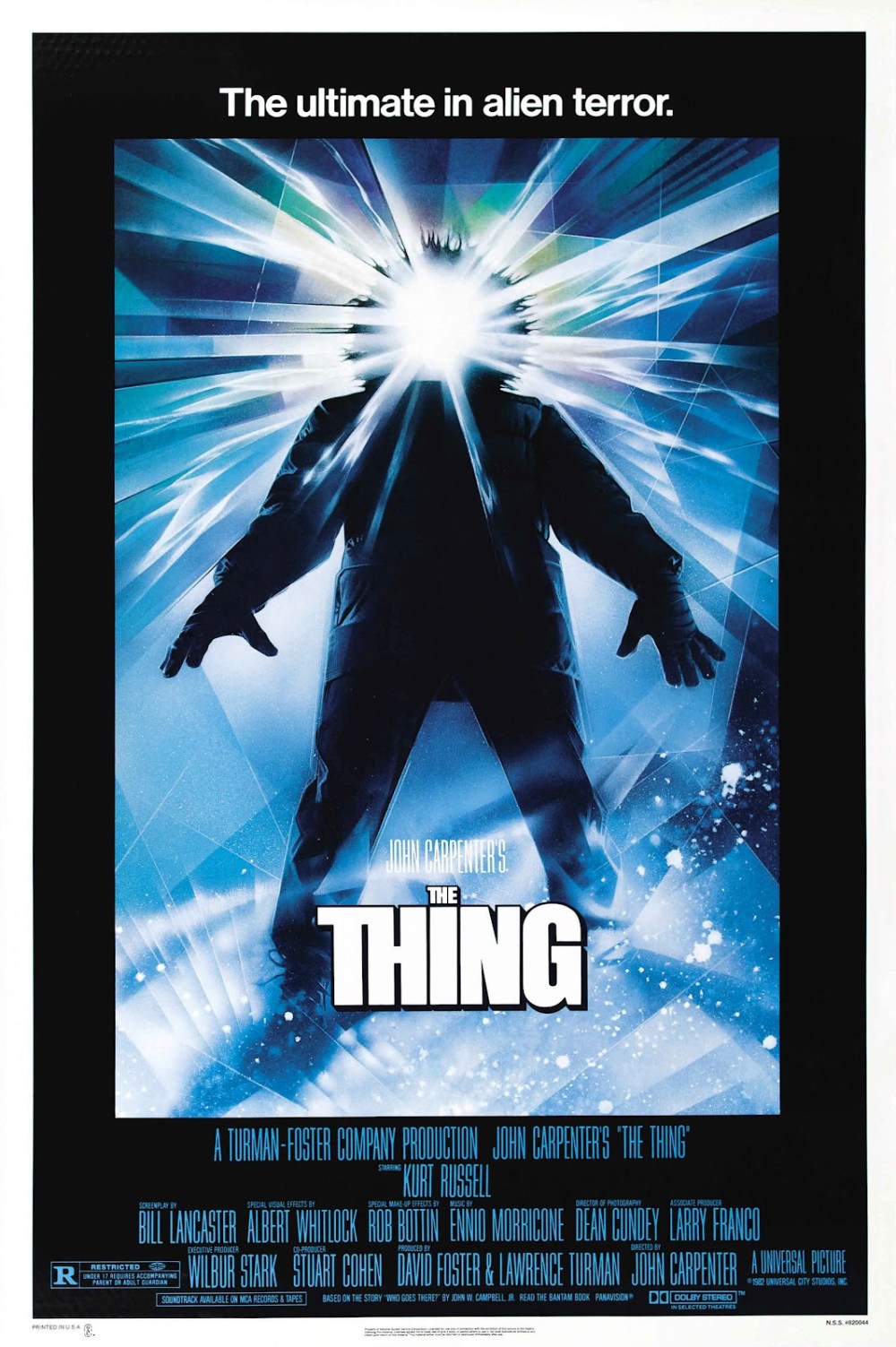
John Carpenter’s ‘The Thing’ is One of the Best Horror Movies Ever Made

The Thing movie poster

Many of you probably know the story behind John Carpenter’s “The Thing.” It came out in the summer of 1982, two weeks after Steven Spielberg’s “E.T,” and while the alien from Spielberg’s movie was warm and cuddly, the one in Carpenter’s was cold, ugly, and utterly vicious. As a result, “The Thing” was quickly derided by both critics and fans alike, and no one hid their disgust towards Carpenter for what they saw as pornography of violence. In all fairness, however, the movie was released at the wrong time of the year. To release it during what Carpenter called the “summer of love” opposite not just “E.T.,” but also “Star Trek II” and “Tron” was a big mistake on the part of Universal Pictures, and they would have had more luck had they released it in the winter of 1982.

Years later, “The Thing,” like many of Carpenter’s movies, found the audience it deserved through home video and digital media. Perhaps it was ahead of its time, but it is now considered, and rightly so, one of the best horror and sci-fi movies ever made, and it is easily the best horror remake in a sea of horrendously crappy ones. It certainly plays better today than it did when first released, and it is still utterly terrifying 35 years after its release.Unlike the original Howard Hawks version of “The Thing,” Carpenter’s movie hews much closer to the short story “Who Goes There?” by John W. Campbell, Jr. The movie takes place at an American scientific research outpost in Antarctica, perhaps the coldest place on Earth. We are introduced to a bunch of men who are studying the surrounding area, and they look bored and listless as they pass the days smoking, drinking scotch, watching “Let’s Make a Deal” reruns, and playing ping pong. One day, they are met by a wolf being shot at by a Norwegian for no discernable reason. This later leads to events which make them realize they have encountered an alien of unknown origin unearthed from the ice after thousands and thousands of years. It then proceeds to imitate every creature it comes into contact with, and it is revealed any of them could be the thing. They have to destroy the thing before it reaches civilization because, once it does, it would mean the end of the world.

The premise of “The Thing” is genius because it allows for an unending escalation of tension and suspense throughout. Like the characters, you have no idea who to trust. The paranoia which closes in on the characters puts them in an airtight cage, and this cage gets smaller and smaller as it heads to its infinitely bleak climax. There are no women to be found which eliminates any sexual tension and could have added an unnecessary element to the movie. Many say this makes the movie sexist, but it is a ridiculous charge.

“The Thing” was released when the whole world started to become aware of the AIDS virus. The idea of any virus infecting us completely and rearranging our body to the point may have seemed unreal to us back in 1982. But today, it is a reality more horrifying than ever, and it presents itself with no cure. This makes “The Thing” even scarier to take in when watching it now. The scene where Dr. Blair (Wilford Brimley) observes a computer image of the virus infecting a human host is one of the movie’s scariest moments, and it feels like an all too real a possibility today. The only thing truly dated about the scene is the computer graphics look like they are from some old Atari game, but it doesn’t change anything.

This movie also marks one of several collaborations between Carpenter and Kurt Russell who started working together on the TV movie “Elvis.” After all these years, Russell can still make you believe he is a regular guy like the rest of us, and his role as helicopter pilot R.J. MacReady is one of his best. You never get the feeling Russell is acting here. Instead, he inhabits the character he plays, and you follow him every step of the way without any doubt of who the hero really is.

Carpenter cast “The Thing” perfectly with actors like Richard Masur, Richard Dysart, Donald Moffat and David Clennon. But one of the best performances comes from Brimley as Dr. Blair. In the past, we have seen him in countless oatmeal commercials and in roles as the grandfather we wished we had in our lives. But his role in “The Thing” offered him an opportunity to go completely against type. Brimley goes from curious to utterly horrified by what this unknown creature can do, and he ends up wreaking havoc in a way you would never ever see in an oatmeal.

Another great actor in this movie is Keith David who plays Childs. David has a don’t mess with me intensity, and he matches Russell’s intensity every step of the way. The tension between them is as frightening as is waiting for the thing to make its next horrifically gory entrance.

But let’s talk about who the real star of “The Thing” really is, and that is Rob Bottin who designed the movie’s horrifically brilliant special effects and makeup designs. Long before the advance of computer technology, Bottin had to make all these designs from scratch, and what he came up with is now considered a benchmark in his field. The thing mimics everything it touches, and this must have been a huge inspiration for him as it allowed his imagination to run amuck with infinite possibilities. You never know what’s coming next, and this makes “The Thing” even scarier.

Some have called this movie a “geek show” made only with the intention of grossing people out. Granted, a good case could be made for that, but “The Thing” explores a theme that is commonplace in many of Carpenter’s movies; the struggle to maintain one’s individuality. Of never letting go of who you are because it allows you to survive in a world which keeps finding new ways of robbing your individuality at any given opportunity. The threat of this loss is very real, and the characters have the unfortunate disadvantage of being stuck in one of the most remote and desolate places on Earth.

I also imagine a big complaint people have about “The Thing” is we never learn about the alien or where it came from. Basically, we know it’s from outer space which imitates whatever it comes in contact with, and it clearly deals with the cold better than any of us do. Here’s the thing, do we really need to know everything about this creature? Maybe not knowing is more terrifying than knowing. It leaves a lot of things to the viewer’s imagination which I love because it leaves so many possibilities open for how this horrific situation is going to play out.

“The Thing” truly is Carpenter’s masterpiece as it shows him to be a true master of horror and suspense. He endlessly generates unbearable tension throughout, and just when you think the movie has peaked, you realize it has not. Carpenter’s goal here is not just to make us jump out of our seats, but to make us feel the terrifying isolation and complete lack of trust these characters are forced to endure.

Carpenter has said “The Thing” was the first in his apocalypse trilogy (the other two were “Prince of Darkness” and “In the Mouth of Madness”), and it does have an unrelentingly bleak tone which made it seem completely out of place back in 1982. As time goes on though, many of us keep thinking the world is coming to an end with more deadly diseases like the Ebola Virus among others, and the scenario this movie presents us feels all the more frightening and immediate as a result.

Some movies are robbed of their greatness through the passage of time, and we watch them and wonder why we liked them in the first place. But “The Thing” is an exception as the passage of time has made it all the more effective. You can’t help but think its story was ahead of its time, and it remains one of those movies I never ever tire of watching. It has more than earned its place on the list of my all-time favorite movies.

* * * * out of * * * *


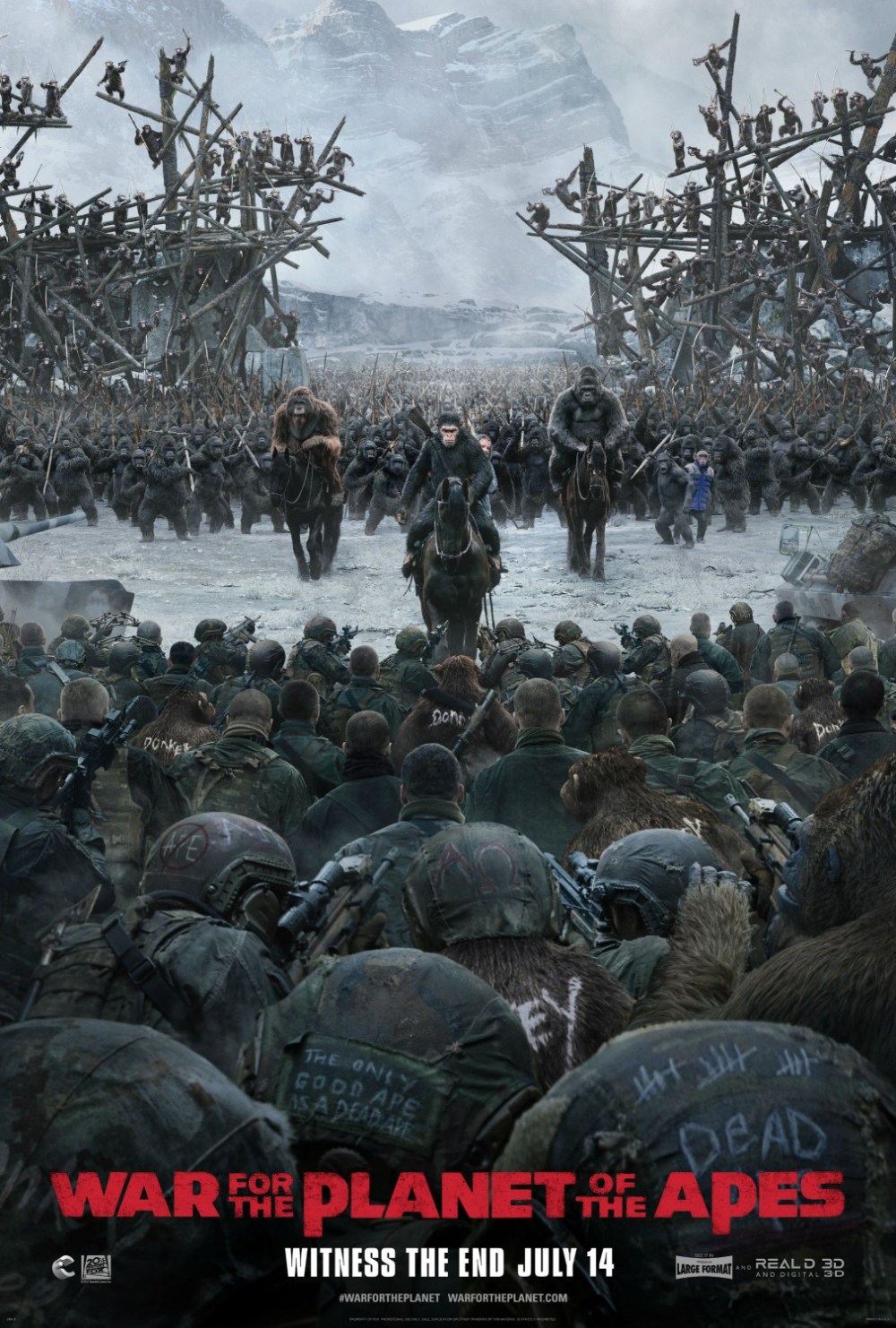
‘War for the Planet of the Apes’ Caps Off a Truly Great Trilogy

War for the Planet of the Apes poster

The summer 2017 movie season hasn’t necessarily been a bad one, but so far it has been overrun by franchise fatigue. Did we really need another “Transformers” sequel? Was the wait for the latest “Pirates of the Caribbean” really worth it? Can’t Pixar do more than just give us another sequel to “Cars?” Some franchises have seriously overstayed their welcome to where it feels like we need to take a LONG break from sequels of any kind, except of course for the next ones coming from the Marvel Cinematic Universe.

But now we have “War for the Planet of the Apes,” the third in the rebooted “Apes” franchise which is not only the best one to date, but also one of the best movies of 2017. Unlike other sequels which essentially repeat the same story to nauseating effect, “War” is not out to give us a replica of everything which happened before. From the start, we see how far the apes have evolved, and we also see the humans going through a state of de-evolution as well. In this war, it won’t matter who wins because nothing will ever be the same for anybody.

Taking place two years after the events of “Dawn of the Planet of the Apes,” “War” finds the conflict between the apes and the humans getting bloodier and bloodier. Both sides have taken heavy casualties, and the humans have resorted to recruiting apes to betray their own in a desperate effort to gain the upper hand in an escalating conflict. Caesar (Andy Serkis) has now reached a mythic status on the planet as a strong leader, and he now speaks as well as any human. When the movie starts, he has just survived another battle which leaves many dead in its wake, but instead of killing the remaining human soldiers, he sends them back to their base with a message to their leader, leave us alone. At this point, Caesar merely wants to protect his fellow apes and everything which is rightfully theirs.

But after being reunited with his loving family, Caesar suffers an unimaginable tragedy perpetrated by a military unit led by the ruthless Colonel McCullough (Woody Harrelson), and he heads out on a mission of revenge which, to quote a Klingon proverb, will be best served cold. Joined by several of his closest friends which include the wise and benevolent Maurice (Karin Konoval), Caesar comes not just to understand the world around him, but also about himself and of how he may be the maker of his own fate.

Whereas “Rise” dealt with evolution and how humans may not be a superior race of beings, and “Dawn” observed how humans and apes can be their own worst enemies, “War” focuses on the themes of vengeance and hate and what they do to the soul. Caesar’s quest for revenge is completely understandable, but his friends worry about what his hate for the Colonel is doing to his inner self. Caesar finds his strength from within and is as wise as he is strong, but we can see his soul is being corrupted on this mission as he is determined to exterminate his enemy with extreme prejudice.

The cost of revenge is a common theme in many stories, but “War” treats it with a great deal of intelligence. Caesar is constantly haunted by visions of Koba (Toby Kebbell) whose treacherous actions led Caesar to drop him to his death in “Dawn.” Maurice, the Obi-Wan Kenobi of these “Apes” movies, reminds Caesar of how Koba never got past his hate for humans to see the need for peace. But while Caesar convinces himself his motives are far purer than Koba’s, he comes to realize he is no different from Koba as his need to exact revenge takes precedence over everything else which holds great meaning in his life. The question is, can Caesar pull out of this moral nosedive before it’s late, or will he sink into an abyss of hatred which will rob him of all he stands for?

Not enough can be said about Andy Serkis’ performance as Caesar, and his work should have netted him at least one Oscar by now. We have seen Caesar go from being a frightened young ape into a hardened warrior, and Serkis has made every emotional beat count for something deep and true. While the visual effects help to illustrate how he has paid a price for the war being fought, it is Serkis who gives these effects soul and meaning as he plumbs the depths of Caesar to give us a character who is wonderfully complex and haunted by past deeds which cannot be simply washed away.

Woody Harrelson once again reminds us how he can play just about any role given to him these days with his portrayal of Colonel McCullough. His performance draws a bit from Marlon Brando’s in “Apocalypse Now” as, like Colonel Kurtz, McCullough has become a rogue soldier as his need to wipe out the apes and save the humans comes from a place of pain and delusion instead of from a higher military authority. Part of me expected to McCullough to be the usual military antagonist movies of this kind typically employ, but Harrelson gives this character much more dimension than you might be anticipating, and he matches Serkis scene for scene as their characters come to discover how alike they really are.

In addition, Serkis and Harrelson get strong support from Karin Konoval who makes Maurice far wiser than CGI can ever convey, Steve Zahn whose character of “Bad Ape” is kind of the equivalent to “Harry Potter’s” Dobby, and Amiah Miller is a scene-stealer as the mute war orphan who comes to be known as Nova.

Matt Reeves, who directed “Dawn,” returns to helm “War” and tops what he gave us before. The third movie in a franchise usually falls back on a well-trod formula, but he instead advances the plight of the apes to another level which furthers their evolution, and of the humans’ furious attempts to eradicate them which reveals their failings and a tremendous lack of understanding about where we all came from. And while the visual effects are tremendous in how they make the apes look ever so real, they are not the point. Reeves’ focus is more on character and performance more than ever before, and it is those things which make “War” especially epic. A lot of summer blockbusters are geared towards wowing us with special effects to where the human element is lost, but Reeves and company have the special effects serving the movie and its characters in a wonderfully effective way. On top of all this, “War” is well-served by one of Michael Giacchino’s best film scores to date.

The “Apes” reboot trilogy now joins the company of great cinematic trilogies such as Episodes IV, V and VI of “Star Wars,” the Jason Bourne trilogy, and “The Lord of the Rings” among others. It’s so pleasing to see filmmakers give us the kind of summer blockbuster many don’t always expect to see, one filled with great performances and intelligence as well as characters who are very interesting and whom you want to root for. Many blockbusters are the equivalent of a fast food meal which you may have enjoyed eating but which does not leave much of an aftertaste, but this is epic filmmaking which you can’t help but be emotionally drawn into. In a summer movie season which has been lacking to say the least, “War for the Planet of the Apes” is a real winner.

I also have to say “War” kept reminded of a Talking Heads song called “(Nothing But) Flowers.” As apes and humans traverse a landscape dominated by trees, rocks and lakes to where you can’t remember the last time you saw a building, the following lyric kept playing in my head:

“If this is paradise, I wish I had a lawnmower.”

* * * * out of * * * *

Exclusive Interview with Tim Smit on His Directorial Debut, ‘Kill Switch’

Tim Smit photo

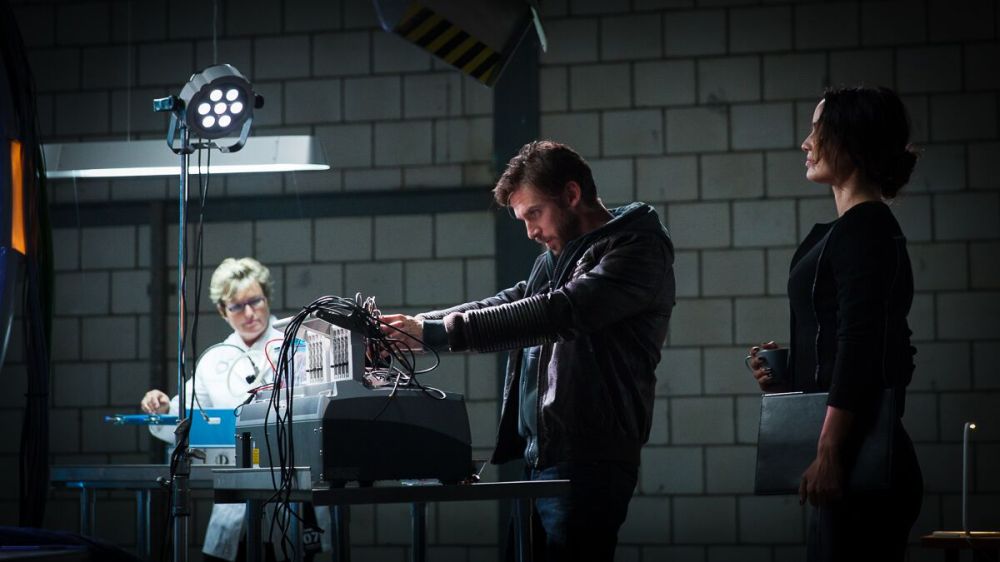
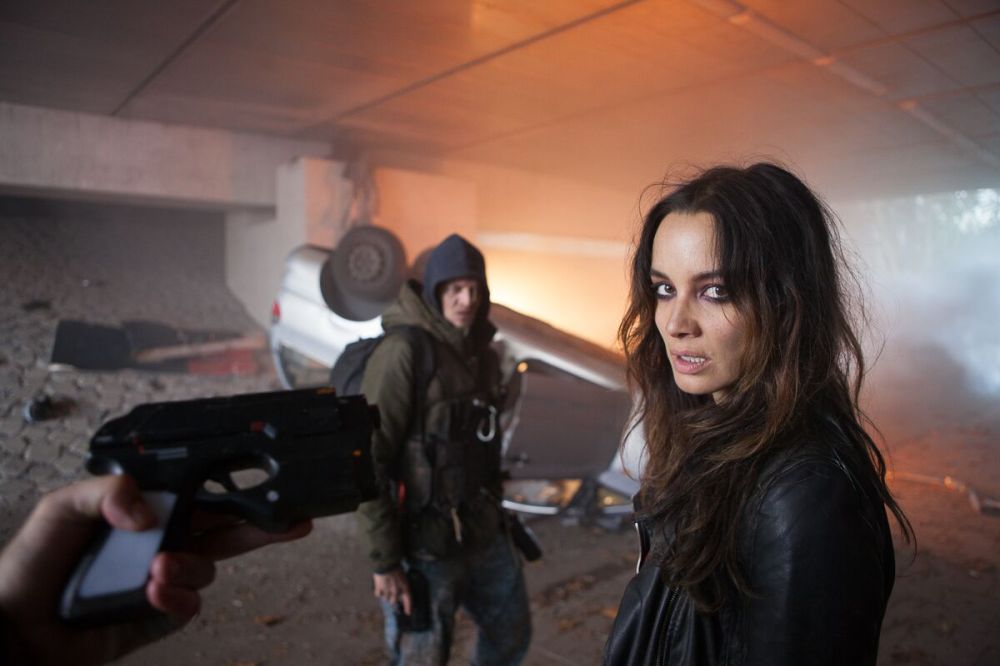
Acclaimed writer, director and visual effects artist Tim Smit makes his feature film directorial debut with “Kill Switch.” Based on his short film “What’s in The Box?” which gathered a large audience on YouTube, it stars Dan Stevens as physicist and NASA pilot Will Porter who is recruited by Alterplex, a power company which has built an enormous tower designed to harness unlimited quantum energy. The company’s vice-president, Abby (Bérénice Marlohe), informs Will a mirror universe has been created solely to drain energy from, and he is sent into it with a device called a “Redivider” which will balance the power between the two universes. But as you can imagine, nothing goes quite as planned as the mirror universe proves to more than anyone thought it could be as Will finds himself on the run from drones, soldiers, and people he is no longer sure he can trust.

“Kill Switch” takes place in a future version of our world, and it is largely a POV movie as we see much of the action from Will’s eyes as he struggles to say alive in an especially hostile universe. I talked with Smit about the movie’s origins, how the story evolved from a short into a feature film, and of how he was able to create a visual effects heavy movie in just 18 days and on a small budget.

Kill Switch poster

Ben Kenber: I really like the way this movie is set up because you are thrown into this story to where you cannot help but be gripped by everything going on. You’re not sure what is happening and, like Dan Steven’s character, you are desperate to find out. When conceiving “Kill Switch,” did you know how the story was going to end, or did you just start off with the idea and went from there?

Tim Smit: We knew that, when I did the short a couple of years ago, the box was going to be used as sort of a kill switch for destroying a parallel universe meant for energy harvesting. But we never really knew the full arc of the story before we hired the writers to get involved, so it took a while to get to the point we ended up with. It was interesting and a very steep learning curve for me to work on this as a conceptual arc as a writer and also as a director, and of course the visual effects too. It wasn’t fairly clear, but we got there as we developed the kill switch idea.

BK: The screenwriters you hired for this project, Charlie Kindinger and Omid Nooshin, what would you say they brought to this story which wasn’t in your short film?

TS: What they did is they fleshed out the characters much more than we already had in the original short. But they also wrote the dialogue and they did the screenwriting of the story. It was a difficult movie to write because of the whole POV aspect. It’s difficult to tell a story through POV. Also, we did have, for that reason, to introduce the whole flashback storyline to help us with that, and to help provide a rest for the audience so that they do not get POV tired. So, they focused on that the feeding of information so the audience knew enough to keep going with the movie, and they were more associated with that than the base idea.

BK: I did watch the short “What’s in The Box?” which led to the “Kill Switch” feature film, and the whole idea of the parallel universe is something which has been explored in science fiction constantly such as the “Dark Mirror” episode of the original “Star Trek” series. What inspirations did you draw from when putting together the short and the feature film?

TS: So, the main inspiration behind it was a couple of things actually. Visually it was inspired by a couple of video games because this was always meant to be sort of an homage to video gaming, and we used various inspirations like “Half-Life,” “Halo” and games like that. From a physics standpoint, the idea for the parallel world came from the concept of Schrödinger’s cat, a thought concept where you got a box and in it is a cat with a poison. If you keep the box closed, you don’t know if the cat survived because the poison still has a chance to kill the cat. You only know the cat is dead when you open the box. So, this is kind of like the idea for the initial mystery where you’ve got this black box and you don’t know yet what it is and you don’t know what it does, but it triggers you to go along and see what it ends up doing. So, the whole idea of Schrödinger’s cat was the main inspiration behind the short and the box as a MacGuffin.

Kill Switch POV still

BK: The POV shots reminded me a lot of Kathryn Bigelow’s “Strange Days” which also had them. When you put those shots together, did you have a set of rules you wanted your collaborators to follow during shooting?

TS: Yeah, we did a couple of things, some of them worked better than others, which we wanted to explore. One of them was, most of the time, we wanted to see the other actors. As a rule of thumb, we wanted Will Porter to be running behind the other characters so you can actually see what’s happening. So that was something we took into consideration while we filmed this because you are kind of used to the main character taking the lead, but in this case, he’s following them because otherwise it would be difficult to see them. It’s a very simple thing you have to keep in mind, and that was one of the rules we followed.

Kill Switch Dan Stevens

BK: Did Dan Stevens have to do any camerawork himself for the POV scenes?

TS: No. Obviously I would’ve loved to have used him, but we just didn’t have the budget for him for all the days. So, we just hired him on some of the days where he would be the voice, and of course on the days where we would shoot conventional scenes. Our DOP was basically the character, and then Dan came in later and did the ADR for the character.

BK: The special effects are actually pretty good for a low-budget movie like this. We see objects like train cars falling out of the sky. Did you set any rules for yourself as to what kind of objects and vehicles could fall into the echo universe?

TS: So, we focused initially on metallic objects just because that made it easier to create for us. The idea was that this parallel world is being arched for energy, but somehow the original world is fighting back as the universe is trying to balance itself out, and it does so by pulling over objects from the original universe into this echo universe. The rule of thumb was the first thing to be pulled over was small metal objects for various reasons, but you can figure out in physics that there are only four main forces, and one of them is electromagnetic. It is not inconceivable that something like metal will react first or that something else will react to metal first. It made easier for us to make these objects fall down. It’s harder to do entire buildings or something like water. It was a compromise, but I felt it worked from the basic physics ideas as well. We see this boat falling from the sky, it’s not metaphorical.

BK: The whole idea of an echo universe is interesting because the characters say there is not supposed to be any organic life in it, but we can see from the start there is.

TS: Yes, that’s what I like about the movie as well. It’s not as fleshed out as it should be, but the idea is that this company didn’t care. They were just interested in creating this echo universe, and they are telling us that it’ll be fine and there will be no organic life, but they don’t care. They just care about the energy, and of course they didn’t expect it to be that intense or of the rebellion that arrives. But I kind of like that idea of what are your priorities as a company. These huge oil companies are pretty much going across the line, and that’s what drew me to this story as well. That was something I could really personalize.

Kill Switch Berenice

BK: Dan Stevens has a very challenging role because he wasn’t on set too much, but he still had to get to the emotion of what is characters going through. Also, Bérénice Marlohe has a wonderfully intimate presence throughout the film. How did you come to cast both these actors?

TS: It was amazing to work with these two. The great thing about Bérénice and Dan is that they are both so interested in science fiction, and they are both really interested in broadening their own horizons and trying to do something new. It’s an experiment, this film. Let’s be honest, you don’t see a POV movie every day. It’s an attempt to do something new especially with a director that’s also doing all of the effects. It was an experiment on multiple levels, and they were committed and went for it, and that’s what I really appreciated about them. It was a very difficult movie especially for Bérénice because she was acting against I camera where there is no reaction, and most of the enemies are CG. It was very demanding for her to do, but she gave it her best and gave it everything she had. We had 18 days to do everything.

BK: 18 days? That’s very impressive especially for a science fiction movie.

TS: It was something I underestimated when I started working on this. I was experienced as a visual effects artist, but I wasn’t experienced as a character director. You would think shooting this movie, even though it was 18 days, would’ve given you a whole set of problems and obstacles to get over, which we had. But even after it was all done, that’s when the real challenge started. You would think that after having a number of years of the effects experience that it would be easier, but it was actually the other way around. It was very difficult for me to combine the directorial duties and the effects duties at one point. You can get so involved in the technical part that you get sort of a tunnel vision and you still have to be the director. There is the reason why the director is separate from the visual effects department because that makes the movie better.

Kill Switch vessel

BK: “Kill Switch” takes place in a future which seems not too distant from our own. We never get an exact date of the time the movie takes place in. Was that intentional on your part?

TS: Yeah, actually it was, but sometimes in the movie you do see the date on the newscasts, but it was never deliberately mentioned. I felt, in my mind, the movie was in the near future, but the concepts we are introducing we do not have access to in the near future. The problem with going further into the future is your design and your world view changes, and the budget doesn’t allow that. If you really want to know which year it was, it was actually 2043. So, it was further into the future, but not that far. It was a budget reason.

BK: You studied natural sciences as a student. Did those studies inform the science of this movie?

TS: Yeah, the studies did help. A lot of people wonder why I studied natural sciences if you wanted to be a filmmaker, but the way you were trained as a scientist really does help in making movies. There’s a certain amount of problem solving that you are used to which is really helpful as a director, and the visual effects that I did, they tend to be of a physical origin. With physics, you are trying to explain or describe the real world. With visual effects, you are kind of doing the opposite. You are using formulas to create a fake or, at least, a realistic looking fake world. To me, that is really fascinating and the physics background helped in doing that.

I want to thank Tim Smit for taking the time to talk with me. “Kill Switch” is now playing nationwide at the following theaters:

Laemmle Monica Film Center, Los Angeles

Cinema Village, New York

AMC Rio, Washington, D.C.

AMC Methuen, Boston

AMC Southfield, Detroit

AMC Arizona Center, Phoenix

AMC West Oaks, Orlando

AMC Ritz Center, Philadelphia

AMC Woodridge, Chicago

AMC Town Center, Kansas City

Poster, stills and trailer courtesy of Saban Films.

Click here to visit the movie’s website.

‘Dawn of the Planet of the Apes’ is an Infinitely Worthy Sequel

Dawn of the Planet of the Apes movie poster

“So, what is it that separates you and me from the goldfish, the butterfly, the flat billed platypus? Our minds? Our souls? That fact that we can get HBO? Well maybe it’s that humans are the only species to put other animals in cages, put its own kind in cages.”

-Augustus Hill

“Oz”

This quote from one of my favorite, and most unsettling, television shows of the 1990’s kept reverberating through my mind as I watched “Dawn of the Planet of the Apes,” the sequel to the surprisingly well-received “Rise of the Planet of the Apes.” Animals do operate by their own set of rules and are not governed by the same ones we follow on a regular basis. But what if animals evolved to where they could cage us? Would they really be any different from us? Every creature on this planet yearns for independence from others, but what cost are we all willing to pay for it? This is one of the many questions this movie asks its viewers, and it’s particularly noteworthy to see in a summer movie with a very large budget.

“Dawn” takes place ten years after the events of “Rise,” and the world has changed in a highly dramatic fashion. Much of human civilization has been wiped out by the ALZ-113 virus which Gen-Sys created in the hopes of curing Alzheimer’s disease, and the apes are now the dominant species on Earth. Caesar (Andy Serkis) is still the leader of the apes, and we see them in their natural habitat working to survive in a hostile world and educating their young. It’s been a very long time since any of them have seen a human, but this changes when they run into Carver (Kirk Acevedo), an ape hating human who makes the mistake of shooting one of them.

From there, we come to see there are still many human beings who have not succumbed to the virus, and among them is Malcolm (Jason Clarke) who is determined to reach out to the apes in a peaceful manner. The humans are running low on power and need to gain access to a hydroelectric dam which is in the apes’ territory. Of course, this requires a lot of trust between the different species for this to happen, and neither one is prepared to make it easy for the other.

With Serkis returning as Caesar, all eyes are on him as he was brilliant in “Rise,” and he knocks it out of the park once again in “Dawn.” Time has hardened Caesar and his trust in humans has almost completely disappeared, and his days are spent protecting his fellow apes and keeping them in line. Yes, all the apes you see here are CGI-created, but the great thing about actors like Serkis is, after a while, they make you forget about how you’re looking at a visual effect. Serkis invests Caesar with such a raw emotional power to where you can’t help but feel for him when things go horribly wrong. Even when Caesar speaks, and it was a shock to hear him say “no” in the previous film, Serkis makes the character’s struggles all the more palpable to where you root for him to ease the divisions between humans and apes.

But what makes “Dawn” especially effective is, like the best science fiction stories, it reflects the struggles of the world today. The conflicts between the humans and apes could easily be compared to those between Israel and Palestine, blacks and whites, the rich and the poor and perhaps even between Star Wars and Star Trek fans (let’s not leave anyone out here). Director Matt Reeves (“Cloverfield” and “Let Me In”) mines this material for all the emotional depth it has, and none of the characters, human or otherwise, can be boiled down to a one-dimensional cliché. If they can just get past their perceived differences, the world can become a peaceful place for them to live in.

Also, “Dawn” gets at the unavoidable truth of how the greatest threat to a group doesn’t come from its enemy, but instead from within. Caesar’s second in command, Koba (Toby Kebbell), can’t get himself to make peace with all the cruel animal testing he was forced to endure before the virus laid waste to the planet. And on the human side, you have Dreyfus (Gary Oldman), the leader of the remaining human survivors who is determined to protect them no matter what. There will always be change and there will always be resistance to change, and Koba and Dreyfus represent the greatest threat to any change which can occur. If they could see that their differences are only skin deep, then maybe there would be a chance but, as Peter Gabriel said, fear is the mother of violence.

Now a lot of people have said the human element in “Dawn” is lacking, but I’m not sure about that. Granted, the CGI creation of the apes is amazing to look at and the actors who inhabit them deserve more recognition than they will probably get when awards season comes around, but “Dawn” has a good human cast as well. Jason Clarke, so good in “Zero Dark Thirty,” proves to be a human worth rooting for as Malcolm, a man who has shared about the same number of loses as Caesar has. Keri Russell, who is currently kicking ass on “The Americans,” reminds us of how lovely she can be playing such a tough woman devoted to her loves in her life as well as in science and facts. Oldman, who can be prone to overacting in movies like this, is fun to watch here as he gives us a character who is not quite a bad guy but not necessarily a good one either. It’s also great to see Kirk Acevedo, so great as Alvarez on the HBO series “Oz,” here as Carver, a former water worker who has trouble getting past his fear and misunderstanding of apes.

The rebooting of the “Planet of the Apes” franchise was not exactly met with open arms, and this was especially the case after we witnessed Tim Burton’s incredibly disappointing remake. But ever since “Rise of the Planet of the Apes,” this franchise has proven to be one to look forward to. Our expectations for it remain in check, and things get even better this time around with “Dawn of the Planet of the Apes.” Even if this movie ends on a note of despair over what could have been, there is still an inkling of hope as we look into Caesar’s eyes. For once, we get the feeling all of humanity might actually learn from its mistake, and maybe the apes can too.

* * * ½ out of * * * *

‘Alien: Covenant’ Mixes the Old and the New for a Pulse-Pounding Ride

Alien Covenant poster

With the “Alien” franchise, it always helps to keep your expectations in check. The first one, released back in 1979 was one of the scariest science-fiction movies ever made, “Aliens” was one of the most intense, “Alien 3” was one of the most infinitely depressing, and “Alien Resurrection” was the slimiest by far. When Ridley Scott, who directed “Alien,” returned to the franchise with “Prometheus,” he presented us with a film containing, as he said, “strands of ‘Alien’ DNA in it,” but it was also designed to have its own mythology and ideas while existing in the same cinematic universe. Each time, the filmmakers brought their own unique vision to this franchise and succeeded in creating something daring, and at times maddening, which no other franchise would have dared pulled off. As for the “Alien vs Predator” movies, the less said, the better.

Now Scott returns again to the franchise with another prequel, “Alien: Covenant,” which looks to be a return to basics after the mixed reaction “Prometheus” received. Sure enough, composer Jed Kurzel’s score starts off with a taste of Jerry Goldsmith’s theme from “Alien” which has the audience feeling like they are entering familiar territory. But Kurzel’s music also has the music Marc Streitenfeld created for “Prometheus,” and it made me realize Scott was not about to leave the themes he explored previously in the dust.

“Alien: Covenant” picks up ten years after “Prometheus” as we come across the spaceship Covenant making its way to a remote planet where colonists intend to start a new life. These plans go awry when a neutrino blast hits the ship, killing some of the passengers and leaving the survivors in a state of devastation they cannot be expected to quickly recover from. Suddenly they intercept a human radio transmission from a nearby planet not on their charts and despite some objections, which of course are ignored, they change course to investigate. From there, you have a pretty good idea of what will happen.

Scott, as usual, works visual wonders along with cinematographer Dariusz Wolski which put us right into the action instead of just viewing it from a distance. Seeing these humans arrive on a planet we know many of them will not leave, not in one piece anyway, jacks up the tension in no time at all, and he still knows how to make those xenomorphs look more vicious than the average sci-fi creatures.

At the same time, he continues the themes of “Prometheus” with the assistance of one of its best actors, Michael Fassbender (god he has an awesome last name!). Fassbender returns as David, the synthetic android who is revealed to be alive and in one piece on this new planet, and he also plays Walter, another synthetic android assigned to look after the crew of the Covenant. Seeing David and Walter share scenes with one another prove to be some of this movie’s most fascinating for me as Fassbender makes you forget special effects were involved in him having a conversation with himself.

The balance between the themes of “Prometheus” and the typically visceral action of the average “Alien” movie is a tricky one, and Scott manages to pull it off for the most part. Still, it will be interesting to see how audiences react to this one as they may like certain parts of “Alien: Covenant” more than others.

I do wish Scott and screenwriters John Logan and Dante Harper had given more attention to the characters here as many of them appear to be too one-dimensional for this movie’s own good. This franchise thrives on our getting to know these characters as individuals we can relate to, but many of them appear to exist solely for the xenomorphs to rip apart limb from limb. Some characters fare better than others, but the rest of the pack deserved more attention than they got.

Katherine Waterston, unforgettable in Paul Thomas Anderson’s “Inherent Vice,” has a big challenge here as she is essentially playing the Sigourney Weaver/Ellen Ripley role as terraforming expert Daniels Branson. What I really admired about Waterston’s work here is how she never invites easy comparison to Weaver, and I never bothered spending time comparing the two actresses as the movie unfolded before me. Waterston fully embraces her character’s complex emotions as she is forced to deal with an unexpected tragedy which would easily wreck another, and she turns Daniels into formidable warrior long before the movie’s furious climax.

Another actor I got a kick out of seeing here was Danny McBride who plays the chief pilot of the Covenant, Tennessee. McBride is best known for his no-holds-barred comedic performances in “Pineapple Express,” “Tropic Thunder,” “The Foot Fist Way,” and the HBO series “Eastbound & Down,” and several critics have said they felt he was miscast here. I completely disagree as he brings the kind of the down-to-earth character the “Alien” movies can’t exist without as well as a subtlety which makes his emotions feel genuine and never faked. Once again, I truly believe that if you can do comedy, you can do drama.

I also have to give Billy Crudup a lot of credit for taking a character like the self-serious man of faith, Christopher Oram, who lacks the confidence a leader should have and making him into someone more human than any other actor could have. I say this because this kind of character usually comes across as totally annoying and infinitely idiotic, but Crudup succeeds in making Christopher down to earth and more empathetic than you might expect. And those scenes he has with Fassbender in the latter half? Priceless.

Does “Alien: Covenant” reach the exhilarating heights of the first two “Alien” movies? No, but I wasn’t surprised it didn’t. We have long since gotten used to these vicious creatures to where they aren’t as terrifying as when we first met them. Still, I found “Alien: Covenant” to be a pulse-pounding ride with strong performances, a sleek design and the kind of stunning look you can always expect from the average Ridley Scott film. It pays homage not just to its predecessors, but also to “Blade Runner” as well, and it has an infinitely unnerving conclusion which reminds us all that in space, no one can hear you scream.

Just try to go into it with an open mind. There is a bit of the old here which I know fans will enjoy, but there is also a lot of thought put into the story which you don’t often get with the usual summer blockbuster.

* * * ½ out of * * * *

Ridley Scott’s ‘Alien’ Remains an Exceptionally Intense Experience

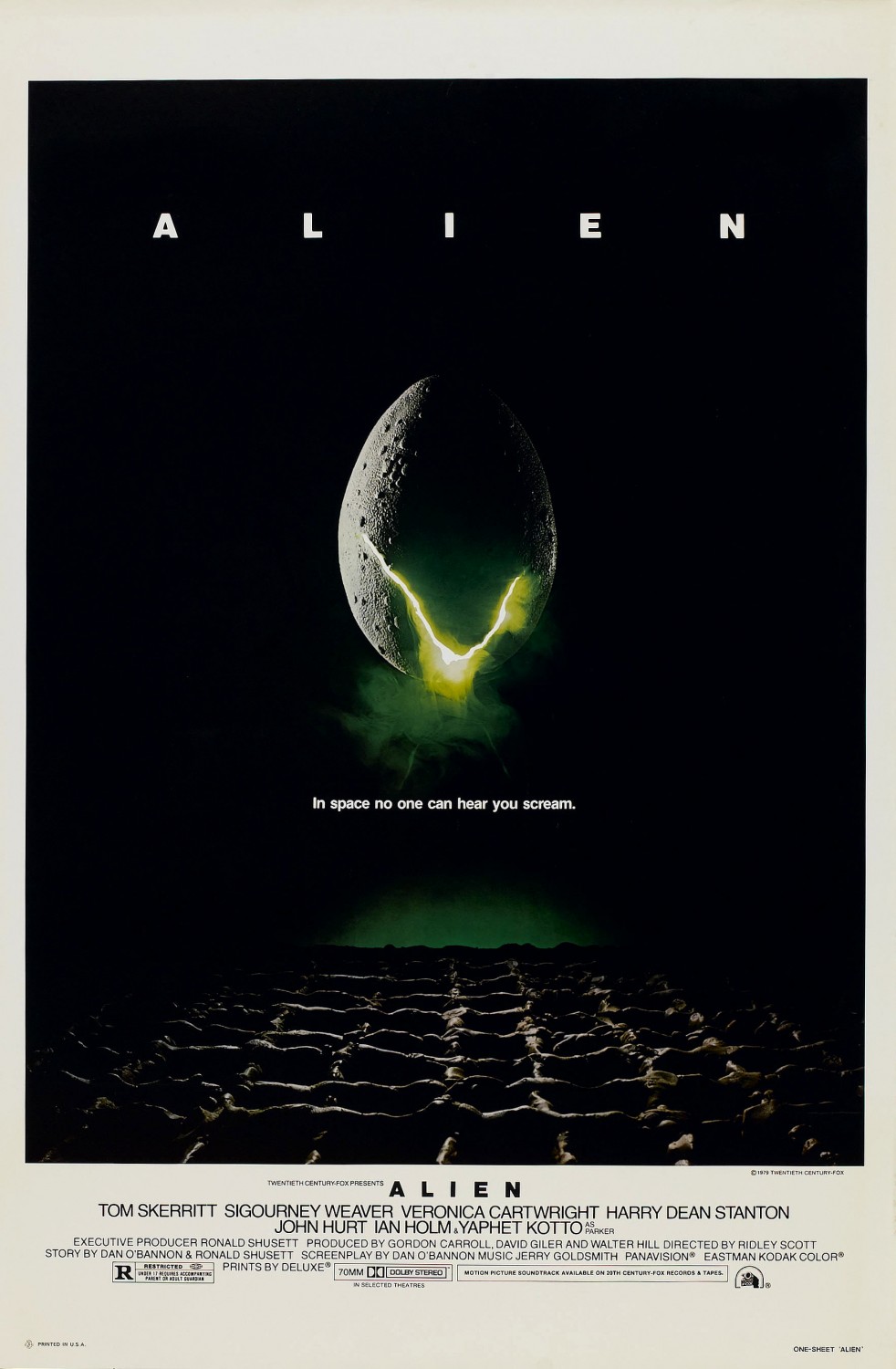
Alien movie poster

In regards to horror movies, “John Carpenter’s The Thing” ranks highest on the list of my all-time favorite movies in general. However, if you were to ask me what I consider to be the scariest movie ever, the first that quickly comes to mind is Ridley Scott’s “Alien.” Now considered a classic haunted house kind of movie, it freaked me out far more than I had expected it to. These days, if I come across someone who hasn’t seen “Alien,” I would be desperate to take the time and watch it with them just to see the look on their face. What may seem like a harmless old science fiction movie still has the power to unnerve and creep up on its audience when they least expect it.

Now when I say that this movie freaked me out more than I expected it to, there are a number of reasons why: I ended up seeing James Cameron’s sequel “Aliens” beforehand, so I already knew Ellen Ripley (played by Sigourney Weaver) was the sole survivor from the original. When I watched “Alien” for the very first time, it was back in the days of VCR’s and VHS tapes, and the one I obtained from my favorite video store was a fairly old copy which showed a bit of wear and tear. When it came to watching it, I got consigned to my parents’ bedroom as they had already called dibs on the big television in the family room which was connected to a “super cool” stereo system. The TV set in their bedroom was tiny by today’s standards. As I remember, it was a 13-inch set which was already on its last legs after years of use. This one didn’t have any surround sound system to enhance the experience, so I just tried to be happy I had a TV to view it on at all.

Having said all this, “Alien” still had my hairs standing on end throughout. Even though I knew who would live and die, the suspense and tension were extreme throughout, and you never ever felt safe on board the spaceship Nostromo. I can still remember hiding my eyes and would be turning the volume down at certain points because my heart threatened to stop beating a few times. Imagine if I had watched it for the first time on a big screen TV with surround system, or better yet, in a movie theater when it originally came out! I wouldn’t have slept for days! Some movies play better on the silver screen than on your television, but “Alien” appears to work on either format with the same degree of success.

There are many different reasons why Scott’s film remains such an effective sci-fi horror classic to this day. For me, it starts with the characters and how down to earth they are. While other outer space movies have characters who revel in the wonder of what’s out there, all the workers on the Nostromo treat their dark habitat as just another office job they take to get by. When we meet up with them, they are on their way back to Earth and just want to be home already. The writers also gave the actors dialogue which was never too heavy on the technobabble and hearing the characters talk about how they deserve full shares for the work they did defines them as blue collar workers. These are not brilliant scientists looking to discover new planets; they’re just people working for the man. The time Scott takes in introducing all these individuals pays off by the time we are given a visceral introduction to the alien of the movie’s title.

Now let’s talk about this alien which was designed by H.R. Geiger, a Swiss surrealist artist. I can’t really compare it to other movie creatures I’ve seen in the slightest because it looks so frighteningly unique in its construction. Its mouth hides an additional set of jaws that lunges out at unsuspecting victims as if they are “faster than a speeding bullet.” Furthermore, there is something quite phallic about that jaw in how it juts out at you without warning or of any thought of the damage it is about to inflict. Its lethal penetration is highly unnerving in how it reminds the viewer of what we all agree constitutes a serious and unconscionable violation to the human body.

But one of Ridley’s most brilliant moves with “Alien” was in not showing the creature fully. We only got glimpses of it throughout the film until the end, and even then we weren’t entirely sure of all that we saw. It was all up to our imaginations to figure out what kind of a threat this creature is. This added immeasurably to the film’s infinite suspense and unending tension. Plus, with the spaceship Nostromo designed to look all dark and shabby with not much light to be found in certain sections, this made it easier for the creature to hide. When it leaped up at the cast member about to meet his maker, it was completely unexpected and defined the jump out of your seat moment for me.

As the movie goes on, we get to an even more frightening aspect; of how corporations can put profits above their workers so coldly. When Ripley discovers the Nostromo crew was made to pick up an alien organism to bring back for further study and that they were expendable, it only further demonstrates just how much alone everyone is on the ship. To realize the company which has employed you couldn’t care less about your existence makes you fully aware of your immediate surroundings, and the instinct to survive becomes stronger than ever. Of course, are cynicism today has us expecting this from any corporation we work with, so we’re more prepared for this than the Nostromo crew was.

A lot of credit also goes to the late Jerry Goldsmith for creating a music score which adds subtly to the action, or at least until the film’s last half hour when the realm of outer space feels even smaller than before. His music touches on the tension inherent in each character without becoming melodramatic, and at times it sounds like invisible ghosts hovering over the unprepared crew waiting to strike. Also, the use of silence in certain scenes makes it even more frightening as we are reminded of how unsettling things can be when our surroundings become far too quiet for comfort.

All of this leads to one of the most intense climaxes in cinema history as we are fully aware of time running out. Just when you think the movie’s over, there’s still another horrendous challenge to overcome. It’s in the movie’s last minute where you can finally breathe a much-needed sigh of relief. Even if you know how of this movie will end, it is still an intensely riveting experience that never lets up for a second. The look in Ripley’s eyes as she makes her way to the escape shuttle perfectly mirrors our own emotions as she is forced into a situation which leaves her with no other options to consider.

I still have very vivid memories of seeing this movie on that unspectacular little television set in my parents’ bedroom while they enjoyed something on Masterpiece Theater with more advanced technology. As the beginning credits began to roll, I was convinced that sitting through this would be a piece of cake. Coincidentally, I also felt the same way about the original version of “The Texas Chainsaw Massacre” when I rented it through Netflix. “Alien” remains one of the most truly terrifying experiences I have ever had watching a movie either on the big screen or the small one. To this day, it remains an effectively scary movie which has lost none of its power. Now if 20th Century Fox had fully realized how all these elements had added to make such a great movie, those hopelessly pathetic “Alien vs. Predator” films might have actually been worth watching.

* * * * out of * * * *


Paul Verhoeven and Company Revisit ‘Total Recall’ in Hollywood

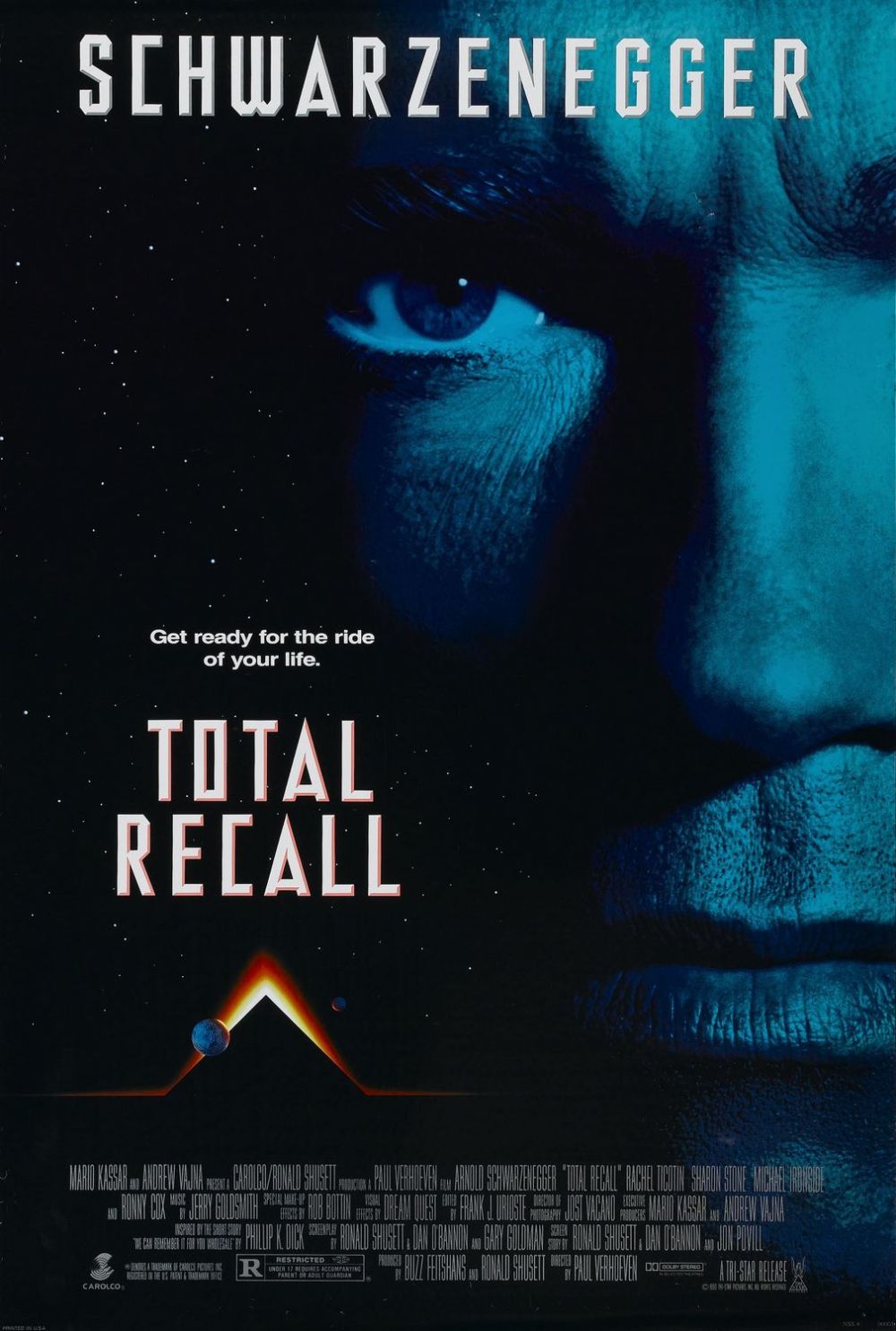
Total Recall movie poster

On Friday, August 24, 2012, Dutch filmmaker Paul Verhoeven dropped by the Egyptian Theatre in Hollywood where American Cinematheque screened a 70mm print of his 1990 movie “Total Recall.” Joining Verhoeven for a Q&A after the movie was two of its screenwriters, Ronald Shusett and Gary Goldman. They discussed the rigors of making the movie, and of how the script eventually made its way out of development hell.

As we all know by now, “Total Recall” is loosely based on the Philip K. Dick short story “We Can Remember It for You Wholesale.” Shusett said he and the late Dan O’Bannon, writer of “Dark Star” and “Alien,” bought the rights to the story back in 1974, and they completed their first draft in 1981. From there it was set to be made into a movie, but the project kept falling apart time and time again. Filmmakers like Bruce Beresford and David Cronenberg had worked on it for a long time but eventually pulled out due to creative differences or studios canceling the project because of its enormous budget.

“Everything kept falling through over and over again,” Shusett said. “Sets were built, but then the project kept getting canceled because it was too expensive. Back in 1990, this was considered to be the most expensive movie ever made. I wanted to keep all those sets that were built from being torn down, and I asked one studio executive how I could save them. He responded that I should change the movie’s name to ‘Partial Recall.’”

Verhoeven got involved in “Total Recall” because Arnold Schwarzenegger had picked him to direct after seeing “Robocop.” Schwarzenegger had actually been interested in doing the movie for a long time and had encouraged Carolco Pictures producer Mario Kassar to buy the rights to it from Dino De Laurentis whose film company had gone into bankruptcy. The movie had already gone through many drafts, and it took one specific scene to pique Verhoeven’s interest:

“I came to the scene where Dr. Edgemar (played by Roy Brocksmith) visits Arnold’s character on Mars and tells him that he’s not really here,” Verhoeven said. “In that moment you are not sure if what you’re seeing is real or a dream, and that got me really excited because none of the movies I had made in Europe ever had a scene like that. What Edgemar tells Arnold is that what he is experiencing is not true, so we had to prove it wasn’t true again.”

Working with Carolco Pictures on “Total Recall” was “paradise,” Verhoeven said, as they never forced anything on the filmmaker other than actors they hand-picked to star in their movies. He also said the beauty of Carolco is that they never subjected him or the movie to test screenings. Verhoeven went on to make “Basic Instinct” and “Showgirls” for Carolco, and then the gigantic flop that was “Cutthroat Island” ended up forcing the company into bankruptcy.

Schwarzenegger was set to be the star of “Total Recall” no matter who directed it, and Verhoeven said he was perfectly fine with that. Changes in the story had to be made though as his character was originally an accountant. Verhoeven and the screenwriters ended up changing his profession to that of a construction worker as they all agreed you could not go around Arnold.

Verhoeven also pointed out how having Schwarzenegger in “Total Recall” made the movie “very light” which was great because, as put it, “the straight way of telling the story would not have worked.” This has been further proved by Len Wiseman’s remake of the movie which even Verhoeven admitted “wasn’t good.”

The main problem with adapting any Philip K. Dick story to the silver screen is that they are basically told in two acts, and finding a third act proved to be very difficult.

“I got really scared because there had already been forty drafts written, and we could never seem to figure the third act out,” Verhoeven said. “It eventually came down to Hauser (Schwarzenegger’s secret agent character) always being the bad guy as it gave us somewhere to go.”

One audience member asked Verhoeven how Sharon Stone got cast in “Total Recall:”

“Sharon came in the first day of casting, and after a half hour I was convinced she would be perfect as Lori,” Verhoeven said. “Once we were filming the movie, however, I came to realize what she could do as an actress. After one fight scene where she almost kills Rachel Ticotin’s character and Arnold aims a gun right at her, she quickly changes moods in what seemed like a heartbeat. It was Sharon’s final scene before her character was shot that made me want to choose her for ‘Basic Instinct.’”

Goldman told the audience movies like “The Matrix” and “Inception” wouldn’t have happened without Verhoeven’s pushing the idea of the dream in “Total Recall.” The audience applauded this sentiment loudly, and the movie still holds up well more than twenty years after its release. It’s a shame the producers of the recent remake failed to realize what made the original so good as one of them described Verhoeven’s movie as being “kitsch.” That producer is now eating their own words in the wake of the remake’s critical and commercial disappointment.