‘In a Violent Nature’ – If Terrence Malick Directed a Slasher Movie

In a Violent Nature” has all the requisites of the average slasher film. It contains a bunch of young adults vacationing out in the wilderness in a lone wood cabin, a developmentally challenged child who died under cruel and tragic circumstances and has since become a most vengeful spirit, that one guy who tells the tale of the vengeful spirit who will eventually slaughter them all before they realize it is too late to leave, sharp objects, a mask for the killer, a variety of brutal deaths and, of course, a final girl. Anything you would expect from the average slasher film, this one has got it.

But what makes “In a Violent Nature,” which was written and directed by Chris Nash, stand out among so many others of its bloody ilk is its unique vantage point: the majority of the film takes place from the killer’s perspective. This quickly reminded of Alfred Hitchcock who dared us to see things from a murderous point of view in “Psycho” and “Frenzy,” but those films spent only so much time observing things from a killer’s mind. This IFC Films release, however, invites you to spend the majority of its 94-minute running time sharing in a murderer’s cold and brutal gaze as his victims die the most painful of deaths.

Things starts off with the image of a locket hanging on the remains of a fire tower. An unseen character takes the locket with him, and a few seconds later we see Johnny rise up from underneath the ground. Johnny, we learn, was a developmentally disabled boy who was tricked into climbing up the same fire tower years ago with the promise of getting a plethora of toys. But instead of toys, he finds someone willing to scare him out of his wits, and he tragically falls to his death. Now Johnny is back, and he aims to retrieve the locket taken from him. What particular value does this locket have for him? Keep watching to find out.

When it comes to Johnny, he looks a lot like Jason Voorhees. He has no hair, his clothes are very tattered, and he moves at a very slow pace wherever he goes. I shudder, no pun intended, to think of how bad his body odor likely was as he trudged through the woods to lay waste to his prey. It got to where I kept waiting for someone to tell this particular slasher, “Oh my god, you really need a makeover!”

But what really surprised me about “In a Violent Nature” is how quiet a slasher film it is. Most feature jump scares and loud music scores from composers who abuse violins to an overwhelming degree. This one, however, does not go out of its way to give you a sensory overload (or at least, not right away), nor does it contain a film score of any kind. The only music you hear comes from a character’s Walkman which keeps playing after he is decapitated, and we hear it play on as the batteries in it die an ever so slow death.

Some have called this horror film an “ambient slasher,” and it feels like one crossed with a nature documentary. I am curious to see what audience members and horror buffs in particular think of this methodical slasher as it is deliberately paced. I imagine they might be expecting something much different, but this little shocker is quite thoughtful in its design. If Terrence Malick ever madr a horror film, it would look something like this.

For those of you worried that this film will be seriously lacking in gory and bloody kills, have no fear. The first few deals with things unseen, and they threaten to be the most haunting moments director Nash has to offer us as he toys with our collective imaginations. But then we get one where a yoga practitioner has her body contorted in directions which would have any instructor yelling out loud, “Oh you so can’t do that to yourself! There is no downward dog pose to be found here!”

Then there is another character who ends up getting bludgeoned by an ax and repeatedly so, and it gives new meaning to the term beating a dead horse. This horse keeps getting beat to death long after its heart has stopped pumping blood, and its carcass has long since decayed. Some horror maniacs just don’t know when too much is too much, or maybe the sexual frustration they experience is completely unbearable.

The ending, which I would never dream of giving away, is especially haunting as we reach a conclusion I did not expect. It also features an actress known for her work in the “Friday the 13th” franchise, and she is very effective as she is thrust into a intense situation she was not expecting. Whether or not it is the ending you wanted or not, it is a thoughtful and unpredictable conclusion which had me at attention throughout.

“In a Violent Nature” may not reinvent the slasher film as we know it, but it does dare to take the genre in a thoughtful direction. It does have a lot of the same beats as the average horror movie, but it subverts them to where we are reminded of what filmmakers can accomplish. There are many reasons why IFC Films gave this movie, which cost well under a million dollars, its widest theatrical release to date, and why it got some extra press coverage when an audience member allegedly vomited during one of the goriest murder scenes it had to offer.

Of course, now I have to wonder if this slasher flick will get a sequel. If the money keeps rolling in, we will get another bunch of young adults dumb enough to once again take Johnny’s locket. Perhaps they will try to sell it on eBay or at a local flea market. Flea markets still exist, right? With horror sequels, the body count is much higher and gorier. Imagine the sights and sounds of such a sequel, even if it is not directed by Terrence Malick…

* * * ½ out of * * * *

‘American Fiction’ Movie and Blu-ray Review

The following review was written by Ultimate Rabbit correspondent, Tony Farinella.

American Fiction” is the kind of adult drama which has been sorely missing from Hollywood over the past decade and a half.  Hollywood has become obsessed with the big screen blockbuster and superhero films. Now, of course, there is nothing wrong with those films, but the adult drama along with R-rated comedies are becoming harder and harder to find these days.  It is why a film like “American Fiction” is such a delightful treat for moviegoers who enjoy complex characters and well-rounded stories, and who like to be challenged when they sit down and watch a movie.

The film stars Jeffrey Wright as Thelonious ‘Monk’ Ellison, an author and teacher who is grumpy, defeated and incredibly unhappy with his life.  Thelonious is a difficult person to be around as he’s critical of not only himself but everyone else around him.  It doesn’t help that he isn’t as successful as he used to be with his writing.  He’s finding it harder and harder to connect with audiences as he sees a shift in the literary landscape. The books which are making money and selling are those which profit off the stereotypes that exist in black entertainment.

Thelonius is told to write a “black book,” which is something he wants nothing to do with at all as it goes against his principles and his beliefs. It makes him angry to see a writer like Sintara Golden (Issa Rae) selling books left and right while his own work is financially unsuccessful.  He returns home to spend time with his family, which is another source of stress in his life. His sister, Lisa (Tracee Ellis Ross), is a hard-working physician who is doing her best to get back on her feet after a painful and costly divorce. He also discovers that his mother, Agnes (Leslie Uggams), is suffering from Alzheimer’s Disease.

This is not the pick-me-up visit Thelonius needed, as he’s not exactly close with his brother, Cliff, played by Sterling K. Brown.  Cliff and Lisa have trouble getting along with him because he’s too much like their deceased father who was withdrawn, judgmental and often pushed people away.  With his mother’s health suffering, it is up to Thelonius to take care of her finances and figure out what to do with her care.  He finds a solution when he ends up writing a book under a pseudonym, which gives the public what they are looking for: a stereotypical black book which relies on the offensive and cliché-ridden tropes audiences love. As the old expression goes, “No one ever went broke underestimating the intelligence of the American public.”

Thelonius has also developed a relationship with a neighbor, Coraline, played by Erika Alexander. She likes him, but can he love himself enough to work it out with her? Can he get along with his brother? He’s also discovering through his agent, played by John Ortiz, that his book might even be turned into a movie. This is all happening very fast for him as he’s wrestling with his need to produce substantial material and also his need for money.  In many cases, the two do not go hand-in-hand. He doesn’t want to sell his soul for the almighty dollar, but he also has bills to pay in the meantime. Can his moral compass allow him to “sell out?”

“American Fiction” was my favorite film of 2023. It starts with the screenplay, which won Best Adapted Screenplay at this year’s Academy Awards.  The film has great dialogue in it along with rich and funny characters that really sizzle on screen. It’s a witty, timely and sharp script.  The film reminded me a lot of Spike Lee’s “Bamboozled,” but it’s a more upbeat film and not as bleak. It is hard to overlook how little has changed since “Bamboozled” came out back in 2000, though. The big thing that has changed is there are more platforms and outlets for this kind of material to be digested by audiences.

This film also has a tremendous cast from top-to-bottom. Everyone has effortless chemistry with one another on screen, and they are all likable, interesting and well-developed.  Even though Thelonius is a curmudgeon, he’s never boring.  There is something very quirky and funny about him, and it is because he was written with a lot of different layers to him.  As an audience, we understand his frustration and we know why he feels the way he does about his family and how African Americans are presented in mainstream media. He’s not wrong, even if he goes about it in a way that tends to grate on those closest to him.  He can be preachy and self-righteous, but it’s hard to argue with his points.  This is a man who is learning to love himself, love someone else, and reconnect with his family.  He’s a work-in-progress.

If you are like me and enjoy a film with heart, humor and a bit of edge to it, you will love “American Fiction.”  This is the kind of movie Hollywood used to make but seem to shy away from these days.  I enjoyed every single minute of this hilarious, heartfelt and intelligent piece of moviemaking.  This film allows the audience to spend time with these characters, get to know, care about, and become emotionally invested in them. The ending, without giving anything away, is also perfect. I loved “American Fiction,” and I’m confident you will love it too.

* * * * out of * * * *

Blu-ray Info: “American Fiction” is being released on a single-disc Blu-ray from Warner Brothers Home Entertainment.  It has a running time of 117 minutes and is rated R for language throughout, some drug use, sexual references, and brief violence. It also comes with a digital copy of the film as well.

Video/Audio Info: The 1080p high-definition transfer is very colorful, clear, and bright. Would I have loved a 4K transfer of my favorite film of last year? Of course! However, this is a very good-looking Blu-ray, and I can hold out hope it gets a 4K upgrade at some point as I think this film is only going to grow in popularity as more people see it on physical media. The audio on this Blu-ray is also top-of-the-line. All of the dialogue can be heard very clearly, which is important, because this is a very dialogue-driven film. Subtitles are included in English, French and Spanish.

Special Features:

None

Should You Buy It?

If you are strictly buying “American Fiction” for the movie itself, you should definitely buy it right away. However, this is only available on Blu-ray and DVD, and there are also no special features. This is a supremely bare bones Blu-ray from Warner Brothers Home Entertainment which is pretty disappointing. It does come with a slipcover, though. I’d say buy the Blu-ray with the slipcover as, from an audio and visual standpoint, it still looks and sounds really good. I always like to err on the side of caution, and I’d rather have a great movie on Blu-ray with the slipcover while I can before they stop releasing it with a slipcover. That being said, this film deserved a much better physical media release than it got,

**Disclaimer** I received a copy of this film from Warner Brothers to review for free.  The opinions and statements in the review are mine and mine alone.

Terrence Malick’s ‘To the Wonder’ – Meandering but Still Unforgettably Beautiful

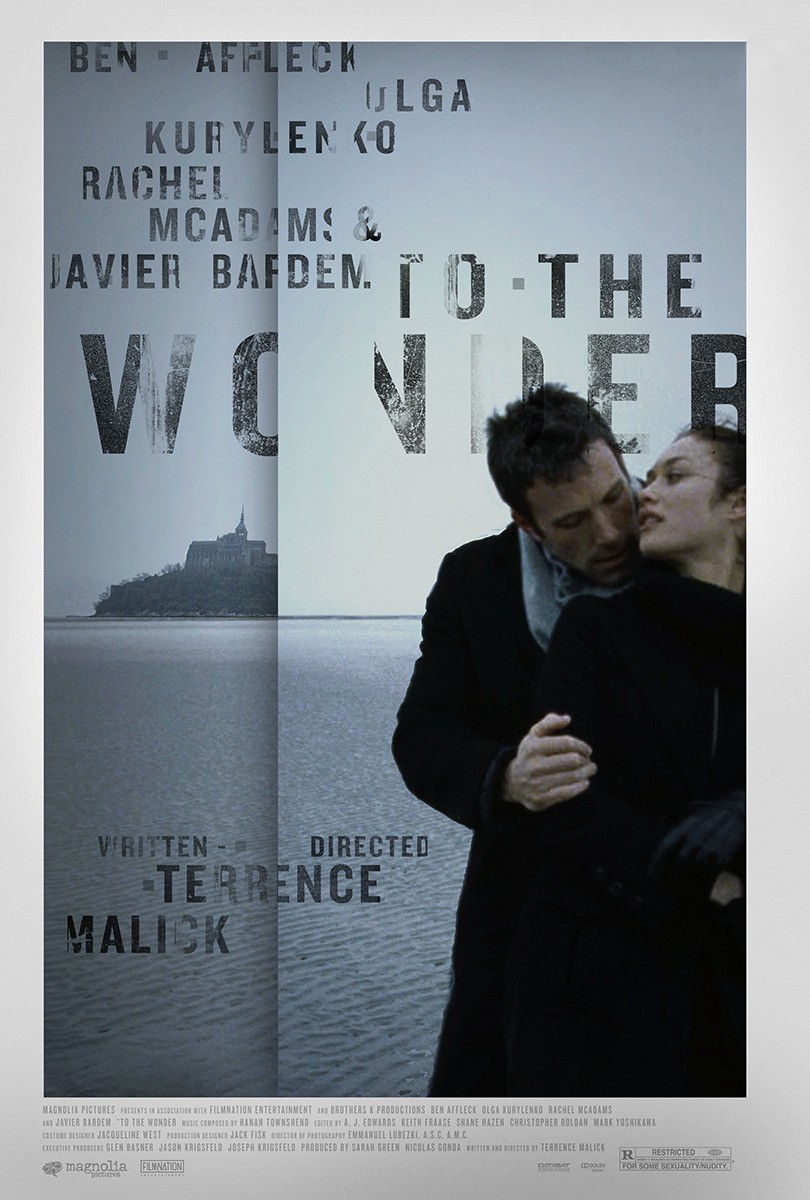
Terrence Malick’s “To the Wonder” is, in many ways, a mixed bag of a film. Not all of its parts go together in a way which feels entirely cohesive. It focuses on a couple played by Ben Affleck and Olga Kurylenko who fall in love and come to America to start a new life, but they eventually find themselves falling out of love, and they constantly struggle to understand how something so wonderful can go so awry. And then we have Father Quintana (Javier Bardem), a Catholic priest who is struggling to keep his faith even as he feels the presence of God eluding him at a time when he is desperate to believe in an afterlife. The balancing act between these characters is wobbly at best, but Malick still gives us many beautiful and wondrous images which are very powerful, and these images quickly remind me of how brilliant he is at capturing nature on film.

“To the Wonder” starts off in Europe where Marina (Kurylenko) finds herself completely enamored by her American boyfriend, Neil (Affleck), as they take a tour around town. Along with them is Marina’s daughter, Tatiana (Tatiana Chiline), who is thrilled when Neil asks her if she and her mom would like to move with him to the United States to live. After briefly viewing the European sights, the film then heads over to Neil’s home state of Oklahoma where the flatlands appear to stretch out as far as the eye can see. Heck, it almost looks like hardly anybody lives there, so it is a huge relief when we see t Neil and Marina actually have neighbors.

As with “The Tree of Life,” “To the Wonder” functions mostly as a silent film as the majority of the dialogue we hear is as a voiceover. Malick is far more interested in the inner thoughts of his characters than anything else as they struggle with the things they want and which are constantly outside of their grasp. We feel their passion for one another, and we also feel their pain and disappointment when their love eventually fades away.

Having read up on Malick as a filmmaker and as a person, it is clear to me how this film and “The Tree of Life” are his most autobiographical works overall. What the characters go through is not much different from what he has experienced in his own life, and with these films, it looks as though he is still trying to pick up the pieces of what went wrong.

Kurylenko first came to my attention in “Quantum of Solace,” and she has made the most of being a Bond woman as her performance here shows. It is thrilling to watch her dancing around the streets of Europe as well as in a corporate drug store which typically sucks the life out of everyone who shops at one. In many ways, Kurylenko is the best thing about this film as she takes us through Marina’s transcendent highs and her emotionally draining lows with complete conviction throughout.

Back in 20123, people had serious issues with Affleck as an actor, and this is even after his film “Argo” won the Academy Award for Best Picture. I myself have never had any issues with his acting abilities, and he gives a strong, understated performance as Neil, and it is never his fault we come to know less about this character than the others we are introduced to here. I really wish Malick had given Neil as much attention as he did to Marina as this would have made Neil’s journey in this story all the more illuminating. Nonetheless, Affleck is still very good in here.

Rachel McAdams is inescapably luminous as Jane; a childhood sweetheart of Neil’s who shows up after Marina has gone away. Malick makes Jane look beyond beautiful as he frames her against fields of wheat, and it is emotionally draining to watch Jane bear her soul to Neil and try to melt his heart in the process. McAdams ends up disappearing from “To the Wonder” a little bit too soon, but she is a vision to watch throughout.

Bardem’s character of Father Quintana at first feels a little out of place as much of the focus seems to be on the relationship between Marina and Neil, but his presence makes more sense as this film goes on. With this character, Malick seems to be saying how our loss of love for one another may have to do with our relationship to God, or lack thereof. Bardem does some of his subtlest work as he portrays a man struggling to hold onto whatever faith he has left, and it results in some of this film’s most emotionally draining scenes.

When we watch Quintana visit the sick, the elderly and the dying, I found myself being reduced to tears as these moments ring so emotionally true in a way I would rather not realize as death is becoming all too common for me to deal with. Plus, Malick just had to use Henryk Górecki’s third symphony entitled the “Symphony of Sorrowful Songs” which Peter Weir used to such great effect in “Fearless.” It remains a piece of music which is as beautiful as it is infinitely sad, and it always reduces me to a weeping wreck whenever I listen to it. I also have to admit I was very angry at Malick for using this piece of music here as it felt so unfair that he reduced me to a complete wreck in an inescapably manipulative way. Then again, I was in the midst of a very deep depression at the time, so that did not help matters.

But as mournful as “To the Wonder” is, there are still many beautiful moments to watch for as Malick remains a master of capturing the unpredictability of nature and animals on film. This includes moments like when Affleck and McAdams are suddenly surrounded by more buffalo than Kevin Costner dealt with in “Dances with Wolves,” the sunlight piercing through the colored glass in a church, or watching Kurylenko walking across the beach as the water covers the sand. These are moments which still will not fade away from my memory anytime soon. Working again with his “Tree of Life” cinematographer, Emmanuel Lubezki, Malick still captures moments of visual poetry in ways few other filmmakers can ever hope to equal.

It is those incredible visual moments which make me want to forgive how meandering “To the Wonder” is as it unfolds before us. I have learned Malick actually shot this movie without a screenplay, and this made me wonder how the actors dealt with this style of filmmaking. Considering that Jessica Chastain, Rachel Weisz, Amanda Peet, Barry Pepper and Michael Sheen all had roles in this film which were eventually removed from the final cut has me believing there was a whole lot more to this film than what ended up onscreen. While “The Tree of Life” had several different story lines going on, Malick was able to rein them all in to where everything seemed to fit perfectly. With “To the Wonder,” he has a little too much going on, and the film ends up losing focus more often than it does not.

Still, if you are willing to tolerate those flaws, “To the Wonder” is still a profound experience filled with great performances and beautiful images which will stay with you long after this film has concluded. I really wish the audience I saw it with all those years ago felt the same way I did. I bring this up as one audience member remarked at how the lives of these characters proved to be far more boring than anyone else’s. Well hell, some people enjoy the simple pleasures in life more than others, but many are still insistent about how theirs are better than the average human being, and that is even though there is plenty of evidence to prove otherwise.

Seriously, it seems very fitting that “To the Wonder” was the last film Roger Ebert reviewed and gave to the Chicago Sun Times before he passed away in April of 2013. Rest in peace, Roger.

* * * out of * * * *