Richard Gere on Making Us Root for the Bad Guy in ‘Arbitrage’

Photography By Myles Aronowitz

WRITER’S NOTE: This article was originally written in 2012.

Don’t get me wrong, Richard Gere has played many likable characters in movies like “Pretty Woman” and “An Officer and a Gentleman,” but it’s when he plays despicable ones that he truly excels as an actor. The latest example of this is his brilliant performance as Robert Miller in “Arbitrage,” the movie which marks the directorial debut of writer Nicholas Jarecki. Robert is a hedge fund magnate who is desperately trying to cover up his instances of fraud, cheats on his wife, and willfully deceives his children. On paper this character is a jerk, but the beauty of Gere’s performance is how he keeps us rooting for him regardless of this fact.

So, how does Gere manage to make such an unlikable person so fascinating and relatable on screen? Audie Cornish of NPR’s “All Things Considered” asked him this question as she couldn’t get past the fact that Robert Miller is a “monster” and yet still wanted him to get away with what he did.

“Isn’t that funny? I mean, that’s one of the uniform things and kind of mystifying things,” Gere said. “And the comments I’ve gotten back, even from very close friends, that they’re very angry with me, that they care about this guy and want him to get out of trouble, although they’re well aware the guy is a jerk, as you say, and makes some very bad decisions in his life and has a kind of a mindset that you go, huh?”

“But look, that’s my job, is to make characters human, to make them knowable on some level,” Gere continued. “I think it had root in when you spend time with even supposed monsters, there’s a human being there. And in storytelling, you’ve got to find that human being.”

This humanity certainly shows up in the scene between Robert and his daughter, Brooke (played by Brit Marling), where he has to break her heart by telling her the truth of his fraudulent activities. What he is doing to her is terrible, and yet you still feel for him as he tries to explain how his business really works. Regardless of all the bad things Robert has done, there’s no doubt as to just how much he loves his family.

“That was a scene we (Gere and Marling) worked on a lot, and in the end, it came out of an improvisation actually, that she’s not my partner, that she works for me,” Gere said. “And I found myself almost in an animal growl saying everyone works for me. And I think that was the truest moment with this character, that that’s his mentality – horrifying but true. I mean, he’s naked in that moment.”

Another great scene in “Arbitrage” has Robert to do the right thing only to see him look for another way out. Being the reckless gambler that Robert is, he always seems to find another angle which can keep him up and running for yet another day. Gere remarked about how his sister, who is a psychiatrist, found this moment in the film especially fascinating.

“That mentality of I’m always going to find a way out, always find a way out. I think it’s that kind of a gambler’s thing,” Gere said. “Well, I’m down to my last penny, but I’m going to turn that penny into two pennies, and I’m going to get out of this. It’s a really interesting kind of person that never truly gives in. Now, if you’d imagine they were in the service of something extraordinary on the planet, what they could achieve, I guess the hope for me is, is that the people who are so effective in the world and can do this stuff, which is just ultimately pretty silly, just the accumulation of wealth, if they were putting their minds and their talents and their skill towards being of service and responsible on this planet, man, this will be a garden.”

Whether or not he is playing good or bad guys, Richard Gere always comes across in his performances as someone we want to support. Regardless of whether he plays a self-serving defense attorney in “Primal Fear” or “Chicago” or portraying an infinitely corrupt cop in “Internal Affairs,” there is something about this actor which is always alluring. Just don’t expect him to explain what it is because even he’s not sure:

“I don’t know. I don’t know what that is. I suppose it’s some peculiar thing I’m able to do. I don’t know. It’s certainly nothing I work at or particularly aware of in the process.”

Perhaps it’s best he does not find out because we want to see him giving more great performances like this one in the near future.

SOURCE:

Audie Cornish, “Richard Gere on Playing a Jerk You Want to Root For,” All Things Considered, NPR, September 14, 2012.

Amy Adams Shows a Menacing Side in ‘The Master’

WRITER’S NOTE: This article was written in 2012.

While Joaquin Phoenix and Philip Seymour Hoffman are getting some of the biggest raves of their career for their work in “The Master,” Amy Adams proves to every bit as good as Peggy Dodd, the wife to Hoffman’s charismatic leader of “The Cause.” From the outset, this looks like yet another role where Adams gets to be all sweet, but as Peggy, she proves to be tough and hotly determined to further her husband’s work and silence every single doubter who ridicules his beliefs. While the male characters revel in the effect they have on others, it is Peggy who exerts the most control over the people around her.

Peggy has been described by many as being a Lady Macbeth-like character as she is able to manipulate her husband into doing things he might not otherwise do. That this character cannot be mistaken for an easy pushover appealed greatly to Adams as well as the challenge of acting against Hoffman, whom she adores.

“It was fun to get to go toe-to-toe with him as a person of power,” Adams said. “In some past roles I’ve been a bit more submissive, so it was great to get to overpower Phillip in ‘The Master’ – because that’s the only time that’s ever going to happen in my life.”

Still, the role proved to be emotionally demanding for Adams, and she talked with Stephen Schaefer of the Boston Herald about why this was the case:

“I had to lose myself in a character to which any similarities I had were not similarities that I want to bring out of myself,” Adams remarked. “To lose myself in a character like that, well, it doesn’t feel as good at the end of the day. Let’s just put it that way.”

Of all the characters in “The Master,” Peggy proves to be the most mysterious as we never get much of a backstory on her or discover how she first met Lancaster Dodd (Hoffman’s character). In an interview with Scott Simon on NPR’s Weekend Edition, Adams explained how she went about playing Peggy and of what she brought to the role:

`”I tend to try to fill in the blanks as much as possible for myself,” Adams said. “One of the things that I really thought about was a long time ago I read a book called ‘The Feminine Mystique.’ In ‘The Feminine Mystique’ she (author Betty Friedan) talked a lot about women’s roles in World War II and sort of how that translated post-World War II. Their roles were a little less traditional than they’d been before, and then when the men came back, they sort of went into the background again. And I saw my character as somebody who was very focused on education, was very educated, very smart, but given the climate, felt like she was more powerful behind a man than in front of a man.”

Adams also made clear how Peggy is a true believer and not a blind follower like some might suspect her of being. Throughout the movie, Peggy does see the positive outcome of her husband’s philosophy, and she defends it without question. This leads her to be very hard on Phoenix’s character of Freddie Quell whose doubts and violent ways typically get the best of him.

While Amy Adams may still seem to us like America’s sweetheart, she has defied that image to give us some hard-edged characters like the one she played in “The Fighter.” “The Master” is the latest example of just how far her range as an actress goes, and hearing her talk about the similarities between her and Peggy shows there is more to her than her image suggests:

“I can be really steely, maybe not to such effect, but I’m definitely not always warm and cuddly and sunshine and lollipops, so it’s nice to sometimes get to bring that to a role. Although I do love playing characters with a sunny disposition, it just takes a little bit more energy some days.”

SOURCES:

Stephen Schaefer, “Amy Adams’ acting skills put to test by ‘Curve,’ ‘Master’,” Boston Herald, September 19, 2012.

Justin Harp, “‘The Master’ Amy Adams: ‘I adore Philip Seymour Hoffman’,” Digital Spy, September 19, 2012.

Scott Simon, “Amy Adams: A Steely Wife Stands Behind ‘The Master’,” NPR Weekend Edition, September 15, 2012.

Naomi Watts on Portraying a Tsunami Survivor in ‘The Impossible’

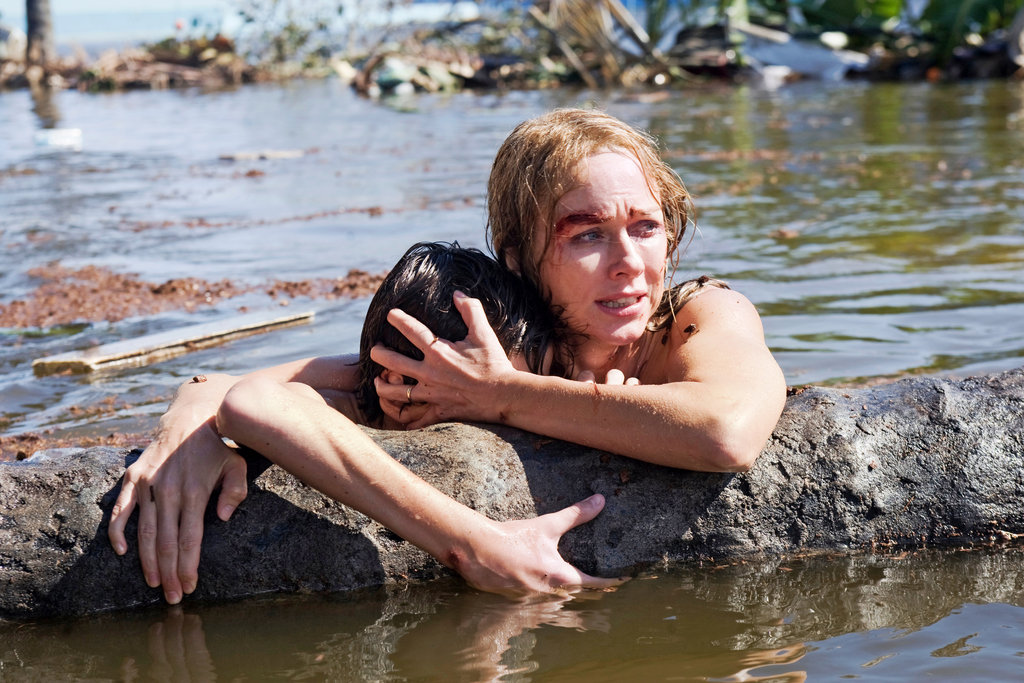
Naomi Watts in The Impossible

WRITER’S NOTE: This article was written back in 2012.

Australian actress Naomi Watts gives an emotionally pulverizing performance in J.A. Bayona’sThe Impossible,” a film which chronicles one family’s struggle for survival in the aftermath of the 2004 Indian Ocean tsunami. In it, Watts plays Maria, a doctor who is staying with her husband and children in a beautiful resort in Thailand for the Christmas holiday. This vacation comes to a horrific end when the tsunami decimates the country’s coastal zone and separates Maria and her son Lucas from the rest of her family. The role has Watts dealing with her fear of water, playing a character based on a real-life person, and the immense difficulty of shooting in not one, but two giant water tanks.

While at the movie’s press conference which was held at The Four Seasons Hotel in Beverly Hills, Watts described playing Maria as being “the most physically, emotionally draining role” she has ever taken on since “King Kong.” Considering she has played such equally draining roles in “21 Grams” and “Mulholland Drive,” that’s saying a lot. After doing “King Kong” she said she would never take on a role like that again, but even she couldn’t say no this script or working with Bayona who made the acclaimed horror movie “The Orphanage.”

Unlike the tsunami sequence in Clint Eastwood’s “Hereafter,” the one in “The Impossible” was done with real effects and no CGI. This makes the sequence all the more harrowing to watch, and seeing Watts hang onto a tree for dear life while water keeps rushing furiously by here makes for one of the most emotionally intense sequences in any 2012 movie. In an interview with Steven Rea which was featured on the Philly.com website, Watts talked about what it was like shooting the sequence which itself took four weeks to complete.

“I didn’t know it was going to be so difficult,” Watts told Rea. “They had it all very well prepared – we had allegedly the second largest water tank in the world, and they had these giant cups that we were anchored into . . . so you were just above water level, you could use your head, and you can use your arms so you looked like you were swimming. . . . And you’re on this track, and then a giant wave was coming towards you . . . and then side pumps were shooting more water, and all the garbage and debris. . ..”

“So, it got increasingly difficult, and then we noticed that we couldn’t actually act, or speak,” Watts continued. “We were lucky if we could get one word out, and that word would be ‘LU-CAS!’ It was tough, and then the underwater stuff was even more difficult. That was very scary.”

You have to give Watts a lot of credit not just for the brave performance she gives, but also for how making this movie made her deal with her fear of water. This was not the result of watching “Jaws” several dozen times, but of a near drowning accident she had when a teenager. She related this story to NPR’s Melissa Block.

“When I was about 14, my family emigrated from England to Australia, and we decided to stop in Bali on the way through. And having grown up in England, we were not great swimmers and knew nothing about riptides,” Watts told Block. “Anyway, we got caught in a riptide, and I didn’t know what to do other than swim against it, and got to the point of exhaustion, and then just about gave up. But then my mother, somehow, miraculously found sand beneath her feet and just managed to pull me in. And so, as a result of that experience, I’ve always been afraid of the waves and strong currents, so it’s quite interesting that I ended up doing this.”

It’s very interesting indeed, and it makes you admire Watts all the more for playing this character. After learning about her near-death experience, it becomes clear the fear which crosses the actress’ face onscreen was not at all faked.

Another big challenge for Watts in playing this role was it was based on a real-life person, Maria Belon, who, along with her family, amazingly survived the tsunami which claimed thousands of lives, and she herself suffered some serious injuries which had her at death’s door a few times. It’s always intimidating to portray a person from real life, especially one who’s still alive and has been through an experience we are grateful not to have gone through ourselves. While at “The Impossible” press conference, Watts talked about what it was like to meet Belon.

“Originally when I met Maria, I was incredibly nervous and I didn’t know where to begin. I felt like, I’m just an actor and you have lived through this extraordinary horrendous thing, and I just don’t know where to start,” Watts said of their first meeting. “But we sat there in front of each other for five minutes, she didn’t feel the need to speak and I couldn’t, and then she started just welling up and the story was told just through a look. I started welling up and then we just thought okay, let’s get on with this, and she continued to speak for three and a half hours and time just went by like that.”

“She stayed with me the whole time,” Watts continued. “I don’t just mean physically, but we were connected. We sent emails back and forth, and she would write endless letters about all the details that took place. The thing that she talked about was her instinct and her ability to trust herself which I think we lose so often. I feel like I am full of self-doubt and second guessing which is why this story becomes an interesting one because you wonder how you would deal with this.”

Naomi Watt’s performance in “The Impossible” deserves a Purple Heart as much as it does an Oscar. As an actress, she appears to be plumbing the depths of her soul to pull off roles like this one, and I think she’s one of the bravest actresses working today. While she may be yearning to stay away from roles like this in the future, it’s hard to think of many other actresses who can go to the places she goes to portray raw emotion so honestly.

SOURCES:

Ben Kenber, “Interview with Naomi Watts On The Impossible,” We Got This Covered, December 19, 2012.

Steven Rea, “Naomi Watts endured physically harrowing work for ‘The Impossible,’” Philly.com, December 20, 2012.

Melissa Block, “Naomi Watts, Mulling ‘The Impossible,’” NPR, December 12, 2012.