Geretta Geretta on Working with Lucio Fulci and Bruno Mattei


Geretta Geretta Demons photo

WRITER’S NOTE: This article is about a screening which took place in 2013.

Actress Geretta Geretta (a.k.a. Geretta Giancarlo) was at New Beverly Cinema to talk about her role in Lamberto Bava’s Italian horror movie “Demons.” It turns out that movie was one of ten she made while living in Italy for several years, and her time there also had her working with a couple of other Italian filmmakers: Lucio Fulci and Bruno Mattei. Both have long since gained a large cult following for their cinematic work, and Geretta took the time to tell the audience what it was like working with them.

Fulci has been called the “Godfather of Gore” by many, and he is best known for his films “Zombie” and “The Beyond.” Geretta worked with Fulci on “Murder Rock: Dancing with Death” which was about the owner of a prestigious New York ballet school who teams up with a male model in an attempt to solve the murders of a few students. One male audience member told Geretta how the movie has one of his favorite death sequences ever, and she was thrilled to hear this and quickly responded, “kiss that man!” Her description of Fulci as a filmmaker and as a person surprised those who didn’t know him as well as she did.

Murder Rock movie poster

Geretta Geretta: He was known to have a difficult personality, and that’s putting it lightly. He had a lot of tragedy in his life. A couple of his wives committed suicide, and his kids were on drugs. Everything was really bad for him, and he had to work. He had to keep working and get that job done. So, when you went to the audition your agent said, don’t talk back, don’t say anything, and don’t ask any questions. What’s your motivation? Your check. Just shut up and do whatever he says. For me, working with him was a dream. I have no problem following direction. But he literally would go into a shaking fit, start screaming, spit coming out of his face, rolling on the ground furious. That’s what it was like working with Fulci.

Mattei was another Italian filmmaker who had gained a significant cult following for his exploitation movies such as “SS Girls” and the zombie flick “Virus: Hell of the Living Dead.” In many circles he is considered to be the “Ed Wood of Italian filmmaking” as his films were filled with a lot of stock footage, bad acting and utterly ridiculous dialogue. Still, Mattei got to work with many noted filmmakers such as Fulci and Claudio Fragasso, and he was lucky enough to direct actors like Lou Ferrigno, Donald Pleasance and Richard Harris before they became famous.

Of all the movies Mattei made, the one he was proudest of was “Rats: Night of Terror.” Inspired by the look of futuristic 1980’s movies, it takes place more than a century after a nuclear war has devastated Earth. What is left of society has been divided into two groups; those who live comfortably in underground cities, and the scavengers who are forced to live in the sunlight. But soon, these two groups are forced to work together to defend themselves against a horde of flesh-eating mutant rats which are prepared to devour everything and anything in their path.

Geretta played Chocolate in “Rats: Night of Terror,” and she gleefully shared what it was like auditioning for Mattei.

Rats Night of Terror poster

GG: With Bruno (Mattei) it was kind of different because with Dario (Argento) it’s all hushed in the halls and everything’s like yes sir, yes sir, and Bruno was like all excited about everything. He asked me, hey kid! You afraid of animals? And I go, no. He then asked, are you worried about furry things? I said no. And he’s all, great because it’s gonna be rats! And I won’t even tell you the things we used to do before the cameras started rolling because it was very scary.

Geretta then went on to say while Bava and Argento had a million dollars to make “Demons” with, Mattei’s budget on “Rats: Night of Terror” was so low to where the film crew kept the dead rats they threw at the actors so that they could reuse them (yikes!).

It was great to listen to Geretta Geretta talk about these two filmmakers, both of whom have since passed away. While some critics have long since dismissed the films of Lucio Fulci and Bruno Mattei, they both still have a strong legion of fans who are more than willing to see every single movie they created. Both Anchor Bay Entertainment and Blue Underground have gone out of their way to remaster their films for new generations of movie buffs to discover, so the stamp they left on the world of cinema is not about to disappear.

Geretta Geretta Looks Back on ‘Demons’ at New Beverly Cinema

Geretta Geretta Demons photo

WRITER’S NOTE: This article was written in 2013 when this screening took place.

Actress Geretta Geretta (a.k.a. Geretta Giancarlo) was the Grindhouse Film Festival’s guest of honor at New Beverly Cinema where they were screening a very nice print of Lamberto Bava’s “Demons.” This Italian cult horror film from 1985 stars Geretta as Rosemary, one of several people attending a special screening of a horror film at a local theater. Before the screening starts, however, she ends up putting on this weird looking mask she finds in the lobby which ends up scratching her face. Eventually, the scratch infects the rest of her body and turns her into a bloodthirsty demon. In short, she is the character who dooms everybody else in this film. Way to go Rosemary!

Geretta was extremely excited to be seeing “Demons” with the sold-out audience at the New Beverly, and she even brought some bobblehead figures of her character Rosemary, created by Cult Collectibles, with her to sell. Before the film began, Geretta asked everyone if there were any “Demons” virgins (a.k.a. people who hadn’t seen the movie before), and it turns out there were quite a few. To this, she responded, “This is good! You guys are in for a treat!” She also rattled off in rapid succession a few things for everyone to keep in mind while watching this film.

Geretta Geretta: This is a movie, we did it in Italy. I’m American, I have an Italian name, my family is Italian, but I went there, I was a model, I made a bunch of Italian movies, this is one of them, I made ten. We sound funny and our lips are moving in funny directions but not mine because I am actually speaking English when we shot the movie.

Grindhouse Film Festival emcee, Brian J. Quinn, was quick to say how all the other movies Geretta did while she lived in Italy such as “Murder Rock: Dancing Death” and “Rats: Night of Terror” are all worth seeking out as they are “good and entertaining.”

After we finished watching “Demons,” Geretta came up front to talk about its making and took questions from the audience. She told Quinn that making this film wasn’t a lot of fun as there was a lot of work involved like on any other film, but the set was never unpleasant or difficult. She also pointed out while most horror movies made today with similar special effects are done on very low budgets, the budget for “Demons” was actually a million dollars. Only the great Italian filmmaker Federico Fellini could get a movie made for millions back then, so this made “Demons” a special picture in that regard.

Geretta talked about how she auditioned for Bava and Dario Argento who produced and co-wrote the movie, and she also described the differences between how movies are cast in Italy as opposed to in America.

GG: You don’t really go in and do something. First of all, they cast by picture because they go by look first. So if you look the part then that’s enough for them because they figure they can direct and can get you to do what they want you to do, and it’s very rare everyone would be speaking the same language on the set, so really what difference does it make your mumble?

Most of the exteriors in “Demons” were actually shot in Germany, and the movie theater where the majority of the action takes place was in the process of being destroyed. Geretta was working on a television series at the time, and it was a two-and-a-half-hour drive from that set to where “Demons” was being filmed.

Geretta also pointed out how you never see Rosemary die in “Demons” and, having seen the movie a couple of times, I can verify this to be true. She joked how she was plotting the whole time to make sure her character would not die so she could be cast in the sequel. But when the time came to make “Demons 2,” Geretta was unfortunately out of town.

One audience member asked about the vomit which comes out of the zombies’ mouths, and the vomit does look appropriately disgusting. Geretta described its ingredients in detail as well as what was in everybody’s hair.

GG: The vomit that comes out of any orifice or anybody’s mouth is food coloring, Alka-Seltzer, and some other liquid. The stuff that’s in our hair is yogurt, food coloring and milk, and these are serious folks (the filmmakers) so none of us could change any of our clothes the whole shoot.

The audience reacted loudly to this particular description and understandably so. You’re dealing with ingredients which not only have an expiration date, but which let you know when they have expired. Can you imagine how smelly the set became? Yuck! Geretta then went on to say the film crew had to redo her hair every single day so it would match with what she called “dead yogurt.”

“Demons” was shot in twenty days, and Geretta said she was on set for ten. But while many American actors have found shooting on Italian film sets to be very different and at times very distracting with the film crews yelling at each other back and forth, she said she had no problem adapting to the “Italian style.”

GG: I did come to like things that are done the Italian way. In the Italian way you have lunch on the set, and hey it’s Italy, so you’re gonna have your choice of red or white wine which would never happen on an American set. Things are very calm and it’s more like a family, so maybe if there is some yelling or something it’s just like a family in the background. You tend to work with the same people over and over and over, and it’s just great. I loved it. In America you’re as famous as your last picture, and in Italy you’re as famous as whatever made you famous. It doesn’t matter what you did and it doesn’t matter how long ago, you stay the same. There’s a real appreciation for what you did, so it’s nice.

Ever since she starred in “Demons,” Geretta Geretta has proven to the world just how multi-talented she is. In addition to acting, she has gone on to write, direct and produce her own movies, and her career has also taken her to many different countries such as Italy, Ireland, South Africa and Switzerland. She shows no sign of slowing down anytime soon, and it was great to see her at New Beverly Cinema. Many actors get sick of the movies they star in, but she made it clear how grateful she was that everyone showed up in droves to see “Demons” which she made so long ago. Just don’t ask her how long ago it was.

The Movie Trailers Which Played Before ‘Django Unchained’ at New Beverly Cinema

DjangoUnchained_poster2

WRITER’S NOTE: This article was originally back in 2012.

I was lucky enough to check out Quentin Tarantino’s latest movie “Django Unchained” at New Beverly Cinema, the same movie theater he bought and kept from going out of business. It was being shown in 35mm instead of a digital print at other theaters because Tarantino is still a big fan of film, and the New Beverly is known for showing movies in 35mm because that’s exactly what the owners and patrons like best.

One of the real treats of seeing “Django Unchained” at New Beverly Cinema is instead of getting coming attractions for 2013 movies, we instead get to watch movie trailers from the past. These ones were especially campy and represent the kind of movies Hollywood no longer makes, and I wondered if the trailers being shown before “Django Unchained” inspired this particular Tarantino film in some way. Many of the prints of movies and trailers shown at the New Beverly tend to come from Tarantino’s own personal collection, so even if they didn’t inspire this movie of his, then they must have been ones he loves watching over and over.

Let’s take a look.

The Arena 1974 movie poster

“The Arena”

This exploitation film from 1974, one which clearly was inspired by “Spartacus,” stars Pam Grier and Margaret Markov as female gladiators who have been enslaved in Rome and are forced to fight for their freedom. The trailer proved to be hilarious as the acting is over the top, and the narrator embellishes the more explicit elements of this movie by saying how the Romans “enslaved the most sensuous women to titillate the perverted pleasures of the Roman public” and how the main characters are “beautiful unchained women” whose bodies are “shaped into superb fighting equipment.” There’s also a bit of nudity and blood on display, the kinds of things you almost never see in a movie trailer today unless it is a red band trailer being shown for restricted audiences only.

Still, it’s great to see Grier here whom Tarantino cast in his movie “Jackie Brown,” and it is said she and Markov did all their own fights and stunts in “The Arena.” We should all known by now that Grier is as tough as the characters she has played in dozens of movies, and seeing her take on the Romans makes this one worth a look.

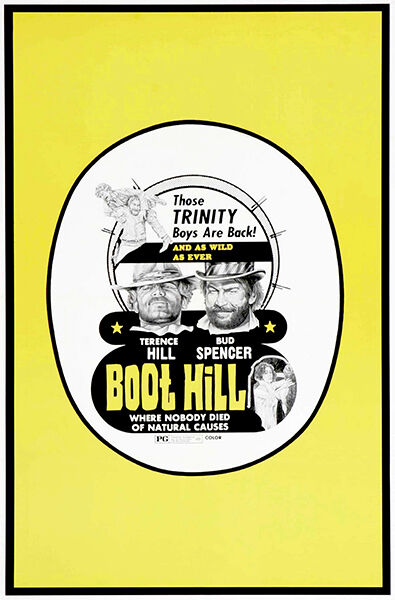
Boot Hill movie poster

“Boot Hill”

The trailer for this 1969 Italian Spaghetti Western runs four minutes long, much longer than the average movie trailer we see in theaters today. It stars Terence Hill as Cat Stevens, but the trailer’s narrator refers to him as “the man with no name.” It also stars football great Woody Strode as Thomas, a man who is quick with a gun and out for revenge over the death of his son. Together, these two help the inhabitants of a gold mining community which is being oppressed by a criminal organization.

This is another trailer which has a male narrator emphasizing the movie’s violence, and it’s fun to hear him say how “Boot Hill” is a town “where death comes quick,” “where death comes hard,” and where “death comes in two colors.” Seeing Hill and Strode walk into town all serious and without a smile on their faces brings to mind how Jamie Foxx and Christoph Waltz roll into town in “Django Unchained.”

“Boot Hill” was actually the last film in a trilogy of movies directed by Giuseppe Colizzi, and it was preceded by “God Forgives… I Don’t!” and “Aces High.”

Mandingo movie poster

“Mandingo”

This 1975 film was based on the best-selling novel of the same name by Kyle Onstott, and it stars James Mason, Susan George, Perry King, Lillian Hayman, former boxer Ken Norton and pro-wrestler Earl Maynard. It takes place in the 1840’s where a plantation owner trains one of his slaves to be a bare-knuckle fighter, and there are some brutal scenes of bare-knuckle fighting to be found in “Django Unchained.” It makes me wonder if Tarantino based the character of Calvin Candie (played by Leonardo DiCaprio) on the ones played by Mason or King in “Mandingo.”

The narrator of this trailer describes “Mandingo” as being “the first true motion picture epic of the Old South,” but it’s a little hard to believe this as certain scenes appear to be very overwrought. The audience couldn’t help but laugh at the actress who told her lover “don’t kiss me yet, unless it’s just a cousin kiss” because the kiss which followed seems to be anything but a cousin kiss.

The movie version of “Mandingo” received a severe bashing from film critics like Roger Ebert, Leonard Maltin and Richard Schickel, all of whom gave it their lowest rating. Tarantino, however, said it represents one of only two instances in the last few decades where “a major studio made a full-on, gigantic, big-budget exploitation movie” (the other being Paul Verhoeven’s “Showgirls”).

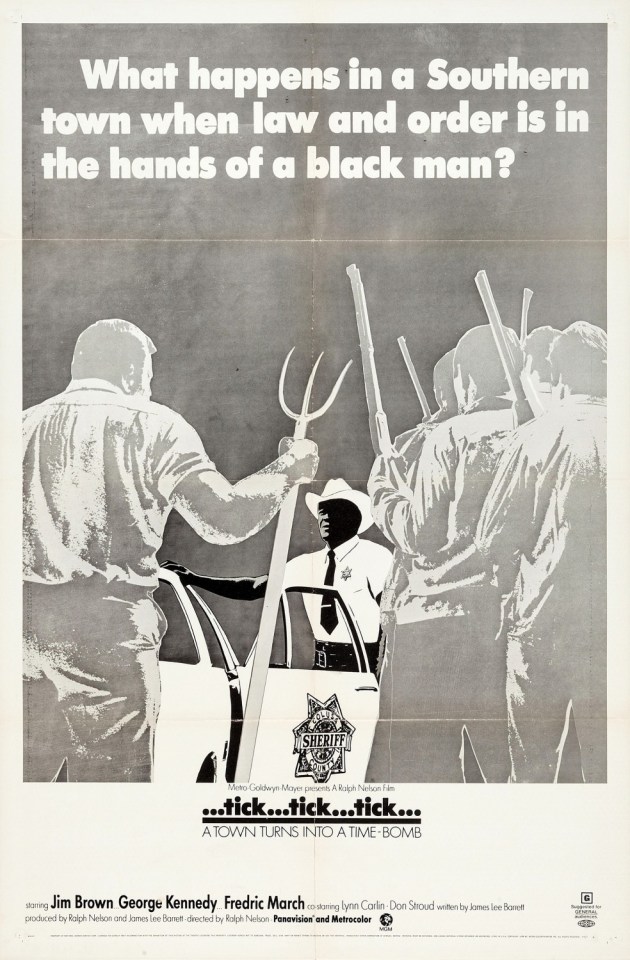
Tick Tick Tick movie poster

“…tick…tick…tick…”

Ralph Nelson’s 1970 movie stars another football great, Jim Brown, as Jimmy Price, a black police officer who has just been elected sheriff of a racially divided town in the American South. The fact he beat out the former Sheriff, a white man named John Little (George Kennedy), does not sit well with some of the townspeople. As the movie’s title and the endless ticking in the trailer indicates, the racial tensions will continue to rise until they boil over into a possibly fatal conflict.

…tick…tick…tick…” has long since become a cult classic for its cutting-edge portrayal of racial tensions and its tense narrative, and of all the trailers shown before “Django Unchained” at New Beverly Cinema, this was the one the audience laughed at the least, if at all. It looks like it still holds up to this day regardless of the passing of time, and the way the white characters treat Jimmy doesn’t seem much different from the way Django is treated in “Django Unchained.” It’s especially cool to see Brown as a Sheriff because he has always had the appearance of someone who can clean up a town single-handedly.

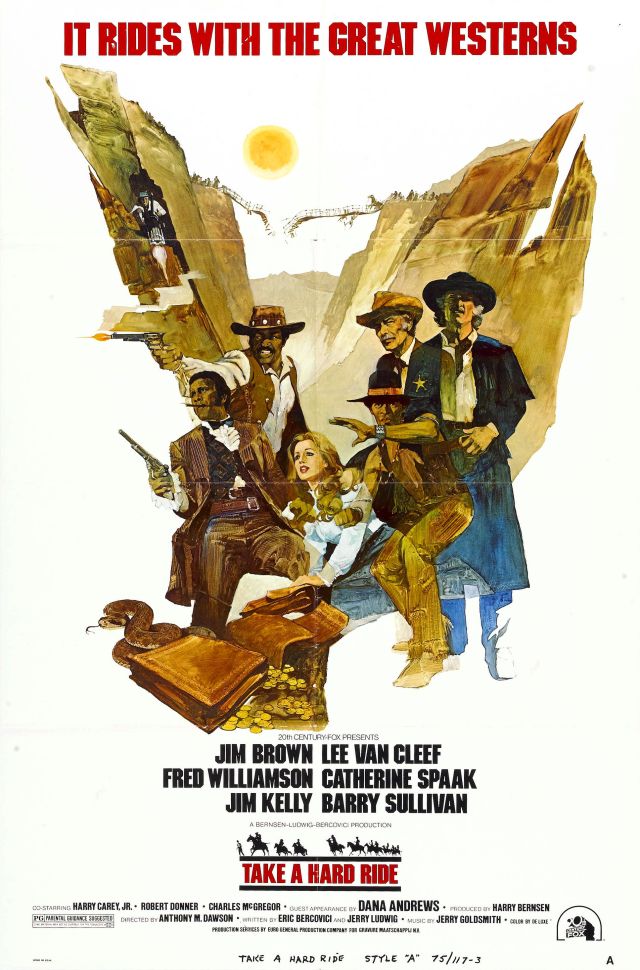
Take a Hard Ride movie poster

“Take a Hard Ride”

This Western from 1975 also stars Jim Brown as Pike, a rugged trail boss and former criminal who promises Bob Morgan (Dana Andrews) he will successfully transport $86,000 across the border to a ranch in Sonora, Mexico. Pike is forced to team up with a dishonest gambler named Tyree (Fred Williamson) for this mission, and they are soon being pursued by the ruthless bounty hunter Kiefer (Lee Van Cleef) and the corrupt sheriff Kane (Barry Sullivan).

The trailer for “Take a Hard Ride” made it look like a movie I really want to check out. Like “Django Unchained,” it is a mix up of the Blaxploitation and western genres and features one of the best casts a movie like this could ever hope to have. Brown and Williamson have always proven to be ultimate bad asses in whatever movies they appear in, and I love how the trailer’s narrator describes Cleef’s character as being “as sly as a rattlesnake and twice as deadly.” It was also great watching the scene where the cowboys and their horses crash down a hill because now I know where the filmmakers of “Young Guns II” got the idea for a similar scene.

After watching all these trailers and “Django Unchained,” it becomes clearer to see where Tarantino took his cues from as a writer and director. It also shows how brilliant he is at taking all the elements and turning them into a movie which is uniquely his own and not just an uninspired homage that pales in comparison to the films it inspired. “Django Unchained” proved to be a lot of fun, and the trailers which preceded it are for movies which look to be just as entertaining.

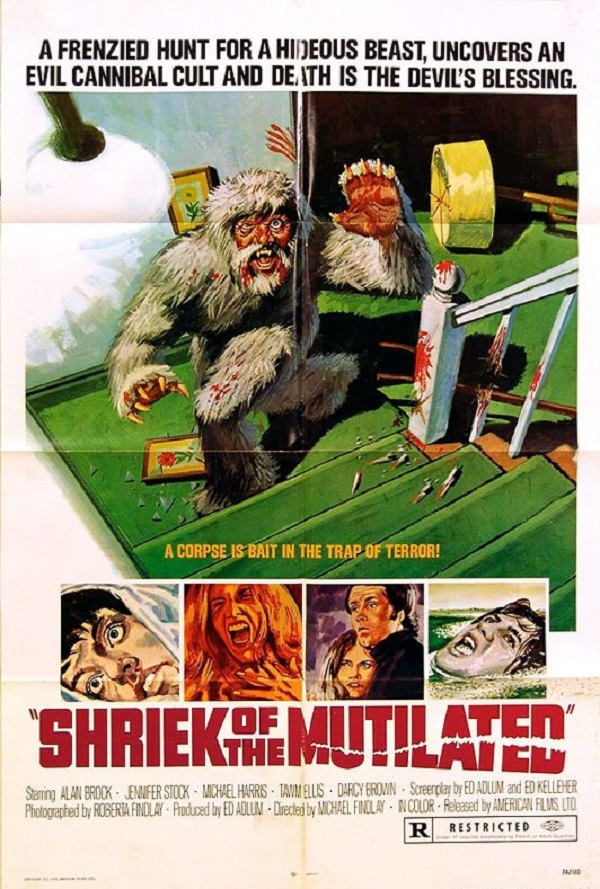
So Bad It’s Good: Ed Adlum on the Making of ‘Shriek of the Mutilated’

Shriek of the Mutilated movie poster

“The picture you are about to see… is not good.”

So said filmmaker Ed Adlum who introduced the screening of the 1974 cult horror movie he wrote and produced called “Shriek of the Mutilated.” This film played as part of a double feature along with another movie of his, “Invasion of the Blood Farmers,” for the Grindhouse Film Festival’s tribute to him at New Beverly Cinema back in September of 2012. Adlum also brought up a conversation his daughter Ingrid got involved in while she was a student at UC Irvine of what the worst movie ever made was. Ingrid said it was “Plan 9 from Outer Space,” but another student ended up saying:

“There’s one worse than that. It’s called ‘Shriek of the Mutilated.'”

“My father made that movie!” Ingrid said.

After Adlum’s introduction we watched “Shriek of the Mutilated,” and while it is far from brilliant to put it mildly, everyone in the audience had fun watching it. The movie even had the techno-pop song “Popcorn” by Hot Butter playing in a party scene, and listening to the song proved to be more exciting than the party. Brian J. Quinn, one of the programmers of the Grindhouse Film Festival, defended it by saying the worst movie ever made is a $100 million-dollar blockbuster which is a piece of crap, and “Shriek of the Mutilated” is certainly not that kind of movie.

“I don’t know about you but I had a ball,” Adlum told the audience after the movie had finished. “The thing isn’t as bad as I remember. The unintended laughs of which there were about 115 are really the best part of the picture. The things I can see that you can’t see like the guy wheeling Karen (Jennifer Stock’s character) into the room and banging into the door, I remember all of that stuff!”

There’s one moment where Lynn (played by Darcy Brown) is walking outside and picks up a broom and starts sweeping for no discernible reason before putting it back down. Adlum said it was “just a piece of business to do as she walked from here to there” and that “acting wasn’t essential” for anyone to be in this movie.

Adlum talked a bit about actor Alan Brock who played Dr. Ernst Prell, the professor who assembles a group of his students for a field trip to search for a dangerous creature known as a Yeti.

“Alan Brock was at one time a child star on film and hadn’t worked in years,” Adlum said. “He still lived with his mother and even though he was well into his 60s, he was so immature in that he had to be driven home every night instead of staying at the motel with all the other players and the crew. He had to be in his house and in his own bed, then I would pick him up in the morning and bring him back up to the woods (in Westchester County, New York) to do the film.”

The director of “Shriek of the Mutilated” was Michael Findlay, an exploitation filmmaker, and Adlum said the movie was his gift to Findlay for editing “Invasion of the Blood Farmers.” Adlum said he and Findlay were “fierce friends” as they “drank their brains out,” and he described him as knowing more about films than anybody else. For Findlay, “Shriek of the Mutilated” represented his chance to make a real movie as compared to the ones he was famous for like “Take Me Naked” or “The Touch of Her Flesh.”

Sadly, Adlum and Findlay had a big falling out at one point to where Findlay ended up calling Adlum a Nazi for some odd reason, and they didn’t speak again for years. Findlay died in 1977 on top of the Pam Am Building in New York City when a helicopter crashed and killed him and two other people. Upon hearing of his death, Adlum said he cried harder than when he found out his parents had died.

One audience member described “Shriek of the Mutilated” as starting off like a Bigfoot movie but then ends like a Manson cult movie, and he asked Adlum if this was always his plan.

“No, a lot of stuff was done on the fly and it kind of morphed into that,” Adlum said. “You think of stuff while you’re standing there. You may find a prop and work that into the film. Then when you’re all done with the picture and you’re editing it you say, these eight minutes is boring, let’s do something. So, you come up with what we call inserts, and sometimes inserts have nothing to do with the plot but they’ll make people go, oh!”

In talking about the music used in the movie, Adlum said it came from the Prague Philharmonic. This was back in the day of the Iron Curtain and the Eastern Bloc had no intellectual property rights with America, and America didn’t have any with them.

“I bought the record in the bargain bin, and I bought it for $2.98 with the express purpose of using it as background music in the movie” Adlum remembered. “The guy at the counter says to me, what are you doing with that? And I tell him and he says, well you better keep the receipt so that you can prove you have the rights!”

It also turns out Ivan Agar, the man who played the Indian Laughing Crow, was actually a chiropractor from Brooklyn, New York. Adlum said Agar had the funniest scene in the movie where a big line of drool comes out the side of his mouth, but this scene unfortunately didn’t make it into the final cut.

So yeah, “Shriek of the Mutilated” is not on the same level of filmmaking as Alfred Hitchcock’s “Vertigo,” but it was fun to watch even if we enjoyed for all the wrong reasons. It was a treat for us to hear Ed Adlum talk about its making, and you have to admire the sense of humor he has about the finished product. While he thought we would all head home after his Q&A, everyone stayed to watch “Invasion of the Blood Farmers” which showed just how much we appreciated him spending some time with us.

‘Judgment at Nuremberg’ Anniversary Screening at New Beverly Cinema

Judgment at Nuremberg movie poster

Stanley Kramer’s classic movie “Judgment at Nuremberg” got a very special screening at New Beverly Cinema on October 1, 2012. At the time, the movie was celebrating its 51st anniversary, and introducing it was Stanley’s widow, Karen Kramer. She took the time to talk not just about “Judgment at Nuremberg,” but also of her husband’s other work and the impact his films have had overall.

Karen was actually at the Cinerama Dome in Hollywood the night before where they were showing another of her husband Stanley’s best-known works, “It’s a Mad, Mad, Mad, Mad World.”

“That film was all about greed,” Karen said. “And of course, globally we thought that was bad in 1963 when that film was made. But of course, globally now it’s become a national pastime.”

“Judgment at Nuremberg” is a different film, Karen said, and one which audiences of all kinds owe it to themselves to see again and again. Like “It’s a Mad, Mad, Mad, Mad World,” this movie is as important to watch today as it was when it first came out.

“I don’t think any of us thought that genocide would ever exist again after World War II,” Karen said. “We knew all the facts and we knew all the heinous crimes that had been committed, but genocide unfortunately is running rampant again. So, this film is unfortunately very relevant (to today’s world events).”

Stanley had made “Judgment at Nuremberg” 14 years after World War II ended, and back then no studio wanted to make it and he had a very difficult time raising the money for its production. But Karen said Stanley thought it was very interesting to explore what happened with the judicial system during that time. The movie was inspired by the trail of four German Judges at Nuremberg who were tried for crimes perpetrated by the Nazi party. The question, however, becomes one of whether or not these particular Judges were fully aware of what Adolf Hitler was doing to the Jews.

“This (trial) is the one he chose because the judicial system was supposed to represent globally men of honor, men with education, men who were supposed to be fair to humanity, and these men of the Third Reich sanctioned all those heinous crimes,” Karen said. “But then I wonder about this and I think, yes of course they’re guilty but then you think about their position which was also explored in this film; if you were a member of a judicial system of the Third Reich, what would happen if you said no, I’m not going to participate? Would you lose your life, your reputation, your financial security? I suppose there was pressure put upon these men, but it doesn’t make it right.”

Karen was correct in saying Stanley explored this subject very well in “Judgment at Nuremberg.” The movie was nominated for 11 Academy Awards and Stanley himself got a Best Director nomination. It took home two Oscars, one for Maximilian Schell who won for Best Supporting Actor as defense attorney Hans Rolfe, and the other for Best Adapted Screenplay written by Abby Mann. Stanley made over thirty movies which were mostly socially conscious films, and they garnered over eighty Oscar nominations. Karen remarked how Stanley himself never got an Oscar, but that he did receive the Irving Thalberg Award which is the most important award anyone can get from the Academy of Motion Picture Arts and Sciences.

Karen went on to tell a story about Montgomery Cliff who gives an astonishing performance as Rudolph Peterson and of how he had trouble remembering his lines on the day his scene was shot.

“Stanley and Spencer Tracy (who played Chief Judge Dan Haywood) got together and they said look, I think we can handle this but a little bit differently,” said Karen. “So, Spencer went over to Montgomery and said look, I know you can’t remember the lines but you know what this scene is about. I’ll sit very close to the camera and just look into my eyes and just play from the heart, which of course he did.”

Karen also talked about Judy Garland whose performance as Irene Wallner garnered her an Oscar nomination. Clift did his performance on the stand first and then Garland did hers, and Clift came to watch Garland perform.

“I think he wanted to make sure she wasn’t better than he was, but that’s how actors were then,” Karen said. “So, he’s watching this and he’s crouching down in a corner someplace watching her perform, and he’s crying and she’s crying. He’s just undone and the minute she finished of course everyone applauded her, and he just went over to Stanley and he says, ‘you know Stanley, she played it all wrong!'”

Karen said “Judgment at Nuremberg” is one of her late husband’s better films and that he used film constantly as a tool or weapon to fight against discrimination, bigotry and man’s inhumanity. She also made it clear how Stanley didn’t make a movie unless it had something to say.

“He didn’t think of himself as a message filmmaker which is what interested him, and he took risks,” Karen said. “His life was threatened often, and when we made ‘Guess Who’s Coming to Dinner’ our lives were threatened because interracial marriage was against the law in sixteen states when he made that movie. He was always questioning things like in ‘High Noon;’ he would question standing up even if you’re alone to do the right thing even if people don’t support you. He often risked his financial security and his reputation to tell his stories.”

A big thank you to Karen Kramer for taking the time to talk about her late husband Stanley Kramer and this movie of his which continues to stand the test of time. “Judgment at Nuremberg” is as riveting to watch today as it was when it first came out a half a century ago. Don’t let the black and white photography turn you off of seeing this classic film because the issues it ponders are the same ones we are forced to deal with today.

Thomas Jane on Playing Todd Parker in ‘Boogie Nights’

Boogie Nights Thomas Jane photo

WRITER’S NOTE: This is from a Q&A which took place on October 5, 2012.

Actor Thomas Jane was excited to be a guest at New Beverly Cinema as the theater presented the first day of their Paul Thomas Anderson movie marathon. One of the movie’s being shown this evening was “Boogie Nights” which served as Jane’s big acting breakthrough, and in it he plays dancer Todd Parker who becomes a dangerous friend to the characters played by Mark Wahlberg and John C. Reilly. During a Q&A which was moderated by Brian McQuery, Jane talked about how he prepared to play Todd and of what it was like working with Anderson.

One audience member asked Jane if he prepared a certain voice or walk for when he played Todd, and he replied he usually took the script for “Boogie Nights” to this theater he was working out of in Los Angeles where he could get his fellow actors to play all the other parts. It was there where Jane did a lot of experimentation which led him giving the role his own interpretation.

“I’d bring in funny glasses, do my hair crazy and try all this different stuff like bringing in a flowered shirt to wear,” Jane said. “I didn’t have any clue about who this guy was. I just knew that I was trying to find him, and then it just clicked in one day. I think it was the voice and just doing the scenes in my little theater off of Hyperion and Melrose. The first thing I found as an actor was the way Todd talked, and once I found that then everything else happened with the role.”

Jane first heard about “Boogie Nights” from casting director Christine Sheaks who had sent him the script which she said was “pretty amazing.” Upon reading the scene where Todd, along with Dirk Diggler and Reed Rothchild, go to rob a drug dealer, Jane said he was especially interested in playing Todd. Then, after doing an improvisation with Philip Seymour Hoffman and John C. Reilly in front of Anderson which lasted about fifteen minutes, he was cast in the role.

Looking back at shoot, Jane recollected much of what went on was improvised on set, and he attributed it to Anderson’s jazz-like direction.

“One thing that’s notable about the way Paul Thomas Anderson works is the freedom he gives to his actors,” Jane said. “We did have lines to say and stuff, but if you had an idea at the moment or a line to throw in or if something happens by mistake, he always encouraged that spontaneity and that freedom. That was what was so fun about working on ‘Boogie Nights.'”

When asked if he had any stories about the actors he worked with, Jane came up with a great one about Burt Reynolds. He talked about the scene where Wahlberg gets into a fight with Reynolds over wanting to shoot his sex scene now instead of later, and Anderson told Jane to fuck with Reynolds and “get in his face” once Wahlberg ran away. So, Jane started messing with Reynolds like Anderson asked him to and even pushed him, and Reynolds ended up kicking Jane right in the nuts.

“He thought the take was over and I was some punk actor getting in his face,” Jane said of Reynolds. “Paul Thomas Anderson didn’t tell Burt Reynolds that we were doing a little improvisation after the scene was over! To his (Reynold’s) credit, he gave me a bottle of champagne in my trailer the next day and he actually turned out to be really cool.”

There was also a lot of talk about the scene at the drug dealer’s house when Cosmo kept throwing fire crackers all over the place. It turns out the actor playing Cosmo was actually a friend of Anderson’s, and the fire crackers were not originally in the script. However, it got Anderson the reactions he wanted so he just put it into the movie. But since the scene was shot over several days, Anderson had to find other ways to keep the actors on their feet.

“The first day was all fire crackers, but then we had to recreate that over the next three days,” Jane said. “After the first twenty or thirty fire crackers go off you’re kind of over it, but then you can’t hear anymore. So, Paul brought a starting pistol in and he used a starting pistol for a while and then that got old. I remember he brought in a big couple of boards and was whacking those together. That was a brilliant scene because all that stuff made the tension so high.”

Thomas Jane has come a long way from his hungry days as an actor, and seeing him strut his way onto the screen in “Boogie Nights” showed us a star had arrived. For him, talking about this movie at New Beverly Cinema was very special as he said he got his film education there. He also remembered when Sherman Torgan was running the theater back then and of how he let Jane in for free, and that popcorn and candy bars served as his nightly dinner for a time.

Jane has since moved on from “Boogie Nights” to make a successful acting career for himself, and he still has many great performances left to give.

Roddy Piper Discusses the Fight Scene in ‘They Live’

They Live Roddy and Keith

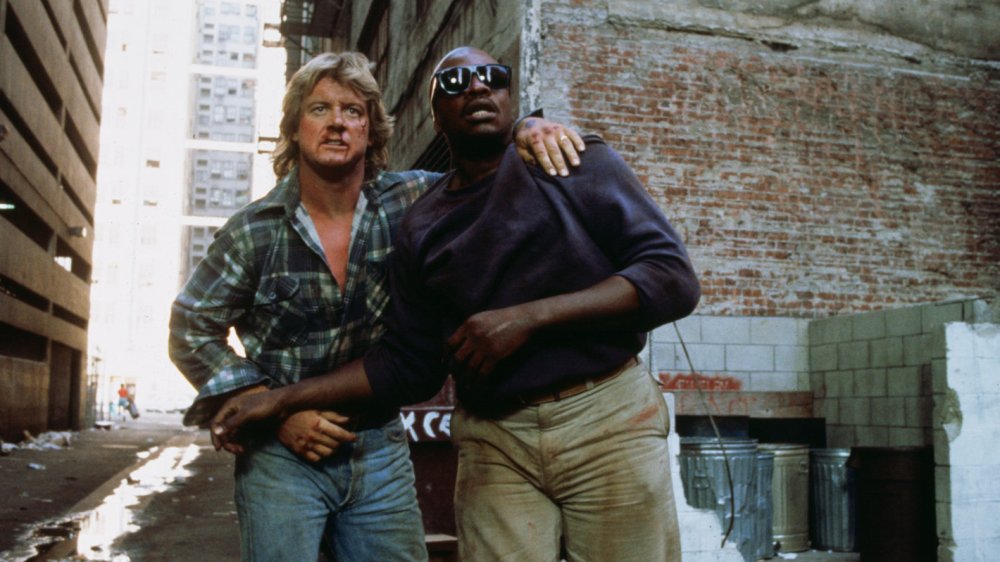
While at New Beverly Cinema for a screening of “They Live” on June 10, 2012, Roddy Piper spent some time talking about how he, director John Carpenter and co-star Keith David staged the alley fight in the movie. At five and a half minutes, it remains one of the longest fight scenes in cinema history.

Piper said that while Carpenter asked him many questions in preparation for “They Live,” the director also made him watch “The Quiet Man” which starred John Wayne and Maureen O’Hara. Aside from its beautiful photography of the Irish countryside, the movie also had one of the longest fight scenes ever filmed. Carpenter was determined to make an even longer fight scene, and to that, Piper said, “Okey dokey.”

Another reason Carpenter asked him so many questions, Piper said, was because “he was trying to figure out whom to put with me.” Keith David ended up being his co-star, and Piper described him as a “220-pound dancer” and of how “he is like Mike Tyson and doesn’t know it.” He also went on to describe David as a “great and wonderful man” and that he “kept laughing at all my mistakes.”

Piper did have a hand in choreographing the fight, and much of the rehearsal between him and David took place in Carpenter’s backyard. He taught David how to throw and take a punch, but knowing how punches on camera can appear faked, Piper eventually told him:

“Listen Keith, just hit me. From here and down (pointing to below his neck and above his waist) just hit me and go as far as you can.”

Piper said David had no problem doing that.

In filming the fight, Piper said he and David worked on three sections of it, and that they took it as far as they could. The day after that, they worked on the close ups for the scene. Rumor has it that it took three weeks of rehearsal to get the choreography of the fight just right. The audience was shocked however to hear that, even with the fight lasting almost six minutes, five minutes were actually taken out of it.

“They Live” also inspired a parody on “South Park” in which Timmy and Jimmy duke it out in a shot-for-shot remake of Piper and David’s fight. Upon learning this particular “South Park” episode featured “little crippled kids” fighting, Piper said he felt so bad about it and refused to watch it for about ten years. What changed his attitude regarding the episode was when he was at an autograph convention a few years ago:

“There was a beautiful little kid in a wheelchair that came up and told me about it, and he was laughing his ass off! Then I watched it and, oh baby Jesus put the hat on, one got hit in the crouch and another with a wheelchair! So you know if he likes it then I like it too! I just didn’t want to offend him.”

Piper did talk about how “They Live” is on the verge of being remade, and this did not please any fans in the sold-out audience at New Beverly Cinema. Apparently the remake will not have a fight scene in it. While some were disappointed to hear this, it’s probably just as well. After watching Piper and David pummel each other with such raw power, it seems impossible to top what they did today.

They Live movie poster

Roddy Piper Revisits John Carpenter’s ‘They Live’ at New Beverly Cinema

RODDY-PIPER-THEY-LIVE-10

It was a huge shock to hear of the sudden passing of “Rowdy” Roddy Piper who died on July 31, 2015 from a heart attack at the age of 61. Many of us remember him from his wrestling days with the World Wrestling Federation (WWF, now WWE) where he battled Hulk Hogan and Mr. T in the ring, and for also making Cyndi Lauper’s life (in her music videos anyway) a living hell.

But for me, I’m always going to remember him best for his performance in John Carpenter’s “They Live” in which he played a nameless drifter who discovers that the earth has been taken over by aliens disguised as rich people. While he may have seemed an unusual choice for a movie role, Carpenter said he cast Piper because he had life written all over his face, and that’s a quality that not enough people in Hollywood pay attention to these days.

The following is an article I wrote after I attended a special screening of one of Carpenter’s best movies.

They Live movie poster

Former wrestler and actor Roddy Piper visited New Beverly Cinema on June 10, 2012 to talk about his role in John Carpenter’s “They Live.” Once the film ended, Piper made his way to the front and leapt onstage and yelled out for all to hear:

“I HAVE COME HERE TO CHEW BUBBLE GUM AND KICK ASS!!! AND I AM ALL OUT OF BUBBLE GUM!!!”

This screening was put together by the horror convention Days of The Dead, and moderating the Q&A was Brian W. Collins from the website Horror Movie a Day. During the time he spent with the audience, Piper looked so incredibly happy to be there.

When Brian asked him how he got cast in “They Live,” Piper said he was doing Wrestlemania III and got asked out to dinner by Carpenter afterwards. Piper had, as he said, “been on the road since he was 15 years old,” and he admitted to the audience he “had no idea of who John Carpenter was.” But once he realized he was a movie director offering him the lead role in a motion picture, Piper was eager to work with him.

In talking about filming the destruction of the shantytown, Piper pointed out how many people in that scene were actually homeless and not your average Hollywood extras. He also said the filmmakers had to pay two gangs off so that, when they left at night, the trailers would still be there in the morning. Piper said he also knew the president of each gang, and that really helped.

Then there was the discussion about the “bubble gum” line which Brian heard was improvised by Piper. Piper confirmed it was his idea and jokingly described it as “lame,” and it came about when Carpenter told him just before the cameras started rolling:

“Roddy, you know you’re going into a bank, you got bullets on, you got a shotgun, you got sunglasses. You gotta say something because you’re not robbing it. Action!”

Piper said the line, and then Carpenter yelled cut and immediately said, “Lunch!”

One audience member asked Piper if he did his own stunts in “They Live,” and he admitted he did all of them except for when Meg Foster pushes him out the window. Piper, however, also said if it was the last shot of the movie, then they would’ve let him do it. Speaking of Foster, he confessed he did indeed trip out over her eyes because they are so beautiful. Looking back, he marveled at how she brings you right in with those eyes.

We never do learn Piper’s character’s real name, and he is called Nada in the end credits which in Spanish means nothing. In describing Nada, Piper said, “You don’t know where he came from, you don’t know why he’s doing what he’s doing, you don’t know why he’s wearing a wedding ring. You know nothing about him.” Carpenter told him the thought behind this was if you don’t know anything about him, it makes him more intriguing to where you want to watch more.

Piper ended the evening by speaking profoundly about his role:

“Nada is you, he is every one of you, not blue collar or white collar. He’s you and that’s why you know nothing about him because it depends on if it’s you, then that’s what’s about him. He’s supposed to represent everybody, not just America, but everybody in the world. And that’s kind of why you as an audience fill in the nothing with whatever ethics and morals you’re fighting for at the time.”

Upon hearing of Piper’s death, Carpenter said he was “devastated to hear the news of my friend Roddy Piper’s passing today. He was a great wrestler, a masterful entertainer and a good friend.”

RIP “Rowdy” Roddy Piper.

William H. Macy Talks with Jason Reitman about ‘Boogie Nights’

Boogie Nights William H Macy photo

Jason Reitman proudly said he saw Paul Thomas Anderson’s “Boogie Nights” long before everyone in attendance at the New Beverly Cinema on February 21, 2010 had. This was the fourth movie he showed as part of his guest programming at the still standing Los Angeles revival movie theater. It was at a test screening shown at the Beverly Center where he first witnessed this movie which proved to be the breakthrough for Anderson whose previous cinematic effort was the acclaimed but little seen “Hard Eight.” With “Boogie Nights,” Reitman said he saw a filmmaker who knew how to handle all the elements while dealing with twenty characters.

Reitman’s special guest for this screening of “Boogie Nights” was William H. Macy who played Little Bill, the assistant director to Jack Horner (Burt Reynolds) who is married to a porn star (played by Nina Hartley) who sleeps with everyone but him. In many ways, Little Bill is the most empathetic character in this movie even though we keep waiting for him to stand up for himself.

Boogie Nights poster

Reitman, who had previously worked with Macy on “Thank You for Smoking,” first asked him how he came upon the script for “Boogie Nights:”

“I got the script through the normal channels,” Macy said. “I think I was still with CAA then, and the script was even more outrageous. I said, ‘Is this a porn film?’ There was actual shtüpping in it! Then I met with Paul and, the actors in the room will love this, I decided I wanted to do it and met with him at the Formosa Café, and it was about ten minutes in when I realized he was selling me. I wasn’t there to audition for him, he was trying to convince me to do it, and it was one of the great moments of my career.”

Reitman replied to this by saying, “I remember having a similar meeting when I was trying to get you to do ‘Thank You for Smoking,’”

 From there, Reitman talked about all the great long shots Anderson has used in his movies. Specifically, he talked about the one where Little Bill was at the New Year’s Eve party and found his wife once again sleeping with another guy. It’s a long tracking shot which goes from Little Bill looking for his wife, finding her, and then going back to his car to get a gun after which he goes back inside and shoots his wife and the other guy dead. Watching it years after “Boogie Nights” was first released, it is still amazing Anderson pulled such a shot off. Macy described how this scene was put together.

“Paul does a couple of his gazunga shots in this one and they are not as hard as you would think,” Macy said. “It took forever to set up, but then after three and a half to four hours of setting it up, the shot’s done. No coverage, no nothing and you move on. Four pages just bit the dust.”

Macy then talked about how much he loved Nina Hartley. The first time he met her was when he went into the makeup room, and she had her legs up on the counter and was shaving herself. At the end of the shoot, Hartley had started this series entitled “Nina Hartley’s Guide to Swinging” as well as one on anal intercourse. Macy then added, “In the end, she gave these films as wrap gifts! It was great to see (the reactions); anal intercourse? THANK YOU NINA!”

There was a number of actual adult film actors involved in the making of “Boogie Nights.” One of the girls who had a small scene in the movie came to Macy’s attention while he was having lunch one day with Anderson. She came down and sat between the two of them and asked Paul a career question, “Should I go legit or should I go anal?”

Reitman went back to the long shot which ended when Little Bill puts the gun in his mouth and blows his brains out. What made this shot particularly dangerous was Macy had to wear a squib on the side of his head. With squibs, the crew doesn’t want you to move around at all for your own good, and Macy went into detail over why it was so dangerous.

“What was dangerous about it was they let me do it,” Macy said. “I found out since then that they no longer let actors use that kind of squib. It’s a little explosive device and it’s called a gore gun. So I had this little backpack with all this blood and brains that would come shooting out the back, and it was wired to the pistol so that when I fired the pistol, that’s what set off the ‘gore gun’ and that’s not allowed anymore. A stunt guy sets off the gore gun now, but there is a cut because we couldn’t figure out how to do the whole thing with a loaded gun and the gore pack. So there is a cut.”

The conversation then went to the tone of a movie and what a director actually does. It’s nowhere as simple as Burt Reynolds’ character of Jack Horner makes it look in “Boogie Nights.” Reitman took the time to explain what he thinks tone is.

“Tone is like this inexplicable thing that, if you ask what a director actually does, it’s not like setting up shots or telling actors what to do,” Reitman said. “Really, what a director does is set tone. It’s not about the words; it’s about the feeling that carries through the scenes, and P.T. A’s movies have a very specific tone to them.”

Reitman then asked Macy if this is something he feels on set or if it was something he didn’t realize until he saw the finished product. Macy said he wasn’t aware of how special “Boogie Nights” was until he saw the final cut, and he was understandably very impressed with it. This led him to talk about when he made “The Cooler” (the mention of it got a strong applause from the audience) which contains one of his very best performances.

“The director kept telling me, ‘Wait until you hear the score!’ To where I finally said, ‘Dude, if you think the music is going to save this then you’re in trouble!’ I was wrong, and when he put that lush score over the film it was a different sort of film, and he had that in his head the whole time,” Macy said.

Macy went on to say the tone of the set bleeds onto the film and the way you comport yourself, or how your first assistant director comports his or herself.

“To my mind, it’s always like going to war then making art,” Macy said. “You need a good general. I’ve been known to call in first time directors and I say to them, ‘If I catch you making art on my time, then we’re going to have trouble.’ You better know what you want because it’s more like going to war.”

One of the best moments of the evening came when Macy talked about the extras who were brought in when Anderson shot the scenes at the adult movie awards. They were all told to bring their best 70’s clothes and that they were working on a Burt Reynolds movie. Then there was that moment where actress Melora Waters is about to give an award to Mark Wahlberg, and it was worded a little differently than what we saw in the theatrical version.

“I’ve seen all his movies and I can’t wait to get his cock inside my pussy, MR. DIRK DIGGLER!”

Macy said the whole crowd just sat there in utter silence, completely unprepared for what they heard. It certainly wasn’t your average everyday Burt Reynolds movie.

All in all, it was another fun evening which provided an in depth look into one of the best movies of the 1990’s, and “Boogie Nights” made clear to the world Paul Thomas Anderson was a born filmmaker.


Veronica Cartwright Talks About ‘The Right Stuff’ at New Beverly Cinema

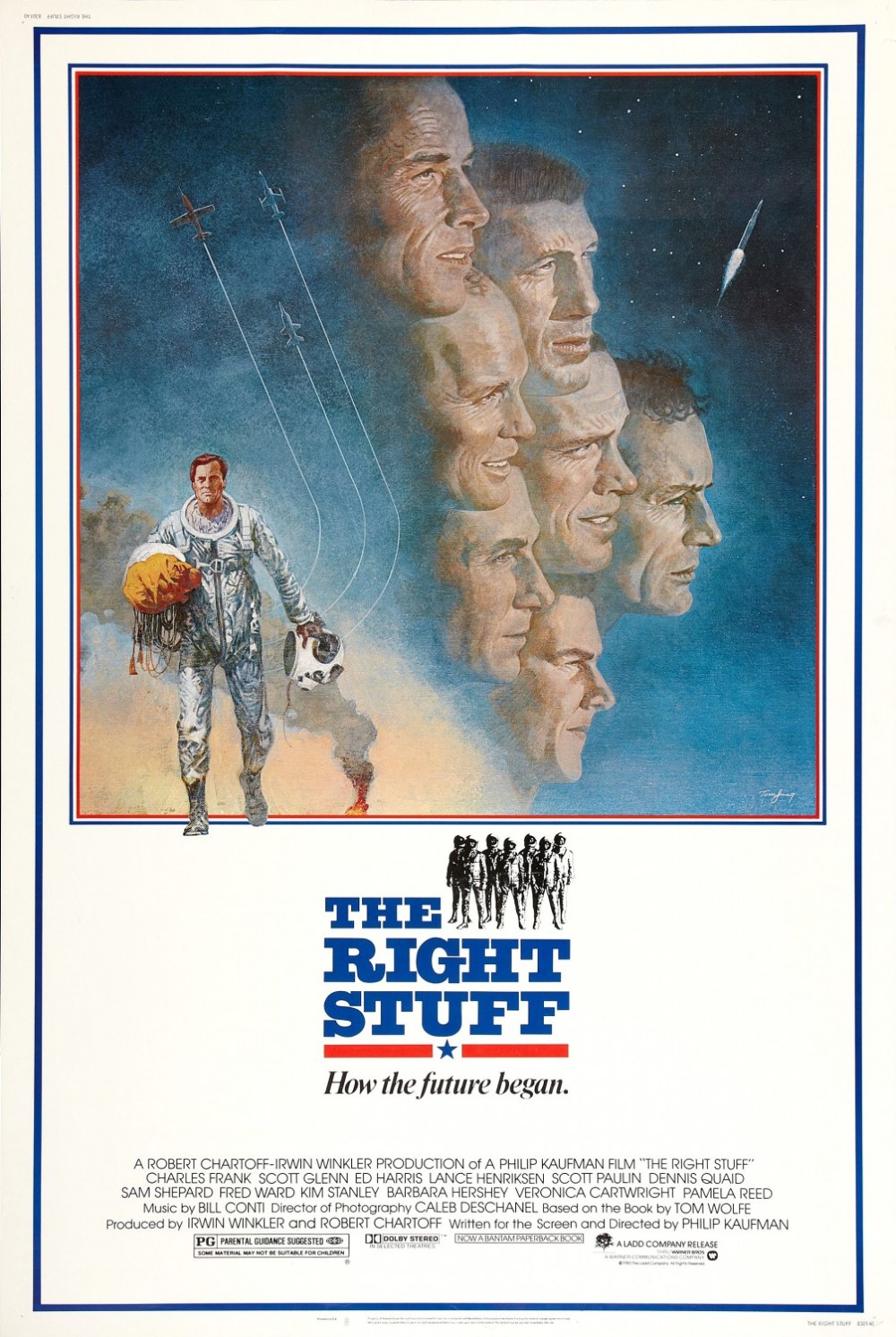
The Right Stuff movie poster

Filmmaker Brian McQuery asked New Beverly Cinema to program it, and his wish came true on July 4, 2013 when the revival theater screened “The Right Stuff” in honor of its thirtieth anniversary. Philip Kaufman’s adaptation of Tom Wolfe’s non-fiction book on the Mercury Seven astronaut program and Chuck Yeager was not a box office success when it first came out, but it did find its audience on video, cable and Digital. Seeing it again on the big screen was a real treat, and the audience got an even bigger one when McQuery welcomed actress Veronica Cartwright to the stage.

Cartwright played Betty Grissom, wife to Gus Grissom who was the second American to fly into outer space. Gus’ flight, however, ended on a controversial note after he landed in the ocean and the hatch on his spacecraft suddenly exploded and came off. This caused the spacecraft to sink, and the whole incident left NASA feeling embarrassed. Gus was later found to be not at fault for what happened.

Cartwright had previously worked with Kaufman on his remake of “Invasion of the Body Snatchers,” and he told her he had written the part of Betty Grissom with her in mind. Still, Cartwright had to convince to the movie’s producers she was the right person for the role, but there was one thing which threatened to derail her interview with them.

Veronica Cartwright: I had been in a car accident in 1981 where I broke my leg in 35 places. Then this interview came up and I was six months in a cast, and I had nine screws and an 8-inch plate in my ankle. I had just gotten out of my cast and my mother had to drive me to the interview, and I dressed in red, white and blue. I thought this was the appropriate thing to do. As I got up the stairs and I walked, Phil came out. Well I had a bit of a limp at this point so I thought, oh my god if he sees me limping… So, I went, “Hey Phil! What’s happening?” And I danced the whole length of the hallway.

Despite the shape her leg was in, Cartwright still got the part. In fact, she didn’t even tell Kaufman or any of the producers her leg was broken until after shooting wrapped. However, she did have to wear high heels for a scene three months after her leg came out of the cast which was anything but comfortable.

Cartwright’s character is of course based on a real person, but she admitted she never got to meet Betty Grissom before, during or after making the movie. This was due to a big lawsuit going on after Gus died aboard Apollo 1 which caught fire before it took off, and Betty was not in a good state of mind to assist with the production of “The Right Stuff.” As a result, Cartwright had to rely on other ways to get into character, and she talked about how she prepared to play Betty.

VC: We looked at the archival footage and we were all given backgrounds of where the characters were born and how they met their husbands and how they got involved in the whole space program. When you’re doing a real character, I think it’s a little scarier because you want to do that person justice. It’s not coming off of your own imagination. It’s coming off of reality so you have to be careful. I hope I justified her. I always write myself a biography so I know where I came from and stuff like that. Of course, a lot of that was supplied because of her being an actual person. If I know who the person is, just from however I created them, then the lines come like that because I have become that person. I believe you need to have enough background and stuff so that, say something improvisational comes up, you would act according to what your character would do. It’s become ingrained as part of your character. I do a lot of homework before I do something, and I always found that it works for me.

During filming, Cartwright said the actors hung out with the actors while the actresses hung out with the actresses. She remarked how they were “separate entities” as a result which in a weird way was what the movie was about. Everyone in the cast, however, became a close-knit group by the end of filming, and Cartwright pointed out how this showed in the big barbecue scene where their characters are given a huge banquet in Texas courtesy of Vice President Lyndon B. Johnson. The scene was actually shot at the Cow Palace in San Francisco with hundreds of extras, and she remembered the shooting of it quite vividly as the meat being barbecued was not as tasty as it looked.

VC: We were in the Cow Palace for five days and those sides of beef weren’t very pretty after five days. We kept hearing, “DO NOT EAT THE MEAT! DO NOT EAT THE MEAT!” Oh my gosh! They would bring in thousands of McDonald’s burgers. Bags of McDonald’s were handed out because they kept saying, “DO NOT EAT THE MEAT!” They would be over there with that blowtorch and putting that glaze all over the beef and it was disgusting. But it was a wonderful experience (filming that scene), it was really great.

In talking about Kaufman, Cartwright described him as a great, lovely person. Since “The Right Stuff” is such a big ensemble piece, everyone had major rehearsals to get the blocking right, but Kaufman did allow for improvisation. Cartwright also admitted the scene in the hotel where Betty gets upset with Gus because they were not invited to the White House after his space mission took a whole day to shoot.

The screenplay for “The Right Stuff” was to be written by William Goldman, but Goldman wanted to leave out the Chuck Yeager story and focus solely on the astronauts. Kaufman disagreed with this decision as he felt Yeager’s story was a very important part of the film because, even though he didn’t go into space, the future of space travel really began with him. Goldman ended up withdrawing from the film and Kaufman wrote the screenplay himself. Cartwright lauded his work.

VC: I thought the script was brilliant because the book is sort of like a train of thought and things that are said but not spoken out loud. What Phil did was he took that book and made all those thoughts reality. I think very rarely can books translate into the movies and the movies be as good as the books were, and in this case, he was right on.

The cinematographer for “The Right Stuff” was Caleb Deschanel who received an Oscar nomination for his work. He was also nominated for his work on the films “The Natural,” “Fly Away Home,” “The Patriot” and “The Passion of the Christ.” Of course, these days he is known as the father of Emily and Zooey Deschanel who have become successful actresses in their own right.

VC: He’s very meticulous. The lighting was amazing. He didn’t have standard lights. Everything had these big shrouds of silks over the top of them. The whole Cow Palace was lit and it would be on gimbles where they could just move the lighting, but it took hours to set up. It was pretty intense. And it’s so funny to see Zooey now because she was three-years old during the making of the movie, and Emily had just been born. Thirty years is a long time!

Actually, the most fascinating story Cartwright told that evening involved how Kaufman and his crew filmed the flying sequences. Until “Top Gun” came along, “The Right Stuff” had some of the best and most convincing aerial footage of any movie I had ever seen. So it was a big surprise when Cartwright revealed to us what kinds of planes and special effects were used to create those moments.

VC: When you see the planes going up and down, those were all Japanese models and they (the filmmakers) stood on the top of a very tall building and chucked them off (laughs). That was the CGI! They just sort of painted them and Phil said “oh my God it was incredible! We just go up on the top of the building and throw the plane off and see what happens!” So when you’re watching the movie tonight, you can figure out that it’s a little Japanese air model. It was hysterical!

Veronica Cartwright ended her Q&A with Brian McQuery by saying “The Right Stuff” was a wonderful movie and that she loved the sense of drama and comedy and how it was a wonderful blend of the two. Thirty years after its release, we couldn’t have agreed more. “The Right Stuff” remains one of the greatest movies to come out of the 1980s, and it has lost none of its power to excite and entertain those who watch it. Some movies don’t age well, but this one has.