Sam Rockwell on Playing Billy Bickle in ‘Seven Psychopaths’

It is so much fun watching Sam Rockwell in Martin McDonagh’sSeven Psychopaths.” In the movie he plays Billy Bickle, an unemployed actor and friend to alcoholic screenwriter Marty Faranan (Colin Farrell). In addition, Billy is also a part-time dog thief who, along with his partner Hans (Christopher Walken), kidnaps dogs and then returns them to their owners who offer them a generous reward for their return. But Billy’s criminal deeds come back to haunt him when he steals a Shih Tzu which belongs to the vicious gangster Charlie Costello (Woody Harrelson), and Charlie will stop at nothing to get his beloved dog back.

Rockwell described the screenplay for “Seven Psychopaths” as great and said the part of Billy was “amazing.” You couldn’t agree with him more as this role gave him the opportunity to really chew up the scenery. Throughout, Billy fools around with his friend, unveils parts of his psyche which we do not see coming, and he eventually comes up with what he believes to be the mother of all action movie climaxes.

It’s also no mistake how Billy Bickle shares the same last name with Robert De Niro’s famous character of Travis Bickle from Martin Scorsese’s “Taxi Driver.” However, it was another De Niro character which came to inform Billy more for Rockwell.

“Johnny Boy (from ‘Mean Streets’) is definitely a template for Billy, probably more than Travis Bickle I think,” said Rockwell. That kind of flamboyance that De Niro has in that and also in ‘New York, New York’ and ‘Midnight Run.’ He has a kind of flamboyance that is particular to those films.”

Other characters which inspired Rockwell’s performance in “Seven Psychopaths” were Annie Wilkes (played by Kathy Bates) in “Misery,” and Timothy Treadwell who was the subject of Werner Herzog’s brilliant documentary “Grizzly Man.”

In regards to the friendship between Billy and Marty, Rockwell remarked he found inspiration through the performances of Jeff Bridges and Robin Williams in “The Fisher King” as well as the work of Kevin Spacey and Sean Penn in “Hurlyburly.”

“There are many examples of that kind of codependent, male-bonding relationship. Alpha-beta and beta-alpha switching,” Rockwell said of the above movies.

When it came to fleshing out the relationships of the characters played by Rockwell, Farrell and Walken, Rockwell said they all took the time to form a bond before shooting began. To that effect, they rented a house near Joshua Tree Park which is where the last half of “Seven Psychopaths” takes place. As for the bear hat Rockwell wears, Farrell ended up picking it out after finding it at a rest stop.

Many will come out of “Seven Psychopaths” saying Rockwell’s best scene comes when he discusses his idea for an action movie climax in a cemetery. In his best roles, Rockwell has such an unpredictable energy which continually makes him so fascinating to watch. It makes one wonder how much of this scene was scripted and what parts of it were improvised. Hearing Rockwell explain it is very interesting.

“It has to be in the writing or you can’t do it,” Rockwell said. “But certainly, all actors want to be spontaneous that’s the trick of acting, to be truthful under imaginary circumstances. You want it to be truthful, meaning it has to be fresh, it has to be spontaneous, so you have to trick yourself that it’s happening for the first time and trust this actor’s faith, so to speak.”

“I think that’s the little kid part of acting. Being with a kid is like hanging out with a drunken person or schizophrenic,” Rockwell continued. “One moment they’re crying and they’re sad, then they’re like hitting things, and that’s what actors have to do. They have to manipulate their emotions. You just got to really go back to that place of spontaneity and no boundaries.”

Watching “Seven Psychopaths” makes you realize just how much fun these actors had playing their roles. This is especially the case when you watch Sam Rockwell here, and his performance as Billy Bickle is another reminder of just how endlessly creative he is. To hear him talk about it, this was clearly one of his best experiences he has had so far in his career.

“What’s memorable for me is the experience that we had on the film. It was such a great experience,” Rockwell said. “We took our jobs very seriously, but we also had a lot of fun, and that’s what is really memorable for me. Of course, we want the movie to be a smash hit, but who knows what’s going to happen. I have memories of films that nobody ever saw, that I was very proud of, and those are still great memories. It would be great, if people saw this movie. It’s a cool movie.”

SOURCES:

Steven M. Paquin, “Exclusive Interview: Martin McDonagh and Sam Rockwell talk ‘Seven Psychopaths’ and Writing for Women, Psychos, and More,” Just Press Play, October 12, 2012.

Christina Radish, “Sam Rockwell and Christopher Walken Talk ‘Seven Psychopaths,’ What Inspired Their Performances, Memorable Moments, and More,” Collider, October 11, 2012.
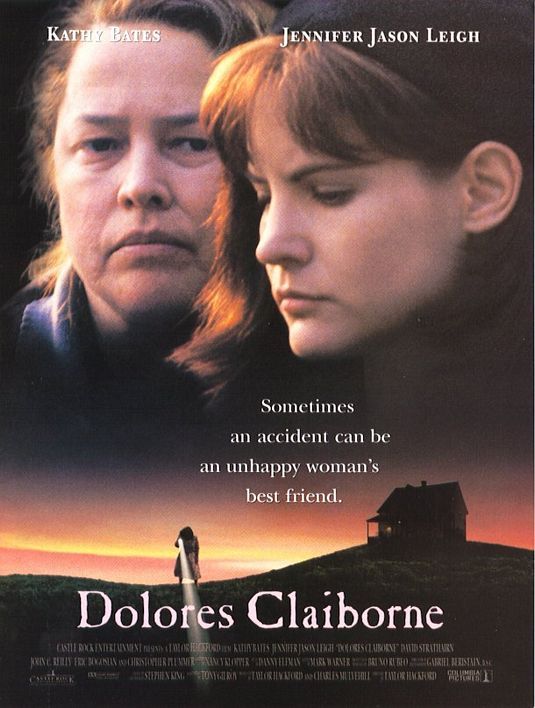
‘Dolores Claiborne’ – A Stephen King Horror Tale of the Real-Life Kind

Dolores Claiborne” is, on the surface, not your typical Stephen King novel, and this is important to note before you begin watching this particular adaptation of his work. This cinematic treatment reunites him with the great Kathy Bates who won an Oscar for playing Annie Wilkes in “Misery,” but she’s not playing a deranged psycho this time around. Also, while much of King’s writings deal with terrifying supernatural powers and unspeakable terrors, the horror generated here comes from real life horrors no one should ever have to endure. In some ways, this makes it one of his more terrifying tales because it deals with the kind of horrible crimes we hope and pray never to experience first-hand. Having said this, it is clear how many of us can never be so lucky as to avoid the worst traumas humanity has to offer.

Bates plays the title character who, as “Dolores Claiborne” opens, is believed to have killed her rich employer Vera Donovan (Judy Parfitt). This crime immediately reminds the town of Little Tall Island in Maine when Dolores’ husband, Joe (David Strathairn), died twenty years ago under mysterious circumstances, and the general consensus was that Dolores killed him. Detective John Mackey (Christopher Plummer), who had pursued the case against her back then is determined to put her behind bars this time and for good. Into this mix comes Dolores’ daughter, Selena St. George (Jennifer Jason Leigh), a big-time reporter who arrives to defend her mother despite the two of them having been estranged for over a decade.

The novel “Dolores Claiborne” was essentially one long monologue as the story was written entirely from the title character’s point of view. This makes the work director Taylor Hackford and screenwriter Tony Gilroy have done here all the more impressive. They have taken Dolores’ unsettling story and have stretched it out into a character driven motion picture filled with various characters who have been fleshed out in unforgettably compelling ways. None of these characters, even that drunken lout of a husband and father, are one-dimensional or throwaway caricatures. Each one is complex, and they take unexpected directions which might seem jarring at first, but eventually make sense in the large scheme of things.

The plot shifts back and forth in time as we flashback to when Dolores lived with her drunk and abusive husband and of the vicious abuse she took from him in his endlessly drunken state. Director of photography Gabriel Beristain shoots this hideous past with such vivid colors to where he gives the scenes an innocent look which is soon contrasted with horrible violence. It almost acts as a façade for how the past was seen as if it were some sort of Norman Rockwell painting, the kind made to cover up the severe family dysfunction many would like to pretend does not exist.

For the record, King said he wrote the character of Dolores Claiborne with Kathy Bates in mind, and it is very hard to think of another actress who could have inhabited this role. Stripped of any false glamour, Bates takes her character from being a victim to one who understandably takes matters into her own hands. Her acting here is flawless and compelling, and we root for her even though her actions have devastating moral implications.

When you look at her overall body of work, this movie almost seems like a walk in the park for Leigh. She has gone to great physical and emotional lengths to portray a character throughout her long career, but here it looks like she is taking it easy. However, her character of Selena is no less challenging to portray than the others listed on her vast resume. Selena is not easily likable, but she has to be empathetic because the viewer slowly starts to see how her innocence was irrevocably and unforgivably destroyed. Leigh matches Bates’ performance scene for scene by showing how much Selena wants to forget the past, but she comes to see how her most repressed memories cannot stay below the surface forever.

Special attention also needs to be paid to Ellen Muth who portrays Selena as a little girl. This is not the kind of role parents want their children to portray to as it deals with abuse and molestation among other things, but Muth proves to be utterly convincing in making the young Selena deeply distraught and confused by actions no child should ever have to be put through.

There’s also a bevy of excellent performances from the rest of the cast as well. Christopher Plummer, who is never bad in anything, is memorable as the relentless Detective John Mackey. This could have been a throwaway role, but Plummer makes Mackey a complex character to where you question whether his determination is based more on personal revenge than justice. Judy Parfitt is unbearably domineering as Dolores’ wealthy employer, Vera Donovan, and their relationship runs much deeper than we see at first glance. And David Strathairn manages to flesh out his despicable character of Joe St. George to where he’s just slightly more than your average mean drunk.

Most of King’s novels deal with the horror of supernatural elements or ghosts and demons which haunt our nightmares. But “Dolores Claiborne,” much like “Stand by Me,” deals with the horrors of real life which we are never quick to confront unless we are put in a position where the awful truth can no longer be ignored. Perhaps the unsettling nature of this particular work by King is what kept many from checking out this motion picture when it arrived in movie theatres back in 1995, but those of us who were willing to dive into the dark side of things like myself did not deny ourselves a journey to the horrors this film has to offer. But now, 25 years later, this film fits in perfectly with a time which includes the Time’s Up movement as we are forced to realize we have thoughtlessly ignored the worst abuses made against other human beings for far too long. As a result, this particular King cinematic adaption plays even better than it did back when it was released.

* * * ½ out of * * * *