Tom Hiddleston Discusses ‘I Saw The Light’ and Singing Like Hank Williams

I Saw the Light movie poster

We all know him as the villainous Loki from the Marvel Cinematic Universe, but now British actor Tom Hiddleston takes on his most challenging role yet as iconic country singer Hank Williams in “I Saw the Light.” Written and directed by Marc Abraham, the movie starts with Hank getting married to the lovely and business savvy Audrey Williams (Elizabeth Olsen), and it follows him from there as he works his way from singing on the radio to becoming a big time star at the Grand Ole Opry. The movie also shows the pain, challenges and addictions he suffered through which led to him creating some of the most memorable country music and his premature death at age 29.

In preparing to play Hank Williams, Hiddleston had to learn his songs and sing them himself. Working extensively with musical coach and veteran country singer and songwriter Rodney Crowell, Hiddleston immersed himself in Hank’s music and worked tirelessly to match his vocals to Hank’s as much as he could. There’s no doubt it was a difficult process for the actor, but watching him in “I Saw the Light” makes you see the tremendous effort he put into his performance.

I attended the movie’s press conference at the London Hotel in West Hollywood, California where Hiddleston was joined by Abraham and Olsen. I was very interested in how Hiddleston managed to get past all the technical aspects of the singing to where he could put all the rehearsal behind him and just sing his heart out. Izumi Hasegawa, a reporter for What’s Up Hollywood and Hollywood News Wire asked him which of Hank’s songs was the hardest to sing, and this would later lead in to my question for him.

Tom Hiddleston: The most challenging song was probably “Lovesick Blues.” “Lovesick Blues” is, I think, of all the songs Hank sang, the hardest, and he probably sang that the most. It was a huge hit for him. He once went up on stage somewhere, it’s on an album called “The Lost Concerts,” and he’s about to introduce it. He says, “I’m going to play a little song for you. I sang this 13,000,001 and a half times and it’s earned us quite a few beans and biscuits.” It was obviously this real hit maker for him and he sang with such control and such authority that he must have done it in his sleep, and I had to accelerate that process because it’s a very technically difficult song. You are yodeling and you are jumping octaves, and so to be on pitch in every note of that song was really challenging. I had days where I felt like I was bashing my head against a brick wall because Rodney Crowell and I would do take after take after take because if I was rhythmically precise the pitch was off, but if the pitch and the rhythm were right Rodney would say, “Well, you weren’t really feeling it. I kind of lost your sincerity, I lost the twinkle, so could you put that back?” And then I’d have the twinkle and I’d go off rhythm again. So yeah, that was probably the most challenging.

Ben Kenber: Clearly you did a lot of vocal work in preparing to sing like Hank Williams. When do you think you got to the point where you stopped worrying about the singing technicality and started to feel the songs instinctually?

TH: It goes back to what I was saying about “Lovesick Blues.” We had to pre-record certain tracks because of the way we were going to shoot them. If Marc was covering a concert performance, it meant he was going to be cutting from wide shots to close-ups to handheld which meant that we had to be very technically precise about the musical track and therefore couldn’t play it live in order for it to cut in. So we had to pre-record the tracks which I would then play and sing along to myself. They each had to have different atmosphere because some of them are radio station tracks, some of them are studio tracks, some of them are live concert performances, and there were some that came very quickly and very easily to me and some that didn’t. I had recorded “Why Don’t You Love Me” in about an hour. It took me about 10 days to record “Lovesick Blues” and I can’t explain why (laughs). Rodney and I used to say that it was like swimming through the ocean, and that I would have to swim for miles and miles through seaweed in order to get to clear water. And that’s how it felt vocally; there would be cracks and strains in my voice. Singing is a physical thing, and once your body and your resonance and your lungs are sufficiently warm, you can actually get to a place where it feels like you’re up at altitude where you are finally in control of the airplane if that makes sense. It’s a fascinating experience for me because I still believe singing is the most naked form of emotional expression. Actors can hide behind characters, writers can hide behind their writing, painters can hide behind paintings, but singers are purely open. The reason we revere the greatest singers is because we feel a raw power to the transmission of their emotions whether it’s Johnny Cash or Amy Winehouse or Nina Simone or Hank Williams or whoever it may be for you. That was challenging because even though there was a technical discipline to it in manipulating my baritone voice to sound like Hank’s tenor, there was still a commitment to emotional sincerity which was really new for me.

Following Hiddleston’s response, Abraham spoke up about what he specifically wanted for this movie.

Marc Abraham: I just want to add something to that because it was a big deal when we decided how we were going to do the music. From the very moment I wrote the script and decided to make the movie, I was intent that we would not have any lip-synching and that whoever played the part was going to have to sing it. I didn’t know they would be able to do it as well as Tom did. I was hoping that would happen, but what’s important to understand and that Tom understood and Elizabeth to some extent when she was even pretending to sing badly even though she gets mad at me for saying she can sing well (she can). Tom and I both knew from the very beginning that he would never sound exactly like Hank Williams. I know Hank Williams like my mother knows her kitchen. There are people who can imitate Hank Williams better than Tom Hiddleston can imitate Hank Williams because he is a natural baritone and Hank’s a tenor, and that’s just reality. What Tom was able to do was to create the feeling not just in his voice and replicate the sounds and the modulations and to get close enough for us, but to inhabit the character. So in the end it didn’t matter that he didn’t sound exactly like Hank Williams. What we wanted was for you to feel that he was Hank Williams, and that was magic. The magic was that he got so close to the music and put so much energy and time and devoted himself so deeply to becoming that character and bring his vocal representation that close, knowing from the very beginning he couldn’t be exactly like Hank. It’s not possible. That was what was really important, and that’s why we didn’t lip-synch it because then you are watching it and you may think you know what it sounds like, but in the end you feel it and you see that character at play and you see Hank singing “Your Cheating Heart” which is done live. That’s Hank Williams.

I want to thank Tom Hiddleston and Marc Abrahams for sharing their thoughts on the making of “I Saw the Light.” The movie is now available to own and rent on DVD, Blu-ray, and Digital.

Copyright Ben Kenber 2016.
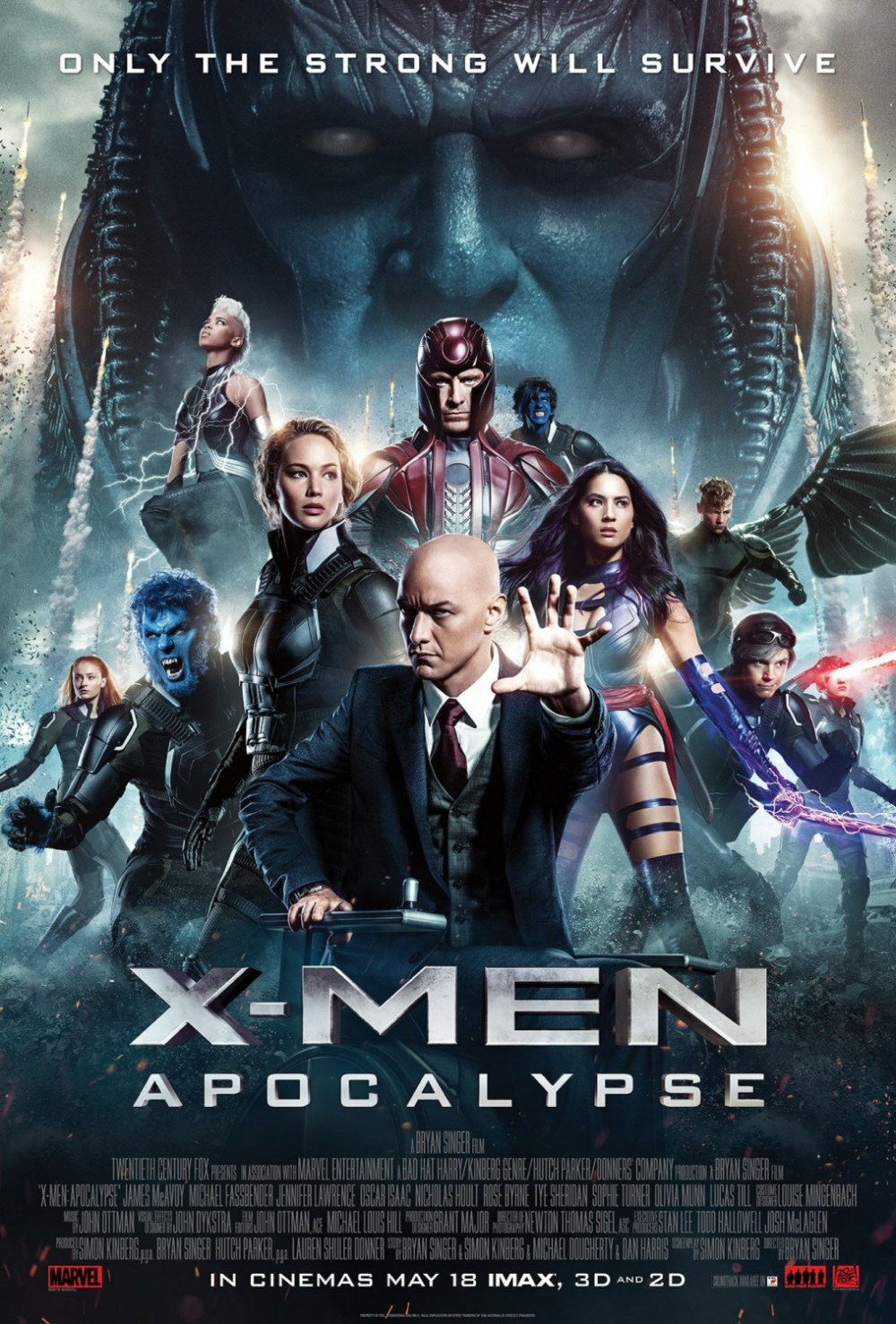
X-Men: Apocalypse

X Men Apocalypse poster

In the whirlwind of superhero movies which have come out in 2016, “X-Men: Apocalypse” ends up being sandwiched between “Captain America: Civil War” and “Batman vs. Superman: Dawn of Justice.” Like those two, “X-Men: Apocalypse” has far too many characters and plotlines to deal with, and its running time is much longer than it needs to be. But while this “X-Men” might not reach thrilling heights of “Captain America: Civil War,” it is far more enjoyable than the dour affair that was “Batman vs. Superman.” Still, after “X-Men: Days of Future Past,” this entry does feel like a comedown for the long running franchise.

The movie takes place in the 1980’s; a time of synth pop, “Knight Rider,” Ronald Reagan and “Return of the Jedi” among other things. The newest threat to both humans and mutants alike is En Sabah Nur, better known as Apocalypse, the world’s first and most powerful mutant. The movie starts off with him being entombed in a rocky grave after being betrayed by his followers, but he is awakened in 1983 and finds humanity has lost its way because, as he sees it, humanity was without his presence. As a result, he vows to destroy the world and remake it, and this time the X-Men may have a foe too powerful for them to defeat.

Playing Apocalypse is Oscar Isaac who enters yet another incredibly successful franchise after leaving his mark on another in “Star Wars: The Force Awakens.” In a way he is undone here by the large amount of makeup he is forced to wear as it threatens to rob him of his charisma. Seriously, the less makeup you put on Isaac the better as he can lock you in place with just a look from his eyes. Regardless, he is still very good here as he holds his own opposite actors who have been veterans of this franchise for quite some time.

Many of the “X-Men: First Class” cast return as well like James McAvoy, Jennifer Lawrence, Nicholas Hout, Michael Fassbender, Rose Byrne and Evan Peters. It’s great to see them all back as they are still deeply invested in these famous comic book characters as always. McAvoy, portraying Professor Charles Xavier/Professor X, shows just how mentally exhausting it is to fight an antagonist with only your mind. We also get to see how Charles lost his hair, and we leave the theater wondering how his eyebrows managed to remain intact.

Lawrence remains an enthralling presence in any movie she appears in, and she makes Raven/Mystique another in a long line of wounded warriors. The Oscar winning actress makes this comic book character into a hero as reluctant as Katniss Everdeen, and we feel for even as she feels she deserves no respect because of her regretful mistakes. While Raven/Mystique has been an antagonist for many of the “X-Men” movies, Lawrence makes her a complex character who comes to see what she must fight for most.

Erik Lehnsherr/Magneto has a setup like Logan/Wolverine had in “X-Men Origins: Wolverine” in which he’s found peace but eventually sees it completely destroyed to where the only thing on his mind is vengeance. It’s a familiar setup we have seen many times, but whether or not you know how Magneto will end up in this mutant tug of war, it’s worth just seeing Fassbender inhabit this role once again as he is riveting for every second he appears onscreen. Compare him all you want to Sir Ian McKellen, Fassbender imbues this iconic comic book character with a lot of raw emotion which will not leave you unmoved.

Evan Peters steals the show once again as Peter Maximoff/Quicksilver, the man who can move at supersonic speeds and yet still lives in his mother’s basement. Peters had one of “Days of Future Past’s” best scenes which was set to the tune of a classic 70’s song, and he does his thing here yet again to an 80’s song. It has been said that the next “X-Men” movie will take place in the 90’s, so we’ll have some time to guess what classic grunge song he will be saving the day to.

A number of other X-Men return as well, but this time played different actors. Kurt Wagner/Nightcrawler finally returns to the franchise for the first time since “X-Men 2: X-Men United,” and he is played by Kodi Smit-McPhee who gives the character a good dose of humor. Alexandra Shipp takes on Storm and sports a mohawk which is as fierce as her attitude, so watch out. The terrific Tye Sheridan portrays Scott Summers/Cyclops, and this character gets fleshed out in a way we have not seen previously. “Game of Thrones” star Sophie Turner appears here as Jean Grey, and it’s great to see the actress portray Jean’s dark side which is her gift and her possible undoing in the future.

With Bryan Singer returning to the director’s chair for his fourth “X-Men” movie, you can’t help but walk into “Apocalypse” with high expectations. Both he and screenwriter Simon Kinberg have too many characters to deal with to where several are not developed fully enough to be satisfying, and others are simply there for dramatic conflict. The mutant hating William Stryker returns, but the character barely registers this time around. We also get introduced to new mutants like Psylocke whose talents seem no different from others like her, and more could have been done to make her stand out. However, it should be noted that Olivia Munn fills out Psylocke’s uniform very well.

But even with its inescapable flaws, Singer still makes “X-Men: Apocalypse” a summer blockbuster packed with action, and the movie also hits you on a deep emotional level. We’ve been following these characters now for nearly a dozen movies, and we still care about their predicaments regardless of whatever timeline they are living through. Other directors in this franchise, with the exception of Matthew Vaughn, have not had the same success in engaging us as Singer has, and he continues to set the bar high for others looking to helm the next entry. And once again, Singer is served well here by his longtime editor and composer John Ottman who gives us yet another rousing music score.

So yeah, “X-Men: Apocalypse” could have been better, but it still works for what it is. It has a serious yet playful tone which has been the mark of many comic book movies in recent years, and it’s better than its score on Rotten Tomatoes would suggest. Regardless of how you feel about this movie, there’s still a lot of life left in this franchise and I am eager to see how the next “Wolverine” movie turns out.

Oh by the way, the filmmakers do pull off a none-too-subtle dig at “X-Men: The Last Stand.” Trust me, you will know it when you see it. Suffice to say, I don’t think Brett Ratner will be returning to this franchise anytime soon.

Copyright Ben Kenber 2016.

* * * out of * * * *

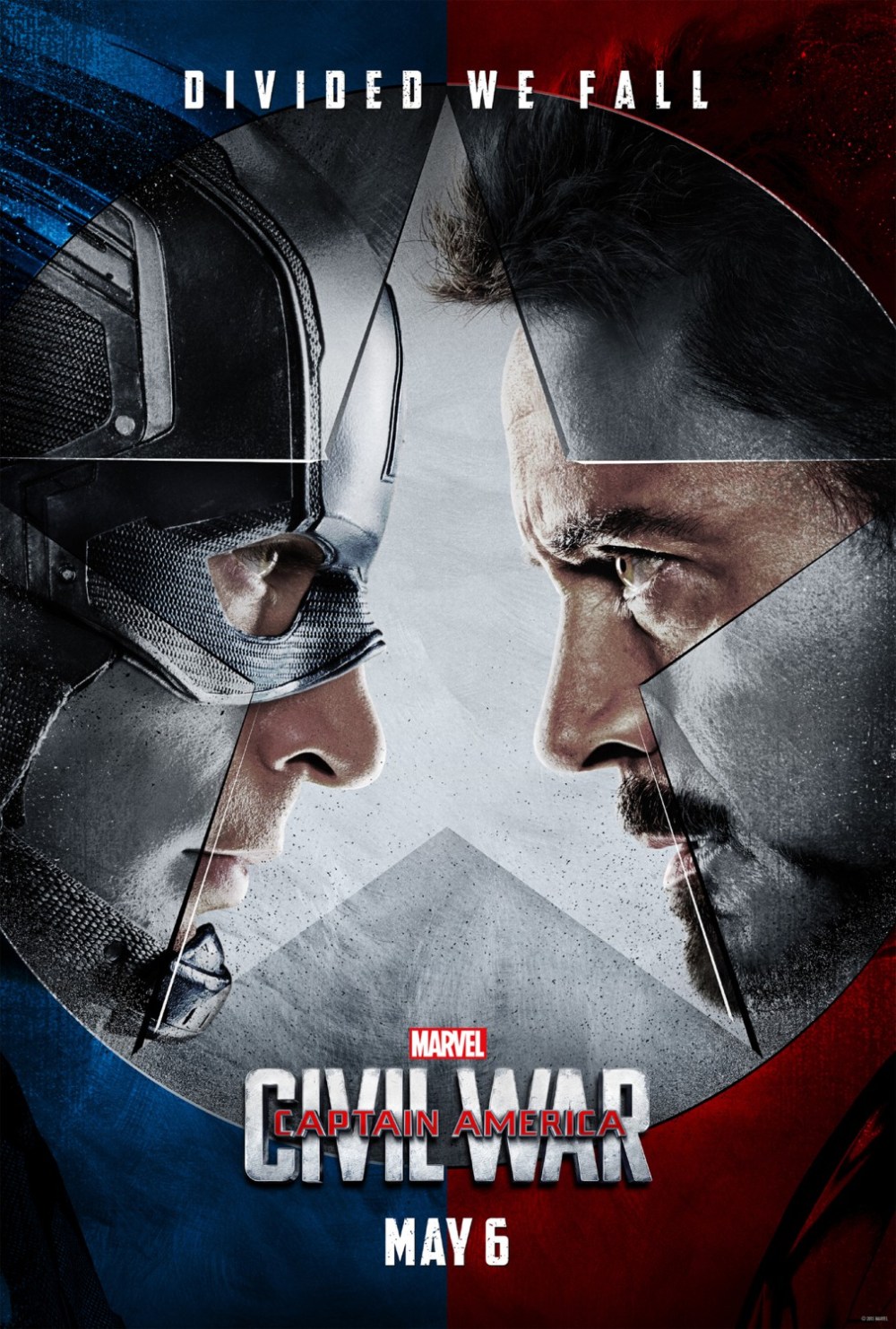
Captain America: Civil War

Captain America Civil War poster

It’s tempting to call this latest Marvel movie “31 short films about The Avengers” as “Captain America: Civil War” manages to cram in so many characters and various storylines into its nearly two and a half hour running in a way which has one wondering why it didn’t burst at the seams. But despite that, it still works as directors Anthony and Joe Russo (who also helmed the superb “Captain America: The Winter Soldier”) manage to balance everything out as they combine tremendous superhero action scenes with thought provoking storylines. Whereas “The Avengers: Age of Ultron” didn’t leave much of an aftertaste, “Civil War” proves to be one of Marvel Studios best offerings to date.

Actually, this really should be called “The Avengers Part 2.5” as many of the Avengers are reunited here with the exception of the Hulk, Thor and Nick Fury. “Civil War” starts off a year after “Age of Ultron” as Captain America and company take on the bad guys but, as usual, cause a lot of collateral damage in the process. As a result, U.S. Secretary of State Thaddeus Ross (William Hurt) informs them the United Nations are working to establish a panel which will oversee and control The Avengers from here on out. Because of these superheroes’ activities, it’s a good guess many insurance companies went bankrupt while cleaning up what’s left of their mess.

What’s interesting about this is the dynamic it sets up between each superhero character. Tony Stark/Iron Man (Robert Downey Jr.) is quick to accept this accord as he is still smarting from his creation of Ultron and the destruction caused in Sokovia. However, Steve Rogers/Captain America (Chris Evans) refuses to sign on as he feels any government interference will hinder what he sees as the right thing to do. This sets up an interesting conundrum as the need to control the Avengers is understandable, but with limits set on what they can and cannot do, this could severely affect their ability to save the world, and we know they will need to save it again sooner rather than later.

In the midst of all this, the United Nations building is bombed and the chief suspect is revealed to be Bucky Barnes/Winter Soldier (Sebastian Stan). But Steve remembers the last time he saw Bucky up close and isn’t sure he’s the evil man everyone else sees him as, and he becomes determined to bring in Bucky himself. But as the movie’s trailers have shown, this will soon erupt into a major conflict for the Avengers as they are forced to take sides to where alliances may be torn apart forever.

We have been submerged in the Marvel Cinematic Universe since 2008 when “Iron Man” was released, and the filmmakers have smartly allowed the characters to evolve from one movie to the next. As much as this is Captain America’s movie, it is also Iron Man’s as we watch his alter ego Tony Stark change his ways, to a certain extent anyway, as he believes the Avengers have done a lot of bad things in the process of saving the world. While he still thinks all too highly of himself, Tony believes the team does need some supervision in order to keep it in line, and this is something he never would have suggested in the previous “Iron Man” movies.

When “Captain America: The First Avenger” first came out in 2011, many expected that the character would be the dullest Avenger as the comics showed him to be a straight arrow and overly patriotic. But with “The Winter Soldier” and “Civil War,” Captain America has become the most interesting character in this cinematic universe as his morality remains strong and unbreakable. A lot of that is thanks to Evans who invests the character with an unshakable pride and thoughtfulness which makes Steve Rogers more authentically heroic than other superheroes currently occupying your local multiplex.

In addition to Iron Man, the other Avengers who turn up include Natasha Romanoff/Black Widow (Scarlett Johansson), Sam Wilson/Falcon (Anthony Mackie), James Rhodes/War Machine (Don Cheadle), Vision (Paul Bettany), Clint Barton/Hawkeye (Jeremy Renner), and Scott Lang/Ant-Man (Paul Rudd). The Russo brothers are smart not to waste time introducing these characters as we have long since gotten to know them and need no explanation as to who they are. It’s great to see them here, and the actors portraying them continue to do excellent work.

As for the new superheroes in “Civil War,” each makes a memorable impression. Chadwick Boseman comes onboard as T’Challa, prince of the African nation of Wakanda who is later revealed to be Black Panther. Boseman imbues his character with a wounded pride which threatens to get the best of him, and he ends up in the middle of the Avengers’ conflict to where he might lose himself in anger and bitterness. The wonderful Elisabeth Olsen also shows up as Wanda Maximoff/Scarlet Witch whose powers include harnessing magic and engaging in hypnosis and telekinesis. Olsen shows us a superhero slowly coming into her own as she is conflicted on how to use the abilities she has been gifted, or perhaps cursed, with, and she makes the character both flawed and sympathetic.

But make no mistake, the big addition in “Civil War” is Peter Parker and his beloved alter-ego of Spider-Man. After the abominable cinematic mess that was “The Amazing Spider-Man 2,” the character has been rebooted yet again, but this time it may prove to be a good thing. Tom Holland now takes on the role of this web slinger and, like Tobey Maguire and Andrew Garfield before him, succeeds in making it his own as he creates a character who is wonderfully cheeky and super enthusiastic. Spider-Man isn’t onscreen a whole lot, but Holland is a big delight as he leaps all over the place with great abandon. Suffice to say, this bodes very well for this character’s future.

“Captain America: Civil War” is what “Batman vs. Superman: Dawn of Justice” promised but failed to be: a riveting motion picture featuring two superheroes who are prepared to fight to the death. It is also an improvement over “The Avengers: Age of Ultron” which, while not bad, failed to live up to expectations. The Russo brothers revel in showing these superheroes doing battle with one another, and they also provide them with a dramatic scenario which will forever test their relationships. I can’t wait to see how the events here will affect the next Marvel movie as the cinematic universe now enters a new phase which looks to be more interesting than what came before. Captain America and Iron Man don’t have mothers named Martha, so it may take a lot for them to get back on the same page.

* * * ½ out of * * * *