Tracy Letts Looks Back on ‘Bug’ at New Beverly Cinema

Tracy Letts photo

New Beverly Cinema concluded their month long tribute to Oscar winning filmmaker William Friedkin with a double feature of “Bug” and “Killer Joe,” movies which allowed him to escape the pressures of big budget filmmaking by going the indie route. Both were based on plays written by Pulitzer Prize-winning playwright Tracy Letts who also adapted them to the big screen, and he was the guest of honor at the New Beverly for this final night of Friedkin. Following “Bug,” he participated in a Q&A with Brian J. Quinn, host of the Grindhouse Film Festival. Quinn’s first question was how Letts first came up with “Bug,” and Letts took us back in time to when the play was first conceived and of how Michael Shannon was involved.

Bug movie poster

“Where it came from is what I’m puzzling about myself right now,” Letts said. “I had written ‘Killer Joe’ in 91, it got produced in 93, and that production wound up going to the UK. The Gate Theatre in Notting Hill (where it was put up) asked us for another show. The group for ‘Killer Joe’ were interested in working again, so I wrote quickly and I wrote the role of Peter for Mike (Shannon). Mike had played Chris in my production of ‘Killer Joe’ and was such a great actor. We took it to the Gate Theatre and the play wasn’t worked out. It took a long time and a lot of productions for me to work out some of the problems with it, but Mike played Peter not only in the London production but in the subsequent production in Chicago where I continued to work on it. And then the play went to the Barrow Street Theatre in New York in 2005, and Mike had been with the play for a number of years at that point.”

“Bill Friedkin saw the play in New York and he called me out of the blue,” Letts continued. “I had never met him or spoken to him and I thought it was a prank actually, but he had seen the show. He actually said, ‘I don’t actually think this is a movie. I just wanted to tell you that I am a fan of your writing and I think it’s great.’ And he called the next day and said, ‘Maybe it is a movie. Why don’t you come out here to LA and talk to me’ So I flew to Los Angeles and I met Bill at his home for the first time. He said, ‘I think it is a film. The more I think about it, it seems very cinematic to me.’ I said I would love to work with Bill Friedkin but it’s a claustrophobic piece. It doesn’t really make a lot of sense to open it up and have these disturbed people out in the world. And he said, ‘First, do no harm. I love the play and I have a way to make the play cinematic, so let’s work on the screenplay.’ And we did.”
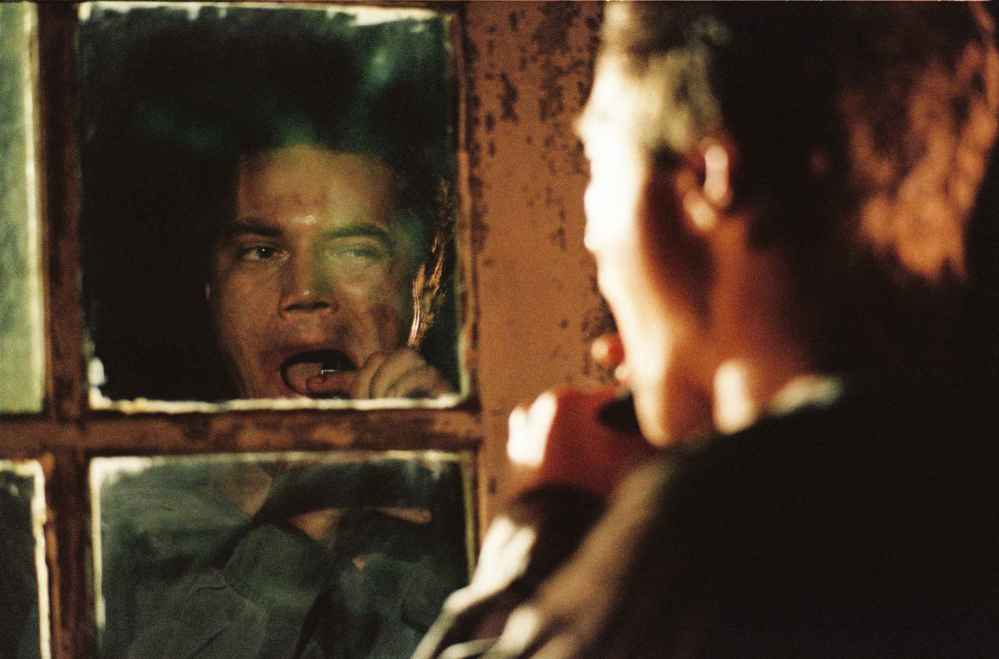
Bug Michael Shannon and his teeth

Now while Shannon is well known these days for his work in movies like “99 Homes” and “Man of Steel,” he still had yet to make his big cinematic breakthrough. That would come a few years later in Sam Mendes’ “Revolutionary Road” which earned him an Oscar nomination for Best Supporting Actor, but there was no forgetting who he was after watching “Bug.” Of course, getting the actor cast in the movie was a challenge, but Letts explained how Friedkin championed for him.

“Billy fought really hard for him,” Letts said. “The people who were financing the film had no interest in using Mike, but Billy just insisted. He had seen Mike do the play live, he knew how powerful Mike was in the role, and he knew the role was written for Mike. And Billy actually had a lot of experience casting a lot of unknowns in movies: William L. Petersen in ‘To Live and Die in LA’ was his first big break, Linda Blair and Jason Miller in ‘The Exorcist.” I’m really glad he did (fight for Mike) because among the many pleasures of the film is the fact that Mike’s extraordinary stage performance was preserved on film. The freak out scene where he’s flopping and having a seizure on the bed, he used to do that on stage eight times a week.”

“Bug” was not a big hit when it arrived in movie theaters back in 2007. Part of this was due to competition from summer blockbusters, but it was also the result of what Letts called a terrible marketing campaign. While “Bug” looks like a horror movie, it is at its heart a psychological thriller and a character study. Still, studio executives in their infinite wisdom were convinced they knew what they were doing.

“Lionsgate decided that they were going to do a big opening and they were gonna just try and lure the kids into it like it was ‘Saw’ or ‘Hostel,’” Letts said. “They opened us up on 1,600 screens and they opened it in the summer opposite ‘Pirates of the Caribbean: At World’s End’ on Memorial Day weekend. Billy had begged them not to do this. We said please don’t open this movie on 1,600 screens. We said this was a terrible mistake; we should open it small and let it build its audience. But they just insisted and ran these terrible trailers on TV with the announcer going, ‘They live in your blood. They feed on your brain.’ So the horror movie kids came in and they hated it, and the people who would have enjoyed the movie didn’t come because they thought it wasn’t their cup of tea. So it just died a terrible death unfortunately.”

Letts also talked about Friedkin and of how he makes a movie. Because this was a low budget feature, its shooting schedule was very short and Friedkin was in no position to be like Stanley Kubrick or David Fincher and do 70 takes of the same scene. Letts also took the time to demystify Friedkin’s reputation.

“Billy shoots quick,” Letts said of Friedkin. “He starts work early in the morning at four o’clock, he’s done and goes home. He brags about the fact that he only shoots one take. That’s not quite true. He will shoot something else if light falls into the shot. Mike used to ask him for another take and Billy said, ‘What, you got stock in Eastman Kodak?’”

Bug Ashley Judd

“Bug” proved to be an emotionally raw cinematic experience and is almost as unnerving as Darren Aronofsky’s “Requiem for a Dream.” Both Shannon and Ashley Judd give some of their best performances ever, and Friedkin succeeds in stretching this play beyond its claustrophobic staging to give us something which slams us back into our seats and never lets us go for a second. It was a real treat for the New Beverly audience to have Tracy Letts come down and talk with us. In his heart he still feels like a Chicago theatre guy more than anything else, but along with Friedkin he made a pair of movies which fearlessly went against what was mainstream, and we need movies to go against the grain every once in a while.

Bug movie poster 2

Copyright Ben Kenber 2016.


Save

America: Imagine the World Without Her

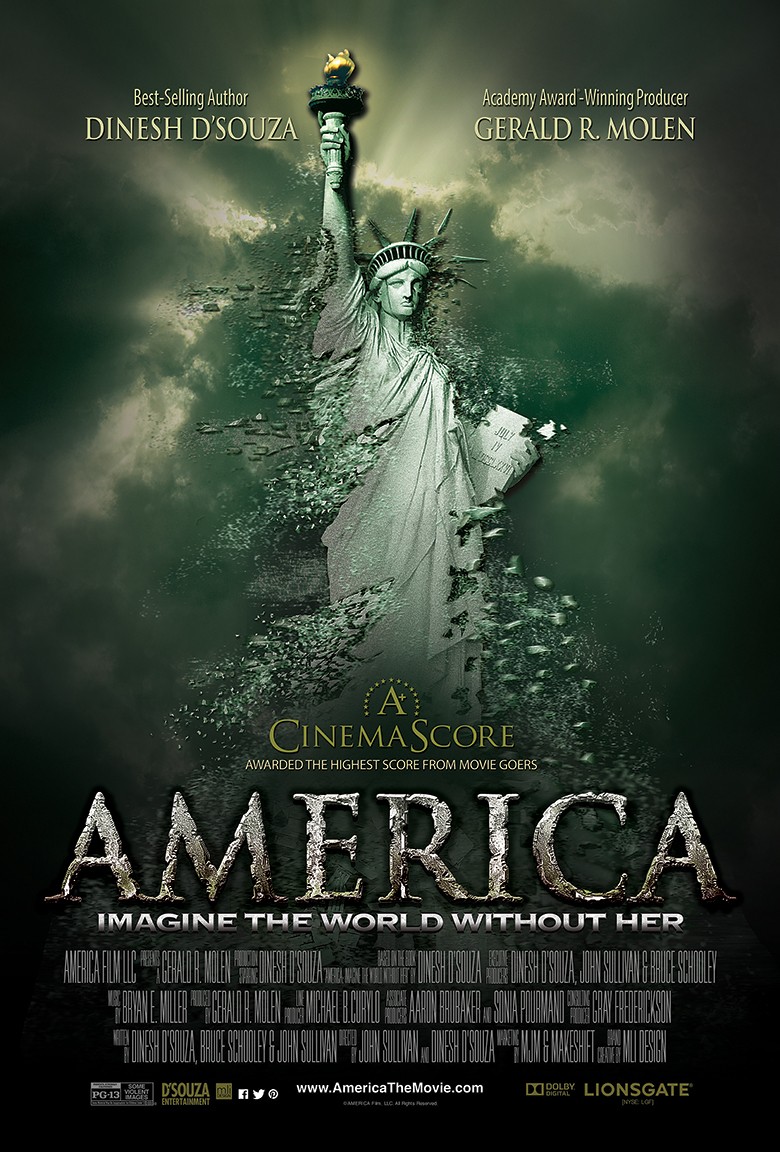
America Imagine the World Without Her poster

Is it even possible to write a review of Dinesh D’Souza’s documentary “America: Imagine the World Without Her” without seeming the least bit biased? Many who have slammed it have been greeted by comments accusing them of being blinded by President Obama’s “socialist” brainwashing, and those who praise it get accused of watching Fox News too much among other criticisms. Is there any way to view this documentary in an objective manner? Moreover, will anyone allow those who have seen it to review it in an objective manner? Well, I’ll give it a shot, but I can already see a number of comments coming my way which are both good and bad.

“America: Imagine the World Without Her” starts off with D’Souza meditating on what this country would have been like had George Washington been killed on the battlefield, and it is followed by images of institutions like Mount Rushmore, the Statue of Liberty and the Lincoln Memorial vanishing into dust. From there, he explores the dark history of America and a number of well-known individuals whom he believes have done nothing more than shame America rather than looking at what makes it one of the best countries on Earth.

“America” gets off to a shaky start because, from its trailers, the movie looked to present an alternate reality of what the country would look like if George Washington died early on, but he all but drops this concept and instead goes on a different path. If that was the case, then why did he bring up this scenario if he never intended to explore it? Maybe he came to the conclusion that a number of different things could have happened as a result, and to narrow it down to one would be difficult if not impossible.

Now D’Souza makes it perfectly clear he loves America, and I have no doubt of that. Furthermore, I would never dream of taking his love of America away from him as it has given him much success. Having said that, there is an overabundance of shots throughout of him staring at various monuments like the White House, the Marine Corps War Memorial (a.k.a. the Iwo Jima Memorial) and Mount Rushmore which we see him looking at as if he is desperate to make his love for the United States absolutely clear and without doubt. But after a while it becomes a self-indulgent nuisance to where we want to yell at the screen, “We get it! You love America! Enough already!”

D’Souza then takes an overview of America’s dark history and uses it to criticize a number of people (particularly on the left side of politics) whom he believes have used these historical events to shame the country and make it look like an evil place. From there, his intent is to refute much of what we have been taught about American history and to demonize those he believes have taken away from this country and empowered others who are a threat to it. He does this by using old news footage, historical reenactments with notable figures like Abraham Lincoln and Frederick Douglas and interviews with experts who tell D’Souza more or less what he wants to hear.

Regarding the historical reenactments, they come across as very bland and boring and are seriously lacking in any depth. The acting is pedestrian, the staging lacks much in the way of excitement, and the special effects are ridiculously cheap. There’s even a scene where we see Christopher Columbus’ three ships, the Nina, the Pinta and the Santa Maria, sailing towards America, and it looks like someone just put three toy boats in a river and filmed them. You’d figure a documentary produced by Gerald R. Molen, a man who produced many of Steven Spielberg’s movies including “Jurassic Park” and “Minority Report,” would have higher production values to work with, but that’s not the case here.

When it comes to the genocide of American Indians, D’Souza claims much of it was the result of different Indian tribes attacking one another over land. Granted, there is some truth to this as we have seen this conflict portrayed in movies like “Dances with Wolves” and “The Last of the Mohicans,” but this argument carries only so much weight and D’Souza only skims the surface. He gives the audience a lot of graphics you would find in a power point presentation, but it all comes off like a copy of Cliff Notes which might give you just enough information, but not everything you need to hear.

On top of this, D’Souza claims the majority of Indians lost their lives because of diseases. It was at this point I started to get confused as to what D’Souza was trying to get across. Was he saying the Indians were more susceptible to diseases than others? What life has taught me is that diseases do not discriminate like humans do. As a result, what D’Souza ends up implying with this assertion feels not only baseless but completely out of line.

As for how he deals with slavery, I have to give D’Souza some credit because even he admits it was not just a problem in America but in other countries as well. But then he goes into how certain blacks, before slavery was abolished, owned slaves as well, and he brings up the story of C.J. Walker who became known as the first female self-made millionaire in America and of how she made her fortune through a successful line of beauty products for black women. On one hand it’s interesting to learn about Ms. Walker, but I wondered what D’Souza was trying to prove here. Is he saying slavery was nowhere as bad in America as it was in other countries? Looking back, I got the impression he really glossed over the barbaric treatment many slaves received. He also describes the abolition of slavery as being “uniquely western,” but considering how it had its roots in European urban culture and that the Atlantic slave trade came to an end before American slavery did, this is not altogether accurate.

Things in “America” get worse as D’Souza defends capitalism by showing a scene where we see multiple versions of him running a fast food joint and cooking hamburgers. This is a moment where he could have had some fun with his own image, but he ends up taking himself too seriously and comes off as unintentionally goofy. Furthermore, he talks about how ordering a hamburger from his faux restaurant is cheaper than making one at home with the same ingredients. This is a weak argument as I have visited many fast food joints and none of the burgers came close to equaling the price D’Souza was offering for his.

D’Souza even says America’s wealth was created and not stolen and that colonial Manhattan was purchased from the Indians for $700. Considering there is much evidence available on how the Indians, a people never to be mistaken as immigrants, were driven from their lands and killed, I can’t help but wonder if they sold this land by choice or under duress. While I was watching this segment, I was reminded of what comedian Bobcat Goldthwait once said:

“America is one of the finest countries anyone ever stole.”

D’Souza then directs his ire at a number of “leftists” such as Saul Alinsky, Hilary Clinton, Matt Damon, Howard Zinn and President Barack Obama. The way he sees it, they are responsible for exploiting the dark moments of American history and for attempting to rewrite it for their own benefit. It is from there that “America” becomes nothing more than a propaganda piece designed to deliver a lot of fear-mongering to the masses.

Look, I have no problem with Americans criticizing President Obama when it’s within reason, but many of D’Souza’s criticisms feel like they are based on deep seated fears rather than actual facts. When “America” begins, he says the three things he feared would happen under an Obama administration did happen, but those things are still open to debate as President Obama did get elected to a second term.

But D’Souza’s sights are set mostly on Hilary Clinton as he sees her as being subverted in her early years by leftists and socialists who forever corrupted her worldview, and the way he presents Hilary in a series of reenactments reeks of shameless manipulation more than anything else.

Another public figure who gets dragged over hot coals is Saul Alinsky, the legendary community organizer and writer. D’Souza portrays him as the devil in disguise and attempts to use his own words against him. He even goes out of his way to say Alinsky learned many things from Lucifer like strategies for demonization and polarization. In retrospect, the way D’Souza portrays Alinsky makes the community organizer come across as a one-dimensional villain in your typical action flick. I imagine there is more to Alinsky than what we see here, but to tell us more might take away from D’Souza’s overall argument which was pretty weak to begin with.

But perhaps the most unintentionally hilarious moment comes when D’Souza brings up how he was indicted for making illegal political contributions to a 2012 United States Senate campaign. He ended up pleading guilty to this and doesn’t deny that he committed a crime, but it all leads to a staged shot of him sitting in a holding cell with handcuffs on. The way D’Souza sees it, he’s a victim of persecution by the government due to the success of his documentary “2016: Obama’s America.” Now whether or not D’Souza was a victim of selective prosecution was up for debate, but this staged moment proves to be so shameless that it comes across as completely self-serving. Considering he knowingly committed a crime which he plead guilty to, does he really have the right to play the victim card?

Looking back at “America: Imagine the World Without Her,” my reaction to it isn’t all that different from how I react to a Michael Moore documentary. Their movies make me want to do a lot of research into the subject matter they deal with to see how accurate they are to the facts and to see what else I could possibly learn about America in the process. Many accuse Moore of playing loose with the facts, but if that’s true then D’Souza isn’t any different.

D’Souza and his co-director John Sullivan came into “America” with a lot of passion which does come across onscreen, but it is still filled with illogical arguments which don’t carry much weight. While he accuses others of trying to rewrite history, he ends pretty much does the same thing here. The movie is also weighed down by poorly directed reenactments which don’t leave much to the imagination, and D’Souza spends his time onscreen implying things rather than proving them. Seriously, if he were to turn all this in as a term paper, he would have ended up with an F or a D- if he was lucky.

I always thought it was incredibly difficult to make a bad documentary, but D’Souza and Sullivan prove it is possible with “America: Imagine the World Without Her.” In the end, the criticisms this movie receives will matter very little as it has been embraced by the crowd it was made for. But none of this changes the fact this is a poorly made film which has little to show for its arguments, and it exists as nothing more than a boring propaganda piece. D’Souza is free to make the movies he wants to make, but next time he’s got to make arguments which stand up to scrutiny and get a better understanding of American history.

* out of * * * *

Copyright Ben Kenber 2014.

Save

The Duel

The Duel poster

The Duel” is one of those movies that wants to generate tension you can feel simmering below the surface, but it doesn’t come to life until it is much too late. It’s a shame because it features a pair of mesmerizing performances that are offset by a weak one, and its last half really does keep you on the edge of your seat. Everything leading up to that, however, is undone by a dullness that infects the whole proceedings.

The movie starts off in the year 1866 as young David Kingston watches his father get killed in a knife duel by Abraham Brant (Woody Harrelson), and then it moves to 20 years later with David (now played by Liam Hemsworth) a man and serving as a Texas Ranger. David gets assigned to investigate a series of murders and disappearances that have taken place in an Old West frontier town named Helena, and he reluctantly brings along his wife Marisol (Alice Braga) who doesn’t want to wait for him to return home. It is there that he becomes reacquainted with Abraham who is the town’s preacher and manages to keep the people there in a fearful grip. You should have a pretty good idea of where the story will go from this description.

The setup of the story is reminiscent of Martin Scorsese’s “Gangs of New York” which had Leonardo DiCaprio avenging his father’s death at the hands of Daniel Day Lewis, and “The Duel” looks to travel that same path. The problem is that director Kieran Darcy-Smith and screenwriter Matt Cook are not entirely sure how to reach the expected climax with David and Abraham fighting to the death. There are also many questions the movie raises and never answers in a satisfying way, and it really should not have taken long for Abraham to realize who David really is. As a result, the movie never comes to life until we get past the halfway point.

The best thing about “The Duel” is Woody Harrelson who, at this point in his career, can play just about any character he wants to whether it’s in a comedy or a drama. Right from the start, he is a menacing presence as he stares down into everybody’s soul and manages to put the town under a hypnotic spell. Harrelson has played his share of bad dudes before in movies like “Natural Born Killers,” “Out of the Furnace” and “Rampart,” and Abraham Brant is another he can add to his ever-growing resume. Harrelson may have made his Hollywood breakthrough playing a dim-witted bartender on “Cheers,” but watching him in “The Duel” makes that seem like such a distant memory.

Another strong performance comes from Alice Braga as Marisol, David’s wife who falls under Abraham’s spell to where you really want to kick David for leaving her alone so much. Braga is riveting as she takes Marisol from a strong-willed woman to one who is under the grip of something she is desperate to get control over. This is not some stock female character that can be found in your typical western movie, and Braga makes that very clear throughout.

But then there’s Liam Hemsworth who is simply miscast as David Kingston. It’s not that he isn’t believable as a Texas Ranger, but that he shows no real acting range in the role. In many ways he gives an emotionless performance, and it would have been better if another actor equal to Harrelson were cast in his place. Hemsworth just doesn’t bring much to the part, and the movie suffers considerably as a result.

For what it’s worth, Darcy-Smith does a very good job of transporting the audience back to the 1880’s as everything we see feels authentic to the era. He also jacks up the tension considerably in the last half as David and Abraham try to outsmart one another in the barren fields outside of town, and there’s a taut scene where the two face off in the town’s bar. It’s a very effective moment as the anticipation of guns going off becomes unbearably strong, and we can’t be sure of who is going to walk out of there alive.

Indeed, there are many things to like about “The Duel” from its production values to its performances, so it is frustrating to say that it really disappoints. The filmmakers may have wanted to emulate the great and gritty westerns of the past like “The Wild Bunch” or any starring John Wayne, but it can’t hold a candle to them. They are many who say that the western is dead, but no genre ever really dies. But after watching “The Duel,” it does feel like it needs a lot of reenergizing.

Copyright Ben Kenber 2016.

* * out of * * * *

Daniel Radcliffe goes undercover in ‘Imperium’ trailer

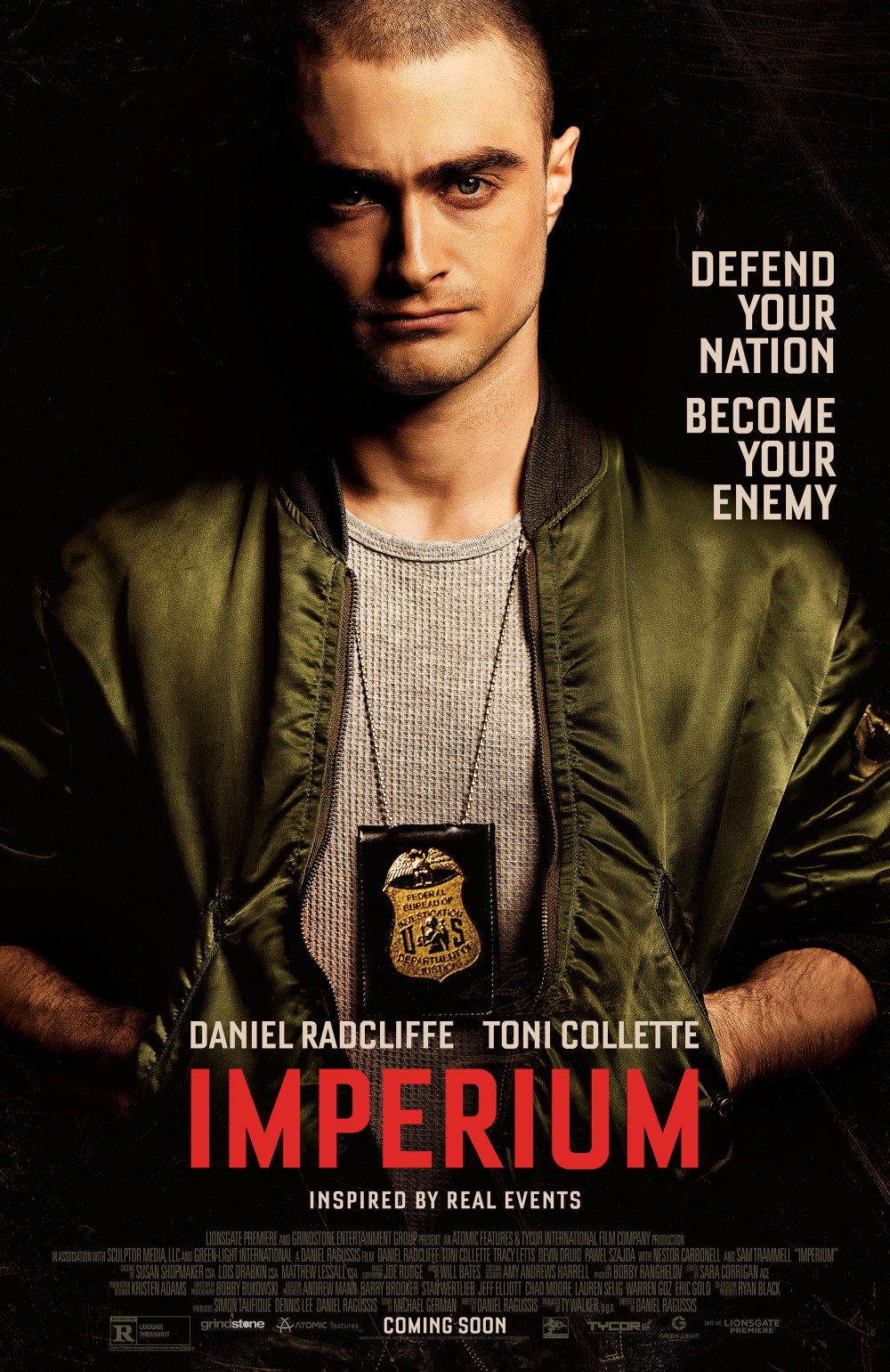
IMPERIUMfinalposter

Lionsgate Premiere has released the first trailer for their upcoming thriller “Imperium.” It tells the tale of an idealistic FBI agent (is there any other kind?) assigned to go undercover and infiltrate a radical right-wing terrorist group that is in the process of creating a dirty bomb to set off in a public place. The trailer makes the movie look like something along the lines of “The Departed” or perhaps even “Reservoir Dogs” as those two featured characters who went deep undercover into the criminal lairs of others and almost lose themselves in the process. It is said to have been “inspired by real events,” and it’s a relief to see that phrase instead of “based on a true story.”

But even though “Imperium” looks like an average thriller on the basis of what we see in the trailer, it does have one major selling point: Daniel Radcliffe. While we will always recognize him as Harry Potter, Radcliffe has long since proven there is so much more to him than J.K. Rowling’s infinitely popular character. Ever since “Harry Potter and the Deathly Hallows – Part 2,” he has portrayed a variety of characters that include Allen Ginsberg in “Kill Your Darlings,” Ig Perrish in “Horns,” a conniving individual in “Now You See Me 2,” and a corpse in “Swiss Army Man.” His role as FBI agent Nate Foster in “Imperium” is the kind we have not seen him play before, and that makes what we see in this trailer especially interesting. While the story is a familiar one, it will be fascinating to see what he does here. And perhaps this movie will shed more light on the fact that right wing and Neo-Nazi terrorists represent a bigger threat to the United States than foreign terrorists do.

Also starring in “Imperium” is Toni Collette who plays Angela Zampino, Nate’s superior officer who will help him with his infiltration into this terrorist group. Nate complains throughout the trailer of how he is in over his head, but Radcliffe shows him to be a dedicated agent who will see the job through even if he comes out of it a completely different person. But it also shows how others will be infinitely suspicious of his intentions from one moment to the next.

”Imperium” marks the feature film directorial debut of Daniel Ragussis, and it is set to open in theaters and On Demand August 19, 2016. By the way, imperium is a Latin word which translates roughly as power to command. Check out the trailer below!

Copyright Ben Kenber 2016.


Marauders

MARAUDERS final poster

Watching “Marauders,” I kept wondering how this movie even went into production as the screenplay needs a lot more work. It does have some strong action scenes and the cast for the most part does good work, but the plot becomes so amazingly convoluted that it didn’t take long for me to give up following what was going on. Perhaps the filmmakers wanted to keep you guessing as to who was up to what, but you have to give a damn about the characters for that to work. What we have instead are cardboard cutouts from every other cop drama ever made, and they occupy a movie too brutal and nihilistic to be the least bit enjoyable.

Marauders Day 2 everything-412.dng

Robbing the bank

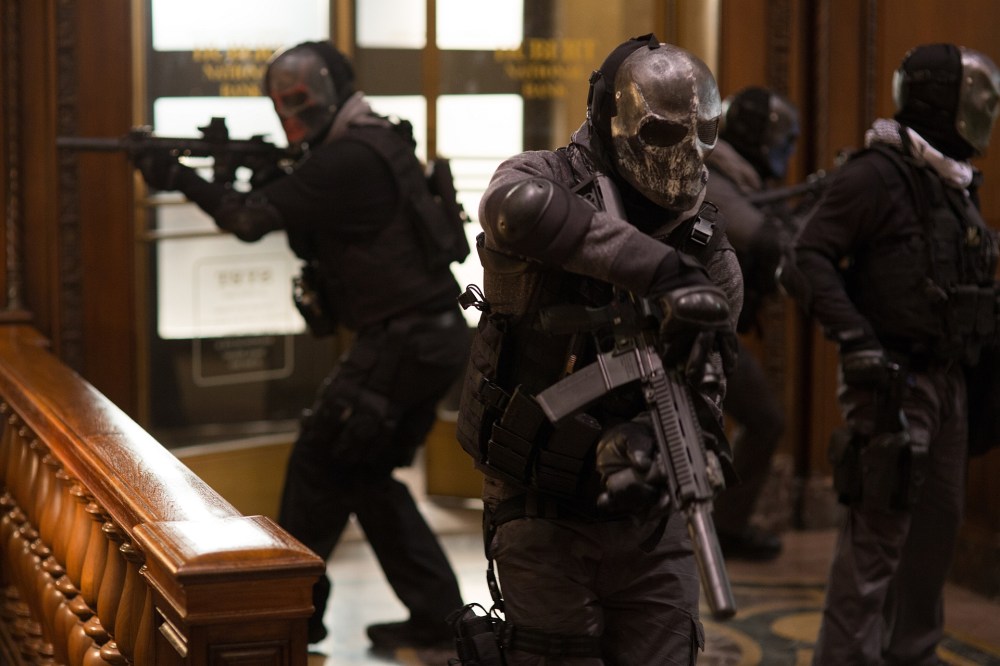
The movie starts off with a bank robbery where the thieves wear these scary looking masks and use a Siri-like device to give orders to the customers and employees. It’s actually a very clever setup as it looks like these thieves have done their homework and have succeeded in covering their tracks. At the same time, “Marauders” announces loudly, thanks in part to a booming industrial film score by Ryan Dodson, that it is going to be a brutal ride. It’s brutal alright, but brutal doesn’t automatically equate to entertainment.

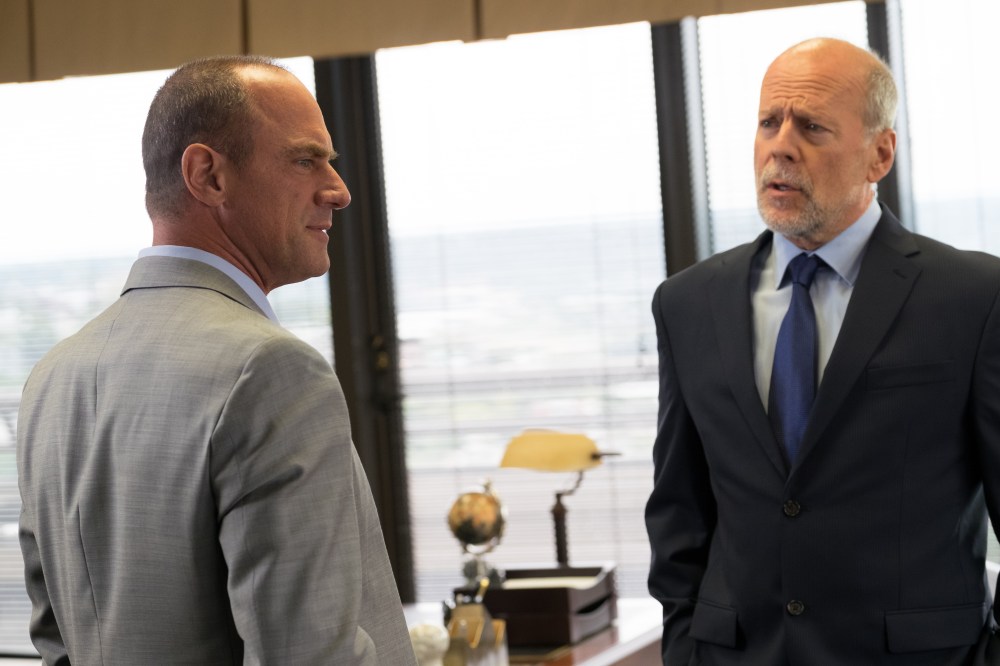
From there we meet a group of FBI agents played by Chris Meloni, Dave Butista and Adrian Grenier who study the crime scene the way cops and FBI agents do in movies and the evidence points to the bank’s owner, Jeffrey Hubert (Bruce Willis), and his high powered clients as the culprits. Jeffrey treats things and people the way he runs his bank, in an exceedingly cold fashion. Oh yeah, Meloni’s character is a widower who still plays around with his wedding ring and listens to voice messages his wife left him. Grenier plays a newbie to the FBI team, so of course he’s going to be seen as the rookie who has yet to learn how things really work in law enforcement. As for Butista, he plays a seen-it-all kind of guy whose work has long since wiped the smile off his face. You know, it’s the usual cast of characters.

Perhaps I am asking too much of “Marauders” or came into it expecting a fresh take on the heist movie. A movie like this isn’t required to reinvent the genre, but it would have helped if the plot made the least bit of sense or gave us characters who you give a damn about. The term marauder refers to a person involved in banditry, piracy, looting, robbery or theft, and after a while it seems like everyone here is one whether they wear a mask or not. Alliances keep shifting to where the screenplay has plot holes as big as the sinkhole which recently opened up on Contra Costa Boulevard in Northern California.

Marauders Day 1-0837.dng

Then there’s Bruce Willis whose career continues to take a nosedive as he has been reduced to appearing in VOD releases like this, “Precious Cargo,” “Vice” and “Extraction.” Looking at his face, he seems so disinterested to even be in “Marauders” to where I can’t help but think he did this film just for the money. Heck, he’s barely even in it and is only top billed because he is still considered a big time movie star. Is there anything notable to say about Willis’ appearance here? Well, he does have some hair on his head for a change…

For what it’s worth, Meloni does turn in a strong performance as the widowed FBI agent Jonathan Montgomery. It’s a role not unlike the one he played for years on “Law & Order: Special Victims Unit,” and he gives Jonathan a gruff don’t-mess-with-me demeanor that few are foolish to question or challenge. It’s also cool to see Bautista here as he proves that there is more to him than just being another action hero or a Bond villain. As for Grenier, he’s also good even though his character is essentially a Johnny “Point Break” Utah wannabe who you know is going to mess up on the job at least once.

untitled shoot-4942.dng

Adrian Grenier

But good performances are not nearly enough to save this mess of a movie which goes in all sorts of directions without ever reaching a satisfying conclusion, and the tone is so vile that there’s not much enjoyment to be had. Director Steven C. Miller may have wanted to pay homage to all the great heist movies like Michael Mann’s “Heat,” but it never comes close to reaching greatness. Instead, it leaves a vile aftertaste and you come out of feeling very unclean. A good long shower is mandatory if you bother to sit through this whole thing.

Seriously, “Marauders” is the equivalent of all those straight to video movies that used to pop up at the video store all the time, but it’s not even enjoyable on a “so good it’s bad” level. One has to wonder if Lionsgate had any interest in making a good heist movie when the script for this came along. Perhaps they figured that with stars like Willis and Meloni, the movie would turn a profit even if people hate it. Then again, movies like this one do have “don’t bother” written all over them, so hopefully its target audience will watch “Captain America: Civil War” for the seventh time instead.

* ½ out of * * * *

Copyright Ben Kenber 2016.