History Repeats Itself to a Depressing Extent in ‘Jurassic World: Fallen Kingdom’
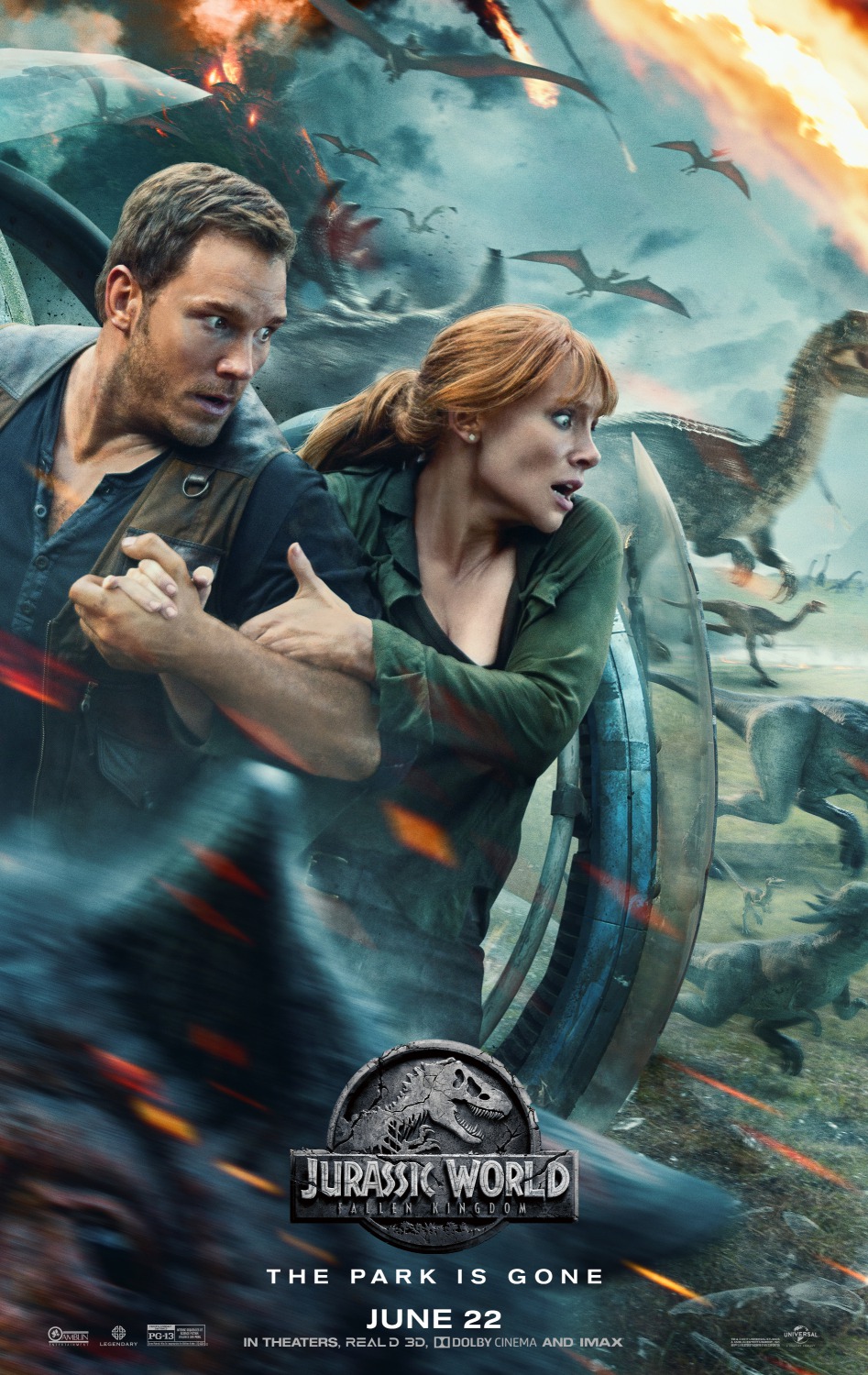
Jurassic World Fallen Kingdom movie poster

Remember the scene in “The Lost World: Jurassic Park” where John Hammond told Ian Malcolm they were not going to make the same mistakes, and Malcolm quickly replied they were going to be making new ones? Well, “Jurassic World: Fallen Kingdom” doesn’t make new mistakes and instead repeats the old ones as the humans once again try to save the once extinct species in way we have all seen before. Yes, the visual effects are fantastic, but everything else feels astonishingly banal as nothing new is brought to the franchise. As for the storyline, it simply shows history repeating itself, something we see happen in the real world more often than not.

Three years have passed since the events of “Jurassic World,” and the theme park has been left in ruins. Now an active volcano threatens to destroy what’s left of the dinosaurs, and those in the government debate whether it is worth the trouble to save the species from becoming extinct again. Ian Malcolm (Jeff Goldblum) argues it would be best for the volcano to destroy the dinosaurs as he sees this as nature’s way of correcting the mistake Hammond made in cloning them years ago. Meanwhile, Claire Dearing (Bryce Dallas Howard) has formed the Dinosaur Protection Group in an effort to save them. When the U.S. senators do not come through for her, she finds a savior in Sir Benjamin Lockwood (James Cromwell), Hammond’s partner in developing the technology to clone dinosaurs, who is intent on moving the dinosaurs to an island where they will have zero interaction with humans. Of course, this also means she will have to acquire the services of her ex-boyfriend, Owen Grady (Chris Pratt), in the effort to rescue them.

Okay, the “Jurassic” movies have never been heavy on complex characters as the attention is focused mostly on the dinosaurs. The reasoning is understandable, but I have grown weary of letting the filmmakers get away with weak characterizations which are always upstaged by the special effects. Howard and Pratt are fun to watch in anything the appear in, but their talents are wasted as their characters are relegated to the romantic will-they-or-won’t-they scenario which will all know will end with them kissing passionately as they can only fight their intense feelings of love for so long.

The screenplay by Colin Trevorrow and Derek Connolly proves to be “Fallen Kingdom’s” biggest stumbling block as it takes the story of “The Lost World” and follows it to the letter to where the twists and turns the story takes are not the least bit surprising. As I’m sure you have derived from the trailers, the plans to move the dinosaurs to another island are thwarted by a team of mercenaries led by Ken Wheatley (Ted Levine) and Lockwood’s slimy right-hand man Eli Mills (Rafe Spall) who looks to sell the dinosaurs to the highest bidders. You would think after all these movies humans would realize they can never fully control what they have created, but when dollar signs are involved, common sense and morality always take a backseat to greed.

Actually, some characters here had interesting potential which the filmmakers really could have built on. Eli Mills, thanks in large part to Rafe Spall, wins the audience over as he does Claire when he tells her of the plan to save the dinosaurs, but he is later revealed to be a slimy bastard as he looks to profit off them instead. Spall has described Eli as being a victim of high ambitions and of allowing himself to believe he is doing the right thing. He has been entrusted with securing the financial future of the Lockwood estate, and he feels this is the only way he can do it. Still, the character eventually becomes a one-dimensional baddie whom the audience is made to hate, and it got to where I kept waiting for him to say, “Hey look at me! I’m dino-meat!”

The same goes with Gunnar Eversol who is played by Toby Jones. Gunnar is the auctioneer who sells off the dinosaurs, and Jones has compared him to a rogue arms dealer who is morally neutral about the work he is doing. This could have made for an especially fascinating character, but alas, Jones is given only so much to do here as Gunnar is designed to be an appetizer for the “Jurassic” franchise’s newest dinosaur, the Indoraptor. Considering how morally neutral Gunnar is, it would have made more sense for him to take his fate as though he saw it coming instead of screaming like he doesn’t deserve it.

B.D. Wong returns again as Dr. Henry Wu, the chief geneticist of the Jurassic theme parks. Wong plays Henry as a man whose love for science is as big as his own ego, and he is a welcome presence in this deeply flawed sequel. But like the other characters, Henry is given short-shrift to where he just ends up acting like a one-dimensional jerk.

There are some new characters added to the mix such as Dr. Zia Rodriguez, a Marine veteran and a paleo veterinarian, played by Daniella Pineda. Pineda makes Zia into a quirky presence throughout, but the character feels half-realized never fully human. As for Justice Smith, his character of hacker and systems analyst Franklin Webb is this sequel’s most annoying as runs all over the place screaming as if we couldn’t already tell how unprepared he is to be around dinosaurs. I kept wanting to slap Franklin in the face and tell him to grow a pair as his whining made this sequel even more frustrating than it already was.

It is great to see Jeff Goldblum back as Ian Malcolm, one of the most popular and fascinating characters in the “Jurassic” franchise, but his appearance here is a mere cameo as he serves to bookend “Fallen Kingdom.” This is a real shame as the speeches he gives offers us a glimpse at what this sequel could have been: a look at humankind’s abuse of various powers, and at the possibility of if and how humanity and dinosaurs can co-exist. As he makes clear how Jurassic World is no longer the name of a theme park, but of the times humanity now lives in, we are reminded of the opportunities this sequel lost out on exploring.

And yes, there is the little child character named Maisie Lockwood played by Isabella Sermon who constantly sees through the deceptions of the adults and manages to outwit the dinosaurs chasing her. Of course, seeing her being smarter than the adults quickly becomes exasperating, and that’s even though this kind of character serves to remind adults of why they need to listen to children more often. Remember the child from Terry Gilliam’s “Time Bandits” who told his parents “don’t touch it, it’s evil” and they did anyway? Well, you get the picture.

I couldn’t help but walk into “Jurassic World: Fallen Kingdom” with high expectations as it was directed by J.A. Bayona, the Spanish film director who gave us “The Orphanage,” “The Impossible” and “A Monster Calls.” “The Impossible” had an especially profound impact on me as he depicted the devastation of 2004 Indian Ocean tsunami in a way to where I felt I experienced and survived it along with the characters. I guess I was hoping he would bring that same cinematic power to this long-running franchise, but his efforts do little to improve this sequel’s poor story and screenplay.

For what it’s worth, Bayona does give us some memorable moments. The scene where the characters observe one of the vegan dinosaurs crying out to be rescued as the volcano lays waste to Isla Nublar is truly heartbreaking, and the moment where the Indoraptor stalks the helpless Maisie in a sequence which evokes “Nosferatu” as the dinosaur stretches his creepy claws out is wonderfully chilling. I also loved how Bayona started this movie off in near silence as it opens in an underwater environment. It is times like this where I am reminded of how silence is golden, and I was hoping he would use it to his advantage. But as many sequels go, this one is noisy as hell and is at times undone by Michael Giacchino’s overambitious score.

“Jurassic World: Fallen Kingdom” is not this franchise’s worst installment (“Jurassic Park III” still holds that honor), but it is pretty close. “Jurassic World” managed to do the impossible which was bring back much of the awe and wonder from Spielberg’s 1993 classic, but this one finds those things sorely missing to where I wondered if there was ever enough of a reason to make another sequel other than money. What we get here is the same old thing, and the results are depressing as its storyline points out how humans will keep making the same mistakes over and over again as they refuse to learn from history. It left me wondering who would be better off here, the humans or the dinosaurs. As I left the theater, I kept thinking about what Ellen Ripley said in “Aliens:”

“You know, Burke, I don’t know which species is worse. You don’t see them fucking each other over for a goddamn percentage.”

Ripley had a really good point there, and this line was also proof of how James Cameron could come up with good dialogue when he put his mind to it.

* * out of * * * *


‘Jurassic World’ Resurrects a Decades-Old Franchise with Fresh Blood

Jurassic World movie poster

I still vividly remember when “Jurassic Park” came out in 1993. I was in high school back then, and many of my friends got to see it before I did. Their reactions always stayed with me as they described how thrilling a movie it was. One guy kept holding his arm intensely and kept saying, “It steamed the glass!” I would later find out what he meant when I saw the movie a few days later, and it was quite the thrill ride as well as groundbreaking in terms of special effects. Steven Spielberg delivered us the kind of blockbuster he had been delivering to us since he made “Jaws” all those years ago, one which is thrilling and fills you with wonder and awe.

It was later followed by “The Lost World: Jurassic Park” which was more of the same but fun if you could get past the fact that Spielberg pretty much directed in on auto pilot. As for “Jurassic Park III,” a better title for it was “300 special effects in search of a screenplay.” Now we have “Jurassic World,” the latest sequel in this franchise which arrives over a decade after the previous installment. While there’s little chance in recapturing the wonder of the original, this sequel still proves to be a fun time at the movies.

Intended as a direct sequel to “Jurassic Park,” “Jurassic World “shows us how the island of Isla Nublar has long since become an infinitely popular theme park. John Hammond’s dream is now a reality, and guests are treated to a variety of shows and rides which depict these once extinct creatures in all their incredible glory. But now tourists have long since gotten used to dinosaurs being brought back from extinction, and now they want something more intense and scary. As a character notes, the park’s attendance level spikes when a new dinosaur is unveiled, and this makes the park operators create one which ends up scaring not just the children but their parents as well. And just as before, the results prove to be disastrous as the road to hell is always paved with good intentions and a misguided quest for profit.

What I liked most about “Jurassic World” is how its screenplay acknowledges how tired and worn out people are by watching dinosaurs in this day and age. This is exactly how I felt after watching “Jurassic Park III” as what was once thrilling and magic had since become depressingly routine. As a result, the script has a subversive feel as it ponders our need for the same level excitement we had in the past, and of how desperate we are to relive or top it. Now on one hand this sequel has a lot of things going for it as the filmmakers explore the desires of both the public and the corporate world which continues to be blinded by dollar signs at the expense of everything else. This wouldn’t be a theme park without a Starbucks or a Jimmy Buffet Margaritaville Restaurant in it, and both are on display here. Heck, even Buffet makes a cameo carrying a couple of margaritas, but when the dinosaurs start wreaking havoc, it’s clear he won’t have time to look for his lost shaker of salt.

On the other hand, the movie has its characters making incredibly dumb decisions which will have audience members scratching their heads in disbelief. Then again, this wouldn’t be much of a movie if everyone used their common sense on a regular basis. Those of you who have watched “Jurassic Park” over a thousand times will be instantly reminded of famous dialogue like when Ian Malcolm talked about how scientists were so preoccupied with whether or not they could create dinosaurs to where they never stopped to think if they should. Then there’s Ellie Sattler who made it clear to Hammond he will never have control because that’s the illusion he was trying to avoid.

Then again, the one line which stands out most is when Hammond said how he “spared no expense.” When we get our first glimpse of what has become of Isla Nublar, we are reminded of what Hammond said as it has accommodations your local Motel 6 can only dream of offering guests. They may leave the light on for you, but they can’t give you amazing vistas or prehistoric creatures to look at.

Actually, one of the best moments in “Jurassic World” comes from B.D. Wong who reprises his role of Dr. Henry Wu from the first movie. When asked why he and the other scientists created the new dinosaur, Indominus Rex, Henry responds, “Monster is a relative term. To a canary, a cat is a monster. We’re just used to being the cat.”

In terms of the human element, “Jurassic World” does suffer a bit. Then again, these movies have never been about complex characters as much as they have been about dinosaurs. Still, one of the best things about this long-awaited sequel is Chris Pratt who lends his “Guardians of the Galaxy” charisma to his role as Owen Grady, a former military officer and velociraptor trainer. Pratt adds the heroic element this movie demands, and his comedic skills are put to good use.

Another terrific performance comes from Bryce Dallas Howard as the park’s operations manager, Claire Dearing. It’s great to watch Howard take Claire from being a work obsessed park employee to a badass heroine who ventures out into the danger zone to save her two nephews before they become the dinosaurs’ main course.

It’s also a kick to see Vincent D’Onofrio here as the antagonist Vic Hoskins, head of security operations for InGen. The actor manages to take what could have been a simple one-dimensional villain and makes him a lot more interesting. You can see in his eyes how he has a secret plan for the dinosaurs which has yet to be revealed to our heroes. Of course, we all know how D’Onofrio’s character is going to die, and it is not pretty.

Spielberg once again stayed in the executive producer’s chair for this sequel, and the director is Colin Trevorrow who is a very lucky filmmaker as he went from directing a movie with a budget of $750,000 (“Safety Not Guaranteed”) to this $150 million summer blockbuster. While he is not able to fully recapture the wonder of “Jurassic Park,” he makes “Jurassic World” a solid piece of summer entertainment which brings out the kid in you. Trevorrow also creates moments which will have the audience cheering loudly, showing he is more than capable of giving us the kind of crowd pleasing movie we expect in the summertime.

“Jurassic World,” like “Mad Max: Fury Road,” was stuck in development hell for years before it finally came to fruition. For the most part it was worth the wait as it comes with a stronger story and screenplay than the last two “Jurassic” movies could ever hope to have. There’s plenty of great dinosaur fights, tourists getting terrified, and there are characters here worth rooting for. All in all, it does what a summer movie should do which is entertain you from beginning to end.

Of course, when you look more closely at the story, it illustrates how history keeps repeating itself when dollar signs get in the way. Once again humans deluded themselves into thinking they could control dinosaurs, and nature finds a way to prove them wrong. With “Jurassic World: Fallen Kingdom” about to be released, I imagine we will watch humans again trying to tame these prehistoric creatures, and their efforts will prove to be largely futile. Oh well, hopefully we’ll get another entertaining sequel in the process.

* * * out of * * * *

‘Man of Steel’ is Not Just a Bird or a Plane

Man of Steel movie poster

I grew up watching reruns of “The Adventures of Superman” with George Reeves playing the iconic character, and I loved how he stood still and never blinked an eye when the bad guys shot bullets at him. Then came the movies with Christopher Reeve playing the sole survivor of Krypton, and I reveled in watching him give us the definitive version of this heroic character. Since then, Superman has not been the same for me as his goody two shoes image makes him seem a little dull compared to Batman, and the character has gone through various interpretations on television and in comic books to where I’m not sure what to make of him, or his alter ego Clark Kent, anymore.

I liked “Superman Returns” more than most people because it reminded me of the effect this iconic character had on me when I was young, and Bryan Singer made it clear we needed a hero like Superman now more than ever. However, the more Singer paid homage to the first two “Superman” movies, the more it paled in comparison to them. The character is now more than 75 years old and in desperate need of a reboot to stay relevant to today’s increasingly cynical society.

Now we have “Man of Steel” which takes Superman back to his beginnings to where we have to go through all the origin stuff yet again. This threatens to make the movie a bit tedious as we all know Superman was born as Kal-El on the planet Krypton and how his parents sent him to Earth before Krypton exploded. But what’s interesting is how director Zack Snyder tells Superman’s story in a non-linear fashion to where we’re never quite sure which direction the movie is going to take. Snyder also shows us how, while it may seem cool to be Superman, being him can also be quite lonely and painful.

For the filmmakers, the real challenge was making Superman more down to earth than he has been in the past and, for the most part, they succeeded. We all have experienced loneliness and alienation in our childhood and the changes our bodies go through, be it puberty or something else, which can drive us to the brink of insanity. But what’s worse for Kal-El, who is now named Clark Kent by his human parents, is he can’t really ask anyone for advice on how to deal with x-ray vision or super hearing abilities. While this kid is capable of doing great things, you can understand why he yearns for the normal life constantly denied to him.

I liked the scenes dealing with Superman’s childhood because they rang true emotionally, and the wisdom his human father Jonathan (Kevin Costner) passes on to him makes sense. Yes, this young man has super powers, but he’s got to keep them under wraps until he can learn the truth about where he came from. It’s frustrating, but it helps to keep Superman from being subjected to crazy medical experiments by the government and from growing an oversized ego which will definitely get the best of him.

Since the first half of “Man of Steel” is told in a non-linear fashion, it doesn’t take long for us to meet Henry Cavill, the latest actor to play Superman. It also doesn’t take long for him to remove his shirt and show us how much time he has spent at the gym. Cavill’s road to playing this iconic character has been a tough one as he came so close to getting cast in “Superman Returns,” and for a while he was known as the unluckiest man in Hollywood as he barely missed out on playing Cedric Diggory in “Harry Potter and the Goblet of Fire” and Edward Cullen in “Twilight.” How nice it is to see Cavill finally get his moment in the spotlight.

Cavill does solid work here as Superman, and he also gives us a Clark Kent who is unlike the four-eyed wimp we all remember him being. This is a Kent who wanders from job to job, haunted by an upbringing he has yet to learn more about, and it is a journey which has toughened him up quite a bit. Cavill also benefits from getting to play a more complex Superman in “Man of Steel” whereas the one we saw in “Superman Returns” was kind of neutered (no offense Brandon Routh). While he doesn’t quite have the same charisma Reeve brought to Superman, Cavill is a terrific choice for the role and he has more than earned the right to play him in this and future movies (and you know there will be more).

But as with “Superman: The Movie,” Warner Brothers put their nerves at ease by surrounding Cavill with a cast filled with stars and Oscar winners. I very much enjoyed Kevin Costner as Jonathan Kent, and he gives a wonderfully understated performance as Kal-El’s human father. However (SPOILER ALERT), I’m pretty certain I have not seen another actor other than him who looked so ridiculously serene as an enormous hurricane came barreling down on him (SPOLIERS END).

Diane Lane is also well cast as Kal-El’s human mother, Martha, and it’s a treat to see this actress in anything and everything she does. Plus, even as Martha heads into old age, Lane still looks irresistibly sexy as she refuses to betray her son’s whereabouts to General Zod. Some credit should go to Snyder for this as he doesn’t plaster Lane with the same hideous old-age makeup he used on Carla Gugino in “Watchmen.” I am so very glad he learned his lesson.

Speaking of General Zod, the great character actor Michael Shannon plays him in “Man of Steel.” Shannon does make him a compelling nemesis to Superman, and I liked how the actor portrays Zod as a man led by a corrupted sense of loyalty rather than just a power hungry villain. His work in “Man of Steel,” however, pales a bit in comparison to his galvanizing turn as serial killer Richard Kuklinski in “The Iceman.” Perhaps I was expecting a bit too much from Shannon this time around as I was hoping he would give us a villain for the ages. But even though he doesn’t, he is still very good here.

In addition, Amy Adams gives us a strong Lois Lane who doesn’t falter in the face of supernatural discoveries, Laurence Fishburne makes for a good Perry White, Antje Traue makes Faora into a tremendously lethal villainess, and it’s hard to think of anyone other than Russell Crowe to play Superman’s biological father, Jor-El. Crowe gives the role a gravitas not easily earned, and you will be pleased to know that he doesn’t sing in this film. I am, however, willing to defend his performance and singing in “Les Misérables.”

The one major complaint I had with “Man of Steel” was the spectacle at times overwhelmed the story and characters. This is not to say the characters are neglected, but I’m not sure I have seen as many high-rise buildings come crashing down in one movie. Just when I think I have seen the loudest action movie ever made, another one comes along to remind me of the necessity of ear plugs. In the process of giving us one tremendous action scene after another, Snyder ends up topping himself a bit too much to where I was desperate for him to tone things down. Still, he respects Superman enough to keep the character’s ideals intact even while taking some liberties.

Part of me still yearns for the “Superman” of yesterday when Christopher Reeve made us believe a man can fly, and of how the first two movies lifted my spirits up high. I think part of how you enjoy “Man of Steel” depends on how willing you are to separate it from all the “Superman” films which preceded it, and for me this is tough. But in the end, there’s no way things can stay the same, and this iconic character was in need of a refresher. With “Man of Steel,” Snyder has given us an exciting piece of entertainment which holds our attention for over two hours, and I am eager to see where Superman will go from here.

* * * out of * * * *

‘Observe and Report’ is the Blackest of Black Comedies

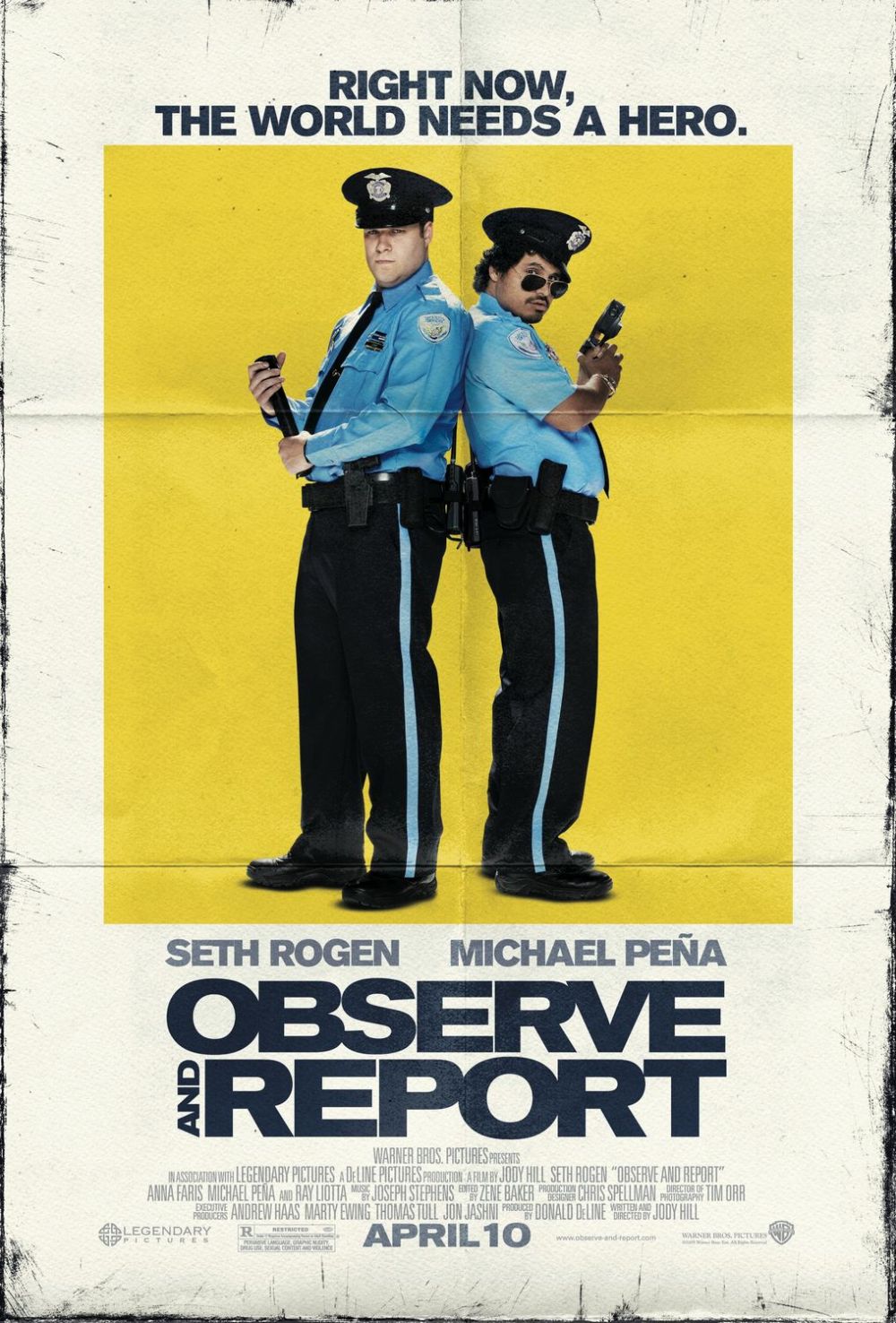
Observe and Report movie poster

I read an article in the Los Angeles Times which had an interview with Jody Hill, the writer/director of “Observe and Report.” Reading it was the best preparation I got for watching the movie as the trailers made it look like the typical Judd Apatow produced, Seth Rogen starring comedy. However, director Hill didn’t really see it as a comedy, and he said the term “dark comedy” didn’t really apply to the film the way he envisioned it. Hell, even Rogen went out of his way to call the film a “dangerous comedy.” I never would have guessed from the trailers which made the film seem like the average formulaic comedy I was more or less interested in seeing. I should have seen it coming it was not going to be what I expected it to be when I realized that Apatow had nothing to do with this.

If you’re thinking “Paul Blart: Mall Cop” redux, you’re dead wrong. With “Observe and Report,” you need to go in expecting “Taxi Driver” or “One Hour Photo” as if they were comedies. This is a very black comedy. We’re talking Martin Scorsese’s “After Hours” black. It touches on several ever so touchy subjects such as drug abuse, date rape, alcoholism, delusional, and racial stereotypes among others. It is also proof of how comedy can be mined out of places and subjects you would never expect to find it in. Hill and Rogen prove to have a large pair of cojones on them as they take big risks with their subject matter and come out of it with many moments which are frickin’ hilarious. It says a lot about this movie how it can break taboos, many of which will easily offend people, and still have you laughing your ass off at the same time.

Rogen stars as Ronnie Barnhardt, the head of Forest Ridge mall security. From the start, we can see this is a guy with a few screws loose. Along with his fellow mall cops, he laments at the fact none of them are allowed guns on the job. Ronnie is a hero in his own mind, and no one takes the job of what is essentially a “rent a cop” position as seriously as him. Ronnie also longs to join the police force, but he is kept from being accepted due to his bi-polar illness which he treats with the typical medication Scientologists rally against. This is not your typical Rogen character where you wonder if and when he will get the girl. Instead, you wonder if this guy is going to have a psychotic break and end up killing someone before it is too late.

Ronnie’s mission in life, however, becomes crystal clear to him when a flasher exposes himself to the girl of his dreams, makeup counter employee Brandi (Anna Faris). So distraught she is after this attack, Ronnie makes it his mission to catch the flasher before he can attack her again. But then the local police department gets involved in the form of Detective Harrison (Ray Liotta at his overplaying best), and Ronnie sees this as a threat to his mission. The way Ronnie sees it, this is his case and no one else’s. To let the local police take over would be the same as giving up control of the mall. Paul Blart may have taken his job as a mall cop seriously, but he has got nothing on Ronnie Barnhardt.

For Rogen, this movie represents a sharp change of pace. Through movies like “Knocked Up” and “Zack & Miri Make a Porno,” he has perfected the role of lovable loser to the point where you could not see him in any other role. This usually results in a career which starts big and then crashes in record time. I was hoping to see him play some other role because I found him to be one of the funniest actors in quite some time, and I was in no mood to see him crash and burn. With his role in “Observe and Report,” Rogen finally breaks out of his comfort zone to play someone who is anything but lovable. He also never plays the role just for laughs which is a major plus. As Ronnie Barnhardt, he manages to find the heart of this delusional character, and he keeps the audience up with him even as Ronnie’s mental state continues to get worse.

Among the supporting cast in “Observe and Report” is Michael Pena. As Dennis, Ronnie’s second in command and best friend, Pena also goes against type to play a role we have never see him in before. He has proven to be the most dependable of supporting actors in movies like “Crash,” “Shooter,” and “World Trade Center” to name a few. As Dennis, he steals scenes from Rogen as his character ends up taking directions you never expect him to take. This is an inspired performance by Pena, and he serves, however briefly, as Ronnie’s conscience when he sees Ronnie is taking himself WAY too seriously. Dennis’ methods of loosening up Ronnie, however, are anything but safe and legal.

Another inspired performance in “Observe and Report” is from Celia Weston who plays Ronnie’s alcoholic mother who still lets her son live under her roof even though he is well into his 30’s. There is no doubt of how much Weston’s character loves her son even when she is hopelessly drunk, and it leads to where she tells one of Ronnie’s fellow mall cops of how she slept with his friends while he was in high school. This could have been a cruel and clichéd character, but Weston makes it a lot more.

You also have to give a lot of credit to Anna Faris who proves here she is not afraid of going to extreme lengths to get laughs. Throughout the movie, she never tries to sweeten her character of Brandi up like many actresses would. Brandi will easily remind you of all those spoiled rotten bitches you had the misfortune of going to high school with. Many may hate the way her character is treated in the movie, but to a large extent, Brandi brings a lot of it on herself. Like Rogen and Hill, Faris does not shy away from the unpleasant extremes of her role.

Then there is Ray Liotta, who will always be best remembered for playing Henry Hill in “Goodfellas.” As Detective Harrison, Liotta is the perfect counterpoint to Rogen’s mentally unhinged mall cop. His strait-laced character has his shit together, but it doesn’t necessarily make him much better. One of the movie’s best moments has him taking Ronnie on a ride along which ends with him stranding Ronnie on a bad corner with a bunch of crack head drug dealers. How Ronnie ends up handling these dealers is something I would prefer not to spoil for you. Just when you think you know where the scene is going, Hill and Rogen pull the rug right out from under you.

Another really nice performance comes from Collette Wolfe who plays Nell, an employee at the mall’s coffee shop who is somewhat hindered by her leg being in a cast. While Brandi really wants nothing to do with Ronnie, Nell pines for him every time he comes to get his free cup of coffee. She also has to deal with an unsympathetic boss (Patton Oswalt) who picks on her whenever given the opportunity. She is a sweet presence in an otherwise nasty movie which seeks to make you uncomfortable and laugh at the same time. For a moment, I thought this would turn into another tale of unrequited love a la “Rules of Attraction,” but Collette’s character gives Ronnie the emotional grounding he DESPERATLEY needs.

Hill’s biggest success with “Observe and Report” doesn’t lie in just the laughs he gets, but more in the fact he and the actors never just play everything just for laughs. There is no winking at the camera in this film. The actors don’t play it completely straight in this movie, but they take their roles seriously and never appear as if they all know they are in on the joke. If they did, the movie would not be anywhere as effective.

Hill’s breakthrough directorial effort was the movie “The Foot Fist Way” which served as the breakthrough for Danny McBride who went on to appear in “Pineapple Express” and “Tropic Thunder.” It is clear Hill revels in the portrait of people who live in their own world and are oblivious to what the world thinks of them. What Hill does here is ballsy to say the least.

“Observe and Report” also serves as a biting satire of the mall culture which serves as the movie’s setting. It ends up being symbolic of the melting pot which is the United States of America. Cultures of all kinds rub up against each other in the mall, and it unsettles our main character at times. Ronnie ends up having a tense moment with a character he thoughtlessly nicknames Sadamn (played by Aziz Ansari) who has filed a restraining order against Ronnie for past transgresses. This leads to one of the movie’s most insanely funniest moments as they say a barrage of “fuck you’s” to each other. The F-bomb is uttered almost endlessly in this scene to where you think they are going to give “Scarface” a run for its money in terms of how much the word is uttered.

This movie also continues the trend started with movies like “Forgetting Sarah Marshall” of showing the penis in all its tiny glory. The audience I saw it with seemed more shocked by the “throbbing python of love,” as Robin Williams once described it, than they were with Rogen’s character holding a gun in his hand. After all these years, American audiences still prove to be an unknowingly hypocritical bunch as they find themselves more comfortable with the sight of a gun than with the appearance of a sexual organ.

Suffice to say, not everything in the movie works perfectly. The ending where Ronnie defends his place in the mall falls a little flat despite the use of Queen’s music from “Flash Gordon.” And granted, the mix of comedy and action and violence is a tricky road, but it is a road bound to have some inescapable potholes.

Still, when all is said and done, “Observe and Report” is a comedy with big cojones which cannot be easily ignored. It is not a movie for all tastes, but for those who are willing to travel a darkly comic path, there is much to find in this crazy film which dares to imagine a Travis Bickle-like character as a funny person despite himself. Do not say you weren’t warned.

* * * ½ out of * * * *

Gareth Edwards and Thomas Tull Talk About Making ‘Godzilla’

godzilla-2014-poster

I was invited to attend a special press screening of the 2014 “Godzilla” at Grauman’s Chinese Theatre (it’s now called TCL Chinese Theatres, but I prefer to call it Grauman’s), and it proved to be a huge improvement over Roland Emmerich’s 1998 debacle. Following the screening, we were treated to a Q&A with the movie’s director Gareth Edwards and the CEO of Legendary Pictures, Thomas Tull. The two of them discussed how they saw this version of the giant monster, the first time they became aware of who or what Godzilla was, and of how their film mirrors the current events of today.

There have been dozens and dozens of “Godzilla” movies made since 1954, most of them made in Japan by Toho Company Limited. There have been a couple of American movies made about this enormous monster as well, but they didn’t fare well to say the least. “Godzilla 1985” was universally panned by film critics and died a quick death at the box office. As for Roland Emmerich’s “Godzilla” which came out in 1998, I still cringe at the thought of its existence as it was amazingly awful. But when it came to making the 2014 version, Edwards made clear he was not about to let fans or critics down.

“We were trying to put more into it than just a simple monster movie because the original was definitely a metaphor for Hiroshima and Nagasaki and a very serious film. So we were inspired to try and reflect that,” Edwards said. “We police the world and go, ‘You can’t have nuclear power. You can’t have it. But we can have it, and we have nuclear weapons.’ And what if there were a creature that existed, creatures that were attracted to radiation? Suddenly the tables would be turned, and we’d be desperately trying to get rid of that stuff.”

From there, both Edwards and Tull described the first time they saw Godzilla. Hearing Tull talk about his first exposure to the Japanese monster came to illustrate just how big of an effect monster movies had on him when he was growing up. As for Edwards, he ended up describing his first exposure as being embarrassing.

“First time I saw it, it was the ’54 version,” Tull said. “I was probably around 7 years old. Where I grew up in upstate New York, what I looked forward to every year was the Friday after Thanksgiving when the local TV station would play ‘Godzilla’ marathons all day. That was my favorite thing of the year. I had the incredible fortune of making movies out of all the stuff I loved as a kid: ‘Batman,’ ‘Superman,’ Watchmen’ and now ‘Godzilla.’ Somehow the magic genie made it happen. This is really special to me.”

“In the U.K. when we were kids growing up, they had the Hanna Barbara cartoon. Not many people know that in America. I thought it was a worldwide thing,” Edwards said. “But it was basically Godzilla and I guess his son, Godzuki, and it would fly; it was all very cute. When you’re a kid it was great. I got offered this amazing opportunity. People in the U.K, they like to take the piss out of their friends, so just to mock me they would always refer to it as Godzuki. They’d be like, ‘How’s Godzuki going? Have you been to any Godzuki meetings?’ And I used to play along with it to the point where my phone learned how to spell Godzuki more than Godzilla. So when we used to have regular emails about the film, I’d type Godzilla and it would automatically change it to Godzuki. And for a while, I thought I might get fired.”

Edwards said while he and Tull were in the process of putting the movie together, the Tōhoku earthquake and tsunami, also known as the Great East Japan Earthquake, occurred which decimated much of Fukushima and caused serious accidents at nuclear power plants. Now when horrific events like this occur, Hollywood is quick to distance itself from them for fear of appearing like they are profiting from them. But considering the genres “Godzilla” covers, there was enough of a reason not to ignore the serious events happening around the world.

“There was a point where it felt like, well, maybe we shouldn’t set it in Japan. Maybe we shouldn’t deal with radiation or anything like this,” Edwards said. “We had genuine conversations for quite a while and we talked to a lot of people, and knew a lot of people, who were Japanese obviously working with Toho. And after a while the general consensus was that the 1954 version, the whole point of that movie, and science fiction and fantasy in general I think, they have this opportunity to reflect the period that they’re made in, and so it was thought as long as we did it respectively and the city and the events in our film are not about anything that happened in Japan. So, we felt it kind of appropriate to acknowledge some of these issues as we were figuring out the storyline.”

“When I was a kid, my dad used to have an encyclopedia on the twentieth Century, and on the front cover was Hiroshima, JFK’s assassination, Hitler, all the major events of the twentieth century,” Edwards continued. “I used to look at it and think none of that happened in my lifetime. Nothing significant like that has happened in my lifetime. Maybe nothing like that ever will. And then in the last ten years with the obvious things, it’s nearly impossible to genuinely sit down and say, ‘OK, I want to do a monster movie. I want to try and treat this like it really happened. What would it look like? How would people react and not be infected by the imagery over the last ten years, whether it be the natural disasters or even some of the terrorism?’ So that kind of infected the film a little bit. But we tried to do it in a way that, first and foremost, it’s entertainment. You’re here to see a Godzilla. But I personally like a little meat on my bone, so within that there’s obviously this other imagery and meaning that you can pull from as much as you want or as little as you want.”

Before this, Edwards had only one directorial effort to his name, the 2010 film “Monsters.” It had a budget of only $500,000 and, in addition to directing it, he also worked as writer, cinematographer and the visual effects artist which may explain why it didn’t cost much to make. With “Godzilla,” he had the backing of a major studio and an estimated budget of $160 million. Talk about one heck of a promotion! This has got to put the fear of God into any filmmaker making this kind of transition, but Edwards sounded like he has handled big budget moviemaking very well.

“It’s a massive, massive deal,” Edwards said. “It’s not just a once in a lifetime opportunity; it’s a once in a million-lifetime opportunity to be able to get to do this. The way I dealt with it was to forget we were doing it and just convince ourselves, which was kind of very easy to do, that we’re just in this bubble; it’s just us, and we’re just making a movie that we want to sit and watch, something that will give us goose bumps. And it’s kind of this selfish passion project in the way you kind of approach every day. Because I’d get paralyzed if I really thought about the number of people who would end up seeing the film and all the publicity and press that would come from it.”

“But it’s such a great opportunity,” Edwards continued. “I grew up since I was a little kid desperate to be a film director, and the second they mentioned it I was just like, I could never live with myself if I ever turned this down. I mean, I love monster movies. My first film was a monster movie. This is the ultimate monster movie. So how could you live with yourself having not made ‘Godzilla’ when you had that opportunity?”

Even before its release, “Godzilla” had already sparked conversations about a sequel or a potential franchise. This is not a surprise as movie studios are always looking for the next big movie trilogy to thrust at movie fans eager to pay their hard-earned money for. Edwards, however, said it was his intention to make a stand-alone movie, something I was very pleased to hear. As for Tull, with Legendary Pictures having been purchased by Universal Pictures, he was asked if a sequel would be released by either Universal Pictures or Warner Brothers, the latter which is distributing this movie. In the end, Tull could only say the following:

“We have a little rule: we can’t talk about anything else until this comes out and works,” Tull said. “It’s a little superstition I have. All I can say is, we’re passionate fans of the universe and we love Godzilla and some of those other folks do too, so if this comes out and works we’ll figure it out.”

Save

Godzilla (2014)

godzilla-2014-poster

The stench which emanated from the sheer awfulness of Roland Emmerich’s “Godzilla” has haunted me ever since I saw it on the big screen in 1998. For a time, it dampened my spirits in terms of where movies were headed as I was afraid many more of them would be dumbed down like Emmerich’s movie was. Had it been an even bigger hit, I feared more summer blockbusters would look exactly like it; filled with lame one-dimensional characters and special effects which look no different from the video games we play at home. But in the end, it was so critically reviled that even Toho, the company that owns Godzilla, looked at Emmerich’s version of the monster as a separate, stand-alone character whom they renamed Zilla. It was if they were saying, “Oh no, that was so not Godzilla. That was a cousin or a step child or maybe the product of a one-night stand.”

But now that stench has vanished as Gareth Edwards has given us his version of “Godzilla,” and it makes for one of the most entertaining movies of the 2014 summer movie season. Instead of having this enormous Japanese monster chase after characters who look like they were part of a rejected sitcom pilot, he stays true to the style of the Toho series of Godzilla films and manages to weave in some commentary about nuclear power. Just as the original “Godzilla” served as a metaphor for Hiroshima, this one doesn’t dare hide away from what happened in Fukushima where nuclear accidents occurred after the massive earthquake and tsunami which occurred there.

The movie starts off with the terrifying destruction of a nuclear power plant, one which ends up dividing a father and his son. We then move to several years later when Ford Brody (Aaron Taylor-Johnson), an explosive ordnance disposal technician in the US Navy, comes home to his wife Elle (Elizabeth Olsen) and their son after a long tour of duty. Their reunion, however, is cut short as Ford gets word his father, nuclear physicist Joe Brody (Bryan Cranston), has once again been arrested in Japan for trespassing into areas blocked off to the general public as the area surrounding the power plant isn’t all that different from Chernobyl when it suffered a meltdown.

Joe is still convinced the power plant accident was really a cover up for something, and he and Ford come to discover what’s left of it has been converted into a laboratory of sorts. Scientists led by Dr. Ishiro Serizawa (Ken Watanabe) and Dr. Vivienne Graham (Sally Hawkins) reveal they have been housing a MUTO (Massive Unidentified Terrestrial Organism) and are trying to keep it contained by giving it doses of radiation. But, of course, all hell breaks loose when the MUTO breaks free of its captivity and heads out to sea, and it is then we learn another MUTO (this one a female) has been held in the United States and has also escaped and quickly laid waste to Las Vegas. Like Natasha Henstridge’s character in “Species,” she is looking to start a big family with offspring which will surely destroy all of humanity, and it’s only a matter of time before she finds her MUTO mate. Clearly, safe sex is not on their agenda.

This is where the iconic Godzilla comes in. Now in the past, this gigantic creature has been portrayed as an enemy to all of humanity and as an antihero who looks to take down any other monster who foolishly thinks it can defeat him. But in Edwards’ movie, Godzilla is really the good guy who, as Dr. Serizawa puts it, is here to “restore balance” to the world, and he doesn’t even bother the battleships which sail alongside him as he swims from one country to the next. We all know Godzilla will end up destroying a lot of expensive real estate which will cause many insurance companies to go bankrupt, but we’re still on the monster’s side as we know the military won’t have enough firepower to bring down the MUTOs.

Edwards takes his sweet time in revealing Godzilla to the audience, and we don’t really get a good look at him until almost an hour into the movie. When he does finally appear onscreen and let out the biggest of roars anyone has ever heard, the audience I saw this movie with broke into a tremendous applause. This is the fiercest Godzilla has looked in many years, and the way he towers over the tallest of buildings had me in awe. This is the way Godzilla should look and feel.

One of the many problems I had with the 1998 “Godzilla” is it never felt like I was watching a real monster on the big screen. It felt more like I was watching a big special effect to where the creature didn’t even fill the least bit threatening. But in 2014’s “Godzilla,” the creature looks and feels real to where I kept praying the human characters would keep themselves from standing underneath its feet. The thought of being crushed by a creature that big is horrifying.

As for “Godzilla’s” human element, it’s not altogether strong, but I still liked how the characters came across as relatable even if they were at times clichéd. I also have to give the screenwriters credit as the movie starts as one thing but surprisingly turns into something else. Just when I thought I knew what kind of movie this “Godzilla” was going to be, it continued to surprise me as it went along. Yes, we all know how things will end, but getting there proved to be more fun than I expected.

It also helps there is a terrific cast of actors to keep us emotionally involved in the characters before and after Godzilla makes his grand entrance. You can never go wrong with Bryan Cranston whether it’s “Breaking Bad” or anything else, and he makes his character very empathetic when he could have been easily laughable. As for Aaron Taylor-Johnson, I almost didn’t recognize him after getting so used to how he looked in those “Kick Ass” movies, and he does good work portraying the typical heroic military character we always see in “Godzilla” movies. Ken Watanabe remains a tremendously gifted actor, and even though I thought stared in horror one too many times in this movie, he is a very welcome addition to this cast. And then there’s David Strathairn who plays Admiral William Stenz, and he can always be counted on to give the military leader the gravitas and humanity a character like this deserves.

As for the female characters, their roles are a bit underwritten and I didn’t get to see as much of them as I would have liked. Still, you have actresses like Elizabeth Olsen, Juliette Binoche and Sally Hawkins making them into memorable characters when they could have been ones who were easily forgettable.

This “Godzilla” does have its problems, and there are times I wished Edwards and company had injected just a little more humor into the proceedings. Also, the big fight between Godzilla and the MUTOs never seems to come soon enough. There’s a moment where it looks like the fight will begin, but then a door closes on the characters and on our view of the monsters, and that was really frustrating. The human characters may have wanted the door shut, but everyone in the audience was clamoring for it stay open so we could see one enormous mutated creature beat the crap out of another. And yes, there probably are some plot holes and gaps in logic in the story, but I really didn’t care. You don’t always go to these movies expecting a whole lot of logic anyway.

What makes this “Godzilla” work is how it is clearly made by filmmakers who have a great love of monster movies. Edwards, whose previous directorial effort was British science fiction film “Monsters,” has talked about just how much he loves those kinds of movies, and he does an excellent job of making Godzilla a truly terrifying force of nature. After being absent from the big screen for over a decade, it is great to see this iconic monster make such a tremendous comeback.

I also got to say watching “Godzilla” makes me really happy that I do not work for an insurance company. Seeing all those destroyed buildings and roads, I can see claim adjustors going nuts as they field one phone call after another regarding totaled Hondas, decimated condos and bridges which now really lead to nowhere because they’ve been destroyed. You can bet no one’s going to take any guff from someone who tells them their insurance policy doesn’t cover attacks from giant mutated monsters!

* * * out of * * * *

Save