No, I Haven’t Seen It Until Now: ‘The Room’ (2003)
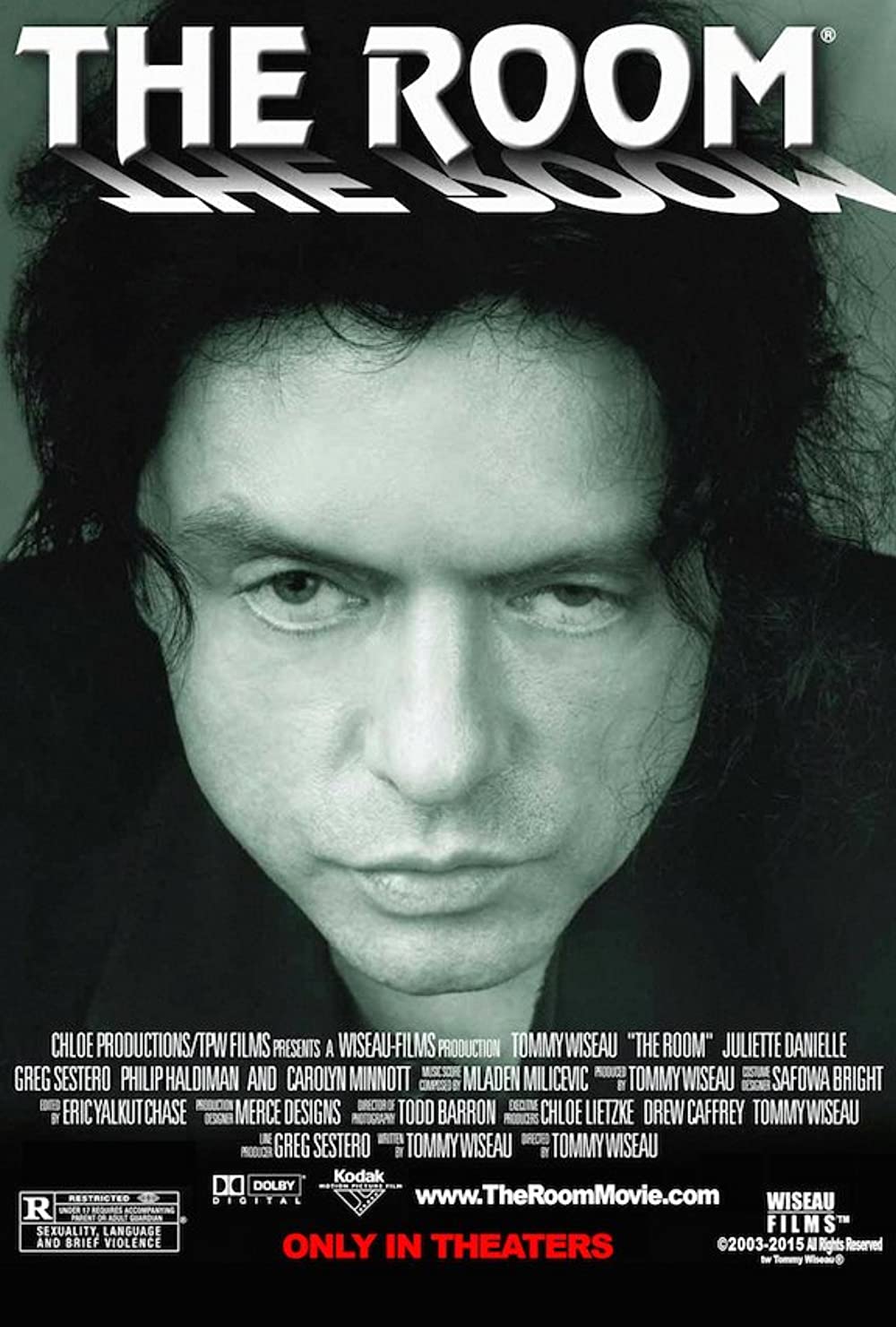
After all these years, I finally took the time to watch Tommy Wiseau’s “The Room” from start to finish. I have viewed some of its most infamous scenes on You Tube from time to time, but upon learning it was going to be showing at the Landmark Theater in Westwood, my procrastination in viewing it came to an end.
When I interviewed director Jan Komasa and actor Bartosz Bielenia about their religious drama “Corpus Christi,” I wore the following t-shirt:

The two of them got a huge kick out of this shirt and encouraged me to check this cult classic on the silver screen with an audience. The way they saw it, this is the best way to experience this hopelessly bizarre motion picture as it had already become the next generation’s “Rocky Horror Picture Show.” Watching “The Room” just for the drama is not enough. It’s the audience participation which makes it all the more worthwhile as the most devoted fans are quick to seize the moment and celebrate this film’s most glaring mistakes with tremendous glee.
Wiseau, whose name is plastered over the opening credits, stars as Johnny, a man who is expecting to receive a big promotion at work and is madly in love with his girlfriend Lisa (Juliette Danielle). But at the same time, Lisa is having a torrid affair with Johnny’s best friend, Mark (Greg Sestero, who I went to junior high school with, believe it or not), and this leads to inadvertently hilarious sex scenes which almost had me believing Wiseau and company were actually trying to sell “The Room” to Cinemax as opposed to a major Hollywood studio. Let’s face it, these “love-making: scenes are so ridiculously staged and choreographed to where they make the average episodes of “Red Shoe Diaries” and “Beverly Hills Bordello” rise to the level of high art. Watching Wiseau and Sestero make out with Lisa also reminded me of what Robin Williams once said:
“Men can’t fake orgasms! Who wants to look that dumb?”
Into this tragic love triangle comes a variety of characters, many of whom forget to close the door to Johnny and Lisa’s apartment upon entering it. There is Lisa’s mother, Claudette (Carolyn Minnott), who is far more concerned with her daughter marrying Johnny for financial security than she is in her recent breast cancer diagnosis. Then there’s Denny (Philip Haldiman), a young college student who is supported financially and emotionally by Johnny and is quite smitten with Lisa (who isn’t?). And let us not leave out Michelle (Robyn Paris) and Mike (Scott Holmes), the couple whose love for chocolate provides this movie with its “9 ½ Weeks” moment.
What can I tell you? “The Room” is filled with gloriously hammy acting and terrible one-note performances. Certain scenes are clearly shot in front of a green screen, and many images of San Francisco float cross the screen for the sake of making this movie look like it takes place in more than one room. Certain camera moves look to be shot on a tripod in need of some serious tightening, and the movie suffers from a terrible editing job as scenes feel as though they are put into the wrong place. To all aspiring filmmakers out there, you may fear your debut feature will look a cinematic abomination, but whatever happens, there is no doubt it will look far more professional than Wiseau gave us here.
And yet, as terrible as “The Room” is, watching it provided me with the most enjoyable times I have ever had at a movie theater. I haven’t laughed this hard at a motion picture since “Deadpool 2,” and unintentional hilarity hasn’t felt this inspired for me since “Troll 2” or Tyler Perry’s “The Single Mom’s Club.” Any film which has me laughing so hard to where I get lightheaded and almost pass out will always hold a special place in my heart, and this one is honestly no exception.
Granted, there are many movies out there which are truly awful, but the worst are usually multi-millionaire dollar feature films which are made with nothing more than the thought of a potential franchise that can keep the money train rolling in for years. Those ones end up having more money spent on promotion than on the actual movie, and what we get is an overhyped event where the anticipation proves to be more exciting than the final cut. Those are movies made without heart, and it shows in an inescapably depressing way.
When it comes to “The Room,” however, it is a movie made with a lot of heart but not a lot of thought, and it shows its heart right on its sleeve without any shame. The screenplay introduces us to far too many characters it can possibly deal with, and several subplots are never brought to a satisfactory conclusion. All of this reminds me of one of my favorite guilty pleasures, “Star Trek V: The Final Frontier” which has many of the same problems but had a slightly higher budget regardless.
Wiseau remains an enigma years after “The Room” was released as many wonder about his past and present. He certainly has an unusual look which some might scoff at, but to others it shows a life lived long and hard. Regardless, his line readings of dialogue are ever so memorable even if they show how he emotes more than acts. “You’re tearing me apart Lisa” will never sound the same when uttered by another individual, and another’s denial of not hitting another will sound hollow in comparison. While harsh criticism is needed in situations like these, they are not worth the trouble here as they would simply take away from our enjoyment of this cinematic spectacle, regardless of how poorly realized it may be.
A lot of people who aspire to make a movie many times do so to leave their mark on the world. Wiseau’s path in making “The Room” is not all that different from what Rudy Rae Moore aspired to do when he made his first “Dolemite” movie. While the finished result did not merit a single Oscar nomination, it left its mark on those who were quick to watch it. The same goes with Wiseau who wanted “The Room” to be an epic of sorts. Well, his work is epic alright, but not for reasons he intended. Still, his film has given millions of moviegoers great joy even if it was of the unintentional kind. Perhaps making any kind of mark with a motion picture like that is better than letting it sink into the realm of streaming where it could easily get lost in an overcrowded cinematic ocean.
While Wiseau is in intent on making us believe he always meant for “The Room” to be a dark comedy, it is clear he wanted this film to be something else. But whatever the case, it is a memorable motion picture which will never be easily forgotten, and you don’t want anyone to forget what you did, you know? Besides, the term “male bonding” will never sound the same ever again.
One other thing; I was reminded of the following dialogue between Teasle and Trautman from “First Blood” in which they talked about capturing John Rambo:
Teasle: “Are you telling me that 200 of our men against your boy is a no-win situation for us?”
Trautman: “You send that many, don’t forget one thing.”
Teasle: “What?”
Trautman: “A good supply of body bags.”
Well, when it comes to “The Room,” I say don’t forget this: a good supply of plastic spoons!
WRITER’S NOTE: I am not going to bother giving this movie a star rating. Seriously, what’s the point?

 The Ultimate Rabbit