‘Bridesmaids’ – Do Not Mistake This Film for an Average ‘Chick Flick’
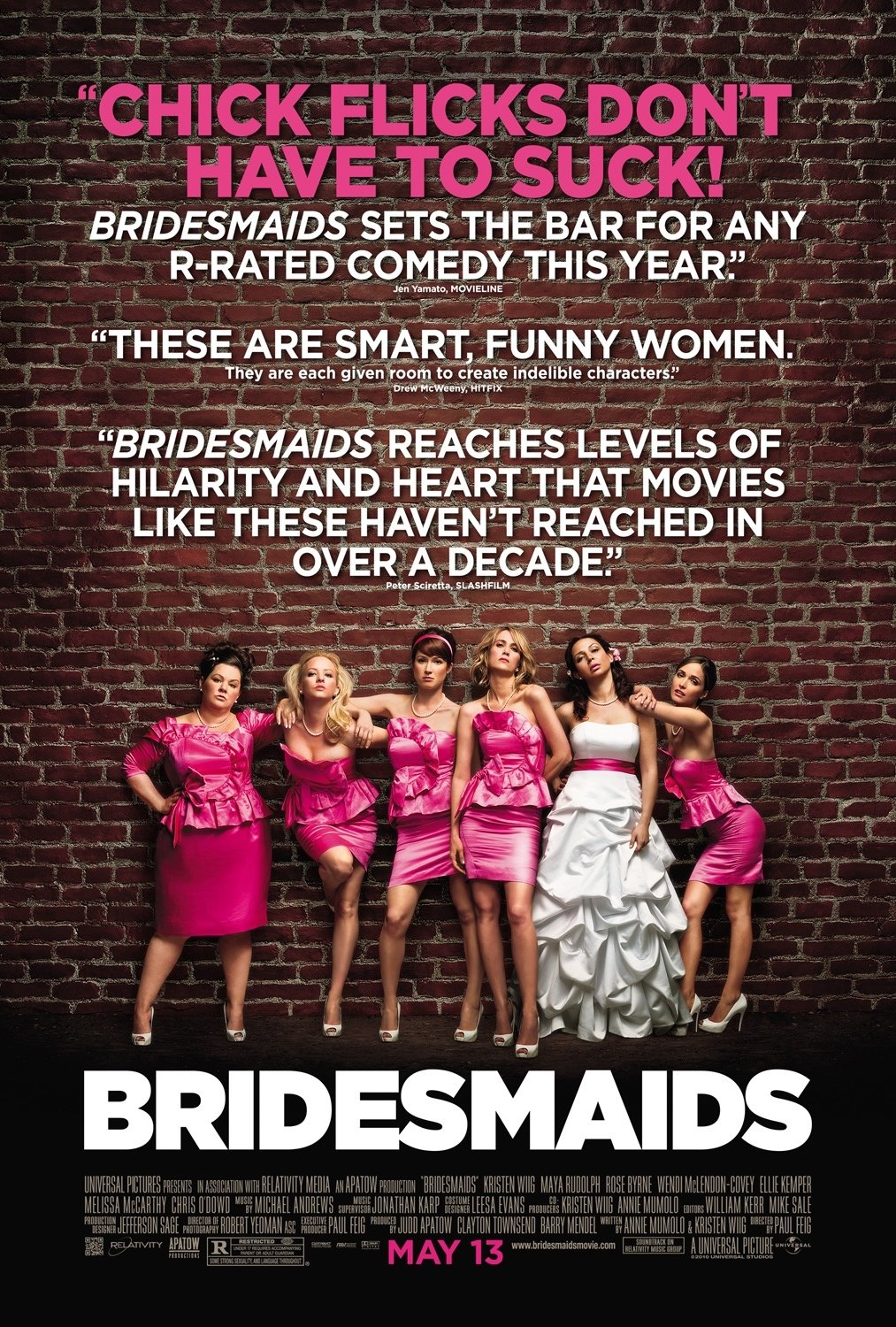
Bridesmaids” looks like it has “chick flick” written all over it to where many, including myself, were not quick to rush out and see this film when it arrived in movie theaters everywhere. But having since watched it, I can confirm this is not your average “chick flick” in the slightest. Moreover, it will appeal to a wider audience than its title might suggest. There is nothing groundbreaking about “Bridesmaids” as it initially comes across as a typical formulaic comedy, but the laughs do come at us fast, many of them gut busters. But seriously, it also has a lot of heart and makes you care about the characters very much to where we can easily relate to their struggles.

Kristen Wiig, one of the most acclaimed alums of “Saturday Night Live”  who co-wrote this film’s screenplay with Annie Mumolo, stars as Annie Walker, a single underachiever whose cake shop went bankrupt due to the recession, and who is currently having sex with Ted (an uncredited John Hamm), a man who sees her as nothing more than a fuck buddy. Then she finds out that her best friend since childhood, Lillian (Maya Rudolph, another “SNL” vet) has gotten engaged, and Lillian asks Annie to be her maid of honor. From there, we know things are going to go south between these two as the road to any marriage is filled with endless speed bumps which lead many to encourage others to elope instead.

Complications arise almost immediately when Annie meets Lillian’s other BFF, Helen Harris (Rose Byrne), a beautiful and wealthy woman who seems to have everything together in her life. The resentment and insecurity between these Annie and Helen are evident on their faces following their first encounter. This is made even clearer when both toast Lillian and then try to top each other in showering their love on her, attempting to prove who is the better best friend.

Things get even more complicated when Lillian selects the rest of her maids of honor. They include Becca (Ellie Kemper) who loves wedding and pities Annie because she is not currently engaged to anyone, Megan (Melissa McCarthy) who is as aggressive as they come, and Rita (Wendi McLendon-Covey) who may very well be the unhappiest wife and mother on the face of the Earth as well as the most consistently drunk of the bunch. With all these different personalities working together, will the road to this wedding be a happy one? Was Donald Trump always faithful to Melania?

What I really loved about “Bridesmaids” was the same thing I also loved about “Knocked Up;” the characters are very down to earth and easy to relate to. Being that Judd Apatow is a producer on both films, this should have been obvious from the start. These characters are real people with real problems which are not far removed from our own, and we come to care deeply about each and every character here. It does not matter if none of you have ever been a bridesmaid. As for you men, being groomsman is enough qualification to understand the headaches in planning matrimony.

“Bridesmaids” also a film where facial expressions at times speak more loudly than words. It certainly does have great dialogue, but the looks on these actresses’ faces is what really cracked me up. They say one thing, but their eyes tell us what is really on their mind. This goes for the men in as well, and they all seem to pale in comparison to the females in terms of inner strength. We see right through each character, and the tension resulting from a possible slip of the tongue is always in the air.

This film proved to be the true cinematic breakthrough for Wiig. When I have seen her in other films, she always seems to be doing a riff on her most deadpan characters from “SNL” whether she is appearing in “Knocked Up” or “MacGruber.” But as Annie Walker, Wiig really inhabits this character and gives her life in a way we did not get to see her do previously. She makes us embrace Annie as a kindred spirit because we have all felt the way she feels; lost in a world she feels betrayed by, and desperately trying to hold on to what means the most to her.

Maya Rudolph is equally wonderful here as the bride to be, Lillian. She previously showed us in Sam Mendes’ “Away We Go” what a great actress she can be, and she vividly reminds us of our best friends from childhood. Lillian runs through a gamut of emotions as her road towards marriage start off wonderfully and then eventually turn into an unmitigated disaster. In a pivotal scene in which Lillian about to leave her apartment for the last time, Rudolph shows us a worry and concern which we all see within ourselves from time to time. Not once does she portray Lillian as your usual clichéd character, and this says so much about what she is capable of.

Rose Byrne proves to be a delight as Helen, and her beautiful face and eyes cannot quite mask the growing resentment she has towards Annie. This character could have easily turned into your typical one-dimensional villainess, but by the end we discover tshe and Annie are not all that different. Byrne makes you like Helen despite her overly meddling ways, and she has since proven to be a strong presence in every motion picture she has appeared in.

But out of all the characters here, the one who stands out the most is Megan who is portrayed in a deservedly Oscar nominated performance by Melissa McCarthy. Overweight and raunchy whenever she wants to be, McCarthy is a trye comedic powerhouse when the camera focuses on her. Seducing airplane passengers and showing no shame in what she is, she makes Megan a strong character and never once digresses into making her a cloyingly sentimental one.

“Bridesmaids” was directed by Paul Feig, Mr. Eugene Pool from “Sabrina, The Teenage Witch” and the creator of “Freaks and Greeks;” a brilliant show that like many other brilliant shows which aired on network television lasted only one season. With this film, he manages to find humor even in the most painful of moments and never makes the comedy too overly broad. Sure, some scenes are broadly played, but Feig remembers comedy can only work if you truly care about the characters.

Looking back, “Bridesmaids” proved to be one of the best comedies to be released back in 2011, and no man out there should dismiss it as a film only women would be interested in. The audience for this one proved to be far more diverse than its promotion may have suggested. Plus, you have Wiig and Rudolph on display here, and they always kick ass! If you liked them on “Saturday Night Live,” you are bound to love them here.

* * * * out of * * * *

WRITER’S NOTE: This film marked the very last screen performance of actress Jill Clayburgh who passed away in November 2010 from leukemia. She is a wonderful presence here as Annie’s mother, Judy Walker. May she rest in peace.
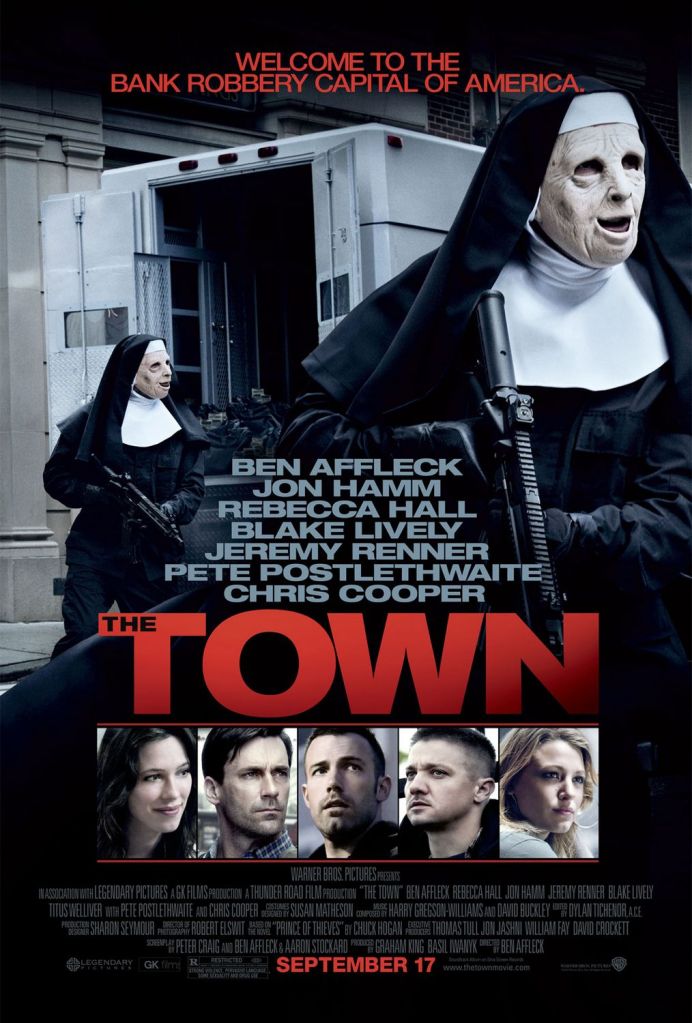
Ten Years Later, ‘The Town’ Remains a Riveting Crime Thriller

I saw this film with a friend of mine who grew up around the area it takes place in, and he declared this to be the “best Boston movie ever.” Now I am not in a position to verify this as fact because while I visited Boston when I was a kid, I have never lived there. But with this coming from someone who spent his childhood growing up in this neighborhood and made hundreds of visits to Fenway Park, this is very high praise which cannot be ignored or easily dismissed.

With “The Town,” an adaptation of Chuck Hogan’s novel “Prince of Thieves,” Ben Affleck proves what should have been clear to us after his directorial debut “Gone Baby Gone;” he is truly an excellent filmmaker. Moreover, he has a strong understanding of Boston and the surrounding areas. Affleck also succeeds in giving us one of his very best performances while surrounding himself with a strong cast of talented actors. Upon this film’s release, many were out for his blood as he was making one terrible movie after another with “Gigli,” “Reindeer Games” and “Surviving Christmas,” but “The Town” showed us that his career deserved a second act.

Affleck stars as Doug MacRay who, with his lifelong group of friends, commits robberies on banks and armored cars. One such robbery has them kidnapping a beautiful bank manager named Claire whom they let go after they have successfully made their getaway. But after looking over her driver’s license, they realize she lives only a block or two away from where they reside. Fearful that she might recognize them, Doug volunteers to check her out to see if she knows anything. In the process, he falls madly in love with her, and she is quick to return his feelings. Now this could mean one of two things; crime truly makes you stupid, or love conquers all. This leads the team of robbers to get even more paranoid than they already are as they are about to pull off one last heist, and we all know what happens on that “last job.”

While Boston plays a big part in this film, the setting of “The Town” is actually Charlestown, home of the Bunker Hill Monument which is prominently featured throughout. In the opening titles, it is said Charlestown has more than 500 robberies in a year and is known as a place which breeds a strong criminal element. It all reminds me of what Bono sang about in the U2 song “Dirty Day:”

“If you need someone to blame, throw a rock in the air. You’ll hit someone guilty.”

Now “The Town” is more than likely to earn a lot of comparison with Michael Mann’s “Heat” as both share plot and thematic similarities. But while “Heat” was truly an epic motion picture, “The Town” is far more intimate in its scope and characters. Much of the attention is paid to the criminals themselves than to the police or FBI agents who are obsessively pursuing them. It also surrounds you in an authentic Boston atmosphere and makes you wonder if the characters who were born and raised there will ever be able to survive outside of it, let alone leave it without the threat of death hanging over their heads.

Along with screenwriters Peter Craig and Aaron Stockard, Affleck takes the most familiar elements of your average heist movie and reinvigorates them to create an exciting motion picture which is as big on character as it is on action. Clearly, Affleck’s attention is more acutely focused on the characters and the circumstances which surround them all. As for the action, it has some of the best staged robbery sequences I have seen in recent films, and there is also a brilliantly staged car chase through the narrow streets which makes you wonder if the thieves could ever possibly escape as the police are not always the bumbling idiots they are made out to be on the silver screen.

Then there is Affleck the actor, and a lot of my friends still cannot stand him. Truth be told, I never thought he was a bad actor, and as Doug MacRay he gives one of his best performances to date. I totally believed him as a hardened criminal who looks to find another path in life, and he holds his own against a cast of exceptional actors who give him so much to work off of.

Another big standout performance in “The Town” comes from Jeremy Renner who was on a roll after his Oscar-nominated performance in “The Hurt Locker.” As James “Jem” Coughlin, Renner portrays the most unstable and drug addicted member of the gang, and its most heedless one as well. Coughlin is like a coiled snake waiting to strike and it is easy to see he will be the master of his own downfall, but Renner gives him a wounded soul as well. Having served nine years in prison rather than rat on his best friend Doug, James constantly feels like he is on the verge of being betrayed and feels, as Lars Ulrich once said, “so disrespected.” Other actors would just play up the hothead aspects of this character, but Renner gets at James’ heart and of how his feelings end up dictating his actions.

Jon Hamm is also on board as Special Agent Adam Frawley. But while he looks to be one of your obsessive law enforcement characters in a heist movie, Hamm actually subverts this to show us an FBI agent who proves to be as ruthless as the criminals he is chasing. In certain scenes, he proves more than willing to ruin another character’s life if it means gaining evidence and capturing criminals who are always one step ahead of the law. That Don Draper coolness rubs off on Adam as he almost effortlessly wiggles his way past another person’s defenses and then dives in for the kill.

The actresses cast do remarkable work here, holding their own against a dominantly male cast. Rebecca Hall is Claire Keesey, the bank manager held hostage who later falls for one of the robbers without even knowing it. Claire has to balance out her own frazzled emotions in the aftermath of what she has been through, and she has to deal with her strong feelings for Doug which never falter even after she discovers who he really is. As for Blake Lively, her performance as drugged out single mother Krista showed there was more to her than her work on “Gossip Girl.”. Lively excels in showing how Krista still harbors deep feelings for Doug and yet is unable to pull herself out of a painful downward spiral.

You also have resident character actors Chris Cooper and the late Pete Postlethwaite doing the same solid acting work you can always count on them for. Cooper only appears in one scene as Doug’s dad, Stephen MacRay, but he creates a fully developed character whose troubled history is communicated more in facial expressions and actions than it is in words. Postlethwaite plays Fergie the Florist, your typical mob boss, but his performance never feels anywhere as clichéd as you might expect. Even in a few scenes, his Fergie is a very scary character whose threats seem very real and who holds the answers to the questions Doug is always asking. Both of these guys are proof there are no small roles, only small actors, and these guys are most definitely NOT small actors!

Looking at the plot of “The Town” as a whole, this film could have been average or would have told the same old tired heist story with nothing new or original to say about it. But while this film may not be original, all the specific details put into use here seriously elevate it from the ordinary. The relationships and dialogue between each character never feels contrived or artificial, and the screenplay has great moments where characters realistically regain the trust of others without being at all manipulative:

“Ask me anything you want.”

“I won’t believe you.”

“Yes, you will.”

“Why?”

“Because you’ll fucking hate the answers.”

Going into “The Town,” I knew I was in for a good movie, but I should have known I was about to watch a great one. Affleck more than earned his career resurgence, and his work as a director cannot be held in doubt after this and “Gone Baby Gone,” let alone his Oscar winning triumph “Argo.” This movie could have been a spectacular failure in anyone else’s hands, but Affleck is much smarter than we ever give him credit for. Ten years after its successful release, “The Town” remains a riveting motion picture which sucks you in and never lets you off easy. Even if it brings to mind other heist movies, this one stands on its own as a unique piece of cinema and the kind only Affleck could have given us.

* * * * out of * * * *

‘Bad Times at the El Royale’ Invites You to Peel Back its Many Layers

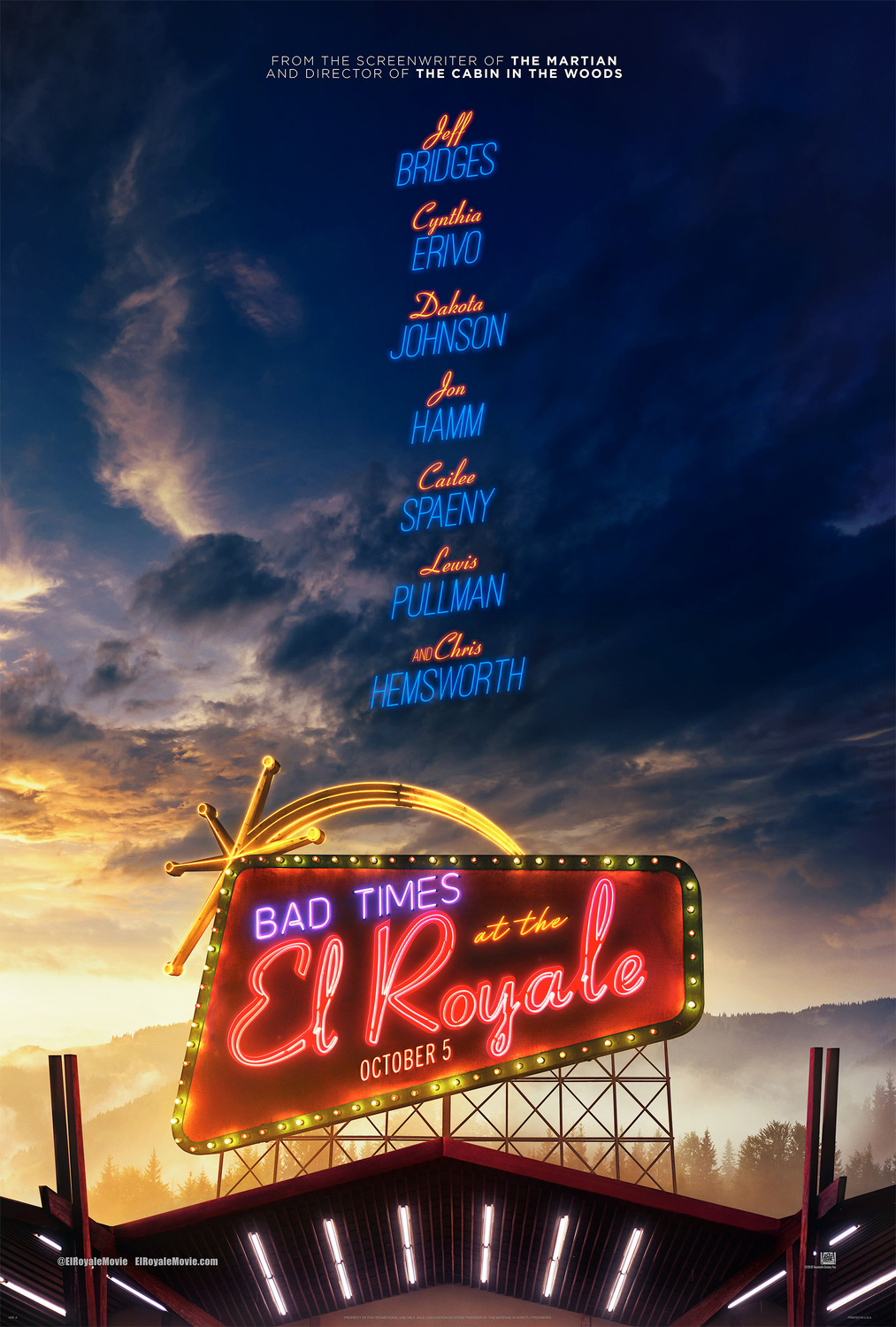
Bad Times at the El Royale poster

Bad Times at the El Royale” is one of those movies I have really come to deeply admire as it is like an onion you keep peeling at continually to see what’s underneath. Just when I thought I knew where things were heading, the story heads in another direction to where what we were initially introduced to is not all what it seems. As Bo Diddley once sang, you can’t judge a book by looking at the cover, and while this movie’s poster tells us what we need to know before going into the theater, there is more to discover than we could ever anticipate.

The El Royale of the movie’s title is a hotel which, at one time, was one a glorious place to visit, but it has since fallen into disrepute. The first sequence shows a man entering a room there, digging beneath its surface to play a bag of money beneath it. He is later greeted by another man who he kindly welcomes in, but who quickly shoots him dead with a shotgun. It’s a wonderfully elaborate sequence which brings us into a motion picture which promises not to be the usual mainstream fare.

We then move to 10 years later when a number of visitors arrive at the El Royale to stay for a night or two. They include the kindly priest Father Daniel Flynn (Jeff Bridges), aspiring singer Darlene Sweet (Cynthia Erivo), vacuum cleaner salesman Dwight Broadbeck (Jon Hamm), and a young hippie named Emily Summerspring (Dakota Johnson). All of them are greeted by the hotel’s concierge and apparently its only employee, Miles Miller (Lewis Pullman), who gleefully illustrates the location’s history and amenities for all of those willing to hear him out.

Revealing more from here would spoil one too many surprises as we discover not everyone is who they appear to be, but I can tell you the characters soon find themselves on a road to hell as their sins rise to the surface for everyone around them to see. In one way or another, everyone is either trying to escape their past or reclaim it in a way which offers no promises, and not everyone is going to make it out of their predicament in one piece.

“Bad Times at the El Royale” was written and directed by Drew Goddard who wrote the screenplays for the highly-entertaining “Cloverfield,” “World War Z” and “The Martian,” the one Ridley Scott movie in recent years which we can all agree on (in that it was great). Goddard also wrote and directed the horror comedy “The Cabin in the Woods,” a movie I should have seen already, but anyway. He composes this movie in vignettes just as Quentin Tarantino composes his with chapters out of a novel. Each one allows us to learn more about the characters and what brought them to this once glorious resort. The question is, do they all know about the valuables buried beneath one of the rooms?

I enjoyed how Goddard kept peeling away at each of these characters’ identities as we learn more about them in ways which are both illuminating and shocking, and it kept me guessing as to where things were going to go next. There’s even a scene of shocking violence involving a wine bottle which just comes out of nowhere, and it slammed me back into my seat in a way such a scene has not in recent years.

The movie, however, does suffer as it goes on. You should have heard the collective gasp from the audience at the press screening I attended when they were told the running time would be two hours and 21 minutes. Most Hollywood studios these days would never dare to let one of their releases last more than 90 or 100 minutes, so the amount of freedom Goddard got here seems astonishing in retrospect.

I have nothing against movies which last over two hours as long as they are able to justify their length. It is far too easy for a filmmaker to become self-indulgent. In retrospect, “Bad Times at the El Royale” could have used some tightening in the editing room as the story slowly drags towards its conclusion which involves a charismatic cult leader named Billy Lee (Chris Hemsworth, taking a much-needed break from the Marvel Cinematic Universe) and his much-too devoted follower, Rose (the wonderfully possessed Cailee Spaeny). By the time we finally arrive at the ending, it feels like everything is concluding on the wrong note. This could have been an even more frustrating ending than the one in “The Matrix Revolutions,” but saying so is a little too punishing.

Still, there is much to admire here such as the cinematography by Seamus McGarvey, the terrific set and art direction and, of course, the great cast that tears into their roles with great gusto. Jeff Bridges continues to remain one of our finest actors as he inhabits his role of Father Daniel Flynn in a way few others could. Cynthia Erivo proves to have quite the vocal chops here as her singing left the audience I saw this movie with in almost total silence. Dakota Johnson, finally freed from those god-awful “Fifty Shades of Grey” movies, gets to show an enigmatic side of her acting that makes it clear how we have no business dismissing her as just another pretty face. As for Jon Hamm, he is as charming as ever, and watching him hustle the other characters almost effortlessly makes me believe he will be the next Batman.

“Bad Times at the El Royale” is a flawed movie, but for me, its strengths more than outweigh its weaknesses. I am curious to see how audiences end up reacting to this as it is coming out in a cinematic time dominated by superheroes. Goddard’s film definitely stands outside the norm, but my hope is audiences will take the time to discover something a little different from what they are used to.

Whatever you think of “Bad Times at the El Royale,” you have to admit it allows Jeff Bridges to utter one of the best lines of dialogue in recent years:

“Shit happens… Get the whiskey.”

* * * out of * * * *

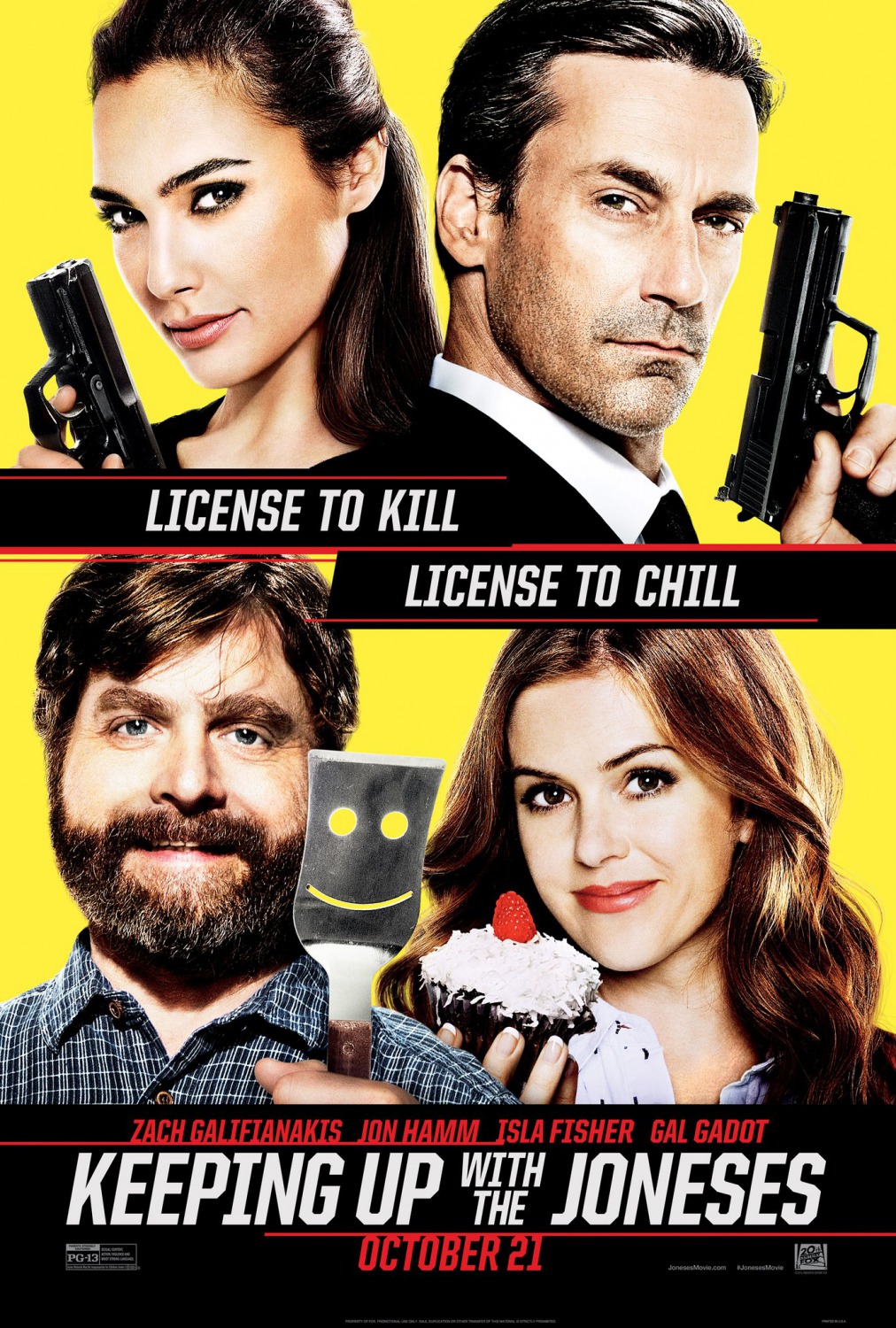
Keeping Up With The Joneses

keeping-up-with-the-joneses-poster

When a movie takes its title from a tagline used to promote “Indiana Jones and the Last Crusade,” I can’t help but walk into it with high expectations. Indeed, “Keeping Up with the Joneses” boasts a plot which quickly reminded me of “True Lies” and “Mr. and Mrs. Smith” in which government spies disguise themselves as ordinary suburban residents, and it has a cast of actors who you can always count on to give you a fun time. It’s even directed by the man who gave us “Superbad” and “Adventureland,” Greg Mottola. But while it does have some inspired moments, “Keeping Up with the Joneses” ends up feeling, to put it bluntly, half-assed.

We meet Jeff Gaffney (Zach Galifianakis) who works at a corporate office as a human resources director. He is happily married to Karen (Isla Fisher), and they have two children who, as the movie starts, are heading off to summer camp for a few weeks. For the first time in years, the Gaffneys have the whole house to themselves which has them thinking of all kinds of mischief to get into, but any plans they have for getting naughty are interrupted when a new couple moves into the neighborhood.

Tim and Natalie Jones (Jon Hamm and Gal Gadot) are not your usual couple as they look as if they have traveled all over the world, and they look far too gorgeous to pass as ordinary people. As a result, the Gaffneys get overly suspicious and are eager to learn everything there is to know about them. It doesn’t take long, however, to realize they are spies, but whether they are foreign or domestic spies remains to be seen.

“Keeping Up with the Joneses” gets off to a strong start as we get a picturesque view of suburbia with the peaceful neighborhood these characters inhabit. As the camera pans around the different houses, one of them blows up into smithereens, and the explosion almost feels like something out of a Kathryn Bigelow movie. Next thing you know, the story moves back to two weeks before the explosion, so we already know this peaceful neighborhood won’t be very peaceful for much longer.

The great things about the movie is the cast. Galifianakis gets to play a different role this time around as Jeff Gaffney is not like the mentally unstable characters he became famous for playing like in “The Hangover.” Seeing him play a down to earth guy who is all about family and good times feels like a stretch for him, and it’s fun watching him opposite Hamm especially when they have lunch at an underground restaurant which is definitely not for vegans.

Hamm gets to play on his sexy guy image, and he is well matched with Gadot who looks very comfortable in the action comedy genre. Isla Fisher has been great fun to watch in any movie she appears in ever since her scene-stealing turn in “Wedding Crashers,” and she doesn’t disappoint here. There’s also a nice pair of performances from Matt Walsh and Maribeth Monroe as a pair of neighbors who might be getting a little to nosy in everyone’s affairs.

But as terrific as this cast is, they are not enough to save this movie which runs out of inspiration very quickly. It would have been more fun if the director and screenwriter kept us guessing as to whether the Joneses really were spies or not. Looking back, I kept thinking everyone missed out on various opportunities to make this movie cleverer than it is. This could have been an uproarious comedy had more effort been put into the script. After a while, we know how things are going to turn out for the four main characters here, and it just reminds us of other movies like it which were much, much better.

When the movie reaches its conclusion, it’s sunk by a predictability everyone could have avoided for the benefit of the audience. What we are left with is a premise which everyone could have and should have had a lot more fun with. The characters, despite the best efforts of the actors, could have been better developed to where they don’t feel like caricatures. The action scenes are fun, but you feel like they could have been more thrilling. Instead of accepting the movie for what it is, we keep thinking about the movie it could have been, and realizing this is depressing.

“Keeping Up with the Joneses” is one those films I analyze endlessly as I watch it because I am convinced I could have done a better job with the material. This premise could have been taken in a number of different directions and could have ended up being an insane amount of fun. But we get instead is a motion picture which have spent more time in the development phase because this one came out of the oven far too soon. It has its moments, but it could have had a lot more of them.

* * out of * * * *