Exclusive Interview: Ben Cotner and Ryan White Talk About ‘The Case Against 8’
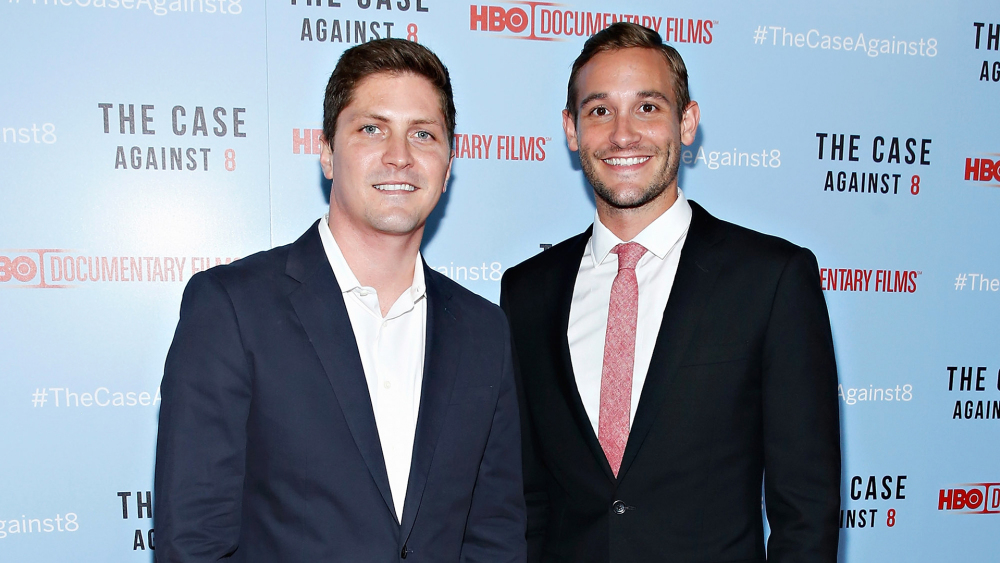
Case Against 8 Ben Cotner and Ryan White photo

The documentary “The Case Against 8” focuses on the historic federal lawsuit which was filed to overturn Prop 8, California’s discriminatory ban on gay marriage. Its directors, Ben Cotner and Ryan White, spent five years filming the plight of two couples (Kris Perry and Sandy Stier, Paul Katami and Jeff Zarrillo) who were plaintiffs in this case as well as Ted Olson and David Boies, the lawyers in “Bush v. Gore,” who represented them. The documentary made its debut on HBO back in 2014, and it gave us an in depth look at what went on behind the scenes with these people as they fought for marriage equality.

I got to speak with Cotner and White in 2014 when they were in Los Angeles, California for “The Case Against 8” press day. Cotner has served as an executive at Paramount Pictures and Open Road Films, and he has worked on the films “An Inconvenient Truth,” “American Teen” and “Side Effects.” White produced and directed of “Good Ol’ Freda” which is about Freda Kelly, The Beatles’ longtime secretary, and “Pelada” which follows two soccer players as they travel around the world. They were both very open about the challenges and surprises they encountered while making this documentary.

The Case Against 8 poster

Ben Kenber: The lawsuit was supposed to last only a year or so, but it ended up going on for five years. You couldn’t have known how everything would turn out, but did you have a clear idea of how you wanted this documentary to play out?

Ryan White: No. We began filming in 2009 right after the case was filed, but more just to cover our bases in case it became something big. We were lucky to get Ted (Olson) and David (Boies) on board, and they recognized also that if it snowballed into something bigger, it might be important to have a video record of it. But we filmed for three or four years without even knowing whether we had a film, or at least whether we had a third act or not. It was when the Supreme Court granted cert in December 2012, that was when we really sort of launched into hyper drive and realized that we have to finish our film. We had six months to edit it, but also that we would have a really great ending no matter which way it went.

BK: And you did end up with a great ending.

RW: Well we were very lucky in a Hollywood fairytale type of way (laughs).

BK: What surprised you most about making this documentary?

Ben Cotner: I think one of the things I was most surprised about was how open the plaintiffs and the lawyers were with us in sharing their lives. When we first went in there we had never met them, so it was really important for us to spend a lot of time gaining trust with them and for them to be comfortable with cameras around. Ryan and I intentionally didn’t have big camera crews. We shot everything ourselves so I was surprised that we were able to slip in and out of rooms for these incredibly confidential meetings and they let us do that. That was really, truly, as a documentary filmmaker, such a gift and such an exciting opportunity for us because we would get to see things that were happening that other people involved in the case weren’t able to see.

RW: I mean it’s a surprise where we are now in the country with the climate on marriage equality and what’s happening with states right now. When Prop 8 passed I think only two states had legalized gay marriage at the time in California was the third so it was relatively normal that things like Prop 8 could pass, and now it’s pretty abnormal. Even in the reddest of red states we are seeing federal judges saying that the constitutional bans/the state bans are unconstitutional, so I would’ve never expected in 2008 when we began this film that we would be at this point which feels like a tipping point.

BK: There is some attention paid to the defendants. Did you ever get any pressure to put a little more focus on them as well, or did you feel that they got enough focus?

BC: The title of our film is “The Case Against 8” because we really wanted to tell a character piece, a journey of these people to overturn this law that was affecting them. I think in doing so we spent so much time behind the scenes with these people that it would’ve been deceptive of us to pretend to be giving fair attention to the other side. At the same time, we wanted to be very respectful and not villainize them. So it really wasn’t that we were setting out to make them look bad. I think we wanted to present the best of their arguments that we could see as they were presented in court and be very true to what they said, which I think at the end of the day we were. Their lead witness, David Blankenhorn, we approached when he changed his mind about same-sex marriage very publicly. He agreed to an interview which we thought was really interesting, so we could actually see some of the perspective of somebody who was, at the time, on that side during the trial. It wasn’t that he was a hateful person. He would say there was some animus in their belief that gays and lesbians shouldn’t have the right to marry, but it wasn’t because he was trying to be mean to anybody. He was essentially a nice guy. As he said, he just hadn’t gotten to know people. So for us it was important to be as fair as possible to them but not pretend that we were going to make a film about whether gay marriage was right or wrong and be fair to both sides. It really wasn’t about that for us. It was telling these characters’ stories.

BK: You had 600 hours of footage when you finished making this documentary. What was it like editing that down?

RW: A nightmare (laughs). No, it’s fun editing it down but it’s also a nightmare at the same time. Ben and I shot the footage ourselves so we were intimately familiar with what we had shot, but we hadn’t looked at it for many years. When we would shoot on tapes and we would put them into safety deposit boxes. We didn’t look at the footage. Our agreement with the legal team was we wouldn’t put a film out until the case had resolved, so we didn’t even look at the footage until we knew it was going to the Supreme Court and then we only had six months to finish a film. So it was a really fun, sort of nightmarish process to have to go through all that footage and figure out what we had and how we could put it into a cohesive narrative, but that’s where all the chips fall into place. Our main editorial goal was to balance a legal story with the human story. If you look at the structure of the film, it leads in and out of legal intricacies with the lives of the plaintiffs, and that was sort of the balance that was always the goal to strike. Hopefully we did in the end.

BK: Was there anything in this documentary that you wanted to include that you were unable to for one reason or another?

RW: It would have been great to have footage of the Supreme Court just to get to see them in action. I liked what we were able to do with the scene and hearing their voices is amazing. I can picture it myself, and as an audience member I would love to be able to picture those nine justices in action.

BC: There were some very special, intimate moments with the plaintiffs such as the day after they testified. Everyone left the courtroom and went into this sort of back secure elevator that was closed to the public, and everyone that was involved in the case was in there including us. And as soon as the elevator doors shut everybody burst into chairs. Those little special moments that, because you’re in a courtroom you can’t be filming, I think it would’ve been great to have. But fortunately there were plenty of other joyful moments that we could put in the film.

BK: I was talking with another documentary filmmaker recently and she talked about respecting the space in terms of keeping a certain difference from your subjects. Do you think you were able to pull that off?

RW: I think it’s inevitable in a film like ours that lasts for five years that’s so personal and with issues that are personal to Ben and I, we are gay Californians, that it’s hard not to have a respect for their bravery. Also, seeing them go through the wringer during this case, it’s hard not to feel invested in what happens to them. So we tried to be very respectful of telling their story faithfully, and also if there were things that they didn’t want to be part of the process we were respectful of that, but to their credit that was very few and far in between. I think one of my favorite parts of the film right now is that we are releasing it, and Ben and I are not holding cameras anymore. This morning we were all in the same room and we got to spend time with them without any of us working. It’s just getting to enjoy being together because we did become friends with them during the process. We adored both of their families, we wanted them to get their fairytale ending, and we were thrilled filming their weddings so I think it’s just about finding a balance between respecting their privacy and also trying to make a great film. We obviously had a lot of respect for them as people and families.

BK: One of the things I love about this documentary is how it peels away at political labels.

RW: Thank you. That’s our goal. That’s what we wanted to do.

BK: Ted Olson was the lead attorney for the plaintiffs, and he is the same guy who basically gave us George W. Bush as President of the United States. What was your first reaction when you found out that he was going to be taking this case?

BC: We were definitely surprised. We knew who Ted Olson was, and he is one of the most famous conservative litigators in the country. At the time, Dick Cheney was probably the only prominent conservative who was speaking openly for same-sex marriage. When he took the case we were surprised, but then once we got to know Ted we understood a little bit more why. He was never really opposed to it and he believes in equal protection of the law and always has believed that. But what was so great about it was that we could look at the issues not in a political way and not in a partisan way. We could look at the facts and we could look at what scientists were saying. Preeminent scholars from around the world came and testified about what the real science and statistics say, and individuals like Kris, Sandy, Jeff and Paul could speak to their experience and how it affected them in a very real way. So I think it allowed those stories to be heard in a way that never had happened before.

RW: Yeah, and the case was engineered around stripping politics out of it. We sort of tried to mimic that in our film because we could have concentrated on a lot of political things. We didn’t want to make a traditional social issue film about one side’s opinion on an issue and the other side’s opinion on an issue and try to draw a conclusion from it. That just wasn’t our goal. Our goal was to tell human stories, and that is the trajectory of two couples. This isn’t a movie about gay marriage being right or wrong. It’s just watching what these two couples were put through and the extraordinary circumstances they had to go through. Most straight people propose, get married in a year and it’s very routine. That’s what they grew up thinking is normal, and these two couples didn’t go through that. They went through a completely rigorous zig-zag way of getting to their fairytale ending. So I hope that that’s what the film’s take away is; just human stories rather than the political things that just sort of overwhelm the issue.

I want to thank Ben Cotner and Ryan White for taking the time to talk with me. “The Case Against 8” is now available on DVD, Blu-ray and Digital.
Recount

recount-poster

Memories of hanging chads and confusing ballots permeate our consciousness years after the heavily contested 2000 presidential election between Al Gore and George W. Bush. We saw this played out on the networks with all their furious coverage, but with “Recount” we get a look at what went on in the campaign offices while this election fight went on to get a picture of what they each felt was fair and just.

How you view “Recount” may depend on what side of the political spectrum you have placed yourself on. I’m not sure how accurate this movie is to the real events, but I imagine it is pretty close. Coming out of it, you may feel it values one candidate over the other. But in the end, “Recount” is not so much a movie about the fight to get candidates elected as it is about the fight for democracy. It is a fight for all the voters to be heard, and also a scary tale of how the fate of the Presidency can end up in the hands of a powerful few instead of America as a whole. Hopefully, this is something that we all collectively hope we never have to live through again.

“Recount” was directed by Jay Roach, best known as the director of the “Austin Powers” movies. Here, he directs a large cast of superlative actors who take the roles of many people we know well from the 2000 election and gives us a strong case of why many still thank Al Gore was robbed of the Presidency. Both Gore and Bush are basically supporting players here, and we only see them from the backs of their heads or in news footage of them during the campaign. The movie is more interested in what went on behind the scenes of the election and of the different fights made to get to the truth of who won the Florida electoral votes.

Even though we all know how this ended up and who got elected, the movie is still riveting in the same way “Apollo 13” was. The filmmakers are not so much interested in the general way things happened as they are in the specifics of the election. We see brilliantly shot examples of how chads in ballots could not be broken off as they were designed to. The opening shot of the movie shows how easily confused some Florida residents are when they are trying to vote, and yet it is not altogether clear how to vote for Gore so that you don’t accidentally vote for Pat Buchannan. The moment where one of Gore’s campaign workers rushes up to him before he is about to make his concession speech on the night of the election is scary as we all feel like we are running alongside him. Even after all these years, we have a strong emotional reaction to the thought of Gore conceding the election.

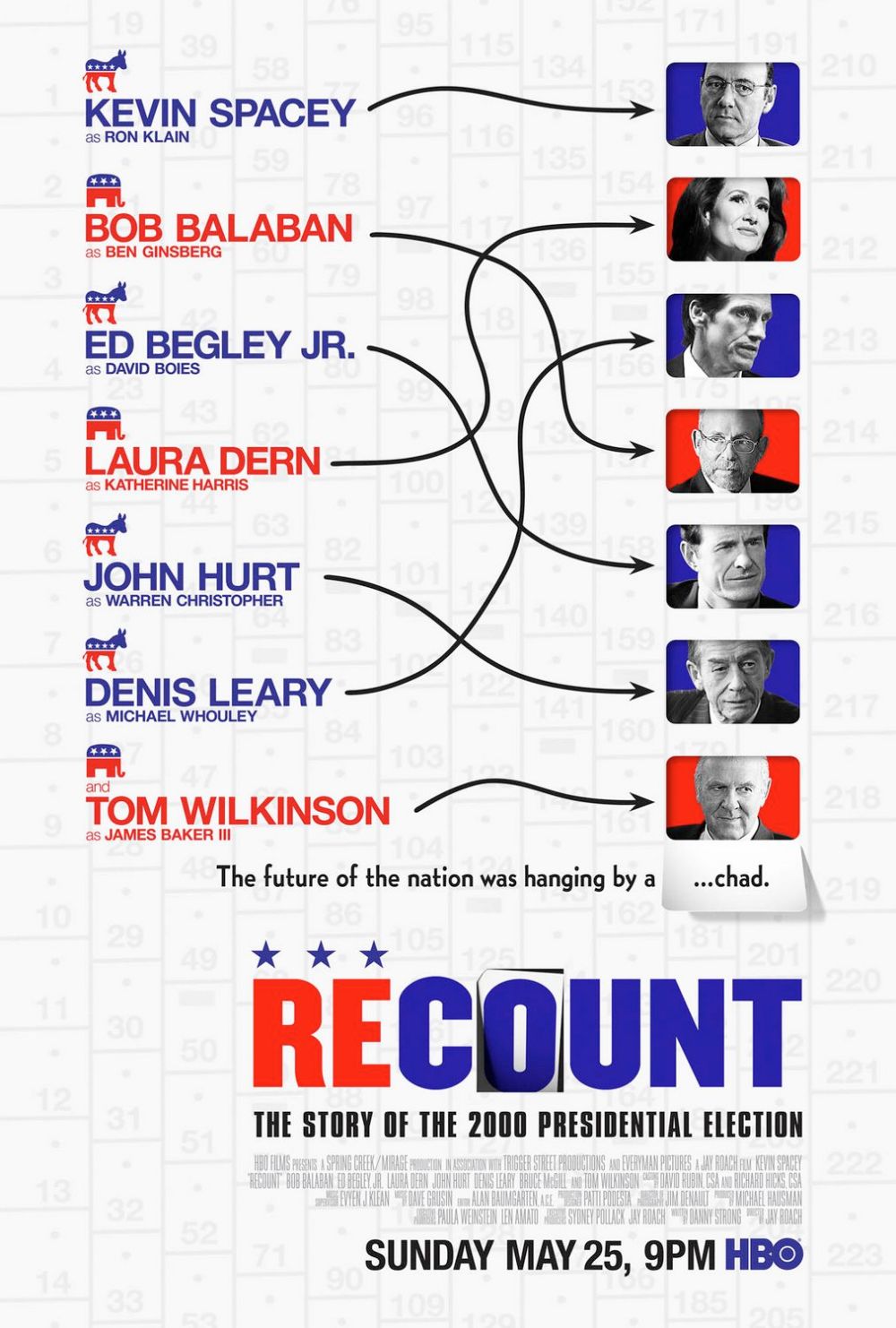
At the head of this star-studded cast is Kevin Spacey who gives one of his best performances as Ron Klain, Gore’s legal advisor on the campaign trail. The day before the election, it is presumed Gore is going to win, and Klain is offered a job in Gore’s new administration. Klain ends up turning it down as he feels it is not the way he wants to spend the next eight years of his life. But when it becomes clear there are clear inconsistencies in the voting in certain Florida counties, Klain goes right into action to make sure all the votes are recounted, as the margin of victory is only off by just over a thousand votes. Klain is aided by a large team of political strategists from Michael Whouley (Denis Leary) to Warren Christopher (John Hurt).

Spacey makes it clear from the start that Klain is an idealist more than anything else about the way the political system works. What he does throughout the movie is not motivated by his desire to see Gore become President, as he even admits he is not even sure he likes Gore, as it is by the desire to see all the votes counted and to not have any of them thrown out for different reasons like those rejected ones which contain the similar names of convicted felons. Because the election was so close, we can see in Spacey’s eyes how this election is much too important for anyone’s vote to be cast aside.

We also get great performances from actors like Ed Begley Jr. who plays David Boes who passionately fought for the recount to continue when testifying at the Supreme Court. Another great one comes from the always reliable Tom Wilkinson (“Michael Clayton”) who plays James Baker who fights on behalf of George W. Bush to turn the election his way. Wilkinson plays Baker as being idealistic in his own way, and he is almost as idealistic as Klain is for the democrats. Bruce McGill is also great here as Republican lobbyist Mac Stipanovich who is brought in to persuade Florida Secretary of State Katherine Harris to stop the recount.

Speaking of Katherine Harris, who by the way wanted nothing to do with “Recount,” she is played here in a brilliant performance by Laura Dern. With makeup, which brings up harsh memories of Faye Dunaway in “Mommie Dearest,” Dern gives us a Katherine Harris who is not dumb, but who is oblivious to what is going on around her. Harris says she is following the law, but never really questions those around her as to what their true motives are. Dern is one of the best actresses working today, and this movie is a good reminder of this fact.

The other thing to note about “Recount” is how the actors do a great job of inhabiting their roles as opposed to impersonating people we have become all too familiar with. The trap of playing real life people is many actors end up playing them from the outside in instead of the inside out. It takes a group of well-trained actors to play these roles, and who are not mere impressionists or mimics. Mimicry is a cool art, but it doesn’t work in a movie like this one.

Roach does a great job of putting us back in the year 2000, and he makes you a witness to all the events to where even though you know how this race ended, you still hope and pray for a different outcome. He also shows how each candidate has to be grateful for the dozens of people and hundreds of supporters who helped them get to where they ended up. The truth is we haven’t had many movies recently which have looked at the people who work so hard for the politicians they support, and these people need to be thanked for all they do. They can’t stay behind the scenes forever. They need to be seen for who they are.

In the end, “Recount” is not so much a movie about how Gore got screwed out of an election he won the popular vote on. It’s not even about if Gore lost the election. It is about how democracy was lost in the 2000 election, and of how many voices were rendered irrelevant for reasons which were not altogether justified. The final scene of the warehouse where all those uncounted votes is haunting, and it  feels like an outtake of the scene from “Raiders of The Lost Ark” where the Ark of the Covenant got stored in a factory holding hundreds of boxes which all look alike. The real victim of this election was all the voters were not heard, and this left a shadow over George W. Bush’s presidency which will never be erased.

It also serves as an important document of this moment in history which we can never forget. We need to remember what happened so it never happens again.

* * * * out of * * * *

Mapplethorpe: Look At The Pictures

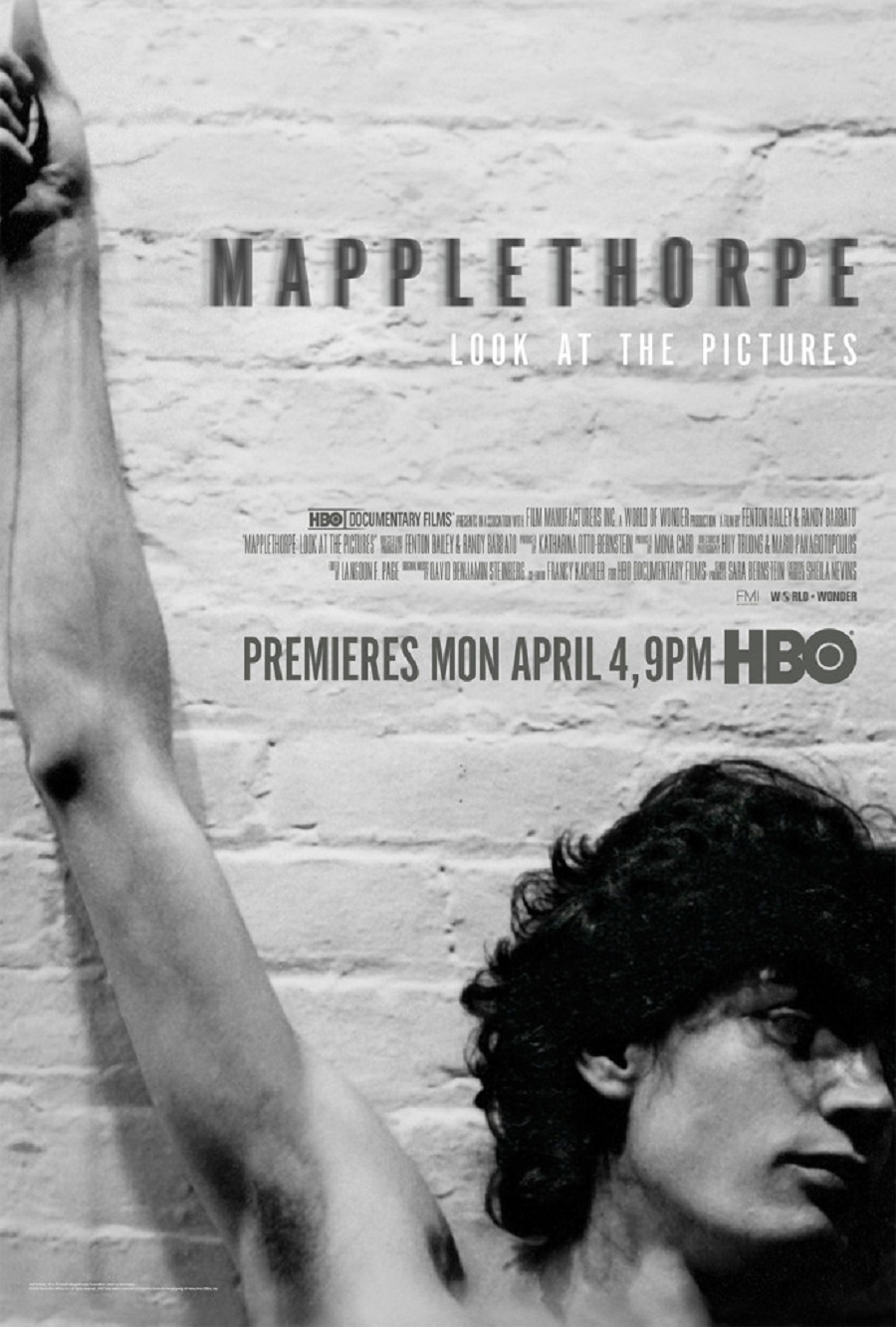
Mapplethorpe poster

This documentary starts off with former Senator Jesse Helms on the floor of congress back in 1989 where he denounced the controversial photography of Robert Mapplethorpe. Now Mapplethorpe’s work ended up pushing a lot of social boundaries with his frank depictions of sexuality, nudity and fetishism, and since he became known during the age of Ronald Reagan’s moral America, many saw him as nothing more than a shameless pornographer and refused to look at his photographs with any penetrating insight. What was on the surface bothered them, but like with any work of art it is about how the mind perceives it and of the effect it has on your perception of the world around you.

Helms told congress to look at the pictures as if they were done by someone possessed by the devil, but the HBO documentary “Mapplethorpe: Look at the Pictures” invites the viewer to look at them from a less biased perspective and see how this artist managed to turn contemporary art into fine art. What results is a fascinating look at an artist who in some ways is more prolific in death than in life, and it is probably the most in depth look at his life currently available.

We get scenes featuring curators at The J. Paul Getty Museum and The Los Angeles County Museum of Art as they prepare to open a landmark retrospective of Mapplethorpe’s work. Their intent is to look at him as a human being, and that intent is shared by the documentary’s directors Fenton Bailey and Randy Barbato whose previous work includes “Inside Deep Throat,” “The Eyes of Tammy Faye” and “Party Monster” (both the documentary and the feature film starring Macaulay Culkin). They dig deep into Robert’s past and never sugar coat his life for easy consumption.

It was very interesting to see Robert as a kid when he was considered the pogo stick champion of his neighborhood and somewhat unsurprising to learn he never really fit into any of the social circles in high schools (the great artists never seem to). Throughout the documentary we get to hear his voice from old recordings, and he says that he grew up in suburban America which he described as a good place to come from because it is also a good place to leave. He also admits he never set out to be a photographer as he took a course on it and hated it. And yet during his college years he found a creative spark which never left him.

“Mapplethorpe: Look at the Pictures” also features interviews with various friends, family members and celebrities who all seem to agree Robert was a largely mysterious person who was always looking to get a rise out of people.  At the same time, his brother Edward said he could be quieter than anyone else in the room. Writer Fran Lebowitz even described him as looking like a “broken Cupid,” so it’s safe to say that many people viewed him differently. As the documentary continues on, it shows us a man struggling to express himself during a time where voices which differed from the norm were quickly chastised and silenced.

One of the documentary’s most fascinating segments comes when Robert meets up with singer Patti Smith and observes the time they spent together at the famous Chelsea Hotel in New York. This segment also takes us back to a time when the Big Apple was bankrupt, corrupt and looked nothing like the insanely expensive city it is today. The two of them fed off each other creatively and created art no one else ever could have, and Mapplethorpe even shot the photograph which became the cover for her first album, “Horses.” The fact that their relationship is cut a little short in the documentary is disappointing as it would have been great to see more of them here, and it could very well make for a great documentary of its own.

Both Bailey and Barbato also might have fared a little bit better had they given equal time to the methods Robert used to create his art instead of his personal life. Many of his photographs, including his famous “Man in the Polyester Suit,” are on display here, and while we get an idea of how he messed around with his Polaroid photos to create something startlingly unique, it would have been nice to see more of his technique in how he pulled certain photographs off.

Instead, “Mapplethorpe: Look at the Pictures” spends more time than it needs to on Robert’s love life and his various lovers. Granted, hearing them talk about Robert does give us deeper insight into his psychology and how selfish he became as he got older. We even here Robert say at one point, “Life is about using people and being used by people,” so his self-centeredness is very understandable. But to hear people talk about him in this manner makes the documentary at times feel like a broken record.

However, “Mapplethorpe: Look at the Pictures” finishes on a strong note as we watch Robert putting up his last solo show entitled “The Perfect Moment.” By this time, he had been diagnosed with AIDS which back then was a death sentence, and some described this show as being a “memorial with a living corpse.” Robert was only 42 years old when he died on March 9, 1989, but he looked more like he was in his late 60’s. In his later years he sought fame like crazy, and he soon became more famous in death than in life. The effect this final show had on the general public was profound, and it served to secure his legacy after he passed away.

Despite some minor flaws, “Mapplethorpe: Look at the Pictures” is a compelling documentary which serves to look at the famous artist as more than just a controversial figure. Robert was a human being with problems like anybody else’s, but he always photographed what he loved and the people he loved to be with. He pushed all sorts of boundaries as he described art as being about “opening something up.” He certainly opened the world up to looking at things differently than ever before, and he remains a potent force in the art world today. Looking at his photographs now, one cannot help but wonder why certain parts of the human body are still considered more dangerous than a loaded gun.

Copyright Ben Kenber 2016

* * * ½ out of * * * *


Abortion: Stories Women Tell

Abortion Stories Women Tell poster

Was there ever a time when abortion didn’t seem like such a controversial issue? Well, if there was, that was certainly a long, long, long time ago. Even with the passage of Roe v. Wade in 1973, which gave every woman in the United States the right to an abortion, many have still been doing their best to get it overturned. Never mind that the Supreme Court has the final say on issues like this, never mind that Roe v. Wade was passed to stop women dying from abortions, and never mind that abortions make up a very tiny percentage of the work Planned Parenthood does; people are still swayed by their emotions more than they are by facts, and many have to be reminded of the importance of the separation between church and state.

The HBO documentary “Abortion: Stories Women Tell” is not out to take sides on this contentious debate. Instead, it gives women the opportunity to talk about their experiences with both pregnancy and abortion and to tell their own stories without any filters. Some men are heard on this too, but the focus is on women on both sides of the fence as they are the ones who have to deal not just with their decisions, but also the aftermath they are unwillingly exposed to.

The documentary starts off with a pro-life rally in Missouri where supporters chant “all in Christ,” and an elected representative tells them they are making progress in closing clinics in the state as they now “have the ability to look inside the womb.” But the focus then quickly shifts to a title card which states how since 2011, more than half of the United States have significantly restricted access to abortions, and those restrictions have increased from year to year. Abortion opponents may not be able to overturn Roe v. Wade, but they have managed to find ways around it.

Missouri at this time has only one abortion clinic which means the women who live there are more likely to drive many miles across the state border into Illinois to seek help. The documentary looks at the daily happenings at the Hope Clinic in Granite City, Illinois where employees do their best to help women in need of health care even while they are constantly harassed by protestors. None of them have any shame over the work they do, and that’s even if some consider themselves the black sheep of their family as a result.

The stories we hear cover different parts of the spectrum regarding the abortion debate. There’s Amie, a 30-year-old single mom who works 70 to 90 hours a week to make ends meet and cannot afford to have another baby right now. We get to meet Sarah who has discovered her baby will have lungs missing and won’t survive long after birth. Then there’s Kathy whose house is filled with various religious objects, and she is setting up a peaceful pro-life march to get what she sees as God’s message across to others. And there’s no forgetting Alexis who is 17 years old and pregnant, whose mother died when she was just 8 and who gets picked on at school because of her condition. It’s painful to see how isolated all these women are from the rest of society as the stigma of abortion is still all too harsh. Granted, Kathy might not seem as isolated, but there is a strong sense of loneliness about her as she pursues her quest to end abortions.

Director Tracy Droz Tragos, herself a Missouri resident, presents all these women’s stories without any judgment. She has given them a forum to speak their minds, and they all need to be heard regardless of how we feel about this infinitely taboo subject. There’s no narration to be found here as Tragos is not looking to steer the conversation one way or another, and this is even though the number of pro-lifers interview here pales in comparison to the pro-choice advocates. But for what it’s worth, the pro-life women interviewed here come across as very nice and full of much love, and this is in sharp contrast to those protestors (mostly men) who stand outside the clinic berating anybody and everybody who enters it.

But for me, the most important takeaway from “Abortion: Stories Women Tell” is that none of the women featured here take the issue of abortion lightly. Why would they? Many people who oppose abortion treat those who have had one with such disgusting disdain as if to say they never bothered to put much thought into what they were doing. But as Representative Jackie Speier said in a session of congress, the thought that anyone enters into such a decision with a cavalier attitude is just “preposterous.”

It’s impossible not to be emotionally affected by what these women go through. Plus, one cannot but be infuriated at those protestors who hold up signs featuring what looks like aborted fetuses which are disgusting and unforgivably cruel as they do nothing more than try to manipulate the actions of people they have no interest in knowing personally. Tragos briefly gets to interview one of the most outspoken pro-lifers who follows a clinic escort all the way to her car, begging her to repent. He talks about a law in California which punishes someone with not one, but two murders when they kill a pregnant woman. Whoever this person is, he may need to look at the California law book more closely.

With the United States currently entering the most contentious of Presidential elections, the future of Roe v. Wade is in more danger than ever. But watching “Abortion: Stories Women Tell” is a stark reminder of how women are still treated like a minority even though they make up more than fifty percent of the world’s population. This documentary will bring about a fury of emotions for everyone who watches it, but the one thing to keep in mind is all the women featured here are no different from one another. They believe in the same things and have more in common than they bother to realize.

I also have to quote Kenneth Turan of the Los Angeles Times here as he made an excellent point in his review I wish I had made myself:

“The key to understanding why ‘Abortion: Stories Women Tell’ is a quietly powerful documentary is not the first word in the title, but the final three.”

* * * * out of * * * *

Copyright Ben Kenber 2016.