‘Black Swan’ is a Tour de Force for Darren Aronofsky and Natalie Portman
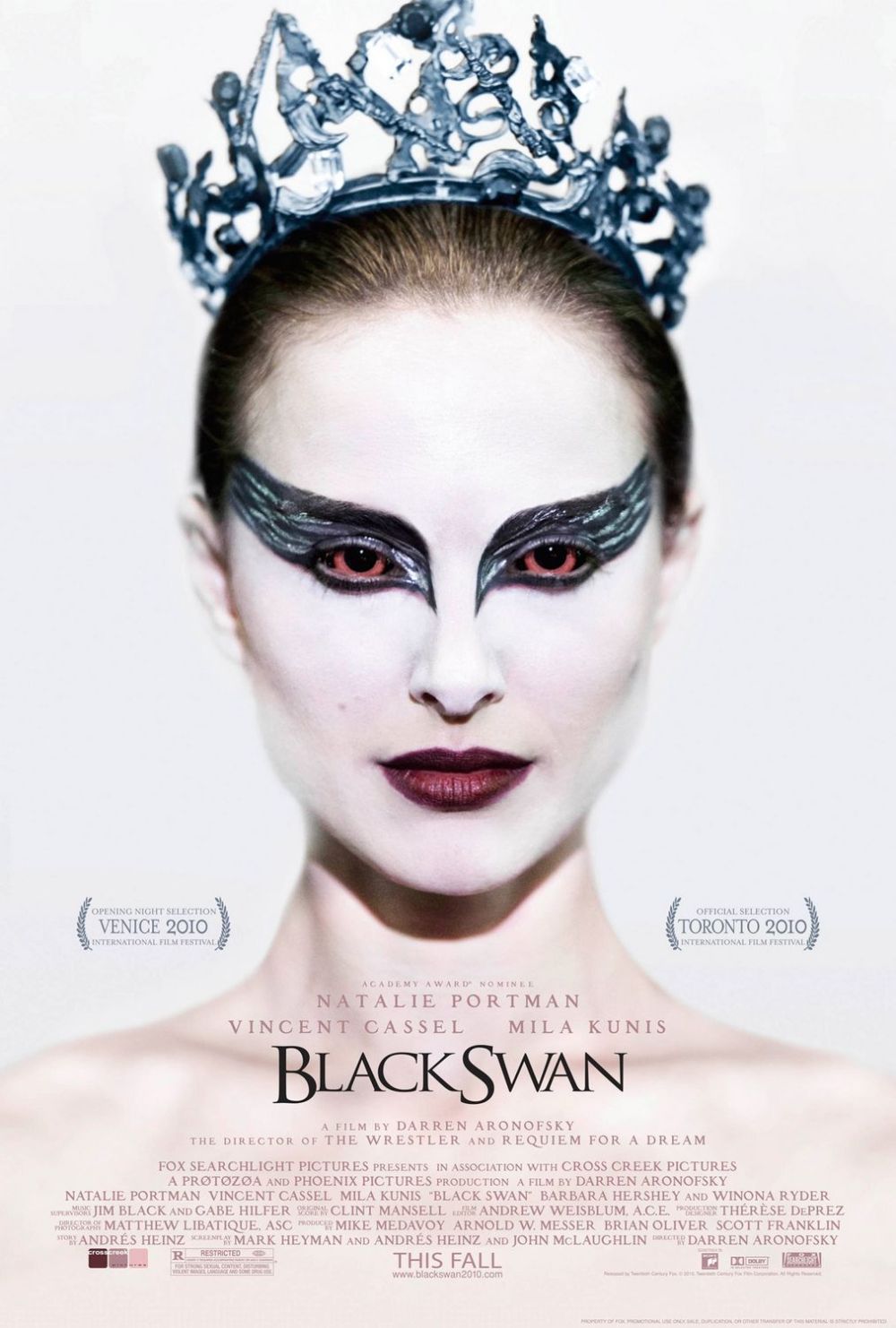
JESUS CHRIST!!! This was my immediate reaction after witnessing Darren Aronofsky’s “Black Swan.” A combination of “The Wrestler” and “Requiem for A Dream” with a dose of “Rosemary’s Baby” thrown in for good measure, it is a brilliantly over the top psychosexual thriller which continually ratchets up suspense and tension all the way to its horrifying climax. And unlike Mia Farrow’s character in “Rosemary’s Baby,” Natalie Portman has a really nice haircut.
Just as it was with “The Wrestler,” “Black Swan” serves as an expose sorts on the athletic arena it focuses on. The backstage world of ballet dancing is highly competitive, and the career of a dancer can easily be short-lived if an unexpected injury, either a big or small one, occurs. Many view ballet as being very boring and would rather tune into Monday Night Football. Try dragging kids to a production of “The Nutcracker” and watch how they run for the hills. This is the reaction I get from most people I know, although I’m sure there are exceptions.
But don’t let any preconceptions about ballet turn you off from seeing this film. It is anything but boring, and both Aronofsky and Portman brilliantly capture the physically and psychologically draining aspects of ballet to where you feel as wiped out and crazed as they do throughout. Like any other art form, ballet demands years of training in order to reach a level of perfection few can achieve. It is also shown to be an isolating career because, with so many people going after the same lead role, making friends is a struggle as you wonder what they are saying behind your back. With the bitterness level sky high, ballet threatens to be more damaging psychologically than physically.
Portman plays Nina Sayers, a member of a prominent New York City ballet company. After years of hard work, Nina gets her lucky break when she snags the lead role in “Swan Lake,” a show is as overdone as many of Neil Simon’s plays. This show has one of the most coveted roles in any show as it is incredibly challenging. Nina has to play the White Swan who is a creature of innocence, and also the Black Swan who is one of a sensual and dark nature. Basically, it is the dancer’s “Hamlet.” While her director Thomas Leroy (Vincent Cassel) thinks she is perfect as the White Swan, he has doubts about her ability to play the Black Swan as she is so technically precise in her movements, and the latter role requires her to lose herself in the passionately dark nature of the character.
Once we see Nina walk down the streets of New York past a woman who looks exactly like her, we are caught up in her downward spiral which she is helpless to stop. We watch as she encounters people and situations which feel real, but later turn out to be nothing more than hallucinations. There are times where she even looks like she is turning into a swan. While this may sound ridiculous on paper, it is brilliantly conceived visually from the rash on Nina’s back to those blood red eyes she develops. There are even points where she is dancing in front of a mirror, and her reflection turns around to glare at her malevolently.
The line between what is real and what is not becomes completely blurred, and neither the audience or Nina are able to tell the difference between the two. Many may be maddened at not being able to understand all of what is happening, but that’s precisely the point. Aronofsky puts you directly into Nina’s mindset, which has already proven to be an emotionally fragile place, and we are instantly caught up in her psychological disintegration. This makes “Black Swan” all the more visceral to experience. We are not just watching Nina go mad, we feel like we are going mad with her.
Portman does truly give the performance of her career here. She trained in ballet for a year or so, and her preparation really paid off. Throughout, she captures the sweet nature of Nina as well as the paranoia and resentment which overwhelms her the closer she gets to the opening performance. Watching Portman practice her dancing to no end is emotionally exhausting as it is for her physically, and she makes us feel like we are right on the edge of disaster with her. Portman has always been an amazing actress, but her work in “Black Swan” represents the culmination of a great career which is more than ready to head into adulthood.
Mila Kunis, looking even sexier here than she did in “Forgetting Sarah Marshall,” co-stars as another dancer, Lily. Unlike Nina, she is free with her body and mind, and what she lacks in precision she makes up for in unbridled passion. She’s at times friendly, wanting to break the ice between her and Nina, and her power of seduction is one Nina desperately wants to capture for herself. Kunis has become an increasingly fascinating actress, and seeing her go from sweet to a cold back stabber of a human being is made very believable by her work.
Oh yeah, there is a sex scene between Portman and Kunis which will have people checking out “Black Swan” for all the wrong reasons. Then again, any reason to get people to see this film might not be so bad. Furthermore, to dismiss this as a simple lesbian sex scene will only show how short sighted you are.
Aronofsky again employs his frequent collaborators to excellent effect. His director of photography, Matthew Libatique, almost makes this film look like a remake of “Suspiria” as the colors become overpowering once they become blacker and infinitely vicious. “Black Swan” is as much a sensory experience as it is a psychological one, just like “Requiem for A Dream” was. Libatique makes the special effects appear seamless in scenes where CGI is clearly utilized. As the background dancers pass by her, Nina sees her face in all of them. It’s such an eerie moment to where it doesn’t even feel like a special effect.
Then there is the fantastic Clint Mansell whose work on Aronofsky’s movies has become a main character in each of them. Mansell takes Pyotr Ilyich Tchaikovsky’s “Swan Lake” and breathes fresh life into it which is exhilarating to take in. His score becomes as intense as the images we see on screen, and I loved how visceral and thrillingly alive it all feels.
The movie also offers great performances from actresses we don’t see as much of on the silver screen: Winona Ryder and Barbara Hershey. Ryder clearly understands the frustration her character of veteran dancer Beth MacIntyre is going through, and she captures this deeply hurt and excessively bitter character perfectly. At once an empathetic and at other times a pathetic person, we see just how much Beth has lived for ballet, and now that it has been cruelly taken away from her, she has little else to devote her life to. To be placed on a pedestal so high only to be yanked from it leaves her with nothing but desperation and deep self-loathing which is hard to dig oneself out of.
As for Hershey, she remains a phenomenal actress as she has been for many years. In movies like “A World Apart” and “Portrait of a Lady,” she has created indelible female characters who are never easily forgotten. Her role in “Black Swan” is no exception as she takes the clichéd role of a stage mother and makes her a loving person as well as an overbearing one. When we come to see how her character failed at a dancing career, it becomes frighteningly clear how much of her happiness is based on how successful her daughter is at hers.
“Black Swan” once again shows how brilliant a director Aronofsky is as he mixes up different genres to create one hell of a movie going experience. Portman’s magnificent performance really is one for the ages, and few other characters have been as physically demanding for an actor as Nina is. Even as things get more and more horrifying, Aronofsky keeps your eyes focused on the screen to where looking away from it would feel like a crime. Is it more intense than “Requiem for a Dream?” No, but it sure does come close!
One thing’s for sure, this will not be a good recruiting film for dancers. They’ll want to go into accounting or dentistry after watching this one!


 The Ultimate Rabbit