‘Jurassic World: Fallen Kingdom’ Director J.A. Bayona Talks About Making ‘The Impossible’
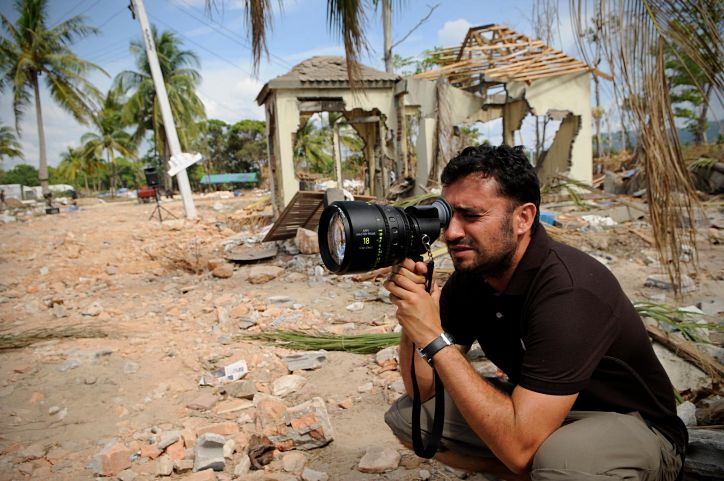
The Impossible JA Bayona photo

Spanish film director Juan Antonio Bayona, or J.A. Bayona for short, made a name for himself in 2007 with the horror movie “The Orphanage.” It earned him the respect of his fellow Spaniard Guillermo Del Toro who helped produce the film, and it became a big box office hit worldwide. These days he is known for directing “Jurassic World: Fallen Kingdom” which is expected to be one of the biggest hits of the 2018 summer movie season.

Following “The Orphanage,” Bayona was offered a number of movies to direct including “The Twilight Saga: Eclipse,” but he was really interested in doing something far more challenging to take on. Bayona found the challenge he was looking for with “The Impossible,” a movie based on the true story of a family that survived the devastating 2004 Indian Ocean tsunami in Thailand. What Bayona accomplished showed him to have great skill in getting strong performances out of an incredibly gifted cast, and he staged a tsunami scene so horrific, it puts the one in Clint Eastwood’s “Hereafter” to utter shame. The movie proves to be a cinematic experience as brilliant as it is gut wrenching to watch, and you won’t be able to ignore Bayona’s talent after you have seen it.

Bayona was at the Los Angeles press conference for “The Impossible” which was held at the Four Seasons Hotel in Beverly Hills, California back in 2012, and I was fortunate enough to attend his roundtable interview. We all thanked him for making this film which we agreed was one of the very best of the year.

The Impossible movie poster

Question: This is a great movie. Did you realize the scope of it when you got involved? Did you realize how inspiring it would be to moviegoers in general?

J.A. Bayona: Well it was getting bigger and bigger as much as we were getting into it. The first impact we had when we heard Maria (Belon’s) story was very emotional, and we wanted to figure out where that emotion was coming from. Even though it is a tough story and we’re talking about a tragedy, the emotion was coming not from a dark place. It was something that was coming from the way these people gave to the other ones in the worst moment. So, I thought that was very powerful and it was a very beautiful idea of approaching that. But then you talk to Maria and you realize how much suffering there is still nowadays. They call it “survivor’s guilt” even though she doesn’t like to call it that. She will talk about survival suffering because she doesn’t feel guilty for anything she did, but it’s really that there is a lot of suffering. I thought that would be interesting to tell the story of this family going there and then going back home and not talking about a disaster in a compassionate way and where you only talk about whether you live or you die. There’s a lot of gray space in the middle. From the very first meeting that we had we agreed that this was not just the family story. It was the story of many people, but the whole ending talks about that; how do you go home to the real world when your real world disappears? I like to see the film tell the story about the end of innocence. They don’t feel the same anymore, they lose the sense of security and their life is not the same anymore.

Q: How big of a challenge was this movie for you?

JAB: Well of course there was a huge challenge in the technical aspects of the film, but for me that was exciting and I was not worried about that. The real challenge was how to portray the story of the people who were there and how to give the big picture of what went on there and being respectful of the time.

Q: How much the movie was real and how much what was done with CGI? The movie looks very real even though some of those effects were probably done digitally.

JAB: Well it had to be like that because the story was very simple in reality so it could look like a visual effects movie. It had to feel real all the time. We did a lot of things for real like practical shooting and practical effects, and we also used a lot of CGI for greeneries and digital composition. But the great thing is to always mix several techniques so there’s a moment where everything gets lost so the audience doesn’t know what they are watching.

Q: Was anything done to reduce the carbon footprint of the movie or in trying to conserve resources?

JAB: Everything these days is now very regulated, so you have to be very respectful. For example, in shooting the water sequences in Spain the waters had to be darkened with a coloring used for food because that water had to be sent back again to the sea. Everything had to be natural. The water had to be decidedly desalinated before it got sent back to the sea.

Q: Did you think about shooting the movie in another country other than Spain, or was it always your intention to shoot there?

JAB: We did it in Spain because we found this huge water tank which is the second biggest in the world I think. So it was the perfect place to shoot all of the water sequences and once we finished with that we went to Thailand and we shot in the same places the tsunami took place in.

Q: The sound design in this movie is incredible, especially in the opening sequence. The screen is black but you already feel like you’re underwater. Can you tell us more about the sound design for this movie?

JAB: One of the things that I soon realized is that the characters didn’t have time to stop and think about what was happening. Everything was so fast that we had to deal more with emotions and sensory details. I was intellectualizing the sequence a lot with the actors, but in the end in front of the camera everything had to be sensorial and about the emotions. Sound has a great role in the film, and I talked a lot with Maria about the sounds and she was telling me for example that the sounds of the wave reminded her of the engine of the plane. This is the moment where I had the idea of starting with the sound of the engine because the movie was already starting and finishing on a plane. The way the plane sounds at the beginning and at the end is completely different, and that sets the behavior of the characters of how they go to Thailand and how they came back from Thailand. The sound of the way was very interesting. It sounds wilder underwater than on the surface because that’s where the danger was with all the debris and all the things which were dangerous for the people who were in the water were underwater. Maria was telling the also about the bloody birds, and I said, “What do you mean by the bloody birds?” She told me, “Once the water receded and we were completely alone in the debris and the devastation I started listening to the birds singing like nothing had happened, and I hated them at that moment because nothing happened to them.” This gave me the idea of how nature goes back to normal and that puts the characters very close to reality at the time, so of course we played a lot with this sound and with the music. It’s very interesting to see how music plays a lot with things that the characters can find the words to explain. I remember the moment when Maria was being dragged by this old man, and she sent me a message that was four pages of all these things that she felt in that moment. And in that sequence you only have a man dragging a woman so I focused only on Naomi’s eyes and I put some small music in their going up slowly, and only with that Naomi’s performance and only with their eyes and seeing the connection between this woman and this man. Using some notes of music, I was able to try to create a thought provoking experience in the audience, and that deals a lot with the four pages that Maria sent me.

Q: When this project began it was intended to be a Spanish production with Spanish actors, but then it became this huge thing. When did you decide to make this change?

JAB: Well we wrote the script in Spanish and we soon realized that 80% of the dialogue was already in English because people had to talk in English to be understandable to each other. Also I didn’t want to put the accent on nationalities because I wanted to portray all the people on the same level. I wanted to portray all the people like people, no nationalities. So it felt natural to go to English-speaking actors because first of all to finance a movie like this you need important names, but most of all I never wanted to put an accent on nationalities. If you see the film, they never say where they are from. All the time they talk about going back home. I wanted them to be very universal like a wide canvas so you can project yourself in there.

“The Impossible” is now available to own and rent on DVD, Blu-ray and Digital, and “Jurassic Park: Fallen Kingdom” arrives in theaters on June 22, 2018.


 

Jenny Slate Makes a Lasting Impression on us in ‘Obvious Child’

Obvious Child Jenny Slate

We all know Jenny Slate from her brief tenure on “Saturday Night Live,” and she has since left an impression on us with “Marcel the Shell with Shoes On” and on episodes of “Parks and Recreation.” But in Gillian Robespierre’sObvious Child,” Slate gives one of the best breakout performances of 2014 which will stay with you long after the movie has ended. As comedian Donna Stern, we watch as her life hits rock bottom after she gets dumped by her boyfriend and fired from her job in rapid succession. Then after a one-night stand with a really nice guy named Max (Jake Lacy), she finds herself dealing with an unplanned pregnancy. She decides to get an abortion, and it all leads up to the best/worst Valentine’s Day she’s ever had.

Obvious Child movie poster

I was very excited to meet Slate when she arrived for a roundtable interview at the “Obvious Child” press day held at the Four Seasons Hotel in Los Angeles, California. I told her I came out of the movie wanting to hug her character, and she replied that was great and exactly the way we were supposed to feel (I couldn’t agree more). The movie is advertised as being the first “abortion comedy” ever, but that’s far too simplistic a description. To me, it was about how Donna learns how to empower herself and trust people again after having her heart broken, and Slate felt the same way.

Jenny Slate: It’s not representative of what the film actually does or how it unfolds. I guess, trying to look on the positive side, if people think that’s all that it is when they go and see the film, they will be delighted to see how complex and thoughtful it is and funny. If you think about it as just the story of one woman trying to understand the process of going from passive to active and trying to understand how to make choices you’d think, well why would I try to shy away from that? That’s a human story and I should just tell it.

“Obvious Child” derives its title from the song of the same name by Paul Simon. The discussion about the song led Slate to talk about when she used to ride the subway while she was a college student living in New York. She reminisced about how, when the train went through a tunnel, the window across from her would become a mirror, and this usually happened when she had headphones on.

JS: I remember sophomore year of college I would listen to, on repeat, the “Amelie” soundtrack and just imagine myself as a woman in a movie that was about a woman. It’s pretty interesting that I got to do it. I think a lot of people connected music that way. It makes them feel like they’re in a movie.

In the movie, Slate’s character is a comedian who does a stand-up act at a club in Brooklyn. The way Slate performs Donna’s act, you can’t help but think all her material was improvised, but Slate made it clear those scenes were the result of her collaboration with Robespierre.

JS: Gillian wrote this stand up based off of the style that I perform in; sort of loose storytelling, very instant with the audience, a conversation that’s evolving and not clubby or anything like that. She wrote it, we cut it down, we did some workshopping where I improvised a set based off of what she had written, and she recorded that, rewrote it, and then on the day of the shoot the shooting draft of the film had that stand-up set that we turned into bullet points so that I was not memorized and that it could be natural. You would have the feel of Donna feeling it out, and we talked about it and then I went up and went through these subjects that Gillian had set out and some of them are exact lines of her writing and some of them are lines that came up during it, and she would also call out to me during the shooting and be like, you know, circle back to talking about dirty underwear or whatever. And then I would go back and, during that time of walking backwards, new material would come in. I think if somebody says to me that it’s okay to work and it’s okay to be loose then I go with that. It’s in my nature to be playful and it’s my nature to feel a little bit claustrophobic with the rules, and that’s something I often just have to deal with and work through. You can’t improvise on every job, and you should be good enough at acting that you can say your lines. But for Gillian to say you can be a little looser and for her to be comfortable enough in what she had written to be flexible was an amazing testament to her. We are just a good pair.

One actress who was brought up with much excitement during this interview was Gaby Hoffman who plays Donna’s roommate, Nellie. Hoffman is best known for playing Kevin Costner’s daughter in “Field of Dreams” and for playing Maizy Russell in “Uncle Buck.” The interesting thing is that Slate and Hoffman actually look a lot alike to where you want to see them play sisters in a movie together. As it turns out, Hoffman’s career proved to have a major effect on Slate’s.

JS: I have always wanted to be an actress since I was young and can’t remember anything else. It was my ultimate desire, and she was my age and acting when I was growing up. I used to think I looked like her and was just like, oh I want to be like that girl. And when I got to meet her in my adulthood, I was like totally blown away in general just because I was such a huge fan. After getting past that, the real ultimate moment of just like being totally floored was discovering her personality. She’s very wise, really open and just like really no nonsense. She’s very fearless and I think she sets the bar really high for performance, and I felt that in a good way. I wanted to impress her, and I just think she’s the closest you can get to like a goddess. She’s got that real mythical vibe.

Now many people may say Slate is just playing herself in this movie, but this is the kind of unfair assumption we tend to make about actors in general. We may think we know an actor from reading about them in magazines or seeing them on the countless talk shows on television, but while Slate is a stand-up comedian like Donna, she was quick to point out the differences between herself and her character. Most importantly, she does not expound endlessly on her personal life like Donna does.

JS: I don’t do it. It just never seems right to me, but I’m not Donna. I know my boundaries and I think, although my standup is about like being horny and diarrhea and things like that, I still feel like it’s paired with really nice manners. I think the cornerstone of having nice manners is to have an equal exchange. Someone says how are you, and I say fine how are you, and Donna does not understand boundaries and limits at the beginning of the film. For me, I get it. My relationships are precious and I don’t talk about my husband on stage unless it’s something flattering. But even if it was something flattering that was going to embarrass him, I wouldn’t do it because there’s just too much to talk about.

Seriously, Jenny Slate’s performance in “Obvious Child” is one of the best and most moving I saw in 2014, and it’s a must see even for those who, like me, are not fans of romantic comedies. Regardless of how you feel about the Valentine’s Day Donna ends up having, it’s a lot better than the one Slate told us about from her past.

JS: I had a really bad Valentine’s Day one year because I had a really shitty boyfriend who forgot that it was Valentine’s Day, and he gave me his digital camera in a sock. Wow, thanks! Such a bummer, the worst present ever. That’s like a present that a baby would give to somebody. I never wanted a digital camera in general. I don’t care, I don’t like technology. I just wanted some fucking chocolate. Look around you! There’s hearts everywhere! Fucking get it right! Dammit! My husband is so good at Valentine’s Day. He rules at it. No socks.

Joan Allen on Playing the Mother of a Kidnapped Child in ‘Room’

joan-allen-in-room

Whether she has the lead in a movie or is just playing a supporting role, you can always count on Joan Allen to give a compelling performance. In ‘Room’ she plays Nancy, a mother reunited with her daughter, Joy (Brie Larson), who was kidnapped years before. She also discovers Joy is now a mother herself to five-year-old Jack (Jacob Tremblay), a product of the abuse she suffered while in captivity. As thrilled as she is to have her daughter back in her life, Nancy now has to face the immense struggle of acclimating Joy back into the life she was taken away from and forging a relationship with her surprise grandson. It’s a journey full of awkwardness, but also one which comes to be filled with hope.

Allen appeared at the “Room” press day held at the Four Seasons Hotel in Los Angeles, California and talked about her experience making the movie which was one of the most acclaimed movies of 2015. While it deals with such dark themes as kidnapping, abuse and captivity, she also feels “Room” examines the many truths of parenthood. I asked her what kind of research she did to better understand her character and the nightmarish situation she is forced to endure.

Joan Allen: I just did some reading about abductions and parents. I looked up in particular Terry Probyn who is Jaycee Dugard’s mother. I was hoping to speak with her but I wasn’t able to make that happen, but she had some YouTube footage of what it was like to be reunified. She said one thing that was very helpful to me, that it was a very difficult thing to reunify and you need a lot of help in order to do it. In fact, she and her daughter have created a foundation that helps people and families in this situation unify not only from abduction cases but veterans who had long periods away in the war zone where they’ve been traumatized. It’s very difficult for families to find a way when they’ve had such radically different experiences for extended periods of time and are sad and traumatized by them. And I’m a mother of a 21-year-old and have been sufficiently scared enough by various choices she’s made in life (laughs) to understand what that’s like, to feel that scared for your child and how it’s a ripple effect. It’s certainly not an ouch contest. If it were, the mom would have the biggest ouch. But everybody has huge ouches and that’s just the way it is, and what I’m so moved about by all the characters including Jack is that everybody is trying to move forward and they don’t really know how. They are just not really a throw in the towel kind of people. There is that forward movement, no matter how hard it is, to try and figure it out and to be loving and to try and understand the best way to move forward and get closer to a whole family life back because it’s a tremendous loss. It’s a tremendous devastation to not have that. But they are characters that do try and that do move forward and there’s a tremendous amount of love there, and that’s why I think that the story really reflects that.

“Room” is now available to own and rent on DVD, Blu-ray, and Digital.

room-movie-poster

Brie Larson on preparing for her role in ‘Room’

brie-larson-in-room

Brie Larson is best known for her performances in movies like “Short Term 12,” “Scott Pilgrim vs. The World,” “21 Jump Street” and “Trainwreck,” and she also has a singing career and released an album entitled “Finally Out of P.E.” But if you’re not familiar with whom she is, that’s alright because you won’t be able to forget her after watching her emotionally exhausting performance in Lenny Abrahamson’s “Room.” She plays Joy (a.k.a. Ma), a young woman who was kidnapped several years ago by a man who tricked her into helping him find his lost dog. Joy has since been imprisoned in that man’s garden shed located in his backyard, and she occupies it with her son Jack (Jacob Tremblay). But as time flies by, Joy becomes increasingly determined to escape the prison she and her son have been forced to grow up in, but the outside world provides them with even more challenges than they could ever have expected to endure.

Larson was at the “Room” press day held at the Four Seasons Hotel in Los Angeles, California where she was lauded by many reporters for her brave acting. I read how, when she accepted the role of Joy, she decided to lead a more reclusive life and reduce her social interaction with others in order to better understand her character’s mindset. I asked her what that preparation specifically entailed, and her answer proved to be endlessly fascinating.

Brie Larson: I really love the myth about my reclusive life (laughs). The words that have been used today have been so interesting. How it started was in trying to understand those two years of basic silence of being alone in this place, and I meditate so I was little familiar with trying to get to mental silence and how hard that is. And then I had some friends who had been on silent retreats and I was fascinated by the reactions because some of them could go 10 days and they do it every year and it’s just this time that they absolutely love. You’re not allowed to speak and you’re not allowed to look at anybody because that’s also seen as a form of communication. There’s no connection to the outside world. But I had other friends who couldn’t last 24 hours. They just panicked and left and so there was this sense of just sitting with yourself and imagining Ma at 17, 18 and 19 years old sitting with herself in the way most teenagers don’t. That’s a period of time where it’s all fleeting. It’s all just getting away from everything and wanting to move out and pushing away a parent. In some ways I felt that period of time to be this bizarrely mature experience and set in a horrible setting, but in a way that she has to come to terms with who she is now and this new individual that she’s become that is completely separate from her friends, from her home and from her parents, and it’s the time right before she has a child which becomes her next identity as being a mother. So for myself, it was just seeing what that mental chatter felt like and if it was something to feel that painful moments of it, to feel eureka moments. They were moments that I remembered from my childhood that I had forgotten that were so beautiful and other moments that I completely had forgotten that were more painful. And so having that time to just very simply reflect I felt became a huge part of getting to know her better. But it wasn’t like painful. I found it kind of fun to be honest. I didn’t mind it.

Larson later won, and deservedly so, the Oscar for Best Actress for her performance, and it has since opened up a number of opportunities I can’t wait to see her take on. “Room” is now available to own and rent on DVD, Blu-ray, and Digital.

room-movie-poster