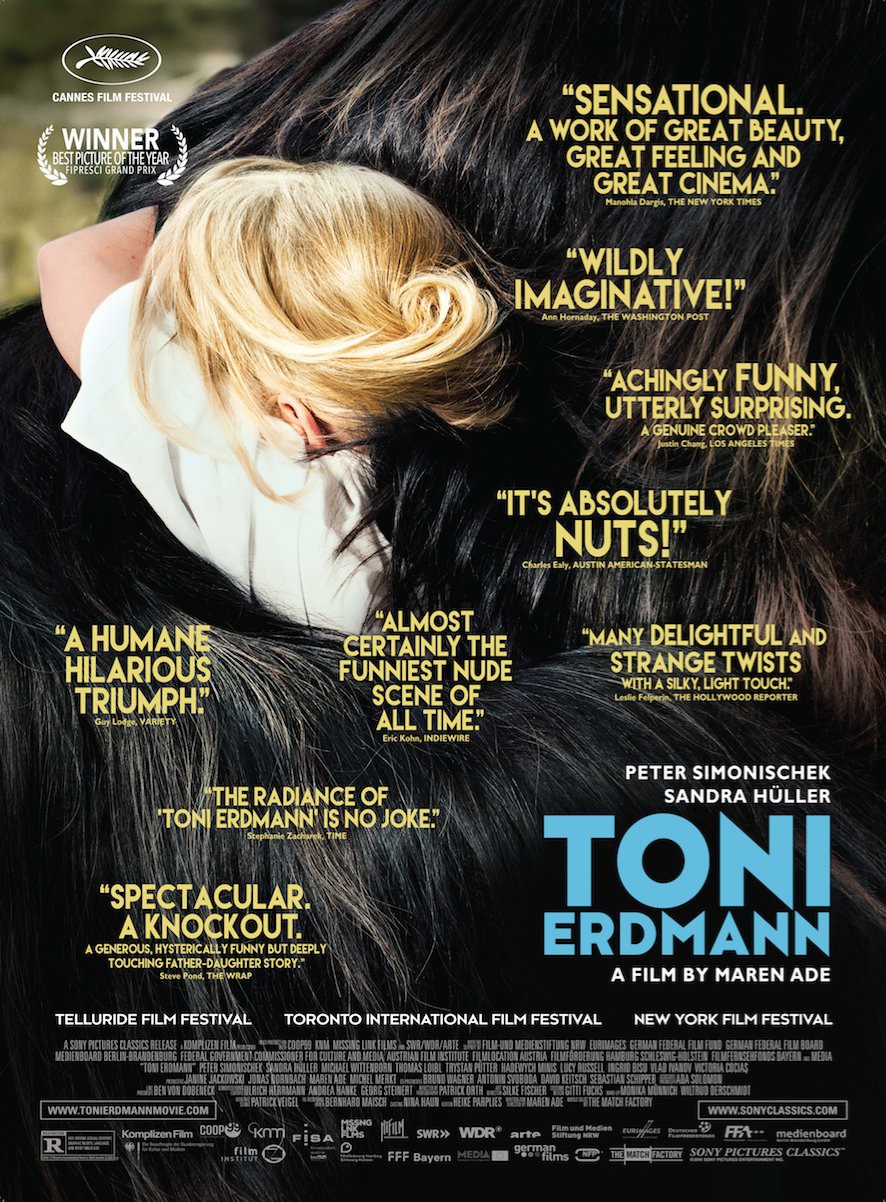
It’s hard to tell you how to go into “Toni Erdmann” as it works as both a comedy and a drama. Some moments are truly hysterical while others are deeply moving as German filmmaker Maren Ade draws us into a story which takes us in completely unexpected directions. These days, only a foreign film can get away with what “Toni Erdmann” does here as it balances out both its hilarious and moving scenes for a nearly 3-hour running time. Yes, it’s that long, but don’t let this and subtitles give you a reason not to sit through it because you will be missing out.
We meet Winfried Conradi (Peter Simonischek), a music teacher who thrives on playing pranks and practical jokes on unsuspecting victims with tremendous glee. Winifred is eager to reconnect with his daughter, Ines (Sandra Hüller), who is currently working in Bucharest, Romania as a business consultant in the oil industry. Ines is hopelessly addicted to her phone, as many of us are from one nation to the next, and she barely has any time at all to spend with her family as she is constantly called away to work. Following a sudden death, Winfried impulsively travels to Romania to spend time with Ines, but his unexpected visit cannot compete with her seemingly ambitious climb up the corporate ladder. Winfried at one point asks Ines what she enjoys most out of life, and she finds she cannot really answer the question as the term enjoyment is impossible for her to honestly define. These days, with everyone struggling to make a living, it’s very hard not to relate to how she feels.
After feeling quite alienated, Winfried decides to leave Romania and let Ines go about her hectic life. A few days later, however, Winfried reappears as Toni Erdmann, his alter-ego who presents himself as a life coach and consultant to Ines and her friends, and it doesn’t take long for him to draw a crowd with his effortless charisma. Ines is at first horrified by what her father has pulled off as she feels her career might be put in jeopardy as a result, but she eventually finds herself playing along as it gives her life a levity which constantly eludes it.
Watching “Toni Erdmann,” I kept thinking how a Hollywood studio would try to dumb down the material and force the director to cut the movie down to 90 minutes so they could maximize the number of screenings which can be shown in a day. I imagine producers were trying to do the same to Ade, but she apparently said deleting scenes would have hurt the movie’s pacing. Keep in mind, she spent over a year editing the movie and even gave birth to her second child in the process, so you cannot say she didn’t put a lot of thought into what she was doing here. The end result is a final cut which doesn’t have a single wasted shot in it as we watch Winfried and Ines struggle with this crazy thing called life.
Both Simonischek and Hüller are exemplary in portraying characters who could have been played far too broadly in any other movie, and the actors fully invest in the emotional natures of Winfried/Toni and Ines to where we are completely caught up in what’s going on in their minds. Just when you think each actor has given their best moment onscreen here, they come up with another one which has you in awe as well as in hysterics in regards to what they succeed in pulling off.
Winfried could have been a completely obnoxious and annoying father like many are in movies these days, but Simonischek makes him a wonderful presence even when Winfried, in his alter-ego of Toni, threatens to overstay his welcome. When he reveals who he really is to another person and why he is putting on such a disguise, it is a wonderfully moving moment as he is not greeted with disdain but instead with understanding and empathy. I imagine most parents are desperate to keep a strong connection with their children after they move away from home, so it shouldn’t be a big surprise when some resort to desperate measures.
Hüller gives us a character ever so serious in advancing her career in a male-dominated business, but she’s also not afraid of showing the bruises in Ines’ armor which come up when her world becomes too much to deal with emotionally. She also brilliantly takes her character in directions you couldn’t possibly anticipate, and this results in a musical scene and a birthday party, both of which need to be seen to be believed. She fearlessly dives into those moments with sheer enthusiasm as she soon finds herself battling against a lifestyle which has become far too suffocating to deal with.
“Toni Erdmann” is in many ways a comedy, but the comedy doesn’t just come out of its hysterical moments. It also comes out of the painful and awkward ones as humor at times becomes the only way to deal with the emotional hurdles life constantly throws in our direction. There is a seriousness to the subject matter as well as life and death are dealt with in equal measure. Taking this into account, it’s best to go in with an open mind as expectations will threaten your cinematic experience rather than inform it. What you can expect are a number of surprises you could never have expected, if that makes any sense.
Every once in a while, we need a movie which reminds us of the importance of living in the here and now as life becomes far too hectic for us to realize it. “Toni Erdmann” never tries to shameless manipulate its audience into feeling anything as we come to fully sympathize with Winfried and Ines to where we do see the importance of stopping to smell the flowers more often. Winfried’s last scene with Ines drives this point through as they come to realize how quickly time passes everyone by to where it is very hard to slow down for just a second. Please don’t try to convince me you don’t relate to this in the slightest.
I am still thinking about that last scene long after the movie ended, and of how Hollywood would never have let Ade get away with a nearly 3-hour running time. I’m convinced they would rather rush to get to the “live in the moment” scene in a mere 90 minutes because more screenings in a day means more money. Sometimes it is worth it to take the time to tell a really good story.
On the surface, “Miss Lovely” might look like a typical Bollywood movie, but this couldn’t be further from the truth. It’s a Hindi feature film which digs deep into the sordid back alley of India’s film industry of the 1980’s which churned out countless horror and soft-core porn movies. In the midst of this sleazy atmosphere are the Duggal brothers, Sonu (Nawazuddin Siddiqui) and Vicky (Anil George), who are among the most prolific producers of trashy C-grade films for Mumbai’s underground market. But while Vicky has no problem with what he does, Sonu is desperately looking to escape this underground reality. When he meets the beautiful actress Pinky (Niharika Singh), Sonu sees not only his chance for escape but also the opportunity to make a real romance movie with her as the star. But as he works to make this a reality, he ends up going down a road from which there is no return.
“Miss Lovely” was directed by Ashim Ahluwalia who is said to be part of a new generation of Indian filmmakers who prefer to avoid working with Hindi film stars, and his films have been described as unconventional in how they blur the lines between documentary and fiction. This is certainly the case here as Ahluwalia’s film deals with an industry he has seen up close, and he invites us to journey into its murky depths. It was originally supposed to be a documentary, but when Ahluwalia couldn’t get those working in the C-grade film industry to be involved, he decided to make a fiction film instead. What results is an unforgettable motion picture which is as unsettling as it is intoxicating to sit through, and it’s one of those movies I sarcastically describe as being good fun for the whole family.
I got to speak with Ahluwalia while he was out to promote “Miss Lovely,” and he was super excited to talk about it as the movie looks at an industry which has long ceased to exist due to changes in technology and the widespread availability of pornography on the internet. It was fascinating to hear him talk about this as filmmakers today are dealing with a shift in technology from film to digital, and it’s a shift many are not quick to embrace.
Ben Kenber: I was blown away by it and it was not at all what I expected. It’s more of a movie you experience than just watch.
Ashim Ahluwalia: Exactly. I think that’s really a good way to describe it.
BK: I especially liked how you shot this movie on Kodak Super 16 and 35mm film as it gives the movie a really rough feel which in turn captures the sleazy nature of the business these characters are engulfed in.
AA: Yeah, it was also about the end of celluloid. The whole period that these films were made in was kind of the end of celluloid and then you have VHS replacing it. In a way, that was the precursor to the digital age and this whole way of consuming sleaze I guess. It just moved to the internet in the 2000’s and then that was the end of that. So I think a lot of it has to do with this material that was so critical in the way these films are made and consumed. It’s crazy to think that they were shooting that sleaze on 35mm (laughs), and now people would just die to get their hands on that kind of access to celluloid, so it’s pretty much part of what the film is about.
BK: Now some have suggested that “Miss Lovely” is part of a new wave of Indian cinema. How do you feel about the reaction this movie has had so far?
AA: It has random individuals doing random things and they’re not really connected, and that has more to do with the fact that now people are more exposed to cinema and they’re getting excited by what’s happening in the rest of Asia and the possibility of digital, etc. I think this whole idea was kind of overblown. It was sort of a moment when they were trying to tie everything together. I think “Miss Lovely” is a very odd film honestly. It’s not unique. It’s not odd just to India; it’s just odd generally because it’s such a hybrid film. It’s just taking very comfortably in a way that most art-house movies don’t just take it from the musical, taking from a 50’s noir, taking from sex horror, taking from porn, maybe documentaries or experimental films and stuff like that. I don’t think it represents a new specific type of film from India, but I think this is definitely a moment where there is new stuff and it’s not just Bollywood, Bollywood, Bollywood.
BK: To be honest, I’m not too familiar with Bollywood films…
AA: Well you’re lucky (laughs).
BK: I think the closest I’ve come to Bollywood so far is “Slumdog Millionaire,” but I’m not sure if that counts.
AA: Well yeah but it’s borderline Bollywood honestly. New Bollywood is kind of like that.
BK: How difficult was it to re-create the Mumbai of the 1980’s as you remember it?
AA: It was really hard because most of the places were being bulldozed as we were shooting them. So sometimes at a location, half the building was already knocked down and we just got them to hold for like a week until we shot a scene. It was literally shooting the last remnants of that kind of 80’s one-hour hotels and cabaret halls and stuff. I would say that about 60 or 70% of the locations are gone now and it’s not even been two years. It becomes kind of a document of those places and that kind of time. It doesn’t exist anymore.
BK: I read that you were not looking to romanticize or do a parody of the 1980’s. How did you manage to keep yourself from doing that?
AA: Well I think there’s sort of like a hipster 1980’s thing and I really wanted to stay away from that. I didn’t want to just make like fetishes of all those little 80’s objects. For me, the reason is because I spent a year and a half hanging out with a lot of these people from the C-grade industry because I initially wanted to make a documentary. So, by the time I was done with that one-and-a-half-year period, it was very hard to poke fun at anyone because these are people that you spent so much time with and saw so intimately. It was hard to caricaturize them.
BK: During the movie, we don’t see a lot of the real world outside of the one the Duggal brothers inhabit. When it does intrude on their sleazy underworld, you feel almost as lost as the characters do as they desperately try to escape their circumstances.
AA: Yeah, it’s kind of claustrophobic. I wanted the film to be like this kind of maze that you were trying to get out of and you can’t. The whole point is this kind of escape ends up being a fantasy of a film that could maybe get you out of there, but it’s sort of like endless passageways that lead into other passageways. It’s just a very interior, claustrophobic kind of environment which I think, for me, I relate to that. When you work sometimes in film you feel like that. You don’t have to really only work in secret cinema, but sometimes a bad day job can be like that. So, I think that idea of you were always trying to escape but you can’t, I like that somehow.
BK: This is your first feature film as a director, and your previous film was a documentary. What was the transition like for you from making documentaries to directing an actual feature film?
AA: The first film I made was “John & Jane” and that was a documentary, but it was shot on 35mm and looks more like a dystopian sci-fi film than a documentary. Somebody told me that my documentaries look more like fiction and my fiction looks more like documentaries, so I’m really interested in this idea of what a fiction film is and what a documentary is. “Miss Lovely” is not a conventional or traditional film. It’s still quite loose in terms of its language and it’s quite experimental, so I don’t find much difference. I feel like I could slip in and out between these two worlds quite easily in some ways.
BK: You once said that the raw energy of these C-grade filmmakers reminded you of why you set out to make films in the first place. What was it specifically about them that reminded you of that?
AA: Well I think what happens is that when you start working in any capacity like in an industry or an environment, what ends up happening is that you become quite jaded as a filmmaker. You’re just like always thinking about how do I get money, do I put it in this thing, if I put this person in it then I get this money and then if I work with that person then I get this distribution, etc. I think what ends up happening is that you lose that energy and spirit of why you really love cinema. You don’t watch films anymore because you’re so jaded by it. But when I experienced these guys making films, although the films are very bad admittedly, the way that they would make the films would be so like run and gone. It would be like, “Oh are we running out of film stock? What we do? The actor’s not available? Get another actor to stand in for the guy.” So the character is now played by a different actor, or if you don’t have a shot then you put a stock shot in, or the police are coming into the building so you have to finish the scene like within 15 minutes. The whole anarchic energy of the way the films are made really reminded me of what independent film should be; just making it with such passion. It’s like the passion is going to make the film happen. It really inspired me in a way to just make something which I really love with some degree of madness and passion which I think sometimes gets filtered out of you.
BK: I’m always waiting for the independent film world to explode again like it did in the 1990’s.
AA: Yeah exactly, and then you see how it’s just been co-opted and it feels like such a tired kind of thing.
BK: The characters in “Miss Lovely” are basically composites of the people you met in this industry. You said you originally wanted to do a documentary, but a lot of the people you talked to didn’t want to be involved in it because of the illegal nature of what they were doing. How accurate is this movie to those types of filmmakers?
AA: A lot of the people that were going to be in the documentary initially, I got them to just play themselves in the background. So all the background characters are all like real C-grade people. All the secondaries are actually people that, when I cast them in a fiction film, were like, “Okay I’ll do it.” But they didn’t want to be in the documentary somehow. So, a lot of those real elements I just kind of brought back into this movie in another way through another backdoor and just brought the realism back into it.
BK: That’s surprising to hear that they did find a way to be in this movie without compromising their true identities.
AA: Yeah, and as long as they were in costume they felt like they weren’t revealing too much of themselves, but they were playing themselves essentially. That just gave the whole thing a bona fide genuine authentic atmosphere that is just almost impossible to re-create artificially with actors who don’t know anything about that world. I felt it just brings another energy to it.
BK: The cast is just spot on with their performances. What was the casting process for “Miss Lovely” like?
AA: Well a lot of them are real people that, when you meet them, are so performative anyway. There’s a midget casting director, the little guy, and when I met him he was just so charismatic when he was talking to me about what he did. He is actually a casting director in real life, so he just had to do what he always does and he was really comfortable. A lot of them were really comfortable around the cameras somehow. It’s almost like they were waiting all their lives to be in front of the camera, and suddenly they just did that thing. And of course, if I gave somebody lines, finally they would never remember the lines but they would do their own thing which would be better than the lines I wrote. I would be like, “Yeah let’s just keep that. It’s much better.”
BK: All the actors seem to have a wonderfully natural quality whenever they appear onscreen. It’s like there inhabiting the roles instead of just playing them, and it really sucks you into the atmosphere of the movie even more.
AA: Well that’s because a lot of them really are those people, so that’s partly it. And the others who were more professional actors were now having to match their performance with someone who’s so bona fide and so real that they are like, “S—t! I need to get better at what I’m doing because I’m looking fake now in relation to this person.” So, putting nonprofessional and then professional actors in the same space together creates a very interesting dynamic.
BK: “Miss Lovely” reminded me a bit of the Coen Brothers’ film “Barton Fink” as both movies have protagonists who really want to make a difference in the industry they’re working in, and then they see their dreams get shattered in the worst way possible.
AA: Yeah, I like that film a lot actually. That’s a very atmospheric film. The atmosphere is very much a character in the film, and it’s not just about the narrative. It’s just about the texture of that space and stuff. It’s a good reference I think.
BK: Another movie reminded me of was “Boogie Nights” and the scene where the producers are talking to Burt Reynolds about switching from celluloid to videotape since it’s a lot less expensive.
AA: Yeah. I think probably there are similar interests from filmmakers because we grew up in a certain time and a certain place, and you’ve seen this shift happen to digital and it’s such a radical change in terms of what it means to make a movie or what a film even is. I think it’s all about a certain generation of filmmakers grappling with the shift.
I want to thank Ashim Ahluwalia for taking the time to talk with me. “Miss Lovely” is now available to own and rent on DVD, Blu-ray, and Digital.
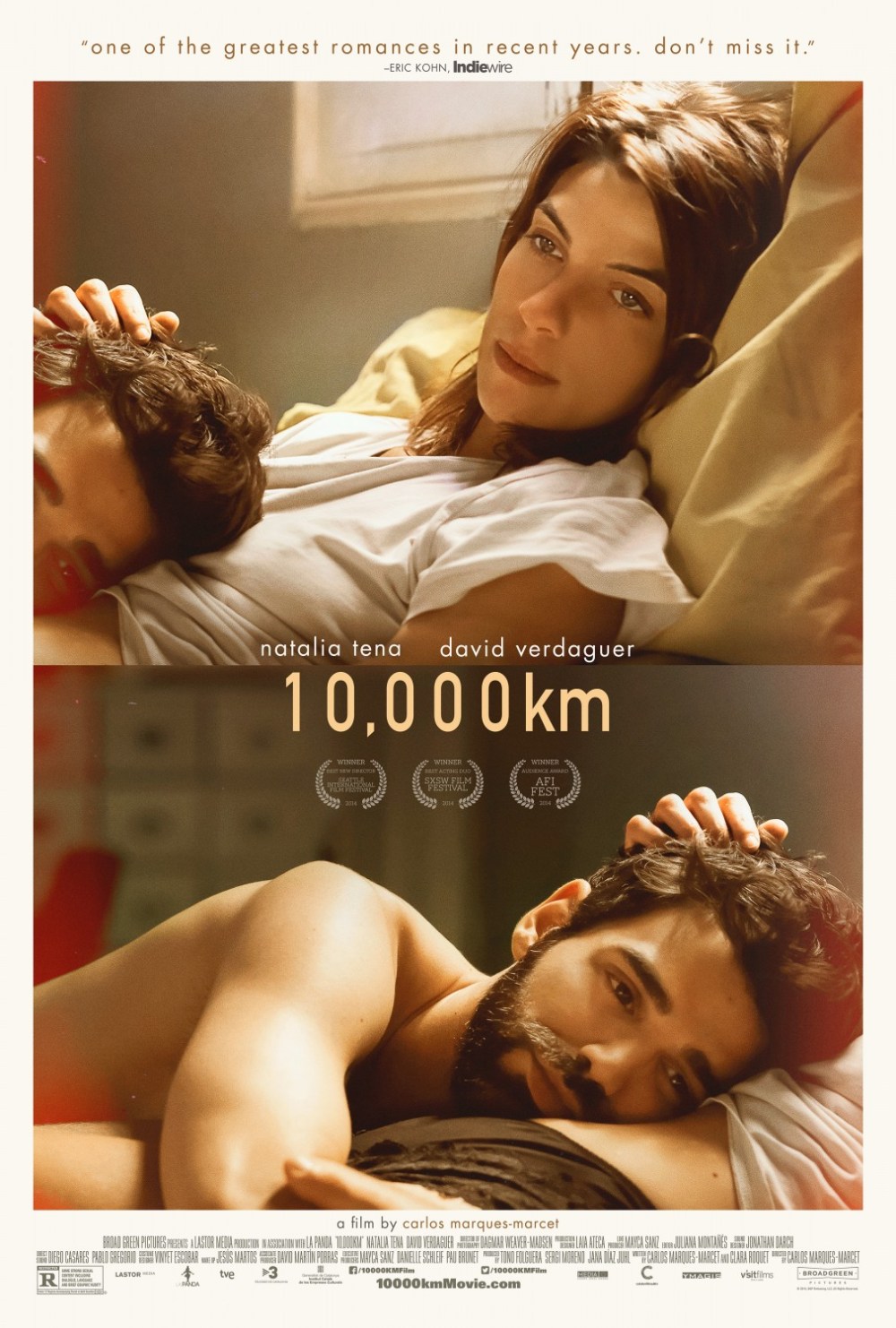
The thought of a long-distance relationship is frightening as it thoroughly tests the bond between a loving couple to where it looks like they are destined for disaster. One relationship is put to this test in “10,000 Km,” a romantic drama co-written and directed by Carlos Marques-Marcet.
Alexandra (Natalia Tena) and Sergi (David Verdaguer) are a loving couple living in Barcelona, Spain, but they also struggle to balance out their careers while trying to start a family. Then Alexandra accepts a one-year residency in Los Angeles which could really jump start her photography career, and Sergi has no choice but to stay in Barcelona where he works as a teacher. Luckily, they have modern technology which allows them to keep in touch on a daily basis, but what is helping to keep them together may also tear them apart.
“10,000 Km” proved to be a powerful meditation on the struggle of a long-distance relationship, and it starts off with a scene which lasts several minutes and captures the characters in their most intimate state. I got to talk with Marcet while he was in Los Angeles, and he talked about how that scene came about and how long it took to shoot. In addition, he also clarified how much of the movie was shot in Spain and Los Angeles, how he came to cast Tena and Verdaguer, and of how he kept the actors separated during shooting.
Ben Kenber: It’s interesting to see how this relationship evolves once the two lovers are separated by continents and use technology to keep in touch with one another. Was it hard to balance out the benefits of technology with the human element in this movie?
Carlos Marques-Marcet: No. We knew from the beginning that the driving point was to portray the relationship which derives from the human element. The technology was the tool and the human part was the means somehow, so it wasn’t so much about finding a balance but trying to see how to use these tools to convey the means.
BK: The opening sequence of “10,000 Km” is amazing as it lasts several minutes and features the two lovers being intimate with one another, and then one of them receives an unexpected job opportunity. How did you go about setting the scene up?
CMM: It was a long process to arrive there. It was originally not such a long scene, but then we looked at the script and it suddenly made sense to have this very long scene where you see them together. It’s a two shot of them and you are with them, then afterwards the rest of the movie we shot over shot because they have no other possibilities. There’s a symbolic element to it, this raw thing of being with two people together that weren’t there together. The making of it involved a lot of preparation. The location was the producer’s house, so I knew where I was going to shoot. It was a combination of working with all the departments, the actors and rehearsing. It was like a dance.
BK: This scene must have taken a very long time to shoot.
CMM: 17 takes and three days of shooting. We planned it and we wanted to do it with the dollies. There was no handheld camera. We wanted it to be grounded to the ground. I think it was an interesting way of how to go about it.
BK: Natalia Tena and David Verdaguer are both terrific in this movie. What was the casting process like?
CMM: So basically, we found David about a year before shooting. I had just graduated from UCLA and I didn’t want to shoot another short. I just took a couple of scenes from the movie and shot them just as an experiment with another actress. I watched a lot of You Tube videos and interviews. I like to see how actors move and how they talk, and I was looking for another actor, not David, and then I saw him in this video he made with a cell phone of two friends. Then I saw that he was an actor and I proposed to my producers that we bring him in for casting, but then it turned out that he’s actually known as a comedian. I had no idea. He’s like a “Saturday Night Live” comedian. Actually, he’s done a lot of theater, very serious theater, but people love him for his comedic aspect. But then he came into the casting process, and it was a very long casting process with two people for hours. I like to work with the actors instead of just having them come in to read. I like to meet people. It was David for sure, no doubt. And then with Natalia, it was a last-minute thing. We were actually going to shoot with another actress and she had to cancel, and when we finally found Natalia it was like a miracle. It was very clear that they had chemistry, and they became very close friends instantaneously.
BK: When it came to shooting the scenes when she’s in Los Angeles and he’s back in Spain and they are using Skype to keep in touch with one another, did you purposely separate the actors?
CMM: Yeah. Originally I wanted to shoot it in Los Angeles and in Barcelona at the same time, but Natalia had some scheduling conflicts. It wasn’t that cheap to do it. I wanted to shoot it in my own house in Los Angeles, but schedule wise it was not possible. So we put them in two different apartments in Barcelona and I actually after shooting the first scene said that it would be nice if they didn’t see each other, but that lasted like two or three days (laughs). After three days I was like it’s fine if they hang out with each other. I wanted to create the feeling of missing somebody, and three days was totally enough. In the end, they were hanging out together every night playing cards, going over the lines and drinking wine, and in the morning they had to be separated. So, for them being in touch every day and then during the day not being able to be together was very frustrating, and I think that shows up somehow in the movie.
BK: When “10,000 Km” begins we see this couple at their most intimate, and they still have that intimacy throughout the movie to a certain extent. I don’t want to give away the ending, but I loved how you ended the movie on an ambiguous note. It’s not the kind of movie that begs for a solid or more definitive conclusion.
CMM: Yeah, that came about during the editing. Actually, the script was much more clear, but while we were editing there was a bunch of dialogue that we decided to take out because I felt that already through the images we could tell what was going on. Then we took it out and then for some people it became more ambiguous than it was in the script. I like it. It was not in the plan of how I shot it. I have my own vision of it, but I also like to let people imagine whatever they want.
BK: “10,000 Km” is not designed to give anyone a definitive answer to whether long-distance relationships can work or not, but I came out of it hoping these two would find a way to make things work out.
CMM: That’s a very optimistic view (laughs). We leave it so that the very optimistic people can think that (laughs).
BK: Despite the scheduling conflicts, were you able to shoot any of the movie in Los Angeles, or was it mostly shot in Barcelona?
CMM: Mostly in Barcelona, and then I shot some of the stuff in LA. There are some shots where you see my home in Echo Park with the webcam and everything, but mostly we shot it in Barcelona. We faked the LA interior in Barcelona. It was not possible to do it the other way around. In Los Angeles, you won’t find interior like you would in Barcelona. I didn’t want to shoot in a studio. I wanted to shoot in a real location so they have the feeling that they are in a house or a real apartment.
I want to thank Carlos Marques for taking the time to talk with me. “10,000 Km” is now available to own and rent on Blu-ray, DVD, and Digital.
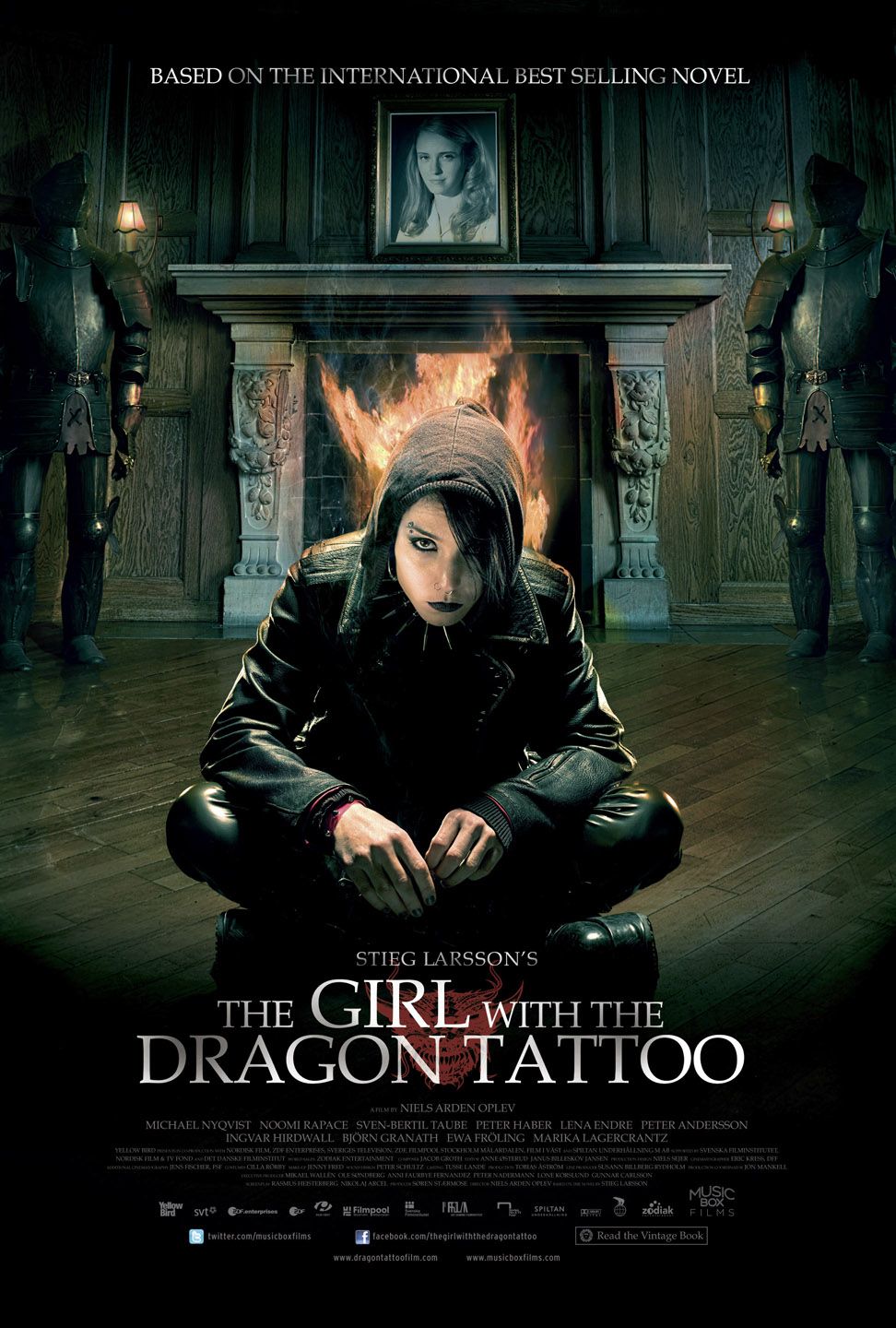
You look at her from a distance, and all you see is just another punk chick who’s nothing but trouble; born under a bad sign. You’d figure she’s pierced her body in lord only knows how many different places, and the mascara applied to her eyes might make you see her as an intimidating threat. Not once does she try to adjust her antisocial behavior or clothing attire in the workplace, and this is a sign of how unwilling she is to compromise her learned set of values.
But once you get to know her, you will find Lisbeth Salander is not your average punk rock girl. In fact, she’s a brilliant hacker and researcher who knows more about yourself than you could possibly realize. Bo Diddley was right when he said you can’t judge a book by looking at the cover. I mean you could, but she would just kick your ass because a rough upbringing has more than prepared her for the harsh reality of life.
Lisbeth Salander is the heroine of “The Girl with the Dragon Tattoo,” a brilliant mystery/thriller based on the best-selling novel by the late Stieg Larsson. Many have said Noomi Rapace gives a star making performance as Lisbeth, and nothing could be more true. She finds the heart of this incredibly intelligent yet mysterious character whose past is hinted at but never explained until the end, but we come to get enough of a glimpse which helps us understand where she is coming from. Lisbeth sets the bar high in terms of compelling characters (and not just females) you can find in movies from any country.
Right from the start, this film absorbs us in its compelling mystery involving the case of a missing girl which has remained unsolved for 40 years. Mikael Blomkvist (Michael Nyqvist), the publisher of Millennium Magazine, is coming off of a trial where he was wrongfully disgraced, and soon after he is hired by rich man Henrik Vanger (Sven-Bertil Taube) who wants him to look into the disappearance of his great-niece Harriet who was last seen years ago when she was only 16. Henrik believes Harriet was murdered by someone in his family, and it’s a very dysfunctional family filled with those who will fight one other for the whole inheritance without a single thought for anyone else.
Please believe me when I say “The Girl with the Dragon Tattoo” puts so many American movies of this genre to utter shame. Seriously, many of the mystery thrillers I have seen in the past few years are full of plot holes Michael Bay could lead both Autobots and Decepticons through no matter how enormous they are. Instead of being enthralled, we come out of them feeling like they are average at best, but they do allow us to feel smarter than the filmmakers since we spotted all their foolish mistakes.
Compared to all those wannabes, “The Girl with the Dragon Tattoo” has a very well-constructed plot to where if it is at all flawed, we certainly don’t realize it because we are too caught up with what’s unfolding onscreen. But where this movie truly succeeds is as a character piece in how deeply it involves us in the lives of two very different people. The two main characters are well developed and are very complex, something I always look forward to seeing. Lisbeth is a wounded person, damaged by life, and the trust she puts in others is exceedingly rare. These two end up coming together as Lisbeth has been hacking into Mikael’s computer as part of his case, and she ends up giving him some clues which have eluded him. While she is hesitant to get involved with Mikael professionally or emotionally, he points out how she contacted him in a way that is easy to track.
Lisbeth and Mikael are indeed an odd couple, and yet perfectly matched to work on the coldest of cases. They are also coming together at a time where they are in a very isolated state, having been largely misunderstood by just about everyone around them. While many view them negatively, they come to see one another as who they really are. The more they work together, the more they gain each other’s trust. In the large scheme of things, these are two people who do not let others define them.
“The Girl with the Dragon Tattoo” was directed by Niels Arden Oplev, a three-time award-winning director from Denmark. He deserves a lot of credit for keeping us deeply involved in a movie that could have easily overstayed its welcome. Not once did I find myself getting bored or restless while watching it. Oplev balances out the story and the acting to where they are on equal footing and never upstaged by style. Never does he indulge in quirky camera angles or other visual elements which would have taken away from this movie. Some directors just love to show off instead of just trusting what is there, and Oplev has clearly laid his complete trust in the story and the actors cast.
Noomi Rapace brings a powerful life force to Lisbeth Salander, a character destined to become as iconic as Clarice Starling from “The Silence of the Lambs.” Beneath her hard exterior is a person whose trust in others is practically non-existent for reasons which eventually become clear. Rapace more than succeeds in making Lisbeth tough as well as sympathetic. Her performance could easily have been a caricature, but she proves to be far too good of an actress to allow this to happen.
Michael Nyqvist does excellent work as Mikael Blomkvist, showing his strong resolve and utter frustration without ever going overboard in his performance. When he is first shown to the audience, it is as a man who has just been found guilty. We don’t know why at first, so we can only assume he had it coming or perhaps he was framed. We see him walking down the street when his picture comes up on television, pretty much defining him in the eyes of those who do not know him personally. But Nyqvist invests his character with a strong moral code which he never surrenders even when it seems smart for him to do so. We sympathize with Mikael as it always seems the wealthiest of people are more than willing to smash down the individual, especially when said individual is correct in what he or she discovers about them. The truth always seems to come at a heavy price.
Peter Andersson doesn’t even try to hide the hideous slime that consumes his utterly immoral character of Bjurman, a sexually abusive bastard who takes advantage of Lisbeth in the worst way possible. Even worse, he is her new legal guardian who takes charge of her trust fund after her original guardian suffers a stroke. Not to worry though, the pain Bjurman inflicts on Lisbeth comes back at him in a most vicious way, showing us once again what you see on the surface does not even begin to tell you the whole story.
Two sequels based on Stieg Larsson’s follow up novels have already been made, and I eagerly await the opportunity to see them on the big screen. They will have a tough act to follow after “The Girl with the Dragon Tattoo,” but with Rapace and Nyqvist reprising their roles, they will continue one of the more interesting and unusual partnerships you can hope to find in cinematic history.
It will be interesting to see who will be the next idiotic human being who foolishly thinks they have complete control over Lisbeth. Even more interesting will be in what way Lisbeth lets said person know just how wrong they are. Pray for whoever it is.
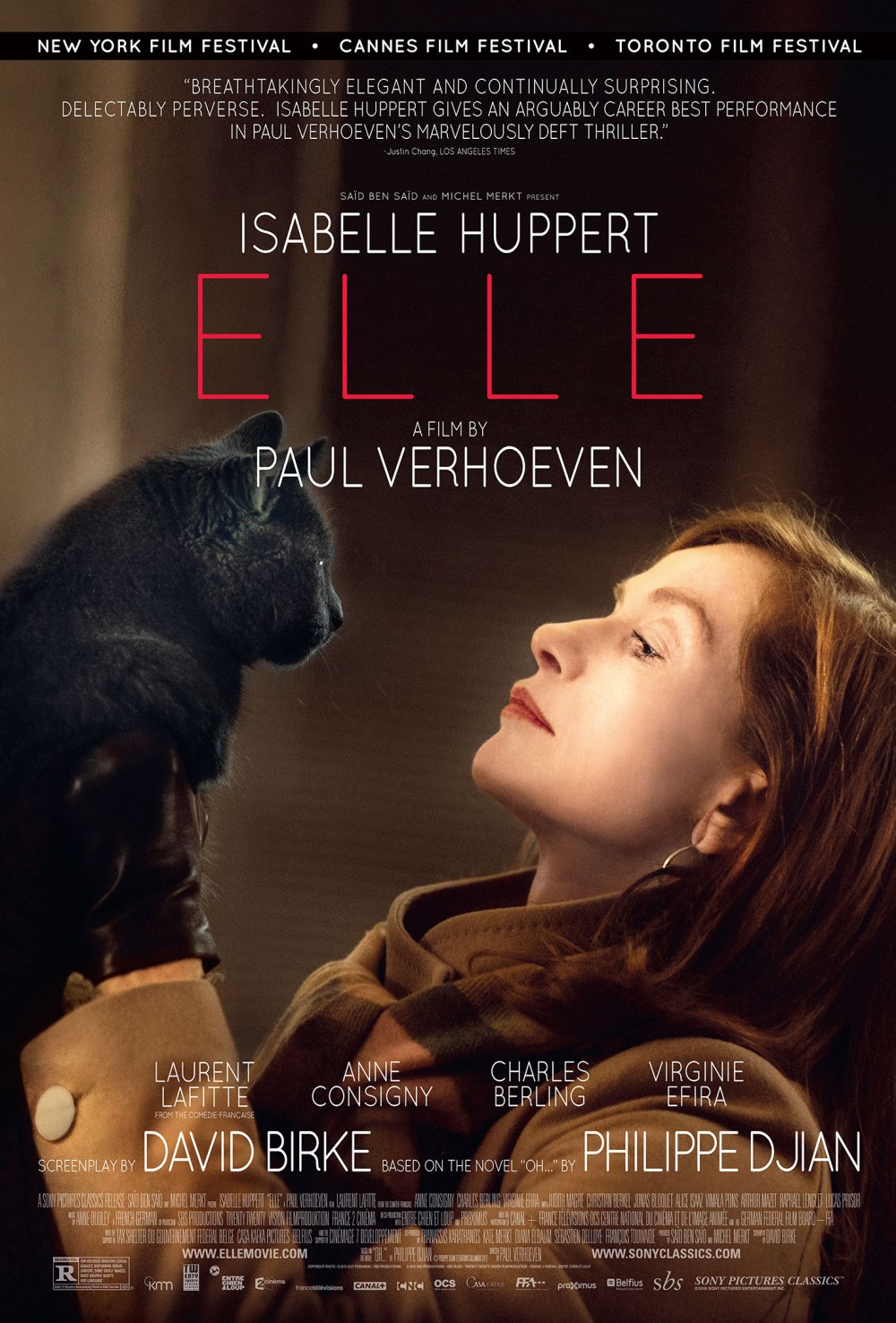
Dutch filmmaker Paul Verhoeven has given us unforgettable movies like “Robocop,” “Total Recall” and “Basic Instinct,” and he had gleeful fun satirizing the war propaganda machine with “Starship Troopers.” Now he returns with his first movie in ten years, his last being the excellent “Black Book,” the psychological thriller “Elle” which stars the brilliant (and not to mention brave) French actress Isabelle Huppert. From watching the trailer, it looks like Verhoeven is up to his usual button-pushing tricks, but the viewer should not go into this expecting “Basic Instinct” redux.
Based on the novel “Oh…” by Philippe Djian, Huppert plays Michèle Leblanc, the head of a leading video game company, and the plot synopsis describes her as seemingly “indestructible” as she “brings the same ruthless attitude to her love life as to business.” As the movie’s trailer begins, Michèle is at a dinner party where she tells a group of friends she was sexually assaulted, and she presents this confession in a calm and collected manner. Whereas you might expect a scene where a rape victim has a nervous breakdown as she accepts the reality of what she’s been through, Michèle doesn’t even blink an eye. Her friends, however, are shocked at this news to where they encourage the waiter, who has just brought a lovely bottle of wine, to come back in a few minutes.
Throughout the trailer, we see Michèle go about her work and life as if nothing has changed, but it becomes clear the attack has forever left a huge psychological scar on her which cannot be wiped away. Her need for revenge is understandable, and Verhoeven’s movies are well known for their characters getting vicious revenge on their attackers, and the trailer shows her as a ticking bomb waiting to go off. In the end, one can remain cool for only so long.
“Elle” is being released by Sony Pictures Classics, and they recently unveiled a clip from the movie titled “Empty Stare.” Watching this clip, there’s no doubt Verhoeven picked the right actress to star here. Huppert has taken on challenging roles in Michael Haneke’s “The Piano Teacher,” Christophe Honoré’s “Ma Mère” and Claude Chabrol’s “La Cérémonie,” and she looks to have risen to the challenges Verhoeven has put in front of her here. As Michèle tells an unsettling story about her father to a male friend, Huppert makes you wonder if she is telling the truth or simply playing around with someone who doesn’t know her very well. The beauty of watching Huppert is how she creates such vivid and frightening imagery with just words. Other directors would add flashbacks to give this scene more emotional power, but Verhoeven doesn’t need to do this when he has Huppert to work with.
“Elle” was shown at the 2016 Cannes Film Festival where it received critical acclaim and a seven-minute standing ovation. Guy Lodge of Variety proclaimed on Twitter that “Isabelle Huppert might be our best living actor, and ‘Elle’ might be Paul Verhoeven’s best film.” Verhoeven has said the movie is not to be mistaken for an “erotic thriller” in the vein of “Basic Instinct,” and that anyone who goes into it thinking it is will be “disillusioned.”
Adventurous moviegoers look to be in for a dark treat when “Elle” opens in New York and Los Angeles on November 11. Please be sure to check out the movie’s trailer and the “Empty Stare” clip below.
“Bang Gang (A Modern Love Story),” just by looking at its trailer, seems like the French version of “Kids,” but that’s not even remotely true. Based on a true story, a fact we don’t discover until the end credits, it follows a group of ordinary teenagers who live in the suburban neighborhoods of France and participate in sex parties they refer to as “bang gangs.” In the center of the sexual shenanigans is the beautiful George (Marilyn Lima), one of the main organizers of these parties and who experiences some intense inner turmoil. After being spurned by her would-be boyfriend Alex (Finnegan Oldfield) who goes after her best friend Laetitia (Daisy Broom), George begins feel increasingly isolated from everyone around her even as the parties become increasingly reckless. In short, this story will not end well. Or will it?
This movie marks the feature film directorial debut of Eva Husson whose previous credits include the short films “Hope to Die” and “Those for Whom It’s Always Complicated.” Many consider her one of many directors to emerge from the world of music videos, but she will be quick to silence you on that. Born in France, Husson earned an M.A. in English literature from the Sorbonne, and she would later move to America to pursue an M.F.A. at the American Film Institute. She did make some music videos along the way, but her focus has always been on writing and directing feature films.
With “Bang Gang,” Husson has pulled off an impressive debut filled with strong performances by a mostly non-professional cast, and she is aided by the lush cinematography of Mattias Troelstrup as well as the atmospheric music score by White Sea.
I got to talk with Husson while she was in Los Angeles to promote “Bang Gang (A Modern Love Story” which she described as “a movie about teenagers falling in love in the midst of a sexual apocalypse.” She explained how she pulled off the long tracking shot at the movie’s beginning which lasts for several minutes, why she put the term “based on a true story” at the movie’s end instead of the beginning, and she pointed out how the project was inspired by stories involving American teenagers and not French ones. She also spoke of why she had her cast watch Paul Thomas Anderson’s “Boogie Nights” and Lars Von Trier’s “Melancholia” before the film shoot began.
Please check out the interview above.
AN ULTIMATE RABBIT NOTE: This video interview was recently updated to eliminate any copyright issues which were never intended, and to make it available to the widest audience possible.
The problem with most disaster movies these days is they present their horrific scenarios with nothing but stock characters who end up spouting annoying clichés aided by a weak screenplay. While they have amazing special effects at their disposal, they are saddled with a conventional story filled with people we can never truly relate to, and they bend the rules of science in a way that’s shameless as filmmakers believe we won’t question what we see. But we do question what we see, and what ends up on the screen ends up being far more laughable than thrilling.
That’s what makes the Norwegian thriller “The Wave” so refreshingly effective as it has down to earth characters we can relate to, and it also deals with science in a way which is not insulting to the intelligence. The movie doesn’t break any new ground in the disaster genre, but the filmmakers still leave us on the edge of our seats throughout as they present us with a scenario which could very well happen before I finish writing this review.
The movie starts off with a documentary sequence which shows how parts of Norway, while stunning in their beauty, are always susceptible to collapse and utter catastrophe. This country saw one of its town decimated by a rock-slide tsunami back in 1934, and there was another massive tsunami in 1905 which killed 65 people. Scientists all agree this catastrophe will very likely happen again but they don’t know when, and this sequence hovers the rest of “The Wave” as we go into it knowing this beautiful Norwegian will soon be laid waste.
Kristoffer Joner stars as Kristian, a geologist who has worked in the small Norwegian village of Geiranger for the past few years and is about to start a new job at an oil company. His family is in the process of vacating their home to move to a new apartment in the big city, but on his last day at work he sees the substrata is shifting and things don’t feel right to him. But when he presents his concerns to his co-workers, they are not quick to alert the village’s inhabitants as they don’t see much of a threat based on the evidence at hand. Plus, the tourism season is at its peak and this town, just like Amity in “Jaws,” depends on this season to meet their financial obligations.
Watching “The Wave” reminded me of when I saw Roland Emmerich’s “The Day After Tomorrow.” While Emmerich’s movie was never boring, it’s take on science was hard to accept especially when the characters tried to outrun a weather freeze which immobilizes everything in its path. But the filmmakers of “The Wave” are not about to insult our intelligence and present us with scientifically sound facts, and that makes watching this movie all the more intense and anxiety-inducing as a result.
Going into this movie we all know that this town will be utterly destroyed, but the buildup to the inevitable catastrophe is worth it as, when it does hit, it leaves us as trapped as the characters as they desperately try to reach safety. Kristian is not out to be a hero as he warns others as he tries outrun the tsunami that will eventually wreak havoc on the defenseless village. Joner does an excellent job of giving us a protagonist who is an ordinary guy who recognizes the dangers this village will eventually fall victim to, and the reaction he has when a flock of birds flies away in anticipation of the massive rockslide tsunami is priceless.
Joner also has a family which includes his wife Idun (Ane Dahl Torp), his daughter Julia (Edith Haagenrud-Sande) who is fascinated by the world at large, and his son Sondre (Jonas Hoff Oftebro) who is NOT looking forward to being uprooted from his hometown even if his dad got a better job than the one he had. These are all people we understand and whose struggles we can easily relate to, and that makes this motion picture even more intense as we don’t feel like we’re watching characters; we’re watching real people.
As for the wave of the movie’s title, it is a CGI creation which is rendered very effectively. Seeing it demolish everything in its path feels more terrifying than anything shown in “San Andreas.” Seeing the townspeople flee to higher ground as it approaches is anxiety-inducing as we know not everyone will escape its wrath. Some disaster movies throw a barrage of visual effects at us to where we don’t feel like we’re watching a real disaster unfold, but that’s not the case here.
Sure, the story is predictable as Joner is determined to find his wife and son who get trapped in the post-tsunami devastation, and the movie’s ending is no surprise at all. But thanks to the attention on character as much as spectacle, this is a disaster movie Hollywood can really learn a lot from. Don’t let the subtitles turn you off because this is an especially intense disaster movie which will have your heart racing.
“Cache” was written and directed by Michael Haneke who made “Funny Games” (both the original and the remake), “The White Ribbon” and “Amour.” My parents gave me the DVD to this film as a Christmas present, and I went ahead and watched it before going out to see the “Funny Games” remake in theaters. With all the polarizing opinions regarding that film, I felt it was in my best interest to see “Cache” beforehand as I was afraid that if I hated it, then I would never get around to watching the DVD my parents gave me. I have enough trouble as it is watching the other movies they have given me over the years, but this one had a great quote on the DVD cover by Steven Rea of the Philadelphia Inquirer, “Like Hitchcock, only creepier.” I read that quote and was immediately intrigued about what this movie had in store for me.
“Cache” opens up with a long and uninterrupted shot of an exterior of the residence the main characters live in which lasts a good three or four minutes. But suddenly we hear voices and eventually realize we are actually watching a videotape along with two people who rewind it at one point. The couple is made up of TV talk show host Georges Laurent (Daniel Auteuil) and his wife Anne (Juliette Binoche), and they have received this tape from an anonymous person for reasons unknown. As this couple continues to receive more videos, their lives unravel at an increasing rate as the layers of the movie’s story keep getting peeled away.
Describing a movie like this is difficult because its creator makes it ambiguous to the point where we have no choice but to draw our conclusions as to what we have witnessed. These videos reawaken long and dormant memories for Georges as we come to see events from his childhood which may or may not be real, and it uncovers a guilt he thought he had long since made his peace with. But instead, he discovers that deep emotional scar never really disappeared, and now it is being picked at like a nasty scab more than ever before. In the end, it does not matter who is making these videos as much as it does the effect they have on Georges and those closest to him.
It’s clear to me Haneke really likes to play around with the audiences’ expectations. We are so conditioned by the formulaic movies mainstream cinema churns out with consistent regularity to where anything which challenges the norm seems designed to give us unbearable headaches. Those looking for a resolution which tidies up everything to everyone’s satisfaction will be endlessly frustrated with “Cache.” Haneke is not a director interested in spelling out everything for you as he is in trying to get you to figure out the story for yourself.
What is revealed is that Georges did something to another person he never really forgave himself for. Now the past is coming back to haunt him, and it ends up isolating him in his own guilt and fears and alienates him from his family. Anne, Georges’ wife, is incensed she is not being let in on any guesses her husband has as to who might be putting them through such immense anxiety. Georges is never portrayed as a bad person, but it doesn’t matter if he is a good person. Guilt tears away at him, and while some make peace with the past, he may never have that luxury. What’s worse, this guilt may end up being carried on by his son who only has inklings of what is going on between his parents.
Haneke won the Best Director award at the 2005 Cannes Film Festival for “Cache,” and it was probably well deserved. He keeps you hooked into the story which is like an onion that keeps being peeled away, and he succeeds in generating strong tension without the use of a music score. In fact, there is little to no music played throughout the entire movie. The only other movie I can think of which succeeded in keeping us on the edge of our seats without the aid of a music score is “The China Syndrome.”
All the performances are excellent without ever being flashy. Daniel Auteuil creates a morally ambiguous character who is not always easy to get along with, but we still care about what he goes through from start to finish. The most recognizable actor here is Juliette Binoche, and her performance is another in a long line of brilliant ones she has given. Binoche makes Anne’s panic and anxiety all the more real as she keeps getting shut out in the cold as to what’s really going on. Also, Maurice Bénichou, who plays a very pivotal character, brilliantly shows how a person can be threating while remaining perfectly calm.
“Cache” is a brilliant exercise in suspense, and it shows how much of a master Haneke in generating suspense. There are no easy answers to be found here, and the ending itself leaves a lot of things open, but not all movies are meant to be easily understood. Some are meant to engage you mentally so you can draw your own conclusions. What’s wrong with having a movie like that every once in a while? We need challenging movies which break the typical formulas dominating most of American cinema today. “Cache” engages you with the unblinking eye of the camera, and it traps you in the world of its characters to where it is impossible to look away. Movies don’t get more suspenseful than this one.




 The Ultimate Rabbit