The following review was written by Ultimate Rabbit correspondent, Tony Farinella.
“Twister” is a film that is currently celebrating its 28th anniversary. It raises two important questions—where has time gone, and when did I become old? Watching “Twister” for the first-time since its release, it is clear this is a quintessential 1990’s action flick—you have your movie stars, your big budget, and your special effects. If you are able to shut off your brain and sit back and enjoy the ride, there is plenty to like here. If you are looking for logic or a complex story, you have come to the wrong movie. Your enjoyment level of this movie is solely dependent on your ability to suspend your disbelief when it comes to flying cows and off-the-wall tornadoes.
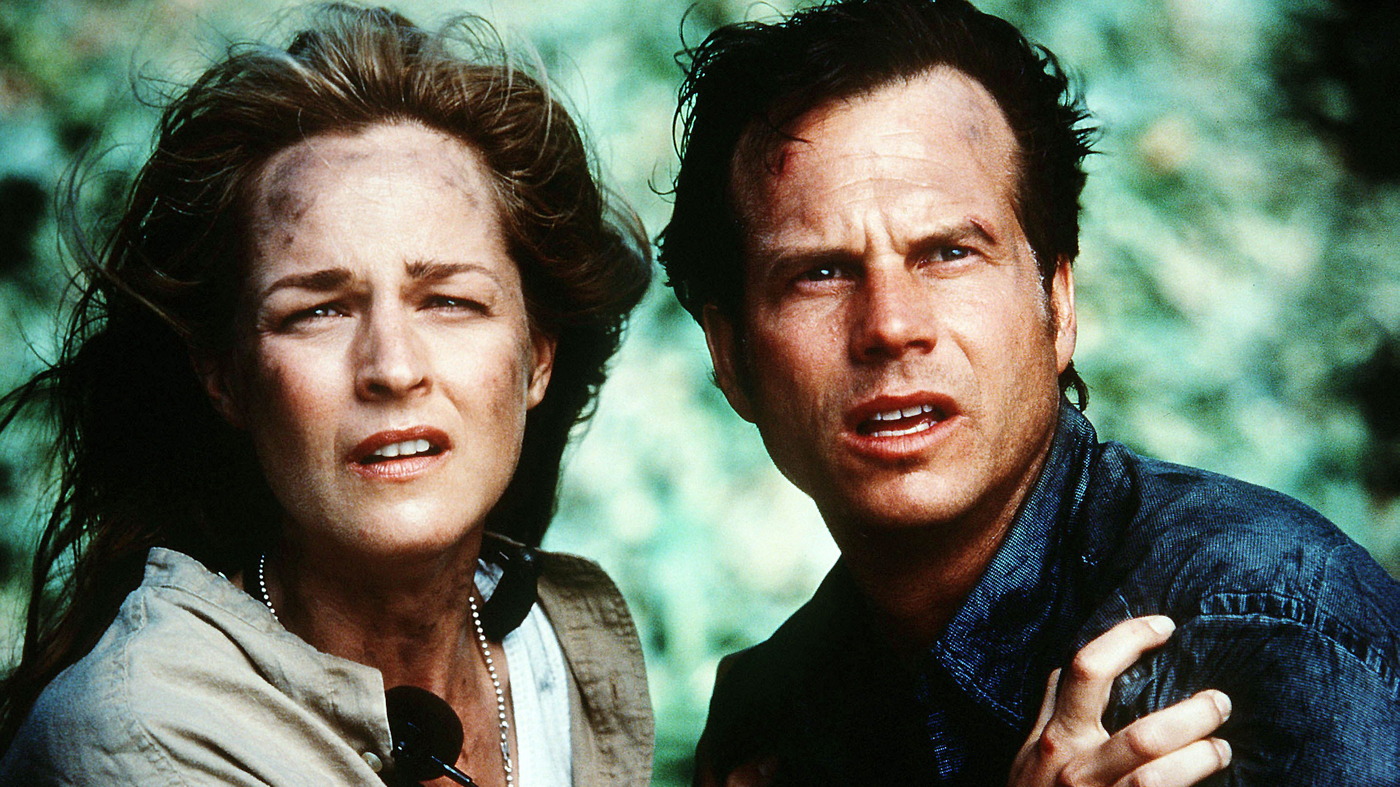
In the opening scene, we see a young woman named Jo Harding who unfortunately loses her father in an F5 tornado. This has stayed with her well until her adult life, as she is now entrenched in the world of tornadoes as a professional storm chaser. She is going through a divorce with her weatherman husband named Bill, played by the late Bill Paxton. He is hoping she will sign the rest of their divorce papers, so he can finally marry Dr. Melissa Reeves, a reproductive therapist, played by Jami Gertz. Jo (Helen Hunt), however, is dragging her feet as she still has feelings for Bill. They soon find themselves in a situation where they need to work together in order to survive because a massive tornado is coming their way.
Helen Hunt and Bill Paxton star in Twister.
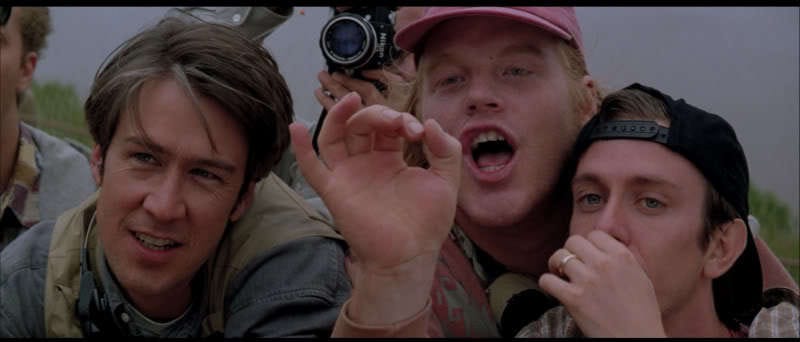
Jo and Bill have created a storm-device called Dorothy, which can predict if a storm is happening fifteen minutes ahead of time as opposed to the usual three minutes. This will give people more time to prepare for a tornado and make sure they find a safe haven for them and their loved ones. It needs to get close to a tornado in order for the sensors inside of it to track any weather data. Jo has also assembled a talented team which includes Dustin Davis (Philip Seymour Hoffman) and Rabbit (Alan Ruck). The scene stealer here is Philip Seymour Hoffman. I would describe him as Jeff Spicoli if he ever pursued a career as a storm-chaser, and he steals every scene he’s in throughout. He’s hilarious, charming and off-the-wall.
“Twister” is an incredibly entertaining action picture that works because of the jaw-dropping special effects and its likable cast. Helen Hunt, in particular, is great as a strongly written female character dealing with grief and trauma by trying to make sure no one ever experiences what she went through as a child. Bill Paxton is a cheesy goofball who doesn’t see what’s right in front of him and the fact he’s better off with Jo. Jami Gertz takes a thankless role as the “other woman” and makes it work to where the audience still likes her, even though we’d rather see Jo and Bill together.
The special effects and tornado scenes are expected to deliver in a film like “Twister,” and they do not disappoint. The film is wise to take some time to have the characters interact with one another, so that when the storm scenes kick up a notch, we care about what happens to the participants. They also build up the storm scenes so when they happen, we are waiting for them and are emotionally invested. “Twister” was directed by Jan de Bont, who had previously directed 1993’s “Speed.” He knows how to blend the action scenes in with the character scenes in an effortless way, and he hits the right balance throughout. After not seeing the film for over two decades, one of my concerns was it would be too action heavy. I’m glad to see he strikes the right chord with his direction. It helps that the film was co-written by Michael Crichton, the smart and talented author and screenwriter.
“Twister”is about fifteen minutes too long, and sometimes there are too many characters here, some of which I did not mention. It’s not a perfect film by any stretch of the imagination. However, for a big-budget action flick, it’s exactly what it needs to be and then some. As mentioned earlier, there is a build-up to the storm scenes, which are bonkers and over-the-top. It’s about making the little scenes and the big scenes matter and co-exist together in harmony. It’s also about having fun. There is a lot of fun to be had with “Twister” even in 2024. It’s an entertaining action film with some big laughs and even bigger explosions.
* * * ½ out of * * * *
4K Info: “Twister” is released on a single disc 4K from Warner Brothers Home Entertainment. The film has a running time of 117 minutes and is rated PG-13 for intense depiction of very bad weather. This release also comes with a digital copy of the film along with a really cool looking slipcover.
4K Video: This is one of my favorite 4K releases of the year from a visual standpoint. It looks gorgeous, clear, and vivid. When I think of this movie, I think of the colors. The colors really pop here, especially when the sky outside is green. It’s a tremendous looking 4K and it’s an early candidate for one of the best 4K releases of the year.
Audio Info: The Dolby Atmos soundtrack is a fantastic touch here, as this is a big screen movie that is being brought right into your home theater. This film was made for 4K. The big scenes feel big with this Dolby Atmos track. It sounded perfect. It wasn’t too boisterous or in-your-face, but it gets the point across in an effective manner. They did a great job here, too.
Special Features:
The Legacy of Twister – Taken by the Wind (NEW)
Chasing the Storm: Twister Revisited
Anatomy of a Twister
The Making of Twister
Van Halen Music Video – “Humans Being”
Commentary by director Jan de Bont and visual effects supervisor Stefen Fangmeier
Should You Buy It?
HECK YES! If you enjoy a good action flick in 4K, “Twister”is exactly why they made this format in the first place. It’s the movie you show your friends and family when you are trying to convince them to switch from Blu-ray to 4K. It also comes with a brand-new special feature, which is rare on catalog titles from studios. You also have the previously released Blu-ray special features, so you can keep the 4K and have everything that came with the Blu-ray as well. It’s the best of both worlds. Even though this film looks and feels like a 1990’s summer blockbuster, I found it to be a blast because it holds up well while also being a good nostalgia piece as well. If I were you, I’d buy this film on day one of its release. It comes highly recommended.
**Disclaimer** I received a copy of this film from Warner Brothers to review for free. The opinions and statements in the review are mine and mine alone.
The following review was written by Ultimate Rabbit correspondent, Tony Farinella.
“American Fiction” is the kind of adult drama which has been sorely missing from Hollywood over the past decade and a half. Hollywood has become obsessed with the big screen blockbuster and superhero films. Now, of course, there is nothing wrong with those films, but the adult drama along with R-rated comedies are becoming harder and harder to find these days. It is why a film like “American Fiction” is such a delightful treat for moviegoers who enjoy complex characters and well-rounded stories, and who like to be challenged when they sit down and watch a movie.
The film stars Jeffrey Wright as Thelonious ‘Monk’ Ellison, an author and teacher who is grumpy, defeated and incredibly unhappy with his life. Thelonious is a difficult person to be around as he’s critical of not only himself but everyone else around him. It doesn’t help that he isn’t as successful as he used to be with his writing. He’s finding it harder and harder to connect with audiences as he sees a shift in the literary landscape. The books which are making money and selling are those which profit off the stereotypes that exist in black entertainment.
Thelonius is told to write a “black book,” which is something he wants nothing to do with at all as it goes against his principles and his beliefs. It makes him angry to see a writer like Sintara Golden (Issa Rae) selling books left and right while his own work is financially unsuccessful. He returns home to spend time with his family, which is another source of stress in his life. His sister, Lisa (Tracee Ellis Ross), is a hard-working physician who is doing her best to get back on her feet after a painful and costly divorce. He also discovers that his mother, Agnes (Leslie Uggams), is suffering from Alzheimer’s Disease.
This is not the pick-me-up visit Thelonius needed, as he’s not exactly close with his brother, Cliff, played by Sterling K. Brown. Cliff and Lisa have trouble getting along with him because he’s too much like their deceased father who was withdrawn, judgmental and often pushed people away. With his mother’s health suffering, it is up to Thelonius to take care of her finances and figure out what to do with her care. He finds a solution when he ends up writing a book under a pseudonym, which gives the public what they are looking for: a stereotypical black book which relies on the offensive and cliché-ridden tropes audiences love. As the old expression goes, “No one ever went broke underestimating the intelligence of the American public.”
Thelonius has also developed a relationship with a neighbor, Coraline, played by Erika Alexander. She likes him, but can he love himself enough to work it out with her? Can he get along with his brother? He’s also discovering through his agent, played by John Ortiz, that his book might even be turned into a movie. This is all happening very fast for him as he’s wrestling with his need to produce substantial material and also his need for money. In many cases, the two do not go hand-in-hand. He doesn’t want to sell his soul for the almighty dollar, but he also has bills to pay in the meantime. Can his moral compass allow him to “sell out?”
“American Fiction” was my favorite film of 2023. It starts with the screenplay, which won Best Adapted Screenplay at this year’s Academy Awards. The film has great dialogue in it along with rich and funny characters that really sizzle on screen. It’s a witty, timely and sharp script. The film reminded me a lot of Spike Lee’s “Bamboozled,” but it’s a more upbeat film and not as bleak. It is hard to overlook how little has changed since “Bamboozled” came out back in 2000, though. The big thing that has changed is there are more platforms and outlets for this kind of material to be digested by audiences.
This film also has a tremendous cast from top-to-bottom. Everyone has effortless chemistry with one another on screen, and they are all likable, interesting and well-developed. Even though Thelonius is a curmudgeon, he’s never boring. There is something very quirky and funny about him, and it is because he was written with a lot of different layers to him. As an audience, we understand his frustration and we know why he feels the way he does about his family and how African Americans are presented in mainstream media. He’s not wrong, even if he goes about it in a way that tends to grate on those closest to him. He can be preachy and self-righteous, but it’s hard to argue with his points. This is a man who is learning to love himself, love someone else, and reconnect with his family. He’s a work-in-progress.
If you are like me and enjoy a film with heart, humor and a bit of edge to it, you will love “American Fiction.” This is the kind of movie Hollywood used to make but seem to shy away from these days. I enjoyed every single minute of this hilarious, heartfelt and intelligent piece of moviemaking. This film allows the audience to spend time with these characters, get to know, care about, and become emotionally invested in them. The ending, without giving anything away, is also perfect. I loved “American Fiction,” and I’m confident you will love it too.
* * * * out of * * * *
Blu-ray Info: “American Fiction” is being released on a single-disc Blu-ray from Warner Brothers Home Entertainment. It has a running time of 117 minutes and is rated R for language throughout, some drug use, sexual references, and brief violence. It also comes with a digital copy of the film as well.
Video/Audio Info: The 1080p high-definition transfer is very colorful, clear, and bright. Would I have loved a 4K transfer of my favorite film of last year? Of course! However, this is a very good-looking Blu-ray, and I can hold out hope it gets a 4K upgrade at some point as I think this film is only going to grow in popularity as more people see it on physical media. The audio on this Blu-ray is also top-of-the-line. All of the dialogue can be heard very clearly, which is important, because this is a very dialogue-driven film. Subtitles are included in English, French and Spanish.
Special Features:
None
Should You Buy It?
If you are strictly buying “American Fiction” for the movie itself, you should definitely buy it right away. However, this is only available on Blu-ray and DVD, and there are also no special features. This is a supremely bare bones Blu-ray from Warner Brothers Home Entertainment which is pretty disappointing. It does come with a slipcover, though. I’d say buy the Blu-ray with the slipcover as, from an audio and visual standpoint, it still looks and sounds really good. I always like to err on the side of caution, and I’d rather have a great movie on Blu-ray with the slipcover while I can before they stop releasing it with a slipcover. That being said, this film deserved a much better physical media release than it got,
**Disclaimer** I received a copy of this film from Warner Brothers to review for free. The opinions and statements in the review are mine and mine alone.
The following review was written by Ultimate Rabbit correspondent, Tony Farinella.
When you think of the “Ocean’s Trilogy,” you think of big movie stars, high stakes, and witty banter. These are individuals known for being con-artists and having a certain set of skills, but they bring an element of fun to the proceedings. They are interesting, layered, and unique. These are not your bargain basement crooks and thieves. These films are also aided by the direction of the stellar Steven Soderbergh. He makes everything pop and sizzle on screen. He knows how to add just the right amount of style to these films without taking away from his ensemble cast. The beauty of a Soderbergh film is the fact he can dabble in a number of genres and make a film successful both commercially and financially. He’s not just pigeonholing himself into one type of film. He can do an independent film that gets people talking or he can do blockbuster films like the “Ocean’s Trilogy.”
Let’s start with “Ocean’s Eleven,” which is, of course, a remake of the 1960 film starring Frank Sinatra, Dean Martin and Sammy Davis Jr. I don’t think it is fair to compare these two films as they are forty years apart, but I will say that both are entertaining and sleek in their own ways. Remakes in general tend to get a bad rap, but when they are done with the right people involved and the right mindset, they can really deliver the goods. It’s about taking an idea and making it your own without copying from the original source material. This is not always easy to accomplish, but they did that with “Ocean’s Eleven” in 2001.
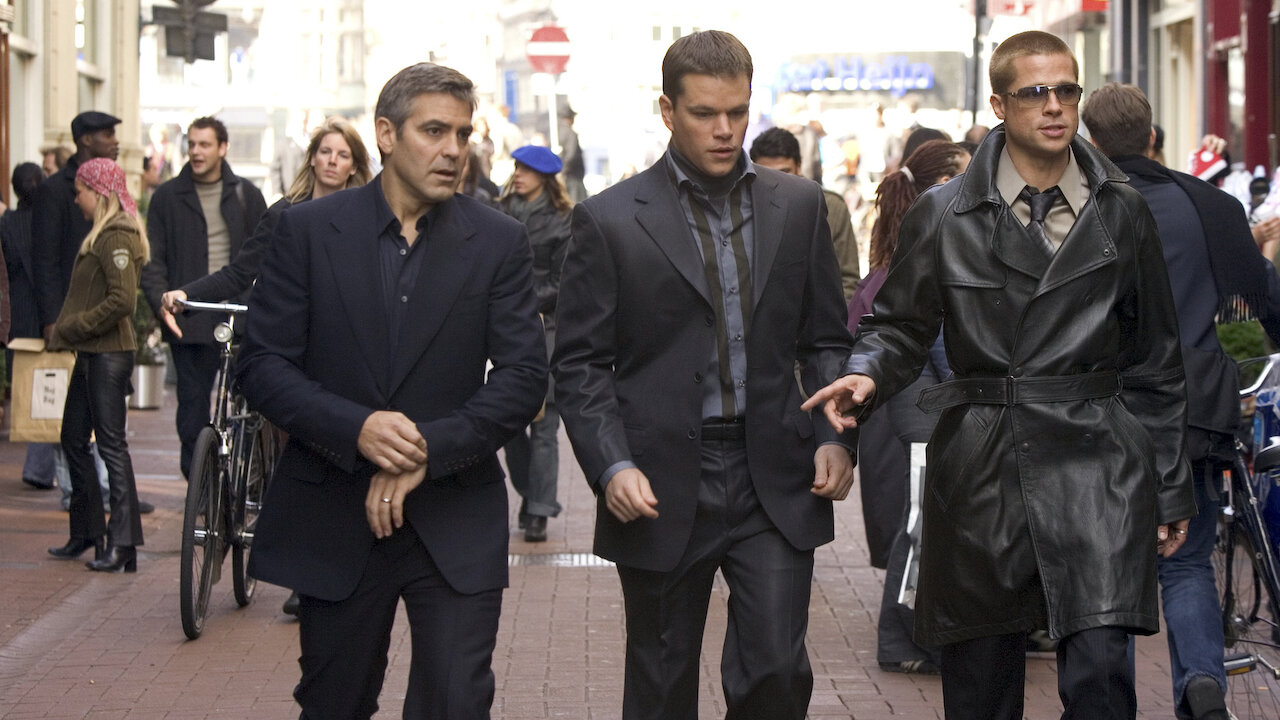
The charming George Clooney stars as Danny Ocean, a professional thief who has recently been released from prison. Even though he served time, he’s on the lookout for his next big caper. Once he gets involved with the thrill of the chase and the risk and reward that comes with it, it’s hard to turn it down or live a normal lifestyle after that. He meets up with an old partner named Rusty Ryan (Brad Pitt), and they are looking to hit up Las Vegas for their next big heist. When it comes to a heist like this, money is important. They end up securing the money from Reuben Tishkoff (Elliott Gould), and their plan is to rob three casinos in Las Vegas, which are owned by Tishkoff’s rival. The stakes are high, at $160 million, so they need to make sure they are on their A-game.
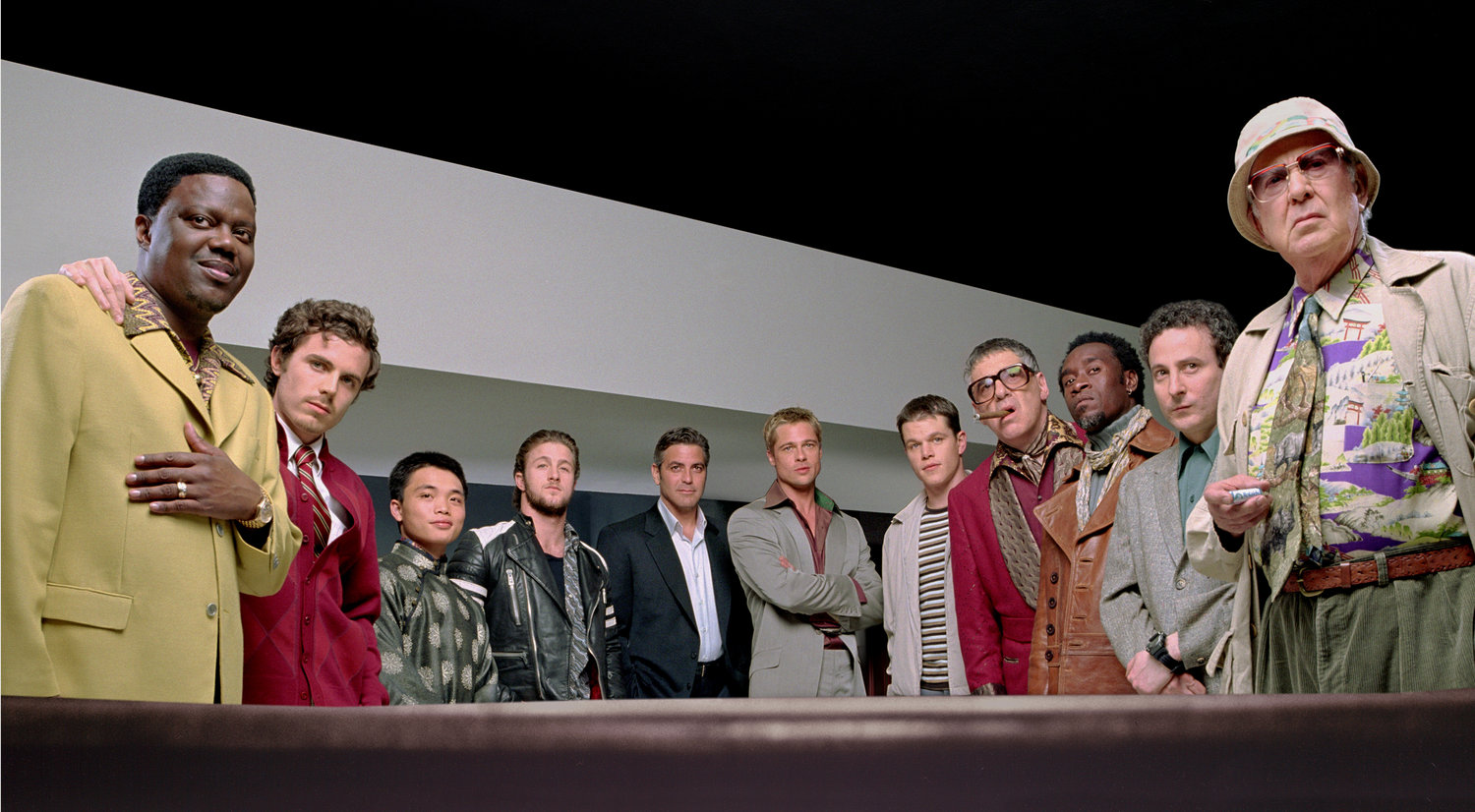
In order for Danny and Rusty to pull this off, they will need to assemble the right team. They enlist the help of Basher Tarr (Don Cheadle), Livingston Dell (Eddie Jemison), Linus Caldwell (Matt Damon), Frank Catton (Bernie Mac), and Virgil and Turk Malloy (Casey Affleck and Scott Caan). Every one of them brings something unique and special to the table. Julia Roberts also shows up as the Danny Ocean’s ex-wife, Tess, and she has a bone to pick with Danny. Andy Garcia is in the film as well as Terry Benedict, the owner of the three casinos they are trying to rip off in the film.
For my money, “Ocean’s Eleven” is the best of the three films. The pacing is terrific, and there is never a dull moment in the film. Even though there are a lot of moving pieces, it never feels like the movie is overstuffed, boring or too long as it moves at a brisk pace. Also, when you have top-notch actors and actresses together, you know you are going to get some great performances. A big part of the fun of these films is seeing these Hollywood legends go toe-to-toe with one another.
Moving onto “Ocean’s Twelve,” which came out in 2004, I don’t want to go into too much detail on this film just in case you are watching this trilogy in order for the first time. I will say I found it to be a little bit more of a slog to sit through and a bit of a letdown after “Ocean’s Eleven.” It was merely an OK film. It was successful at the box office, but I didn’t find the story as engaging this time around. Of course, the characters are still entertaining and fun to spend time with, but since there isn’t a great story or plot to drive them, they quickly run out of steam here. It ends up being one of those films where the cast had a lot more fun making it than we had watching it.
In 2007, they came back with “Ocean’s Thirteen” which introduced Al Pacino to the proceedings and was once again directed by Soderbergh. Julia Roberts and Catherine Zeta-Jones are missing here, which makes this film feel a bit off in regards to the female-male ratio. Roberts, especially, was such a big part of the first film, and Zeta-Jones was also very charming and lit up the screen in “Ocean’s Twelve.”
“Ocean’s Thirteen,” however, is a nice return to form after the lackluster and underwhelming “Ocean’s Twelve.” It’s almost as if Soderbergh sat down and realized what was missing from the last film and made sure to make up for those mistakes this time around. The addition of Al Pacino to the mix is also a juicy twist as well. What I enjoyed most about “Ocean’s Thirteen” is how it brought back the fun factor from the first film. “Ocean’s Twelve” was an entertaining film at times, but it was also a lazy one as well. This time, they work on making sure the fun is included along with a story that can hold its own in the process.
When these films work best in this franchise, it is when they realize we are just as interested in the story as we are in the characters. They go hand-in-hand. They play off each other in a sense. We love to see the characters in action and find out all of the twists and turns along the way. It was clear they put time, effort and brains into the first and third films. They lost their way a little in “Ocean’s Twelve,” which feels like a sequel they didn’t put a ton of thought into.
“Ocean’s Eleven” – * * * ½ out of * * * *
“Ocean’s Twelve” – * * out of * * * *
“Ocean’s Thirteen” – * * * out of * * * *
4K Info: The “Ocean’s Trilogy” is released on a three-disc 4K set from Warner Brothers Home Entertainment. This set only includes the 4K discs, so if you are looking for Blu-rays and 4Ks together, you will not find them here. According to the press release, the 4K remasters of “Ocean’s Eleven,” “Ocean’s Twelve” and “Ocean’s Thirteen” were completed at Warner Brothers Discovery’s Motion Picture Imaging (MPI) with the participation of Soderbergh. All of the films are rated PG-13, and their respective running times are 116 minutes, 125 minutes and 122 minutes. There is also a digital copy for each film which allows you to own all three copies of the trilogy. Subtitles are included in English, Spanish, and French.
Video Info: I really like the look of these movies on 4K. Having previously seen “Contagion” on 4K, also from Soderbergh, I’m happy to report this is another fantastic looking 4K set. Its color is vivid, bright and filled with a lot of life. It’s also dark and mysterious when things turn up a notch. All three of the films look great on 4K.
Audio Info: There is a lot of talking in these films as they are going over plans and information, and the dialogue comes in crystal clear on all three films. The soundtrack is just right in covering the dialogue, music and background noise without being too distracting. It captures the essence of each film.
Special Features:
“Ocean’s Eleven”
• Commentary by Steven Soderbergh and Ted Griffin
• Commentary by Brad Pitt, Matt Damon and Andy Garcia
• Are You In or Out? The Making of Ocean’s Eleven
• Pros & Cons: Inside Ocean’s Outfit
• The Style of Steal
• The Look of the Con
• Original Ocean’s, Original Cool
“Ocean’s Twelve”
• Commentary by Steven Soderbergh and George Nolfi
• Ready, Jet Set, Go: The Making of Ocean’s Twelve
• HBO First Look: Twelve Is the New Eleven: The Making of Ocean’s Twelve
• Deleted Scenes
“Ocean’s Thirteen”
• Commentary by Steven Soderbergh, Brian Koppelman and David Levien
• Third’s a Charm: The Making of Ocean’s Thirteen
• Ahab with a Piggyback: The Means & Machines of Ocean’s
• Jerry Weintraub Walk and Talk
• Masters of the Heist
• Deleted Scenes
Should You Buy It?
I’m seeing this set go for about $55 right now online, which is a really good price. That’s a little less than $20 for each 4K. If you enjoy a good movie collection, this one is definitely recommended. You get all of the old special features included here along with updated 4K transfers on these films as well. These are 4K transfers where it is clear they put a lot of care and effort into them. They didn’t just throw them together. If you enjoy heist movies with great casts, you really can’t go wrong with this trilogy. I’d recommend you go out and buy this set right now at its current price. You can make a weekend out of watching all three films and really enjoy yourself.
**Disclaimer** I received a copy of this film from Warner Brothers to review for free. The opinions and statements in the review are mine and mine alone.
The following review was written by Ultimate Rabbit correspondent, Tony Farinella.
Out of all the films I watched in 2014, “American Sniper” was the one which hit me the hardest. I had never seen a film like it before, and I was surprised I enjoyed it as much as I did, considering I’m not a huge fan of war films. This is much more than a war film, though. It’s a personal story, and this part of the film resonated with me much more than any shootings. Although there is one particular shooting that made me wince, Chris Kyle was only doing what he was trained to do as a Navy Seal.
Bradley Cooper stars as Chris Kyle in one of the best performances of his career. Not only did he put on the weight to play Kyle, but he completely became him. On the special features, they talked about how they would have moments on set that would cause goosebumps because his performance was so true to life. It’s always a thing of beauty when you see an actor completely devote themselves to a role and a film. It helps that the film was directed by the legendary Clint Eastwood. There’s also a quality screenplay by Jason Hall, adapted from Kyle’s book of the same name.
Kyle believes strongly in America and goes through some intense training that would make most men run for the hills, but he eventually becomes a sniper for the Navy Seals. Before he even attempts to do this, someone informs him that most men quit. Kyle says he is no quitter. Meanwhile, he meets his wife, Taya, played by Sienna Miller, and they eventually have a child together, adding even more pressure to Kyle’s life. He ends up taking part in four tours, which puts a strain on their relationship and his well-being. He knows he is doing a service to his country and protecting his fellow men, but that doesn’t make things any easier.
Bradley Cooper gained 40 pounds of muscle to play Navy SEAL Chris Kyle in the film American Sniper. “It wasn’t at all like a costume,” he said. “It was like … this sort of transformative experience to me because there was no going home from it.”
One of the things I admired the most about this film was the patience in which it was filmed. Kyle ends up doing four tours, and we get to see the tours along with him spending time with his family. For me, the “at home” scenes were far more effective than his time as a sniper. This is not to take anything away from his time on tour and how it’s filmed. The scenes are jarring and extremely well shot. I’m just always more engrossed in the human side of the story, and that truly adds more to what’s happening during his time becoming “The Legend”, a nickname he seems proud of at times, but also a little uneasy about as well. He is known as the U.S.’s deadliest sniper.
A lot of attention and praise was put on Cooper upon the film’s release, but credit also goes out to Miller as she has an extremely tough role to portray as well as Taya. She has to be supportive of her husband while also looking out for the best interests of her family. One thing is certain: her love for Kyle never waivers. She just worries about feeling disconnected from him. It’s clear he’s not the same when everything is over. How can he be? As he tells his psychiatrist, he thinks more about the men he couldn’t save as opposed to the ones he did. However, Taya wants her husband back, and she wants the man she married. The ability to disconnect from the war is a hard one, and that is explored in great detail in this magnificent film.
“American Sniper” made my list of the top ten films of 2014, and it is also one of the best films Eastwood has ever directed. Everyone watches movies for various reasons. I watch movies to be moved and engrossed by great stories and fascinating people. On my third viewing, I’m happy to report “American Sniper” holds up incredibly well. It’s also enhanced by the 4K transfer Warner Brothers has added to the film as well. It was released a few years before 4K discs became a reality, and with this being the ten-year anniversary of the film, it’s a great time to add it to your collection and upgrade the Blu-ray if you already own it.
* * * * out of * * * *
4K Info: “American Sniper” is released on a single 4K disc from Warner Brothers Home Entertainment. It also comes with a digital copy of the film as well. The film runs at 132 minutes and is rated R for strong and disturbing war violence, and language throughout including some sexual references.
Video Info: “American Sniper” on 4K really takes you into the heat of battle. I did mention that the war scenes didn’t hit me as emotionally as the sequences between Chris and Taya, but they still had their impact nonetheless. You would have to be a rock to not be moved and affected by what’s happening on screen. All of it is shot with just the right number of colors and texture. It’s sort of a dreary looking film, but that is to be expected with war.
Audio Info: The Dolby Atmos soundtrack is also an improvement over the inconsistent audio on the previously released Blu-ray of the film, which was a bit too loud at times. This time, it’s right on cue throughout the entire film. It was also fairly consistent during the quieter moments as well.
Special Features:
One Soldier’s Story: The Journey of American Sniper
Chris Kyle: The Man Behind the Legend
Clint Eastwood: A Cinematic Legacy – The Heart of a Hero
Navy SEALs: In War and Peace
Bringing the War Home: The Cost of Heroism
The Making of American Sniper
Guardian
Should You Buy It?
“American Sniper” is finally on 4K, and it was well worth the wait. The technical aspects are amazing, as they usually are with a Clint Eastwood film, especially on 4K. Bradley Cooper turns in an astounding performance and one which really hit me like a ton of bricks. Sienna Miller also turns in an underrated and potent performance as well. This is a film firing on all cylinders, and it will make a great addition to your physical media collection. This is top-notch filmmaking and a film that comes from a labor of love from everyone involved. When you have films like this one, the audience is the ultimate winner. The special features are also ported over the Blu-ray release as well, and they add a lot of context and information on the making of the film and Chris Kyle’s backstory. This is a day-one purchase, especially with the impressive slipcover which is included with this release.
**Disclaimer** I received a copy of this film from Warner Brothers to review for free. The opinions and statements in the review are mine and mine alone.
There are many who see support groups (or 12-step groups if you want to call them that). The truth, however, is that those who attend them are not any different from the rest of us, and they can at times be very funny. At the very least, these people deserve credit and applause for taking the time to get the help they need because asking for help is usually one of the hardest things to do.
“Thanks for Sharing” is one of the few movies I have seen which deals with these groups and the people who attend them. While it does take the subject of addiction seriously, it also finds a good balance between drama and comedy to where we find ourselves laughing with these characters and never at them.
This movie focuses on three men who attend the same Sex Addicts Anonymous meeting: Adam (Mark Ruffalo), Mike (Tim Robbins) and Neil (Josh Gad). Adam is an over-achieving environmental consultant who is celebrating his fifth year of sobriety. Mike is a happily married man who is kind of the elder statesman of the support group these men attend. And then there’s Neil, an emergency room doctor who is in serious denial over his addictions to where he gets in serious trouble with the law. I like how we are given characters who are at different stages of dealing with this addiction to where it gives you a good idea of why people come to these groups in the first place.
Adam is at a good place as he has really cleaned up his act and is coping with life really well. He takes great pains to keep himself on the right track by taking such measures as removing television sets from his hotel rooms so he won’t find himself watching anything pornographic. But then he meets the irresistibly beautiful Phoebe (Gwyneth Paltrow) while at a party where people are eating bugs (don’t ask), and the two are instantly attracted to one another. While Adam is eager to be in a relationship with her, he is not altogether sure he is ready to fall in love again after all he has accomplished. He is trying to keep his demons at bay, but it becomes much harder for him to do so.
Mike has been in recovery the longest, and he appears to have a great relationship with his wife, Katie (Joely Richardson). Things between them, however, change very quickly when his son Danny (Patrick Fugit) turns out to have some serious addiction problems of his own. Katie is thrilled to see Danny, but Mike is not sure he can trust him after all they have been through. In the process, we come to see that Mike, despite his well-earned sobriety, still has some major control issues he has yet to make peace with.
As for Neil, he has gotten himself into a painful situation when he stands uncomfortably close to a very attractive woman while riding on the subway. From there, things come to a head for him when he loses his job under embarrassing circumstances, and this finally makes him realize he needs help. Neil eventually finds solace through another recovering addict, Dede (Alecia Moore, better known as Pink), who is just starting to deal with her personal demons as well.
I am always yearning for movies which have down to earth characters, and “Thanks for Sharing” is definitely one of them. All of what everyone goes through feels very real, and nothing ever felt contrived to me. Granted, the storyline involving Robbins’ character is one we have seen many times before, but the acting between him, Fugit and Richardson are so good to where we can forgive the filmmakers for venturing into familiar territory. It really is a shame how most Hollywood movies do not dare give us more characters we can relate to on a human level. If they did, it would make most movies far more enjoyable and invigorating as a result.
“Thanks for Sharing” was directed and co-written by Stuart Blumberg, one of the writers of “The Kids Are All Right.” Finding a balance between comedy and drama can be very hard to pull off, but Blumberg is successful in doing so for the most part. He also shows a lot of love for each character here, and not just the ones who in recovery.
Mark Ruffalo remains one of the best and most naturalistic actors working today. As Adam, I never caught him acting once, and his chemistry with Paltrow is very strong. Ruffalo makes Adam a very likable guy as he struggles to not fall back into his old habits, and he makes you see how much of a challenge this is for him.
As for Paltrow, this is the most relaxed she has been onscreen in some time. While she was a blast to watch in “Iron Man 3,” she seems more in her element here as she portrays a character who is not an addict, but one who needs to face up to the issues slowly eating away at her. Watching her in “Thanks for Sharing” reminded me of just how wonderful she can be when she is given the right role.
Robbins remains as terrific an actor as ever, and I am always enthralled when I watch him in anything he does. His character of Mike seems like the typical father who has lost trust with those he should be the closest to, but he imbues this character with a lot of humanity to where he never seems like a simple caricature. His scenes with Fugit, who we have not seen enough of since “Almost Famous,” feel emotionally true, and their relationship feels authentic when it could have come across as ridiculously manipulative.
At this point, I am not familiar with Gad’s work other than him appearing in the acclaimed musical “The Book of Mormon.” Gad has the trickiest role here as he is this movie’s comic relief, but he never plays Neil for simple laughs. We are watching Neil as he is at the start of his recovery, and it isa rough start to say the least. Gad makes you root for Neil even as he does some of the dumbest and most reckless things anyone would ever have the nerve to do.
But there is no forgetting Alecia Moore, a.k.a. Pink, who gives an impressive performance as an addict who was pushed into this particular support group by a friend. Her character of Dede ends up forming a strong rapport with Neil, and they find in each other the strength they need to move past what is destroying their lives to where they can see the light at the end of the tunnel. From start to finish, she really understands this character very well, and I could see it in her eyes. Like Ruffalo, you never catch her acting here as she grounds her character in a reality which is not all removed from our own.
I liked how “Thanks for Sharing” showed how these support groups can become another addiction as its members begin to spend more time with others instead of their own families. While these characters have made great strides in conquering their demons, they still struggle with their urges every single day. Truth be told, it takes a lot of courage to face up to the things which are tearing your life apart, and long before this movie is over, you realize these addicts are not weak but strong.
The one thing I would have liked to see more of is how the family members deal with their loved ones’ addictions. My understanding is that they can only be so involved in what an addict goes through as they can never fully comprehend how dangerous their addictions can be unless they have experienced the same thing themselves. There is a scene between Paltrow and Richardson which addresses this divide, but I would have liked to see this movie go a little bit deeper in this area.
But when all is said and done, “Thanks for Sharing” fulfilled my need to see a motion picture with characters which we can recognize in our own lives. With all these superhero movies coming at us endlessly, it is important to remember we will never be perfect and cannot be everybody’s everything. It would be nice to be a superhero though, wouldn’t it? Lord knows we could use a couple of them right now. Anyway, I think this movie is definitely worth checking out.
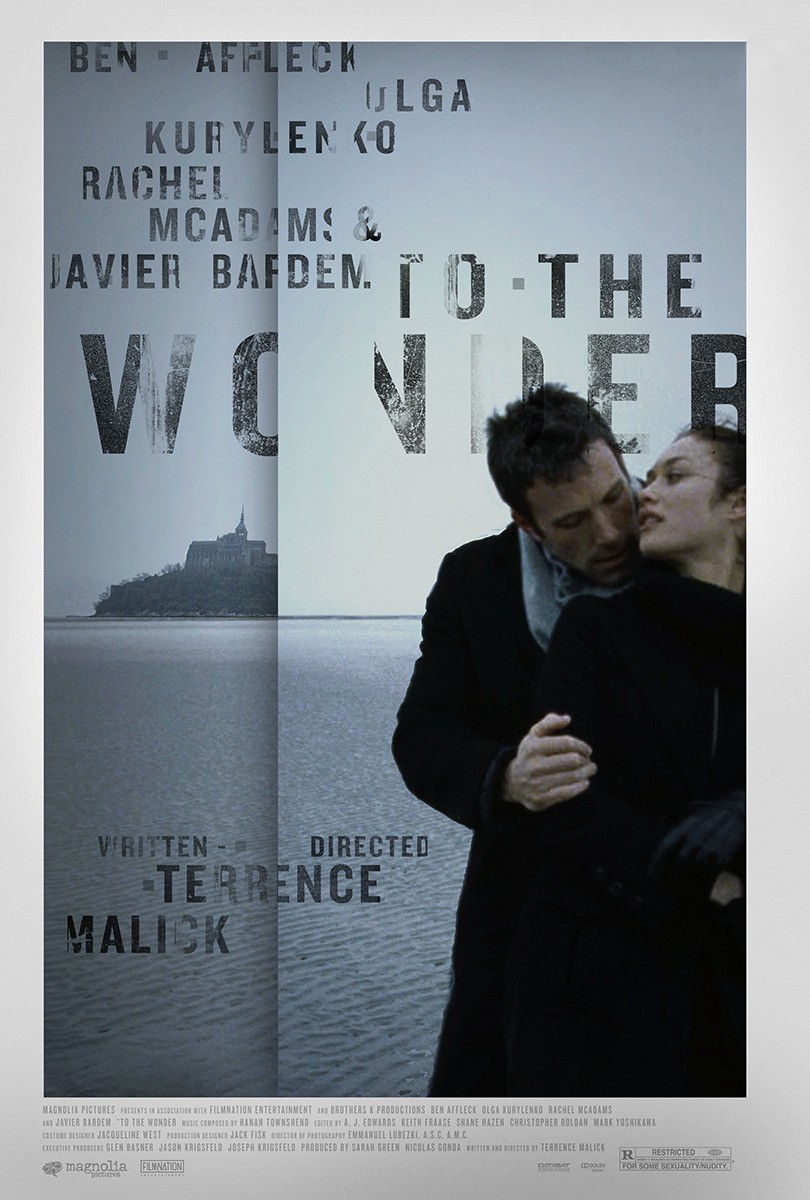
Terrence Malick’s “To the Wonder” is, in many ways, a mixed bag of a film. Not all of its parts go together in a way which feels entirely cohesive. It focuses on a couple played by Ben Affleck and Olga Kurylenko who fall in love and come to America to start a new life, but they eventually find themselves falling out of love, and they constantly struggle to understand how something so wonderful can go so awry. And then we have Father Quintana (Javier Bardem), a Catholic priest who is struggling to keep his faith even as he feels the presence of God eluding him at a time when he is desperate to believe in an afterlife. The balancing act between these characters is wobbly at best, but Malick still gives us many beautiful and wondrous images which are very powerful, and these images quickly remind me of how brilliant he is at capturing nature on film.
“To the Wonder” starts off in Europe where Marina (Kurylenko) finds herself completely enamored by her American boyfriend, Neil (Affleck), as they take a tour around town. Along with them is Marina’s daughter, Tatiana (Tatiana Chiline), who is thrilled when Neil asks her if she and her mom would like to move with him to the United States to live. After briefly viewing the European sights, the film then heads over to Neil’s home state of Oklahoma where the flatlands appear to stretch out as far as the eye can see. Heck, it almost looks like hardly anybody lives there, so it is a huge relief when we see t Neil and Marina actually have neighbors.
As with “The Tree of Life,” “To the Wonder” functions mostly as a silent film as the majority of the dialogue we hear is as a voiceover. Malick is far more interested in the inner thoughts of his characters than anything else as they struggle with the things they want and which are constantly outside of their grasp. We feel their passion for one another, and we also feel their pain and disappointment when their love eventually fades away.
Having read up on Malick as a filmmaker and as a person, it is clear to me how this film and “The Tree of Life” are his most autobiographical works overall. What the characters go through is not much different from what he has experienced in his own life, and with these films, it looks as though he is still trying to pick up the pieces of what went wrong.
Kurylenko first came to my attention in “Quantum of Solace,” and she has made the most of being a Bond woman as her performance here shows. It is thrilling to watch her dancing around the streets of Europe as well as in a corporate drug store which typically sucks the life out of everyone who shops at one. In many ways, Kurylenko is the best thing about this film as she takes us through Marina’s transcendent highs and her emotionally draining lows with complete conviction throughout.
Back in 20123, people had serious issues with Affleck as an actor, and this is even after his film “Argo” won the Academy Award for Best Picture. I myself have never had any issues with his acting abilities, and he gives a strong, understated performance as Neil, and it is never his fault we come to know less about this character than the others we are introduced to here. I really wish Malick had given Neil as much attention as he did to Marina as this would have made Neil’s journey in this story all the more illuminating. Nonetheless, Affleck is still very good in here.
Rachel McAdams is inescapably luminous as Jane; a childhood sweetheart of Neil’s who shows up after Marina has gone away. Malick makes Jane look beyond beautiful as he frames her against fields of wheat, and it is emotionally draining to watch Jane bear her soul to Neil and try to melt his heart in the process. McAdams ends up disappearing from “To the Wonder” a little bit too soon, but she is a vision to watch throughout.
Bardem’s character of Father Quintana at first feels a little out of place as much of the focus seems to be on the relationship between Marina and Neil, but his presence makes more sense as this film goes on. With this character, Malick seems to be saying how our loss of love for one another may have to do with our relationship to God, or lack thereof. Bardem does some of his subtlest work as he portrays a man struggling to hold onto whatever faith he has left, and it results in some of this film’s most emotionally draining scenes.
When we watch Quintana visit the sick, the elderly and the dying, I found myself being reduced to tears as these moments ring so emotionally true in a way I would rather not realize as death is becoming all too common for me to deal with. Plus, Malick just had to use Henryk Górecki’s third symphony entitled the “Symphony of Sorrowful Songs” which Peter Weir used to such great effect in “Fearless.” It remains a piece of music which is as beautiful as it is infinitely sad, and it always reduces me to a weeping wreck whenever I listen to it. I also have to admit I was very angry at Malick for using this piece of music here as it felt so unfair that he reduced me to a complete wreck in an inescapably manipulative way. Then again, I was in the midst of a very deep depression at the time, so that did not help matters.
But as mournful as “To the Wonder” is, there are still many beautiful moments to watch for as Malick remains a master of capturing the unpredictability of nature and animals on film. This includes moments like when Affleck and McAdams are suddenly surrounded by more buffalo than Kevin Costner dealt with in “Dances with Wolves,” the sunlight piercing through the colored glass in a church, or watching Kurylenko walking across the beach as the water covers the sand. These are moments which still will not fade away from my memory anytime soon. Working again with his “Tree of Life” cinematographer, Emmanuel Lubezki, Malick still captures moments of visual poetry in ways few other filmmakers can ever hope to equal.
It is those incredible visual moments which make me want to forgive how meandering “To the Wonder” is as it unfolds before us. I have learned Malick actually shot this movie without a screenplay, and this made me wonder how the actors dealt with this style of filmmaking. Considering that Jessica Chastain, Rachel Weisz, Amanda Peet, Barry Pepper and Michael Sheen all had roles in this film which were eventually removed from the final cut has me believing there was a whole lot more to this film than what ended up onscreen. While “The Tree of Life” had several different story lines going on, Malick was able to rein them all in to where everything seemed to fit perfectly. With “To the Wonder,” he has a little too much going on, and the film ends up losing focus more often than it does not.
Still, if you are willing to tolerate those flaws, “To the Wonder” is still a profound experience filled with great performances and beautiful images which will stay with you long after this film has concluded. I really wish the audience I saw it with all those years ago felt the same way I did. I bring this up as one audience member remarked at how the lives of these characters proved to be far more boring than anyone else’s. Well hell, some people enjoy the simple pleasures in life more than others, but many are still insistent about how theirs are better than the average human being, and that is even though there is plenty of evidence to prove otherwise.
Seriously, it seems very fitting that “To the Wonder” was the last film Roger Ebert reviewed and gave to the Chicago Sun Times before he passed away in April of 2013. Rest in peace, Roger.
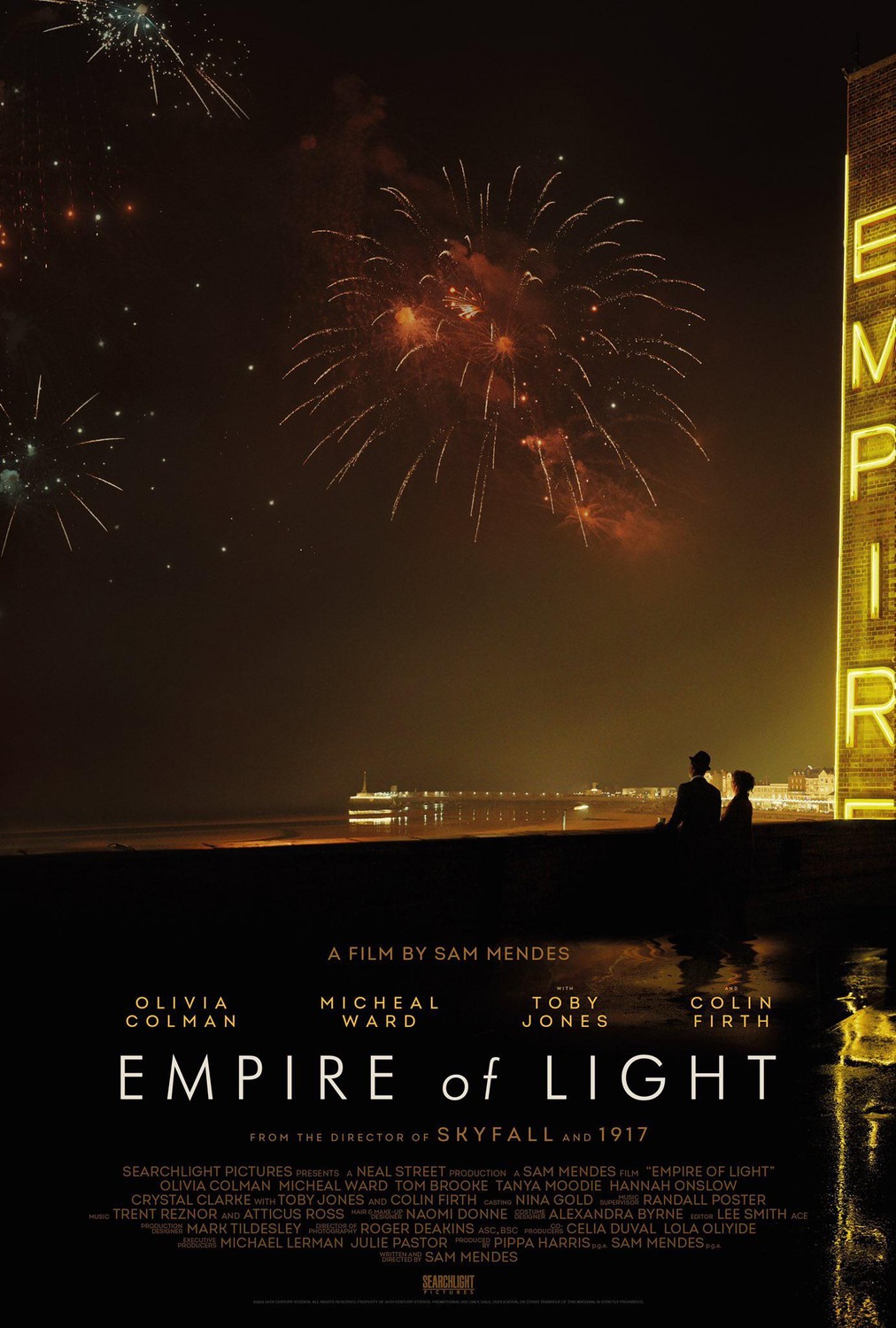
One of the things which really excited me about “Empire of Light” is how it reunited director Sam Mendes with the God of all living cinematographers, Roger Deakins. Together, these two geniuses have given us visual wonders in “Revolutionary Road,” “Skyfall” and “1917.” And with “1917,” Deakins finally won his second Academy Award for Best Cinematography, so he and Mendes are a match made in cinematic heaven as far as I am concerned. As this movie itself, I had no idea what to expect, and that is just as well.
“Empire of Light” transports us back to the early 1980’s where we are taken to an English seaside town where a cinema is showing “The Blues Brothers” and “All That Jazz,” the latter which I still need to watch. We meet Hilary Small (Olivia Colman), one of the cinema’s managers who dutifully opens it up at the start of a new day and helps get everything ready for audience members eager to take in the latest feature presentation. But while she at first seems like a pleasant enough human being, we soon learn during a doctor’s appointment that she is taking lithium. It is not made entirely clear why she has been prescribed this form of medication, but it implies she has been through a wealth of emotional turmoil to where she needs some reigning in. But while the medication may be helping her, she admits to her doctor that she generally feels lifeless on a daily basis. And there’s also the cinema’s chief manager, Mr. Ellis (Colin Firth), who often invites her into his office to discuss professional matters which prove to be anything but professional.
And then we are introduced to the cinema’s newest employee, Stephen (Michael Ward), a young black man who has been applying to college with little success. Quickly, a relationship forms between him and Hilary as both feel a deep need for compassion which reality constantly denies them. But the times they are forced to live through constantly threatens to tear them apart in tragic ways, and their secrets may reveal more to the other than they can possibly ever hope to deal with.
The first thing I have to mention about “Empire of Light” is the performance of Olivia Colman. As always, she remains an acting dynamo as she takes Hilary from ecstatic highs to devastating lows as her character is forced to deal with a roller coaster of emotions she cannot easily control in the slightest. Every single moment she has onscreen is mesmerizing as she exhibits emotions not easily faked, and it makes Hilary’s journey from start to finish all the more emotionally extreme.
Then there is Michael Ward who portrays Stephen, the one who helps lift Hilary out of her mundane existence. Ward is wonderful in creating a character whose passion for things helps to make him all the more charismatic as he navigates through a time of cruel racism and missed opportunities which can easily bring anyone else down. He also makes the seemingly unlikely relationship between Stephen and Hilary all the more palpable as some may be quick to dismiss any possibility of something like this actually happening. What life has taught me is that anything is possible, so why shouldn’t this relationship be a distinct possibility?
And yes, there is Deakins’ cinematography which is as captivating as ever. While it may not be as orgasmic as the visuals he gave us in “Blade Runner 2049,” he succeeds in painting a lovely atmosphere of an English coastal town, the kind which ceased to exist decades ago, but whose history is still relevant in today’s world of Brexit and humanity going backwards. His work is also complimented beautifully by the wonderfully ambient film score by Trent Reznor and Atticus Ross who stand in for Mendes’ regular musical collaborator, Thomas Newman.
When it comes to the screenplay by Mendes, however, it does try to cover more ground than it possibly can to where the focus gets lost from time to time. Part of me wanted to see more of the racism of the time explored more deeply as the script only seemed to touch the surface of it. The same goes with Hilary’s mental illness as it felt like I only learned so much about what she has been through. Perhaps this was by Mendes’ design as he wanted to keep us at a certain distance, but had we known more, perhaps this part of the movie would have been more profound as a result.
As for the love “Empire of Light” has for movies in general, it does make for one great scene involving Toby Jones who plays the cinema’s dedicated projectionist. Norman. Hearing Jones describe the intricacies of feeding film through the projectors makes for some of this movie’s most memorable and magical moments as it reminded me of the time I worked at a cinema in my youth. It also leads to a scene later on which reminded me of the climatic one in “Cinema Paradiso,” one of the greatest movies ever made about movies.
I do have to say that this film does threaten to have as many endings as “The Lord of the Rings: Return of the King.” Mendes must have been searching endlessly for the right way to conclude this particular film of his. Did he succeed? Well, I’ll leave it to you to find out. All I can say is that when you think the movie is over, it isn’t.
Despite its flaws which keep it from being the perfect Mendes motion picture which “American Beauty” and “Skyfall” are, I found “Empire of Light” to be very enthralling. It captures an interesting period of history, and its love of movies and film is deeply felt. And when all is said and done, it proves that Olivia Coleman is worth the price of admission no matter what she is appearing. Heck, my dad would pay her to read the phone to him just as he would with Tilda Swinton. I’m serious!
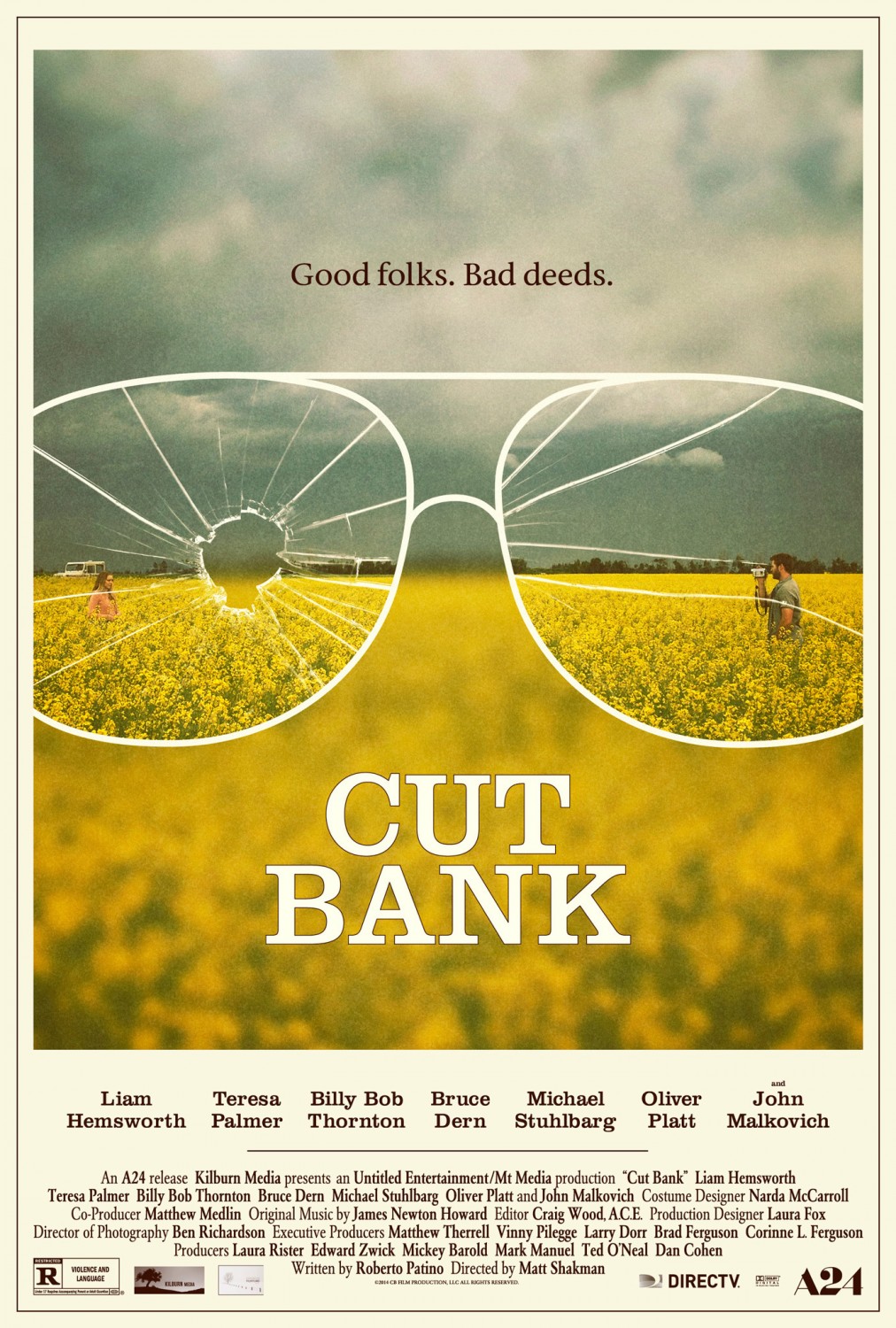
Matt Shakman has had quite the journey through show business so far. He started off as a child actor doing commercials, and he played the role of Graham “J.R.” Lubbock, Jr. in “Just the Ten of Us,” a spin-off of “Growing Pains.” From there he went to Yale University where he studied theater, and while there he directed several plays. Upon arriving in Los Angeles, he founded the Black Dahlia Theatre which American Theatre Magazine later called one of “a dozen young American companies you need to know.” Eventually, this led to him directing television for such shows as “It’s Always Sunny in Philadelphia,” “Mad Men” and “Fargo.” Now, he makes his feature film directorial debut with the thriller “Cut Bank,” a film noir along the lines of “Blood Simple.”
“Cut Bank” stars Liam Hemsworth as Dwayne McLaren, a former high school football star who is desperate to escape his hometown of Cut Bank, Montana. Then one day, while filming a video for his girlfriend, he witnesses the town’s mailman Georgie Wits (Bruce Dern) being shot to death. From there a scheme is uncovered where some people look to get rich very quickly, but it all comes to spiral out of control in horrendous ways. The movie also stars John Malkovich, Billy Bob Thornton and Michael Stuhlbarg.
I got to speak with Shakman over the phone about “Cut Bank,” and he discussed what it was like working with actors like Malkovich, Thornton and Stuhlbarg, how he managed to shoot the movie on 35mm film, and he spoke of how he went from being a child actor to a theater and television director and now a film director.
Ben Kenber: I read you approached this movie as a play more than anything else.
Matt Shakman: Yeah, I tried to cast actors who I’ve always admired and put together kind of like a rep company. In a way, I could imagine doing the movie again and everybody switching parts. They’re all so great and talented and versatile. So yeah, I definitely considered it like I was casting a play.
BK: Of all the actors you cast in this movie, John Malkovich was the first one you went to. What made you start with him?
MS: I’ve been a fan of John Malkovich onstage and onscreen, and he’s a personal hero of mine because he founded Steppenwolf. I’m a theater guy and I founded a small theater in Los Angeles, and I look up to Steppenwolf and the guys who started that. I just thought, here’s a guy who is from Southern Illinois who sort of felt like he knew this world, and yet we haven’t seen him play this small-town guy in a really long time maybe since “Places in the Heart,” and he’s brilliant in that movie. He’s come around to do great but larger than life characters in so many films. So we reached out to him and he really responded to it and he had personal experience with the town of Cut Bank. He actually worked there one summer putting himself through college. He worked on the trail crew at Glacier National Park and knew the town of Cut Bank very well, so he had a strong personal connection to it. He did a beautiful job playing a guy who really feels sort of overwhelmed by his own decency which feels really believable in that small-town world.
BK: Watching “Cut Bank” brings to mind other movies like “Blood Simple” or “Before the Devil Knows Your Dead.” When it came to making this movie, were there any clichés or cinematic tropes you were looking to avoid?
MS: You mentioned some films that I love, “Blood Simple” being one in particular. I think that blend of dark comedy and thriller stakes is something to aspire to, and we tried to do our best in that same kind of world. Also “The Last Picture Show;” the idea of the small town and the guy who wants to get out of it, that’s always been a big inspiration for me. A lot of 70’s crime thrillers were inspirations as well. We went and shot 2 perf, 35mm to give it an extra grainy look so we could evoke some of the Sergio Leone films of the 70’s as well. So, those were just some of the inspirations.
BK: I love that you got to film this movie in 35mm. Was it hard to get the opportunity to shoot in that format?
MS: Definitely. We had to make a lot of sacrifices to be able to pay for it. The cost of doing film had gone up so much because the labs were shutting down everywhere, and you couldn’t get the same deals that you would get before. Kodak was really cutting the price on film to try and keep people shooting film, but we were just on the other side of that curve where they realized uh-oh, nobody’s shooting film anymore so we need to get whatever we can get out of the people who will be using our stock. I love it. I wish I could always shoot on film. It’s really just a much better way to do it.
BK: That’s what I have been hearing from a lot of filmmakers. There are still a lot of things you can capture on film you can’t on digital film.
MS: Yeah, there’s a mystery to film that I think is important, and we were shooting a lot of days here where film has a real advantage. The argument can be made that when you should at night, having something like an Alexa can bring certain advantages in terms of less light needed and more range. But I still think that nothing really touches film.
BK: Among the performances in “Cut Bank,” one which stands out in particular is Michael Stuhlbarg’s as Derby Milton. He had the lead role in the Coen Brothers’ “A Serious Man,” but he’s almost completely unrecognizable here. How did you go about directing him?
MS: Michael’s a genius and a total chameleon, and I’ve been a fan of his ever since I saw him in “The Pillowman” (a play by Martin McDonough) on Broadway. He stole the show there and I think he’s been stealing every show everywhere he does ever since, so I was so thrilled when he agreed to come on board and be a part of “Cut Bank.” I sent him a bunch of references and pictures I had, one of which was a Chuck Close painting, which we both really liked a lot. He sent me a few references as well which inspired him, and we built this guy together through lots of phone conversations and exchanging images. Eventually we came up with what Derby looks like now which involved all sorts of trickery from wigs and fake teeth and contact lenses and coke bottle glasses and fingernails and all that. But he’s a great actor and he’s very thoughtful. He’s very smart and he goes deep into the character, and I thought he did a beautiful job.
BK: Yes, this is a character that could have easily been turned into a stereotype, but Stuhlbarg gives Derby a uniqueness I don’t seen many other actors giving the character.
MS: Definitely. Derby is a really fascinating guy even though he is the antagonist of the film. He’s probably the most reasonable person in the movie and what he ends up doing and the body count that follows him really is unnecessary if people were as reasonable to him as he is to them.
BK: It’s great how you made the town look vast, but at the same time anybody who has lived in a small town like Cut Bank can definitely relate to it feeling like a prison and wanting to break free of it.
MS: Exactly. That kind of modern western feeling of being trapped in this little frontier town with the gates of the port closed, and the idea that anything beyond those gates is terrifying is best to be ignored is what the town has to confront. By the end they are able to turn around and head into an uncertain future, but the whole experience of the film is opening up that town.
BK: What were the biggest challenges of making “Cut Bank?” It takes place in what is said to be one of the coldest places in America, but you actually filmed it in a time of year when it was exceedingly warm.
MS: We shot in Canada and Alberta and in the town of Edmonton, and that’s very close to Calgary where I shot “Fargo.” I’ve been there when it was the coldest part of the year at minus 40, and I’ve been there when it was the hottest day on record, so I’ve seen the full cycle from super cold to super-hot and it has its challenges. Certainly, there are some scenes in the movie, especially in the junkyard trailer where Bruce Dern is, where we were shooting in the middle of really, really hot summer days in a metal tin can covered in black fabric to make it look like it was nighttime. Everybody was sweating. It was pouring off of them. It was miserable and I felt terrible, and you can still see in a couple of shots in the movie how red everybody’s face is when they are in that junkyard trailer. So it did have its challenges like no air-conditioning, and you just kind of roll up your sleeves and do the best you can despite the elements. You’ve got to do what you’ve got to do.
BK: I got a kick out of Bruce Dern’s character here. He’s been around for a long time, but his career has gone up another notch thanks to his work in “Nebraska.” What did Bruce bring to this movie that wasn’t in the script?
MS: He’s a live wire (laughs). I loved Bruce Dern. He’s incredibly alive as a performer. He describes what he’s doing as dancing in a way, and I think he absolutely is truly that, a dancer. He’s playing with it almost like jazz as he goes and that’s wonderful. He’s never going to do the same thing twice. He does throw in some bits of improv as he goes, and a lot of wonderful things ended up in the film that were all of his own devising. He’s a bit of a mercurial, charismatic guy and he has the best stories in the world. He remembers everything that has ever happened in an illustrious way, and it’s incredible to hear. He tells stories about everyone from Hitchcock to Spielberg, etc. He’s in one of my favorites also from the 70’s with “The King of Marvin Gardens.” It’s a pleasure to get to work with somebody who’s a legend like that.
BK: Billy Bob Thornton also stars in the movie, and he’s played a lot of unforgettable small-town characters. What would you say he brought to this movie that wasn’t in the script?
MS: He really does understand this world. He’s from a small southern town which is such a different thing from the prairie town in the film, but it has the same kind of heartbeat. Billy Bob, like Malkovich, is just one of my heroes. He’s a great writer and a great director and a great actor, and I had the pleasure of working with him on “Fargo” as well. He’s just an incredibly good person and very smart, and whenever he had notes we would talk about the script and you knew you were getting notes from an Oscar-winning screenwriter. He always had tremendous things to say and just made everything better.
BK: There is a scene between Liam Hemsworth and Oliver Platt where Liam looks at Oliver and realizes that this is the person he will become like if he throws all his moral values to the wind. Would you say that’s the case?
MS: Yeah, he’s very interested to know what’s the big city is like, and here in the person of Oliver Platt is the big city. I love Oliver Platt. He’s great and he brings this incredible urbanity and charm and intelligence to it. But yeah, he represents the big outside world in all the positives and all the negatives.
BK: James Newton Howard scored this film. How did you manage to get him on board?
MS: Through his generosity. He does these just giant movies like “The Hunger Games” and “Maleficent,” and then “Nightcrawler” which is a smaller movie but certainly a big profile film. Getting him to come and do our tiny little film was entirely because he is just a lovely, generous person. I reached out to him, we had a mutual friend in common, and sent him the script and made my pitch about what the film would be about, and he really liked it and wanted to come on board. He devoted tons of time and energy to it, as much energy as he puts into his other big films, and he really cared and did a lovely job.
BK: “Cut Bank” is being distributed by A24 Films which has become a great company for independent films to get behind. What did A24 bring to this project that other distribution companies might not have brought to it?
MS: God bless A24. Their taste is great and eclectic. They are picking up movies that are very different from each other, but are all really worthy. I was so thrilled when they wanted to release “Cut Bank.” They’re a great group of people who really care. They are very supportive of the movie. They have devoted a lot of energy and great taste to their marketing and ad campaign with the artwork they are doing. They have left no small detail unnoticed. They are really on the ball and I’m really thrilled to be a part of a company that has released everything from “Under the Skin,” “The Spectacular Now,” “Spring Breakers” and “A Most Violent Year.” It’s a really great roster of movies and I’m thrilled to be a part of it.
BK: How much time did you have to shoot “Cut Bank” in?
MS: 27 days for “Cut Bank,” which is fast for a movie that is 93 minutes long, so we were jamming and going quickly. I thought this would be a little more luxurious compared to my TV days as TV is famous for being quick, and I was wrong. Doing an independent film is actually faster than doing TV. We were out there shooting outside of Edmonton and small towns. We were building our entire world from the ground up and going into practical locations which added extra challenges, so time was not a commodity we had a lot of. We had to hustle and go as fast as we could to try and get it all done in time. There was a lot of different locations, there was a lot of night work, and we were shooting at the time of year when the night is the shortest. We only had about four hours of darkness every night so we had to be really careful about how we structured everything, and we ended up shooting all night long in order to have the time to shoot all the night stuff.
BK: Does working that fast help you creatively?
MS: It can. Necessity is the mother of invention. It’s true that when you’re forced to compromise, you sometimes end up with a solution which is better than what you were trying to accomplish to begin with. Everybody bonds together and tries to get everything done. You’ve got a short amount of time so everybody knows it’s game time, and that brings out the best in everybody.
BK: You started out as a child actor. How would you say you evolved from being a child actor to a director?
MS: It was definitely part of my life when I was young, and I had some experience being on the other side of the camera and understood about hitting marks and what the actor’s process was like. But then I left that behind and went off to school and had a normal experience in college and did a lot of theater and found my way to theater directing. My path was more direct from theater to directing plays to directing television and to directing film than really from the acting experience, but I’m really grateful to have had that background and the experience of being an actor because it helps. When speaking to actors, I understand what they are going through and what their process is like.
I want to thank Matt Shakman for taking the time to talk with me about “Cut Bank” and his career. “Cut Bank” is now available to own and rent on DVD, Blu-ray and Digital.