Exclusive Interview with Cherien Dabis on ‘May in the Summer’
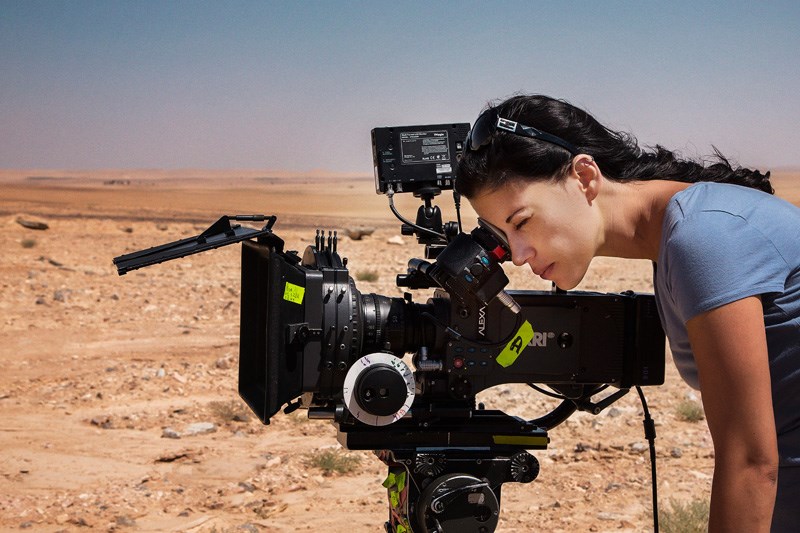
cherien-dabis-on-the-set-of-may-in-the-summer

May in the Summer” may look like the typical romantic comedy on the surface, but it’s really much more than that as it delves into a culture many of us have not seen. Cherien Dabis who wrote, directed and stars in this movie as May Brennan, a sophisticated New Yorker and an acclaimed author who travels to her childhood home in Amman, Jordan to prepare for her wedding. But shortly after reuniting with her sisters and her divorced parents, May begins to question whether she should go through with the marriage after experiencing a number of familial and cultural conflicts.

It was a pleasure talking with Dabis while she was in Los Angeles. While she talked at length about her movie, she also described just how much Jordan has changed from when she was a child. In addition, she spoke of the challenges she faced of acting and directing at the same time, what she was proudest of being able to capture onscreen about Jordan, and she talked about how actors Bill Pullman and Alia Shawkat came to be cast.
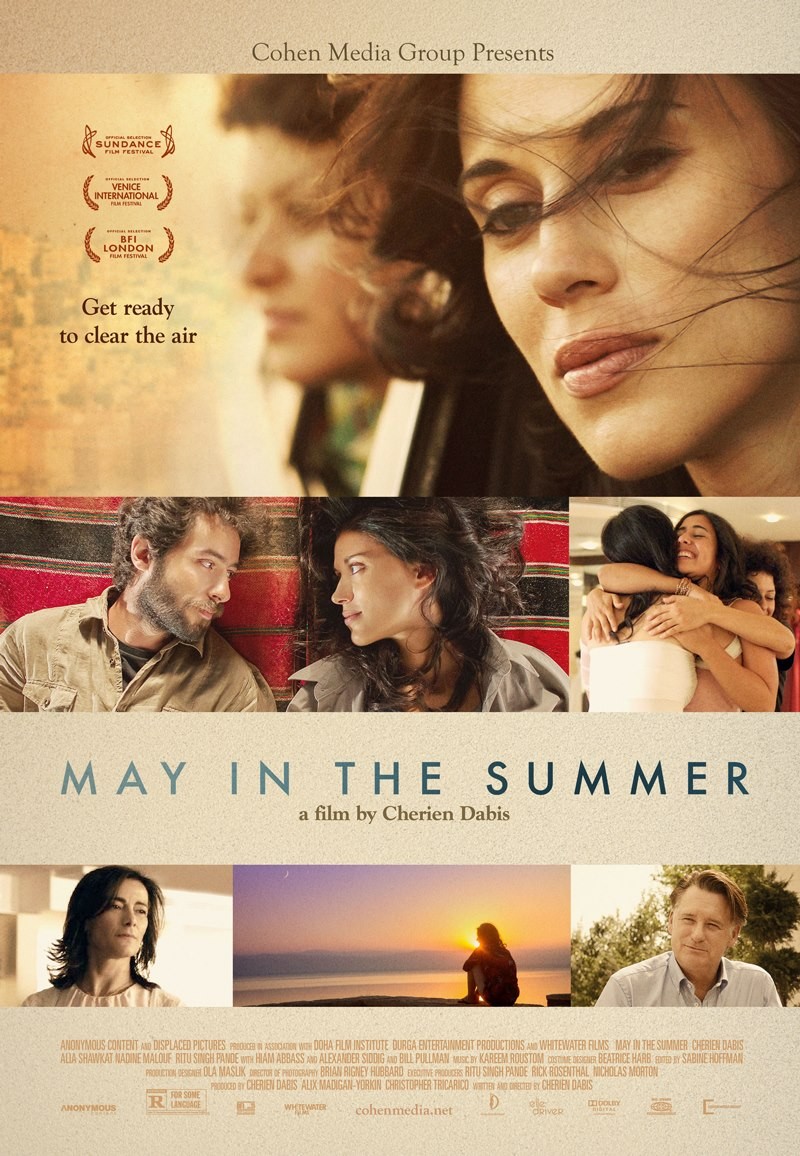
may-in-the-summer-poster

Ben Kenber: What I really liked about “May in the Summer” is that it gives us a unique look into a culture that most people have seen from a distance, and in some cases a rather biased distance. How was it for you capturing Jordan on film?

Cherien Dabis: It was great. Jordan’s a country I know very well. I’ve been traveling there since I was a kid. My parents are Palestinian and Jordanian and I was born and raised in the US, but we would return to Jordan almost every summer. For the last three decades I’ve watched the country grow and change so much that it’s been really shocking the amount of growth and change. I knew I always wanted to do something there because what I find really particular to Amman specifically is that it’s not only become super westernized, but it’s also quite Americanized. There’s a lot of American schools popping up, there are a lot of young people who are speaking English with an American accent, there’s so much American culture and American products; there’s fast food chains and Starbucks. So it’s just the side of the Middle East that I didn’t think people would find really surprising, and I wanted to feature that and to be able to feature the country and parts of the country that I’d been going to since I was young and places where I really discovered myself. It was really, really cool.

BK: You both acted in and directed this movie. Initially, you were looking to cast someone else in the role of May, correct?

CD: Yeah, I didn’t write the role for myself. I spent about a year looking for someone to play the part and I wasn’t finding someone who I felt was really authentic to the culture and language, but also someone who really embodied the spirit of the character. At the same time, I kept getting people, like random people, who would suggest that I consider myself for the part. It was really shocking to me that people kept saying that to me, but enough people said it that I just finally was like okay, this somehow feels like I am meant to do this. I am meant to consider this, that maybe this is part of my journey. I think ultimately that’s what I found. I very hesitantly put myself forward. I put myself on tape, I watch myself back and it’s always such a trip to do that for the first time. It took a little while for me to find a sense of objectivity or at least as close to objectivity as I could, but I saw something there that was raw enough that felt like I could work with it and that embodied the spirit of the character and what I had been looking for, and I surprised myself a little bit. So I called myself back, I made myself go through this rigorous casting process only to discover that wow, I think I might be able to do this. It was kind of an amazing journey and one in which I kind of paralleled May in a way. May is on this journey of self-discovery, and by putting myself in the film I was also on a journey of self-discovery in having to make myself vulnerable just like the character in the film. And when I realized that I was like oh God, now I really have to do it. It really feels like the right choice for the film, but it was a tough one to make given all of the hats that I was wearing.

BK: In terms of acting, did you have someone looking out for you when you stepped in front of the camera?

CD: I did. When I made the choice to do it, I brought on someone who became a very good friend. He’s an acting teacher in Brooklyn and he became somewhat of an acting coach to me. So I worked with him for about a year and a half before making the film, and it was great because my training was really about getting as much experience in the skill of acting and directing and not back and forth in directing myself. It is a very specific skill and I wanted to have as much experience in it as I could before getting to set, and it was really important that I did that because I would’ve been a mess if I hadn’t. But he came to set and he was there for me. He was sort of my eyes and by then we had a short hand because we had been working together for so long, so it was really great to have them there.

BK: I really loved how the Dead Sea looked in this movie. It’s just beautiful to the point where the name seems a little contradictory considering how lively the atmosphere out there seems.

CD: Right, and yet strangely appropriate given what’s on the other side of the Dead Sea. It’s (Palestine) so close. The Dead Sea’s so small and narrow, and the other side of the shore is the West Bank. It’s sort of shocking when you’re standing there looking out and you’re at a resort where there are these really beautiful infinity pools and spas and food and drinks and people partying by the pool. It’s a very contradictory paradoxical experience, and that was something I wanted to capture in the film.

BK: What would you say you were the proudest of being able to capture in this film about Jordan and its culture?

CD: That’s a really good question. I think the surrealism almost of being in a place. I have not seen that yet in a film, and I do think that what sets this movie apart from other Middle Eastern films, or Middle Eastern themed films, is that it really explores family. It’s a story about family and it’s a story that’s really relatable about relationships, and it looks at divorce but through a wedding. In some ways, it’s a sort of a divorce drama disguised as a wedding comedy. So it’s this really relatable film that’s set in this really specific part of the world, and it shows a part of that world that we don’t ever really get to see. The surrealism of that world I think is really interesting. Being in a place like Jordan which is just surrounded by conflict is at times really surreal because you can find yourself living this totally seemingly normal existence where you are going to cafés with friends or going out to dinner. You’re just going about your work, your life and you’re interacting with family, and then a fighter jet flies by and it rocks your entire world and you suddenly remember where you are and you remember that anything could happen at any moment. It gives you this incredible sense of perspective on your life where suddenly what you’re going through is not so bad and your problems seem really trivial and you remember the greater suffering in the world. I think it affects you in your life and your choices and who you are in a way that’s very unique to that part of the world, and that’s something I really wanted to capture and I think that’s something that’s there in the film. It’s something that I don’t think you get to see very often.

BK: We see a number of women in “May in the Summer” wearing a full hijab (a veil which covers the head and chest). Is it something that’s still imposed on women in Jordan or is that something women do by choice?

CD: Both. I think a lot of women do it by choice, but for a lot of women it’s not a choice. It’s imposed on them by their families or by society or by the culture. I do think this is a movie that looks at expectations like that. Our main character is definitely on a journey of self-discovery where she’s trying to figure out what kind of future she wants. She’s trying to strip away a familial expectation, a parental expectation or a societal expectation or even a political expectation, and she’s really trying to connect with her own inner voice and her own truth. That’s the only way she can really move into her own future, so it looks at those levels of expectations.

BK: Bill Pullman plays your character’s father and it’s great to see him here. Was it hard getting him cast in this movie?

CD: Surprisingly not and I was really presently surprised by that. My producer sent the script to his agent and he really responded to the script and the role. He’s just a very adventurous spirit so he wanted to travel to Jordan, he wanted to have that experience and he really wanted to go to Petra which was amazing. He was just fabulous. The moment he arrived in Jordan he just immersed himself in the culture and he wanted to just soak it all in. He was making friends right and left and he was having dinner with people he just met on the street. Within the first day of shooting, he knew everyone’s names. He was really just a special, special person and I’m so glad that he came over and wanted to be a part of that. People appreciated him so much for being so open in the culture.

BK: Alia Shawkat, who plays your sister Dalia, is also wonderful here, and she was also terrific in “The Moment” where she acted opposite Jennifer Jason Leigh. How did you go about casting her?

CD: Well I had worked with Alia on my first film, “Amreeka.” I was a huge fan of hers from “Arrested Development.” I just loved her. My executive producer on “Amreeka” actually told me that she’s half Iraqi which I had no idea, but I was very excited by that because I’m always looking to cast very authentically. So when I found that out I approached her for a role in my first feature, and when I met her she just so was that character in my first feature. When I worked with her I just absolutely loved her. We had a great time and we became friends and we kept in touch. When I conceived of the idea for “May in the Summer,” I immediately thought of her for the role of the sister, Dalia. She just has such a similar voice to that character; witty, sarcastic and subversive.

BK: Was there anything that you wanted to put into “May in the Summer” but were not able to for one reason or another?

CD: Well there are always things like that. You quickly realize when you’re making independent films that you have limited resources and there always comes a time when you have to make really painful decisions, and I definitely did on this film. I had to cut things out that I think would’ve added a lot of fabric and texture. There were a number of sequences, one where May goes downtown and we see a whole other part of the Middle East and we see it go from the really nice sort of upper-class neighborhood to the more downtown, shoddy kind of refugee camp neighborhoods. We are more used to seeing that probably on the news, and I wanted to show that transition and a little bit more of the society and give a little bit more of the political context of Jordan and the refugee situation. But ultimately the heart of the story is this family, and I had to keep the essence of that story. When I had to make those difficult decisions, Fort Lee a lot of that texture had to be cut out because we just didn’t have the time or the resources to capture it.

BK: My understanding is there’s a film industry growing in Jordan right now.

CD: Yeah that’s right, there’s definitely a burgeoning film industry. The Royal Film Commission in Jordan is great; they’ve been there for I think about 10 years now and they help facilitate production. They were enormously helpful to us and the crews are gaining a lot of experience. Kathryn Bigelow’s last two movies were shot there and a lot of the people I worked with worked on those movies. Also, John Stewart’s movie (“Rosewater”) was shot in Jordan which was another great experience for the country. It was exciting to be a part of that, to be a part of the really up-and-coming film community.

My thanks to Cherien Dabis for taking the time to talk with me. “May in the Summer” is now available to own and rent on DVD, Blu-ray, and Digital.
Exclusive Interview with Kenneth Walker and Julia Lallas about ‘Loving’

Jeff Nichols’ “Loving” is a beautiful movie from top to bottom as everyone involved in its making did an expert job of transporting us back to the 1950’s and 60’s. Based on a, yes, true story, it introduces us to Richard Loving (Joel Edgerton) and Mildred Jeter (Ruth Negga) who are deeply in love with one another. They eventually get married, but with Richard being white and Ruth being black, they are arrested and put in jail as their interracial marriage violated Virginia’s anti-miscegenation laws. As punishment, they are banned from returning to Virginia for 25 years and forced to live in Washington D.C., but they soon sue the state and their case eventually made it all the way to the Supreme Court where it was ruled banning interracial marriage is unconstitutional.

I recently got to speak with two artists who worked on “Loving” behind the scenes: Kenneth Walker and Julie Lallas. Walker was the head of the hair department, and his previous credits include “Jimi: All is By My Side,” “Munich” and Ridley Scott’s “American Gangster” which he described as the hardest film he ever worked on. Lallas headed up the makeup department and worked with Nichols previously on “Take Shelter,” and she has also worked on the set of “Enchanted,” “Nick & Norah’s Infinite Playlist” and “We Need to Talk About Kevin.” Talking with them both was very illuminating in terms of how they went about their jobs, and it also allowed me to ask them if they want their work to be showy or to instead just disappear into the framework of the movie.

Check out the interview above, and also included below is a trailer for “Loving.” Nichols’ movie is now playing in Los Angeles and New York, and it is definitely worth checking out.

Exclusive Interview with John Jarratt on ‘Wolf Creek 2’

john-jarratt-wolf-creek-2

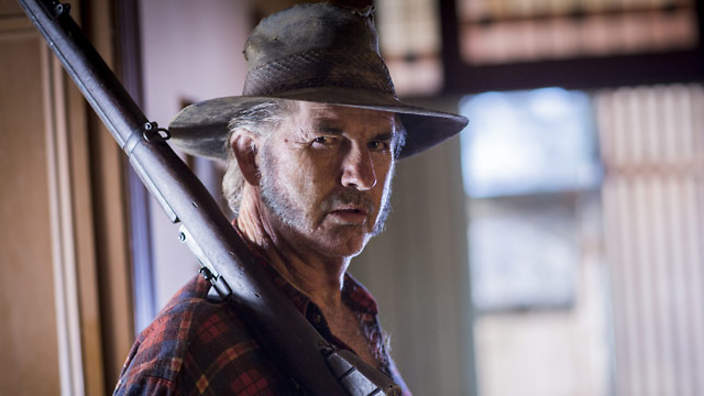
It’s been a long time coming, but Australian actor John Jarratt finally returns to his famous role of serial killer Mick Taylor in “Wolf Creek 2.” When Jarratt first played this role back in the 2005 original, he succeeded in giving us one of the most terrifying psychopaths the world of cinema has ever seen. But at the same time, he also made Mick into one of the most amusing as well, and while watching him in this sequel you can’t help but laugh with him even as he becomes increasingly sadistic. Now he’s back to terrorize a new group of backpackers from other countries who don’t quite share his love for Australia.

I got to talk with Jarratt while he was doing press for “Wolf Creek 2,” and it was a real pleasure chatting with him. The sequel isn’t so much a horror movie as it is a thriller and a road movie, and Jarratt talked about the change in tone between the two movies. In addition, he also discussed how he based Mick Taylor on his father, how method he was in his approach to playing him, and of whether or not movies like this will affect tourism to Australia.

Ben Kenber: Thanks for another great performance as Mick Taylor. It was a lot of fun watching you play him once again.

John Jarratt: Thank you very much.

BK: You’re welcome. There was a long break between “Wolf Creek” and “Wolf Creek 2” (about eight years). Were there any changes for you in the way you portrayed Mick Taylor between the two movies?

JJ: No, not a bit. It was exactly the same. He’s not the kind of guy who has growth.

BK: That’s true. It was said you stayed in character during the making of “Wolf Creek.” Was this also the case on the sequel?

JJ: Not so much because I knew what worked, but you have to stay within the realms of it. You can’t be having a coffee and just fall back into John Jarratt and then some guy says, “Come over here and cut this person’s head off,” you know? So you’ve got to kind of stay in the zone if you know what I mean (laughs).

BK: But it’s not like Daniel Day-Lewis who stays in character 24 hours a day obviously.

JJ: No, I think that’s a bit of a wank, but anyway. With Mick Taylor, I tend to go a little bit method because he’s a psychopath and a serial killer, and it’s a long way from who I am, you know? So I have to work at that. People say you’re a method actor, and I just say I’m a professional actor.

BK: It was said that you based Mick Taylor on your father but that you filled in the evil bits because your father is clearly not evil. When it came to the evil bits, what exactly did you add?

JJ: Well if Mick Taylor wasn’t a psychopath and a serial killer, if he wasn’t bent, and if he was the guy you thought you knew at the hotel at the bar if you met Mick, that’s my dad. But like all serial killers he’s bent and everyone says, “He seems like such a nice guy and he’s a terrific fella. He’s quiet and he was a good neighbor and he’s mutilated 27 people, but…” The hard part for me was to find that part of Mick, that psychopath side, and find a way that he was comfortable with it, you know?

BK: Yeah. It reminds me of when Anthony Hopkins played Hannibal Lecter in “The Silence of the Lambs” where he said he wasn’t so much interested in doing research on serial killers. Instead, he worked on finding the psychopath or the crazy person within himself.

JJ: Yeah.

BK: While the original was a full out horror movie, and one of the scariest and unnerving in recent memory, “Wolf Creek 2” is more of a thriller and a road movie. How did you feel about that shift in tone this time out?

JJ: In a way, sequels are lose, lose affair, you know? If we made it pretty much the same as the first one, you’d all be complaining about that we didn’t go anywhere with it. But if you change a little, then everyone says it’s not like the first one. To me, I thought it was a good movement on the first one. The first one you wait for the monster to come out of the cage which is about halfway through the movie, and it’s the set up that’s scary and then how he becomes (who he is) and everyone freaks out. With the second one we all know who he is, so it’s a waste of time doing that so you get them from the get-go. It’s not unlike the first one much when Mick turns up because, as you may remember in the first one, they (the unlucky tourists) drive my pick up over a cliff and then I chased them in a car and I blow the girl way, and that’s the end of the movie. So there’s a bit of chase in that one, but a hell of a lot more in this one because you get the Mick thing happening from the beginning rather than halfway through.

BK: The scene where Mick Taylor sends that big rig truck rolling down a hill where it crashes into Ryan Corr’s jeep gives “Wolf Creek 2” one of its best action sequences. Were you on the set when it was shot?

JJ: Yeah, I was there. It was fantastic (laughs). The funny thing was that the jeep came down the hill and landed like nothing had happened to it. We didn’t expect that, but it says a lot about the jeep I’ve got to say. Then the big truck comes down and creams it, and it was a great day. They were 20 cameras on it watching the truck come down the hill. In real life it was quite stunning.

BK: I imagine it was. If this was an American production, I bet they would’ve used CGI effects instead, but the fact that you did the real thing makes the sequence all the more thrilling to watch.

JJ: Yeah, it was great. It was like “Mad Max” days, you know? It’s what Aussies do really well.

BK: What would you say you added to this character that wasn’t in the script or which Greg McLean didn’t come up with?

JJ: I don’t think I added anything. He (McLean) was there for the entire film. There was more opportunity for a lot more humor I suppose, but I honestly didn’t add anything. I just knew a hell of a lot more, and I thought Mick was pretty funny in the first one. I think about 90% of this film is Mick as opposed to 50%. I think that’s the difference, I really do, so I didn’t do anything differently except you see even more of what he does. I suppose that’s different.

BK: The black humor in this movie is very clever.

JJ: Yeah, you’ve got to have a laugh. You got to remember that he (Mick) is having a ball and he’s got a great sense of humor. If you met him in a bar you’d think he was a lot of fun; he’s a big barrel of happy-go-lucky and a fun kind of guy. He’s having a ball playing games with these Pommy backpackers, so I think it lends itself to comedy.

BK: A lot of people might look at a movie like this as if it will decrease tourism to Australia, but I think it will increase it because people travel to different countries for a variety of reasons. What effect do you think “Wolf Creek 2” will have on tourism?

JJ: I tend to think that tourism improves with these kinds of films and “Crocodile Dundee” kind of films. If someone gets eaten by a crocodile in the northern territory in Australia, the tourist numbers go up from the publicity it gets. So I don’t think people will be frightened (from travelling there) really.

I want to thank John Jarratt for taking the time to talk with me. “Wolf Creek 2” is now available to own or rent on DVD, Blu-ray and Digital.

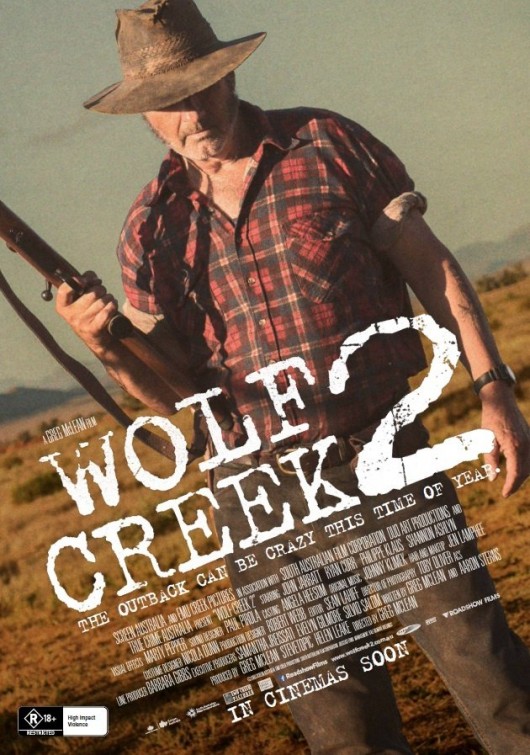
wolf-creek-2-poster

Exclusive Interview with Kirsten Johnson about ‘Cameraperson’

2016 has been a superb year for documentaries, and the latest example of this is “Cameraperson.” Directed by documentary filmmaker and cinematographer Kirsten Johnson, it is a series of images taken from her 20-plus year filmmaking career which she treats as a memoir of her life behind the camera. Among the visuals we get to see are of Brooklyn, a boxing match, postwar Bosnia and Herzegovina, a Nigerian midwife delivering babies as well as moments taken from Johnson’s own life as well. There is even a moment where she shoots footage of the entrance to an Iraqi prison which has a “you are there” feel to it, and it gets to where you are as eager to escape the area as they are. She presents these images to us in a movie without any narration as all these pictures tell a story all their own, and it is impossible to take your eyes off the screen. “Cameraperson” allows us to step into Johnson’s worldview as she takes us on a personal journey, and she acknowledges how complex it is to film and be filmed.

It was a real pleasure talking with Johnson while she was in Los Angeles to promote “Cameraperson,” and it resulted in one of the most fascinating interviews I have conducted this year. I was very eager to learn about how she went about constructing her documentary and of how it evolved from start to finish. This could have just been a movie with a bunch of images thrown together randomly, but there was clearly a lot of thought put into this one. Johnson also explained how she resisted the urge to put narration in her documentary, and she even shared some behind the scenes stories about “Citizenfour” which she was one of the camera people on.

Please check out the interview above, and be sure to watch “Cameraperson” which is now playing in Los Angeles at the Laemmle Royal thru September 29th.

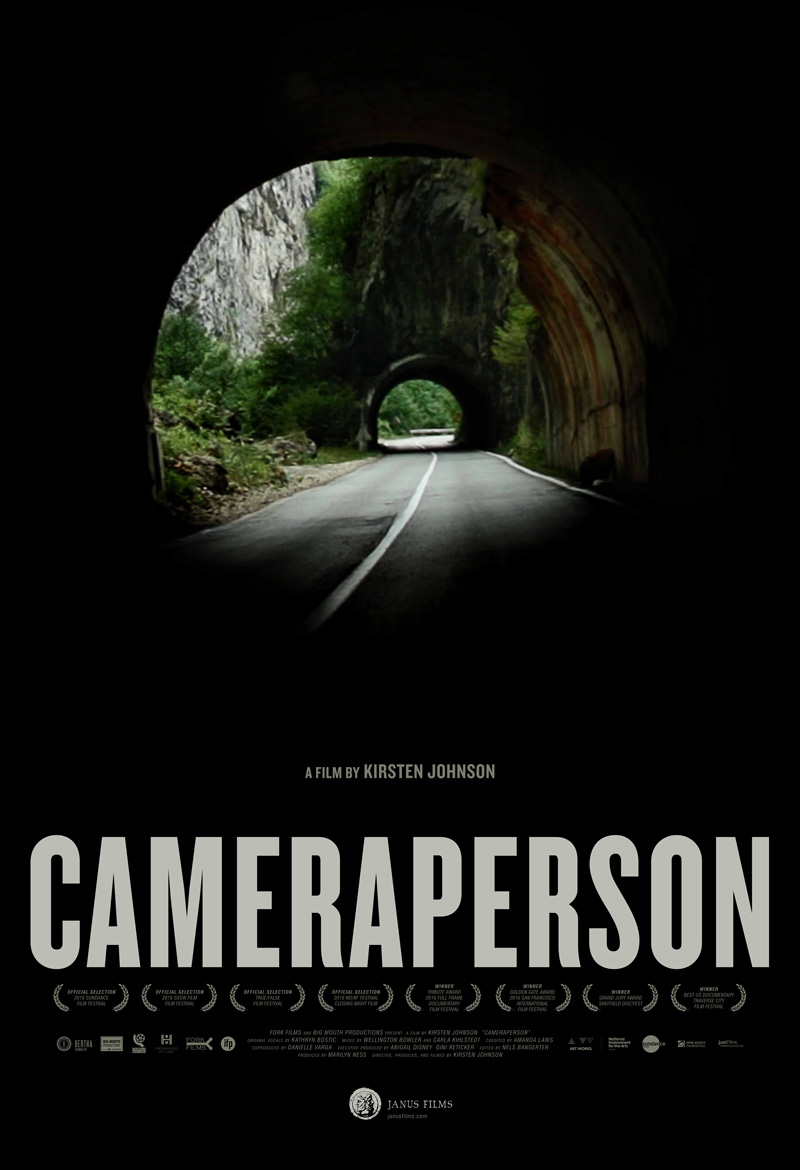
cameraperson-poster


Exclusive Interview with Jane Weinstock on ‘The Moment’

MCDEASY EC007

Jane Weinstock, 2003

Filmmaker Jane Weinstock follows up her directorial debut of “Easy” with “The Moment,” a compelling psychological thriller starring Jennifer Jason Leigh, Martin Henderson and Alia Shawkat. In the movie, Leigh plays Lee, a photojournalist who has just ended a tumultuous affair with troubled writer John (Henderson). But when she goes to John’s place to get her things, she discovers he has disappeared and is nowhere to be found. The stress of not knowing his whereabouts causes Lee to have a nervous breakdown, which in turn lands her in a mental hospital. During her recuperation, Lee reconnects with her estranged daughter, Jessie (Shawkat), and ends up meeting Peter, a fellow patient who somehow looks a lot like John. As Lee struggles to get a grip on reality and learn the truth behind John’s disappearance, the clues she is given lead her to the most unexpected of places.

Just as with “Easy,” “The Moment” has Weinstock dealing with the contradictions of human nature and psychological realism. It was fascinating talking to her about this movie, and we discussed the challenges of writing a highly complex screenplay, what it was like working with Leigh who is very serious in her approach to playing a character, and how her studies in psychoanalytic theory and semiotics came to inform this film.

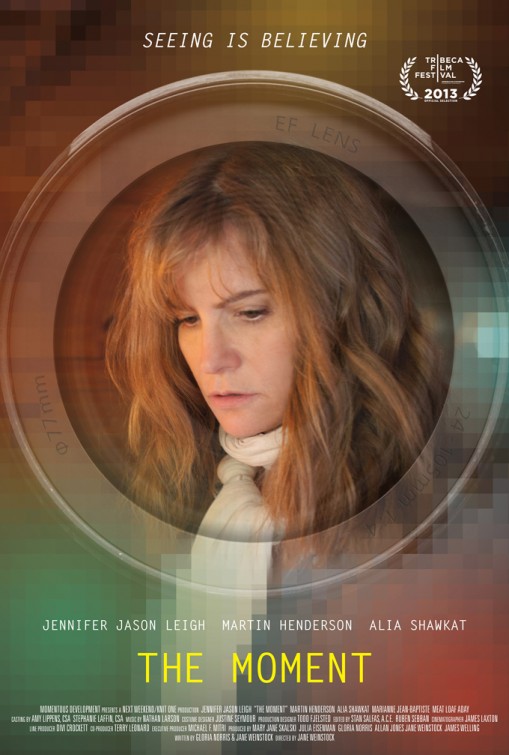
the-moment-movie-poster

Ben Kenber: Regarding the screenplay, how difficult was it for you and your co-writer Gloria Norris to write it?

Jane Weinstock: Well our starting point oddly enough was the Edith Wharton novel “The Mother’s Recompense,” but we weren’t able to get to the rights to that. We didn’t want to do a period piece, but we wanted to sort of take the basic structure of this extremely complicated mother/daughter relationship and make a movie out of it. So once we realized that we couldn’t even get the rights, we just kept that relationship as our starting point and then we went on to write this piece. We decided quite early on to make the character of Lee a photojournalist because we have a fascination with danger, and at the same time a kind of ethical commitment to try to do good in the world. We both love Hitchcock, so I think there were Hitchcockian elements that we gravitated towards, and it also changed in various rewrites. We worked on it for a very long time so we rewrote it a number of times.

BK: When it came to the subject matter, did you do a lot of research on photography as well as depression, anxiety and posttraumatic stress disorder?

JW: Yes, I definitely thought of researching PTSD first. We actually showed it (the movie) in New York to a posttraumatic stress disorder specialist at Hunter College, and she felt that we really got it right so that was very gratifying.

BK: There’s a scene in the movie where Martin Henderson’s character is eating sardines which he says are good for those suffering from depression. Is that true?

JW: No, not really (laughs). They are good for your brain and they don’t have a lot of mercury.

BK: Jennifer Jason Leigh is well known for her method approach to the characters she plays. How did she approach the role of Lee in this movie?

JW: Well I did a lot of research and I gave her my research and she looked through that, and she’s known photographers before and she just was her many ways. During rehearsal we worked on the script together. We made some changes as we were rehearsing, and she’s a writer/director so she’s very, very good at that. She also looked at different cuts of the movie and made suggestions, so she was very involved creatively and not just as an actress.

BK: There is a moment in the movie where Peter is standing in front of his place of work and Lee is taking pictures of him, and he is covering up part of the word “storage” to where only “rage” can be seen. What was your reasoning for shooting the scene like that?

JW: It was just a little reference that I thought not many people would get, but you got it. He is a character who was filled with rage. He was imprisoned for five years for a crime that he didn’t commit, so he’s got a lot of rage that he turns against himself and feels towards the world as well.

BK: Alia Shawkat is fantastic as Lee’s daughter, Jessie. How did she get cast in the film?

JW: Well Jennifer had already been cast, so we had her read with several actresses. They were all great, but when I asked myself, ‘could this actress be capable of murdering somebody,’ I always came up with the answer no except for Alia. I really wanted her to feel like someone who is capable of murder, and I also really liked the fact that she looks like she’s part Iranian, and she is part Iranian, so we could give her an Iraqi father.

BK: How much time did you have to shoot this movie?

JW: We shot it in 22 days, and then we had two days for re-shoots.

BK: With movies like these, the shooting schedule always seems to get shorter and shorter.

JW: I know. It’s crazy.

BK: I read how while you were at New York University you focused on psychoanalytic theory and semiotics. Did any of those studies factor into the making of this movie?

JW: You know it must have especially in terms of the writing and having a psychoanalyst be in the movie. But there’s also a way in which I had to drop a lot of my theoretical knowledge and just make it more organic, and at other times I could get very heady.

BK: In some ways “The Moment” is timely because our reality keeps getting distorted by technology and in other ways as well. By the movie’s end we’re not entirely sure if Lee is even dealing fully with reality. With technology today we are getting closer to the truth, yet at the same time we’re being taken further away from it. Was that something you thought about during the making of this movie?

JW: I guess something I thought about most in terms of that kind of general theme of the movie is that we live precariously in an uncertain world which is partly a function of technology but also a function of the times and all the wars we’ve been living through. The last 20 years has been a very, very uncertain time, and then the reaction to this kind of need for certainty comes up in the form of the Tea Party and other kinds of very fundamentalist types of positions. I thought about it in terms of that more than in just technology specifically.

BK: It seems like these days people are not fighting for the truth necessarily, but more for the truth as they see it. “The Moment” reminded me a bit of David Lynch’s “Lost Highway.” It’s a very different movie, but like with Bill Pullman’s character, Lee is trying to get a grip on all that is happened to her. Still, we’re not entirely sure she has succeeded in doing so.

JW: Yeah, people have compared the film to David Lynch’s work. He’s not somebody who I respond that strongly to. I’m much more of a Hitchcock person, but I can see that. Another big theme in the movie which is definitely Hitchcockian is guilt, and even if none of these people actually killed John, is that really the end of it? Can people carry guilt with them, or for the moments that they have created that may or may not have led to John’s death? For example, the moment where Lee kisses John, at that point there’s no turning back. This has to end badly, right?

Thanks to Jane Weinstock for taking the time to talk with me about “The Moment,” a film that constantly challenges your perception of reality throughout its running time.

Exclusive Interview with Rick Alverson and Gregg Turkington about ‘Entertainment’

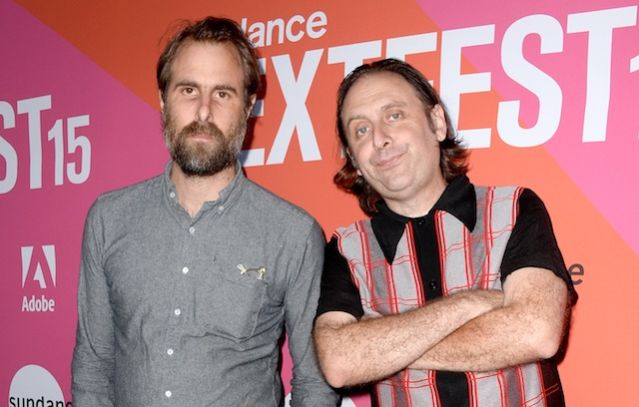
entertainment-gregg-and-rick

Entertainment” is probably the most ironically named movie to be released in 2015 as it is not entirely fun to sit through, but to dismiss it as bad because it is not enjoyable would be missing the point. It proves to be an experience more than anything else as we watch a stand-up comic named The Comedian (played by Gregg Turkington) travel through the California desert while performing at a string of third-rate venues in front of audiences who couldn’t be less excited to watch him. During this time, he tries to get in touch with his estranged daughter and eagerly awaits a lucrative Hollywood engagement which just might revive his sagging career. But first, he has to travel through what seems like the equivalent of Dante’s Inferno in order to find any hope of salvation.

“Entertainment” was directed by Rick Alverson who previously gave us “The Comedy,” another ironically named motion picture which starred Tim Heidecker as an aging New Yorker who is indifferent to inheriting his father’s estate and passes time with friends playing games of mock sincerity and irreverence. Turkington is a noted stand-up comic best known for his alter-ego of Neil Hamburger, a persona which he brings to “Entertainment” but who is not the same character as The Comedian.

I got to speak with Alverson and Turkington while they were at Cinefamily in Los Angeles where “Entertainment” was being shown. When I told that them this interview was for Examiner.com, they joking replied how someone on the website gave them their movie the worst review imaginable and described it as anything but entertaining. We started with that review and went from there.

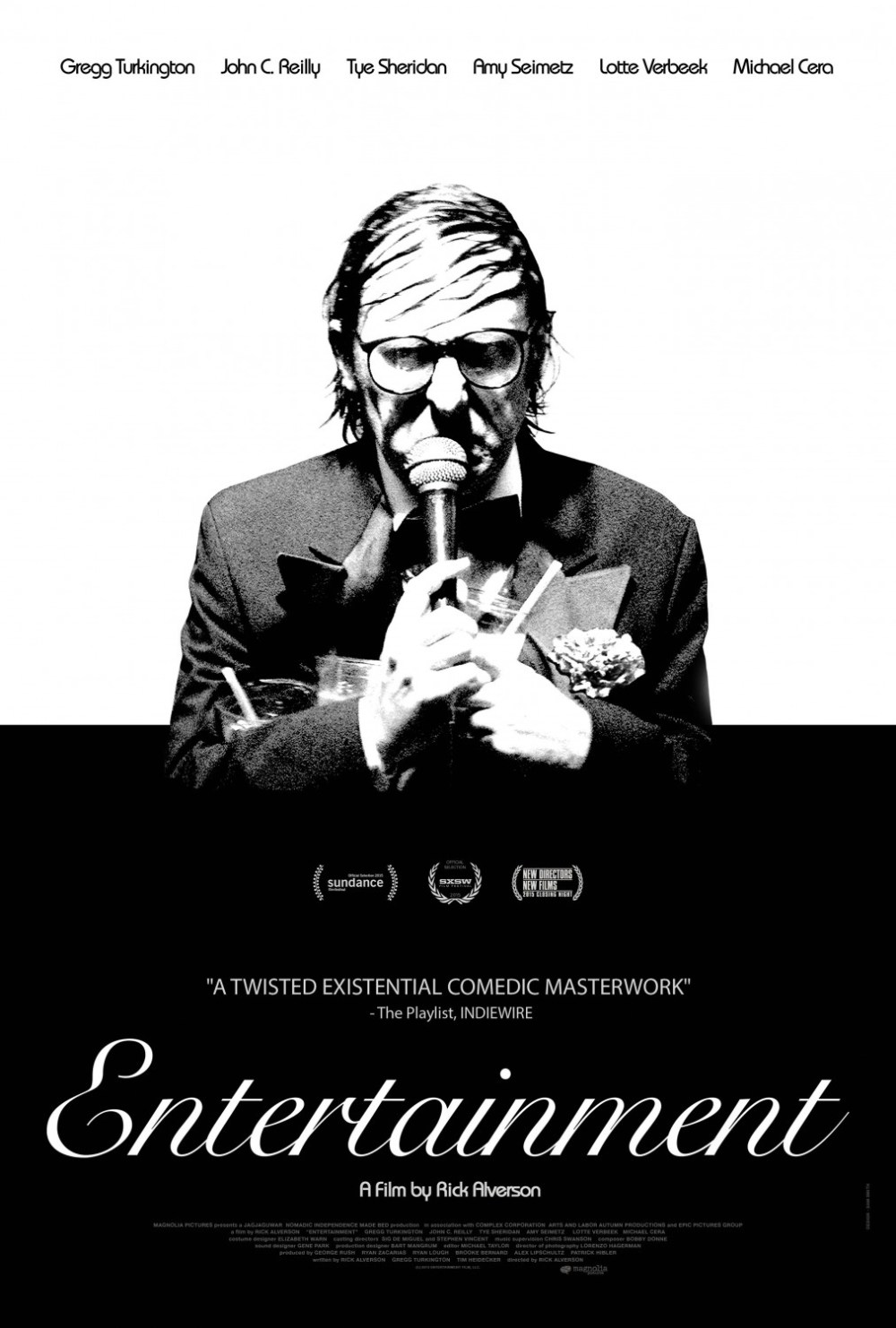
entertainment-movie-poster

Ben Kenber: How do you feel about reviews like that?

Rick Alverson: Well it’s weird. Obviously the movie isn’t a romp through a good time, so if somebody says it’s a failure for doing that they are right, but that’s not even engaging with the movie (laughs). It’s like you’re not even walking into the room.

Gregg Turkington: They got the details wrong, that’s what I don’t like. They seem to have thought he was trying to do something else and that he failed in trying to do that, but he was trying to do that so he didn’t fail so fuck yourself (laughs). But I like the bad reviews if sometimes it feels like the person’s taking it so personally that the review, when you are reading it, you can tell that I don’t like this person and they don’t like this and this sounds interesting to me, I’m gonna go see the movie. I’ve gone to a lot of movies with scathing reviews because I could tell we are not on the same page, and what you hate is what I like. That’s fine with me.

BK: I saw “Entertainment” a couple of weeks ago and it has stayed with me ever since. Some movies are meant to be experienced more than enjoyed, and this movie is an example of that. Not all movies are meant to be enjoyed.

RA: Great. That’s very good to hear.

BK: We’re looking at a comedian who is at the end of his rope psychologically, and you can’t turn away from his suffering.

RA: Yeah, I would say it’s even more than just psychological. I think it’s a holistic disaster biologically, psychologically, spiritually…

GT: Environmentally (laughs). Although we did win an award in Switzerland at this film Festival we went to.

RA: Environment is Quality of Life Award from the junior jury at Locarno in Switzerland.

GT: Pick the film that best sums up the environment is quality of life (laughs).

RA: It’s true, we won.

GT: Environment is low quality of life, and that environment is low quality (laughs).

BK: I can see why it won. Greg, your character of The Comedian was inspired by your character of Neil Hamburger. When you brought that character to this movie, did you have to change anything about the way you perform?

GT: The live stage show is similar to the real live stage show although me lashing out at somebody for no good reason is not something I would do in a live stage show. That was more the character. But yeah, there were a lot of things that had to be planned out and thought about and addressed. Ultimately I don’t think it is the Neil Hamburger story. It’s a very similar character and certainly it helps to have that character up our sleeves when we need it, but we had to be free to start from scratch.

BK: Rick, I read in the production notes that you had mentioned how you found failure as being very liberating. What specifically about failure do you find so liberating?

RA: Well it describes the boundaries and limitations of the world and experience, and there’s something beautiful to what we can and can’t do and understanding them. It’s like understanding what your feet are for, and your feet have a certain function. I think functionality is beautiful, and we are increasingly a society that’s divorced from form in every way and ignores the limitations which are the actual architecture of life. So we are just ignoring the shape of things and instead are wrapped up in what things could be in this idealized ephemeral flight of fancy. There is a neglecting the beauty of facts on the ground.

GT: A lot of peoples’ failures are to me successes. There’s a purity often to them that you don’t find with things that are successful.

RA: Yeah, because the idea of success is that so few can achieve it in any discipline and any particular way, whether it’s the success of becoming incredibly rich or the success of perfectly achieving the discipline. The majority of people are in some sort of muddy approximation of that. I don’t use traditionally scripted dialogue in any of my movies, so there’s improvisation and other methods of achieving tonal exchanges or content. I really like when things fall flat or there is that absence of chiseled, airtight exchange that we see in so much of popular cinema.

BK: Regardless of how people view “Entertainment,” I have a feeling it will endure over the years as it offers a different and specific view of things.

GT: I’m surprised at how people’s perceptions of things is all based on something like an opening weekend or with music too. It’s like some record comes out and it doesn’t do well, but the music is still valid at any point. The time that it comes out shouldn’t determine the value of it. It’s crazy.

RA: There are these sort of free market metrics especially in an age where we don’t even know who’s buying this stuff. Netflix isn’t releasing their numbers or whatever company. Digital platforms don’t need to release their numbers, so we really don’t know where this stuff’s going and who it’s being imbibed by. To think that our metrics for an opening weekend at the box office have any sort of say about a work is silly.

GT: It’s also replaced for a lot of people film criticism. I hear people in airports or on the street talking about box office numbers and really that should only be of interest to the investors, not to the moviegoers. What do you care if it made 30 million or 60 million? That’s nothing to do with you.

RA: Increasingly we want context for everything. We need context for our own experience. We need to understand how other people are viewing something so that we know how to view it, which is a bit of a shame. Where’s discovery?

BK: I imagine there was a lot of improvisation involved in the making of this movie.

GT: For the dialogue. The rest of it is pretty scripted out very carefully scripted out. It’s not improvised like, what will we talk about now. It’s written there what the topic is, what the town he is in and what’s being communicated. It’s just up to the actors to use the actual words.

RA: We were talking about the other day how there’s, in a tent pole blockbuster movie, a general sense that people were improvising. Because of the prowess of the spectacle, everybody is saying that they know that they (the actors) are riffing on lines in a popular sense. But I think when people talk about independent films and say that they are improvised, it’s just like you turn on the camera and everybody’s doing whatever the fuck they want. It’s so many different things for so many different people. You think you are communicating one thing by saying it, but language is useless sometimes. This was fun because we worked with different people in different ways. I was improvising lines and writing lines on the spot and feeding them to certain people. Others like John (C. Reilly) and Gregg, they have a chemistry and they are very good improvisers so the dialogue exchanges between them were in that world. For me, watching that thing sort of come apart or the attempt at it, honestly half the time if I know we are covering whatever little narrative ground we need, I’m just listening to the voices. We don’t do more than three takes, and some of that is economic. If it’s not achieved by the casting or by the sort of conditions that you’re setting up, then what are you aiming for? I like things falling kind of flat too.

GT: But it’s also true that people think it’s a big free-for-all, improvising. They should see a scene that we might do where we do the first take, me talking to somebody or whatever making up the dialogue, and Rick says, “Alright for this one I need you to move half a millimeter to your right.” That’s not a free-for-all, being told to move half a millimeter to the right. That would probably be the direction over we need you to use this line and to say this specific thing. A lot of times it was stuff like that which is really the opposite of a free-for-all.

BK: Gregg, your character gets booked at a lot of second-rate venues or places that are the worst for comedians to be stuck at. Is that something you’ve experienced in your own career, or is that something you just been a witness to?

GT: I experienced it when I’ve gone out of my way to make sure that it was happening by booking shows that I knew what have that sort of outcome. And then sometimes you go into a show with the best of intentions and it just doesn’t pan out. Things get awful and ugly. But I like a variety of responses and so I like to have shows that are successes on the traditional level, success in the failures on the traditional level. To me they are probably both successes because they gave me a different experience.

RA: I feel that way about movies. It’s strange increasingly for me to recognize how similar me and Gregg are and what we want out of the thing whether it’s comedy or drama or film or stand up. We’re kind of curious about the off-kilter event (laughs).

BK: There are some amazing shots of the California desert in this movie. On one hand they are beautiful, but on the other they illustrate how vacant and empty The Comedian’s life is. Was it challenging to get those shots with the budget you had?

RA: We stretched our budget really, really far, and that speaks to the dedication of everybody involved; the crew and the producers and the cast. So yeah, of course it’s challenging. It’s 112° outside and Lorenzo Hagerman, our cameraman, is carrying a 50-pound camera kit on his shoulder up a rocky cliff to get those wide vista shots 400 yards from something. Gregg’s shoes are melting and it’s dangerous out there. Don’t go to the desert! (Laughs)

GT: Don’t shoot in the desert is right!

RA: Me and Gregg talked about how we liked in the 70’s you see a lot of films of people just sweating and nobody’s dabbing them. They are just covered in sweat and look greasy and wrong. You started to see that becoming the sterilization of, “No that’s not quite right. We can do better than that.” So you had to sterilize the representation down to its most idealized form, but we were hoping for some more sweat actually.

BK: Tye Sheridan’s role in this movie is interesting because he basically plays a clown who doesn’t have much of an act. He just basically panders to the audience’s basest instincts. How did you work with him on that role?

RA: I showed him an idiot dance and he brought it to life. I’d ask him to do sort of these mime-ish things at events, and he stepped up on that stage and animated it in a way that shocked all of us. It was electrifying. He sort of plays the apocalypse in the movie. He definitely is the end of the spectacle. He’s reduced down to the rawest of the raw materials. He is the smut in the pig sty, the character I mean. Tye is one of the kindest, gentlest, most respectful young men that you could ever meet.

BK: What do you hope people get the most out of “Entertainment” and the experience of watching it?

RA: I hope they do what you’ve done. You can watch a film and be activated by it and be engaged with it and have an experience like you’re saying. It doesn’t necessarily in a typical sort of way expect for it to do to you what the majority of films do. There can be an outlier that doesn’t operate by those principal, and the spectrum of art is much larger than a particular metric like if you enjoyed it or if you didn’t enjoy it. It’s so much more broad.

I want to thank Rick Alverson and Gregg Turkington for taking the time to talk with me. “Entertainment” is now available to watch on DVD, Blu-ray and Digital.

Exclusive Interview with Karl Glusman about Gaspar Noe’s ‘Love 3D’

karl-glusman-photo

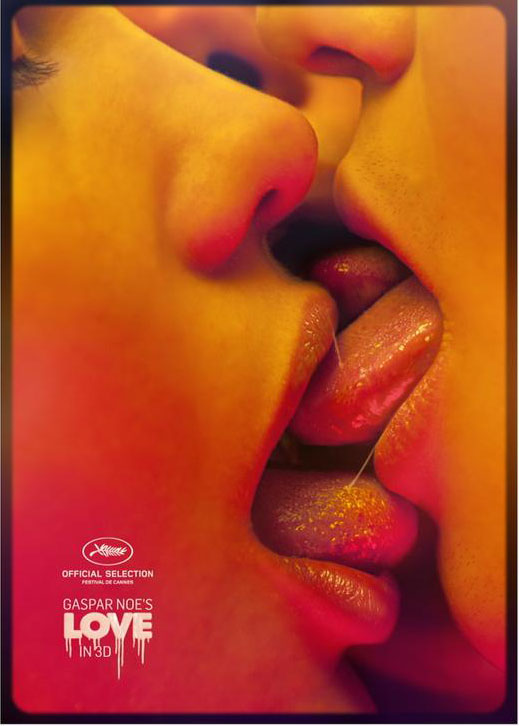
As many will expect, Gaspar Noe’s film “Love” is full of nudity and sex, much of it unsimulated. However, it is also his most personal film as he explores the power love can have over people and how it can be mesmerizing and yet so painful at the same time. Karl Glusman stars as Murphy, a young film student who is in a deeply romantic and sexual relationship with Electra (Aomi Muyock). Then one day they invite another young woman, Omi (Klara Kristin), to their bed to fulfill a sexual fantasy, and soon after everything falls apart. Murphy ends up having sex with Omi which leads to an unplanned pregnancy, and Electra ends their relationship as a result. In the process of trying to get her back, Murphy reflects on the highs and lows of his time with Electra as he sinks into a deep depression.

I got to talk with Glusman over the phone about what it was like to work on “Love.” It marks his debut in a live-action film, and he has since been cast in Nicolas Winding Refn’s “The Neon Demon” and Tom Ford’s “Nocturnal Animals.” Many have asked Glusman about what it was like to be fully naked throughout “Love,” but I was more interested in finding out what it was like for him to give such an emotionally naked performance. He also described in detail the way Noe makes his movies, and he shared his experience of working with Refn on “The Neon Demon.”

gaspar-noe-love-movie-poster

Ben Kenber: “Love” is a very hypnotic movie as most Gaspar Noe movies are. The thing I admired most about your performance is how it is more emotionally naked than physically naked, and that’s something I hope people will realize when they watch it. Just how emotionally taxing was the role of Murphy for you?

Karl Glusman: You are the first person to ask me that because the focus is always kind of on the flesh. It was tough. Gaspar liked to surprise us a lot. He wouldn’t tell us what we were going to shoot the day we were shooting. He would kind of put us into position and let us run for 45 minutes at a time and then change the cameras around. There would be screaming at each other and spitting on each other. In Paris I was alone and I didn’t really know anybody, and I don’t really speak very good French at all. I could understand a little more by the end than when we started shooting, but when you are doing stuff like this you become part of a smaller group of people that really understands the work you are doing. It’s hard to talk to friends back home about it because they don’t really know what you’re going through. You feel a little isolated. It’s hard to talk to people about it when they have no concept of what you’re doing. There were definitely times where I felt kind of crazy. I felt like Gaspar was really having a laugh like he was sort of manic and he’s like the master manipulator. I had a nightmare before I went over to France and before he even hired me. In my dream I was in sort of a spherical compartment. The walls were lined with cameras from every angle, and I was being shaken and tossed around. That sort of in a nutshell was what the experience was like at times because he really asked a lot of his actors. He wanted you to cry, he wanted you to strip down naked, he wanted you to scream and spit on each other, and he tried to charm you constantly and get you to fall in love with each other and didn’t really allow you to prepare for it because there is no script. How do you prepare for something like that? You kind of just have to take a breath and jump off a cliff and hope that the parachute is going to open at some point.

BK: I read that you and the actresses didn’t have any dialogue to work with. How would you go about preparing to do a scene with Gaspar?

KG: I’ll take you through one day of shooting. Without giving any of the plot away, there was one day where I got up, I had my little coffee in the morning, I’m waiting for the car to pick me up to take me to set and I get a call from Gaspar and he’s like, “Hey I’m at a café not too far from you. Can you come over and meet me here?” I said, “Yeah but the car is coming to pick me up like right now.” And he’s like, “Oh no, no, no, I called them and I told them not to get you. Just come over to the café which is a couple of blocks down on the left and meet me there. There is somebody I want you to meet.” Okay, so I walk over to the café and there is a young guy there whose name is Juan and he’s actually in the movie. Juan didn’t know it, but Gaspar wanted to put him in the movie so he has me meet him to see if he can play my best friend. So I meet that guy and he’s like nice and we talked for a minute. He had done this with a couple of other actors and I tried to give him the thumbs up. And he turns to Juan says, “So can you come by to the set today for a little screen test? Would you be cool with that?” The guy was like, “Sure, cool.” Gaspar then said, “Cool, just make sure you’re not late.” So then we go to set and a couple hours later Juan shows up and he thinks that he’s just doing a little audition or something, and both the cameras are set up. I don’t know what the shot’s going to be, neither does Gaspar, neither does Benoît Debie (the director of photography). They (Gaspar and Benoît) play with the lights for 45 minutes before they find a shot that they like, and that’s literally how they work. He just knew that if he put me in this position or if he put her in that position, then maybe he could match cut it with a different scene. He is giving himself options in the editing room. And then before Juan knows it he’s signing his NDA and he’s cast in the movie, and like 10 minutes later I’m like screaming at him that I’m going to kill him for like fucking my girlfriend and this and that. It was like that the whole time. We wouldn’t have an actor cast and he’d say we gotta go find an actor, and we would go out that night and go trolling the bars looking for someone who might be able to play the police commissioner and then we would run it through Vincent Maraval, our producer at Wild Bunch. Gaspar would tell them, “Hey you should be in the movie” and they were like “nah, nah, nah.” And Gaspar was like, “No, no, no, you should show up tomorrow.” And that’s how it was. Gaspar would have friends show up on set and make cameos, and it was all very, very improvised, very in the moment, very immediate. The whole nature of the movie and in terms of his process is surprising himself, surprising everybody around him and kind of not planning. That’s kind of the way it was with him. It was just like go, go, go and you never knew what you were going to get that day. His whole mantra was every day is Christmas. What do you want for Christmas today? And I think that he kind of lives by that; that life is short and that the only promise that God ever made to man is that you’re going to die and you might as well enjoy it now because you don’t know what dreams may come.

BK: I imagine many people, especially in America, will be quick to dismiss “Love” as just a porno, but it really isn’t. What’s fascinating is how it portrays sex in its different forms.

KG: Yeah, sex is a necessary component to love. Let’s get real here; real love requires that. You can love someone without having sex with them, but if you are in love with someone, especially when you are young, you’d probably, I think, would want to have sex with them. The whole porno conversation is a bit of a joke and a bit of a marketing thing. I’ve talked to a lot of people who have gotten a lot out of this. They had an experience, and I think those who are patient with the film will see something much bigger than what they might assume is some raunchy porno. I would be hard-pressed to think that Pierre Rissient who runs the Cannes Film Festival would let some piece of trash into his festival. He has high standards usually.

BK: Your character of Murphy is very self-absorbed.

KG: Definitely (laughs).

BK: But that reminded me of how self-absorbed we can get when we are young or when we are in love. It’s like the outside world almost doesn’t exist and the movie does a very good job of making us remember a time like that in our own lives?

KG: He’s a bit of a bitter loser, not making films. He’s a young filmmaker guided by passion.

BK: While Murphy may not be altogether likable, we are still compelled to follow him throughout this movie. How did you approach this character?

KG: I went to school, I studied seriously and I had incredible teachers that I admire. I admire talented and great actors and I have no interest in just being in a porno. Gaspar Noe is someone who I consider to be a brilliant filmmaker and someone I always wanted to work with, and it was all about trusting him and his vision and being part of that. When we talked about the characters I was asking all these questions. Who is this guy? What is he like? What does he want? He’s so secretive and he’s always kind of withholding information. Gaspar was like, “Well he’s kind of like sort of a funny guy, kind of clever at this and that.” At one point he said, “Maybe is kind of like my friend Harmony Korine when he was younger but not so drugged out. He’s just kind of funny in that way.” Gaspar was always complaining that I was too sweet to the girls and said, “I want you to ravage them. I want you to do this.” And I always thought that since we were making what some people might think of as sort of a dirty movie that I should be really sweet and really kinder. I always would try to insert jokes. I was always trying to make the crew laugh as much as possible while we were rolling. It’s kind of my fantasy that 10 years down the line maybe Gaspar will let me have a crack at editing my own version so that I could release a 3-D comedy because I think there is an alternate version where there’s a very sweet, a very funny Murphy which was what I was trying to do. But in the end he didn’t want it to be too funny. He didn’t want Rock Hudson. He wanted someone who was more bitter and had a lot of contradictions and would say one thing and like and then go do something else just like real people, he said. At one point, Murphy has sex with another girl at a party while his girlfriend Electra is in the other room and I was like, what was that? That makes me a total liar and he said, “Yeah, just like real life. People lie and people cheat on each other.” And I really had a moment where I was like, “Yeah you’re right.” We’re really just trying to make something that really felt honest. It’s not the smoothest, most cinematic piece where someone turns to their close-up mark perfectly so that the lover turns their collar and walks off into the rain. It’s not like that. It’s messy and it’s meant to feel much more like an honest depiction of what he or I or our friends relate to.

BK: I kept thinking that your character was more or less based on Gaspar especially in the moment where Murphy says his favorite movie is “2001.”

KG: There’s definitely a lot of that. I’m wearing Gaspar’s clothes in many of the scenes like T-shirts that he didn’t even wash. I would smell like his armpits. And sometimes he wouldn’t like the color of my pants and he would just pull his pants off and we would switch right there. He decided keep my belt because we had slightly different waist sizes. A lot of the story came from his own experiences. Not everything. There are certain things like I don’t think Gaspar ever impregnated the wrong woman, the woman he wasn’t in love with. He drew from some of his friends’ experiences and took them apart and put them together to create this portrait of a love story and tried to hit all aspects of it that he could think of. But as you see, a lot of the characters’ names are… Noe is the gallery owner, Gaspar is the child, and Murphy is actually Gaspar’s mother’s maiden name. He wanted to make what he felt was his most personal film, so there are little tombstones there to his loved ones and friends with the characters’ names. But obviously there’s also visual inside jokes. You can see the model of the Love Hotel from “Enter the Void” somewhere in the movie. I even tried to do little things that I think he kind of got a kick out of. I would change the time on the clocks to Gaspar’s birthday. I pulled out the DVD case of “I Stand Alone” at one point. It’s nice to have those Easter eggs there.

BK: There are a lot of easter eggs throughout this movie. He has all these posters of movies he really likes and which had an effect on him as a filmmaker like “Taxi Driver.”

KG: He’s got a pretty amazing poster collection. He keeps them all sort of rolled up or laid flat. He doesn’t hang them up, but he’s got some really rare ones. That “M” poster that you see at one point in my room is one of four existing “M” posters in the world. I think the Nazis destroyed most of them, and that one is one of four and I think it’s like one the nicest condition ones. I think he goes and does a commercial and get a bunch of money and then blows it all on old movie posters.

BK: I imagine a lot of people tried to dissuade you from doing this movie because of the nudity involved and the potentially negative effect it could have on your career. But you have since been cast in movies directed by Tom Ford and Nicolas Winding Refn.

KG: Nic is awesome.

BK: Working with Nic was fun?

KG: Yeah I would love to plug Nic right now. He, like Gaspar, is an auteur. He has final cut, he works from a script too, and he’s just one of these interesting guys who can paint his own picture. You’re not gonna tell him like, “No I need more green on this. I don’t like that. You need to change that.” He is someone who doesn’t like to be told what to do but however, like Gaspar, he is a collaborator and he’s very inclusive. When I was cast, I had this sort of blank canvas. I told him anyone can do this part and he said, “Karl if we cast you then you and I will build this character together and we will make it something.” And he was bringing me over to his house for meetings along with the other actors. He always asked everybody, what do you think of this? How do you think this should happen? What do you think you should do in the scene? Where should you be from, or how do you feel about that? And Nicolas shoots chronologically which is cool because then you can change where the story goes. I think the ending of the movie is completely different now than the draft I read initially before auditioning for it. He doesn’t know where he’s going, he doesn’t know what’s going to be, so that’s what’s exciting. So in a way I guess in a way he is similar to Gaspar like that in the sense of he wants to surprise himself. I think that’s pretty fun. I think Hitchcock was once quoted as saying “shooting a movie is the least exciting part of making a movie” because he already knew what everything was going to look like whereas I think these two filmmakers were talking about how that in a way they had no idea where they were going. They both want to see how deep the rabbit hole goes. I think Gaspar was really happy with the end product. He said it came out much better than he ever thought, and I think that was in big part because of hiring Aomi who I think is just lovely and just fantastic in the movie and Klara who’s just so brave as well. I think these girls were just so generous and so joyful on set, and we got something much better than what he ever anticipated. And Nic and I have stayed in touch. He needled me a little bit saying that just a hang tight and that we were going to make another movie together, and I told him he can’t fuck with me like that. If we’re going to bed and we’re gonna fuck then we better fuck. Let’s not talk about it. He once said that making a movie with an actor is like going to bed with them because you make this baby with a big movie.

BK: It sounds like “Love” has had a very positive effect on your career so far. How would you describe the overall effect it has had?

KG: Well I mean it’s just kind of like a more immediate and obvious level. I met Tom Ford at Cannes, and so I happened to be in the same venue as him and talked to him about his movie. A couple of months went by before he hired me, but that meeting led to a job. Gaspar actually called Nic Refn personally in front of me and sold him the movie and told him to hire me. He gave me this ridiculous pitch which sounded better than any agent saying “he is the most daring and most professional actor in the world!” I don’t know if he went out on a limb but he didn’t have to do that, and his recommendation meant a lot to Nicolas because Nicolas has a lot of respect for Gaspar. And the movie resonates with certain filmmakers and certain actors who I admire and would love to work with some day. The movie has had nothing but a positive effect. My mother, she cried when I told her that we were going to go to Cannes. That was a big deal for her that her son might get to go to a big international film festival like that. I always wanted to do things that made my mother proud of me and cheer her up. When I was a little kid actually I think that was kind of the first thing that got me into acting is when my parents split up. I used to entertain my mom in the kitchen cleaning pots and pans and putting a chef’s hat on my head and pretending to have a cooking show. I called it Thor’s Kitchen because my mom was really into Norse mythology and I would make imaginary recipes in front of her and try to make her laugh. I think she has always been the driving force for me. So although she hasn’t seen this movie yet, and it will probably be some time before she does, she’s very proud of it and I think my dad kind of understands it better than some people too that there is a theory to cinema. Not every movie is just entertainment. Some movies have political messages or social messages. Some movies have an ambition to do a little bit more than just entertaining for an hour and a half while you’re chewing on popcorn.

BK: And some movies are meant to be an experience more than anything else

KG: Exactly, and this is one of them. It is not an experience for everybody, but some people will like it a lot hopefully.

I want to thank Karl Glusman for taking the time to talk with me. Special thanks also goes to WooJae Chung for the use of his photo at the top of Glusman which comes from his film “Consilience.” Gaspar Noe’s “Love” is now available to own, watch and rent on DVD, Blu-ray, and Digital.
 

Save

Save

Exclusive Interview with Jeff Feuerzeig and Laura Albert on ‘Author: The JT Leroy Story’

Of the plethora of excellent documentaries to come out in 2016, one of the most fascinating to watch is “Author: The JT Leroy Story.” Directed by Jeff Feuerzeig, it chronicles the rise and fall of literary sensation JT Leroy whose rough and tumble childhood crafted him into a writer of such books as “Sarah” and “The Heart Is Deceitful Above All Things,” the latter of which was adapted into a film by Asia Argento. However, it was eventually revealed that JT Leroy did not in fact exist and was actually an avatar for former phone sex worker turned housewife, Laura Albert. Following this revelation, Albert was considered a fraud and many believed she concocted nothing more than an elaborate hoax. But with this documentary, Albert seeks to set the record straight over how JT Leroy came into existence for her, and she makes it clear that what happened was in no way a hoax.

The beauty of “Author: The JT Leroy Story” is it never judges Albert for a second. The documentary simply lets her tell her side of the story which proves to be more complex than we could ever have imagined. Considering her dysfunctional childhood, it is understandable she needed an outlet of some kind to vent her pain and frustration with life, and with JT Leroy she found a way to express things she was unable to as herself.

author-the-jt-leroy-story-poster

It was a real pleasure to talk with Feuerzeig and Albert while they were in Los Angeles, and the two of them talked at length about what possessed them to take on this project and of what went into its making. Albert’s insights into her writing process were especially fascinating as she actually found herself predicting the future through her books.

Check out the interview above, and be sure to catch “Author: The JT Leroy Story” when it arrives in theaters in Los Angeles on September 9. You can also check out a trailer for the documentary below.


Exclusive Interview with Eva Husson about ‘Bang Gang (A Modern Love Story)’

Bang Gang (A Modern Love Story),” just by looking at its trailer, seems like the French version of “Kids,” but that’s not even remotely true. Based on a true story, a fact we don’t discover until the end credits, it follows a group of ordinary teenagers who live in the suburban neighborhoods of France and participate in sex parties they refer to as “bang gangs.” In the center of the sexual shenanigans is the beautiful George (Marilyn Lima), one of the main organizers of these parties and who experiences some intense inner turmoil. After being spurned by her would-be boyfriend Alex (Finnegan Oldfield) who goes after her best friend Laetitia (Daisy Broom), George begins feel increasingly isolated from everyone around her even as the parties become increasingly reckless. In short, this story will not end well. Or will it?

This movie marks the feature film directorial debut of Eva Husson whose previous credits include the short films “Hope to Die” and “Those for Whom It’s Always Complicated.” Many consider her one of many directors to emerge from the world of music videos, but she will be quick to silence you on that. Born in France, Husson earned an M.A. in English literature from the Sorbonne, and she would later move to America to pursue an M.F.A. at the American Film Institute. She did make some music videos along the way, but her focus has always been on writing and directing feature films.

With “Bang Gang,” Husson has pulled off an impressive debut filled with strong performances by a mostly non-professional cast, and she is aided by the lush cinematography of Mattias Troelstrup as well as the atmospheric music score by White Sea.

I got to talk with Husson while she was in Los Angeles to promote “Bang Gang (A Modern Love Story” which she described as “a movie about teenagers falling in love in the midst of a sexual apocalypse.” She explained how she pulled off the long tracking shot at the movie’s beginning which lasts for several minutes, why she put the term “based on a true story” at the movie’s end instead of the beginning, and she pointed out how the project was inspired by stories involving American teenagers and not French ones. She also spoke of why she had her cast watch Paul Thomas Anderson’s “Boogie Nights” and Lars Von Trier’s “Melancholia” before the film shoot began.

Please check out the interview above. 

AN ULTIMATE RABBIT NOTE: This video interview was recently updated to eliminate any copyright issues which were never intended, and to make it available to the widest audience possible.

Bang Gang poster

Exclusive Interview with Melissa Joan Hart on ‘God’s Not Dead 2’

Gods Not Dead Melissa Joan Hart photo

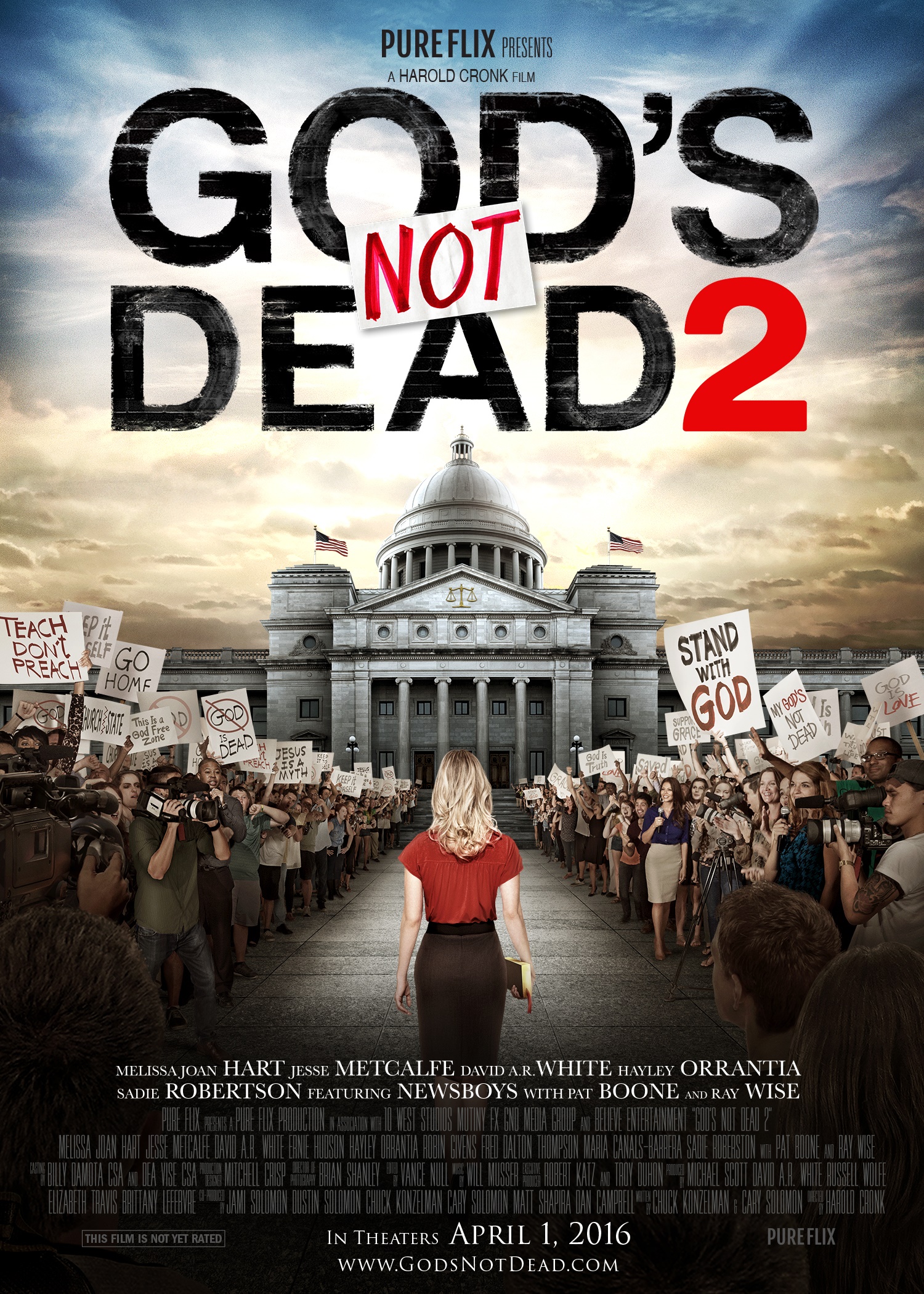
The 2014 movie “God’s Not Dead” only cost $2 million to make, but it went on to gross over $60 million and began a movement to strengthen the faith of Christians everywhere. That movement continues with “God’s Not Dead 2” which reunites director Harold Cronk with screenwriters Chuck Konzelman and Cary Solomon, but it tells a completely different story. This time the action moves to a public high school where teacher Grace Wesley (Melissa Joan Hart) encourages her students to appreciate history. But after Grace gives a reasoned response to a question about Jesus, she becomes the center of an epic court case which could end her career and expel God from the public square once and for all.

We all know Melissa Joan Hart from her popular television shows “Sabrina The Teenage Witch” and “Melissa & Joey,” and she is a veteran of show business having started at the tender age of four. I got to speak with Melissa while she was in Los Angeles, California for the “God’s Not Dead 2” press junket. She talked about joining a sequel which had none of the main cast members from the original returning to it, how social media has both helped and hindered the Christian movement, how she had to do a lot of reacting in this sequel, and why she feels likes an anomaly in today’s Hollywood.

Gods Not Dead 2 movie poster

Ben Kenber: It’s interesting how your character talks about Jesus as a historical figure and not a divine person, and yet it somehow leads to this legal case which dominates the movie.

Melissa Joan Hart: Well someone did ask us today in one of our interviews, “Is Jesus a bad word, and why has Jesus become a bad word?” You say Jesus you make people uncomfortable, especially Christians. I have become very comfortable with talking about things within my religion and within my faith. I have been a faithful person my whole life, but only in the last 5 years have I started bible study and really, really studying the word. It’s a hard thing to feel comfortable in this day and age. It’s weird that it used to be such an easy topic, and now it has become such a difficult, strained topic. You say things like “God bless you” and they look at you sideways. It is a weird situation going on these days, and so I like to make sure when someone sneezes that my kids go “God bless you” or if they see a man in military fatigues to say “thank you for your service.” People find it a little disconcerting, but when you do it they appreciate it. I was telling someone earlier about the ten commandments and someone pointed out to me and said, “Which of the ten commandments doesn’t hold up today?” The only one that seems to be fading out slightly is though shall not take my name in vain, and so I make sure I don’t, in my work, say “oh my god” or “OMG.” It really bothers me when other people do now, but in my house they don’t. My kids’ friends come over there and they are not allowed to say it and I’ll tell them why. If I feel the need to pray on an airplane because I’m terrified of flying, I’m not ashamed of that. I cross myself right there in front of whoever is watching. I had some controversy over a Christmas dinner at my house about whether everyone should go to church, and my stepfather brilliantly pointed out if anyone had gone to a Passover or any other kind of religious ceremony or holiday, you would respect that person’s wishes in their home. If you did accept that invitation to go to that event, you would be a part of it and not mock it. We are PC-ing ourselves to death here, literally. I think that’s why Trump is doing so well because he’s not correcting himself and he’s not being politically correct. He’s being completely politically incorrect, and not that I think he’s the best choice, but I can see the draw.

BK: Trump is definitely not the best choice and the fact that he has gotten as far as he has is frightening.

MJH: It’s disturbing.

BK: This is a sequel which features the same directors and some of the same writers but none of the main stars from the original returned for it. Was that ever a concern for you?

MJH: Actually I thought that was pretty exciting. I can’t recall another situation where that happened where they didn’t try to get the original cast and didn’t. I don’t think I’ve ever seen a sequel where the star didn’t go on. Well, maybe “Bruce Almighty” (laughs).

BK: There have been a few sequels like that such as “Son of the Mask” and “28 Weeks Later.”

MJH: But this is a completely different story. It’s not even the same movie. It’s a different movie with similar undertones and a few recurring characters, but really it’s a different story and so that’s kind of exciting and interesting. It was definitely a blessing to step into a leading role in a film that’s already well-established as a movement. The first movie ignited a movement across the country and I think it rallied together the Christian community, especially the youth, and they took to social media and started a movement.

BK: Speaking of social media, do you feel that it has helped the Christian movement or taken away from it?

MJH: I think it’s done both. I read somewhere that they say cell phones are the cigarette of the twenty-first century. They say that for health reasons but I think it’s toxic to families. I read a study where they were observing parents sitting in restaurants with their kids, and if they were on their phone they were more likely to be more violent towards their children and impatient and have outbursts towards their children than the ones that weren’t on their phones. I do think social media plays a big part in that because we want to be attached, but we’re not attached. I remember being in my house on a Thanksgiving and sitting around with everybody. We were watching TV and I made some comment about what was on the TV and I was like, “Can you believe he said that?” And I looked around and everybody was on their phone, but they justified it by saying, “Well we’re playing Words with Friends with each other.” And I said, “Well then why don’t we just play Scrabble?” So I do think that social media can be completely toxic. We feel like we are connected when we are totally not connected. We worry more about followers than friends. But in that way we have also found a fellowship out there of people across the world that we can relate to on certain subjects and certain topics, and Christianity is definitely a big one. I think the movement behind “God’s Not Dead” is doing amazing things on social media.

BK: You talked about how you had to do a lot of reacting in this movie, and that was great to hear because listening is one of the key things in African do especially when they are in a movie. How tough was that for you?

MJH: It was really a lesson for me. Obviously I’ve done reaction shots before, but usually I’m talking at a fast pace but trying to be funny. Usually when you’re the lead of the movie you just talk endlessly. Every other line is your line. So it was hard for me to sit there and just observe and then react, but it was also a great lesson for me to take a deep breath and enjoy not having to learn lines, but also being a part of the scene without having a voice in it and trust that the filmmaker and producers have you protected. It was a little bit for me to wrap my head around that the first week. I was like, “Well I’m not even saying anything. I barely talk.” I didn’t even realize until I get there and you start really reading the lines and you go, “I don’t have a line all day! I’m in every scene but I don’t have a line or I say three words and that’s it.” Jesse’s got six pages. It was hard for me to switch roles, but I’m excited I got the opportunity to do it obviously. If I get the opportunity to do that sort of thing again I know how to handle it better, and hopefully I’ll improve and hopefully with each project you’ll improve.

BK: The two “God’s Not Dead” movies have very different stories. It’s kind of like what’s going on with the two “Cloverfield” movies in that it deals with the same thematic elements even though they each take place on a different timeline. This makes the “God’s Not Dead” franchise seem more like an anthology than anything else.

MJH: Which is why I’m bummed because I know I won’t be in the third movie (laughs). But that’s exciting too because it gives the audience something else. They can come to the movie have knowing what to expect, but part of the fun of film beginning is not knowing the twists and turns and not knowing these characters and infuse it with some new energy. It’s about opening up the stereotypes because as Christians I feel like a lot of people, when you say Christian or the name Jesus, go oh you’re going to judge me now or I don’t go to church enough for you or I don’t know the verses of the Bible. People are always so afraid to be judged and I feel like a lot of Christian films do a little stereotyping, but I feel like in this case with this movie it’s really evolved to a place where these characters are complex. They are real people and these are real human experiences. People will hopefully relate to it more because they will find someone they identify with in this movie or they will identify with everyone.

BK: A lot of criticism that was directed at the first “God’s Not Dead” movie was that there were a lot of Christian stereotypes, but this one has characters that are a lot more complex which makes it more interesting.

MJH: Yeah, you don’t necessarily have a protagonist and an antagonist. I’m the victim in a sense, but not if you are an atheist. With Robin Givens’ character, we didn’t really know which way her character was going until the re-shoots. So I actually asked the director, “Is she bad or is she good? Is she on my side or are we hinting at that?” They decided to keep her a little bit more on the side of evil, but they do walk this nice line with everybody. It’s just a very realistic view of people, and you can’t put people in boxes and you can’t stereotype. I’m a conservative Hollywood girl, and yet I grew up in New York. I’m a Republican so I don’t really fit in with the liberal views of Hollywood, but I’m also anti-gun and pro-choice so I don’t fit into that spectrum. I feel like I’m an anomaly because people can’t figure out where to put me, you know?

BK: It’s interesting to hear you say that because in this day and age we have reduced so many things down to soundbites to where it’s far too easy to label everybody and anybody so broadly.

MJH: Yes. I said I was voting for Romney on Twitter years ago for the election, and instantly I got people saying you must be anti-gay, you must hate all other races, etc. Instantly it was like I just got pigeonholed into then you must be this way if you vote that way instead of just thinking maybe the other choice wasn’t so great (laughing).

BK: “God’s Not Dead 2” was a low budget movie that was shot in less than a month. Did the speed of that help you at all?

MJH: The speed of a movie never helps. They are trying to make movies faster and faster and faster these days which ends up putting a lot of pressure on the crew. So when you do speed these things up, the process is not helpful to the production. They say it puts more money on the screen but I don’t think it does. I think time really helps especially the performances. It’s hard to rush a performance. It’s hard to be like, “Hurry up! Cry! Okay, next scene!” But I feel like working in television you get used to a very rigid schedule and a very fast pace which also kind of kills a performance because I’m used to trying to make sure I hit my marks so I get my letting right. I don’t bang on my microphone so I don’t ruin sound. But am I really think about my performance when I’m thinking about all these other things as well? Did I hit my mark? Am I in the light? My makeup artist is telling me to keep my eye open and to keep my head up. If we had more time to rehearse it and feel it out and do everything and go through it systematically performances would be better, so I think that’s the main thing that suffers, the creativity behind the film, when you rush through it. They save a lot of money and it does get you back to your family faster, but at the same time it’s like you still can only work 12 hours a day.

I want to thank Melissa Joan Hart for taking the time to talk with me. “God’s Not Dead” is now available to own and rent on DVD and Blu-ray. Please visit the movie’s website (www.godnotdeadthemovie.com) for more information.

Copyright Ben Kenber 2016.

//pagead2.googlesyndication.com/pagead/js/adsbygoogle.js
<!– Ultimate Rabbit –>
<ins class=”adsbygoogle”
style=”display:block”
data-ad-client=”ca-pub-4712728578817385″
data-ad-slot=”1713958158″
data-ad-format=”auto”></ins>

(adsbygoogle = window.adsbygoogle || []).push({});