Terrence Malick’s ‘To the Wonder’ – Meandering but Still Unforgettably Beautiful
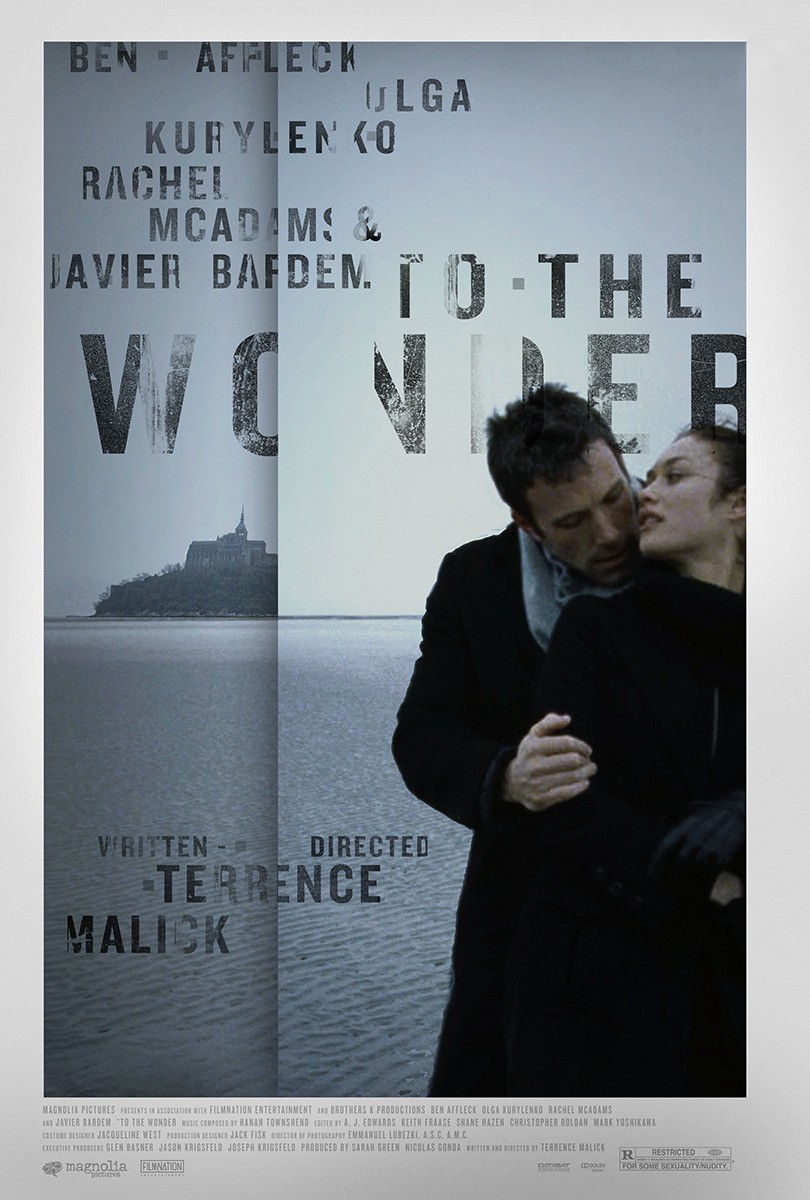
Terrence Malick’s “To the Wonder” is, in many ways, a mixed bag of a film. Not all of its parts go together in a way which feels entirely cohesive. It focuses on a couple played by Ben Affleck and Olga Kurylenko who fall in love and come to America to start a new life, but they eventually find themselves falling out of love, and they constantly struggle to understand how something so wonderful can go so awry. And then we have Father Quintana (Javier Bardem), a Catholic priest who is struggling to keep his faith even as he feels the presence of God eluding him at a time when he is desperate to believe in an afterlife. The balancing act between these characters is wobbly at best, but Malick still gives us many beautiful and wondrous images which are very powerful, and these images quickly remind me of how brilliant he is at capturing nature on film.
“To the Wonder” starts off in Europe where Marina (Kurylenko) finds herself completely enamored by her American boyfriend, Neil (Affleck), as they take a tour around town. Along with them is Marina’s daughter, Tatiana (Tatiana Chiline), who is thrilled when Neil asks her if she and her mom would like to move with him to the United States to live. After briefly viewing the European sights, the film then heads over to Neil’s home state of Oklahoma where the flatlands appear to stretch out as far as the eye can see. Heck, it almost looks like hardly anybody lives there, so it is a huge relief when we see t Neil and Marina actually have neighbors.
As with “The Tree of Life,” “To the Wonder” functions mostly as a silent film as the majority of the dialogue we hear is as a voiceover. Malick is far more interested in the inner thoughts of his characters than anything else as they struggle with the things they want and which are constantly outside of their grasp. We feel their passion for one another, and we also feel their pain and disappointment when their love eventually fades away.
Having read up on Malick as a filmmaker and as a person, it is clear to me how this film and “The Tree of Life” are his most autobiographical works overall. What the characters go through is not much different from what he has experienced in his own life, and with these films, it looks as though he is still trying to pick up the pieces of what went wrong.
Kurylenko first came to my attention in “Quantum of Solace,” and she has made the most of being a Bond woman as her performance here shows. It is thrilling to watch her dancing around the streets of Europe as well as in a corporate drug store which typically sucks the life out of everyone who shops at one. In many ways, Kurylenko is the best thing about this film as she takes us through Marina’s transcendent highs and her emotionally draining lows with complete conviction throughout.
Back in 20123, people had serious issues with Affleck as an actor, and this is even after his film “Argo” won the Academy Award for Best Picture. I myself have never had any issues with his acting abilities, and he gives a strong, understated performance as Neil, and it is never his fault we come to know less about this character than the others we are introduced to here. I really wish Malick had given Neil as much attention as he did to Marina as this would have made Neil’s journey in this story all the more illuminating. Nonetheless, Affleck is still very good in here.
Rachel McAdams is inescapably luminous as Jane; a childhood sweetheart of Neil’s who shows up after Marina has gone away. Malick makes Jane look beyond beautiful as he frames her against fields of wheat, and it is emotionally draining to watch Jane bear her soul to Neil and try to melt his heart in the process. McAdams ends up disappearing from “To the Wonder” a little bit too soon, but she is a vision to watch throughout.
Bardem’s character of Father Quintana at first feels a little out of place as much of the focus seems to be on the relationship between Marina and Neil, but his presence makes more sense as this film goes on. With this character, Malick seems to be saying how our loss of love for one another may have to do with our relationship to God, or lack thereof. Bardem does some of his subtlest work as he portrays a man struggling to hold onto whatever faith he has left, and it results in some of this film’s most emotionally draining scenes.
When we watch Quintana visit the sick, the elderly and the dying, I found myself being reduced to tears as these moments ring so emotionally true in a way I would rather not realize as death is becoming all too common for me to deal with. Plus, Malick just had to use Henryk Górecki’s third symphony entitled the “Symphony of Sorrowful Songs” which Peter Weir used to such great effect in “Fearless.” It remains a piece of music which is as beautiful as it is infinitely sad, and it always reduces me to a weeping wreck whenever I listen to it. I also have to admit I was very angry at Malick for using this piece of music here as it felt so unfair that he reduced me to a complete wreck in an inescapably manipulative way. Then again, I was in the midst of a very deep depression at the time, so that did not help matters.
But as mournful as “To the Wonder” is, there are still many beautiful moments to watch for as Malick remains a master of capturing the unpredictability of nature and animals on film. This includes moments like when Affleck and McAdams are suddenly surrounded by more buffalo than Kevin Costner dealt with in “Dances with Wolves,” the sunlight piercing through the colored glass in a church, or watching Kurylenko walking across the beach as the water covers the sand. These are moments which still will not fade away from my memory anytime soon. Working again with his “Tree of Life” cinematographer, Emmanuel Lubezki, Malick still captures moments of visual poetry in ways few other filmmakers can ever hope to equal.
It is those incredible visual moments which make me want to forgive how meandering “To the Wonder” is as it unfolds before us. I have learned Malick actually shot this movie without a screenplay, and this made me wonder how the actors dealt with this style of filmmaking. Considering that Jessica Chastain, Rachel Weisz, Amanda Peet, Barry Pepper and Michael Sheen all had roles in this film which were eventually removed from the final cut has me believing there was a whole lot more to this film than what ended up onscreen. While “The Tree of Life” had several different story lines going on, Malick was able to rein them all in to where everything seemed to fit perfectly. With “To the Wonder,” he has a little too much going on, and the film ends up losing focus more often than it does not.
Still, if you are willing to tolerate those flaws, “To the Wonder” is still a profound experience filled with great performances and beautiful images which will stay with you long after this film has concluded. I really wish the audience I saw it with all those years ago felt the same way I did. I bring this up as one audience member remarked at how the lives of these characters proved to be far more boring than anyone else’s. Well hell, some people enjoy the simple pleasures in life more than others, but many are still insistent about how theirs are better than the average human being, and that is even though there is plenty of evidence to prove otherwise.
Seriously, it seems very fitting that “To the Wonder” was the last film Roger Ebert reviewed and gave to the Chicago Sun Times before he passed away in April of 2013. Rest in peace, Roger.
* * * out of * * * *
 The Ultimate Rabbit