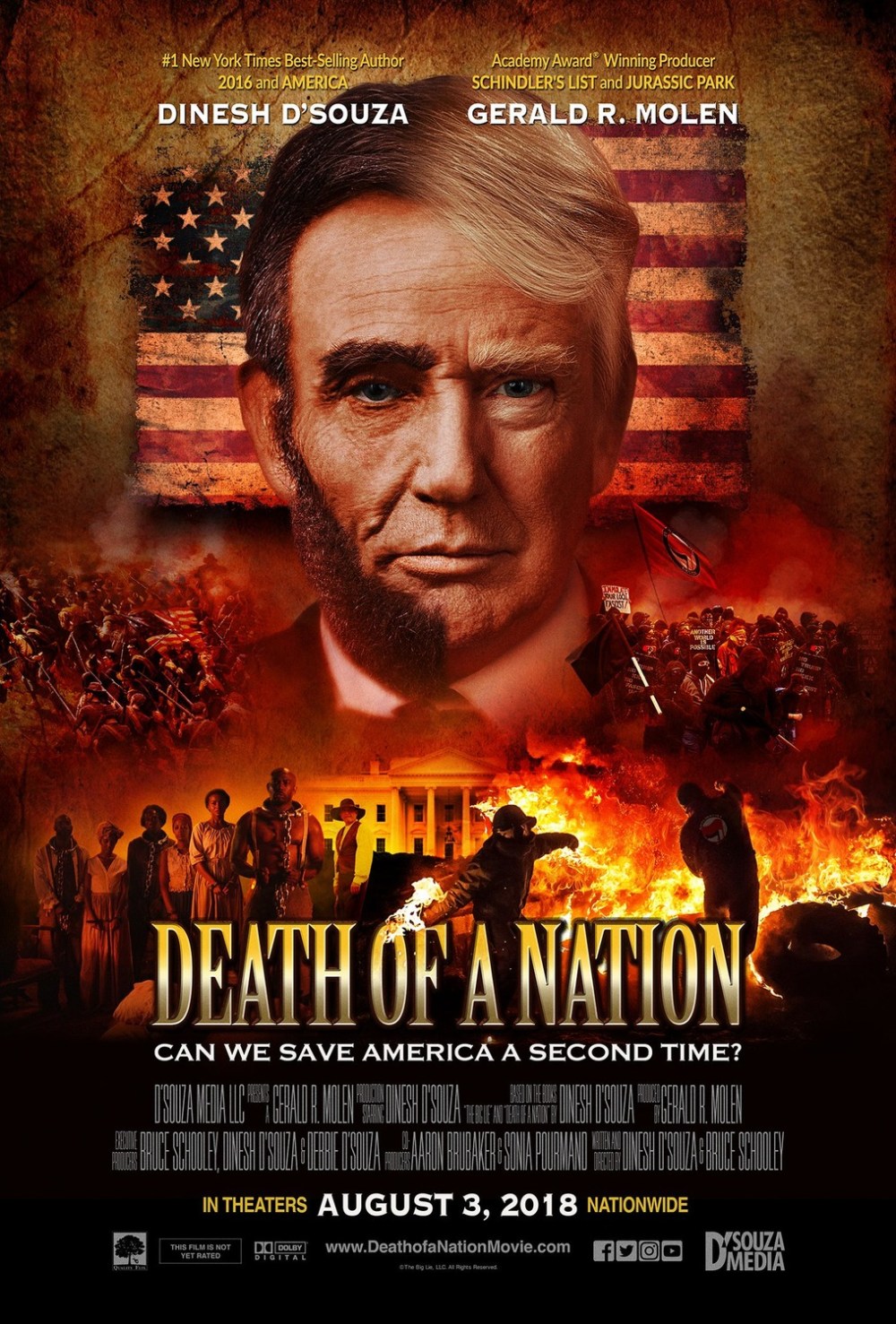
Oh my lord, the poster above just has me howling with laughter. Comparing Abraham Lincoln with Donald Trump to where it combines the faces of both is just asking for endless derision, especially with the Trump Administration continuing to make disastrous policies which would make Lincoln gasp in disbelief.
That’s right folks, political commentator, filmmaker, convicted felon and (sigh) the recently pardoned Dinesh D’Souza has once again teamed up with co-director Bruce Schooley and producer Gerald R. Molen to gives us another cinematic political screed which Alex Jones cannot wait to see, “Death of a Nation.” The title is of course a play on “Birth of a Nation,” the 1915 silent film directed by D.W. Griffith which portrayed the Klu Klux Klan as being heroic and black men as unintelligent. Once again, D’Souza is out to show us the racist beginnings of the Democratic party, and he looks to pay careful attention to American history as he does to the tweets on Twitter which he re-tweets and that contain racist hashtags (which is to say, not carefully enough).
Seeing the trailer open with Abraham Lincoln with his hand moving gracefully through the fields looks like it was stolen from “Gladiator.” From there, we are shown many historical re-enactments featuring moments from the Civil War, a black man being whipped on a white plantation, and moments from Nazi Germany where we are reminded of what a fascist dictator Adolf Hitler was. Having seen “America: Imagine the World Without Her” and “Hillary’s America,” D’Souza’s attempts in giving us compelling historical re-enactments have failed miserablymore often than not as he instead gives us moments both hilarious and boring as they are hobbled by weak acting and poor direction. As for his portrayal of Lincoln, I cannot help but think D’Souza will continue to treat this American president as some sort of superhero instead of as a real person, something I think audiences of all kinds would benefit from seeing just as they did with Steven Spielberg’s “Lincoln.”
As for Trump, who issued a full pardon for D’Souza’s 2014 felony conviction, we do not see much of him here. But it is clear he is out to make Trump look like a heroic President who will “save America” from the Democrats just like Lincoln did back in the 19th century. Whether D’Souza will include anything in regards to Trump’s multiple infidelities, business dealings, numerous bankruptcies, that Access Hollywood video or the Mueller investigation remains to be seen. The movie’s subtitle says, “Can we save America a second time?” Well, perhaps D’Souza isn’t very good with math.
For me, D’Souza’s films (I’m not going to bother calling them documentaries anymore) hold the same fascination for me as it does with people who stop to look at car accidents. As much as I want to look away, there is just too much carnage and damage to ignore. This looks to be just another movie preaching to a particular crowd while its filmmakers attempt to make us see history in a way which doesn’t jive with the facts. D’Souza may want to control the narrative, but he has yet to prove he has any right to do so.
Anyway, “Death of a Nation” is set to arrive in theaters on August 3, 2018, just three months before the 2018 midterm elections (how convenient). I shouldn’t watch it, and I resent it being released the day after my birthday, but with D’Souza I just cannot help myself.
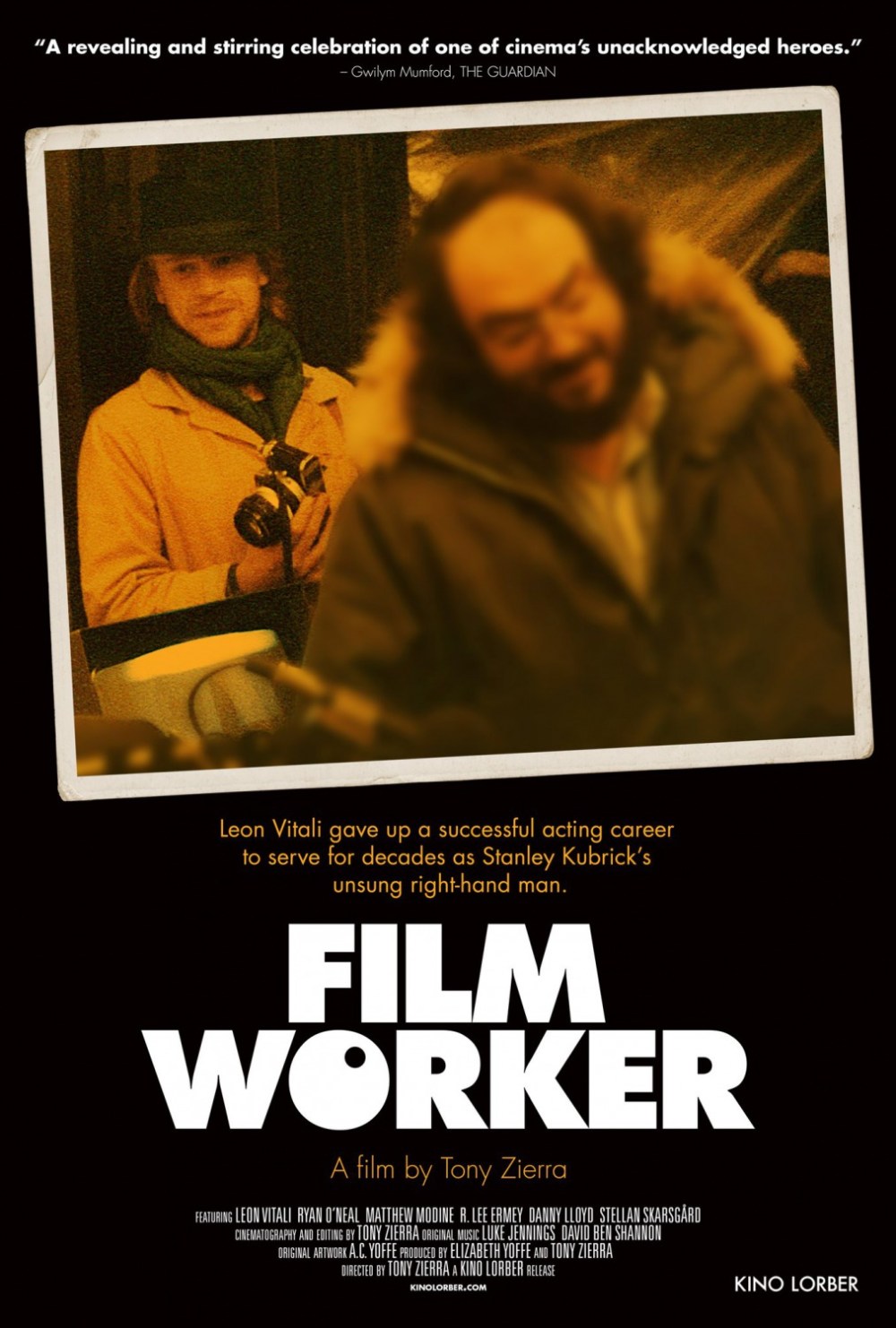
Leon Vitali was the guest of honor at the Nuart Theatre on Friday, May 18, 2018 where the documentary “Filmworker” was being shown. Directed by Tony Zierra, it chronicles how Vitali went from being a successful British actor to becoming Stanley Kubrick’s personal assistant after starring in “Barry Lyndon,” and of the intense dedication he gave to the filmmaker’s work from “The Shining” to “Eyes Wide Shut.” Vitali was greeted with a much-deserved standing ovation as he made his way to the stage for a Q&A. Joining him were Zierra and actor Matthew Modine who played Joker in “Full Metal Jacket.”
Modine remarked about a scene which was cut out of “Filmworker” where he said “Stanley stood on Leon’s shoulders” and how much of a marriage Leon and Stanley’s working relationship was, and he described it as being “at times dysfunctional” and “lovely in a British way.” Zierra was actually working on another documentary about Kubrick called “SK13” when he met Vitali, and he said talking with Vitali was a must as it was well-known how he was one of Kubrick’s closest associates. Zierra managed to track him down in Culver City and met with him, and what resulted was this documentary which was filmed over three and a half years.
“This is the worst nightmare for a filmmaker that when you are really super independent you pick up another documentary and you can’t even finish one,” Zierra said. “I went back and told my producer and partner, Elizabeth Yoffe, this is the most amazing story and I have to do a documentary about this guy, but I’m not sure if I really want to take on another project. But then I remember she said to me you are going to regret it if you don’t do it, so I went back and I asked him, and he said no. And I realized that Leon is just not used to talking about himself. He can talk about Kubrick forever, so it was quite difficult.”
Zierra then remarked how he and Vitali eventually “broke the ice” when he volunteered to organize the heaps of notebooks and materials Vitali had kept over the years while working for Kubrick. As we see in “Filmworker,” Vitali has a huge collection which really does deserve an exhibit of its own.
Modine talked about the overall crew numbers on a Kubrick film and illustrated just how important Vitali was to the famed filmmaker. In the process, he revealed something very surprising as Kubrick’s movies have such an epic look about them to where it looked like hundreds, maybe even thousands, of people worked for him. But as life often teaches us, looks can be deceiving.
“(People) imagine the enormity of Stanley Kubrick’s legend is that he was a filmmaker who must’ve had hundreds of people working for him, and it was quite the contrary,” Modine said. “Leon really did wear 100 different hats because when you went to work there was sometimes, when we were filming on the stage, maybe it felt like 15 people working on the film. What I feel is that Stanley Kubrick created an environment for himself to be able to keep production costs down to the minimum so that he could have the ability to work for an extended period of time to do as many takes as were necessary. But in fact, he was probably the most independent filmmaker I’ve ever worked with.”
“That’s absolutely true,” Vitali responded. “The crew on ‘Full Metal Jacket’ ended up looking like a well-crewed student film, you know? We had one electrician, that was it, because he shot so much of it in natural light. And any light he did have, it was a bank of lights like in the barracks for instance that just went up and down on a dimmer. So, he was always conscious about getting every single dollar on the screen. It was the most important thing to him.”
Vitali did share stories about Kubrick which involved him calling Vitali a certain word which has a broader meaning in England and Scotland but a simpler one in America as many find it extremely offensive (hint: it begins wit a c and ends with a t), and he also talked about the pie fight scene which was taken out of “Dr. Strangeglove” because they just felt it would have been a terrible way to end the movie. In terms of filmmakers today who Vitali considers in Kubrick’s league, he said he really admires Paul Thomas Anderson, Guillermo Del Toro because he gets back to the fairy tale part of the storytelling, and Sean Baker who directed “The Florida Project.” In terms of his favorite Kubrick movie, he said if you put a gun to his head he would have to say it is “2001: A Space Odyssey.”
One of the most interesting moments of the evening, however, came when Modine asked Vitali what an artist is and what value art and movies have.
“Artist has become a word like love or hate, and it’s used so loosely I think” Vitali said. “To me, anyone can be an artist. In my vacation time from drama school, I used to work with a brick layer, and I eventually saw the way he worked with the bricks. He was an artist at what he did. I’ve seen car mechanics who find their way around because it’s all a process of elimination. I think an artist’s work is a process of elimination because the hardest thing to do is to get back to simplicity of whatever it is you are trying to tell or the story you are trying to tell, and how often things come in which seem like good ideas but they are big distractions. So, you are all the time working to get rid of the junk, however appealing it might seem at the time. Composers and musicians and actors or any of those, they are all artists because that’s what they do. It’s getting everything down to the simplest that you can make it to make the story resonate and have a point. That’s what I think anyway.”
“Filmworker” is an absolute must see for Stanley Kubrick fans, and it is now playing at the Nuart Theatre in Los Angeles through May 24th.
Photos, poster and trailer courtesy of Kino Lorber.
It has been almost 20 years since Stanley Kubrick passed away, but his presence is still deeply felt among cinephiles. Some may say this is because “2001: A Space Odyssey” is being re-released in honor of its 50th anniversary, but it goes much further than that. Kubrick had a singular vision, and stories of his directorial methods, such as getting an actor to do dozens upon dozens of takes of a single scene, remain legendary as only a handful of filmmakers could have gotten away with this. And as the documentary “Room 237” showed, people continue to share their interpretations of “The Shining” and of the meanings they believe certain images in it have. Indeed, Kubrick’s films had a large degree of ambiguity in them, and watching them just once is never enough.
But just when you thought you had heard every story about Kubrick, along comes Tony Zierra’s documentary “Filmworker” which looks at the life and times of Kubrick’s right-hand man, Leon Vitali. As an actor, he worked a lot in British television, but after appearing in Kubrick’s film “Barry Lyndon,” he dedicated his life to helping the famed director any which way he could. What results is a movie about working with such a meticulous human being, and of the overall effects it had on Vitali to where it is shocking to see he is still above ground.
“Filmworker” starts with a look at Vitali’s early life as an actor, and it shows how o often he worked in British television and movies to where he was never ever lacking for a job, a position I and my actor friends get to enjoy at some point in this lifetime. Then he got the role of Lord Bullingdon in “Barry Lyndon,” and this introduced the actor to the Kubrick life he was quick to embrace. In a scene where Ryan O’Neal ends up punching Vitali in the back, O’Neal says Kubrick told him, “You’re not hitting him hard enough.” From there, they did the scene 30 more times, and it served as Vitali’s introduction to Kubrick’s obsessive nature in getting things just right down to the smallest of details.
It is very easy to see why Vitali became such a die-hard Kubrick fan after he watched “2001” and “A Clockwork Orange.” Both films reflected a singular vision no other director could have conjured, and Vitali remarked how “2001” dared to have no dialogue in its first 20 minutes, something which seems unthinkable in this day and age. Following their collaboration on “Barry Lyndon,” Kubrick sent him a copy of Stephen King’s “The Shining” to see if it would be worth turning into a movie. Once Vitali told Kubrick it was, the director brought him on so he could search for the perfect child actor to play Danny Torrance. From there, he abandoned his acting career and dedicated his life to Kubrick all the way through his last movie, “Eyes Wide Shut.”
Vitali ended up doing just about every kind of job for Kubrick including casting director, acting coach, location scout, sound engineer and color corrector to name a few. Upon Kubrick’s passing, he became the only person to restore his films. To say he dedicated his life to Kubrick’s work would be the understatement of the millennium. We watch as he works tirelessly to get all the details right, and we see the toll it takes on him and his body. He speaks of how he worked two 36-hour shifts on one project and of how he slept on the floor to catch a two-hour nap while fully dressed so that, when he woke up, he could get right back to work.
Watching “Filmworker,” I wasn’t always sure if I should thank Vitali for all the work he has done or pity him. Some describe him as Igor to Kubrick’s Dr. Frankenstein. I prefer to see him as Waylon Smithers to Kubrick’s Mr. Burns. This man gave up a thriving acting career to work for the director of “Dr. Strangeglove,” and their relationship certainly had a bit of Dr. Jekyll and Mr. Hyde to it. Vitali shows us the note Kubrick wrote to him in thanks for his work on “Barry Lyndon,” and he remarks at how his first handshake with the filmmaker proved to be “very warm.” But once they began working on “Full Metal Jacket,” Vitali admitted he came to see another side of Kubrick, one which few others got to see up close.
Many like to talk about the Stanley Kubrick they met and of how he was so different compared to all the rumors which were circulating throughout Hollywood about him, but Vitali makes it abundantly clear how he knew Kubrick in a way no one else could. At one point, he even describes Kubrick as the film industry’s equivalent to Gordon Ramsey, the chef from “Hell’s Kitchen” and a man who is always in serious need of anger management classes. People keep asking Vitali how he handled Kubrick, but he responds to this by saying he never handled him but instead handled himself so that he could exist in Kubrick’s world.
Actors like Matthew Modine, Danny Lloyd and the late R. Lee Ermey are interviewed at length here, and they have great stories to share about both Kubrick and Vitali. Lloyd and Ermey credit Vitali for helping them with their performances in a way no one else could, and Modine remarks at how selfless Vitali is when it comes to his work for Kubrick. Modine is just one of several individuals who freely admit they are too selfish to dedicate their lives to Kubrick the way Vitali did. O’Neal goes out of his way to say he “fled” the set of “Barry Lyndon” once his work there was done as he was terrified of being subjected to reshoots.
Indeed, the level of dedication Vitali gives Kubrick is both commendable and scary. You also have to feel for him as he suffers under the heavy hand of Warner Brothers while working to give Kubrick’s films the attention they deserved. I remember when the first DVD’s of his work came out and how bad they were, and Vitali spent his precious time getting the color just right. Hearing how Kubrick got incensed if the green was off reminded me of Robin Williams in “One Hour Photo” when his character of Sy went off at a repairman for not taking a difference of three points in color all that seriously. If you are passionate enough about something, you will see it through to the very last detail.
As you can imagine, there is a good deal of trivia about Kubrick on display here. Among the most interesting bits come from Ermey who played Gunnery Sargent Hartman in “Full Metal Jacket” as he discusses how he went about getting actors for the movie, and it is eerie to see him describe what the movie did for his career and of how he has led a great life as it was only a few weeks ago he died due to complications from pneumonia. We also get to hear from Tim Colceri who was originally cast as Hartman before being replaced by Ermey. He ended up playing the doorgunner who shoots away at any and every Vietnamese individual regardless of whether or not they are the “enemy.” Watching Colceri’s face as he reflects on the role he could have had is heartbreaking as his disappointment looks to last a lifetime.
In a lot of ways, “Filmworker” serves as a love letter to Vitali as his work on Kubrick’s films is extraordinary, and we should be thankful for what he has done as this documentary shows how no one else could have preserved the iconic director’s work the way he has. But beyond that, it also acts as a love letter to those who work tirelessly behind the scenes on film sets as they often do not get the respect they deserve. To many, they simply appear as names on a movie’s end credits, and some of those credits move at lightning speed when those movies are shown on the Sundance Channel. But after watching this documentary, we have every reason to thank Vitali for his devotion to Kubrick as, without him, no one could have been able to give “Eyes Wide Shut” the release it deserved. But more importantly, it provides Vitali with the happy ending he has long since earned.
While watching “Filmworker,” I was reminded of what Homer Simpson told his family while they watched the end credits for “The Simpsons Movie:”
“A lot of people worked hard on this film, and all they ask is for you to memorize their names!”
This is, of course, completely unrealistic, but when it comes to “Filmworker,” I want to believe such a thing could be possible.
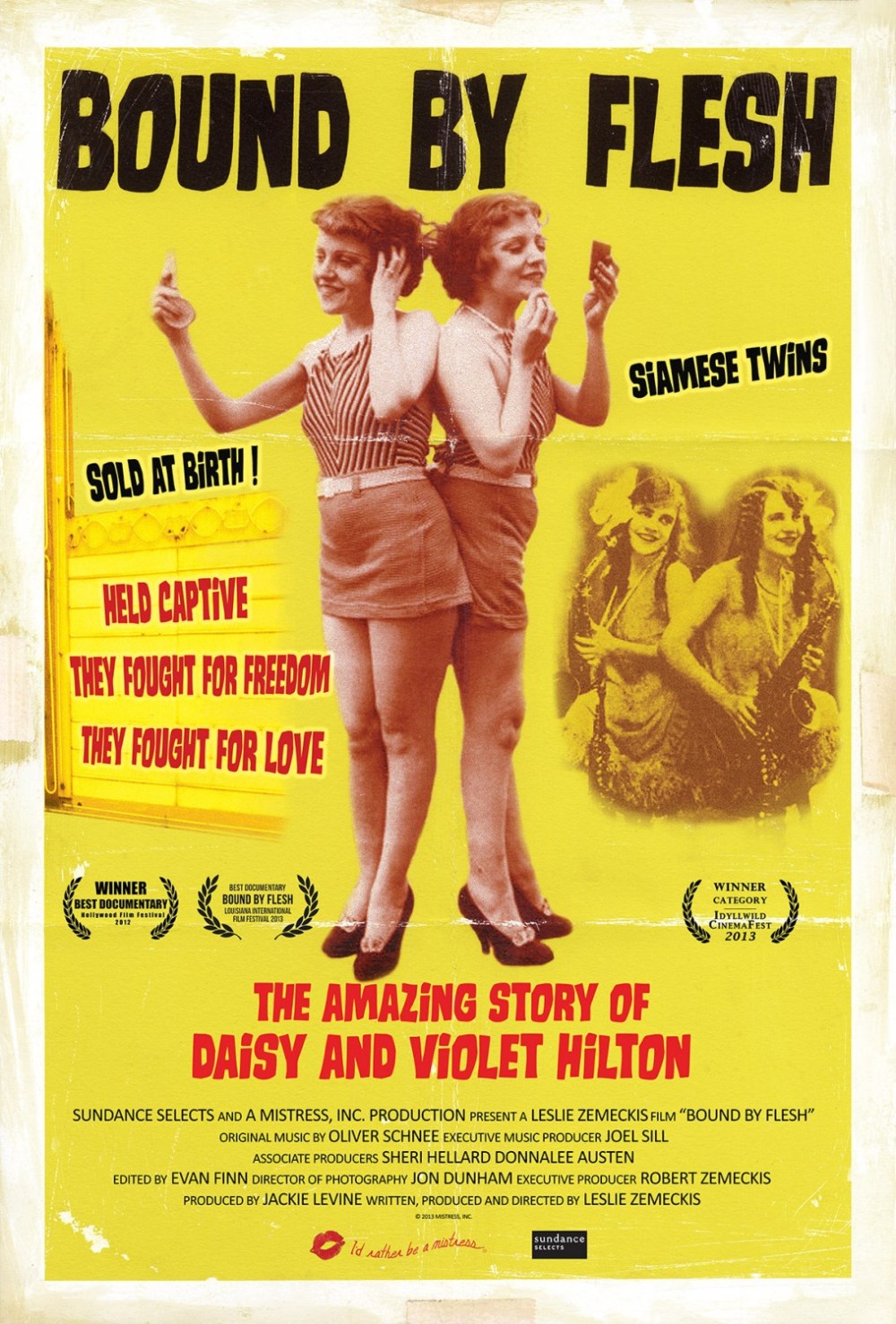
With her documentary “Bound by Flesh,” Leslie Zemeckis has reopened a part of history many have either forgotten about or never knew about. It focuses on Daisy and Violet Hilton, conjoined twins who became stars in sideshows and were generally viewed as freaks of nature. Throughout their lives they were subjected to abuse by their handlers and kept out of public view in fear of losing their monetary value. But when they finally got their freedom, life became even worse for them as they didn’t know how to deal with the ways of show business, and they eventually lost everything and entered a life of poverty.
What’s great about Zemeckis’ documentary is how it forces you to look at the Hilton sisters as human beings as opposed to oddities to be gawked at. I got to talk with Zemeckis over the phone about “Bound by Flesh,” how she first became aware of Daisy and Violet, and of the research she did.
Ben Kenber: This is a fascinating documentary. I didn’t know about the Hilton sisters at all, and they suffered through quite a miserable existence. “Bound by Flesh” deals with them as “freaks,” but it also deals with them as human beings which I really liked. What they go through is not unusual for people who don’t know the ways of show business.
Leslie Zemeckis: Good, I like that.
BK: How did you first find out about the Hilton sisters?
LZ: When I was doing my first documentary, “Behind the Burly Q” about burlesque I had read someplace that they were in burlesque briefly, so that kind of intrigued me and I put a little bit about them in the first film. Then I read Dean Jensen’s biography about them (“The Lives and Loves of Daisy and Violet Hilton: A True Story of Conjoined Twins”), and just over time, while I was editing my other film, I kind of became obsessed by their story. But also taking into context of the time they lived and what the carnival was and what circus life and sideshows were, we don’t have that today. There’s really almost no animals even left in the circus, so we’re kind of bringing to light and exploring what that world was that they lived in.
BK: In regards to the historical footage that you were able to include in this documentary, how did you go about researching this subject?
LZ: Every which way I could. I did the research myself so that I’m familiar with the names and dates, and I knew that they were, in their day, photographed a lot. They were interviewed and they had done a lot of newsreels, so I actually went to a news real company in New York and I sorted through their files, and because I knew the names that they were involved with, I found some footage that hasn’t been seen since the 30’s. It probably never would’ve (been discovered) because it doesn’t have their names on that little 3 x 5 index card. I found that within 10 minutes of searching.
BK: On the surface and outside the fact that they were conjoined twins, Daisy and Violet really looked like normal people and very innocent in a sense.
LZ: Well they were. It was a double-edged sword by them being so protected and kept away from other people that they were innocent. But then when they were out on their own they didn’t have the skills to deal with people or their career or money really, and that’s why they were taken so badly advantage of.
BK: You find yourself rooting for the twins to get freedom from their handlers, but once they do get their freedom they are thrust into a world they don’t have any control over. They are not prepared for it at all.
LZ: Yeah, it was a little bit of a curse maybe to get their freedom.
BK: I got a big kick out of the logos because they look like they came out of a schlocky B-movie from the 50’s. Who designed the logos?
LZ: Well it was my idea because they were in B-movies like “Chained for Life” and their story, when you talk about it, is so headline; kept in chains and held captive and all that. So I wanted to add an element of that for fun, but there really is a deep story behind it and my editor Evan Finn designed all that because he’s brilliant.
BK: Regarding the sound clips, were they created for this documentary or was it a combination of archival footage and actors redoing them?
LZ: It was actors redoing them, but that was their (the twins’) words. In both “Behind the Burly Q” and then this, I wanted the sisters to tell the story. I want people to tell their story instead of me imposing on it for the audience, so I used their words. I didn’t write those words. Those were what the sisters said.
BK: It definitely felt like their words. Who were the most fun or most informative to talk to when it comes to your interview subjects?
LZ: Well I just thought it was a little amusing that I had James Taylor and Phillip Morris (laughs). We would just laugh about it. I mean where else are you going to find “characters” like this? But they were all very charismatic, knew their history and I loved and loved talking to them and they loved it too. They loved that era, they loved the sideshow and they love the circus.
BK: Was there anything that you wanted to include in this documentary that you were not able to for one reason or another?
LZ: No. I would’ve liked to of had more footage of them, but I am super happy with what I found. I wanted people to see their movement. I don’t believe there’s any footage of them performing live in vaudeville, but I was really pleased with what I did find.
BK: The Hilton sisters did appear in “Freaks” which is now considered a classic, but when it first came out it was treated as very controversial and off-putting. It’s interesting to see how people initially reacted to the movie when it was first released.
LZ: It’s a disturbing movie, but what’s funny is that the twins actually aren’t in it as much as you would think. But the film has value; it’s in the National Archives. It’s just a world that is no longer.
BK: Are there still any sideshows still performing today?
LZ: Not really. There’s so little “born freaks,” but to me I equate it, and it’s not PC of course to go stare at people, with watching reality TV. Everybody sits in their home and it’s okay to watch the Kardashians comment on their physicality, and I think we still have a form of the sideshow. It’s just changed to reality TV. All forms of entertainment just change. They stay but they change. We just now do it from our home.
BK: There’s something to be said for the twins living as long as they did because the lifespan of conjoined twins is not good.
LZ: Right and they were generally very healthy throughout their lives.
BK: The choice of music was interesting because some of it goes outside of the times the Hilton sisters went through. How did you go about choosing the music, or did you just leave that to your composer (Oliver Schnee)?
LZ: No, I don’t leave anything to anybody (laughs). It’s too much of my baby. I certainly didn’t compose it. He (Oliver Schnee) was brilliant, but I didn’t want it to feel like you’re just watching this period piece that has nothing to do with today. It’s still hip, they were hip, and I wanted the music to reflect that.
BK: Going back to the voice cues, those were done by Lea Thompson and Nancy Allen. How did you manage to get them involved in this documentary?
LZ: Well I knew them so I was familiar with their voices, and they both have a similar quality with each other which I felt would work with the sisters. They also have a very light, optimistic voice. I was so lucky to get them. They were similar enough that I thought they sounded like sisters.
A big thank you to Leslie for taking the time to talk with me about “Bound by Flesh” which opens us up to a part of history that has been forgotten for far too long. It is now available to own and rent on DVD, Blu-ray and Digital.
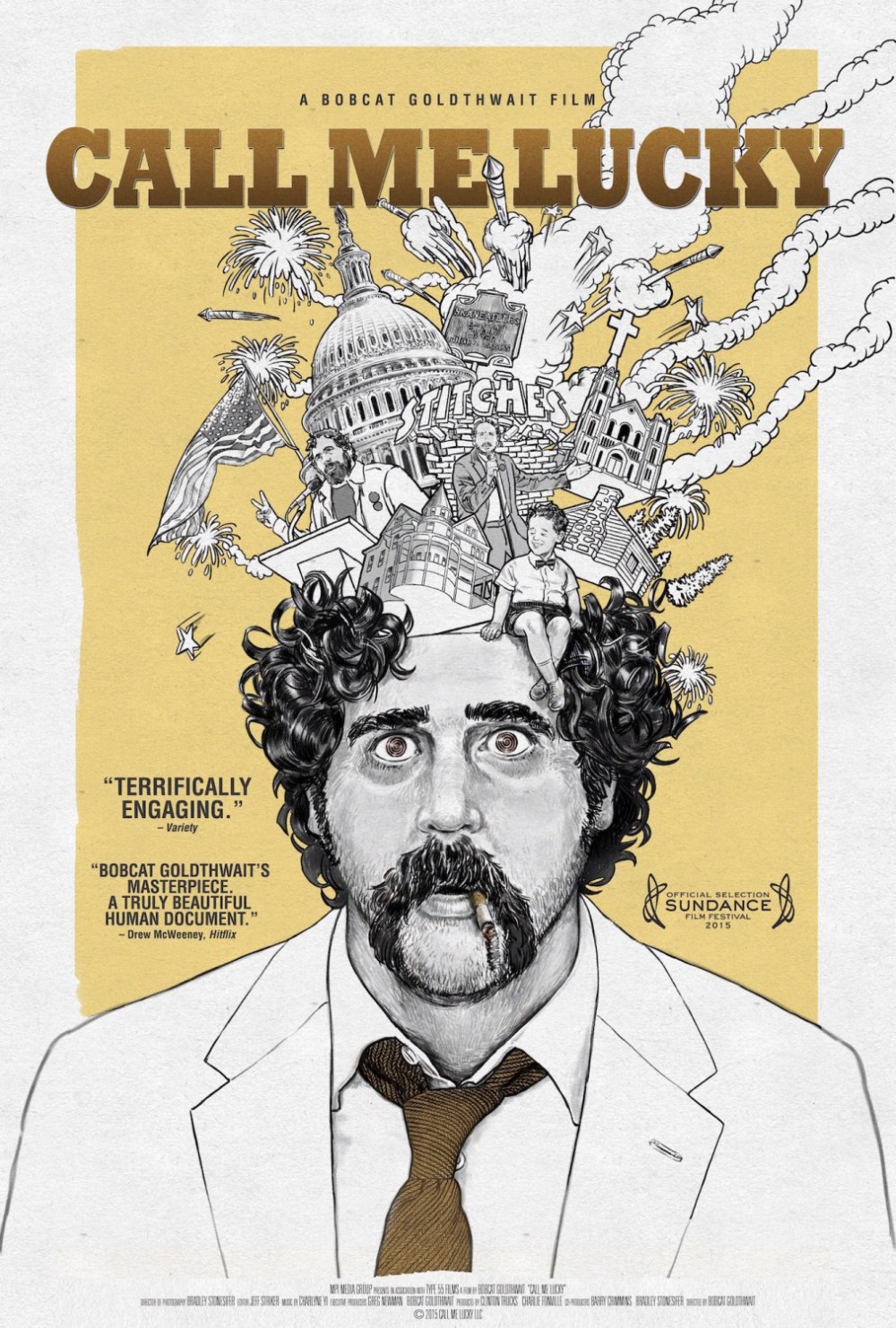
It was very sad to learn Barry Crimmins passed away on February 28, 2018 at the age of 64. Crimmins was diagnosed with cancer only a month earlier, but the disease spread through his body very rapidly. He was an American stand-up comedian, a political activist and satirist, a writer and a comedy club owner, and his comedy predated that of the late Bill Hicks. He brought the comedy scene in Boston to a new level of prominence after forming the city’s two clubs, The Ding Ho and Stitches. He has long since earned the respect of fellow comics like Bobcat Goldthwait, Steven Wright, Paula Poundstone, Kevin Meaney and many, many others who continue to sing his praises, But the thing is, I was only just getting to know him just a few years ago.
Despite Crimmins having done so much work, many people today, myself included, had never heard of him before. This changed in 2015 with Goldthwait’s acclaimed documentary “Call Me Lucky” which chronicled Crimmins’ beginnings as a comic in New York to his work in the present as a political activist. The documentary also reveals how Crimmins was a victim of sexual abuse as a child, and we even see him revisit the scene of his abuse in an effort to come to terms with what he went through. For years, he was an anti-pedophilia activist, and he went out of his way to expose pedophiles on the internet in the 1990’s before turning his evidence over to the FBI. In 1995, he testified before Congress about the need to enforce child pornography laws more than ever before.
In 2017, Crimmins married Helen Lysen, a photographer and font designer, and she was with him when he passed away peacefully. She shared the news of his death and wrote, “He would want everyone to know that he cared deeply about mankind and wants you to carry on the good fight. Peace.” Indeed, his death is a real loss as we need voices like his as the political climate we are currently dealing with in America continues to grow more volatile as days go by.
I was fortunate to talk with Crimmins and Goldthwait while they were doing press for “Call Me Lucky” a few years ago. To this interview, I wore one of my “They Live” t-shirts as I figured Crimmins was a fan of John Carpenter’s 1988 cult classic which remains one of the most politically subversive movies ever made. It turns out he had not seen it, but Goldthwait certainly did, and I hope he got Crimmins to check it out before he passed away. I am certain he would have enjoyed it immensely.
Please check out my exclusive interview with Crimmins and Goldthwait above. “Call Me Lucky” is now available to own and rent on DVD, Blu-ray and Digital.
I felt like I could never figure Hunter S. Thompson out. Whenever I saw films based on his work, he seemed like some crazed lunatic living in a world of his own creation and madness. After watching “Gonzo: The Life and Work of Dr. Hunter S. Thompson,” I feel like I now know what he was all about. Hunter was as patriotic as any American can get, and while he always seemed to be losing his mind, no one can deny he was a true visionary. At the very least, he was never boring.
This documentary was directed by Alex Gibney who managed to get many people to talk on camera about Hunter who, whether they loved or hated it, had to admit to feeling the upmost respect for all he did. The fact Pat Buchanan participated in this documentary is a big surprise considering how Hunter described him as a “half-crazed Davy Crockett running around the parapets of Nixon’s Alamo.” The writings of Dr. Thompson are featured throughout, and the documentary is narrated by Johnny Depp who played the eccentric author in Terry Gilliam’s film version of “Fear & Loathing in Las Vegas.”
Hunter is credited with creating Gonzo journalism, a style of reporting where reporters involve themselves in the action to such a degree to where they become central figures in their own stories. He would take on assignments like covering a motorcycle event, and then he would veer off into something else like the death of the American dream. Through his writing, he got at the ugly heart of the matter and exposed it for all its misleading falsehoods.
“He was a reporter with a wild imagination.”
-Tom Wolfe
“He was not afraid to express himself in sometimes shocking ways.”
-President Jimmy Carter
We see Hunter take on his first big assignment when he meets the Hell’s Angels in California which he looked up to as the last outlaws in the world. This relationship, however, turned sour when he witnessed them gang bang a woman at their party. The group later suspected Hunter of trying to profit off of what he wrote, and they beat him severely. This whole experience ended up shaping him as a writer as he looked beyond the façade sold to the public on a regular basis.
One of the most interesting parts in this documentary is how it shows Hunter’s love of America and his sadness over the death of one of his favorite politicians, Robert Kennedy. It is made abundantly clear how Hunter so wanted to believe in the hope of a better future. His sadness only deepens when he is witness to the beatings at the Democratic convention which took place the same year Robert died, and he berated the Democrats for not doing their part to put an end to the violence.
I got a huge kick out of the section where Hunter runs for Sheriff of Pitkin County, Colorado, as it showed how visionary he was as he had all these plans for revitalizing the town of Aspen. He called for the decriminalization of drugs for personal use, but he also wanted to keep a ban on trafficking as he was no fan of people profiting off of them. Furthermore, he wanted to tear up the streets and replace them with grassy pedestrian malls, he proposed placing a ban on tall buildings being built as they obscured his view of the mountains, and he wanted to rename Aspen “Fat City” in an effort to deter investors who wanted to commercialize the city. Of course, Hunter lost the election which was no real surprise to him, but his run for the office was never ever forgotten.
“Gonzo” also does a great job of looking at the various relationships Hunter had throughout his lifetime. We get a look at his marriages and learned what it was like living with him. To know Hunter was to tolerate him. Perhaps the most interesting relationship documented here is the one between Hunter and artist Ralph Steadman who created some of the most insane drawings which accompanied Hunter’s feverish writings in Rolling Stone magazine. It is interesting to learn Steadman was actually a conventional artist whose work was no different from anyone else’s. But then Hunter turned Steadman on to drugs, and his work evolved into what he is best known for. There is a great moment where we see Steadman at work, and he has this utterly insane look on his face as if he is gleefully possessed. Who knows what would have happened to him had he never met Hunter.
Perhaps the most important section of “Gonzo” is when Hunter supports George McGovern’s run for President of the United States. McGovern was the democratic nominee running against incumbent President Richard Nixon. The Vietnam War was raging on, and hundreds of young American lives were being snuffed out day after day. McGovern sought to put an end to the Vietnam war which the whole country had since gone against. Hunter had a vicious hatred of Nixon, and he saw the possibility of Nixon going on to a second presidential term as a possible death blow to this country.
As important as this section of the documentary, it was a bit overlong and could have been shortened. It gets redundant as we clearly get the message of Hunter’s disillusionment with politics in general. Fortunately, “Gonzo” picks up in the last half as we see how Hunter became trapped by his fame to where his work suffered as a result. But the McGovern section is still important, especially when Hunter is interviewed in the documentary and says this, “I desperately wanted to put an end to that senseless war [in Vietnam]. I’m sick and tired of old men dreaming up wars for young men to die in.”
Sound familiar? No wonder Hunter got depressed when George W. Bush got elected and the World Trade Center was attacked on September 11, 2001. Hunter wrote about those events as if he knew exactly what they would lead to, another war overseas with America striking back in revenge mode. This was all another depressing example of how history repeats itself.
For the most part, “Gonzo: The Life and Work of Dr. Hunter S. Thompson” does an excellent job of making you understand him better and of where he was coming from. We need people like Hunter, people who challenge authority and get us riled up about the way the country is heading. His suicide, other than being very selfish and hardly noble, robbed us of a powerful voice we need in times when politicians continue to deepen the divide between the rich and the poor. Hunter was a crazy man at times, and he was also proof that if you take enough drugs, they will completely mess up your head. But you had to love him because he was never boring and always fearless. It is likely there will never be another man like him.
Of the documentaries released in 2017, “City of Ghosts” is one of the most important to witness. It follows the journey of “Raqqa is Being Slaughtered Silently” (RBSS), a group of anonymous activists who came together after their peaceful hometown was taken over and decimated by ISIS in 2014. What results is a film which is as astonishing as it is harrowing to sit through. We watch as Raqqa goes from being a town whose inhabitants celebrate weddings for a whole week to one laid in ruins as the radical terrorist group ISIS uses every weapon available to suppress the population and silence those who would speak out against them. Despite being threatened by one of the greatest evils in the world today, this group of citizen journalists continue to stand up against the atrocities ISIS has committed, and the images they have captured show just how far they will go which includes executing the father of one of the journalists.
“City of Ghosts” was directed by Matthew Heineman who previously gave us “Cartel Land,” a documentary which examined the ongoing drug war at the U.S./Mexican border and of the vigilante groups fighting the Mexican drug cartels. Heineman was inspired to make a documentary about RBSS after reading an article about them in the New Yorker, and he managed to gain their trust very quickly to where it didn’t take long for filming to begin. We watch as these journalists and activists flee their homeland and struggle to keep their spirits up as the threat of death continues to hang over them no matter how far they manage to get away. Also, we view the horrifying footage they have captured of the horrific acts ISIS has committed in Raqqa which includes executing and crucifying its citizens in public view. What is shown cannot be easily erased from our minds, but these crimes of humanity need to be seen as this threat needs to be stopped, and the actions of RBSS need to be commended in a time when journalism is being attacked by those who do not want to hear the truth.
It was an honor to speak with Heineman while he was in Los Angeles to talk about “City of Ghosts,” and he spoke of how he became inspired to create this documentary as well as the current state of the war in Syria which will hopefully end sooner rather than later. Check out the interview below as well as the documentary’s trailer. “City of Ghosts” will make its streaming debut on Amazon starting October 13, 2017.
As a movie buff, I have to admit it is shameful on my part I have not seen more movies directed by Werner Herzog. I did see “Grizzly Man,” a brilliant documentary about Timothy Treadwell and his obsession with the grizzly bears, and like all brilliant documentaries made today, it did not get an Oscar nomination for Best Documentary. Thankfully, the Oscars did not ignore his documentary “Encounters at the End of the World” which is an endlessly fascinating look at his travels and discoveries in Antarctica. It is at times an incredibly beautiful look at an icy landscape, at others a bleak look at the inevitable end of the human race. At the same time, it also a rather humorous and interesting look at the people who risk their lives by living there to study the cutting-edge world of science.
Herzog narrates “Encounters at the End of the World,” and he allows us to go inside his head on how he views the icy wilderness of Antarctica, and of how he views the people and wildlife there. He makes it clear from the onset that when he was asked by Discovery Films to do this documentary, he agreed to it on the condition he would not be forced to do a “fuzzy” movie with penguins in it (a little jab at “March of the Penguins”). The first 10 or so minutes deal with the McMurdo Research Station which is full of buildings and tractors constantly moving all over the place. Herzog finds himself wanting to get away from McMurdo right away as he feels it is corrupting the Antarctic island with the inhabitants’ own self-interests as it is filled with horrors there like “yoga classes.”
Eventually, he ventures out of the encampment and into the far-off research facilities removed from the town. We see him and others there being put through safety drills and emergency preparations to deal with the worst of circumstances. The group leader speaks of how the wind can get so bad to where you can’t see even your hand in front of your face or hear yourself talk. This lends a chilling effect to an already chilled environment, and while it is exciting to be there, you feel the danger of it throughout.
The best part of this documentary, and the reason I wanted to see it, is the underwater footage where you follow divers underneath the glaciers of Antarctica. The visuals on display here are both beautiful and extraordinary to see, and there is a unique beauty to the underwater landscape you would be hard pressed to find anywhere else. This is all reminiscent of James Cameron’s documentary “Aliens from the Deep” in which he went with scientists in submersibles down to the bottom of the ocean to see what things live down there. But while Cameron’s documentary was fascinating, this one is not encumbered with 3D effects and of looks at where the future will take us. It deals with the world we exist in right now, and it doesn’t hide from how everything will disappear in the distant future.
I was also eager to find out how these scientists were able to dive down into waters which they would not be expected to stay alive in for more than 5 minutes. They wear special suits which are heavily insulated to protect them from the cold, and they wear gloves that threaten to make them look like aliens from another planet. Herzog says the water they are diving into is -2 degrees Celsius, and the divers go in with no ropes attached to their bodies as it will give them more room to move around. Still, this is very dangerous work they are doing, and if they get lost underneath the glacier, they will become a permanently frozen resident. You feel the danger of what they are doing, but you end up getting overwhelmed by the spectacular visuals they discover underneath it all.
Another fascinating moment comes when some scientists on the island play recordings of the sounds the local seals make underwater. The seals themselves steal some scenes from the human actors as they lie back lazily in the sun and look too tired to get up and acknowledge anybody. The underwater sounds of the seals seem so unreal, and I could not help but believe they were all computer generated. But they are indeed the real thing, and you experience the sounds along with Herzog and the scientists as they put their ears down to the ground and take it all in. It’s an amazing moment to witness.
The other thing I really loved was how it was just not another average science documentary filled with talking heads telling you all the things you need to know about the environments they are studying. There is science talk throughout the documentary which is fine, but Herzog also looks at the individual personalities he comes into contact with throughout his journey. Along with Herzog, you also wonder what could make all these people come to one of the most isolated places on the face of the earth and of how they stay there for so long.
Among the people Herzog meets throughout his travels are a philosopher who has a great quote at the end of the movie about how the universe is looking at itself through our eyes, and how we give life to everything in the way we view it. We meet one of the scuba divers who has a pensive moment where he takes in the fact he is about to making his very last dive into the icy depths. Then Herzog meets up with a Russian who had escaped the Soviet Union after the fall of the Iron Curtain, and the Russian almost loses it emotionally when he tries to describe to him how bad things were when he left. This Russian also has an escape plan at the ready with a big pack of supplies in case he needs to flee once again.
There are a couple of other people in the documentary who just talk and talk about themselves and the adventures they have been on. Herzog cuts them off in his narration by saying, “To make a long story short…”
“Encounters at the End of the World” does have a bleak view of humanity’s future, and the scientists are fully aware of this as temperatures continue to rise to where it is inevitable that ice will eventually melt completely in the future. This is also shown as we see a group of scientists watching “Them,” a 1950’s B-movie about radioactive ants which have grown to an enormous size. It turns out to be one of the many apocalyptic movies they show to each other from week to week. I wonder if they have ever gotten around to watching John Carpenter’s “The Thing.”
At the center of “Encounters at the End of the World” is not just Antarctica, but Herzog himself. His narration throughout could have been annoying, but it serves to illuminate what a funny and interesting person he is. Clearly, he is attracted to madness in various forms throughout the world as is shown here and also in “Grizzly Man.” I imagine this is a big theme in all of his movies. We discover all there is to see through his eyes, and of how he views the beauty of the ice and how it forms. As a result, it does make me want to see more of his movies.
Just remember what one of the men says in this documentary, and remember it always:
“The Wrecking Crew” joins the company of great documentaries like “Standing in the Shadows of Motown” and “20 Feet from Stardom” as it puts the spotlight on a group of musicians who have been in the background for far too long. The title refers to studio and session musicians based in Los Angeles, California who played anonymously on many famous records back in the 1960’s. During a decade dominated by The Beach Boys, The Mamas & The Papas and The Monkees among others, they were the ones who recorded the music we came to love so much.
“The Wrecking Crew” was directed by Denny Tedesco whose father, Tommy Tedesco, was a legendary guitarist who played with this group of unsung musicians. Tedesco started filming this documentary back in 1996 when he discovered his father was diagnosed with terminal cancer as he wanted to get as much of his father’s musical history on film for the record. From there, it became a celebration of musicians whose work resulted in the creation of many great songs. In addition, Tedesco succeeded in getting many interviews from stars like Cher, Nancy Sinatra, Mickey Dolenz, Glen Campbell and Dick Clark who shared their memories of The Wrecking Crew and of what they brought to the world of music.
A press day for “The Wrecking Crew” was held at The Professional Drum Shop in Hollywood, California, a famous location where George Harrison once bought a pair of drums for Ringo Starr. Joining Tedesco was The Wrecking Crew’s drummer Hal Blaine who came up with the group’s name, and its keyboard player Don Randi. While the documentary started playing at film festivals in 2008, it did not receive a theatrical release until 2015 due to the incredibly difficulty of licensing music for its inclusion here. I asked Tedesco how the documentary evolved from when he started shooting it in 1996 to when he finally got a rough cut together.
Denny Tedesco: Format wise, we started shooting in film, 16mm, because I wanted to be a filmmaker. My wife Susie and myself, she’s a commercial producer, had better access to the film cameras, but we also liked the idea of film. But years later I started to go to video out of necessity, and I realized that was much easier because now what I missed with film is a lot of great interviews. With film, you’ve got to have a whole film crew. When we started cutting I knew the beginning, I knew the middle and I knew the end, but when the first 30 minutes of the film were cut another director saw it and said, “Why are you cutting it like this?” And I said, “What do you mean?” Because I wasn’t gonna be part of this film at all. I was the director and I wanted to keep myself out of it. He said, “You’re crazy not to be a part of this. You have access that none of us have. What you’re cutting, we couldn’t do this. You should go the other way.” And that’s when I decided that I would try and introduce the film as myself and that this is the reason why I started the film; my dad’s passing away and I said this is the story of my father and his extended family, The Wrecking Crew, and that’s how I introduce all of these guys.
Tedesco, Blaine and Randi said all the musicians originally came from jazz backgrounds, but that they eventually found themselves playing rock and roll music as they could make more of a living this way. We get to meet each of these musicians, and one who stands out in particular is Carol Kaye not because she is the only female member of The Wrecking Crew, but because she is a truly gifted bass player. Randi himself described Carol as being very innovative and that she has a great ear for music, and she gave us all a respect for the bass guitar we should have today.
Hal Blaine: I have to make mention right here about Berry Gordy who was actually a neighbor of mine. We used to laugh at the limo that used to pick up this little, tiny child to take him to school every day. Eventually there were people out there saying they did all the Motown records, and we knew that they didn’t. We knew that we had done a couple, three maybe, but there were some people who claimed they did all of them. They will be nameless at this point. Berry Gordy, not very long ago, did an interview and mentioned the fact that the very first hits came out of his garage where he had a little studio, and then he became Twentieth Century Fox’s head of musical engineering. We did the first few (songs) like “Baby Love” and a couple of things and it was an amazing time, and I was shocked to hear Berry Gordy actually do this. Not coming clean, but just to clear up things.
Randi also shared a sobering story about The Funk Brothers, Detroit based musicians who performed the backing music to the majority of Motown recordings from 1959 until 1972 when the company moved to Los Angeles.
Don Randi: When we all went into the Musicians Hall of Fame in Nashville, The Funk Brothers were there and The Wrecking Crew was there. We all went in at the same time and I sat with The Funk Brothers and they had me crying because there weren’t no contracts and they didn’t get the residuals. These guys are old and they don’t have that… Those guys worked their butts off for Berry, and when they first came out on the first date I did for them they went to pay us with cash, and I said, “Wait a second, we don’t do this.” And they said, “Well that’s the way we do it in Detroit. We pay cash.”
Well, hopefully all these musicians will get the respect they deserve when audiences watch “The Wrecking Crew.” It is a great celebration of the music we grew up on and of the artists who created it in the first place. While this documentary might look like it is riding the coattails of similar ones, it stands on its own and sheds a light on a piece of musical history we all need to know more about.
Danny Tedesco: All these other docs, thank God they came out. Thank God they laid the ground work and thank God they were successful. And I’m so happy because there is always another story. I tell people there’s so much information out there. You could interview your parents and you would get a great story and they should. There’s so much knowledge out there and I’m so glad that these different musicians… I’m lucky that I got them in their youth. If I had to do this documentary today, forget it. A lot of guys are gone and memories are maybe not as sharp.
“The Wrecking Crew” is now available to own and rent on DVD, Blu-ray, and Digital.
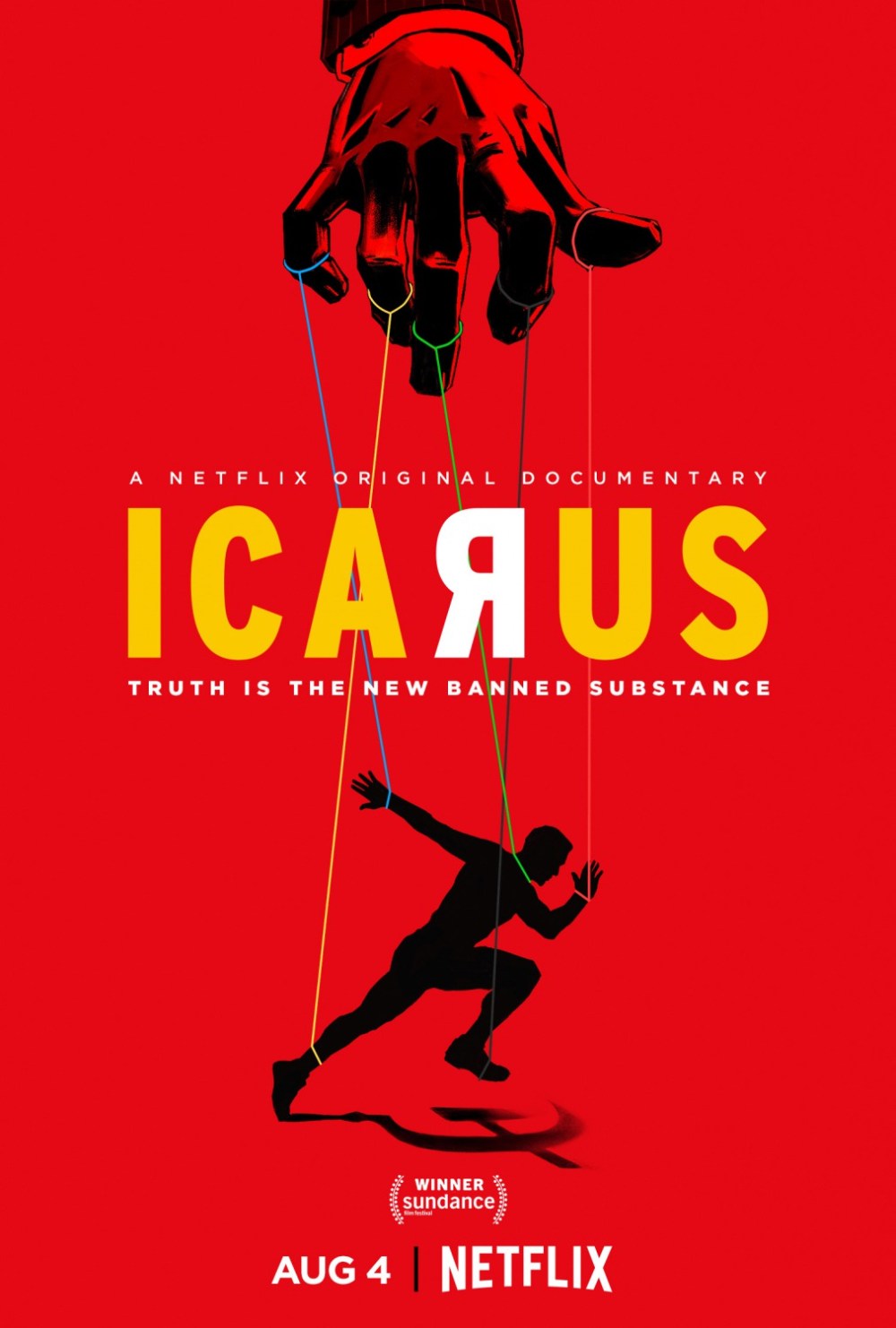
Actor, writer and filmmaker Bryan Fogel first came to the world’s attention with “Jewtopia,” a play he co-wrote and starred in which went on to become one of the longest running shows in off-Broadway and Los Angeles history as it was seen by over a million viewers. Now he is set to reach an even larger audience with his documentary “Icarus” which will debut on Netflix on August 4.
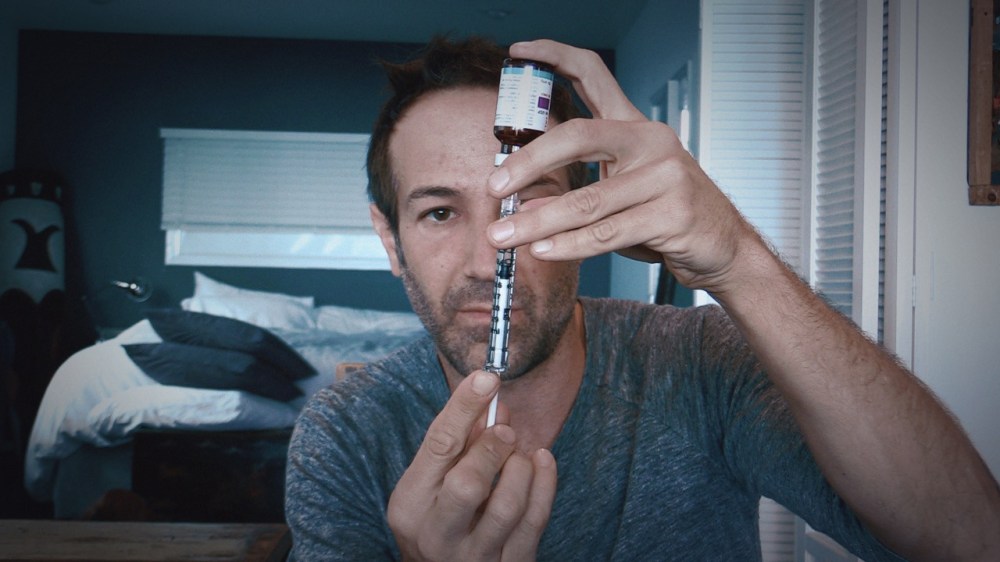
“Icarus” follows Fogel as he went on a mission to investigate doping in sports. Like Morgan Spurlock in “Super Size Me,” he becomes the main experiment of his own documentary as he dopes himself with performance enhancing drugs to observe the changes they have on his body, and to see if he can avoid detection from anti-doping officials. By doing so, he aims to prove the current process of testing athletes for performance enhancing drugs does not work in the slightest.
During this process, Fogel comes to meet Dr. Grigory Rodchenkov, a pillar of Russia’s “anti-doping” program who aids the filmmaker in avoiding doping detection through various processes which include being injected with various substances as well as collecting daily urine samples which will be smuggled from one country to another. But as Fogel becomes closer with Rodchenkov, he soon discovers the Russian is at the center of his country’s state-sponsored Olympic doping program. From there, “Icarus” goes in a different direction as it delves deep into Russia’s program and discovers the illegal activities go all the way up to the country’s highest chain of command which includes Vladimir Putin. The deeper this documentary goes, the more aware we become of how truth can be an easy casualty as others die under mysterious circumstances.
I had the opportunity to speak with Fogel about “Icarus” while he was in Los Angeles to promote it. He spoke about the documentary’s evolution from being a simple exploration into sports anti-doping programs to becoming a geopolitical thriller where witnesses are forced to go into hiding. Also, he spoke of how Lance Armstrong’s admission of using performance enhancing drugs was merely a needle in the haystack as many athletes were utilizing the same chemicals and threw him under the bus to save their own careers.





 The Ultimate Rabbit