Underseen Movie: ‘State and Main’ – A Ralph Report Video Vault Selection

One of my favorite parts of “The Ralph Report” podcast has been the Video Vault segment in which Ralph Garman, Steve Ashton and Eddie Pence recommend movies to watch that people may not be particularly familiar with. One episode had the three recommending movies about filmmaking, and Ralph picked David Mamet’s comedy “State and Main.” While listening to him describe this film, it suddenly occurred to me I had rescued a DVD copy of it from a Blockbuster Video store which was about to close forever. It has stood proudly on my shelf for many years, but therein lies the problem; I never took the time to watch the movie, and it was written and directed by Mamet for crying out loud!

So, the question is this, do I put “State and Main” in the “Underseen Movies” category as it was not a huge hit upon its release in 2000, or do I instead put it the one I lovingly titled “No, I Haven’t Seen It Until Now?” Come to think of it, maybe I should create a new category entitled “No Longer Gathering Dust on My Shelf” as there are many DVDs and Blu-rays I own which I promised myself to view one day, and yet they still remain unseen by me. So, what are my excuses regarding this? That was a rhetorical question.

Anyway, “State and Main” starts off with a Hollywood film crew invading the small New England town of Waterford, Vermont to make a movie called “The Old Mill.” We quickly learn this crew had been kicked out of New Hampshire as the movie’s star, Bob Barrenger (Alec Baldwin), has a penchant for underage girls, something many do not take kindly to (need I say why?). Once the director, Walt Price (William H. Macy) arrives, he thinks he has found the perfect location as the town does indeed have an old mill which the film’s writer, Joseph Turner White (Philip Seymour Hoffman), has centered his screenplay around. They quickly find out, however, that the town’s mill has long since burned down to the ground, so several things, among others, need to be changed in the screenplay even if it goes against the writer’s original intentions.

Part of the fun “State and Main” is watching how Hollywood succeeds in bringing out the worst impulses in everyone. Whether it’s the film crew, the cast or the townspeople, everyone is out to get their piece of the pie, and everyone is a player. A plethora of chaos ensues, and this all happens even before a single frame of footage for “The Old Mill” is shot.

When it comes to Mamet, his plays and screenplays cut really deep when it comes to the real world, and his take on Hollywood players can be quite scathing. Just look at “Speed-the-Plow” in which three movie studio employees engage in a power struggle to get a certain movie made while moving up the corporate ladder to become rich beyond their wildest dreams. Then there was the political satire “Wag the Dog” in which Robert De Niro and Anne Heche and fabricate a war in Albania to distract Americans from a Presidential sex scandal, and they enlist Dustin Hoffman, playing a famous Hollywood producer clearly modeled on Robert Evans. Both projects leave a bitter aftertaste whether you enjoy them or not as Mamet acknowledges how brutal and competitive Hollywood can be when it comes to what gets made and how much truth gets revealed to the world at large.

With “State and Main,” however, Mamet gives us something lighter than he usually does as he revels in the various problems and complexities the characters are forced to deal with. Moreover, while he revels in exposing the Hollywood players for the selfish schmucks they can be, the townspeople prove to be every bit as devious in their own unique ways.

Watching William H. Macy here makes one realize why he and Mamet have had such a fruitful working relationship for so many years. Macy is well versed in the rhythm of Mamet’s dialogue, and he does an excellent job of making his character of Walt Price into a filmmaking veteran who has directed more motion pictures than we are quick to realize. Walt is a pro at handling every and all problems which come his way, and he only loses so much of his cool when one of his assistants tells him his wife has gone into labor. While some directors may be understanding, Macy makes you see why Walt treats the impending birth of a baby as an annoying inconvenience.

Is tempting to say Alec Baldwin was in his prime when he played movie star Bob Barrenger here, but he is still quite the actor after all these years and not just because of his work on “Saturday Night Live.” Baldwin makes Bob into the kind of star whom filmmakers work with against their own best interests as he wants to change the dialogue in the script because it doesn’t sound like something he would say in real life. You want to berate him for his selfishness and remind him he is playing a character and not himself, but Baldwin reminds you of how actors like this one are on an island with themselves to where their egos get the best of them before they could ever realize it.   

Philip Seymour Hoffman left the land of the living a few years ago, and watching him in “State and Main” is a bittersweet reminder of the amazing talent we lost all too soon. As screenwriter Joseph Turner White, the actor gives us the perfect portrait of a man struggling for truth amongst a film crew whom sees the truth as a major inconvenience in the large scheme of things. Even as Joseph is forced to navigate a realm of endless cynicism and casual indifference, Hoffman renders this character as someone whom you believe is determined to remain noble to his beliefs even as many around him have long since given up on morality as a concept.

But seriously, my favorite performance comes from Rebecca Pidgeon as Ann, a local bookseller who helps to lift Joseph out of his latest bout of writer’s block. Right from the start, Pidgeon is so charming and fetching as she delivers Mamet’s dialogue like a true pro and makes Ann into one of the cleverest characters a movie like this could ever hope to have. She is just so much fun to watch here, and I could not help but root for her throughout.

And, with this screenplay written by Mamet, you can sure bet there are many lines of dialogue which sound like something only he could have come up with. Here’s a few worth noting:

“Everybody makes their own fun. If you don’t make it yourself, it isn’t fun. It’s entertainment.”

“What’s an associate producer credit?

“It’s what you give to your secretary instead of a raise.”

“It’s not a lie. It’s a gift for fiction.”

“I’m going to rip your heart out, then I’m going to piss on your lungs through the hole in your chest! And the best to Marian…”

But my favorite piece of dialogue, and it has always stood out to me even from the film’s trailer, comes from an exchange between Joseph and Ann:

“But it’s absurd.”

“So is our electoral process. But we still vote.”

Now that line remains as true now as it did back when this movie was released, and I can’t help but still laugh at it loudly as the electoral process is being scrutinized today in ways both sound and utterly ridiculous. By the way, Biden won and Trump lost. That is all.

I am not sure where to rate “State and Main” in regards to the other many works of Mamet. At times I wondered if this material might be a little too light for him, but this was clearly not designed to be as emotionally brutal as “Glengarry Glen Ross.” In the end, I think this was a movie everyone in front of and behind the camera had a lot of fun making, and not just because Mamet’s name was on it. A lot of times, movie sets can be nightmarish places regardless of whether or not Scott Rudin is wandering around on them, but the love everyone had for the material is clearly on display here.  

Big thanks to Ralph Garman for giving me and others a reason to check “State and Main” out. Here’s hoping his recommendation will give this film a stronger shelf life than it already has.

* * * ½ out of * * * *
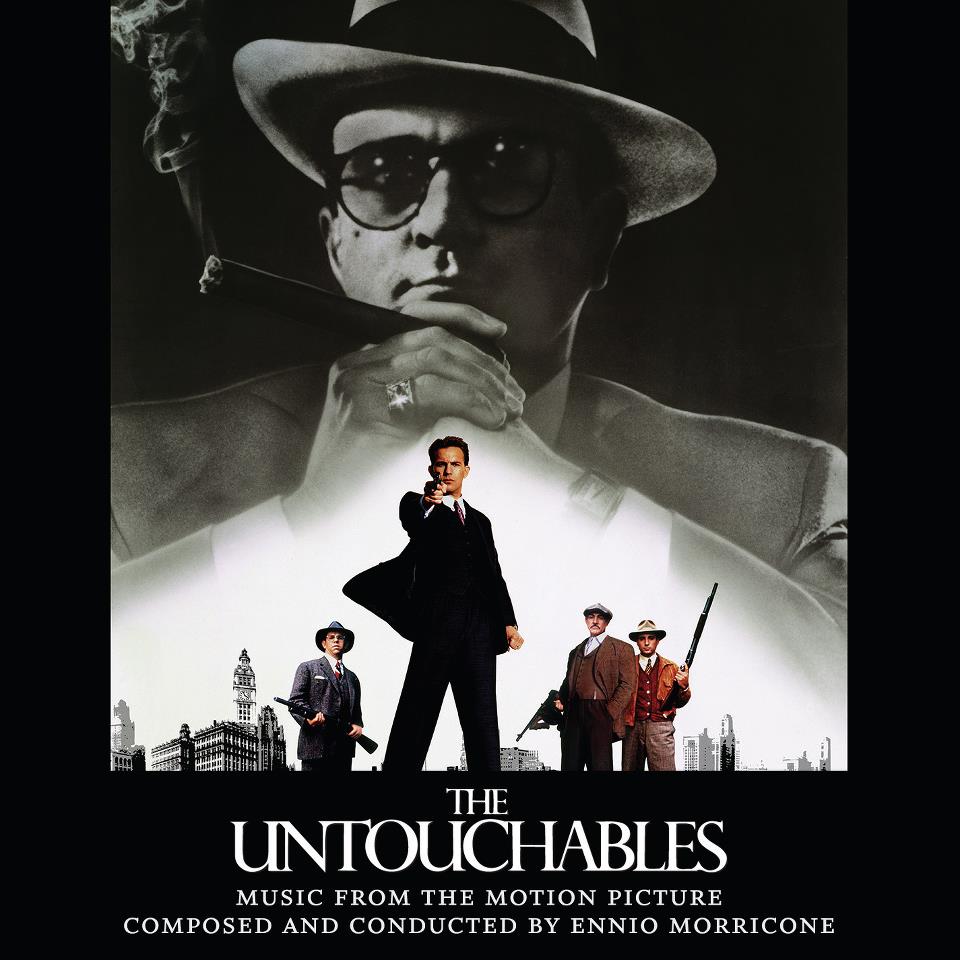
Soundtrack Review: Ennio Morricone’s Score to ‘The Untouchables’

WRITER’S NOTE: I wrote this review back in 2012 when this limited edition of the soundtrack was released. This edition has since sold out, but it can be found on websites such as eBay, Amazon and Discogs. Of course, this edition does not come at a cheap price, so be sure to do your research. I am presenting this review here out of respect for the great Ennio Morricone who passed away on July 6, 2020 at the age of 91 years old.

Ennio Morricone’s film score for Brian DePalma’s “The Untouchables” remains one of my favorites of his from the 1980’s. It covers the gamut of musical themes from victory to tragedy, and it captures the corruptness of the city our heroic characters played by Kevin Costner, Sean Connery, Andy Garcia and Charles Martin Smith have to fight against. Now, La La Land Records has put together a long-awaited remastered edition of this soundtrack which has Morricone’s music sounding better than ever. It features two discs, has over two hours of music and contains an informative booklet written by Jeff Bond, all of which makes for a release fans of Morricone will be pleased to add to their collection.

The first disc contains the original motion picture score for “The Untouchables,” and the tracks are sequenced in the order in which they appeared. This was not the case when the original soundtrack was released in 1987. That version started with the movie’s end title for some odd reason. There’s still no beating “The Strength of the Righteous” which gets the movie off to a thrilling start, and it’s one of those pieces of film music I never get sick of listening to. “Al Capone” perfectly illustrates the obscene wealth and greedy nature of a man who is more than willing to use violent means to achieve his goals.

Listening to this soundtrack for “The Untouchables” also reminded me of how beautiful Morricone’s music is. He captures the idyllic home life of Elliot Ness (played by Kevin Costner) and his family so well to where it makes you wonder if your own family life can ever compare. Other tracks like “Four Friends” help to elevate the tragedies the main characters suffer. I remember watching “The Untouchables” when it came out on VHS, and it was the first film I saw where the heroes do not make it to the end with a pulse. This shocked and saddened me, and Morricone’s “Four Friends” emphasizes not only the loss of life but of what that life meant to those who remember him dearly. Some of my other favorite tracks include “Waiting at the Border” which has Ness and company waiting in Canada for the arrival of Capone’s liquor shipment, and I love how the track starts soft and continues to build dramatically throughout. There’s “Courthouse Chase” which adds a lot to the big action scene between Ness and Frank Nitti (played by Billy Drago). The end title of “The Untouchables” is also one of those thrilling pieces of music as it celebrates the victory of those characters who scored one for justice, and listening to it always raises my spirits.

There is also no forgetting Morricone’s masterpiece of this score which is “Machine Gun Lullaby,” and it shows his brilliance in how he escalates the suspense and tension of certain scenes in DePalma’s movie. The first disc also contains tracks of Morricone’s which were not used, most of which are short transitional cues. The second disc contains the remastered version of the original soundtrack release from A&M Records, and the order of the tracks remains the same. Hearing it again might seem redundant for those who spent an hour listening to the first disc, but some still hold the original release of “The Untouchables” as sacred so it is here for them to enjoy with a better sound quality than ever before. The second disc also has several bonus tracks which include different versions of “Machine Gun Lullaby” and “On The Rooftops” among others. There’s also the “Love Theme from The Untouchables” which is sung by Randy Edelman and did not make it into the movie.

Jeff Bond, who has written informative booklets for many special edition soundtrack releases, writes us another great one for this release of “The Untouchables” which is entitled “The Strength of the Righteous and the Triumph of the Police.” Most of Bond’s booklets are usually written in two halves; one half details the making of a movie, and the other half details how its soundtrack came together. With “The Untouchables,” however, Bond is more interested in focusing on Morricone and the working relationship he had with DePalma. Bond even takes the time to write about every single track on each disc and the specific instruments which stand out and help to define certain characters and scenes.

“The Untouchables” actually marked the first collaboration between Morricone and DePalma, and the composer came to work with DePalma again on “Casualties of War” and “Mission to Mars.” In the booklet, Bond quotes from an interview with Morricone in which he describes DePalma as being “a great film director” and “wonderful to work with.”

“At a human level, too, he is a wonderful person, even if he gives the appearance of being a very reserved sort,” Morricone said of DePalma. “Behind that gruff exterior is a very kind soul.”

Morricone has still never won an Oscar for any of his scores, but he did deservedly receive one for lifetime achievement in 2007. Then again, he does not need one to prove to the world what a prolific film composer he is, and his output of work over the decades is amazing. “The Untouchables” remains one of my favorite film scores of his and it takes listeners through a wave of different emotions, some sad and others which make you happy and fulfilled.

La La Land Records has limited this special edition of “The Untouchables” to only 3500 copies, so be sure to get yours soon before it sells out. They have once again put together a great release of a truly unforgettable film score.

ADDITIONAL WRITER’S NOTE: Morricone finally won the Best Original Score Oscar which had long eluded him in 2016 for his work on Quentin Tarantino’s “The Hateful Eight.” To say this was deserved is to point out the bleeding obvious.

Rest in peace Ennio.

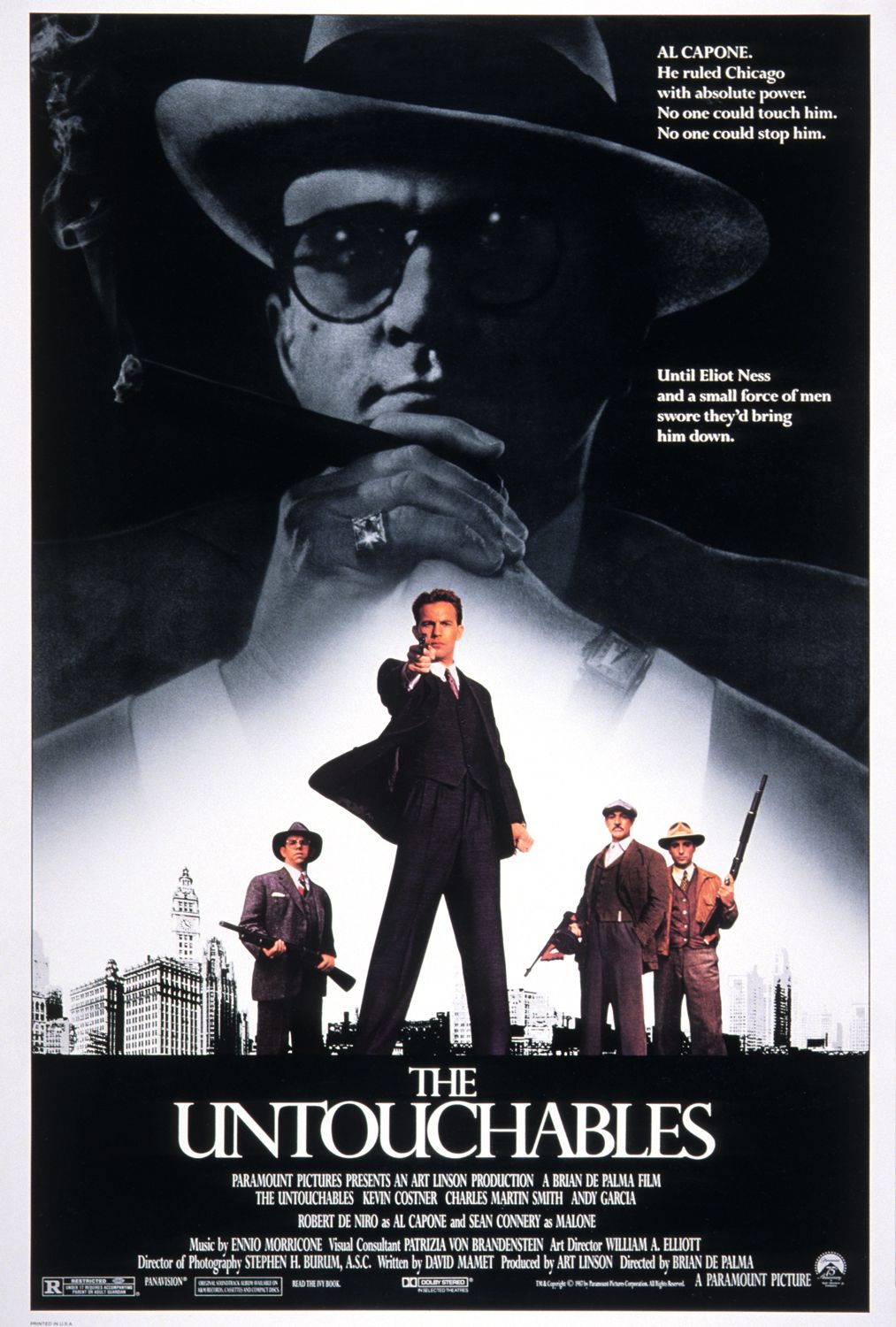
David Mamet Looks Back at Writing ‘The Untouchables’ on Tax Day

David Mamet photo

There were more than enough film buffs who filed their tax returns, or applied for an extension, on April 15, 2010, in the nick of time to check out a special screening of Brian De Palma’s 1987 classic “The Untouchables” at the Aero Theatre in Santa Monica. Following the story of how Elliot Ness and his select group of men who worked to bring down infamous crime boss Al Capone on tax evasion charges seemed like the perfect way to celebrate Tax Day. Finally seeing it on the big screen in glorious 70 mm was great after first watching it on VHS years ago.

But I do have to admit though that this movie really screwed me up for a time after I first saw it. It was one of the few times my parents let me watch an R-rated movie with them when they rented it on video. Having seen it reviewed on so many different shows like “At The Movies,” “Sneak Previews” and of course “Siskel & Ebert” (which had both hosts clashing over it passionately) had me excited about watching it eventually, and this was back in the day when I rarely, if ever, went out to the movies. But it was one of the first times where I realized the good guys didn’t always make it to the finish line. To see them get killed off in a most gruesome way was painful for a 12-year-old to take in as I always believed the good guys, those who work for justice would be the ones left standing. Back then, I was starting to learn how unfair the world can be.

The Untouchables movie poster

Anyway, this evening had a special reason for us to come out other than seeing the film in 70 mm as David Mamet, who wrote the screenplay for “The Untouchables,” was also in attendance to engage in a Q&A. Instantly recognizable in his beret and those huge yellow glasses of his, Mamet had many stories to tell regarding the making of De Palma’s film, writing the script for it and his thoughts on writing and Hollywood in general.

The first question asked was how Mamet got hired to write the script, and he replied that he got the job by default. Apparently, the job was first given to the late playwright Wendy Wasserstein who had won a Pulitzer for “The Heidi Chronicles.” She must have done quite a bit of work on it because Mamet said the Writer’s Guild of America still wanted to give her a credit. But he never hid the fact that what attracted him to writing the script was, as he said, “a lot of money.” The way Mamet described it, writing for someone else is known as “whoring.”

Being one of America’s most acclaimed playwrights and having grown up in Chicago where “The Untouchables” takes place should have made Mamet the most obvious choice for this motion picture. Mamet talked about how he grew up there with gangsters all around him and of how everyone lived and breathed the same air as them. As for the cops, he got to know them better while working as a cab driver. He also went on to say several of his family members kept telling him stories about Capone from time to time.

For years, Chicago has been known to be a city engulfed by corruption, and Mamet did nothing to hide the fact it is full of crooks. He described it as a machine that is run downstate and remarked the mayors occasionally go to jail. He also remembered a saying once told to him when he asked someone in politics what the difference was in running for one office or the other. The politician told him, “the girls get prettier.”

It seems many natives of this city have the same romantic view of Chicago as Mamet did, and he said it best, “In Chicago, we love our crooks!”

 A lot of Mamet’s inspiration for “The Untouchables” came from all of Chicago, he said. He tried to include as many famous landmarks such as The Anchors Restaurant and The Lake. Much of downtown Chicago was used to great effect throughout, and I wonder if there has been a movie since which is as superb in the way it brings Prohibition-era Chicago to life.

With De Palma directing “The Untouchables,” Mamet said he just hoped the director would stick to the script he wrote. Looking back, he said De Palma did actually stay true to his script to a certain extent, but that there were moments where he felt aliens had come down and sucked the brains out of those making the film. In terms of differences from his original script, Mamet said they took out the crawl he put at the end of what happened after the Prohibition Era ended and of how gangsters are still with us today. Mamet also said De Palma was the one who added the “cockamamie baby carriage” sequence.

During the making of “The Untouchables,” Mamet said he was never on the set. He was actually quite happy he wasn’t there which was surprising to here as you’d figure any writer would want to be there even if it annoys the hell out of the director. But while most writers want the opportunity to be on a film set, Mamet said he feels better off staying out of the way.

One of the main sources behind the screenplay was Elliot Ness’ autobiography which Ness wrote with Oscar Fraley. When an audience member asked Mamet if he believed what Ness wrote about, Mamet replied quite simply, “I don’t believe anything anymore.”

At its essence, Mamet described “The Untouchables” as a melodrama. Lest people see this as him looking down on the way De Palma shot this now classic movie, he was quick to quote from Stanislavski, “Tragedy is just heightened melodrama.” Looking at the movie as a melodramatic piece actually makes perfect sense as audiences got so swept up in the story to where it affected them more emotionally than they could have anticipated.

Other tidbits Mamet shared included that aside from Robert DeNiro’s method preparation in playing Al Capone, he ended up saying just what was in the script. The line uttered by Sean Connery’s Malone character of “here endeth the lesson” came from the book of common prayers. But the one which really stood out was what Mamet said Connery first told the producers when he came to make this movie, “Broccoli never paid me a dime to play James Bond!” As for “the Chicago way,” Mamet said it was something he just came up with. The philosophy behind it was when you take something, burn it down to the ground and then build it back up again.

Many in the audience were also eager to hear Mamet talk about the art of writing, and he had much to say on the subject. As a dramatist, he said his job is to take out the narration and go with the plot and characters. Watching the plot for him is where the enjoyment comes from. The problem is actors and directors end up wanting to put all the narration back in. They want to spell out everything for the audience, but dramatists make you want to know more about what’s going on. The way Mamet sees it, you just need a plot and an actor to get the ball rolling. A play or a movie cannot start from an ongoing situation. Of course, writing a plot can be very hard. In terms of plots, he views “Wag The Dog” as his “Casablanca” in that it was the easiest plot for him to write. Once he was finished, Barry Levinson started shooting the movie a month later, and the shoot went very quickly. As for all the other plots he has worked on, they were nightmares.

In talking about some of his other projects, Mamet said the coffee’s for closers speech with Alec Baldwin from “Glengarry Glen Ross” might have come from sitting in an office where he once worked. There was also some talk of how he wrote the script for “Ronin,” which was directed by the late John Frankenheimer, and never got credit for it. Mamet said he had always wanted to write something anonymously, and “Ronin” became that something because he was not originally hired to write it. What happened was Robert De Niro pleaded with him to do a rewrite as he felt the script was not up to speed. Mamet said he eventually caved in and rewrote the whole script in a week.

In addition to being a writer, Mamet is also a director of film and stage. When asked about his approach to directing, he said he wants to know what the story is about and how each beat contributes to the action. From there, everything comes together along with some unforeseen difficulties. When asked if movies would ever become an art form again, Mamet said, “Movies were never an art form, they were entertainment. It just evolved into an art form from there, and it’s still evolving in different ways.”

Mamet was up onstage for almost an hour at the Aero Theatre, and it still didn’t feel like he was there long enough. This writer, who grew up a working-class man and went to Kaminsky Park on a regular basis (yes, he is a Cubs fan) was full of anecdotal moments which made us want to learn more. When it comes to “The Untouchables,” he gives all the credit for its success to De Palma as he made all the elements work perfectly. He said almost everything good that happens is an accident, so it’s safe to say “The Untouchables” is a glorious accident and one which invites repeat viewing.

I personally want to thank David Mamet for saying something he once heard from a judge; that being quoted out of context is “the definition of a quote.” This makes writing articles like these so much easier! As for his line about critics being “illiterate swine taking the bread from my children,” I won’t take that one personally. Oh yeah, he also said the lizards in Hollywood will be the last ones to die, and he believes their last words will be, “I want to know more…”