‘Bridesmaids’ – Do Not Mistake This Film for an Average ‘Chick Flick’
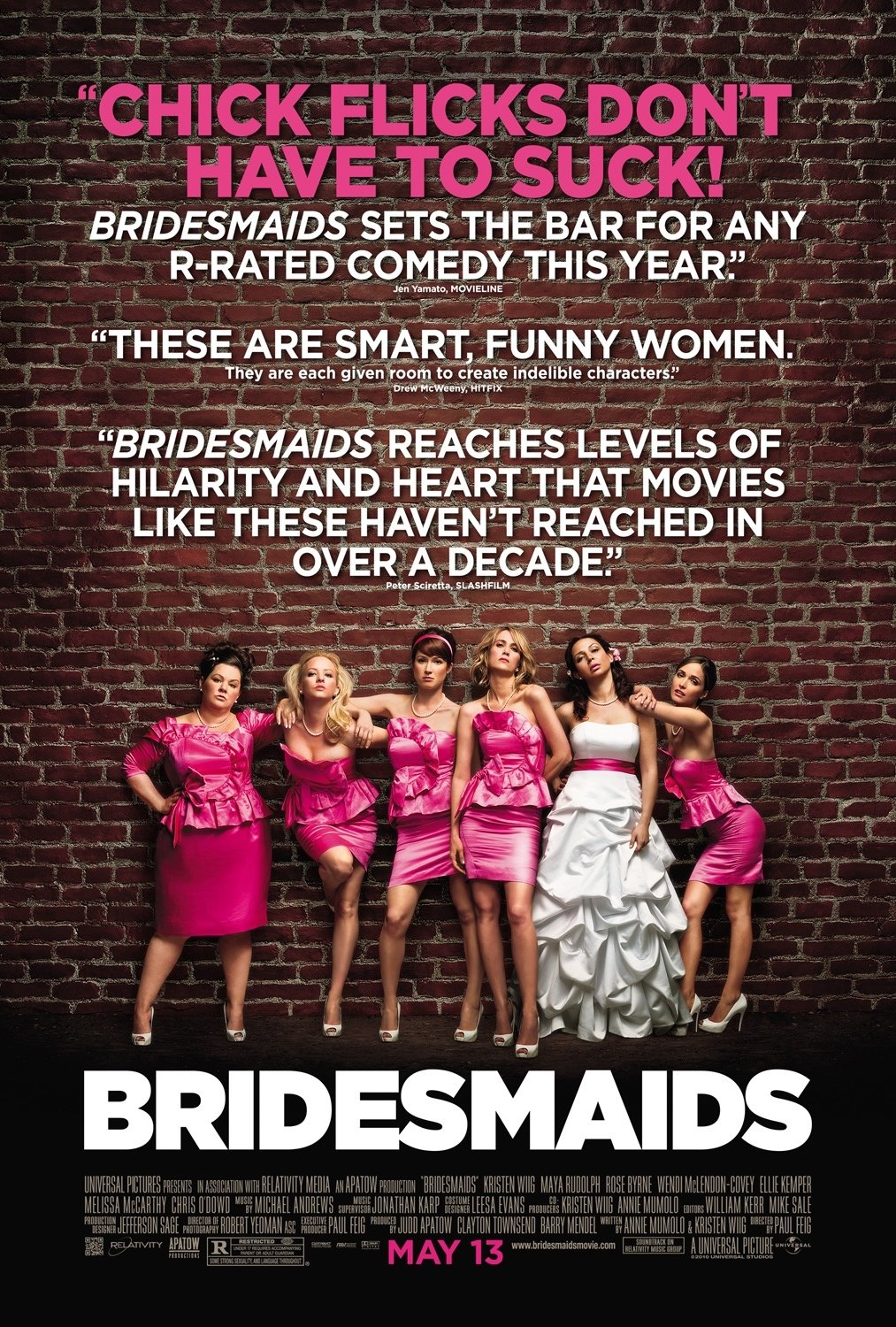
Bridesmaids” looks like it has “chick flick” written all over it to where many, including myself, were not quick to rush out and see this film when it arrived in movie theaters everywhere. But having since watched it, I can confirm this is not your average “chick flick” in the slightest. Moreover, it will appeal to a wider audience than its title might suggest. There is nothing groundbreaking about “Bridesmaids” as it initially comes across as a typical formulaic comedy, but the laughs do come at us fast, many of them gut busters. But seriously, it also has a lot of heart and makes you care about the characters very much to where we can easily relate to their struggles.

Kristen Wiig, one of the most acclaimed alums of “Saturday Night Live”  who co-wrote this film’s screenplay with Annie Mumolo, stars as Annie Walker, a single underachiever whose cake shop went bankrupt due to the recession, and who is currently having sex with Ted (an uncredited John Hamm), a man who sees her as nothing more than a fuck buddy. Then she finds out that her best friend since childhood, Lillian (Maya Rudolph, another “SNL” vet) has gotten engaged, and Lillian asks Annie to be her maid of honor. From there, we know things are going to go south between these two as the road to any marriage is filled with endless speed bumps which lead many to encourage others to elope instead.

Complications arise almost immediately when Annie meets Lillian’s other BFF, Helen Harris (Rose Byrne), a beautiful and wealthy woman who seems to have everything together in her life. The resentment and insecurity between these Annie and Helen are evident on their faces following their first encounter. This is made even clearer when both toast Lillian and then try to top each other in showering their love on her, attempting to prove who is the better best friend.

Things get even more complicated when Lillian selects the rest of her maids of honor. They include Becca (Ellie Kemper) who loves wedding and pities Annie because she is not currently engaged to anyone, Megan (Melissa McCarthy) who is as aggressive as they come, and Rita (Wendi McLendon-Covey) who may very well be the unhappiest wife and mother on the face of the Earth as well as the most consistently drunk of the bunch. With all these different personalities working together, will the road to this wedding be a happy one? Was Donald Trump always faithful to Melania?

What I really loved about “Bridesmaids” was the same thing I also loved about “Knocked Up;” the characters are very down to earth and easy to relate to. Being that Judd Apatow is a producer on both films, this should have been obvious from the start. These characters are real people with real problems which are not far removed from our own, and we come to care deeply about each and every character here. It does not matter if none of you have ever been a bridesmaid. As for you men, being groomsman is enough qualification to understand the headaches in planning matrimony.

“Bridesmaids” also a film where facial expressions at times speak more loudly than words. It certainly does have great dialogue, but the looks on these actresses’ faces is what really cracked me up. They say one thing, but their eyes tell us what is really on their mind. This goes for the men in as well, and they all seem to pale in comparison to the females in terms of inner strength. We see right through each character, and the tension resulting from a possible slip of the tongue is always in the air.

This film proved to be the true cinematic breakthrough for Wiig. When I have seen her in other films, she always seems to be doing a riff on her most deadpan characters from “SNL” whether she is appearing in “Knocked Up” or “MacGruber.” But as Annie Walker, Wiig really inhabits this character and gives her life in a way we did not get to see her do previously. She makes us embrace Annie as a kindred spirit because we have all felt the way she feels; lost in a world she feels betrayed by, and desperately trying to hold on to what means the most to her.

Maya Rudolph is equally wonderful here as the bride to be, Lillian. She previously showed us in Sam Mendes’ “Away We Go” what a great actress she can be, and she vividly reminds us of our best friends from childhood. Lillian runs through a gamut of emotions as her road towards marriage start off wonderfully and then eventually turn into an unmitigated disaster. In a pivotal scene in which Lillian about to leave her apartment for the last time, Rudolph shows us a worry and concern which we all see within ourselves from time to time. Not once does she portray Lillian as your usual clichéd character, and this says so much about what she is capable of.

Rose Byrne proves to be a delight as Helen, and her beautiful face and eyes cannot quite mask the growing resentment she has towards Annie. This character could have easily turned into your typical one-dimensional villainess, but by the end we discover tshe and Annie are not all that different. Byrne makes you like Helen despite her overly meddling ways, and she has since proven to be a strong presence in every motion picture she has appeared in.

But out of all the characters here, the one who stands out the most is Megan who is portrayed in a deservedly Oscar nominated performance by Melissa McCarthy. Overweight and raunchy whenever she wants to be, McCarthy is a trye comedic powerhouse when the camera focuses on her. Seducing airplane passengers and showing no shame in what she is, she makes Megan a strong character and never once digresses into making her a cloyingly sentimental one.

“Bridesmaids” was directed by Paul Feig, Mr. Eugene Pool from “Sabrina, The Teenage Witch” and the creator of “Freaks and Greeks;” a brilliant show that like many other brilliant shows which aired on network television lasted only one season. With this film, he manages to find humor even in the most painful of moments and never makes the comedy too overly broad. Sure, some scenes are broadly played, but Feig remembers comedy can only work if you truly care about the characters.

Looking back, “Bridesmaids” proved to be one of the best comedies to be released back in 2011, and no man out there should dismiss it as a film only women would be interested in. The audience for this one proved to be far more diverse than its promotion may have suggested. Plus, you have Wiig and Rudolph on display here, and they always kick ass! If you liked them on “Saturday Night Live,” you are bound to love them here.

* * * * out of * * * *

WRITER’S NOTE: This film marked the very last screen performance of actress Jill Clayburgh who passed away in November 2010 from leukemia. She is a wonderful presence here as Annie’s mother, Judy Walker. May she rest in peace.

St. Vincent

St Vincent movie poster

Leave it to “Saturday Night Live” alum Bill Murray to play the ultimate sad sack loser whom you manage to find some empathy for. Other great actors have played this kind of role to great effect like Al Pacino, Gene Hackman, and Billy Bob Thornton, but I am convinced after watching the movie “St. Vincent” that no one does it better than Murray. Even if the character he plays appears to be an irredeemable jerk, Murray still makes you see there is at least one redemptive quality in this infinitely cynical soul.

Murray plays the Vincent of the movie’s title, but he doesn’t look anything like a saint when we first meet him. We see him getting liquored up frequently and betting on the horses, and he clearly he has more luck getting drunk than he does at gambling. Then he comes to discover he is beyond flat broke (there is such a thing) as he borrowed money against his house to an alarming degree, and a local bookie named Zucko (Terrence Howard) informs him he has a serious debt to pay.

We watch Vincent dance all by himself to Jefferson Airplane’s “Somebody to Love,” and we can’t help but wonder if he cares if anyone loves him in the slightest. In case you haven’t noticed, Vincent is not the nicest person to be around.

As his troubled times ramble on, Vincent suddenly discovers he has some new neighbors which include the recently divorced Maggie (Melissa McCarthy) and her 12-year-old son Oliver (Jaeden Lieberher). They don’t get off to a good start as their moving van accidentally hits a tree and damages Vincent’s fence and his “antique” car. Vincent doesn’t seem the slightest bit interested in giving them a warm welcome as he is in getting reimbursed for the damage done, but when Maggie finds herself forced to work long hours, she has no choice but to let Vincent babysit Oliver while she’s away.

Vincent’s idea of taking care of Oliver includes going to the racetrack where his luck with the horses changes dramatically, and he teaches Oliver to defend himself which comes in handy when he has to get back at the school bully. Now these are not the kind of things you teach a child, but it helps break the ice between them to where they come to enjoy each other’s company.

Murray does not need to win an Oscar to show us all what a great actor he is because we have known this for years now. His performances in “Rushmore,” “Lost in Translation” and “Groundhog Day” show just how far his range stretches, and he does wonders with a character we would be quick to hate in real life. Even when “St. Vincent” becomes a little too sentimental for its own good, Murray never fakes an emotion and we feel for him regardless of how he treats others. The sad look in his eyes speaks volumes and tells us what we need to know about Vincent without him having to spell it out for everyone.

It’s also nice to see Melissa McCarthy in a good movie for a change. Ever since her brilliant supporting turn in “Bridesmaids,” she has been stuck doing solid work in bad movies like “Identity Thief” and “Tammy,” but here she is served by a good script and a role which allows her to take a more serious turn. She’s wonderful here as Maggie, a single mom who’s doing the best she can under difficult circumstances, and she scores some funny moments as well, especially when it comes to a certain plant.

Seeing Chris O’Dowd play Catholic school teacher Brother Geraghty is amusingly ironic as we last saw him as a very anti-Catholic character in “Calvary,” and he is wonderful to watch here. As for Terrence Howard, he has this brilliant ability to take stock characters like the angry bookie and make them seem not the least bit cliché, and his performance as Zucko is yet another example of that. And then there’s Naomi Watts who knocks it out of the park as pregnant Russian stripper Daka, and she gets the accent down perfectly.

But seriously, the performance I was most impressed with in “St. Vincent” was Jaeden Lieberher’s as Oliver as he gives us the perfect example of a child who can see right through adult hypocrisy. It’s such a genuine and unforced performance to where Lieberher inhabits Oliver more than plays him, and he makes this young man come across as smarter and far more mature than the adults around him.

“St. Vincent” was written and directed by Theodore Melfi, and he travels through the familiar “Scent of a Woman” territory to where you have a good idea of where this movie is heading. As I said earlier, it does get a little too sentimental at times, but Melfi throws some interesting twists into the mix I didn’t see coming. I also like how Oliver fights off the school bully and then becomes really good friends with him. It’s not often in movies that you see something like that happen.

When it comes down to it, “St. Vincent” doesn’t reinvent the wheel, but it is very well made and features some truly memorable performances. Will Murray get an Oscar nomination for his work here? Probably not, but that’s because he gives a subtle performance the Academy never appreciates enough. Regardless, he continues to turn in one great performance after another, and his work in this movie is just the latest example.

* * * out of * * * *

Calvary

calvary-movie-poster

Calvary” is one of those movies which left me in a deep state of contemplative silence after it was over. While it is advertised as a darkly comic tale, and it does have some funny moments, it is really a serious story about sin, faith, and of what it means to be a good person in this day and age. I am always fascinated with movies about Catholics as they deal with characters who suffer psychologically, who are always caught up in one sin or another, and who can’t deal with the state of the world today in a relatively sane manner. The word Calvary is defined as an experience or an occasion of extreme suffering, especially mental suffering, and it is the perfect title for this particular movie.

The character who suffers most in “Calvary” is Father James Lavelle (Brendan Gleeson), and the movie opens with him listening to an unseen parishioner who confesses to being sexually abused by a priest when he was a boy. But then the conversation takes a sinister turn when the parishioner tells Father James he will kill him in a week. When Father James asks why, the parishioner tells him it is because he is a good man as well as a good priest, and a good priest’s death will have a far more devastating impact on the Catholic Church. From there, Father James has a week to settle his affairs with the townspeople and his family, and hopefully give him time to discover the identity of his purported assailant. But more than anything else, we will see his faith in the things he believes in get tested more than ever before.

“Calvary” takes place in the small Irish town of Sligo where everyone seems to know one another quite intimately. The more we get to know the town’s inhabitants, the more it seems like any of them could be the one who wants to murder Father James. They all have problems in their lives which have led them to lose their faith or belief in God, and while they come to Father James for help, they also tease and question him over his supposed rule over the town and for supporting a church forever tarnished by scandal.

The movie was written and directed by John Michael McDonagh, brother of the insanely talented playwright Martin McDonagh. It’s tempting to think John would be suffering endlessly under his famous brother’s shadow especially after “In Bruges,” but he has already found his voice thanks to his previous film “The Guard.” With “Calvary,” he goes even deeper to explore issues of faith in a time where virtue seems like it’s in such short supply. As good hearted as Father James is, he is surrounded by people who have been scarred deeply by life and have sinned in one way or another. Heck, there are even people who go out of their way to flout their sins in his face just to see how he will react.

What’s really shocking about “Calvary” is John has gotten away with creating a truly good priest. Father James proves to be a good-natured man right from the start, and it made me realize how we don’t always see good characters like these in movies these days. Most characters we typically see are antiheroes or deeply flawed human beings struggling for some form of redemption, and it feels like filmmakers avoid using good characters in their movies for the fear of them appearing quite dull. This is not to say that Father James is not without his own flaws, but even when he waivers you feel his goodness flowing throughout, and you pray he doesn’t falter in the face of what seems at times like a godless town.

John also struck gold by casting Brendan Gleeson as Father James as the actor gives one of the very best performances of his career here. What I love about Gleeson here is he inhabits his character more than he plays him. From start to finish, he is simply Father James, and he gives this character an unforced naturalism which looks easy to portray, but in actuality is quite difficult to pull off. One scene which stands out is when Father James befriends a young girl whom he finds walking along the road by herself, only to be interrupted by the girl’s father who suspects this Catholic priest of being up to no good. It’s a painful moment as we, the audience, have gotten to know Father James quite well, and Gleeson makes the character’s wounded feelings all the more palpable.

Gleeson is also surrounded by a top-notch cast as well. Kelly Reilly, so good in “Eden Lake” and “Flight,” plays Father James’ daughter Fiona who was at one time suicidal and is now very eager to repair her relationship with her dad. From that description, this could have been a subplot overrun by a plethora of clichés, but Reilly invests her character with a wounded strength, and her scenes with Gleeson are wonderfully moving.

We all remember Chris O’Dowd from his star-making performance in “Bridesmaids,” and he is stunning here as Jack, the local butcher who doesn’t seem to mind his wife constantly cheating on him. O’Dowd has some funny moments here, but his role is a serious one as he constantly dares Father James to prove to him there is a god. It should be no surprise O’Dowd is as good as he is in “Calvary,” but then again, we still live in a world where most people think doing comedy is easy while making people cry is hard (it’s the other way around folks).

Irish comedian Dylan Moran successfully wrings the complexity out of his character Michael Fitzgerald, an extremely wealthy man whose life seems to have lost all its meaning. You also have Aidan Gillen here as the gleefully atheist surgeon Dr. Frank Harte, Marie Josee Croze as French tourist Teresa who suffers an unspeakable tragedy, Isaach de Bankole as car mechanic Simon Asamoah who does not like to be bossed around, David Wilmot as the good-natured but rather oblivious Father Leary, Pat Short as the incensed barman Brendan Lynch, Gary Lydon as shady detective Inspector Gerry Stanton, Killian Scott who plays the lovesick Milo, and Orla O’Rourke as the butcher’s flagrantly unfaithful wife Veronica. You even have veteran actor M. Emmet Walsh showing up here as American novelist Gerard Ryan, and even Brendan’s son Domhnall Gleeson shows up, and he looks completely unrecognizable by the way, as serial killer Freddie Joyce.

Every single actor in “Calvary” gives an exceptional performance. It doesn’t matter how big or small the roles are because all are very well written, and each actor seizes the material with tremendous passion. Every character is fully realized here, and no one looks to be off their acting game for one second.

While “Calvary” is a kind of whodunit story, it really doesn’t matter if you know the identity of the person threatening Father James long before it’s revealed because it’s not the point. What matters is how Father James struggles to maintain his faith as dark forces continually close in around him, and you pray he doesn’t lose an ounce of it in the movie’s climax. In the process, John forces you to question your own faith and of what means to be a good person in an increasingly cynical world.

“Calvary” does end on an ambiguous note which may annoy some members of the audience, but I happen to like ambiguous endings, and the one here is perfect. No, it doesn’t provide us with an easy answer, but so what? Not all movies are meant to have easy answers, and this one certainly wouldn’t benefit from any. Every once in a while, it is a good to watch a movie which really forces you to think long and hard about what you just saw.

If nothing else, John came up with a lot of great quotes which will stay with the viewer long after the movie has ended. My favorite has already been spoiled by the movie’s trailer:

“I think there’s too much talk about sins to be honest and not enough talk about virtues.”

Never has a truer line been spoken in a movie released in 2014.

* * * * out of * * * *

Click here to read an exclusive interview I did with John Michael McDonagh on “Calvary.”