‘Indiana Jones and the Kingdom of the Crystal Skull’ – It’s Not Bad

WRITER’S NOTE: This review was written back in 2008.

Indiana Jones and the Kingdom of the Crystal Skull” is another in a long line of films listed as the most eagerly awaited in cinema history. However, what the “Star Wars” prequels and “The Matrix” sequels taught us, whatever you thought of them, is that the expectation of something tends to be far more exciting than the finished product. This always works against movies like these because we are just so excited about sitting down to see them, and we have images of what we would like to be inside our head, but they never quite meet our expectations. Ever since I saw “Star Trek V: The Final Frontier,” I have done my best to keep my expectations in check. It is far too easy to be disappointed by a movie you wait impatiently for. I came into this latest Indiana Jones adventure just wanting to have a good time, and you know what? That’s exactly what I got.

This Indiana Jones cinematic installment is not without its flaws, and this is typically the case with all the sequels in this franchise. The screenplay at times is a bit convoluted, and it’s a little hard to figure out what the whole deal with the crystal skull is (a second viewing may end up rectifying that). It’s not the equal of “Raiders of the Lost Ark,” but expecting it to be an instant classic is ridiculous. The first adventure of Dr. Jones is such a favorite of moviegoers everywhere, and it has since been held so far up in the pantheon of cinema to where it is impossible to beat it in terms of its entertainment value and freshness. For myself, just seeing Harrison Ford put on that fedora one more time was more than enough for me.

“Kingdom of the Crystal Skull” moves Indiana Jones to the 1950’s. The Nazis are all gone (or so we thought), and in their place are the Russians, the villain of choice back in the day. Indy and his pal ‘Mac’ George McHale (Ray Winstone) have been captured by them and taken over to Area 51 in New Mexico, the warehouse where the United States government hides all the things it wants no one to see. This leads to the first big action sequence which gets things off to a rousing start. While the circumstances might seem a bit ridiculous, these movies deal with death-defying actions and situations which do not instantly lend themselves to reality, and these are stories which take a place in a reality somewhat removed from our own.

Dr. Henry Jones Jr. (his real name as we learned it from “The Last Crusade”) still teaches archaeology courses, but he soon finds himself dismissed as he is under suspicion of being a Communist. Back in the days of the Joseph McCarthy era, you were guilty until proven innocent. Time has certainly passed by for Indy and his university friend Dean Charles Stanforth (Jim Broadbent), and they have both lost friends over the years like Indy’s father and Marcus Brody (played by the late Denholm Elliott, who is appropriately acknowledged here years after his death). But just as Indy heads off to go around the world, he is visited by Mutt Williams, a 1950’s greaser played by Shia LeBeouf. Mutt informs Indiana his mother has been kidnapped and needs his help to get to the Crystal Skull of this film’s title.

The Russians are led by Irina Spalko, and she is played with utter relish by Cate Blanchett. Irina is a cold, steely Russian whose interest in psychic powers and education proves to be more dangerous than anyone can quickly realize. Like all the villains in this franchise, she lusts for ultimate power and is determined to get it at any cost. Of course, her lust and greed will lead to her eventual undoing. You know how these movies go, and while Irina may not be the greatest villain in this franchise, she is still a formidable foe as embodied by Blanchett, one of many actresses out there who can play just about anybody.

“Kingdom of the Crystal Skull” does feature great stunts which, even if they are not entirely believable, still generate a good deal of excitement. Some are ridiculously over the top, like Shia’s character swinging along vines with the monkeys. But then again, not everything in this movie is meant to be completely believable. Spielberg said he would not rely so much on CGI effects in this movie, but you do notice them when you see them, and it does take away from the action a little. In the end though, the movie keeps up at a pace which never lets you catch your breath.

When this film was first announced, many said Ford was just too damn old to play this or any other role in your average action film. Frankly, I am sick of all this talk about any actor or actress who is at the AARP age level. Ford certainly doesn’t look his age (who does these days?), and he still handles the action scenes with a supreme gusto which proved how serious he is about staying in shape. No one will ever surpass Ford in this iconic role, and I would hate to see anyone else try.

But one of the greatest moves which Spielberg and Lucas did here was bring back Karen Allen as Marion Ravenwood, Indiana’s love from “Raiders of the Lost Ark.” It is so great to see her again as she matches wits with Indiana at every step of the way. Marion also turns out to be Mutt’s mother, and this leads to other revelations ehich I invite you to see for yourself. There is a line of dialogue where Marion and Indy are in the back of a truck trying to escape, and she asks Indy why his other relationships didn’t last, and Indy says:

“Because they weren’t you, Marion.”

This points the obvious of how the other heroines of these movies didn’t even come close to matching the wonderful presence of Marion, and Allen continues to be such an immensely engaging presence in this and other movies she is in. Her character is not a whiny pain in the neck like Willie Scott (Kate Capshaw) in “Temple of Doom,” nor is she the underwritten cold-blooded character played by Allison Doody in “The Last Crusade.” It is clear that everyone involved knew that they could do no worse than to bring Allen back. I am very glad that they did.

The big surprise I got from this movie was the performance of Shia LeBeouf. I expected him to be an annoying sidekick a la Short Round from “Temple of Doom,” and essentially give the same annoying performance he gave us in “Transformers.” But this was not the case as he perfectly slipped into the mold of a 1950’s greaser out to save his mother. He matches wits well with Ford as they journey to other countries on a search and rescue mission. Thus, we get another one of those scenes where we see a map and a red line showing where our heroes are going, silhouetted against the planes and other transportation they use to get to their final destination. LaBeouf is very good here, even if he does end up on the verge of some Wesley Crusher-like moments.

Ray Winstone is also very good, as he is in everything else he does. At first, I started to wonder if his character was necessary, and if was basically just there as a foil for both Indy and the plot. Winstone’s performance, however, helps to make some of the more implausible moments in more believable as he sucks us into what his character wants, and he convinces us of this as much as he does Indiana Jones.

I have to give the filmmakers some credit as they took their iconic hero and placed him in another period of time. Having Dr. Jones go up against the Russians showed that at least the filmmakers were trying something a little bit different instead of just giving us the same old thing. There are a lot of moments where Spielberg and Lucas pay homage to the earlier Indy movies as well as to other Spielberg movies like “Close Encounters of the Third Kind.” There is a big science-fiction/B-movie element to this one in particular, something the previous installments would have never gone near, but these movies have always indulged in the world of fantasies be it real or imagined, so why not deal with extra-terrestrials?

There is actually a surprising lack of snakes in this sequel, but one does make a memorable cameo appearance. The main animals to fear here are red ants who, even in their CGI form, are terrifying man and woman eaters. We even worry about them devouring the bad guys. Even if the angry red ants do look a bit fake, they still left me unnerved like all the dangerous animals in an Indiana Jones do.

“Indiana Jones and the Kingdom of the Crystal Skull” is by no means a perfect movie, but then again, we should never have expected it to be. None of the sequels in this series were perfect either, but whatever flaws they had were eventually redeemed by their entertainment factor which was far above most other blockbusters overcrowding the local multiplex. The only movie in this franchise that has any right to be called perfect is “Raiders of the Lost Ark,” and nothing is ever going to top that. Ever.

I would probably rate this particular sequel just right above “Temple of Doom.” While that one may have been a little more entertaining, it also had a first half and characters that drove me up the wall. It doesn’t have the same amount of heart and character as “Raiders” or “The Last Crusade,” but these characters still remain true to their origins and they keep us engaged in the action. And yes, I had no problem with the “nuke the fridge” scene.

In terms of the summer movies released thus far, “Iron Man” is still the movie to beat. “Indiana Jones and the Kingdom of the Crystal Skull” is not quite as good, but “Iron Man” is a strong movie for more or less the same reasons “Raiders of the Lost Ark” was when it was first released. They both brought a freshness and energy to their genres which had become somewhat dormant, and they were created by filmmakers who cared about the stories and the characters involved. “Iron Man” will eventually lead to a number of sequels, most of which will probably not hold a candle to the original. While we want some of the same old stuff, we also want something new which brings a fresh edge to what we saw before. With the latest adventure of Indiana Jones, it was business as usual, but that was more than enough for me.

And stop telling me that Harrison Ford is too old to be doing movies like this because, quite frankly, I don’t give a shit!

* * * ½ out of * * * *

‘Hanna’ Features One of Saoirse Ronan’s Best Performances

Hanna movie poster

Joe Wright’s “Hanna” on the surface looks a bit like “Kick Ass” as, like that movie, it follows the exploits of a young girl who has been trained to be an elite assassin so she can avenge her mother’s murder. But “Hanna,” however, is more down to earth in how it treats its characters and the events which envelop them. Does this make it better than “Kick Ass?” No, just different.

On top of it being an action thriller with a bit of Luc Besson sleekness in its design, “Hanna” is also a fish out of water story as the title character discovers the real world in a way previously denied to her. Hanna has spent her entire life in the woods, living in a snow-covered cabin where her dad, Erik Heller (Eric Bana), has kept her safe. But now she is heading into a world completely unfamiliar to her. Hanna’s mission of assassination is also a journey of discovery, and this movie ends up coming with more surprises than I ever could have expected.

Playing Hanna is Saoirse Ronan who has gone from her Oscar-nominated turn in “Atonement” to an excellent career which includes unforgettable performances in films like “Brooklyn,” “Lady Bird” and “Mary Queen of Scots.” On paper, Hanna seems like a completely unrealistic character who could in no way exist in real life. But the beauty of Ronan’s performance is how she makes Hanna seem as real as any 16-year old girl even as the character leads a double life the average teenager does not. Seeing her come into contact with a civilization she has been sheltered from provides her with evidence of how not everything involves guns, bullets and violence. Of course, seeing her get her first kiss is frightening because she can flip back to assassin mode in a heartbeat if she gets the wrong impression.

Most of Hanna’s adventures come as a result of her befriending a British family on a road trip whose daughter Sophie (Jessica Barden) introduces her to teenage rebellion and some rather tacky fashion statements. Sophie’s parents, Sebastian (Jason Fleming) and Rachel (“The Ghost Writer’s” Olivia Williams), come to admire Hanna and help her as she moves on to a safer haven from the government forces who look to eliminate her.

Wright comes up with several invigorating action sequences which made me feel like I was watching a Jason Bourne movie. There’s not much in the way of shaky camerawork, but you can feel the bullets flying in the air as well as the punches and kicks which land on her opponents, crushing them as if she were simply swatting flies. This is the kind of action film I like to watch as it makes you feel things instead of letting you just sit back like you’re some passive observer.

In addition, Wright gets some amazing unbroken shots as we watch characters make their way through crowds of people while being followed by their cold-hearted adversaries. It makes me want to say “eat your heart out Brian DePalma” as the choreography involved in filming an unbroken sequence like this is anything but easy.

There are other great performances to be found in “Hanna” as well. One in particular is from Eric Bana who plays Hanna’s father Erik Heller. His character is also a spy on the run whose relationship with Hanna is far more complicated than at first glance. Watching Bana here reminded me of just how much he throws himself physically and emotionally into his characters. It’s exhausting watching him here as we get reminded of his strong work in “Black Hawk Down” as well as his comedic roles like the one he had in “Funny People.”

Then there’s the infinitely brilliant Cate Blanchett who never seems to suck in anything she does. While listening to her southern accent feels a bit odd at first, she is still sharp as ever as corrupt CIA agent Marissa Wiegler. Throughout Marissa is as obsessive in eliminating Hanna and Erik as she is in cleaning her teeth. Heck, watching her brushing even while her gums bleed profusely reminded me of just how long it’s been since I’ve gone to the dentist. Blanchett also has a brilliant moment where she pays a visit to a key witness, but her face suddenly shows a wealth of pain which is mysterious in its origin. I don’t know how she did it, but it’s the one shot in “Hanna” which stays with me the most as her ruthless character succumbs to a moment of inescapable vulnerability.

On top of it all, you get a brilliantly propulsive electronic film score from The Chemical Brothers. I immediately downloaded it off of iTunes as soon as I got back to my apartment. It’s actually the first time they have ever composed for a movie. Learning this made me want to say, “duh, what about ‘Fight Club?’” But wait, it was The Dust Brothers who composed the score for that 1999 classic. I guess techno music is more of a family affair than I realized. Either that or all these brothers look alike.

“Hanna” is not without its faults. The pace of the movie tends to slag in between the action scenes which, while offering us beautiful moments for the title character, drag the proceedings down more than they should. Also, it ends without resolving the fate of several characters, leaving us wondering what happened to them and if they came out of this story alive and in one piece. As a result, the ending feels a bit too abrupt.

Still, “Hanna” is a remarkably involving action thriller which doesn’t lay out everything for you right at the start. The story continues to unfold throughout, revealing each of its secrets along the way. What brings it altogether is the fantastic performance of Saoirse Ronan who at a young age showed a professionalism and sharp focus on character equal to many acting veterans. Seeing her portray someone as innocent as she is very deadly made it one of the most unforgettable performances I had seen in any movie from 2011.

* * * ½ out of * * * *

James Vanderbilt on Making His Directorial Debut with ‘Truth’

james-vanderbilt-on-truth

James Vanderbilt has been a prolific writer and producer in Hollywood for several years. His screenplay credits include Peter Berg’s “The Rundown” which remains one of Dwayne Johnson’s best action films, David Fincher’s “Zodiac” which was about the notorious serial killer who terrorized San Francisco back in the 1970’s and Roland Emmerich’s “White House Down” which dealt with terrorists attacking the White House. In addition, he was a writer and producer on “The Amazing Spider-Man” movies and “Independence Day: Resurgence.”

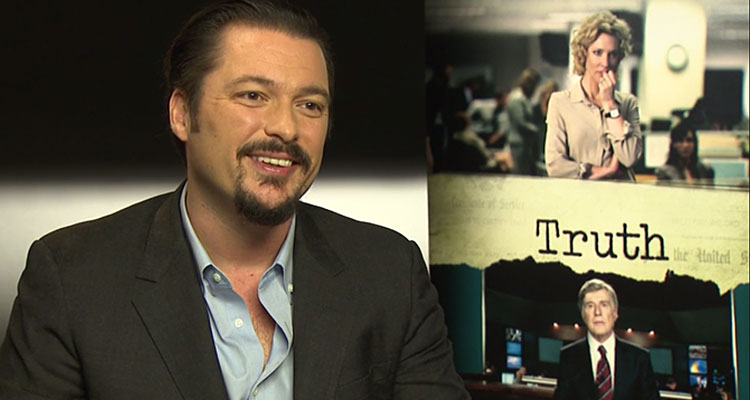
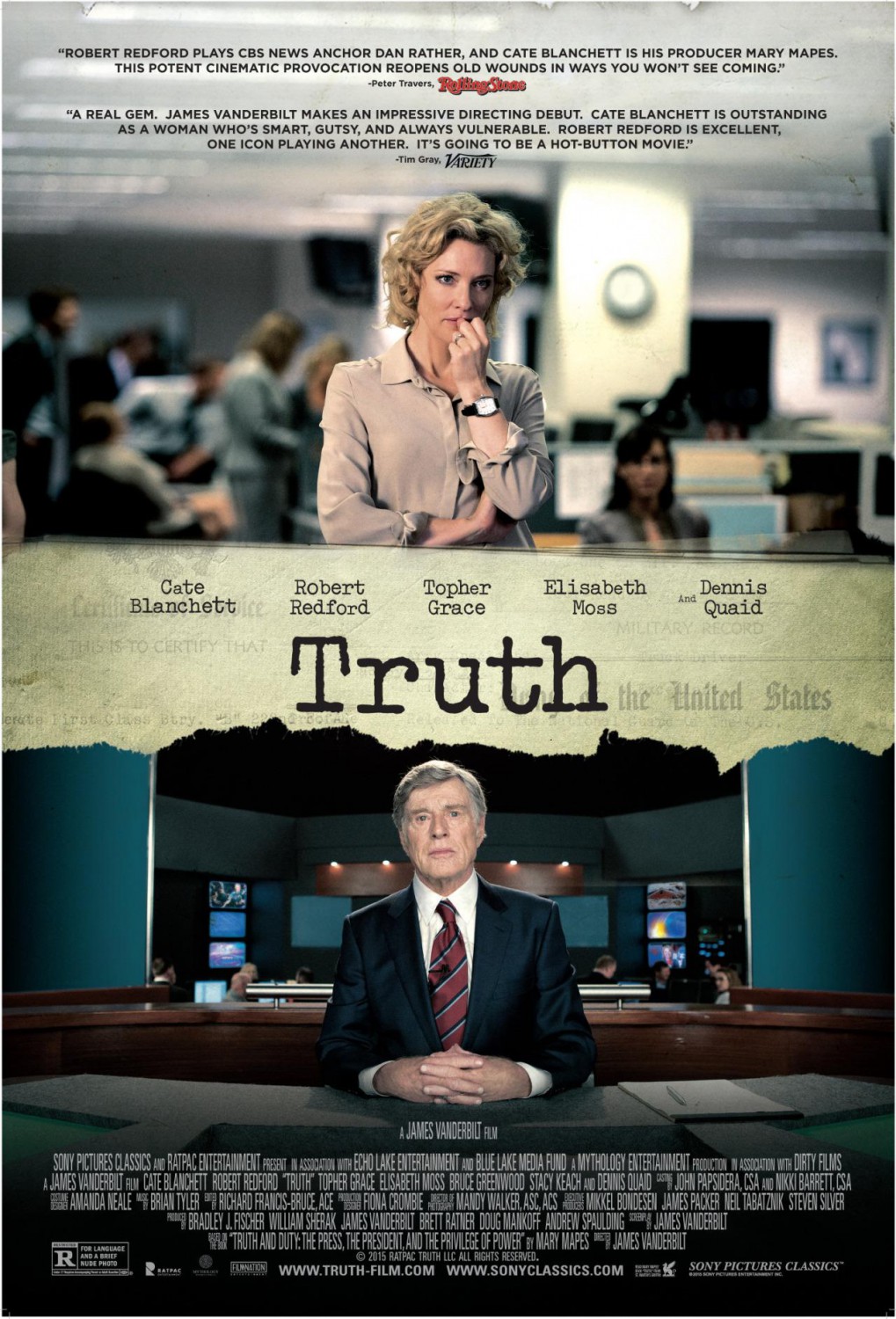
Vanderbilt now makes his directorial debut with “Truth,” the political docudrama about the 2004 “60 Minutes” news report on George W. Bush’s military service and the subsequent controversy which came to engulf it and destroyed several careers in the process. It is based on the memoir “Truth and Duty: The Press, The President and The Privilege of Power” written by Mary Mapes, a noted American journalist who was the producer of Bush news story, and she is played by Oscar winner Cate Blanchett. The movie details meticulously the research Mapes and her team did on this story and of how many came to sharply criticize the veracity of the information given. What started out as an expose of Bush’s service, or lack thereof, in the Texas Air National Guard becomes focused solely on the reporters involved to where broadcast journalism would never be the same.

I got to sit in on a roundtable interview with Vanderbilt at the Four Seasons Hotel in Los Angeles, California while he was in town to promote “Truth.” His desire to adapt this memoir into a film came from his infinite curiosity about broadcast journalism and how people in a newsroom work and put a story together.

truth-movie-poster

Ben Kenber: What made you decide that the time had come for you to step behind the camera to direct?

James Vanderbilt: I don’t know. Uh, foolishness? No, I was at a film school with all these people who really, really wanted to direct, and I always wanted to be a writer. It seemed like they were all looking at screenwriting as the stepping stone for the real job and so, being an angry young film student, I was totally resentful of them. Screenwriting is a craft and it’s got a great history, so I wasn’t the guy who was like “what I really want to do is direct.” I was lucky enough to have some films made and to produce some films and work with some really great directors, and watching them was actually the thing that made me go, I’d be curious to know if I could do that” Watching directors work with actors was actually the biggest thing which was fun for me to see and wanting to be a part of that, but as the writer and producer you want there always to be one voice to the actor. You never want the producer to come in and go, “You know what would also be great?” So, I always wondered if I could do that, carry the ball all the way down the field, and it came out of a very misguided desire to see if it would even be a possibility for me and if I would enjoy it.

BK: Did you enjoy it?

JV: I really loved it. I really loved every part of the process. It was just so exciting and fun.

BK: Doubt has become such a powerful tool over the years, and it really came down hard on this particular news story when it aired on television. Were you ever worried as a writer or as a director of getting caught up in that realm of doubt to where it was hard to distinguish between both sides of the argument?

JV: I don’t know about worried. We tried to present a bunch of different arguments in the film. It was important to us and important to me that the film was, although some might characterize it as trying to prove a point, not a film that’s trying to prove a point. What I love is seeing people come out of it discussing it and arguing about it, and that’s great to me. Seeing a married couple come out of it and one of them saying absolutely she should’ve been fired, and the other one going, “What are you crazy?” Apparently, I just enjoy discordant marriages (laughs). But the goal for me first and foremost was just to tell a really interesting story about this woman and what she went through and make it an emotional story. We didn’t want it to be homework. You want it to be a real tale and an emotional story. If audiences go on that journey and then maybe if they also think a little bit about media and where we are right now, all of that would-be gravy.

Enough time has passed since this “60 Minutes” news story premiered to where we should be able to view it more objectively, and “Truth” will give audiences a lot to think about as it is not so much about whether or Mapes got the story right or not, but of how much a casualty truth can be when it comes to presidential politics and personal bias.

“Truth” is now available to own and rent on DVD, Blu-ray, and Digital.

Knight of Cups

knight-of-cups-poster

Ever since he ended his decades-long hiatus with “The Thin Red Line,” Terrence Malick has been very prolific as he keeps putting out one beautifully poetic film after another. He also remains a filmmaker people either love or hate as his work leaves audiences deeply polarized. His seventh film, “Knight of Cups,” is unlikely to change the perceptions people have of him, but those who admire him will find much to take in. It’s also a film which has what many of Malick’s films lack: a straightforward narrative.

“Knight of Cups” takes its name from the tarot card which, when held upright, represents change and new excitements especially of a romantic nature, and it can mean opportunities and offers. When the card is reversed, however, it represents unreliability and recklessness and indicates false promises. But moreover, the Knight of Cups is a person who is a bringer of ideas, opportunities, and offers, and who is constantly bored and in need of stimulation. This person is intelligent and full of high principles, but he is also a dreamer who can be easily persuaded or discouraged.

The knight of Malick’s film is Rick, a Hollywood screenwriter played by Christian Bale. When we first meet Rick, he looks to be living the high life as he attends parties in Los Angeles which look as decadent as they come, but while he looks to be enjoying himself, those famous Malick voiceovers reveal him to be a lost soul who finds he is not living the life he was meant to. From there he goes on a journey to find an escape from the emptiness he feels and discover more about himself.

The film is divided into chapters named after tarot cards as Rick engages in relationships with different women as he searches for love and a sense of self. We also get to see the troubled relationships he has with his father Joseph (Brian Dennehy) who looks to have been driven insane by the hardships of life, and his brother Barry (Wes Bentley) whose life had been derailed by a drug addiction he has since gotten clean from. Throughout we get the usual Malick-isms of voiceovers, characters staring out into space and wanting to speak truthfully to those closest to them, and it’s all captured with a poetic beauty which continues to make Malick one of the more unique filmmakers working today.

Malick has the good fortune of working with the brilliant cinematographer Emmanuel Lubezki who just won his third Oscar in a row for “The Revenant,” and Lubezki captures the decadent landscapes of Los Angeles and Las Vegas with an inescapable beauty they don’t always have in reality. But he and Malick also capture the banality of them which quickly infects Rick’s soul, and the scenes where Bale is swimming in the violent ocean and wandering through a barren wilderness illustrates how inescapable his loneliness is.

It is said Malick shoots his films without a screenplay and instead gives the actors a storyline to improvise off of. This puts actors on an emotional tightrope which challenges them in ways they don’t often get challenged on, and the cast of “Knight of Cups” more than rises to the occasion. Bale is one of those actors who never backs down from any acting challenge given to him, and he gives yet another compelling performance in a career full of them. It’s also great to see Brian Dennehy here as this is the kind of film role we don’t always see him in, and it serves to remind us of how powerful an actor he can be when given the right role.

The movie also features a number of remarkable actresses playing the various lovers of Rick, and they all stand out in their own individual ways. Cate Blanchett, Australia’s answer to Meryl Streep, plays Rick’s physician ex-wife who still feels a connection to him even though she can’t quite get through to him. Imogen Poots rivets as the rebellious Della, Teresa Palmer makes Karen a most spirited and playful stripper who can seduce anyone with what seems like little trouble, and Frieda Pinto is the definition of serenity as Helen.

But one performance I was especially impressed with was Natalie Portman’s as Elizabeth, the woman Rick had wronged. After all these years, Portman remains a wonderfully vulnerable actress who is incapable of faking an emotion. She makes you feel the pain Elizabeth goes through, and you can’t take your eyes off of her for one second.

“Knight of Cups” proves to have a more straightforward narrative than Malick’s other films, and that’s saying something. His last film, “To the Wonder,” was good, but it meandered all over the place as he couldn’t decide which story was the more important one to tell. This time, however, he manages to stay with Rick and his romantic adventures for the majority of the film’s running time. It does veer off slightly when we get introduced to Antonio Banderas who plays the ironically named Tonio, a playboy who loves the company of more than just one woman. Considering Banderas’ recent stormy divorce from Melanie Griffith, his part in this film feels a bit voyeuristic as it seems like he is simply playing himself and explaining why his marriage to her fell apart.

“Knight of Cups” doesn’t reach the cinematic heights of “The Tree of Life” or “Days of Heaven,” but it is still a must for Malick’s fans as few other filmmakers can make a movie the way he can. Some will call it self-indulgent and complain it focuses on individuals who have it a lot better than the working class of America, but for those who relate to the journey Rick takes here, it is an immersive experience which leaves you guessing as to the possibilities open to him at the film’s conclusion.

It’s also worth watching to see characters drive their cars on the empty roads of Los Angeles at night. Anyone who lives in Los Angeles knows the roads are never that empty during the day, so it’s nice to know they are not always a traffic nightmare.

* * * ½ out of * * * *