“The widespread use of drugs is a symptom of a sick society. The war on drugs is bullshit. Especially since the CIA is one of the biggest dealers around.”
-David Byrne in 1992
I don’t think it’s any secret our government, let alone any government in the world, was at one time or another complicit in drug dealing. It’s not like we don’t treat as if it’s no big thing, it’s just that we have gotten so used to it to where many don’t bother to acknowledge or do anything about it. But one man, Gary Webb, did not hesitate to expose the CIA for its involvement in drug smuggling back in the 1980’s, and he ended up paying the ultimate price for telling the truth.
“Kill the Messenger” is one of many movies which is “based on a true story” or “inspired by actual events,” but it deals with a story which needs to be told. Gary Webb was a reporter for the San Jose Mercury News, a newspaper not known for doing international stories until he came along. We watch as he stumbles across a story dealing with the shady origins of the crack epidemic which spread throughout the nation’s inner cities, particularly in South Central Los Angeles. His investigation into the matter led him to discover how, in order to raise money for the fight against the Nicaraguan Sandinista Government, the CIA supported the cocaine smuggling of top members of Nicaraguan Contra Rebel organizations. When Webb published his articles on this story, which later became the basis for his book “Dark Alliance,” he won a lot of praise for his work, but then the roof caved in.
It’s no surprise the CIA came down hard on Webb as they began to conduct a vicious smear campaign on him which included veiled threats against his life. But what really stunned me was how rival newspapers went after him with a vengeance as he broke the story before they ever had a chance to investigate it. The Washington Post in particular hated how Webb broke the story as they were known for being first to report stories on the United States government, and their attacks on his credibility became more about protecting their own integrity as opposed to pursuing the truth. Taking this into account, it gives the audience an idea of just how cutthroat the newspaper business can be. As for myself, it makes me wonder if there is any business on this planet which is not cutthroat.
Playing Webb in “Kill the Messenger” is Jeremy Renner, and his performance here ranks among his best. He doesn’t try to make Webb a heroic character but instead a regular, ordinary man who does the job he is hired to do, and he does it really well. Renner makes us revel in Webb’s victories and feel for him when the whole world, even his own newspaper, suddenly turns against him. Not once does the actor overplay his role, and that he is able to keep Webb so grounded here is one of the things which makes “Kill the Messenger” work as well as it does.
Rosemarie DeWitt also shines as Webb’s wife, Susan. This could have been a throwaway role with DeWitt being left with little to do other than beg her husband to stop pursuing this story, but the actress makes Susan into the conscience Gary desperately needs through the toughest of times. Like Renner, DeWitt keeps the character grounded in a reality we can all relate to as she tries to make sense of a situation spiraling out of her husband’s control.
Directing “Kill the Messenger” is Michael Cuesta who also directed the powerful “L.I.E.” which the MPAA just had to give an NC-17 rating to for the most inexplicable of reasons. Could he have gone deeper with the subject matter that inspired this movie? Perhaps, but he makes a very good case for why we should be infuriated over why people were more interested in burying Gary Webb than they were in confronting how our government knew about and participated in the drug dealing being conducted on American soil.
Is this movie historically accurate to what actually happened in real life? I don’t know and I don’t care. Most movies based on true stories take liberties with the truth for dramatic purposes, and I doubt “Kill the Messenger” is an exception to that. What matters to me is this movie tells a compelling story which keeps you involved from start to finish, and Cuesta has given us just that. For those interested in getting to the absolute truth, try reading Webb’s “Dark Alliance” and Nick Schou’s book of the same name. This movie was based on both of those books.
“Kill the Messenger” joins the company of movies like “The Insider” and “Good Night and Good Luck” which are about people who decide to tell the truth and get punished for it in varying degrees. These days it seems like there are larger numbers of people who are more interested in their own monetary gain than they are in exposing wrongdoings. Webb’s story is one which deserves to be told as it is about a man whose job was to get to the truth of things, and the fact he was dragged through the coals because of that is one of the many unnecessary reminders of how unfair life can be. But in the end, he was vindicated, and this movie stands as a strong tribute to what he accomplished.
* * * ½ out of * * * *
Check out the video below where I interviewed Jeremy Renner and Rosemarie DeWitt.
Tim Burton’s unique talents as a filmmaker have floundered in recent years with his abysmal remakes of “Planet of the Apes” and “Alice in Wonderland” which was lacking in wonder. But with “Big Eyes,” he gives us his best and most human movie in a long time as he examines the life of American artist Margaret Keane whose paintings of children with oversized, doe-like eyes became very popular in the 1950’s. It reunites Burton with his “Ed Wood” screenwriters Scott Alexander and Larry Karaszewski who have provided us with some of the most unique biopics in recent memory like “The People vs. Larry Flynt” and “Man on The Moon.” Yes, it is based on a true story, but for once it helps to know this as the movie is a tale which proves there are things much stranger than fiction.
“Big Eyes” starts with a narrator saying the 1950’s was a good time if you were a man. This certainly seems to be the case with Margaret Keane (Amy Adams) as she is in the process of leaving her husband and drive herself and her daughter Jane out to San Francisco to start all over again. This decade had women relegated to the role of housewife, and they could do very little else as feminism had yet to become a movement. Margaret has trouble finding work until she gets a job at a furniture company painting baby cribs. At the same time, she is quite the painter who paints pictures of children, most of which resemble her daughter, that stand out because of the big eyes she gives her subjects.
While at an art sale, Margaret meets Walter (Christoph Waltz), a fellow painter who quickly becomes enamored of her and her paintings, and he quickly begins to encourage her not to sell herself short. They soon fall for one another and get married, and they become determined to sell their art to the masses. When their attempts to get their work hung up at art houses fails, Walter resorts to renting the walls at The Hungry I club owned by Enrico Banducci (Jon Polito). It is there the paintings begin to gain notice, but patrons are far more interested in Margaret’s work than they are in Walter’s. In the process, Walter starts to take credit for his wife’s paintings, and this is where things take a rather interesting turn.
Margaret is repulsed at first by the idea of Walter taking credit for her work, but she finds herself giving in to him as he promises to give her everything she ever wanted in life like a big house to live in. But as the popularity of the paintings grows, a rift forms between them as Margaret ends up residing in the background while Walter takes center stage at various talk shows and public engagements. Soon, Margaret goes from being timid to becoming a very determined person as she aims to reclaim the art she created.
What happened between Margaret and Walter Keane became the story of one of the most epic art frauds in history, and I have to admit I was not aware of this piece of history before I saw “Big Eyes.” If this story were presented to me as fiction, I’m fairly certain I would not have bought it as this story would have been far too bizarre to be the least bit believable. But these events did happen, and Burton’s strong affection for Margaret’s work is definitely on display here.
I’m so glad Alexander and Karaszewski are still getting away with making these renegade biopics about individuals who might otherwise not get cinematic treatment. The fact they brought this particular story to the big screen is extraordinary as it involves an act of plagiarism which didn’t take place in Hollywood. It sounds like a typical good guy/bad guy story, but the way the story develops shows this to not be the case.
Adams is her usually remarkable self as she takes Margaret Keane from the depths of isolation and bitterness to the heights of confidence and self-assertion. She also presents Margaret to us with flaws and all to where we respect her deeply even if some say she put herself in the position of having her work stolen. The 1950’s may have not been the best time for women, but the victory Margaret achieved opened doors for them to where they would never ever be held back by the role society expected them to play.
Waltz won his two Oscars for good reasons as he portrayed his characters in Quentin Tarantino’s “Inglourious Basterds” and “Django Unchained” with such relish. His performance in “Big Eyes” proves to be equally wonderful as he makes Walter into such a charismatic figure to where it’s no wonder Margaret falls under his spell. While his character is essentially the bad guy of this piece, Waltz does give Walter some empathy as his actions result from a rather unconscious need for approval in a world which has deemed him a fair artist at best. While we can’t condone his actions, we can certainly understand where his motivations come from.
For Burton, “Big Eyes” is a return to the low budget roots he started out in. While it may not feel like the typical Burton movie along the lines of “Beetlejuice,” “Edward Scissorhands” or even “Batman,” it’s certainly his most heartfelt movie in a long time. He recreates the San Francisco many of us know from the 1950’s and 1960’s, and he shows us how Walter succeeded in commercializing art to where it became available at all the local supermarkets. But at the heart of it all, “Big Eyes” fits in with the kind of stories Burton loves to tell; of outsiders who are seen as far too different to succeed in popular culture.
“Big Eyes” falters a little towards the end as Walter starts to come across as less complex and more of a one-dimensional bad guy the audience understandably wants to see go down. Part of me wanted to see Burton delve a little deeper into his psychology as making him the typical bad guy in this movie seemed much too easy. Still, it makes for a very entertaining courtroom scene where both he and Margaret fight for the right to Margaret’s work like never before.
It’s heartening to see Burton give us such a heartfelt motion picture like “Big Eyes” as his last few movies kept taking away from his distinct talent as a director. Even with a lower budget than what he is used to working with, he still gives us a wondrous if roughened up look at an artist caught up in a real-life situation which threatens to rob her of the work she created. Here’s hoping we see more movies like this from Burton in the near future.
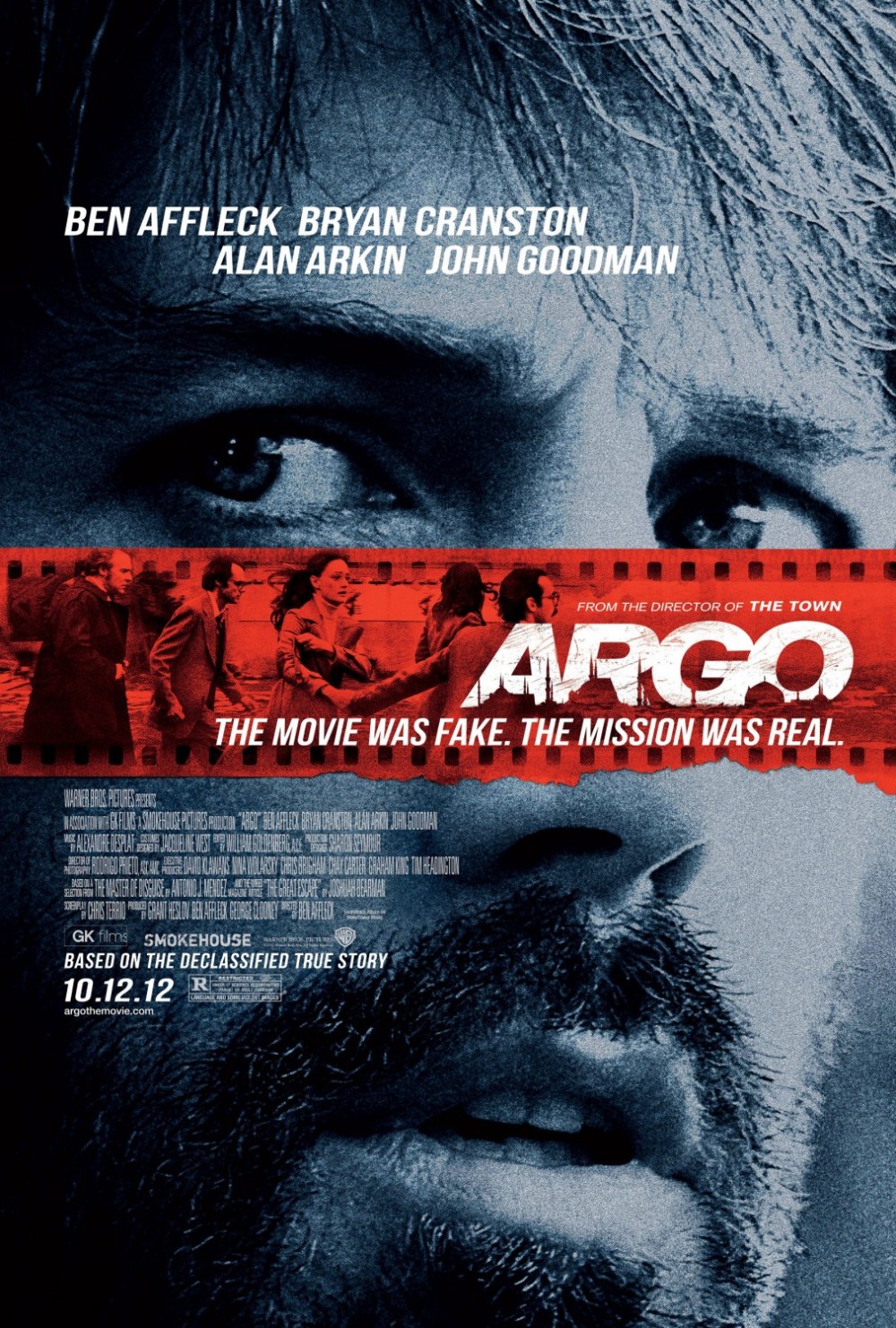
After the one-two punch of “Gone Baby Gone” and “The Town,” Ben Affleck should not have to prove what a great movie director he is. But for those who, for some utterly bizarre reason, still believe they need further evidence to support this conclusion, I give you “Argo.” His third movie as a director tells the story of how CIA specialist Tony Mendez went about trying to extract six U.S. diplomats out of Iran during the 1979 hostage crisis. It proves to be a very intense experience watching this movie, and I also got a huge kick over how it skewers Hollywood and the business of making movies as well.
I loved how Affleck really went out of his way to make “Argo” look like a 70’s movie. He even included the old Warner Brothers logo (referred to as the “Big W” logo) which preceded the studio’s movies from 1972 to 1984. I’ve really missed this logo for the longest time.
Anyway, when Iranian revolutionaries ended up storming the U.S. embassy in Tehran, six diplomats manage to evade capture and find refuge in the home of Canadian ambassador Ken Taylor (Victor Garber). Meanwhile, back in the United States, the State Department has learned of the escapees and their predicament, and they start looking for ways to get them out of Iran. It is Mendez who comes up with the idea, after watching “Battle for the Planet of the Apes” on television, to create a cover story of how the six are actually filmmakers from Canada who are scouting locations for a fake sci-fi movie called Argo. This looks to be one of those “so bad it’s good” kind of movies, and it would have been fun to watch for all the wrong reasons had it ever been made.
The scenes where Mendez goes to Hollywood are among my favorites in “Argo” as he works with movie business veterans who are keenly aware that lying to others is part of their job description. John Goodman and Alan Arkin are priceless as make-up artist John Chambers and film producer Lester Siegel, and they are given great pieces of dialogue to speak throughout. The lines Arkin is given are especially biting:
“You’re worried about the Ayatollah? Try the WGA!”
The tension is then ratcheted up tremendously when Mendez heads over to Iran to prep those six diplomats on how to get out of the country alive. You feel their collective anxiety as they become fully aware of how one little slip up will get them quickly executed in public view, and you are with them every step of the way as the walls continue to close in on them. Emotionally speaking, “Argo” is the first movie I have found myself crying after in a long time, and the tears I cried were from sheer relief.
“Argo” is based on a true story and, while this remains a serious pet peeve of mine, this is one which needed to be told. It wasn’t until 1997 that this rescue operation was declassified for all the world to know about, and it speaks a lot about how two countries can come together in a tough situation (in this case, the U.S. and Canada). Yes, portions of the story were fictionalized for dramatic purposes, but that’s always the case so just get over it.
Affleck casts a lot of great acting veterans in “Argo,” and kudos to him for doing so. I’ve already mentioned Goodman and Arkin, but you will also find Bryan Cranston, Kyle Chandler and Philip Baker Hall doing terrific work here as well. As for the diplomats, they are played by such actors as Clea DuVall and Tate Donovan among others, and they all are uniformly excellent.
In addition to directing this movie, Affleck also stars as Mendez and gives a particularly understated performance. I know we all love to pick on him as an actor, but he’s a better one than we give him credit for. Not once does Affleck try to steal the show from the actors around him, and his work is commendable as acting and directing a movie at the same time can be a real pain in the ass.
“Argo” has more than earned its place among the best movies of 2012, and it makes clear that Affleck’s success as a director is no fluke. This is a guy who has seen the heights of success and the utter embarrassment of failure, and he has come out the other side of it all proving he is a great talent whether he’s in front of or behind the camera.
Be sure to stay through the end credits as well as there is information you will need to hear about this true story.
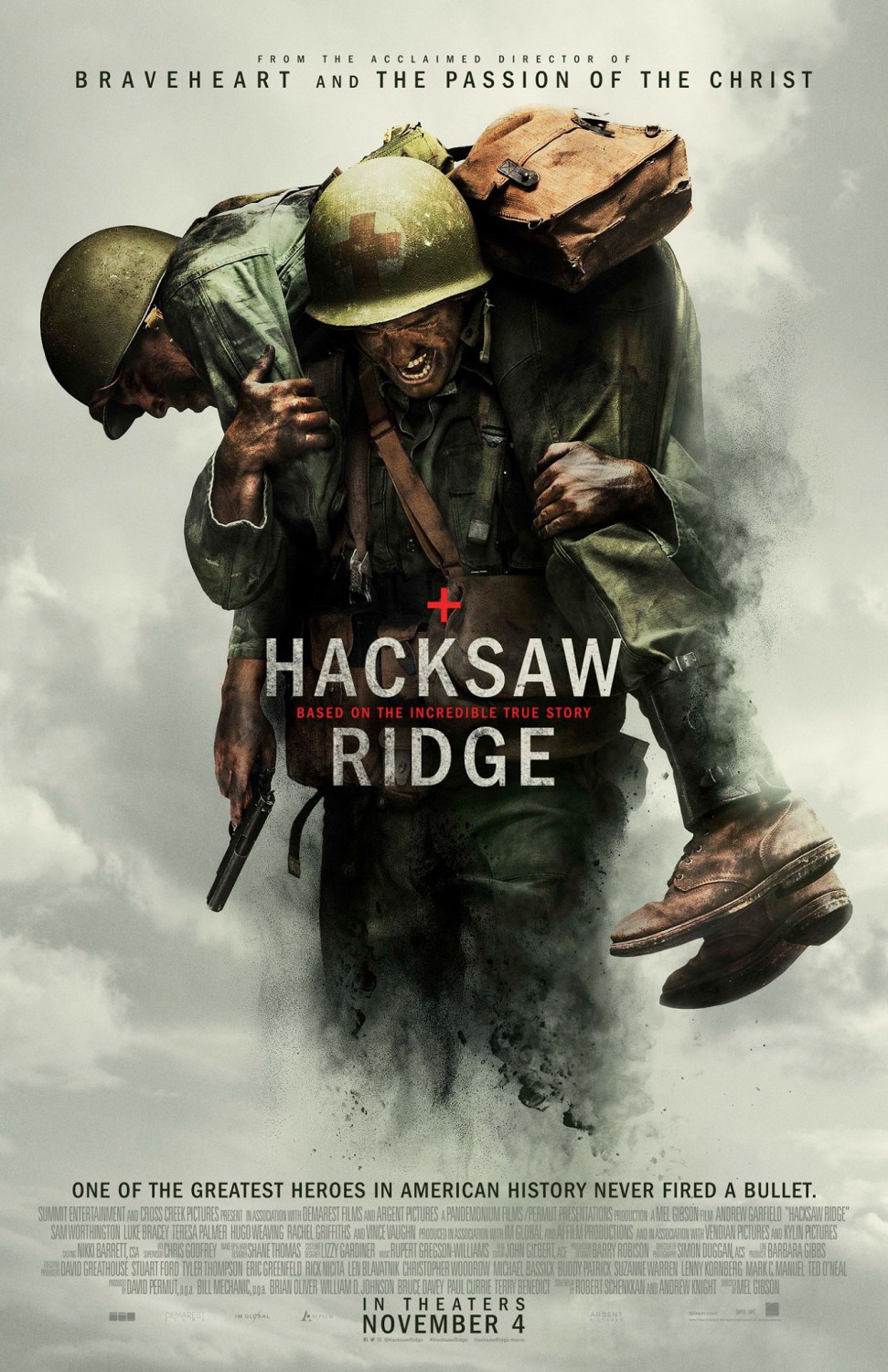
I want to start off first by applauding director Mel Gibson for using the term “A True Story” as opposed to “Based on a True Story” when he starts off “Hacksaw Ridge.” You all know how much I have come to despise the term “Based on a True Story” as it has long since lost its meaning, and I have to give credit to Gibson for altering this phrase here. As a director, you know he’s not about to take the easy way out or give us something which feels emotionally false. This continues to be the case with “Hacksaw Ridge,” his first directorial effort in ten years.
This movie tells the story of Desmond Doss, a Seventh-day Adventist Christian who joined the Army in World War II to serve as a medic. The only thing is, he joins as a conscientious objector and refuses to carry a weapon of any kind into the battlefield. At the Battle of Okinawa, he succeeded in rescuing 75 wounded soldiers without firing a single shot, and he was later awarded the Medal of Honor for his acts which went above and beyond the call of duty.
Desmond is played as a young adult by Andrew Garfield, and he is very deserving of the Oscar nomination he received for his performance. From start to finish, the British-American actor imbues Desmond with an unshakable faith in a higher power, and I never saw this faith waiver for a single second. Seeing him square off with a fellow soldier who assumes he is a coward for not picking up a rifle is fascinating as Garfield’s eyes emit a hard-won bravery the others around him only think they possess. This even comes across as he pursues Nurse Dorothy Schutte (the luminous Teresa Palmer) as obsessively as Dustin Hoffman chased Katherine Ross around town in “The Graduate” to where you wonder if anything could stand in Desmond’s way at all.
We all know Gibson is a devoutly religious person, and not just because he made “The Passion of the Christ.” Indeed, “Hacksaw Ridge” could have easily looked silly if it took its subject far too seriously or tried to indoctrinate us or push some agenda, but Gibson doesn’t make those mistakes. The director treats Desmond with the respect he deserves, and he was clearly determined not to make him look like a joke. Desmond was the real deal, and he found the perfect actor to portray him in Garfield.
Gibson also wades through a wealth of war movie clichés which do take away from the final cut, but the scenes are elevated by a number of strong performances from a well-chosen cast. Hugo Weaving of “The Matrix” and “Lord of the Rings” fame (“Welcome to Rivendale, Mr. Anderson”) is a big standout as Desmond’s father, Tom. Being a war veteran himself, Tom has seen the vicious damage it has done to the soul and the psyche. Weaving makes Tom more than the average abusive drunk you see in cinema as he shows his character’s pain over the memories he can’t drink away, and of the terror he wishes to keep his sons from experiencing themselves.
Rachel Griffiths provides the yin to Weaving’s yang in her performance as Desmond’s mom, Bertha, who enforces in her son the importance of God’s commandments, especially the one which states “thou shalt not kill.” She also gives Bertha a strong gravitas which Garfield benefits richly from as the movie goes on, and you can see how her presence remained a strong one in Desmond’s life.
Then there’s Vince Vaughn who gives his best performance in quite some time as Army Drill Sergeant Howell. While his work may pale in comparison to R. Lee Ermey’s brutal performance in “Full Metal Jacket,” at least Vaughn invests Howell with a strong dose of human you wouldn’t often expect characters like these to have in war movies.
But the real meat of “Hacksaw Ridge” comes in the last section during the battle sequences. Now Gibson might not be able to match Steven Spielberg’s powerful realism when it came to those unforgettable opening minutes of “Saving Private Ryan,” but he tops him when it comes to bloody carnage. Bullets fly everywhere, limbs are blown off and guts are laid out for rats to chew on. This should be no surprise as this movie comes from the director of “Braveheart,” “The Passion of the Christ,” and “Apocalypto,” and like those movies, it features a protagonist who has to wade through body parts and blood in order to receive any kind of salvation.
Along with director of photography Simon Duggan, Gibson gives us some of the most visceral and best war movies I have seen in a long time as he shows you the damage war leave in its wake as well as what it does to the souls of those in the front line. It also gives a real-life superhero who selflessly risked his life to help those who could no longer help themselves. While certain sections are undone a bit by an innate corniness which comes with unavoidable clichés, Gibson gives us a war movie for the ages which, in the wrong hands, could have become silly and heavy-handed, but in his, it becomes a celebration of a man who saved so many without even firing a bullet.
“Hacksaw Ridge” had been in development hell for 14 years, and the rights to it were at one point in the hands of Walden Media which wanted to turn Desmond’s story into a PG-13 movie. Something tells me this would have been a mistake as sanitizing the struggles of war would have been an insult to those who fought for our freedoms. Yes, this is an ultra-violent motion picture, but for good reason. Could we have appreciated what Desmond without having a clear view of the chaos he and other soldiers put themselves into? I think not.
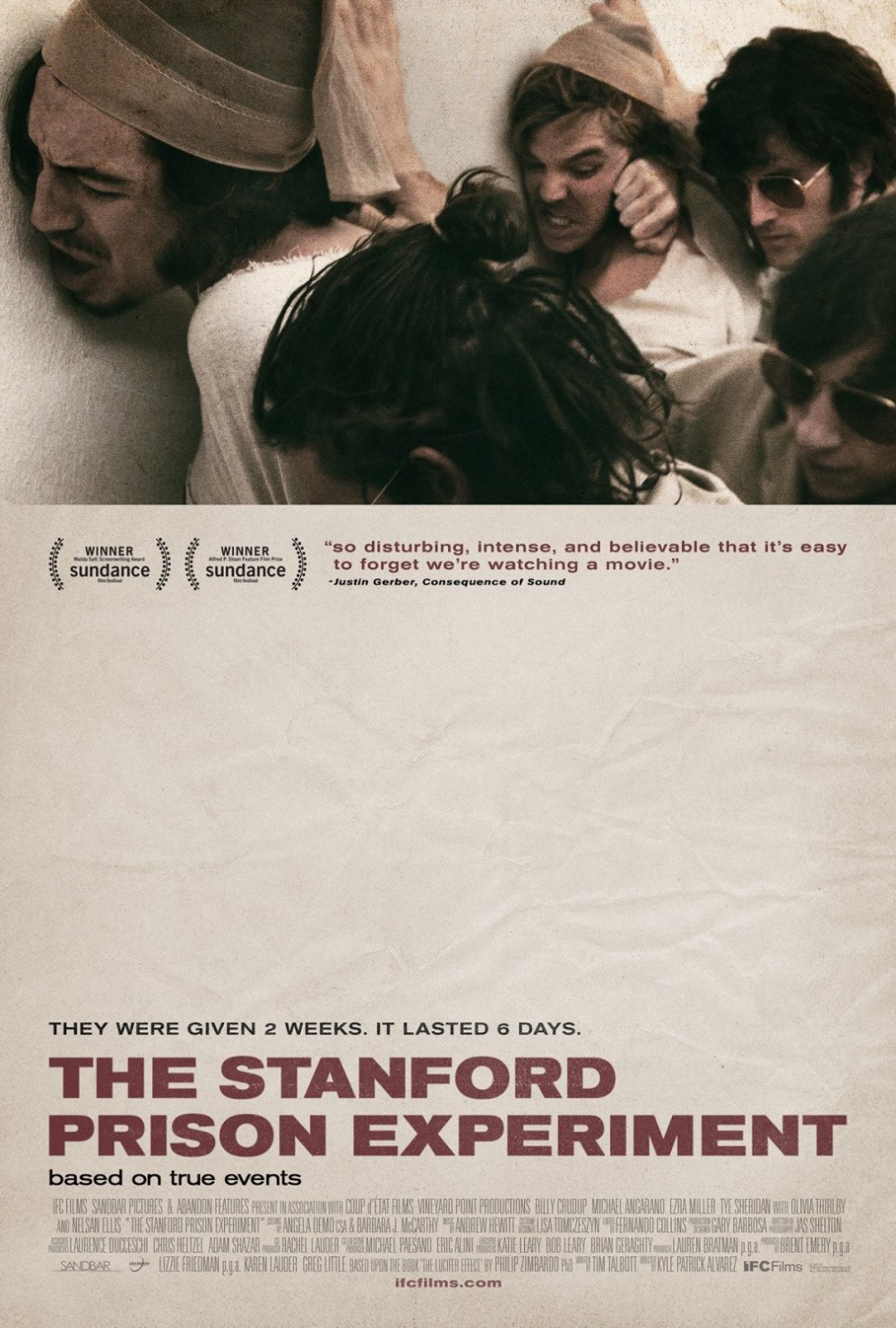
Kyle Patrick Alvarez’s “The Stanford Prison Experiment” takes us back to the year 1971 when psychology professor Philip Zimbardo (played in the movie by Billy Crudup) conducted the infamous experiment which had 24 students playing the roles of prisoners and guards in a makeshift prison located in the basement of the school’s psychology building. Things start off well, but the experiment soon goes out of control when the guards become increasingly abusive to the prisoners, and Zimbardo is unwilling to stop their brutality as he is infinitely curious to see what it will produce. Zimbardo was out to test his hypothesis of how the personality traits of prisoners and guards are the chief cause of abusive behavior between them. The experiment was supposed to last fourteen days, but it ended after 6.
What results is one of the most intense moviegoing experiences from the year 2015 as a cast of actors including Ezra Miller, Tye Sheridan, Michael Angarano, and Logan Miller find themselves caught up in the experiment’s grip to where the line between reality and fiction is completely blurred. Whereas previous films have observed this experiment from an academic standpoint, this one observes it from an emotional one.
I got to talk with Kyle while he was in Los Angeles to promote “The Stanford Prison Experiment.” His previous films as writer and director were “C.O.G.” in which a cocky young man travels to Oregon to work on an apple farm, and “Easier with Practice” which tells the tale of a novelist going on a road trip with his younger brother to promote his unpublished novel.
Ben Kenber: “The Stanford Prison Experiment” is one of the most movies you don’t watch as much as you experience.
Kyle Patrick Alvarez: I’m finding that out, yeah (laughs).
BK: There are only so many movies you can say that about. “Deliverance” is a good example of that.
KPA: I was really humbled. When the movie first played I think the first question at the Q&A was, “Did you feel like this movie was an experiment on the audience?” I was so taken aback by the question not in a negative way, but because no one had seen the movie before. I was actually working so hard to not overburden the audience with the story. We even tempered it down a lot. They were stripping guys by the end of day one. I think by the end it’s supposed to become burdensome to watch, and I embrace it now that that’s the reaction, but I didn’t know that that was going to be the case. So the first time the movie screened I was like. okay, it is playing this way to people and I know I can just embrace that now which is good. I hope not every movie I make is like that, but hopefully the movie earns it and then people appreciate the challenge of the experience of watching it.
BK: I remember hearing about this particular experiment while I was in a psychology class in college, and we even watched a documentary about it as well. The one thing that stood out to me the most was when the prisoners started saying “prisoner 819 did a bad thing,” and they kept saying it over and over. I kept waiting for that moment to come up in this movie.
KPA: Oh yeah. I felt like that was one of the really iconic things that you hear. You can hear it over and over and over again in your head, and I think we even joked at one point that they could release a teaser that was just that over and over again. That was interesting to me. As I read the script I had all these things that seemed larger than life, and when you read about it or saw the footage you’re like oh these things really did happen. The Frankenstein walk, to me, is so bizarre and so odd, yet it’s a real thing. To try to make a film that embodies that sort of spirit was hopefully the aim.
BK: This movie is “based on a true story,” but you didn’t use that phrase at the start of it. I was glad you didn’t because this phrase has long since lost its meaning.
KPA: I kind of fought for that a little bit actually. My whole argument was that marketing is going to say it no matter what. I’m a firm believer that you want the movie to stand on its own regardless of marketing, but at the same time I just don’t know anyone that would go to a movie called The Stanford Prison Experiment and not know anything about it and not know it was based on a true thing. I talked about it when I first got involved in the film that “based on a true story” means nothing anymore. The movie I was using for an example was the one where Eric Bana plays a cop who is hunting demons in New York City (“Deliver Us from Evil”), and the trailer says it was “based on a true story.” There are demons in New York; we know this as fact, right? There are not people who hunt demons in New York. Maybe there’s someone who said he does once, but that doesn’t mean it is based on a true story. So, it just doesn’t mean anything to people anymore and it doesn’t carry any weight or value. I tried to think of some other vernacular it could be. I didn’t want it to be like this is a true story because then that says everything in it is true, which is a lie. As soon as you make a movie on anything, nothing in it is true anymore.
BK: With movies based on real events there are dramatic liberties taken, but with this one it sounds like that wasn’t entirely the case.
KPA: I think we reduced the dramatic liberties quite a bit. I think if you look at a movie, for example, like “Lincoln” which takes voting public record and changes it. I don’t mean to slam the film, I like the film quite a bit, but when they’re voting they change the numbers to make it more suspenseful. I don’t think we took any liberties anywhere near that extreme. Maybe some people who were in the experiment could argue that it wasn’t really that intense or something like that. Others may argue that the intensity comes from putting the camera in their faces or the artistic representation of it. Two of our biggest liberties are when Ezra (Miller) and Brett (Davern) escape the prison. In real life the guy really did take a panel off. He was a guitar player and took the panel off with a sundial, broke the lock and I think they tried to open a door, but a guard was there and admonished them and told them that they had to fix the lock. We added an extra couple hundred feet. When we were doing that we said that we were gonna add this chase sequence because the movie needs to breathe and open up a bit. I thought Tim (Talbott) had done a really good job with that in the script. But then when Phil (Zimbardo) comes around and the other guys, there’s a reason we never see them touch them because they didn’t. That was where we were embellishing a little bit for the sake of the narrative, but we’re not abandoning the fundamentals of what this experiment was about. Those guys did not touch them or physically harass them so we didn’t show that, and having Phil involved was a really good and constant reminder of what those fundamentals are that we shouldn’t change. The ending, when they called it off, actually Phil and Christina kind of said that they needed to call this off and they came up with a plan to do it professionally. For me, you show that and there is an anti-climactic nature to that. I think the emotions are real and that they were being felt, and we just put them in at different times for the ending. I was really interested in making a film that could hold up. If you sit down and watch the documentary “Quiet Rage,” you will go oh, that is actually pretty similar. I didn’t want to make a movie that would replace that or replace “The Lucifer Effect.” I wanted to make a film that would work in tandem with those where it would feel like you could gain something a little more emotional and different than if you just did the academia side.
BK: The actors are all fantastic in the movie and they each give very intense performances. Watching them made me wonder if the movie was an experiment on them.
KPA: In a weird way, I almost wish I had this story to make interviews more exciting about these kids became their characters and I became like Zimbardo. But the truth was I think I was actually overtly aware of that potential, and actually it would have worked so hard against us. If you ask any of the guys, they will say that they had a lot of fun. You only have two options: either go down the path where everyone has fun and everyone gets along, or you gotta push it to go really extreme. I am not a big manipulator. If an actor wants me to manipulate them I will work with that, but on this film it was one of those things where it’s like when the camera’s rolling we’re on, and when it’s off be respectful. Some guys might need more space and might want to stay in character a little bit more, but it never took on the form of the experiment. We did spend two and a half weeks in that hallway, and we were sick of the hallway. We were ready to be done. Sure, some feelings were created, but I told them everyone every day that this is like a soccer game where we all shake hands at the end. So if something is going on that you’re not comfortable with, just say it. I said that probably more to the guards than the prisoners, but once it came down to doing those few physical things in the movie the actors loved it. Nick and Ezra had worked together before so they already respected each other, and they would just run through their scenes and had such a blast. For me, in a weird way we actually worked against that, and I think consequently the actors look back on it very fondly. I also think we got, for the nature of the movie and the tight shooting schedule, better stuff from them because they just felt more invigorated. I would just love to be able to build a career out of actors having good experiences. That’s my favorite party of the process, working with actors. I admire what they do so much because I never could, so it’s honoring that by working to each person. But this is the first time I ever did an ensemble piece and it was a little more about telling them hey this is what it’s going to be like, hey it’s not going to get out of control, guards you are going to follow the script and if you want to push something a little bit more than we’ll talk about it as opposed to unleashing them. There have been previous iterations of this project where that had been the aim where they try to create this potboiler environment where the actors really lose it, but I think what you get with that is more of a machismo quality. I jokingly refer to it as the David Ayer effect. I like his movies so it’s not a slam on them at all, but he’s making testosterone and there’s no doubt about it. I actually was more interested in making the inverse of that. The set was like a frat house, but the aggression was coming from a more complicated place. There wasn’t any actual physical violence. When you look closely at the movie there is no drop of blood other than one or two moments. No one was physically hurt, and so we were really careful to honor that while still creating tension.
BK: One interesting scene is when Ezra Miller’s character gets arrested as part of the experiment. He treats it like it’s no big deal at first, but then the cops slam his head on the car and his mood changes instantly.
KPA: They really did get real cops and they said arrest these guys like they are really criminals. This is something we didn’t have the money to shoot, but they actually took them to the police station and fingerprinted them and booked them and took photos of them and everything. They really put them through this simulation and it really got to them. The cops were really putting paper bags on their heads. Someone criticized the film once saying that they used too much on the nose imagery from Abu Ghraib, specifically referring to the bags. I was like no, no, no, Abu Ghraib just did the same exact thing.
BK: It seems like certain audience members need to be reminded that the Stanford Prison Experiment took place long before Abu Ghraib.
KPA: Oh yeah. It’s one of those stories that’s too bizarre to be true. It’s hard to accept that it was true. I knew there was no way to succeed 100% on this but I tried to work the hardest to make a film that didn’t just always say, “Well it really did happen.” That’s not enough of an answer when you make a movie like this because you have to make the audience feel like it could have happened. I wanted it to be like, “Well I understand why it happened.”
BK: By the time the movie gets to day three, it feels like we have been with these guys for a month.
KPA: Yeah (laughs), that’s how they felt too. They really did not know how many days had passed. They weren’t sleeping which I think was the biggest thing. You can go 36 hours without sleep when you start to legitimately lose your mind, and I think that’s a huge part of what happened.
BK: The Stanford Prison Experiment was supposed to last two weeks, but it ended up being shut down after 6 days. Some have said that it wasn’t because the experiment wasn’t successful, but that it was too successful. Would you say that was the case?
KPA: I think once you talk about success of the experiment you start to bring into the question its true purpose and its ethics. I was really interested in pushing questions of things like that in the movie. At the same time, I didn’t want to fall into the question of, was this okay? People are still arguing the exact same things, so I figured we are never going to solve this. 40 years later people are still arguing whether this experiment succeeded or not or whether it should have never have ever been done in the first place. What we do know now is that the experiment would never be allowed to happen today. It was military financed. Partly because of the experiment, there are so many more checks and balances in place. When I first sat down with Billy (Crudup), one of the things he said was, “How could everyone be so naïve to not realize this would happen?” And I said, “Well of course, they could have because it hadn’t happened yet.” Now it’s easier for us to go, “Well, of course, it would have gone wrong. What were they thinking?” They were doing experiments like this all the time; simulations or recreations. This was just part of what psychologists were doing at the time. This was the time it just really imploded.
BK: That’s a good point. Ever since then we have a better understanding of the power dynamic between prisoners and guards more than ever before.
KPA: Yeah, and that’s why I added a line at the end when Billy is talking to the camera. He says, “There was no sense of precedent. We didn’t know this was going to happen.” I thought that was a really important element.
I want to thank Kyle Patrick Alvarez for taking the time to talk to me. “The Stanford Prison Experiment” is now available to own and rent on DVD, Blu-ray, and Digital.
James Vanderbilt has been a prolific writer and producer in Hollywood for several years. His screenplay credits include Peter Berg’s “The Rundown” which remains one of Dwayne Johnson’s best action films, David Fincher’s “Zodiac” which was about the notorious serial killer who terrorized San Francisco back in the 1970’s and Roland Emmerich’s “White House Down” which dealt with terrorists attacking the White House. In addition, he was a writer and producer on “The Amazing Spider-Man” movies and “Independence Day: Resurgence.”
Vanderbilt now makes his directorial debut with “Truth,” the political docudrama about the 2004 “60 Minutes” news report on George W. Bush’s military service and the subsequent controversy which came to engulf it and destroyed several careers in the process. It is based on the memoir “Truth and Duty: The Press, The President and The Privilege of Power” written by Mary Mapes, a noted American journalist who was the producer of Bush news story, and she is played by Oscar winner Cate Blanchett. The movie details meticulously the research Mapes and her team did on this story and of how many came to sharply criticize the veracity of the information given. What started out as an expose of Bush’s service, or lack thereof, in the Texas Air National Guard becomes focused solely on the reporters involved to where broadcast journalism would never be the same.
I got to sit in on a roundtable interview with Vanderbilt at the Four Seasons Hotel in Los Angeles, California while he was in town to promote “Truth.” His desire to adapt this memoir into a film came from his infinite curiosity about broadcast journalism and how people in a newsroom work and put a story together.
Ben Kenber: What made you decide that the time had come for you to step behind the camera to direct?
James Vanderbilt: I don’t know. Uh, foolishness? No, I was at a film school with all these people who really, really wanted to direct, and I always wanted to be a writer. It seemed like they were all looking at screenwriting as the stepping stone for the real job and so, being an angry young film student, I was totally resentful of them. Screenwriting is a craft and it’s got a great history, so I wasn’t the guy who was like “what I really want to do is direct.” I was lucky enough to have some films made and to produce some films and work with some really great directors, and watching them was actually the thing that made me go, I’d be curious to know if I could do that” Watching directors work with actors was actually the biggest thing which was fun for me to see and wanting to be a part of that, but as the writer and producer you want there always to be one voice to the actor. You never want the producer to come in and go, “You know what would also be great?” So, I always wondered if I could do that, carry the ball all the way down the field, and it came out of a very misguided desire to see if it would even be a possibility for me and if I would enjoy it.
BK: Did you enjoy it?
JV: I really loved it. I really loved every part of the process. It was just so exciting and fun.
BK: Doubt has become such a powerful tool over the years, and it really came down hard on this particular news story when it aired on television. Were you ever worried as a writer or as a director of getting caught up in that realm of doubt to where it was hard to distinguish between both sides of the argument?
JV: I don’t know about worried. We tried to present a bunch of different arguments in the film. It was important to us and important to me that the film was, although some might characterize it as trying to prove a point, not a film that’s trying to prove a point. What I love is seeing people come out of it discussing it and arguing about it, and that’s great to me. Seeing a married couple come out of it and one of them saying absolutely she should’ve been fired, and the other one going, “What are you crazy?” Apparently, I just enjoy discordant marriages (laughs). But the goal for me first and foremost was just to tell a really interesting story about this woman and what she went through and make it an emotional story. We didn’t want it to be homework. You want it to be a real tale and an emotional story. If audiences go on that journey and then maybe if they also think a little bit about media and where we are right now, all of that would-be gravy.
Enough time has passed since this “60 Minutes” news story premiered to where we should be able to view it more objectively, and “Truth” will give audiences a lot to think about as it is not so much about whether or Mapes got the story right or not, but of how much a casualty truth can be when it comes to presidential politics and personal bias.
“Truth” is now available to own and rent on DVD, Blu-ray, and Digital.
Watching Michael Keaton as Ray Kroc, the man who acquired McDonald’s and turned it into a billion-dollar franchise in “The Founder,” reminded me of his role as Hunt Stevenson in “Gung Ho.” Granted, there’s a number of fast-talking characters from Keaton’s long resume which could have come to mind, but “Gung Ho” proved to be one of my favorite Ron Howard films. Like Hunt, Ray is eager to convince everyone around him he knows what’s best for everyone, but while Hunt’s efforts are altruistic, Ray’s speak more to the kind of capitalism which is very unrestrained. Either way, you know you have the right actor portraying someone eager to get things his own way or no way at all.
“The Founder” is, yes, “based on a true story,” but we don’t even need to be told this because it is far too easy to invent a character like Ray Kroc these days. The movie opens up in the 1950’s when Ray, a salesman from Illinois, is trying to sell milkshake mixers to drive-in diners and failing to do so. While his face is filled with confidence, his mind is being subjected to countless scores of rejections as failure haunts him at every corner. As we watch Ray alone in his motel room, listening to a self-esteem record where a narrator talks about the importance of confidence, we see him desperate to outrun failure as he is now in his 50’s, a time where most men hang it up and enter retirement (back in that decade anyway).
Then one day, Ray comes across a little hamburger stand out in San Bernardino, California called McDonald’s. Immediately, he is stunned and amazed by the speedy system its owners have come up with which produces high quality food in a very short period of time. Upon taking the brothers who own the restaurant, Mac (John Carroll Lynch) and Dick McDonald (Nick Offerman), out to dinner, he soon offers to turn their restaurant into a bona fide franchise. From there, we know it’s going to be an interesting ride, albeit one filled with countless speed bumps and strong disagreements.
Now it would have been far too easy for the filmmakers to vilify Ray Kroc as he essentially stole the McDonald brothers’ business right out from under them, but director John Lee Hancock and screenwriter Robert Siegel have more on their minds than reducing this man to a mere villain. From the start, we see the desperation on Ray’s face as he is at the age where most men retire, but he still sees the potential of success waiting for him regardless of how many road blocks get put up in his path. His fear of failure becomes the driving force behind his business decisions, and while it eventually reveals him to be ruthless in his quest for dominance, we can certainly understand where the drive comes from.
The role of Ray was made for Keaton, and it’s impossible to think of another actor who could have played this businessman as effectively as the “Birdman” actor does here. It fits perfectly into his talents as a fast talker and as someone who can convince you he is on your side even when the character he plays is not. As portrayed here, Ray is a complex character whose motivations are controlled by desperation and fear of failure, and Keaton nails every complexity perfectly to where we are completely sucked into Ray’s realm of business dealing even as Ray begins to take credit for things he did not create.
I also admired the portrayal of the McDonald brothers as they are shown to be decent Americans who struggled with failure themselves until they found success with their little hamburger stand. It should be noted that the brothers were never uninterested in turning McDonald’s into a franchise (early attempts to do so did not work out for them), but were instead interested in a form of capitalism which allowed them firm control over the quality of food and service at each restaurant to where they could make a healthy profit and live comfortably without trying to overrun their competition.
It also helps that “The Founder” has two terrific actors portraying Mac and Dick McDonald in John Carroll Lynch and Nick Offerman. Lynch, in particular, has one incredible scene which involves him going into a five-page monologue where he vividly describes how the first McDonald’s restaurant came into existence. It’s an exhilarating moment to watch as the creation of this now globally dominant fast food chain reminds us of the greatness of America as it is a country where just about anyone can succeed in business if they try really hard enough and are persistent as well.
Laura Dern also shows up as Ray’s long-suffering wife, Ethel. Now this could have been a thankless role as we mostly see Ethel staying back at home while Ray is on the road trying to make a sale, but Dern makes the most of it as she shows how Ethel represents the kind of life anyone else would be satisfied with. Dern never portrays Ethel as a constant whiner, but instead as a sympathetic person who struggles to support and understand her husband, a man whose appetites extend far beyond the dining room table and evenings out at local social events.
There’s also strong support on hand from actors like Patrick Wilson, B.J. Novak, Ric Reitz, Justin Randell Brooke and Wilbur Fitzgerald who play characters that come to inform Ray’s business interests, interests which soon evolve into infinitely greedy ones. Another great stand out is Linda Cardellini as Joan Smith, the woman who would eventually become Ray’s second wife. Cardellini is fantastic as she sees in Ray a strong ambition which she wants to help advance, and she proves to have a strong chemistry with Keaton right from the first moment he spots her playing the piano.
Most of Hancock’s movies, “The Blind Side,” “The Rookie,” “The Alamo” and “Saving Mr. Banks,” have dealt with true-life stories, and like those movies, “The Founder” conveys these stories in a way which feels remarkably down to earth. No one involved in this motion picture gets overwhelmed by the iconography of McDonald’s or the people involved in its making and its dominance, and it makes for a deeply involving cinematic experience. Hancock gets all the period details down perfectly to where we are believably transported back to a time where it seemed unthinkable to eat any meal without the use of silverware.
In some ways, I wished “The Founder” had dug even deeper into its subject matter to where the McDonald brothers were included more in the story, but it is still a compelling motion picture which makes the term “based on a true story” feel like it means something for a change. I also love how it is a movie which cannot be boiled down to one sentence. It deals with many things like the American dream, business, greed and the cost of success to a fascinating degree. But looking back, it is primarily about capitalism and of how it can be both good and bad. And considering how capitalism has become such an unrestrained thing to the detriment of many, it makes this movie all the timelier as it shows where capitalism in its most dominant form was born, and Gordon Gekko isn’t even in it.
“The Founder” ends with footage of the real Ray Kroc as he explains how McDonald’s came into being, but in his own way. Many things can be said about Ray as the final image of him in front of a McDonald’s restaurant leaves us in silence as he clearly claimed something which wasn’t even his to begin with. Then again, would it have become such an enormous enterprise without him? It’s hard to say otherwise.
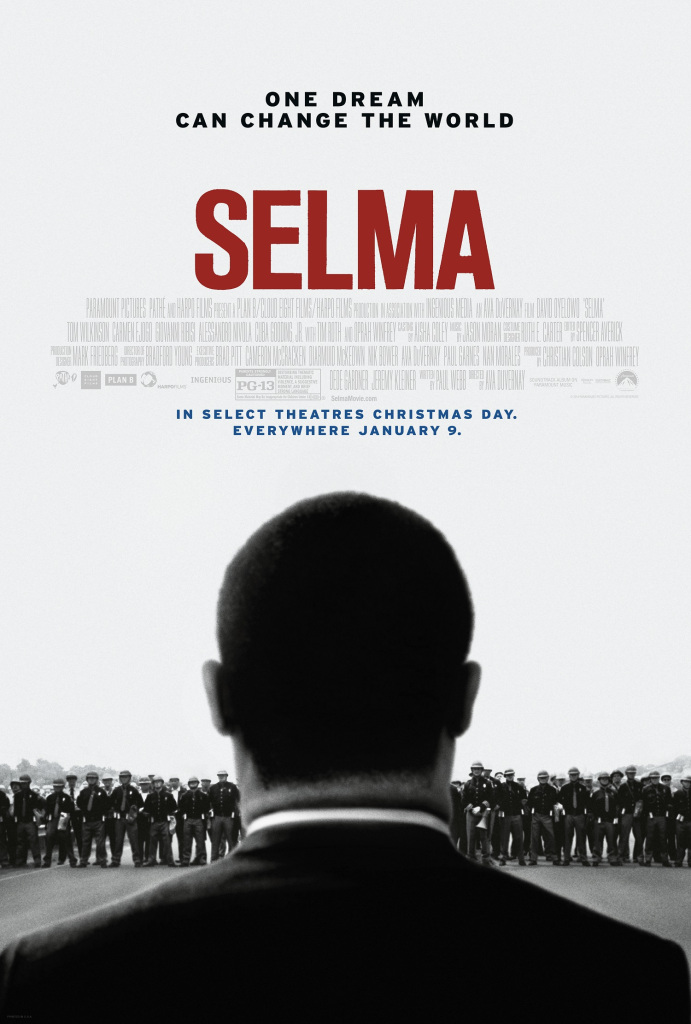
Had “Selma” been released a number of years ago, people would probably just see it as another movie which chronicles a historical moment which has long since passed us by. But with all the upheaval in places like Ferguson, Missouri where violence against people of color is increasing substantially and the Voting Rights Act having taken a very unnecessary hit, this movie could not be timelier. What we see in “Selma” now feels like prologue as the fight for equal rights continues on to this very day. By now we should very well know we’re not living in a post-racial society.
“Selma” takes us back to the year 1965 when Dr. Martin Luther King, Jr. (played by David Oyelowo) and several others led marches from Selma to Montgomery, Alabama in an effort to obtain equal voting rights for African Americans. It was tough times indeed as Dr. King faces an uphill battle with everyone including President Lyndon B. Johnson (Tom Wilkinson) who is not quick to pass a Voting Rights Act as he is still dealing with civil unrest in the South which he is desperately trying to get under control. But King knows this is not an issue that can wait much longer to be addressed.
I have got to start off by saying David Oyelowo is a powerhouse in his portrayal of Dr. King, and he holds our attention completely from the very first moment he appears onscreen. It should be noted how Oyelowo campaigned for this role for seven years and managed to keep it even after the original director, Lee Daniels, departed the project. I have seen Oyelowo do memorable work in movies like “Rise of the Planet of the Apes,” “Lincoln” and “A Most Violent Year,” but I couldn’t find a trace of him in “Selma.” It felt like I was really watching Martin Luther King Jr. resurrected and walking among us again. Not once does Oyelowo succumb to doing a mere impersonation of the man who had a dream we still want to see become a reality. There’s a saying that in the theater you play a character and in film you are the character, and Oyelowo is definitely the man here.
The other big star of “Selma” is its director Ava DuVernay who brings this ever so important story to life so vividly. Granted, in some ways her presentation of the 60’s feels a little routine, and some scenes feel one-sided when they shouldn’t. Her portrayal of the marches, however, is appropriately devastating as she makes you feel ever blow inflicted by those afraid of change. These scenes do not leave the mind easily. King and his supporters are determined to protest in a non-violent way, and it’s hard not to feel for them when their supporters are being beaten senselessly. Deep down you want to see them fight back against the brutality even though we’re aware to do so will be giving the opposition far more ammunition than they deserve.
“Selma” also features a wealth of great performances from actors like Oprah Winfrey who channels her inner Sofia (the character she played in “The Color Purple”) for her role as Annie Lee Cooper who, at the movie’s start, is cruelly denied the opportunity to register to vote. I also enjoyed Tom Wilkinson’s performance as Lyndon B. Johnson as he adds layers to the former President which the screenplay doesn’t always give him. Tim Roth also turns in a strong performance as George Wallace, the always welcome Wendell Pierce is excellent as Hosea Williams, and Dylan Baker is ever so effective as J. Edgar Hoover to where I ended up trying to remember the actor’s name while watching this film.
Another performance worth giving special note to is Carmen Ejogo’s as Coretta Scott King. Ejogo played this role previously in the 2011 movie “Boycott.” She and Oyelowo have a great scene together when she questions him about his alleged infidelity, and no music score is needed to empower it as DuVernay wisely focuses on the actors for all they are worth. Watching these actors here makes for one of the most compelling scenes I have seen in any 2014 movie.
Is “Selma” accurate to what actually happened in history? I don’t know, and I don’t really care. All that matters to me is that it is true to the spirit of the facts more than anything else. We are beyond the point where we should expect movies “based on a true story” to be completely accurate to what actually occurred because dramatic considerations have to be taken into effect. While some argue Johnson was more open to King’s request for voting rights than he was shown to be here, there’s no denying the one most passionate about this issue was King himself. Whether or not this movie fails on a historical accuracy level, it does succeed on a dramatic one.
Having said all this, I kind of wished “Selma” didn’t paint a number of its character in such broad strokes. I guess I was expecting something along the lines of Spike Lee’s “Do the Right Thing” which observed its characters, regardless of color or nationality, with a lot more thoughtfulness and dimension. The fact that “Selma” doesn’t quite succeed in doing this is a bit frustrating, but it doesn’t take away from the powerful effect the movie will have on those who take the time to see it.
“Selma” doesn’t just take us back to an important period in history; it reminds us of the things we as Americans should be fighting for. The movie shows many people of different races and religions joining Dr. King in this fight for an equality no one should have to fight for in this country. But here we are years later, and it turns out the fight is far from over. Once again, we have a lot to learn from history.
It appears director Peter Berg and actor Mark Wahlberg are on their way to completing a trilogy of movies which aim to show audiences how Americans stand up and take care of their own during the most trying of times. In 2013 they gave us “Lone Survivor” which dramatized the unsuccessful United States Navy SEALs counter-insurgent mission Operation Red Wings, and before 2016 ends we will get “Patriots Day” which deals with the Boston Marathon bombing and the subsequent terrorist manhunt. But before that we get “Deepwater Horizon” which focuses on the offshore drilling rig of the same name which exploded in 2010 and created the worst oil spill in U.S. history. As you can expect, it is a riveting motion picture which provides audiences with a visceral experience even though we know how the story will end.
Wahlberg portrays Mike Williams, one of the chief rig workers on Deepwater Horizon, and as the movie starts we see him spending precious time with his beautiful wife Felicia (Kate Hudson) and daughter. Before he leaves to go to work for a couple of weeks, Mike’s daughter shows him a science project she is working on which involves poking a hole in the bottom of a Coke can and then stuffing it up with honey. But, of course, it explodes all over the family dinner table as it foreshadows the terrible disaster which is yet to come.
Berg does great work portraying the working environment these oil rig workers endure on a daily basis as their work is always dangerous, and their animosity towards the executives of BP and Halliburton, a company whose name has long since become a four-letter word, is completely understandable. While these workers aim to do their job safely, the execs are eager to increase their profits as the drilling schedule has fallen behind by forty days. Profit always seems to reign supreme over the rights of the workers who might never reach the level of the 1%, and this is further proof of how the 80’s never left us.
The foreshadowing of the explosion becomes a little too much as Berg employs Steve Jablonsky’s music score to an unnecessary degree. Jablonsky’s score booms way too much as we watch the beginnings of this explosion which emanate far below the ocean’s surface. It alerts us way too early that a natural disaster is about to occur, and this could have instead been a time where we could have seen proof of how silence is golden because, as Gary Oldman’s character from “The Professional” said, we like these quiet little moments before the storm, and that’s regardless of whether or not it reminds us of the Ludwig Van Beethoven’s music.
When things do go horrifically bad on the rig, Berg captures it in a way which feels horrific and almost unbearable as he captures the disaster with a lot of handheld footage. When the main pipe goes bust, it’s not like your average disaster movie where things go out of control but in a not so dangerous way. Bodies are flung with full force against metal railings, and it doesn’t take long for the viewer to feel how painful the deaths and injuries on display are. To say what happened here was a natural disaster is an understatement as the chemicals underneath the earth’s surface make their way to the surface to where it feels like planet is having serious revenge on us.
Wahlberg is an actor who can authentically portray a blue collar worker without any movie star swagger. With a role like Mike Williams, he never ever lets his ego get the best of him or tries to show off in some obnoxious way. You may never lose sight of the fact you are watching Mark Wahlberg on the big screen, but he always succeeds in portraying a character who spends his days doing hard work for an honest living. Not many actors of his stature can pull that off these days.
Then we have Kurt Russell, a veteran actor you can never ever go wrong with, who plays Jimmy Harrell, the man who is very serious about ensuring the safety of his workers. The oil company’s profits may suffer, but that is the least of Jimmy’s problems. Russell makes it clear from the get go where Jimmy’s priorities lie, and you never doubt him for a second. Even when Jimmy suffers greatly from the rig’s explosion to where one of his eyes is swollen shut, which quickly reminds us of Russell’s role as Snake Plissken from “Escape From New York,” he is still infinitely determined to ensure the safety of his workers.
Another standout performance to be found in “Deepwater Horizon” comes from Gina Rodriguez who plays Andrea Fleytas, an oil rig worker prepared to do what’s necessary to save lives but is stopped by the men who somehow think they know better. Rodriguez throws herself into the role to where you never doubt her for a second, and it makes you all the angrier when she is admonished by her superiors who are afraid to make decisions under pressure. She certainly knows her way around an oil rig better than her beat up Mustang.
As for Kate Hudson, she does fine work with an underwritten role. As Felicia, she has to be stuck at home and worried sick about her husband and the situation on the rig, so we only get to see so much of her in this movie. However, her role is an important one as she puts a human face on those who have to suffer from a distance. Besides, it is so nice to see Hudson in a good movie after she appeared in the cinematic monstrosity that was “Mother’s Day.”
But the biggest star of “Deepwater Horizon” is Berg as he thrusts into a real life story with gusto and intensity. As a director, he has never been one to give us a decent time at the movies. Whether it’s “The Rundown,” “Lone Survivor” or “The Kingdom,” Berg wants us pinned to our seats and gasping for air. He achieves this once again with “Deepwater Horizon,” and in the process pays tribute to those who lost their lives while doing their jobs. It makes me look forward to his next movie, “Patriots Day,” all the more.
In a sense, this movie almost shouldn’t work. The title alone flat out tells you only one person will survive the battle we are about to see, and the opening shows doctors working furiously to save that person’s life. From the start, we know how this movie’s going to end even if we haven’t read the book it is based on, so this should kill any suspense it hopes to have right there. But thanks to the tense direction of Peter Berg and a terrific cast, “Lone Survivor” proves to be one of the most visceral war movies I have seen in quite some time.
Like every other movie coming out today, this one is based on a true story. Wahlberg portrays Marcus Luttrell, a United States Navy SEAL who, along with three other Navy SEALS, were dropped off in the mountainous Afghanistan-Pakistan border to conduct a reconnaissance mission on notorious Taliban leader Ahmad Shahd. This particular Taliban leader was said to have close ties to Osama Bin Laden, and we watch as these soldiers keep a very close eye on him.
But during their mission, they are accosted by a group of civilians whom they quickly restrain. Some of the Navy SEALS consider killing them so that their mission can remain a secret, but Marcus manages to convince his fellow soldiers that letting them go is the best option. To kill them would mean standing trial for murder and spending the rest of their lives in prison, and since this has already happened to other soldiers, they agree it is in their best interest to avoid this particular fate. So they let the civilians go and abort their mission, feeling they will be exposed if they stay any longer.
The time these men have to wonder if they made the right choice or not is cut short when they get ambushed by Taliban forces which end up surrounding them on all sides. From there, it is a race for survival as, despite their training, the SEALS find themselves outnumbered and out of communication range with the rest of their unit. From there, “Lone Survivor” becomes quite the blistering experience as you feel everything these soldiers are forced to experience and endure.
Berg starts the movie off with documentary footage of Navy SEAL training which is still considered the toughest military training anyone could endure. It is said 70% of the soldiers who enlist in this training end up dropping out, and from what we see here this is no surprise. I was immediately reminded of Ridley Scott’s “G.I. Jane” which had Demi Moore going through the torturous ritual of becoming a Navy SEAL, but seeing real people go through it here makes it seem all the more brutal.
This opening succeeds in showing us how these soldiers come to form such a close bond with one another, having succeeded in making it to the level of a Navy SEAL. But as this movie continues on, they will soon come face to face with something they are not used to enduring at all: failure.
Berg has proven himself to be a terrific action director with films like “The Rundown” and “The Kingdom,” and he really outdoes himself here. He makes you feel the bullet wounds, the cuts and dark bruises these men are forced to put up with as their chances for survival continue to erode. By the time “Lone Survivor” comes to its inevitable conclusion, I found myself feeling emotionally and physically exhausted by what I had seen. This is a movie which barely lets you come up for air. Even though we know who the lone survivor of the movie’s title will to be, we are still riveted because we still don’t want these soldiers to die.
Berg treats this story with tremendous respect and doesn’t ever try to exploit what these soldiers went through for the sake of entertainment. We get to know these men well enough to where their eventual demise is harrowing to witness. Berg also has quite the cast to help him make this film a reality. In addition to Wahlberg, “Lone Survivor” also stars Taylor Kitsch, Emile Hirsch and Ben Foster as the Navy SEALS, and each actor puts their all into roles which are physically and emotionally draining. Foster is especially a standout as Matthew Axelson who meets his end with sheer defiance.
2013 was a busy year for Wahlberg as he starred in “Broken City,” “Pain & Gain” and “2 Guns” in addition to this. When all is said and done, “Lone Survivor” represents the best work did that year. While watching him, you can tell how deeply he felt about this story just by looking at his eyes. Ever since he blew us away with his performance in “The Basketball Diaries,” Wahlberg has given us one unforgettable performance after another, and he rarely if ever lets us down when he’s onscreen. He has never been the kind of actor who just walks through a role, and I believe him when he talks about the effect playing Marcus Luttrell had on him.
There’s a lot more I would love to tell you about “Lone Survivor,” but I really don’t want to spoil it for those who haven’t read the book this film is based on. As much as I want to tell you this was one of the first really good movies of 2014, it was given a limited release before the end of 2013. Oh well, whether you consider it a 2013 or 2014 film, “Lone Survivor” is certainly one of the most visceral movie going experiences we have seen in a while. For those who like their movies filled with intense emotions, this is a must see.







 The Ultimate Rabbit