Richard Gere and Joseph Cedar Talk about What Went Into ‘Norman’

Miami Film Festival at Olympia Theater - Opening Night

After all these years, I think Richard Gere is one of the most underappreciated actors working in movies today. Sure, he’s been a movie star for years, having appeared in such classics as “An Officer and a Gentleman” and “Pretty Woman,” but I wonder if people in general see him as more than just another pretty face after all this time. Seriously, he has pulled off a number of unforgettable turns in “Primal Fear,” “Chicago” and “Arbitrage” which had him portraying morally duplicitous characters whom you cannot help but root for. The fact he has never been nominated for an Academy Award is baffling as he has more than earned his place among the best, and it seems like he still has to keep reminding us of how good an actor he is.

The latest example of this is “Norman” in which Gere plays Norman Oppenheimer, a humble New York fixer who lives a lonely life in the margins of power and money. He is a would-be operator who dreams up financial schemes, and he strives to be everyone’s friend as he networks with anyone who can elevate him in society. In the process, he gains the attention of Micha Eshel (Lior Ashkwnazi), an Israeli politician who has yet to fully advance in his career, by buying him a super expensive pair of shoes. When Micha becomes Prime Minister of Israel, he remembers Norman’s generous gift and brings him into his inner circle. This gets Norman to set up the biggest deal of his career, but it all threatens to end in an international crisis no one can walk away from in one piece.

Norman movie poster

“Norman” was directed by Joseph Cedar. His previous films include “Campfire” which earned him Ophir awards for Best Director and Best Screenplay, “Beaufort” which won him the Silver Bear award for Best Director at the Berlin International Film Festival, and “Footnote” which earned an Academy Award nomination for Best Foreign Language Film. “Norman” was inspired by the archetypal tale of the Court Jew which involves a Jew meeting a man with power when his resistance is very low. The Jew gives the man an incredible gift, and the man remembers him when he ends rising in stature. The Jew then becomes a consultant to the man, but when the man becomes subjected to endless antagonism, he has no choice but to get rid of the Jew because the Jew is far too easy to get rid of.

The tale of the Court Jew is one I was not familiar with, and it was fascinating to hear Cedar talk about it when he joined Gere for an interview at the Beverly Wilshire Hotel. Yes, this was the same hotel Gere romanced Julia Roberts in “Pretty Woman,” and the irony of this fact was not lost on any of us. Anyway, Cedar got more specific about this tale with us.

Joseph Cedar: Aside from the type of personality that the Court Jew has to do what a Court Jew does, which is a combination of brilliance because otherwise he is not essential to whoever has power, and a flexibility which allows him to sell out. These are complicated characters that are in the gray area of many moral questions, and it’s part of what allows them to be of influence. But there’s another aspect to it that I think is extremely interesting me. I think all of modern progress is the result of some Court Jew, or at least in Europe. If you look at the great European monuments, none of them would have been possible without that relationship between a king, a duke, a prince or someone in power, and a Jew is able to finance things that the township or the common person, the farmers of whatever area they were in, would have never agreed to do. So rulers needed that function in order to do things that, in retrospect, we are all enjoying right now: art, culture in general, architecture. And then there are some things that are considered negative but are also important: armies, bridges. But it’s a combination of things which are objectively good together with things that are questionable. There are many taxes that Jews convinced their rulers to put up, so those taxes were seen as something bad for the people who have to pay them. But 500 years later, those taxes created beautiful cities.

Ben Kenber: Was there anything specific about the Court Jew tale which you really wanted to get across in this screenplay? It sounds like a tale many other writers are familiar with, and it has been told a number of times, but was there something specific you wanted to address?

Joseph Cedar: I don’t know. It was something I was attracted to in a very sincere way. It’s not that I was looking for this tale.

Richard Gere: Is it the fact that the Court Jew who would be sacrificed in the end and the easiest one to let go?

Joseph Cedar: I think that’s what makes this tale, this journey, this narrative so involving.

Watching Gere as Norman Oppenheimer reminded me of his great work in “Arbitrage,” “Primal Fear” and “Internal Affairs” as he is so good at playing immoral characters who somehow manage to bring you over to their side despite their duplicitous ways. But while Norman is trying to get the upper hand in a way which benefits him, we see he is a desperately lonely man who longs to be accepted by others. Deep down, we want to see Norman succeed, and you can see his lonely desperation in his eyes. This is what I asked Gere about.

Ben Kenber: The thing I love about your performance Richard is we can tell when your character is playing with peoples’ emotions and trying to get what he wants, and then there are other moments where you can see in his eyes that he is being truly honest with others. How challenging is that for you as an actor to pull off?

Richard Gere: Not so hard because he believes it every time. When he’s lying, he believes it. When he’s telling the truth, he believes it. As soon as he starts or if something happens, he has got to fix it. Someone confronts him and he’s got to make it sound like, “Well my wife babysat him…” Whatever the story is, but once he starts it, his fantasy life is so vivid to him that he totally believes it. Totally. So, to him there’s no difference.

Joseph Cedar: I believed you believing it.

Richard Gere: Well that was important.

I want to thank Richard Gere and Joseph Cedar for taking the time to talk with me. “Norman” opens in theaters on April 14, and it is a very good movie worth checking out.

The First Trailer for ‘It’ Floats to the Surface

It teaser poster

I count Stephen King’s “It” as one of my all-time favorite novels, and I very much enjoyed the 1990 miniseries based on it, and that’s even though the ending was incredibly disappointing. Now, after many false starts which saw actors and directors come and go from the project, “It” is finally making its way to the silver screen courtesy of Warner Brothers and New Line Cinema, and now we the first trailer for the film.

After watching this trailer several times, my interest in this new adaptation has tripled. Pennywise the Clown, this time portrayed by one of the many actors from the Skarsgard family, Bill Skarsgard, comes across as far more lethal than the one Tim Curry gave us, and seeing Pennywise leap out at us in the trailer’s final moments has me believing anyone with a clown phobia should seriously consider not seeing this movie. We never get to see all of Pennywise here, and he is instead shown through quick flashes throughout, but it’s enough to send a chill down my spine.

The cast of actors is led by Jaeden Lieberher, who left a strong impression on audiences with his performances in “St. Vincent” and “Midnight Special,” who plays Bill Denbrough, the leader of the Loser’s Club who vows revenge against Pennywise for murdering his little brother Georgie. It’s hard not to be reminded of the Netflix series “Stranger Things” while watching these young actors as they too are on a mission to find out what evil lurks in the underbelly of their hometown of Derry, Maine. The story has also been moved up from the 1950’s to the 1980’s (the slide projector is a dead giveaway), so the filmmakers look to be playing on our collective nostalgia which should make this movie extra fun.

Cary Fukunaga was set to direct this adaptation, but although he eventually dropped out due to those “creative differences” filmmakers just love to throw out there, he is still listed in the credits as one of the screenwriters. Directing “It” is Andrés Muschietti who previously directed Jessica Chastain in the box office hit “Mama.” From this trailer, it looks like he is having lots of fun exploring the many ways Pennywise terrorizes the young children of Derry, Maine as he gets at their deepest fears and exploits them for all they are worth. My hope is he focuses on the characters of King’s classic novel as well as on the scares. One thing’s for sure, he certainly knows how to make a red balloon look especially ominous.

“It” is clearly covering the first part of King’s novel when the members of the Loser’s Club were kids. Here’s hoping this adaptation scares us silly enough to where we get follow-up which will follow them into adulthood as we all know the past stays with us in one way or another. Adaptations of King’s novels range from brilliant (“The Shining,” “Misery,” “The Shawshank Redemption”) to horrendous (“Maximum Overdrive,” “Graveyard Shift”), so let’s hope this is not just one of the better ones, but one of the best.

Check out the teaser trailer below.


Trainspotting 2

Trainspotting 2 poster

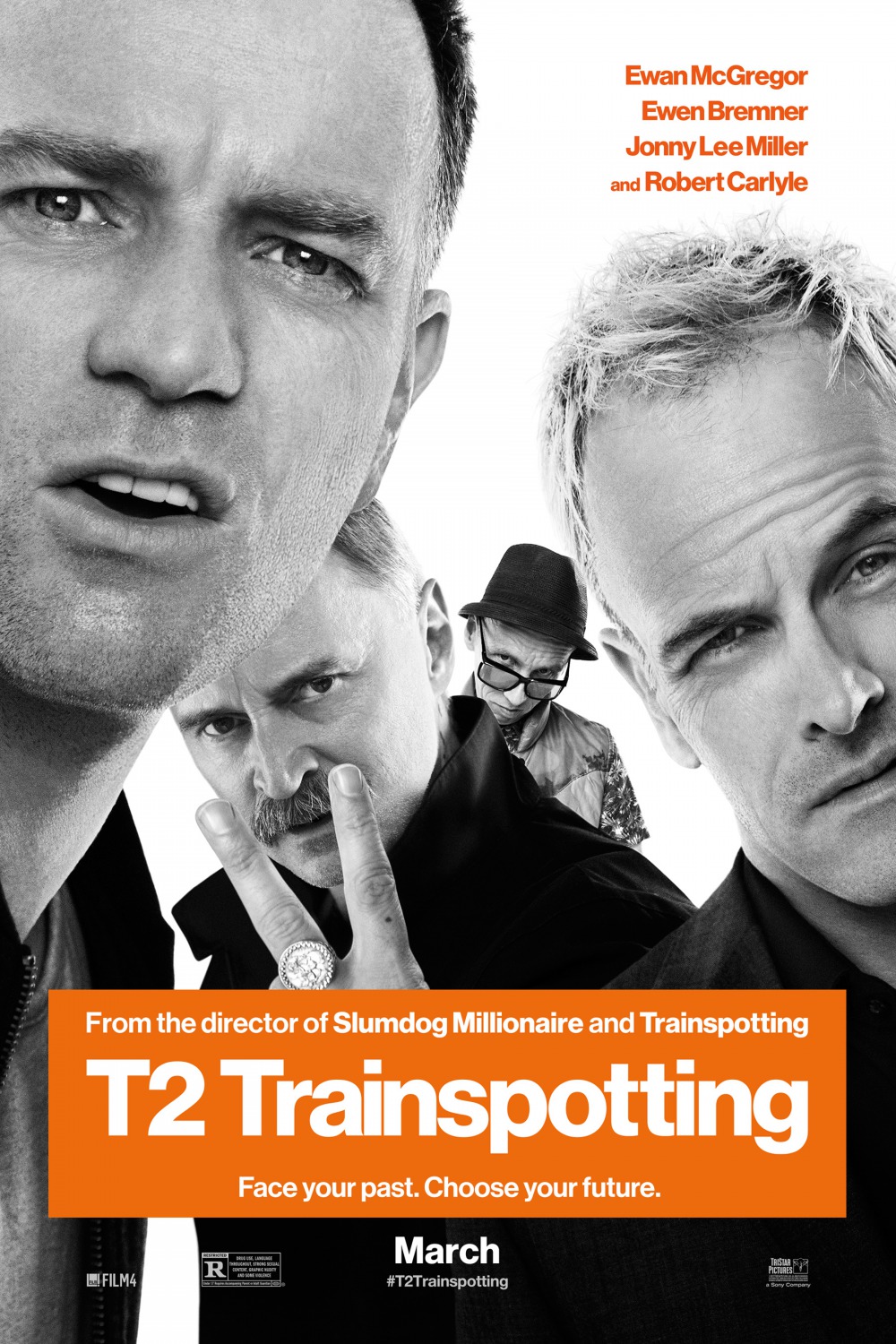
I actually found myself getting choked up while watching “Trainspotting 2,” a sequel I long believed would never become a reality. The original 1996 film featured youthful characters bursting with life as they inject heroin into their veins and create chaos for everyone and each other. Now it’s 20 years later, and these same characters are now middle-aged and struggling with a future which looks to leave them behind. They are dealing with regrets which eat at them, and are still stuck in a past which constantly gnaws at their conscience. While I can’t say I relate to all the adventures Renton, Sick Boy, Spud and Begbie have gone through, I can certainly relate to their current state of mind as their lives are at an impasse to where they have to ask themselves the question David Byrne brought up in a Talking Heads song, “Well, how did I get here?”

When we last saw the “Trainspotting” gang, Renton (Ewan McGregor) had absconded with the money they scored through a heroin deal, and he was determined to go straight and engage in a much more stable lifestyle. “Trainspotting 2” starts with him running on a treadmill only to trip and fall, and it’s enough to show he is not the same man he was before. He has lived in Amsterdam all this time with his wife, but now he is getting divorced and finds his job security to be very shaky, to say the least. Feeling lost in modern society, he decides to return home to Edinburgh, Scotland in an effort to make amends with family and friends.

Everyone is still back in Edinburgh doing their thing. Sick Boy runs a bar which is lucky to have many, if any, patrons walking through the door. In his spare time, he engages in blackmail schemes with his partner and girlfriend, Veronika Kovach (Anjela Nedyalkova). Daniel Murphy/Spud is still in the throes of his heroin addiction which has long since estranged him from his partner Gail and their son Fergus. As for Francis “Franco” Begbie, he has been in prison all this time and just received news that his parole did not go through. So, like any pissed off inmate, he escapes and heads back to Edinburgh to get revenge on those who betrayed him long ago.

When “Trainspotting” came out 20 years ago, it represented a fresh burst of filmmaking energy and felt so different from anything else playing at your local cinema. Director Danny Boyle and screenwriter John Hodge once again take the works of author Irvine Welsh, in this case his novels “Trainspotting” and “Porno,” to create a motion picture pulsating with an energy lacking in so many others out right now. The fact they can’t quite equal the energy of the original is not a surprise as many imitators came in its wake, and what was once subversive now feels much less so. But I think Boyle intended for this sequel to have a different energy for those reasons as things are different now for the characters and ourselves.

“Trainspotting 2” does traffic in nostalgia as several references to the original are made throughout, but it doesn’t get stuck there to where it comes across as a mere copy of what came before. Moreover, Boyle and Hodge show how these characters are stuck in a past they never fully escaped from. I also have to say it is daring of them to show these characters at this stage in their life as Hollywood is typically afraid of ageism more than they would ever legally admit. Just like in “Logan” and “Creed,” we are forced to see what the winds of change have done to those we grew up watching, and it isn’t always pleasant.

It’s great to see Ewan McGregor back working with Boyle, Hodge, and producer Andrew Macdonald. McGregor and had a huge falling out with Boyle when the director handed the lead role in “The Beach” over to Leonardo DiCaprio instead of him, and the two ended up not talking for years. Well, whatever happened is now water under the bridge, and it would certainly be unthinkable for Boyle to replace McGregor with another actor. While Renton has suffered through years of regret and decreased vitality, McGregor still brings much of the same boundless energy to the character as he did before. It’s also a thrill to see him engage in one of Renton’s “Choose Life” speeches, especially since it takes on a much more emotional dimension than ever before.

Jonny Lee Miller continues to bring a wonderfully perverted energy to his portrayal of Sick Boy as his criminal exploits are fueled by bitterness and large doses of cocaine. I was especially taken in by Ewan Bremmer’s portrayal of Spud which is funny and heartbreaking all at the same time. We are constantly reminded of how Spud is harmless to anyone but himself, and Bremmer makes the character’s ever so wounded pride all the more palpable throughout.

My hat is really off, however, to Robert Carlyle as he makes Begbie every bit as explosive and lethal as he did 20 years ago. Some actors lose their edge as they get older, but not Carlyle as Begbie is still a volcanic force of nature you best not be around if you value your physical well-being. At the same time, the actor brings an honest vulnerability to the character which is both unexpected and wrenching. It serves as a reminder of how much acting range Carlyle has. Remember, he went from playing Begbie to playing a loving father in “The Full Monty,” and I had to keep pinching myself to realize it was the same actor playing both roles.

In addition, I enjoyed Anjela Nedyalkova’s performance as Veronika, a working girl who sees right through all the men around her and gets to the truth they have yet to realize for themselves. She brings a confident and sassy energy to this sequel, and she is a strong addition to this strong quartet of actors. It was also nice to see Kelly Macdonald reprise her role as Diane who has since become a lawyer. She kept stealing the show from her male co-stars in the original, and she does it again here.

They say you can never go back, but “Trainspotting 2” shows you can, but never all the way. There is a mournful feel to this sequel, but it’s there for good reason. In watching these characters wonder how they ended up at this point in their lives, we are forced to examine our own lives and wonder how we got here. It’s an unnerving prospect for a movie to offer its viewers, but I’m glad this one did even though it almost left me on the verge of tears. There needs to be time for a re-examination of our lives and desires, and we have to find a way to make peace with our past. Boyle and company understand this, and they never back down from exploring these emotionally complicated themes.

The cast and crew of “Trainspotting” have given us a very worthy follow up to their original masterpiece, and it is backed up by strong acting, a kick ass soundtrack, and the invigorating visuals we can always count on Boyle putting up on the silver screen. Yes, “Trainspotting 2” was well worth the wait, but be prepared for it to take a piece out of you. And remember what Renton says: Choose life and be addicted to something good.

* * * ½ out of * * * *

Save

Get Out

Get Out movie poster

You know the main characters of this movie are in trouble once they hit a deer. Of this, I speak from my own experience as my dad drove me to the airport one time and ran over a deer which walked into his traffic lane. It was not his fault as the deer came out of nowhere, and there wasn’t any time to hit the brakes to avoid an animal oblivious to the Volvo station wagon heading straight at him (or her). Nevertheless, a week later I got laid off from my job. Looking back, hitting the deer proved to be an omen of bad things to come, and losing my job was one of them.

I was reminded of this as I watched the opening minutes of “Get Out,” an insidiously clever horror movie with the occasional dose of humor thrown in. Chris Washington (Daniel Kaluuya) and Rose Armitage (Allison Williams) are driving up an empty stretch of road to meet her parents when they slam into a deer. There’s nothing they can do to help the animal, and the police officer who arrives at the scene asks for Chris’ license even though he wasn’t driving. Rose encourages the officer to let Chris be, and he eventually leaves the scene while advising her to fix her broken rearview mirror. But as the movie goes on, this turns out to be the least of their problems.

I should probably point out that Chris and Rose are an interracial couple, and Chris is concerned Rose’s parents have no idea her daughter is dating a black man. His nervousness is understandable, and it is elevated further when Rose’s parents, Dean (Bradley Whitford) and Missy Armitage (Catherine Keener) try to make him feel welcome by telling him they would have voted President Barack Obama for a third time if it were possible. Basically, the Armitages are well-meaning white folks who support the fight against racism, but they have yet to understand the damage, however unintentional, they are doing to African-Americans.

Things get even weirder when Chris meets two other black people who work for the Armitages, Georgina (Betty Gabriel) and Walter (Marcus Henderson). Both act very strangely and in a manner which threatens to redefine passive-aggressive, and the way they stare at Chris is unnerving as they look like snakes ready to strike at their pray without much notice. It doesn’t take long for Chris to realize something is terribly wrong, but his attempts to escape the Armitage household are not exactly successful.

There is a lot of racial tension burning right underneath the surface in “Get Out,” and this is on purpose. The movie plays on the stereotypes whites have of blacks and vice-versa. Everyone is trying to be polite, but you can sense what’s really going on by looking into the eyes of each character as they project darker intentions or sheer terror, and sometimes both. We are left in suspense as we constantly wonder what the Armitages truly have in store for the helpless Chris, and when their intentions are revealed, it makes a scary, and an oddly amusing, amount of sense.

“Get Out” marks the directorial debut of Jordan Peele, one-half of the famous comedy duo “Key & Peele,” who also wrote the screenplay. It’s a very strong debut as he takes satirical elements and places them into a story which ratchets up the intensity throughout and keeps it up to the end. But Peele doesn’t just give us a flat-out satire as he never set out to play everything just for laughs. He digs deep and touches at our own preconceptions of race in America and plays around with the unintentional ways we reveal ourselves to be more prejudice than we ever realized.

Daniel Kaluuya, whom you might remember from “Sicario” and “Kick-Ass 2,” is excellent as Chris, a young man caught up in a situation we hope he fully comprehends before it is too late. He also has good chemistry with Allison Williams to where you can’t doubt they are believable as a couple. “Get Out” also has the benefit of having two terrific actors playing Rose’s parents, Bradley Whitford and Catherine Keener. Both have a warm presence here which eventually turns into something more sinister before you even know it.

I especially have to single out Keener as she remains one of the most underrated actors working today, and the scene where she hypnotizes Chris is a huge reminder of that inescapable fact. She doesn’t have to do too much to get our attention, and as Missy, she seduces us to a place we didn’t plan on going to, and it’s a place where we fear we will never rise up from.

There’s also a terrific scene-stealing performance from Lil Rel Howery as Chris’ best friend, Rod Williams, a TSA agent who has seen it all. In any other movie, Rod would be the one to overact in the most annoying way possible, but Howery turns the character into a welcome form of comic-relief the movie needs to ease the at times unbearable tension, and he is hilarious.

In many ways, “Get Out” is a clever riff on movies of the past like “The Stepford Wives” which dealt with the unusual behavior of female residents in a little Connecticut town, and Peel takes risks with the material you wish other filmmakers would take on a more regular basis. What results is a motion picture which is not perfect, but still a very good one which will stay with and unsettle you in the way a good horror movie should. It also plays with the ways white people try to show how non-racist they are and yet fall into an inescapable pit of hypocrisy before they even know it.

And for the record, I’m a white guy and I would definitely have voted for Barrack Obama for a third term as President. Think what you will of that statement. I’m just going to leave it here.

* * * ½ out of * * * *


Logan

Logan movie poster

Watching “Logan” is especially thrilling if you have been keeping up with the “X-Men” movies since the first one came out in the year 2000. While the previous installments played by a certain set of rules, this one smashes through them to create something unique in the long-running franchise. No longer shackled by the PG-13 rating, Hugh Jackman is given free rein to show just how bloody Wolverine can get when you piss him off, and he gives this character, which made him into a movie star, the swan song he deserves.

While the “X-Men” movies were largely science-fiction, “Logan” plays more like a western, and this will become abundantly clear even before characters sit down in a hotel room to watch “Shane.” We catch up with Wolverine, a.k.a. James “Logan” Howlett, in a future not too distant from our own where mutants have long since become an endangered species. Wolverine is now past his prime and works as a limo driver in an effort to save money to buy a boat which he and the ailing Professor Charles Xavier (Patrick Stewart) can sail away in from all of humanity. While he can still kick ass, he is now hobbled by a bad leg and a dependency on alcohol which eases the pain of surviving in this world for far too long.

The same goes with Xavier who now suffers from a neurodegenerative disease which has turned his telepathic abilities from a blessing into an unstable force people would be best not to be in the vicinity of. When he has an episode, the world around him is threatened in a highly unsettling way, and only Wolverine can give him the medication he needs to stop him from becoming a true weapon of mass destruction.

Then into the picture comes Laura (Dafne Keen), a young mutant who has more in common with Wolverine than he would care to admit or realize. Like the miraculously pregnant woman in “Children of Men,” Laura represents the next step in human evolution, and she needs to be taken to a safe haven for mutants which may or may not exist. On her trail are Reavers, a team of criminal cyborgs hell-bent on wiping mutants off the face of the earth, led by the gleefully sadistic Donald Pierce (Boyd Holbrook) who is not about to let his fandom of Wolverine get in the way of his mission.

What I especially admired about “Logan” is how it dealt with the effects of aging and of people now past their prime. This is s0mething superhero or comic book movies, let alone most Hollywood movies, usually avoid dealing with as the powers that be wish to keep everything looking and feeling youthful. But we are forced to look at Wolverine and Xavier at a point in their lives where they are more vulnerable than ever to their enemies and especially their own mortality. Once they were powerful, but now they are pretty much off-warranty. How does one deal with arriving at a point in life where their bodies start working against them? “Logan” dares to deal with this question, and it does so in a way which is more character driven than ever before but still action packed as ever.

Jackman intends “Logan” to be his last “X-Men” as he has played Wolverine now for over a decade, and he has certainly given the character quite the exit. He even took a pay cut in order to ensure this film would get an R-rating, and it was certainly worth it as it gives him the freedom to make this iconic comic book character a far more blunt and brutal instrument than ever before.

Life is suffering, and no one knows this more than Wolverine who has lived more lifetimes than anyone else around him. Jackman has been brilliant at letting us see the inescapable vulnerabilities which are just beneath the surface of his tough and rugged exterior. Seeing him portray Wolverine at his most wounded is brave as he shows how even the most powerful of superheroes can reach their limit and yet still fight the good fight.

The movie also proves to be a perfect swansong for Patrick Stewart’s interpretation of Charles Xavier as he too portrays this character in a way we never expected. The professor was once a man of significant intelligence and insight, and now he has become a victim of the cruelties of aging none of us are eager to experience. Stewart shows no fear at portraying Xavier in his most disabled state, and while it is painful to see this once great character reduced to a mere shell of who he once was, the great actor is priceless in giving us a man who clings on to the mere gifts afforded to him in a way we all take for granted. It’s a heartbreaking performance, and Stewart plays it without a single faked emotion.

There are also a number of terrific supporting performances here, and the most impressive of the bunch comes from Dafne Keen as the young and deadly mutant, Laura, who befriends Wolverine and Professor X. At the tender age of 11 or 12 years old, Keen is forced to play most of her scenes with no dialogue whatsoever, but she still speaks so many words with even the smallest of facial expressions. It’s a lot to ask of an actor of any age to accept such an acting challenge, but she is more than up to it and gives us a riveting portrayal of a child who has been made to become something no child should ever be made into.

I also admired Stephen Merchant’s performance as Caliban, an albino mutant who can sense and track other mutants. This could have easily been the kind of wimpy character who goes through the usual scenarios of betraying others for his own selfish purposes, but Merchant makes him into much more than that as we see how heavy the consequences of his actions weigh on his conscience. In the hands of another actor, this could have been a throwaway role, but Merchant is too good to let something like that happen.

Boyd Holbrook makes a perfectly hateful yet charismatic villain out of Donald Pierce, Eriq La Salle has some strong moments as a family man who helps out Wolverine and his friends, and Frank Gallegos figures prominently in a small role as a Federale Lieutenant who ends up in the wrong place at the wrong time. Please believe me when I say Gallegos is concrete proof of how actors in the smallest of roles can make quite the impression, and he more than does that here.

Directing “Logan” is James Mangold who directed the previous “X-Men” spinoff “The Wolverine” which was easily better than its predecessor, “X-Men Origins: Wolverine.” Mangold’s films have mostly been studies in empathy about people who have been severely damaged by life, but who still have yet to meet their greatest challenge. Whether it’s Sylvester Stallone’s disabled police officer in “Copland,” the emotionally unstable women portrayed by Winona Ryder and Angelina Jolie in “Girl, Interrupted,” singers Johnny Cash and June Carter in “Walk the Line,” or even Tom Cruise’s eccentric spy in “Knight and Day,” the characters who occupy his films have suffered deep emotional wounds which they will be eventually forced to confront and make peace with whether they want to or not. “Logan” definitely fits in with the themes Mangold has explored throughout his films, and he makes this comic book/superhero an especially enthralling one as we are thrilled as much as we are moved emotionally.

Mangold also breaks free of the rules and conventions the “X-Men” movie franchise has laid out for its various filmmakers, and as a result, it really does feel like a true spin-off compared to the others before it. He gives “Logan” a very gritty feel, but as brutal and bleak as this movie is, it is also filled with hope. While history does repeat itself more often than we would like to admit, we are left with the strong possibility that the next generation of mutants will find a better way to exist in a world with those who have yet to fully trust them.

Seriously, I found “Logan” to be a thing of beauty as it dares to take characters we have grown up watching and put them in situations no filmmaker would have dared to put them in 10 years ago. I came into it thinking it would be the “Alien 3” of the “X-Men” movies as the use of Johnny Cash’s cover of Nine Inch Nails’ “Hurt” in the teaser trailer implied this would show Wolverine and Xavier at the darkest points in their lives. It certainly does, but it doesn’t leave us in a state of utter depression at its climax. We have come too far to give up on these mutants, and there’s no giving up on them now.

“Logan” proves to be one of the best “X-Men” movies as well as one of the best comic book movies ever made. With this gripping installment, this franchise has found its own version of “The Dark Knight,” and 2017 has already found one of its best motion pictures in only its third month.

* * * * out of * * * *