Exclusive Interview with Eliza Coupe about ‘The Last Time You Had Fun’

The Paley Center For Media Presents An Evening With

Eliza Coupe has left a strong impression on audiences on the TV shows “Happy Endings” and “Scrubs,” and now she makes her jump to the silver screen in the comedy-drama, “The Last Time You Had Fun.” In it, she plays Ida, a woman who is going through a lot of problems and is estranged from her crazy husband Jake (Jimmi Simpson). She ends up going out with her sister Alison (Mary Elizabeth Ellis), and in the process they meet the recently divorced Clark (Kyle Bornheimer) and his lawyer friend Will (Demetri Martin). From there, they jump into a limo and drive around Los Angeles with the hope of rediscovering the fun they once had in life before becoming adults.

I spoke with Eliza about “The Last Time You Had Fun,” and we both agreed it deals honestly with the struggles and disappointments of adulthood. She explained about how being divorced herself inspired her to play Ida, what it was like to work on a film with a very short shooting schedule, and of filming a scene in the Los Angeles ocean which did not look the least bit warm.
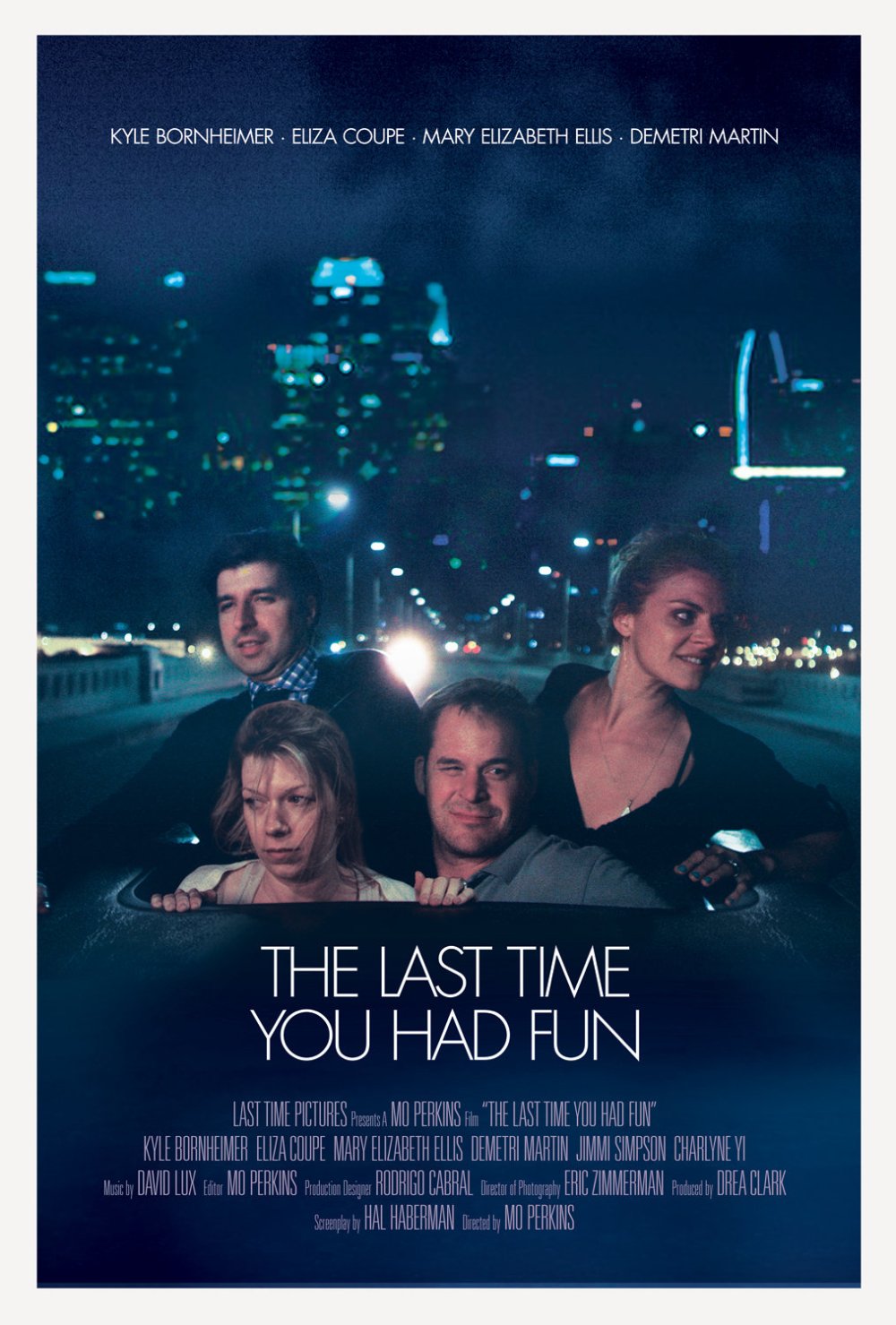
The Last Time You Had Fun poster

Ben Kenber: This is a good movie in how it deals with the responsibilities and frustrations of adulthood where you find yourself wondering if happiness is even a reality at some point. What parts of the script spoke the strongest to you when you read it?

Eliza Coupe: Well, I was actually going through a divorce when I decided to take this part. Part of me was like I don’t even want to go near this part because of that, and the other part of me was like well, maybe this would be like in therapy where people act things out with puppets, so maybe I should go to do this. This was live-action stuff so I was like, I’ll do it. Actually, I could relate so much to the character. My ex-husband and I are on great terms and he is not like Jimmy’s character. It was the whole thing of she knows that it needs to end but it can’t, and when do you know that it’s over. When you’re going through a divorce it’s like you have those thoughts all the time of I guess this is really it, and you just keep going back and forth. Because it’s a marriage you’re like, I’ve got to make a decision. So, I could really relate to the kind of indecisiveness and denial that she was in.

BK: it’s nice to know that you and your ex-husband are on good terms.

EC: Yeah, I just sent him a birthday card actually (laughs).

BK: What would you say that challenges or difficulties were for you in playing a character who appears to be emotionally unstable?

EC: What’s funny was that I welcomed it because I have done so much comedy. My characters are broken but they hide it really well. Obviously, anybody who’s that uptight or an A-type or alpha, they’re hiding some serious hurt, but she wore it on her sleeve. Part of the scene where my character calls her estranged husband outside of the limo, that was actually a much bigger scene. They cut it down and chopped it up a little bit, but when I did that one I had to get really emotional and I was actually, when we shot it, really sobbing. I haven’t had to do that on TV so it was difficult to get to that place, but it was also cool and I was excited to do it. It’s tough to pull that off.

BK: I imagine the shooting schedule for this movie was really, really short.

EC: Um yeah, and it was all nights. It was so brutal and I am such a morning person and I go to bed around 8 PM on a normal day when I’m not working. I changed my clock around.

BK: Did working that fast or at night help you in playing Ida?

EC: I think for sure. When you shoot so quickly and you have to get it all in, I think your adrenaline takes over and I’m pretty sure that every actor goes into flight or fright because it’s like look let’s get this done. You forget to eat, you forget to do anything, you’re not sleeping and you’re just doing it and you have to live in it. Honestly for this character, I was glad to not have to live in that for so long and I was happy that it was such a concentrated amount of time. When you’re tired and you’re kind of strung out and sleep deprived and all that stuff, it only adds to your acting. Even if you’re very sane and very mentally healthy you will fall apart if you don’t get sleep or if you’re on a weird sleep schedule, so it played a great role in my character.

BK: Director Mo Perkins said directing four people in one scene was a lot harder than directing just two. Did being in the scene with that many people present any challenges for you as well?

EC: I don’t think so. I guess I was kind of used to it because I come from ensemble comedies and that’s how it always was. Also, those three other actors were so fun and we had so much fun on camera and off-camera to where it felt like camp. It was the shortest summer camp where we had so much fun. At the end of the shoot we got each other these presents that were these inside jokes, and how we developed inside jokes in a matter of what felt like 15 days (it was longer than that, but it felt like that), it was just amazing. To be able to play off them in a scene, it just added to it because they were all kind of just going through the shit together.

BK: I have to ask you about the scene where the four of you jump into the ocean. I imagine the ocean was colder than it looked.

EC: Oh my God. It was 3 A.M., it was down by LAX (Los Angeles International Airport) and it was so fucking cold. Seriously, I think Dimitri and I both were like, we’re not doing it. There were moments where I’m like okay, I guess I’m going have to ruin this entire movie because I’m not going in there. Of course, we knew we were going in there, but your brain takes over in a way where you’re like, I’m not doing this. Actually, it was 48 degrees. I’m from New Hampshire and I was a total pussy. I was like this is insane, and getting in that water was the most guerrilla style filmmaking because we had a camera guy out there and there was a bag around the camera so that it wouldn’t get wet. The waves were crazy and he had to go out past the break of it. We would go running into the water and I’m topless, and I’m thinking they’re going to cut around this because in my contract they can’t show anything. But I was full on just boobs everywhere and they all saw every bit of me, but I didn’t care because I was so cold. It was the craziest experience, and then there was a stingray in the water and Mary Elizabeth ended up having a nice dance with the stingray. She was just like, “I just danced with a stingray in the water. I was just swimming around with it,” and I was like that’s great. My nipples are freezing and I’m going to die. We all went back into this crazy warming hut that had 20 heaters in it, and none of us cared about how the others were. It was like get me warm now! I can’t even go into the ocean in Maine because it’s so cold. I’m not an ocean person, but that’s a whole other issue.

BK: I read that the lifeguards on the set gave you a strong warning about the stingrays in the jellyfish that were out there in the ocean, so the fact you all still went in there speaks a lot to your bravery.

EC: Yeah, we were all making jokes afterwards. To this day we still all text each other that Mary Elizabeth got pregnant from Ray the stingray, so it’s just an ongoing joke and that now I’m dating him. Ray needs to take up a special thanks, but I guess he didn’t make it into the credits.

BK: I understand Ray the stingray actually appears in this movie.

EC: Mary Elizabeth says that it did. She said, “Did you see?” Crazy.

BK: According to your bio you studied at The Groundlings as well as Improv Olympic…

EC: Which is hilarious because I did not (laughs). Here’s why that says: I took one class at The Groundlings and actually that’s where I became friends with Nasim Pedrad, Mikey Day and Taran Killam. We all took the same classes together, and then I didn’t get moved forward because I wasn’t funny enough. I needed more work so I said fuck you (laughs) and moved back to New York. Before I did that, I paid to put up a one person show at Improv Olympic. After I moved to New York I rewrote the whole thing, and that’s where everything started. I put it up at UCB (Upright Citizen’s Brigade), but I actually never took classes there either. This is why in the comedy world everybody hates me because I’ve actually performed at all these theaters, but I’ve never taken any classes at any of them.

A big thanks to Eliza Coupe for taking the time to talk with me. “The Last Time You Had Fun” is now available to own and rent on DVD, Blu-ray, and Digital.

Above photo courtesy of Getty Images.

Save

X-Men: Days of Future Past

X Men Days of Future Past poster

Okay, let me get it out of the way now; “X-Men: Days of Future Past” is not only the best “X-Men” movie since “X2,” but it is also the most entertaining and emotionally powerful film of the franchise to date. For a while, it seemed like the series peaked as the succeeding sequels and prequels were critically maligned to where you wondered if this particular superhero franchise had finally overstayed its welcome. But with Bryan Singer, having been led away by Superman and a giant slayer among others things, back behind the camera again, everything feels fresh and invigorating again, and it’s hard to think of another “X-Men” movie which can top this one.

“X-Men: Days of Future Past” starts off in a very bleak future where sentient robots known as Sentinels have exterminated most of the mutants as well as those humans who have helped them. Not much is left which leads me to believe that in the process of protecting humanity, humans ended up destroying themselves by creating the Sentinels. Time is running out for the remaining X-Men which include Charles Xavier/Professor X (Patrick Stewart), Erik Lehnsherr / Magneto (Ian McKellen), Ororo Munroe / Storm (Halle Berry), Kitty Pryde / Shadowcat (Ellen Page), Bobby Drake / Iceman (Shawn Ashmore) and of course Logan / Wolverine (Hugh Jackman), and they hide away in a Chinese monastery and prepare to use the only method they can to save all of humanity: time travel.

Charles explains to Logan of how they need to prevent the assassination of Bolivar Trask (Peter Dinklage), the military scientist who created the Sentinels, by Raven Darkhölme / Mystique (Jennifer Lawrence). While it is completely understandable for any mutant to hate Bolivar with a passion, his assassination ends up making him a martyr and Raven gets captured and experimented on to where the analysis of her mutant powers help to make the Sentinels all the more effective. So Logan, with the help of Shadowcat, ends up traveling back to the year 1973 to stop Raven from killing Bolivar as he is the only one of the group who can withstand the rigors of time travel. But just when you think this is going to turn into the usual time-travel flick, it becomes anything but.

What I love about the “X-Men” movies are how they focus on character as much as they do on visual effects. The mutants are treated as the outcasts of society, and we feel their pain at being excluded for who they are. Singer understands this pain, and it makes his return to the franchise all the more welcome. Also, there’s something bigger at stake than changing the course of events in time, and that’s preserving hope. While Morgan Freeman said in “The Shawshank Redemption” of how hope is a dangerous thing as it can drive a man insane, the mutants (the good ones anyway) thrive on it because they know no one can live any other way. Even in the darkest of times, they strive to make the world a better place for all of humanity. You feel the weight of the choices they are about to make, and it produced moments which truly left me on the edge of my seat.

After playing Wolverine for so many years, I figured Hugh Jackman would be sick of the character as he remained a moody son of a bitch in. But the great thing about Wolverine this time around is how he and Charles Xavier essentially trade places. In the previous films, Charles was always trying to get Wolverine to look past his anger and bitterness to embrace a better path in life, and now Wolverine has to do the same for Charles. When we catch up with the younger Professor X (this time played by James McAvoy) in 1973, he is a broken man who has regained the ability to walk (don’t worry, there is an explanation) and has become more comfortable being a functioning alcoholic instead of being a teacher. His school is now empty since the Vietnam War took away many of his students, and he spends his days hanging out with Hank McCoy/Beast (Nicholas Hout) who tends to his needs.

In some ways, Jackman looks really invigorated this time around as Wolverine proves to be the source of hope the other characters desperately need. He still remains the Wolverine we all know and love, and it’s a lot of fun watching him interact with the cast members of “X-Men: First Class.” Both McAvoy and Michael Fassbender, who plays the younger Magneto, once again make these iconic roles their own without the shadows of Stewart and McKellen hovering over them. It’s also great to see Hout and Jennifer Lawrence back as well as both actors make Beast and Mystique more than just a couple of mere supporting characters.

It’s also great to see a lot of veteran “X-Men” actors here as I was afraid we would never see them together again in the same movie. Stewart, McKellen, Berry, Page and Ashmore make their welcome returns count for every second of their screen time. And yes, Anna Paquin does make an appearance as Marie/Rogue. She’s only in the movie for a little bit, but at least she didn’t get cut out of it completely.

The screenwriter of “X-Men: Days of Future Past” is Simon Kinberg, and it is based on the famous comic book by Chris Claremont and John Byrne. For a time, I thought this was going to be your typical time travel movie where everything hinges on a pivotal moment in human history, but Kinberg has a few surprises in store for us as the story doesn’t stop at the moment we expect it to. The characters are acutely aware of the ripple effects they can cause in the history of things, and there’s no time wasted on showing how out of place they are in the 70’s as they always seem to be out of place in everyone’s eyes regardless of the decade.

There are also a bunch of new mutants joining the party this time around, and the one which stands out the most is Pietro Maximoff /Quicksilver who is played by Evan Peters. Peters is a gas to watch as his character moves at supersonic speeds around everyone, and he injects a good dose of humor into the proceedings. Singer also features Quicksilver in one of the movie’s most ingenious sequences which is scored to the most unlikely of songs. Seriously, I don’t want to spoil it for you, but it has to be seen to be believed.

Another standout performance in “X-Men: Days of Future Past” is Peter Dinklage’s as Bolivar Trask. Like any good actor, Dinklage keeps Bolivar from becoming another one-dimensional villain as he infuses the character with an arrogance and blind ambition which makes him all the more dangerous. Bolivar believes deeply in what he is doing as he feels it is right, and you come out of the movie pitying him. This is a character who has struggled all his life to get the respect he feels he deserves, and he never gives much thought to the consequences of his actions.

I also got to give kudos to Richard Camacho who plays President Richard Nixon. After watching Frank Langella portray this American President in “Frost/Nixon,” I wasn’t sure I ever wanted to see another actor play Nixon again as anyone else would have simply played him as a caricature. But I was surprised to see how good Camacho was because he didn’t give us the usual Nixon as this movie would have suffered as a result.

But in many ways, the biggest star of this “X-Men” movie is Singer himself. Regardless of his current legal predicament (I’m not even going into that here), he makes a comeback of sorts with this entry as his last few efforts have seen him lose his touch as a filmmaker. No, I haven’t seen “Jack the Giant Slayer,” but I have yet to hear my friends say anything good about it. But just as he did with the first “X-Men” movies, he does a terrific job of balancing out the visual effects with character development, and what results is the most emotionally satisfying comic book blockbuster I’ve ever seen. “Captain America: The Winter Soldier,” which was really good, set the bar high, but Singer surpasses it by a wide margin with this installment.

After watching “X-Men: Days of Future Past,” you will agree that “X-Men: Apocalypse” can’t come soon enough. Seriously, “The Amazing Spider-Man 2” only dreamed of being this good.

* * * * out of * * * *

A Most Violent Year

a-most-violent-year-movie-poster

A Most Violent Year” takes us back to the New York City of 1981 which was statistically the most dangerous year in the city’s history. It was just before crazy hairdos, Madonna, “Miami Vice,” and MTV became a reality, and it was also a time where doing business in the Big Apple became fraught with unbearable tension. Many people fled to the safety of the suburbs as immigrants arrived who were searching for the American dream, and I don’t just mean Tony Montana. In some ways, the movie’s title is misleading as this is not one filled with wall-to-wall violence. Instead, it’s more about the violence hiding beneath the surface which is just waiting to burst out as one immigrant in particular looks to start a legitimate business, but he soon discovers that the road to success is paved with devious intentions.

Oscar Isaac stars as Abel Morales, and this movie starts with him putting a down payment on a piece of land in Brooklyn where he looks to expand his small heating-oil business to a significant degree. Abel has a strong business partner in his wife, the straight out of Brooklyn Anna (Jessica Chastain), whose father, a known gangster, he bought the business from. Abel makes it no secret that he intends to run this business in a legitimate fashion, but it doesn’t take long to see how incredibly difficult that will be for him.

Just as Abel’s plans look to be coming together, he finds himself dealing with competitors who are ever so eager to snag a bigger share of the market. On top of that, thieves keep attacking his drivers, stealing his fuel and selling it to illegitimate markets, and Assistant District Attorney Lawrence (David Oyelowo) is investigating Abel’s accounting practices which just might reveal that he’s not the law abiding citizen he constantly claims to be. Suffice to say, this man has a lot on his plate and he now has only three days to finalize his deal on the land he wants to purchase.

What’s fascinating about “A Most Violent Year” is how all the characters are stuck in a morally gray area throughout. The difference between right and wrong is impossible to sort out because the overriding concern for Abel and Anna is to close the deal before everything falls apart and their dreams are destroyed. The movie really puts you in Abel’s shoes to where you get a full sense of his desperation to keep his head above water. What he comes to discover is that he cannot depend on others in the business community to help him with his escalating troubles. In his attempt to expand his business, he finds that he’s living in a time where it’s every man for himself.

I loved watching Isaac as he imbues Abel with such a strong aura of confidence (some may say overconfidence) as he tries to gain the trust of those who are in a position to help him. To be honest, it’s that kind of confidence I would love to exude in my own life. As “A Most Violent Year” goes on, we see that confidence start to slip ever so slightly which leads to a number of intense moments Isaac has no problem delivering on. This is the same actor who so memorably broke through into our consciousness with his performance in the Coen brothers’ “Inside Llewyn Davis,” and with “A Most Violent Year” he shows just how far his range as an actor goes. Even when his character becomes desperate in his attempts to make his business expansion a reality, Isaac maintains a commanding presence throughout.

But as good as Isaac is, he almost gets the movie stolen out from under him by Jessica Chastain. Her performance as Anna is a scorcher as she makes clear who the better businessman is in the family, and Chastain molds her into a Lady Macbeth-like character who is far cleverer than anyone will ever give her credit for. Knowing she’s a native of Northern California, I thought casting her as someone born and raised in Brooklyn might be a mistake. Well shame on me for thinking that because Chastain once again proves why she is a talent to be reckoned with.

“A Most Violent Year” was written and directed J.C. Chandor who also gave us “Margin Call” and “All is Lost.” All of his films to date have dealt with people caught up in crisis situations that continue to spiral out of their control, and this one proves to be every bit as enthralling. Chandor gives us a highly specific view of 1981 that never feels clichéd or obvious to the decade, and he takes us on a very tense journey with someone who may dress far better than I ever will, but who also exhibits the same anxieties and concerns we all do. His attention to character is exemplary, and he leaves on the edge of our seats in more ways than one.

It would be so nice to do business without having to go against the things we were taught to believe in, but we eventually learn business in general is never fair (and I don’t just say this because I live in Los Angeles). I found myself never quibbling too much about the things Abel ends up doing in “A Most Violent Year” because I have a very nasty feeling I wouldn’t approach his situation all that differently. Back in a time where the established way of doing business ceased to exist, I imagine I would have made the same compromises Abel is forced to make here. Whether one can live with that is a whole other story, and “A Most Violent Year” tells it in a very compelling manner that holds your attention throughout.

* * * ½ out of * * * *

Exclusive Interview with Peter Strickland on ‘The Duke of Burgundy’

the-duke-of-burgundy-peter-strickland

He received critical acclaim for his film “Berberian Sound Studio,” and now British filmmaker Peter Strickland follows it up with “The Duke of Burgundy.” Now while the title might have you believing this is just another stiff period piece, it proves to be anything but that. It stars Sidse Babett Knudsen and Chiara D’Anna as Cynthia and Evelyn, two women with a keen interest in butterflies who are involved in a sadomasochistic relationship. Despite what sounds like a harsh situation, Cynthia and Evelyn are very much in love with one another and enjoy playing the roles of the dominant and the submissive. But as Cynthia begins to yearn for their relationship to become a more normal one, Evelyn becomes increasingly obsessed with playing the submissive to where it becomes an addiction which cannot be easily fulfilled.

I got to speak with Strickland over the phone while he was doing press for “The Duke of Burgundy,” and we talked about how the movie is not what it appears to be. Strickland described how he achieved the movie’s beautiful look, what he wanted to see onscreen in regards to a sadomasochistic relationship, and of the challenges of shooting a six-minute scene in one take.

the-duke-of-burgundy-movie-poster

Ben Kenber: “The Duke of Burgundy” is a fascinating and mesmerizing movie, and what I liked about it was that while these two women are involved in a sadomasochistic relationship, it still feels like any other relationship in terms of how it runs on routine and gets run down by it as well.

Peter Strickland: Yeah. Ultimately what I found really interesting was that one of them is doing that out of the purest joy. There are two levels: one level is the joy of sex which makes us happy but also the joy of feeling desired I think especially as she’s (Cynthia) feeling that she’s getting older, but only have so much mileage to that. To me the film is about anybody who’s in a relationship with someone who has different needs and how you navigate those and how you find compromise, and I think coercion leads into it somehow. To be honest I was making the movie as a way to argue that afterwards or at least have discussions about who should compromise. Should it be one person doing things to somebody else that they find distasteful? It doesn’t matter what that thing is. It could be the most basic sexual acts. Or should the other person compromise and just withhold their desires and not express themselves? I don’t have the answers to that. I’m just showing this domestic drama really.

BK: Yeah, in any relationship those questions of who’s going to compromise the most comes up. In the end when you take away the sadomasochistic elements it really is like any other relationship.

PS: Yeah, I think so. And I think that, despite some of the harshness, there was a tenderness there as well. What I wanted to do was to start the first 10 minutes like your classic 70’s sexploitation film which would serve that kind of fantasy where they are all in character where the stern mistress is the stern mistress but then somehow unpeel that, and I want to see that stern mistress in her pajamas. I want to see her snoring at night, I want to see her get her lines wrong and miss her cues just to see what ticks underneath that somehow.

BK: This movie has such a beautiful look to it. It looks like it was shot on film, but I read that you actually shot it digitally. How did you make The Duke of Burgundy look like it was shot on film?

PS: That was Nicky (Nowland, the Director of Photography). He has literally been shooting on film for many, many years and he has been shooting stuff since the 60’s so he’s got a good feel for that. We were very close to shooting on 16mm but we just didn’t quite… We could’ve applied for more money, but the more money you get, the less control you have. So, we kept the budget around $1,000,000 pounds which meant I had complete control, but the consequence of having complete control is that we had to make cuts, so film was the first one to go. Nick can talk more about it in terms of the lenses he uses which were older lenses which I think were uncoated. That haze machine is quite important for him in terms of having this very diffuse quality to the whole movie. But also during the scenes where Evelyn is having her sort of excitable moments he was using doubles and mirrors so all that is done in camera, and I think we just did a lot of trial and error just moving the camera and moving the actors. Sometimes you have two doubles crossing into the mirror and crossing into another mirror and cover that up with the haze machine, and that really has a certain tasty look that’s reminiscent of the 70’s. We didn’t want to try too much to go down that route. Now you can make film looked distressed and so on, and that was the danger of sort of being a pastiche. We just wanted to do the most beautiful job we could, and I think the production design played a huge part in that and the costumes played a huge part as well.

BK: The movie kind of looks like it takes place in the 70’s, but in the end, it could be taking place in any time period. Was it your intention to leave the movie’s time period ambiguous?

PS: I wanted it to be kind of like a fairytale in that you don’t know where it is, you don’t know when it is, and you don’t know how in the hell they make their money to live in that place. It’s all those things that fairytales have been in a sense. Hopefully, you’re not worried about social elements of class or gender. There’s no counterpoint in that sense, so hopefully you’re just immersed in the dynamic of it. What was important as well was to be open to the fact that other people enjoy these practices so it doesn’t feel like this unusual activity. It’s kind of normalizing it so it’s not about treating it like it’s this odd thing. It could be any act in that sense, it’s just one person doesn’t like it, that’s all.

BK: I also got the impression that you designed “The Duke of Burgundy” to mislead viewers in a way starting with the movie’s title. Also, with the relationship between Cynthia and Evelyn, it looks like Cynthia is the dominant one, but it turns out to be the other way around.

PS: Yeah. Very subconsciously, I knew people wouldn’t watch the film so I just tried to make it like this kind of tasteful period drama, but I think it was kind of like a perverse pleasure having one concession to a masculine presence especially given that, being a male director, you can’t avoid that element of it. I’ve seen a lot of films on that subject, not everything, but I think what often happened was they would prop up the fantasy of masochism and never show the dominant out of character. What I wanted to look at was the idea of the masochist controlling the whole scenario, and the whole paradox is controlling the situation where you are controlled by someone else. The whole paradox of the submissive controlling the dominant is that it is being dominated on her terms. It’s exploring all these dynamics I guess.

BK: One of my favorite scenes is where Cynthia and Evelyn are in bed, and you see on Cynthia’s face a yearning for something normal in their relationship. The acting by Sidse Babett Knudsen who play Cynthia is extraordinary. How did you go about directing that scene?

PS: That was a weird one. There wasn’t enough space for me in the bedroom, so I directed it from the bathroom. Normally I talk to the actors in person but there was just so many wires that I had to sort of shout to them from the bathroom. Obviously, we spoke about it prior to that. In one sense, it was quite easy to do because of the whole dynamics of it, but it was very difficult in another sense because we had to do it in one take. If you get one line wrong, you have to go again. There’s a weird kind of meta thing going on because obviously if one line goes wrong for Evelyn’s character it’s gone wrong for her, and if one line is wrong for me it’s gone wrong. Since there was this double pressure, I actually think it was quite easy to do that scene. It was quite tense because it was actually six minutes long, and even though we got it in one take at the very end it was just too long. It’s a weird thing because when you’re on set time just flies by, and when you look at it at in the edit room out of context you think, oh my god this is so long, it’s just not working anymore. So all that effort to do it in one take was just kind of wasted; we had to do it like a sort of insert cut. But yeah, that scene kind of sums up the film: to being ordered to order someone. It sounds kind of preposterous but it’s really an interesting part of human nature.

BK: The music score by Cat’s Eyes is wonderful and sounded very unique. What was it like working with the band on the score?

PS: I loved working with them. They are really, really, really talented and woefully overlooked. Hopefully that will change now. They come from very different disciplines. Rachel (Zeffira) comes from a classical background and Faris (Badwan) comes from this rock ‘n roll, experimental background, and they just complement each other really well. They’re completely fine if it’s not right; they’ll just keep going. The main thing at the beginning is just setting them up for the right mood and just playing the music. In hindsight, I feel a bit guilty sometimes that maybe I’ve gotten too attached to some piece of music, but I think it was setting the mood for them and discussing the instruments they would use. I remember I put Mozart’s Requiem over that long montage towards the end, and I knew I shouldn’t do it because it’s such an obvious piece of music and everyone’s used it. Then Rachel just came on and said, “I don’t care. I can just write my own requiem.” It was just an amazing piece and I didn’t miss the Mozart at all. I assume that they will be asked a lot more to do soundtracks. I bought their first album in 2011 and it just blew me away. They’re the first band that made me say, “Okay this is The Carpenters if they were doing music now without any kind of ironic take or pastiche.” I highly recommend the first album they did. I was really, really lucky that they said yes (to working with me).

BK: It’s compelling to think that the use of butterflies in this movie serves as a metaphor for the relationship between the two women, but it’s my understanding that you never actually intended that to be the case.

PS: No, not really. I’m not a big fan of putting the audience through that (laughs). For me, it was a framework for the film. Obviously, there are connections you can make, but you can do that with anything if you wanted to because of the metamorphosis and the cataloging of the insects. But there’s something about the absence of these insects when they’re emigrating and their hibernating which really added to the atmosphere of this very autumnal love story where you just feel it might be coming to an end. And that last lecture that Cynthia gives with the mole cricket going into hibernation really connected with Evelyn’s dormant desires. So, you really feel this extreme hibernation that is coming.

Thanks to Peter Strickland for taking the time to talk with me. “The Duke of Burgundy” is now available to own and rent on Blu-ray, DVD, and Digital.

Forget ‘Fifty Shades of Grey,’ and Check Out ‘The Duke of Burgundy’

the-duke-of-burgundy-movie-poster

Looking at the trailer for “The Duke of Burgundy,” I couldn’t help but expect a sexploitation flick with lots of nudity and dozens of butterflies. But while the movie does deal with a sadomasochistic relationship between two women, it actually turns out to be a domestic drama about two people who love one another deeply. When the movie starts, however, it looks like this relationship is reaching its breaking point.

“The Duke of Burgundy” starts off with an innocent looking woman named Evelyn (Chiara D’Anna) cycling over to a grand mansion where she is greeted coldly by Cynthia (Sidse Babett Knudsen) who bluntly informs her she is late for work. From there it looks like Evelyn works as Cynthia’s maid and is rudely ordered around and made to do chores, each of which are increasingly demeaning. It’s a daily routine for these two, and the day ends with Cynthia punishing Evelyn behind a closed bathroom door. We have a good idea of what Cynthia’s doing to her, but director Peter Strickland is more content to let us visualize what’s happening instead of showing us everything.

At this point, I became very eager for Evelyn to smack Cynthia in the face, but as the saying goes, you can’t judge a book by looking at the cover. What’s actually happening is that these two are in a relationship where Evelyn is the submissive one and Cynthia is the dominant one. They are deep into role playing and enjoy each other’s company more than we could have realized. But as “The Duke of Burgundy” continues on, it becomes apparent that a compromise in this relationship is desperately needed. We see in Cynthia’s eyes a longing for a more normal relationship, but Evelyn has become hopelessly addicted to the submissive role she plays and wants her lover to punish her more aggressively than ever before. With any addiction, you eventually come to find too much is not enough.

This movie surprised me throughout as it plays around with what you think you know about sadomasochism to where you’d expect Cynthia to come out dressed as a dominatrix and carrying a big whip. But if you strip away the strange and painful things they do to one another, you see their relationship is no different from any other, and like any relationship, there needs to be some compromise. The question is, who’s willing to compromise more?

Both D’Anna and Knudsen are perfectly cast, and they nail each of their characters’ complexities with a lot of depth. It’s fascinating to watch their relationship evolve to where the most dominant one is actually Evelyn as she continually begs Cynthia to feed her dark desires. Knudsen, in particular, has a great moment where she’s getting intimate with D’Anna, and you see this wounded look in her eyes which says without words how this relationship is becoming a lot less comfortable for her.

“The Duke of Burgundy” is also one of the most beautifully filmed movies I’ve seen in a while as it looks like it was shot on 16mm film to where you think you’re watching something from the 70’s. To my astonishment, I discovered it was shot digitally which completely blew my mind. Many congratulations go to cinematographer Nic Knowland who has been working in movies since the 60’s. The lush and hazy look he gives this movie feels magical and makes you realize what amazing things can be captured with digital cameras. It was also fascinating to learn many of the images were created in the camera and not in post-production.

The movie also features a very unique and original score by Cat’s Eyes, an alternative pop duo made up of two musicians from entirely different disciplines. Their music adds immeasurably to the story which reaches a fever pitch towards the end when this relationship looks to be doomed. Like Mica Levi’s score for “Under the Skin,” I have a hard time comparing Cat’s Eyes score to others out there. Here’s hoping they compose more film scores in the future.

Strickland previously directed “Berberian Sound Studio” which brought him to the attention of many film critics who became immediately enthralled with his work. I regret to say I haven’t seen that movie yet, but watching “The Duke of Burgundy” does make me want to check it out sooner than later. Strickland shows a strong mastery of the filmmaking process, and he ends up taking us on a journey unlike few other have recently. He also tricks us into thinking we are watching one type of movie, and he ends up giving us something which is not only different but far deeper and more mesmerizing than we ever could have expected.

I also want to point out that there’s not a single male character to be found in this movie. That’s actually pretty amazing considering how hard it is to think of an American movie where this is the case. I’m sure there’s one like this one out there, but nothing comes to mind right away.

What bums me out is audiences will not be quick to come out in droves to see a movie like “The Duke of Burgundy.” Small and original movies like these tend to get swept under the rug far too quickly in this day and age of superhero franchises, and I hope those with a taste for challenging and unusual material will give it a shot. What Strickland has given us is an edgy fairy tale which could take place in any time period, and he sucks us into a story you cannot help but be enthralled by. With any luck, we’ll get more challenging movies like this one in the future. At the very least, it’s infinitely better than the awful monstrosity which is “Fifty Shades of Grey.”

* * * ½ out of * * * *

Save

Brendan Gleeson on Acting Naturally in ‘Calvary’

brendan-gleeson-in-calvary

As Father James in “Calvary,” actor Brendan Gleeson succeeds in giving one of the very best performances of his career. What I loved about his performance is you never really catch him acting. Instead of just playing the character, Gleeson inhabits him to where you’d think he’s been a priest all his life. Father James attends to the townspeople of the small Irish town he lives in, and he tries to keep his faith strong even as everyone else struggles with their own or have long since given up on finding goodness in life. We see the various emotions flow over Gleeson’s face such as grief, anger, sadness, disappointment and confusion to where he makes film acting look so easy. But anyone who knows the craft of acting in front of the camera can tell you it’s bloody difficult work.

After watching Gleeson in “Calvary,” I was very eager to learn about his style of acting. When it comes to awards seasons, the performances that get the most attention are the showy ones which scream out Oscar, but the subtlest ones like Gleeson’s don’t often get the credit they deserve which is a shame. I got to meet him when he was at the “Calvary” press day during a roundtable interview, and I asked him how he was able to pull off such a naturalistic performance. His answer showed how it has taken him a number of years to learn how to do just that.

Brendan Gleeson: You know, I had to quite meticulously look at my own performances when I started because I was 34 years of age before I started doing anything in front of a camera. I had to actually figure out how my face worked because it’s a different craft from stage work which I knew, but I knew theoretically that something you do on camera is magnified to such an extent. So I knew that I shouldn’t exaggerate by way of communicating where you have to talk to somebody there at the end of the room and all that in the theater. I knew I had to bring it down to a natural level. What I didn’t understand is that my particular face at least had a way of expressing itself. You kind of go, what’s going on there? You’d see it back and kind of say, it’s telling lies. I look angry there. I didn’t feel angry at the time. What’s going on? So there was a long period of kind of working at your craft, but at some point it becomes very dull just not making mistakes. It becomes very dull playing safe, and at some point you have to start trusting. When it comes down to it fundamentally, if you trust the person behind the camera and the person in the editing room, you can then let the walls down and just be, and that’s what your striving to do. They always say it’s that John Hurt thing about trying to get it into your DNA, and ultimately that’s what you’re trying to do; you’re trying to access it and then trust that it’s going to carry.

With that, Gleeson perfectly captured the challenges of film acting and of how hard it can be. A craft like this can take years to perfect, and Gleeson has paid his dues for quite some time now. His performance in “Calvary” contains some of the best acting I have seen in a 2014 movie. Here’s hoping we get to see more great performances from Gleeson again in the near future.

calvary-movie-poster-2

Calvary

calvary-movie-poster

Calvary” is one of those movies which left me in a deep state of contemplative silence after it was over. While it is advertised as a darkly comic tale, and it does have some funny moments, it is really a serious story about sin, faith, and of what it means to be a good person in this day and age. I am always fascinated with movies about Catholics as they deal with characters who suffer psychologically, who are always caught up in one sin or another, and who can’t deal with the state of the world today in a relatively sane manner. The word Calvary is defined as an experience or an occasion of extreme suffering, especially mental suffering, and it is the perfect title for this particular movie.

The character who suffers most in “Calvary” is Father James Lavelle (Brendan Gleeson), and the movie opens with him listening to an unseen parishioner who confesses to being sexually abused by a priest when he was a boy. But then the conversation takes a sinister turn when the parishioner tells Father James he will kill him in a week. When Father James asks why, the parishioner tells him it is because he is a good man as well as a good priest, and a good priest’s death will have a far more devastating impact on the Catholic Church. From there, Father James has a week to settle his affairs with the townspeople and his family, and hopefully give him time to discover the identity of his purported assailant. But more than anything else, we will see his faith in the things he believes in get tested more than ever before.

“Calvary” takes place in the small Irish town of Sligo where everyone seems to know one another quite intimately. The more we get to know the town’s inhabitants, the more it seems like any of them could be the one who wants to murder Father James. They all have problems in their lives which have led them to lose their faith or belief in God, and while they come to Father James for help, they also tease and question him over his supposed rule over the town and for supporting a church forever tarnished by scandal.

The movie was written and directed by John Michael McDonagh, brother of the insanely talented playwright Martin McDonagh. It’s tempting to think John would be suffering endlessly under his famous brother’s shadow especially after “In Bruges,” but he has already found his voice thanks to his previous film “The Guard.” With “Calvary,” he goes even deeper to explore issues of faith in a time where virtue seems like it’s in such short supply. As good hearted as Father James is, he is surrounded by people who have been scarred deeply by life and have sinned in one way or another. Heck, there are even people who go out of their way to flout their sins in his face just to see how he will react.

What’s really shocking about “Calvary” is John has gotten away with creating a truly good priest. Father James proves to be a good-natured man right from the start, and it made me realize how we don’t always see good characters like these in movies these days. Most characters we typically see are antiheroes or deeply flawed human beings struggling for some form of redemption, and it feels like filmmakers avoid using good characters in their movies for the fear of them appearing quite dull. This is not to say that Father James is not without his own flaws, but even when he waivers you feel his goodness flowing throughout, and you pray he doesn’t falter in the face of what seems at times like a godless town.

John also struck gold by casting Brendan Gleeson as Father James as the actor gives one of the very best performances of his career here. What I love about Gleeson here is he inhabits his character more than he plays him. From start to finish, he is simply Father James, and he gives this character an unforced naturalism which looks easy to portray, but in actuality is quite difficult to pull off. One scene which stands out is when Father James befriends a young girl whom he finds walking along the road by herself, only to be interrupted by the girl’s father who suspects this Catholic priest of being up to no good. It’s a painful moment as we, the audience, have gotten to know Father James quite well, and Gleeson makes the character’s wounded feelings all the more palpable.

Gleeson is also surrounded by a top-notch cast as well. Kelly Reilly, so good in “Eden Lake” and “Flight,” plays Father James’ daughter Fiona who was at one time suicidal and is now very eager to repair her relationship with her dad. From that description, this could have been a subplot overrun by a plethora of clichés, but Reilly invests her character with a wounded strength, and her scenes with Gleeson are wonderfully moving.

We all remember Chris O’Dowd from his star-making performance in “Bridesmaids,” and he is stunning here as Jack, the local butcher who doesn’t seem to mind his wife constantly cheating on him. O’Dowd has some funny moments here, but his role is a serious one as he constantly dares Father James to prove to him there is a god. It should be no surprise O’Dowd is as good as he is in “Calvary,” but then again, we still live in a world where most people think doing comedy is easy while making people cry is hard (it’s the other way around folks).

Irish comedian Dylan Moran successfully wrings the complexity out of his character Michael Fitzgerald, an extremely wealthy man whose life seems to have lost all its meaning. You also have Aidan Gillen here as the gleefully atheist surgeon Dr. Frank Harte, Marie Josee Croze as French tourist Teresa who suffers an unspeakable tragedy, Isaach de Bankole as car mechanic Simon Asamoah who does not like to be bossed around, David Wilmot as the good-natured but rather oblivious Father Leary, Pat Short as the incensed barman Brendan Lynch, Gary Lydon as shady detective Inspector Gerry Stanton, Killian Scott who plays the lovesick Milo, and Orla O’Rourke as the butcher’s flagrantly unfaithful wife Veronica. You even have veteran actor M. Emmet Walsh showing up here as American novelist Gerard Ryan, and even Brendan’s son Domhnall Gleeson shows up, and he looks completely unrecognizable by the way, as serial killer Freddie Joyce.

Every single actor in “Calvary” gives an exceptional performance. It doesn’t matter how big or small the roles are because all are very well written, and each actor seizes the material with tremendous passion. Every character is fully realized here, and no one looks to be off their acting game for one second.

While “Calvary” is a kind of whodunit story, it really doesn’t matter if you know the identity of the person threatening Father James long before it’s revealed because it’s not the point. What matters is how Father James struggles to maintain his faith as dark forces continually close in around him, and you pray he doesn’t lose an ounce of it in the movie’s climax. In the process, John forces you to question your own faith and of what means to be a good person in an increasingly cynical world.

“Calvary” does end on an ambiguous note which may annoy some members of the audience, but I happen to like ambiguous endings, and the one here is perfect. No, it doesn’t provide us with an easy answer, but so what? Not all movies are meant to have easy answers, and this one certainly wouldn’t benefit from any. Every once in a while, it is a good to watch a movie which really forces you to think long and hard about what you just saw.

If nothing else, John came up with a lot of great quotes which will stay with the viewer long after the movie has ended. My favorite has already been spoiled by the movie’s trailer:

“I think there’s too much talk about sins to be honest and not enough talk about virtues.”

Never has a truer line been spoken in a movie released in 2014.

* * * * out of * * * *

Click here to read an exclusive interview I did with John Michael McDonagh on “Calvary.”

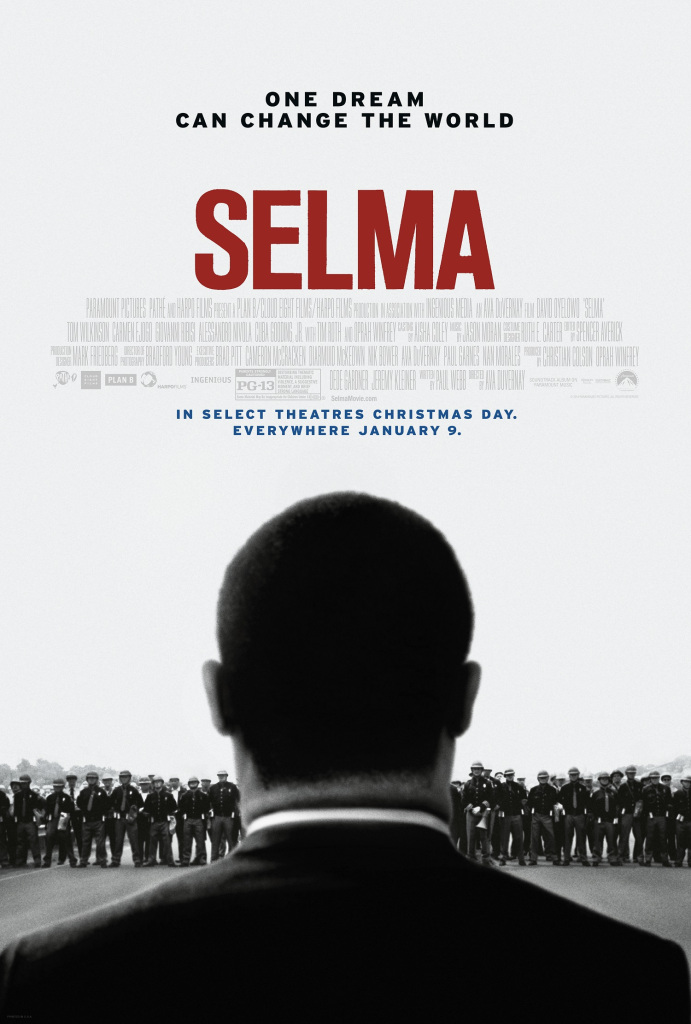
Selma

selma-movie-poster

Had “Selma” been released a number of years ago, people would probably just see it as another movie which chronicles a historical moment which has long since passed us by. But with all the upheaval in places like Ferguson, Missouri where violence against people of color is increasing substantially and the Voting Rights Act having taken a very unnecessary hit, this movie could not be timelier. What we see in “Selma” now feels like prologue as the fight for equal rights continues on to this very day. By now we should very well know we’re not living in a post-racial society.

“Selma” takes us back to the year 1965 when Dr. Martin Luther King, Jr. (played by David Oyelowo) and several others led marches from Selma to Montgomery, Alabama in an effort to obtain equal voting rights for African Americans. It was tough times indeed as Dr. King faces an uphill battle with everyone including President Lyndon B. Johnson (Tom Wilkinson) who is not quick to pass a Voting Rights Act as he is still dealing with civil unrest in the South which he is desperately trying to get under control. But King knows this is not an issue that can wait much longer to be addressed.

I have got to start off by saying David Oyelowo is a powerhouse in his portrayal of Dr. King, and he holds our attention completely from the very first moment he appears onscreen. It should be noted how Oyelowo campaigned for this role for seven years and managed to keep it even after the original director, Lee Daniels, departed the project. I have seen Oyelowo do memorable work in movies like “Rise of the Planet of the Apes,” “Lincoln” and “A Most Violent Year,” but I couldn’t find a trace of him in “Selma.” It felt like I was really watching Martin Luther King Jr. resurrected and walking among us again. Not once does Oyelowo succumb to doing a mere impersonation of the man who had a dream we still want to see become a reality. There’s a saying that in the theater you play a character and in film you are the character, and Oyelowo is definitely the man here.

The other big star of “Selma” is its director Ava DuVernay who brings this ever so important story to life so vividly. Granted, in some ways her presentation of the 60’s feels a little routine, and some scenes feel one-sided when they shouldn’t. Her portrayal of the marches, however, is appropriately devastating as she makes you feel ever blow inflicted by those afraid of change. These scenes do not leave the mind easily. King and his supporters are determined to protest in a non-violent way, and it’s hard not to feel for them when their supporters are being beaten senselessly. Deep down you want to see them fight back against the brutality even though we’re aware to do so will be giving the opposition far more ammunition than they deserve.

“Selma” also features a wealth of great performances from actors like Oprah Winfrey who channels her inner Sofia (the character she played in “The Color Purple”) for her role as Annie Lee Cooper who, at the movie’s start, is cruelly denied the opportunity to register to vote. I also enjoyed Tom Wilkinson’s performance as Lyndon B. Johnson as he adds layers to the former President which the screenplay doesn’t always give him. Tim Roth also turns in a strong performance as George Wallace, the always welcome Wendell Pierce is excellent as Hosea Williams, and Dylan Baker is ever so effective as J. Edgar Hoover to where I ended up trying to remember the actor’s name while watching this film.

Another performance worth giving special note to is Carmen Ejogo’s as Coretta Scott King. Ejogo played this role previously in the 2011 movie “Boycott.” She and Oyelowo have a great scene together when she questions him about his alleged infidelity, and no music score is needed to empower it as DuVernay wisely focuses on the actors for all they are worth. Watching these actors here makes for one of the most compelling scenes I have seen in any 2014 movie.

Is “Selma” accurate to what actually happened in history? I don’t know, and I don’t really care. All that matters to me is that it is true to the spirit of the facts more than anything else. We are beyond the point where we should expect movies “based on a true story” to be completely accurate to what actually occurred because dramatic considerations have to be taken into effect. While some argue Johnson was more open to King’s request for voting rights than he was shown to be here, there’s no denying the one most passionate about this issue was King himself. Whether or not this movie fails on a historical accuracy level, it does succeed on a dramatic one.

Having said all this, I kind of wished “Selma” didn’t paint a number of its character in such broad strokes. I guess I was expecting something along the lines of Spike Lee’s “Do the Right Thing” which observed its characters, regardless of color or nationality, with a lot more thoughtfulness and dimension. The fact that “Selma” doesn’t quite succeed in doing this is a bit frustrating, but it doesn’t take away from the powerful effect the movie will have on those who take the time to see it.

“Selma” doesn’t just take us back to an important period in history; it reminds us of the things we as Americans should be fighting for. The movie shows many people of different races and religions joining Dr. King in this fight for an equality no one should have to fight for in this country. But here we are years later, and it turns out the fight is far from over. Once again, we have a lot to learn from history.

* * * ½ out of * * * *

Gareth Edwards and Thomas Tull Talk About Making ‘Godzilla’

godzilla-2014-poster

I was invited to attend a special press screening of the 2014 “Godzilla” at Grauman’s Chinese Theatre (it’s now called TCL Chinese Theatres, but I prefer to call it Grauman’s), and it proved to be a huge improvement over Roland Emmerich’s 1998 debacle. Following the screening, we were treated to a Q&A with the movie’s director Gareth Edwards and the CEO of Legendary Pictures, Thomas Tull. The two of them discussed how they saw this version of the giant monster, the first time they became aware of who or what Godzilla was, and of how their film mirrors the current events of today.

There have been dozens and dozens of “Godzilla” movies made since 1954, most of them made in Japan by Toho Company Limited. There have been a couple of American movies made about this enormous monster as well, but they didn’t fare well to say the least. “Godzilla 1985” was universally panned by film critics and died a quick death at the box office. As for Roland Emmerich’s “Godzilla” which came out in 1998, I still cringe at the thought of its existence as it was amazingly awful. But when it came to making the 2014 version, Edwards made clear he was not about to let fans or critics down.

“We were trying to put more into it than just a simple monster movie because the original was definitely a metaphor for Hiroshima and Nagasaki and a very serious film. So we were inspired to try and reflect that,” Edwards said. “We police the world and go, ‘You can’t have nuclear power. You can’t have it. But we can have it, and we have nuclear weapons.’ And what if there were a creature that existed, creatures that were attracted to radiation? Suddenly the tables would be turned, and we’d be desperately trying to get rid of that stuff.”

From there, both Edwards and Tull described the first time they saw Godzilla. Hearing Tull talk about his first exposure to the Japanese monster came to illustrate just how big of an effect monster movies had on him when he was growing up. As for Edwards, he ended up describing his first exposure as being embarrassing.

“First time I saw it, it was the ’54 version,” Tull said. “I was probably around 7 years old. Where I grew up in upstate New York, what I looked forward to every year was the Friday after Thanksgiving when the local TV station would play ‘Godzilla’ marathons all day. That was my favorite thing of the year. I had the incredible fortune of making movies out of all the stuff I loved as a kid: ‘Batman,’ ‘Superman,’ Watchmen’ and now ‘Godzilla.’ Somehow the magic genie made it happen. This is really special to me.”

“In the U.K. when we were kids growing up, they had the Hanna Barbara cartoon. Not many people know that in America. I thought it was a worldwide thing,” Edwards said. “But it was basically Godzilla and I guess his son, Godzuki, and it would fly; it was all very cute. When you’re a kid it was great. I got offered this amazing opportunity. People in the U.K, they like to take the piss out of their friends, so just to mock me they would always refer to it as Godzuki. They’d be like, ‘How’s Godzuki going? Have you been to any Godzuki meetings?’ And I used to play along with it to the point where my phone learned how to spell Godzuki more than Godzilla. So when we used to have regular emails about the film, I’d type Godzilla and it would automatically change it to Godzuki. And for a while, I thought I might get fired.”

Edwards said while he and Tull were in the process of putting the movie together, the Tōhoku earthquake and tsunami, also known as the Great East Japan Earthquake, occurred which decimated much of Fukushima and caused serious accidents at nuclear power plants. Now when horrific events like this occur, Hollywood is quick to distance itself from them for fear of appearing like they are profiting from them. But considering the genres “Godzilla” covers, there was enough of a reason not to ignore the serious events happening around the world.

“There was a point where it felt like, well, maybe we shouldn’t set it in Japan. Maybe we shouldn’t deal with radiation or anything like this,” Edwards said. “We had genuine conversations for quite a while and we talked to a lot of people, and knew a lot of people, who were Japanese obviously working with Toho. And after a while the general consensus was that the 1954 version, the whole point of that movie, and science fiction and fantasy in general I think, they have this opportunity to reflect the period that they’re made in, and so it was thought as long as we did it respectively and the city and the events in our film are not about anything that happened in Japan. So, we felt it kind of appropriate to acknowledge some of these issues as we were figuring out the storyline.”

“When I was a kid, my dad used to have an encyclopedia on the twentieth Century, and on the front cover was Hiroshima, JFK’s assassination, Hitler, all the major events of the twentieth century,” Edwards continued. “I used to look at it and think none of that happened in my lifetime. Nothing significant like that has happened in my lifetime. Maybe nothing like that ever will. And then in the last ten years with the obvious things, it’s nearly impossible to genuinely sit down and say, ‘OK, I want to do a monster movie. I want to try and treat this like it really happened. What would it look like? How would people react and not be infected by the imagery over the last ten years, whether it be the natural disasters or even some of the terrorism?’ So that kind of infected the film a little bit. But we tried to do it in a way that, first and foremost, it’s entertainment. You’re here to see a Godzilla. But I personally like a little meat on my bone, so within that there’s obviously this other imagery and meaning that you can pull from as much as you want or as little as you want.”

Before this, Edwards had only one directorial effort to his name, the 2010 film “Monsters.” It had a budget of only $500,000 and, in addition to directing it, he also worked as writer, cinematographer and the visual effects artist which may explain why it didn’t cost much to make. With “Godzilla,” he had the backing of a major studio and an estimated budget of $160 million. Talk about one heck of a promotion! This has got to put the fear of God into any filmmaker making this kind of transition, but Edwards sounded like he has handled big budget moviemaking very well.

“It’s a massive, massive deal,” Edwards said. “It’s not just a once in a lifetime opportunity; it’s a once in a million-lifetime opportunity to be able to get to do this. The way I dealt with it was to forget we were doing it and just convince ourselves, which was kind of very easy to do, that we’re just in this bubble; it’s just us, and we’re just making a movie that we want to sit and watch, something that will give us goose bumps. And it’s kind of this selfish passion project in the way you kind of approach every day. Because I’d get paralyzed if I really thought about the number of people who would end up seeing the film and all the publicity and press that would come from it.”

“But it’s such a great opportunity,” Edwards continued. “I grew up since I was a little kid desperate to be a film director, and the second they mentioned it I was just like, I could never live with myself if I ever turned this down. I mean, I love monster movies. My first film was a monster movie. This is the ultimate monster movie. So how could you live with yourself having not made ‘Godzilla’ when you had that opportunity?”

Even before its release, “Godzilla” had already sparked conversations about a sequel or a potential franchise. This is not a surprise as movie studios are always looking for the next big movie trilogy to thrust at movie fans eager to pay their hard-earned money for. Edwards, however, said it was his intention to make a stand-alone movie, something I was very pleased to hear. As for Tull, with Legendary Pictures having been purchased by Universal Pictures, he was asked if a sequel would be released by either Universal Pictures or Warner Brothers, the latter which is distributing this movie. In the end, Tull could only say the following:

“We have a little rule: we can’t talk about anything else until this comes out and works,” Tull said. “It’s a little superstition I have. All I can say is, we’re passionate fans of the universe and we love Godzilla and some of those other folks do too, so if this comes out and works we’ll figure it out.”

Save

A Merry Friggin’ Christmas

a-merry-friggin-christmas-poster

The worst Christmas memories we have tend to become the funniest and most memorable moments of our lives, and I went into “A Merry Friggin’ Christmas” thinking it would reflect this fact. With a cast which includes such tremendously talented actors like Joel McHale, Lauren Graham, Candice Bergen, Clark Duke and Robin Williams, in what sadly turned out to be one of his last roles before his tragic death, this seemed to be a surefire winner and quite possibly one of the most subversive Christmas comedies ever, right?

Nope, no such luck. “A Merry Friggin’ Christmas” turns out to be a tremendous disappointment as it strands its wonderful cast in a far too typical Christmas movie with very little in the way of laughs. In fact, I never got much in the way of gut-busting laughs like I hoped I would. When actors like these can’t make this holiday comedy rise above its formulaic conventions, you know something is seriously wrong in the state of Denmark.

McHale stars as Boyd Mitchler, and the movie starts with him as a boy hiding under the Christmas tree waiting for Santa Claus to appear. But instead of Santa Claus, Boyd is greeted by his drunken father Mitch (Robin Williams) who quickly tells him that, like the Easter Bunny, Santa doesn’t exist. Move to a number of years later, and Boyd is now happily married to Luann (Lauren Graham) and the father of two adorable children. Unlike his father, Boyd is determined to keep the magic of Christmas going for his kids as long as he can before the reality of the cruel world they live in forever robs them of it.

It’s interesting how Boyd’s daughter already knows Santa doesn’t exist as kids these days are getting increasingly harder to trick or fool. Still, Boyd is determined to keep his son Douglas (Pierce Gagnon from “Looper”) believing the jolly fat man from the North Pole is real even if he has to fly at 20,000 mph in order to deliver all those presents in a timely fashion. Of course, with climate change melting away much of the ice on this planet, Santa will most likely be living in a submarine at this point.

But then Boyd gets word from his brother Nelson (Clark Duke) that his baby is going to be baptized on Christmas Eve, and this means the whole Mitchler family is going to be reunited under one roof for the first time in years. We all know what happens when such a dysfunctional family gets together; tempers flare and old resentments quickly rise to the surface. Clearly, things are going to get worse before they can finally get better, and it doesn’t take a genius to see how predictable this “comedy” is going to end up being.

What’s even more unsurprising is how we see early on that Boyd is going to completely forget to bring Douglas’ presents along with him, and this results in him going on an 8-hour round trip to get them and preserve his son’s belief in Christmas. Coming along with Boyd on this ride is father who uses his truck which has a couple of portable toilets stowed in the back. Will one of them fall off the truck and create a disgusting mess? Does a bear shit in the woods?

Holiday movies are a dime a dozen, and I’m always waiting for one which messes around with the formula to give us something different. “A Merry Friggin’ Christmas” had the potential to be such a movie, but it ends up falling apart as soon as it starts. The performances and the comedy are played much too broadly, and everything comes off as uninspired. It’s such a shame because you have an actor like Graham, who starred in one of the greatest Christmas movies ever made, “Bad Santa,” and even she can’t save this movie with her priceless expressions (and they really are priceless).

“A Merry Friggin’ Christmas” has taken on a special meaning in light of Williams’ tragic death, and it’s sad his career had to end with a movie like this one. Having said that, he does have some moments where he doesn’t say a word but his face speaks volumes about what Mitch is feeling and going through in his head. He makes you feel Mitch’s pain when he discovers he has been photo-shopped out of a family photo, and while his character is mostly a one-dimensional jerk, Williams gives him a depth many other actors would not have been able to achieve. It’s a shame his talents ended up being wasted on such a half-baked screenplay.

For me, there are few things worse than a comedy that doesn’t make you laugh, and “A Merry Friggin’ Christmas” sadly turns out to be one of them. Those looking for the perfect Christmas movie for the whole family will be better off renting “National Lampoon’s Christmas Vacation,” “Love Actually” or “Bad Santa.” This one is not going to keep you entertained.

* out of * * * *

On the upside, the existence of this misbegotten Christmas movie did allow me the opportunity to talk with two of its stars, Joel McHale and Lauren Graham, about its making. Please check out the interview below: