‘Adventureland’ – A Ralph Report Video Vault Selection

WRITER’S NOTE: This review was written back in 2010. I applaud Eddie Pence for featuring this as a Video Vault selection on “The Ralph Report.”

It’s always those low paying jobs you had as a teenager during the summer months which helped mold you into the person you are today. It sucks how it takes you another decade or so to realize this upon closer reflection. Being there at the cash register, ringing up orders for customers in the real world, this all shows you things people they don’t teach you in high school or college. So yes, even those cumbersome jobs I had such as cutting the guts out of fish, teaching little kids how NOT to fish (and they still didn’t listen to me), shoveling popcorn constantly to where I came home reeking of it, and selling overpriced drinks at the movie theater (because that’s where they get their profit from folks) made me wise up to things which would eventually benefit me later in life. It also taught me how to take control and responsibility for my life. Still, it would have been nice if they paid me more an hour. Minimum wage was around four dollars back then. I wouldn’t be able to live on that today.

Adventureland” follows the exploits of James Brennan who is forced to take a summer job upon graduating from Oberlin College. His dad just got laid off to where neither of his parents will be able to support him financially either for the summer vacation in Europe he was hoping to take, or for his first year at Columbia College where he was planning to study journalism. Despite gloating over the great vacation he cannot go on now, James applies for different jobs around his hometown, but even his impressive transcript from Oberlin can’t land him a decent paying job. Adventureland Park, however, is hiring just about anyone with a pulse who fills out an application. Heck, I bet they even hire people they call the cops on! James tries to get a ride operator position, but managers Bobby and Paulette (played by Bill Hader and Kristen Wiig) are convinced he is more of a games person, so he unenthusiastically takes on the job only out of a financial need.

This is one of those movies which unfortunately got lost in the shuffle due in part to Miramax’s promoting it in the wrong way. The posters kept screaming out how it was from the director of “Superbad,” Greg Mottola. But despite the fact both movies have the same director, they are very different from one another. While “Superbad” was a broadly comic farce (one of the most gut-bustlingly hilarious ones from this past decade might I add), “Adventureland” is more of a serio-comic story and one of the more realistic coming of age movies I have seen in a while. Don’t get me wrong, there are some very funny moments to be found here, but you really can’t walk into this movie expecting another “Superbad.” If you do, you will be disappointed for all the wrong reasons.

The Adventureland Park itself is like one of those travelling carnivals you see come into town once or twice a year. You know, the ones with those rides which are in a constant state of disrepair which no cleverness can ever hide. The games they have like the ring toss and dart throwing are all designed to be unwinnable. This doesn’t stop people from still paying to play them though, hence the profit. Plus, like all amusement parks, they play the same damn songs over and over to where the employees are driven to insanity. I remember working at a park like this once, and I endured the same exact daily irritations. Where James and his colleagues have to listen to Falco’s “Rock Me Amadeus” every other five minutes, we kept getting subjected to Tom Petty & The Heartbreakers… Well actually, I do like Tom Petty, but I just realized I don’t listen to him as much as I used to.

I love how “Adventureland” gets all the specific details down to where it resembles just about any job I could have had as a youth. I actually worked at Disneyland for a couple of years myself, and while Adventureland is a pale imitation of it, many of the same rules I lived under were reflected by the park employees here. What this park has over that corporate monolith, however, is that the rules are much looser, and the working environment is nowhere as stressful.

Jesse Eisenberg plays James Brennan, and right now he is going through that Michael Cera phase of playing the young adult who is not always of sure of what he is supposed to say, think or do most of the time. He is best known for starring in “Zombieland” opposite Woody Harrelson or from “The Squid & The Whale” where he held his own opposite the great Jeff Daniels. Eisenberg is perfect as James in how he finds things to savor at Adventureland even though he would rather be vacationing in Europe. He never overplays or underplays the part to where he becomes ingratiating to watch. Somehow, this actor finds the perfect note to play James to where we like this guy and want to follow him on his post-graduate summer from start to finish.

The other big star here is Kristen Stewart who we all know of course from those darn “Twilight” movies. I haven’t seen any of them but, from what I have been told, I haven’t missed much. My friends keep telling me Stewart cannot act and how she looks all vacant whenever she is onscreen. Well, they didn’t check her out in “Adventureland” because her talent really shines through. Her character of Emily Lewin is the most complex here as she is dealing with a lot of problems which make her yearn for an escape out of town. Emily’s dad is actually a rich lawyer whom she resents for remarrying so soon to a woman she cannot stand. She really doesn’t need to work a part time job, but she does so just to get out of the house. Her methods of escape end up getting her into a relationship with Mike Connell (Ryan Reynolds), a married man who also works at the park.

Stewart does great work in portraying a character who yearns to be with someone who really sees her for who she is, but ends up running away from that particular someone when she becomes seriously afraid of messing everything up. You care about Emily because we can all relate to being confused about our place in life and of wanting to escape an environment which feels too confining. As a teenager, you can really feel like a prisoner in your hometown, especially if you don’t have a driver’s license. There are only so many places you can go to, and there is a strong need to break the boundaries holding you back. Stewart and the rest of the cast really show this throughout.

Another actor I want to give a lot of credit to is Martin Starr who plays Joel, the sarcastic co-worker who shows James around the park and makes him see how everything works. Starr has an amazingly dry sense of humor which has served him very well ever since appeared on the depressingly short-lived show “Freaks & Geeks.” This role is perfect for him as he embodies the antisocial misfit we remember from school, and who proves to be far more interesting than the jocks who were the stars on campus. Starr also gives his role an unexpected depth as we see him getting involved with a girl who ends up thoughtlessly rejecting not for who he is, but of what she and her family sees him as. It’s one of the film’s most honestly painful moments which rings true in ways too real to discuss openly.

And, of course, I can never get enough of Bill Hader and Kristen Wiig, some of the funniest people working today on “Saturday Night Live.” They are great together as the managers of this barely average amusement park and provide some of the biggest laughs as they take care of business as professionally as they can. Just make sure not to litter around Hader’s character because this will set his fuse off almost immediately,

With “Adventureland,” Mottola really captures how those jobs we worked for little money growing up toughened us up and helped in our evolution. I think it will be seen in the future as one of the most vastly underrated coming of age movies ever. It deals with the painful truths of growing up, and of experiences we had which molded the way we think and acted from there. Hopefully it will find the audience it deserves on cable and physical media. And for those of you who still think Kristen Stewart cannot act, get a clue, please.

* * * ½ out of * * * *

‘Fantastic Mr. Fox’ is One of Wes Anderson’s Most Inspired Works

WRITER’S NOTE: This review was written in 2009.

After watching “Fantastic Mr. Fox,” I am convinced Wes Anderson should make as many stop-motion animated movies as he possibly can. Nothing against his live action work, but this form of animation seems really suited to Anderson’s unique blend of comedy and dysfunction. While his last film, “The Darjeeling Limited,” was very good, it started to seem like he had been dealing with the same themes once too often. But with the brilliantly made “Fantastic Mr. Fox,” his material is given a freshness which, for a moment, seemed to have escaped him. I wasn’t sure what to expect, but this turned out to be one of the most enjoyable movies I saw in 2009. As a result, any frustration I had over not being able to see “Avatar” (it was a family outing, and it didn’t seem right for my 5-year-old niece) was completely forgiven.

“Fantastic Mr. Fox” is based on a children’s novel written by Roald Dahl whom Anderson considers one of his personal heroes. Dahl is the same man who wrote “Charlie and the Chocolate Factory” and “James and the Giant Peach” among other stories, and his work is characterized by a lack of sentimentality and a lot of dark humor. Judging from “Rushmore” and “The Royal Tenenbaums” with their strong black humor, it’s no wonder Anderson digs Dahl!

The Mr. Fox of the title is a cool and exceedingly clever animal, and we first see him with his wife sneaking into a farm to steal food. They are, however, caught in a trap which has his wife pointing out they should choose a safer form of work. Oh yeah, she also tells him she’s pregnant, and this changes the dynamics of their relationship in a heartbeat. We catch up with these two a couple of years later after they have found a home within a hole in the ground. Mr. Fox is now a newspaper columnist, and he and his wife are parents to a son, the sullen Ash, who constantly feels unappreciated in all he does. Still, Mr. Fox does not like where his family lives and promises to do better by them. Despite the warnings of his lawyer, Badger, he ends up buying a new home in the base of a tree. These new lodgings are also coincidently right near the gigantic farms owned by three ugly looking farmers: Walter Boggis, Nathan Bunce, and Franklin Bean. So, of course, this gets Mr. Fox all excited and back to his usual tricks of stealing food and drink while the rest of the family remains unaware. To quote another fox from a vastly different 2009 movie, “chaos reigns!”

The first thing people will notice about this movie is its “star studded” (what does that term mean anyway?) cast of actors. Voicing Mr. Fox is the most debonair of movie stars right now, George Clooney. With this, “The Men Who Stare at Goats” and “Up in The Air,” I can’t help but wonder when Clooney gets the time to sleep. At this moment, he’s everywhere, and his constant presence would be ever so annoying if he weren’t such a terrific actor. Clooney perfectly captures Mr. Fox’s confidence without ever becoming overly smug, and he exudes the cleverness this character has in getting back at the three farmers.

Meryl Streep, who has also had a busy year with this, “Julie & Julia” and “It’s Complicated,” voices Mrs. Fox. I actually wonder how much sleep she gets as well as Streep always seems to be learning a new accent she has not taken on yet. Streep is the perfect contrast to Clooney’s charmingly reckless nature, and she serves as the conscience Mr. Fox needs to hear out more often. Streep doesn’t do anything incredibly different with her voice like she did for Julia Childs, but its warmth is quite seductive at times.

Anderson has also employed many of his regulars for “Fantastic Mr. Fox” as well. Jason Schwartzman who was featured quite prominently in “Rushmore” and “The Darjeeling Limited” voices Mr. Fox’s son, Ash. Schwartzman perfectly captures the angst Ash feels at never fully winning his dad’s approval, and you feel Ash’s desperation as he goes to dangerous lengths to get any approval. Owen Wilson, who co-wrote “The Royal Tenenbaums” with Anderson, has a cameo voicing Ash’s athletic coach, Skip. You can tell its Wilson right away, and he gives Skip a wonderfully dry voice which gets a good number of laughs whenever he appears. Even Bill Murray, who has had a role in just about all of Anderson’s movies, voices Mr. Fox’s lawyer, Clive Badger, and he always seems to fit in perfectly in Anderson’s cinematic universe. And let us not forget Wallace Wolodarsky who voices the confidence challenged Kylie Sven Opossum who somehow gets sucked into Mr. Fox’s schemes against his better judgment.

Others to be found here are Michael Gambon, the current Dumbledore of the “Harry Potter” movies, who voices one of the farmers hellbent on eliminating the thieving Mr. Fox, Franklin Bean. Eric Chase Anderson, who is responsible for those illustrations of Anderson’s movies when they are given Criterion Collection releases, voices Mrs. Fox’s nephew Kristofferson who is perfect in every way Ash is not. But the most surprising voice here is from the actor who voices Rat, Bean’s security guard. Rat was a French character, so I assumed the actor voicing him was French. Turns out that it was actually Willem Dafoe! That’s right, the same guy who was in that other delightful 2009 movie with a fox, “Antichrist.”

With just about all of animated movies being done with computers and digital effects, it’s refreshing to see other filmmakers go a little retro with the stop-motion animation. The work here is brilliantly done, and I was surprised at how lifelike everything looked. Movies like these must require an exceeding amount of patience to make because they clearly take years to produce. It also fits right in with Anderson’s quirky sense of humor which remains intact a good ten years or so after “Rushmore.”

I also really dug the soundtrack Anderson chose for “Fantastic Mr. Fox.” Each of his movies contain a great selection of music which veers from classic British rock songs to American rock among other genres. With this film, Anderson includes songs from the Beach Boys and Burt Ives which fuel the proceedingas with an undeniable sense of innocence and adventure. It also made me an instant fan of The Bobby Fuller Four whose song “Let Her Dance” plays during one of the most joyful moments this film has. Composing the score is Alexandre Desplat who has composed music for movies like “Firewall” and “The Curious Case of Benjamin Button” among others. I love how Desplat captures the infectious spirit of everything which takes place.

Is this a kid appropriate movie? I think so. It did get a PG rating which seems appropriate. Sure, there are many bottles of alcoholic apple cider and some smoked chickens which might give you the wrong impression of the goings on being displayed, but I really think this movie is harmless. Compare this to the recently released sequel to “Alvin and the Chipmunks” which has not so subtle references to classic movies like “Taxi Driver” and “Silence of the Lambs” among others. This film is not just aimed at kids, but for the whole family as well.

While many will be more likely to view this movie on DVD or Blu-ray (or VHS if it’s still available), ” Fantastic Mr. Fox” really is a fantastic piece of work which deserves a big audience. Anderson, along with co-writer Noah Baumbach (“The Squid & The Whale” and “Margot at the Wedding“), has managed to take his fascination with families that are less than perfect and put them in a context which will not scar your kids for life. It was also cool to see Clooney play a character who, unlike the one he portrayed in “The Men Who Stare at Goats,” was not afraid to dance.

Was it worth not going to see “Avatar” this day and watching this instead? I hate to say it, but yeah.

* * * * out of * * * *

Underseen Movie: ‘Fish Tank’ – 2009 Jury Prize Winner at Cannes

Here’s a little British independent feature which came out at the beginning of 2010 in America after being named the Jury Prize Winner at the 2009 Cannes Film Festival. Unfortunately, however, it barely registered in movie theaters, so here’s hoping it finds an audience on physical media and/or cable. “Fish Tank” is a raw and unsentimental character study that pulls no punches in its portrayal of a tough and troubled teenage girl growing up in an East London council estate. It was directed by Andrea Arnold, an actress turned filmmaker who previously directed “Red Road,” and it stars Katie Jarvis as Mia, the teenage girl you may figure is up to no good just by looking at her. There is no Hollywood gloss on display here, and the environment this young woman inhabits feels both real and rundown, just like the other characters who are stuck there with her.

Now council estates are to England what public housing or “the projects” are to cities all over the United States; rundown buildings designed for the economically challenged that carry a stigma of poverty and endless crime. Now whether this is true or not, this is usually the impression people have of these places. It is clear from the start that Mia, along with her mother and younger sister Tyler, have lived in this place for a long time, and it has shaped them into the people they are today. There is seemingly no room for much in the way of respect or gratitude towards neighbors or strangers.

Mia appears to have it the roughest compared as she has been kicked out of school and seemingly wanders around the estate aimlessly. We see her putting up a seriously tough front for some girls whose dancing moves she bluntly criticizes as sucking big time, and this leads to her head-butting a girl in the face which shows how quick she is to defend herself. At home in one of the many far too cramped apartments in the council estate, her mother continually treats her like dirt and appears more interested in partying and getting drunk rather than being a parent. The only real tender moment between them comes at the end of the film, and you will know it when you see it. As for Mia’s younger sister Tyler, she has a vocabulary which Chloe Grace Moretz’s character from “Kick Ass” sound PG rated in comparison.

Being the loner she is, Mia’s only escape is practicing her dance moves in an abandoned apartment near where she lives. This proves to be her only real outlet for the frustration and aggravation which has consumed her life to this point. She is shy in revealing this part of herself to just about anyone as vulnerabilities are easily spotted and exploited for all the humiliation which can be derived from them. No one is ever quick to show any weakness in this kind of environment.

Into this environment enters her mother’s latest boyfriend, Connor, a security guard at a nearby hardware store played by Michael Fassbender. Mia is never quick to warm up to others she doesn’t know well, but she quickly develops an interest in Connor who becomes the father figure she lacks. From the moment we see Mia help him catch a fish in the lake with his bare hands (it’s possible), he inspires her to try new things and open herself up to possibilities which previously seemed beyond her reach.

This leads to a great deal of tension in “Fish Tank” as we cannot help but wonder if this relationship is going to end up crossing any boundaries. There are moments captured where the chemistry between Mia and Connor is so strong, you fear the possible and destructive ways this relationship can go to. Words are not needed to illustrate the bond they have, be it when Mia films Connor with a video camera while he’s getting dressed for work, or when Connor gives Mia a piggy back ride out of the river after she injures herself. Their growing discoveries of one another and what they are capable of is impossible to ignore, and we can see the positives of this even while the negatives are never far off.

Arnold films the movie in a way where nothing feels staged, and every character and location feels authentic to what it must be like in reality. I’m not sure a movie like this could have been filmed any other way and have the same effect. She also captures the suffocating environment of being in these big government buildings which are treated more like dumps for the lowest on the economic ladder. The apartments themselves are ridiculously tiny, and there is no privacy for any family member who has to live there. Places like these must feel like prisons to those who inhabit them, and Arnold captures this mindset clearly to where you feel as helpless as these characters do.

As bleak as “Fish Tank” is though, its ending offers hope that anyone can escape such a confining environment if they have the means and the foresight to change their lives for the better. Some are too far gone to be saved, but Mia still has a chance to move forward, and her relationship with Connor makes this clear to her.

Katie Jarvis who plays Mia in had no real acting experience before she got cast in this movie. It turns out she got an audition after one of the casting assistants saw her arguing with her boyfriend quite loudly outside a train station. Indeed, this role not only requires an actress who comes off as tough, but one who inhabits a role more than play it. While a lot of struggling actors out there may hate the fact Jarvis got one of the luckiest breaks ever, it makes a lot of sense Arnold would cast someone who came from this environment.

The role Jarvis plays is not an easy one to portray. Mia has to be tough yet show just enough vulnerability to let the audience look past the defenses she has built up. She also has to be shy but angry, curious without spelling it out for the audience, and her character needs to evolve from the person we see at the start of the movie. This makes her performance all the more revelatory because you come out thinking she has been acting all her life. She successfully captures all the subtle nuances of Mia to bring out the complexities which makes her more than just any other angry young person. Truly, it’s a daunting role for even the most experienced actor, and Jarvis comes out of the picture looking like a pro.

The other key performance comes from Michael Fassbender as Connor. Fassbender has been in movies like Steve McQueen’s “Hunger,” and he stole a number of scenes in Quentin Tarantino’s “Inglourious Basterds.” As Connor, he comes across as a generous human being, and it’s commendable that he would want to try and be a father figure to someone else’s children. This is something most people would NOT want to do. But her also gives Connor an enigmatic nature which makes him hard to pin down and figure out. Like Mia, you want to more about this guy than what he is telling everyone around him.

The only real problem I had with “Fish Tank” involved one character’s revelation in the last half. It’s hard to talk about it without giving anything away, but it was one of the few times where I have watched a movie and left it begging for more answers. Mysteries which stay after a movie ends can be fascinating, but others are not so lucky. Some movies need and demand closure, and this one could have used more of one. Either that, or I completely missed something…

I meant to see this film when it briefly played in theaters back in January 2010, but I never got around to it. When I did, it was playing at New Beverly Cinema in a double feature with “An Education.” That film featured another breakout performance from Carey Mulligan, another actress who seemingly came out of nowhere. Having seen both, it was clear why the New Beverly put them together; they are both about the same thing. Each is about a young British girl who feels trapped in an environment they desperately want to escape. Just when they think they have found a way out, reality rears its ugly head and takes any possibilities for an exciting life away from them rather cruelly. Still, both women rise above the pain inflicted on them and find a way to move on in spite of what they were forced to endure.

For those of you with a hankering for dramas with raw emotion and non-manufactured realism, “Fish Tank” is definitely a movie I recommend for you to see. As I write this, the Criterion Collection has released a special edition of it on DVD and Blu-ray. It features a digital transfer of the film, some short films by Arnold, and interviews with the actors, one of which is with Fassbender. In a time where the local cinema is getting overrun by blockbuster movies and immortal franchises, movies like this demand to be seen, and this is one of them.

* * * ½ out of * * * *

Funny People – A Flawed But Fascinating Look at a Tortured Stand-Up Comedian

I always figured comedians were the best kind of people to hang out with as a kid. Hearing them tell funny stories, making joke after joke, happiness always seemed served up to them on a silver platter. But as time went on, I came to see while they were clowns on the outside, they were crying an endless river of tears inside. Comedy from these people comes from a deep pain and sadness in their lives, or out of a deep-seated anger they have at the world around them.

Look at Richard Pryor, need I say more? He had all the money, women, cars and drugs you could ever ask for. For “Superman III,” he ended up paid more than Christopher Reeve. Still, I remember reading an interview in which he said the last truly happy moment he remembers in his life was when he was jumping around in the dirt while pretending to be a cowboy at the age of 10, and he was in his 40’s when this interview was conducted. Comedy was his constant weapon against pain, and he never held anything back in his routines.

Funny People” understands very well this gloomy realm many comedians live in, and is written and directed by a filmmaker who still performs from time to time as a standup comedian, Judd Apatow. But unlike “The 40-Year Old Virgin” and “Knocked Up,” this film has a darker edge to it and doesn’t hide away from the inherent viciousness of its characters. “Funny People” has been advertised as a comedy drama, but the balance often veers more to the dramatic. There are many laughs to be had here, but this movie clearly came from a rather dark place.

Adam Sandler stars as George Simmons, a comedian turned movie star whose career looks a lot like Sander’s own. George became famous with movies like “Merman” where he played a male mermaid, and “Re-do” in which he plays a character whose body has transformed into that of an infant. Seeing George’s head digitally inserted onto a baby’s body at once gives us a great sight gag, but it also seems like the kind of silly comedy Sandler himself has made once too often. Besides, I have more than my fill of talking babies.

George has it all: a beautiful mansion overlooking the sea, a swimming pool he does laps in on a regular basis, great cars, women who don’t hesitate to sleep with him even if they have boyfriends, and all the money one could hope to live off of to the end of time. But in his eyes, we see he is a sad man who has come to truly despise himself for what he has become. All the wealth he has amassed only serves to isolate him from the rest of the world, and it makes him defensive around total strangers who are unable to see him as ever resembling a regular person. But now, his doctor has diagnosed him with a terminal disease and has only months left to live. George reacts to this news as if someone drained his blood while he wasn’t looking, and it makes him realize how much self-hatred he has. From there, he becomes to make every last minute of his life count, but this may not alter his antagonistic personality from where it currently resides.

As George Simmons, Adam Sandler gives one of his best performances to date, and its right up there with his brilliant turn in Paul Thomas Anderson’s “Punch Drunk Love.” Not once does he back down from how George is a hard man to like. Throughout “Funny People,” George is dismissive to many around him, and he ends up being thoughtlessly mean to those who look up to him. Regardless, Sandler still manages to make you sympathize with this character and of the terminable diagnosis which he did not see coming. It’s the moments where Sandler lets it show through his eyes just how full of regret Simmons is, and it serves as proof of how this former “Saturday Night Live” performer is more talented than he thinks.

Along with this famous comedian on his cynical farewell tour is Ira Wright (Seth Rogen), an aspiring young comic who is not entirely confident with his stand-up act. George catches Ira’s act one night after he makes a surprise appearance at a comedy club, and while he is hurt when Ira discusses how he bombed onstage just moments before, George thinks this kid has got talent and offers to pay him some money to write up some jokes for an upcoming benefit show. From there, George hires Ira as his personal assistant, an employment opportunity which involves more work than the average 9 to 5 job which never pays enough.

Remember all those nasty horror stories from people who were assistants to the stars and certain sociopathic studio executives? Well, Ira may have gotten off easy compared to those people, but we fear his soul will be forever crushed the longer he stays with George.

In a lot of ways, Ira is they typical kind of character Rogen has played over and over again in movies, and not just the ones he does with Apatow. While I would love to see him take on riskier roles like the one he played in “Observe and Report,” he is the perfect match for Sandler’s endlessly cynical misanthrope of George. By the movie’s end, Rogen his performance proves to be the most underrated in the film, and he believably takes Ira from someone lacking in confidence to one who finds his voice with each standup routine he does to where he shows a strength he did not know he had. Rogen makes this transition feel seamless to where he had a stand out moment when he faces down Simmons and tries to make him see how his terminal disease has not come close to changing his outlook on life.

But the one person who almost steals “Funny People” is Apatow’s wife, Leslie Mann. Having already proved what a comedy dynamo she was in her husband’s previous films, there should be no more talk from those who believe she has only gotten this far as an actress because of nepotism.

Mann plays Laura, and George describes her to Ira as “the one that got away.” Laura was and still is George’s one true love, and he finds she still yearns for him even though their relationship came to a heartbreaking end when he cheated on her. This is a moment George appears to regret more than any other, and he becomes eager to make up for it as soon as he can. Laura never tries to hide her character’s undying affection for this man who is lonelier than most, and she is willing to end her marriage to an Australian soccer nut (Eric Bana, who is hilarious) who may be cheating on her as well. As Laura, Mann succeeds in making you fall for this character even while she selfishly tries to redirect her life without realizing the consequences of her actions.

There are a lot of strong elements working in favor for “Funny People,” but it doesn’t change the fact it is a deeply flawed movie. While it is good and worth watching, it will most likely be seen as one of Apatow’s weakest movies. I do like how he dared to go in a slightly different direction with this movie compared to what he has given us previously, but the balance between comedy and drama is off kilter most of the time. For many, I don’t think it will be entirely clear as to whether they are watching something comic or very serious.

Plus, at over two hours long, this movie really could have been shorter. I’m usually cool with long movies, but only if they can justify their length. It is way too easy to come off as self-indulgent when making a three-hour epic. “Funny People’s” length does cut deeply into its comic momentum, and there are spots where it things really dragged. It does pick up towards the end, but the story still could have used a bit more tightening.

Still, I really did like “Funny People” because it shows how Apatow still succeeds in giving us characters and situations which feel very real on an emotional level. With him taking his established formulas in a different direction, it is clear his work will continue to grow with each successive project he takes on.

I also love the brilliant cameos he manages to extract from big celebrities in his films. One scene in “Funny People” has George meeting up with a lot of famous comedians like Norm McDonald, Andy Dick (wow), Charles Fleischer, Collin Quinn and Sarah Silverman who has one of the movie’s funniest scenes. But the biggest surprise cameo to be found here is Eminem’s as I never expected to see him in any movie, let alone one directed by Apatow. Seeing him dissing Ray Romano provides us with an unforgettable moment where Ira ends up saying to Ray, “I thought everybody loved you.”

One perception about “Funny People” which needs to be cleared up is that it is not what many would call a “disease movie.” It is really to Apatow’s credit here that he never gets all mushy on us like many others would have when it comes to films about people who think they are facing certain death. George’s arc here is much like the character Michael Keaton played in “Clean and Sober.” In the process of trying to improve themselves and become better people, they end up fooling themselves to where they think they are changing for the better, but are instead acting more selfishly than they realize. Their attempts to help those in desperate situations reveal just how self-involved they are, and it just gets worse for them from there. It is not until the climax which has them at a place where they realize what they truly need to do to move on from a fractured past.

“Funny People” is definitely worth seeing. Just don’t go in with the normal set of expectations you have for the average Apatow production because things are a little different here. It definitely has some hilarious moments and dramatic ones, and Sandler makes it clear to us he can be a great actor when given the right material. It is also an intimate look at the fame and success one person experiences, and of how damaging and isolating it can be.

This project was really a long time coming for both Apatow and Sandler because they did share an apartment when they first moved out to Los Angeles. “Funny People” actually starts off with home video footage of them making prank phone calls which has them laughing in hysterics. It is meant to be a look of innocence which fame forever changes, but at least we can see how in real life these two funny men have their families to keep their egos in balance. George Simmons is simply the person each of them would have become if they weren’t careful.

* * * out of * * * *

Underseen Movie: Harry Brown in Which Michael Caine Gets His Own Version of Death Wish

Back in 2010, I was trying to remember the last time I saw Sir Michael Caine play the lead in a motion picture. Looking back, I think it was “The Quiet American” in which he gave what he thought, and I agree with him, was one of his very best performances ever. Since then, he has been the supporting actor of choice in movies like “The Dark Knight” and “Inception.” The big joke around Hollywood was if you can’t get Morgan Freeman for your movie, get Caine. Those two guys are in just about every other movie being made. Still, we need a reminder every so often of how truly great an actor Caine is. There are a number of good reasons why his career has lasted several decades after having survived critical disasters like “Jaws: The Revenge.”

But in 2009, Caine did get indeed get the lead in a movie many still have not seen, “Harry Brown.” I saw it as a double feature at the New Beverly Cinema along with a classic movie Caine starred in called “Get Carter.” Both these films have him playing characters where violence plays or has played a big part in their lives. With “Get Carter,” he played a professional killer who was almost completely amoral, and yet you couldn’t help but like him. It’s almost tempting to look at “Harry Brown” as kind of a sequel to “Get Carter” as it makes you wonder what Jack Carter would have been like had he grown up long enough to become a senior citizen. Even if he managed to put his past behind him, it is always bound to catch up with him as only so many bad deeds go unpunished.

From its trailer, “Harry Brown” certainly does look like the British version of “Death Wish,” one of the most unforgettable movies about vigilante justice. But you could also look at it as being to Caine what “Gran Torino” was to Clint Eastwood. Each movie involves a character so uncomfortable with the changes going on around them, and they are resistant, as is everyone, to any kind of change. There’s even a good dose of Eastwood’s “Unforgiven” thrown in for good measure as you wonder how deeply Harry was shaped by his experiences as a military officer.

Either way you look at it, “Harry Brown” takes the overused concept of a regular person who loses someone close to them, forcing them to take matters into their own hands when the police fail to help, and turns it into a very effective thriller which is truly unrelenting in the intensity it generates. Seriously, this is a very bleak movie which puts you into the main character’s mindset and never lets you go. It also takes place in a an environment which is all too real to those who live in it, and the consequences hit you like a swift kick to the gut. You may look at Brown’s surroundings and say to yourself no one could pay me enough to live in this environment, but we are stuck there for 103 minutes, and there’s no easy way out.

Caine plays the title character, a widowed North Ireland military veteran who finds his training coming back to him as he comes to confront those who murdered his best friend, Leonard (David Bradley) in such a cold and callous way. Following this, it becomes clear to Harry his days of being indifferent to the horrible goings on now are at an end, and he threatens to become even more lethal than those gang members he stealthily pursues. In the process, his training as a soldier is reawakened, and he uses it to his advantage. The way Harry sees it, he and his men fought for something important, but these kids today are instead fighting for their own depressing amusement.

Caine continues to make screen acting look effortless for him, and even the moments where he doesn’t speak a single word speaks volumes of what is going through his mind. We feel Harry’s pain over becoming so lonely without a soul to rely on, and we experience his state of mind completely thanks to Caine’s incredible performance. We have seen this kind of character a lot in movies, but Caine imbues Harry with a wounded humanity which keeps him for becoming completely cold blooded. Even as he descends into violent acts of raw vengeance, we can’t help but sympathize with Harry as we come to wonder what we would do if we unlucky enough to be in this situation. We never catch Caine playing on the clichés other actors would likely fall into, and it makes you wonder if there is another actor who could have played this role as well as him.

“Harry Brown” marks the feature length directorial debut of Daniel Barber whose only other project was the Oscar nominated short film “The Tonto Woman.” Filming at a council estate in South London, he creates an unrelentingly bleak atmosphere which feels even darker than anything David Fincher came up with in “Alien 3” or “Seven.” Just taking in the atmosphere which surrounds Harry and his fellow neighbors drains the soul pretty quick. Instead of prettying anything up, Barber captures the hopelessness of a people stuck in a crime ridden area so far out of their control, and of the frustration which drives the main character into action.

It is clear from the start that this will not be your average Hollywood vigilante flick, and the violence featured here is very brutal. The movie’s opening sequence features a very realistically staged gang initiation sequence where a new recruit is made to do drugs and then gets beaten up to within an inch of his life. This is later followed up by a highly unnerving scene where two gang members are riding along on a motorbike while filming their escapades, and one of them ends up shooting a young mother while she is pushing her baby in a stroller. From that point on, you never feel safe while watching this movie. You feel the gunshots when they go off here, and it all becomes a race to see how much longer Harry can stay alive.

Barber also proves to be masterful in setting up highly suspenseful scenes which are brimming over with excruciating tension. The best example of this comes when Harry meets with two young men to buy a gun, and both are clearly high on their own supply to where they are hopelessly paranoid. You feel like things could explode at any second, and I have to give a lot of credit to the two actors, Sean Harris and Joseph Gilgun, here as they make their drugged-up characters all the more frightening than they already were in the screenplay. Seriously, the scene between them and Caine is one of the most unnerving I have seen in a long time, and I will never be able to shake it.

There is also a very nice supporting performance here from the lovely Emily Mortimer who previously stole my heart in “Lars and the Real Girl” opposite Ryan Gosling. She plays Detective Inspector Alice Frampton who is at times empathetic to the suffering around her, and at other times very serious about the work she does. It’s not your typical tough as nails cop on display here, and I found this to be quite interesting. Frampton almost looks out of her league, but she quickly shows us how she keeps an open mind and considers every possibility without singling out anything based on preconceptions or stereotypes. Of course, being the smartest cop in the movie, no one listens to or takes her seriously enough. Then again, if they had, the running length of this film would be equivalent to that of “The Tonto Woman.”

“Harry Brown” is truly one of the bleakest movies I have ever seen, and while the trailers make you think we are traveling into familiar “Death Wish” territory, this is not the case in the slightest. All these years later, I still can’t get it out of my head as it affected me more than I anticipated. I was expecting a solid B-movie at most, but there was much more to the story than what I saw at first glance. It marks a very impressive debut for Barber, and it allows Caine to give us yet another great character and unforgettable performance to a resume which is overflowing with them.

* * * ½ out of * * * *

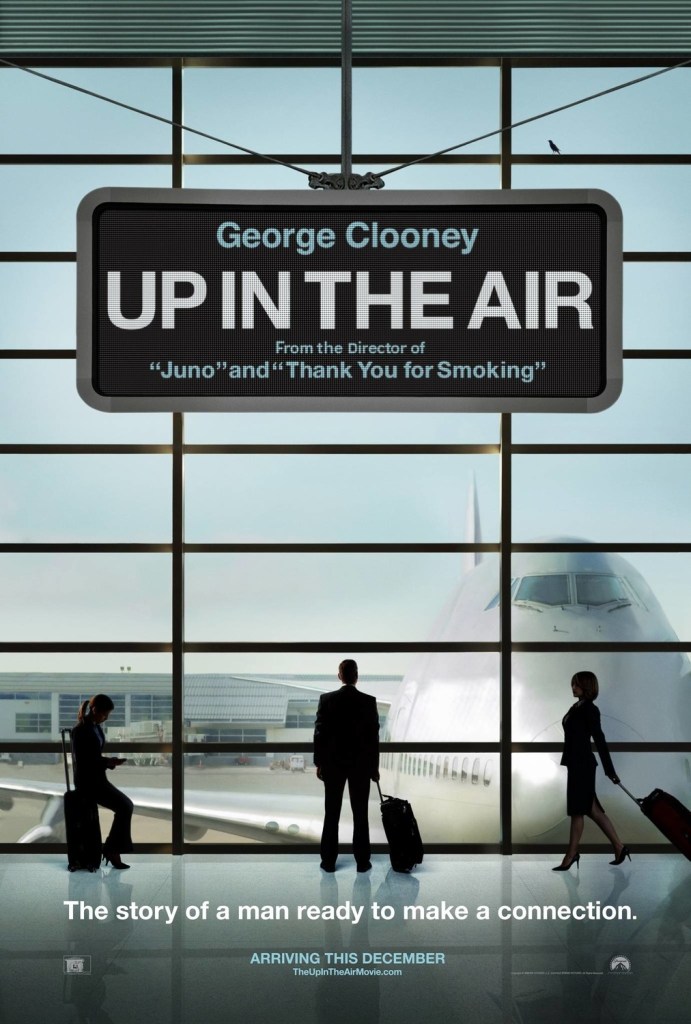
One From Jason Reitman: Up in The Air

A life without many, if any, emotional attachments seems like an appealing lifestyle to many, especially for those who are ever so career minded. To not have to worry about kids because you don’t have any, and to not get involved in serious relationships with others leaves you with a lot of room to breathe in. But what happens when something comes along to shatter the façade of this lifestyle? Will you be able to handle it without reverting to your old ways? Will it make you realize just how lonely a person you truly are to where you have no idea how to alleviate this permanent state of solitude you are stuck in? One thing’s for sure, this kind of life is not meant to last forever, and eventually you will be greeted with an unexpected awakening. Hugh Grant got to play a character who lived this kind of like in “About A Boy,” and George Clooney came to play a similar one in Jason Reitman’s brilliant film, “Up in The Air.”

Based on the 2001 novel by Walter Kim, Clooney stars as Ryan Bingham, a man whose job is to travel all over the country to corporate offices to lay off employees. Companies hire people like Ryan so that their bosses can easily squirm their way out of this depressing part of the job (pussies). What he does feels a bit similar to the sad duty military officers or police officers have in telling families their husbands, wives or long-lost relatives have died. While Ryan is not informing anyone of a dead family member, the people on the receiving end don’t really react all much differently. Still, he sees his job as a service as he tries to make them see this is not the end, but simply the beginning of a new life. In addition, he also conducts conferences where he talks about “emptying the backpack” of attachments and things you don’t really need. Hence, the backpack is clearly symbolic of his life at this point for there is not much of anything inside of it.

The perks of this unappealing job? Well, it does allow him to travel on airplanes for over 300 days out of the year. He does have a puny one-bedroom apartment back in Omaha, Nebraska, but he is barely there. For him, the airports and airplanes feel like his real home, so his address truly is up in the air. Still, he has the same problem those seriously addicted to social media have; a serious fear of human contact. They say they don’t want any personal attachments in life, but it speaks of some deeper fear they may not be aware of consciously.

Clooney gave one of his very best performances in this film, and he has always been great at playing the world-weary man who has seen just about everything. From a distance, this almost seems like a walk in the park for him as this movie’s trailers have him flashing that famous grin of his every five minutes. But he brings a real depth to a really well written character, and despite the fact he plays a man none of us would want to meet ever, he makes Ryan Bingham likable and very sympathetic.

Ryan ends up capturing the attention of another corporate employee who spends more time in the air than in the office, Alex Goran. She is played by Vera Farmiga, and she is as great in the role as she is seriously sexy! The first scene between these two reminded me so much of the scene in “Jaws” where Robert Shaw and Richard Dreyfuss compare their scars as they show off all these executive cards and credit cards which they have earned from travelling so much and for staying in the same hotels. The chemistry between Clooney and Farmiga is instant, and it sells us on their budding relationship almost immediately. You want their characters to end up together as they are essentially the same person, although Alex puts it in another way:

“I’m like you with a vagina.”

Of course, there is a third wheel to balance things and give a little more perspective on the story. That third wheel is Natalie Keener, a recent graduate from Cornell University who has a lot of smarts, but who also has much to learn about the real world. Natalie is played by Anna Kendrick, and she is wonderful here. Natalie is here to prepare Bingham and his colleagues for a new way of firing employees; they will do it online from the comfort of their own offices. So basically, it makes a depressing piece of business all the colder. It also threatens Ryan’s way of life as he lives to be on a plane instead of his tiny dump of an apartment, and while there will always be change, his resistance to this change is very understandable.

With this development comes the road movie part as Ryan takes Natalie to different cities across the country to show her how he does his job, and of how the use of computers will detract from it and his frequent flier miles rewards. Kendrick does brilliant work in taking Natalie from being confident yet naïve to vulnerable and sad. None of the education she got could ever have prepared her for the unpredictability of a job which is never easy no matter how it’s done. Seeing her address a corporate meeting to her doing a drunken karaoke rendition of Cyndi Lauper’s “Time After Time” should give you an idea of the range she has as an actress.

Watching Clooney instruct Kendrick on how to pack her suitcase and leave stuff out she needs is hilarious as it reminds me of my parents constantly begging me to put everything in one suitcase when traveling. This way, I won’t have to check any luggage in. I don’t know about you, but I get so sick and tired of hauling a suitcase all over the place when I have my messenger bag to worry about already. Who packed this suitcase anyway? Okay, I’m getting off track here…

“Up in The Air,” was Jason Reitman’s third film and, along with “Juno” and “Thank You for Smoking,” he showed us how infinitely talented he is as a director. He even makes this movie even more authentic to those times of high unemployment by casting real people who have lost their jobs. This brings a lot more reality to the movie and reminds us of how unfair life can be despite our individual efforts to do the best job possible. Reitman also does not sell out the movie with a false ending where everything is wrapped up neatly. In fact, it proves to be far more devastating than I ever could have expected.

Reitman also populates the movie with other great actors who make as strong an imprint on the film as the leads do. Jason Bateman plays Bingham’s boss, Craig Gregory, and this role is the flipside of the manager he played in “Extract.” It turns out Bateman can be charming in one role and utterly smarmy in another with no problem. Amy Morton is also really good as Ryan’s estranged sister Kara, a woman suffering through her own midlife crises which her brother makes look like he is getting through it with no problem. Melanie Lynskey (great in both “The Informant!” and “Away We Go“) is a wonderful presence as Julie, Ryan’s younger sister who is about to get married. I was also surprised to see Danny McBride here in a slightly more dramatic role as Julie’s soon-to-be husband, Jim Miller. McBride definitely has some funny moments, but he really sells himself as a man who is not sure if he’s doing the right thing or not.

I also have to give a lot of credit to some actors who make the most of their respective cameos. Zach Galifianakis gives this movie one of its funniest moments as Steve, one of many fired employees whom Ryan has had to face. Looking at the things his character could have done had he been fired by his cowardly boss instead is hysterical. Then you have J.K. Simmons who gives his suddenly jobless character of Bob a morbid sense of humor as he manages to contain himself in his understandably pissed off state. When Ryan ends up making Bob see this is not an end but a beginning, Simmons takes this character from being depressed to being aroused with possibilities he thought were long since lost to him. Simmons is onscreen for only a couple of minutes, but he infuses his role with a dry sense of humor which makes his performance especially memorable.

Another thing I really loved about “Up in The Air” is how wonderfully complex the characters are, and this includes the ones who are only onscreen for a few minutes. We may have the stereotypical traits of each character nailed into our heads, but they keep revealing different parts of their personalities in ways which truly surprised me. Once we have these characters figured out, another layer is revealed which affects their relationships with one another quite deeply. I would love it if more movies allowed to have more multi-faceted characters in them instead of just succumbing to one-dimensional freaks who exist to annoy the hell out of you.

“Up in The Air” was far and away one of my favorite films of 2009, and it is interesting to watch it again years later during a time of a frightening global pandemic. On top of many worried about their health and toilet paper, this pandemic has left a record number of Americans out of work. This film was quick to remind me of what it was to suddenly lose a job and how to move on from there. It also has a cameo from Young M.C. who sings his hit song “Bust a Move.” He certainly has gained a lot of weight since the 1990’s. Then again, I should talk (sigh)…

* * * * out of * * * *

‘Away We Go’ – Sam Mendes At His Most Laid Back

In 2008, director Sam Mendes gave us the marriage from hell with one of the year’s best movies, “Revolutionary Road.” We saw those two “Titanic” stars go at it like they were reincarnations of the characters from “Who’s Afraid of Virginia Woolf,” and the movie proved to be a horror show more than anything else as we saw this doomed couple descend into the hell which is marriage in dull suburbia. Then in 2009, Mendes gave us a movie which is more or less its polar opposite, “Away We Go.” It’s a sweet if flawed comedy-drama that focuses on a couple who manage to stick it out together as they travel from one city to another in an effort to find a place they can call home. You could almost say this is Mendes’ apology for the horrifying experience which was “Revolutionary Road,” but that movie was so damn good, why should he have to apologize for it? At least with this one, he observes a loving couple who are not out to scream at one another.

“Away We Go” stars John Krasinski and Maya Rudolph as Burt and Verona, a couple who suddenly find themselves expecting their first child (the moment Burt finds out is classic). They share their great news with Burt’s parents, Jerry and Gloria Farlander (the always fantastic Jeff Daniels and Catherine O’Hara), whom they see as their chief support system through the pregnancy. However, Jerry and Gloria end up laying a bombshell on the expecting couple by announcing they will be moving to Belgium for two years, and they will be leaving before their grandchild comes into the world. The only reason they have stayed in their present location was to be close to Burt’s parents (Verona’s are both dead), and so they both decide to go on a vacation to find a new home with people they know who they can form a strong family unit with.

With “Away We Go,” Mendes gives us a road movie with two characters traveling from Arizona to Montreal to find a home they can call their own. Signs keep popping up like “AWAY TO TUSCON” or “AWAY TO MIAMI” as Burt and Verona continue their travels, hoping to find the support system they need. Things get off to a shaky start when they first go to Phoenix and meet up with Verona’s old boss, Lily (Allison Janney), and her alienated family. This moment plays more like a sitcom and features situations I have seen many times before, and it made me feel like the rest of the movie would be even worse. Janney is a hoot, but she plays the scene too broadly and it never feels real enough. Jim Gaffigan, on the other hand, who plays Lily’s emotionally repressed husband Lowell, fares better as he doesn’t overplay his hand. There is one moment where he goes over all the bad things which could be happening to him, and he keeps talking long after everyone wants him to shut up. It is a darkly hilarious moment.

Things, however do improve from there. The setup is familiar, but Mendes and his actors give this endeavor a lot of heart which really won me over. Rudolph has a wonderful moment where she meets up with her sister Grace, (Carmen Ejogo) and they are hanging out in a bath tub and talking about the past neither of them feels ready to revisit because it’s too painful. Their dialogue is really good, but it is their faces which do most of the acting as their eyes serve as windows to their mournful souls.

Maggie Gyllenhaal also makes an appearance here as LN, a cousin of sorts to Burt. Along with her husband Roderick (Josh Hamilton), they live an insanely subdued life of peace and tranquility which is really more of a hilariously terrifying example of repression. Krasinski steals a scene as he rebels against LN’s way of living by giving her son the one pleasure no child should ever be denied – a ride in a stroller. Gyllenhaal is a kick to watch here as she gives this movie one of its most memorable moments.

The people Verona and Burt meet from there vary in degrees of happiness and sadness, and it wreaks havoc on them as it would any expectant parent. Like many, they are presented with scary examples of what could end up happening to them. Some of the couples seem very happy at first, but it serves to mask a deep hurt they are trying to keep under wraps. I think this will be a good movie for expectant parents and/or young couples to check out as they will probably relate very easily to what these two end up enduring in their travels.

The screenplay by the husband and wife team of Dave Eggers and Vendela Vida does not travel into original territory. There are several clichés to be found as we travel with this loving and petrified couple from place to place. Their dialogue, however, does manage to lift the movie above the routine, and it delves deeply to give us characters with many different dimensions, and this includes the ones with the shortest screen time. They even manage to surprise us with revelations I did not see coming even if I sensed trouble was just around the corner. Some of the speeches do have an original feel to them, and they are delivered by a well-chosen cast who are fearless in digging to the root of the movie’s most emotional moments.

Krasinski is perfectly cast here, and he is almost completely unrecognizable with all that darn facial hair. As Burt, he gives us a character so lovably goofy, and he also shows a vulnerable side as many of the things scaring him about becoming a parent comes right up to the surface. Burt could have easily been turned into a stereotypical in another film, but Krasinski turns him into a well-rounded individual from start to finish.

But the real revelation of “Away We Go” is Maya Rudolph. She is one of my all-time favorite “Saturday Night Live” performers, and she showed quite a range from playing characters like Megan (the future Mrs. Randy Goldman as she called herself) to her hilarious impersonations of Donatella Versace and Beyoncé Knowles. With this movie, she reminds us of how she is also a very accomplished actress in case we foolishly did not realize this previously. Even when she is not talking, a movement of her face communicates how she feels, and it speaks volumes of what Verona has been through, and of the family she lost and still misses.

Mendes’ career as a filmmaker from “American Beauty” to “1917” shows a brilliant artist who is super focused on every element involved in creating a movie. It is not just about the acting or the screenplay, but he pays just as much attention to the set design, the cinematography, and the film score to create motion pictures which stand above so many others. With “Away We Go,” he seems to have changed his pattern of directing here, and it looks like it has freed him up to make a fly-by-the-pants movie where he does not have to focus on each element as he had before. As a result, this is probably his weakest film to date as there were certain elements which could have been improved on. Regardless, he has not lost an inch of his talent, and even with the least of his movies he gives us memorable characters and settings which stay with you long after the picture fades to black.

“Away We Go” plays better on the small screen due to its rather intimate nature, but if you are looking for a nice romantic movie, this is certainly one to check out. It starts off imperfectly, but it gets better and better as it goes on.

* * * out of * * * *

In Defense of Rob Zombie’s ‘Halloween’ Movies

The two “Halloween” movies written and directed by Rob Zombie were eviscerated not just by critics but by the fans as well. Some critics, like James Berardinelli of Reel Views, said they did not even feel like “Halloween” movies. Fans were vocal in how characters like Laurie Strode and Dr. Loomis were unforgivably degraded compared to how they were portrayed in John Carpenter’s original. Others simply said Zombie’s take on Michael Myers just wasn’t that scary.

Well, I say phooey to all this nonsense! Zombie’s “Halloween” movies may not be as scary as the one which started off this never-ending franchise, but for me this was pretty much a given. There is no way you could recapture what Carpenter thrilled us with years ago. Zombie was aware of how Michael Myers, like other horror icons such as Freddy Krueger and Jason Voorhees, had pretty much worn out their usefulness. His respect for Carpenter’s slasher opus was strong, and after making a true grindhouse classic with “The Devil’s Rejects,” I knew he would take this story and these characters and make them his own.

What makes Zombie’s “Halloween” stand out from what came before it is how he treats the backstory of Michael Myers. Granted, this threatens to take away from what made him so scary in the first place. Carpenter’s original was an unrelentingly visceral experience mainly because we were not sure what to make of “The Shape” as he became less than human throughout. But here we get a strong idea of how young Michael went bad as he dealt with an uncaring sister, a busy mother, and an abusive lout of a stepfather. Seeing all he had to deal with made it understandable, if not forgivable, as to why he went psycho in the first place.

Now whereas Zombie’s “Halloween” was about Michael, his “Halloween II” was all about Laurie Strode, Dr. Loomis and of how the horrific events they went through forever destroyed them. It is here we come to realize what Zombie has accomplished with these movies: They are character studies instead of the average slasher movie we have come to expect. This is made even clearer on the “Halloween II” director’s cut which is available on DVD and Blu-ray as it proves to be infinitely superior to the theatrical version.

Fans hated how Laurie Strode and Dr. Loomis were so different from how they were portrayed in Carpenter’s original film, but they forgot how Zombie’s films were a meant to be a reimagining of the franchise and not business as usual. Strode’s extreme emotional reactions might make her unlikable, but they soon become understandable as no one involved in what she went through can ever walk away from it unscathed. Both Scout-Taylor Compton and Malcolm McDowell deserve credit for not being constrained by what Jaime Lee Curtis and Donald Pleasence created before them. In Zombie’s incarnation, these two actors inhabit their characters more than they play them.

In a time of remakes which are as endless as they are unnecessary, you have to give Zombie points for taking this long-running franchise in a different direction. It may not have been what diehard fans wanted or expected, but whereas most remakes repeat the formulas of movies they originated from with negative success, there is something to be said for a filmmaker who willfully goes against expectations. Seriously, this says a lot in a time when originality in cinema is largely frowned upon.

‘Terminator Salvation’ Does Not Have Much in the Way of Salvation

Terminator Salvation movie poster

WRITER’S NOTE: This review was written in 2009 when the movie was released.

Remember how a while back the number three proved to be an unlucky number for sequels? There was “Shrek The Third,” “Pirates of the Caribbean: At World’s End” and, most infamously, “Spider-Man 3” all turning out to be tremendous disappointments. Those sequels left a sour taste in my mouth which still won’t go away (“Spider-Man 3” still eats away at me furiously).

In the summer of 2009, it looked like the fourth movie in a franchise was having the worst luck of all. We got “X-Men Origins: Wolverine,” the fourth X-Men film, landing with a resounding thud. Now, we have “Terminator Salvation,” the fourth in the Terminator series and the first without Arnold Schwarzenegger. This is a franchise which surprisingly found enough energy and excitement for a third movie (I don’t care what anyone says, “Terminator 3: Rise of the Machines” was good), but now it has run out of gas. This sequel brings nothing new to the story of John Connor and his fight against Skynet, and I came out of it feeling unfulfilled which has never been the case with any “Terminator” movie before.

This is the first “Terminator” movie to get a PG-13 rating instead of an R, but this is no excuse. “Live Free or Die Hard” was the first in its series to get a PG-13 and proved to be even more exciting than anyone expected. The ratings for movies like these are pretty much irrelevant these days anyway, so why wonder if “Terminator Salvation” would have been better if it had been rated R?

In a time of endless sequels and prequels, “Terminator Salvation” is actually both. It starts off some time after the third movie and takes place in the year 2018, but it also comes before the events which set off James Cameron’s original. John Connor (“The Dark Knight’s” Christian Bale) has now fully accepted his role as the leader in the resistance against the machines, and he is no longer the whiny little bitch he was previously. I know this aspect really drove fans crazy in part three, so they will be relieved if and when they ever get around to seeing this movie.

It soon comes to John’s attention that Skynet is kidnapping humans, and one of them turns out to be Kyle Reese (Anton Yelchin), his father who must later travel back in time to get all hot and heavy with Sarah Connor or else he will not exist. Also, John meets a man named Marcus Wright (Sam Worthington) who is not all he appears to be. Soon all these characters will come together to fight against the evil which is Skynet.

One of my big problems with “Terminator Salvation” is it does not have much of a plot. It feels like it exists more for the explosions being set off every other minute more than anything else. The “Terminator” movies were never just about action and special effects, but of great stories and memorable characters which gave these particular films a lot heart and soul which the genre does not always allow for. This fourth “Terminator” movie, however, does not have much of a pulse, and all the loud explosions become tiring after a while. You don’t feel for the characters in the way you should, and some of them get short shrift and are simply there to maintain some sort of continuity in the franchise’s timeline. Lord knows with movies like this and J.J. Abrams’ “Star Trek,” timelines are getting a hell of a workout!

Bale is the third actor, or fourth if you count the guy in “Terminator 2: Judgment Day’s” prologue) to play John Connor. While he remains one of the best actors working in movies today, his performance as this titular character is shockingly one-note. Part of the problem lies with the screenplay as it does not endow John with the humanity which makes him the great leader we are told he is. Bale plays him as stripped of all feeling, and much of his screen time is spent yelling and screaming at others. Watching him portray this iconic character as a real sour puss made me wonder why John Connor bothered fighting the machines in the first place.

But other actors in the movie end up getting even shorter shrift thanks to the underwritten screenplay. One of the chief victims is Bryce Dallas Howard who portrays Kathryn Brewster, a character previously portrayed by Claire Danes in “Terminator 3.” Howard is more or less reduced to walking around pregnant, working on patients and showing a constant face of worry whenever John goes off into battle. This is a character who should have been utilized more and could have provided this movie with its strongest female protagonist. Howard is a wonderful actress, but she is wasted in a movie which fails to make better use of her talents.

Another character who is ultimately given little to do is Blair Williams, a fighter pilot in the resistance played by Moon Bloodgood. She gets a memorable introduction, figures in some of the most exciting action scenes, and there is no denying she is infinitely sexy. But in the end, Blair basically exists for the sake of the other characters here, and realizing this makes things all the more frustrating.

Helena Bonham Carter’s character of Dr. Serena Kogan could have been a great villain, but she appears only at the very beginning and end of “Terminator Salvation.” A great actress in her own right, she is also wasted in a practically non-existent role. The machines by themselves do not make much of an antagonist here, and they need that one face which can hold them all at attention. Carter’s character could have been this, but it proves not to be the case.

The script by John D. Brancato and Michael Ferris also contains a serious plot hole when compared to the other “Terminator” movies. At one point, the resistance discovers Skynet has a list of targets which includes John Connor and Kyle Reese. But the thing is Skynet could not have been aware of Kyle’s existence at this point in the series. If they were that aware of his existence, he would have never been able to go back in time to rescue Sarah Connor. The Terminator would have spotted Reese before he could have spotted the Terminator if this were the case. I know we are busy reinventing timelines right now, but this plot hole is completely inexcusable.

Even though John Connor appears to be main character, “Terminator Salvation” really belongs to Sam Worthington who plays Marcus Wright. Of everyone here, his character is the most fully realized as we follow Marcus on a road to redemption which takes him to a desolate future he could never have imagined. Worthington delves deeply into his character’s complex nature. Marcus Wright is not exactly a good guy, but he is not a bad guy either, and Worthington plays him as a character caught up in circumstances not of his own making. Without Worthington’s performance, “Terminator Salvation” could have been a lot worse.

One really good performance to be found here is from Anton Yelchin who plays a young Kyle Reese. Yelchin succeeds in giving Reese an energetic feel whic is almost completely different from what we have seen before with this character. Basically, we are seeing Kyle Reese in an unrefined state before he becomes the man who travels back in time to be John Connor’s daddy.

As for Arnold “The Governator” Schwarzenegger, he is and is not in “Terminator Salvation.” With the help of CGI magic, his face was digitally placed on another actor’s buff body, and it makes it look like he never left the franchise. The audience I saw the movie with at Grauman’s Chinese applauded his appearance loudly, and it gave us all an ecstatic sense of joy to see him onscreen. However, it also proves my theory of how you can make a “Terminator” movie without James Cameron, but you cannot make one without Schwarzenegger.

And yet the most ironic thing about Schwarzenegger’s appearance is how it illustrates the movie’s biggest problem; It is missing a strong and intense sense of menace the other “Terminator” films benefited from. Realizing this makes “Terminator Salvation” an especially depressing experience as it is unable to replicate the success of its predecessors.

In all fairness, McG, best known for directing the “Charlie’s Angels” movies, does a good job with the action scenes, and the movie is never truly boring. He makes the action look like it was all done in one shot, and his handling of it is terrific. What he needs to keep in mind is how the characters need to be the ones driving the action and not the other way around. If you do not have strong characters to relate to, the special effects will not mean very much.

“Terminator Salvation” feels like it exists more for the special effects than for the story and its characters, and it makes this long running franchise feel like it has hit a dead end. Maybe it should have stopped after the third one. Considering the talent involved, I cannot help but feel like this could have been so much better. I came out of it feeling empty as if I had just seen something which went in and out of my system like a McDonald’s Happy Meal. This could have been a fresh reinvention of the franchise which thrives on imagination, but there is nothing new brought here. The Terminator will be back whether we like it or not, but will Hollywood’s thirst for franchises allow them the insight to give us a more effective follow-up? Well, here’s hoping.

* * out of * * * *

NOTE: “Terminator Salvation” was dedicated to Stan Winston, the special effects wizard who was an amazing creative force in movies like these. He will be missed.

‘The Hangover’ is Still a Blast to Watch

The Hangover movie poster

The best way for me to describe “The Hangover” is that it is wicked funny. Not once are the filmmakers ever afraid to break any particular taboos, and its setup is ingenious. While part of me wishes that I got to see it before the hype machine exploded and went into overdrive, this movie proved to be one of the best times I had at a theater back in 2009.

“The Hangover” stars Bradley Cooper, Ed Helms, Zach Galifianakis, and Justin Bartha as a group of guys who are on their way to spend a fun filled weekend in Las Vegas, Nevada. The groom, Doug Billings (Justin Bartha), is only a couple of days from becoming a married man, and his close friends and soon-to-be brother in law Alan Garner (Zach Galifianakis) take him out on the town to show him the time of his life while he is still a free man. They celebrate this moment together on the top of Caesar’s Palace where they are staying for the night with a couple shots of Jägermeister, toasting to an evening they will never forget. But it is no surprise that they do, and they have to retrace their steps in order to escape the craziness of their sudden situation.

Todd Phillips, who previously directed Will Ferrell to the Streakers Hall of Fame in “Old School,” uses “The Hangover” to continue his exploration of the lives of men who just cannot seem to grow up. Phil Wenneck (Bradley Cooper) is a schoolteacher, a married man and a father, and yet he seems the most eager of the four guys to live life to the max, free of all obligations. Stu Price (Ed Helms) treats this as an opportunity to escape his girlfriend of several years, who can never stand to have him kiss her I might add, and trick her into believing he is actually going to wine country in Napa County. For Alan Garner (Zach Galifianakis), this is just another place where he can be his usual socially maladjusted self as he is the man child character who easily creeps people out regardless of whether or not he realizes it.

By putting us in the vantage point of Phil, Stu and Alan, “The Hangover” turns into an unpredictable comedy as we go along with these three men and discover what shenanigans they ended up getting themselves Looking back, I am not sure how much these events would stand up to logical scrutiny, but this movie is so much fun, WHO CARES?! It is not like we are watching a “Saw” movie for crying out loud! What I love about “The Hangover” is how it keeps building up from one utterly bizarre situation to another, and just when you think things can’t get any worse, they do.

I refuse to spend this review ruining the best parts of the movie for you, so let us just get to the talent involved. Bradley Cooper got a great opportunity to shed his bully image which he perfected in such movies as “Wedding Crashers.” Well actually, he did not permanently shed it here as his character gets people to do things they would not otherwise do under normal circumstances. But his role here in “The Hangover” succeeded in breaking him out of his typecasting dilemma of being the snobbish bully as he gives this movie its coolest character.

Ed Helms has appeared on the American version of “The Office” and was a correspondent “The Daily Show” with Jon Stewart. As Stu Price, he gives us this movie its resident wimpy nerd character, a common stereotype in comedies. Indeed, any actor in this role could just get away with simply playing the character as a pussy-whipped bitch with the shy and awkward smiles, letting the glasses define them on the surface to where they are easily identifiable, and wearing tidy clothes in the most inappropriate of venues. The fact Helms never stoops to playing all these behaviors and appearances makes his performance come off really well. We have a good idea from the start of where Stu will end up by the movie’s end, but Helms takes him from being a wimp to a stronger man in a very believable way, and he makes Stu ever so endearing as a result.

Hey wait a second… Let’s talk about the sexiest character in “The Hangover.” She is an escort and exotic dancer named Jade, and she is played by irresistible Heather Graham. It has now been a many years since she burned herself into our collective consciousness as Rollergirl in “Boogie Nights,” and I was thrilled to see her here. No one should forget what a great actress she is, and many projects she has appeared in over the years have squandered her talent. The Hangover” shows she has not lost an ounce of her talent and never will. After all these years, she is still an actress who deserves your attention.

As Alan Garner, Zach Galifianakis gives us someone whose sanity seems to be quite questionable, and what he says about himself hints at just how screwed up he really is. You can only guess at what kind of character he really is, and the rub there is what you say about him could end up saying more about you. Alan Garner turns out to be one of the more unpredictable characters in movies to where you almost live in fear of what he might do next, and this is even if he has you laughing your ass off throughout. The way he bonds with these guys is anything but healthy.

In addition, “The Hangover” features some great cameos throughout. Seeing Mike Tyson rock out to Phil Collins’ “In The Air Tonight” is a comic highlight. I also loved Jeffrey Tambour who is always a deadpan delight in everything he does, and as Alan’s father, Sid Garner, he personifies the knowledge of how what goes on in Vegas really needs to stay there, seriously. And Ken Jeong, very memorable as a doctor in “Knocked Up,” is a gas as crime boss Mr. Chow.

“The Hangover” is not politically correct to put it mildly, but in the end, this is just a movie you should sit back and have fun watching. Years after its release, it is still a blast to take in.

* * * ½ out of * * * *