‘Se7en’ Movie and 4K Review
The following review was written by Ultimate Rabbit correspondent, Tony Farinella.

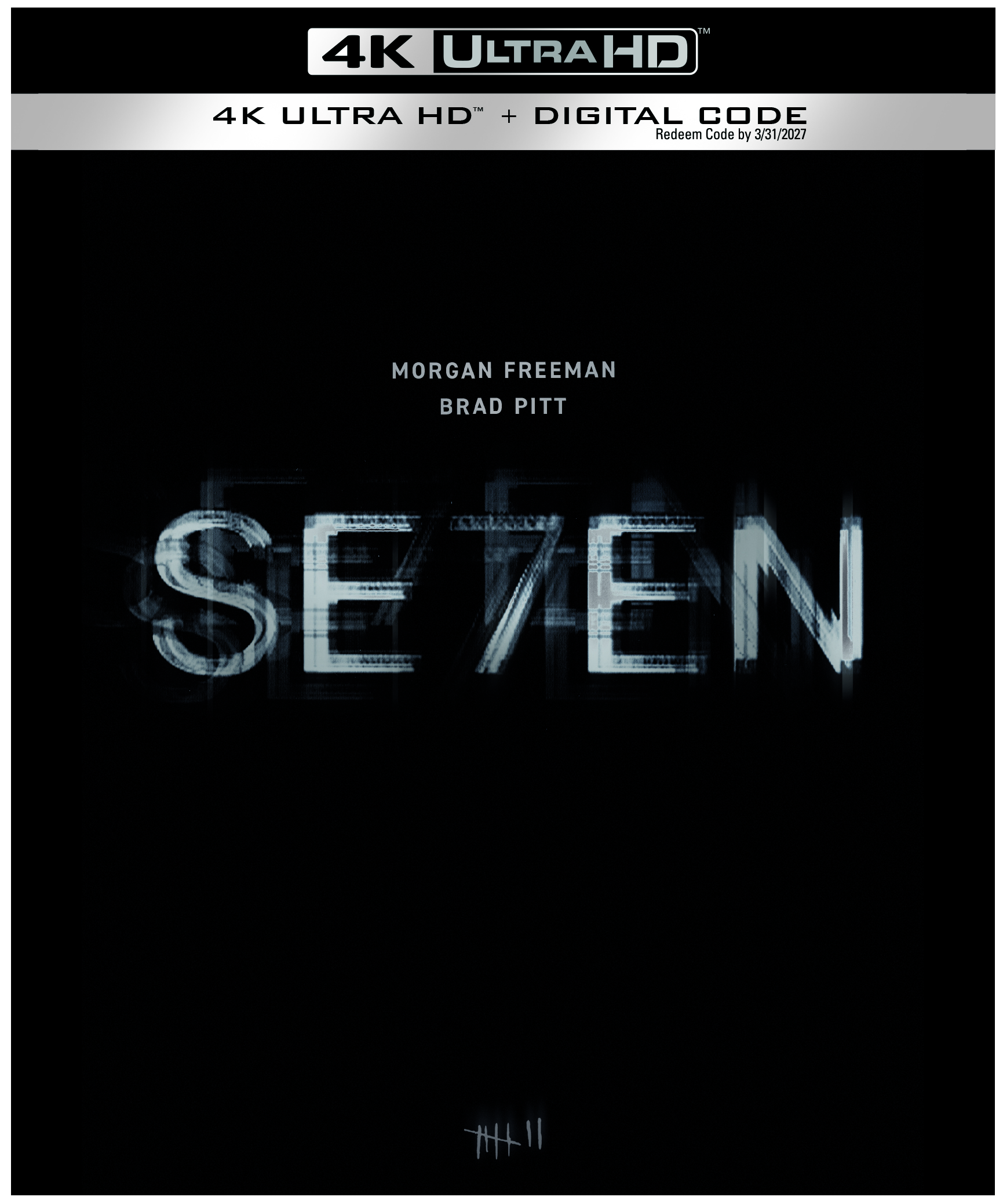
When it comes to 1990’s cinema, it’s difficult to find a film as popular or as well-received as “Se7en.”  It became part of the pop-culture zeitgeist when it was released, and it still is a film which elicits a strong reaction from audiences today.  Whenever people talk about it, they instantly quote Brad Pitt’s famous line of, “What’s in the box?”  The film also served as inspiration for the “Saw” franchise and was ahead of its time in terms of the true crime genre. Now, the film is celebrating its 30th anniversary on 4K from Warner Brothers Home Entertainment.  This is sure to be one of the most popular 4K releases of the year.

“Se7en” opens up by introducing the audience to Detective Lieutenant William Somerset (Morgan Freeman) who is one week away from his retirement before he is thrown into a case which captures his attention.  It starts off with a man who is found dead after being forced to eat spaghetti over and over again until he perishes.  Somerset teams up with a hot shot detective named David Mills, played by Brad Pitt.  He recently moved with his wife Tracy (Gwyneth Paltrow) to the city, and he’s looking to make a name for himself.  Somerset and Mills could not be more different in how they approach their jobs.

Mills has a short fuse and is ready to fly off the handle at anyone who gets in his way. He also doesn’t play by the rules.  Somerset is even-keeled, a deep thinker, and someone who believes you have to look at these cases as more than just black and white, crazy and sane. Before long, more murders are occurring, and the serial killer is murdering people based on the seven deadly sins. For Mills, he simply thinks the killer is a crazy person and writes him off as someone who is going to get caught and isn’t thinking straight. Somerset, on the other hand, sees there is a clear motive and agenda by the killer.

“Se7en” was one of my favorite films growing up. I was 10 years old when it was released, and I saw it when I was 15.  It was very much ahead of its time with its gritty, down and dirty filmmaking style.  When I watched it in 2025, I liked the film a lot and I admire the craft and precision which went into making it, along with the incredible performance by Freeman.  However, I do see some flaws in the film, such as Pitt’s performance.  Of course, his “What’s in the box?” scene has become a legendary meme, but he’s way too over-the-top here.  After a while, it becomes hard to spend too much time with his character.

I also wanted to learn more about Tracy, played by Gwyneth Paltrow.  Paltrow is a terrific actress, and her scenes with Freeman, especially at the diner, give the film some much needed levity. Her character isn’t given enough to do though, besides stay at home and just be written as a one-note character. She and her character deserved better. Going back to Pitt for a moment, I understand what he was going for with his performance, but he plays it too big.  In a serious movie like “Se7en,” it almost feels like his character doesn’t belong here. Freeman makes it look easy, and he’s able to portray all of his emotions on his face perfectly.   I understand the film was showing the contrast between the two characters, but it doesn’t work as well as I remembered it.

When it comes to films like “Se7en” which rely on a twist, they don’t always hold up as well on multiple viewings because the element of surprise is gone.  I still think it is a really good film though, and I enjoyed revisiting it on 4K.  The atmosphere and the sense of dread is on full-display from David Fincher.  The film also has a lot to say when it comes to its views on the world and the people in it.  While Mills believes he can make a change and clean up the world, Somerset is more realistic on what he can do and what the world is capable of as a whole.  It’s a film with some brainy ideas, but those ideas sometimes get lost in the middle of trying to solve the crime.

Overall, I still like “Se7en,” even though this might sound like a negative review.  I’m just not as enthusiastic about it as I was 10 or 15 years ago. I see more of the film’s flaws than I did in the past.  The second half, especially the big reveal, is still as powerful as it was upon its release.  The film works best when it allows its actors room to show off their acting chops and really get into the meat and potatoes of their characters.  I found the police work and the case itself not as interesting or multifaceted as I remembered it being in the past. “Se7en” is still a film worth revisiting and owning, despite some new flaws I’ve noticed along the way.

* * * out of * * * *

4K Info: “Se7en” is released on single-disc 4K Digibook or Steelbook from Warner Brothers Home Entertainment.  It comes with a digital copy of the film as well. It has a running time of 127 minutes and is rated R for grisly afterviews of horrific and bizarre killings, and for strong language.

4K Video Info: “Se7en” is a dark and grisly film, and this specific visual aesthetic is perfect for the 4K format.  I don’t think anyone is expecting the film to look crisp, clear and colorful in 4K. The 4K is not as washed out or bright as the Blu-ray, and this is a good thing. It has a more film-like look to it, which is what I was hoping for with this 4K release. 4K is supposed to bring out the best elements of what the director was looking to achieve with the picture, and “Se7en” is a solid 4K release.

4k Audio Info: “Se7en” comes with a DTS-HD Master Audio soundtrack for the film, which is consistent and steady throughout the course of the film.  This is a pretty quiet film with moments of loud and intense dialogue, but it never feels like it’s too much. Subtitles are included in English, Spanish and French.

Special Features:

Commentaries –

The Stars: David Fincher, Brad Pitt, Morgan Freeman

The Story: Richard Dyer, Andrew Kevin Walker, Richard Francis-Bruce, Michael De Luca, David Fincher

The Picture: Darius Khondji, Arthur Max, Richard Francis-Bruce, Richard Dyer, David Fincher

The Sound: Ren Klyce, Howard Shore, Richard Dyer, David Fincher

Deleted Scenes

Alternate endings

Still Photographs (featurettes) –

Production Design (featurette)

Mastering for the Home Theater (featurette)

Exploration of the Opening Title Sequence: Early Storyboards (featurette)

Exploration of the Opening Title Sequence: Rough Version (featurette)

Exploration of the Opening Title Sequence: Final Edit (featurette)

Exploration of the Opening Title Sequence: Stereo Audio Commentary One – The Concept – Designer Kyle Cooper (featurette)

Exploration of the Opening Title Sequence: Stereo Audio Commentary Two – The Sound – Brant Biles & Robert Margouleff (featurette)

Theatrical EPK

Should You Buy It?

“Se7en” is a must-own for physical media enthusiasts out there, but there is one problem with this release: the packaging.  If you are going to get the digibook, you should know the film is housed in a sleeve, which makes it very hard to take the disc out without touching the back of it.  As many of you know, 4K’s are easier to scratch and damage than Blu-rays.  While I appreciate the fact they tried something different with this packaging, they should have at least thought about the overall health of the disc. I would recommend you pick up the Steelbook release instead. I’ve noticed a lot of people are unhappy with the lack of updated special features, as these are the same special features that came with the Blu-ray. Special features on older films are not as prevalent in today’s releases as they were originally done during the height of DVDs and Blu-ray releases, and I think it’s important to remember that.  It costs money to interview the actors, and it’s not always easy to track them down for new interviews regarding older films they have done. While it would have been a nice addition to the 4K release, I understand it isn’t cost effective. The film looks sharp and the soundtrack is impressive. For the film itself, as stated in my review, it didn’t hold up as well as I remembered it, but it’s still a really good flick. This is a day-one purchase despite the less than stellar packaging options.

**Disclaimer** I received a copy of this film from Warner Brothers to review for free.  The opinions and statements in the review are mine and mine alone.

Favorite Opening Titles: ‘Seven’ (1995)

For years now, motion picture opening credits have increasingly become a lost art form as filmmakers want to hit the ground running and leave all the credits to the very end. But while audience members are quick to exit the theater to take care of their ever-growing urine aches, it feels like increasingly shameful that filmmakers are less and less interested in giving their works a prologue which helps to illustrate the cinematic stories audiences are about to take in.

Now when it comes to my favorite opening titles, the first one which comes to mind is for “Seven,” David Fincher’s 1995 film which proved to be his true big breakthrough. Things start off with us being introduced to Detective William Somerset (Morgan Freeman), a veteran homicide detective on the verge of retirement, and his partner and eventual replacement David Mills (Brad Pitt). From there, we watch Somerset try to fall asleep in his bed to the sound of a metronome, and the sound of the metronome is constantly overwhelmed by the violent sounds coming from the streets outside of his apartment.

After this, the opening titles, which I did not expect “Seven” to have, began, and they were done to a remix of the Nine Inch Nails song “Closer” which was entitled “Precursor.” Right from the start, they serve as an introduction to the main antagonist known as John Doe who commits murders based on the seven deadly sins. The way Fincher saw it, these titles were a way of introducing the audience to this character’s perverted state of mind, and there was no forgetting this throughout the rest of the film.

I love the shakiness of the credits as they illustrate the deeply disturbed mindset of John Doe as he writes in his journals and attaches pictures of people who are either his intended victims, those he has already harmed in an inescapable way, or those young ones whom he would prefer not to witness the bloodiness of what he is doing.

These opening titles captivated me from the get-go as they were unlike any that I had ever previously seen in other motion pictures. They were designed by Kyle Cooper whose other credits include the titles to “Home Alone,” “Passenger 57,” “Carlito’s Way” and the acclaimed television series “Homicide: Life on the Street.” Cooper was assigned by Fincher to create a montage reflecting the disturbed perspective of John Doe. The images presented here hang over everything else we come to see in “Seven” as the film heads towards a climax which proves to be utterly devastating.

It should also be noted that the opening titles to “Seven” were filmed over the course of eight days and cost around $50,000 to complete.

Please feel free to check out the opening titles of “Seven” down below:

All-Time Favorite Trailers: ‘Strange Days’

I first saw this trailer when it played before “Mad Love” which starred Drew Barrymore and Chris O’Donnell. This was at Crow Canyon Cinemas, a movie multiplex I once worked at, and the volume was not all that great as the teenage audience, desperately waiting to see O’Donnell take his shirt off, were talking endlessly before the lights finally went down. I saw it again at the UC Berkeley theater, which was once known as the New Beverly Cinema of Northern California, and I got a better idea of what was on display as I could actually hear what was being said that time around.

Strange Days” is a 1995 science fiction thriller which starred Ralph Fiennes, Angela Bassett and Juliette Lewis, and the film featured a kind of technology which allowed those who used it to experience recorded memories and physical sensations of others. But despite it being co-written and produced by James Cameron and having been directed by Kathryn Bigelow, it flopped hard at the box office. It is only over time that this film has gotten the cult following it truly deserved as this one offers the viewer a cinematic experience you cannot find elsewhere.

This particular trailer for “Strange Days” was its teaser trailer which had Fiennes selling us on this technology. The dialogue is taken from a scene in which he is trying to get a potential customer to buy some recorded memories, but this time Fiennes is looking straight into the camera, attempting to sell the audience on what he has.

Fiennes starred in this film not long after his Oscar-nominated turn in “Schindler’s List,” and I love how he tells us about this technology here without showing us a thing. His words suck us in to the possibilities of what we could experience if common sense didn’t kick in on a regular basis. It’s a brilliant piece of acting as he succeeds in making us want to open Pandora’s Box and experience pleasures which are ever so forbidden.

I also love the sound design of this trailer as it features a hum throughout which is much like the one I heard as I entered the American Conservatory Theater to watch the first part of “Angels in America.” There is something so comforting and alluring about such a hum that I cannot help but be drawn into the subject matter in a heartbeat.

By the way, can anyone tell me what song was used at the end of this trailer? I really dug it and would love to know where it came from. Perhaps it was by the band Deep Forest as they were supposed to be composing this film’s music score (it would later be done by Graeme Revell), but I don’t know.

If you have not watched “Strange Days” yet, I encourage you to do so as it deals with themes which are more pertinent today than when this film first came out.

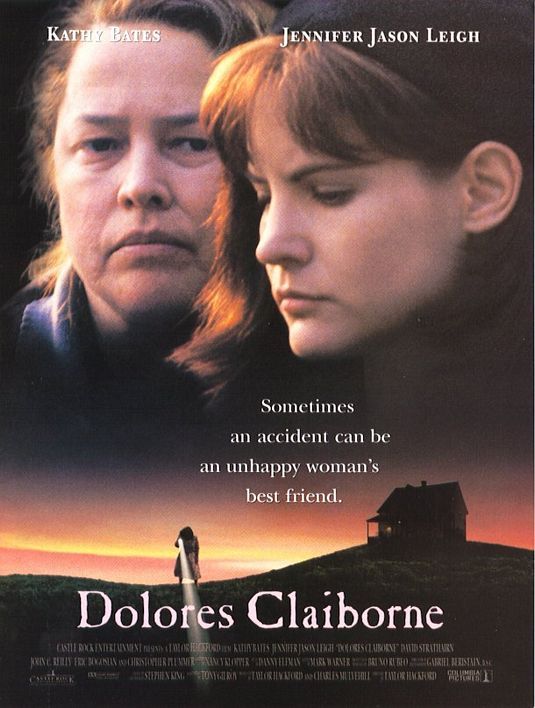
‘Dolores Claiborne’ – A Stephen King Horror Tale of the Real-Life Kind

Dolores Claiborne” is, on the surface, not your typical Stephen King novel, and this is important to note before you begin watching this particular adaptation of his work. This cinematic treatment reunites him with the great Kathy Bates who won an Oscar for playing Annie Wilkes in “Misery,” but she’s not playing a deranged psycho this time around. Also, while much of King’s writings deal with terrifying supernatural powers and unspeakable terrors, the horror generated here comes from real life horrors no one should ever have to endure. In some ways, this makes it one of his more terrifying tales because it deals with the kind of horrible crimes we hope and pray never to experience first-hand. Having said this, it is clear how many of us can never be so lucky as to avoid the worst traumas humanity has to offer.

Bates plays the title character who, as “Dolores Claiborne” opens, is believed to have killed her rich employer Vera Donovan (Judy Parfitt). This crime immediately reminds the town of Little Tall Island in Maine when Dolores’ husband, Joe (David Strathairn), died twenty years ago under mysterious circumstances, and the general consensus was that Dolores killed him. Detective John Mackey (Christopher Plummer), who had pursued the case against her back then is determined to put her behind bars this time and for good. Into this mix comes Dolores’ daughter, Selena St. George (Jennifer Jason Leigh), a big-time reporter who arrives to defend her mother despite the two of them having been estranged for over a decade.

The novel “Dolores Claiborne” was essentially one long monologue as the story was written entirely from the title character’s point of view. This makes the work director Taylor Hackford and screenwriter Tony Gilroy have done here all the more impressive. They have taken Dolores’ unsettling story and have stretched it out into a character driven motion picture filled with various characters who have been fleshed out in unforgettably compelling ways. None of these characters, even that drunken lout of a husband and father, are one-dimensional or throwaway caricatures. Each one is complex, and they take unexpected directions which might seem jarring at first, but eventually make sense in the large scheme of things.

The plot shifts back and forth in time as we flashback to when Dolores lived with her drunk and abusive husband and of the vicious abuse she took from him in his endlessly drunken state. Director of photography Gabriel Beristain shoots this hideous past with such vivid colors to where he gives the scenes an innocent look which is soon contrasted with horrible violence. It almost acts as a façade for how the past was seen as if it were some sort of Norman Rockwell painting, the kind made to cover up the severe family dysfunction many would like to pretend does not exist.

For the record, King said he wrote the character of Dolores Claiborne with Kathy Bates in mind, and it is very hard to think of another actress who could have inhabited this role. Stripped of any false glamour, Bates takes her character from being a victim to one who understandably takes matters into her own hands. Her acting here is flawless and compelling, and we root for her even though her actions have devastating moral implications.

When you look at her overall body of work, this movie almost seems like a walk in the park for Leigh. She has gone to great physical and emotional lengths to portray a character throughout her long career, but here it looks like she is taking it easy. However, her character of Selena is no less challenging to portray than the others listed on her vast resume. Selena is not easily likable, but she has to be empathetic because the viewer slowly starts to see how her innocence was irrevocably and unforgivably destroyed. Leigh matches Bates’ performance scene for scene by showing how much Selena wants to forget the past, but she comes to see how her most repressed memories cannot stay below the surface forever.

Special attention also needs to be paid to Ellen Muth who portrays Selena as a little girl. This is not the kind of role parents want their children to portray to as it deals with abuse and molestation among other things, but Muth proves to be utterly convincing in making the young Selena deeply distraught and confused by actions no child should ever have to be put through.

There’s also a bevy of excellent performances from the rest of the cast as well. Christopher Plummer, who is never bad in anything, is memorable as the relentless Detective John Mackey. This could have been a throwaway role, but Plummer makes Mackey a complex character to where you question whether his determination is based more on personal revenge than justice. Judy Parfitt is unbearably domineering as Dolores’ wealthy employer, Vera Donovan, and their relationship runs much deeper than we see at first glance. And David Strathairn manages to flesh out his despicable character of Joe St. George to where he’s just slightly more than your average mean drunk.

Most of King’s novels deal with the horror of supernatural elements or ghosts and demons which haunt our nightmares. But “Dolores Claiborne,” much like “Stand by Me,” deals with the horrors of real life which we are never quick to confront unless we are put in a position where the awful truth can no longer be ignored. Perhaps the unsettling nature of this particular work by King is what kept many from checking out this motion picture when it arrived in movie theatres back in 1995, but those of us who were willing to dive into the dark side of things like myself did not deny ourselves a journey to the horrors this film has to offer. But now, 25 years later, this film fits in perfectly with a time which includes the Time’s Up movement as we are forced to realize we have thoughtlessly ignored the worst abuses made against other human beings for far too long. As a result, this particular King cinematic adaption plays even better than it did back when it was released.

* * * ½ out of * * * *

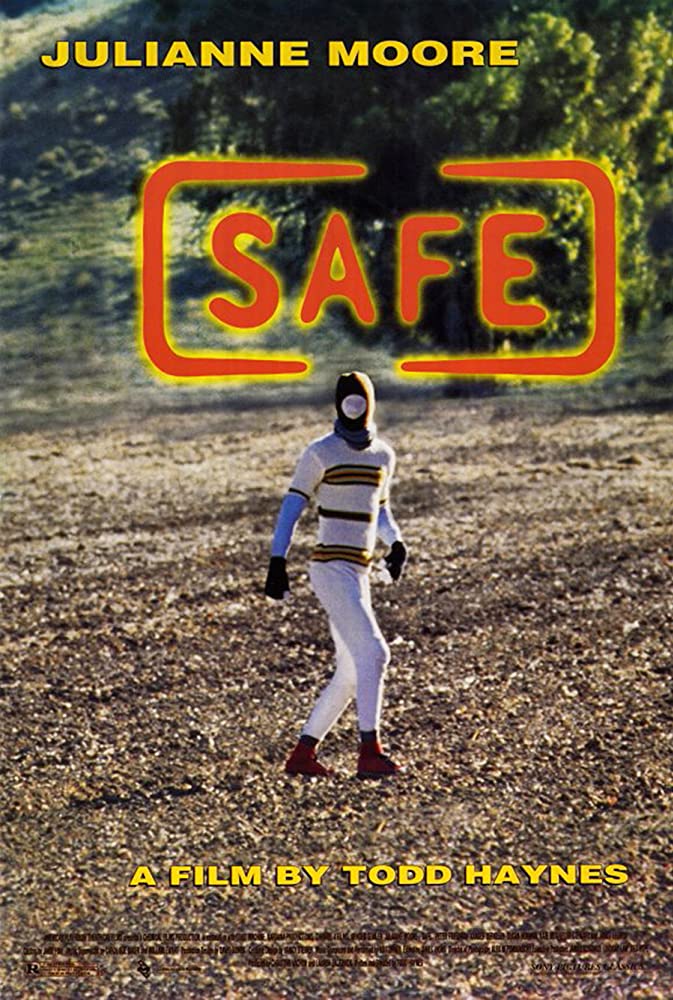
Underseen Movie: Safe – Directed by Todd Haynes and Starring Julianne Moore

I am thankful I live near New Beverly Cinema as it has long since proven to be a great film school for movie buffs like me, and it has allowed me to watch movies I might otherwise not have bothered to watch when they were first released. Case in point is the 1995 movie “Safe” which marked a huge breakthrough for its director Todd Haynes and lead actress Julianne Moore. I do remember when it was first released and of film critics like Roger Ebert singing its praises, and it came out during a time when movies like these played in cities far from where I lived, and getting out to see them was impossible. Even with a driver’s license, certain cinematic events were too far away for me to attend.

Anyway, Moore plays Carol White, a suburban homemaker who is comfortably married to Greg (Xander Berkeley), and she spends her days either doing things around the house, going to her local aerobics class, or having lunch with friends. But one day after driving down Olympic Boulevard, she finds herself coughing uncontrollably after traveling behind a big rig truck whose exhaust seeps right into her air conditioning system. This marks the beginning of an acute sensitivity to just about every chemical known to the human race, and things just get worse and worse for her from there. In addition to coughing uncontrollably, she later finds herself suffering from nose bleeds, she develops asthma-like symptoms, and she ends up convulsing at the local dry cleaners.

Carol is said to have developed multiple chemical sensitivity, otherwise known as MCS or the “Twentieth-Century Disease.” This is still seen as a very controversial diagnosis which remains unrecognized by the American Medical Association. “Safe,” however, is not out to prove if MCS is a real threat to us all or not. Instead, it looks at how a disease can forever change the way we look at ourselves and of how we view the world around us.

“Safe” also gets deep into that anxiety-ridden place in our psyche which goes haywire when our safety zone gets violated by forces beyond our control. We feel Carol’s agony throughout because we all collectively fear getting a disease which has no clear diagnosis or an immediate cure. When you end up going through lord only knows how many doctor’s appointments where it feels like nothing’s working, it really wears you and your loved ones down to the point of sheer desperation.

Things get even more horrifying from there when Carol travels to a resort in the New Mexico desert called Wrenwood. Designed to help those afflicted with MCS, it really seems more like a cult. Instead of finding ways to deal with this condition to where people can function normally in their daily lives, its leader Peter Dunning (the excellent Peter Friedman) subtly enforces his fear of the chemical world on his dutiful followers. Peter comes in the guise of a very friendly person with the best of intentions, but we all know where good intentions lead.

Haynes, working with a minimal budget, makes “Safe” feel all the more real as he portrays suburban life in the San Fernando Valley in ways which never come across as corny or the least bit campy. All the characters are complex and the kind we recognize from our own lives, and the agitation they experience feels unnervingly vivid. Adding to this sense of dread is an excellent ambient score by Ed Tomney which deftly illustrates the growing anxiety of the film’s main character. Haynes brings out the best in each of the actors, and he lets them become their characters instead of just playing them.

Moore’s performance in “Safe” proved to be a revelation as she sucks us right into her character’s dilemma, and we can never take our eyes off her as Carol turns further inward and isolates herself from the world at large. The whole movie rests on her shoulders, and she shows no vanity in her portrayal of Carol. She literally becomes the character before our very eyes to where she looks frighteningly emaciated and close to being completely incapacitated. It’s a deeply affecting performance which made me want to reach out and hug her, and I say this even though it would probably not be enough to save her character.

“Safe” ends on an ambiguous note, leaving it up to the audience to guess what will become of Carol White. This will drive a lot of the mainstream audience members crazy as they demand to have things explained in full detail, but a movie like this cannot and should not offer easy solutions. How can it? I got so caught up in Carol’s ordeal to where I felt I was in her shoes. Personally, I hope she finds a way to overcome her circumstances, but that may just be wishful thinking.

I am really glad I finally got to see “Safe,” and I hope more people take the time to check it out. It stays with you in a way few movies do. It also leaves us with a haunting image of a certain character seen from a distance, completely covered with clothing to where they are hiding every part of their body from the world at large. Arcade Fire may sing about the body being a cage, but what happens when we put another cage over it? This all reminds me of a lyric from a song by Peter Gabriel:

“The more we are protected, the more we’re trapped within.”

* * * * out of * * * *

WRITER’S NOTE: When I first saw “Safe” at New Beverly Cinema, it had been out of print on DVD and VHS for several years. The Criterion Collection, however, has since released a special edition of it on DVD and Blu-ray, and I could not recommend it more highly. Click here to find out more about this special edition.

Soundtrack Review: ‘Die Hard with a Vengeance’

Die Hard 3 soundtrack

Anyone remember the RCA Victor release of the “Die Hard with a Vengeance” soundtrack back in 1995? That release was a joke and an unforgivable one as well. It did have some of Michael Kamen’s music score on it as well as a couple of rap songs which I’m not sure were in the movie, and some symphony pieces by Beethoven and Brahms which are not in this movie at all. It was as if RCA just wanted to throw any kind of soundtrack together so they could cash in on this sequel’s expected success, and what resulted was a travesty which any true soundtrack fan would be right to despise.

Well, it took over a decade, but La La Land Records has finally given “Die Hard with a Vengeance” not only the proper soundtrack release it deserves but an expanded one which contains two discs of music. In addition, it also comes with an informative booklet written by Jeff Bond who discusses how this “Die Hard” movie differs from the two which came before it, and it looks at how Kamen came to develop this particular score. But the great thing about this soundtrack release is it forces you to listen to Kamen’s music more closely in a way we didn’t previously.

When I first saw this sequel, I wondered if Kamen had actually bothered to create a new score for this “Die Hard” adventure. Many of the music cues sounded like they came from “Die Hard” and “Die Hard 2,” and it was hard to spot any new musical themes throughout. Listening to the La La Land Records release, however, makes you realize Kamen did not just simply throw something together. Much thought went into this particular score as it presents a somewhat darker John McClane (played by Bruce Willis) than what we have seen previously, and it also captures the joyful qualities of the heist movie that “Die Hard with a Vengeance” is meant to be.

Among the pieces of music I was thrilled to hear on this soundtrack is “Taxi Chase” which has McClane and Zeus Carver (played by Samuel L. Jackson) driving through a populated park in New York in an effort to catch a train before it explodes. “Taxi Chase” sounds unlike any music Kamen has previously composed for a movie with all its urban percussion. In the booklet, Bond quotes Kamen on this cue as it is one of the composer’s favorites which found its inspiration from his living in Manhattan.

“A lot of it (the movie) takes place on the streets I inhabited,” Kamen said. “I was trying to figure out what music to put there and I remembered that Needle Park is just up the street, and all you ever hear is bongo players and people driving past, and that’s why that cue is all native percussion. We’re using drums and drum loops and the normal accouterment of a modern recording studio – even a live drummer from time to time.”

This soundtrack not only contains music which was not on the original release, but also the music which was written for the movie but not included in it. Bond writes how director John McTiernan removed a number of Kamen’s cues from the movie, but Kamen wasn’t bothered by this too much because he was very collaborative and agreed with many of the changes McTiernan wanted to make.

And yes, The Lovin’ Spoonful’s “Summer in the City” which opens the movie is on this soundtrack as well, and it has never sounded better.

When it comes to these expanded soundtracks, I usually say how they have never looked or sounded better. With La La Land Records’ release of “Die Hard with a Vengeance” though, that’s a given as the original release was put together before Michael Kamen even had a chance to finish his score. While it may not have the same exhilarating or emotional sweep as his score for “Die Hard 2,” what Kamen has put together here is great and highly enjoyable to listen to. This release also forces you to realize Kamen was never out to just recycle his own work in the way the late James Horner was often accused of doing.

Sadly, this proved to be the last “Die Hard” movie Kamen scored before his death. Marco Beltrami later took over composing duties for “Live Free or Die Hard” and “A Good Day to Die Hard,” but the music Kamen created for these films will live on forever.

CLICK HERE TO FIND OUT HOW YOU CAN PURCHASE THE “DIE HARD WITH A VENGEANCE” EXPANDED SOUNDTRACK.