When I started thinking of writing about my favorite opening credits to movies, the first which came to mind were the ones for “A Few Good Men.” Directed by Rob Reiner, it is based on the play by Aaron Sorkin who also wrote the screenplay, and it is about the court-martial of two United States Marines who have been charged with the murder of a fellow Marine. Furthermore, it deals with the difficulties the lawyers are forced to endure in their defense, but you knew this already as the film stars Tom Cruise, Demi Moore, Jack Nicholson and Kevin Bacon among others.
What I love about these opening credits is the military exercises, or choreography if you will, by the Marines on display. They were performed here by the Texas A&M University’s Corps of Cadets Fish Drill Team, and I was enthralled at how in sync each member of this team was with the other. Throughout, they all move and react in a uniform way to where there is no weak link in the bunch. These military officers have been trained thoroughly to act as one unit, and it shows here as not one of them misses a beat throughout their exercises. They do not even have to look at one another to make sure they are in sync as all of them move like a well-oiled machine.
The drill these Marines perform during the opening titles hang over the rest of “A Few Good Men” as the film deals with many characters who are forced to deal with the death of a recruit whose passing has now put this platoon completely out of sync. The unity is now broken, and it may be a permanent break unless those in power can fix the situation to where everything is back in balance. But what will it take to put this platoon back to a unifying standard While some suggest charging the two marines with murder, others come to see they were only acting under orders by their superiors who had a different, yet illegal, way of bringing order to chaos. The whole movie, in essence, is about bringing an unbreakable unity back to a military system which has been seriously run off course by those whose powers have long since become corrupt.
Please check out the opening titles of “A Few Good Men” down below:
For years now, motion picture opening credits have increasingly become a lost art form as filmmakers want to hit the ground running and leave all the credits to the very end. But while audience members are quick to exit the theater to take care of their ever-growing urine aches, it feels like increasingly shameful that filmmakers are less and less interested in giving their works a prologue which helps to illustrate the cinematic stories audiences are about to take in.
Now when it comes to my favorite opening titles, the first one which comes to mind is for “Seven,” David Fincher’s 1995 film which proved to be his true big breakthrough. Things start off with us being introduced to Detective William Somerset (Morgan Freeman), a veteran homicide detective on the verge of retirement, and his partner and eventual replacement David Mills (Brad Pitt). From there, we watch Somerset try to fall asleep in his bed to the sound of a metronome, and the sound of the metronome is constantly overwhelmed by the violent sounds coming from the streets outside of his apartment.
After this, the opening titles, which I did not expect “Seven” to have, began, and they were done to a remix of the Nine Inch Nails song “Closer” which was entitled “Precursor.” Right from the start, they serve as an introduction to the main antagonist known as John Doe who commits murders based on the seven deadly sins. The way Fincher saw it, these titles were a way of introducing the audience to this character’s perverted state of mind, and there was no forgetting this throughout the rest of the film.
I love the shakiness of the credits as they illustrate the deeply disturbed mindset of John Doe as he writes in his journals and attaches pictures of people who are either his intended victims, those he has already harmed in an inescapable way, or those young ones whom he would prefer not to witness the bloodiness of what he is doing.
These opening titles captivated me from the get-go as they were unlike any that I had ever previously seen in other motion pictures. They were designed by Kyle Cooper whose other credits include the titles to “Home Alone,” “Passenger 57,” “Carlito’s Way” and the acclaimed television series “Homicide: Life on the Street.” Cooper was assigned by Fincher to create a montage reflecting the disturbed perspective of John Doe. The images presented here hang over everything else we come to see in “Seven” as the film heads towards a climax which proves to be utterly devastating.
It should also be noted that the opening titles to “Seven” were filmed over the course of eight days and cost around $50,000 to complete.
Please feel free to check out the opening titles of “Seven” down below:
There was a time long ago, before he decided against paying taxes, when Wesley Snipes was one of the biggest action stars working in movies. When you see an actor like that suddenly sink into the almost inescapable realm of direct-to-video films, you cannot help but feel a little sad. Seriously, Snipes is a better actor than many give him credit for these days. He wowed us in “New Jack City” and the “Blade” movies among others. But in between all that, he starred in crappy movies he usually proved to be the most watchable thing in. “Passenger 57” is one of those crappy movies but, for what it is worth, it is never boring for a second.
Snipes stars as John Cutter, a security specialist for an airline corporation who is taking a flight to Los Angeles to take a new job. He is the kind of character you might see in Sylvester Stallone movies like “Cliffhanger;” a man who has suffered a terrible tragedy and is now heading on to the road to redemption. Cutter watched his wife get shot to death in front of him during a convenience store robbery, so you can understand why he doesn’t smile a lot. Along with him on the plane is flight attendant, don’t dare call her a stewardess, Marti Slayton, played by Alex Datcher. Cutter just got through a training session with her where he chewed Slayton out for improvising a move where she succeeded in disarming a terrorist. Now he is trying to make it up to her, but she is not making it easy for him. Ironically, the thing Cutter chewed Slayton out about becomes their only option for survival.
Unbeknownst to Cutter, aboard the plane is terrorist Charles Rane (Bruce Payne) who is being shipped under the guard of FBI agents to await trial where he will most certainly be found guilty. Payne plays the villain of the piece with a seething glare you can find in any Stanley Kubrick film. It is a one-note performance, even if his character has the excuse of feeling no pain. At the same time, Payne does create a threatening presence as a villain to where he has us desperately wanting him to experience the most intense pain humanly possible. Seriously, karma has got to visit this asshole at some point.
Now this brings me to one of the key idiotic moves in this film. Charles Rane is responsible for all of these terrorist acts of destruction, many of them involving airplane explosions. So of course, the FBI has the bright idea of transporting him to trial via airplane. Not by car, train, or even in a cage or some contraption that they would use for Hannibal Lecter. Of course, if they didn’t take him on a plane, there would be no movie. I doubt it would have been anywhere as exciting to see Mr. Rane hijack a 1970’s Pinto. Then again, that might have made for some interesting fight scenes between him and Cutter.
Some movies have gaping holes in plot logic which don’t bother me because I don’t always realize they are happening while I am watching a movie. But when you have plot holes as big as the ones those dinosaurs could have walked through, it’s kind of hard to not notice them. “Passenger 57” is full of plot holes, and they left me scratching my head constantly. We have already gone over transporting an airline hijacker by airplane, but how does this terrorist manage to get on board after being taken off by the police? He has some guy shooting the officers taking him back on board, but how did he get all the way out there? Did the FBI even bother checking the backgrounds of the flight crew and passengers? Really, you can see it in the eyes of Rane’s henchmen. Then again, looks can be deceiving. And is it really possible for Cutter to get inside an airplane by sneaking up through the landing gear while the plane is taking off and not get crushed or blown away in the process?
To a certain extent, it almost shouldn’t matter as “Passenger 57” is entertaining enough. But if these logic loopholes give you a big enough headache, like being in the front row and staring right up at a movie like “JFK,” then it does. You can only be allowed to insult the intelligence of the audience so much before they get right back up in your face.
The other really big problem is that the majority of the acting here is God awful. Granted, Snipes is always fun to watch, and I even have good things to say about Elizabeth Hurley as well. The other actors, however, all speak as if their feet are nailed to the floor, and they emote more than anything else. This is especially evident on the ground when Snipes is confronted by a bunch of hillbilly cops that are clichéd and racist in inescapable ways. How rare it is that you see this much bad acting in a motion picture which was released theatrically.
Then again, you do have Tom Sizemore on board as Cutter’s friend of sorts, Sly Delvecchio. Even if he was on drugs while acting in this movie, he is never ever boring and raises the acting level ever so slightly for the rest of the cast. Then again, that helped only so much.
The movie was directed by Kevin Hooks who has done a lot more work these days in television than he has in feature films. But considering that he has worked on such shows as “24,” “Alias,” and “Homicide – Life on The Street” among others, it is clear he has a good hand for action and character than this particular motion picture would quickly suggest. Maybe the movie was so low budget that they didn’t have time to work on things more. If they did have more time, it would have ended up being far more entertaining and enthralling than what ended up onscreen here.
As I write this, Snipes has since gone through a career renaissance thanks to the combined efforts of Craig Brewer and Eddie Murphy who allowed him to let loose and go crazy in “Coming 2 America” and “Dolemite is My Name.” Seeing him in “Passenger 57” serves as a reminder of the kind of action movie star he was once upon a time, and he does make this one more watchable than it might be otherwise. Thanks to Snipes, he keeps me from giving this particular movie a more brutal review.
In the end, I can’t say I hated “Passenger 57,” but I never got bored by it either. This was made back when we had dozens of “Die Hard” knock-offs, and this one can safely be described as “Die Hard on A Plane.” If you want a better version of this movie, check out “Executive Decision” with Kurt Russell and Steven Segal which has better acting and characters. Better yet, check out “Air Force One” which stars Harrison Ford and was directed by Wolfgang Peterson.
After all this time, I can’t believe Roger Ebert liked this movie more than “Air Force One.”
I first saw this trailer when it played before “Mad Love” which starred Drew Barrymore and Chris O’Donnell. This was at Crow Canyon Cinemas, a movie multiplex I once worked at, and the volume was not all that great as the teenage audience, desperately waiting to see O’Donnell take his shirt off, were talking endlessly before the lights finally went down. I saw it again at the UC Berkeley theater, which was once known as the New Beverly Cinema of Northern California, and I got a better idea of what was on display as I could actually hear what was being said that time around.
“Strange Days” is a 1995 science fiction thriller which starred Ralph Fiennes, Angela Bassett and Juliette Lewis, and the film featured a kind of technology which allowed those who used it to experience recorded memories and physical sensations of others. But despite it being co-written and produced by James Cameron and having been directed by Kathryn Bigelow, it flopped hard at the box office. It is only over time that this film has gotten the cult following it truly deserved as this one offers the viewer a cinematic experience you cannot find elsewhere.
This particular trailer for “Strange Days” was its teaser trailer which had Fiennes selling us on this technology. The dialogue is taken from a scene in which he is trying to get a potential customer to buy some recorded memories, but this time Fiennes is looking straight into the camera, attempting to sell the audience on what he has.
Fiennes starred in this film not long after his Oscar-nominated turn in “Schindler’s List,” and I love how he tells us about this technology here without showing us a thing. His words suck us in to the possibilities of what we could experience if common sense didn’t kick in on a regular basis. It’s a brilliant piece of acting as he succeeds in making us want to open Pandora’s Box and experience pleasures which are ever so forbidden.
I also love the sound design of this trailer as it features a hum throughout which is much like the one I heard as I entered the American Conservatory Theater to watch the first part of “Angels in America.” There is something so comforting and alluring about such a hum that I cannot help but be drawn into the subject matter in a heartbeat.
By the way, can anyone tell me what song was used at the end of this trailer? I really dug it and would love to know where it came from. Perhaps it was by the band Deep Forest as they were supposed to be composing this film’s music score (it would later be done by Graeme Revell), but I don’t know.
If you have not watched “Strange Days” yet, I encourage you to do so as it deals with themes which are more pertinent today than when this film first came out.
In my review of “The Assistant,” I wrote about how the Human Resources department is the place people should go to if they feel threatened or uncomfortable in their working environment. The fact HR failed the film’s main character of Jane proved to be a devastating moment as the company she works at had long become knowingly complicit in its boss’ sexual harassment of aspiring actresses. But on Reddit, some schmuck called this scene accurate as he felt HR’s job is to protect the company above all else. I felt this was crap as they should be responsible to the needs and concerns of the employees as a healthy working environment is more beneficial than a toxic one. Then again, I have worked at companies where employee concerns were not always taken as seriously as they should have.
I bring this up because I found myself watching “Stalking Laura” (a.k.a. “I Can Make You Love Me”) on Amazon Prime which has just been given a 4K restoration. It features a scene in which Laura Black (played by Brooke Shields) goes to HR to report on one of her co-workers, Richard Farley (Richard Thomas), who has been endlessly harassing her. Instead, the HR director informs Laura of how her smiling at Richard may have invited such harassment and that she should watch how she acts around him. As the movie goes on, we see how the company is keen to protect Richard even after it has terminated his employment and given him a letter of recommendation to other workplaces.
“Stalking Laura” is a 1993 television movie which is, yes, based on a true story. Richard Farley was a software technician who worked at ESL Incorporated in Sunnyvale, California, and he became infinitely smitten with Deborah Black upon first seeing her. Richard asked her out many times, but Deborah felt any relationship the two of them would ever have should be professional more than anything else. For one reason or another, he believed Deborah was destined to be the love of his life, and he was determined to make her see this no matter what.
Deborah eventually filed a restraining order against Richard, and a court date was set for February 17, 1988 to make it permanent. But a day before this, Richard drove up to his old office loaded with a huge arsenal of weapons and bullets, and he laid waste to it and killed seven people and wounded four others including Laura. Richard eventually surrendered hours later and was later convicted of first-degree murder and has been living on death row at San Quentin ever since. As for Laura, she managed to make it out of the building after being shot in the left shoulder, and it took several surgeries for her to regain even partial use her shoulder.
“Stalking Laura” starts off with Laura leaving her family in Virginia and driving out to her new place of employment, Kensitron Electronics International (KEI, renamed for obvious reasons) in Silicon Valley, California. During a tour given to her by Chris (William Allen Young), she comes to meet Richard who is immediately smitten with her. After a nice lunch, he invites her to attend a sporting event with him as he just happens to have a couple of tickets on hand. Laura politely declines as she just met him, but this does not deter him from pursuing her further.
We watch as Richard spies on Laura during her aerobics class where she takes off her shirt to reveal the leotard she is wearing underneath, and we cringe as he continually tries to forge an undying connection to her even while she rejects his advances at every and any given opportunity. But when Laura appears to laugh at Richard as he watches her during a softball game, that’s when he really starts going off the rails.
Look, I have never been a big fan of television movies as they seem inevitably burdened by cliches and a formula they can never escape from. “Stalking Laura,” however, proved to be much better than the average TV movie as it does not present this true story in a shallow way. We see and understand just how brutal the harassment Laura is forced to endure. At one point, Richard gives Laura a small remote-controlled tractor as punishment for laughing at him as he feels the need to treat her like a child as a result. This makes Laura’s first scene with HR all the more infuriating as she is made to believe by the department director how she was the one who exacerbated the incident.
When it comes to Brooke Shields, her career as a model for a time seemed far more laudable than her work as an actress. While she received acclaim for performance in Louis Malle’s “Pretty Baby,” her work in “Endless Love,” “Sahara,” “The Blue Lagoon” (a film best appreciated with the sound turned off) and “Brenda Starr” were loudly disparaged. But in “Stalking Laura,” she gives a strong performance as a bright-eyed new employee who is forced to stand up for herself when a male co-worker harasses her to an endless extent. You cannot blame Laura for getting in the HR director’s face when the moment calls for it, and Shields makes it count for all it is worth.
Many know Richard Thomas from his work on “The Waltons,” but I remember him best for playing Bill Denbrough in the miniseries version of Stephen King’s “It.” Regardless, Thomas inhabits his character, also named Richard, with a frightening enthusiasm as he pursues Laura relentlessly even after she makes it perfectly clear she wants nothing to do with him. While Richard looks innocent and friendly at first glance, Thomas makes us see the cracks in his psyche which worsen to where his desperation leads him to resort to violence. The actor is especially chilling when he tells the HR director he is prepared to kill himself and his co-workers if he is fired from the company. Thomas makes you see how far Richard is willing to go, and it is infinitely chilling to watch him purchase 2,000 rounds of ammunition for his shotgun. Even the gun store owner is freaked out at this request, and someone like him is always looking to make a big sale.
The last half of “Stalking Laura” deals with Richard laying waste to his former place of employment while armed with a barrage of firepower. Being this is a television movie, the blood and gore are kept to a minimum, but the rampage is still pretty terrifying. Director Michael Switzer keeps the tension running high up until the last scene where we can finally take a breath as this desperate situation comes to a conclusion. The most unnerving moments come when the characters stuck in the building hear loud gunshots from a distance. This should give everyone an idea of how terrifying it is to be stuck in a school shooting or something equivalent as you cannot tell if it is safe to stay or go. Seeing your co-workers lying dead under fluorescent lights is brutal enough, but hearing guns going off close by is enough to make one hide under a desk, any desk.
Other things worth pointing out here are how the police characters introduced to deal with this shooting are given various dimensions even though they are not given much screen time. While they want to resolve this violent situation, they all know it may involve a sniper eliminating the shooter at any given opportunity. There is also a nice score composed by Sylvester Levay, and I say this even though his main theme to this film sounds like something out of a Cinemax skin flick.
We do not see many movies like “Stalking Laura” these days as shootings like the one portrayed here have become far too commonplace in America. The only other movie I can think of which covered a shooting like this was Gus Van Sant’s “Elephant” which served as a meditation on the events at Columbine High School. Watching something like this should serve as a reminder of how senseless shootings like these are as they accomplish nothing. But with these violence occurrences still happening at alarming numbers in America, one has to wonder if enough people will listen.
But hey, at least HR did the right thing by firing Richard. Of course, this was after Laura made them do something about her problem. And yes, the HR director did describe his termination as the result of poor work performance, and that’s even after he told the director he has weapons and would kill people. When it came to the restraining order, Laura had to get it herself as the company no longer had to deal with the situation since Richard was fired. So seriously, HR did attest to the needs of a certain employee, right? RIGHT?!
It is only with a surprising amount of free time that I found myself watching “Stepfather III.” Its reputation is so bad that it did not even merit a theatrical release. Yes, it was made for television, but it looks too cheap even for Cinemax. Even Terry O’Quinn, who was so terrifying as Jerry Blake in the previous “Stepfather” movies, bailed on this one. Still, curiosity overtook me as I sat down to see how Jerry’s quest for the perfect family could continue even after being stabbed more times than any mortal being can possibly endure. Plus, it was free to watch on IMDB.
When “Stepfather III” begins, Jerry (played here by Robert Wightman) has already escaped the psychiatric institution in Puget Sound, Washington. This is the same place he was imprisoned in and escaped at the start of “Stepfather II,” and it makes me wonder why anyone would bother sending him back there after he stabbed a psychiatrist who thought he was making progress with him. Why not just send him to prison? Well, in horror movies like this, everyone gets a second chance, and then a third, and then a fourth. Just like Sideshow Bob from “The Simpsons,” there are idiots out there willing to give him a free pass.
Whatever the case, the filmmakers decided to skip over the escape part and cut straight to the chase. Jerry meets up with a back-alley plastic surgeon (played every so shamelessly by Mario Roccuzzo) who proceeds to alter his face while smoking an endless number of cigarettes. Yes, this is how sterile he keeps his workplace. This leads to one of the few interesting moments as director Guy Magar ended up filming an actual plastic surgery procedure which is more unnerving than what any makeup effects professional could have come up with. And again, this sequel has a ridiculously small budget, so filming the real thing must have saved Magar a few pennies.
With his new face, Jerry does what some would do to keep from going bankrupt due to high medical costs; he kills the doctor. Hey, medical insurance in America doesn’t cover everything. Besides, some companies would say being psychotic is a pre-existing condition.
Yes, yes, I know, this is a back-alley doctor who doesn’t deal in paperwork, but let me have some fun here.
Anyway, Jerry makes his way to Deer View, California where he lives under the alias of Keith Grant and works at a plant nursery. This makes sense as he has previously shown just how good he is with gardening tools and other sharp instruments. It’s also no surprise to see how good he is with a shovel.
While at a church dance where he dresses up as the Easter bunny, Keith ends up meeting Christine Davis (Priscilla Barnes), a divorced school principal with a son who is psychosomatically paralyzed. Surprise, surprise, the two quickly fall in love and get married because, you know, why wait in a movie like this? As you can imagine, there is a jealous ex-boyfriend who is quite possessive of Christine, and Christine’s son is busy doing detective work because kids are smarter than we think and are always cutting through their parents’ bullshit.
If there is an interesting angle in this dreaded “Stepfather” sequel, it’s that the story has a bit of a twist. Keith ends up meeting the widow Jennifer Ashley (Season Hubley) who has just moved into town with her son, and he begins courting her. So instead of one potential bride to start a family with, there is another for him to consider. From there, this sequel could have turned into a far more suspenseful motion picture as you wonder which lady will live and die. It’s like a demonic season of “The Bachelor” where a contestant gets a knife in the heart instead of a rose, or perhaps this more resembles one of the many twisted reality shows which aired on Fox back in the 1990’s.
Whatever the case, “Stepfather III” is a horrible waste of time for everyone involved and people like me who made the mistake of watching it. Moreover, this movie drags its way to a pitiful conclusion which utilizes a wood chipper in a way nowhere as memorable as what the Coen brothers did with one in “Fargo.” At least, the filmmakers here gave Jerry/Keith a more permanent conclusion. While he may have survived a dozen knife wounds, I imagine he has as much luck of being put back together as Humpty Dumpty ever did.
Speaking of dragging, this sequel has a running time of almost two hours. Whereas the original “Stepfather” ran a mere 89 minutes and “Stepfather II” is only 93 minutes long, someone decided they could get away with adding another 20 to 30 minutes of footage. On top of “Stepfather III” being boring and terribly made, it feels like it lasts forever. Towards the end, I couldn’t care less about who lived or died. I just wanted this awfulness to be over and done with.
In regards to Robert Wightman, I don’t know whether to pity him or feel sorry for him. Stepping into a role which O’Quinn handled ever so brilliantly was never going to be an easy feat, and Dylan Walsh didn’t have it any better when he starred in the inevitable “Stepfather” remake. O’Quinn brought both a real pathos and a humanity to Jerry Blake, and this made the character all the more frightening. While Wightman does get Jerry’s old-fashioned mannerisms down well, and lord knows this man is far too old-fashioned and polite on the outside, he is unable to make the character the least bit terrifying. In fact, he comes off looking quite harmless even after impaling a man with a rusty shovel.
What else? The music score sounds like it was done on one of those Casio pianos from the 1980’s (understandably, this movie could not afford any orchestra), the acting is terrible, the story is mostly predictable as we have been down this road before, the cinematography particularly at the beginning is bizarre, and the bloody effects look even worse than what Bob and Harvey Weinstein forced Jeff Burr to add to “Stepfather II,” and those efforts looked ridiculously fake.
While I’m at it, what are Priscilla Barnes and Season Hubley doing in this trash? Barnes played a Bond woman in “Licence to Kill,” Rob Zombie made great use of her in “The Devil’s Rejects,” and she was on “Three’s Company” for crying out loud! As for Hubley, she had an unforgettable scene opposite her then-husband Kurt Russell in “Escape From New York,” and she held her own opposite George C. Scott in Paul Schrader’s “Hardcore.” Surely their agents could have gotten them something better than this dreck.
Look, I did not expect much of anything from “Stepfather III” as any movie in this series lacking Terry O’Quinn is just asking for a severe round of bitch slapping. But still, I have seen many horror movies with worse acting and writing, and they proved to be far more entertaining and scarier than this one. Was anyone involved in this sequel’s making the least bit interested in making something the least bit thrilling, or were they more interested in making a quick buck? All we get here is a pathetic excuse of a motion picture which still has not gotten a DVD or Blu-ray release in America. I bet even Shout Factory doesn’t want to touch this one.
WRITER’S NOTE: This article was written back in 2011.
Jason Reitman completed his guest programming at New Beverly Cinema with a screening of Wes Anderson’s directorial debut, “Bottle Rocket.” This film also marked the movie debuts of Luke and Owen Wilson, the latter who co-wrote the screenplay with Anderson. Before seeing this movie, Reitman admitted he was actually scared of becoming a filmmaker especially because he was the son of a famous one (Ivan Reitman). He did see all the great movies of the 1990’s like “Clerks,” “Slacker,” and he checked out all of Quentin Tarantino’s movies, but he said none of them had the same effect on him as “Bottle Rocket” did. For Reitman, this was the movie which made him want to direct films. And of discovering Anderson, he said, “This is the voice that I am going to follow forever.”
Joining Reitman for this special screening was actor Luke Wilson, and it was nice to see him take a break from all those AT&T Wireless commercials he has been doing endlessly. Ironically, the movie Reitman showed the same evening before it was “Breaking Away,” and Wilson said he is actually good friends with one of that movie’s stars, Dennis Quaid. Quaid was away in Hawaii so he was unable to attend the screening with fellow co-stars Dennis Christopher and Daniel Stern. This coincidence did, however, allow Wilson to talk about how Randy Quaid told Dennis he already made the family name and suggested he change his. Dennis ended up asking his brother, “How about McQuaid?”
Anyway, Luke told the audience Wes and Owen originally wanted to shoot “Bottle Rocket” guerilla style so they could shoot it cheaply as Richard Linklater had done the same thing with “Slacker.” However, they ended up meeting a producer who told them about the Sundance Film Festival and advised them to start off by making a short film they could take there. So they made the short and got it entered into Sundance, but nothing happened and they didn’t win anything for it. Despite that, they managed luckily to get hooked up with a producer named Polly Platt who had worked on such movies as “The Last Picture Show” and “Terms of Endearment” among others.
The project went on from there as Platt brought the Wilson brothers and Anderson to the attention of famed writer/producer/director James L. Brooks. Anderson ended up getting everyone to do a read thru of the script at some office in Texas during the summer. Turns out the air conditioning there wasn’t working all that well, and they were reading a screenplay which was two hundred pages long. Luke said he ended up sweating profusely throughout the whole read, and this made Owen glare at him as if to say, what the hell are you doing?
Luke also took some time to talk about Brooks who became one of the chief supporters of “Bottle Rocket,” and he described him as being very nice. However, he also said Brooks can immediately “cut to the truth and be painfully funny.” Of course, Brooks was going through problems of his own. While working on “Bottle Rocket,” he was also busy with his film musical “I’ll Do Anything” with Nick Nolte. For those who remember, it ended up getting released without any of the music as the movie tested poorly (and that’s being polite).
Reitman went on to talk about how he related to the voice of the film and how it had a “strange innocence” to it. Luke replied the film’s voice came from Anderson and Owen, but he said he never got the feeling he was working on anything special. Columbia Pictures, which distributed the movie, wanted to make “Bottle Rocket” but with different actors. When it was all shot and in the can, the studio didn’t like or knew what to make of it. Looking back, Luke said bluntly he was “stunned that the movie got made.”
When it finally came to making “Bottle Rocket” as a feature length film, Luke remarked Wes knew exactly how movies were made. He and Owen, on the other hand, did not. They didn’t understand certain jobs the crew on set had like the boom mike guy. Luke said he and Owen wondered out loud, “How can that guy just stand around like that?”
Also, Anderson did not want the actors to watch dallies of the day’s work, but this didn’t matter much because neither Owen nor Luke wanted to watch them anyway. Luke says he still doesn’t understand what compels actors to watch dallies as he feels it will likely mess you up in terms of how you go about developing your character.
The cast and crew also had the fortune of working with James Caan who had a bit role in “Bottle Rocket,” and Luke recalled he was going through a rough patch at the time, but that he did warm up to the rest of the cast during shooting. At one point Luke, Owen and Wes asked Caan what it was like working with the late Marlon Brando on “The Godfather.” To this Caan replied, “It’s like you guys working with me.”
“Bottle Rocket” did go through the rather unnecessary realm of test screenings. For a movie like this, it must have felt like a waste of time because this is not one which just sells itself to mainstream audiences, but the studio executives decreed that Anderson screen the movie for focus groups nonetheless. So, there was a test screening done in Santa Monica, and out of a crowd of 250 people, 75 walked out. The ones who stayed through the whole thing, as Luke remembered it, wrote nothing but shit about the movie. To date, it remains the one movie with the worst test screenings in the history of Columbia Pictures. Luke said he, Owen and Anderson were convinced they would never get to make another movie ever again.
Despite all that, “Bottle Rocket” did get discovered by audiences through cable, video and DVD. Luke says he still sees it on cable every once in a while, and Reitman remarked it became the “touchstone for those who want to make movies.” Martin Scorsese ended up naming it as one of the best movies of the 1990’s. Still, everyone involved with this little film had a hard time getting over it feeling like a failure. But when these guys got around to making the brilliant “Rushmore,” they found themselves re-energized and have since gone on to make one great movie after another.
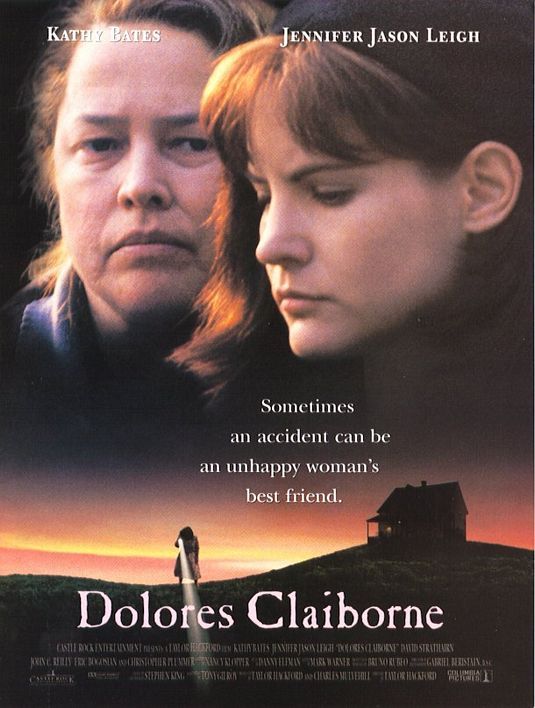
“Dolores Claiborne” is, on the surface, not your typical Stephen King novel, and this is important to note before you begin watching this particular adaptation of his work. This cinematic treatment reunites him with the great Kathy Bates who won an Oscar for playing Annie Wilkes in “Misery,” but she’s not playing a deranged psycho this time around. Also, while much of King’s writings deal with terrifying supernatural powers and unspeakable terrors, the horror generated here comes from real life horrors no one should ever have to endure. In some ways, this makes it one of his more terrifying tales because it deals with the kind of horrible crimes we hope and pray never to experience first-hand. Having said this, it is clear how many of us can never be so lucky as to avoid the worst traumas humanity has to offer.
Bates plays the title character who, as “Dolores Claiborne” opens, is believed to have killed her rich employer Vera Donovan (Judy Parfitt). This crime immediately reminds the town of Little Tall Island in Maine when Dolores’ husband, Joe (David Strathairn), died twenty years ago under mysterious circumstances, and the general consensus was that Dolores killed him. Detective John Mackey (Christopher Plummer), who had pursued the case against her back then is determined to put her behind bars this time and for good. Into this mix comes Dolores’ daughter, Selena St. George (Jennifer Jason Leigh), a big-time reporter who arrives to defend her mother despite the two of them having been estranged for over a decade.
The novel “Dolores Claiborne” was essentially one long monologue as the story was written entirely from the title character’s point of view. This makes the work director Taylor Hackford and screenwriter Tony Gilroy have done here all the more impressive. They have taken Dolores’ unsettling story and have stretched it out into a character driven motion picture filled with various characters who have been fleshed out in unforgettably compelling ways. None of these characters, even that drunken lout of a husband and father, are one-dimensional or throwaway caricatures. Each one is complex, and they take unexpected directions which might seem jarring at first, but eventually make sense in the large scheme of things.
The plot shifts back and forth in time as we flashback to when Dolores lived with her drunk and abusive husband and of the vicious abuse she took from him in his endlessly drunken state. Director of photography Gabriel Beristain shoots this hideous past with such vivid colors to where he gives the scenes an innocent look which is soon contrasted with horrible violence. It almost acts as a façade for how the past was seen as if it were some sort of Norman Rockwell painting, the kind made to cover up the severe family dysfunction many would like to pretend does not exist.
For the record, King said he wrote the character of Dolores Claiborne with Kathy Bates in mind, and it is very hard to think of another actress who could have inhabited this role. Stripped of any false glamour, Bates takes her character from being a victim to one who understandably takes matters into her own hands. Her acting here is flawless and compelling, and we root for her even though her actions have devastating moral implications.
When you look at her overall body of work, this movie almost seems like a walk in the park for Leigh. She has gone to great physical and emotional lengths to portray a character throughout her long career, but here it looks like she is taking it easy. However, her character of Selena is no less challenging to portray than the others listed on her vast resume. Selena is not easily likable, but she has to be empathetic because the viewer slowly starts to see how her innocence was irrevocably and unforgivably destroyed. Leigh matches Bates’ performance scene for scene by showing how much Selena wants to forget the past, but she comes to see how her most repressed memories cannot stay below the surface forever.
Special attention also needs to be paid to Ellen Muth who portrays Selena as a little girl. This is not the kind of role parents want their children to portray to as it deals with abuse and molestation among other things, but Muth proves to be utterly convincing in making the young Selena deeply distraught and confused by actions no child should ever have to be put through.
There’s also a bevy of excellent performances from the rest of the cast as well. Christopher Plummer, who is never bad in anything, is memorable as the relentless Detective John Mackey. This could have been a throwaway role, but Plummer makes Mackey a complex character to where you question whether his determination is based more on personal revenge than justice. Judy Parfitt is unbearably domineering as Dolores’ wealthy employer, Vera Donovan, and their relationship runs much deeper than we see at first glance. And David Strathairn manages to flesh out his despicable character of Joe St. George to where he’s just slightly more than your average mean drunk.
Most of King’s novels deal with the horror of supernatural elements or ghosts and demons which haunt our nightmares. But “Dolores Claiborne,” much like “Stand by Me,” deals with the horrors of real life which we are never quick to confront unless we are put in a position where the awful truth can no longer be ignored. Perhaps the unsettling nature of this particular work by King is what kept many from checking out this motion picture when it arrived in movie theatres back in 1995, but those of us who were willing to dive into the dark side of things like myself did not deny ourselves a journey to the horrors this film has to offer. But now, 25 years later, this film fits in perfectly with a time which includes the Time’s Up movement as we are forced to realize we have thoughtlessly ignored the worst abuses made against other human beings for far too long. As a result, this particular King cinematic adaption plays even better than it did back when it was released.
“Narrow Margin” was released in 1990, back when movie remakes were as rare as people owning cell phones. Yes, it is a remake of the 1952 film noir “The Narrow Margin,” and it tells the tale of a Los Angeles deputy district attorney tasked with keeping a witness to a murder safe from a pair of hitmen as they travel through Canada in a train. What we have here is a movie with a terrific cast, some great stunts and sharp cinematography, but it also doesn’t have much of a brain in its head as the characters make one ridiculously stupid decision after another.
The movie starts with Carol Hunnicut (Anne Archer) arriving at the Four Seasons Hotel in Los Angeles where she has been set up on a blind date with a lawyer named Michael Tarlow (the late and still missed J.T. Walsh). Things go fine between them until Michael has to take a phone call in his hotel room and invites Carol along with him, not wanting to leave her alone. But then well-known gangster Leo Watts (Harris Yulin) arrives along with his henchman Jack Wootton (Nigel Bennett) and doesn’t hesitate in accusing Michael of stealing money from him. Michael, overwhelmed by his guilt, confesses his crime to Leo who offers to forgive him, providing they never do business together again. But we all know that gangsters are not big on honesty, and Leo has Michael murdered right on the spot. But, of course, they have no idea Carol is hiding in the bathroom and has witnessed everything.
Like any person who knows how rich and crooked people get off too easy in the real world, Carol flees Los Angeles, and yet she is somehow easy to find as Deputy District Attorney Robert Caulfield (Gene Hackman) and Detective Sergeant Dominick Benti (M. Emmet Walsh) come to find her hiding out in a remote cabin in Canada. And as you might expect, it doesn’t take long for these three to realize the gangsters have followed them as they were dumb enough to leave a trail of breadcrumbs in their path. Dominick is killed, and Robert and Carol escape onto a train headed for Vancouver. But, surprise, surprise, they are trailed by a pair of ridiculously well-dressed hitmen determined to take them out, and the movie turns into a cat and mouse thriller as Robert tries to keep Carol alive despite their dire and claustrophobic circumstances.
Now “Narrow Margin” does take place in a time where technology was nowhere near what it is today, but it is hard to believe even back then that a person could easily disappear without much of a trace. The fact these gangsters have little trouble in following Robert to where Carol is hiding out shows what terrible preparation he and Dominick put into finding and keeping her safe, and these guys are public servants for crying out loud!
Then there are the two hitmen played by Bennett and James Sikking, the latter I remember fondly as the Captain of the Excelsior in “Star Trek III: The Search for Spock.” They come onto the scene dressed to the max in expensive suits and shiny ties which more than spell out to the audience they are bad guys on the prowl. I guess it is asking too much for these hitmen to dress like they are average passengers as doing so just might make them harder to detect. But no, these guys have to show to everyone just how rich and stylish assassins can be to where they are impossible to miss.
There is also the issue of those assassins failing to follow Hackman back to his cabin where they just might find Archer hiding. When you look closely at the screenplay, you will see it has plot holes Christopher Nolan could have flown that giant airplane from “Tenet” through. The characters keep making an endless number of idiotic mistakes, and it just drains much of the suspense and tension “Narrow Margin” hoped to have. There is also a character reveal towards the end, but you can see that one coming from a mile away.
It really is a shame because “Narrow Margin” has the benefit of two great actors headlining it. Gene Hackman is a lot of fun to watch in a role others would have played too broadly. He has a great scene where he faces off with the two hitmen and explains why he won’t accept a bribe to give up his witness. Hackman plays the scene in such a playfully devious way to where it serves as a reminder of why he is one of the best film actors ever. Put him in a bad movie, and he will still give a terrific performance in it no matter what.
Archer appeared in this movie not long after she co-starred in “Fatal Attraction,” a classic which had us all wondering why in the world would Michael Douglas cheat on her with Glenn Close. She makes Carol Hunnicut into a heroine who is both strong-willed and deeply vulnerable as she struggles to stay alive from one moment to the next. She also has strong chemistry with Hackman to where they make quite the team, and the fact they are unable to fully suspend your disbelief is not entirely their fault.
“Narrow Margin” was written, directed and photographer by Peter Hyams. One of his great strengths is in crafting action sequences which truly leave you on the edge of your seat. A car almost going over a cliff is a cliché used in many action movies, but Hyams makes it work to great effect here as watching it almost made my heart stop. There are also a number of great stunts performed on top of a moving train, many performed by the actors themselves. Hyams really knows how to keep audiences riveted to where it is almost worth watching this film just for the action sequences alone.
But in the end, “Narrow Margin” proves to be more laughable than exciting as the characters do far too many idiotic things we can all see right through. Its trailer made it look like a top-notch thriller you would be foolish to miss out on, but sadly this is not the case. When Hackman and Archer cannot save a movie with their strong performances, not much else can.
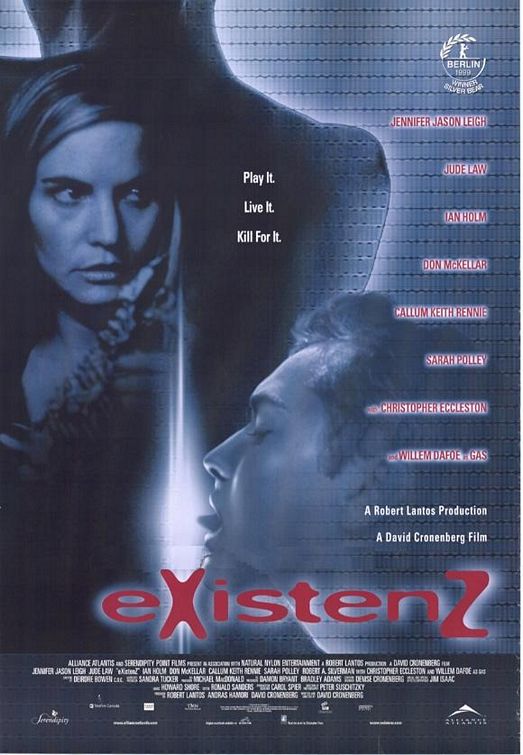
David Cronenberg’s “eXistenZ” is a film I like to describe as being the cerebral version of “The Matrix.” It gets you to question the reality the characters are in all throughout the movie, and it continues Cronenberg’s exploration of the blurring line between reality and fantasy. With “The Matrix,” it was clear what was real and what was not. But with “eXistenZ,” you can never be sure what is truly real, and its ending will leave you guessing for a very long time. But to quote the title of a certain U2 song, one has to wonder if everyone here has found something which is even better than the real thing.
“eXistenZ” stars the always awesome Jennifer Jason Leigh as Allegra Geller, a well-known game programmer who we first see about to try out her latest game which is said to be like no other. While most new game consoles come in these big metal boxes, Allegra’s box is more of an organic creation as it looks like a sizable piece of human skin which looks to be living and breathing when activated. To play the game, you have to hook a cord, one which looks eerily like an umbilical cord, into a port in your back which connects the game to your spine. Like many a Cronenberg movie, “eXistenZ” deals with the degradation of the human body as well as the human soul.
In the course of testing out the game to an excited crowd, Allegra is nearly assassinated by a man who is intent on eliminating what he sees as a threat to reality. From there, it becomes clear a war has begun between those who want to preserve reality by destroying the gaming industry, and those who want to preserve games and see them be taken to another level of advancement. Allegra is forced to go on the run, and coming along with her is a young marketing trainee, a shy nerd of a man named Ted Pikul. Pikul is played by Jude Law, and it is a role no one could probably see him playing these days. Ever since he showed off his tanned body on the sunny shores in “The Talented Mr. Ripley,” he has become a sexy god to so many. There’s nothing sexy to this character he plays here or, at least, not right away.
In the course of the attack, Allegra’s gaming pod is damaged, so she has to play the game to see what needs to be fixed. She encourages Ted to play it with her, but he is not terribly enthusiastic about doing so as he is a virgin to these kinds of games. He has never played them before, and he does not have a bioport in his back which is essential to playing the game. Moreover, he does not like things like bioports or needles being inserted into his body. But Allegra eventually encourages him to play along, and he does get a bioport jack hammered into his back courtesy of Gas (the always reliable Willem Dafoe). From there on out, Allegra’s and Ted’s voyage through the game will challenge their perceptions, and it has them wondering where they really are in all of this.
I remember seeing “eXistenZ” at an art house movie theater in Orange County when it was first released. Along with the characters, I was ever so eager to experience what they were experiencing when they played this game. While it felt like it took forever to get to their game experience, it turned out to be nothing like I could have ever expected.
With our infinite advancements in technology, the story is now far more frightening than ever before. Cronenberg is questioning how far we will go in our pursuit of the high which is virtual reality. Once we have experienced the game, will we even want to leave it? Will it make our “normal” reality feel more unreal? Everyone seems to be stuck in jobs they hate but have to work at, and they always dream of a better life for themselves which they constantly wait for instead of making it actually happen. Could this be accomplished through a game? Maybe not, but with the way technology continues to advance, anything is possible.
The other fascinating thing about “eXistenZ” is how it looks at the moral boundaries these characters cross. The games we play on the latest PlayStation or Xbox console seem to have this effect, but we can easily see we are indulging in a fantasy which makes everything okay. But as the line between reality and fantasy blurs all the more, the consequences seem all the more brutal and fiercer, and these characters end up crossing a line they can never undo. When we cannot tell reality from fantasy, how can we justify the horrible things we do to others?
Cronenberg’s movies have a look all their own, and “eXistenZ” has his signature touch throughout. What other director could come with an organic pod for game playing, or with a gun made out of animal bones with teeth used as bullets? Even in the game the characters are playing, the violence is still pretty vicious, and no death ever looks pretty. This is also typical with Cronenberg’s movies as we see faces blown off to where certain people look like Harvey “Two Face” Dent from “The Dark Knight.“
Leigh and Law are always terrific in just about everything they do, and their work in “eXistenZ” is no exception. Leigh, who usually plays characters who are anything but pretty, is an alluring presence throughout as she not only manages to seduce Law, something which cannot be all that hard to do, but she also succeeds in seducing the audience into the world her character inhabits. This is what her performance needed to accomplish in order to make this film work, and it should make one admire her acting skills all the more.
If “eXistenZ” were made today, I’m not sure we would be seeing Law in this role as he would probably seem too cool to play such an awkwardly social character. People get used to seeing you in a certain way, and it can get to where no one wants to see you as anything else. It’s a shame because Law truly is a great actor, and seeing him go against type here as a man who has to overcome his phobias and aversions in order to play the game and help Allegra is endlessly enthralling. The effect it has on him is immense as it unlocks unconscious desires which quickly rise to the surface. Law portrays this evolution of his character very effectively, and he has great chemistry with Leigh from start to finish. Heck, is it possible for Law to not have good chemistry with any actress?
The ending of “eXistenZ” will leave you with more questions than answers. This may frustrate a lot of audiences, but Cronenberg has not always been one to give you conclusions which tell you all you need to know. You come out of his movies thinking about what you have just witnessed, and this makes his work stay with you long after the end credits have concluded. It is not an action-packed film like “The Matrix,” and you won’t see a lot of actors wearing skin clad leather costumes and wearing cool sunglasses here, but this movie stands on its own as an examination of where technology is taking us. Like “Videodrome,” it threatens to be a very prophetic film as we head further and further into the new millennium with technological discoveries which put us into the action and other realities more than ever before.
We are still all on a search for something which is even better than the real thing, and it’s never gonna stop. But after watching “eXistenZ,” I am reminded of the need for limits on things as many, especially in America, continue to act like children instead of being the adults they have been for some time. Facts should be indisputable, but a reality other than our own is always far more appealing than what our current existence resembles.



 The Ultimate Rabbit