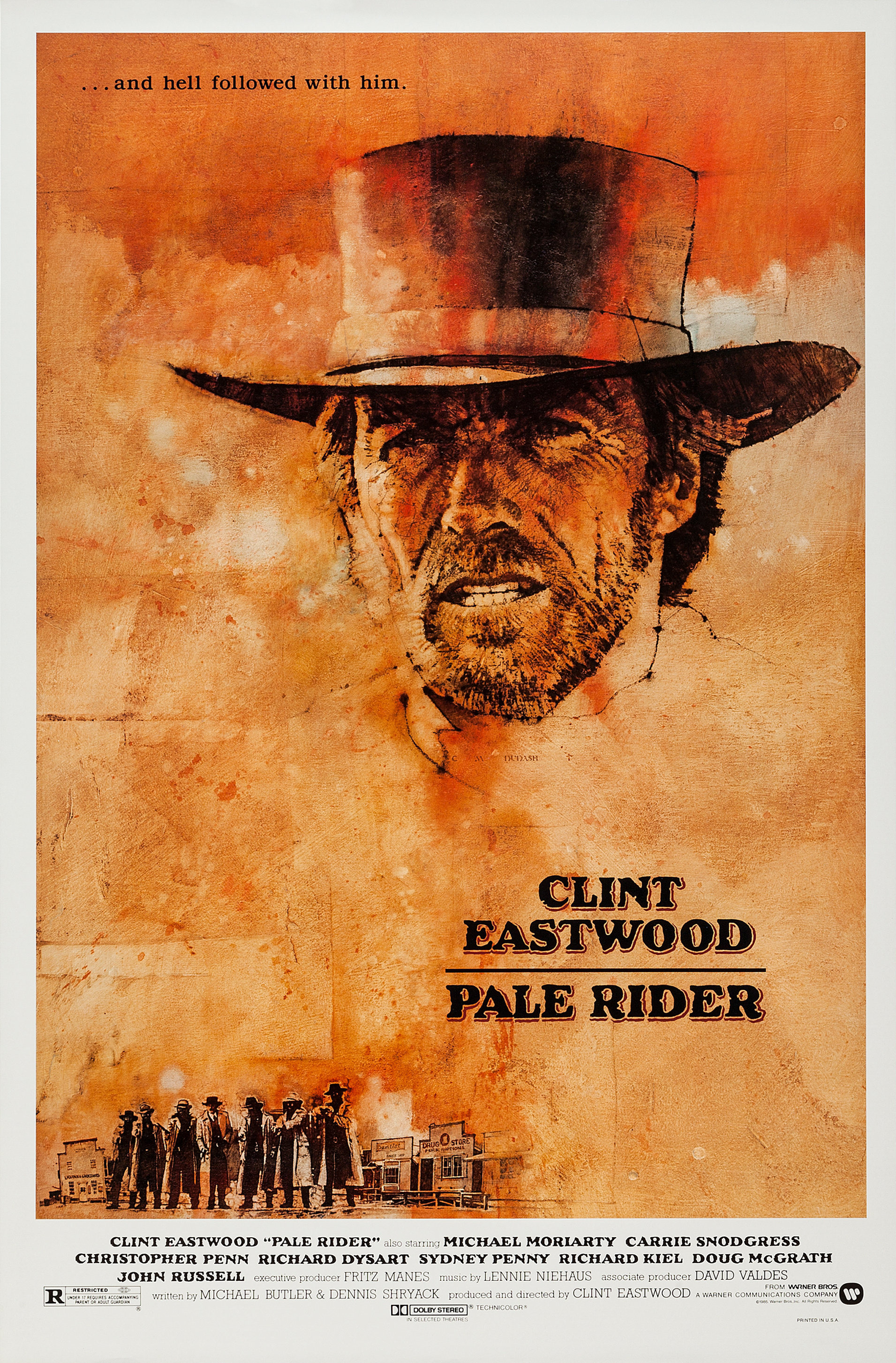
With Tony Farinella’s ever so enthusiastic review of Clint Eastwood’s 1985 western “Pale Rider,” I was quickly reminded of the various trailers made for it back in the day. Each trailer and television commercial made for it was dominated by the music of “Best Endeavours” which was composed by Alan Hawkshaw. That piece of music alone was enough to get me super excited about this particular motion picture.
But one particular trailer for “Pale Rider” which excited and stayed me throughout the years was its teaser. I first watched the teaser when it was included in the VHS release of “City Heat,” a movie which teamed up Eastwood with Burt Reynolds and eventually became one of my most inescapable guilty pleasures.
What makes this trailer for “Pale Rider” stand out for me is how it is composed simply of still images. Like the Italian movie trailer for Dario Argento’s “Suspiria,” it is the images which, in their stillness or frozen moments, spoke volumes. While Warner Brothers might have preferred more in the way of moving images, the still ones had much more of an impact on me.
Plus, it has a narrator telling us how Eastwood had previously directed the last great western back in 1976 with “The Outlaw Josey Wales.” This made the trailer’s promise of “Pale Rider” being the next great American western all the more thrilling. Whether or not you think “Pale Rider” proved to be such the thing, I admired the case the narrator sold us on.
As much as I wanted to see “Pale Rider” when it arrived in theaters, I was only ten years at the time, and it was rated R. The best I could do was watch Siskel & Ebert review it as I got to see movie clips there, and I did get to read the movie’s novelization which was written by Alan Dean Foster. For some odd reason, my parents never kept me from doing that.
I didn’t get to see “Pale Rider” until many years later, but that is a story for another time. And from now on, Alan Hawkshaw’s “Best Endeavours” will always forever be the “Pale Rider” theme to me. To others, it may forever be the theme for the British program Channel 4 News, but Channel 4 never secured permanent exclusivity rights for it at the time, so there!
Please check out the “Pale Rider” teaser trailer down below.
The following review was written by Ultimate Rabbit correspondent, Tony Farinella.
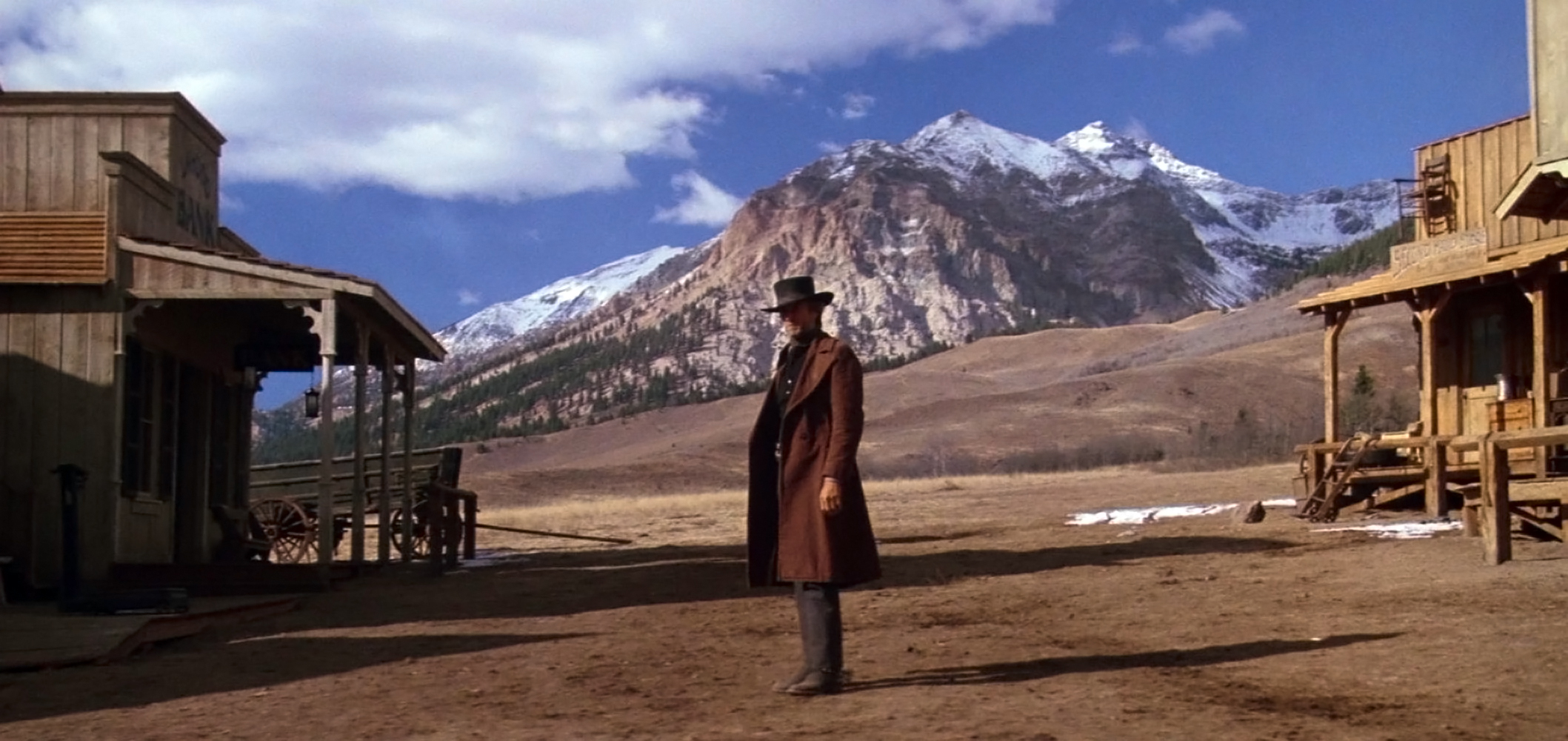
Clint Eastwood is synonymous with the Hollywood western in American cinema. For my money, the westerns of Eastwood are far superior than those of John Wayne. There is a subtlety and nuance to his films and his performances. While not all of them are Hollywood classics, they are a great example of old-school craftsmanship, especially when he’s behind the camera. He is behind the camera for “Pale Rider,” which is celebrating its 40th anniversary with this 4K release. It is a film I have not seen before, but after watching it for the first time, I fell in love with it immediately.
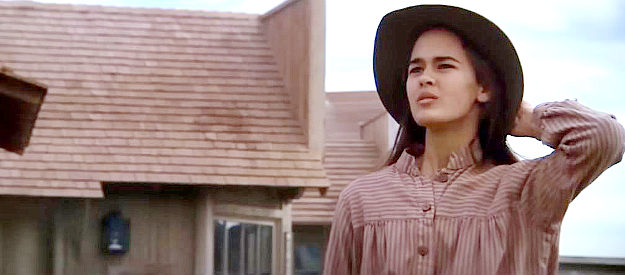
Our film is set in LaHood, California in Carbon Canyon, which is being run by an malevolent banker and a crooked marshal. The banker is named Coy LaHood, played by Richard Dysart. Since he doesn’t have the legal rights to kick the miners out of their homes, he uses violence and intimidation in an attempt to gain complete control of the land. This doesn’t sit right with Hull Barret, played by Michael Moriarty, as he’s trying to take care of his fiancée Sarah (Carrie Snodgress) and her daughter Megan (Sydney Penny). However, he’s finding little to no support in his battle against LaHood.
Megan’s prayers for peace are answered by a man known as the Preacher, played by Eastwood. He’s a mysterious and shadowy figure who shows up to save Hull after he’s attacked by four of LaHood’s men. Megan was having a hard time seeing the silver lining in much of anything after her father left, her grandfather passed away, and her dog was killed. LaHood has brought nothing but mayhem and destruction to Carbon Canyon. The Preacher, however, is not only giving Megan hope, but he’s also giving hope and faith to everyone in Carbon Canyon. They are not going to be kicked out of their homes, and they will not be bought off.
Westerns are often hit or miss with me as a film critic. When they are done with interesting characters, beautiful cinematography and focus on the quiet introspective moments, they connect with me and I’m completely absorbed. One of my favorite Westerns of all time is “Unforgiven,” which was also directed by Eastwood. It deals with the aftermath of the violence and the effect it has on those who have inflicted it on others. “Pale Rider” is about the people of Carbon Canyon and how they are trying to exist, survive, and live while under the thumb of LaHood. Eastwood, in many ways, is a supporting character in his own film. I imagine this was by design. When he does appear on screen, everything he does is thoughtful and understated. He has a terrific scene with Sydney Penny where he describes why they can’t be together romantically. It’s delicate and, in the hands of any other filmmaker, it would have been awkward and out of place.
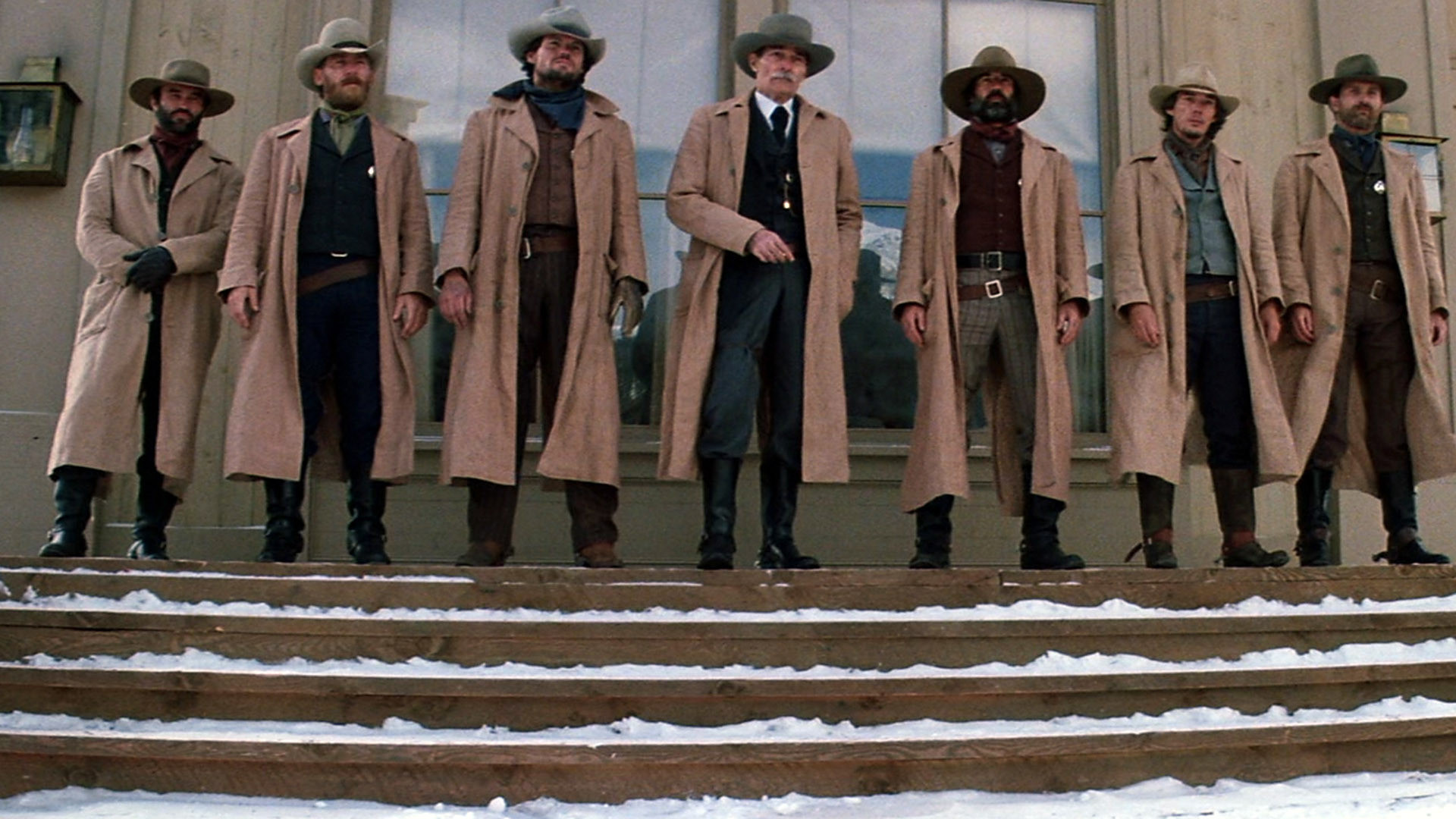
It all leads to the big shootout between the Preacher and LaHood’s men along with Stockburn, the Marshal, played by John Russell. The shootout scene is impactful because Eastwood is a patient director and he takes his time in building up to the grand finale. At the end of the day, movies are simple—introduce us to characters we are invested in, set the stage, let the actors do their work, and get out of the way. Eastwood is one of the best in the business at doing that as a director, which is one of many reasons why he’s a Hollywood legend.
I’d also like to mention the work of Chris Penn in the film as LaHood’s son, Josh. Even though Sean Penn is more well-known and established as an actor, his brother Chris was a terrific character actor who really knew how to play a slimy and underhanded villain. I’ve always been a big fan of his work. Michael Moriarty plays a good man who is trying to do the right thing while simultaneously trying to maintain his manhood at the same time. In many ways, even though Eastwood receives top billing, he’s the lead in the film when it comes to screen time. Carrie Snodgress and Sydney Penny bring vulnerability, strength, and warmth to their performances. This is a terrific cast.
From start to finish, I was utterly engrossed in “Pale Rider,” and I couldn’t take my eyes off the screen. There is a sense of mystery surrounding the Preacher character, and it is what keeps the story moving in a unique and captivating way. I like to be kept on my toes. Overall, this is the kind of movie I love as a moviegoer. The acting, from top-to-bottom, is phenomenal, the scenery is gorgeous, and the story is simple yet powerful. This is another in a long line of classic films from the great Clint Eastwood. The great thing about his filmography is there are still films of his I haven’t seen. He’s the gift that keeps on giving.
* * * ½ out of * * * *
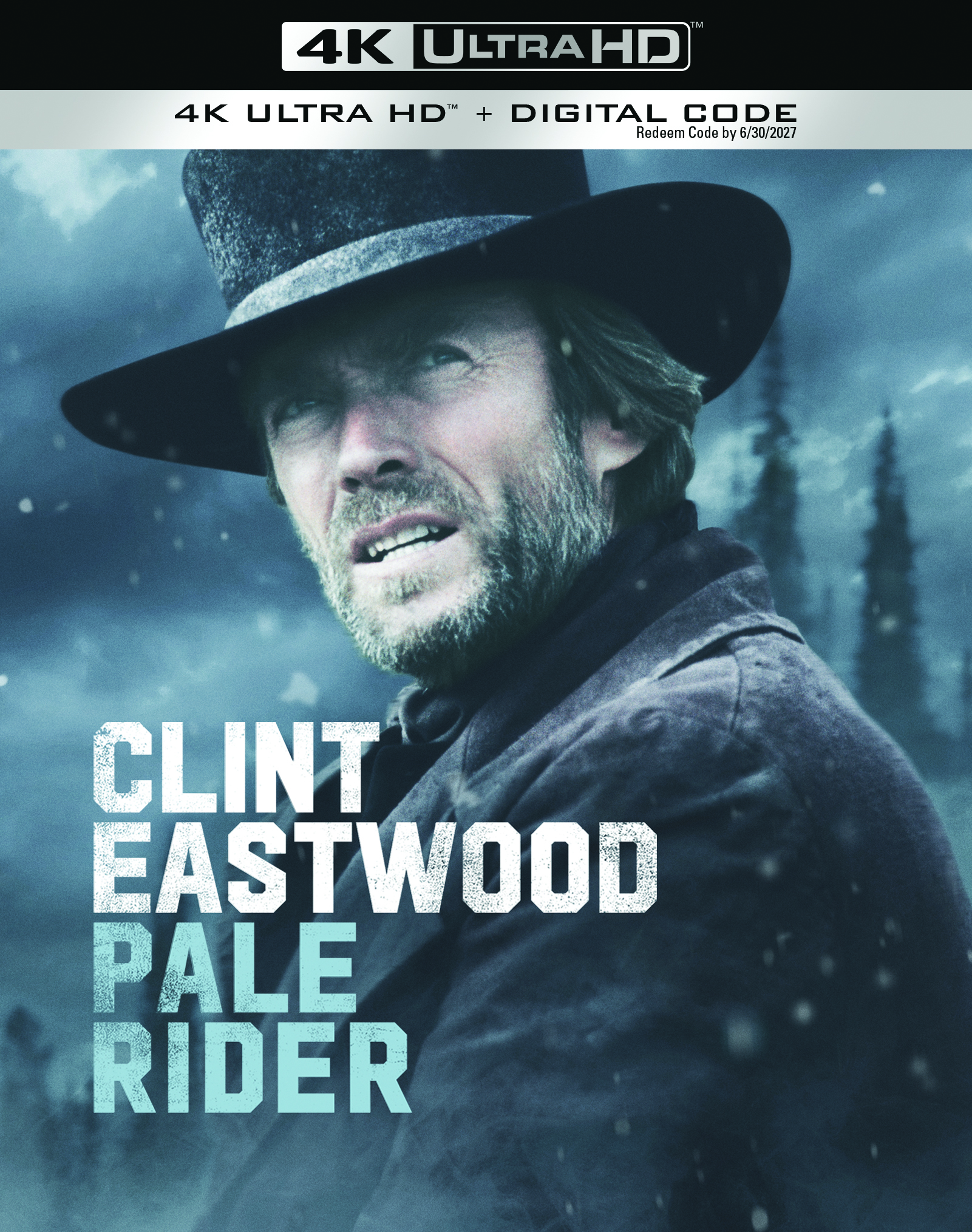
4K Info: “Pale Rider” is being released on a single disc 4K from Warner Brothers Home Entertainment. The release comes with a beautiful slipcover and a digital copy as well. There is a steelbook version of the film available for purchase if you are interested in steelbooks over slipcovers. I prefer slipcovers myself. The film has a running time of 116 minutes and is rated R.
4K Video Info: “Pale Rider” comes with a jaw-dropping 4K HDR transfer. The film looks magnificent. Westerns, in particular, are always a welcome addition to 4K. The landscapes are enthralling to look at and the colors are lively and vivid.
4K Audio Info: The Dolby Atmos track is out of this world as it is peaceful during the quieter moments in the film but it comes to life during the action sequences. Subtitles are included in English, Spanish and French.
Special Features:
The Diary of Sydney Penny: Lessons from the Set – NEW
Painting the Preacher: Bruce Surtees and Pale Rider – NEW
Clint Eastwood: A Cinematic Legacy – Reinventing Westerns
Eastwood Directs: The Untold Story
The Eastwood Factor
Should You Buy It?
HELL YES! “Pale Rider” is a great film. It was almost a perfect film, and I was very close to giving it four stars. In the end, I decided to give it three and a half stars, but when it comes to owning the 4K, it’s a no brainer. There are also new special features on this disc! So many physical media collectors often complain about the lack of new special features, but there are two new special features on this 4K disc. In total, there are over three hours of special features here! Clint Eastwood and Warner Brothers have a special relationship, and this is one of their finest films. The audio and visual aspects of the 4K are magnificent. This is one of my favorite 4K releases of 2025 so far, and I can’t wait to watch “Dirty Harry” and “The Outlaw Josey Wales” on 4K from Warner Brothers. They hit a home run with this release, and you owe it to yourself to add this film to your collection. This one comes highly recommended.
**Disclaimer** I received a copy of this film from Warner Brothers to review for free. The opinions and statements in the review are mine and mine alone.
The following review was written by Ultimate Rabbit correspondent, Tony Farinella.
A little over a year ago, Warner Brothers Home Entertainment released a set which included the first four “Rocky” films along with the director’s cut of “Rocky IV.” Many fans were dissatisfied with this release and pointed out audio and video issues along with the fact that “Rocky V” and “Rocky Balboa” were not included in the set. Now, Warner Brothers has released a new edition of the “Rocky” films on 4K in a set entitled “Rocky: The Ultimate Knockout Edition,” and it includes replacement discs for the issues with the first four films and also includes “Rocky V,” “Rocky Balboa” and “Rocky Balboa: The Director’s Cut.” There is also a Blu-ray disc which includes special features for the first four films. I went back and looked at my review from March 2023 for “Rocky: The Knockout Collection,” and I didn’t feel as though the issues were as egregiously bad as other reviewers made them out to be.
With all six of the Rocky films now out on 4K, people are going to be wondering if this set is worth its hefty price tag. Before I get into all of that, let’s briefly discuss the films. The original “Rocky,” released in 1976, won Best Picture and put Sylvester Stallone on the map. It is the ultimate underdog sports movie and a film which is quoted and remembered to this very day. Even after Stallone is long gone, fans and historians will always remember him as Rocky Balboa. Of course, he also played John Rambo, but people really connect with Rocky and can even see themselves in the character. It was the right film with the right actor at the right time.
There is much debate and handwringing over the sequels. I love all of the “Rocky” films, warts and all, as they play a part in the story of Rocky Balboa and his ups and downs as a character. We see him start from nothing, rise, fall, and rise again. I think you have to appreciate the good, bad and the ugly all of the films as they all serve a specific purpose for this franchise. Of course, my favorite film will always be the first “Rocky.” After that, I’d probably go with “Rocky II,” “Rocky Balboa,” “Rocky IV,” “Rocky III,” and “Rocky V.” If you ask me this question in a few months, my answer might change again.
The original “Rocky,” the one which started it all, is about a low-level boxer who is looking for a chance to prove he’s not another bum from the neighborhood. He mostly takes outlaw fights which make little to no money. One day, Apollo Creed (Carl Weathers) is looking for an opponent in order to sell his next fight. When he stumbles upon Rocky Balboa, an underdog fighter from Philadelphia, he figures he can use this David vs. Goliath story to sell some tickets and get an easy victory. He ends up getting more than he bargained for from Rocky Balboa, who is feeling the support of his newfound love interest, Adrian (Talia Shire) and her brother Paulie (Burt Young). All he wants is a chance to prove his self-worth.
In “Rocky II,” he needs to prepare for his rematch against Apollo Creed. Can he defeat Apollo Creed this time, or will Creed destroy him and show that their last fight was simply a fluke? Even though Creed won the first fight by decision, Rocky showed he can last in the ring with the Heavyweight Champion of the World.
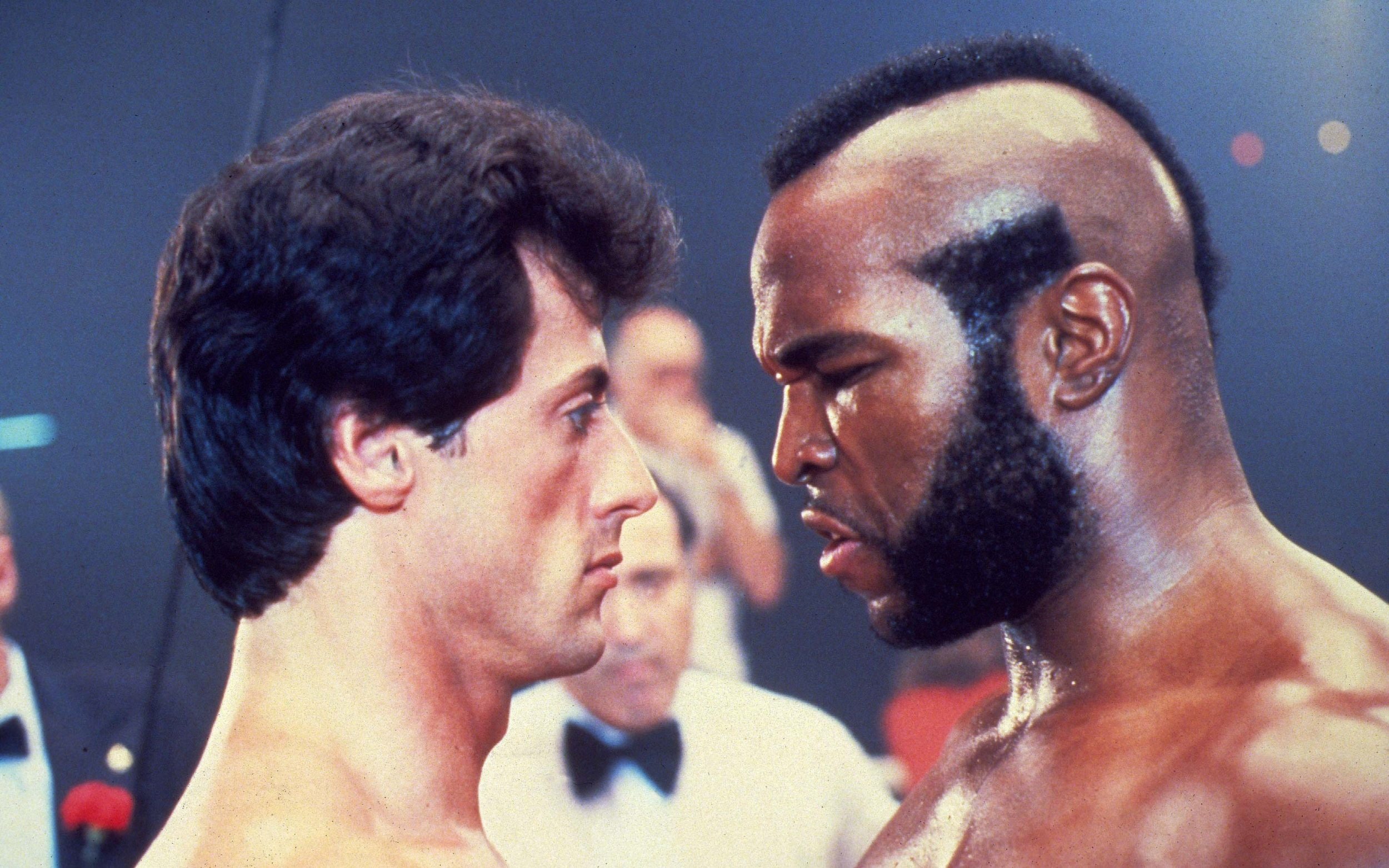
In “Rocky III,” Rocky needs to learn how to handle the biggest obstacle of all: success. How will he deal with money and fame? He also encounters Clubber Lang, played by Mr. T and Thunderlips, played by Hulk Hogan.
In “Rocky IV,” Ivan Drago (Dolph Lundgren), a menacing Russian, awaits him. I mentioned in my initial review of the first set how I preferred “Rocky IV: Rocky vs. Drago” over the original cut of “Rocky IV.”
In “Rocky V,” he has to get a handle on being a dad and life outside of the ring.
In “Rocky Balboa,” he’s past his prime, old and beaten down, but he’s looking to find an outlet to deal with his pain.
I imagine most people reading this review are familiar with each and every film in the “Rocky” series, so I don’t imagine these are major spoilers. They simply serve as a refresher in case you haven’t seen the films in a while. You are reading this review to see if this box set is worth the money, as mentioned previously. The answer is both yes and no. The 4K transfers are cinematic and an upgrade over the Blu-rays. The “Rocky” films have never looked or sounded better in any other format. The audio issues are also cleaned up on all of the films, even though I didn’t really notice them with the last “Rocky” set. This is all of the “Rocky” films, as the “Creed” films are their own separate entity, even though they are in the “Rocky” universe.
This set is going for about $90 to $110 depending on where you purchase it from, as Gruv.com has it for the cheapest I’ve seen. The discs themselves are great. Warner Brothers fails massively with the packaging of this set. It comes in a flimsy cardboard slipcover with discs that can be looked through in a flipper case. These movies are important to me, and they are also important to a lot of film fans out there. They went cheap with the packaging, as the cardboard slipcover is not a thick and sturdy box that can protect the films or the case. The discs are also stuck in a flipper case which shows a lot of off-gassing, which is this greasy substance that is really difficult to remove from the back of the disc holders.
Overall, I enjoyed watching the films on 4K, and I’m happy Warner Brothers decided to release this “Ultimate Knockout Edition” of all of the “Rocky films. At its price point, however, I would expect a lot more on the packaging side of things. The packaging and the case are truly a mess, and it makes it hard to fully enjoy this set. As a collector, we buy movies for the movies and also the packaging. We are not simply buying the discs of these films. I wish they would have shown a little tender loving care to this set. They should have released these in individual cases in a sturdy box set which holds them all together.
Ratings:
“Rocky”: * * * * out of * * * *
“Rocky II”: * * * ½ out of * * * *
“Rocky III”: * * ½ out of * * * *
“Rocky IV”: * * * out of * * * *
“Rocky IV: Rocky vs Drago – The Ultimate Director’s Cut”: * * * ½ out of * * * *
“Rocky V”: * * out of * * * *
“Rocky Balboa”: * * * ½ out of * * * *
“Rocky Balboa: Director’s Cut”: * * * out of * * * *
Video Info: All of the films are released on Dolby Vision, which leads to some very impressive looking visuals. The best-looking films in this set, in order, are “Rocky V,” “Rocky II,” “Rocky IV: Rocky vs. Drago,” “Rocky IV,” “Rocky,” “Rocky III,” “Rocky Balboa” and “Rocky Balboa: The Director’s Cut.” It was a bit of a surprise to me that “Rocky Balboa” was the weakest link out of all these films from a visual standpoint. It was the film I was most excited to see upgraded to 4K, but it looks rather bland and vanilla. This is probably because they put both versions of this film on one 4K, which is asking a lot out of one disc, although it didn’t affect both versions of “Rocky IV” for some reason. It’s surprising to see that the worst film in the “Rocky” franchise, “Rocky V,” is the best-looking one out of the bunch.
Audio Info: All of the audio issues are fixed here from the previous release, but once again, I didn’t notice a big difference the last time they released these films on 4K. I know that Warner Brothers made sure to correct the issues from the last release based on what I’ve read online. You don’t have to worry about a disc replacement program with any of the audio tracks here. None of the films come with Dolby Atmos, which is a bit of a bummer, as the Rocky films seem perfect for Dolby Atmos. The audio is still really good, but this would have given it that extra boost.
Special Features:
“Rocky”
• Audio Commentary with director John Avildsen and producers Irwin Winkler and Robert Chartoff, Talia Shire, Carl Weathers, Burt Young, and Garrett Brown
• Audio Commentary with Lou Duva and Bert Sugar
• Audio Commentary with Sylvester Stallone
“Rocky Balboa”
• Audio Commentary with Writer/Director Sylvester Stallone
• Deleted Scenes
• Skill vs. Will: The Making of Rocky Balboa
• Reality in the Ring: Filming Rocky’s Final Fight
• Virtual Champion: Creating the Computer Fighter
• Fight Makeup
“Rocky” Bonus Disc
• 8MM Home Movies of Rocky
• 3 Rounds with Lou Duva
• Steadicam: Then and Now with Garrett Brown
• Make-Up! The Art and Form with Michael Westmore
• Staccato: A Composer’s Notebook with Bill Conti
• The Ring of Truth
• A Tribute to Burgess Meredith
• Stallone Meets Rocky
• The Making of “Rocky vs. Drago”: Keep Punching
• Trailers
Should You Buy It?
I don’t think Warner Brothers is going to release ANOTHER “Rocky” set, so I would say buy it, but I would wait until it goes on sale. As of right now, the price is way too high considering the packaging on this set and the lack of original special features. My feeling is this—if you are going to release a set like this, which is near and dear to so many people’s hearts, why not release it the right way and take your time? I would have loaded it up with as many special features as possible and spent a little more money on better packaging and a better case. The films, for the most part, look good and the audio is solid. I’m not trying to sound picky here or look a gift horse in the mouth, but this set should cost $60 and not $90 to $110, considering how they threw it all together in this packaging. You will enjoy the films, which is the most important part, but a little quality control would have gone a long way. This “Rocky” set on 4K does come recommended, but I recommend you wait for it to go on sale and not rush out and buy it right away.
**Disclaimer** I received a copy of this film from Warner Brothers to review for free. The opinions and statements in the review are mine and mine alone.
The following review was written by Ultimate Rabbit correspondent, Tony Farinella.
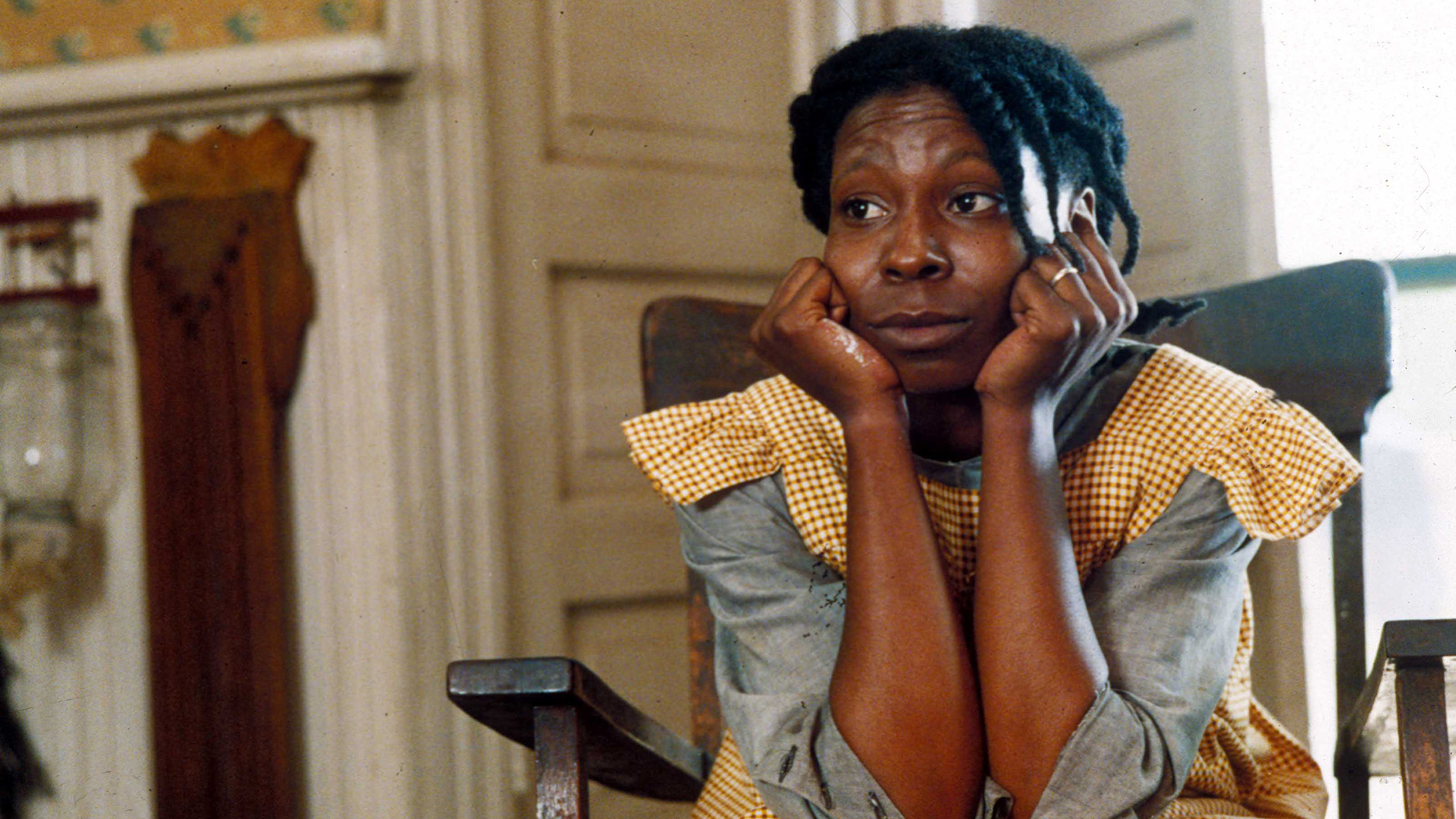
This was my first time having the pleasure of sitting down to watch “The Color Purple,” directed by the legendary Steven Spielberg. This is a director who has never been afraid to tackle any type of film project. When watching this film, his trademark heart is clearly on display. What makes it stand out and be as memorable as it is, though, is the terrific acting, especially from Whoopi Goldberg and Oprah Winfrey. “The Color Purple” is based on the novel by Alice Walker, which I have not read, so my film review will be solely based on the film itself. I have no frame of reference to compare it to, and I think that is more than OK. Too often, people get caught up in comparing films to books, and in the end, they are two totally different mediums. You will never be able to cover everything from the book because you are limited by the running time of the film.
The film takes place from 1909 to 1943 in Georgia where we are introduced to Celie Harris (Whoopi Goldberg), a young teenager who already has two children, a boy and a girl, because she was raped by her father. Her father took the children from her and has essentially sold them off for profit. Celie wonders where her children are and worries about them constantly, as any mother would when they are abruptly taken. She was also married off, thanks to her father, to Albert Johnson (Danny Glover), an abusive man who makes her do anything and everything for him. He beats her, forces her to have sex with him, and controls every aspect of her life. In his eyes, this woman serves one purpose and one purpose only, which is to take care of him. She even has to call him “Mister.”
During this time, she was separated from her sister, Nettie, played by Akosua Busia. When Albert came looking for a wife, he was initially interested in Nettie, but their father would not part with her and insisted on Celie going with Albert. Celie is often told she is too skinny and ugly. She sees inspiration in the strong-willed Sofia, played by Oprah Winfrey. Sofia is not one to take guff from anyone in her life, but you wonder how long this will last before she is beaten down by the rampant racism she experiences. We get to know another woman named Shug Avery, played by Margaret Avery, a flamboyant performer who has Albert Johnson’s full attention. Even though Shug comes with some baggage, she seems to know how to hold her own and capture the attention of men while remaining independent and tough. Celie is hoping to receive some letters from her sister Nettie, but she starts to wonder why they never show up and if her sister is even alive after they were separated.
“The Color Purple” covers a great deal of time and because of the amount of time it covers, four decades, it makes sense that the film is 153 minutes. This was one of those films where I rarely noticed the running time because it was a prime example of good old-fashioned Hollywood craftsmanship. When film critics and fans say things like, “They don’t make ‘em like they used to,” in my eyes, they are talking about films like this one, which was released in 1985. It’s a drama made by adults for adults. This is a serious subject matter, but it’s handled with Spielberg’s trademark warmth, tenderness and care. Because we spend so much time with Celie on her journey, we can’t help but root for her to overcome her circumstances. We get to know her and the women close to her as they have made an impact on her life.
The film is incredibly patient in allowing things to slowly build up to its climax without ever feeling like it’s taking too long to get there. Goldberg is tremendous here. She expresses a plethora of emotions on her face without ever overacting or doing too much. You can look in her eyes and see the pain and heartache of her character. It’s a terrific performance, and I think people forget what a great actress she is when given the chance to show off her range of emotions. Of course, she won an Oscar for “Ghost” in 1991. However, this is clearly the film she should have won an Oscar for, with all due respect to Geraldine Page.
“The Color Purple” does sometimes go off the beaten path with its narrative plot and, at times, it can spend too much time with one character in a specific time and place instead of sticking with Goldberg and her character’s story. I was very, very close to giving this film four stars, especially because of the emotional weight which was incredibly powerful. It earns the tears of the audience here by allowing things to build up and develop. Winfrey is also really, really good here and earned an Oscar nomination for her performance in this film along with Avery.
One of the biggest criticisms of this film is that it was directed by a white director in Steven Spielberg. This is a film populated with a cast which is 95% Black. I can see why audiences would take issue with that, but Spielberg is wise to stay out of the way of the material and the actors. Even though some of his familiar touches are here, as mentioned earlier, it doesn’t feel like a typical Spielberg film. He is sensitive to the story, and he does a terrific job of allowing the performances of his cast and the story itself to take center stage. He’s more in the background here and, for once, it isn’t a bad thing.
* * * ½ out of * * * *
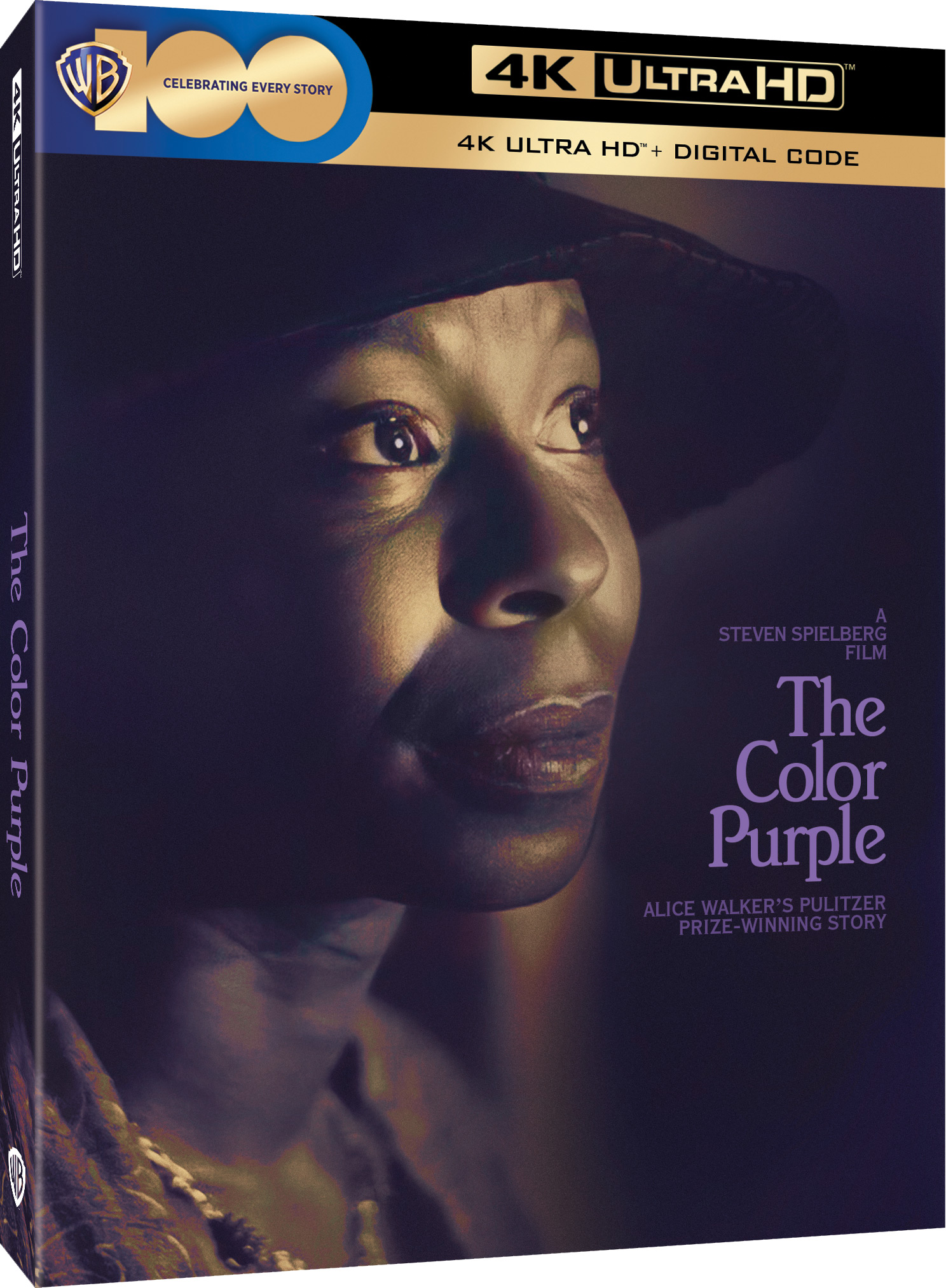
4K Info: “The Color Purple” is released on a single 4K disc from Warner Brothers Home Entertainment. It also comes with a digital copy of the film. The film is rated PG-13 and has a running time of 153 minutes.
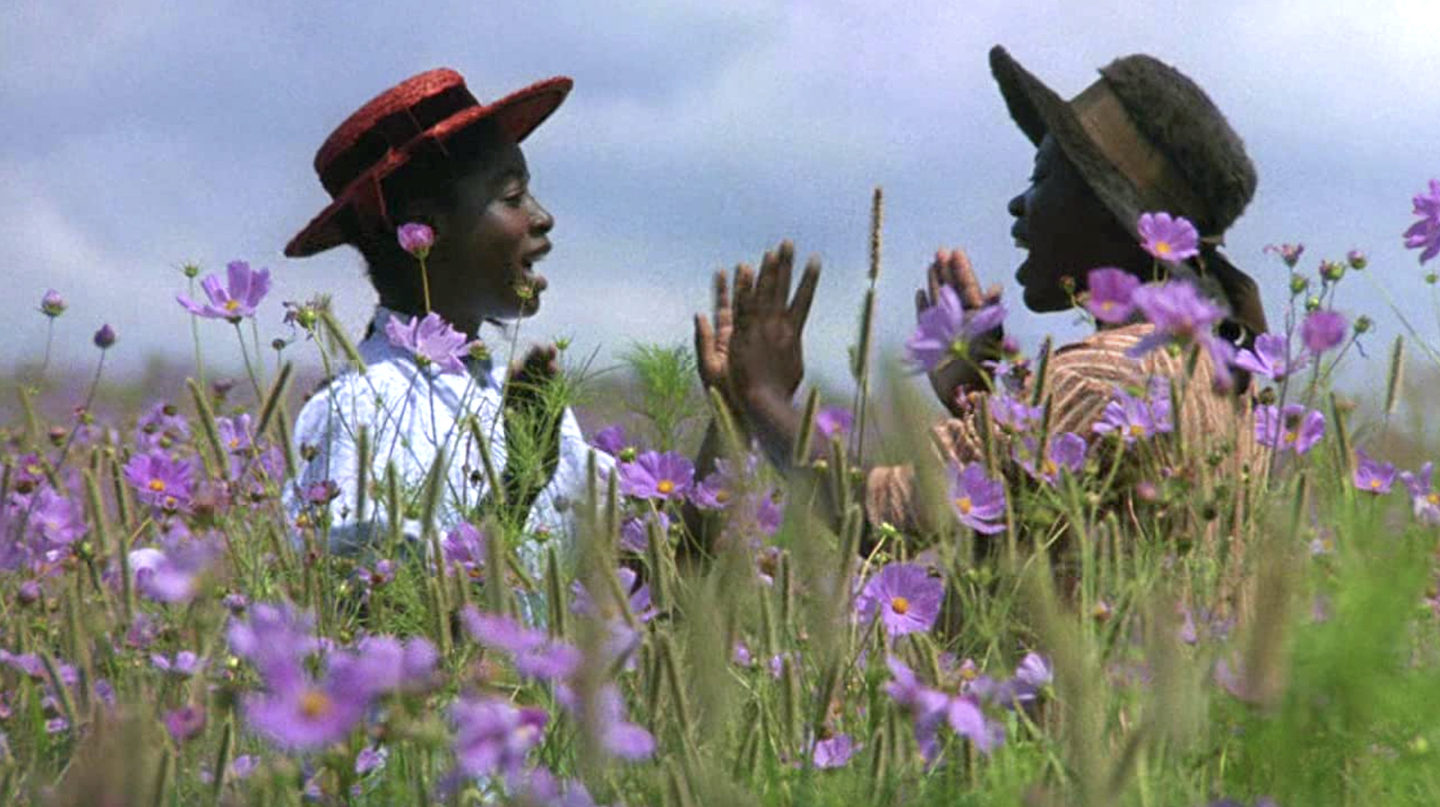
4K Video/Audio Info: This is another top-notch transfer from the folks over at Warner Brothers Home Entertainment. The HDR here really shines in some of the outdoor scenes which are lively and colorful. It has a cinematic feel to it while also cleaning up the picture as well. The audio track is also really solid, as this is a dialogue heavy film, and it’s easy to understand everything that is being said with a clean and crisp audio track here. Subtitles are included in English, Spanish and French.
Special Features:
Conversations with the Ancestors: The Color Purple from Book to Screen
A Collaboration of Spirits: Casting and Acting The Color Purple
Cultivating a Classic: The Making of The Color Purple
The Color Purple: The Musical
Teaser #1
Teaser #2
Trailer
Should You Buy It?
If you read my 4K reviews (and thank you if you do), you know what a big proponent I am of film history and preservation. In the year 2023, Warner Brothers has done their job in going through their extensive catalogue of films and bringing them to 4K and making them look bigger and better than ever. There are a ton of important films in the Warner Brothers library that have received their day in court this year. In order for them to continue doing their job, we need to support their restorations of classic cinema, especially when they are done in such a magnificent manner, leaving no stone unturned. “The Color Purple” pops off the TV here and looks better than it ever has, thanks to this 4K transfer. It sounds great as well. The film itself is an important piece of cinematic history that shows off great acting and tells a vital story with a great cast of actors and one of the best directors of all-time. At its current price point, which is around $23, this is a day one purchase on its December 5th release date.
**Disclaimer** I received a copy of this film from Warner Brothers to review for free. The opinions and statements in the review are mine and mine alone.
WRITER’S NOTE: This article was written in 2010, back when this anniversary screening took place.
Alan Rudolph’s 1985 neo-noir movie “Trouble in Mind” reached its 25th anniversary in 2010. This is especially significant because it got lost by its distributors about twenty years ago, and they only recently found a print of it. The movie has since been restored and been released in a new special edition DVD. To celebrate its anniversary, the producer of “Trouble in Mind,” Dave Walker, showed a new print of it at New Beverly Cinema. Along with him were actors Keith Carradine who played Coop and Lori Singer who played Georgia, and they were also joined by the composer of the film’s score, Mark Isham.
In talking about working with Rudolph, both Singer and Carradine said they never really rehearsed any scenes. A lot of it came down to them meeting with Rudolph, talking about the screenplay, and getting on the same page with what he wanted to accomplish. Singer explained how he created a “very vivid atmosphere” which came about from an “organic, real feeling.” In summarizing Rudolph’s filmmaking process, Singer said, “Whatever he was shooting, he was capturing his vision. That was our rehearsal.”
Isham described Rudolph as a “jazz director” in that he wanted to get everything right in the first take. When asked how he got the job on “Trouble in Mind,” Isham explained he was being represented by CAA and his agent encouraged him to make a list of directors he wanted to work with. After seeing one of Rudolph’s other movies, “Choose Me,” Isham decided he wanted to work with him. Rudolph ended up listening to one of Mark’s albums, liked it and hired him.
One question asked of Isham was in regards to working with singer Marianne Faithful on two of the film’s songs. Isham said he knew nothing about Faithful beforehand, but that he quickly learned she was an artist of instinct, and they captured a lot of magic on tape whenever she sang. Basically, he did an acoustic piano version of each song she would sing, and he gave her the music through headphones. Isham went on to say he added synthesizers to the soundtrack afterwards.
Isham is also considered one of the best trumpet players ever, and he did perform on one here. He stated how he has been playing the trumpet since he was eight years old and is always looking to put it in any movie he works on.
Another audience member asked Carradine about Coop’s hair and why it got all funky throughout. Carradine said he contributed to the look and described it as an “expression of descent into a kind of netherworld from innocent to deeply urban sensibility he was defenseless against.” Coop saw the change of hair as him becoming beautiful, and he was convinced that Singer’s character would like it. Carradine described it as Coop’s way of trying to fit into a world he was utterly clueless about, and that the hair he used was indeed his own, and these days he doesn’t have much of it left.
Carradine and Singer also spoke of working with Divine, the actor made famous in several films directed by John Waters, “Pink Flamingos” in particular. They said they really loved him because he was the sweetest guy and wonderful to work with.
After twenty-five years, “Trouble in Mind” still holds up very well, and hopefully its DVD release will open it up to a young audience waiting to discover something new and different. Rudolph has said this films is meant to have the look of a dream, and he gave Singer all the credit for that. The dream is still a strong one even with an elongated passing of time.
The following review was written by Ultimate Rabbit correspondent, Tony Farinella.
When it comes to the genre of underdog sports films, they don’t make them any better than the original “Rocky.” It was a film that came along at the right place at the right time and with the right actor. After all, Sylvester Stallone was the writer of the original “Rocky” script, and he demanded to star in the film even though the studio wanted a big name. Stallone was unknown at the time. It’s been 47 years since “Rocky” came out, but its staying power will last forever. It is why I was extremely pleased to hear Warner Brothers was going to be releasing a collection of the first four “Rocky” films in 4K and in a set. It was one of my most anticipated releases of the year so far.
Many of you who are reading this review might be asking, “Where is ‘Rocky V?’ What about ‘Rocky Balboa?’ The ‘Creed‘ movies?” I heard rumblings that there are possible director’s cuts coming out for “Rocky V” and “Rocky Balboa.” As far as the “Creed” movies, I would imagine they will get a separate release, as they are part of their own universe. Now with all that out of the way, this review is going to focus on the first four “Rocky” movies and how they are available on 4K for the very first time.
The original “Rocky,” released in 1976, was nominated for 10 Academy Awards and won Best Picture. When revisiting the film, which I’ve seen a number of times, it is easy to see why it has such staying power. It starts with the relationship between Rocky Balboa (Sylvester Stallone) and a shy young woman named Adrian (Talia Shire) who works at a pet store. For my money, “Rocky” is a love story, first and foremost, and it is a sports movie second. The interaction Rocky and Adrian have with one another in his apartment is one of the most tender and genuine love scenes I’ve ever seen on film.
Rocky Balboa is a local southpaw boxer in Philadelphia where he makes little to no money, and he takes a lot of abuse in the process. He also collects for a local loan shark named Tony Gazzo, played by Joe Spinell. He hangs out at a local pub with his friend Paulie (Burt Young), who also happens to be Adrian’s brother. Paulie isn’t always the easiest guy to get along with, but Rocky is a very patient and understanding individual. As a matter of fact, you would be hard-pressed to find anyone that doesn’t like Rocky. It’s a well-known fact these days that Stallone was not someone the studio wanted to portray Rocky. However, the script was written by him, and he knew this character inside and out. He went on to write and direct “Rocky II, III and IV” which are also included in this set, along with “Rocky Balboa.”
That’s the beauty of this film. Stallone was an underdog actor at the time he sold his script, and the film is about an underdog boxer who is given a chance to fight the heavyweight champion of the world, Apollo Creed (Carl Weathers), after Creed’s original opponent ends up injured. Creed, being the shrewd businessman that he is, figures it would be a great idea to give an underdog a shot at the title in order to create a marketable gimmick and make some money. Rocky Balboa knows this is his chance to prove he can go make something of himself and stand out as a winner. He is trained by the cranky yet seasoned Mickey (Burgess Meredith), who is finally willing to give Rocky a chance. The two of them joust verbally back-and-forth with one another for some great comedic relief.
In “Rocky II,” Rocky is dealing with life after the big fight with Creed. Even though he didn’t win, he went the distance with the champion which shocked the world. He lasted all fifteen rounds and lost based on the decision of the judges. Regardless, many people think Rocky was the true winner of the fight. He has to figure out how to live a normal life now that he’s a well-known figure not only in Philadelphia, his hometown, but around the world as well. He starts to do commercials and even ends up with a manual labor job, but he realizes his true calling is as a boxer.
Apollo Creed also has a score to settle with Rocky. He wants to knock him out and prove to the world and himself that he’s truly the world heavyweight champion. Creed wants to show everyone that what happened in their previous fight was a fluke. Rocky, on the other hand, might go blind if he gets in the ring again after what happened in their last fight. He took quite a beating, but he came back for more. He knows he’s a fighter, and he knows the risks, even though he has to think of Adrian now and their child. Mickey has devised a plan for Rocky which he thinks will allow him to win the fight and protect his eyes at the same time.
In “Rocky III,” Rocky is forced to handle success. He learns that Mickey has been protecting him from the really good fighters out there because he wants to keep him safe and look out for him. This causes Rocky to feel like a paper champion and question his manhood. There is also a tough challenger coming for him by the name of Clubber Lang (Mr. T) who is hellbent on embarrassing Rocky in the ring and becoming heavyweight champion of the world. This time, though, he has a new trainer in Apollo Creed. Rocky once again must learn a new fighting style: it is one based on endurance and speed. Clubber Lang is bigger and stronger than Rocky, so it will take everything Rocky has in him in order to defeat him.
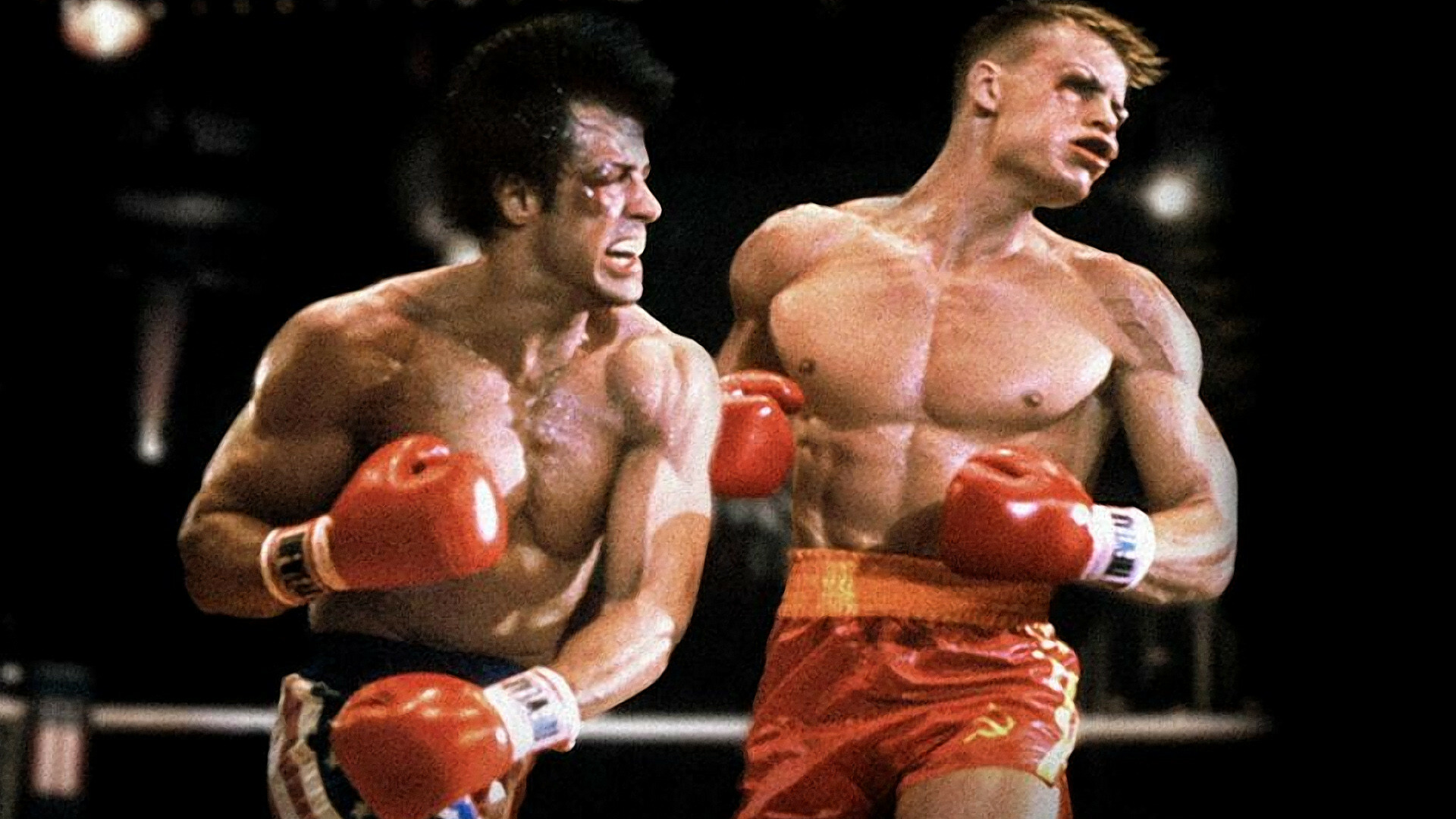
“Rocky IV” is where it gets very interesting, as there are two cuts of the film featured here on one disc. There is the original “Rocky IV” theatrical cut and also “Rocky IV: Rocky vs. Drago,” which is the ultimate director’s cut. This time, Rocky finds himself having to fight his biggest opponent yet in Ivan Drago (Dolph Lundgren), who is a foot taller and thirteen years younger than him. He also must train in Russia as the fight will be taking place there on Christmas Day. Rocky will not only train like he never has before, but he will have to win in enemy territory against “The Russian,” as he’s referred to many times throughout the course of the film.
I didn’t want to give four full-length reviews for these films, as I imagine almost anyone reading this has seen and knows them fairly well, much like myself. If I were to give my ranking of the films featured in this set, I would go with the original “Rocky” as the best, “Rocky II” as the second best, “Rocky IV: Rocky vs. Drago” as the third best, and “Rocky III” as the fourth best. I would really advise you to check out the ultimate director’s cut of “Rocky IV” over the theatrical cut. It’s only two minutes longer, but the film is more serious, intense, and flows in a much more effective manner. It’s all in the tone of the film, and I loved the tone of the ultimate director’s cut. It really gave me a new appreciation for the fourth “Rocky” film.
As soon as this set arrived, it only took me two days to go through all four films. It was truly a treat to revisit them. I understand why they released these four films in a set together. It makes sense after watching them. You can also buy them as standalone steelbooks at your local Best Buy, but I believe they have different release dates. This set is out right now and while it is far from perfect, I’ll explain why later, if you are a “Rocky” fan, you have to buy this set for your collection. The original “Rocky” will always be a great, great piece of cinematic history. The second film is very, very good as well. The third one is good, but not great. “Rocky IV: Rocky vs. Drago” is also much improved with the ultimate director’s cut.
4K Info: “Rocky: The Knockout Collection” is released on 4K from Warner Brothers Home Entertainment. This set features five discs. The first three films are on their own individual discs and “Rocky IV” has the theatrical cut and the ultimate director’s cut on it. There is also a Blu-ray disc of special features. The set also comes with a digital code to have all of them in your digital library on 4K. “Rocky” has a running time of 119 minutes, “Rocky II” has a running time of 120 minutes, “Rocky III” has a running time of 100 minutes, and “Rocky IV” has a running time of 91 minutes (theatrical cut) and 93 minutes (ultimate director’s cut). All the films are rated PG. The set comes in a flipper case with a thick cardboard slipcover, so the discs are not stacked on top of each other and can be flipped through with their own slot. On one hand, I would have loved it if they released these films in four separate cases with slipcovers in a box set. However, for space reasons, this set works for me as it’s easy to put on the shelf with all four films together on five discs (including the Blu-ray special features disc) in a single set which isn’t much bigger than your average 4K film with a slipcover. All of the films come with Dolby Vision as well, which I was VERY happy with as a 4K collector.
Video Info: Let’s talk about the look of these films. The original “Rocky” is probably the worst looking film out of the bunch. I say this because of the age of the film and its low budget. It doesn’t look awful or terrible, but I don’t think it’s ever going to be a film that looks spectacular or blows you away. There is noticeable grain here, but in many ways, it adds to the gritty nature of the original film. That being said, if you are looking for a major upgrade with the first film on 4K, you probably are going to be disappointed. “Rocky II” looks very, very good. It’s a clean transfer which is smooth looking and crystal clear. The boxing scenes, in particular, look the best I’ve ever seen them look. This is when you can see the Dolby Vision and the HDR really, really stand out. This is a major upgrade. For “Rocky III,” the transfer is above average. It’s better than “Rocky,” but it’s not as good as “Rocky II.” There was noticeable grain, but it didn’t have the same old-school charm as the original look of the film. The best-looking film out of the bunch, far and away, is “Rocky IV.” I wish the majority of the films looked like this. This counts for both the ultimate director’s cut and the theatrical cut. You can see everything on their faces, and they really cleaned up this film. It looks beautiful and modern.
Audio Info: The following audio formats were used: English DTS-HD 5.1 Master Audio, English/Spanish/French Dolby Digital, and 2.0 Dolby Digital with subtitles in English, French, and Spanish. I’ve read from a lot of people online that are unhappy with how the films sound. Personally, I don’t think the audio issues are as bad as advertised, and the problems don’t take away from the viewing experience. At times, the films can fluctuate in audio, but the dips are not that frequent. They are here and there throughout the four films. Truth be told, I would not have ever noticed these issues unless they were pointed out to me. Overall, though, I think it’s much to do about nothing.
Special Features:
“Rocky” 4K Special Features:
Audio Commentary featuring Sylvester Stallone.
Audio Commentary featuring John G. Avildsen, Irvin Winkler, Robert Chartoff, Talia Shire, Carl Weathers, Burt Young, and Garrett Brown.
Audio Commentary featuring Lou Duva and Bert Sugar
Bonus Features Disc:
The Making of Rocky vs Drago: Keep Punching
8mm Home Movies of Rocky
3 Rounds with Lou Duva
Steadicam: Then and Now
Staccato: A Composer’s Notebook
The Ring of Truth
Tribute to Burgess Meredith
Stallone Meets Rocky
Trailers
* * * ½ out of * * * *
Should You Buy It?
This set was delayed in getting to me as it had a street date of February 28th, and I imagine a lot of that had to do with people complaining about the audio issues. I’m not a film snob by any means, but I am very particular about the audio and visual quality of 4K releases, as I’ve invested heavily into the 4K format. With all that being said, the pros outweigh the cons. Yes, not all of the films look great, but this is the best they have ever looked, with “Rocky II” and “Rocky IV,” in particular, looking fantastic. Yes, the audio is problematic at times, but it’s not so noticeable that it impacted my ability to hear the films or enjoy them. Right now, the set is going for about $53 plus tax, and I think for four films in 4K that are hugely popular, it’s a good value for the price. I would say this set is imperfectly perfect, as I enjoyed watching the films and the quality of them when they were flying on all cylinders. For film fans or Rocky fans, I think there is A LOT more to like than dislike with this collection. You can buy this set with confidence and try to ignore all of those folks out there who are analyzing every little detail to death. I think people are getting way too particular with 4K films, and this is coming from someone with high standards. The key is watching and enjoying the films with quality video and audio, and I felt I was able to do that more often than not. As far as the films themselves, many would argue these are the best films in the franchise, so it’s fine that “Rocky V” and “Rocky Balboa” are not included. “Rocky Balboa” is enjoyable nostalgia, and I imagine it will get a proper 4K release along with “Rocky V” at some point. As I often bring up, the special features are old special features. It’s hard to get people to sit down and do special features anymore, I feel like. At the end of the day, buy this set and enjoy it!
**Disclaimer** I received a copy of this film from Warner Brothers to review for free. The opinions and statements in the review are mine and mine alone.
The following review was written by Ultimate Rabbit Correspondent, Tony Farinella.
“The Return of The Living Dead” was released the same year I was born, 1985. Even thirty-seven years later, it is clear to see the impact the film had on horror movies, specifically zombie movies. It was a film which was truly ahead of its time. I remember watching and enjoying the Scream Factory Blu-ray when it was released many years ago, and I enjoyed it even more on 4K Ultra HD. The blood, the gore and the colors really are vibrant and stunning on this release. This is a tremendous release from Scream Factory, and it is being released just in time for the Halloween season. It’s a perfect addition to your 4K horror film collection.
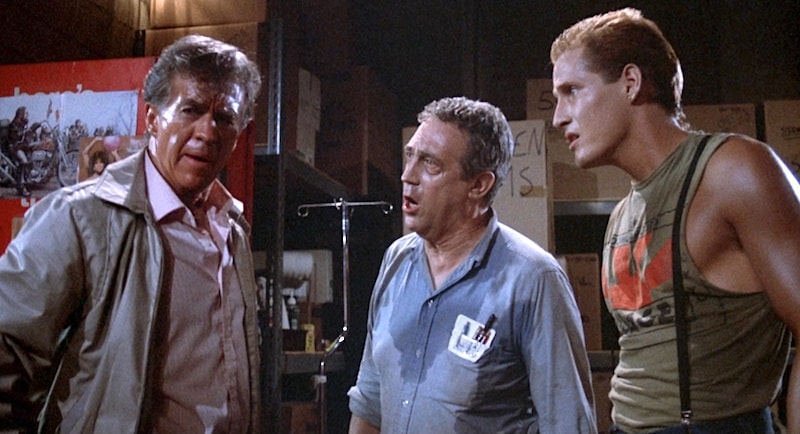
The film is just as funny as it is gory, which is truly saying something. This is not a simple task to pull off, as sometimes zombie films have a hard time with that balancing act. “The Return of the Living Dead” opens up by introducing us to two lovable but goofy factory workers named Freddy (Thom Mathews) and Frank (James Karen), as they work together at the aptly named Uneeda medical supply warehouse. Frank is hoping to look cool in front of Freddy by showing him some of the dead zombie bodies they have lying around the warehouse. According to Frank, the filmmakers behind “Night of the Living Dead” were ordered by government officials to change certain aspects of the film in order to hide from the public that zombies are indeed real and were used for military purposes. Unfortunately for them, when toxic gas is released from one of the meat lockers, the zombies start to rise from the dead.
The only thing that will take away the pain of the zombies is eating brains. These zombies really love brains, and they move a lot quicker than zombies we have seen in previous films. Also, if you take off their head, the rest of the body is still mobile and able to attack. The only way to truly kill these zombies is to burn them completely. Before long, there are hundreds of zombies, and the police and the medics can’t keep up with them. Burt (the late Clu Gulager) is trying to navigate this situation as best as he can, but he’s also looking to save the good name of his company and not let the public know that two of his workers are responsible for this mess.
Freddy is part of a punk rock gang that likes to raise hell, listen to music and have a good time with sex, drugs, and rock n’ roll. Freddy’s gang is looking to help him, but they are also finding themselves in over their heads with all these zombies coming for them left and right. Freddy has a girlfriend named Tina along with some friends named Spider, Trash, Chuck, Casey, Scuz and Suicide. Meanwhile, Burt looks to his friend, Ernie (Don Calfa), for help in disposing of the cadaver zombie that was released thanks to his co-workers. Ernie wants to be helpful, but this is above his pay grade as a mortician. Even though burning a zombie can kill it, it can also lead to toxic rain falling from the sky. This creates even more problems as it burns the skin and also brings more zombies to life from their graves.
This is one of many great things about “The Return of the Living Dead.” There is nothing about the film which is cut and dry. There might be a solution around the corner, as mentioned, but it doesn’t come without casualties or consequences. You also tend to feel a little bit of sympathy for these zombies, especially when you notice that Freddy and Frank are starting to become zombies. They don’t want to eat brains, but it is the only thing that will stop their suffering and pain. The zombies are also beautifully designed and look fantastic on screen. Sometimes they pop up out of nowhere, and sometimes they come in large packs that move really, really fast. These are complex and interesting zombies. These are not your average, run-of-the-mill zombies, and this is a big reason why this film has had such staying power.
“The Return of the Living Dead” also has a ton of quotable lines and quirky characters. I don’t think I can keep a straight face when I hear the line, “It’s not a bad question, Burt.” Every time I watch this film, I gain a new appreciation for it. In my eyes, it is the perfect zombie film. If I had to choose only one tiny issue with this film, and it is a minor one, it is the fact it ends rather abruptly. Besides this little picadillo, this is my favorite zombie movie of all time. Of course, I respect “Dawn of the Dead” and “Night of the Living Dead,” but from a pure entertainment standpoint and for the rewatch factor, “The Return of the Living Dead” is simply horror movie heaven for yours truly. It is the film which keeps on giving with its gore comedy, and quirky cast of characters.
* * * * out of * * * *
4K/Blu-ray Info: “The Return of the Living Dead” is released on a 3-disc 4K and Blu-ray combo pack from Scream Factory. One disc is the 4K of the film, another disc is the Blu-ray, and the third disc includes the special features on a Blu-ray disc.
4K Video/Audio Info: We are treated to this film on an absolutely stunning 4K Dolby Digital HDR transfer. As soon as the film started, I was sucked into how beautiful and bright it looked on my television. They have done a brand-new 4K scan of the original camera negative, and it makes it one of the best-looking horror 4K’s of the year. The bloody reds are a thing to behold, and the darks are also spot-on with this transfer. Scream Factory has been on a roll lately. The audio track on the film is DTS-HD Master Audio 5.1, 2.0 with English subtitles. I thought the audio was perfect, especially during the scenes involving some of the punk rock music. I didn’t have to adjust my volume on this film at all. I was able to keep it at the same volume throughout the entire film.
Special Features:
DISC 1 – (Feature Film – 4K UHD)
· NEW 2022 4K Scan of The Original Camera Negative
· In Dolby Vision (HDR 10 Compatible)
· DTS-HD Master Audio 5.1, 2.0
· Audio Commentary with Gary Smart (Co-author of “The Complete History of The Return of The Living Dead”) And Chris Griffiths
· Audio Commentary with Actors Thom Mathews, John Philbin and Make-up Effects Artist Tony Gardner
· Audio Commentary with Director Dan O’Bannon and Production Designer William Stout
· Audio Commentary with The Cast and Crew Featuring Production Designer William Stout and Actors Don Calfa, Linnea Quigley, Brian Peck, Beverly Randolph and Allan Trautman
· Zombie Subtitles
· In Their Words – The Zombies Speak
DISC 2 – (Feature Film – Blu-ray)
· 2022 4K Scan of The Original Camera Negative
· DTS-HD Master Audio 5.1, 2.0
· Audio Commentary with Gary Smart (Co-author of “The Complete History of The Return of The Living Dead”) and Chris Griffiths
· Audio Commentary with Actors Thom Mathews, John Philbin and Make-up Effects Artist Tony Gardner
· Audio Commentary with Director Dan O’Bannon and Production Designer William Stout
· Audio Commentary with the cast and crew Featuring Production Designer William Stout and actors Don Calfa, Linnea Quigley, Brian Peck, Beverly Randolph and Allan Trautman
· The Decade of Darkness – Featurette On ’80s Horror Films
· Theatrical Trailers
· TV Spots
· Still Gallery – Posters, Lobby Cards, Movie Stills and Behind-The-Scenes Photos
· Still Gallery – Behind-The-Scenes Photos from Special Make-up Effects Artist Kenny Myers’ Personal Collection
DISC 3 – (Special Features – Blu-ray)
· “The Return of The Living Dead” Workprint – Includes 20 minutes of additional footage (in standard definition)
· More Brains: A Return to The Living Dead – The Definitive Documentary on “The Return of the Living Dead.”
· The FX of “The Return of the Living Dead” – with Production Designer William Stout, FX Make-up Artists William Munns, Tony Gardner, Kenny Myers and Craig Caton-Largnet, Visual Effects Artists Bret Mixon and Gene Warren Jr. and actor Brian Peck (Expanded Version)
· Party Time: The Music of “The Return of The Living Dead” – with Music Consultants Budd Carr and Steve Pross and soundtrack artists plus musicians (Expanded Version)
· The Origins of The Living Dead – An Interview with John A. Russo
· “The Return of The Living Dead:” The Dead Have Risen – Interviews with cast members Clu Gulager, James Karen, Don Calfa, Brian Peck, Thom Mathews, Beverly Randolph, Linnea Quigley and More…
· Designing The Dead – Interviews with Writer/Director Dan O’Bannon and Production Designer William Stout
· HORROR’S HALLOWED GROUNDS – Revisiting the locations of this film
· A Conversation with Dan O’Bannon – His final interview
Should You Buy It?
Do you have a perfect zombie movie? Check. Do you have an outstanding 4K picture transfer? Check. Do you have a boat load of special features? Check. This film is a day one purchase without any hesitation whatsoever. It comes out on October 18, and it is a great horror movie to watch during the spooky season of 2022. If you haven’t already, you should pre-order this film from Scream Factory. I promise you that you won’t be disappointed. I can’t say enough glowing things about this movie or its 4K transfer. When you factor in how rewatchable this film is (it only runs at 91 minutes), it’s the kind of film that is going to bring something new to the table for viewers each and every time. It’s a ton of fun, gory, well-acted, cheesy in a good way, and it truly had something new to offer to the horror genre. If you have seen this film before, you have probably already pre-ordered it and can’t wait to watch it again on 4K. If you haven’t seen it before, you are in for a big surprise when you watch this movie. Once again, “The Return of the Living Dead” gets a top recommendation from yours truly.
I pride myself on having a vast knowledge of movies. While my many of my friends stumble across a movie they don’t recognize, I am usually quick to name it even if I have never watched it before. Everyone is amazed at how I could know such things. Still, when it comes to older movies and the great filmmakers who ever lived, there are still many I need to catch up on.
One of those filmmakers I really need to catch up on is Akira Kurosawa who is considered by many to one of the greatest of all time. Until I saw “Ran,”, the only movie of his I had previously watched was “The Seven Samurai” which really is one of greatest movies ever made. Of course, I got exposed to the American remake, “The Magnificent Seven,” beforehand, but anyway.
“Ran” was the very last movie Kurosawa made on such an epic scale, and as amazing as it looked when it was first released, this is even more the case more than 30 years later. Kurosawa clearly had the power to request literally thousands of extras, and it is easy to see well-dressed studio executives looking at him to where, had he made this movie today, would have asked him:
“Can’t you just add all these people in with CGI? Wouldn’t it be easier and cheaper just to hire like 50 guys instead of 1200?”
If they didn’t ask them that, they would obviously come up with the obvious solution:
“We’ll solve it in post!”
Looking at the title and scenes from the movie trailer, I figured the title “Ran” meant the main characters were running from certain doom throughout like it was a big chase. This should show you what I know about the Japanese language, and that is not much. “Ran” actually means “revolt” or “chaos,” and Kurosawa’s movie is filled with so much of both to where this is ends up being a cinematic experience both physically and emotionally draining.
Kurosawa based the story on the legends of the daimyo Mori Motonari and of how he had three sons who were intensely loyal to him. This led him to look at the story a little differently and say the following:
“When I read that three arrows together are invincible, that’s not true. I started doubting, and that’s when I started thinking: the house was prosperous and the sons were courageous. What if this fascinating man had bad sons?”
Of course, anyone familiar with William Shakespeare will say that “Ran” is heavily influenced by the tragedy of “King Lear.” Indeed, the story very much resembles that of “King Lear” as we watch a powerful leader abdicate his throne, and he ends up being betrayed by his own blood in the process.
The powerful leader at the center of “Ran” is Hidetora, leader of the Ichimonji clan. The story starts with Hidetora abdicating his throne to his three sons Taro, Jiro, and Saburo. The majority of the power is given to Taro who is his eldest son, and Jiro and Saburo are ordered by their father to support him no matter what. Saburo, however, does not agree with Hidetora’s decision to disperse all of his powers, reminding him how his kingdom came about through his own treachery and massacre of others. Hidetora starts acting all uppity as if he’s a superstar celebrity who is not used to hearing the word “no” much, and he banishes Saburo from the clan as well as his servant Tango who speaks in Saburo’s defense. It’s amazing what breaking three arrows together can do to a man’s ego.
From there, it is a vicious downfall for Hidetora as he is banished from his kingdom ever so coldly. Many characters here profess to believe in a god, be it Buddha or someone else, and they pray for their assistance in this little world which is quickly collapsing. If there is a god watching over them, he, or she, is blind to their sufferings or deaf to their endless prayers. Hence, this is quite a bleak movie from a thematic and visual standpoint.
After watching “Ran,” I was compelled to learn more about it. While researching the movie more deeply, It turns out “King Lear” never really entered Kurosawa’s mind until he was deep into pre-production. Along the way, he did incorporate different elements of the play into it, and he had this to say about Shakespeare’s classic tragedy:
“What has always troubled me about ‘King Lear’ is that Shakespeare gives his characters no past. … In Ran, I have tried to give Lear a history.”
Now this is what gives Hidetora, among others characters, such gravity throughout the nearly three-hour running time. He was not a leader who earned his kingdom through family succession, but through the pillaging of villages and murdering those who were against them. Perhaps he would like to forget this, but his power and family are forever stained by his deeds, and he is reminded of this in the most painful of ways.
With this in mind, it is no wonder two of Hidetora’s three sons end up turning against him. What his legacy has taught them is you can’t get anywhere in life without beating the crap out of the other guy and stealing everything he and his followers have. Only Saburo is fearless and selfless in telling him this and of pointing out the fact he will always be seen as a killer. Saburo at least cares enough to tell him this instead of just sucking up to him like his brothers do. Some people hear the word “yes” once too often when they need some others say “no” every once in a while.
As we see Hidetora losing his mind and in a state of disbelief, I was reminded of Will Munny, Clint Eastwood character from “Unforgiven.” Both these characters become sick, and in their feverish state they become haunted by the lives they ended ever so coldly. They have tried to convince themselves they are not the same people they once were, and Hidetora appears to develop amnesia in an effort to block his mind of his past deeds. But nightmares abound in his sleep reminding him of the price he has yet to pay. You could even compare this character to Anakin Skywalker who becomes the very thing he fought against in “Star Wars Episode III: Revenge of the Sith.” In the process of trying to prevent the love of his life from dying, he gives up everything he believes in. Hidetora believes that by passing the leadership duties to his oldest son his clan will continue to prosper. The more we fear of something bad happening, the more likely that bad thing will happen.
Taking this into account makes me realize one of the most important elements in the Kurosawa movies I have seen; they are very dependent on the depth of their characters as much as they are on spectacle. Granted, this is only the second movie of his I have seen, but it feels like just enough to understand why his cinematic works made such a strong impression on Steven Spielberg and George Lucas (“The Hidden Fortress” is said to have been a huge influence on “Star Wars”). Most movies today are just about spectacle, and the characters are usually a distant second to it. But it is this focus on character which makes “Ran” so involving and gives its epic scope much more meaning.
But let’s talk about the spectacle of “Ran” which is incredible to say the least. One of the key sequences is the horrific massacre which takes place at the third castle where Hidetora takes refuge. What really struck me was how Kurosawa put Tōru Takemitsu’s music score over the sounds of violence perpetrated by his sons as it gives what is being presented to us with far more emotional power. Takemitsu’s music further illustrates the immense tragedy tearing this powerful clan apart which leaves Hidetora in an endless state of shock. Without the music, it would still be a cinematic high mark of capturing battle on celluloid, but it would not have the same effect.
The bloodbath of the massacre is made all the more vivid by Kurosawa as “Ran” was made long before the advent of CGI effects. With this sequence, Kurosawa brilliantly captures the ugliness and viciousness of war, and of the cruel nature which dominates these characters’ humanity.
All the acting is nothing short of excellent from as the entire cast invests each of their characters with various complexities which allow them to surprise us in unexpected ways. Hidetora is played by Tatsuya Nakadai, and he immerses himself completely into playing a man whose own pride and self-righteousness proves to be his undoing. Without saying a word in the last half of the massacre, Hidetora communicates his utter regret of his thoughtless decision making which has led to the decimation of what he once had. Nakadai makes Hidetora’s eventual descent into madness all the more vivid, and his performance never ever descends into camp.
I also loved Mieko Harada’s performance as Lady Kaede, Kurosawa’s version of Lady Macbeth. Through her deceitful ways, viciousness and endless manipulation, she always seems to get her way and turn the men around her into quivering jelly. Harada’s moments onscreen are among my favorites as she exploits the fears of the men around her and seduces them despite their mistrust of her. Never let it be said that Kurosawa ever writes weak roles for women because it certainly isn’t the case here. Lady Kaede wants to maintain her high status in the clan, and she is ruthless in how she pursues it.
You could say they don’t make movies like “Ran” anymore, but it did come out in a time when they weren’t being made much. For many, it serves as the culmination of all his talents, of what he has accomplished in his career, and of all the struggle and tears he shed while making this movie. During the making of “Ran,” Kurosawa’s wife passed away. By the time he got around to shooting the movie after working on the script for ten years, he was almost completely blind. Regardless of these setbacks, nothing stopped him from making this movie.
Years after its release, “Ran” stands as one of the classic movies from one of the best filmmakers ever. No one can or should doubt the heart and soul Kurosawa put into it for years and years, and getting to see it on the silver screen was a real treat. When all is said and done, the silver screen is where this movie belongs.
I have always had mixed feelings about “Rocky IV.” On one hand, it is a well-oiled machine which is entertaining, never drags, and you easily find yourself caught up in the action to where you join in with the audience chanting, “ROCKY! ROCKY! ROCKY!” On the other hand, it turned Sylvester Stallone’s iconic character of Rocky Balboa into a superhuman comic book character who has clearly spent far too many hours at the gym to develop his well-chiseled body. This character was a relatable human being who wanted to go the distance, and now he was being rendered as some untouchable force of nature who undergoes the most brutal training regime which no mere mortal can easily endure. Basically, I found this installment of the seemingly endless franchise lacking in humanity, and it would take 2006’s “Rocky Balboa” to bring the character back down to earth.
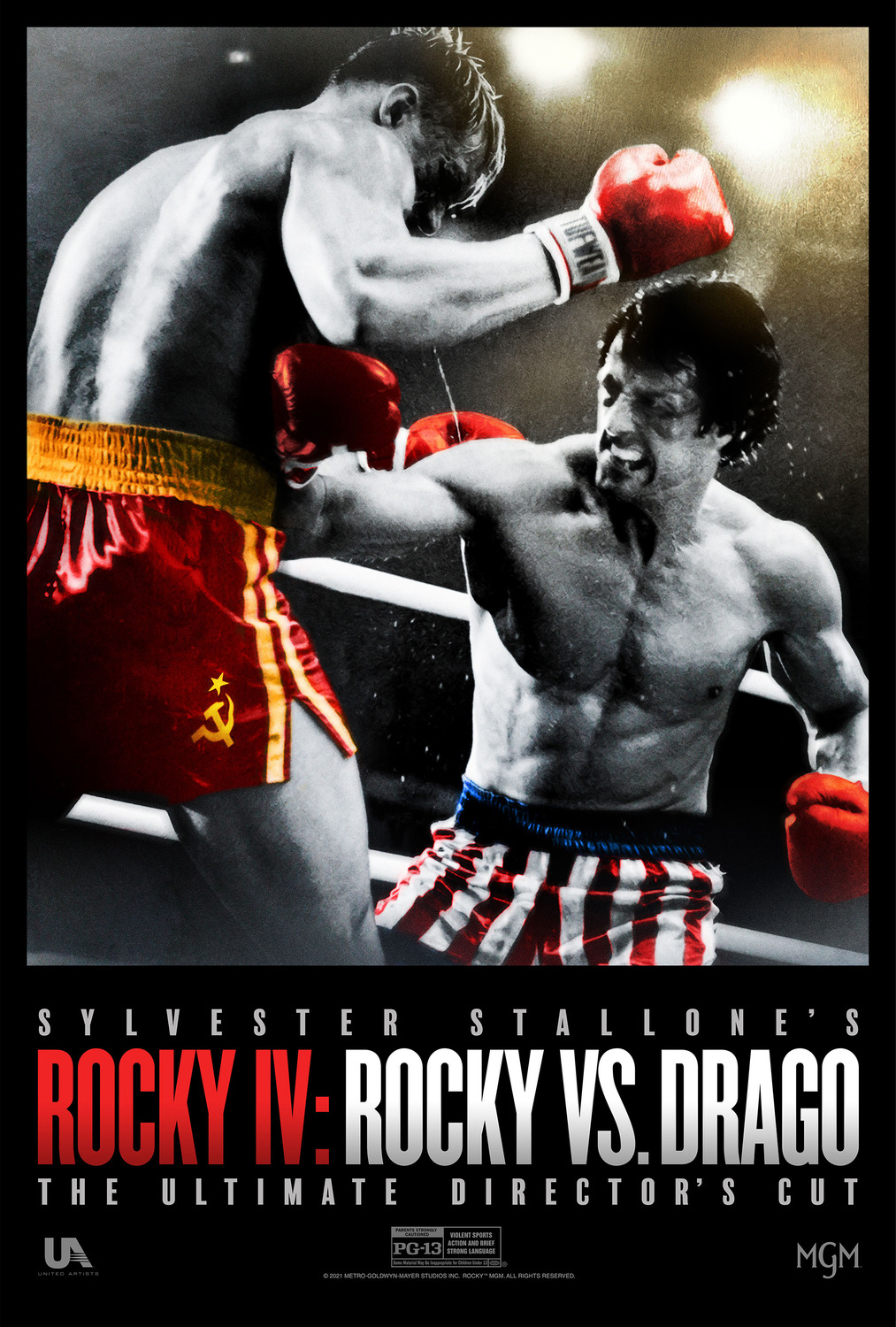
Well, it turns out Stallone felt the same way about “Rocky IV,” and thanks to this time of the COVID-19 pandemic which saw one of his projects get shut down, he decided to revisit this particular “Rocky” sequel which is still this franchise’s most financially successful as even he found it to be flawed. What resulted is his director’s cut entitled “Rocky IV: Rocky vs Drago,” and it has the humanity which was once missing, but now has been found.
The story of “Rocky IV” remains the same. Apollo faces off against Russian boxer Ivan Drago (Dolph Lundgren) and pays with his life, and Rocky travels to the Soviet Union to face off against Drago on Christmas Day. Does Rocky win the fight? Bitch, please, you know the answer to that.
Unlike Francis Ford Coppola’s recent director’s cuts of “The Cotton Club,” “Apocalypse Now” and “The Godfather Part III,” not much about “Rocky IV” has changed here. But again, the characters are fleshed out more here than they were previously, and this made for a more fulfilling cinematic experience for me, and that’s even if the pace drags at times. And yes, Paulie’s robot has been rendered obsolete in this cut. Suffice to say, that robot was no C-3PO and will not be missed.
After a look back at “Rocky III,” this cut starts off with Apollo Creed (Carl Weathers) in his luxurious swimming pool playing with his dogs when Drago and his entourage appear on his television set. This helps change the narrative a bit as we quickly see how this cut is more about Apollo as it shows the character as being restless in his retirement, and it becomes clearer to us how he wants to still matter in a world which may prefer to see him remain retired.
Indeed, Rocky thinks it is time, not just for Apollo, but for him to think about what else they can do with their lives as both have seemingly hit their athletic peak. But in Weathers’ eyes, you can see how desperate he is to remain relevant in the minds of many. It is not just Apollo’s ego crying out for acknowledgement, but also for a need to remain relevant and not easily forgotten. Watching Weathers’ performance here, I can see why Stallone regretted killing Apollo off. Of course, this did lead to the brilliant “Creed.”
Another actor who stands out here is Talia Shire who again takes on one of her most famous roles, Adrian Balboa. When you take the inevitable flashbacks into account, it is fascinating to watch Shire take Adrian from being a shy girl to becoming Rocky’s much-needed conscience as she exerts a confidence which has long since been earned. Indeed, this cut reminds us what a strong anchor she is to Rocky. She is the voice he needs to hear, and that’s even when she yells at him, “You can’t win!” Whereas she appeared quite meek in “Rocky,” she is a force to be reckoned with this time out.
And then there is the late Tony Burton who returns as boxing trainer Tony “Duke” Evans. His character really gets fleshed out a lot here as Tony gives a moving tribute to Apollo, and Burton later shares a thoughtful and moving scene with Stallone where he makes clear with his eyes that Rocky will be the last one standing. Stallone was right; Burton’s eyes were full of soul.
With the Sico the Robot gone, and the chance for Robert Doornick to earn residuals, what else is different about this “Rocky IV” cut? Well, Brigette Nielsen’s role Ludmilla Drago is pared down quite a bit to where her husband gets to talk for himself a bit more. In fact, the late great character actor Michael Pataki gets to speak more for the Russians as Nicolai Koloff this time around, and his wounded face at the movie’s end speaks volumes.
And because of the robot elimination, we see less of Burt Young’s Paulie here to where he is almost forgotten about in the first half. But Paulie does eventually make his cantankerous presence known as he flails around in the snow once in Russia, and his moving tribute to Rocky before he enters the ring is still quite touching. Of course, once Drago pushes Rocky’s gloves down, Paulie takes back what he said. It is very understandable why Stallone did not cut this scene out.
If there is anything I was hoping for in this “Rocky IV” director’s cut, it was to see Ivan Drago humanized a bit more. Part of this is because, during an interview Stallone did with TCM’s Ben Mankiewicz, he talked about Drago’s harsh origins and how he grew up in the gulag which he eventually escaped. This was very interesting to hear, but we do not see any of this onscreen. While presented as slightly more human, Drago is still portrayed as an invulnerable beast of a man. There isn’t much more to this character than that.
Other than that, it’s nice to see a lot of the cheesiness of the theatrical cut gone. Then again, the line of dialogue when Rocky tells Adrian to never ask him “to stop being a man” does land with as loud a thud as when Luke Skywalker begged his Uncle Owen to let him go into town to get some power converters in “Star Wars.” And no, I still don’t believe all the Russians would have began cheering for Rocky after booing him so viciously as he entered the ring. Sure, some would have started cheering him, but not all.
“Rocky IV: Rocky vs Drago” is not a perfect movie, but I consider it a vast improvement over the original version. Around the time this sequel was released 35 years ago (I know, that freaks me out too), Rocky and the franchise was turning into a joke as we had been down this path one too many times it felt. Weird Al Yankovic spoofed Survivor’s “Eye of the Tiger” and called it “The Theme from Rocky XIII” in which Rocky bought the neighborhood deli, “Airplane II: The Sequel” featured a poster of a fictious “Rocky” sequel which showed the Italian Stallion fighting way past his prime, and who can forget this classic line of dialogue from “Spaceballs?”
“Coming up, Pongo’s review of Rocky Five… thousand.”
But to hear Sylvester Stallone talk about his director’s cut and having watched it myself, it is clear he did not simply want to just repeat the formula we had come accustomed to. Rocky Balboa rescued this actor, writer and director from a life of poverty where his dog ate more than he did, and it should be no surprise at how much he cares for this iconic character and the others surrounding him. Had this version of “Rocky IV” been released back in 1985, perhaps many of us would not have been so quick to start joking about the Italian Stallion.
After all these years, we are still clapping along to those songs by Survivor, and we still cheer on Rocky even though the conclusion is never in doubt. While I used to roll my eyes whenever Stallone wanted to revisit this franchise, I say let him do whatever the hell he wants. Except for another “Rambo,” movie, we don’t need it. The last one was awful.
The following review was written by Ultimate Rabbit correspondent Tony Farinella.
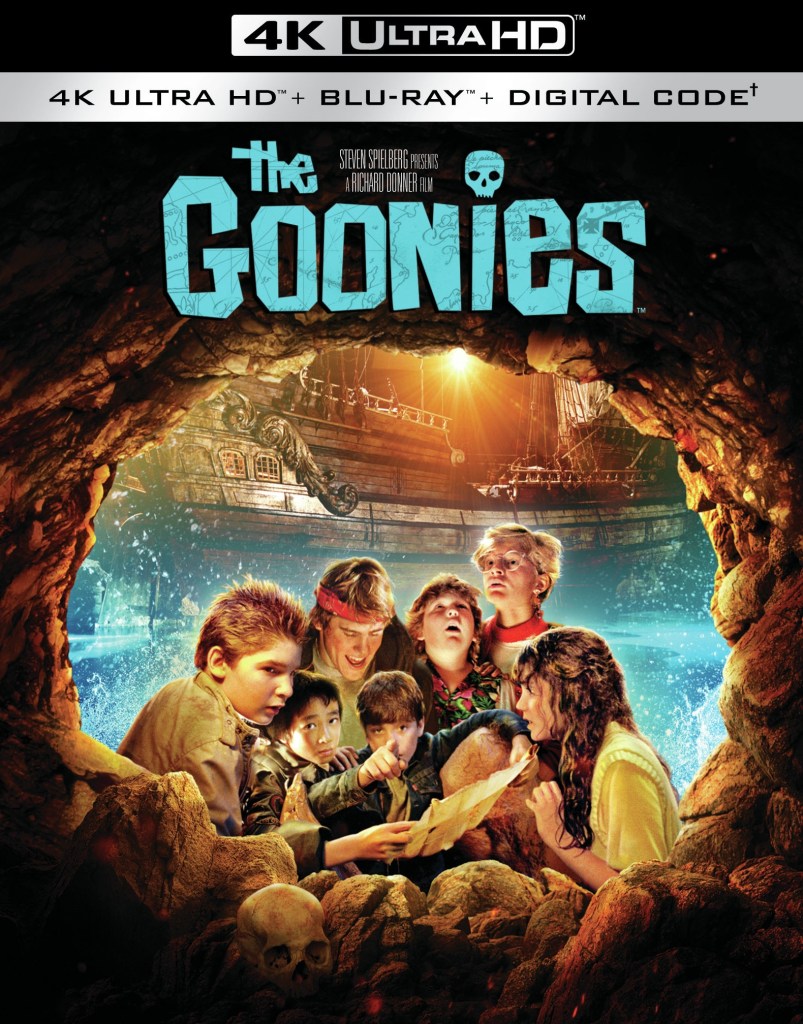
This was my first viewing, ever, of “The Goonies,” which might sound almost sacrilegious to film fans that love this flick and have watched it numerous times. To many, it is considered a classic film with quotable lines and loveable characters. I went into the film with high expectations, and I’m sad to report that I left extremely disappointed. The film is very dated, and it is full of sound and fury, signifying nothing. However, if you are a fan of the film and have been looking to an upgrade for a while, the 4K release from Warner Brothers Home Entertainment will certainly satisfy you. For those, like myself, who are new to the film, I don’t know if it will win over any new fans.
The film was directed by veteran Richard Donner from a story by Steven Spielberg and a screenplay by Chris Columbus. When you factor in a young cast which includes Josh Brolin, Sean Astin and Corey Feldman, all of the ingredients were there for an enjoyable film with a cast full of wacky characters. This is one of the major problems with the film—the characters. They are loud, screechy and supremely annoying. It is hard to get behind this rag-tag group of misfits in the same way you would get behind the Losers Club in “It” or the friends in “Stranger Things.” The film doesn’t waste time in getting right into the action, which ensures the character development is left with a lot to be desired.
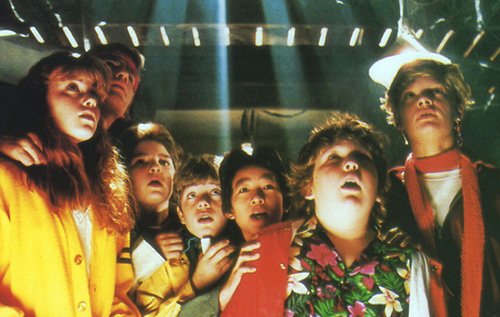
The premise of the film follows a group of friends known as The Goonies. They consist of Sean Astin as Mikey; his brother Brand, played by Josh Brolin; Jeff Cohen as Chunk; Corey Feldman as Mouth; Jonathan Ke Huy Quan as Data along with their female counterparts in Kerri Green as Andy and Martha Plimpton as Stef. Judging by some of their names, it doesn’t take a lot of imagination to piece together how they received their nicknames. They are about to lose their homes in the Goon Docks unless they can come up with some big money and fast.
This leads them on a treasure hunt to come up with a way to save their homes. Hot on their tails, however, is a crime family known as the Fratellis: Mama Fratelli (Anne Ramsey), Jake Fratelli (Robert Davi), and Francis Fratelli (Joe Pantoliano). They also have a deformed younger brother named Sloth (John Matuszak), whom is often neglected and mistreated by his family. They are also looking to get some of the treasures on the ship, which used to belong to “One-Eyed Willy,” the original Goonie.
While “The Goonies” is never boring, and Donner keeps the action moving at a rapid-fire pace, at almost two hours, it feels like sensory overload. As a viewer, I felt like I was on this never-ending mission that I didn’t really care about because I didn’t care for the characters. They are likable when they are not screaming, shrieking or being completely over-the-top. The film shines during the quieter and more tender moments. I was hoping the film would focus more on the friendships between the characters and the families. The families are basically non-existent and played for laughs as clueless parents, which was a major problem with many young children’s/teenage films in the 1980’s.
In the end, if you enjoyed “The Goonies” in the past and it is a film you are known to watch over and over again, you will surely watch it over and over again on 4K as it looks out of this world. If you are new to the film (in the minority like myself), I can’t really see you getting much out of this film as a first-time viewer. Even though it is a children’s movie, I wouldn’t recommend it for young children today based on some of the language and innuendo. While films and shows today owe a great deal of gratitude to “The Goonies,” it is very much a film of its era. I can’t say it holds up very well.
4K Info: “The Goonies” is released by Warner Brothers Home Entertainment on a 4K Ultra HD Combo Pack, which comes with the Blu-Ray and a digital code. The film has a running time of 114 minutes, and it comes in the following languages: English, Latin Spanish, Canadian French, and Brazilian Portuguese.
Video Info: The film comes on 2160 Ultra High Definition for the 4K Version. The Blu-Ray comes in 1080p High Definition.
Audio Info: The 4K Audio is DTS-HD MA: English 5.1 and Dolby Digital: French and Spanish. For the Blu-Ray, it comes with Dolby TrueHD: English 5.1, Dolby Digital: English 5.1, English 2.0, French and Spanish. Subtitles for both versions are in English, French, and Spanish.
Special Features:
Commentary (with Hidden Video Treasures) by Richard Donner and select cast members.
The Making of the Goonies Featurette
Cyndi Lauper “The Goonies ‘r’ Good Enough” Music Video
Outtakes
Theatrical Trailer
My goal with this review was not to be a contrarian, but I realize I’m probably one of the few people in the world who is not in love with “The Goonies.” As mentioned, it had everything, on paper, I was looking for in a film like this. All of the pieces just didn’t add up in the final product. It was tough to finish this one, as even though the action is wall-to-wall, I found myself checking out of the story because of a lack of interest in the people involved in the action. I’m glad to say I have seen it, so I can check it off my list of highly thought of films I need to see. However, I can’t recommend this one as a purchase unless you absolutely love the film. You will be thrilled with the transfer, the 4K look of the film, which is beautiful, and the astounding high dynamic range that comes with 4K releases. For everyone else, if you really want to see it, get it from your local library.









 The Ultimate Rabbit