Goodbye 100.3 FM The Sound, Dammit

1003 The Sound Banner

I honestly thought it was a joke when I first read the article on LAist.com, “100.3 The Sound to Be Replaced with Christian Music Station.” LOL. I mean, come on. Replacing the best classic rock radio station in Los Angeles with one which has one singer praising God and then another saying how much they love God and even another one speaking of how God got them through tough times? You know, a radio station with real variety. Aren’t there a couple of radio stations on the AM/FM radio dial with Christian music already? Do we really need another featuring songs indistinguishable from the others played before them?

Well, it turns out this is not a joke and, as I write this article, April Fool’s Day is not around the corner. In completing its merger with CBS Radio, the American broadcasting company Entercom has agreed to sell three of its radio stations, among which is 100.3 The Sound. The classic rock station is to be replaced by the Christian Contemporary station, K-LOVE and, according to Program Director, Dave Beasing, The Sound now has 30 days until their operations are shuttered. Now radio stations may come and go, but to learn this one is heading towards the annals of radio history has left me utterly infuriated and deeply depressed. Like many out there, I found The Sound and am not prepared to lose it.

Like everyone else, I grew up on FM radio with KISS-FM in Southern California (Rick Dees in the Morning!) and KFOG up in Northern California, but as the years went by, I grew continually restless with every single station I tuned in to as commercials and advertisements became more prevalent than actual music. I eventually gave up on radio for a time and became much more open to inserting a cassette into my car’s tape deck where I could get my music fix more easily and be spared from another advertisement for car insurance.

100.3 The Sound, however, was different. They would play a bunch of songs in a row, and they were the kind of songs which, even after listening to them hundreds of times, I could never get sick of. When the commercials came on, I never found myself eager to change the station as I eagerly anticipated which classic song Uncle Joe Benson, Rita Wilde, Cynthia Fox, Mary Price, Tony Scott, Tina Mica, Steve Hoffman, Mimi Chen, Andy Chanley or Gina Grad would end up spinning next. Did it matter which song they played? No, because I could always count on it being one which raise my spirits whenever I am stuck in a bumper-to-bumper traffic jam on any given Los Angeles freeway. Furthermore, listening to this station on a daily basis keeps making me forget 95.5 KLOS still exists, and this is quite a feat.

Of course, it became an obligation to turn the volume down whenever that blasted Kars 4 Kids jingle was played. So simplistic and annoying in design and yet so catchy at the same time, it has long since proven to be equivalent of the Silver Shamrock jingle from “Halloween III.”

It didn’t matter if they were playing Led Zeppelin, Styx, The Eagles, The Beatles or The Rolling Stones because 100.3 The Sound made you realize why classic rock became classic rock; you never got sick of listening to it. Songs like “Stairway to Heaven” and “Bohemian Rhapsody” never get old for me, ever. “Hotel California” still has relevance in this new millennium. Journey’s “Don’t Stop Believin’” still has us holding out hope even when times seem darker than ever. And while I may not have “Too Much Time on My Hands” like Tommy Shaw does, I always look forward to hearing it as much as another Styx song, “Mr. Roboto.”

That’s the thing about classic rock, it never ever gets old. It has heart and soul which today’s music seriously lacks. The artists of the here and now seem way too focused on generating the next big #1 hit to where they employ an obscene number of writers and producers on a single song in an effort to create something commercially viable, demographically friendly and inoffensive to the most sensitive of ears. Musicians from years past were never as concerned about making hit records as they were in creating music which spoke to them as much as it did to us. Even today’s generation has a great love for these bands to where their music’s power is undeniable. Taylor Swift may be the hit maker of today, but can you see “Shake it Off” or “…Ready for It?” having the lasting power of “Bohemian Rhapsody?” I think not.

Whenever I am driving people all around Southern California, they remark how the music playing on 100.3 The Sound makes them feel like they are in high school again. I feel the same way, and I went to high school back in the 1990’s! Sure, there are some passengers who instead want to hear the latest in hip hop which is fine, but more often than not, they dig listening to what this great radio station plays had on its playlist.

I love it when Andy Chanley breaks down a song to where you hear only the lead singer’s vocals or a particular guitar riff. I love Rita Wilde’s album side at 11, and she made me realize Journey’s “Frontiers” album was actually not a part of my record collection and needed to be. I love Uncle Joe Benson’s “10 at 10” as he was great at taking you back in time to a year which remains fresh in our minds, and his show “Off the Record” had him indulging in down to earth conversations with artists I always want to know more about. This station even managed to lure Mark Thompson back into the realm of morning radio, albeit for far too brief a time. Still, he had his “Cool Stories in Music” podcast which I always enjoyed listening to on a Sunday night.

100.3 The Sound also plays host to “Little Steven’s Underground Garage,” the guitarist and “Sopranos” actor’s radio show which showcases what he sees as the “coolest songs in the world.” Now this is what Vincent Vega would call “a bold statement,” but in Little Steven’s case, he is absolutely justified in making it. While he plays songs by The Rolling Stones and The Monkees, bands we know and love, he also includes the grooviest of tunes from Butch Walker, The Weeklings, Jeremy & The Harlequins, Fleshtones, and the Kurt Baker Combo. I have to say I don’t know these ones but feel like I should, but with his show, Little Steven has introduced them to a new generation of listeners. It is also further proof of how my rock and roll education is far from over as his song selections provide me with a gloriously rockin’ good time.

Plus, how many other radio stations have a show like “Your Turn?” This is where Sound listeners like you and me can spend an hour as a DJ (pre-recorded of course) and play our favorite tunes for devoted listeners to hear. Now this is a radio station which respects its fans like few others do. While many of them may not sound ready for prime time, it is always great fun to hear what songs they selected. I was hoping to get a chance to do it, and I do have experience as a radio DJ, but thanks to corporate greed, it is unlikely I will get the opportunity.

Well, all I can do now is enjoy the remaining days 100.3 The Sound is on the air as I feel uncertain there will be another radio station like it in the near future. I have no real desire to tune into a Christian music station. Granted, there are some great Christian singers out there (Vanessa Jourdan, you rock!), but being without The Sound on my FM radio dial will make it painful to even try to tune in to this channel.

A big thank you to everyone at 100.3 The Sound for all the great times and songs they have given me. You will be deeply missed.

WRITER’S NOTE: I am including the following song as it started playing in my head loudly after it set in that 100.3 The Sound is going away. It was released back in 1992, and I believe this makes it “classic rock.” After all, this station also plays the music of Pearl Jam.

See also:

If I Had Hosted ‘Your Turn’ on 100.3 The Sound
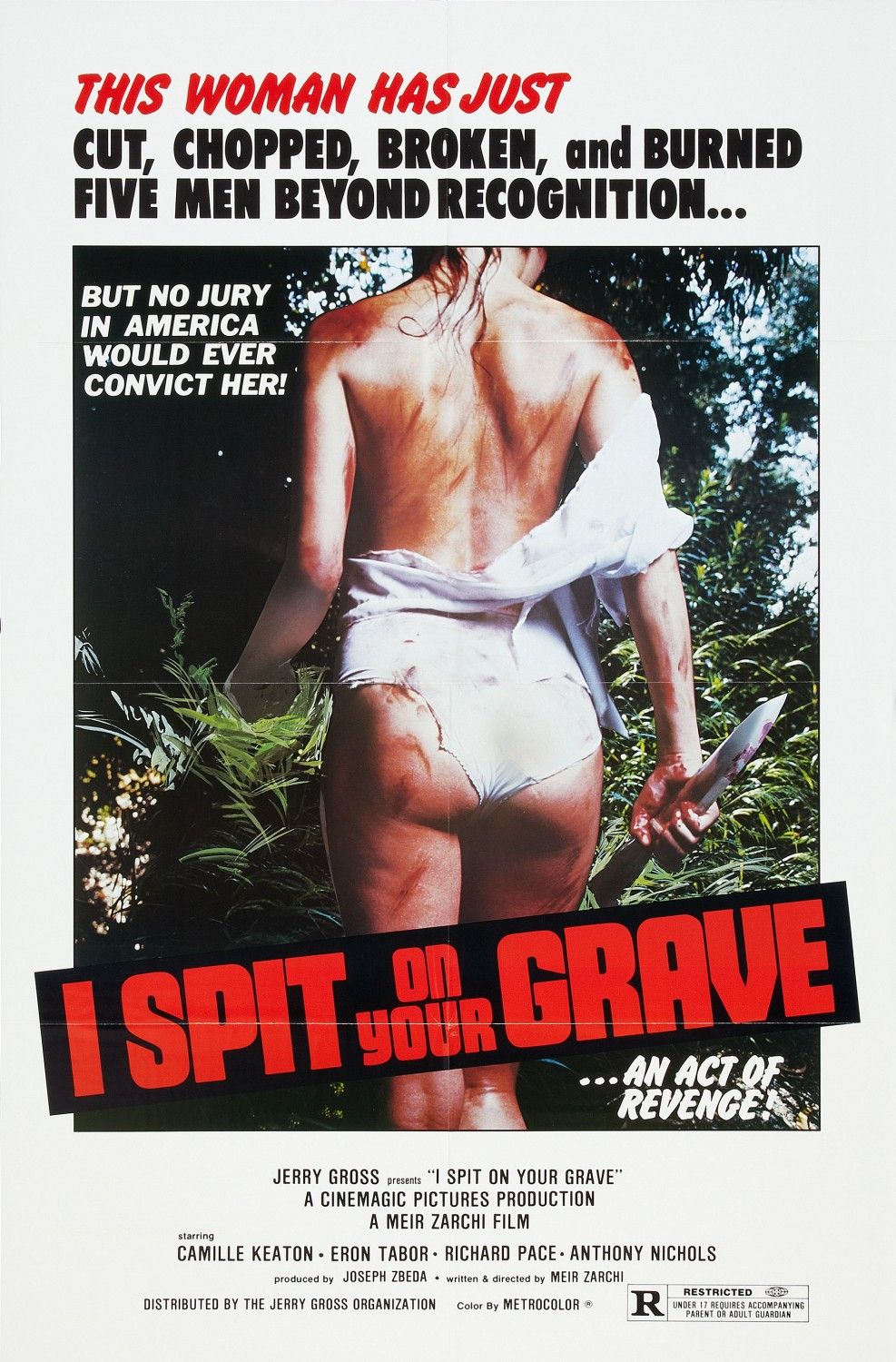
 

‘I Spit on Your Grave’ Remains an Infinitely Repulsive Motion Picture

I Spit On Your Grave 1978 poster

I should have known better than to sit through this infamous motion picture. Years ago, when I received my first Roger Ebert Home Movie companion as a Christmas present, I read his review in which he described this particular movie as a “vile piece of garbage” and that attending it was one of the most depressing experiences of his life. After I finished reading his review, I felt as though I had watched as he didn’t even warn his readers how his review contained spoilers, and it showed how serious he was about convincing us to avoid this exploitation film as he found it to have no redeeming value in the slightest.

Reading Ebert’s review of “I Spit on Your Grave” filled my head with images my young brain had no business thinking about at such a tender young age, but I probably would never have known about this movie were it not for his review. As the years went by, the thought of it remained strong in my consciousness to where I was compelled to find out more about it. Plus, it had a cool movie trailer I couldn’t help but watch multiple times. Then again, “Maximum Overdrive” also had a really cool trailer, and we all know how that one turned out. Curiosity may have killed the cat, but I am still alive, therefore I am no cat.

I Spit on Your Grave” is by far one of the most repulsive motion pictures I have ever allowed myself to sit through, and I have seen “The Human Centipede 3.” It tries to pass itself off as a feminist movie, but it instead proves to be a complete insult to feminism, and you don’t need to be a woman to realize this is the case. Even in the realm of exploitation movies, I could not divorce myself from the moral standards I was raised to believe in as they came into play here.

In case you don’t know the plot of “I Spit on Your Grave,” it follows Jennifer Hills (Camille Keaton) as she drives from Manhattan to an isolated cottage out in Connecticut in an effort to start writing her first novel. While there, she attracts the attention of three men and their mentally disabled friend, Matthew, who eventually abduct and brutally rape her for what seems like an eternity. Somehow, she survives and eventually turns the tables on her attackers in ways which will have men crossing their legs more often than not.

This is a motion picture I found myself skimming through more than watching as the rapes prove to be far too disturbing to endure. The sexual assault of Jennifer lasts for over half an hour, and just when you think it is over, it starts up again to where I wondered what writer and director Meir Zarchi was trying to prove. If he wanted to show how unforgivably brutal a crime rape is, he succeeded far more than he needed to.

For what it’s worth, I have to give Camille Keaton credit as she does make Jennifer’s suffering feel all too real to where she deserves a Purple Heart for her efforts. While the performances in “I Spit on Your Grave” are generally poor, Keaton doesn’t hide from the terrors her character is forced to experience in the most demeaning way possible. There is something to be said for her work even as this film proves to be every bit as deplorable as the violence perpetrated on her character.

At the same time, the major flaw of “I Spit on Your Grave” is how it revels in its heroine’s degradation more than in her revenge. In fact, Jennifer’s bloody vengeance on her attackers takes up less than half the time Zarchi spent on her multiple rapes, and there is something deeply wrong when you realize this. Jennifer comes to strangle, decapitate, castrate and disembowel those men who inflicted an infinite amount of cruelty on her, but we never feel her satisfaction as the morality of what she is doing never feels as justified as you would expect it to in any other exploitation film.

Another big problem with “I Spit on Your Grave” is that it is such an amateurishly made motion picture. The artistry behind the camera is seriously lacking to where the low budget cannot be blamed for this film’s shortcomings. There is no music score to speak of, and there is very little to no music throughout. As a result, the whole thing feels like a home movie which never should have seen the light of day.

The original title of “I Spit on Your Grave” was “Day of the Woman,” and this should show how intent Zarchi was on selling this as a feminist movie. But seriously, this is not what a feminist movie looks like in the slightest. While Jennifer is certainly entitled to her revenge, it doesn’t take away from the fact that what she does is just as bad, if not worse, than what those men did to her. This may be nothing more than a movie, but it is hard for me to escape this fact.

There are other movies which deal with rape in a far more probing and intelligent manner than “I Spit on Your Grave.” Among them are “The Accused” which stars Jodie Foster in her first Oscar-winning performance, and Gaspar Noe’s “Irreversible” which features a scene in which Monica Bellucci’s character is raped and beaten for 10 minutes straight and in a single shot. Even Wes Craven’s “The Last House on the Left,” a movie every bit as violent as this one, dealt with rape and revenge in a way which was as intelligent as any subject Craven dealt with in his career.

And yet after all these years, I find myself writing about “I Spit on Your Grave” as if it were a motion picture worthy of being celebrated. Many may see it as a film worth noticing, but I say it is one you must avoid even if you are open to movies which are psychologically damaging to sit through. It is also so poorly made to where you want to smack its most ardent fans in the face and ask them what they see in it. Some may defend its quality, but this will only make you wonder what the term quality actually means.

As I write this review, “I Spit on Your Grave” has long since been remade, and that remake has so far spawned two sequels. Also, it has just been announced that Zarchi completed a direct sequel to the original entitled “I Spit on Your Grave: Déjà vu” which will be released in 2018. All I can hope is that the sequel will show Zarchi as having learned more about filmmaking in the 40 years since he inflicted this infamous motion picture on us.

* out of * * * *

WRITER’S NOTE: I really wanted to give this film a ZERO STARS rating, but I cannot deny the credit Camille Keaton deserves for enduring what she did here.

‘Dead Man Down’ Reunites Niels Arden Oplev with his Lisbeth Salander

Dead Man Down movie poster

The tagline for “Dead Man Down” is “revenge is coming.” But while revenge is a big theme, it’s really about forgiveness. These characters have been forever wounded by a past which will not let them be, and they spend their time trying to avenge it in order to find some form of peace in their lives. What results is a movie which doesn’t break any new ground (few movies these days do anyway), but it is still a compelling one filled with complex characters and twists I didn’t see coming.

We meet Victor (Colin Farrell), the right-hand man to ruthless New York crime lord Alphonse Hoyt (Terrence Howard), and he defends his boss in a nasty firefight at the movie’s start. Quickly, we assume Victor is as loyal to Alphonse as any gangland player could ever be and that he will soon get a meteoric rise to the top of the criminal food chain. However, it turns out Victor is actually seeking revenge against Alphonse for killing his wife and child, and he is getting closer and closer to exacting his revenge.

But then Beatrice (Noomi Rapace), a woman who lives in an apartment across from Victor’s, enters the picture. Beatrice is still recovering emotionally from a nasty car accident which has left her face permanently scarred. While the scar hasn’t taken away all her beauty, it has destroyed her self-image and left her with a deep-seated rage she is desperate to be rid of.

After a dinner where the two of them make small talk and discover things they have in common, Beatrice makes her real intentions clear to Victor; she wants him to kill the drunk driver who plowed into her car and ruined her face. Moreover, she is willing to blackmail Victor into doing this as she has evidence of him killing another man. Knowing Victor is capable of taking a life, she gives him no choice but to take another. Both have strong motivations for vengeance, but can they tear themselves away from their rage long enough to see the damage they are doing to one another?

Right from the start, “Dead Man Down” is filled with twists and turns which makes this average revenge thriller all the more entertaining to sit through. Even if the twists aren’t entirely plausible, they keep us on the edge of our seats as we can only guess what will happen next. Just when you think you know where things are going, you don’t.

But what I really liked about this movie was how wonderfully complex the characters were. There is nothing black and white about them as everyone exists in a morally grey area. While Victor and Beatrice are clearly justified in having their revenge, we know the ways they are seeking it will do not make them good people. Even Alphonse comes across as much more than an average one-dimensional bad guy as he is someone who certainly wasn’t born evil. While certain characters may deserve some form of punishment over others, no one comes out of this story the least bit innocent.

“Dead Man Down” marks the first English language film from writer and director Niels Arden Oplev, the same man who gave us the original version of “The Girl with the Dragon Tattoo” as well as the recent remake of “Flatliners.” Now when filmmakers from a foreign country come over to America, their talents usually get compromised in the process. But Oplev doesn’t appear to have lost any of his skill here as he gives us a strong motion picture filled with fascinating characters. He also gets terrific performances from each of his actors as well as some strong visual moments such as a descent down the middle of a stairwell.

Colin Farrell has gone from doing needless remakes like “Fright Night” and “Total Recall” to terrific movies such as “In Bruges” and “Seven Psychopaths.” He has become an actor who can go from playing a good guy to a bad guy with relative ease, and this makes him perfect for a character like Victor who could be seen as either. Farrell does excellent work in conveying Victor’s conflicted emotions as he goes about exacting his revenge. As he gets closer to achieving his goal, Victor begins to see how he is becoming just like those who destroyed his life. Seeing the pain in Farrell’s eyes as he makes this clear to the audience without words shows us how great of an actor he can be when given the right material.

Noomi Rapace, the original Lisbeth Salander, is a powerhouse as Beatrice. Watching Rapace deal with her rage as well as the bad luck life has dealt her is enthralling to take in, and the scenes where she is attacked by a group of children who see her as a monster are devastating to witness. Like Salander, Beatrice is stuck in a moment which forever changed the course of her life, but Rapace gets to showcase more of a vulnerability here she wasn’t able to express as much in her star making performance. She remains a compelling actress to keep an eye on, and it’s great to see her reunited here with Oplev.

But I the performance which most impressed me was Terrence Howard’s as Alphonse Hoyt. Now when you see an actor take on the role of an evil crime lord, you expect them to chew the scenery and give an over the top performance. But Howard doesn’t do this here, and it is clear he has given this role a lot of thought. There is no doubt that Alphonse is an evil dude, but Howard is excellent in giving a method to this man’s madness. Howard left such a powerful impression on us with his Oscar nominated performance in “Hustle & Flow,” and his performance in “Dead Man Down” is a reminder of how he never lets us down as an actor.

In addition, there is a really good supporting performance by Dominic Cooper as Victor’s friend Darcy, and he has a wonderful scene at the start where he is holding his baby and talking about how he hopes being a father will lead him to a better future. The great Isabelle Huppert also shows up as Beatrice’s mom, Valentine, and she remains a remarkable actress even in the smallest of roles. There’s also strong cinematography from Paul Cameron and a wonderfully atmospheric film score from composer Jacob Groth to take in as well.

“Dead Man Down” is not the equal of “The Girl with the Dragon Tattoo,” and its climax is a bit over the top for a movie like this, but I liked how character driven it was and you don’t see many movies like that these days. It is also a compelling story about how the power of forgiveness is more important than the need for revenge. In this day and age, it is important to remember that.

* * * out of * * * *

‘The Grey’ Has Liam Neeson Battling More Than Wolves

The Grey movie poster

I was stunned at just how powerful “The Grey” was. Not that I was expecting it to be bad, but I was unprepared for how deep it was on an emotional level. On the surface, it looks like your average action movie crossed with an animal attack movie as the antagonists being a pack of bloodthirsty wolves. But as “The Grey” goes on, it becomes less about the wolves and more about man’s inner struggle. The wolves are really just serve as a metaphor for the beast inside of us which threatens to tear us apart.

Liam Neeson stars as John Ottway, a man who works at an oil drilling platform out in Alaska. John, however, is not an oil worker, but instead a hunter who shoots the wolves which threaten the workers. He also keeps having visions of his wife, Ana, (Anne Openshaw) and of them cuddling in bed together, and it is not clear whether she died or if she left him before he came out to one of the coldest places on Earth. What we do know is John is pretty despondent about his current situation, and he’s not sure if he wants to go on living.

All of this contemplation comes to a sudden halt when the plane he and the workers are traveling back home on suffers a serious malfunction and crashes in the most frigid and coldest place in all of Alaska. Director Joe Carnahan directs this crash sequence for maximum effect, and he keeps you inside the plane at all times which makes it all the more terrifying to watch. Robert Zemeckis’ “Flight” may have contained the most harrowing plane crash of any 2012 movie, but the one in “The Grey” is just as unnerving to witness.

John and the survivors gather supplies and make a fire in the hopes they will be rescued, but they are soon met by a foe deadlier than the subzero temperatures: wolves. They come at the men in packs and rip them apart mercilessly, and those left over are forced to escape the crash site and make their way towards the trees in the hopes of losing the wolves and making it back to civilization in one piece. It doesn’t take long to see how John being with them is a good thing as he knows how wolves think and act, and he understands that these animals feed off of our fear of them. John informs the men it doesn’t matter if they have harmed the wolves or not because they are in their territory and not the least bit welcome in it.

Carnahan, ever since his directorial debut with “Blood, Guts, Bullets and Octane,” has been a kick ass director who fills his films with an energy both kinetic and rough. His movies are never filled with pretty boys and girls, but with working class people who have been through a rough and tumble life which has given them only so much comfort. As a result, these characters feel relatable and are inhabited by a strong group of actors who are not afraid to look less than glamorous as them.

Along with his director of photography Masanobu Takayanagi, Carnahan captures the brutally cold landscape of Alaska in a way which makes you want to wear layers of clothing and a parka even if you’re watching “The Grey” from the comfort of your own home. It should also be noted that the snowstorms seen here are not CGI creations, and the cast and crew did in fact shoot this movie out in British Columbia where the temperatures got as low as -40 degrees Celsius. Give them all points for sheer bravery!

Now I know a lot of animal lovers out there who are boycotting “The Grey” for all it’s worth due to its presentation of wolves being these ferociously evil monsters, but I doubt this movie is meant to be an accurate depiction of these animals. It’s not like you’re going into it expecting a National Geographic special, but if you are, why? The wolves and how they tear away at human flesh is clearly exaggerated for effect, and they are presented as bloodthirsty killers which I doubt they are in real life.

But the more you get into “The Grey,” the more you realize it’s really not about man versus wolf but about man’s conflict with himself. As these men make their way through unforgiving blizzards and up to a higher elevation which their bodies are not prepared to handle, they discuss the existence of God and if there was ever one to begin with. This movie is not out to offer any definitive answer to this question, but examination of this issue creates a moral conundrum for the characters which is fascinating to watch, and it brings the movie to a whole other level I didn’t expect it to go to.

It also helps that Carnahan has a great supporting cast of actors like James Badge Dale, Dermot Mulroney, Frank Grillo, Dallas Roberts, Nonso Anozie and Joe Anderson to work with as they all do a great job of bringing these characters to life. I especially have to single out Grillo who plays the arrogant hard ass Diaz. This character is the kind you want to see die painfully in a movie like this as he is like Hudson from “Aliens,” and excruciating pain in the ass, but Grillo makes Diaz into much more than that, and his character’s fate is a very sobering one to witness.

You have got to hand it to Neeson though as he brings a tremendous gravity to each film he’s in. Neeson has always been a riveting actor to watch, and he sells you on the knowledge his character has of wolves in a way few others can. If it were anyone else in this role, things might not seem as believable, but Neeson is the kind of guy who looks like he’s been through a lot in life (and he has), and you need an actor like him in a movie like this.

“The Grey” also has an emotionally powerful film score by Marc Streitenfeld. He has been Ridley Scott’s composer of choice for several of his movies, and yet he somehow got some time off to compose something for Carnahan. I even detected strands of Henryk Górecki’s Symphony No. 3 in Streitenfeld’s score, and that is a piece of music as beautiful as it is sad (Peter Weir used it to great effect in “Fearless”). I had no idea Streitenfeld was going to come up with music this moving, and this says a lot about his talent.

“The Grey” doesn’t reinvent cinema as we know it, but it does take familiar elements and creates a movie going experience I didn’t expect to be taken on. While many may be bummed out by the film’s ending, I feel it is a perfect one for a movie like this. This is not a story which requires a heavy-duty action sequence to conclude it, and it’s really better for it as a result (be sure to stay through the end credits though). Those involved in its making were not out to give us a simple action movie, but instead a character driven one, and we should give them our thanks for taking it in this particular direction. Any other filmmaker would have been content to give us something which seemed like business as usual, but Carnahan was not out to do that. Thanks goodness for that.

* * * ½ out of * * * *

‘The Mountain Between Us’ Thrives on the Performances of Kate Winslet and Idris Elba

the-mountain-between-us-TMBU_VerAsrgb_rgb

Watching the trailer for “The Mountain Between Us” got me to thinking about other movies about people surviving a horrific plane crash like “Alive,” “Cast Away,” “The Edge” and “The Grey.” You watch these characters struggle to survive in an environment they couldn’t be less prepared to deal with, and they always prove to be compelling as you wonder what you would do in a similar situation. Even movies like “The Blue Lagoon” and “Swept Away” come to mind as both are about a man and a woman trapped together on a deserted island, and it made me wonder what kind of motion picture “The Mountain Between Us” would end up being. Could it be another story of human beings trapped in a harsh environment which tests their limits of survival, or is it one where two strangers to fall in love in a time and place they otherwise would not?

After watching “The Mountain Between Us,” which is based on the novel by Charles Martin, I can confirm it is a combination of both kinds as it deals with a man and woman stuck in an intensely frigid environment after their charter plane crashes in the High Uintas Wilderness, and it is only a matter of time before they fall for one another even as they do their best to keep their mind on survival and making it back to civilization. What results is nothing new as this is territory has been covered countless times from one decade to the next, and yet it is still a very compelling motion picture regardless of the familiar elements.

The main reason this film works as well as it does is because of its main stars, Idris Elba and Kate Winslet. They both are always working at the top of their game no matter what project they appear in, and they work incredibly well off of one another in each scene they share with one another. But more importantly, they are able to render their characters as relatable and down to earth people in ways their individual stardom might otherwise not allow. Winslet and Elba are among the most recognizable movie stars working right now, and this never compromises their work here in my opinion.

Alex Martin (Winslet) is a photojournalist desperate to get back home in time for her wedding to Mark (Dermot Mulroney), and Dr. Ben Bass (Elba) is a neurosurgeon eager to get back to patients in desperate need of his assistance. Their flights end up getting cancelled due to a severe weather front approaching them, and yet their desperation overrides the need for safety. Alex, seeing Ben and she have the same problem, join together to enlist the services of Walter (Beau Bridges), a friendly pilot who agrees to fly them to another airport before the weather gets really bad. But as fate would have it, Walter suffers a stroke in mid-flight, and their plane ends up crashing in the frigid wilderness.

I have to give director Hany Abu-Assad credit for his handling of the plane crash sequence. Somehow, he manages to have his camera moving all around the plane’s interior from the back where Winslet and Elba are seated to the front where Bridges is at the controls, and it all looks like it was done in a single shot. Steven Spielberg shot a similar scene in “War of the Worlds” in which his camera went inside and outside of a van as Tom Cruise navigates it through the debris-laden New Jersey highway, but Abu-Assad instead keeps things relegated to the action inside the plane.

Indeed, plane crashes in movies tend to be more frightening when you are made to feel you are inside the airplane to where the director doesn’t bother with many, or any, exterior shots. Considering how Winslet, Elba and Bridges are also in a plane prone to mechanical failure more often than not makes this crash sequence all the more terrifying and brutal. Plane crashes are common in movies, but this one reminded me of the kind which work best on the silver screen.

Alex and Ben are trapped in the icy mountains of Utah and have suffered painful injuries which force them to stay in one place to recuperate and wait for rescue. Their only other companion is Walter’s dog who is quick to warm up, figuratively speaking, to Winslet, but not to Elba. Eventually, they are forced to realize their hopes of rescue are dwindling with each day, and despite their differing opinions on whether they should stay or go, they realize they need one another to make it through the harsh wilderness which surrounds them as it represents their only chance for survival. As the story goes on, we see the obstacles they face are not just physical, but psychological as well.

I liked how Alex and Ben hint at the many disaster pictures they have watched after their plane makes an unexpected and violent stop. Ben is good at fixing up wounds and stabilizing a broken leg, and Alex keeps reminding him about the rule of threes: you can survive 3 minutes without air or in icy water, you can survive 3 hours without shelter in a harsh environment, you can survive 3 days without water, and you can survive 3 weeks without food. These rules remain strong in our minds as they face deadly animals and icy temperatures their insulated clothing can only handle so much of.

There were a couple of questions, however, which I couldn’t help but ask while “The Mountain Between Us.” Why was Ben so slow to create an S.O.S. sign outside of the wreckage for approaching planes to see? This would have been the first thing I would have done. Also, these two still look quite well-groomed for people who are in no position to bathe themselves while being lost for weeks at a time. After watching “The Revenant” in which Leonardo DiCaprio and ends up sleeping in a dead horse’s carcass to keep from freezing to death, I couldn’t help but think this movie could have used more in the way of realism. Compared to that Oscar-winning film, Winslet and Elba look to have a bit easier.

Regardless, I still found “The Mountain Between Us” to be very compelling film as Winslet and Elba inhabit their characters with a fearlessness as they are forced to expose one another’s vulnerabilities as their survival comes to depend on knowing more about who they are. Winslet, in particular, has an amazing moment where she tells Elba about a refugee girl she once befriended. The way Winslet plays this scene is incredible as she is able to paint for us a vivid experience of the things Alex experienced to where no cinematic flashback is needed to further illustrate what she has been through. love it when filmmakers trust their actors to where they can deliver moments so fully to where we have all the information we need.

And yes, their characters do eventually fall for one another, but thankfully “The Mountain Between Us” never becomes a romantic tale of the cringe-inducing variety like “The Blue Lagoon” or “Swept Away” (and by that, I mean Guy Ritchie’s god-awful remake). The moment where they first kiss is wonderfully acted as I expected one or both of them to say “we shouldn’t” or something equally silly, but Winslet and Elba still manage to say so much more than words can to where dialogue is not necessary.

Regardless of the flaws inherent in “The Mountain Between Us,” its these two remarkable actors who keep us hooked to where their familiar storyline felt fresher than it would have in the hands of others. While familiarity can breed contempt, and this isn’t the first time we have seen Winslet plunge into icy waters, it never takes away from the story’s power or the terrific performances of its leads. Long before we arrive at the movie’s climax, we come to realize the title not only refers to physical obstacles these characters are forced to face, but the emotional ones as well. Considering how we all build emotional walls over the years, tearing them down can be as hard as climbing a mountain, and I don’t mean Mount Everest.

* * * out of * * * *

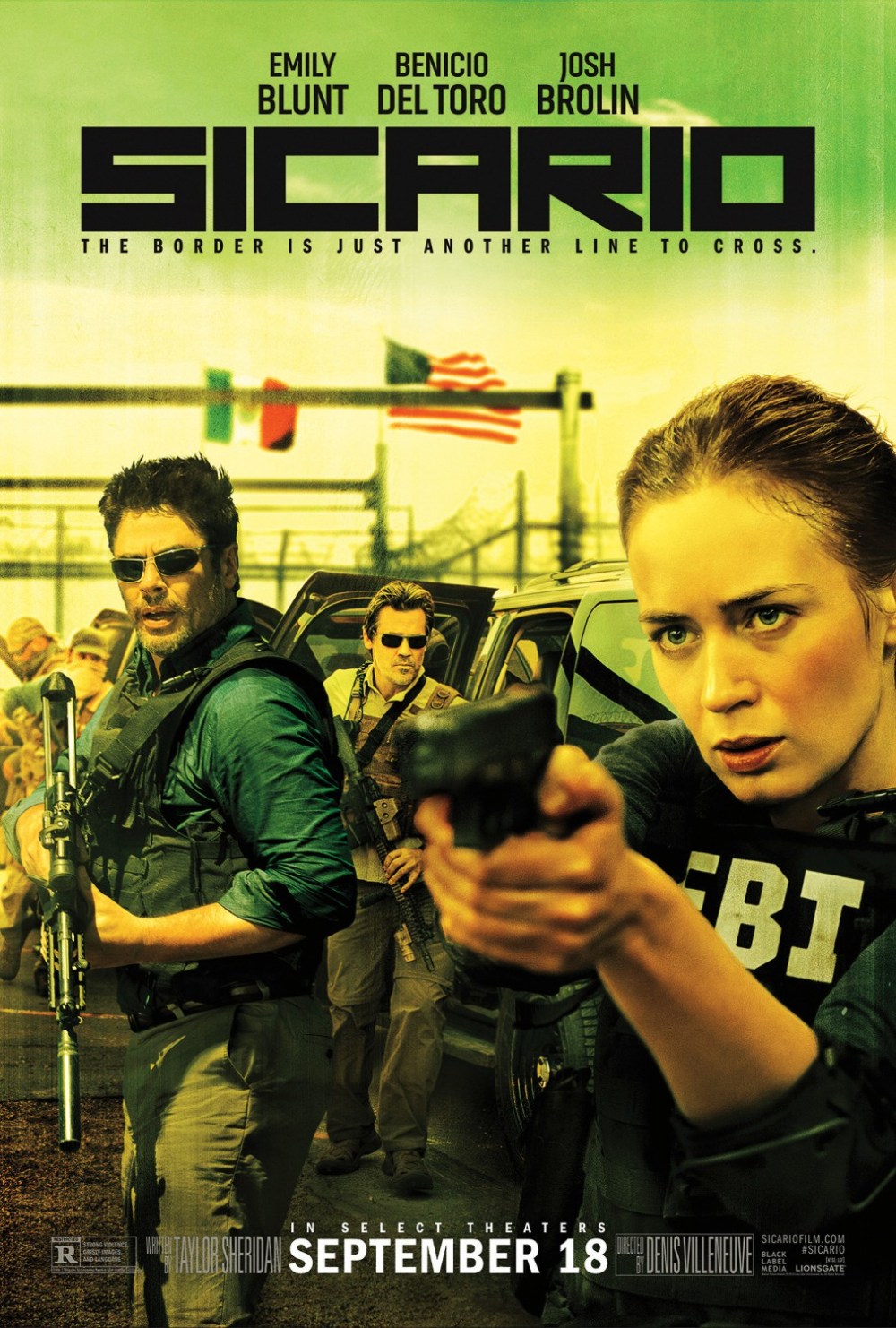
Denis Villeneuve’s ‘Sicario’ is a Seriously Intense Motion Picture

Sicario

I think we have all long since come to the conclusion that the war on drugs is, to put it mildly, an utter failure. Instead of ridding the world of illegal substances, this war has allowed the drug trade to exist in a way it never intended to. Furthermore, many fighting this war have become just as bad as the drug czars they are pursuing, and this should not be seen as anything new. And when you cross a drug cartel, they punish you in the most painful way possible and let the rest of the world know it in a horrifyingly unforgettable manner. In short, we will never get rid of illegal drugs if we keep going on the route we have been on for far too long.

There are many movies which have chronicled the pointlessness and shocking brutality of the war on drugs and the unscrupulous politics behind it like Steven Soderbergh’s “Traffic,” “Kill the Messenger” and David Ayer’s “Sabotage” which I liked more than most people did. “Sicario” is the latest film you can add to the list, and it proves to be one of the most riveting and nerve wracking of its kind as we follow an idealistic FBI agent as she descends into the hellish center of this war and learns a number of harsh truths never taught at Quantico.

“Sicario” hits the ground running with a very intense scene which sets up the chief perspective you will see things from. We meet FBI special agent Kate Macer (Emily Blunt) as she rides along with her fellow agents to a drug bust in which they raid a house where a kidnap victim may be at. Things get even more heightened when the agents discover dozens of dead and decaying bodies hidden in the walls, and this is only the beginning of what’s in store for the audience.

This bust leads Kate to be enlisted, voluntarily of course, by an undefined government task force led by Matt (Josh Brolin) which is put together to aid in the drug war escalating at the U.S./Mexican border. But once there, Kate will find her idealistic nature put to the test as she discovers this war has become more personal to some than she was led to believe.

It should be no surprise “Sicario” is a seriously intense piece of filmmaking considering it was directed by Denis Villeneuve who gave us the equally intense “Prisoners” a few years back. He succeeds in putting us right into Kate’s shoes as we follow her every step of the way as she enters a town as foreign to her as it is to us. We discover things at the same time she does like a couple of naked dead bodies hung from a nearby bridge, a chilling warning of what happens to those who interfere with the drug trade. We also share her sense of panic and terror when a character next to her says, “Keep an eye out for the state police. They’re not always the good guys.”

The movie also makes us share in Kate’s utter frustration as Matt and his troops keep the nature of their overall mission a secret to her and her partner, Reggie (Daniel Kaluuya). But once she is sucked into this increasingly insane mission, she finds it impossible to tear herself away from it even as she questions its legality.

Villeneuve is a master at creating a slow burn intensity which keeps escalating for what seems like an eternity before the situation finally explodes. The picture he paints of the drug war is an a very bleak one, and I imagine this movie won’t do much for the Mexican tourist trade. He is also aided tremendously by master cinematographer Roger Deakins who captures the bleakness of a town long since ravaged by the drug war in a way both horrifying and strangely beautiful, and by composer Jóhann Jóhannsson whose film score lights the fuse to “Sicario’s” intense flame and keeps it burning to where, once you think it has hit its peak, it burns even brighter.

Emily Blunt proved to the world just how badass she can be in “Edge of Tomorrow,” and she is clearly in her element here as an FBI agent who has yet to learn how the drug war is really fought. Seriously, this was one of the best performances by an actress in a 2015 movie. Blunt fully inhabits her character to where you can never spot a faked emotion on her face. It’s a fearless performance which must have emotionally draining for her to pull off, and I love how she never strives for an Oscar moment. Blunt just is Kate Mercer, and you want to follow her into the depths of hell even if you know you won’t like what’s about to be unveiled.

Josh Brolin is perfectly cast as Matt Graver, a government agent who clearly knows more than he lets on. We can see this is a character who has seen a lot of bad stuff go down and has long since become numbed to the effects of an endless drug war which shows no signs of stopping. Brolin doesn’t necessarily have one of those clean-scrubbed faces as his is rough around the edges, and Hollywood doesn’t seem to value this kind of face enough. Some actors benefit from having history written all over them, and Brolin is one of those actors as he makes you believe he has long since been to hell and back.

But make no mistake; the best performance in “Sicario” belongs to Benicio Del Toro who portrays Alejandro, a mysterious figure whose motives and intentions are eventually revealed towards the movie’s conclusion. Del Toro is great at hinting at the horrors his character has faced as Alejandro looks to be suffering a serious case of PTSD, and he makes this character into a dangerously unpredictable one whose next move is always hard to guess. His role in this movie reminds us of what a brilliant actor he can be, not that we ever forgot, and he succeeds in increasing the already high-tension level this movie already has.

“Sicario” is a hard-edged and remarkably intense thriller which grabs you right from the start and holds you in its grasp all the way to the end. Like any great movie, it will shake you up and stay with you long after you have left the theater. Some movies are made to be watched, but “Sicario” was made to be experienced. It’s not the kind of experience audiences are always pinning for, but those willing to travel down its dark path will find much to admire.

* * * * out of * * * *

Exclusive Interview with Nicole Holofcener about ‘Enough Said’

Enough Said movie poster

With movies like “Lovely & Amazing,” “Friends with Money” and “Please Give,” Nicole Holofcener has firmly established herself as a filmmaker with a unique voice. In a time where romance and relationship movies are being critically and commercially crucified, her films are wonderfully refreshing as they feature characters who feel real, are remarkably down to earth and have flaws we can all understand and relate to. Even if you think her films deal with familiar subjects and situations, the attention Holofcener gives to her characters and the actors who play them make you feel like you are experiencing a story you have never watched before.

Her film “Enough Said” is no exception to this, and it stars Julia Louis-Dreyfus as Eva, a professional masseuse and single mother who is slowly getting back into the dating game. While at a party, she meets Albert (James Gandolfini, in one of his last performances), and the two find themselves forming a deep connection very quickly. Things, however, get complicated when (SPOILER ALERT) Eva discovers that one of her patients, Marianne (Catherine Keener), is actually Albert’s ex-wife. Throughout their sessions together, Marianne has been giving Eva many different examples about what a lousy husband Albert was, and this makes Eva wonder if her first impressions of Albert were the right ones to have.

I talked with Holofcener while she was doing press for the “Enough Said” digital release, and the movie itself has since received various nominations from the Golden Globes, the Independent Spirit Awards and the Screen Actors Guild Awards. During our interview, I got to find out how she comes up with such wonderfully unique characters, what it was like for her to work with the late James Gandolfini, and we also talked about Catherine Keener who has appeared in most of her films and how their creative relationship has evolved from their first film together.

Ben Kenber: “Enough Said” is fantastic and one of the best films of 2013. With this and “Please Give,” I really love how your movies deal with characters that are down to earth and have flaws like everybody else. Most romantic movies usually don’t have that, but your films are among the exceptions.

Nicole Holofcener: That’s very nice. Thank you. That’s what I’m going for.

Ben Kenber: With “Enough Said” and the other movies you have made so far, how do you come up with such unique characters?

Nicole Holofcener: I have no idea (laughs). I mean they’re kind of an amalgamation of people I know and people in my imagination. I guess, by going very specific, sometimes I’ll focus on a character’s habit or a quirk or a mannerism or something irritating or something specific. I started with the Sarah character (played by Toni Collette) in this movie with the fact that she has made problems that started with a friend of mine who said she left bracelets on the kitchen counter, and she finds them in the kitchen and how much that annoys her and why she won’t simply ask her housekeeper not to do that. Then I have Sarah, and it’s like everything kind of falls into place after that, not easily. I’m not saying it’s easy, but it informs who that person is and what her issues might be. And then all of a sudden, she had this whole story with her housekeeper and it ended up being a good scene, but it started with the bracelet on the kitchen counter. So very specific, I guess. By going very specific and individual. When I read a script, I hate it when they say things like, “Sarah, 35, driven, type A, but inside falling apart.” It’s like, well then, you don’t even have to read what happens because you’ve already been told who she is.

Ben Kenber: This looks like a movie which sticks very closely to the script you wrote, but was there any improvisation used by the actors?

Nicole Holofcener: Yeah, absolutely. The story is very much the script as written, but they (the actors) ad-libbed all over the place, and I got rid of some and I kept some. But they had the freedom to do that especially because they were so funny and smart. They changed things but not the story.

Ben Kenber: The characters are so down to earth, and everybody seemed so relaxed onscreen. How did you manage to get such naturalistic performances from your cast?

Nicole Holofcener: They were sedated. I just gave everyone a Xanax every day. If only it could be like that (laughs). Some days were more relaxed than others but, as they say, the director sets the tone. I’m pretty relaxed, and while I take directing seriously, we’re not in a war zone. I try to have a good time and help people feel safe and relaxed so that they can give vulnerable performances and trust me. I try to earn their trust, and then I try to help them feel comfortable.

Ben Kenber: Well it definitely looks like he succeeded in doing so.

Nicole Holofcener: Well that’s good.

Ben Kenber: I do have to ask you about the late James Gandolfini because this is a great role to see him in. It shows audiences there was more to him than Tony Soprano. People should’ve known this before “Enough Said” came out, but the movie makes it clear to those who couldn’t get “The Sopranos” out of their heads. What was it like to work with him?

Nicole Holofcener: It was great to work with him. It was often challenging. He asked a lot of questions. I think we were sometimes mutual pains in the asses, but in a very affectionate way. He’d look at me like, “C’mon!” I’d look at him like, “C’mon!” He was playful and very hard-working, very self-effacing and sweet, shy. The crew loved him. He was very friendly and warm toward the crew which was very nice and so was Julia (Louis-Dreyfuss). So, I had a very relaxed family kind of feeling.

Ben Kenber: Yeah, you definitely get that from watching the movie. Catherine Keener also stars in this movie as Marianne, and you’ve worked with her several times in the past. How has your working relationship with her evolved from the first time you worked with her to this one?

Nicole Holofcener: Well, the first time I worked with her I was kind of scared. She had more experience than me. It (“Walking and Talking”) was my first feature, and I was pretty intimidated by her. But she was very giving and warm, and that’s why we continue to work together. We’ve gotten to know each other so well, and discovering how wonderful she is, every part, just made me want to work with her again and again. And now that it has been so many years, it’s a short hand. Even though she’s still great, I’m not intimidated by her anymore (laughs). She can still be a little scary.

Ben Kenber: Keener is a terrific actress, and the rapport between you and her really shows with each movie you work together on.

Nicole Holofcener: Good, yeah. It’s a pretty special relationship, definitely.

Ben Kenber: Well, I really, really liked this movie a lot. I really gravitate towards movies with very down-to-earth characters. I usually avoid romantic movies like the plague, but with movies like yours where you can really relate to the characters and the problems they experience in life, they really stand out in a wonderful way. “Enough Said” is one of those movies.

Nicole Holofcener: I’m so glad. I hope that people who avoid romantic movies will watch this one for the same reason (laughs). Thanks, that’s good.

I want to thank Nicole Holofcener for taking the time to talk with me. “Enough Said” is available to own and rent on DVD, Blu-ray and Digital.


‘The Texas Chainsaw Massacre 2’ is a Mixed Bag, But It’s Never Boring

The Texas Chainsaw Massacre 2 poster

After I finished watching “The Texas Chainsaw Massacre,” I was in no hurry to watch part two. The 1974 horror classic still probes to be an intensely unsettling cinematic experience decades after its release, and Tobe Hooper’s film was far more terrifying than I expected it to be. Recovering from the original was no different than when I slowly pulling myself back together after watching Darren Aronofsky’s “Requiem for a Dream” or just about any Lars Von Trier film. But with Hooper having recently passed away, the time had come for me to check out “The Texas Chainsaw Massacre 2,” a sequel heavily criticized when it opened in 1986, but which has since become a cult classic in the eyes of many.

“The Texas Chainsaw Massacre 2” takes place over a decade after the original, and an opening narration tells us the police searched for Leatherface and his cannibal family but never found any trace of them. But of course, it doesn’t take long for this sequel to reintroduce us to Leatherface as he gleefully slices away at a pair of obnoxious high school seniors who harass on-air radio DJ Vanita “Stretch” Brock (Caroline Williams). Stretch captures the audio of these kids’ murders and passes it on to Lieutenant Baude “Lefty” Enright (Dennis Hopper), uncle to Sally Hardesty and her wheelchair-bound brother Franklin who were victims of Leatherface’s chainsaw wrath. From there, the two of them become determined to end Leatherface and the Sawyer family’s reign of terror once and for all.

How you enjoy this sequel largely depends on what your expectations are when you go into it. If you think Hooper planned to match the claustrophobic terror and unnerving power of the original, you are in for a serious disappointment. But if you are able to accept this sequel in regards to what Hooper intended to accomplish with it, I think there is a good deal of fun to be had even if feels like there is a lot missing from this follow-up.

With “The Texas Chainsaw Massacre 2,” Hooper wanted to focus more on the black comedy he said was inherent in the original. Was there black comedy in the original? Yes, but it took a couple of viewings to realize this was the case. This sequel, however, was made to satirize both horror movies and the excess of the 1980’s. Since this one came out in 1986, the time had come to take aim at the greed which came to define this particular decade. Also, when you take into account how the poster gleefully parodies the one for “The Breakfast Club,” you should know this a film which will not take itself too seriously. Plus, this was released by Cannon Films, so you could count on it being entertaining, and maybe for reasons its director didn’t intend.

Looking back at “The Texas Chainsaw Massacre 2,” my feelings about it are decidedly mixed. I did enjoy the frenzied energy Hooper and company brought to the proceedings, and the actors look like they had great fun committing onscreen mayhem. At the same time, it feels like a missed opportunity as the style and substance of this sequel proved to be much too distant from the original. Its links to the 1974 film are very weak to where this feels like a sequel in name only. Sally Hardesty (Marilyn Burns’ character from the original) is only mentioned in the opening narration as having since gone into catatonia. It would have been cool to see her come back in one way or another, perhaps as some badass hardened warrior eager to get revenge. Heck, this sequel came out in the summer of 1986 not long after Sigourney Weaver set a new standard for female action heroes in “Aliens.” Had Burns come back, it could have been the summer of the vengeful female warrior.

One thing which especially bummed me out was the lack of actors returning from the original. In fact, the only actor from the original to appear here was Jim Siedow who reprises his role as Drayton Sawyer. While his creepy face alone is the kind which inspires wicked nightmares, Siedow doesn’t get as much to do this time around. As for Leatherface, he is portrayed by Bill Johnson and not Gunnar Hansen who brought a twisted realism to the iconic horror character. Johnson isn’t bad as he can wield a rusty chainsaw like the best of them, and his sudden appearance from a room filled with vinyl records results in one of this sequel’s scariest moments, but Hansen is sorely missed here as no other actor can possibly match what he brought to the first film.

The rest of the cast, however, does rise to the frenzied challenge Hooper laid out for them. Bill Moseley, who has since appeared in Rob Zombie’s “House of a 1,000 Corpses” and “The Devil’s Rejects,” looks to be having the time of his life as Chop-Top Sawyer as he gleefully tortures Stretch even after a part of his skull gets accidentally sawed off by Leatherface. Speaking of Stretch, Caroline Williams brings a wonderfully spunky energy to the role as she uses her smarts to outwit the Sawyer family in an effort to escape with her life, and her last moment in this sequel is a memorable one to say the least.

But the actor I got the biggest kick out of watching in “The Texas Chainsaw Massacre 2” was Dennis Hopper who played former Texas Ranger Baude “Lefty” Enright, a man deeply obsessed with finding the Sawyer family and avenging the suffering they and Leatherface inflicted on his kin. Hopper was in the midst of a major comeback in 1986 as he appeared in “Hoosiers,” “River’s Edge” and, most famously, David Lynch’s “Blue Velvet.” While those films are better examples of his acting, his performance in this sequel is equally inspired as he clearly knew he was in an over-the-top horror movie and relished the opportunity to go mano-a-mano with Leatherface. Seeing the “Easy Rider” battle Leatherface with a chainsaw is wickedly gleeful fun as a battle with chainsaws is something this sequel just had to have.

So, when all is said and done, I did admire “The Texas Chainsaw Massacre 2,” but certainly not it in the same way I admired the original. Hooper’s vision wasn’t lacking here in the slightest, but he instead took things in direction fans were prepared for 30 years ago. It is only with the passing of time we can look at it differently and understand how it attained cult status. I don’t think it’s a bad film, but it does feel strange compared to what came before.

Looking back, “The Texas Chainsaw Massacre 2” represented one of several attempts by Menahem Golan and Yoram Globus of taking a well-received motion picture and turning it into a hopefully long-running franchise. Clearly, they had more luck commercially, if not critically, with “Death Wish,” but at least this sequel fared much better than “Superman IV: The Quest for Peace,” the film which pretty much put the final nail in the coffin for Cannon Films.

Of course, “The Texas Chainsaw Massacre” franchise didn’t stop there as the buzz of the saw is still an inviting sound to horror fans all over the world, and filmmakers have continued on with other sequels, a remake, prequels and, yikes, an upcoming origin story. People still want to experience the visceral thrill the 1974 horror classic in one way or another, but when it came to “The Texas Chainsaw Massacre 2,” perhaps Hooper realized from the start that it was not possible to top the original or match its terrifying power. Instead, he felt it was better to try something a little different, and that’s what he did with this sequel for better and for worse.

* * ½ out of * * * *

‘Captain America: The First Avenger’ Introduces Us to a Real American Hero

Captain America The First Avenger poster

Captain America: The First Avenger” succeeds where “The Green Lantern” utterly failed. It gives us a superhero, one from the Marvel Comics universe, who is distinct from those of his ilk, and he is one we quickly come to care about and root for. Steve Rogers isn’t just some cocky kid from Brooklyn with an overinflated ego. He’s a sickly young man who desperately wants to fight for his country, but who has been rejected by the military countless times. But what he lacks in health and strength he makes up for in spirit. Steve wants to fight for his country not because Uncle Sam wants him to, but because, and he said it himself, he never backs down from a fight.

I liked how this movie didn’t shy from its American roots the way “G.I. Joe: The Rise of Cobra” did. While that movie tried to make you forget the slogan “a real American hero,” “Captain America: The First Avenger” doesn’t do the same. At the same time, it doesn’t beat you over the head with blind American patriotism. It has its share of American pride, but it’s really about the spirit of this unlikely soldier which keeps him sane after he is transformed into a super soldier. The outside may be different, but the inside of this man remains the same to where he sounds like a relation to Robocop.

Playing Steve Rogers/Captain America is Chris Evans who you may remember him from those dopey “Fantastic Four” movies. As for myself, I remember him best for doing a skateboard grind down an icy railing which led to his ultimate demise in “Scott Pilgrim vs. The World.” Evans is perfectly cast and does great work in keeping his character from becoming just another clichéd war hero. His heart shines throughout the entire movie, and he never allows Rogers to become laughable or indulge in behavior which would seem cringe inducing.

Once Steve is turned into Captain America, you root for him to go into battle and defeat the Nazis. But seeing him become a pawn for the United States Government in hawking War Bonds is depressing even when his irrepressible spirit and love for country shines through. We understand his desire to prove himself, and our spirits rise along with his.

Of course, with every superhero movie we get a vicious villain. In this case, this would be Johann Schmidt, Adolf Hitler’s right hand man who is later revealed to be Red Skull. This particular Skull has his own plans for world domination through his organization of HYDRA, and he gets his followers to raise both hands instead of just the one for Hitler. With a stolen tesseract, HYDRA can eliminate their foes faster than those phasers that vaporized all the red shirts on “Star Trek.”

Hugo Weaving portrays Johann Schmidt/Red Skull, and he gives “Captain America” the formidable villain it needs. Still, after being in all “The Matrix” and the “Lord of the Rings” movies, I kept waiting for him to say, “Welcome to Rivendell Mr. Anderson!”

“Captain America: The First Avenger” also has the other requisite characters like the Army drill sergeant and the beautiful woman who dares the most macho men to treat her as just a woman instead of the tough as nails soldier she is. It’s not hard to guess who gets their ass kicked here when other men foolishly hit on her. Still, director Joe Johnston succeeds in getting the best actors available to inhabit these roles and give them life beyond the mere superhero movie stereotypes they could have been.

Tommy Lee Jones is highly entertaining as Col. Chester Phillips, a gruff, no nonsense military leader who expects nothing but the best from his soldiers. Jones, however, gives Phillips a wry sense of humor much like the one Sam Gerard had in “The Fugitive.” Watching him being subtly dismissive of others and later coming around to see Steve Rogers is the man is a hoot, and he never ends up screaming all over the place like R. Lee Emery did in “Full Metal Jacket.”

Then there’s Hayley Atwell who plays Peggy Carter, the female officer who eventually becomes Steve Rogers’ love interest. I really liked how Peggy was drawn out to where she doesn’t just exist for the sake of the movie’s superhero. Atwell sells us completely on her tough demeanor to where it cannot and should not be mistaken as an act, and she travels across the screen with an assured confidence which no one should ever doubt. If they do doubt her, it will say much more about her.

Johnston got the job of directing “Captain America: The First Avenger” based on the period movies he made such as “The Rocketeer” and “October Sky.” There’s a lot of attention paid to detail here (the story takes place 1942 to be exact), but it isn’t held prisoner by it. Heck, many of the tools HYDRA ends up using seem far removed from the 40’s, and they look like they came out of a sci-fi movie made in the 1970’s or 80’s. While Johnston hasn’t made a great movie here, he still has given us an undeniably entertaining one, and it didn’t even need another terrific film score by Alan Silvestri to prove this.

When it comes to the 2011 summer movie season, “Captain America: The First Avenger” isn’t better than “Thor” which for me had far more interesting characters, but it easily outdoes “The Green Lantern” which is one of that year’s biggest disappointments. Thanks to Evans’ performance, Captain America finally gets the cinematic respect this character has long since been denied.

* * * out of * * * *

‘Left Behind’ is as Cinematically Atrocious as Movies Get

Left Behind movie poster

The 2014 version of “Left Behind” received quite the critical smackdown upon its release, and this made me all the more interested in seeing it. How many times do you get the opportunity to say you were one of the handful people who got to see such a god-awful motion picture on the big screen which notoriously flopped at the box office during its incredibly short time in theaters? There were a few people who proudly wore t-shirts signifying they saw “Gigli” while it was in theaters, and some wear it like a badge of honor.

“Left Behind” looks like one of those so bad it’s good movies, but even on that level it is a complete failure. This cinematic version of the best-selling novel by Tim LaHaye and Jerry B. Jenkins is every bit as hideous as its reputation suggests. The acting is amazingly bland and lifeless, the dialogue is unforgivingly bad, and the direction is beyond incompetent. Upon coming out of this movie, one has to wonder if its best sequences were all left behind on the cutting room floor on purpose or by accident.

The movie opens on Chloe Steele (Cassi Thomson) arriving home from college to surprise her father, airline pilot Rayford Steele (Nicolas Cage), for his birthday. Rayford, however, is already set to pilot a flight to London and cannot make it. Also, his marriage to his wife Irene (Lea Thompson) is on the fritz as she has since become a devout Christian, something which drives him and Chloe up the wall. He also has his eye on an infinitely beautiful flight attendant to the point where he doesn’t hesitate to leave his wedding ring in the glove compartment of his car.

Anyway, the family members go their separate ways to do their thing, but then people suddenly vanish into thin air without any explanation, and the world quickly descends into utter chaos. Their clothes and belongings are left behind, but their bodies have apparently disappeared and don’t look to reappear anytime soon. It turns out the end of the world is much nearer than the non-believers ever bothered to realize, and those who believe in Jesus are now under his, or her, protection. As for those back on Earth, they are forced to prepare for the rapture which is certain to kill them off at some point in the not too distant future.

“Left Behind” is actually a remake of the 2000 film that starred Kirk Cameron and which received largely negative reviews upon its release. In a time where every other movie is being remade, this looked like the rare remake which could have easily improved upon the original, but no such luck. For all we know, this remake is even worse than its predecessor, and sitting through it is like pouring salt on an already gaping wound.

Where do we start with a cinematic monstrosity like this? Well, let’s take into account how the story lacks much in the way of drama. Those characters who didn’t go up to heaven are basically condemned to a hellish existence, so where’s the drama? As for what’s going on up in the sky, the characters stuck in the airplane are forced to act stupidly and utter dialogue so silly and inane to where it makes the screenplays of the “Star Wars” prequels sound like they were written by Aaron Sorkin.

The saddest thing about “Left Behind” is watching Nicolas Cage give one of the worst performances of his long career. Granted, Cage has done more bad movies than good ones these past few years, but even he can sometimes elevate a terrible motion picture into something which is, at the very least, entertaining. But here he looks like he is about to fall into a coma like Ben Carson threatens to during his campaign for President as he appears bereft of passion and meaning. What made Cage decide to do this movie anyway? He can underplay a role to great effect in movies like “Joe,” but here he only succeeds in making a terrible movie all the more infinitely pathetic.

The director of this misbegotten disaster is Vic Armstrong who is said to be the world’s most prolific stunt double in movies. He doubled for Harrison Ford in the first three “Indiana Jones” movies, Timothy Dalton in “Flash Gordon” and George Lazenby in “On Her Majesty’s Secret Service.” Whatever lessons he gleaned from the directors he worked with on those projects did not translate to “Left Behind.” He should be forgiven for the lousy special effects he had a budget of only $16 million which, for a movie like this, is not nearly enough to, but my sympathy doesn’t extend much further than that. His direction is so amateurish to where I wondered how he got the directing job at all.

There is only so much time one can waste on a movie like “Left Behind” because there are hundreds upon hundreds of other movies out there so much better than this one. It ends on a note of seeming uncertainty as the apocalypse has only begun, but Cage stares at it so blankly as if to say he won’t be around for the sequel, assuming there will ever be one. It’s depressing to see a number of careers hit rock bottom here, but this is what happens here as movies don’t get much worse than this one. Sitting through a Dinesh D’Souza “documentary” is hard enough, but this one is a real endurance test.

For what it’s worth, it is nice to see Lea Thompson here as she always proves to be a very appealing presence in each movie or television show she appears in. What a shame it is that she disappears from this movie far too soon.

½* out of * * * *