Exclusive Interview: Ben Cotner and Ryan White Talk About ‘The Case Against 8’

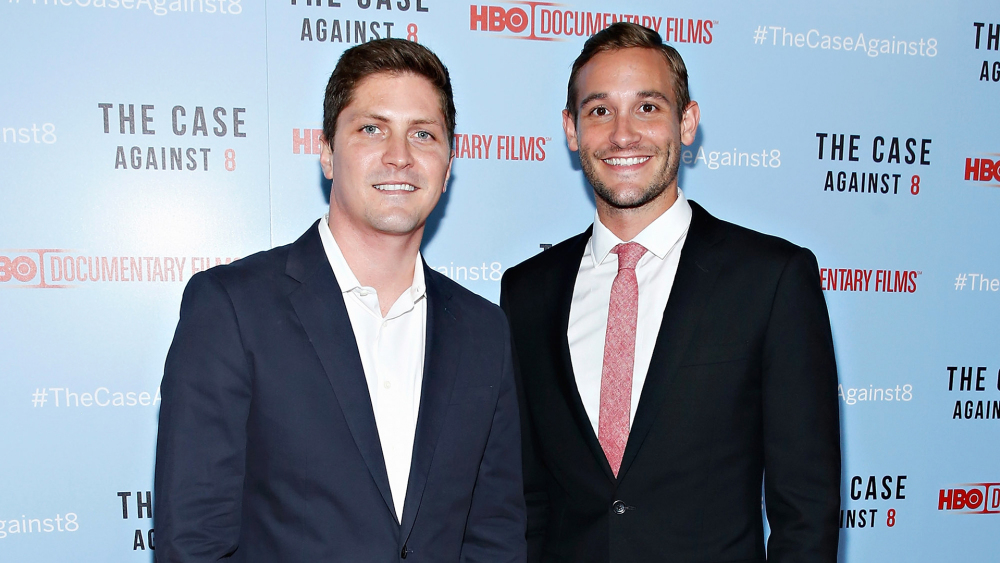
Case Against 8 Ben Cotner and Ryan White photo

The documentary “The Case Against 8” focuses on the historic federal lawsuit which was filed to overturn Prop 8, California’s discriminatory ban on gay marriage. Its directors, Ben Cotner and Ryan White, spent five years filming the plight of two couples (Kris Perry and Sandy Stier, Paul Katami and Jeff Zarrillo) who were plaintiffs in this case as well as Ted Olson and David Boies, the lawyers in “Bush v. Gore,” who represented them. The documentary made its debut on HBO back in 2014, and it gave us an in depth look at what went on behind the scenes with these people as they fought for marriage equality.

I got to speak with Cotner and White in 2014 when they were in Los Angeles, California for “The Case Against 8” press day. Cotner has served as an executive at Paramount Pictures and Open Road Films, and he has worked on the films “An Inconvenient Truth,” “American Teen” and “Side Effects.” White produced and directed of “Good Ol’ Freda” which is about Freda Kelly, The Beatles’ longtime secretary, and “Pelada” which follows two soccer players as they travel around the world. They were both very open about the challenges and surprises they encountered while making this documentary.

The Case Against 8 poster

Ben Kenber: The lawsuit was supposed to last only a year or so, but it ended up going on for five years. You couldn’t have known how everything would turn out, but did you have a clear idea of how you wanted this documentary to play out?

Ryan White: No. We began filming in 2009 right after the case was filed, but more just to cover our bases in case it became something big. We were lucky to get Ted (Olson) and David (Boies) on board, and they recognized also that if it snowballed into something bigger, it might be important to have a video record of it. But we filmed for three or four years without even knowing whether we had a film, or at least whether we had a third act or not. It was when the Supreme Court granted cert in December 2012, that was when we really sort of launched into hyper drive and realized that we have to finish our film. We had six months to edit it, but also that we would have a really great ending no matter which way it went.

BK: And you did end up with a great ending.

RW: Well we were very lucky in a Hollywood fairytale type of way (laughs).

BK: What surprised you most about making this documentary?

Ben Cotner: I think one of the things I was most surprised about was how open the plaintiffs and the lawyers were with us in sharing their lives. When we first went in there we had never met them, so it was really important for us to spend a lot of time gaining trust with them and for them to be comfortable with cameras around. Ryan and I intentionally didn’t have big camera crews. We shot everything ourselves so I was surprised that we were able to slip in and out of rooms for these incredibly confidential meetings and they let us do that. That was really, truly, as a documentary filmmaker, such a gift and such an exciting opportunity for us because we would get to see things that were happening that other people involved in the case weren’t able to see.

RW: I mean it’s a surprise where we are now in the country with the climate on marriage equality and what’s happening with states right now. When Prop 8 passed I think only two states had legalized gay marriage at the time in California was the third so it was relatively normal that things like Prop 8 could pass, and now it’s pretty abnormal. Even in the reddest of red states we are seeing federal judges saying that the constitutional bans/the state bans are unconstitutional, so I would’ve never expected in 2008 when we began this film that we would be at this point which feels like a tipping point.

BK: There is some attention paid to the defendants. Did you ever get any pressure to put a little more focus on them as well, or did you feel that they got enough focus?

BC: The title of our film is “The Case Against 8” because we really wanted to tell a character piece, a journey of these people to overturn this law that was affecting them. I think in doing so we spent so much time behind the scenes with these people that it would’ve been deceptive of us to pretend to be giving fair attention to the other side. At the same time, we wanted to be very respectful and not villainize them. So it really wasn’t that we were setting out to make them look bad. I think we wanted to present the best of their arguments that we could see as they were presented in court and be very true to what they said, which I think at the end of the day we were. Their lead witness, David Blankenhorn, we approached when he changed his mind about same-sex marriage very publicly. He agreed to an interview which we thought was really interesting, so we could actually see some of the perspective of somebody who was, at the time, on that side during the trial. It wasn’t that he was a hateful person. He would say there was some animus in their belief that gays and lesbians shouldn’t have the right to marry, but it wasn’t because he was trying to be mean to anybody. He was essentially a nice guy. As he said, he just hadn’t gotten to know people. So for us it was important to be as fair as possible to them but not pretend that we were going to make a film about whether gay marriage was right or wrong and be fair to both sides. It really wasn’t about that for us. It was telling these characters’ stories.

BK: You had 600 hours of footage when you finished making this documentary. What was it like editing that down?

RW: A nightmare (laughs). No, it’s fun editing it down but it’s also a nightmare at the same time. Ben and I shot the footage ourselves so we were intimately familiar with what we had shot, but we hadn’t looked at it for many years. When we would shoot on tapes and we would put them into safety deposit boxes. We didn’t look at the footage. Our agreement with the legal team was we wouldn’t put a film out until the case had resolved, so we didn’t even look at the footage until we knew it was going to the Supreme Court and then we only had six months to finish a film. So it was a really fun, sort of nightmarish process to have to go through all that footage and figure out what we had and how we could put it into a cohesive narrative, but that’s where all the chips fall into place. Our main editorial goal was to balance a legal story with the human story. If you look at the structure of the film, it leads in and out of legal intricacies with the lives of the plaintiffs, and that was sort of the balance that was always the goal to strike. Hopefully we did in the end.

BK: Was there anything in this documentary that you wanted to include that you were unable to for one reason or another?

RW: It would have been great to have footage of the Supreme Court just to get to see them in action. I liked what we were able to do with the scene and hearing their voices is amazing. I can picture it myself, and as an audience member I would love to be able to picture those nine justices in action.

BC: There were some very special, intimate moments with the plaintiffs such as the day after they testified. Everyone left the courtroom and went into this sort of back secure elevator that was closed to the public, and everyone that was involved in the case was in there including us. And as soon as the elevator doors shut everybody burst into chairs. Those little special moments that, because you’re in a courtroom you can’t be filming, I think it would’ve been great to have. But fortunately there were plenty of other joyful moments that we could put in the film.

BK: I was talking with another documentary filmmaker recently and she talked about respecting the space in terms of keeping a certain difference from your subjects. Do you think you were able to pull that off?

RW: I think it’s inevitable in a film like ours that lasts for five years that’s so personal and with issues that are personal to Ben and I, we are gay Californians, that it’s hard not to have a respect for their bravery. Also, seeing them go through the wringer during this case, it’s hard not to feel invested in what happens to them. So we tried to be very respectful of telling their story faithfully, and also if there were things that they didn’t want to be part of the process we were respectful of that, but to their credit that was very few and far in between. I think one of my favorite parts of the film right now is that we are releasing it, and Ben and I are not holding cameras anymore. This morning we were all in the same room and we got to spend time with them without any of us working. It’s just getting to enjoy being together because we did become friends with them during the process. We adored both of their families, we wanted them to get their fairytale ending, and we were thrilled filming their weddings so I think it’s just about finding a balance between respecting their privacy and also trying to make a great film. We obviously had a lot of respect for them as people and families.

BK: One of the things I love about this documentary is how it peels away at political labels.

RW: Thank you. That’s our goal. That’s what we wanted to do.

BK: Ted Olson was the lead attorney for the plaintiffs, and he is the same guy who basically gave us George W. Bush as President of the United States. What was your first reaction when you found out that he was going to be taking this case?

BC: We were definitely surprised. We knew who Ted Olson was, and he is one of the most famous conservative litigators in the country. At the time, Dick Cheney was probably the only prominent conservative who was speaking openly for same-sex marriage. When he took the case we were surprised, but then once we got to know Ted we understood a little bit more why. He was never really opposed to it and he believes in equal protection of the law and always has believed that. But what was so great about it was that we could look at the issues not in a political way and not in a partisan way. We could look at the facts and we could look at what scientists were saying. Preeminent scholars from around the world came and testified about what the real science and statistics say, and individuals like Kris, Sandy, Jeff and Paul could speak to their experience and how it affected them in a very real way. So I think it allowed those stories to be heard in a way that never had happened before.

RW: Yeah, and the case was engineered around stripping politics out of it. We sort of tried to mimic that in our film because we could have concentrated on a lot of political things. We didn’t want to make a traditional social issue film about one side’s opinion on an issue and the other side’s opinion on an issue and try to draw a conclusion from it. That just wasn’t our goal. Our goal was to tell human stories, and that is the trajectory of two couples. This isn’t a movie about gay marriage being right or wrong. It’s just watching what these two couples were put through and the extraordinary circumstances they had to go through. Most straight people propose, get married in a year and it’s very routine. That’s what they grew up thinking is normal, and these two couples didn’t go through that. They went through a completely rigorous zig-zag way of getting to their fairytale ending. So I hope that that’s what the film’s take away is; just human stories rather than the political things that just sort of overwhelm the issue.

I want to thank Ben Cotner and Ryan White for taking the time to talk with me. “The Case Against 8” is now available on DVD, Blu-ray and Digital.

‘WALL-E’ Remains one of Pixar’s Greatest Masterpieces

Wall E poster

WALL-E” was directed by Andrew Stanton who directed one of the very best Pixar movies, “Finding Nemo.” It takes place in the very distant future when Earth is no longer inhabitable due to uncontrollable pollution, and everyone lives in spaceships. In the midst of all this pollution and garbage is WALL-E whose name is an acronym which stands for Waste Allocation Load Lifter – Earth-Class. There are many like him, but this particular load lifter has long since developed a quirky personality. While he compacts waste into squares, he also collects things like Zippo lighters, Rubik’s Cubes, and parts from similar models which he can use as replacement parts on his body if anything falls apart. He lives a very lonely life with no one to converse with except a cockroach whom he lets wander around his home aboard a broken-down construction vehicle, and he is always watching scenes from the movie musical “Hello Dolly.”

Then one day, he is visited by a large spaceship which a makes a very loud landing on the barren planet. Released from it is a probe named EVE (Extra-terrestrial Vegetation Evaluator), and after some dangerous close encounters, WALL-E earns her trust and friendship. Things between them, however, gets tested when EVE’s mothership comes back, and WALL-E hangs on for dear life as the ship heads into space and towards a ship where what is left of humanity inhabits. What happens when these two board the ship will eventually change the course of everyone’s lives and the way they live.

Just when I thought Pixar couldn’t top itself, it succeeds in doing so yet again. The animation in “WALL-E” is predictably brilliant, but now it’s getting to where I can’t tell what’s animated and what’s real. The Rubik’s cube WALL-E and EVE play with looks very much like the real thing, and the attention to detail in these is almost frightening in its precision.

But the one thing that really makes Pixar movies so damn good is the stories filmmakers come up with, and the characters they create are ever so memorable. WALL-E’s design does remind me of Number 5, a.k.a. Johnny 5, from “Short Circuit,” as he is every bit as quirky as this character from the 1980’s. Pixar also takes a lot of risks by having this movie be devoid of dialogue for the first half hour. I imagine this would freak out other studios, but not Pixar. The fact there is no dialogue shows how good Stanton is in showing things without spelling them out to us.

“What are words for when no one listens anymore?”

“Do you hear me? Do you care?”

-Missing Persons

“WALL-E” is undeniably cute without having to become incredibly manipulative, and this is quite an accomplishment considering how many movies for kids can easily fall into such a trap. Pixar is the equivalent these days of what the Muppets were to me in 1980’s. Their movies appeal to both kids and adults, and it is great to see anyone in Hollywood making motion pictures which succeed in doing just that.

When “WALL-E” moves to the spaceship hovering just outside of the Milky Way galaxy, the movie becomes even more amazing on a visual level. The moment where we see WALL-E hanging on for dear life outside of the spaceship and touching the rings of Saturn is a beautiful moment in a movie full of them. The spaceship he and EVE end up on is called the Axiom, and all its passengers are obese people who sit and move all day long in chairs because being in space for so long has robbed them of their bone density. Now this is a movie which doesn’t hide from the horrors of being a coach potato.

WALL-E and EVE are machines, but you end up caring for them regardless of this fact. They make the perfect couple even if one is more advanced than the other. The heart of the movie is how they come together and of the changes they inadvertently make in the realm of humanity.

WALL-E is voiced by Ben Burtt, and he is responsible for some of the most well-known sound effects in movie history like the lightsabers from “Star Wars” as well as the sound of that gigantic boulder in “Raiders of the Lost Ark.” Burtt can now add this character to his great volume of work with pride. The character itself manages to convey so much through the use of sound and gestures. Whenever WALL-E tilts his mechanical eyes, he can easily go from emotion to emotion, and his voice adds to this as well.

EVE is the perfect match for WALL-E as they are an example of how the old and the more advanced can make the saying of opposites attract all the more valid. Beautiful in her sleekness and with two blue eyes to make her emotions all the more real, EVE is a brilliantly thought out character (and a little too trigger happy for her own good). The moments when these two machines connect are beautiful, and it gets you right in the heart in a way which does not feel the least bit manipulative (thank god for that).

When “WALL-E” gets on board the Axiom, it is a wonderful jab at how we humans have allowed ourselves to let technology overwhelm us to where it does all the work we should be doing ourselves. Laziness and complacency are far too easy to achieve when you have someone or something else doing everything for you. As a result, everyone on the Axiom is always in a chair. Exercise is not a priority, and being in outer space for so long has resulted in their bones almost disappearing. This is something NASA has to think about before they even think about sending astronauts to Mars. When the people of the ship rise against the technology holding them back, it’s a fantastic moment which cannot be easily forgotten.

I’m not sure what else I can say about “WALL-E” other than it’s another home run for the folks at Pixar. I look forward to whatever they do next year and the year after that. It is far and away one of the best movies of 2008, and it is now the one to beat in the summer movie season. For those attempting to do so, I wish you the best of luck because you are going to need it.

* * * * out of * * * *

‘BlackkKlansman’ is Spike Lee’s Best Joint in Years

BlackkKlansman movie poster

Those who read my reviews know how much I despise the term “based on a true story” as it has long since lost its meaning for me. However, Hollywood has been looking for ways to provide variations on this phrase in recent years in an attempt to give it back the value it once had. One of my favorites was “Argo” which was advertised as being based on a “declassified” true story which made it worth seeing all the more. Still, every other movie these days is “based on a true story,” and pointing this out should make you wonder which ones were not. Besides, aren’t all movies based on or inspired by things we have experienced in real life?

BlackkKlansman,” a Spike Lee joint, is the latest movie to be “based on a true story,” but its poster has advertised as being “based on a crazy, outrageous, incredible true story.” Personally, I prefer the phrase Lee uses in the movie itself which says it is based on “some fo’ real, fo’ real shit.” This description feels far more honest as it would have seemed unbelievable were this movie released a few years ago. What results is the best joint Lee has made in years, and I could not recommend it more highly.

Based on the memoir “Black Klansman,” it stars John David Washington as Ron Stallworth who, when we first meet him, is on his way to apply at the Colorado Springs police department and become its first ever black detective. This distinction, however, doesn’t do much for him in the beginning as his fellow officers, particularly the slimy Patrolman Andy Landers (Frederick Weller) who does little to hide his racist attitudes, and he is eager to rise up in the ranks.

Following a boring stint in the records room, Stallworth gets transferred to intelligence where he comes across an advertisement for the Klu Klux Klan which looks to find new members. It is great fun watching Washington talk on the phone with Ryan Eggold who plays Walter Breachway, President of the KKK chapter of Colorado Springs, as he effortlessly convinces him he is as white as they come. This act quickly grabs the attention of Detective Flip Zimmerman who is played by Adam Driver, and it is a gas watching Driver slowly turn around in his chair once he realizes what Stallworth is up to.

Of course, Stallworth does make a critical mistake during this phone call; he uses his real name. As a result, he is forced to turn to Zimmerman who has to pretend to be Stallworth in person as they further infiltrate the KKK. This infiltration becomes a delicate balancing act as Stallworth continues to fool the racist organization over the phone while Zimmerman is forced to fool them in person. In the process, we come to discover how much easier it is for a black man to pretend to be white than it is for a white man to pretend to be black.

“BlackkKlansman” couldn’t be timelier as it digs deep into a past which has a frightening resemblance to America’s present. The KKK is shown here to be as violent and racist as they are today as they keep chanting “America first” and plot acts of violence designed to eliminate those in their way and instill fear in the general public. One of the most disturbing scenes comes as we watch them cheer unabashedly at a screening of D.W. Griffith’s “Birth of a Nation” which portrayed the KKK as heroic and African-Americans as being unintelligent and sexually aggressive. Lee does nothing to hide the racist caricatures Griffith put onto the silver screen back in 1915, and they are as infuriating to take in today as they were a hundred years ago.

It’s very ironic how “BlackkKlansman” was released in theaters around the same time Dinesh D’Souza’s latest propaganda piece, “Death of a Nation,” came out. Both movies deal with “Birth of a Nation” in different ways and acknowledge how it was the first American motion picture ever to be shown inside the White House. D’Souza portrays President Woodrow Wilson as getting a liberal erection from watching Griffith’s movie, and he took this a step further in “Hillary’s America” by having a KKK member on horseback leap out of the screen to where Wilson is shown as being completely hypnotized by this image. D’Souza, however, leaves out “Birth of a Nation’s” more inflammatory segments which include deeply offensive depictions of blacks, something Lee does not shy away from showing here.

As is the case with movies “based on a true story,” “BlackkKlansman” does take numerous liberties with the source material. The events of this story took place in 1979, but Lee has moved the timeline back to 1972 which allows him to acknowledge certain Blaxploitation classics as well as the re-election efforts of President Richard Nixon. It is also said how David Duke never realized Stallworth was a black man until 2006, but the change here was worth it as leads to one of the movie’s best and funniest scenes. With movies like these, it is more important to be true to the spirit of the facts than anything else, and those who have a problem with that can always read Stallworth’s memoir instead.

There’s some additional irony here with “BlackkKlansman’s” release as it is coming out not long after the “Superfly” remake. One scene has Stallworth talking with his girlfriend, Patrice Dumas (Laura Harrier), about which movie was cooler, “Super Fly” or “Shaft.” Patrice replies how “Super Fly” unfairly stereotypes black men as criminals, but it also showed a realistic grittiness to life in the city which was complemented by the brilliant soundtrack composed by Curtis Mayfield. It would be interesting to see how Patrice would have felt about this summer’s remake which threatened to glamorize gangster life more than ever before, and it made me wonder why anyone bothered remaking this blaxploitation classic in the first place.

Then there is former President Nixon whom D’Souza tried to convince us was a true progressive like any other Republican in “Death of a Nation.” We do not see much of Nixon in “BlackkKlansman,” but we do see his re-election posters displayed prominently in KKK hangouts as they were supposedly big supporters of his. Seeing this makes me think of the old Vulcan proverb Spock spoke of in “Star Trek VI” which said “only Nixon could go to China.”

“BlackkKlansman” is designed to make us mad at how history is repeating itself as white supremacist groups have flourished under the Donald Trump administration, but it is also insanely funny at times as it is almost impossible to believe anyone could have gotten away with what Stallworth and Zimmerman did here. Then again, in a time where John Melendez, a.k.a. Stuttering John of the Howard Stern Show, managed to trick Trump into believing he was Senator Bob Menedez in a phone conversation, perhaps it doesn’t seem unbelievable in the slightest

Honestly, it has been some time since I last saw a Spike Lee joint. His movies get overwhelmed at times by his camera tricks and flourishes and overly bombastic music scores which make me want to turn the volume. But with “BlackkKlansman,” Lee has crafted a film where everything feels perfect and spot on, and what results is highly entertaining and deeply visceral. Even as the “Do the Right Thing” director wants you to see how the past never left us, he invites us to revel in Stallworth’s successful infiltration even as those in power want to bury his victories.

There is not a single weak performance to be found here. Both Washington and Driver dig deep into their characters’ complexities as they try to remain professional in an increasingly volatile situation, but their own personal beliefs threaten to get in the way. Jasper Pääkkönen proves to be a fiery presence as Felix Kendrickson, the white supremacist who looks like a grenade primed to explode at any given moment. Corey Hawkins is magnetic as Kwame Ture when he rouses his followers at a civil rights rally. And Topher Grace proves to be an inspired choice to play a young David Duke who is shown to be aloof as to who Stallworth really is, and that’s even when Stallworth is assigned to be his security detail while in Colorado Springs.

It is no mistake Lee concludes “BlackkKlansman” with footage from the Unite the Right rally which took place in Charlottesville, Virginia as the movie is being released on its first anniversary. We see white supremacists marching the streets with tiki torches saying they will not be replaced, we see the real David Duke talk about how Trump is making “America great again,” we see Trump respond to the rally by saying how there were good people on both sides, and we see the car attack perpetrated by a white supremacist which injured many and killed Heather Heyer. While we look at the past as if it is barely visible in our rearview mirrors, it is real events like these which remind us how these same mirrors have the message of how things we see in them are much closer than they appear.

The image of an upside-down American flag which fades into black and white is the perfect image to end “BlackkKlansman” on as we are truly living in “The Twilight Zone” with everything that’s going on. It also reminds me of the final image of that same flag in John Singleton’s “Higher Learning” which ended with the word “unlearn” being typed out over it. Those who do not learn from the past are condemned to repeat it, and history continues to repeat itself again and again and again. The fight for justice has never ceased, and the progress we all thought Americans had made is not as great as it seemed. Lee has made an overtly political movie which could not have come out at a more appropriate time, and it is his best one in years.

* * * * out of * * * *

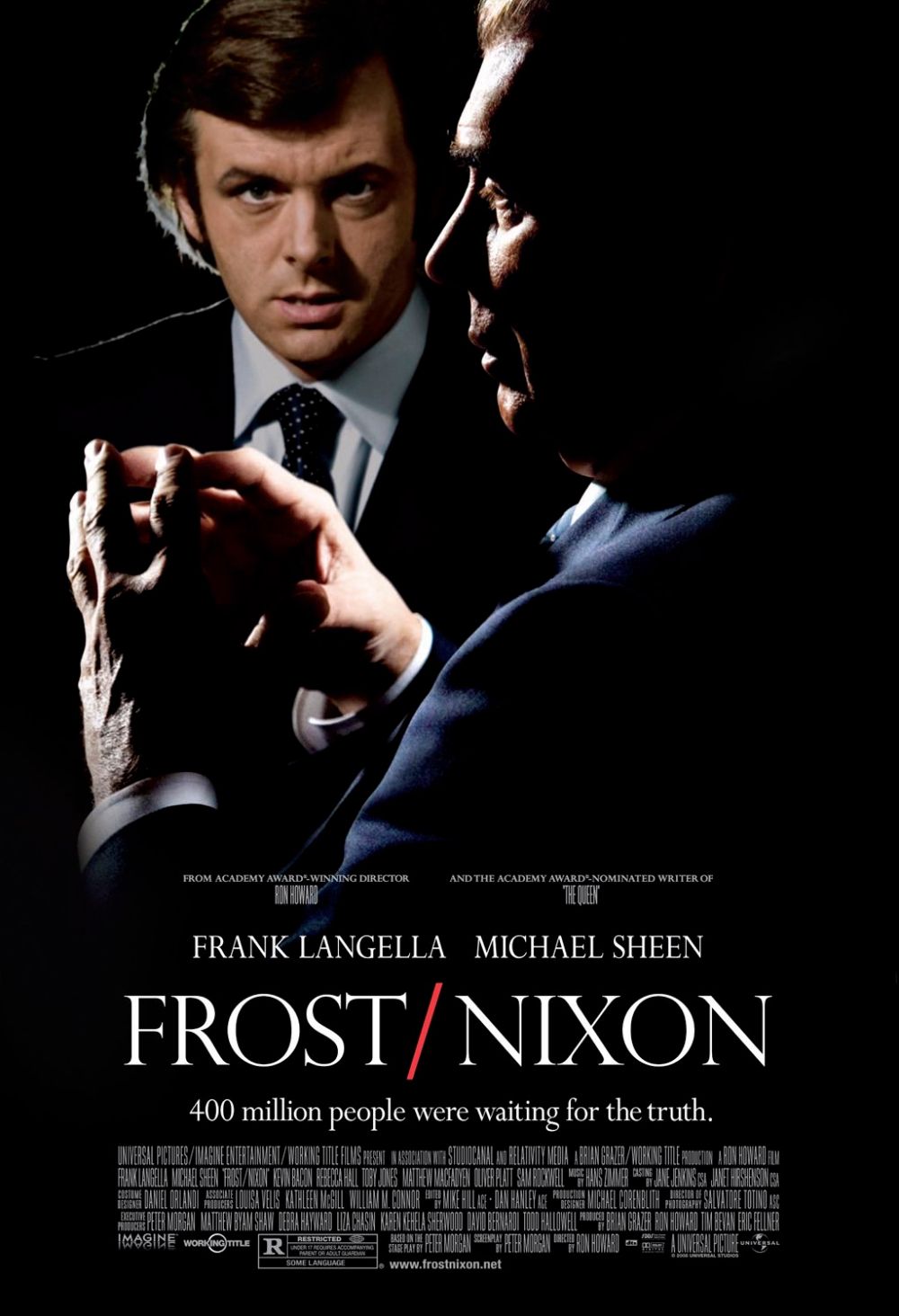
‘Frost/Nixon’ is Ron Howard’s Best Film Since ‘Apollo 13’

10290A_UNI_FNX_DOM1sh_Spread_R4

WRITER’S NOTE: This review was originally written in 2008.

Frost/Nixon” started off as a play which was incredibly well received and went on to have a very successful run on Broadway. It has now been brought to the screen by director Ron Howard, and he ends up giving us one of his best movies to date. Like “Apollo 13,” he takes the outcome of an event which we all know about and he turns it into riveting cinema. Also, unlike John Patrick Shanley who cast different actors in his movie version of “Doubt,” Howard retains the two actors from the original stage production, Michael Sheen and Frank Langella. This is one of the very best movies to come out in 2008, and it makes sense it is coming out at the end of the year instead of the middle of it.

“Frost/Nixon” starts at the point where Nixon has resigned as the President of the United States. David Frost, just coming off of one of his talk shows, sees the image of Nixon waving goodbye before entering the helicopter which took him away from political life forever. When it is gauged as to how many witnessed Nixon’s resignation on television, Frost sees a golden opportunity in attempting to get an interview with Nixon, something which must have seemed incredibly unlikely at the time. Along with his producer John Brit (Matthew Macfadyen), he travels to America to set up the interview with a major network, but they all turn him down. As a result, he decides to fund the whole thing himself at great personal risk, and he and John hire Bob Zelnick (Oliver Platt) and James Reston, Jr. (Sam Rockwell) to prep him for interview and research all the available facts on Nixon.

I liked how “Frost/Nixon” really got into the specifics of how the interviewed was prepped and researched. You might think prepping any interview wouldn’t necessarily be that hard, let alone the interview of a former President of the United States, but it is never as easy as it looks. They prep for months in advance, but Frost’s producer, as well as Bob and James, do most of the grunt work while Frost goes to parties promoting a movie he has worked on. When they finally get around to filming the interview, Frost suddenly realizes the gravity of the situation he has put himself in as the interview may very well destroy his credibility forever.

The movie becomes completely riveting when it focuses on the exchanges between Frost and Nixon in the interview and outside of it as well. Nixon proves to be a smooth operator who takes advantage of Frost as the interviewer appears to be laid back and almost completely oblivious to the seriousness of this interview. We see people from both camps focusing on the interview from other rooms, trying to control what comes out of their guy’s mouth. The intensity immediately increases when Frost starts off the interview with the question, “Why didn’t you burn the tapes?” By that, Frost meant the tapes which all but implicated Nixon’s role in the Watergate scandal.

The last part of the interview these two men do together represents some of the most riveting and intense scenes in any movie of 2008. The fact there are no guns or explosions here says a lot about Howard and the actors managed to accomplish here. The audience, even if they knew the outcome of these interviews, was so intensely drawn into this part of the movie when I saw it at Arclight Cinemas to where you could hear a pin drop during the last exchange, and the gasps from the audience were very audible. I watched it and hoped at the same time that I had remembered to silence my cell phone so it wouldn’t go off during the movie’s final round. It would have destroyed the moment if Daryl Hall & John Oates had started singing “I Can’t Go for That” (my current ring tone) out of my cell phone.

As Sir David Frost, Sheen is brilliant in making him look like a lot of fun to be around without ever seeming overly smug or easily dismissive. His transition from the casual interviewer to Nixon’s grand inquisitor is very convincing, and he makes you feel the increasing stress Frost is going through. Like his close confidents, we desperately want him to get hard on Nixon and not be so soft. When Frost finally does come around, he caps off his interview by getting in Nixon’s face and never backs down from the overbearing stature Nixon imposes on him. Sheen manages to capture all of Frost’s mannerisms and the way he talks without simply impersonating him. Having previously played Tony Blair in “The Queen,” he is great at giving a different face to people we have come to know so well, and in getting at the heart of who they are outside of the media’s perception of them.

With the role of Richard Nixon, I think it’s safe to say Langella gives the performance of his career here. Like Anthony Hopkins in Oliver Stone’s “Nixon,” he never ever tries to impersonate Nixon in this performance. Had he, it would have destroyed his performance and the movie. Langella doesn’t even try to look like Nixon either. What he does instead is dig deep into the heart and soul of Nixon to where he gives the former President a strong sense of empathy. Ever since he came to my attention in Ivan Reitman’s “Dave,” Langella has been the king of quiet menace in just about every movie he has appeared in. The menace of Nixon is always below the surface under the guise of a man always reminiscing about a past he can never get back. When Nixon finally caves in during the last interview he has Frost, Langella gives the man a sorrowful dignity as he realizes what he has done will forever haunt him unless he confronts for what it is.

Langella also makes you believe and understand what Nixon meant when he says no one can ever fully understand what it is like to be President. Nixon is never excused for what he did, nor should he be, but there is some leeway we should give him as he has experienced something the majority of us will never get to experience – being President of the United States. The Oscars better not ignore Frank Langella the same way they ignored Howard for “Apollo 13.”

\Howard almost seems like an odd choice to direct “Frost/Nixon,” and he beat out a lot of directors like Martin Scorsese and Mike Nichols to get the job. It almost seems unbelievable his career has spanned as many decades as it has, but it’s probably because many of us still have the image of him as Richie Cunningham on “Happy Days” burned forever into our heads. His last film as a director was “The Da Vinci Code” which proved to be quite sleep inducing, and yet still made tons of money. It almost made you forget what a great director he can be, and “Frost/Nixon” wakes us up from the Da Vinci coma we fell into unexpectedly.

“Frost/Nixon” is better than you would ever expect it to be, and it is one of Howard’s very best movies to date and one of the very best of 2008.

* * * * out of * * * *

Michael Moore Unleashes the First Trailer for ‘Fahrenheit 11/9’

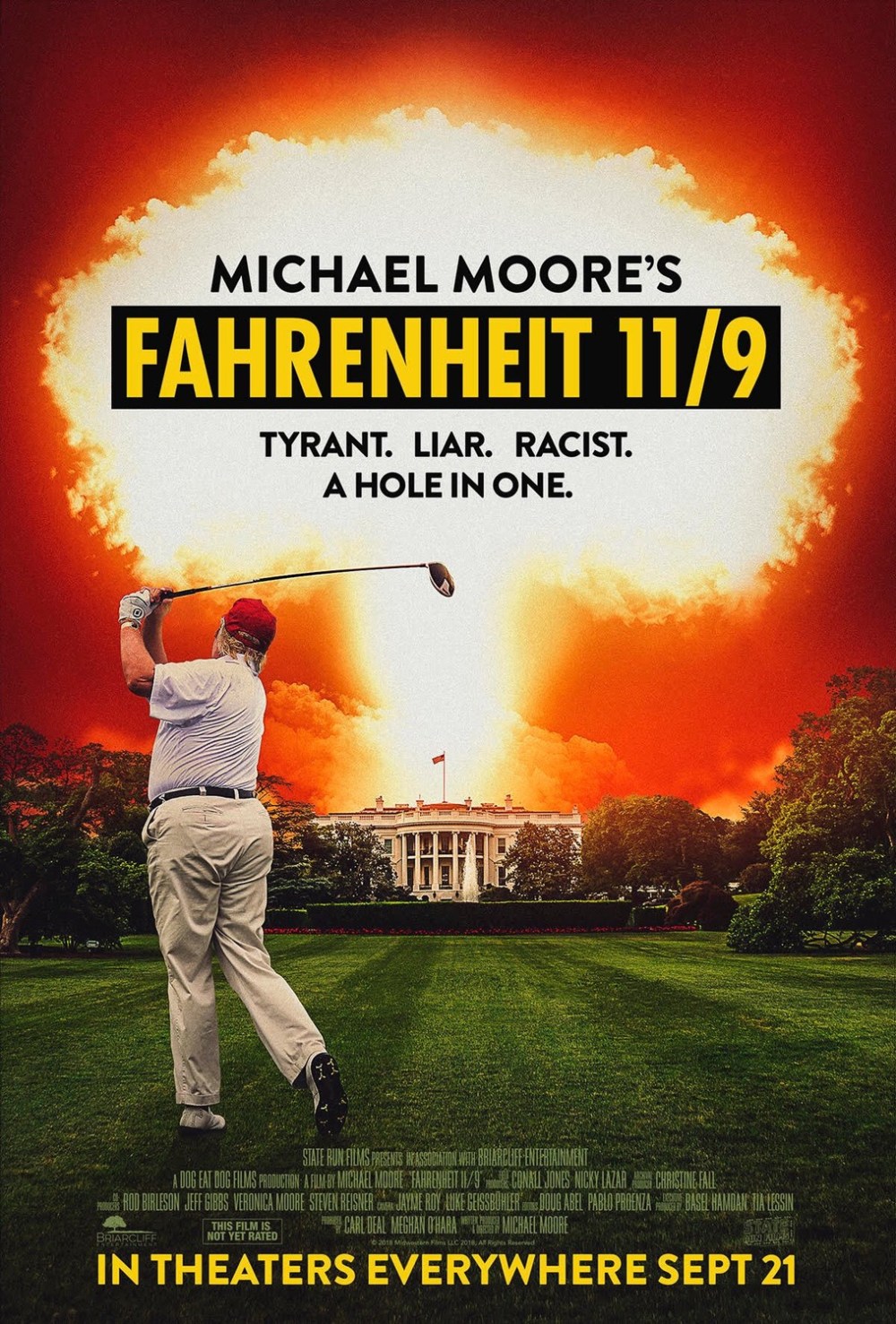
Fahrenheit 119 teaser poster

After witnessing the cinematic debacle that was Dinesh D’Souza’s “Death of a Nation,” I am now eager to watch something which looks at the state of America which actually resembles reality. Looks like I will have to wait only a month for it as Michael Moore has released the first trailer for his latest documentary, “Fahrenheit 11/9.” The title alludes of course to “Fahrenheit 9/11” in which Moore attempted to take down George W. Bush and deny him a second term in the White House, but it also alludes to the date on which Donald Trump captured the electoral votes he needed to become President of the United States. In this trailer, Moore asks the question we were all asking on election night in 2016:

“What the fuck happened?”

We are shown scenes of Trump acting irresponsibly during his campaign, scenes you will never see in any D’Souza movie. There is also a moment where we see White Supremacists burning crosses, and these are a group of people who have become far too emboldened during the Trump administration. But despite the images of doom and gloom Moore gives us here, he does appear to offer a glimmer of hope through his interviews with high school shooting survivor and activist David Hogg and progressive star Alexandria Ocasio-Cortez. And let us be clear, Hogg can in no way ever be considered a crisis actor.

Still, there is political consultant Roger Stone who is caught on camera saying, “Try to impeach him, just try. You will have a spasm of violence in this country like you have never seen!” Considering the tragedy this country witnessed in Charlottesville one year ago, this does seem like a promise people like him can deliver on. All the same, we cannot stay silent or back down.

As dark as this documentary may seem, especially with the image of the American flag made out of matches which are quickly lit to form a visual metaphor of what is happening to this nation, Moore looks to be up to his old tricks as he goes after politicians with a truck of polluted water from Flint, Michigan, and this had me laughing quite a bit. I do have to say, however, that the water looks a little too clean to be from Flint.

Granted, “Fahrenheit 9/11” did not keep George W. Bush from being re-elected (if you want to call it that) for a second term, but here’s hoping “Fahrenheit 11/9” succeeds in stopping Trump and his cronies in their traitorous tracks when it opens in theaters on September 21, 2018.

Check out the trailer below.

Dinesh D’Souza’s ‘Death of a Nation’ is Political and Historical Garbage

Death of a Nation movie poster

I couldn’t wait to see this movie. That’s right, I called it a movie, not a documentary. Dinesh D’Souza wants you to believe he’s giving you the god’s honest truth, but when it comes to his movies, he instead gives you a distorted vision of reality which he has put together by cherry-picking facts and presenting a thesis statement which any rational human being can easily disprove. As a result, I have come to enjoy D’Souza’s movies for reasons he did not intend as they prove to be both hilarious and infuriating, and whenever I am not bored to death by the ridiculous cases he lays out for us, the experience of watching them proves to be quite visceral.

D’Souza’s latest political screed is “Death of a Nation,” and it comes with the strange subtitle of, “Can We Save America a Second Time?” From the poster, I assumed the recently pardoned conservative political commentator was going to show us how Donald Trump is the contemporary equivalent of Abraham Lincoln, but he instead veers from this to show us in an ill-fated attempt how Nazis and Democrats were very similar in their economic and social policies. Along with co-director Bruce Schooley and producer Gerald R. Molen, D’Souza employs his usual tactics which include poorly acted and directed historical reenactments as well as scenes of him walking around and visiting locations which played a role in history. And yes, there are scenes of people (in particular, his wife Debbie) singing patriotic songs to an infinitely nauseating effect. What results is a veritable shit sandwich as D’Souza invites us to see history through his eyes as he begs the audience to see how Democrats are the real fascists, not the Republicans.

I can only imagine just how much glee D’Souza and his collaborators had in the editing room as we are shown scenes of well-known personalities like George Clooney saying out loud how there was no way in hell Donald Trump could ever be elected President of the United States. Indeed, I believed, as did many that Hillary Clinton would have an easy path to victory. So, it was a huge shock to the world at large when Trump scored one of the biggest political upsets in American history as he spent so much time giving us every reason not to vote for him. D’Souza presents videos of Americans sobbing at this victory as they believe nothing good will come from it, and you can sense him mocking them without any remorse. This whole montage really acts a porn for conservative who live to drink the tears of liberals.

D’Souza wants us to see the election of Trump as America rising up against liberal tyranny, and he smugly pats himself on the back by saying his movie “Hillary’s America” played a big role in Trump’s victory. Truth be told, Trump won the election by one of the lowest margins ever, Clinton got almost 3 million more votes in the popular election, and the day of his inauguration had one of the lowest turnouts ever. Of course, D’Souza doesn’t bring these facts up as they would easily take away from he sets out to prove and instead shows us images of Americans howling in agony over the host of “The Apprentice” making his new home at the White House instead of Trump Tower.

As for “Hillary’s America,” it simply preached to an audience who never intended to vote for Hillary in the first place, and its biggest triumph came at the Golden Raspberry Awards where it won several accolades including Worst Picture. Please note, it is the first “documentary” to receive this award.

But following this, D’Souza puts his defense of Trump to the side and instead looks at Adolf Hitler and the history of the Nazi party in a hopelessly vain attempt to compare them to Democrats. As he lays out his pathetic case, I got lost in his convoluted logic to where I gave up trying to understand much of what he was trying to get across. The audience I saw it with was small, and an older guy sitting one row ahead of me began to snore quite loudly. What does that tell you?

The actors here are badly directed to say the least, and the one playing Adolf Hitler (Pavel Kriz) barely even looks like the infamous fascist dictator. I guess Martin Wuttke, who played a far more convincing Hitler in Quentin Tarantino’s “Inglourious Basterds” was unavailable, or perhaps he looked at what D’Souza hoped to accomplish with “Death of a Nation” and told him “bitch, please.” Other actors play famous Democrats to where they stare directly into the camera as if to say they know just how evil they are, and it got to where I expected them to sing “Damn it Feels Good to Be a Gangsta” by The Geto Boys.

Some scenes end up playing like something out of a sitcom as the actors playing Nazis keep screaming out their lines in an overwrought fashion. But nothing compares to the scene where Nazis break into the apartment of a “brown shirt” Nazi and catch him in bed with another man, highlighting the party’s position against homosexuality. After he is arrested and hauled away, the Nazis look under his bed to find yet another man in the apartment. This threatened to be as hilarious as anything in “Deadpool 2,” and I could barely contain myself while watching this scene as this discovery is presented in such an inescapably absurd fashion.

D’Souza does take the time to interview people like political scientist Robert Paxton, Civil War historian Allen C. Guelzo, sociology professor Stefan Kuhl, and syndicated columnist and investigative journalist Edwin Black to name a few. The interesting thing about these interviews is how the majority of them are shot to where we never see D’Souza and his subject together in the same frame. Seeing this, I cannot help but wonder if D’Souza and his accomplices took the words of his subjects out of context in an effort to add weight to a deeply flawed thesis. This makes me want to know how his subjects thought about how they were portrayed after sat through “Death of a Nation.” There is just too much doubt in the way these interviews are presented which cannot be easily dismissed. At least Michael Moore is smart enough to not make this same mistake in his own movies.

Then there is the interview between D’Souza and white supremacist (or white nationalist if you will) Richard Spencer. As D’Souza fumbles about in his attempts to expose Spencer as a progressive, he discusses how the founders saw government as being the enemy of the people. This is one of “Death of a Nation’s” most jaw-dropping moments as anyone with knowledge of American history will be quick to point out how our founding fathers created a government of, for and by the people. We see Spencer quickly disagreeing with D’Souza over this assessment as even he believes the founding fathers did not see the government as the enemy, and it doesn’t help D’Souza when he gets owned by a White Supremacist.

As “Death of a Nation” rolls on, D’Souza comes to repeat many claims he made in his previous movies. Among them is his assertion that Democrats never switched their political views in the past, and he made this same claim in “Hillary’s America.” When he presented us with this false information originally, we could barely make out the faces of the politicians on the silver screen, and we needed the Hubble telescope to make any of them out. In “Death of a Nation,” we get a better look at those democrats D’Souza was talking about, but it doesn’t change how Democrats or Republicans are no longer the same parties they once were.

When D’Souza finally gets around to defending Trump, he does so by presenting us with scenes of President Lincoln (played by Don Taylor) speaking eloquently and then tells the audience how Trump has the same integrity Lincoln had all those years ago. But considering how Trump has been proven to be very temperamental, has broken many promises he made on the campaign trail, cheated on his wife Melania with Stormy Daniels, has a history of stiffing people he was supposed to pay and, most unforgivably, valued the word of Russian President Vladimir Putin over America’s own intelligence community, one has to wonder if D’Souza even knows the meaning of the word integrity. Once again, D’Souza does not acknowledge any of this, and it should not be hard at all to understand why.

D’Souza’s last bit of business is to show how Trump is not a racist, and he does so by showing him at a State of the Union address where he says, “African-American unemployment stands at the lowest rate ever recorded, and Hispanic-American unemployment has also reached the lowest levels in history.” To this, D’Souza replies, would a racist talk like this? Well, there is a slight problem here. While what Trump says is technically true, the fact is unemployment rates for African-Americans and Hispanics have been decreasing steadily for years, so for him to take credit for this is deliberately misleading. For D’Souza to use this as evidence of Trump not being a racist is just hilarious, and he instead falls into a trap he would have been smart not to set for himself.

Look, I have no doubt D’Souza loves America, but for him to show this love through a manipulation of history and facts is beyond deplorable. These days, it is more about who controls the narrative than it is about verifying facts, and D’Souza seizes on this national weakness in a completely shameless way. “Death of a Nation” is a failure from the get go as it is impossible to put liberalism and fascism into the same category. Just ask historians Adam Tooze and John Broich who have gone out of their way to discredit “Death of a Nation.” Broich himself pointed out how fascism is essentially “anti-leftism,” and he quotes scholar Robert Paxton who said fascism is “dictatorship against the Left amidst popular enthusiasm.” Unlike D’Souza, these guys know what they are talking about.

“Death of a Nation” still has a score of 0% on Rotten Tomatoes, and it does not look to escape this rotten rating any time soon. D’Souza has blamed this rating on “leftist” critics as he is determined to stand by his movie no matter what, and he is daring the Golden Raspberry Awards to shower it with every “Worst of” accolade possible. Look, it’s one thing to criticize the Democratic Party, and D’Souza has the right to do so, but to sell the public on comparisons to the Nazi party which are blatantly fale is truly pathetic. Explaining to D’Souza just how wrong he got history in this or any of his other movies is pointless as he will be quick to put his hands over his ears and spin around in circles saying, “There’s no place like the Ronald Reagan Library! There’s no place like the Ronald Reagan Library!”

How will D’Souza react to my review, assuming any he ever bothers to read it? I imagine he will dismiss me as another leftist critic or something along those lines. Anyone who wants an idea of where my political beliefs are can check out my Facebook page. All that matters is this movie is anti-intellectual as well as political and historical garbage. Yes, I enjoy watching D’Souza’s movies, but mainly for the opportunity to analyze everything that’s wrong with them. When I get past the unintentionally hilarity they provide me, what I am left with is pure nonsense which is truly infuriating. If you choose to see “Death of a Nation,” see it as an example of how NOT to make a documentary and of how people will go out of their way to manipulate history to their own ends.

For those of you who are still willing to believe in D’Souza’s political and historical garbage, I have a used Yugo for sale which goes from zero to 60 miles an hour in five seconds. Please message me privately if you would like to know more.

ZERO out of * * * *

Please check out the following articles in which writers lay waste to the connections D’Souza makes in this movie:

“There is Nothing Liberal about Fascism” by John Broich

“Donald Trump Jr. Compares Democrats’ Policies to Those of the Nazis” by Andrew Buncome

“The Apotheosis of Dinesh D’Souza” by 

Kevin Kruse’s Recapitualation of Dinesh D’Souza’s View of American history

‘Christopher Robin’ Has Enough Childlike Wonder to Make it Worthwhile

Christopher Robin movie poster

Christopher Robin” has been compared by many to Steven Spielberg’s “Hook” even before its release. Truth be told, this comparison holds a lot of weight as both films deal with characters we were introduced to as children who have since grown up and left behind the imaginary worlds they reveled in. Both get married and become parents, and we catch up with them as they have long since become consumed by their jobs at the expense of everything else. The question is, can they rediscover the innocence and wonder they once had? We go into these movies knowing the answer will be yes, but we how long will it take? In the case of “Christopher Robin,” this man is quicker than Peter Pan to do so, and this makes the film fare better than “Hook.”

The movie starts off with young Christopher (played by Orton O’Brien) being given a going away party by his furry friends in the 100 Acre Wood as he is about to head off to boarding school. Among his friends is, of course, Winnie-the-Pooh whom he promises never to forget about once he goes away. But as the opening credits unfold, we see Christopher being molded into what society expects of him. Seeing a teacher slam her ruler on his desk quickly brought to mind the lyrics of a certain Pink Floyd song (“we don’t need no education…”). Even worse, he loses his dad much sooner than anyone should, and this forces him to grow up much quicker as he is now considered to be the man of the house. And there is the sequence of him as a soldier on the battlefield, and while it does not include any exploding limbs a la “Hacksaw Ridge” (it’s a Disney film after all), we are shown enough to be convinced Christopher has seen his share of brutal combat.

When we catch up with Christopher as an adult (played by Ewan McGregor), he is married to the lovely Evelyn (Hayley Atwell), father to Madeline (Bronte Carmichael), and an employee at Winslow Luggages. It is no surprise to see he has long since become consumed by work as he makes the mistake of telling his boss, “I’ll do anything for this company.” Now this is something I have long since learned never to tell any employer as they will be quick to blackmail you emotionally, and this is compounded by Christopher’s co-workers constantly living in fear of unemployment. As a result, Christopher is forced to cancel his trip into the country with his family, and they do not even try to hide their disappointment to where Evelyn flat out tells him, “I haven’t seen you laugh in years.” Christopher ends up all alone, that is, until Pooh arrives in London seeking his helps. Pooh has lost all his friends in the 100 Acre Wood, and the two go on a journey which serves to save both of them from a world without love and imagination.

“Christopher Robin” is at its best whenever McGregor and Pooh bear share the screen together. Unforgettably voiced by Jim Cummings, the “silly old bear” remains one of the most lovable creations in literature as he keeps saying he doesn’t have much of a brain, but he proves to be full of Yoda-like wisdom throughout. Instead of being animated this time out, Pooh and his friends are brought to life through CGI effects to more closely resemble the actual toys A.A. Milne owned all those years ago. But as amazing as the effects are, it is Cummings who gives Pooh his heart and soul as he professes to Christopher how “doing nothing often leads to the very best kind of something.”

When it comes to the other furry friends from the 100 Acre Wood, some get more screen time than others like Tigger and Eeyore. Those who know me best know I am a die-hard Eeyore fan, and just as with the animated “Winnie-the-Pooh,” the infinitely depressed donkey steals the show thanks in large part to the vocal talents of Brad Garrett who gives Sam Elliott a run for his money in the baritone department. Eeyore has always been a wonderful supporting character in Milne’s stories as he marches on despite his gloomy state of mind, and Garrett makes him a source of incredibly dry humor throughout. Now if only Eeyore could get his own movie…

Directing “Christopher Robin” is Marc Foster, who at first seemed like an odd choice for this material. Foster previously gave us the devastating “Monster’s Ball,” the James Bond adventure “Quantum of Solace,” the Brad Pitt zombie movie “World War Z,” and “Machine Gun Preacher” (the title says it all). Perhaps it was his film “Finding Neverland” which snagged him the job as that one was about J. M. Barrie and his relationship with a family who inspired him to create “Peter Pan.” Like J.M. Barrie, Christopher is shown here to be a lost soul who needs to regain his sense of wonder before he becomes just another corporate drone. Foster navigates Christopher’s journeys through worlds real and imagined to where we are eager to see regain his sense of wonder, and he looks to remind us of the child within ourselves who hopefully has not been obliterated by society.

Along with cinematographer Matthias Koenigswieser, Foster gives “Christopher Robin” a rather bleak look which recalls the dirty visuals Spielberg gave “Hook” as the imagined world of 100 Acre Wood proves to be vert foggy and not as inviting as it once was. It’s like “Return to Oz” in which Dorothy travels back to the magical world she left behind, only to find the yellow brick road has been ravaged to where you wonder if it will ever be put back together again. Part of me wishes the filmmakers had worked a little harder to balance out the different worlds Christopher and his friends travel in an out of as this movie looks a little bleaker than it needs to. In the process of delving into Christopher’s life in the city as an adult, it threatens to provide more muted colors than luminous ones.

The story hits all the beats you would expect it to as, like “Hook,” we have a good idea of how things will end up. We know Christopher will eventually come to see how his family is a far more precious commodity than anything else, and things are resolved in ways which are not completely satisfying. Granted, Disney would never be quick to allow Foster or anyone else to make “Christopher Robin” a tragic tale of a man who discovers too late what he had after losing everything to where he becomes a real-life Eeyore. Plus, there’s all the merchandising to think about. But for what it’s worth, the performances by McGregor, Atwell and Carmichael succeed in keeping this motion picture from becoming an exercise in shameless manipulation. The cast, whether they are acting or voicing their characters, more than rise to the occasion to where the human element of this movie is never lost.

“Christopher Robin” pales in comparison to “Goodbye Christopher Robin,” one of the more underrated films from 2017. Granted, the latter is more of a biographical film as it deals with the real life A.A. Milne and of how he inadvertently robbed his son of his childhood, but the balance between the real world and imagination felt much stronger in that one. Still, I enjoyed “Christopher Robin” for what it was, and seeing Pooh, Eeyore and Tigger brought to life through CGI made this all the worthwhile for me. When it comes down to it, the moments Christopher shares with his cuddly friends really warmed my heart. While some let the child within them die, you have to admire those who succeed in keeping that part of themselves alive as it is never easy.

While watching “Christopher Robin,” I was reminded of what Stephen Rea said in Neil Jordon’s “The Crying Game:”

“When I was a child, I thought as a child. But when I became a man, I put away childish things.”

Here’s hoping we never put away those childish things away permanently, Oh, and by the way, adults carrying stuffed animals is not a sign of mental illness. Trust me, I have been proving this wrong for years.

* * * out of * * * *

Christopher Robin Eeyore poster

Danny Boyle’s ‘Slumdog Millionaire’ Takes Us on a Journey We Do Not Often Go On

Slumdog Millionaire poster

WRITER’S NOTE: This review was written back in 2008.

Some of the best movies take us to places we most likely have never been to before. “Slumdog Millionaire” is one of them as it invites us to travel through different parts of India from the poor towns to the set of the country’s own version of “Who Wants to Be A Millionaire.” The movie starts off with our main character, Jamal Malik (played as an adult by Dev Patel), being interrogated by the police because they believe he is guilty of cheating on the infinitely popular game show. No one can believe a slum kid like him could do so well without having the answers in advance. As the police get to the bottom of how Jamal has succeeded up to this point, the movie flashes back to his childhood as we see how his answers represents the journey he has taken so far. We soon discover his motivation to be on the show has nothing to do with money, and this is regardless of how he is on the verge of either winning a fortune or losing it all.

The movie flashes back to when Jamal was a boy where he and his brother Salim are suddenly orphaned and forced into surviving on the streets by stealing goods to sell and conning naïve tourists (naïve American tourists always turn out to be the best targets) by giving them tours of the Taj Mahal which are anything but factual. During their travels on one homeless night, Jamal sees a young girl all alone in the rain whom he quickly invites to where he and his brother Salim are sleeping. From there, a relationship emerges which becomes Jamal’s one real reason to live.

I have to tell you, Danny Boyle really surprises and amazes me as a filmmaker. Every movie he makes is almost completely different from the one he gave us beforehand. Boyle first gave us “Shallow Grave” which showed us a severe paranoia among a trio of roommates, and then he gave us one of the seminal drug addiction movies with the brilliant “Trainspotting.” From there, he went Hollywood with “A Life Less Ordinary” and “The Beach,” both of which almost made us forget what made him so good in the first place. Then he went the independent route and reinvented the zombie movie genre with “28 Days Later” which he shot in digital and made for dirt cheap. After that, he made a family movie with “Millions” where a couple of young boys come across a big bag of money thrown off of a train and find creative ways of giving the money away. As you can see, Boyle has become an incredibly unpredictable filmmaker, and it shows how determined he is not to repeat himself.

“Slumdog Millionaire” seems to have come out of nowhere, and I didn’t even know Boyle was working on it. He appears to have fallen in love with the lives and culture in India and of everything which has come out of it. While it is portrayed as a place with much squalor many third world countries are forced to deal with, there is a beauty to it as we see different types of people and cultures coming together in ways not easily accomplished. Along with director of photography Anthony Dod Mantle and India co-director Loveleen Tandan, Boyle gives the town of Mumbai a beauty and vibrancy you don’t see in other places as it goes from a poor town to a city growing bigger by the minute.

The story itself is very familiar to as it is one of boy meets girl, boy loses girl, boy finds girl as we see Jamal never stops thinking about Latika (played as an adult by the lovely Freida Pinto) and yearns to find her wherever he goes. She makes his life worth living, and she gives Jamal something to fight for. But unlike a lot of bland Hollywood romantic comedies, it is not at all manipulative or just about rich white people. It is about people coming up from nothing and supported by a cast which does not have a single weak performance in it as the emotions and actions of its characters never feel less genuine.

The other great thing about “Slumdog Millionaire” is how it becomes even more suspenseful and thrilling as it heads towards its final act. The ending had me on the edge of my seat and quickly reminded me of what an exciting game show “Who Wants to Be Millionaire” can be.  Anil Kapoor plays the Indian host of the show, Prem Kumar, and he is basically the anti-Regis Philbin. Prem playfully insults Jamal as he finds out his job involves serving people tea while everyone works at their cubicles. He taunts Jamal into believing he will win because of the trust he has in him, but Jamal keeps his cool even while he has a hard time breaking a smile on television.

Boyle gives the movie a big advantage by casting unknowns here, and they are all wonderful. If he were forced to cast big name stars, I’m not sure “Slumdog Millionaire” would have had the same effect it does here. This one could have ended up like any other romantic movie ever made which would have been a shame considering the passion which went into the making of it. The movie succeeds in showing specific details of the world these characters inhabit, and it sucks us in almost immediately. The actors in the movie don’t act their roles as much as they inhabit them, and this makes their scavenging adventures all the more interesting.

Dev Patel is perfectly cast as Jamal as he never overplays his part or simply acts out the emotions. The same goes for the rest of the cast including Madhur Mittal who plays the adult Salim whose life has taken a different direction from Jamal’s as he heads into a life of crime to where he is employed by a `big-time drug lord in Mumbai.

Along with a great soundtrack I will most certainly purchase when it comes out on CD, “Slumdog Millionaire” is one of 2008’s most memorably exuberant movies which at its heart is a love story. While many of us come into love stories with a deep cynicism, this one gives you believable characters you root for and never want to see separated. Fox Searchlight plans to make this movie this year’s answer to “Juno” or “Little Miss Sunshine,” but don’t let any potential backlash keep you from seeing it as it a big heart and will excite you in a way many movies like this often don’t.

* * * * out of * * * *

‘Vicky Cristina Barcelona’ Challenges Our Views on Love and Romance

Vicky Cristina Barcelona movie poster

WRITER’S NOTE: This review was written back in 2008.

Vicky Cristina Barcelona” is easily the best Woody Allen movie I have seen in a long time. There is no shaky camera work to induce nausea here, and the story is never boring for one second. There is also none of those Woody Allen-isms we are all so tired of, probably because Allen himself chose not to act in this movie. Instead, he gives us a great cast of actors to bring his material to life, and he sets his story in the beautiful country of Spain. With cinematographer Javier Aguirresarobe, he makes the different areas of Spain so inviting to where you just want to jump on a plane and fly over there right now. If only plane tickets weren’t so damn expensive. Oh yeah, I have a job too. Damn!

The movie starts off by introducing us to Vicky (Rebecca Hall), a graduate student who is engaged to be married, and Cristina (Scarlett Johansson), a woman who just filmed a short feature and recently broke up with her boyfriend. They are best friends who take a vacation to Spain, and they agree on just about everything except when it comes to love. Whereas Vicky is reserved in the ways of love, Cristina is impulsive and spontaneous. While Vicky seems sure of what she wants, Cristina is unsure of what she wants from a lover or from life. The ways of these two women are put to test when they meet Spanish artist Juan Antonio (Javier Bardem). Juan casually comes up to them while at a restaurant and offers to take the two to Oviedo in the next hour where he says they will have great fun, drink fine wine and eventually make love. Cristina is all for going, but Vicky wants nothing of it due to her impending marriage. But of course, she goes to keep Cristina company. What happens from there will or will not change the way they feel about love in general.

Into this mix comes Juan Antonio’s ex-wife, Maria Elena (Penelope Cruz), who wishes she knew how to quit her ex-husband. Maria comes back into Juan’s life after Cristina has moved in with him, and she is unstable to say the least. From there, who knows what will happen. This is what I really liked about the “Vicky Cristina Barcelona;” It was very absorbing, and I had no idea what was going to happen next. I can’t say this about most movies I see these days.

Like I said, the cast is superb. I wish I had the power over women Bardem has over the female characters here. This is quite a switch from his Academy Award winning role as Anton Chigurh in “No Country for Old Men,” and this movie affords him a better haircut as well. Bardem succeeds in showing you how passionate his character is, and how unfulfilled his passion is.

Scarlett Johansson, Allen’s muse at the moment judging from the number of movies they have done together so far, is excellent as usual. Johansson plays an adventurous person who throws caution to the wind, but the actress also allows us to see the vulnerable side of Cristina which reveals her to be insecure as she has no idea of what she really wants out of life.

The most underrated performance of this movie, however, belongs to Rebecca Hall, whose dalliance with Juan Antonio creates conflicted feelings within her character which come across so clearly without her saying a word. Hall’s face does a lot of the acting for her while her words betray what Vicky thinks about what her heart truly desires. She has a loving fiancée, but he is nowhere as romantic as Juan. Of course, who would be? One important lesson for prospective husbands to be; make sure your fiancés don’t meet up with any Spanish men because you will never be able to compete with them. This will especially be the case if you are a banker.

But leave it to the Spanish actors to steal this movie away from everyone else. We already talked about how great Bardem is, but let’s talk about the passionate fireball that is Penelope Cruz. For years, she was stuck in American movies which dealt more with her looks more than her talent. Plus, she was constantly being accused of messing up relationships with married movie stars which was unfair to say the least. Ever since abandoning those movies, her talent has shined brightly in acclaimed films like “Volver.” Cruz is an uncontainable force in this movie, and she takes her characters from highs and lows which feel very believable and never overdone. The relationship between her and Bardem in this movie is easily the most complicated and most infuriating for them both. As Juan correctly points out, “We are meant for each other, and we are not meant for each other.”

The theme of the movie is love and what it does to us when we go after it, and of what it does to us after we think we have it. The one thing these characters have in common is the search for true love feels like a never-ending journey for them, and that’s even if you are with the person you love. It’s a beast which seems far more likely to hurt people instead of making them happy. There are a lot of thoughts here on love which makes “Vicky Cristina Barcelona” one of the more thought-provoking movies I have seen so far in 2008. There is a lot of comedy to be found here, but the movie is mostly a sad story of how love seems to be just out of our grasp. Even if you have the love you need in life, there is always something missing.

What I really loved about the comedy here is how none of the actors ever try to play the joke or attempt to be funny. The humor comes out of the absurd way the characters interact with each other. There is a brilliant moment where Maria tells Cristina how she had to go through her suitcase because she didn’t trust Cristina and that she wanted to know more about who is making out with her ex-husband. The scene is played in all seriousness, even when Cruz talks about how she has thoughts of killing Johansson, and it is hysterical.

“Vicky Cristina Barcelona” is a very unusual Woody Allen movie. While it deals with themes which are very familiar to ones he has dealt with in the past, it does not feel like your typical Woody Allen movie. That is a major plus because most of his movies have an overwhelming feeling of familiarity which threatens to take away from the proceedings. But by putting his thematic material in another country with a terrific cast, this is one of those movies which reminds you Allen can still pull off a great movie worth seeing. For once, I am eager to see what he will do next. He’ll probably go through the regular ups and downs, but he has clearly learned some hard lessons from the movies he did back in the 1990’s.

* * * * out of * * * *

Soundtrack Review: ‘The Man with One Red Shoe’

The Man With One Red Shoe soundtrack cover

Anyone remember the action comedy “The Man with One Red Shoe” from 1985? It starred Tom Hanks as Richard Drew, a concert violinist who is picked out at random from a crowd to become the target of CIA surveillance. It also features one of my all-time favorite film scores by Thomas Newman, a composer who has given us many unforgettable scores like “Scent of a Woman,” “The Shawshank Redemption” and “Skyfall.” But like many film scores I loved from the 1980’s, this one never got a commercial release, and I was relegated to recording sections of the music from a VHS tape onto an audio cassette. While the dialogue threatened to get in the way, I was determined to enjoy this music any way I could get a hold of it.

But now, 33 years later, La La Land Records has now made Newman’s score to “The Man with One Red Shoe” available as a limited-edition CD. I have been waiting for this soundtrack with extreme patience, and it proved to be well worth the wait as this classic 1980’s score has never sounded better. Seeing the iconic image of the red shoe with a lit fuse on the cover made me want to buy this soundtrack yesterday. The back-cover features Hanks being hugged by the gorgeous Lori Singer while on a bicycle, and it makes me just as envious of him as when this movie first came out. And when you take the disc out, you will see a picture of the late Carrie Fisher who co-starred as Paula. Carrie, you are still missed.

Ever since I first watched the trailer for “The Man with One Red Shoe” on television, I quickly fell in love with its main title. It’s a classic 1980’s theme, and it sounded ever so cool. Listening to this theme, it made me want to walk around town like I was a spy. Granted, I was ten years old when this movie was released, so my imagination was unfettered by the harsh reality of the real world.

While I have long been led to believe Newman’s score was completely electronic, there’s actually a good deal of instrumentation involved in it as well. You can hear this in a number of the tracks throughout. Listening to this soundtrack reminded me of just how much I dug what Newman came up with, and in retrospect it proved to the world what a unique film composer he could be.

La La Land Records has included liner notes written by Jeff Bond entitled “How Thomas Newman Got His Groove On.” A portion of the notes deal with this movie’s making and of how it was released in a time when Hanks was best known as the star of the sitcom “Bosom Buddies,” long before he became the prestigious Oscar winning actor we all know him to be these days. In regards to Newman’s score, Bond described it best in this paragraph:

“Sonically, ‘The Man with One Red Shoe’ not only evokes the jazz fusion/pop electronica vibe of 1980’s popular music, but also presents the distinctive musical voice of composer Thomas Newman at a pivotal point in his development as an up-and-coming talent.”

The liner notes do not go into how the movie was ill-received upon its release with both critics and audiences, or that Hanks himself admitted this is not one of his films he would be quick to put into a time capsule. Nevertheless, I cannot recommend this limited-edition release of “The Man with One Red Shoe” soundtrack highly enough. As far as I am concerned, it was well worth the wait, and having it in my soundtrack collection makes it feel more complete than it already is.

Now, if someone could put out limited edition of Newman’s “Gung Ho” score, all will be right in the world.

Click here to find out how you can order a copy of “The Man with One Red Shoe Soundtrack.”