The opening credits to “Superman” and “Superman II” are among the best when it comes to movies. When Bryan Singer used this format for his “Superman Returns,” it felt like the return of a friend who had been gone for far too long, and the theme by John Williams is among the finest he has ever composed.
But then came “Superman IV: The Quest for Peace,” a sequel which was supposed to put this movie franchise back on track after the critical and commercial disappointments of both “Superman III” and “Supergirl.” Instead, we got a sequel which quickly became labeled as one of the worst motion pictures of all time. With the Salkind family abandoning the franchise and Cannon Pictures taking over, the budget got slashed in half do to their money problems, and everything came to look liken nothing but bargain basement deals or useless stuff which had been long since thrown in the trash.
As soon as the opening titles for “Superman IV” begin, we know it is going to be a rough ride even as Williams’ famous theme, conducted this time by Alexander Courage, is not enough to make our spirits soar. Even co-screenwriter Mark Rosenthal, whose audio commentary for this sequel I highly recommend, is quick to say the following in his opening remarks:
“You can tell from the very first credit that says Warner Brothers that something is terribly wrong in Metropolis.”
This is the Wal Mart, 99 Cent Store or Dollar Tree of opening credits as they look ridiculously cheap in ways the ones for the previous installments never did, and this proved to be quite the shock. Then again, perhaps they fit this sequel perfectly as the visual effects and sets look every bit as cheap as the opening titles. Watching them is heart breaking as they make clear that it is all downhill from here. No wonder this sequel was such a big bomb at the box office.
If you must, please feel free to check out the opening titles to “Superman IV: The Quest for Peace” down below:
When I started thinking of writing about my favorite opening credits to movies, the first which came to mind were the ones for “A Few Good Men.” Directed by Rob Reiner, it is based on the play by Aaron Sorkin who also wrote the screenplay, and it is about the court-martial of two United States Marines who have been charged with the murder of a fellow Marine. Furthermore, it deals with the difficulties the lawyers are forced to endure in their defense, but you knew this already as the film stars Tom Cruise, Demi Moore, Jack Nicholson and Kevin Bacon among others.
What I love about these opening credits is the military exercises, or choreography if you will, by the Marines on display. They were performed here by the Texas A&M University’s Corps of Cadets Fish Drill Team, and I was enthralled at how in sync each member of this team was with the other. Throughout, they all move and react in a uniform way to where there is no weak link in the bunch. These military officers have been trained thoroughly to act as one unit, and it shows here as not one of them misses a beat throughout their exercises. They do not even have to look at one another to make sure they are in sync as all of them move like a well-oiled machine.
The drill these Marines perform during the opening titles hang over the rest of “A Few Good Men” as the film deals with many characters who are forced to deal with the death of a recruit whose passing has now put this platoon completely out of sync. The unity is now broken, and it may be a permanent break unless those in power can fix the situation to where everything is back in balance. But what will it take to put this platoon back to a unifying standard While some suggest charging the two marines with murder, others come to see they were only acting under orders by their superiors who had a different, yet illegal, way of bringing order to chaos. The whole movie, in essence, is about bringing an unbreakable unity back to a military system which has been seriously run off course by those whose powers have long since become corrupt.
Please check out the opening titles of “A Few Good Men” down below:
I will never forget the first time I watched this Gaspar Noe film. “Enter the Void” was screening at the Laemmle Sunset 5 (which has since become another AMC Dine-In Theater), and I had been very, very eager to check out his long-awaited follow-up to his powerful and devastating “Irreversible.”
Noe has always been a playful filmmaker when it comes to title credits, regardless of whether appear at the start or the end of his works. “Irreversible” started with the end credits and went backwards from there, “Climax” did not dare to reveal its title until the film’s final moment and spread its opening credits throughout, and “Vortex” started with its end credits in a solemn fashion which indicated we would be following a pair of characters to their last dying breath.
With “Enter the Void,” Noe zooms through the end credits super-fast to some hypnotic sound which acts like a flashing light. Once they are finished, he thrusts int the opening credits which look like they came out of some kind of modern disco while the song “Freak” by British electro artist LFO plays loudly over the speakers. This is Noe’s way of telling the audience they were about to go on quite the cinematically visual ride.
The opening titles of “Enter the Void” are among my favorites as they are unlike any others I have seen before and after it. Seeing the different visual styles employed for it is endlessly fascinating as it made me wonder just how many styles they came up with. When it comes to LFO’s “Freak,” it proves to be the perfect music cue to score these titles. And when these titles concluded to where we came to “enter” this motion picture, the small but attentive audience at the Sunset Laemmle, including myself, burst into applause. Opening titles are never quite this exhilarating when it comes to your average motion picture.
According to Noe, “Enter the Void” was screened at various film festivals without any titles, be it opening or closing. The title logo was designed by German experimental filmmaker Thorsten Fleisch, and the opening titles were designed by Franco-Japanese filmmaker and designer Tom Kan whose other works include “The Matrix Reloaded” and “The Matrix Revolutions,” “Speed Racer” and “Cloud Atlas.
For years now, motion picture opening credits have increasingly become a lost art form as filmmakers want to hit the ground running and leave all the credits to the very end. But while audience members are quick to exit the theater to take care of their ever-growing urine aches, it feels like increasingly shameful that filmmakers are less and less interested in giving their works a prologue which helps to illustrate the cinematic stories audiences are about to take in.
Now when it comes to my favorite opening titles, the first one which comes to mind is for “Seven,” David Fincher’s 1995 film which proved to be his true big breakthrough. Things start off with us being introduced to Detective William Somerset (Morgan Freeman), a veteran homicide detective on the verge of retirement, and his partner and eventual replacement David Mills (Brad Pitt). From there, we watch Somerset try to fall asleep in his bed to the sound of a metronome, and the sound of the metronome is constantly overwhelmed by the violent sounds coming from the streets outside of his apartment.
After this, the opening titles, which I did not expect “Seven” to have, began, and they were done to a remix of the Nine Inch Nails song “Closer” which was entitled “Precursor.” Right from the start, they serve as an introduction to the main antagonist known as John Doe who commits murders based on the seven deadly sins. The way Fincher saw it, these titles were a way of introducing the audience to this character’s perverted state of mind, and there was no forgetting this throughout the rest of the film.
I love the shakiness of the credits as they illustrate the deeply disturbed mindset of John Doe as he writes in his journals and attaches pictures of people who are either his intended victims, those he has already harmed in an inescapable way, or those young ones whom he would prefer not to witness the bloodiness of what he is doing.
These opening titles captivated me from the get-go as they were unlike any that I had ever previously seen in other motion pictures. They were designed by Kyle Cooper whose other credits include the titles to “Home Alone,” “Passenger 57,” “Carlito’s Way” and the acclaimed television series “Homicide: Life on the Street.” Cooper was assigned by Fincher to create a montage reflecting the disturbed perspective of John Doe. The images presented here hang over everything else we come to see in “Seven” as the film heads towards a climax which proves to be utterly devastating.
It should also be noted that the opening titles to “Seven” were filmed over the course of eight days and cost around $50,000 to complete.
Please feel free to check out the opening titles of “Seven” down below:
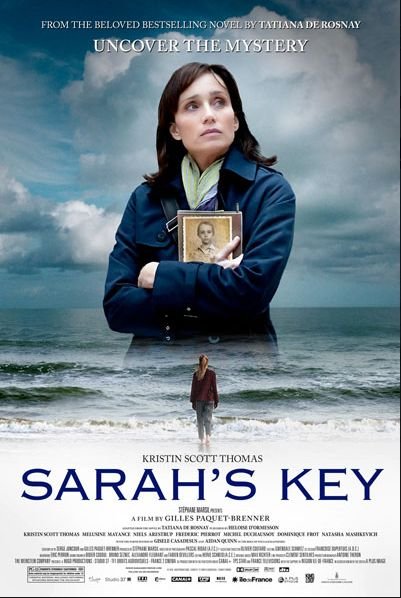
“Sarah’s Key” is what some would say is yet another movie dealing with the Holocaust and its impact on us all, but do not be fooled into thinking it is going to be the same old thing. Based on the novel “Her Name Was Sarah” by Tatiana de Rosnay, it ventures into this dark part of history from a different perspective as we watch the French army and bureaucracy aiding the Nazi party as they rounded up Jews and shipped them to Auschwitz; this event was called the Vel’ d’Hiv’ Roundup. As the story moves back and forth in time from 1942 to 2009, American journalist Julia Jarmond (Kristin Scott Thomas) works to solve a decades-old mystery which can no longer remain hidden, and these days we are all sick of things remaining hidden.
In 2009, Julia has moved into an apartment with her French husband and teenage daughter. She had previously written a celebrated article about the Vel’ d’Hiv’ Roundup, and he soon learns her husband inherited the apartment from his grandparents who came into possession of it during the 1940’s. From there, she becomes obsessed in learning about the apartment’s history, and she learns it was the scene of an unspeakable incident. Finding out the truth about this incident, however, proves to be extremely difficult as her family sees it as too damaging to reveal to the world at large.
Julia’s main focus is centered on a young girl named Sarah Starzynski (Mélusine Mayance) who hid her little brother Michel in a closet to keep him from getting rounded up by the Nazis along with everyone else. She makes him promise to stay in the closet until she returns, and she takes with her the only key which can unlock it. But Sarah soon realizes no one will be going back home anytime soon, and she escapes her captors in a desperate attempt to save Michel before it’s too late.
Like Stephen Daldry did with “The Reader,” director Gilles Paquet-Brenner makes the transitions between the past and present feel seamless to where it never feels jarring. He also avoids turning “Sarah’s Key” into a schmaltz fest begging for Oscar consideration which is quite the relief. By getting naturalistic performances from the cast, he creates an atmosphere which feels real and not exaggerated for effect. You end up getting caught up so emotionally in the story and its characters to where you do not feel like you’re watching just any motion picture.
Thomas is an amazing actress who never gets the same acclaim actresses like Meryl Streep or Viola Davis do on a regular basis. Maybe it is because her acting is not as theatrical, but Thomas’ strength is in inhabiting characters to where you never catch her acting. She pulls off a flawless American accent to where she makes the act look effortless, and she speaks fluent French ever so beautifully.
Attention must also be paid to Mélusine Mayance who gives a very believable performance as the young Sarah. Called upon to portray a child going through horribly nightmarish circumstances, Mayance holds her own amongst the adults, and she breaks your heart through her utter commitment to the character she portrays. Throughout, she makes you share Sarah’s desperation in getting to her little brother before someone else does, and she makes you feel her accomplishments and disappointments in every which way.
“Sarah’s Key” is one of those movies I find it hard to find any fault with it. Everything seems to fit together perfectly, and nothing ever appears superfluous to the story. While it treads the well-worn ground of Holocaust movies and of what happened to millions of Jews, it finds an interesting angle by looking at the complicity of the French in this atrocity. It never did get much of a release as it spent little time in theaters near you, and you will probably be hearing about it more about on physical and digital media. Here is hoping that it finds a bigger audience than the one it has already gotten to date.
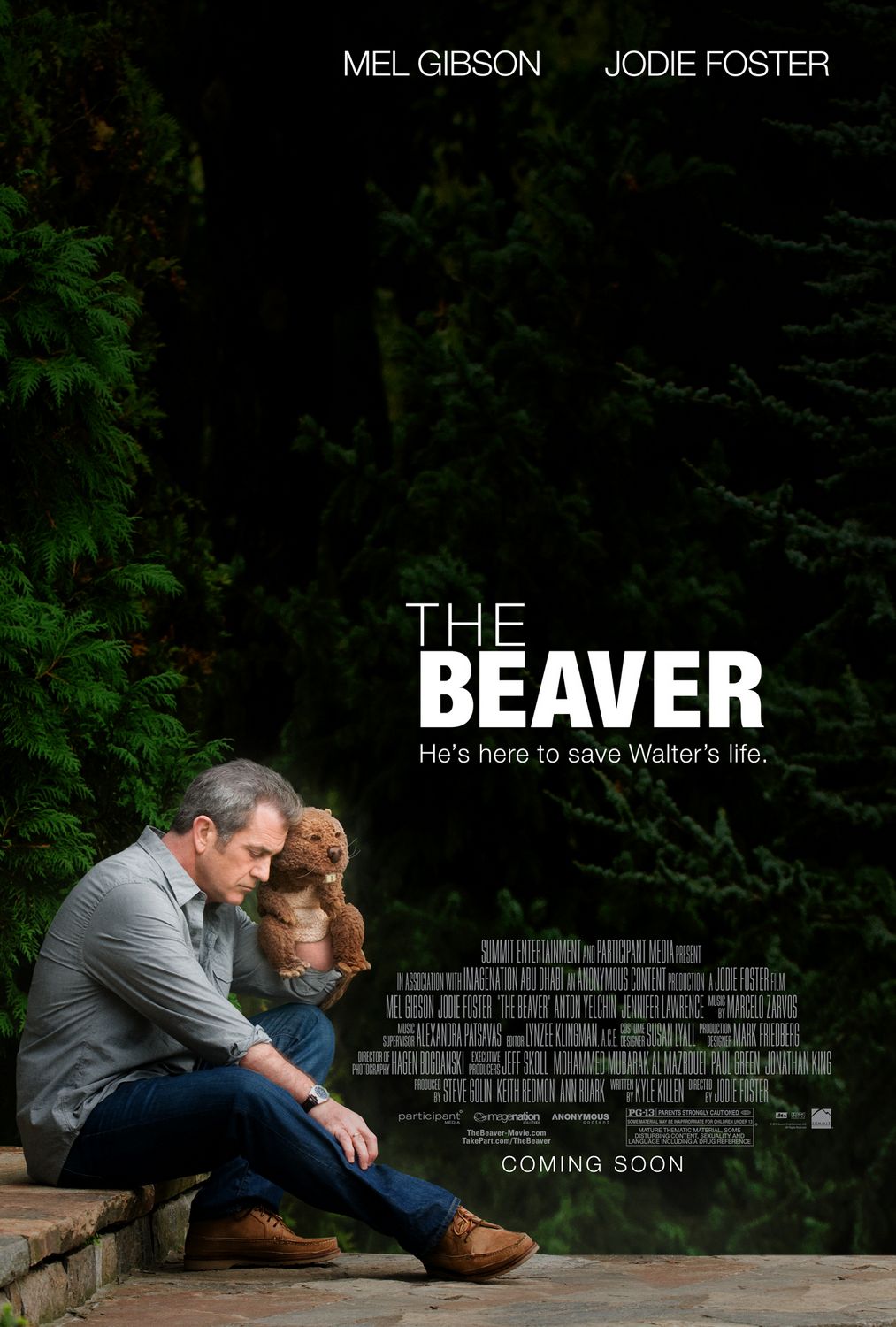
“The Beaver” was Jodie Foster’s first feature film directorial effort since “Home for The Holidays” and it starts off with Mel Gibson as Walter Black laying on an inflatable cushion in his pool, looking lifeless as if any direction he’s had in life has been rendered completely non-existent. We quickly learn he is the CEO of a toy company, has a beautiful wife and two sons, and that he is severely depressed. We are meeting him at the point where he has been in this depressive state for quite some time, and it has gotten to where his wife Meredith (played by Foster) doesn’t want him living at home anymore, and his kids don’t know what to make of him.
After a failed suicide attempt, Walter is brought back to the land of the living through a hand puppet of a beaver which develops a life of its own after he puts it on his hand. With a Michael Caine cockney-like accent, the beaver tells him he is going to save Walter’s life. And sure enough, his life gets better very quickly as the beaver begins doing all the talking for him both at home and at work. But as time goes on, this beaver threatens to make Walter hit rock bottom in a way he may never be able to recover from.
“The Beaver” is a black comedy which gets blacker as it rolls along. The trailers made it look like a light affair, but this is most certainly not the case. It does have its funny moments, but it is really a serious examination of depression. This is an important issue because it is not something you can just simply get over regardless of what others will tell you. Depression can seriously debilitate you and affect those who love you the most, but not many fully understand this. The idea that you must go through life and take the punches which come with it can only go so far. Sooner or later, we find we can only take so much until we break. While some may have a great smile on their faces, they may be fighting a battle you know nothing about.
As Walter Black, Gibson reminds us of what a great actor he can be when given the right material. Aside from his work as a director, which really has been truly remarkable, it is easy to forget what a great presence he can be onscreen. Gibson captures Walter’s emotional downfall in a way few actors could, and he makes you care about him even as he heads further downhill emotionally. It is a brave performance that doesn’t hold anything back, and you have to admire the lengths Gibson goes here.
Foster remains an excellent actress as always, and seeing her acting alongside Gibson is a treat as they were so much fun to watch together in “Maverick.” She makes Meredith Black a strong-willed person who holds it together despite Walter’s behavior. It all makes Foster’s work even more fascinating to watch, and you sympathize with her plight throughout.
It is a real shame it took Foster 16 years to direct another movie. Her past efforts of “Little Man Tate” and “Home for The Holidays” showed a great eye for characters isolated from others because of who they are and what they are going through. Her work on “The Beaver” is especially commendable in that it is not an easy script to bring to the silver screen. Finding the balance between the comedy and drama makes this challenging even for the best directors working today. But Foster manages to pull it off like the professional she is, and she shows an incredible sensitivity to the subject of depression.
For me, “The Beaver” is one of the best films made about mental illness. The screenplay by Kyle Killen topped the 2008 Black List, a ranking of the best unproduced screenplays. I can see why as it features wonderful characters which are thankfully down to earth, and the dialogue feels fresh and does not contain an abundance of worn out clichés. Many will find the premise of a man working through mental illness with the aid of a hand puppet to be far-fetched and unbelievable. But this screenplay really takes some chances, and I honestly did not find any of what I saw as being beyond belief.
Besides, is it really that far-fetched for an adult to play around with puppets or stuffed animals? Look at these names: Jim Henson, Frank Oz and Ben Kenber. All these men have become well known for performing with puppets to the joy of many. Yes, I did put my name up there because I still have a love for stuffed animals which I used to make home movies with and sometimes bring to my day job. People may think this is strange, but I like how it sets me apart from the rest of the crowd.
In addition, there are other wonderful performances to be found here. The late Anton Yelchin, who did unforgettable work in the “Star Trek” movies, “Terminator Salvation,” and “Green Room” among others. He is excellent as the Black’s oldest son, Porter. Throughout, he is terrified of becoming like his dad and implores his mother to divorce him. Yelchin makes what could have been a major brat into a fascinating individual whose endeavors in doing homework for others have long since become quite a profitable venture for him. His relationship with his father never feels contrived, so when we get to the end of the film, the emotions in their climatic meeting feels truly earned.
I also really liked Jennifer Lawrence as Norah, the popular valedictorian cheerleader who hires Porter to write her graduation speech. When this film was released, she was still riding high on the acclaim she received for “Winter’s Bone.” Norah is anything but a cliché, and she surprises us as much as she does Porter with a strong intelligence and a completely welcome lack of snobbery for a popular high school student. At the same time, she also hides a pain deep inside which defines her state of mind, and this presents her with something to overcome. Lawrence is great to watch here, and it was a sign that she had more great performances to give us which we eventually got in films like “Silver Linings Playbook.”
Congrats also goes out to young Riley Thomas Stewart who portrays the Black’s youngest son, Henry. It’s a remarkable performance for an 8- or 9-year-old as he has to convey both the confusion and effect his dad’s depression has on him. The scenes he shares with Foster and especially Gibson are wonderfully realized, and it helps that he has a former child actor directing him who knows how to coax a performance out of such a young human being.
Watching “The Beaver” reminded me of another great movie which had a big effect on me, “Lars And The Real Girl.” Both films featured characters whose pasts damaged them emotionally, and who seek release through unorthodox methods. With Gibson, it’s a hand puppet, and with Ryan Gosling it’s a sex doll he treats as his new girlfriend. Each takes what seems like a completely implausible story and surprises us by making it more than some average comedy which just dumbs everything down.
If you have not already seen “The Beaver,” I do hope you give it a look. Regardless of how you feel about Gibson these days, it’s an incredibly well made movie that takes a great script and visualizes it with respect and empathy to the subject of depression. While it was declared a “flop” after its first week at the box office, this should not define its worth. This film may not be for everyone, but those in the mood for something cinematically unique should find much to admire here. More importantly, I applaud any motion picture which takes the subject of depression seriously. It is not a mental condition that anyone can simply get over.
By the way, I love how Foster got Teri Gross of “Fresh Air” fame to do a cameo. I always wondered what her studio at WHYY in Philadelphia looked like, and we get a brief look at it here. Now how often does that happen?
The following review was written by Ultimate Rabbit correspondent, Tony Farinella.
“Bones and All” is a film I must admit I was not familiar with until I heard of its upcoming release on Blu-ray. After hearing about its premise and the actors involved, I was immediately interested in checking it out. It is an intimate little film which is unique in the way it tells its love story, and it’s filled with great performances and beautiful scenery. We live in a cinematic world where it’s all too commonplace for a film to be a remake, a sequel, or a copy of another film. It is something to admire when a project like “Bones and All” comes along and decides to take an ambitious and outside-the-box approach on young love and mix it with cannibalism. Director Luca Guadagnino (“Call Me by Your Name” and the “Suspiria” remake) is always on the cutting-edge of filmmaking.
The film opens by introducing us to Maren, played by the immensely talented Taylor Russell. Russell has an incredibly expressive face throughout the course of this movie, and she plays this part just right as she balances the vulnerability of Maren along with the inner strength she has been forced to possess because of her situation in life. Her father keeps her under lock and key and for good reason: she is an eater. He never knows when she might decide to eat someone. She first did it to her babysitter when she was younger, and it was something which caused her mother to pull away from her. We find out why later in the film.
Maren’s father is played by André Holland, and he makes the most out of his limited screen time. However, this is really the story of Maren and, later, of Maren and Lee, played by Timothée Chalamet. While on her journey to discover more information about her mother and why she left her and her father, Maren meets Lee in Kentucky. Lee is charming, charismatic, and an eater. For the most part, eaters do not eat other eaters, but they can smell when someone is an eater. The reason they meet is because Maren’s father decided there is nothing else he can do to protect his daughter. He has done all he can for her, and she’s become a threat to anyone she encounters even though she’s very nice, shy, and soft-spoken.
Along the way, the bond between Maren and Lee grows even stronger. This is the first time she has really been outside the house this much and been allowed to interact with people around her age. She likes him, and he likes her. They try to follow a moral code when it comes to the individuals they eat, but they do not always know their backstories, which can sometimes lead to Maren feeling like she’s a bad person. Lee is more experienced in this field and, because of this, he knows he needs to do whatever is necessary to survive.
There is also an older eater named Sully (Mark Rylance) whom Maren runs into earlier in the film. He seems to mean well, but Lee is not exactly sure what to make of him because of the age difference and his overall demeanor. Maren tries to distance herself from Sully, but he seems to be around the corner at every turn. Is he just a harmless old man? Is he a threat to her and possibly Lee? I was fascinated by the cannibalism angle of this film, as it does not really make a judgement on the characters. Cannibalism is part of them, but they are seen as human beings and not monsters. They are trying to live with it as best as they can and forge meaningful friendships and relationships.
“Bones and All” is one of those under-the-radar gems which is shot in such a naturalistic way by Guadagnino . It really allows the audience to spend time with the main characters, get to know, understand and feel for them. The love story between Chalamet and Russell is the lifeblood of this film. It is what makes this film tick. Both on their own and together, they make movie magic on screen. They have strong chemistry from the moment they meet each other, and it only increases as they are put together in various scenarios. Rylance does a fantastic job of keeping the audience guessing as we are left to figure out what his true intentions are with Maren.
This film is truly a journey with its running time of 131 minutes. At certain points, it can lag a little bit and feel a bit disjointed. During other scenes, the pacing is exactly right as it allows things to breathe and have time to resonate with the audience. The more and more I thought about “Bones and All,” the more I liked it. It is not perfect, but the things which work, such as the relationship between the main characters, the gorgeous cinematography and direction are top notch. This is a unique film that packs a powerful punch and is worth seeking out.
* * * ½ out of * * * *
Blu-ray Info: “Bones and All” is being released on a single-disc Blu-ray from Warner Brothers Home Entertainment. The film is rated R for strong, bloody and disturbing violent content, language throughout, some sexual content, and brief graphic nudity. It has a running time of 131 minutes, and it also comes with a digital copy of the film as well.
Video/Audio Info: I really wish this film would have received a 4K release, as it’s a film shot with such scope and beauty. I am a 4K guy and am always going to prefer a 4K release. The Blu-ray, however, is still pretty good, picture-wise. It comes in 1080p High Definition. For the audio, we got a Dolby Atmos track which is really impressive. Subtitles are in English, French and Spanish.
Special Features:
A Look Inside
Luca Guadagnino: The Vision of Bones and All
Meet Lee
Meet Maren
Outsiders in Love
Should You Buy It?
As a firm believer in physical media and independent cinema, I think this is a film worth adding to your collection. Sadly, the special features are noticeably short as they run around two minutes or less. I would have enjoyed a little more detail with them. However, with a film like this, maybe less is more as it allows the audience to come up with their own conclusions as it pertains to how they feel about the film. I am also disappointed about the lack of a 4K release as it would have looked perfect in that ultra-high definition format. The Blu-ray looks good, but a 4K of “Bones and All” would have been stunning. As far as the film itself, if you are like me and enjoy being challenged by a unique story with powerful performances and great cinematography, you will find a lot to like with here. As of right now, the film is going for $27.99, which is a bit pricey for a Blu-ray. If that were the price for the 4K, I would say you should buy it immediately. As it stands, you should buy it, but I would wait for the price to drop.
**Disclaimer** I received a copy of this film from Warner Brothers to review for free. The opinions and statements in the review are mine and mine alone.
Until this past week, the only Wim Wenders film I had ever seen was “The Million Dollar Hotel.” That one was a fascinating motion picture which dragged at times but still had moments that held me in a grasp few other filmmakers could ever hold me in. When all is said and done, the one thing we can all agree on is that it had a terrific soundtrack by U2, and that Mel Gibson should have kept his mouth shut during the film’s press day when he was caught saying it was “boring as a dog’s ass.” This proved to be one of the many times Gibson was obligated to apologize for saying something he never should have said.
But whether you consider “The Million Dollar Hotel” one of Wenders’ best or worst, films, you have to admit “Paris, Texas” shows him working at his filmmaking best. I caught a screening of it at the Nuart Theatre in West Los Angeles as this was a film crying out for me to watch it not at home, but on the silver screen in a darkened theatre. Knowing of its reputation as a Palme d’Or winner at the Cannes Film Festival in 1984 and having a beautifully subdued music score by the great Ry Cooder, I knew I was in for quite a unique cinematic treat.
We open on the driest of deserts in West Texas to find a drifter named Travis Henderson (Harry Dean Stanton) wandering aimlessly while trying to find some water to drink. After passing out in a nearly empty saloon, he awakens in a clinic where a German doctor cannot get a single word out of him. Frustrated, the doctor calls a phone number Travis just happens to have on him, and it is answered by his brother, Walt (Dean Stockwell), who lives out in Los Angeles. It turns out Tavis disappeared without a trace four years ago, leaving behind his wife Jane (Nastassja Kinski) and their son Hunter (Hunter Carson). Why did Travis just up and leave? Well, much of “Paris, Texas” is dedicated to figuring this out, and the answers are never made easy to come by.
The first thing I have to say about “Paris, Texas” was how amazing and mesmerizing it was. Not once could I take my eyes off the screen as Wenders captured a Texas which was at once beautiful and haunted by a past its characters want to, but cannot, recapture or escaoe. It is also an unforgettable time capsule of life in the 1980’s in America as the story takes place in a time when you needed maps instead of GPS to find your way from one place to another, smoking was allowed on airplanes, and regular unleaded gasoline was only $1.07 a gallon (shit). But while things have changed a lot since then, the themes this film deals with still have a lot of resonance in this day and age.
For a moment, I thought Harry Dean Stanton and Dean Stockwell would go on the same kind of road trip Tom Cruise and Dustin Hoffman went on in “Rain Man,” and this was especially the case after we see their characters suddenly get off a commercial airplane and instead travel back to Los Angeles by car. “Paris, Texas,” however, speeds things up and has the two arriving in Los Angeles where Stanton’s character slowly starts to acclimate to civilization and his new environment while trying to reintroduce himself into his son’s life.
Stanton has gone on record in saying “Paris, Texas” is his favorite film out of all the ones he has done, and his performance as Travis may very well be the best of his career outside of “Repo Man.” His face is like a well-trodden landscape which says so much, and it is important to note this as Stanton does not say a single word for the first 26 minutes. It is fascinating to watch him act in a childlike manner as he sits in the backyard of Walt’s home while watching the airplanes fly in and out of Burbank Airport with a pair of binoculars. I also loved the interaction between him and Hunter as he slowly gains the trust of a long-lost son who, very understandably, is not quick to connect with him.
Dean Stockwell was on the verge of quitting acting and going into real estate when he got cast in “Paris, Texas,” and his performance shows how lucky we were that his talents were not robbed from us. What a shame it would have been if we did not get his Oscar-nominated performance in “Married to the Mob” or his co-starring role in the television series “Quantum Leap” had he not appeared here. In this film, he is the audience surrogate as, like him, we are desperate to figure out what Travis has been through in the four years he has been missing. Moreover, Walt must figure out how to deal with how he and his wife Anne (played by Aurore Clément) consider themselves the real parents to Hunter while trying to help Travis make a connection with someone whose life he was always supposed be a part of.
As for Hunter Carson, the son of this film’s co-writer, L.M. Kit Carson, he is perfect for something like this. “Paris, Texas” is a film which demands its actors inhabit their roles naturally rather than act or perform them, and Hunter is a kid who was clearly not brought up by stage parents thank goodness. He simply exists here as any other young child would which makes his scenes with the other actors even more authentic and moving, and this is especially the case in this film’s final moments which are as emotionally moving as one would expect them to be.
But the scenes which had me mesmerized the most were the ones between Stanton and Nastassja Kinski where Cooder’s score was not needed as their acting with one another via a one-way mirror and a telephone proved to be as subtle and intense as any onscreen acting I have ever witnessed. It is always a gift to be held at attention by two wonderful actors who give their roles every ounce of their being, and this is no mere exception in the slightest.
And when it comes to Kinski, who looks so much different than she did in “Cat People,” we do not see her appear onscreen until 53 minutes into this film. And yet somehow, her character Jane’s presence is felt deeply throughout. It is said Kinski wrote a diary for Jane, and it shows how deep into this character she got as her first appearance shows us someone who has lived a long beyond her years, and she was still quite young when “Paris, Texas” was filmed. Watching her react to what Stanton is telling her proved to be utterly enthralling as I wanted Jane to realize something which was right in front of her, and it makes Kinski’s performance all the more inspired.
Now on one hand, I am tempted to say how shameful it is that I did not watch “Paris, Texas” years ago. By that, I do not mean when it came out in 1984 as I was only nine years old back then and not about to take in the impact the Ronald Reagan Presidential years had on the world at large. I am thinking more of when I was in college and watching “A Clockwork Orange,” “Full Metal Jacket,” “Apocalypse Now” and “Taxi Driver” which took my moviegoing to a whole other enthralling level. “Paris, Texas” is a motion picture that does not play by any cinematic rules as it keeps you waiting and longing for certain things to happen, and in a good way. It also dares to leave story threads hanging in an ambiguous fashion which, while some will feel frustrated by this, will make the more adventurous viewers think deeply about what they just saw.
As for myself, I have a lot of Wim Wenders films to catch up on like “Wings of Desire,” “Pina,” “Buena Vista Social Club” and “Until the End of the World.” For what it is worth, I have seen the American remake of “Wings of Desire” which is called “City of Angels,” and it came out in 1998 and starred Nicolas Cage and Meg Ryan. That remake broke my heart, and it makes me wonder if the original will do the same. Perhaps I am afraid to find out.
Man, I would have loved it if this had happened to me as a kid; having one of my stuffed animals come to life and me forming a lifelong friendship with it. That is what makes “Ted” one of the most enjoyable and funniest movies I saw back in 2012 as it makes that dream become a reality. Seth MacFarlane, the creator “Family Guy,” makes his live-action motion picture directorial debut here, and it is one of the few comedies which is not hit and miss as the laughs just keep on coming. “Ted” also balances out its wickedly crude humor with a lot of heart as the movie comes to look at how important friendships can be in life no matter what form they take.
At the movie’s start, we meet young John Bennett (Bretton Manley) who lives with his family in a town near Boston. The narration, delivered in brilliant fashion by Patrick Stewart, goes over how John has no friends and that even the Jewish kid in the neighborhood who keeps getting the crap kicked out of him by bullies wants nothing to do with him. Things change for the better when he receives a teddy bear for Christmas, whom he names Ted. John loves Ted so much to where he makes a wish for the bear to come alive, and I am sure you know what happens from there.
“Ted” doesn’t take long to get the comedy juices rolling as John’s parents (Alex Borstein and the hilarious Ralph Garman) are incredibly shocked to see their son’s teddy bear walking and talking on its own. After that, Ted becomes a celebrity of sorts as he has Johnny Carson in hysterics and ends up getting arrested at the airport for drug possession. Throughout all of this, he and John remain the best of friends through all things and share many common interests including a serious fear of thunder.
Moving forward to the present, John is now played by Mark Wahlberg and works at a car rental agency. He and Ted still enjoy hanging out together while getting high and doing stupid things when left to their own devices. At the same time, John has been in a long-term relationship with the beautiful Lori Collins (Mila Kunis), and she ends up giving John an ultimatum to get Ted to move out of their apartment so they can move on with their lives.
The fact is Ted has become incredibly obnoxious, unthinkably vulgar, and gleefully hedonistic; something which does not stop once he is finally forced to move out and get his own apartment. He even finds a job at a supermarket despite being grossly inappropriate during an interview with the manager. Instead of giving the manager a reason not to hire him, Ted impresses him with his behavior. Either that or he is just desperate for any employee he can get to work for minimum wage.
During this time, Ted still manages to get John to hang out with him, and this results in John having to lie to Lori while making ridiculous excuses to get out of work. One night with Ted which John cannot possibly turn down is when Sam J. Jones, the star of their favorite movie “Flash Gordon,” shows up for a party at Ted’s apartment. You have to give Jones a lot of credit for sending himself up and having a good sense of humor about the popularity of the 1980 camp classic as he portrays himself as a hard living actor looking for a comeback. Even Ted cannot help but remind John about how Jones’ performance in “Flash Gordon” ended up redefining what it means to act in a movie (and not necessarily in a good way).
Truth be told, “Ted” could have just worked with its crude yet irresistible humor as it scores one big laugh after another. But its main success is how it also combines that crude humor with a lot of heart. The movie is really about the power of friendships and the struggle to keep them going when other things get in the way. As crazy as Ted gets, be it humping a checkout scanner or even snorting cocaine, even he comes to see he has to change his ways just like John has to in his own way. But whatever you do, do not get Ted started on Teddy Ruxpin, seriously!
I have never watched “Family Guy” on a regular basis, so I cannot compare “Ted” to it. Regardless, this film does show him to have a great sense of humor as well as a good appreciation for the stranger parts of popular culture. It is also a must for fans of “Flash Gordon” as it pays homage to its so bad it is good qualities. MacFarlane also throws in jabs at other pop culture targets like Taylor Lautner, Justin Bieber, and even Brandon Routh whose performance in “Superman Returns” is not exactly respected here.
Wahlberg is utterly hilarious, but this should be no surprise to anyone who saw him share the screen with Will Ferrell in “The Other Guys.” The scene where he lists off “white trash girls names” in rapid fire succession is a comic highlight, but even that gets outdone by the vicious fight scene he and Ted have. For a moment I thought Ted would descend into Chucky (the doll from the “Child’s Play” movies) territory, but even he doesn’t get that crude. Still, it results in some of the biggest laughs I have ever had in a movie theater.
Mila Kunis remains as engaging as ever, playing the same wonderful type of character she played in “Forgetting Sarah Marshall.” Having her in this movie as Lori makes John’s need to get rid of Ted seem like a real no-brainer. Kunis also gets to play Lori as someone not bound by typical clichés, and she ends up making Lori the most intelligent person in the entire movie as a result.
There is also Giovanni Ribisi showing up as crazed stalker Donny who wants to buy Ted from John so he can give the teddy bear to his son Robert (Aedin Mincks). Donny cannot bring himself to say no to anything his son wants (bad parent alert!), and this includes giving Robert a toy he may very well end up destroying. Granted, Ribisi’s role in “Ted” might seem unnecessary as it adds something the plot does not necessarily need, but it’s worth it just so we can watch his truly creepy dance to Tiffany’s “I Think We’re Alone Now.”
The design of Ted is that of a generic teddy bear, the kind you end up adding your own personality to. It was smart to go with this kind of bear instead of with some iconic stuffed animal with a built-in personality. You never quite know what is going to come out of Ted’s mouth next. While it may seem somewhat unrealistic for any teddy bear or stuffed animal to be having this much fun, women of any age are quick to hug one quicker than men nearby. This is the story of my life these days, dammit.
Seriously, “Ted” was one of the best comedies I ever got to watch in a theater. Now a lot of this has to do with my continued affection for stuffed animals after all these years, but it also proved to be one of those comedies which was not hit and miss like many I see. It speaks to those special memories we had with our stuffed animals growing up, and of how they eventually bec0me as crazy as us.
I remember almost renting “Cannonball Run II” on VHS from Nino’s TV and Video in Thousand Oaks when I was a kid. I enjoyed the first “Cannonball Run” movie a lot and watched it many times, and these days I rate it as an Ultimate Rabbit guilty pleasure. But when I presented it to my dad as the movie I wanted to rent for the weekend, he looked at me and said, “Are you sure you want to rent this? It’s really awful.” This shook my courage in renting movies for a time as I began to doubt my taste in film. As a result, I put this one back on the shelf even though its poster looked ever so cool.
Well, while my dad’s pleas failed to keep me from renting the Clint Eastwood comedy “Every Which Way But Loose,” it did keep me from checking out “Cannonball Run II” for many years. But at a time when I should have been watching such films as “Tar,” “The Banshees of Inisherin” and “Black Panther: Wakanda Forever,” I found myself watching this 1984 sequel as it was available to view for free on You Tube (with ads of course). And though I was not expecting a good movie in the slightest, I was stunned at just how amazingly atrocious this follow up was as everyone involved cannot even bother to give the proceedings a mere 50% of their energies.
This sequel starts off with the Sheik Abdul ben Falafel (Jamie Farr) being berated by his father (played by Ricardo Montalban) for losing the Cannonball Run race last year. Having embarrassed the Falafel family (you read that family name correctly), Abdul’s father orders him to win another Cannonball Run in order to restore the family name. The problem is, there is no Cannonball Run race happening that year, so Abdul is told to buy one, and the grand prize is a million dollars.
From there, “Cannonball Run II” begins its arduous task of reintroducing characters from the original as well as introducing a whole bunch of new ones who could only dream of being as funny as Roger Moore was when he played Seymour Goldfarb, Jr. In fact, Hal Needham, who returns to direct this misbegotten sequel, spends more time with these characters than he does with the race itself.
Burt Reynolds is back as J.J. McClure, and he looks like he can save this motion picture with his charisma and sexy mustache. Dom DeLuise also returns as J.J.’s partner Victor Prinzi and his alter ego of Captain Chaos. These two always look to be having the time of their lives when they work together, but the fun they have does not translate over to the audience as it did for me in the original. This is especially the case when you watch the outtakes which play over the end credits, and you wonder what made the cast enjoy themselves endlessly as their laughter speaks more of a desperation to make this sequel worth watching.
When it comes to racing partnerships, there are a few changes. Jackie Chan is joined this time in his Mitsubishi car by Richard Kiel who plays his driver, Arnold. Doctor Nikolas Van Helsing (Jack Elam), J.J. and Victor’s partner in crime previously, is now working with Sheik Abdul to keep his ulcer in check. And Susan Anton and Catherine Bach are here to replace Tara Buckman and Adrienne Barbeau as those sexy women behind the wheel of a Lamborghini. Still, as Snake Plissken kept saying in “Escape From L.A.,” the more things change, the more they stay the same.
In directing “Cannonball Run II,” I had to wonder what was going through Needham’s mind. Was he just telling a cast which included Shirley McClaine, Dean Martin, Marilu Henner, Sammy Davis Jr., and Tony Danza among others to just go out there and be funny? If so, it did not work to anyone’s advantage as everyone looks to be either phoning it in or trying way too hard to put a smile on our faces. And if you thought the stunts from the original were lacking, the ones here are generic and pedestrian at best.
The only decently funny moment for me was at the beginning with Ricardo Montalban who plays his role as if he is not in on the joke in the slightest. Heck, he even makes the word falafel sound vaguely amusing in a way Bill O’Reilly only thinks he can. Perhaps if the rest of the cast had followed suit, this sequel might have been slightly better than it ever could have hoped to be.
I also keep thinking Needham and company kept looking at this sequel and its making to where he believed he could solve anything and everything in post. There’s a subplot involving mobsters which goes nowhere and has actors like Abe Vigoda being cast just for old time’s sake. And, yes, there is an orangutan driving a car, but he can only hope to be as memorable as Clyde was in “Every Which Way But Loose.”
So much time is spent on such overly broad character moments that Needham and his collaborators kept forgetting there was a long-distance race involved in this movie’s plot. As a result, they brought in Ralph Bakshi to animate the race’s climax in order to give it some momentum, but it doesn’t do much to speed things up, especially after a cameo with Frank Sinatra who plays himself. And yes, it is ever so easy to tell that Sinatra filmed his scenes in a studio by his lonesome. Not once do we see him and actors Reynolds, DeLuise and others in the same scene together.
“Cannonball Run II” will at best be remembered as a footnote in history for the following reasons: it marked Frank Sinatra’s final role in a theatrical motion picture, it is the final action stunt comedy for Reynolds following such films as “Smokey and the Bandit” and “Hooper” among others, it was the last film for Dean Martin, Molly Picon and Jim Nabors who is essentially parodying his character of Gomer Pyle. Other than that, this one is a certifiable waste of 108 minutes out of your life.
What is my excuse for wasting my precious time with “Cannonball Run II?” I will treat that as a rhetorical question. Still, its poster does looks really cool.







 The Ultimate Rabbit